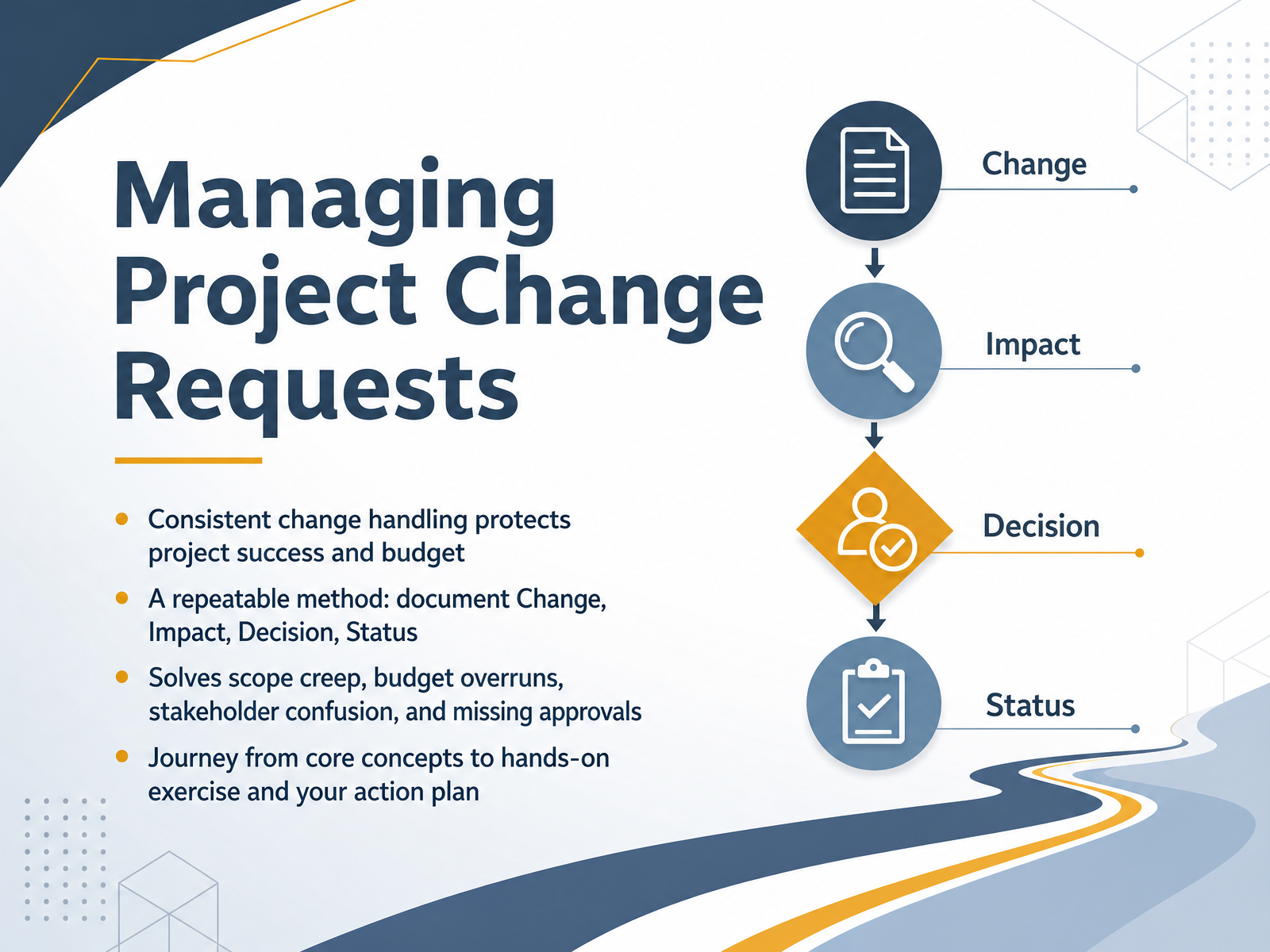
Managing Change Requests
Begin
14 pages · ~28 min
Managing Change Requests
Course on managing project change requests for project managers and team leads.
What you’ll learn
- 01Managing Project Change RequestsWelcome to Managing Project Change Requests. In this session, we focus on handling project changes with a consistent, repeatable process. Change happens on every project. The risk isn't the change itself, it's undocumented, unapproved work that quietly expands the scope, drains your budget, and delays delivery. Our goal today is to give you a practical method built around four core elements: document the change, clarify the impact, capture the required decision, and track the status from request to close-out. This simple framework solves many common problems, including scope creep, budget overruns, stakeholder confusion, and missing approvals. We will move from the core concepts you need to know, through a hands-on exercise, and finish with a concrete action plan you can apply immediately. Let's begin by understanding why consistent change management truly matters.blog.ghw-digital.comatlassian.comschmidtconsulting.group+21 min
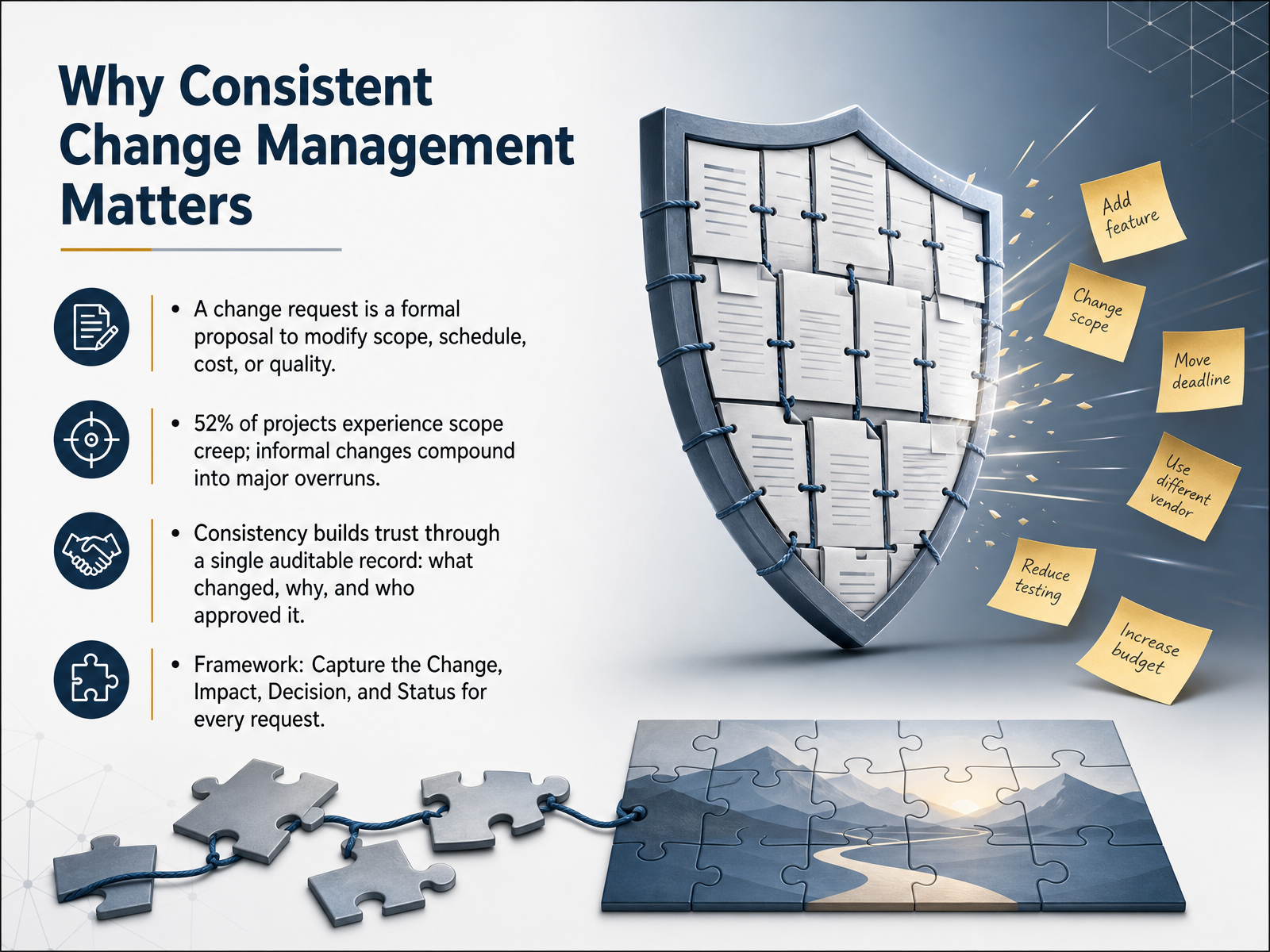
- 02Why Consistent Change Management MattersWe've just covered the basics of a change request. Now, let's talk about why managing them consistently is so critical for your project. A change request is a formal proposal to alter the scope, schedule, cost, or quality. Without a consistent process, these requests lead directly to scope creep. In fact, fifty-two percent of projects experience it. It starts small, a minor tweak here, a quick addition there, but these informal changes quickly compound into major budget and timeline overruns. Consistency is our defense. It builds trust by creating a single, auditable record for every change. This record clearly shows what changed, why it changed, and who approved it. To achieve this, we use a simple, powerful framework. For every single request, you must capture the Change, the Impact, the Decision, and the Status. Think of these four elements as the non-negotiable pillars of your change log. Now that we know why consistency matters, let's look at how this framework comes to life in the next slide, 'The Change Request Lifecycle'.
 blog.ghw-digital.comatlassian.comschmidtconsulting.group+22 min
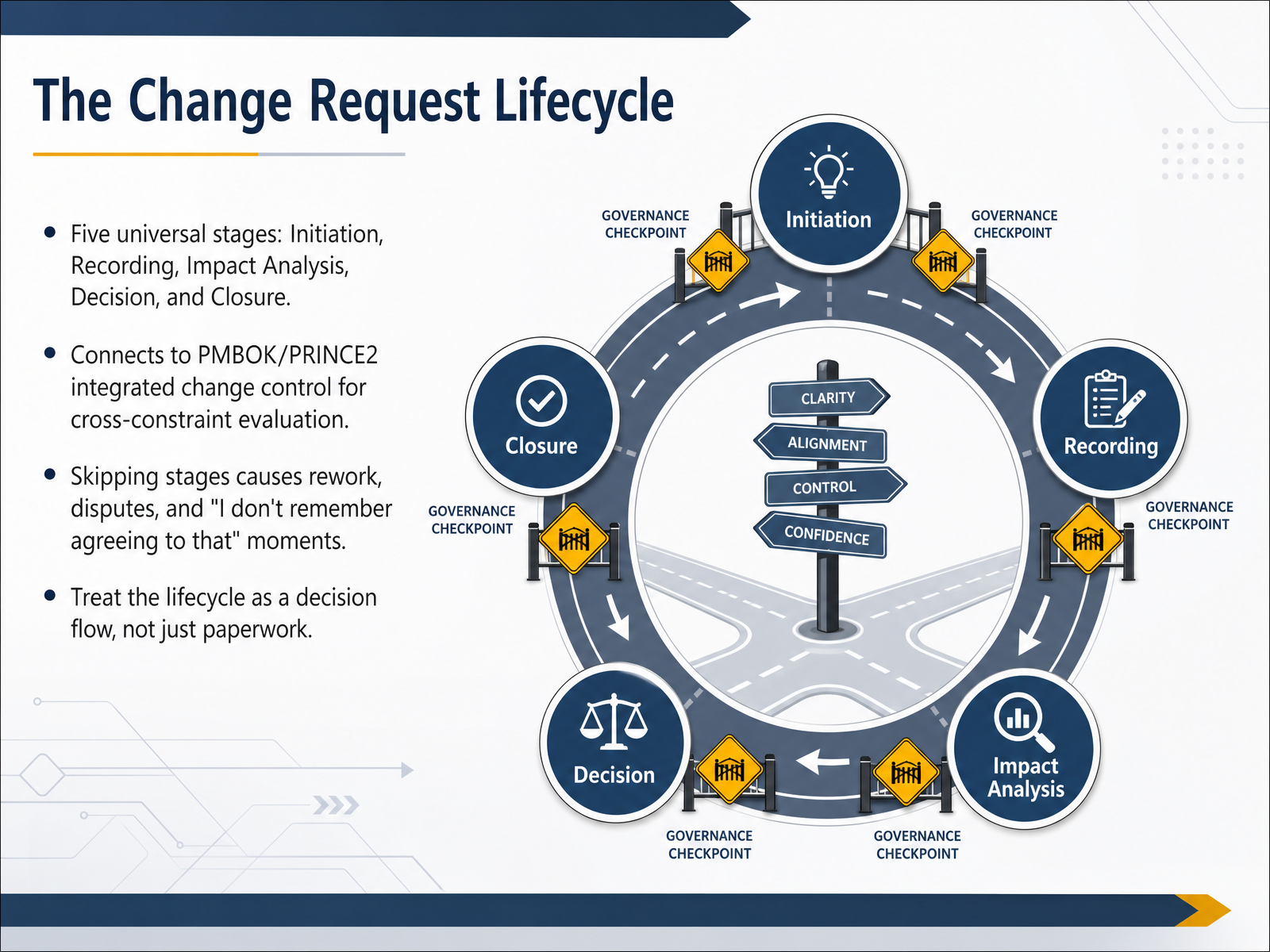
 - 03The Change Request LifecycleNow we turn to the change request lifecycle itself. You can think of this as a decision flow, not just paperwork. The lifecycle has five universal stages: initiation, recording, impact analysis, decision, and closure. These stages connect directly to integrated change control frameworks like PMBOK and PRINCE 2. Their purpose is to evaluate every request across all constraints, scope, schedule, cost, and risk, before anyone says yes. When teams skip stages, problems follow. You get rework, disputes over what was agreed, and the classic line, I don't remember approving that. Treat each stage as a deliberate choice point. Initiate the request, log it consistently, analyze the cross-constraint impact, make a formal decision, and then close it out properly. That discipline builds an audit trail and protects your baseline. Next, we will examine the core elements of a change request record, so you can document every stage with confidence.
 resources.rework.compmexams.comresources.rework.com+22 min
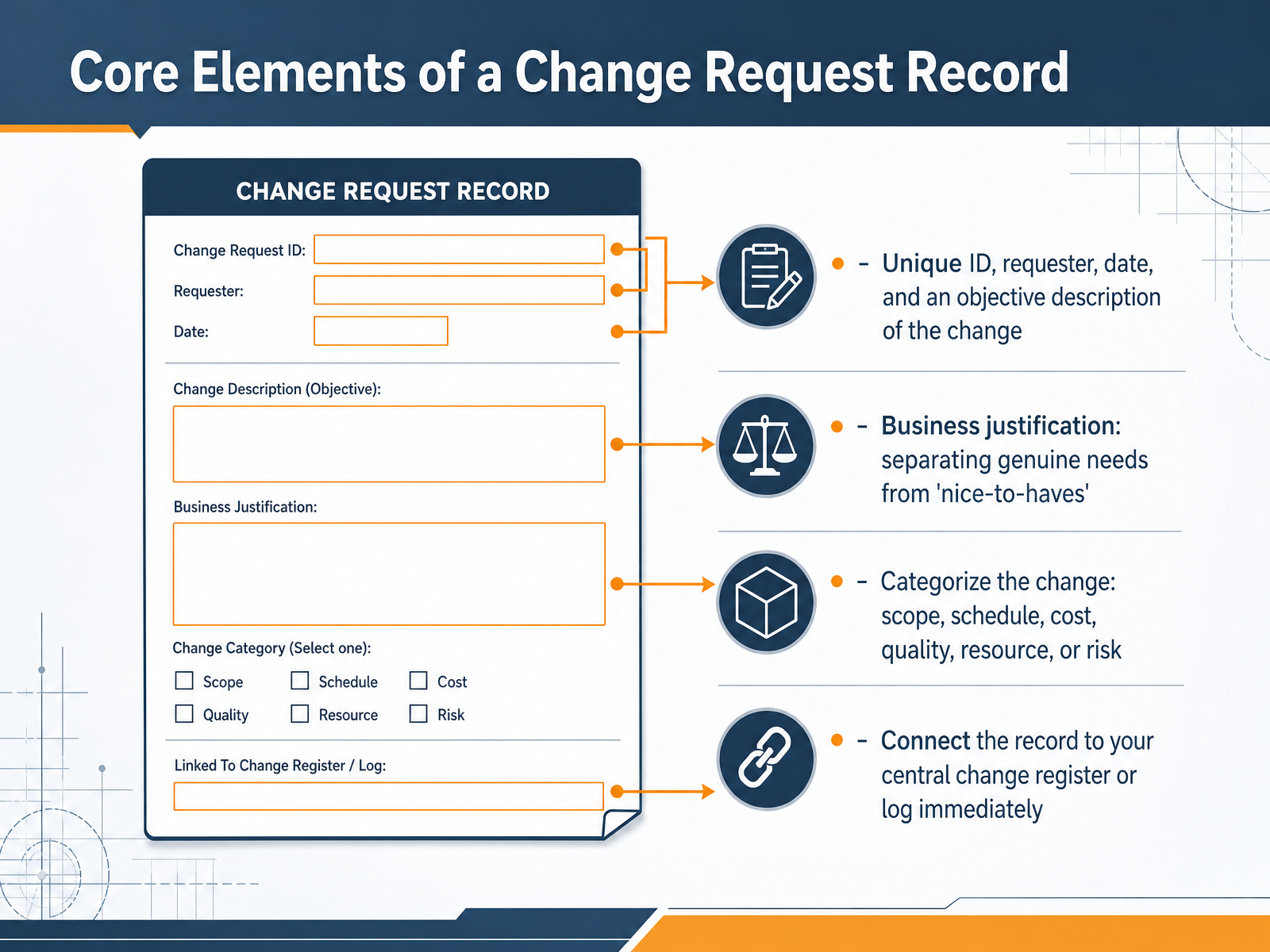
 - 04Core Elements of a Change Request RecordNow let's look at the core elements that every change request record needs to contain. First, the basics: give each request a unique ID, record the requester's name, and capture the date. Then write an objective description of what is being proposed, without adding judgment or opinion. Next, include a clear business justification. This is where you separate genuine needs from nice-to-haves by explaining why the change matters and what problem it solves. Categorize the change into one or more standard areas, such as scope, schedule, cost, quality, resource, or risk. This categorization makes impact assessment faster and more consistent. Finally, connect this individual record to your central change register or log immediately. Every request, whether it gets approved or rejected, must appear in that master log so nothing gets lost or handled outside the formal process. Let's move on to structured impact analysis.
 resources.rework.compmexams.comresources.rework.com+21 min
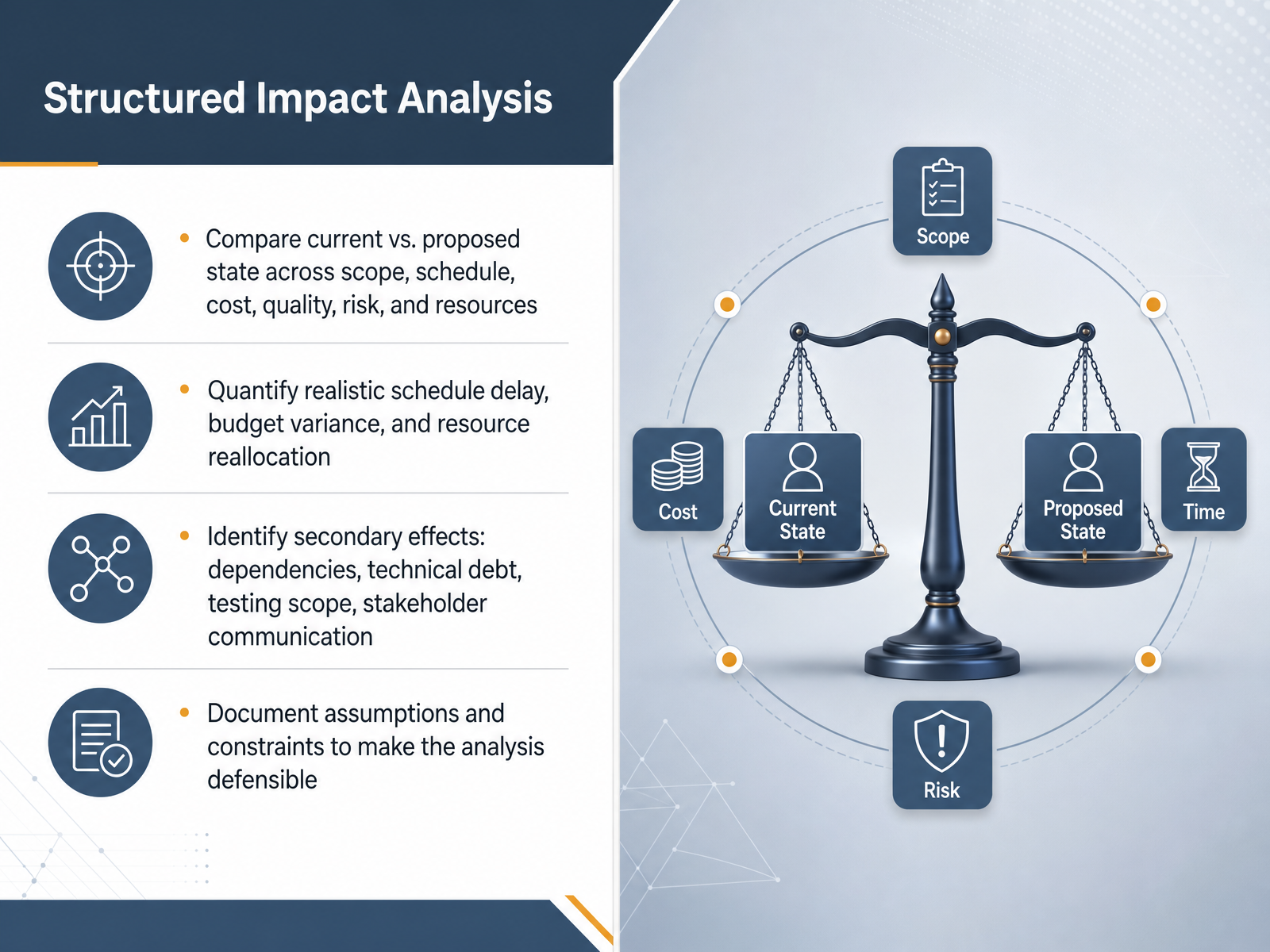
 - 05Structured Impact AnalysisNow we move into the investigative core: structured impact analysis. Before any decision, you compare the current state against the proposed state across six dimensions: scope, schedule, cost, quality, risk, and resources. This is not a general guess. Quantify the realistic schedule delay in days, the budget variance in dollars, and any resource reallocation that must happen. Then go deeper. Identify secondary effects like broken dependencies, new technical debt, expanded testing scope, or additional stakeholder communication needs. If a UI change touches shared components, the testing scope can double. Finally, document your assumptions and constraints. If you assumed the testing team has free capacity but that is unverified, write that down. This makes your analysis defensible when the change board reviews it. Next, we will take this analysis and turn it into a clear decision package.
 resources.rework.compmexams.comresources.rework.com+21 min
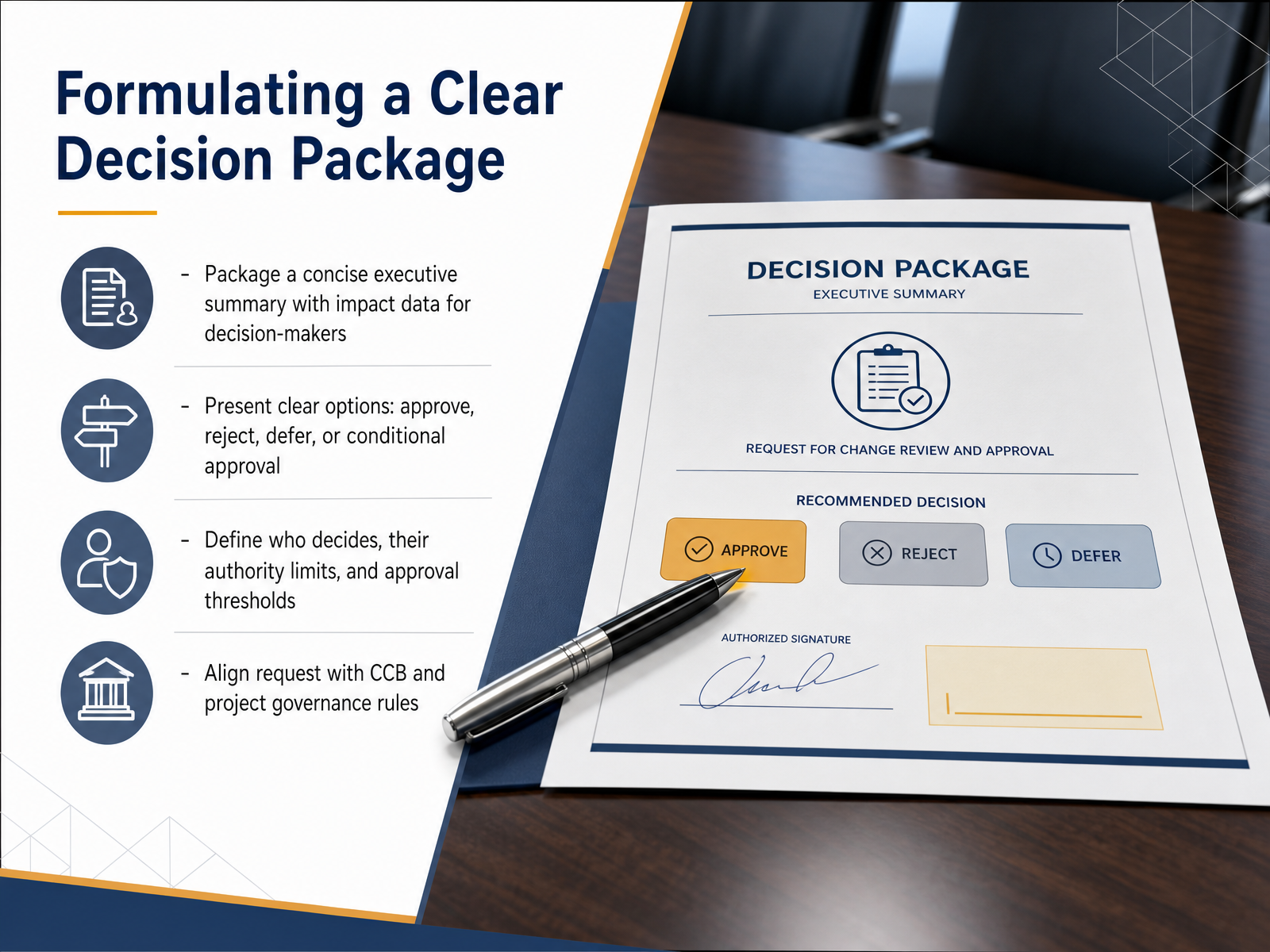
 - 06Formulating a Clear Decision PackageNow let's talk about putting together a clear decision package. Before any change gets approved or rejected, you need to package the information so decision-makers can act quickly and confidently. Start by writing a concise executive summary that ties the request directly to the impact data. Lead with the key numbers: how many days this adds, the budget change, and any new risks. Next, present clear options. Don't just hand over a single path. List the choices: approve as submitted, reject outright, defer to a later phase, or give conditional approval with specific caveats. This gives the Change Control Board genuine options instead of a take-it-or-leave-it proposal. Then define who decides. Reference your pre-established authority thresholds. Confirm whether this sits with the project manager, the sponsor, or the full CCB. State the dollar limit or schedule impact that triggered this routing. Finally, align the package with your CCB and project governance rules. Verify the form has a unique ID, the requester's name, and all required fields, so it fits seamlessly into the formal review cycle. A complete package turns a loose request into a fast, confident decision. Next, we will move into Decision Outcomes and Status Tracking.
 resources.rework.compmexams.comresources.rework.com+22 min
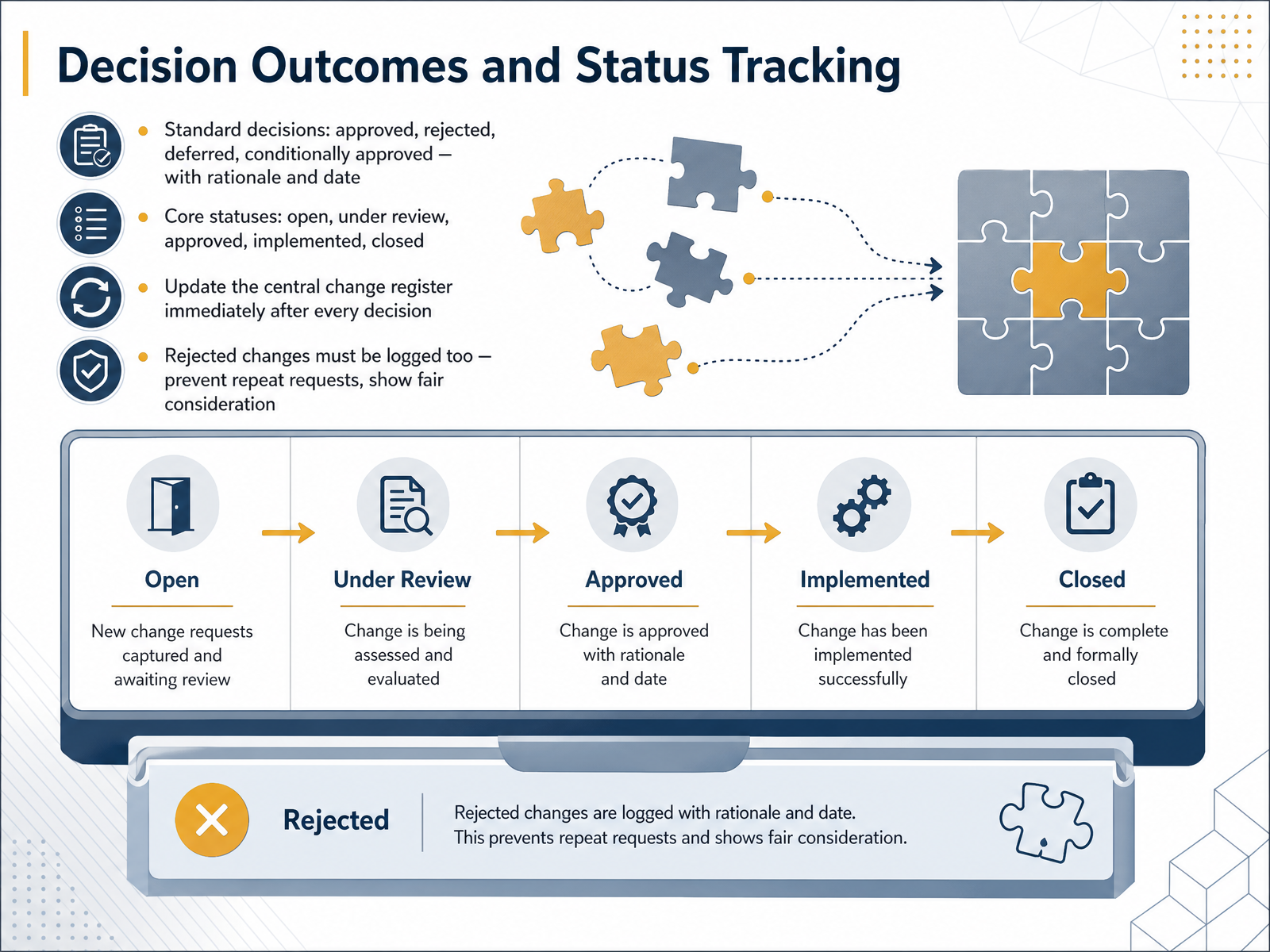
 - 07Decision Outcomes and Status TrackingOnce an impact analysis is complete, the next step is making a formal decision and tracking it. Every change request should receive one of four standard decisions: approved, rejected, deferred, or conditionally approved. Each decision must include a clear rationale and a date, so the record is complete. Immediately after the decision, update the core status in the central change register. The typical status flows from open, to under review, to approved, then implemented, and finally closed. Rejected changes must be logged just as carefully as approved ones. Documenting rejections prevents the same request from being resubmitted repeatedly and shows stakeholders that every idea receives fair consideration. This discipline keeps your project record accurate and trustworthy. Now that we have covered decision outcomes and status tracking, let's move on to maintaining audit trails and version control.
 resources.rework.compmexams.comresources.rework.com+21 min
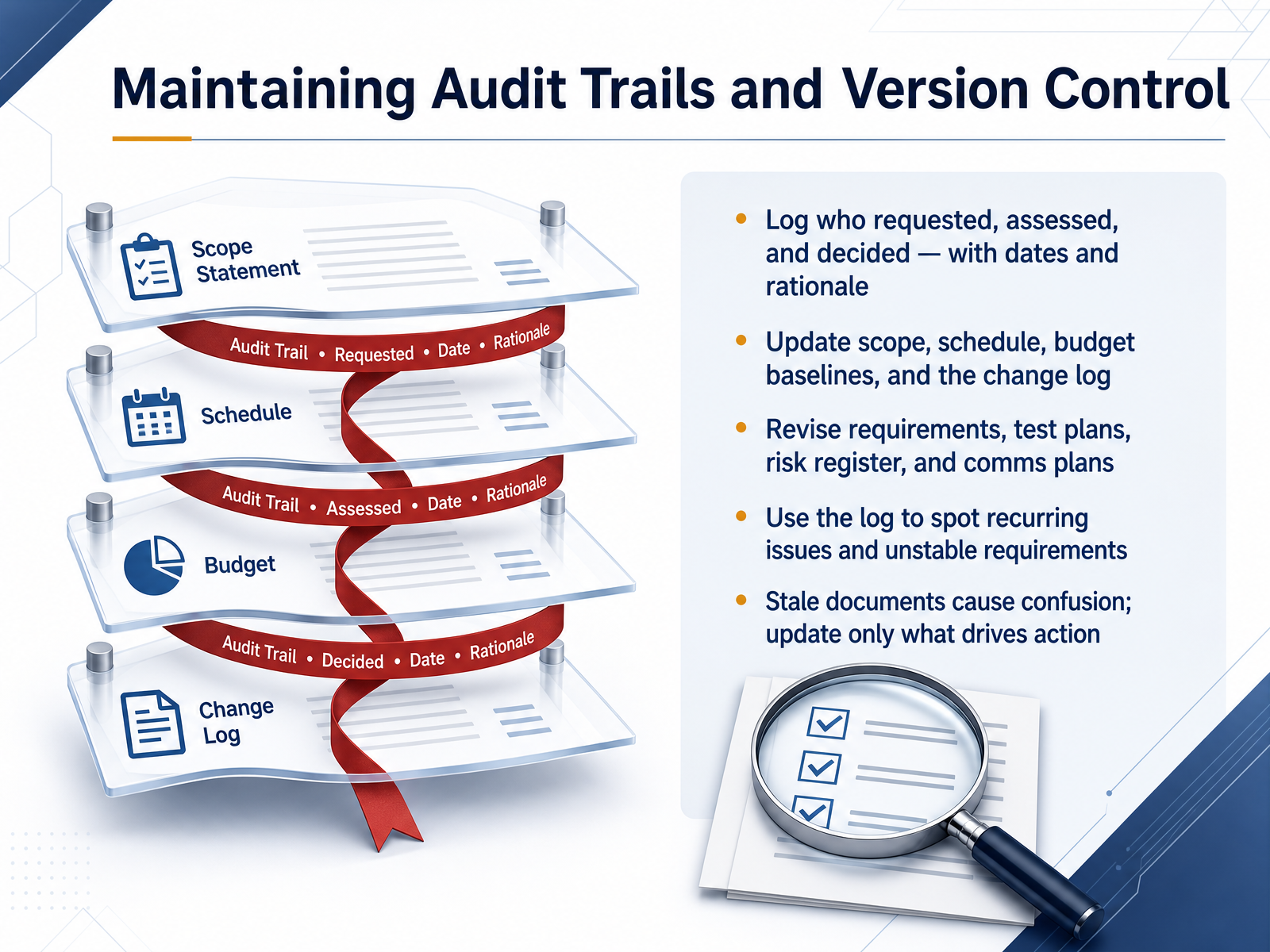
 - 08Maintaining Audit Trails and Version ControlNow, let's talk about maintaining a reliable audit trail and version control. This is how we keep the project's story straight. First, log every key detail in your change register: who requested the change, who assessed it, and who approved or rejected it. Always include the dates and the rationale behind each decision. Second, update your core baselines. An approved change must be reflected in your scope, schedule, and budget documents immediately. Do not forget to update supporting artifacts too, like the requirements, test plans, and risk register. Third, use your log as an analysis tool. Review it regularly to spot recurring issues or unstable requirements, and address the root cause. Finally, remember a critical rule: only update documents that drive action. Stale documents cause confusion, but revising everything mechanically wastes time and creates noise. Update what the team actually uses to work and make decisions. Next, you will learn about common pitfalls and how to avoid them.
 resources.rework.compmexams.comresources.rework.com+22 min
 - 09Common Pitfalls and How to Avoid ThemNow let's look at common pitfalls that derail change management and how to avoid them. First, vague descriptions. A request like 'improve the dashboard' means nothing without specifics. Always require a measurable change statement. Second, verbal approvals. If a decision isn't logged, it didn't happen. Apply the 'no log entry, no change' rule without exception. Third, incomplete impact analysis. Use a mandatory checklist that covers budget, timeline, resources, and quality before any decision. Fourth, bypassing the process under time pressure. Instead, define an expedited path that still requires conditional approval. Don't let urgency erase governance. Finally, treating all changes as equal. Categorize every request by impact: minor, major, or strategic. Route each category to the correct authority so the right people make the call. Avoiding these pitfalls keeps your change log consistent and your project under control. Next, we'll explore tools and technologies that support consistency in change tracking.
 blog.ghw-digital.comatlassian.comschmidtconsulting.group+22 min
 - 10Tools and Technologies for ConsistencyNow let’s talk about the tools and technologies that help you maintain consistency across every change request. You don’t need complex systems to start. Lightweight options like shared spreadsheets, collaborative documents, or a simple change log template can work well for smaller efforts. When you’re ready for more structure, dedicated tools take over. Platforms like Jira Service Management, ServiceNow, Smartsheet, Asana, and Monday.com are commonly used for this. These tools include features that directly enforce consistency: custom fields to capture exactly what you need, mandatory fields so nothing gets missed, automated routing that moves requests to the right people, and approval workflows that lock in decisions. The most important step is to configure your chosen tool to embed the four core elements—change, impact, decision, and status—natively into the request form and workflow. That way, every record follows the same format by default. Next, we’ll put this into practice with Exercise Part One: Recording the Change.
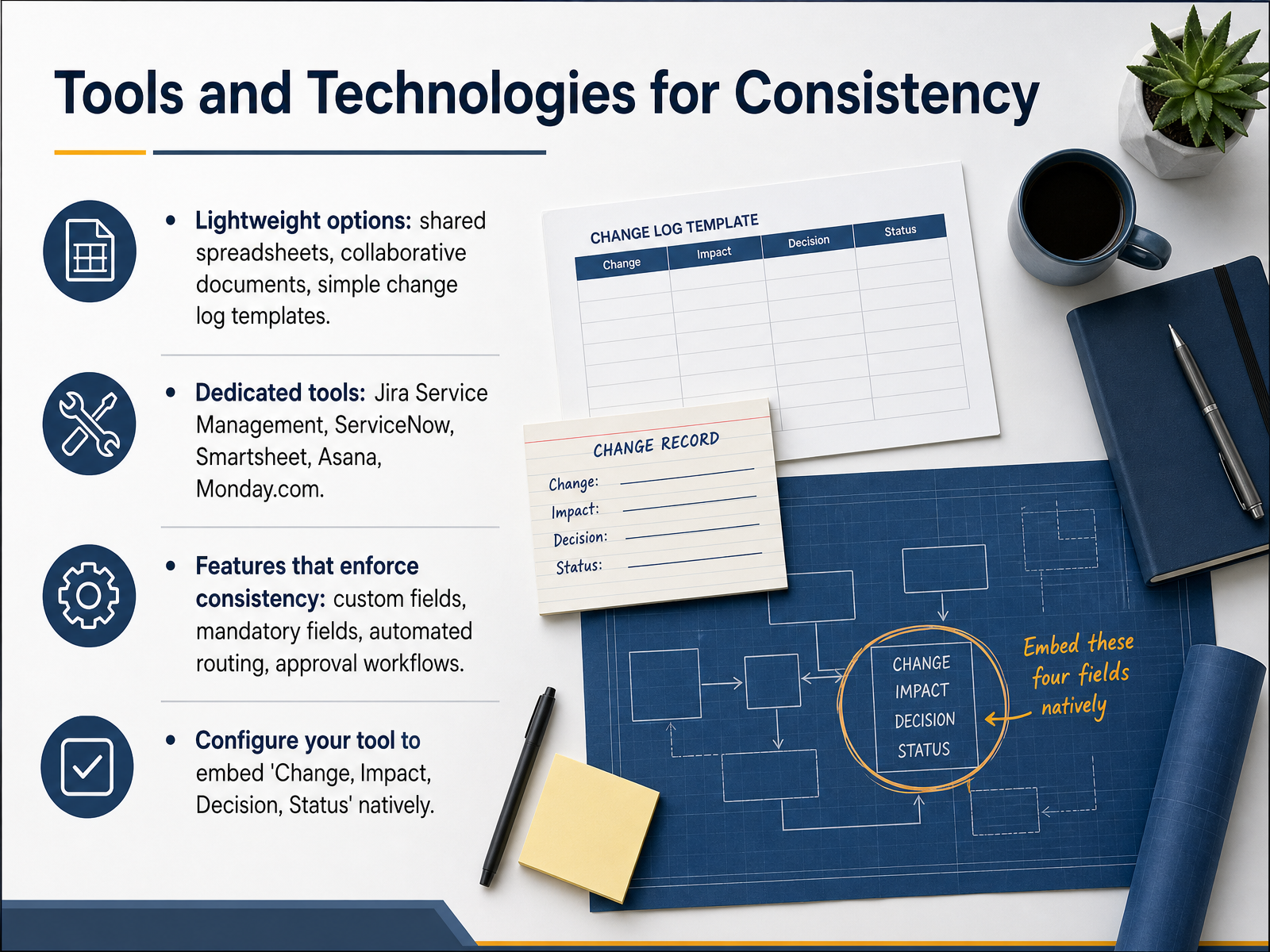 gitnux.orgotrs.comworldmetrics.org+22 min
 - 11Exercise Part 1: Recording the ChangeNow let's put these concepts into practice. In this exercise, we have a mid-project feature addition with a tight deadline. Your first job is to record the change. Start by creating a unique ID. Then write a clear, objective description of the feature and a solid justification. Focus strictly on the 'what' and the 'why'—no opinions, no assumptions. Use plain, unambiguous language. After you finish, we will compare interpretations across the group. This will show just how critical consistent wording is when you log a change. Ready to begin? Once you complete your entry, we will move into Exercise Part Two, where we assess impact and build the decision package.
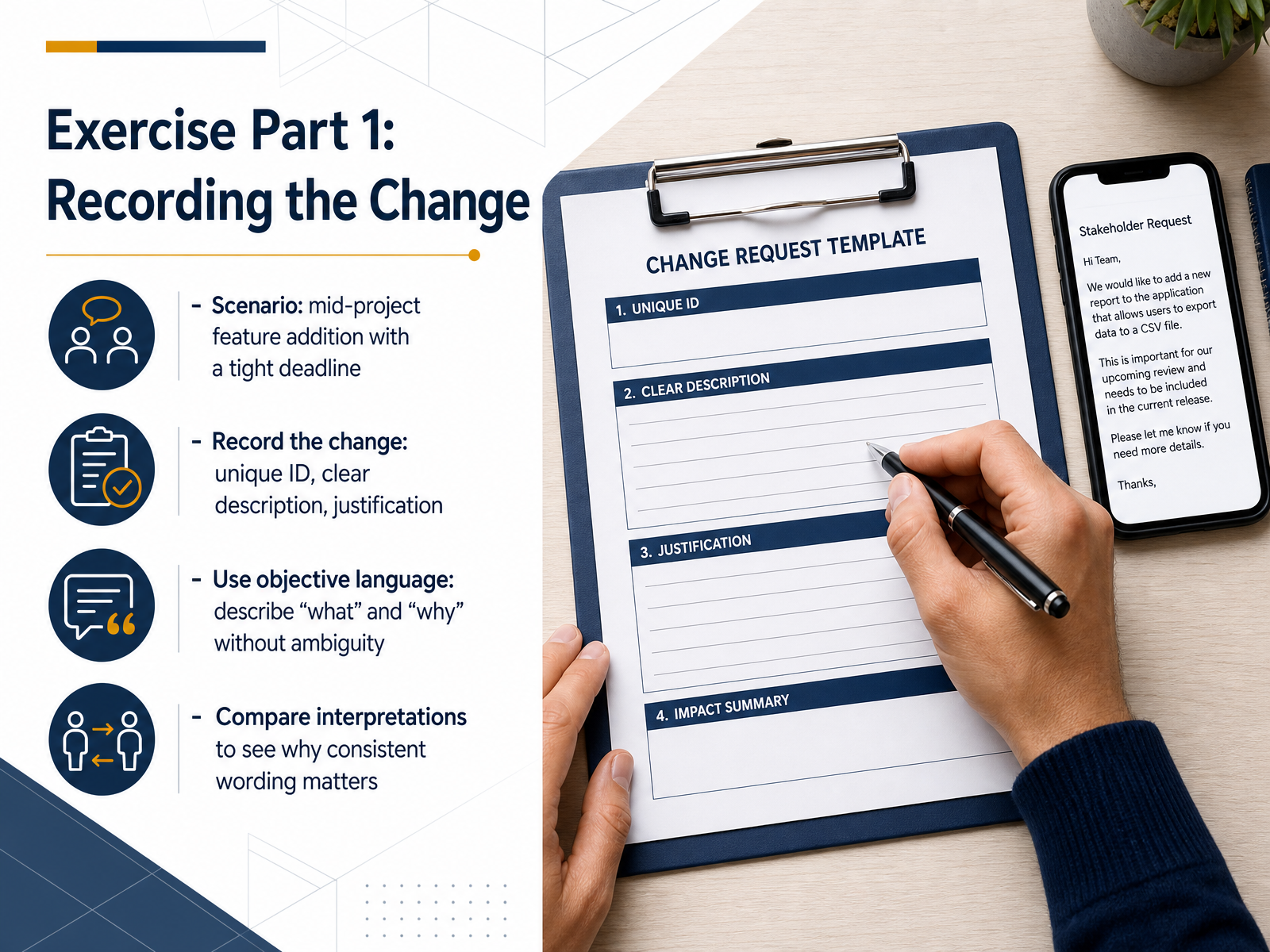 1 min
1 min - 12Exercise Part 2: Impact Analysis and Decision PackageNow let's move into the second part of the exercise, where we assess the impact and build a decision package. Start by evaluating the change across six dimensions: scope, schedule, cost, quality, risk, and resources. For each one, quantify the effect. For example, estimate the number of delay days, the budget variance in dollars, and any resource shifts needed. Once you have those numbers, draft a one-page decision summary with a clear recommendation. Make sure to present the trade-offs explicitly. Use language like, 'If we add this feature, we must delay the launch by two weeks or drop the user profile refresh from this release.' This gives decision-makers a transparent choice. Let's move on to Exercise Part Three: Review and Model Answer, where we will walk through a sample analysis.
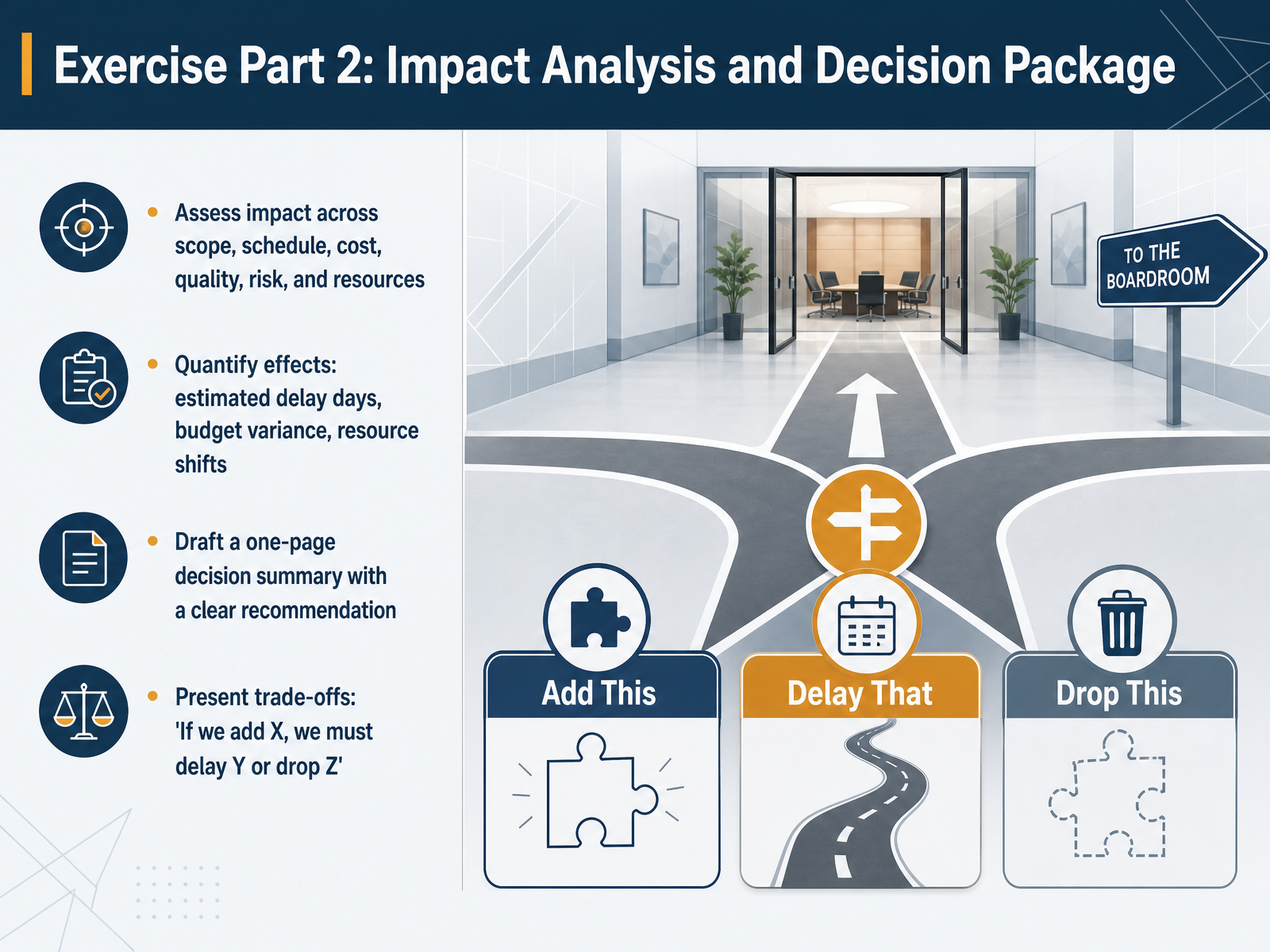 1 min
1 min - 13Exercise Part 3: Review and Model AnswerNow let's review your record against the model answer. Compare your documentation to spot any gaps. Common errors include vague descriptions, underestimated impact, and missing trade offs. If your description could mean two things, it's not clear enough. If the impact seems too small, double check scope and downstream effects. Remember, a rejected decision is not the end. It requires an updated follow up status and clear communication with stakeholders. A complete record protects the team, the budget, and stakeholder trust. When you see a gap, log the correction immediately and note the reason for the update.
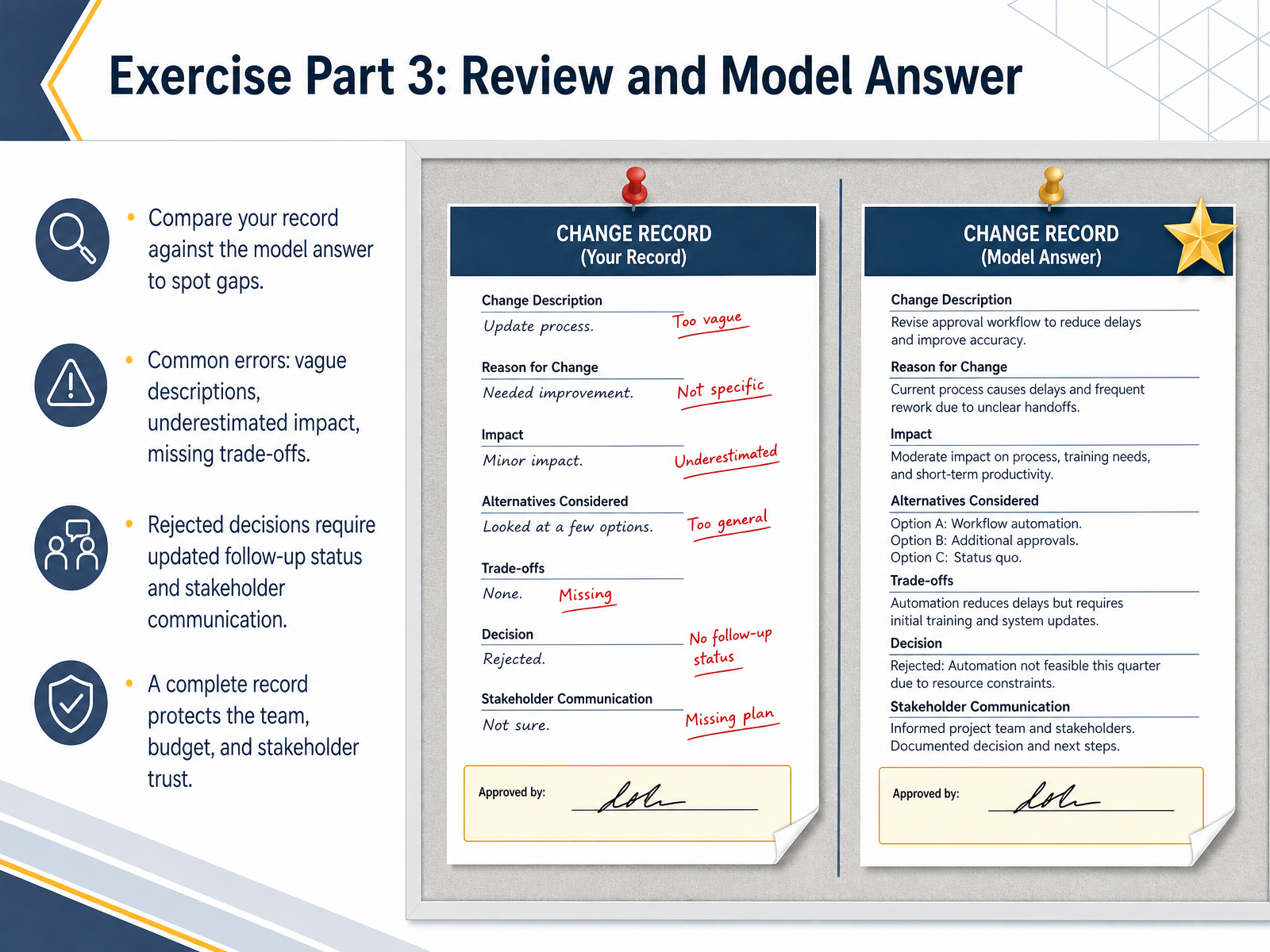 1 min
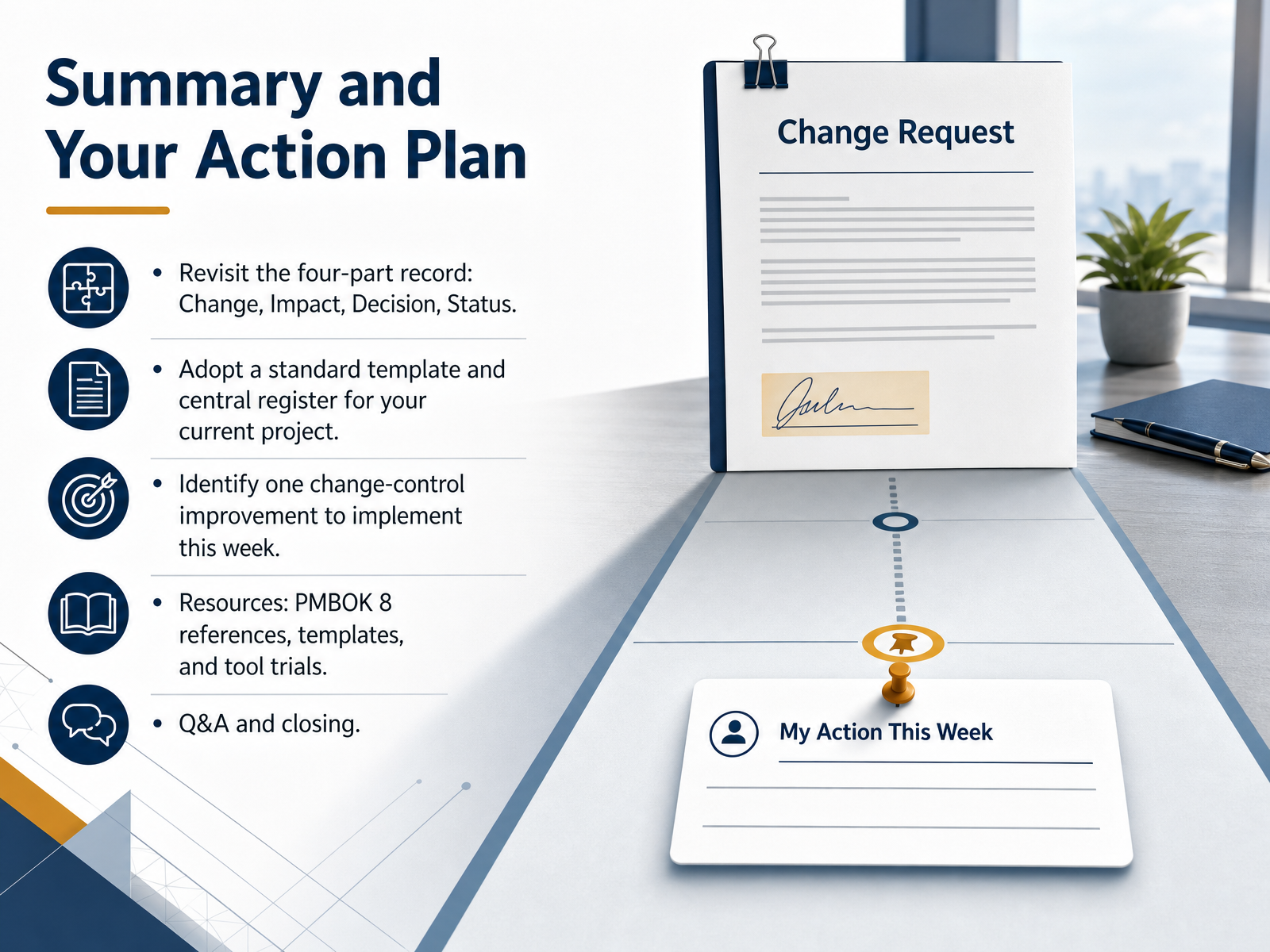
1 min - 14Summary and Your Action PlanLet's bring this together into your action plan. First, revisit the four-part record we covered: change description, impact assessment, decision, and current status. That structure keeps every request consistent and traceable. Second, adopt a standard template and a central change register for your current project. This gives you one source of truth for what changed, why, and who approved it. Third, identify one improvement to implement this week. It could be logging verbal requests immediately, updating artifacts after every approval, or setting clear approval thresholds. Small, consistent steps build lasting discipline. You now have the resources, from PMBOK references to practical templates and tool trials. Thank you for joining this session. Apply these practices, and you'll stay in control of your project's scope and outcomes.
 resources.rework.compmexams.comresources.rework.com+22 min
Take the deck with you
Download this course as a file — free, no sign-up needed.
- PDF handoutEvery slide page, ready to print or share.15 pages · 3.8 MBDownload
- Narrated PowerPointThe deck that presents itself — every slide carries the digital human's narration video.15 pages · 14.4 MBDownload
- PowerPoint slidesThe full deck as a .pptx — open it in PowerPoint, Keynote, or Google Slides.15 pages · 3.7 MBDownload
Free to use in your own training — please keep the PersonWise credit page at the end.
Have your own deck? Turn it into a course
Sources consulted
Web sources consulted while building this course.
- 7 Mistakes You’re Making with Scope Creep Management (And How to Fix Them) - GHW Digital Blog — blog.ghw-digital.com
- Scope Creep in Project Management: How to Manage It — atlassian.com
- Scope Creep: What Causes It and How to Stop It [2026] | SCG — schmidtconsulting.group
- Project Scope Creep: How to Spot It and Stop It | Magnetic — magnetic.app
- Best Practices For Managing Project Scope To Prevent Scope Creep – ITU Online IT Training — ituonline.com
- "Change Control Process: Steps and Template for Projects" — resources.rework.com
- PMP 2026 Updating Documentation and Artifacts | PM Exams — pmexams.com
- "Integrated Change Control: How It Works in Project Management" — resources.rework.com
- Change Requests in PMBOK 8 — Complete Guide — projectmanagement.com.br
- Mastering Integrated Change Control Process: Steps & Best Practices | PM Study Circle — pmstudycircle.com
- Best Project Change Management Software | 2026 Expert Picks — gitnux.org
- The Best Change Management Software 2026 — otrs.com
- Top 10 Best Project Change Management Software (2026 Review) — worldmetrics.org
- Best Project Based Software (2026) — wifitalents.com
- 14 Best Project Management Software: 2026 Buyer's Guide - ProjectManager — projectmanager.com