Critical Thinking Essay Analysis
Begin
14 pages · ~28 min
Critical Thinking Essay Analysis
This training uses a critical thinking essay example to show learners how to identify patterns, strengths, and pitfalls in argument analysis.
What you’ll learn
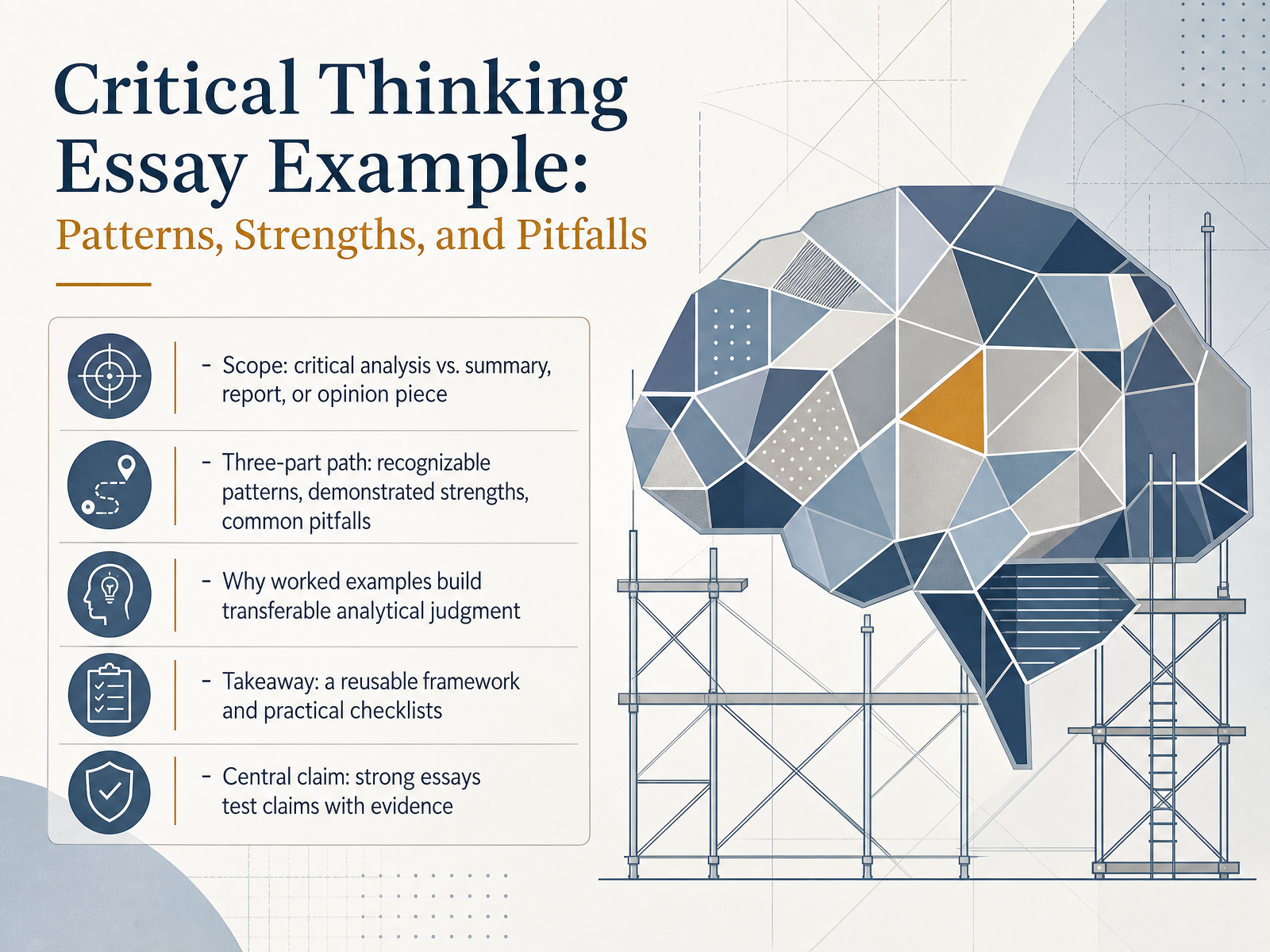
- 01Critical Thinking Essay Example: Patterns, Strengths, and PitfallsWelcome. Over the next few minutes, we'll study a critical thinking essay example, and pull from it a framework you can reuse in your own writing. First, let's draw the boundary. Critical analysis is not summary, not a report, and not an opinion piece. Summary tells us what a source says. Analysis tests whether it holds up. Our path has three parts: recognizable patterns, demonstrated strengths, and common pitfalls. Why focus on worked examples? Because studying how real essays actually move, claim by claim, builds analytical judgment you can transfer to new topics. Here's the central claim for this whole course: strong essays test claims with evidence, rather than decorating a conclusion you already chose. By the end, you'll have a reusable framework and practical checklists. Let's begin with what critical thinking in writing actually means.berkeleycitycollege.educgcc.edueducate.apsanet.org+21 min
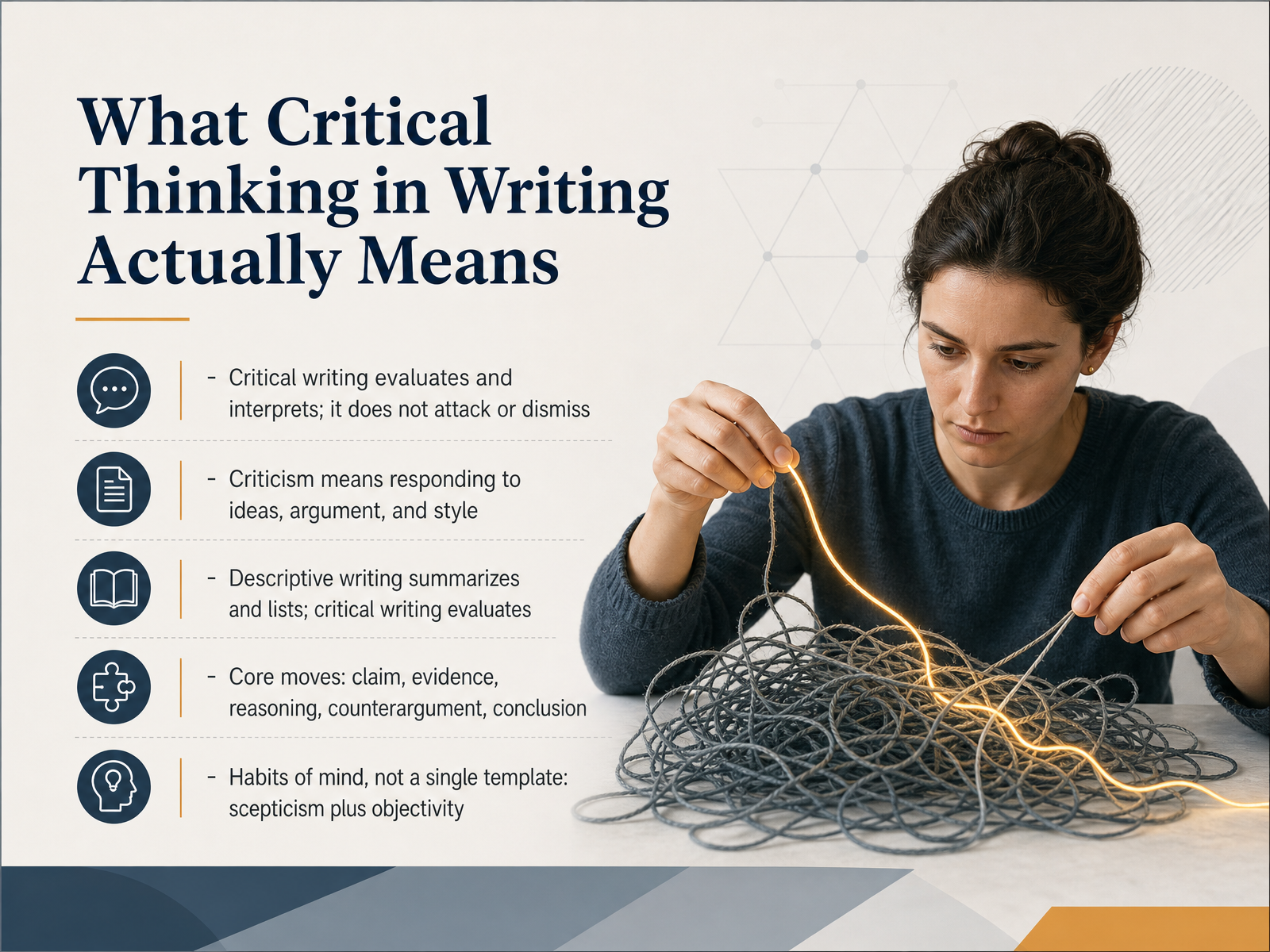
- 02What Critical Thinking in Writing Actually MeansLet us start with what critical thinking in writing actually means. Critical writing evaluates and interprets. It does not attack or dismiss. That distinction matters. To be critical is to respond to ideas, argument, and style, and to show why you value them. Descriptive writing summarizes and lists. Critical writing goes further, weighing evidence and forming your own view. Five core moves carry most essays: claim, evidence, reasoning, counterargument, and conclusion. Notice these are habits of mind, not one template. Use skepticism to question what you read. Balance it with objectivity, so your judgment rests on reasoning, not preference. Next, How This Training Is Organized.
 human.libretexts.orglibguides.westminster.ac.ukcampus.kennesaw.edu+21 min
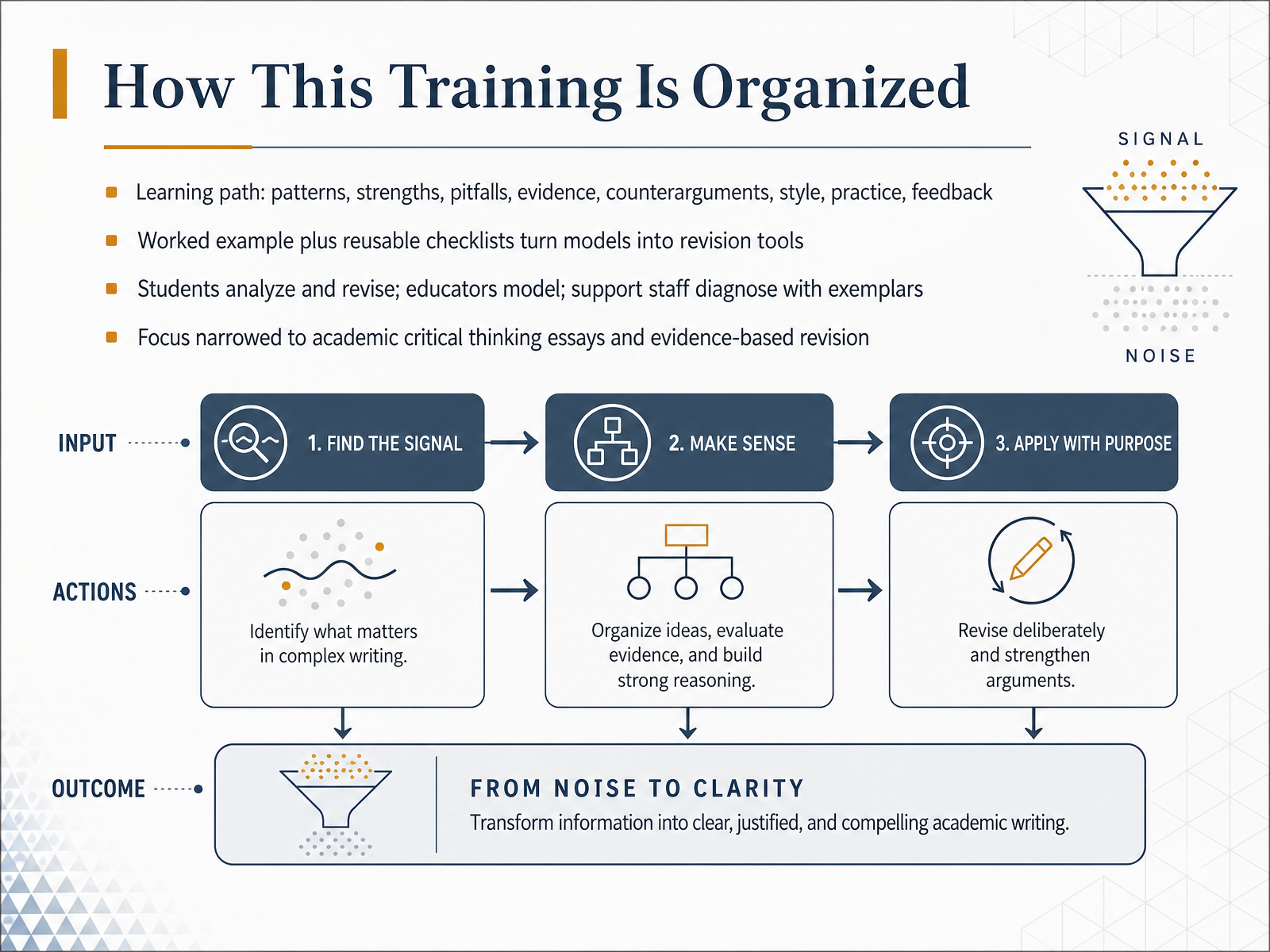
 - 03How This Training Is OrganizedLet's look at how this training is organized, so you know exactly what you're building. First, the learning path. We move through patterns, strengths, pitfalls, evidence, counterarguments, style, practice, and feedback. That order matters. You learn to recognize what strong reasoning looks like before you try to produce it. Next, everything centers on a worked example. We analyze it closely, then convert it into reusable checklists. Those checklists are the real payoff. They turn a model essay into a revision tool you can apply to your own drafts. Third, the roles differ by audience. Students analyze and revise. Educators model the thinking out loud. Support staff use exemplars to diagnose where a draft breaks down. Finally, we narrow the focus. This is about academic critical thinking essays and evidence based revision, not general writing advice. Here's your takeaway. You are not collecting tips. You are building a repeatable process for reading, questioning, and improving an argument. Next, we begin with the recognizable patterns in strong critical essays.
 texasgateway.orgcurriculum.eleducation.orgpmc.ncbi.nlm.nih.gov+21 min
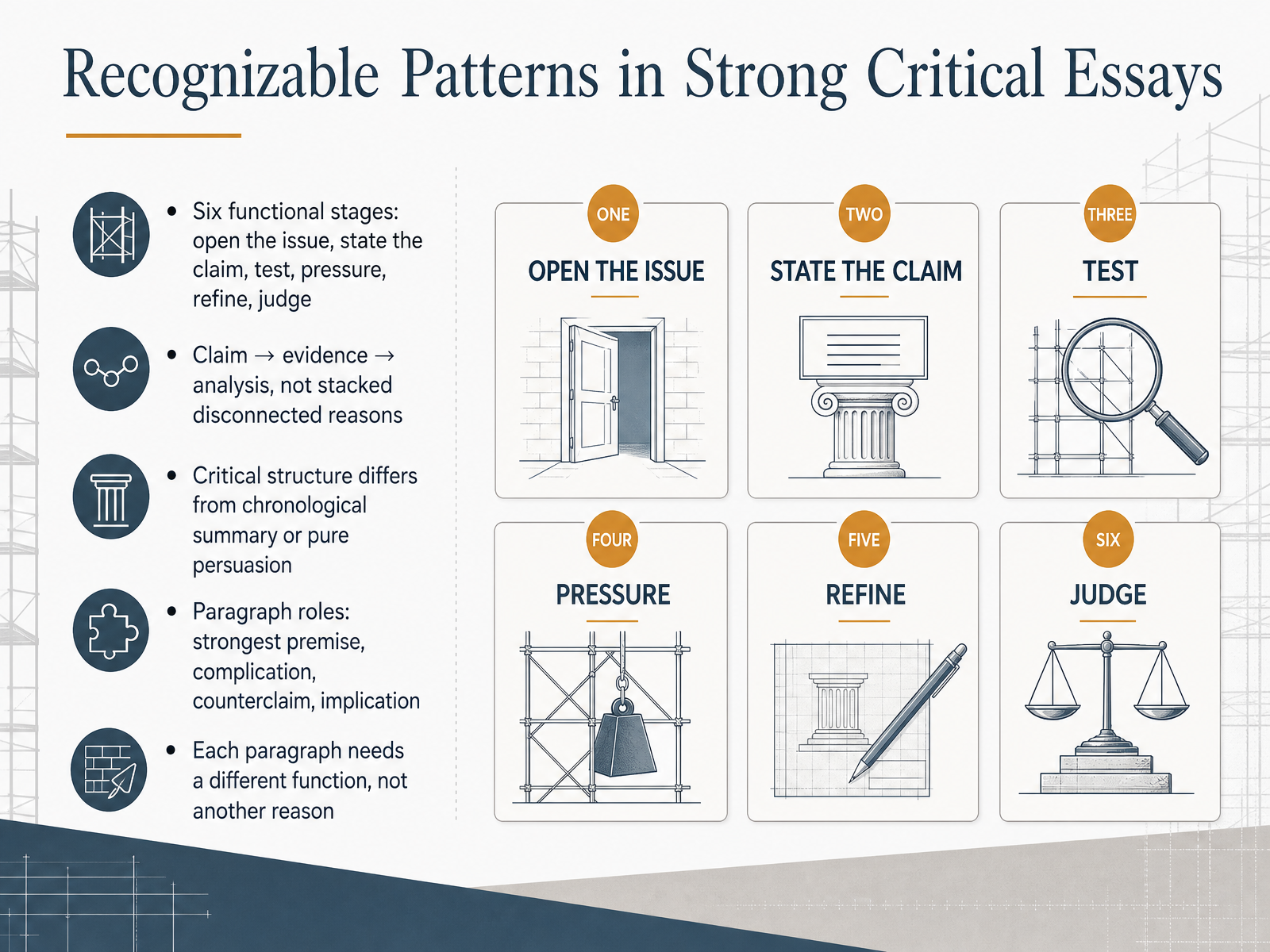
 - 04Recognizable Patterns in Strong Critical EssaysLet's look at the patterns that show up again and again in strong critical essays. Most of them move through six functional stages. They open the issue, state the claim, test it with evidence, pressure it with objections, refine it, and close with a measured judgment. Notice the rhythm there. It's claim, evidence, analysis. Not three reasons stacked in a row. That's the key difference between critical structure and a chronological summary or pure persuasion. Each paragraph should have a different job. One establishes your strongest premise. Another adds a complication. Another handles a counterclaim. Another draws out an implication or a limit. If two paragraphs are doing the same work, one of them probably needs to change.
 human.libretexts.orgessaypro.comessaypay.com+21 min
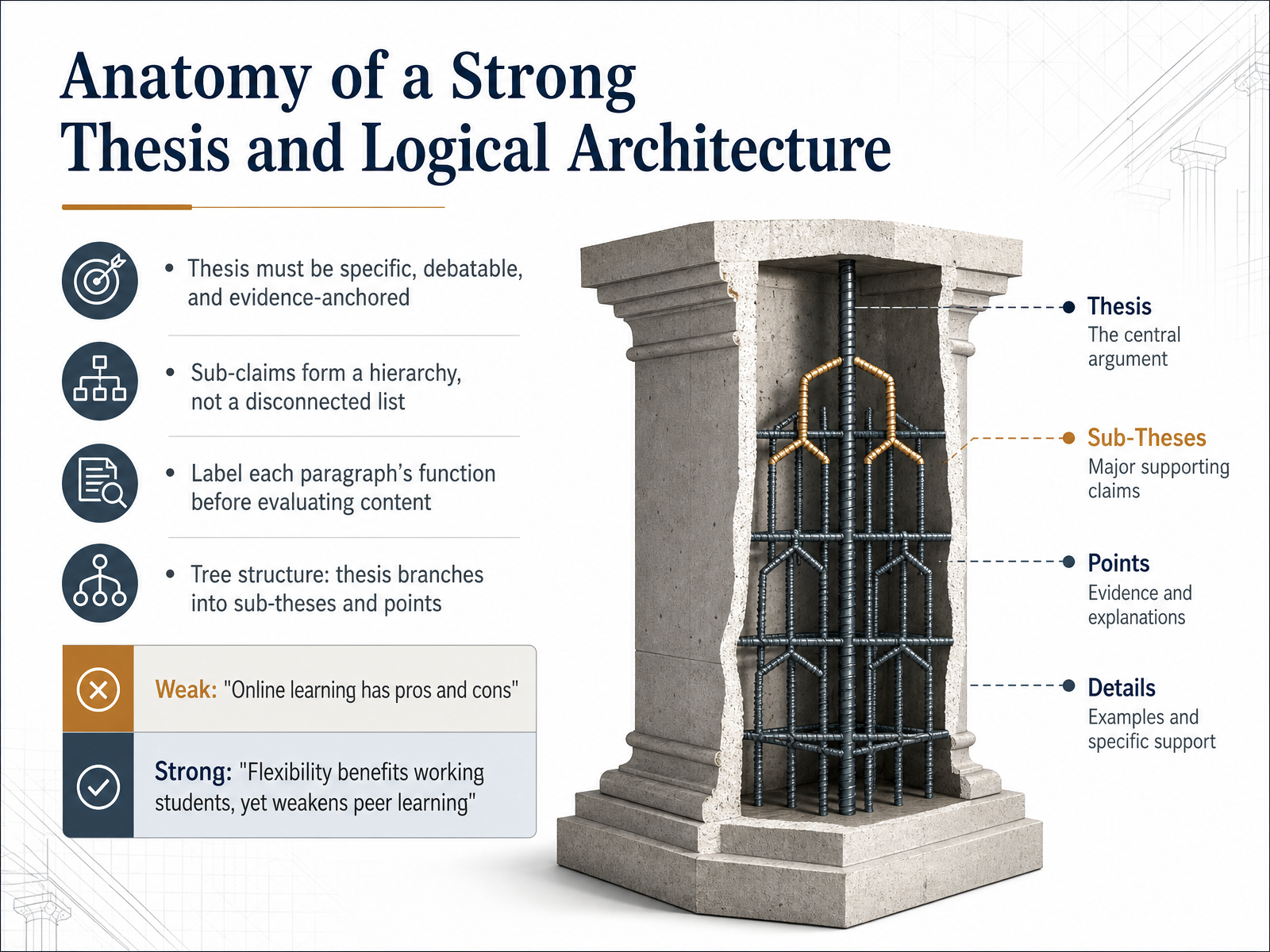
 - 05Anatomy of a Strong Thesis and Logical ArchitectureNow let's look inside the argument itself. A strong thesis has three qualities. It is specific, debatable, and anchored in evidence. Specific means it names the actual tradeoff, not just the topic. Debatable means a reasonable person could disagree. Evidence-anchored means real research supports each part.
Here is the weak version. Online learning has pros and cons. That is a topic, not a claim. Now the strong version. Flexibility benefits working students, yet weakens peer learning. Notice the tension. Now you have something to defend.
Next, sub-claims form a hierarchy, not a disconnected list. Think of a tree. The thesis is the trunk. Sub-theses are the main branches. Points and evidence are the smaller branches. So before you evaluate content, label each paragraph's function. Ask what job does this paragraph do. Does it establish a premise, add a complication, or answer an objection? If two paragraphs do the same job, one needs to change. That structure is what makes reasoning visible. Next, we will examine the strengths of effective critical thinking essays.
 human.libretexts.orgessaypro.comessaypay.com+22 min
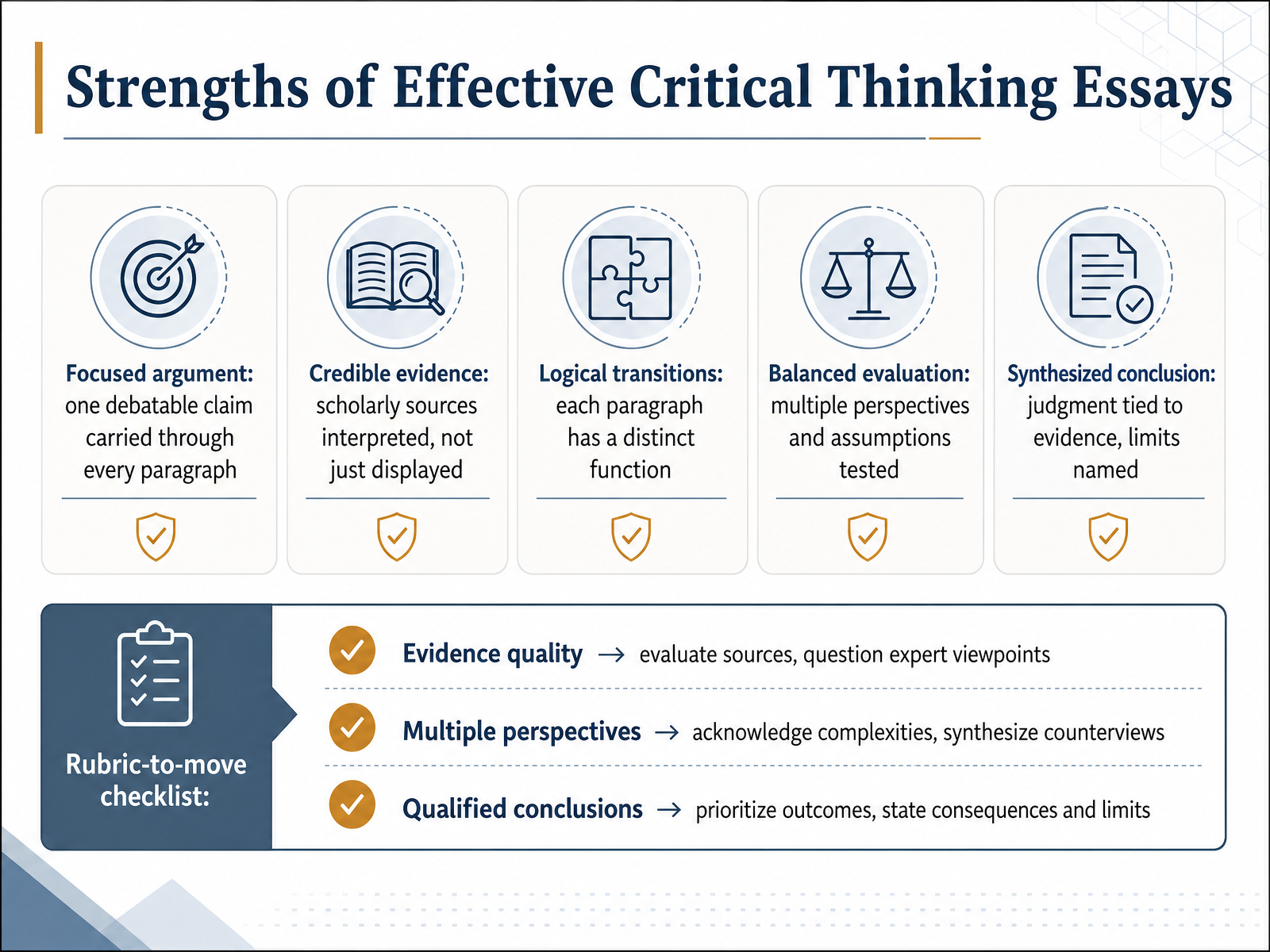
 - 06Strengths of Effective Critical Thinking EssaysLet's break down what strong critical thinking essays actually do. Five moves separate a real argument from a summary. First, a focused argument: one debatable claim carried through every paragraph, not a new thesis halfway down the page. Second, credible evidence. Scholarly sources get interpreted, not just displayed. You question the expert's viewpoint instead of treating it as fact. So instead of dropping a statistic and moving on, you explain what it shows and where it stops holding. Third, logical transitions. Each paragraph has a distinct function. One establishes a premise. One adds a complication. One handles the counterargument. If two paragraphs do the same job, one of them needs to change. Fourth, balanced evaluation. You test multiple perspectives and assumptions, including your own. Fifth, a synthesized conclusion. Your judgment ties back to the evidence, and you name the limits. So the checklist is short. Evaluate your sources. Weigh other perspectives. Qualify your conclusion. Those three moves map directly onto the rubric. Now let's look at where this tends to fall apart: Common Pitfalls and Weak Reasoning.
 berkeleycitycollege.educgcc.edueducate.apsanet.org+22 min
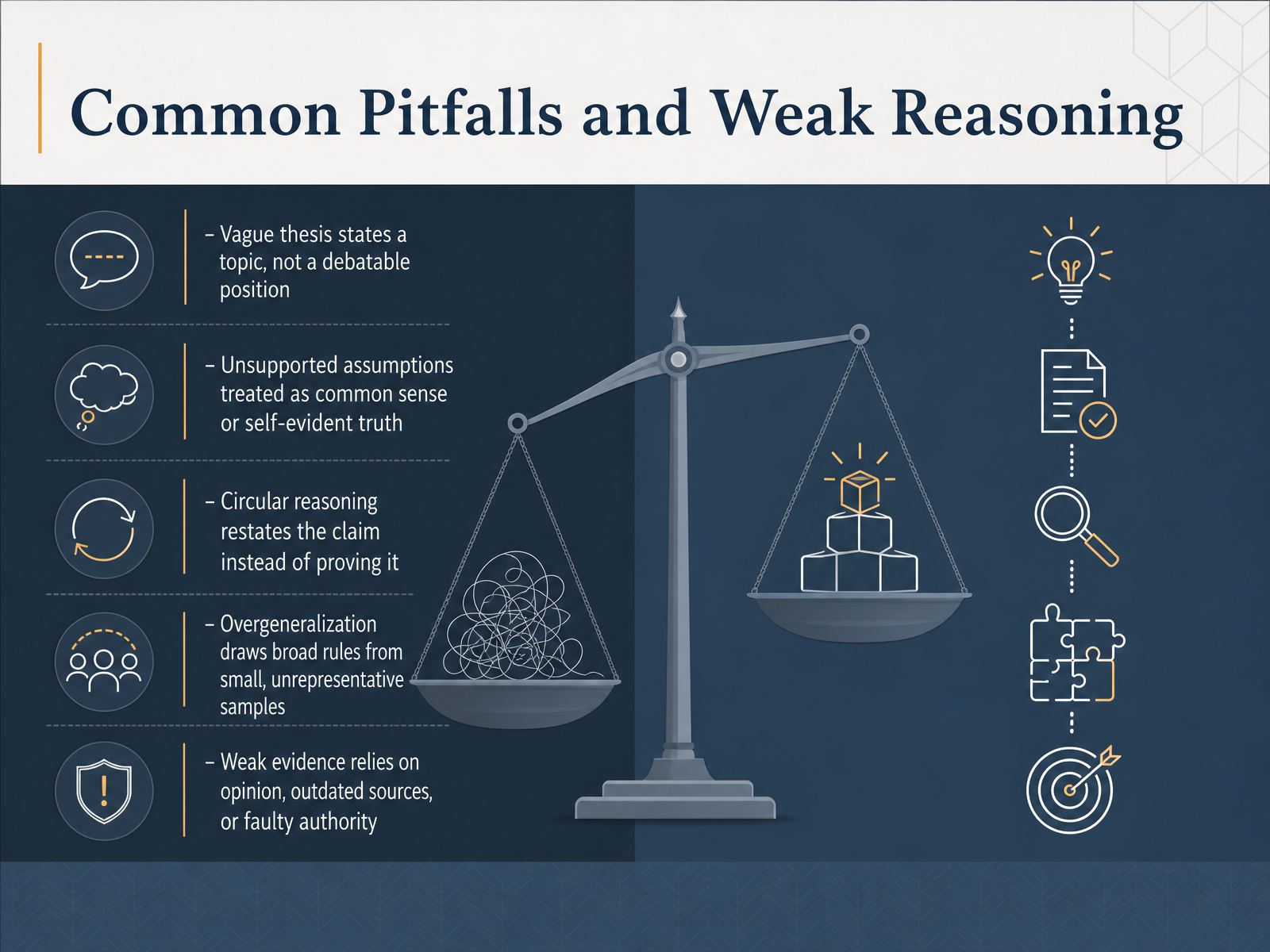
 - 07Common Pitfalls and Weak ReasoningNow let's look at the weak spots that show up most often. First, a vague thesis. It names a topic but takes no position. "Online learning is important" is not debatable. "Online learning improves outcomes for working adults" is. Second, unsupported assumptions. Watch for phrases like "everyone knows" or "it's just common sense." That's a claim dressed up as truth. Third, circular reasoning. The conclusion simply repeats the premise, so nothing gets proven. Fourth, overgeneralization. A sweeping rule drawn from a few cases. One kind taxi driver does not tell you what an entire city is like. Fifth, weak evidence. Opinion, outdated sources, or a so-called expert with no real authority. Here's the pattern to remember. Each pitfall replaces proof with assumption, repetition, or a sample too small to matter. So when you revise, ask one question of every claim. Where is the support? Next, we turn to evaluating evidence and source quality.
 writingcenter.unc.eduulvixo.comhuman.libretexts.org+22 min
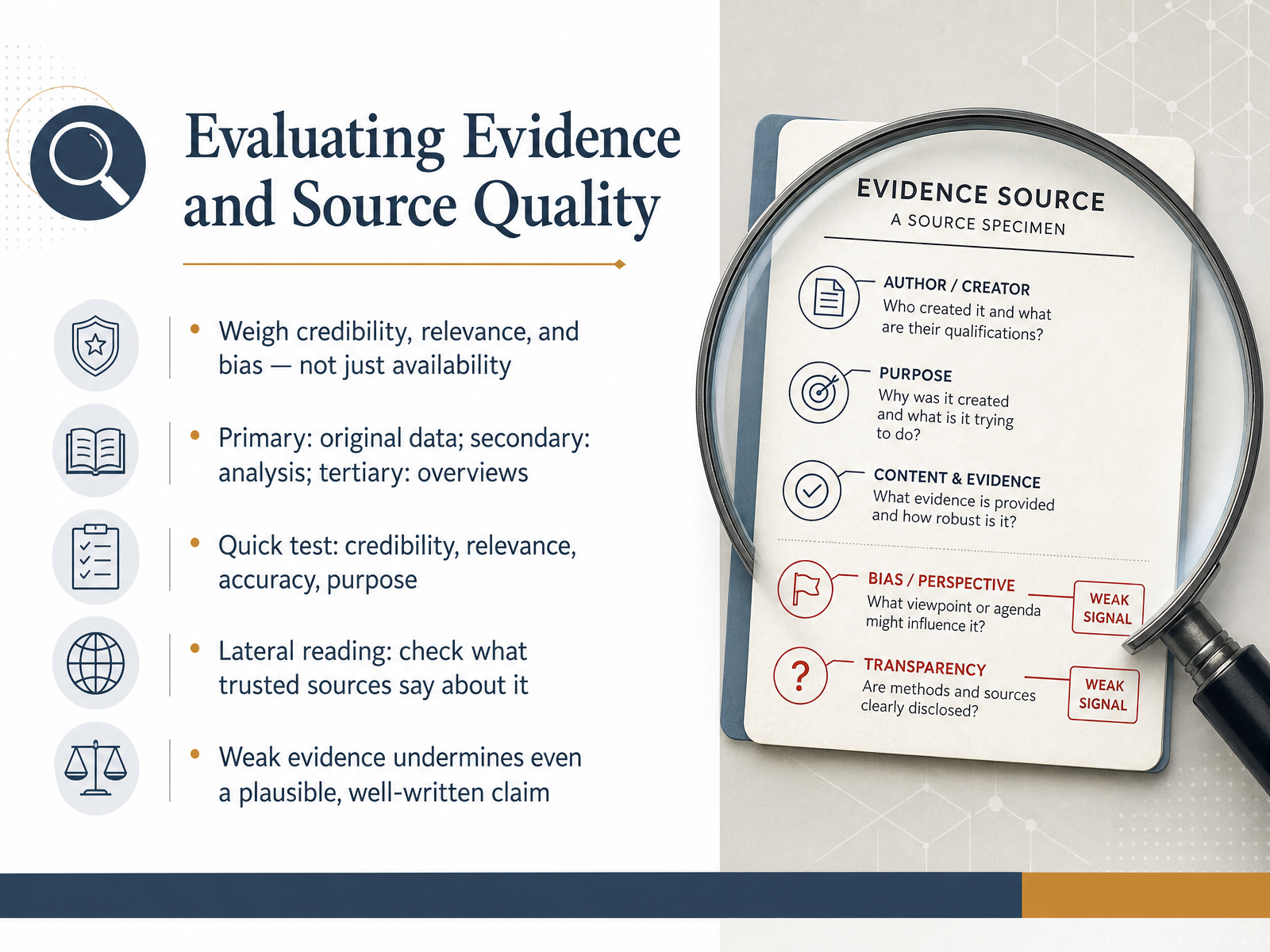
 - 08Evaluating Evidence and Source QualityNow let's talk about evaluating evidence and source quality. A common mistake is grabbing the first source you find and treating availability as credibility. Instead, weigh three things: credibility, relevance, and bias. Ask who wrote it, whether it actually addresses your claim, and what agenda might be shaping it. Evidence comes in layers. Primary sources give you original data. Secondary sources analyze that data. Tertiary sources summarize broad overviews. Know which layer you are using and why. A quick test helps: does the source have credibility, relevance, accuracy, and a clear purpose? Then use lateral reading. Leave the page and check what trusted sources say about it. One weak source can undermine even a plausible, well written claim. So slow down, verify, and choose evidence that can carry the weight of your argument. Next, we turn to building and refuting counterarguments.
 human.libretexts.orgessaypro.comessaypay.com+21 min
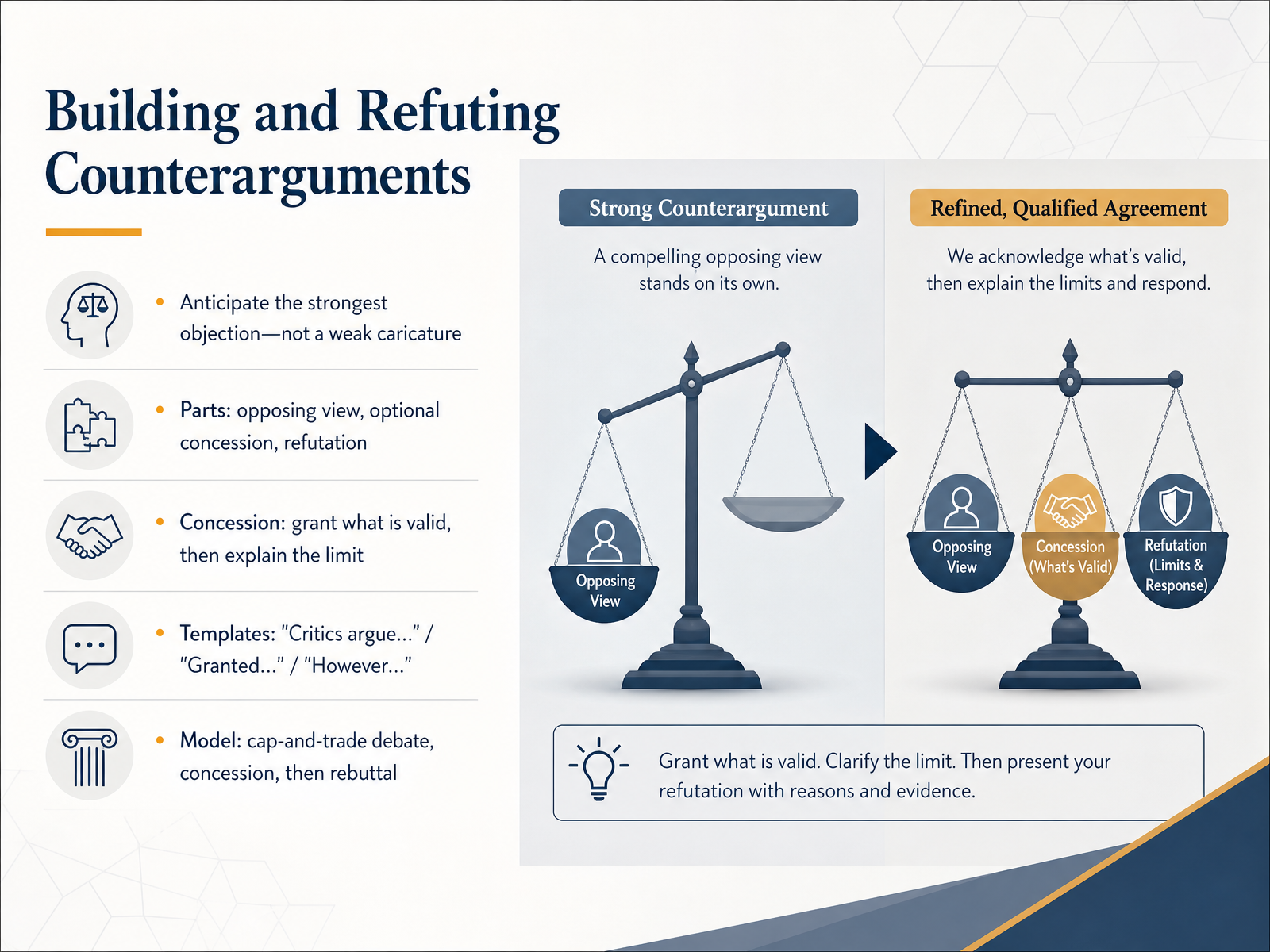
 - 09Building and Refuting CounterargumentsNow let's look at how to build counterarguments and refute them well. The key rule is simple. Anticipate the strongest objection, not a weak caricature. A counterargument typically has three parts: the opposing view, an optional concession, and a refutation. Here is what that sounds like in practice. First, state the opposing view. Critics argue that cap and trade raises energy prices and could cost jobs. Next comes the concession. Granted, higher short-term costs are a real concern for businesses. Then you refute. However, that view focuses only on immediate costs and ignores long-term gains like innovation and cleaner air. Notice the wording. Critics argue, granted, however. Those phrases signal each move clearly. One caution. Never attack the opposing view. Represent it fairly, then show why your argument still holds. That is what earns a reader's trust. Next, we will turn to language and style in critical writing.
 human.libretexts.orgessaypro.comessaypay.com+22 min
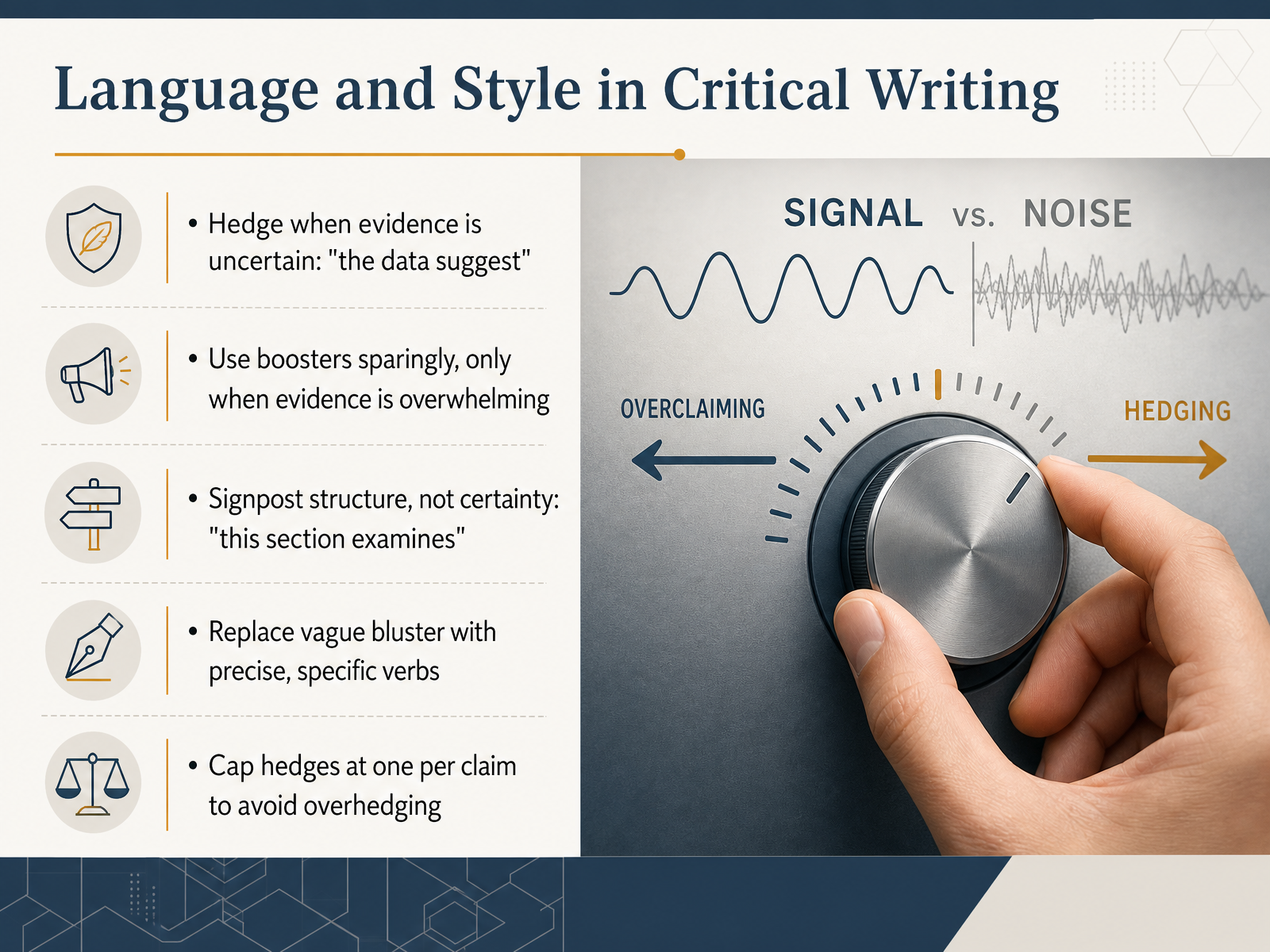
 - 10Language and Style in Critical WritingNow let's look at language and style in critical writing. Hedging is how you match confidence to evidence. When the data are uncertain, write "the data suggest," not "the data prove." Boosters like "clearly" or "undoubtedly" should be rare. Save them for cases where the evidence really is overwhelming. Signposting is different. It orients the reader without making a claim about certainty. So "this section examines" tells readers where they are. It does not hedge or boost the argument itself. Next, replace vague bluster with precise verbs. Instead of "cheating must be stopped," write something specific like "ninety percent of universities have implemented plagiarism prevention technology." That gives readers something concrete to evaluate. Finally, cap hedges at one per claim. "It may perhaps be tentatively suggested" is not more careful. It is just harder to read. One hedge is almost always enough. A second one adds fog, not caution. So here is your takeaway. Hedge once, boost rarely, signpost structure, and choose verbs that carry exact meaning. That combination keeps your writing confident and honest at the same time. From sample essay to student practice.
 human.libretexts.orglibguides.westminster.ac.ukcampus.kennesaw.edu+21 min
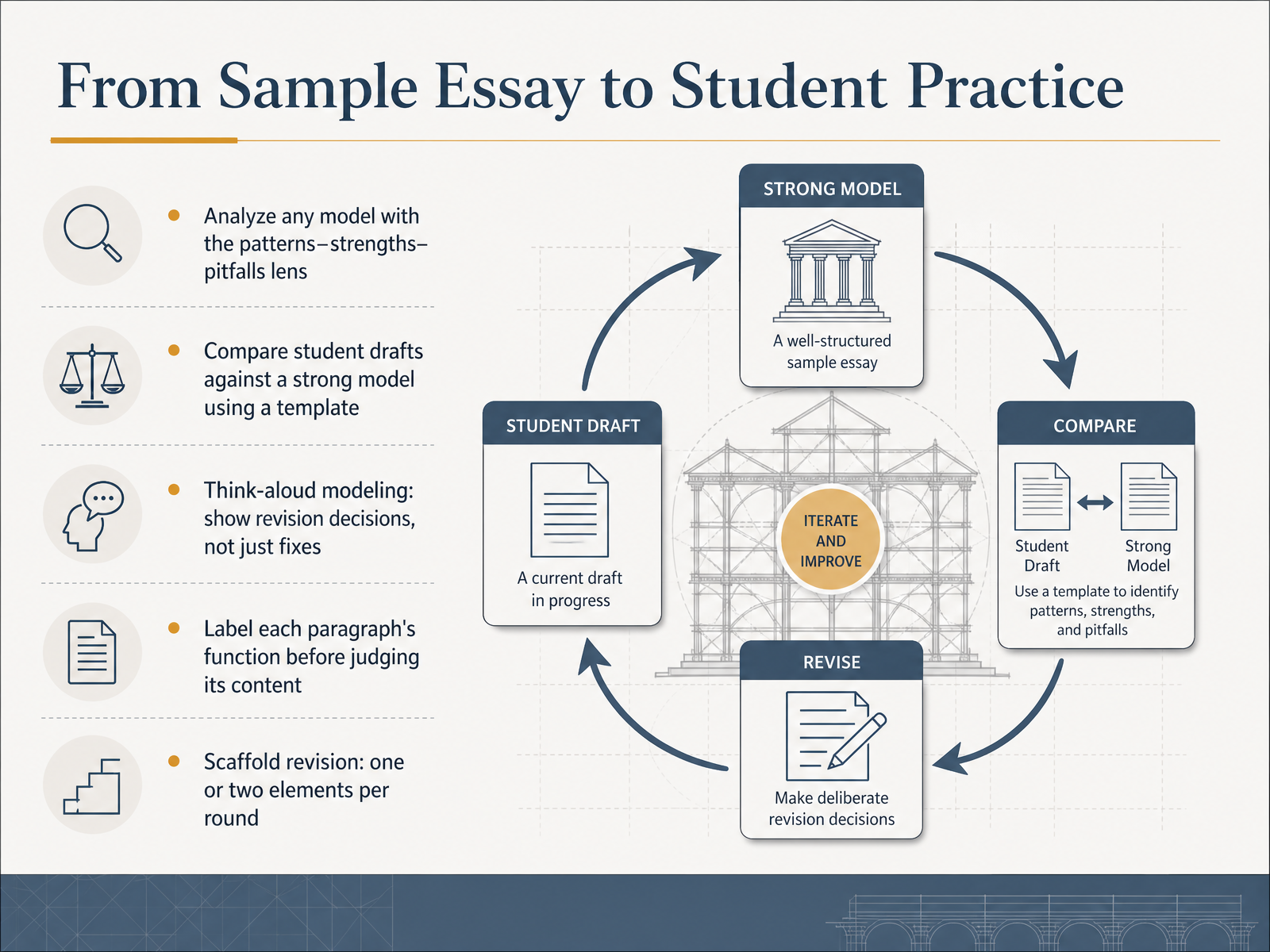
 - 11From Sample Essay to Student PracticeNow let's turn the lens on your own work. You can analyze any model essay with the same three questions you have been using: what patterns does it follow, what strengths does it show, and where are its pitfalls? Then use a simple template to compare a student draft against that strong model. Notice the gaps, and name them.
Here is the key move. Think aloud when you model revision. Show the decisions behind each change, not just the corrected sentence. Ask yourself why this evidence belongs here, or why this paragraph comes before that one. That is the reasoning you want students to imitate.
Before you judge content, label each paragraph's function. Does it define the issue, prove the claim, complicate it, or answer an objection? If two paragraphs do the same job, one needs to change.
Finally, scaffold revision. Focus on one or two elements per round, across several rounds. That is how revision becomes a habit, and how critical thinking becomes visible on the page. Next, we look at assessment and feedback focused on reasoning.
 texasgateway.orgcurriculum.eleducation.orgpmc.ncbi.nlm.nih.gov+22 min
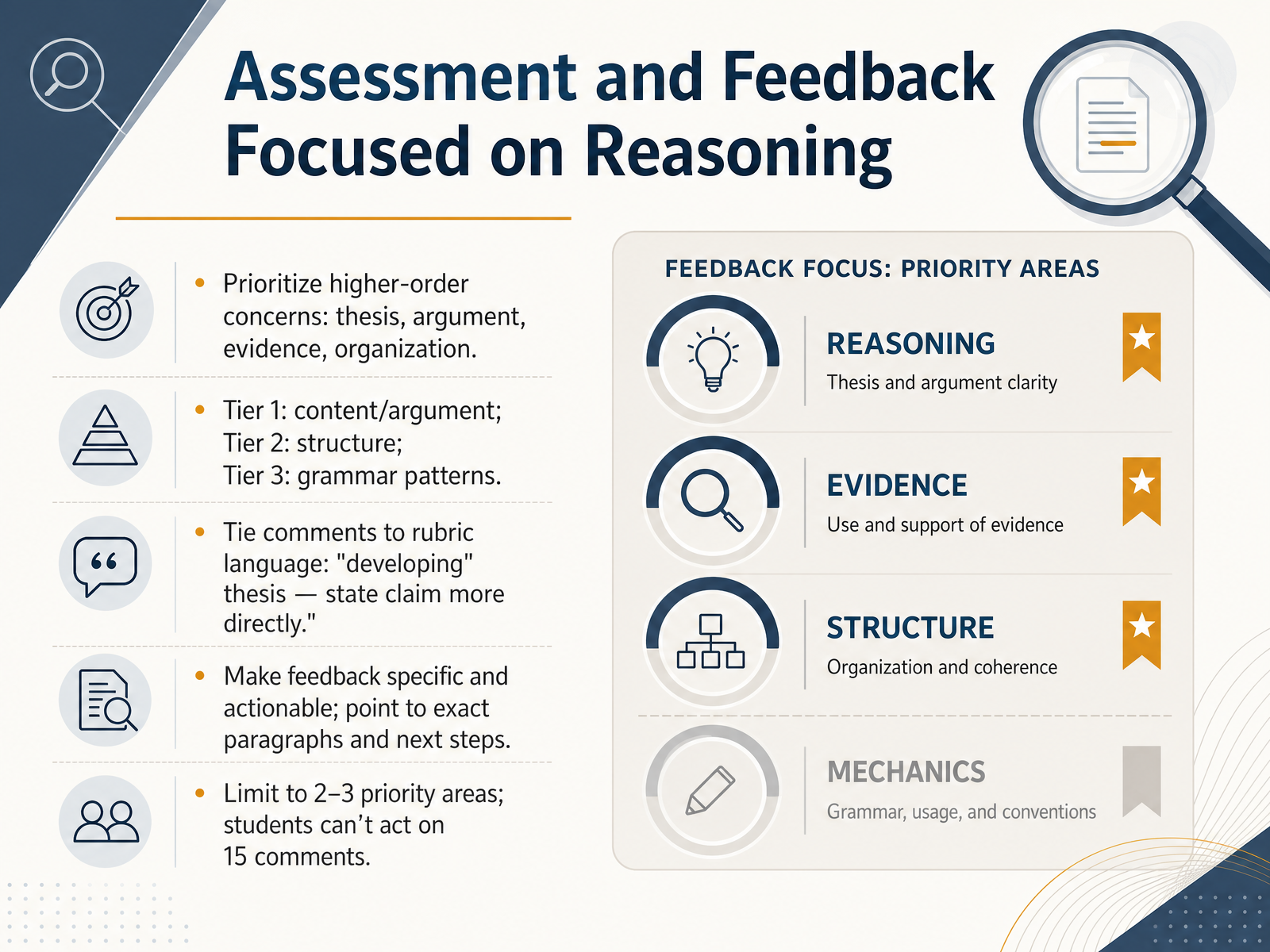
 - 12Assessment and Feedback Focused on ReasoningLet's turn now to assessment and feedback. The principle here is simple. Feedback should target reasoning first, not surface errors. So prioritize higher order concerns: thesis, argument, evidence, and organization. Think in tiers. Tier one is content and argument, and it always gets your attention. Tier two is structure, commenting when organization helps or hinders the case. Tier three is grammar, where you address patterns rather than marking every mistake. Next, tie your comments to rubric language. If the rubric says the thesis is developing, write: state your claim more directly in the introduction. Specific beats general every time. Point to exact paragraphs and offer a concrete next step, like adding one more piece of evidence in paragraph four. And here is the key constraint. Limit feedback to two or three priority areas. Students cannot act on fifteen comments. They freeze, then they revise nothing. So choose the few changes that matter most. Now that we know what to assess, let's look at how to model it. Instructional Methods for Modeling and Revision.
 berkeleycitycollege.eduoecd.orgcgcc.edu+22 min
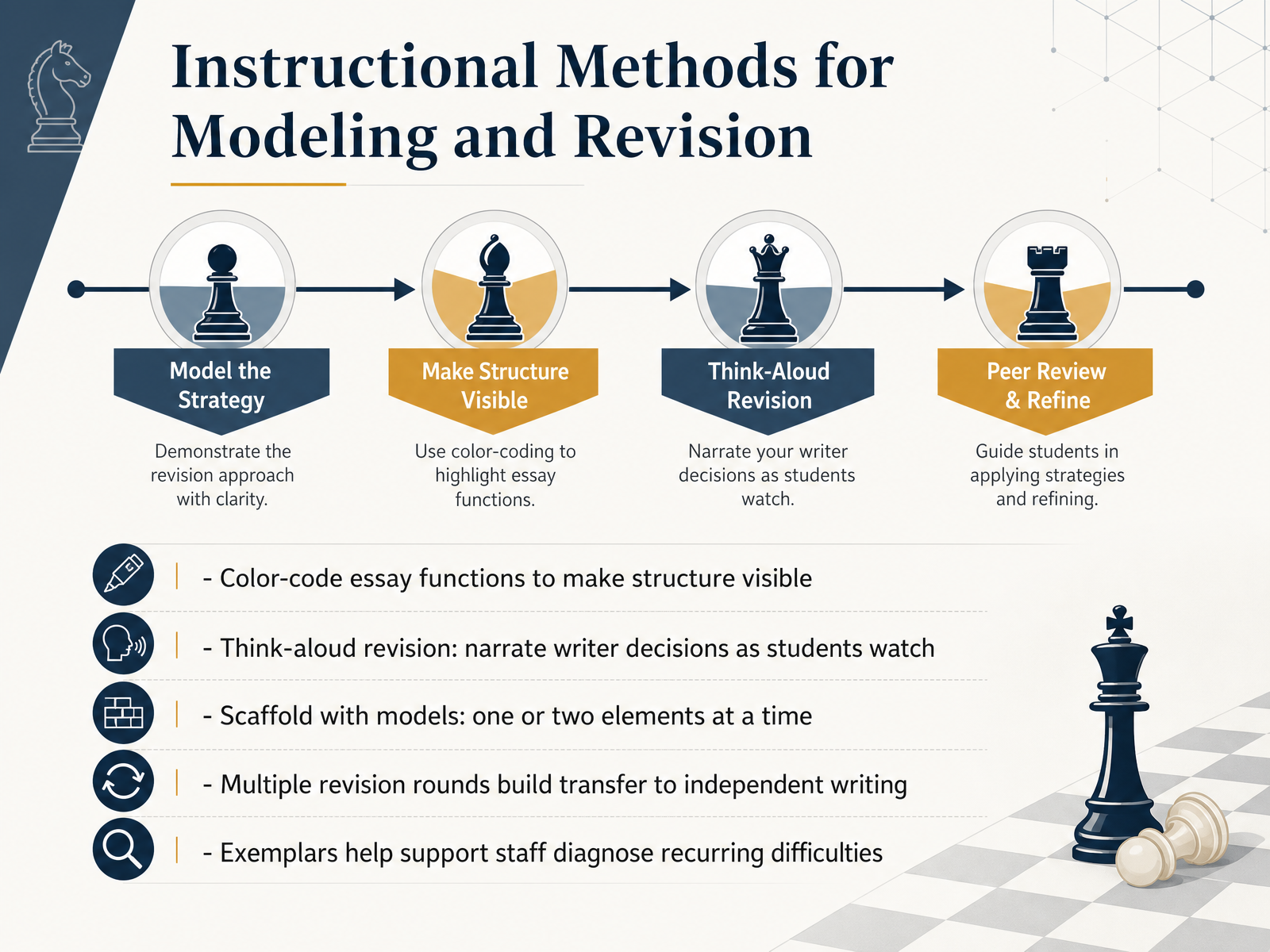
 - 13Instructional Methods for Modeling and RevisionNow let's look at the instructional methods that make modeling and revision actually work in the classroom. First, color-coding. Ask students to mark each part of an essay with a different color, claim in one, evidence in another, reasoning in a third. Suddenly, structure becomes visible. Second, think-aloud revision. Narrate your decisions out loud while students watch, saying something like, this evidence doesn't connect to my claim, so I need to explain the link. Third, scaffold with models. Don't revise everything at once. Focus on one or two elements at a time. Fourth, build in multiple revision rounds. That repetition is what transfers to independent writing. And fifth, use exemplars to help support staff spot the difficulties that keep showing up. The through-line here is simple. Show the thinking, limit the focus, and repeat the cycle. That brings us to our final slide, Summary and Practical Checklist.
 texasgateway.orgcurriculum.eleducation.orgpmc.ncbi.nlm.nih.gov+21 min
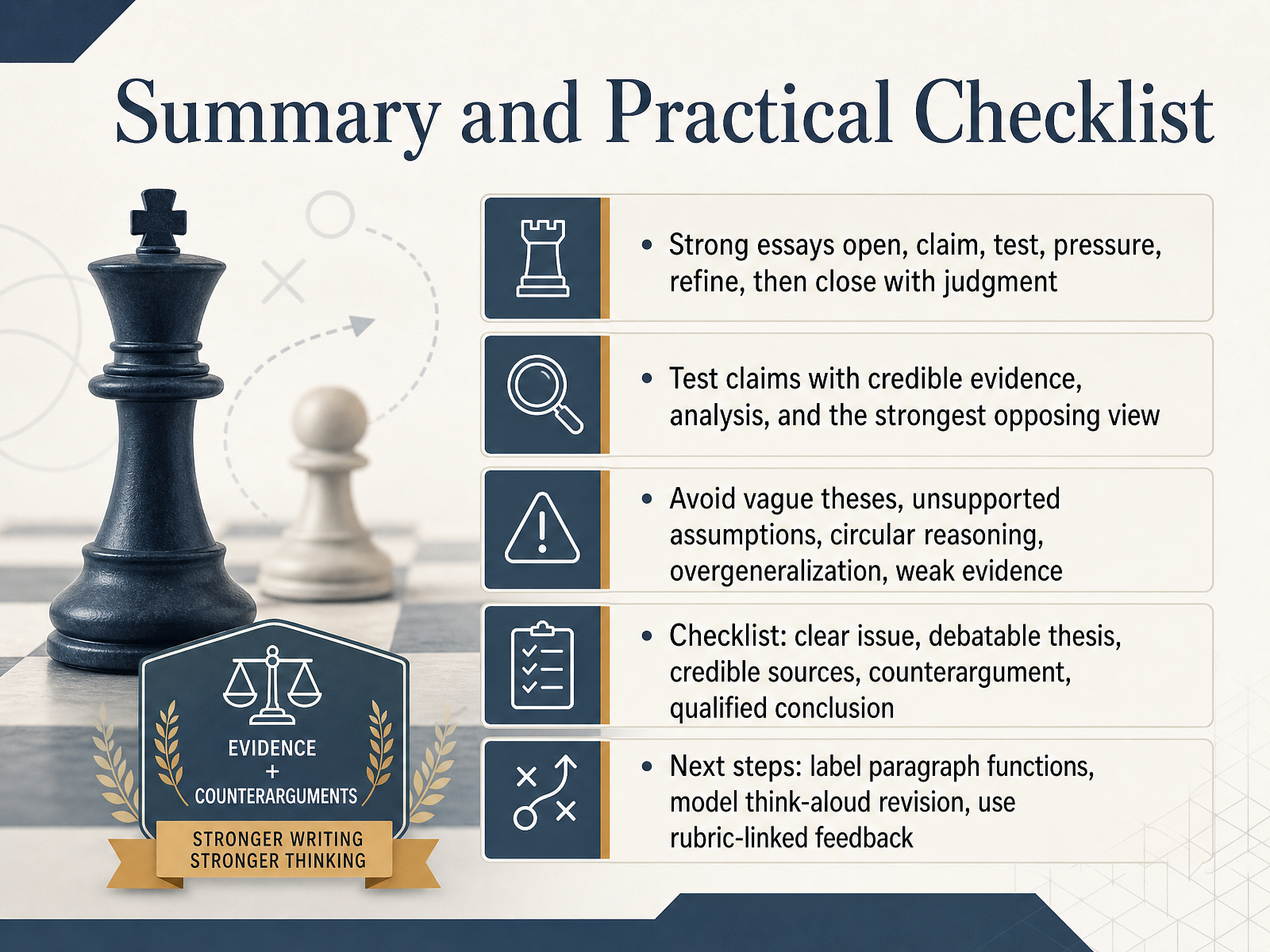
 - 14Summary and Practical ChecklistLet's bring it all together. Strong essays follow a pattern. They open, claim, test, pressure, refine, and then close with judgment. Notice that this sequence is not about adding more reasons. It is about doing different work in each section. Test your claims with credible evidence, real analysis, and the strongest opposing view you can find. Now, the pitfalls. Avoid vague theses. Avoid unsupported assumptions. Avoid circular reasoning, overgeneralization, and weak evidence. Keep this checklist handy. Is there a clear issue? Is your thesis debatable? Are your sources credible? Have you addressed a counterargument? And does your conclusion stay qualified rather than absolute? For next steps, label the function of each paragraph. Model a think-aloud revision so students can see your reasoning. And tie your feedback directly to the rubric. That is how critique becomes a lesson. Thank you for your work here, and keep practicing. Every revision sharpens your judgment.
 berkeleycitycollege.educgcc.edueducate.apsanet.org+22 min
Take the deck with you
Download this course as a file — free, no sign-up needed.
- PDF handoutEvery slide page, ready to print or share.15 pages · 3.8 MBDownload
- Narrated PowerPointThe deck that presents itself — every slide carries the digital human's narration video.15 pages · 13.7 MBDownload
- PowerPoint slidesThe full deck as a .pptx — open it in PowerPoint, Keynote, or Google Slides.15 pages · 3.7 MBDownload
Free to use in your own training — please keep the PersonWise credit page at the end.
Have your own deck? Turn it into a course
Sources consulted
Web sources consulted while building this course.
- Critical Thinking ILO Rubric -- Essays — berkeleycitycollege.edu
- CRITICAL THINKING RUBRIC — cgcc.edu
- Level of Analysis/Evidence Supporting evidence and explanation of key points. — educate.apsanet.org
- CRITICAL THINKING — oecd.org
- Critical Thinking Evaluation Rubric — jalc.edu
- 2.1: Critical Thinking Essay - Humanities LibreTexts — human.libretexts.org
- Essay Writing: Critical Thinking and Arguments — libguides.westminster.ac.uk
- Critical Thinking in College Writing - Writing Center — campus.kennesaw.edu
- Critical writing | Critical thinking — library.leeds.ac.uk
- What is critical writing? - Critical writing — libguides.hull.ac.uk
- Teaching Revision | Texas Gateway — texasgateway.org
- Write a Literary Argument Essay: Analyze a Model | EL Education Curriculum — curriculum.eleducation.org
- Learning to Improve: Using Writing to Increase Critical ... - PMC — pmc.ncbi.nlm.nih.gov
- 4 Steps to Use Example Expository Essays for Successful Writing - Love for Literature — loveforliterature.org
- EL Ed Central 6-8 - EL - G8:M1:U3:L6 — sites.google.com
- How to Write a Critical Thinking Essay with an Example — essaypro.com
- Critical Thinking Essay Structure for Stronger Reasoning — essaypay.com
- Taking a Critical Approach/Critical Appraisal: Critical Writing - LibGuides — libguides.exeter.ac.uk
- Fallacies - The Writing Center — writingcenter.unc.edu
- Common Mistakes to Avoid When Writing a Critical Thinking Essay — ulvixo.com