Begin
14 pages · ~28 min
Firstcry Babyhug Brand Marketing Strategy
This training teaches marketers how to build a brand marketing strategy for Firstcry's Babyhug, covering goal setting, strategic choices, and tradeoffs.
A digital instructor presents all 14 pages. Hold “Ask” at any point and ask out loud — the answer comes from this course. No sign-up needed.
What you’ll learn
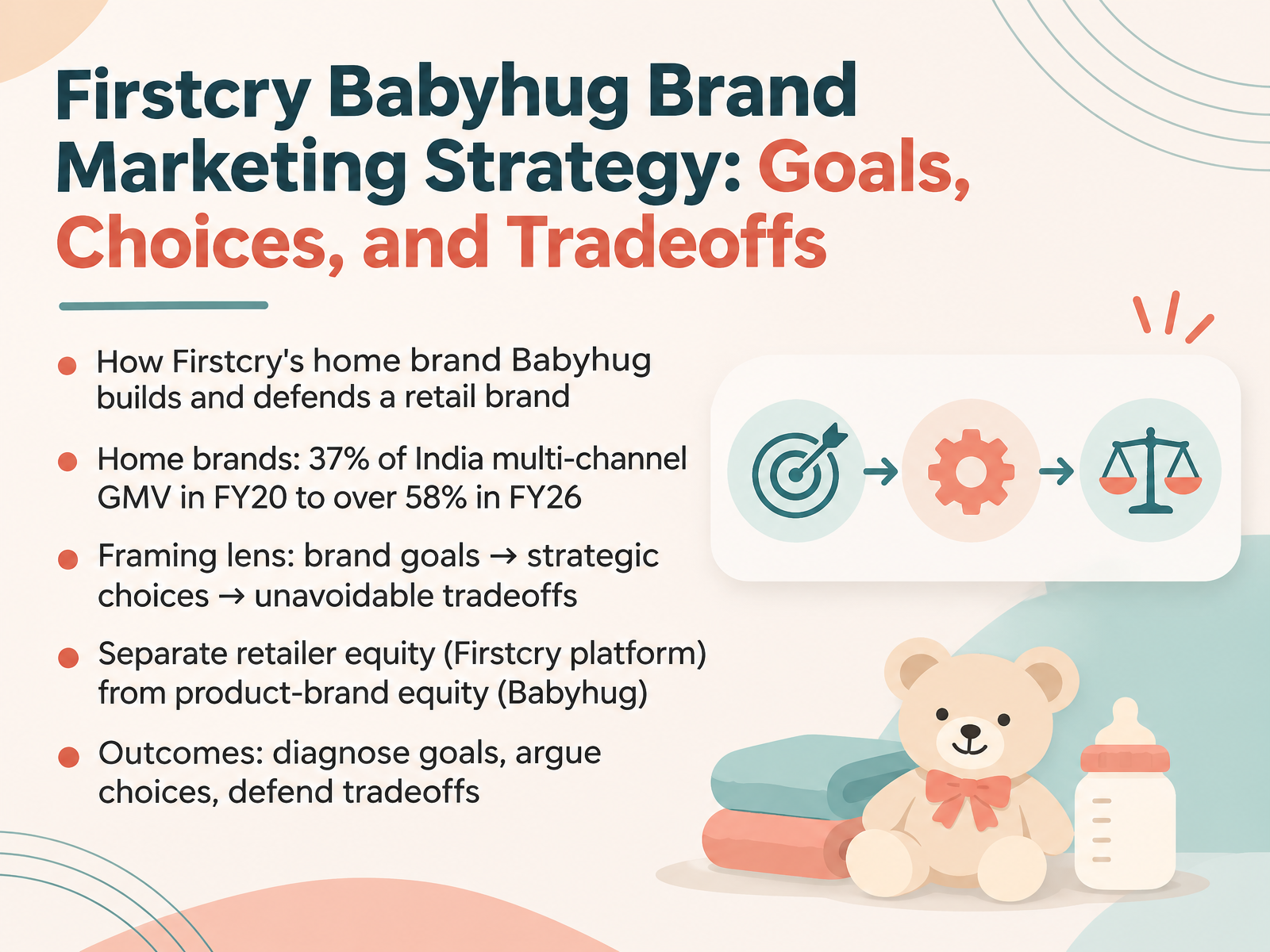
- 01Firstcry Babyhug Brand Marketing Strategy: Goals, Choices, and TradeoffsWelcome. Over the next fourteen slides, we'll work through a single retail question together: how does Firstcry's home brand, Babyhug, build and defend a brand? You already know retail, so we'll treat this as peers analyzing evidence, not a lecture.
Start with the headline number. Home brands accounted for thirty-seven percent of India multi-channel GMV in fiscal twenty twenty, and over fifty-eight percent in fiscal twenty twenty-six. That shift is the case study.
Our framing lens is simple: brand goals, then strategic choices, then the tradeoffs those choices force. Here's a decision rule. Keep retailer equity separate from product-brand equity. Firstcry, the platform, earns trust first. Babyhug, the product brand, borrows it. Confuse the two, and you misread the strategy.
By the end, you should be able to diagnose the goals, argue the choices, and defend the tradeoffs. Next, why analyze Babyhug as a retail brand strategy case.cdn.fcglcdn.comexa.aimedianama.com+22 min
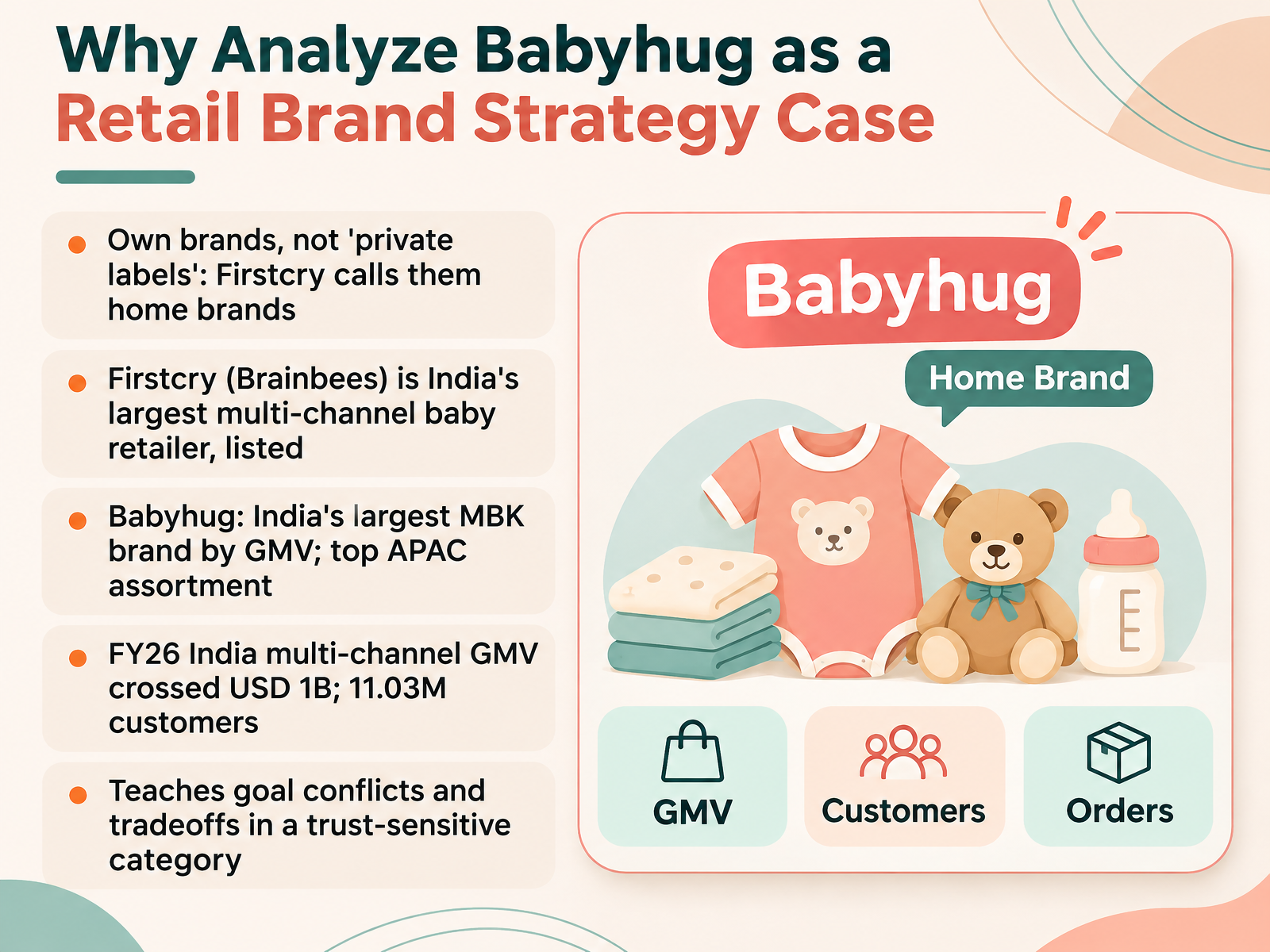
- 02Why Analyze Babyhug as a Retail Brand Strategy CaseLet's start with why this case is worth your time. First, language matters here. Firstcry explicitly rejects the phrase private label and calls these home brands, because the intent is quality and loyalty, not just margin. Second, context. Firstcry, through Brainbees, is India's largest multi-channel baby retailer and it's listed, so we can examine real disclosures. Third, scale of the asset. Babyhug is India's largest mothers', babies' and kids' brand by gross merchandise value, and holds one of the largest assortments in Asia Pacific excluding China. In the 2026 fiscal year, India multi-channel GMV crossed one billion US dollars, with eleven point zero three million annual unique customers. Now the tension worth weighing. Home brands reached over fifty eight percent of that GMV, which lifts margins, yet pushing too far risks narrowing choice and weakening trust with brand partners. Ask yourself where you'd draw that line. That goal conflict is the heart of the case. Next, we set the market context in India's Baby and Maternity Retail Landscape.
 cdn.fcglcdn.comexa.aimedianama.com+22 min
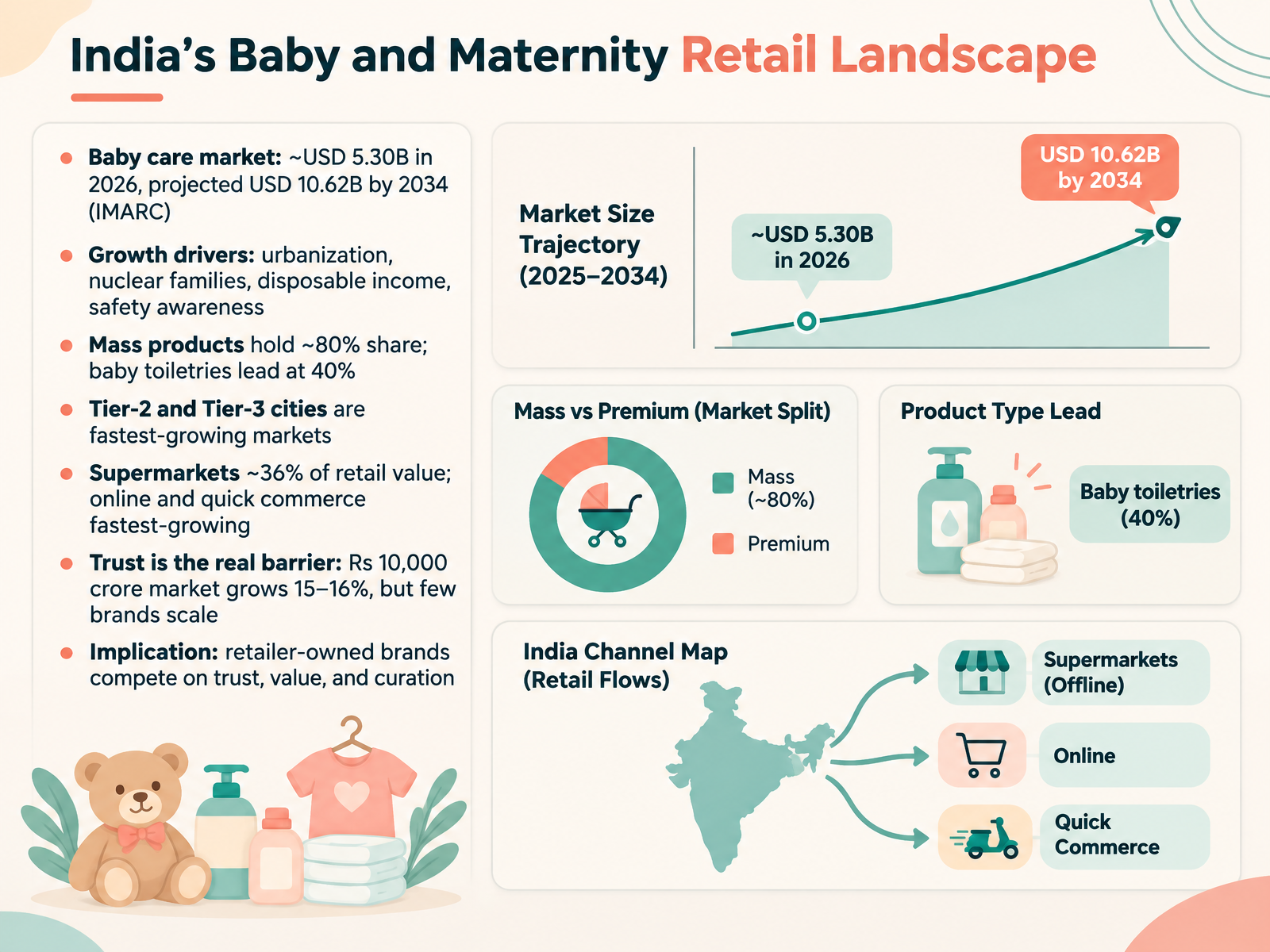
- 03India's Baby and Maternity Retail LandscapeLet's ground the strategy in the market it operates in. India's baby care market is roughly five point three billion dollars in 2026, projected to reach about ten point six two billion by 2034. Growth comes from urbanization, nuclear families, rising disposable income, and sharper safety awareness. Note the structure: mass products hold about eighty percent share, and baby toiletries lead at forty percent. Tier two and tier three cities are the fastest-growing markets. Supermarkets account for roughly thirty-six percent of retail value, while online and quick commerce are growing fastest. Here is the tension worth weighing. It is a ten thousand crore rupee market growing fifteen to sixteen percent a year, yet very few brands scale. The barrier is trust, not demand. Some argue value pricing wins mass share; others argue curation and visible safety claims build trust faster. Weigh the evidence as we go. The implication: retailer-owned brands compete on trust, value, and curation. Next, we examine Firstcry and Babyhug: Brand Architecture and Portfolio Logic.
 imarcgroup.commordorintelligence.comindianretailer.com+22 min
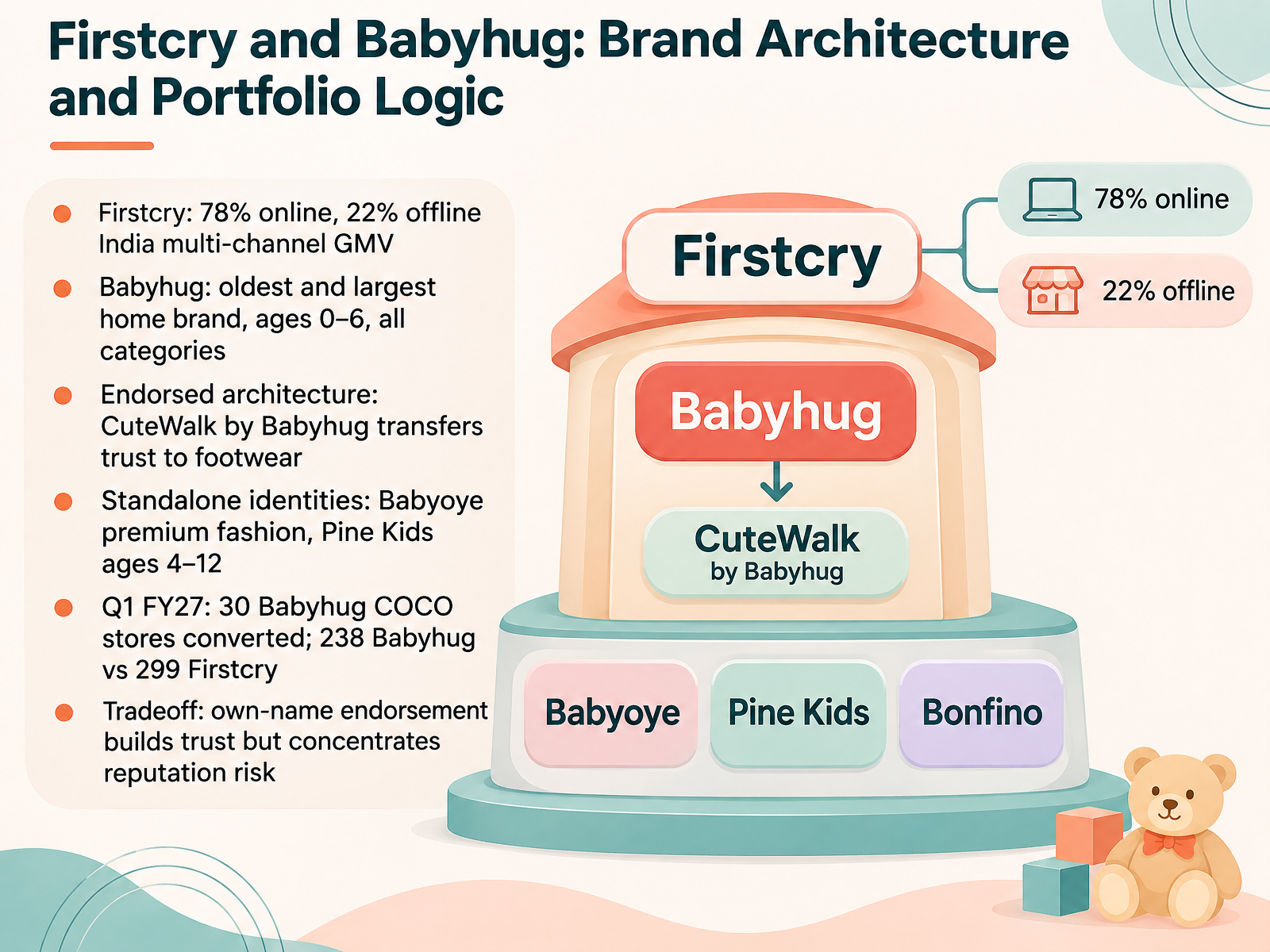
- 04Firstcry and Babyhug: Brand Architecture and Portfolio LogicNow let's look at the portfolio logic behind Firstcry and Babyhug. Firstcry is the platform: seventy-eight percent of India multi-channel GMV comes from online, twenty-two percent from stores. Babyhug is the oldest and largest home brand, serving ages zero to six across every category. Notice the architecture. CuteWalk by Babyhug is an endorsed brand, so footwear inherits trust the parent already has. Babyoye and Pine Kids stand alone, one premium fashion, one for ages four to twelve, so they can occupy distinct positions. And in Q1 FY27, thirty Babyhug company-owned stores were converted to Firstcry: two hundred thirty-eight Babyhug stores versus two hundred ninety-nine Firstcry stores. Here is the tradeoff worth debating. Own-name endorsement transfers trust cheaply, but it concentrates reputation risk: one product failure touches the master brand. Ask yourself where you would draw that line, and why. Next, we examine the strategic goals behind Babyhug.
 cdn.fcglcdn.comfirstcry.comfirstcry.com+21 min
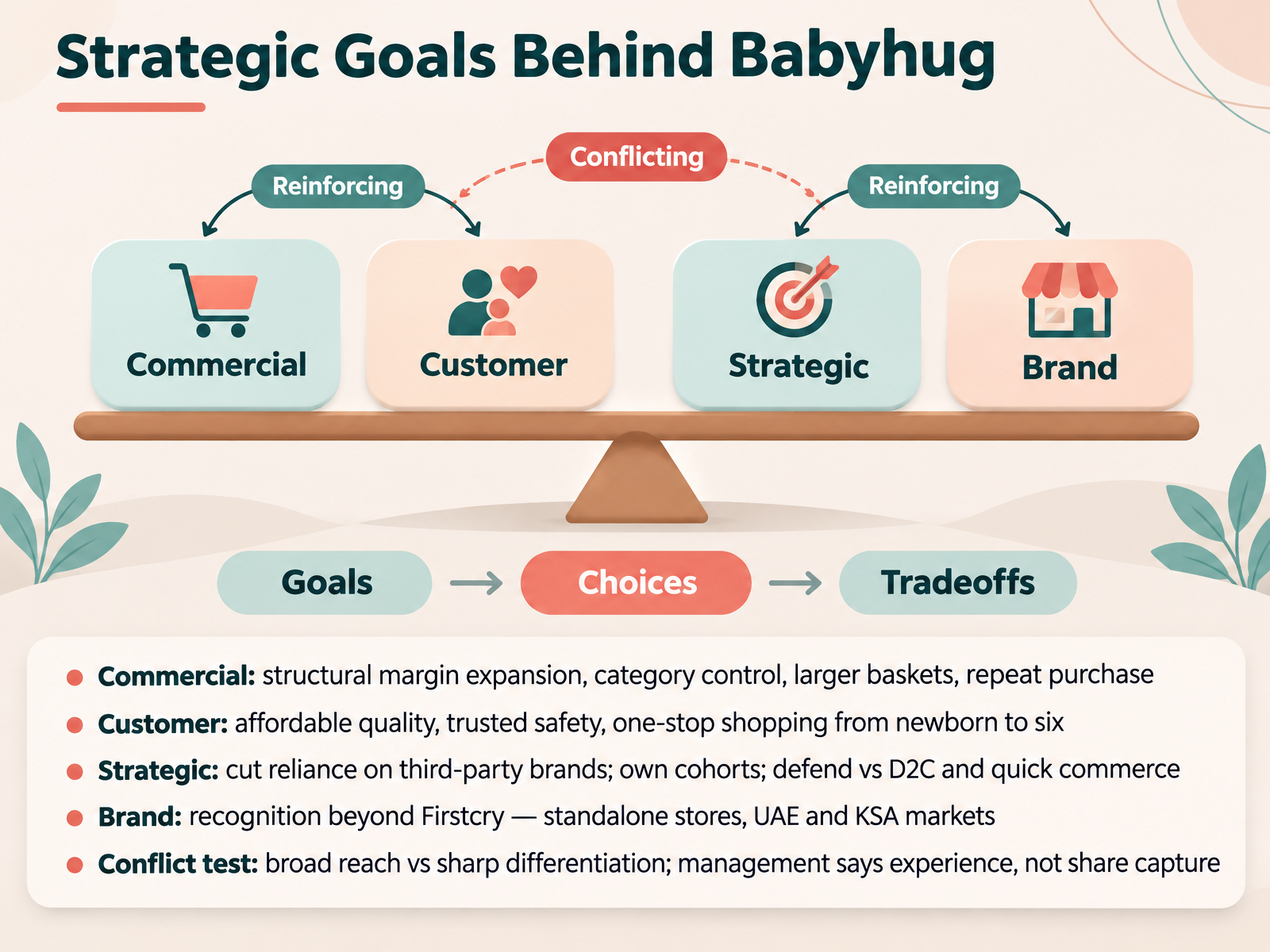
- 05Strategic Goals Behind BabyhugLet's look at what Babyhug is actually expected to deliver. Commercially, it's structural margin expansion, category control, bigger baskets, and repeat purchase. Home brands moved from thirty-seven percent of India multi-channel GMV in twenty twenty to over fifty-eight percent in twenty twenty-six, because they carry better margins than third-party brands. On the customer side, the goals are affordable quality, trusted safety, and one-stop shopping from newborn to age six. Strategically, Babyhug cuts reliance on third-party brands and lets FirstCry own its customer cohorts, which is its defense against D to C brands and quick commerce. On brand, the ambition runs beyond Firstcry itself, through standalone stores and the UAE and KSA markets. Now the conflict test. Broad reach pulls toward third-party assortment and wide appeal. Sharp differentiation pulls toward exclusive Babyhug products. Management resolves this by saying the goal is customer experience, not share capture. That's a judgment call, so weigh the evidence yourself. Next, we move to segmentation, targeting, and positioning choices.
 cdn.fcglcdn.comexa.aimedianama.com+22 min
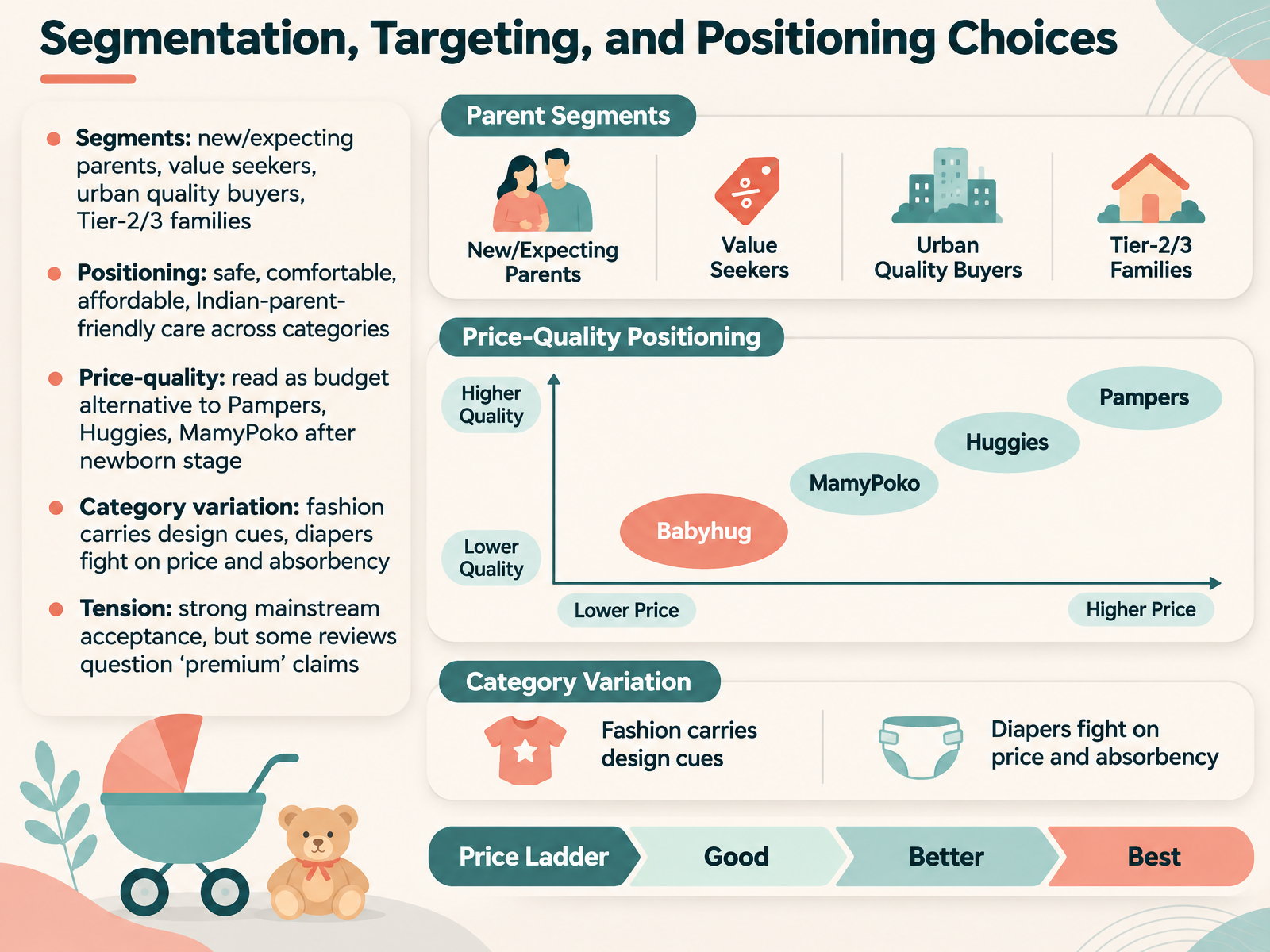
- 06Segmentation, Targeting, and Positioning ChoicesNow, let's talk about segmentation, targeting, and positioning choices. Babyhug serves four distinct segments: new and expecting parents, value seekers, urban quality buyers, and Tier-2 and Tier-3 families. Its positioning centers on safe, comfortable, affordable, Indian-parent-friendly care across categories. Here's a useful decision rule. Look at how price and quality are read by the market. In diapers, many parents treat Babyhug as a budget alternative to Pampers, Huggies, and MamyPoko, especially after the newborn stage. But notice the category variation. Fashion carries design cues and is judged on style and softness, while diapers compete mainly on price and absorbency. Now pause on the tension. Mainstream acceptance is strong, yet some reviews openly question the premium claims, citing build quality or leakage. Is Babyhug premium or affordable? There is no single right answer. Weigh the evidence for each category. Next, we turn to the product and pricing architecture.
 trustpilot.comparenting.firstcry.combabyhug.pissedconsumer.com+22 min
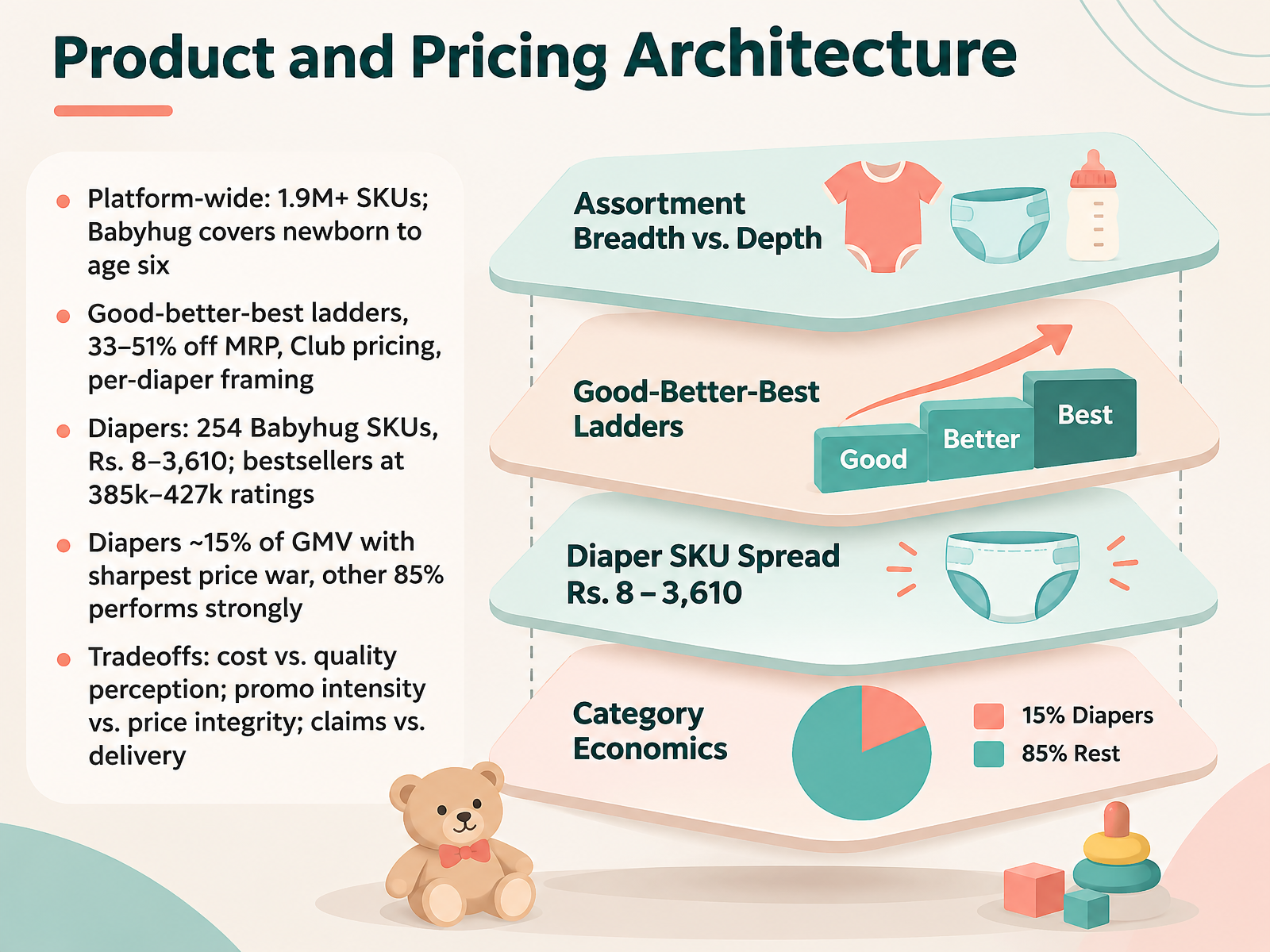
- 07Product and Pricing ArchitectureLet's turn to product and pricing architecture. On the platform, you're looking at roughly one point nine million SKUs, and Babyhug alone spans newborn to age six. The pricing logic is a good-better-best ladder. Products sit at thirty-three to fifty-one percent off list price, with a Club price layered on top, and diapers are reframed per diaper, so parents compare unit cost, not pack size. Diapers illustrate the tension well. Babyhug runs two hundred fifty-four diaper SKUs from eight rupees to three thousand six hundred ten, and bestsellers carry three hundred eighty-five thousand to four hundred twenty-seven thousand ratings. But diapers are only about fifteen percent of GMV, and that is where the price war cuts hardest. The other eighty-five percent, fashion, gear, nursery, toys, performs strongly. So weigh three tradeoffs. Cost versus quality perception. Promo intensity versus price integrity. And marketing claims versus delivery. Notice there is no single right answer here. Each choice buys something and costs something. Let's move on to channel and distribution choices.
 cdn.fcglcdn.comfirstcry.comfirstcry.com+22 min
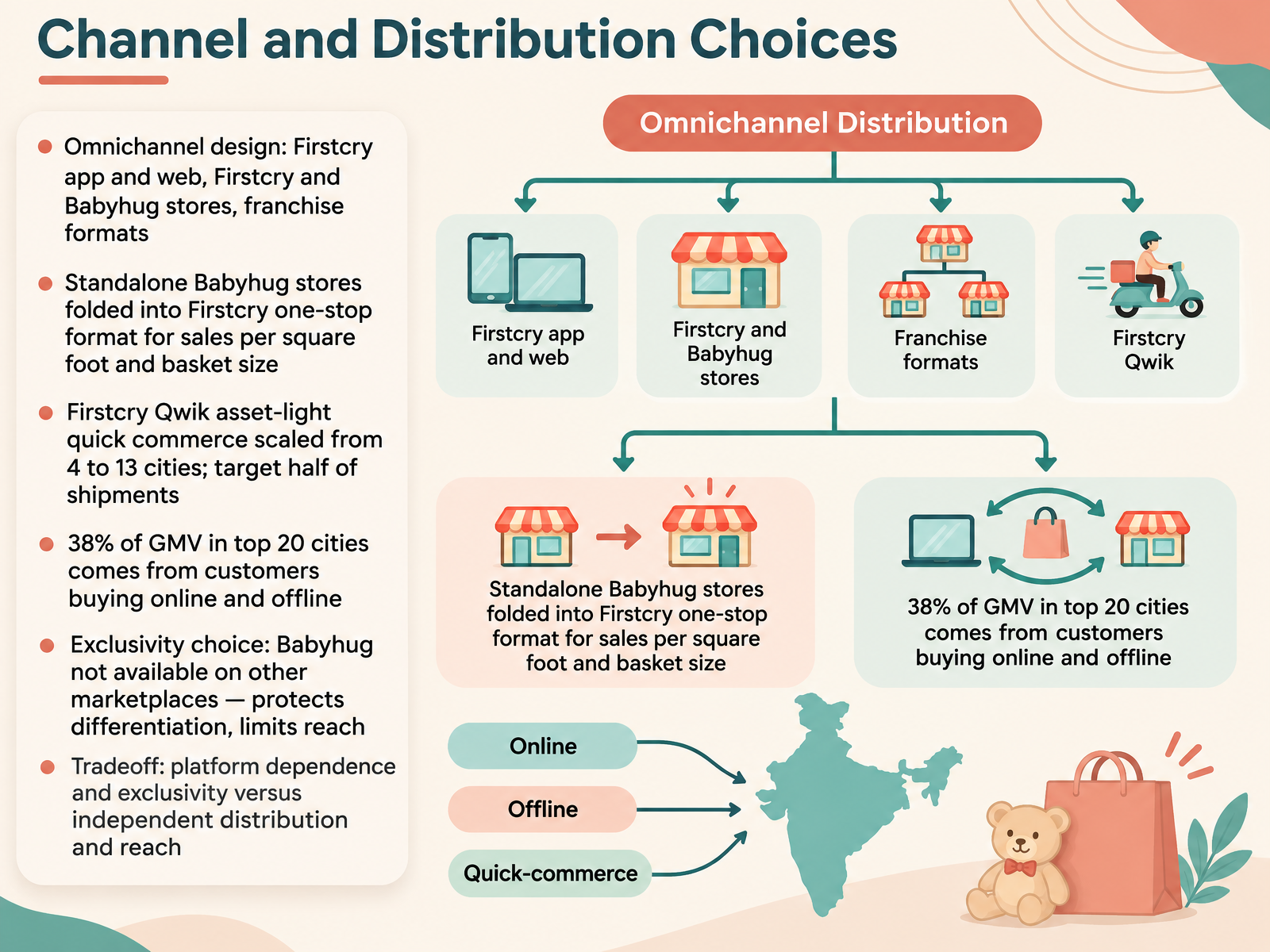
- 08Channel and Distribution ChoicesNow let's examine channel and distribution choices. Firstcry runs a genuinely omnichannel model: app and web, Firstcry and Babyhug stores, plus franchise formats. One deliberate move was folding standalone Babyhug stores into the Firstcry one-stop format. Management expects better sales per square foot and larger baskets, because parents buy Babyhug alongside other brands in one visit. Then there's speed. Firstcry Qwik is asset-light quick commerce, using existing stores and logistics, scaled from four cities to thirteen, with a target of covering half of shipments. Notice the evidence for integration: in the top twenty cities, thirty-eight percent of GMV comes from customers buying both online and offline. Finally, the exclusivity choice. Babyhug is not sold on other marketplaces. That protects differentiation and margin, but limits reach. Weigh that tension yourself: platform dependence and exclusivity versus independent distribution and reach. Next, we turn to Communication, Promotion, and Trust Building.
 medianama.comcdn.fcglcdn.comcdn.fcglcdn.com+22 min
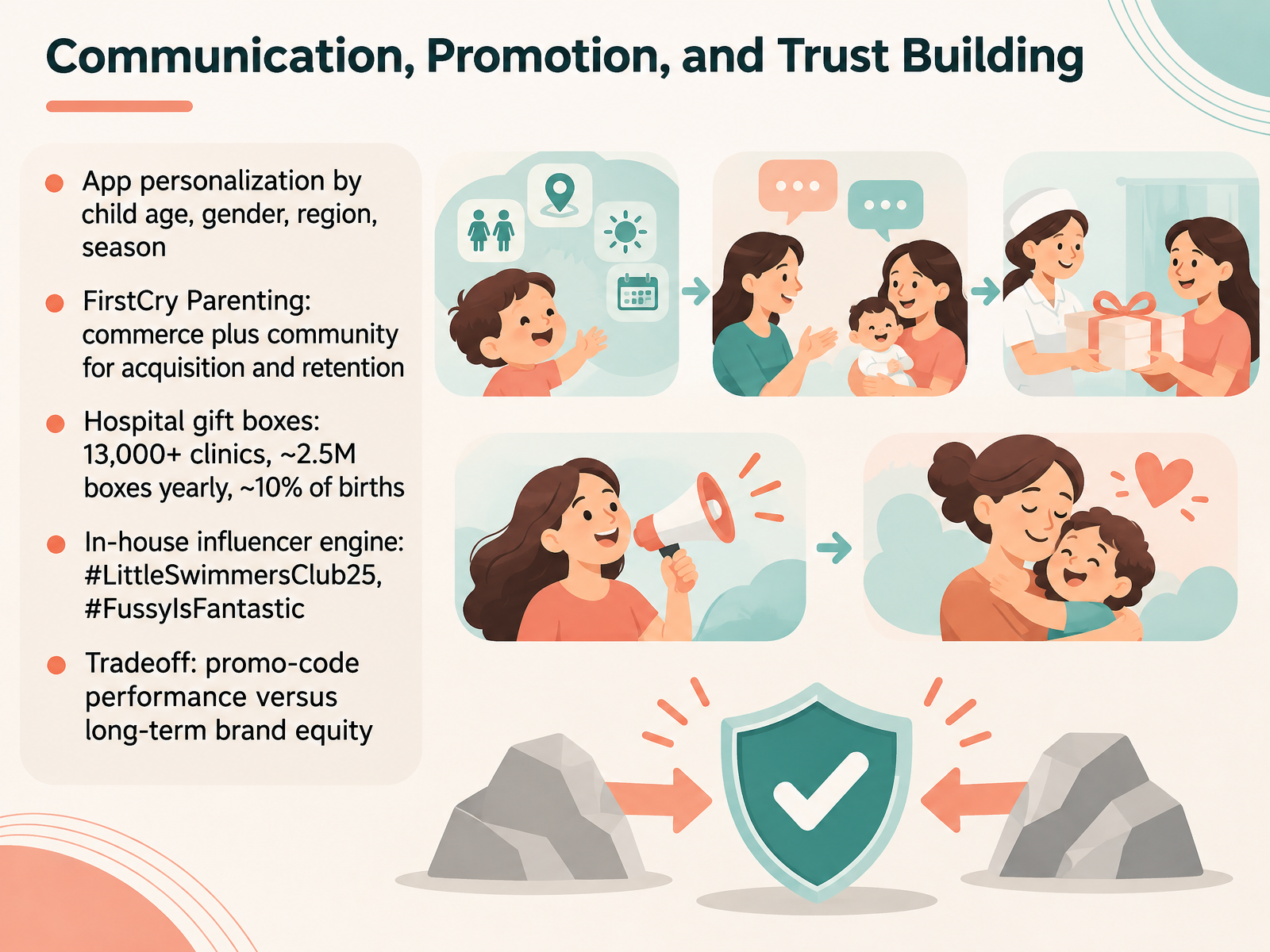
- 09Communication, Promotion, and Trust BuildingNow let's look at how FirstCry and Babyhug build communication and trust. The app personalizes by the child's age, gender, region, and season. A mother of a six-month-old girl sees a different homepage than a mother of a ten-year-old boy. Then FirstCry Parenting blends commerce with community, driving both acquisition and retention. The hospital gift box program covers over thirteen thousand clinics, distributing roughly two and a half million boxes a year, about ten percent of births in India. And the in-house influencer engine runs campaigns like Little Swimmers Club and Fussy Is Fantastic. Here is the tension to weigh. Promo codes drive measurable short-term sales, as we saw with creator-specific discount codes. But heavy discounting can erode long-term brand equity. Ask yourself where you would draw that line. Next, we examine the key tradeoffs and reputation risks in the Babyhug model.
 cdn.fcglcdn.comcdn.fcglcdn.commedianama.com+21 min
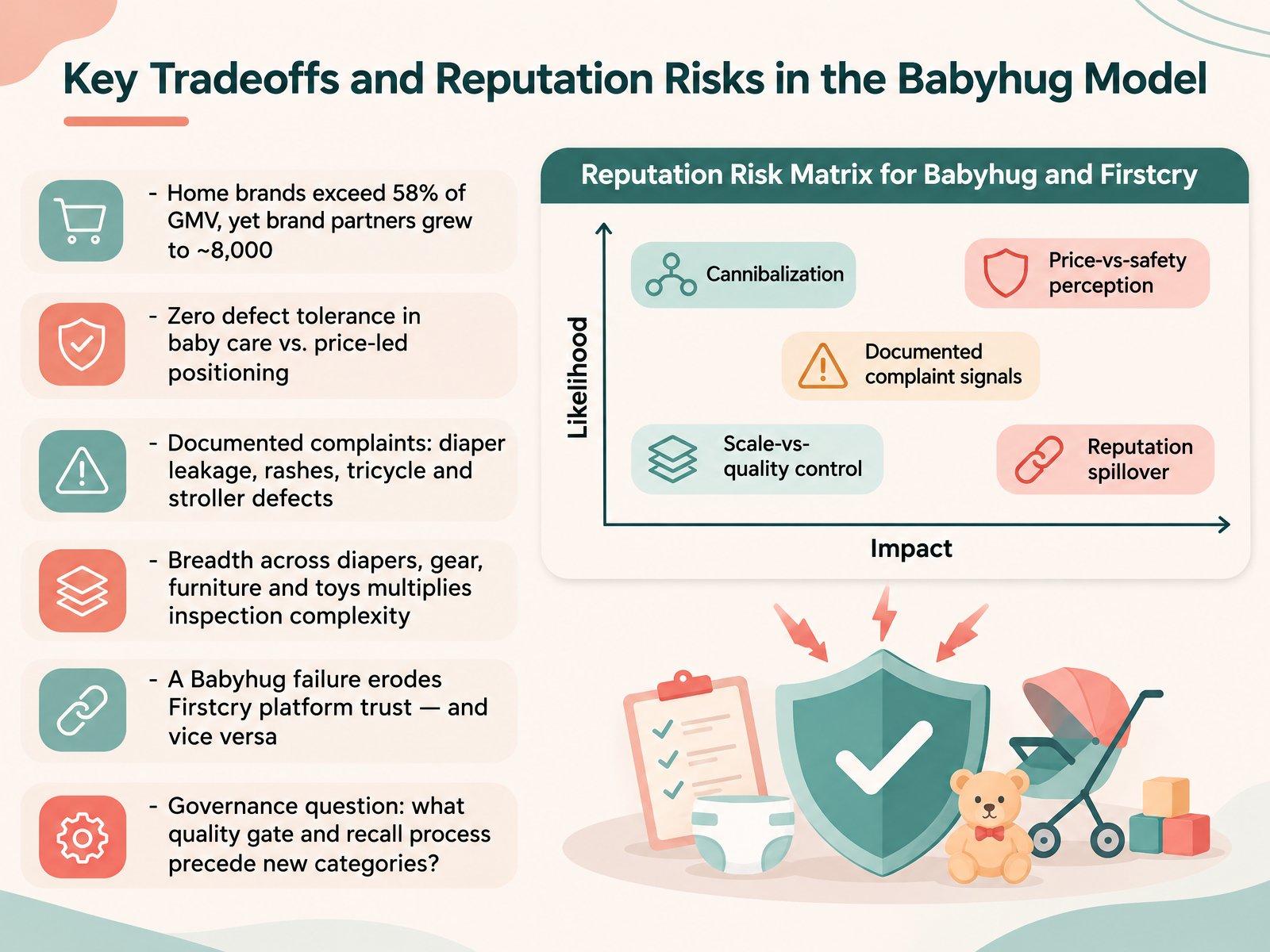
- 10Key Tradeoffs and Reputation Risks in the Babyhug ModelLet's turn now to the tradeoffs and reputation risks inside the Babyhug model. First, the structural tension. Home brands contribute over fifty-eight percent of India multi-channel GMV, yet Firstcry still works with roughly eight thousand brand partners. That balance protects choice, but every home-brand gain raises the question of how neutral the platform looks to partners. Second, quality expectations. Parents apply zero-defect tolerance to baby care, especially diapers and gear, while Babyhug competes partly on price. Documented complaints include diaper leakage, rashes, and defects in tricycles and strollers. Third, complexity. Breadth across diapers, gear, furniture, and toys multiplies the number of suppliers and inspection points a single quality gate must cover. Fourth, spillover. A Babyhug failure erodes trust in Firstcry, and a Firstcry service failure stains Babyhug. So the governance question is concrete. What quality gate and recall process must a category clear before launch? Weigh the margin case against the trust case rather than assuming one answer. Next, we look at performance signals and competitive response.
 trustpilot.comparenting.firstcry.combabyhug.pissedconsumer.com+22 min
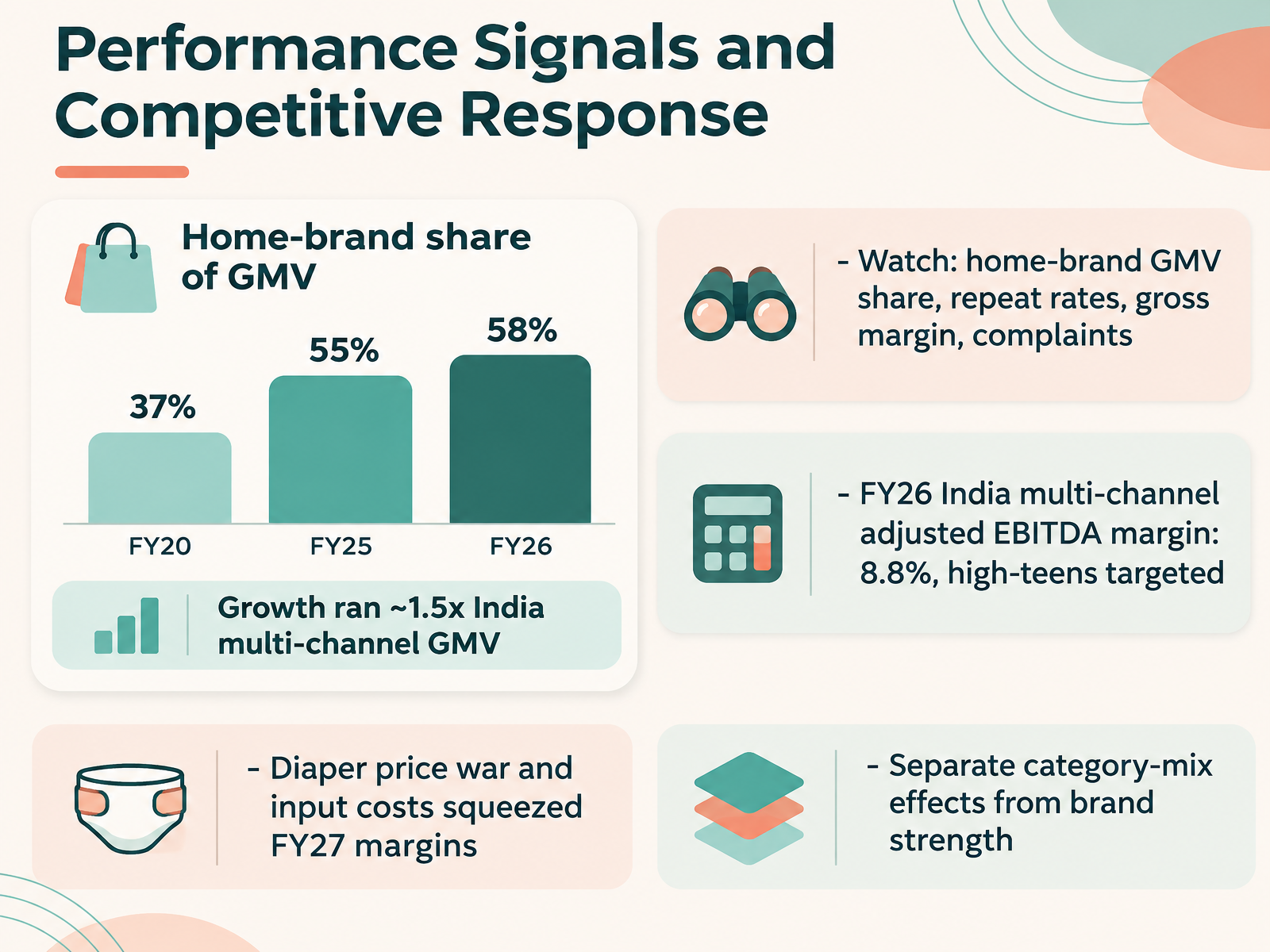
- 11Performance Signals and Competitive ResponseLet's turn to how we read performance signals and competitive response. Track four numbers together: home-brand share of GMV, repeat rates, gross margin, and complaints. Home-brand share rose from thirty-seven percent in FY twenty to fifty-five percent in FY twenty-five, and over fifty-eight percent in FY twenty-six, growing at roughly one point five times India multi-channel GMV. Here is the tension. FY twenty-six India multi-channel adjusted EBITDA margin was eight point eight percent, with high-teens targeted. Yet in FY twenty-seven, a diaper price war and higher input costs squeezed margins. Diapers are largely third-party and about fifteen percent of GMV, so that pressure is partly category mix, not brand weakness. Separate those effects before judging Babyhug's strength. That leads us into premiumization and portfolio extension.
 cdn.fcglcdn.comexa.aimedianama.com+22 min
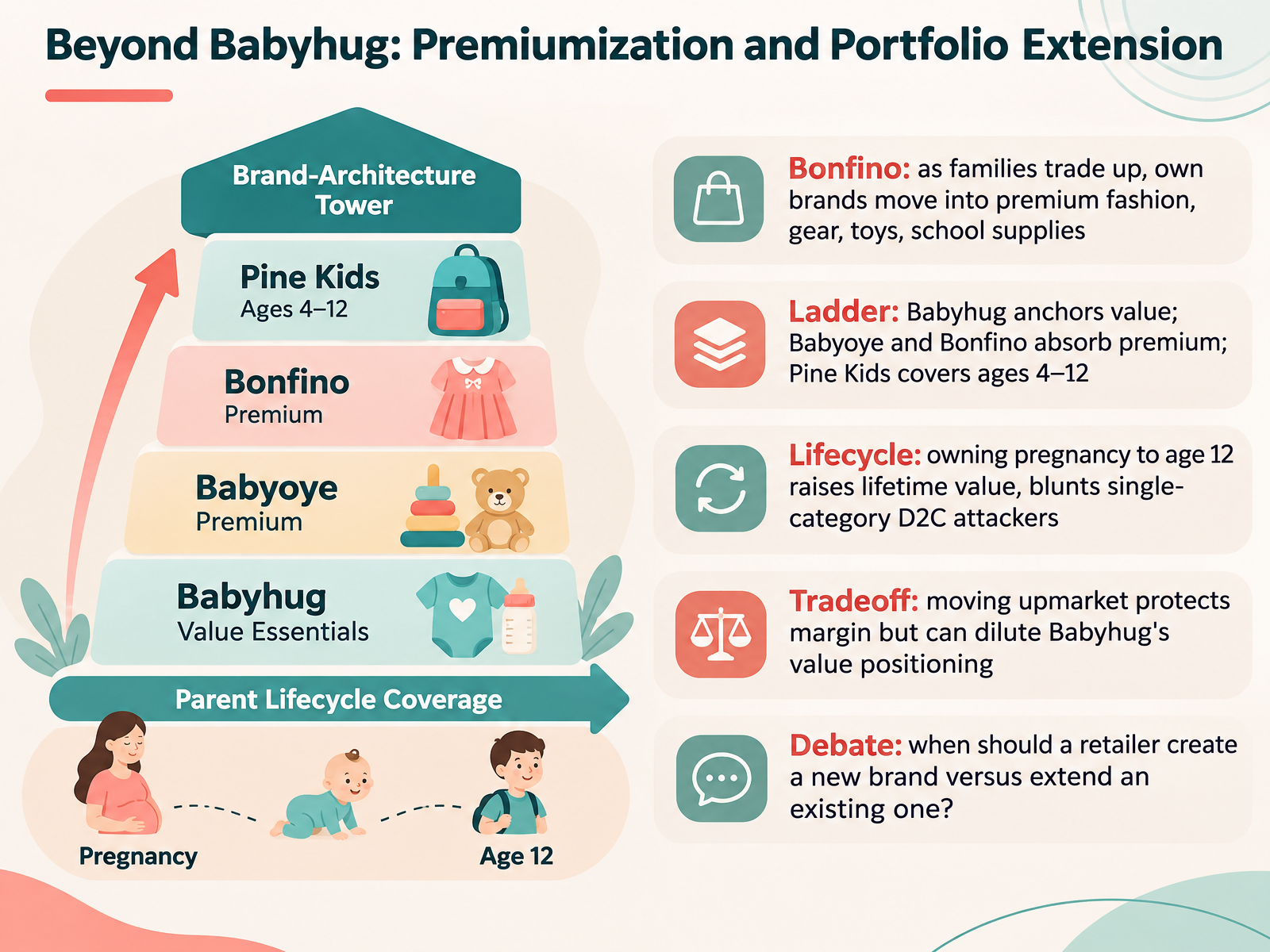
- 12Beyond Babyhug: Premiumization and Portfolio ExtensionLet's move from strategy to portfolio. Premiumization is the next decision. As Indian families trade up, FirstCry is pushing Bonfino into premium fashion, gear, toys, and school supplies. Why a separate name? Because Babyhug carries a value promise. Stretch it upward and you risk confusing the shopper who trusts it for price. So the ladder is deliberate. Babyhug anchors value. Babyoye and Bonfino absorb premium demand. Pine Kids covers ages four to twelve. That lifecycle coverage, from pregnancy to age twelve, raises lifetime value and blunts single-category direct-to-consumer attackers. But name the tension plainly. Moving upmarket protects margin, yet it can dilute Babyhug's value positioning. So the real debate is this. When should a retailer create a new brand versus extend an existing one? Weigh the evidence. Next, we move into Workshop: Diagnosing Goals, Choices, and Tradeoffs.
 cdn.fcglcdn.comexa.aimedianama.com+22 min
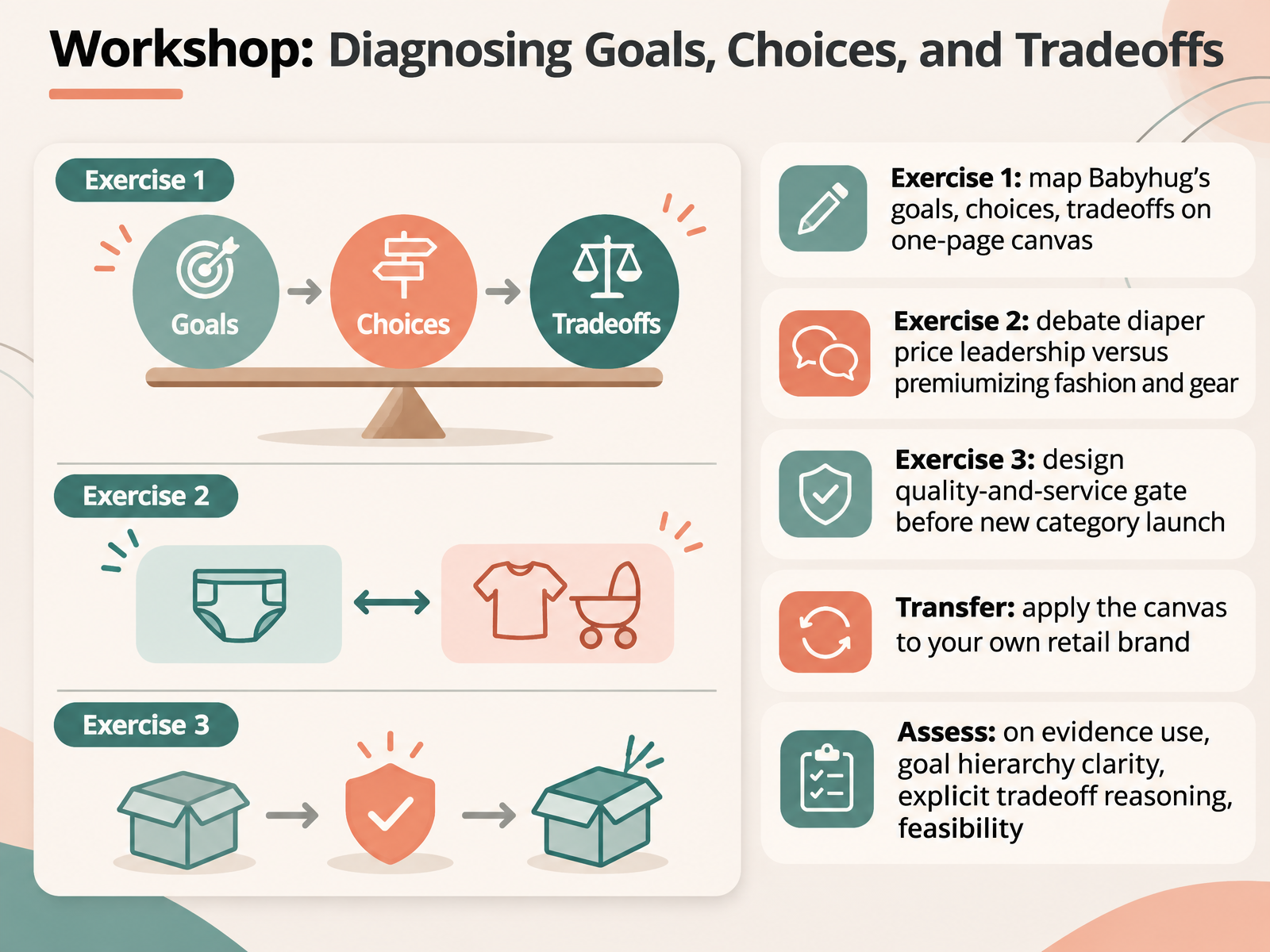
- 13Workshop: Diagnosing Goals, Choices, and TradeoffsNow let's put the framework to work. This slide is a workshop, so you will be doing the analysis. Exercise one: capture Babyhug's goals, choices, and tradeoffs on a single-page canvas. Keep it tight, one page forces hierarchy. Exercise two: debate diaper price leadership against premiumizing fashion and gear. Name the tension, and argue it with evidence. Note that diapers are roughly fifteen percent of gross merchandise value and have faced heavy competitive discounting, while fashion is the largest category and carries home-brand margin. Exercise three: design a quality and service gate before any new category launch. Ask what defect rate, return rate, and service response time a new category must clear first. Then transfer the canvas to your own retail brand. You will be assessed on four things: use of evidence, clarity of goal hierarchy, explicit tradeoff reasoning, and feasibility. Take a position, then show what you would give up to hold it. Next, we'll close with the takeaways and decision checklist for brand strategists.
 cdn.fcglcdn.comexa.aimedianama.com+22 min
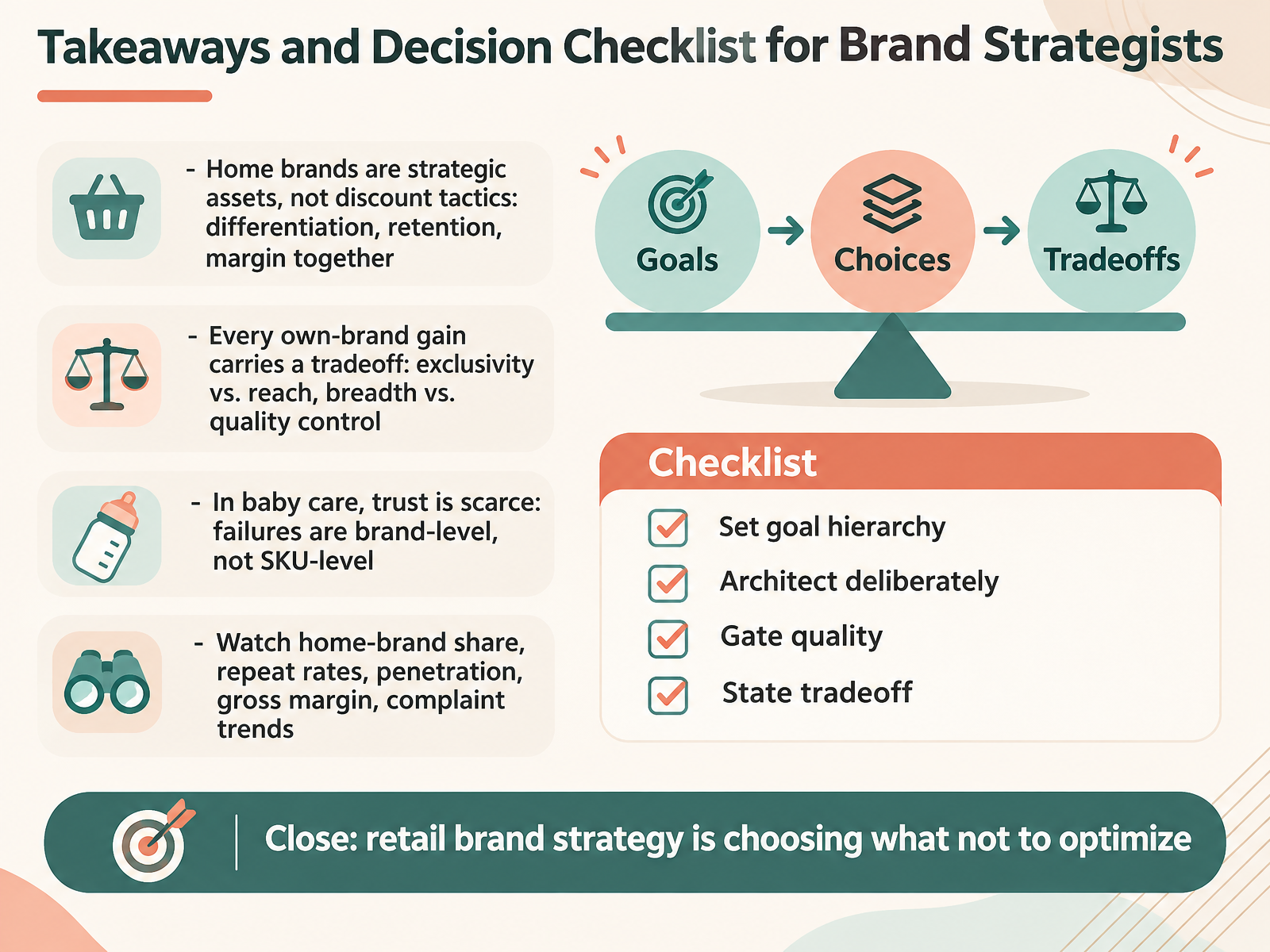
- 14Takeaways and Decision Checklist for Brand StrategistsLet's close with the takeaways. First, treat home brands as strategic assets, not discount tactics. At FirstCry, home brands like BabyHug moved from thirty-seven percent of India multi-channel GMV in fiscal twenty twenty to over fifty-eight percent, and management ties that to differentiation, retention, and structural margin together, not price alone. Second, every own-brand gain carries a tradeoff. Exclusivity builds loyalty but narrows reach, and breadth across categories grows share but strains quality control. Name that tension rather than hiding it. Third, in baby care, trust is scarce. A product failure is brand-level, not SKU-level, so one bad cot or diaper complaint can damage the mother's trust in the whole platform. Fourth, watch home-brand share, repeat rates, penetration, gross margin, and complaint trends together. So here is the checklist: set your goal hierarchy, architect deliberately, gate quality hard, and state your tradeoff explicitly. And the closing idea: retail brand strategy is choosing what not to optimize. Thank you for working through this with me. Take the checklist into your next brand review, and trust your evidence over the easy answer.
 cdn.fcglcdn.comexa.aimedianama.com+22 min
Take the deck with you
Download this course as a file — free, no sign-up needed.
- PDF handoutEvery slide page, ready to print or share.15 pages · 3.6 MBDownload
- Narrated PowerPointThe deck that presents itself — every slide carries the digital human's narration video.15 pages · 26.0 MBDownload
- PowerPoint slidesThe full deck as a .pptx — open it in PowerPoint, Keynote, or Google Slides.15 pages · 3.5 MBDownload
Free to use in your own training — please keep the PersonWise credit page at the end.
Have your own deck? Turn it into a course
Sources consulted
Web sources consulted while building this course.
- Bringing — cdn.fcglcdn.com
- FIRSTCRY Earnings Call Transcript — Fiscal Q4 2025 — exa.ai
- FirstCry’s New Strategy Targets Margins and Faster Delivery — medianama.com
- For Brainbees Solutions Limited — cdn.fcglcdn.com
- Sub: Transcript of the Audio-Video Earnings Call | Quarter ended June 30, 2025 results — cdn.fcglcdn.com
- India Baby Care Products Market Size & Forecast to 2034 — imarcgroup.com
- India Baby Care Products - Market Size & Outlook — mordorintelligence.com
- India’s Baby-Care Market Moves Beyond Basics - Indian Retailer — indianretailer.com
- Baby and Child-Specific Products in India — marketresearch.com
- India Baby Products Market Outlook, 2033 — grandviewresearch.com
- TO PARENTING — cdn.fcglcdn.com
- Babyhug Diapers: Buy Babyhug Baby Diapers Online at Best Price — firstcry.com
- Buy Babyhug Baby Gear Products Online - FirstCry.com — firstcry.com
- Babyhug - India's Largest Baby Products Brand | Trusted by Moms — babyhug.in
- Sub: Transcript of the Audio-Video Earnings Call | Q4 and Financial Year ended March 31, 2025 results — cdn.fcglcdn.com
- Babyhug Reviews | Read Customer Service Reviews of babyhug.in — trustpilot.com
- baby hug products – FirstCry Parenting — parenting.firstcry.com
- 228 Babyhug Reviews | babyhug.in @ PissedConsumer — babyhug.pissedconsumer.com
- Best Diaper Brands in India (2026): Honest Parent Reviews & Comparison - Fabulous Mom Life — fabulousmomlife.com
- Bad product quality. Review on Babyhug — mouthshut.com