API Style Guide Principles
Begin
14 pages · ~28 min
API Style Guide Principles
This training explains the principles behind API style guides and the outcomes of following them, helping developers and teams create consistent, maintainable, and scalable APIs.
What you’ll learn
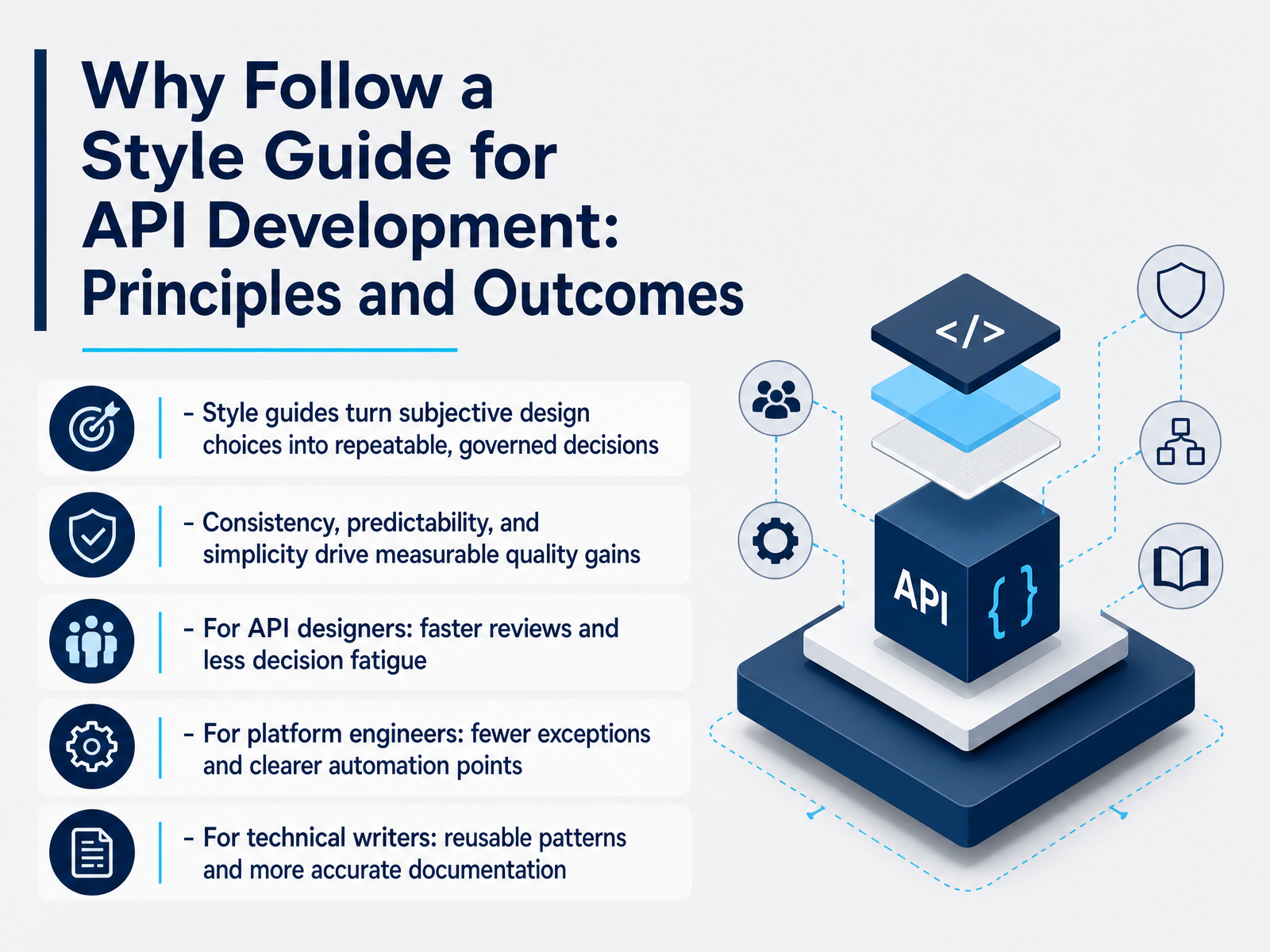
- 01Why Follow a Style Guide for API Development: Principles and OutcomesWelcome. We are going to talk about something that sounds administrative but is actually deeply practical: why your team should follow an API style guide. We are not here to discuss documentation for its own sake. We are here to talk about measurable quality outcomes. A style guide turns subjective design into repeatable, governed decisions. It gives you consistency, predictability, and simplicity. That directly reduces decision fatigue for designers and speeds up reviews. For platform engineers, it means fewer exceptions to handle and clearer automation points. For technical writers, it creates reusable patterns that make documentation more accurate and easier to maintain. Without a shared standard, every new endpoint is a new debate. That is expensive. With one, the choices are already made, and your tooling can enforce them. The goal here is not uniformity for uniformity’s sake. It is a dependable system that lets your team move faster with confidence. So let’s dig into why inconsistency becomes a governance problem in the first place.qaskills.shapidog.comapi-documentation-hub.com+22 min
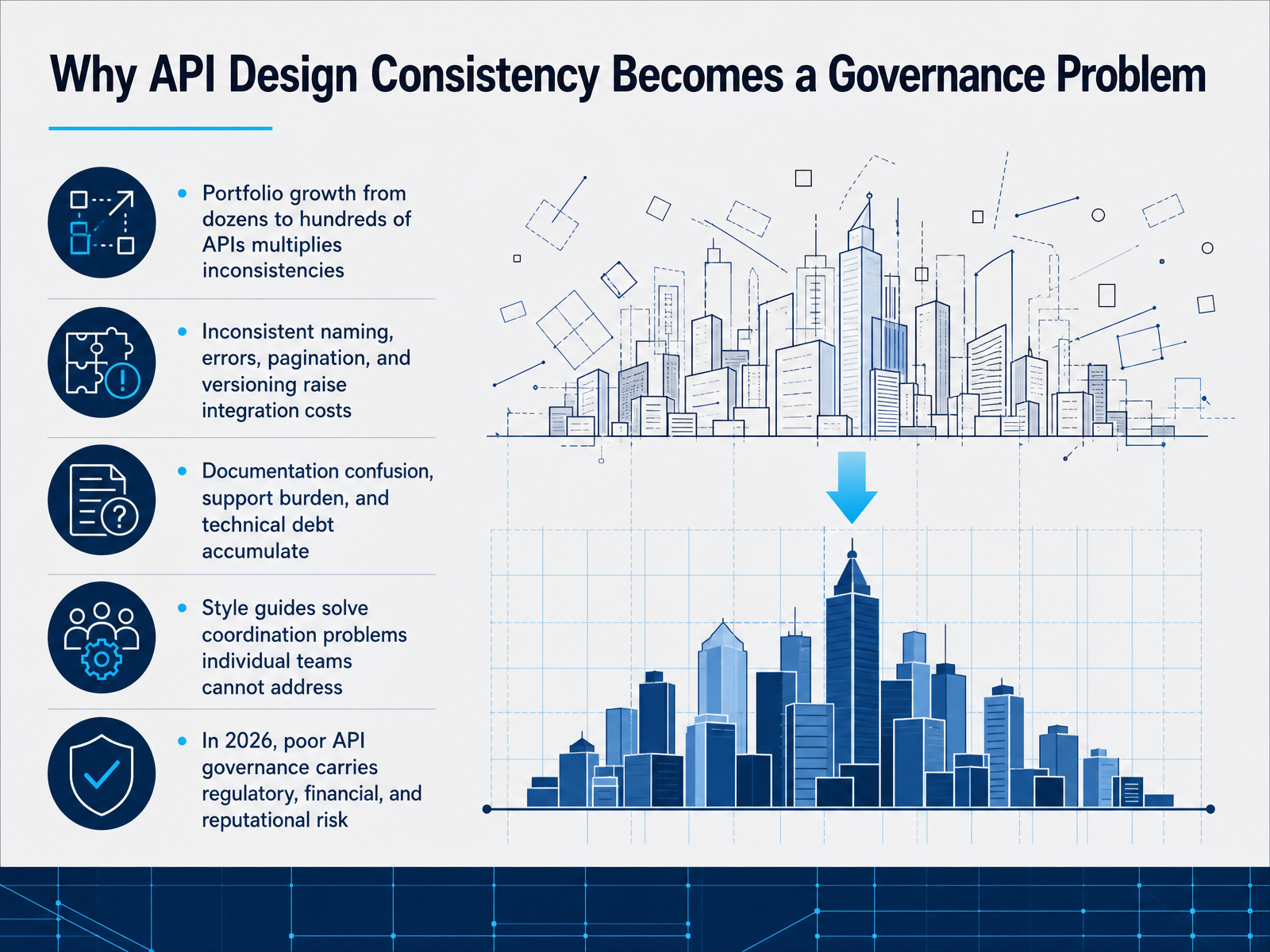
- 02Why API Design Consistency Becomes a Governance ProblemLet’s start with a scenario most of us have seen. Your organization grows from a handful of APIs to hundreds. Early on, each endpoint gets built to fit a single team’s needs. Inconsistent naming, error models, and pagination patterns start to compound. It might look harmless at the interface level. But every inconsistency raises integration costs. Documentation becomes confusing. Support tickets multiply. And technical debt accumulates far faster than any single team can address it. This is precisely why a style guide matters. It is not a set of rules to constrain you. It is the coordination mechanism individual teams cannot build on their own. When we fail to coordinate, the consequences are not abstract. By 2026, poor API governance carries definite regulatory, financial, and reputational risk. A single undocumented breaking change can halt revenue. A misconfigured authentication scheme can expose sensitive data across dozens of downstream consumers. That is what makes consistency a governance problem, not just a design preference. The cost of inconsistency is silent; the payoff of coordination is compounding. Next, let’s look at what an API style guide actually governs.
 stoplight.iodev.toletsbuildsolutions.com+22 min
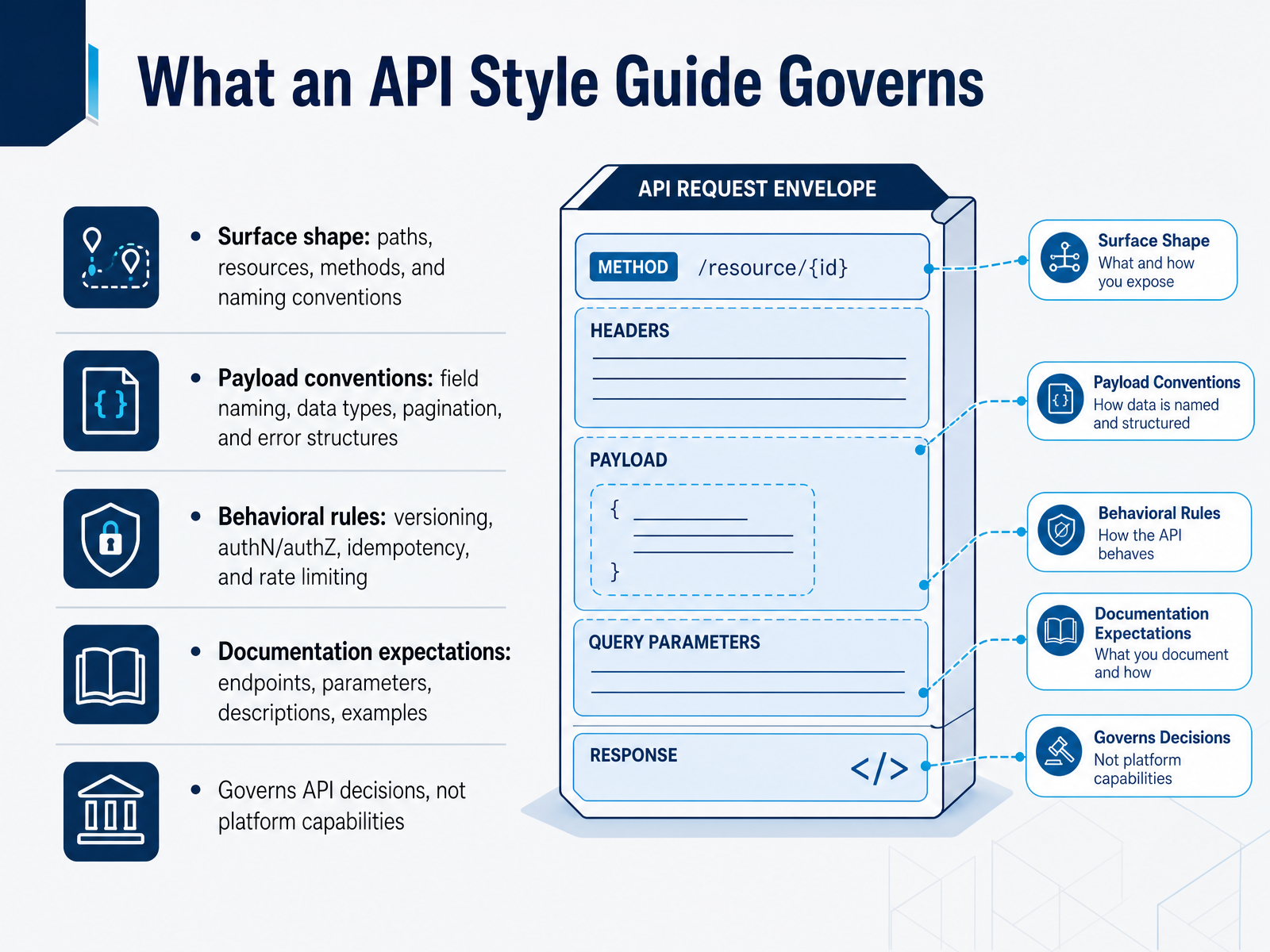
 - 03What an API Style Guide GovernsLet’s be precise about what a style guide actually controls. It governs the shape of your API surface—paths, resources, methods, and naming. These decisions determine guessability and integration speed. It also governs payload conventions: field naming, data types, pagination schemes, and the structure of errors. When clients can rely on one error shape across endpoints, they write one handler instead of many. Behavioral rules matter too. Versioning strategy, authentication and authorization patterns, idempotency, and rate limiting are all defined here. Documentation expectations close the loop: every endpoint needs parameters, descriptions, and realistic examples. That is how you avoid documentation debt that goes stale within weeks. One distinction is critical. A style guide governs API decisions, not platform capabilities. It defines how you design the contract, not what infrastructure you run behind it. Keep the guide focused on the interface your consumers depend on. That separation is what makes the rules enforceable and reviewable without coupling to implementation choices. So when your next design review asks whether a choice is governed, the answer lives in these four areas or it does not belong in the guide. Next, we look at the difference between a policy and a rule, and why conflating them breaks governance programs.
 github.comjsonic.iogithub.com+21 min
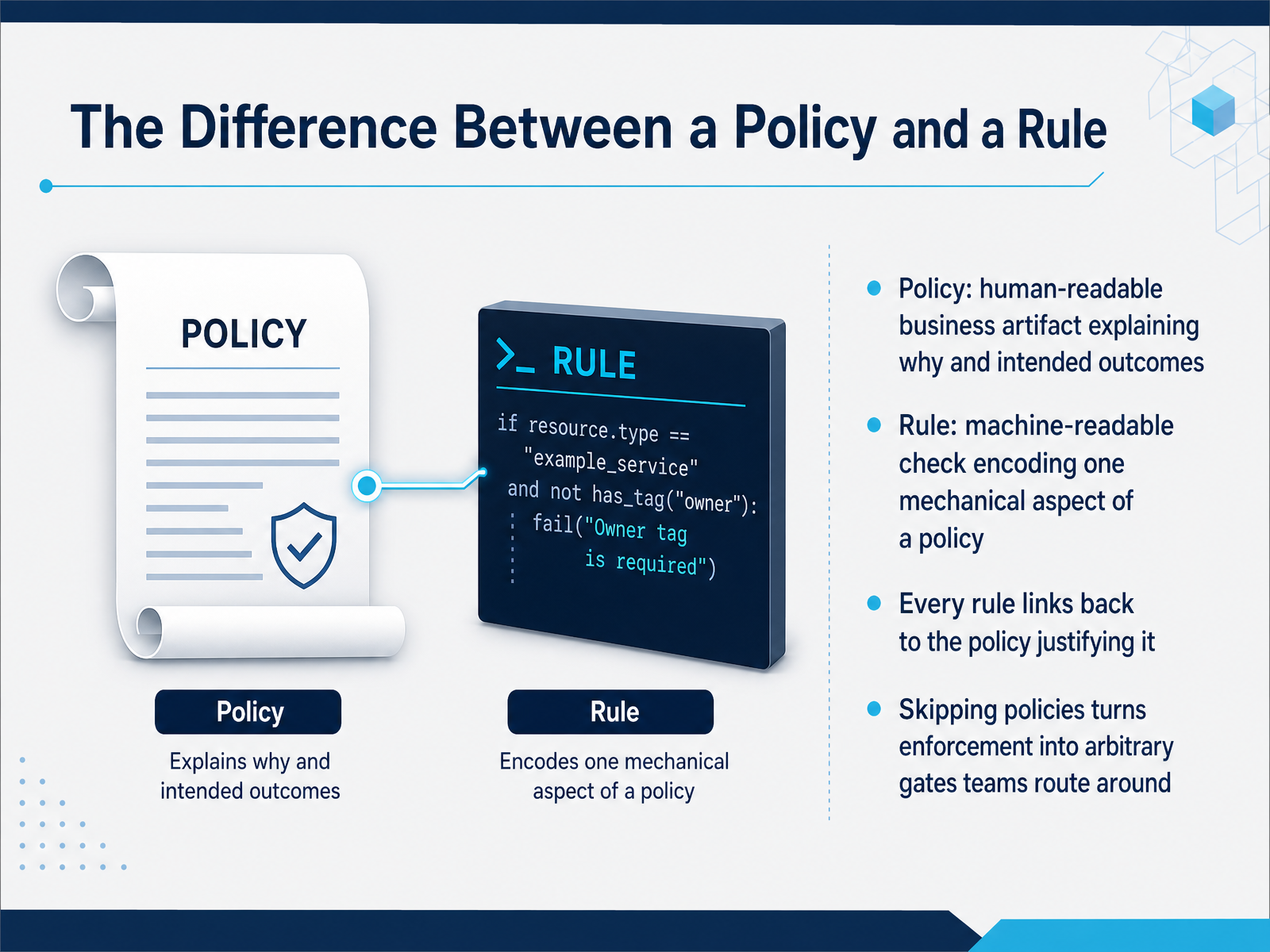
 - 04The Difference Between a Policy and a RuleHere is a distinction worth making carefully: the difference between a policy and a rule. A policy is a human-readable business artifact. It explains why you care about something and what outcome you are trying to drive. A rule, on the other hand, is machine-readable. It encodes one mechanical aspect of a policy, and it runs in your tooling. Now, the critical part: every single rule must link back to the policy that justifies its existence. That link is what lets a product manager understand why a build failed. It is also what lets an engineer see the business intent behind a linting error, instead of resenting it. If you skip the policy layer, your enforcement becomes an arbitrary gate. And when that happens, teams will find ways to route around it. They will override warnings, they will silence the linter, they will request exceptions at scale. What you want is governance that feels like a shared agreement, not a speed bump. The rule tells you the what. The policy tells you the why. You need both. With that foundation in place, let us look at the core principles behind effective style guides.
 stoplight.iodev.toletsbuildsolutions.com+22 min
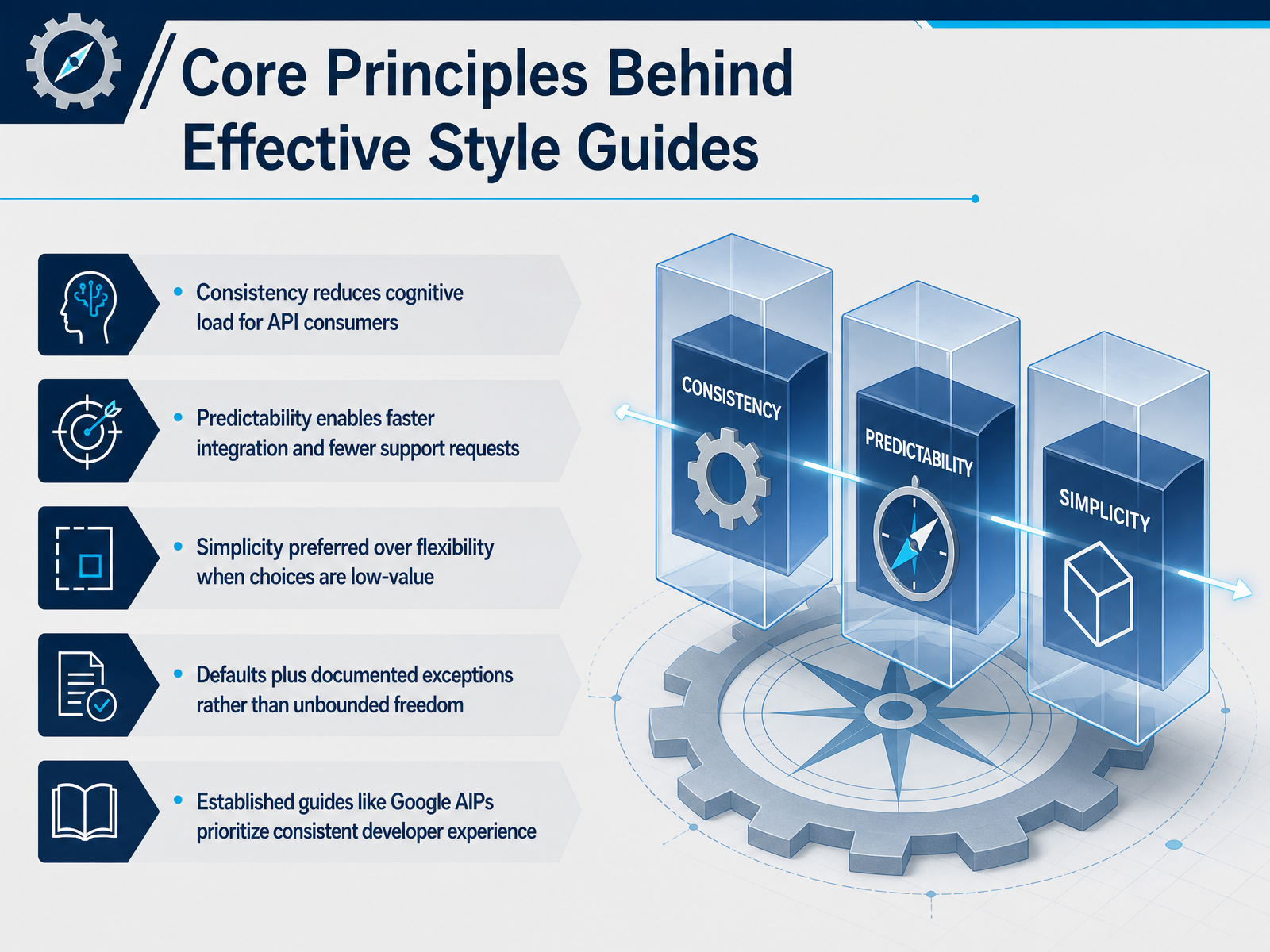
 - 05Core Principles Behind Effective Style GuidesSo why do effective style guides share the same core DNA? It comes down to a handful of principles that shape every rule we write. First, consistency. It reduces cognitive load for consumers. When pagination, authentication, and error shapes are identical across your APIs, developers transfer knowledge from one integration to the next without relearning patterns. Second, predictability. It enables faster integration and measurably reduces support requests. Think about your own experience testing an endpoint without checking the docs. Predictable APIs work on first try. Next, simplicity over flexibility when choices are low-value. A style guide that says use whatever pagination makes sense is worthless. A guide that standardizes a cursor scheme with a documented exception path is useful. That leads to the fourth principle: defaults plus documented exceptions, rather than unbounded freedom. Establish strong standards that must be followed by default, and make exceptions visible with owners and expiry dates. Finally, established guides exist. Google's API Improvement Proposals align every API on a consistent developer experience. They treat precedent as binding for new designs, which directly lowers integration latency across their corpus. Your style guide should do the same. Now, let's look at how these principles translate into actual implementation archetypes.
 google.aip.devgoogle.aip.devgoogle.aip.dev+22 min
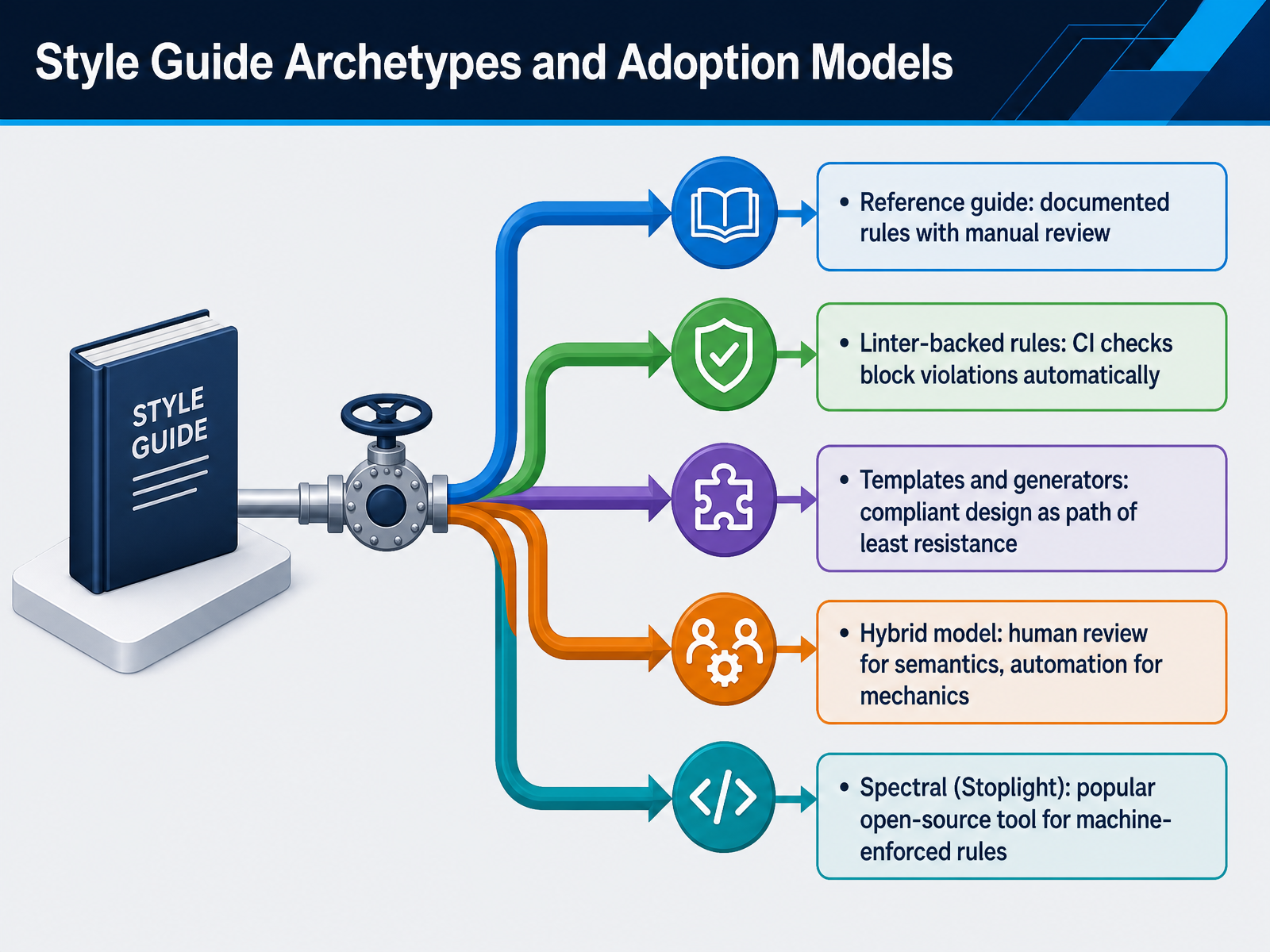
 - 06Style Guide Archetypes and Adoption ModelsNow we get to implementation. There are four archetypes for rolling out a style guide. A reference guide is just documented rules with human review. It works, but humans get tired. Then you have linter-backed rules, where CI checks block violations automatically. This catches the naming mistakes and the missing fields before a reviewer ever looks at the spec. Third, templates and generators. Here, compliant design becomes the path of least resistance. If you scaffold a new service, it should already follow your conventions. You should not have to fix it later. In practice, your team will likely settle on a hybrid model. Use automated checks for mechanics like casing and mandatory fields, and reserve human review for semantics like resource modeling and lifecycle choices. The popular open source tool for the automated layer is Spectral from Stoplight. It is a flexible linter that encodes your style guide as machine enforcement. The setup is straightforward. You define rules, point it at your spec, and wire the command into your pull request pipeline with the fail severity flag set to warn. That is the shift. Governance moves from a document nobody reads to an automated gate. From prose to automated gates, next we will walk through Spectral and CI enforcement in practice.
 qaskills.shapidog.comapi-documentation-hub.com+22 min
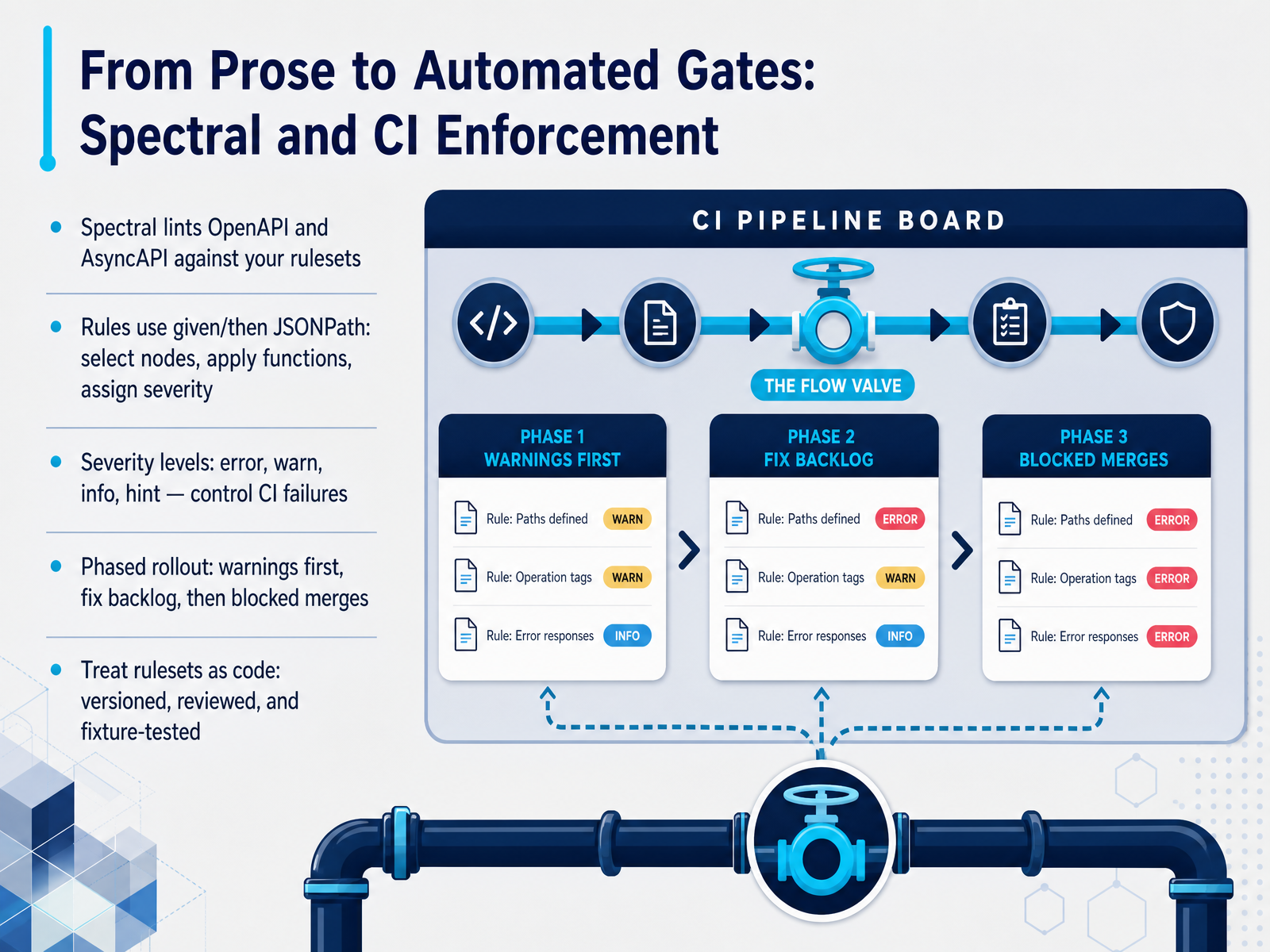
 - 07From Prose to Automated Gates: Spectral and CI EnforcementHere is where a style guide stops being prose and starts being policy. We use Spectral to lint OpenAPI and AsyncAPI documents against rulesets that encode our decisions. Each rule is built from a selector and a check: the given clause uses JSONPath to target nodes, and the then clause applies a function to validate them. Severity is the control knob. Error, warn, info, and hint. By default, only errors fail the build. That is the key to a phased rollout. Start with warnings. Let the team see violations in CI output without blocking anyone. Fix the existing backlog spec by spec, and grandfather legacy paths with overrides. Once clean, flip the gate to fail on warnings and block merges. Then treat the ruleset itself as code. Version it, review it, and keep fixture tests that assert a known-bad spec still triggers each rule. That protects against the silent failure where a refactored pattern stops matching and governance quietly becomes a no-op. Done right, this gate runs on every pull request and makes the style guide testable, reviewable, and enforceable. Next, let us look at the outcomes this creates for API designers.
 qaskills.shapidog.comapi-documentation-hub.com+22 min
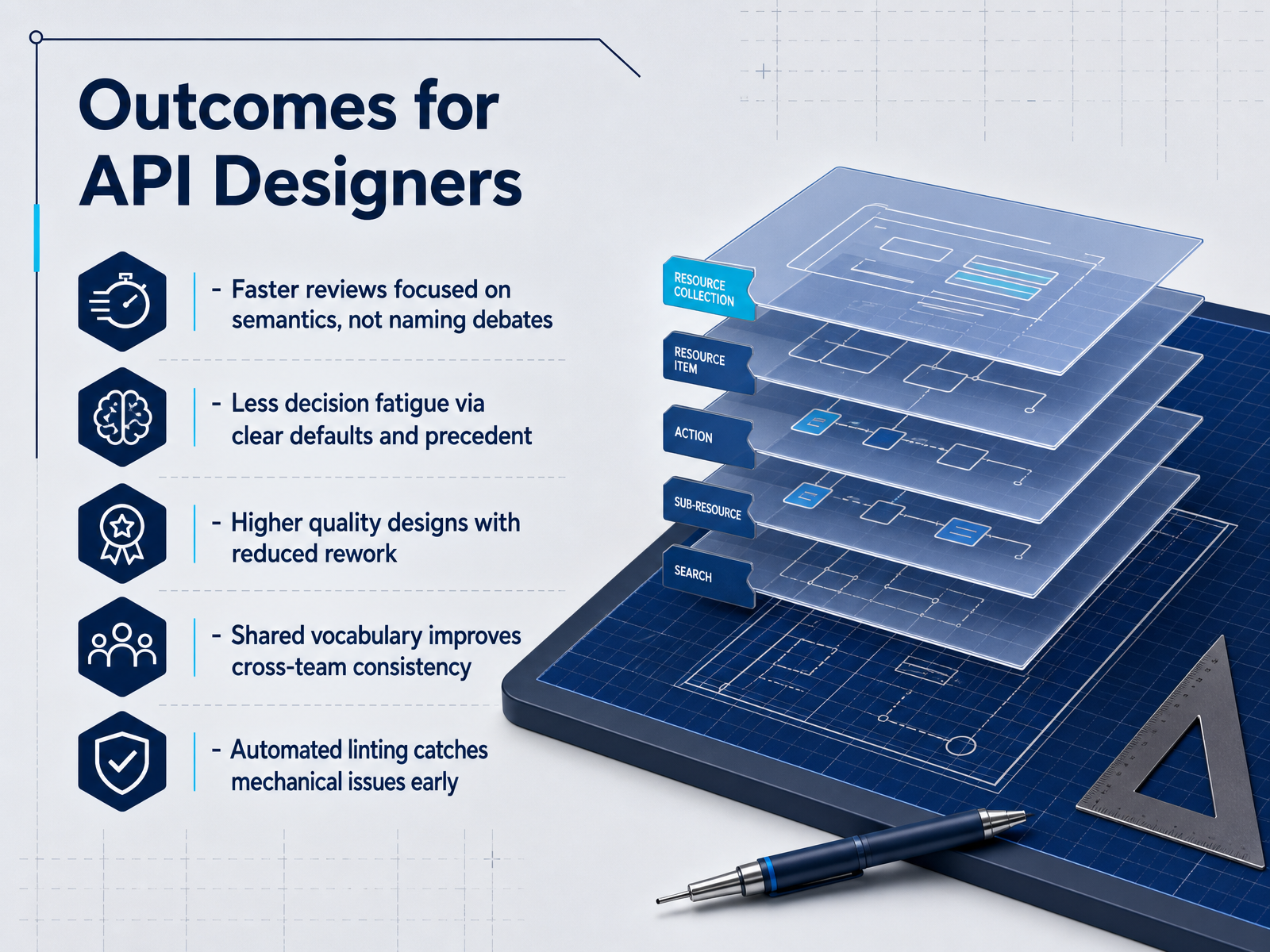
 - 08Outcomes for API DesignersNow, let’s focus on what this means for you, the API designer. A style guide shifts your reviews from naming debates to semantics. Precedent is binding. Once a pattern is established, we implement it the same way everywhere. You are not reinventing pagination or error formats on every project. That reduces decision fatigue. Clear defaults and precedent mean you spend your mental energy on the parts of the design that actually matter. The result is higher quality designs with less rework. You make fewer structural changes down the line when the contract is already aligned with established patterns. And because we share a vocabulary, cross-team consistency improves. Your team’s inconsistencies affect more than just your team. They ripple across the whole developer experience. Finally, automated linting catches mechanical issues early. That frees up human review for judgment calls that machines cannot make. Guardrails, not gatekeepers. Now, let’s shift to see how these outcomes translate for platform engineers.
 google.aip.devgoogle.aip.devgoogle.aip.dev+21 min
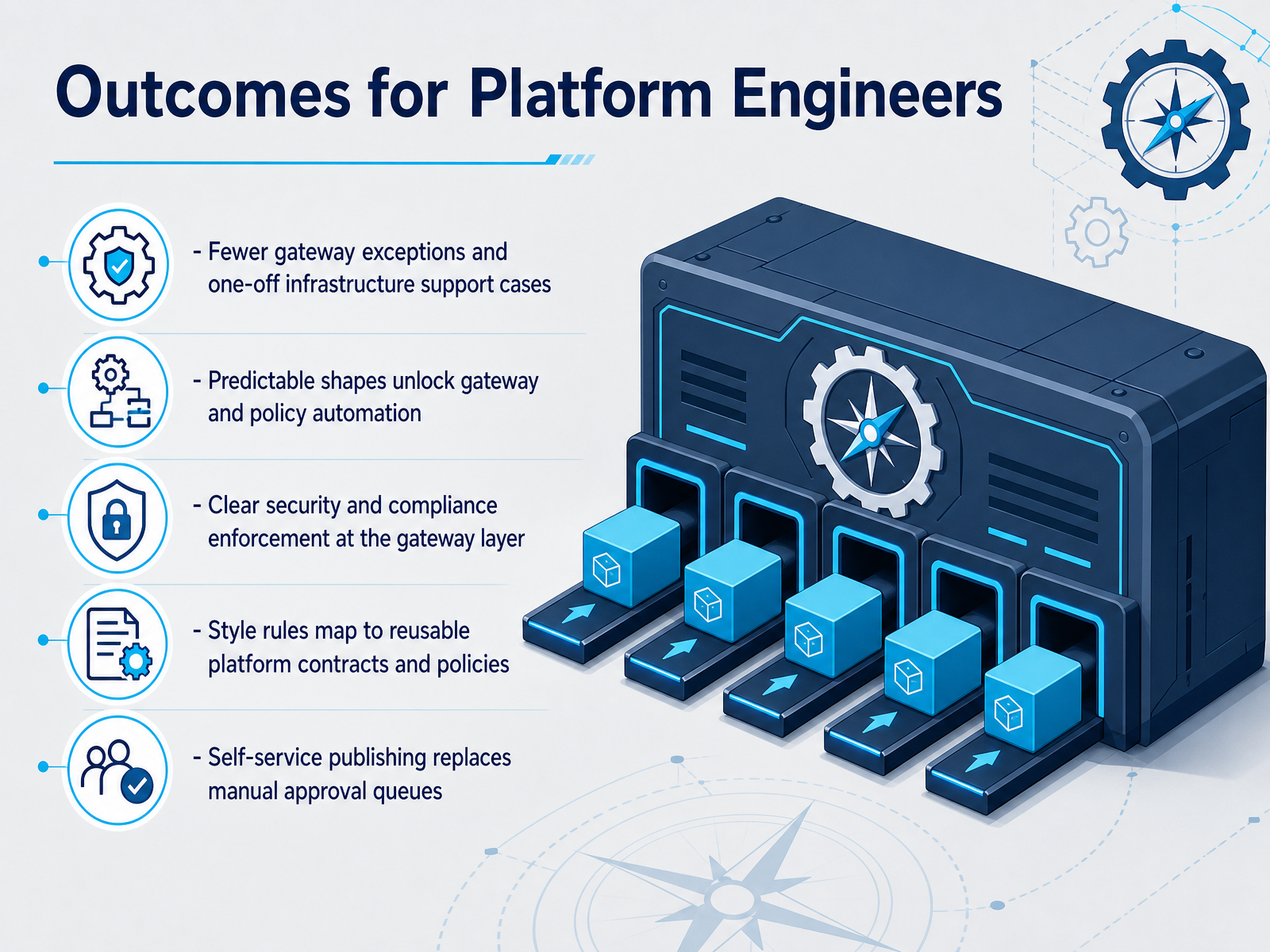
 - 09Outcomes for Platform EngineersSo, what does this mean for you as platform engineers? Fewer gateway exceptions, fewer one-off support cases. That is the tangible outcome. When every API conforms to predictable shapes, your gateway can automate policy enforcement. Authentication, rate limiting, schema validation. These become reusable contracts, not manual configuration. Style rules map directly to platform policies. Enforcement happens at the gateway layer, where traffic flows, not in a wiki. Security and compliance become structural, not aspirational. Self-service publishing replaces the manual approval queue. A developer publishes through the portal, the platform applies the right policies automatically, and your team steps back from gatekeeping. Your time shifts from firefighting to building platform capabilities. That is the shift that scales.
 stoplight.iodev.toletsbuildsolutions.com+21 min
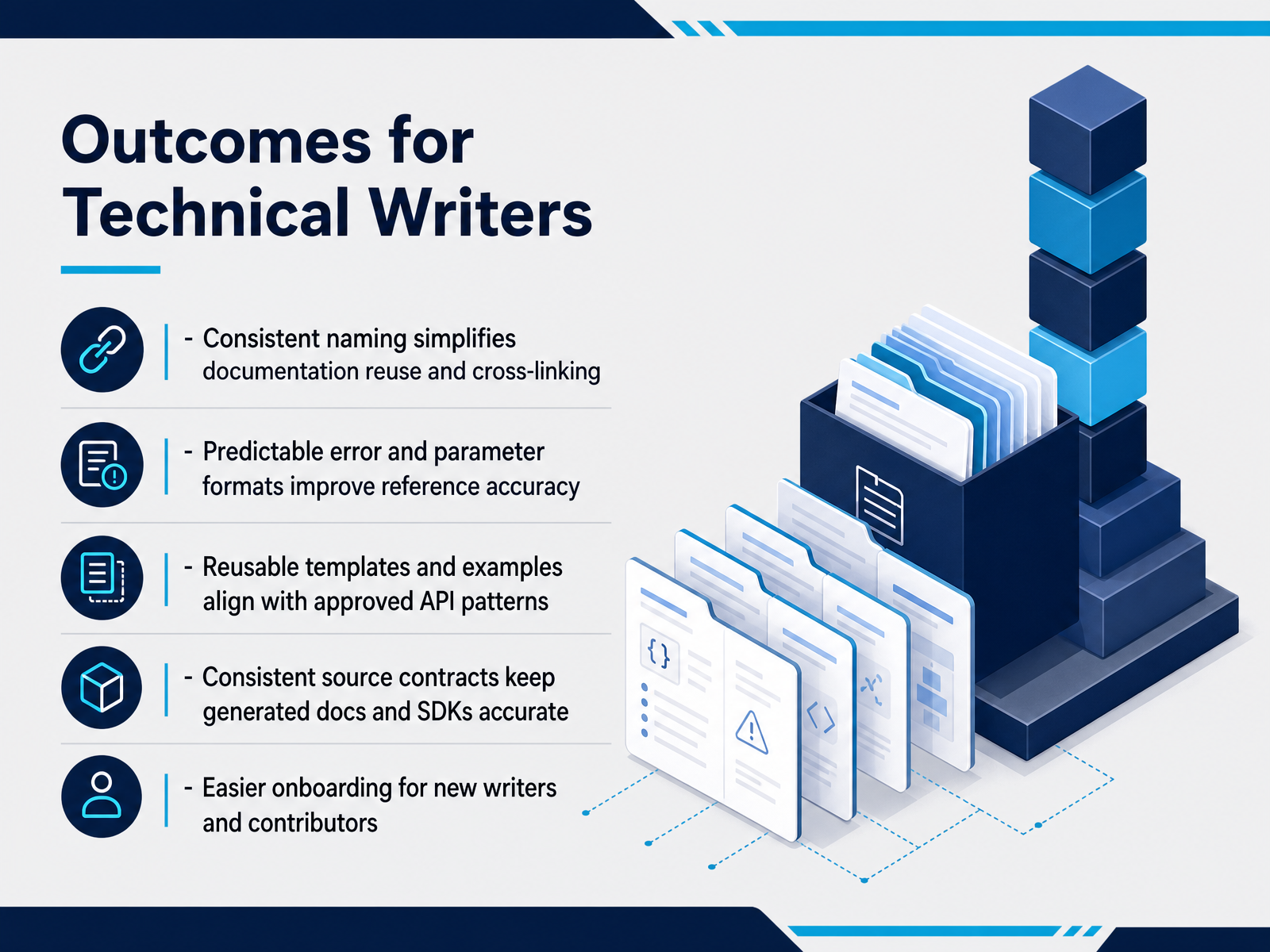
 - 10Outcomes for Technical WritersNow let’s turn to what a style guide means for technical writers, because its outcomes are concrete and measurable. Consistent naming is the foundation. When every endpoint follows the same conventions, documentation reuse becomes simple and cross-linking between resources becomes predictable. A writer can draft a page for a new endpoint using patterns they already know, instead of investigating a fresh set of naming rules. Predictable error formats matter even more. If every error response follows the same shape with the same fields, reference accuracy improves substantially. Writers can document one error structure and know it applies across the whole API surface, which cuts down on mistakes and support tickets. Reusable templates and examples align with approved API patterns, reducing the effort to produce accurate first drafts. And because the contract in the spec stays consistent, generated docs and SDKs remain accurate without manual synchronization. The result is faster onboarding for new writers and contributors. They learn one set of conventions, not a dozen variations. For your team, the takeaway is straightforward: a style guide reduces technical documentation debt and makes your docs trustworthy at scale. Next, we’ll examine common failure modes in API governance and how to steer clear of them.
 stoplight.iodev.toletsbuildsolutions.com+22 min
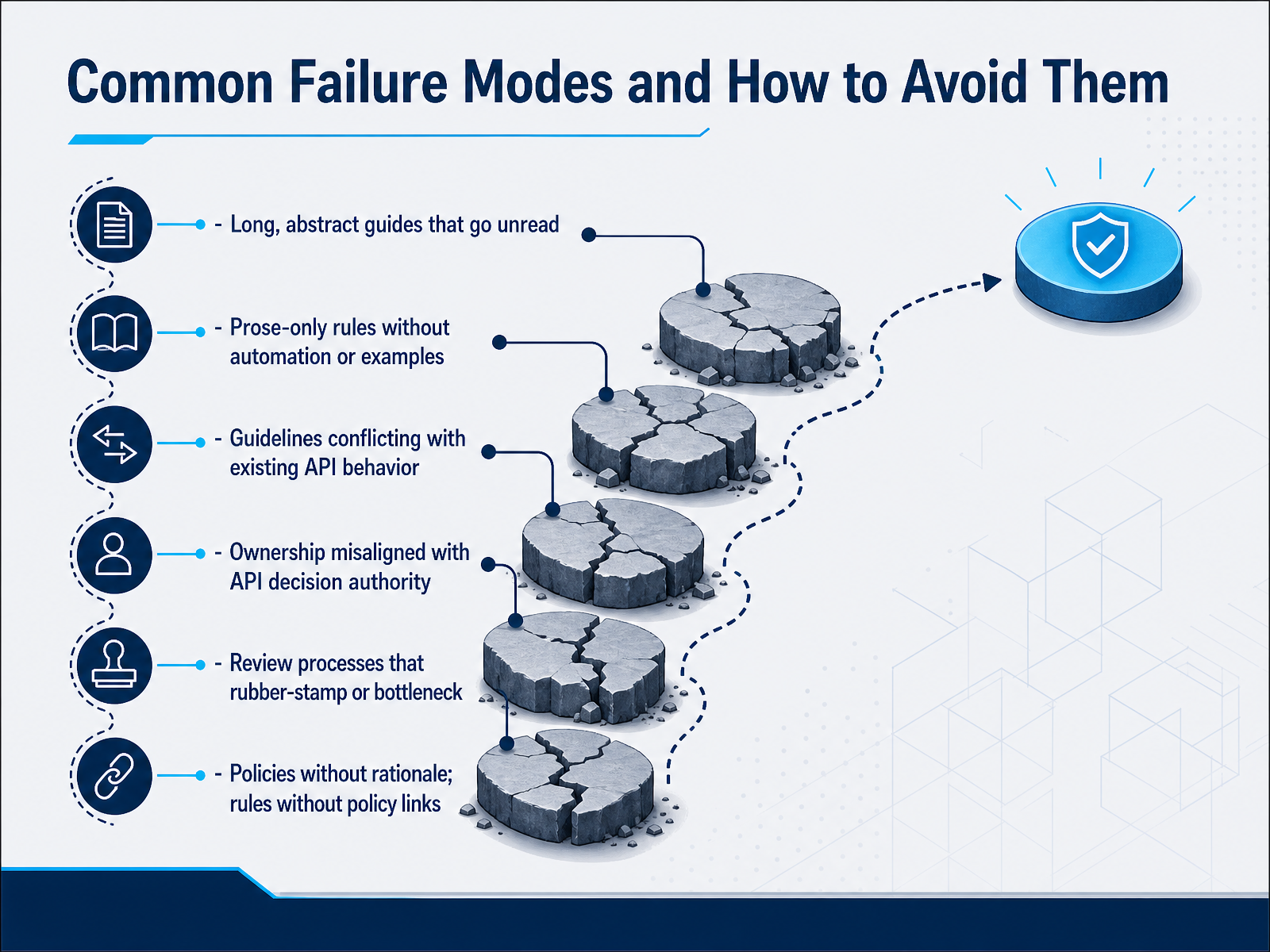
 - 11Common Failure Modes and How to Avoid ThemA style guide fails in predictable ways. Long, abstract documents are never read. That is documentation debt, not governance. Prose-only rules without automation or examples get ignored. Rules must be machine-enforced in CI or they will drift. The bigger problem is conflict. When guidelines contradict existing API behavior, new engineers follow the code they can see, not the wiki they have to search for. Keep the guide consistent with reality, or explicitly mark legacy exceptions. Ownership misalignment kills programs too. If the team writing rules has no authority over API decisions, the rules are suggestions. Worse are rubber-stamp reviews. They create false assurance and provide zero value. Bottlenecks are equally bad. Reviews must be firm on breaking changes and security, but forgiving on style. And finally, rules without rationale breed resentment. Link every rule back to a policy that a product manager can read and challenge. That link turns enforcement into a shared agreement. Otherwise, you have a machine yelling at engineers with no explanation. Remember these failure modes, and build your governance to avoid them before you scale it. Let's talk about that now.
 stoplight.iodev.toletsbuildsolutions.com+22 min
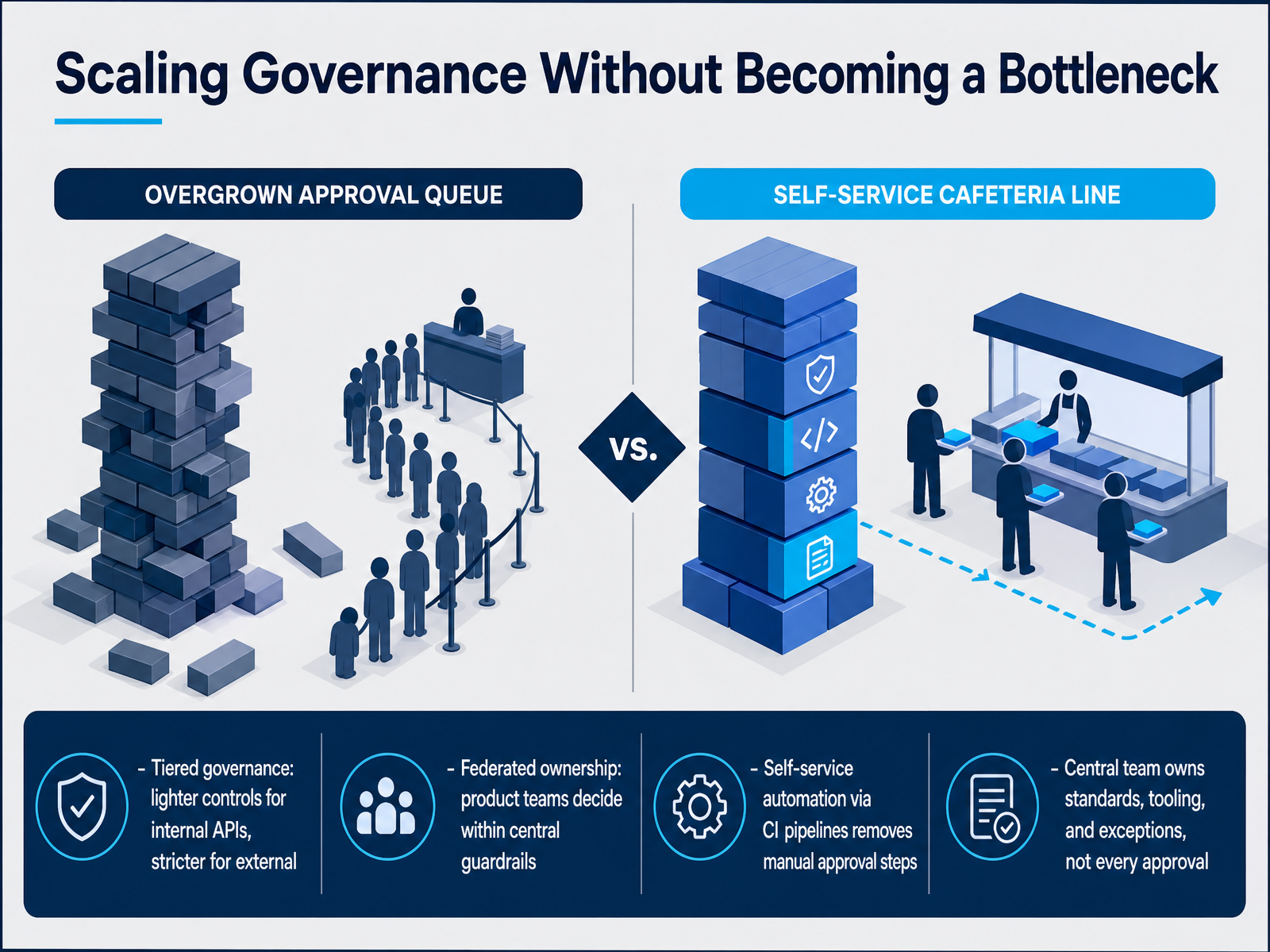
 - 12Scaling Governance Without Becoming a BottleneckNow let's talk about how governance scales without throttling delivery. The answer is tiered governance. Internal APIs get lighter controls. Cross-team and external APIs face stricter standards. You want the rigor to match the blast radius. We also need federated ownership. Product teams make their own design decisions, but they operate inside central guardrails. The central team owns the standards, the tooling, and the exceptions, not every approval. The real unlock is self-service automation. CI pipelines should lint specs, enforce policy, and register APIs automatically. No tickets. No waiting on a human reviewer for routine changes. DATEV, with over four thousand engineers, deploys new internal APIs live in minutes with zero manual steps. Their central governance team is only eighteen people. Think about that ratio. The shift is from manual review to automated guardrails. When governance lives in the pipeline, it scales linearly with your API count, not with your headcount. Your team should design the system so good behavior is the default, not the exception. Now let's look at a practical adoption strategy for your organization.
 stoplight.iodev.toletsbuildsolutions.com+22 min
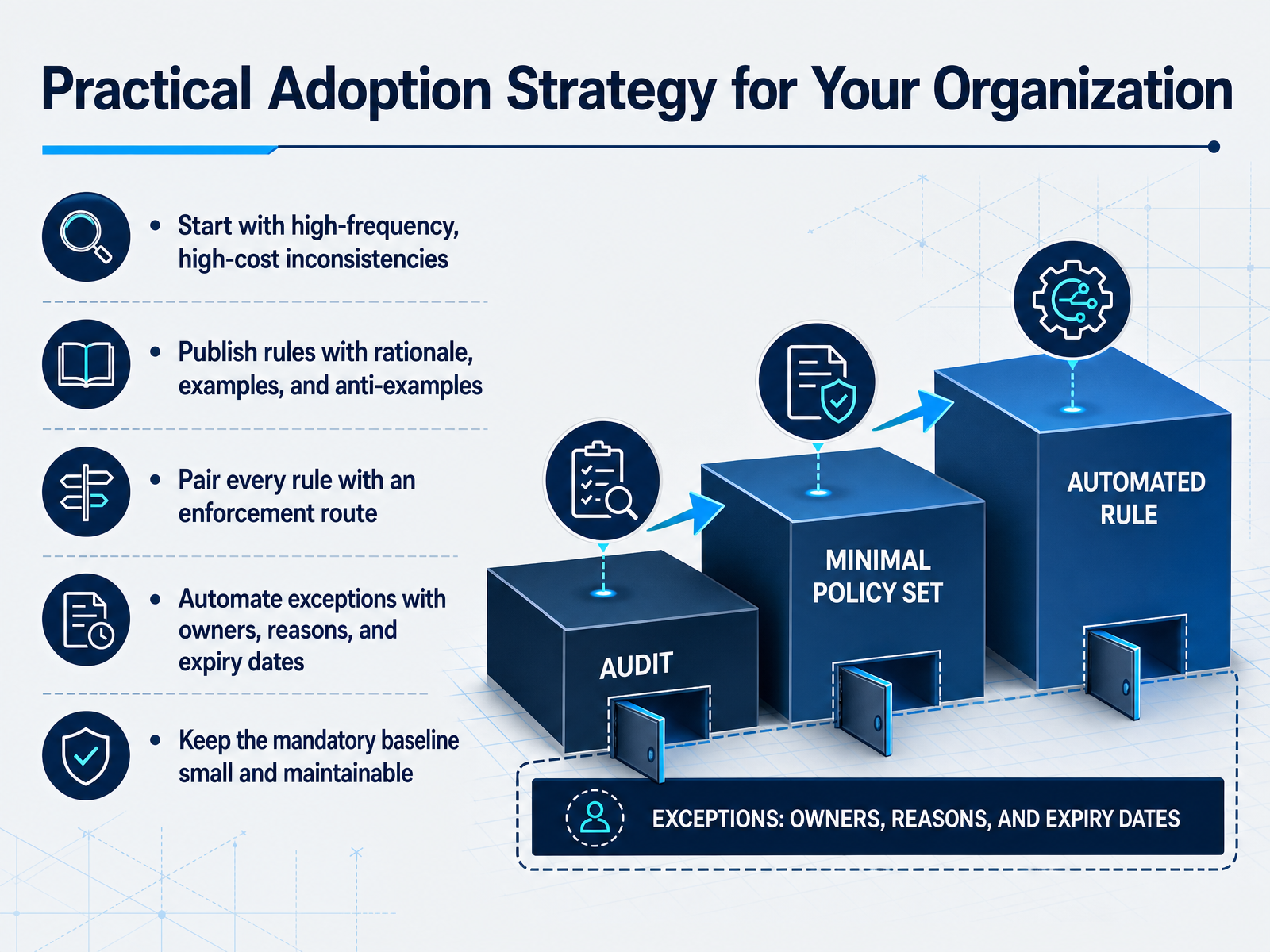
 - 13Practical Adoption Strategy for Your OrganizationLet's talk about the practical adoption strategy. The most common failure is trying to do too much at once. Instead, begin with the inconsistencies that cause the most integration pain. That is where your return on investment is highest. Second, publish your rules with clear rationale, concrete examples, and anti-examples. A developer should understand the intent, not just the constraint. Third, pair every single rule with an enforcement route. If a rule relies on memory or manual review, it will be inconsistently applied. Automate the checks you can within your CI pipeline using tools like Spectral. Fourth, when you need exceptions, make them explicit. Automate them with an owner, a documented reason, and an expiry date. This prevents permanent carve-outs that quietly become the new standard. Finally, keep your mandatory baseline small. A style guide with forty rules is a document nobody reads. Keep it to a minimal, maintainable core that your team can realistically follow. Start strict; expand only when the fundamentals are stable. Begin today with your top five high-cost issues, and build momentum from there. That sets the stage for our final recap and next steps.
 stoplight.iodev.toletsbuildsolutions.com+21 min
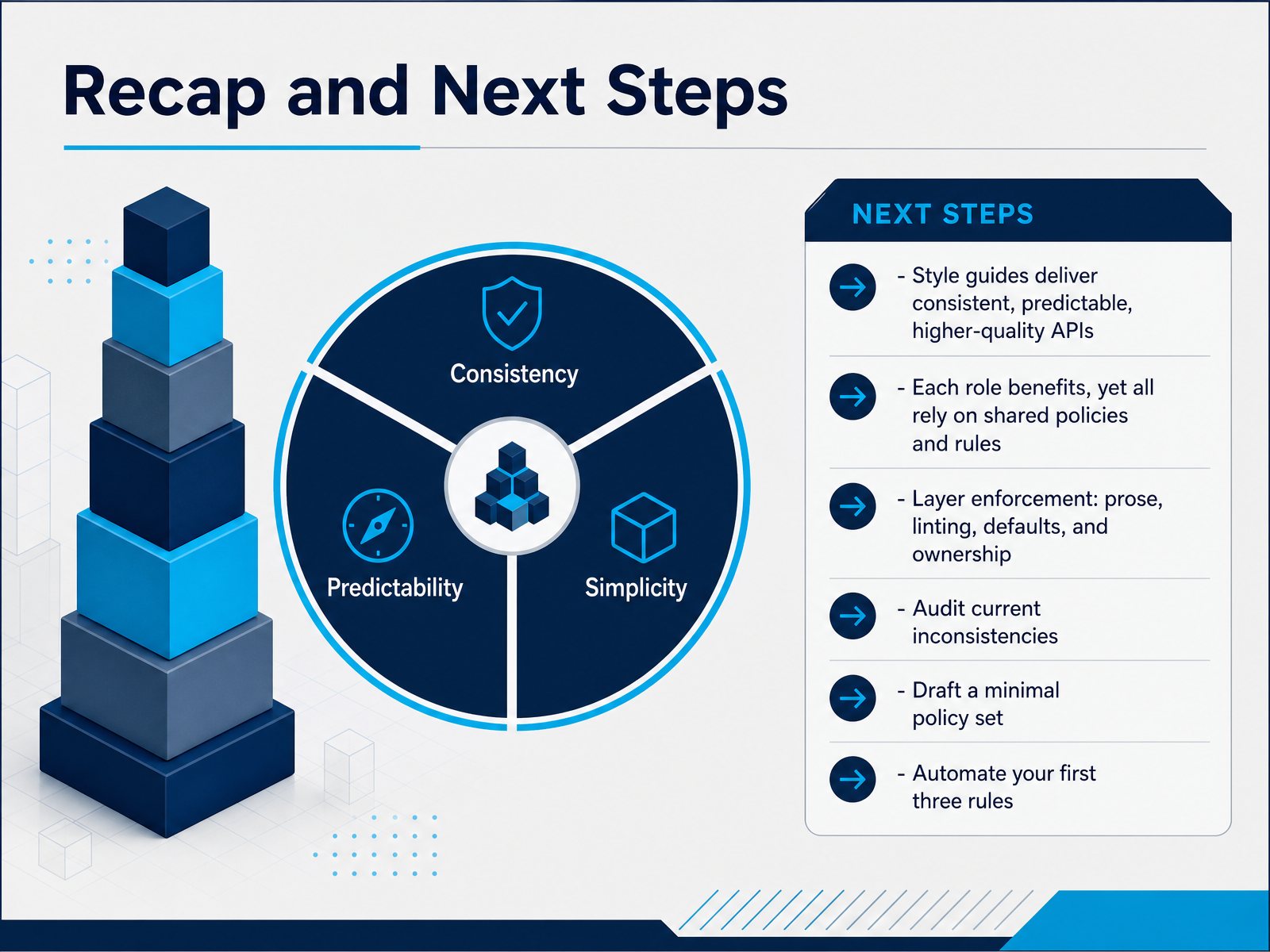
 - 14Recap and Next StepsSo let's pull this together. A style guide is not a document. It is a system that delivers consistent, predictable, and higher-quality APIs. We all benefit—designers, engineers, writers—but only if we share the policies and rules. Enforce in layers. Start with plain prose, then add linting, then sensible defaults, and finally clear ownership. Now, here is your next step. Audit your current specs for inconsistencies. You will find them. Everyone does. Then draft a minimal policy set, not a fifty-page manifesto. Just the decisions that matter. Finally, automate your first three rules with a tool like Spectral. Wire it into your pipeline and let the build fail on violations. Governance becomes a guardrail, not a bottleneck. Thank you for your time today. You have the principles and the path. Now, go make your APIs a little more predictable for everyone who depends on them.
 qaskills.shapidog.comapi-documentation-hub.com+21 min
Take the deck with you
Download this course as a file — free, no sign-up needed.
- PDF handoutEvery slide page, ready to print or share.15 pages · 3.6 MBDownload
- Narrated PowerPointThe deck that presents itself — every slide carries the digital human's narration video.15 pages · 16.8 MBDownload
- PowerPoint slidesThe full deck as a .pptx — open it in PowerPoint, Keynote, or Google Slides.15 pages · 3.5 MBDownload
Free to use in your own training — please keep the PersonWise credit page at the end.
Have your own deck? Turn it into a course
Sources consulted
Web sources consulted while building this course.
- Spectral OpenAPI Linting Guide: Govern API Specs in CI (2026) — qaskills.sh
- Linting OpenAPI with Spectral (Plus an Easier Way) — apidog.com
- Spec Linting & API Governance with Spectral | API Docs Hub — api-documentation-hub.com
- API linting with Spectral: from the basics to enterprise-wide automation — blog.axway.com
- GitHub - stoplightio/spectral: A flexible JSON/YAML linter for creating ... — github.com
- API Design Style Guides, Guidelines, and Best Practices — stoplight.io
- API Governance at Scale - DEV Community — dev.to
- API Design Governance for Growing Teams: Style Guides, Review Processes, and Evolving APIs Without Breaking Consumers — Let's Build — letsbuildsolutions.com
- https://apievangelist.com/2026/06/27/policies-and-style-guides-the-why-above-your-rules/ — apievangelist.com
- API Governance for Enterprise Teams 2026 | APIScout — apiscout.dev
- Guidelines.md — github.com
- JSON Web API Design: Naming, Pagination, Errors, and Versioning — Jsonic — jsonic.io
- RESTfulAPIStyleGuide.md at master · SabreDevStudio/api-style-guides — github.com
- doc/development/api_styleguide.md · 9aaef8bc311e6003b69480aad8799bdc53db16e9 · GitLab.org / GitLab · GitLab — gitlab.com
- doc/development/api_styleguide.md · v18.3.6-ee · GitLab.org / GitLab · GitLab — gitlab.com
- AIP Purpose and Guidelines - API Improvement Proposals — google.aip.dev
- API Improvement Proposals — google.aip.dev
- AIP-100: API Design Review FAQ — google.aip.dev
- AIP-190: Naming conventions — google.aip.dev
- API design guide - Google Cloud Documentation — docs.cloud.google.com