Customer Success Plan Execution
Begin
14 pages · ~28 min
Customer Success Plan Execution
Learn to build and execute customer success plans that turn strategic goals into measurable outcomes for customer retention and growth.
What you’ll learn
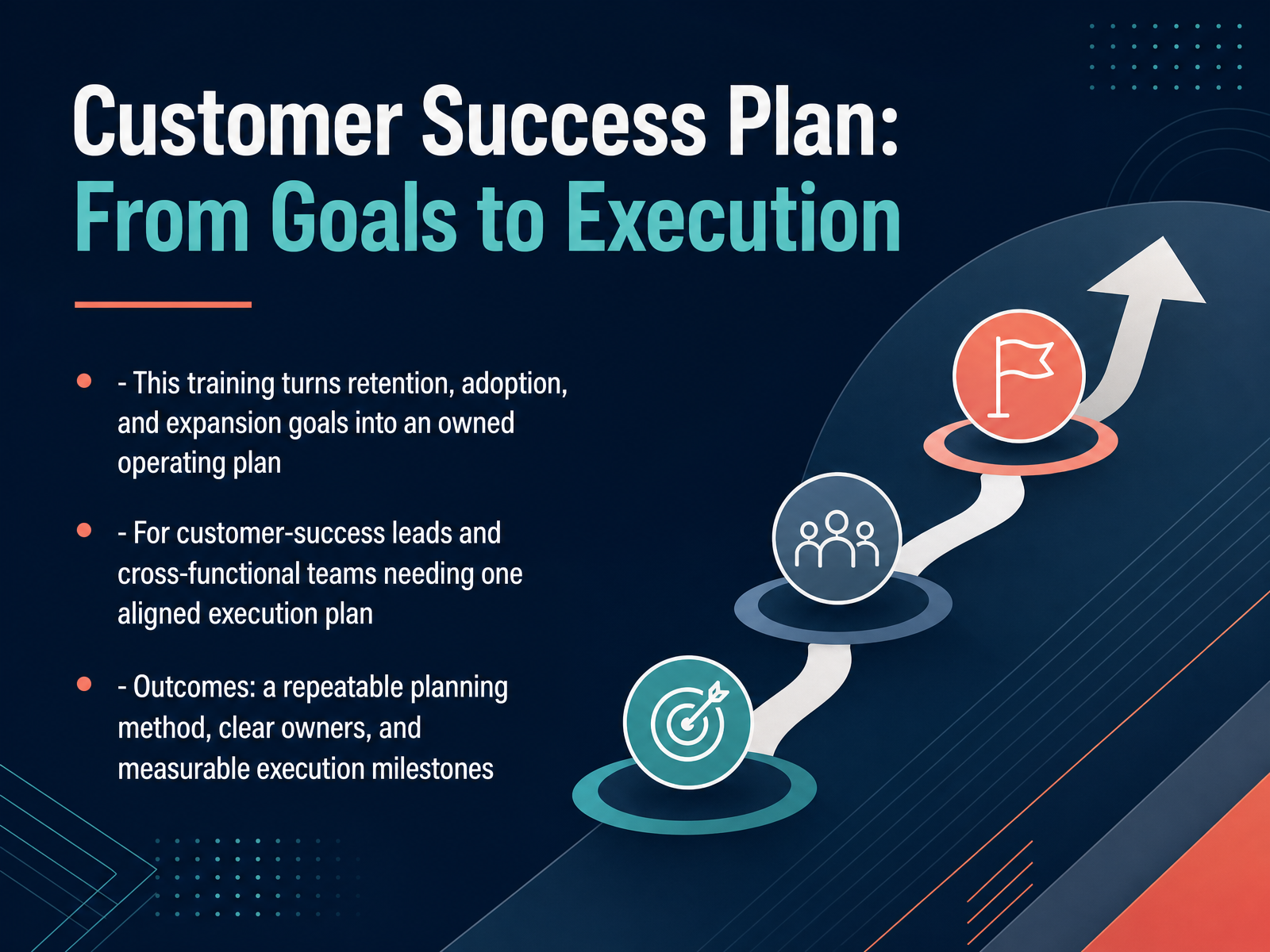
- 01Customer Success Plan: From Goals to ExecutionWelcome. We're here because retention, adoption, and expansion goals only matter when they become a plan that your team actually owns and executes. This training is for customer success leads and the cross-functional partners who need one aligned operating plan, not a set of disconnected initiatives. By the end, you'll have a repeatable method for planning, clear owners for every action, and measurable milestones that let you track progress with confidence. We'll build this together, turning your strategic priorities into the operational engine that drives predictable growth. The payoff is real: companies that formalize this approach consistently see higher net revenue retention and a customer base that expands on its own. Let's get to work, starting with why strategy fails without an operating plan.thegtmadvisor.comziellab.comthemarketingjuice.com+21 min
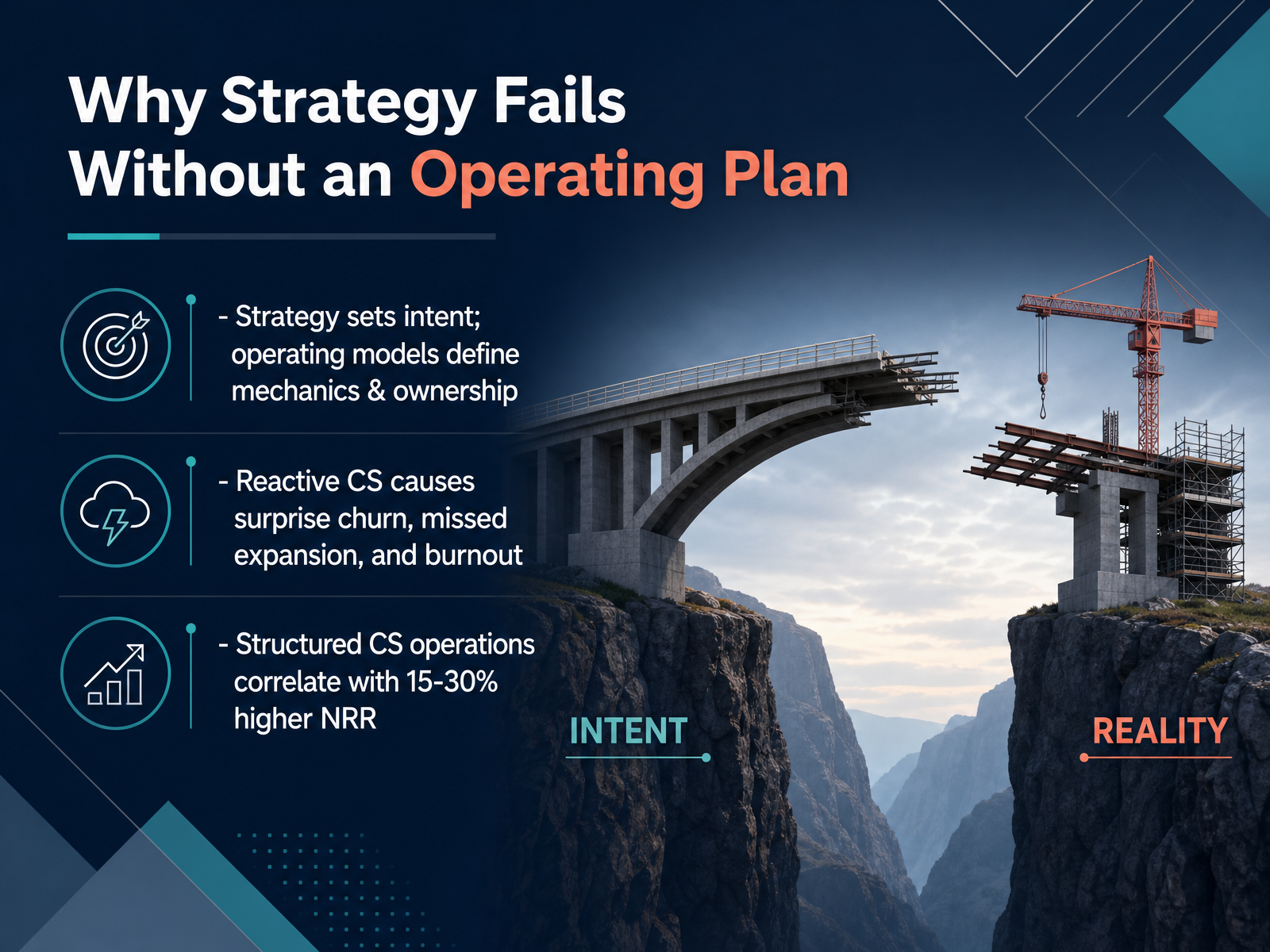
- 02Why Strategy Fails Without an Operating PlanLet’s be direct about why we are here. Most customer-success strategies fail not because the vision is wrong, but because there is no operating plan underneath it. Strategy sets intent. An operating model defines the mechanics, the owners, and the cadence that turn that intent into action. Without it, your team defaults to reactive mode. That is how you get surprise churn, missed expansion revenue, and burned-out managers chasing problems they never saw coming. The data is clear on the payoff for fixing this. Companies with structured customer-success operations consistently report fifteen to thirty percent higher net revenue retention. On a fifty-million-dollar revenue base, that difference is worth millions in recurring revenue every single year. Your plan is not a document. It is the system that converts your retention goals into owned, repeatable execution. Up next, we’ll break down the core building blocks that make a customer-success plan actually hold up in practice.
 thegtmadvisor.comziellab.comthemarketingjuice.com+21 min
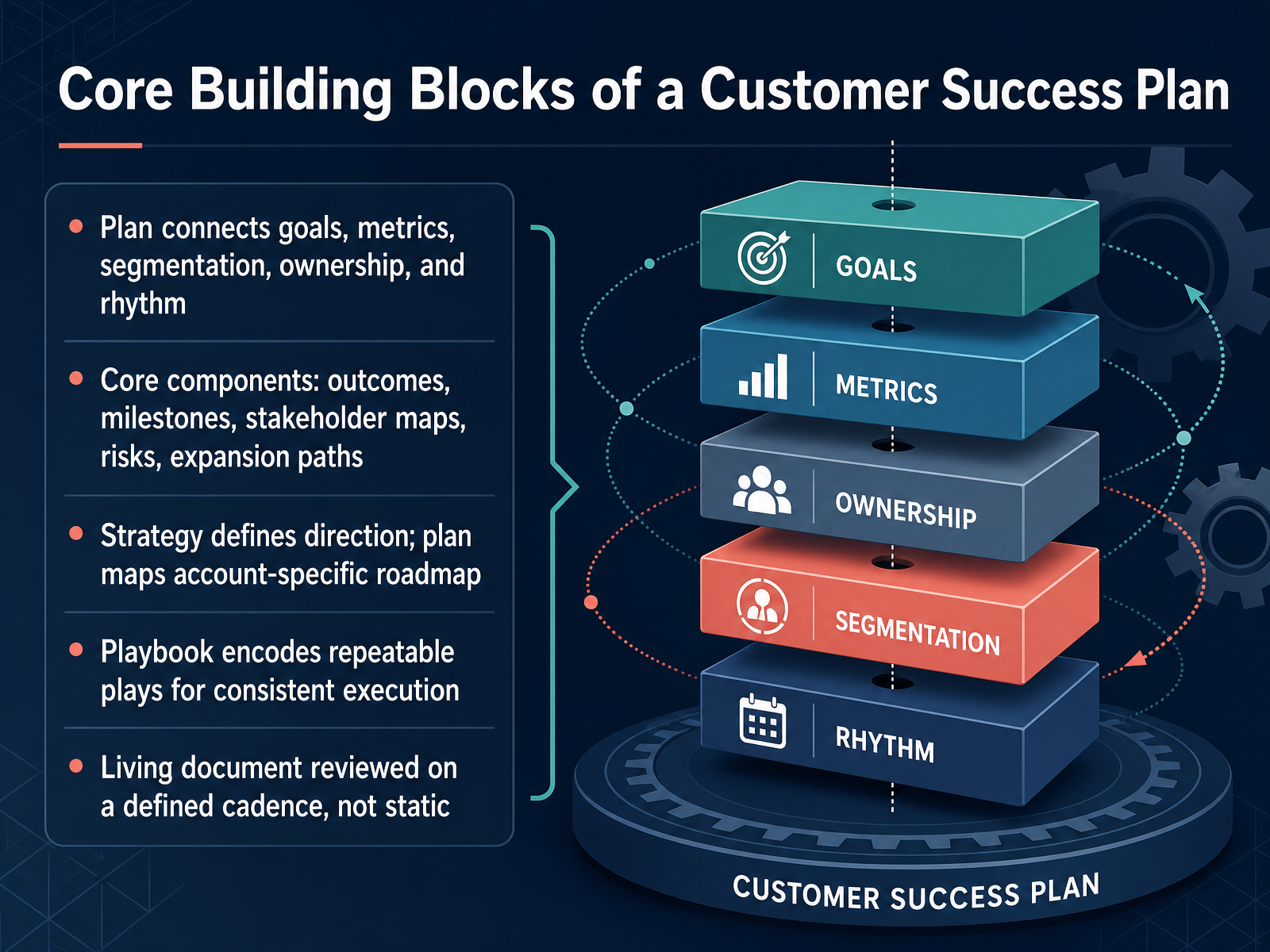
 - 03Core Building Blocks of a Customer Success PlanLet’s talk about the operating backbone of your plan. Strategy defines direction, but a plan has to map the roadmap to specific accounts. That connection is built on six core elements. Goals, metrics, segmentation, ownership, rhythm, and expansion paths. Each one holds a distinct piece of the operating puzzle. Outcomes define the target state in measurable terms. Milestones break that path into checkpoints your team and the customer can track. Stakeholder maps identify who influences decisions, and who can block them. Risks give you early warning triggers so you can act before issues surface at renewal. And expansion paths give you a deliberate route to growth once value is proven. Now, the critical distinction. Strategy states intent. The plan is the account-specific expression of that intent. The playbook is where you encode repeatable plays so execution stays consistent, even when your team scales. But none of this works as a static document. A plan is a living system. It only stays accurate if you review it on a defined cadence, monthly health checks, quarterly business reviews, and an annual reset. Build it deliberately. Then commit to keeping it current. That discipline is what turns your strategy into an operating system that actually runs the business. Next, let’s look at how to align these goals across your cross-functional teams.
 procontentstudio.netthecscafe.comweflow.ai+22 min
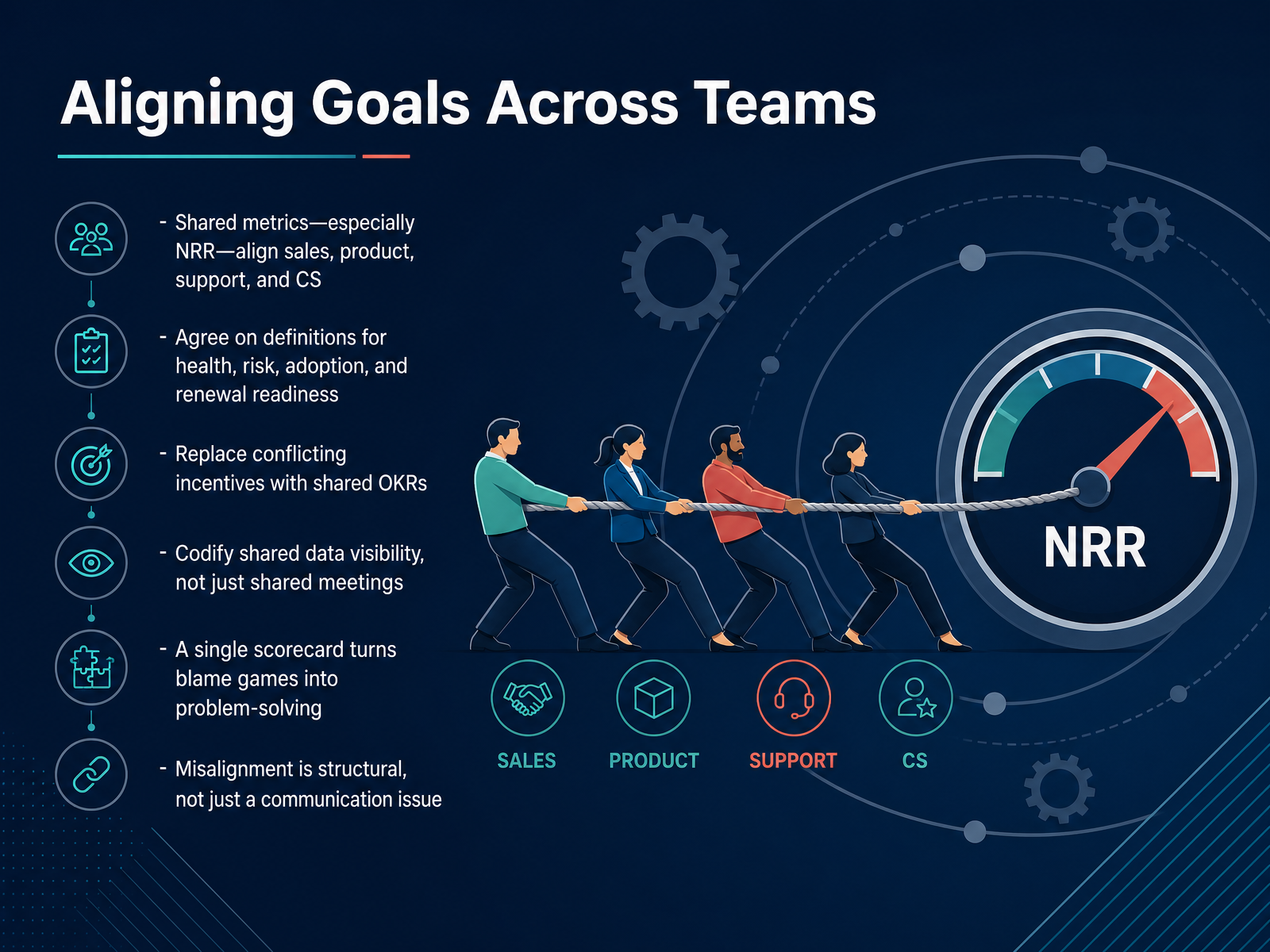
 - 04Aligning Goals Across TeamsLook at your current goal structure honestly. Is your sales team rewarded only for new logos while your customer success team is measured solely on renewals? That disconnect is not a communication issue. It is structural. The fix is to replace conflicting incentives with genuinely shared objectives. And the most powerful unifying metric is net revenue retention, because no single team can move it alone. Product must build for adoption, sales must qualify for the right customers, support must resolve issues before they escalate, and customer success must drive value realization. Start by locking down your definitions. What does a healthy account actually look like versus one at risk? What are your criteria for adoption depth, renewal readiness, and expansion potential? If your team says healthy and revenue operations says at risk about the same account, you have a data or definition problem, not a people problem. Then build one shared scorecard, visible to everyone, updated in real time. When all functions see the same health data, support tickets, and usage trends, the conversation shifts from blame to diagnosis. That single version of the truth is what turns friction into a flywheel. This is where the real operating work begins. From here, we move to prioritizing the actions that actually move those numbers. Let's continue.
 customersuccesssummit.compedowitzgroup.comoscom.ai+22 min
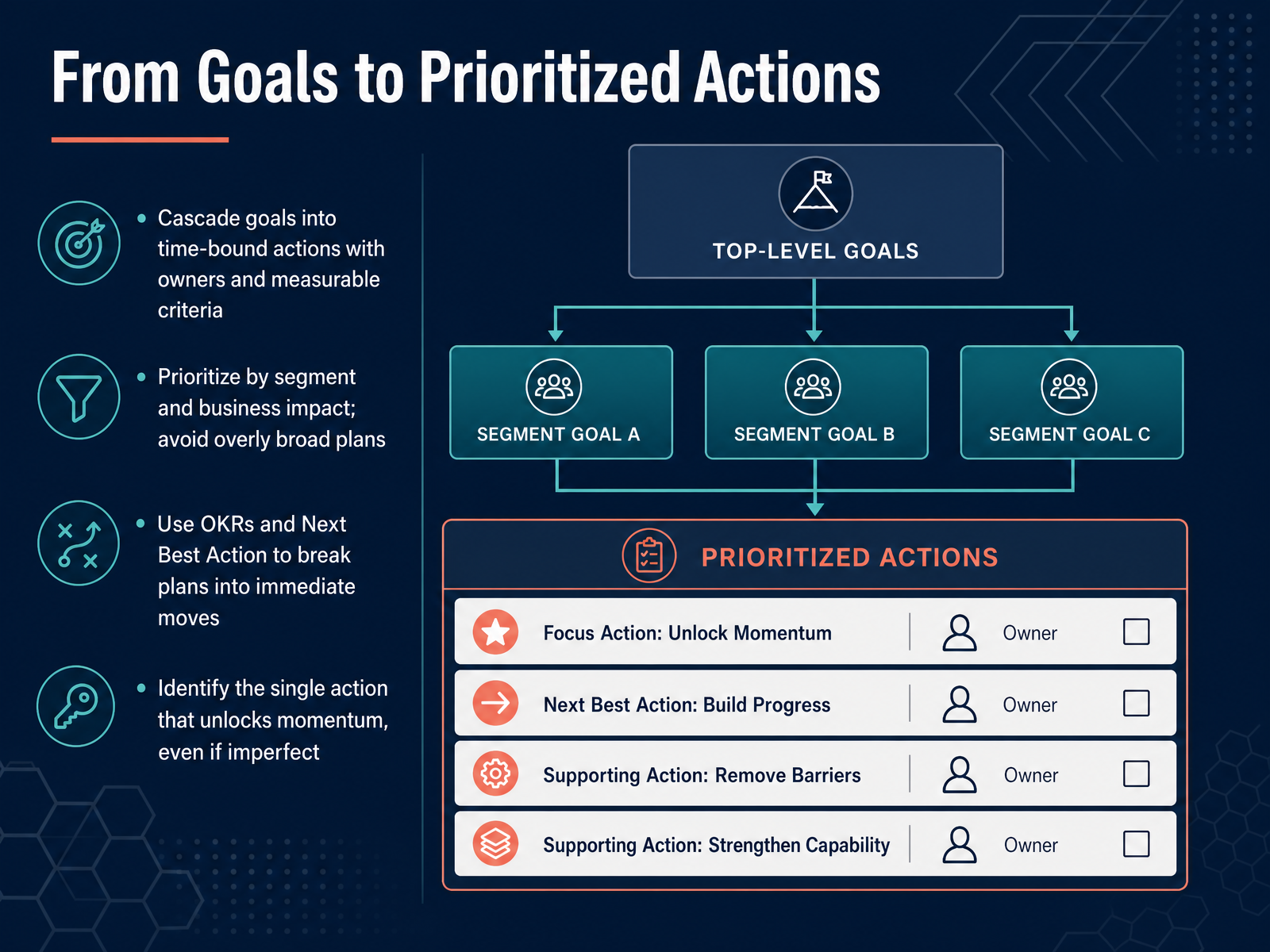
 - 05From Goals to Prioritized ActionsNow let’s turn those goals into action. This is where planning gets real. Every objective needs a time-bound owner and a measurable definition of done. Without those, a plan is just a wish list. Prioritize ruthlessly by segment and by business impact. An overly broad plan dilutes focus and burns out your team. Use OKRs to set the target, then use Next Best Action to decide what you do tomorrow. The OKR tells you where you’re going; the next best action tells you the immediate move that gets you there. And if you’re stuck, ask one question: what single action unlocks momentum, even if it isn’t perfect? Take that shot. A clarifying conversation or a small pilot will teach you more than another week of deliberation. Momentum beats perfection. So define the action, name the owner, and set the date. We’ll talk about assigning ownership and accountabilities next.
 blog.hubspot.comchurnzero.comokrstool.com+21 min
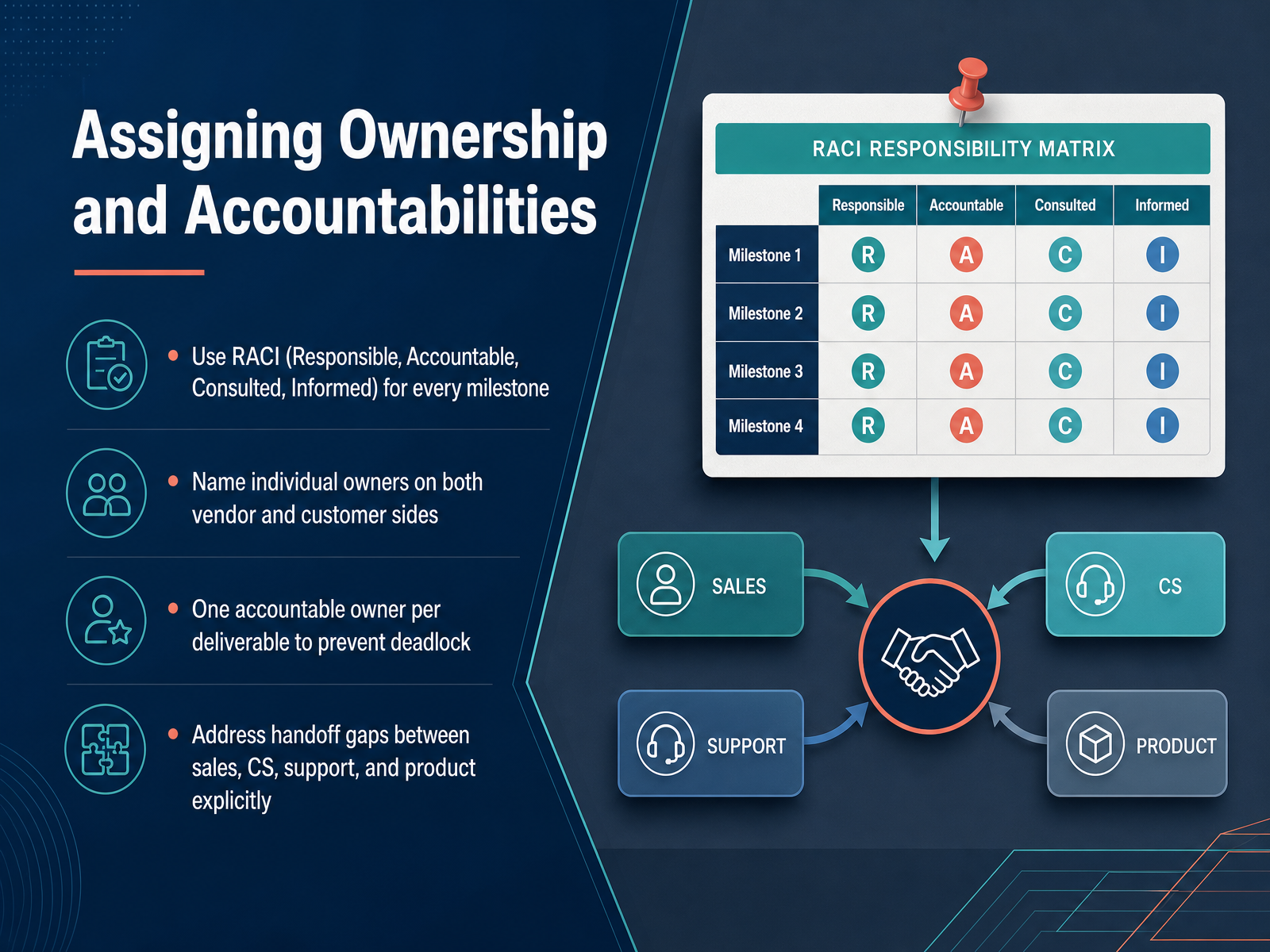
 - 06Assigning Ownership and AccountabilitiesNow let’s turn ambiguity into accountability. Every milestone in your customer success plan needs a RACI—Responsible, Accountable, Consulted, Informed—spelled out for each deliverable. Assign a named individual on both your side and the customer’s side. And remember the golden rule: one accountable owner per deliverable. Shared accountability doesn’t speed things up; it creates deadlock. Think about the handoffs between sales, customer success, support, and product. Each one is a boundary where execution either moves forward or stalls. Make those transitions explicit, with owners and expectations documented, so no account falls into the gap between teams. Once ownership is clear, the next step is building the rhythm to review progress and drive performance. That’s our operating cadence.
 gainsight.comprocontentstudio.net1 min
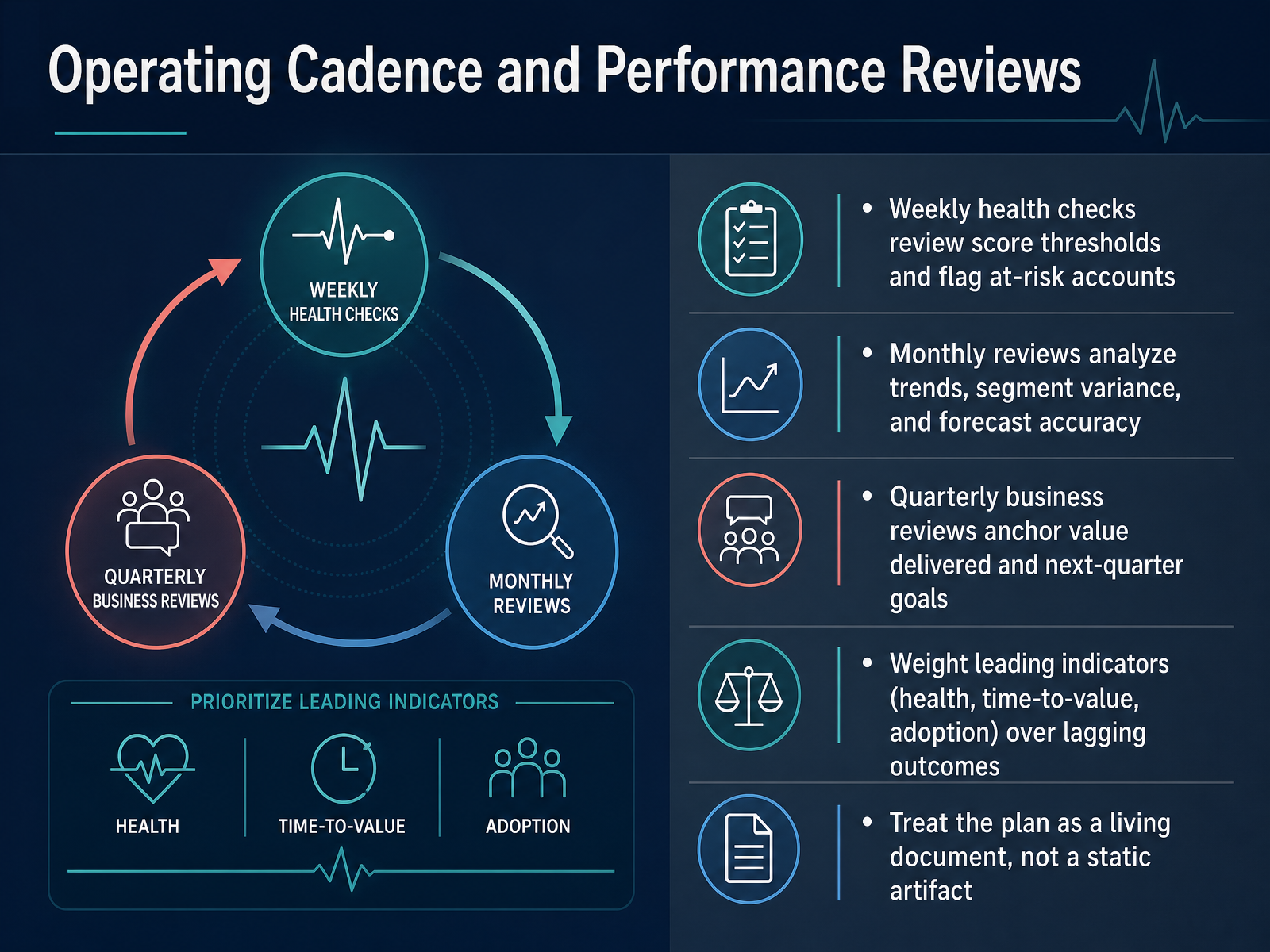
 - 07Operating Cadence and Performance ReviewsNow let's talk about the operating cadence that brings your plan to life. This is where strategy becomes routine. Weekly health checks focus on score thresholds. You're looking for accounts that have crossed a line, say a health score dropping below forty, which predicts a real renewal risk. Flag them, assign an owner, and define the next action within forty-eight hours. Monthly reviews shift to trends and segment variance. You're asking whether a pattern is emerging across a cohort, and whether your forecast accuracy is holding up. Quarterly business reviews anchor the value you've delivered. This is the moment to quantify outcomes in the customer's terms and co-create goals for the next ninety days. Throughout this cadence, weight leading indicators like health, time-to-value, and adoption more heavily than lagging outcomes. They tell you what's about to happen, not just what already did. Above all, treat the plan as a living document. Review and update it at every cadence. A champion change or a shifted priority should be reflected immediately, not at renewal. Next, we'll look at how to execute through customer signals and data.
 weflow.aiwf.gigradar.iothegtmadvisor.com+11 min
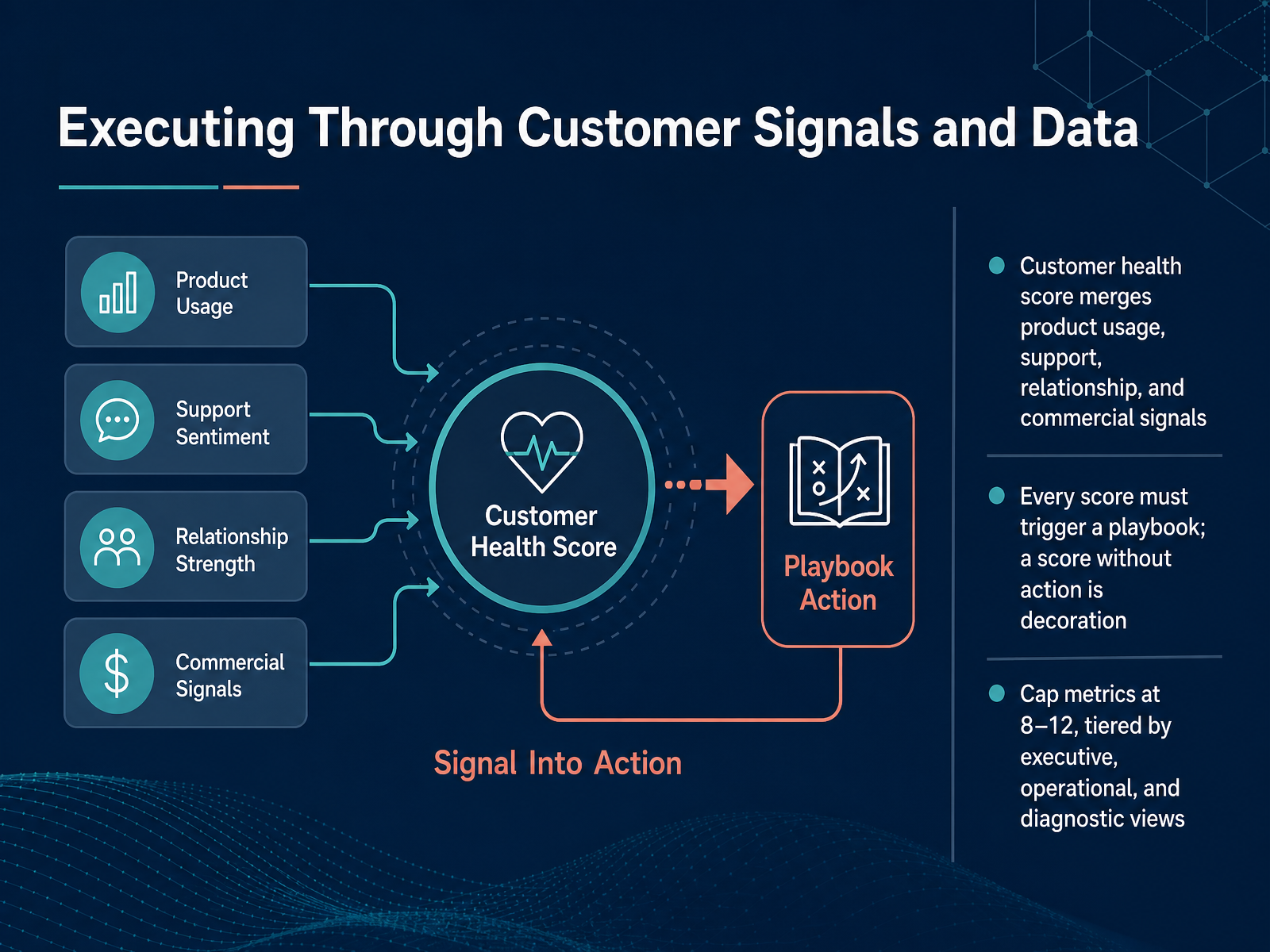
 - 08Executing Through Customer Signals and DataNow let's talk about execution through customer signals. Your customer health score is the connective tissue that merges product usage, support interactions, relationship strength, and commercial signals into one number you can act on. But here's the hard truth: a score that doesn't trigger action is decoration. Every score band must fire a playbook. Green accounts get expansion offers, yellow accounts get proactive outreach, and red accounts get an executive escalation with a clear plan within days. To keep this manageable, cap your metrics at eight to twelve, and slice them into three tiers. Executive views focus on portfolio-level risks and expansion readiness. Operational views let CSMs see daily usage trends and support signals. Diagnostic views dive into why a score moved. This tiering keeps your team from drowning in data while ensuring the right people see the right signal at the right time. Remember, the score is only as good as the response it triggers. Build these triggers now, and your plan moves from goals to action.
 2 min
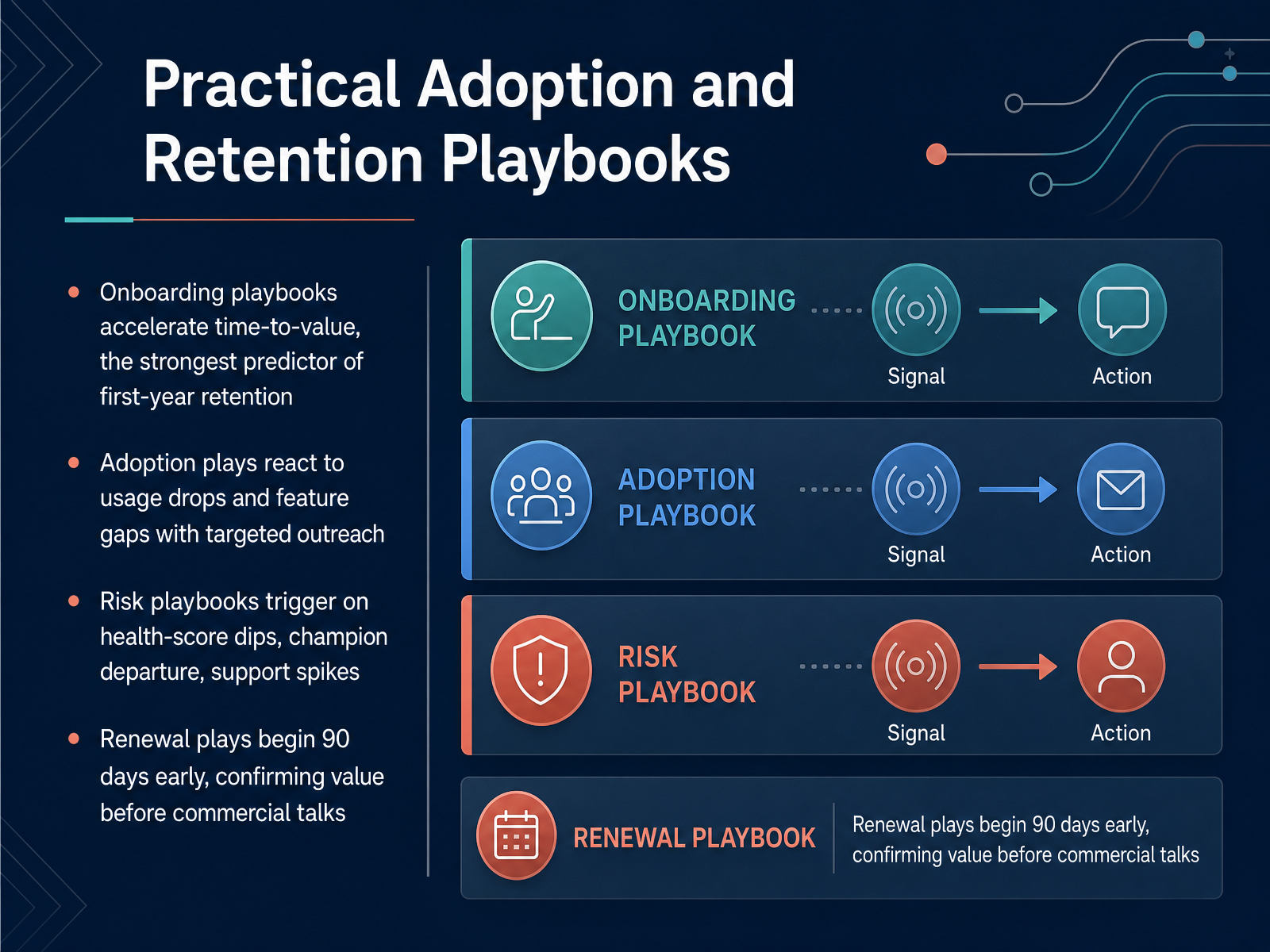
2 min - 09Practical Adoption and Retention PlaybooksNow let's make these playbooks concrete. Onboarding is your first and best lever. It accelerates time to value, and that is the strongest predictor of first-year retention. But playbooks are not just for the start. Adoption plays should react to usage drops and feature gaps with targeted, specific outreach. If a customer stops logging in, don't send a generic check-in. Ask them what outcome they are still trying to reach. Risk plays trigger on the signals that matter: health-score dips, champion departure, or support spikes. These are your early warning systems. And renewal plays begin ninety days out. That is when you confirm value, resolve blockers, and map stakeholders. Do that, and the commercial conversation becomes a formality. Run these four playbooks consistently, and execution becomes predictable. Which brings us to a critical question: once adoption is steady, how do you systematically turn that momentum into expansion revenue?
 tsia.com1 min
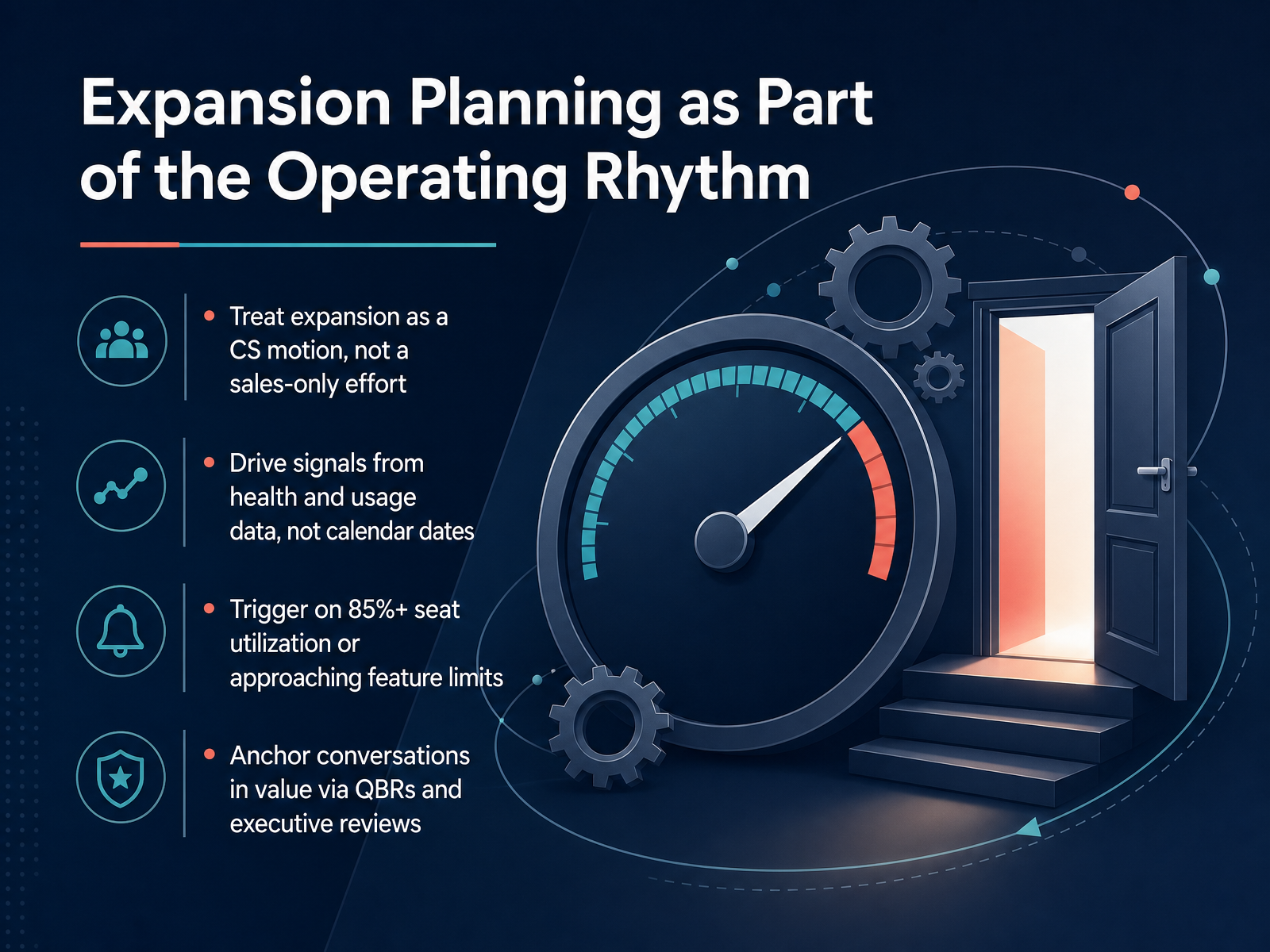
 - 10Expansion Planning as Part of the Operating RhythmNow let's lock expansion into your operating rhythm. Expansion is a customer success motion, not a sales-only effort. Your team sees the usage patterns and the business outcomes that signal readiness. So treat it as a core part of your plan. Drive signals from health and usage data, not calendar dates. A renewal date tells you when the contract ends, not when the customer needs more. Instead, watch for triggers like seat utilization above eighty-five percent for thirty days or usage approaching feature limits. Those are the moments when value is real and the next step is natural. Then anchor the conversation in value through quarterly and executive reviews. Use those sessions to show what they've achieved, tie it to the metrics they care about, and explore the outcomes they still want. That turns expansion from a pitch into a shared next step. The takeaway: build expansion into your cadence, trigger on behavior, and let value lead the conversation. Next, we'll look at how segmentation and coverage models shape where you focus your team's effort.
 tsia.comcustomersuccesssummit.compedowitzgroup.com+22 min
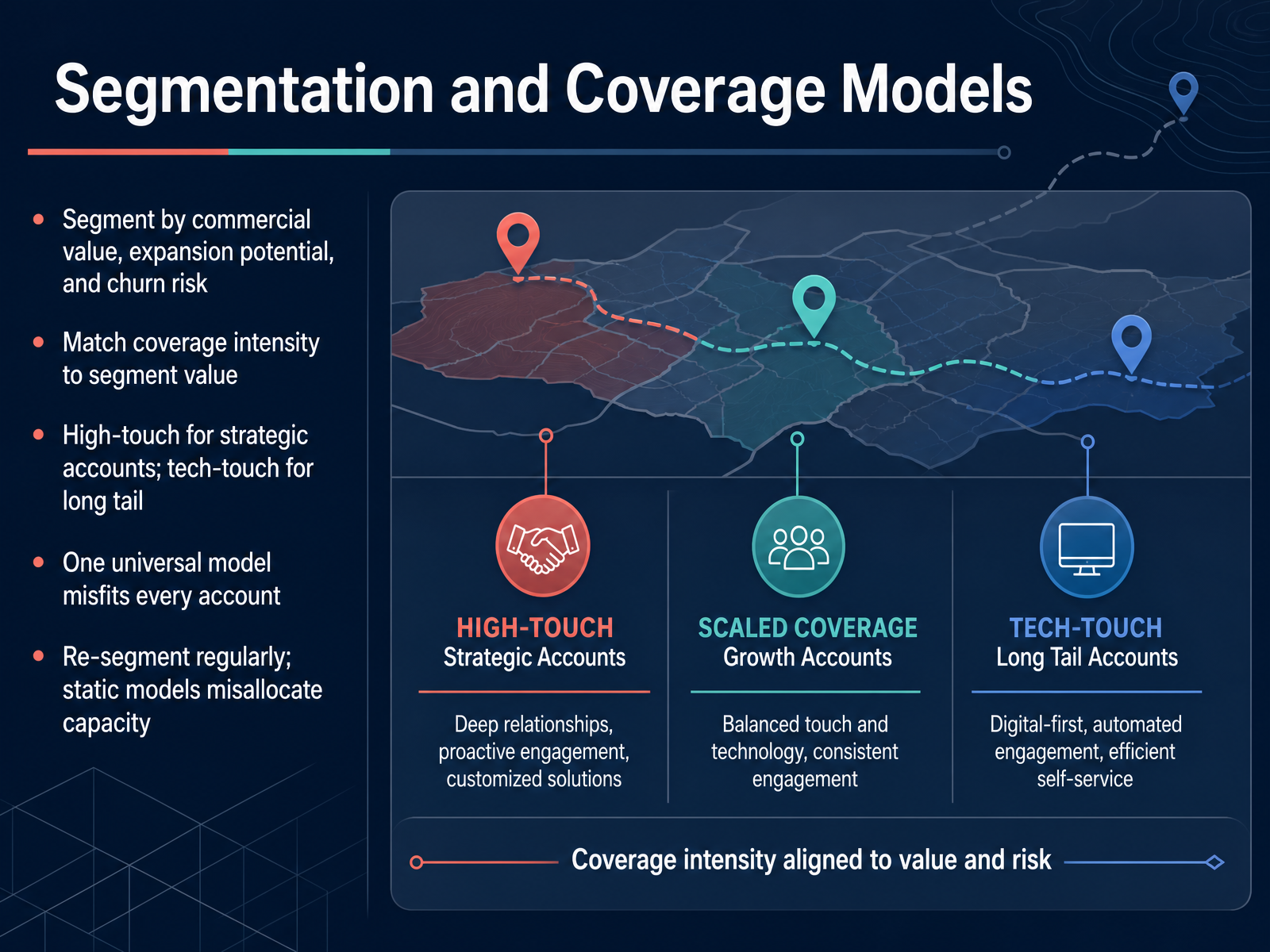
 - 11Segmentation and Coverage ModelsNow let's talk about where your plan actually meets your customer base: segmentation and coverage. One universal coverage model is a formula for misfit. A twelve-person startup and a five-thousand-person enterprise simply don't look the same when healthy, and treating them alike misfits both. So you need to segment on three axes. Commercial value tells you what the account is worth today. Expansion potential tells you what it could be worth tomorrow. And churn risk tells you where you're most exposed. Then you match coverage intensity to that value. Your strategic accounts get high-touch, dedicated management. Your long tail gets tech-touch, automated sequences, and self-serve resources with triggered interventions when signals warrant it. That isn't neglect; it's honesty about economics. And don't let the model sit. Re-segment regularly because accounts move. A small account that expands should graduate to more touch. A strategic account that plateaus may not justify a dedicated manager. Static segmentation quietly misallocates your capacity a year at a time. So, ground your coverage in current value and future potential, and let the model evolve with the base. Next, we'll look at how to execute scaled engagement across those low-touch and high-touch tiers.
 thegtmadvisor.comziellab.comthemarketingjuice.com+22 min
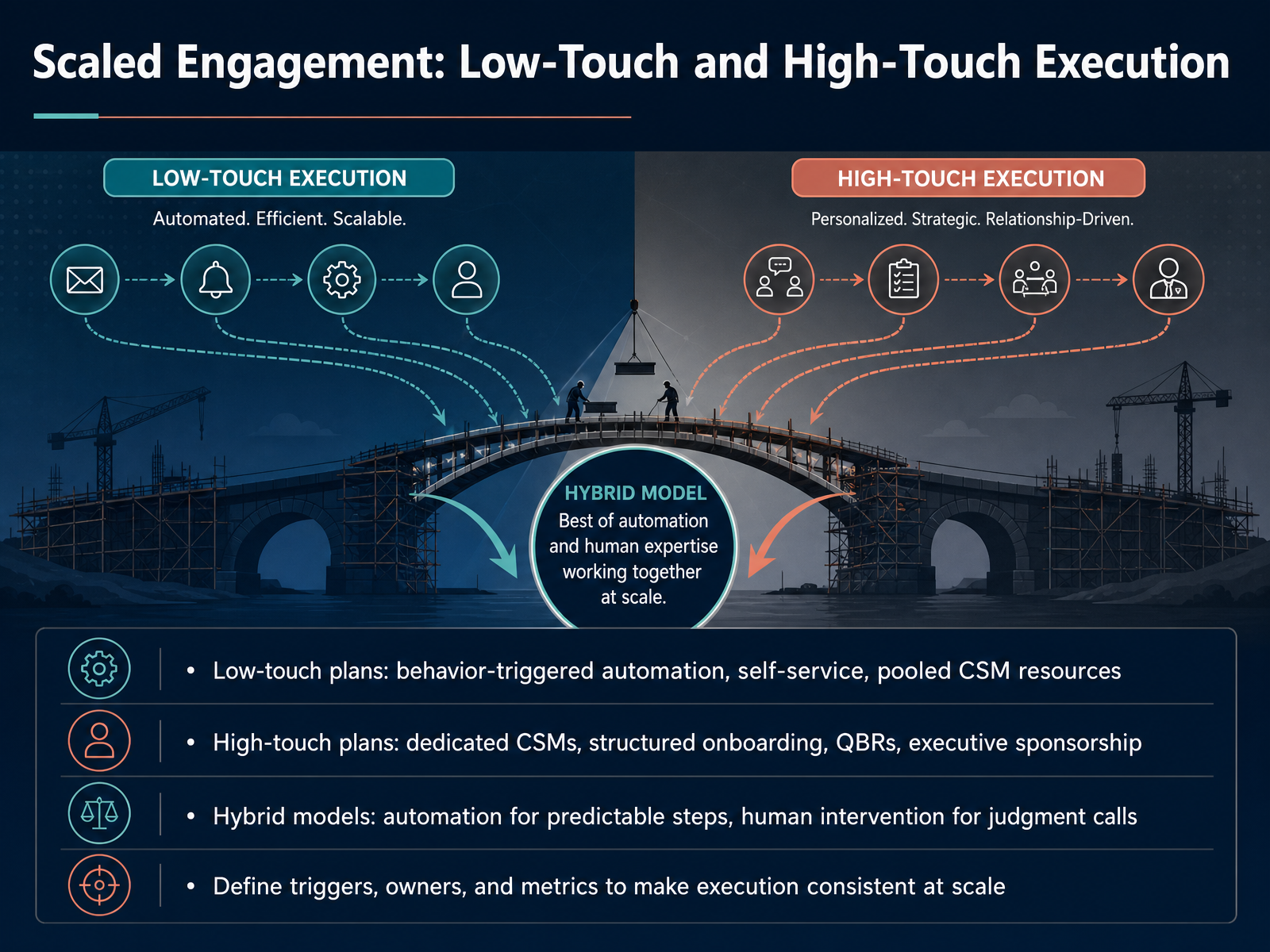
 - 12Scaled Engagement: Low-Touch and High-Touch ExecutionNow let's talk about scaling engagement. The reality is, not every customer needs the same level of attention, and pretending otherwise is inefficient. Low-touch plans make sense for accounts where predictable behaviors let us automate outreach through triggers and self-service resources. A pooled CSM team can handle those, stepping in only when a signal fires. High-touch plans are for your strategic accounts, where dedicated CSMs, structured onboarding, quarterly reviews, and executive sponsorship drive the relationship. But most portfolios sit somewhere in between, and that's where hybrid models shine. Use automation for predictable steps like renewal reminders or usage nudges, but keep human intervention for the judgment calls, like negotiating scope changes or handling a sudden support spike. Consistency at scale doesn't come from everyone improvising; it comes from defining the triggers, owners, and metrics for each play upfront. If you don't define those, your team defaults to reactive mode, and that's where churn risks hide. So as you build your plan, ask: which accounts are truly low-touch, which require dedicated attention, and what automated workflows can bridge the gap? With that clarity, you're ready to bring it all together into your customer success operating plan.
 tsia.com1 min
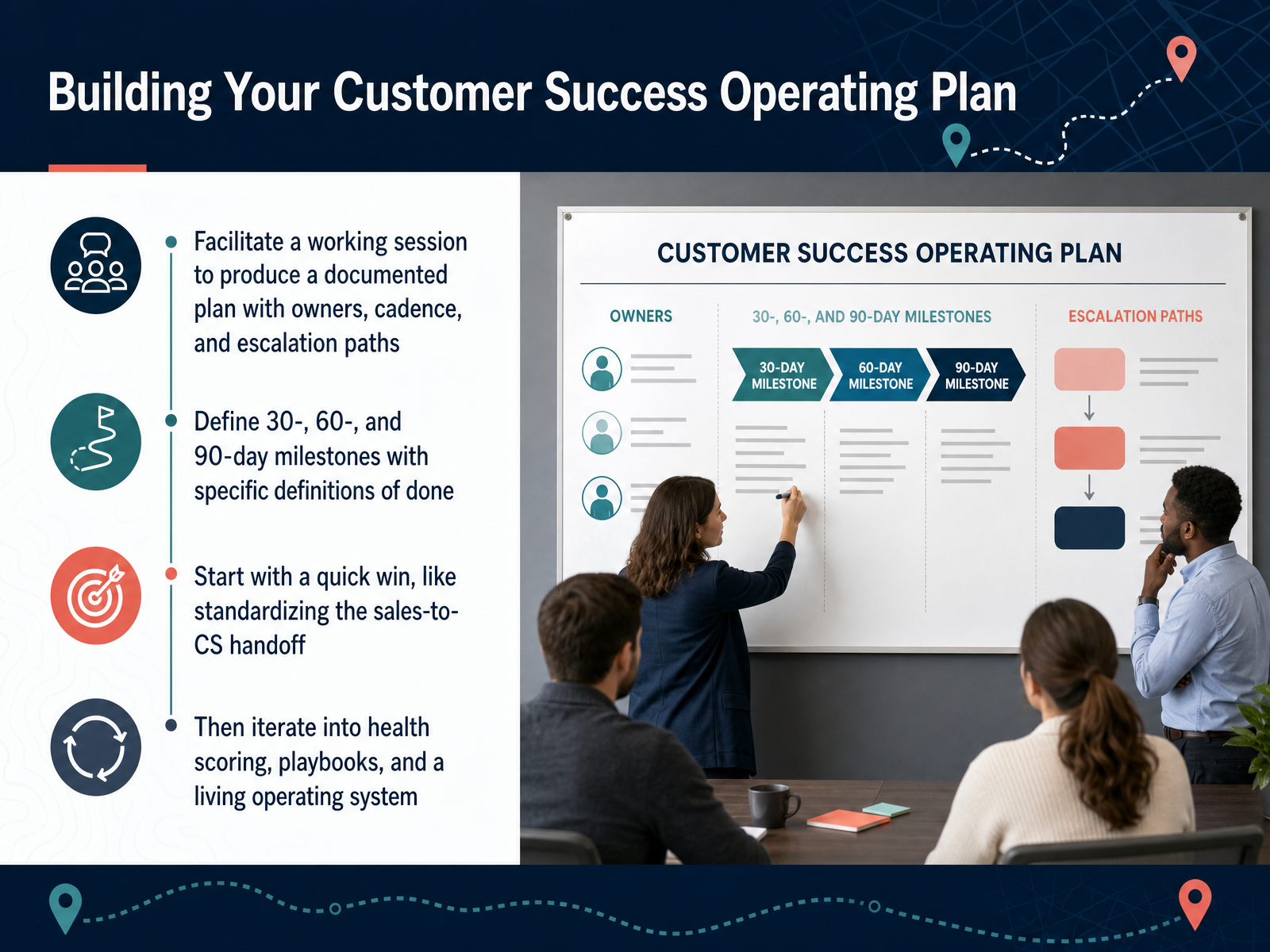
 - 13Building Your Customer Success Operating PlanNow we turn strategy into execution. Facilitate a working session where your cross-functional team produces a documented operating plan—one with named owners, a defined cadence, and clear escalation paths. Don't let it stay a slide deck. Define thirty, sixty, and ninety-day milestones, each with a specific, testable definition of done. Then, start with a quick win. Standardizing the sales-to-customer-success handoff is often the highest-leverage first move, because a poor handoff is the most common source of early churn. Once that discipline is visible, iterate. Build your first health score with a few reliable inputs, then layer in playbooks that fire on clear signals. The goal is not a static document, but a living operating system your team actually runs against. From plan to living system, that is what we build next.
 thegtmadvisor.comziellab.comthemarketingjuice.com+21 min
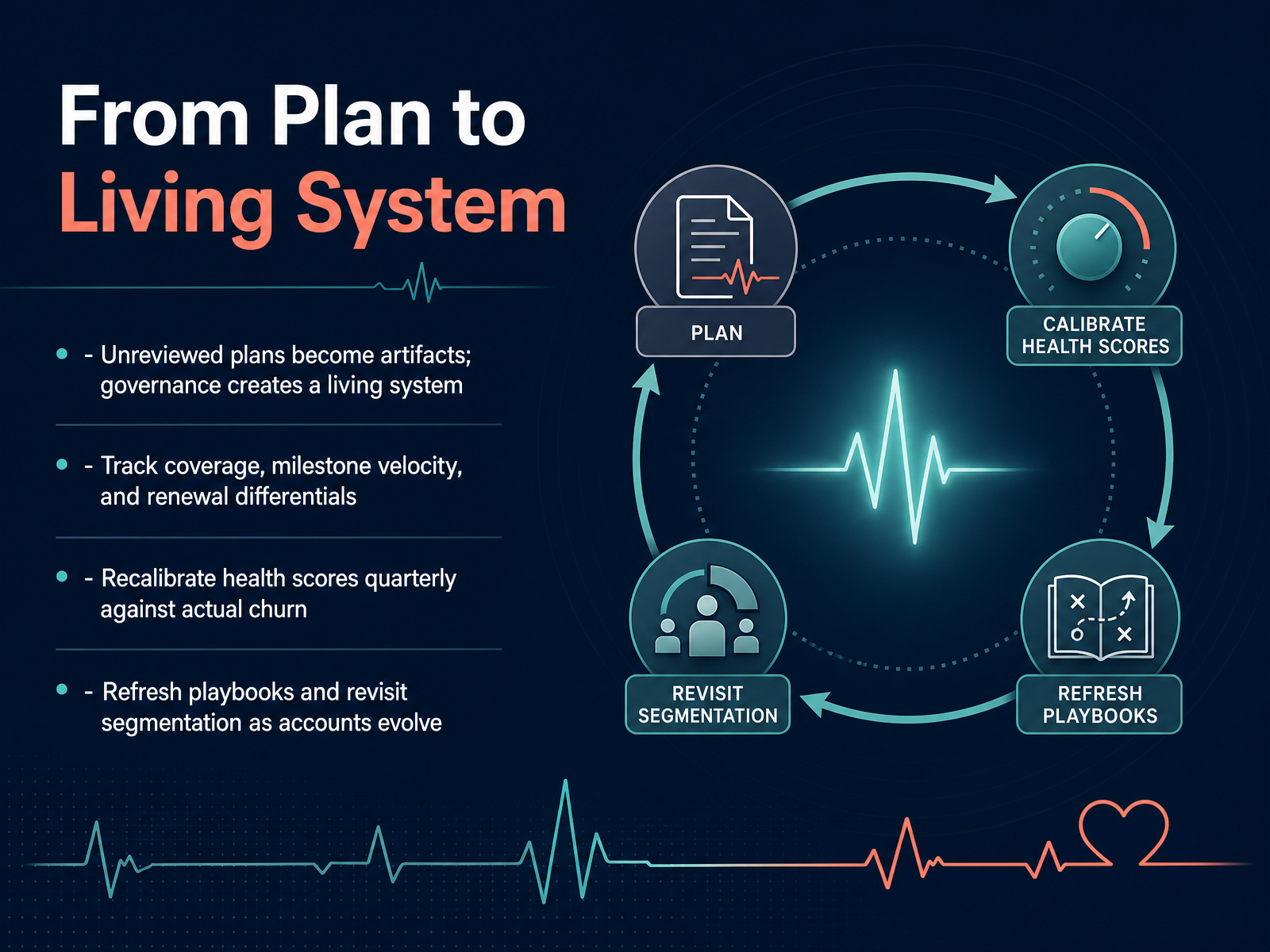
 - 14From Plan to Living SystemSo here is the final discipline: your plan only works if it keeps moving. An unreviewed plan becomes an artifact, a document that collects dust instead of driving decisions. Governance is what turns it into a living system. Track coverage, milestone velocity, and renewal differentials every week. These are the numbers that tell you whether adoption is actually happening or just being reported. Recalibrate your health scores quarterly against real churn outcomes. If your score says an account is healthy but it churns anyway, the model is wrong, not the customer. Refresh your playbooks and revisit your segmentation as accounts evolve. A playbook that worked for a startup will not fit a five-hundred-person enterprise. What we have built today is not a static plan; it is a system you own and tune. You set the goals, mapped the ownership, and sequenced the execution. Now you close the loop and run it. Thank you for your focus and your trust. Go make this plan work.
 weflow.aiwf.gigradar.iothegtmadvisor.com+12 min
Take the deck with you
Download this course as a file — free, no sign-up needed.
- PDF handoutEvery slide page, ready to print or share.15 pages · 3.5 MBDownload
- Narrated PowerPointThe deck that presents itself — every slide carries the digital human's narration video.15 pages · 13.6 MBDownload
- PowerPoint slidesThe full deck as a .pptx — open it in PowerPoint, Keynote, or Google Slides.15 pages · 3.4 MBDownload
Free to use in your own training — please keep the PersonWise credit page at the end.
Have your own deck? Turn it into a course
Sources consulted
Web sources consulted while building this course.
- Customer Success Operations: The Executive Guide to Building CS Ops That Drives Retention and Revenue — The GTM Advisor Group — thegtmadvisor.com
- Customer success operations: the system that scales CS — ziellab.com
- Customer Success Operations: Where Retention Breaks Down — themarketingjuice.com
- Customer Success Operations: Scaling Retention ... - Fullcast — fullcast.com
- Customer Success Plan Template + Free Builder (2026) — wf.gigradar.io
- Customer Success Operating Model: 8 Proven Pillars for B2B SaaS — procontentstudio.net
- Customer Success Plan Template: The 2026 Operating System — thecscafe.com
- Customer Success Operations: Build Health Scores, Renewal Forecasts, and Scalable Playbooks [Framework] — weflow.ai
- Customer Success Playbook: A Step-by-Step Guide for Technology Companies | TSIA — tsia.com
- How to Align Sales, Support, and Success for Maximum Impact - Customer Success Summit — customersuccesssummit.com
- How to Align Marketing, Sales, and Customer Success ... — pedowitzgroup.com
- How to Align Customer Success With RevOps for Net Revenue Retention Above 120% — oscom.ai
- How Do I Align Sales, RevOps, and Customer Success on the Same… — pulserevops.com
- Revenue Team Alignment: Building a Unified Go-to-Market Engine - Fullcast — fullcast.com
- Customer success framework: Build one that scales — blog.hubspot.com
- Build customer success agility with the Next Best Action Framework. - ChurnZero — churnzero.com
- How to Set Customer Success OKRs — okrstool.com
- Customer Success Plan: A Framework for B2B Revenue Teams | Prolifiq — prolifiq.com
- Customer Success Plan: How to Build One That Works — featurebase.app
- Aligning Responsibilities & Outcomes For Customer Success — gainsight.com