B2B Brand Strategy: Goals, Choices, Tradeoffs
Begin
14 pages · ~28 min
B2B Brand Strategy: Goals, Choices, Tradeoffs
Learn to craft effective B2B brand strategies by defining clear goals, making strategic choices, and navigating tradeoffs for measurable impact.
What you’ll learn
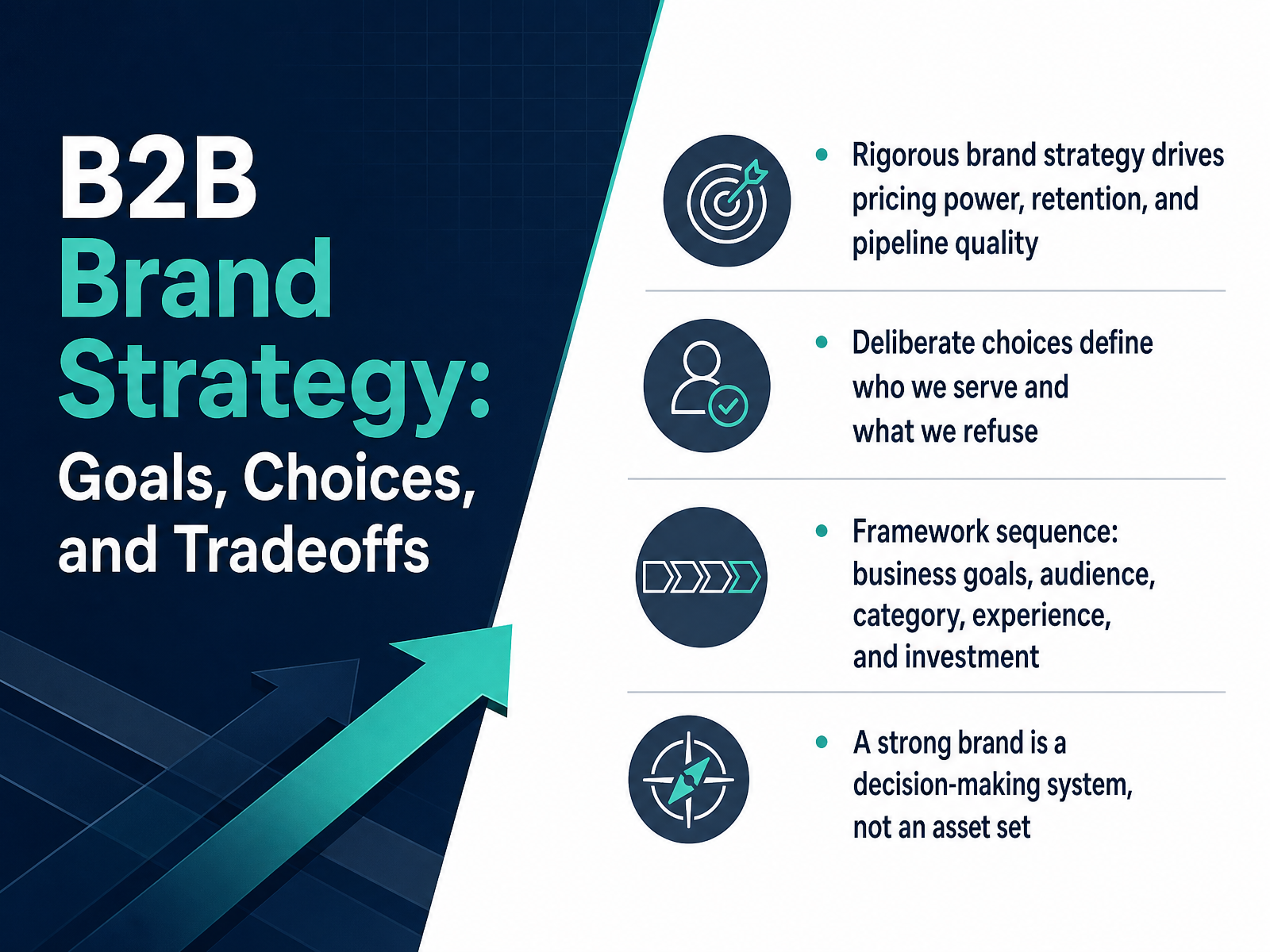
- 01B2B Brand Strategy: Goals, Choices, and TradeoffsWelcome. In the next few minutes, we're going to talk about B2B brand strategy the way it deserves to be discussed: not as logos, taglines, or asset libraries, but as a decision-making system that drives pricing power, retention, and pipeline quality. When done with rigor, your brand becomes the reason sales cycles shorten and deals stop discounting. But here's the uncomfortable part we're going to confront directly: real strategy requires deliberate choices. It defines who we serve, what we stand for, and, just as importantly, what we refuse to do. That kind of clarity is scarce in B2B, and it's exactly why strong brands command premium prices. Over this session, we'll move through a sequence of decisions that build this system, starting with business goals, moving to audience selection, then category positioning, the experience you deliver, and finally, the investment required to compound it all. You'll leave with a framework for making tradeoffs with confidence, not guesswork. Let's begin.inkbotdesign.comthestarrconspiracy.comeverything.design+22 min
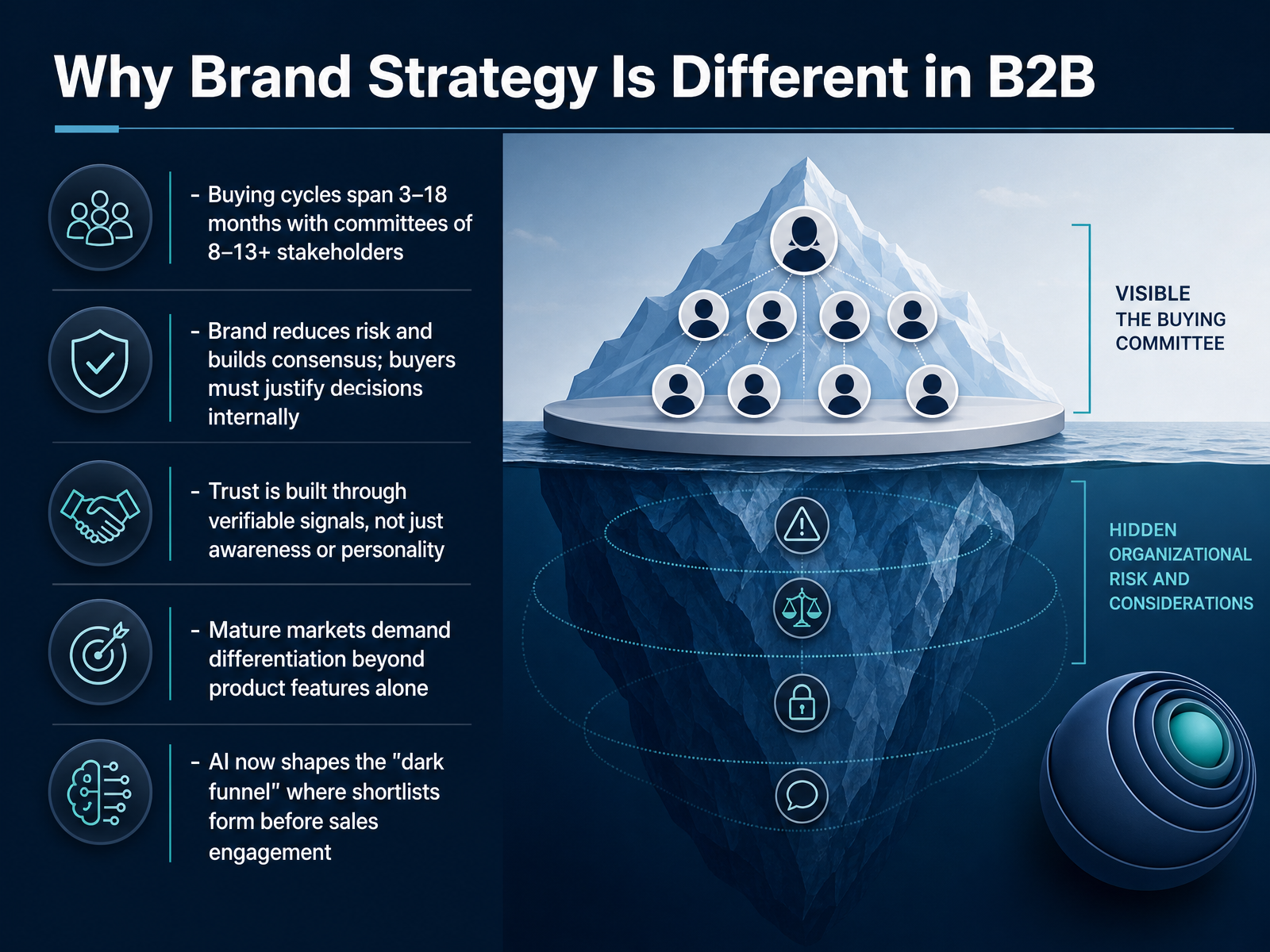
- 02Why Brand Strategy Is Different in B2BLet’s be candid about why B2B brand strategy is a different discipline entirely. You’re not driving impulse purchases. The average deal spans three to eighteen months, with a committee of eight to thirteen stakeholders pulling in different directions. Your brand isn’t just competing against other vendors. It’s competing against the status quo and the internal risk of doing nothing. That means your brand’s primary job is risk reduction and consensus building. Each stakeholder needs to justify the decision internally. So trust can’t be built on personality or awareness alone. It requires verifiable signals—third-party validation, proof points, and evidence that make the buyer the safe choice in the room. And in mature markets, product features have become table stakes. Differentiation now demands a clear point of view and a defensible category position. There’s another force reshaping the game entirely. AI now shapes what we call the dark funnel. Over half of buyers start their research in a chatbot, and shortlists form before your sales team even knows a deal exists. Your brand must be legible to those AI engines as much as to human buyers. Get that right, and you set the stage. Next, let’s focus on setting brand goals that connect directly to business outcomes.
 inkbotdesign.comthestarrconspiracy.comeverything.design+22 min
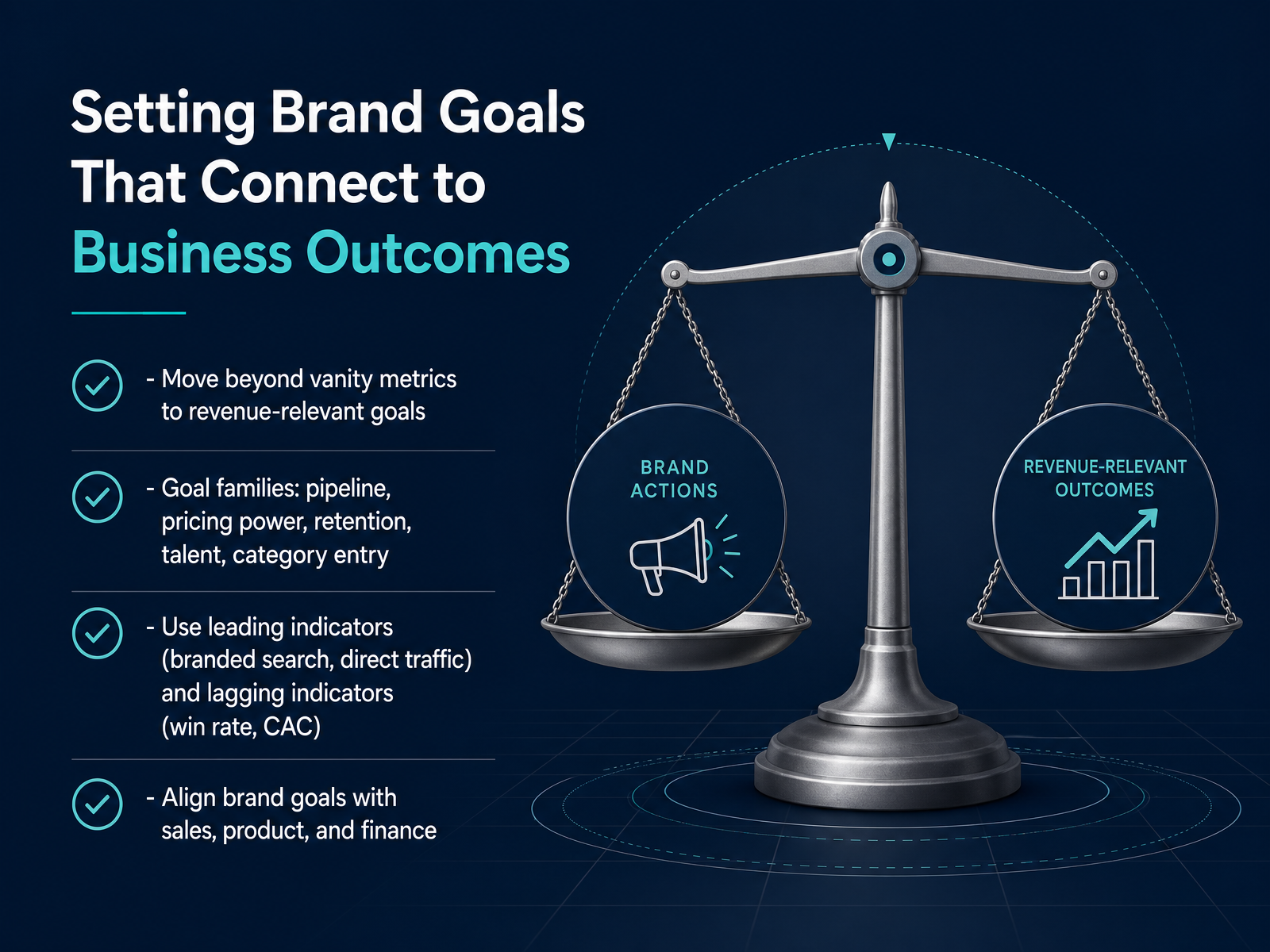
 - 03Setting Brand Goals That Connect to Business OutcomesLet's talk about setting brand goals that actually connect to business outcomes. If your brand dashboard is full of impressions, reach, or engagement rates, you're measuring activity, not impact. Move beyond vanity metrics and anchor your goals to revenue-relevant outcomes. Think in goal families. Pipeline contribution is the obvious one, but brand also drives pricing power, retention, talent attraction, and category entry. Each of those deserves its own explicit objective. To track progress, you need both leading and lagging indicators. Leading indicators, like branded search volume, direct traffic, and share of voice, tell you early whether your brand investment is working. They move within a few months. Lagging indicators, like win rate, customer acquisition cost, and pipeline velocity, confirm the payoff. Those take six to twelve months or longer to shift. Most importantly, align these goals with sales, product, and finance from the start. Brand goals should not live in a marketing silo. If your brand strategy aims to compress sales cycles, finance should see it in the forecast model. If it targets pricing power, product should know the positioning supports it. That alignment is what turns brand from a cost center into a growth asset. Now, let's shift to audience choices, specifically which customers and influencers should define your brand.
 seicho.iewinstonfrancois.comabmatic.ai+22 min
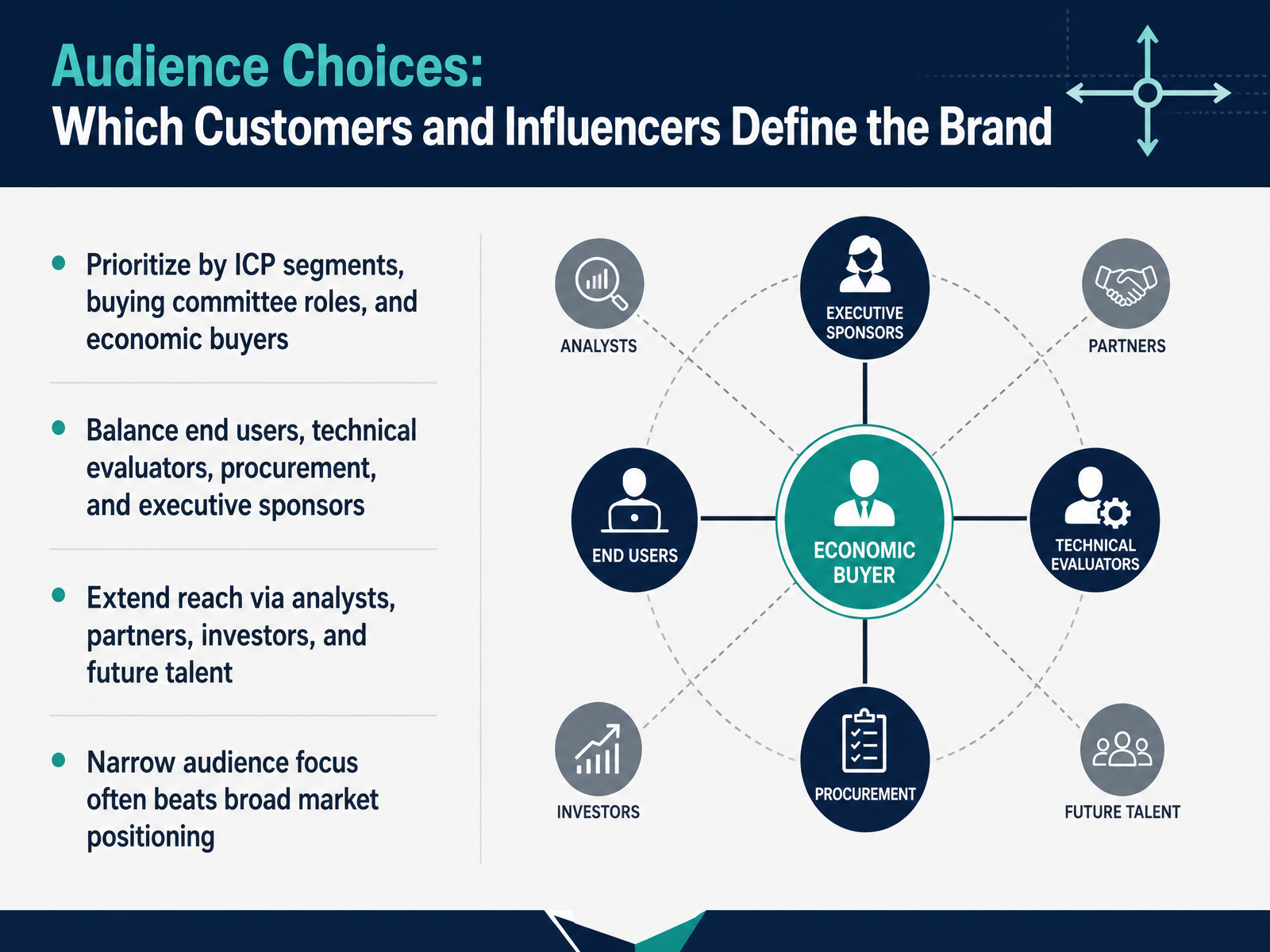
 - 04Audience Choices: Which Customers and Influencers Define the BrandNow let's talk about audience choices. This is where brand strategy gets uncomfortable, because it requires saying no. The reality in B2B is that your brand has to resonate across a buying committee that now averages over a dozen internal stakeholders plus external influencers. But that doesn't mean you position for all of them equally. Start by prioritizing your ideal customer profile segments, then map the specific roles that define the deal: the economic buyer, the technical evaluator, procurement, and the executive sponsor. Each one needs a different risk signal from your brand. The CFO needs ROI and stability. The security team needs compliance proof. The end user needs workflow fit. A single positioning statement won't serve all of them, but a layered messaging architecture will. Beyond the direct committee, consider the influencers who shape your category: analysts, partners, investors, and even future talent. They extend your credibility without adding go-to-market complexity. But here's the tradeoff, and it's the most important one on this slide: narrow audience focus almost always beats broad market positioning. A challenger that owns a specific niche becomes the obvious choice, while the generalist becomes too generic to trust. Decide who you are for, and just as critically, who you are not for. That clarity will drive everything from messaging to pricing power. This sets up the next critical choice: positioning and category definition, which we'll cover now.
 inkbotdesign.comthestarrconspiracy.comeverything.design+22 min
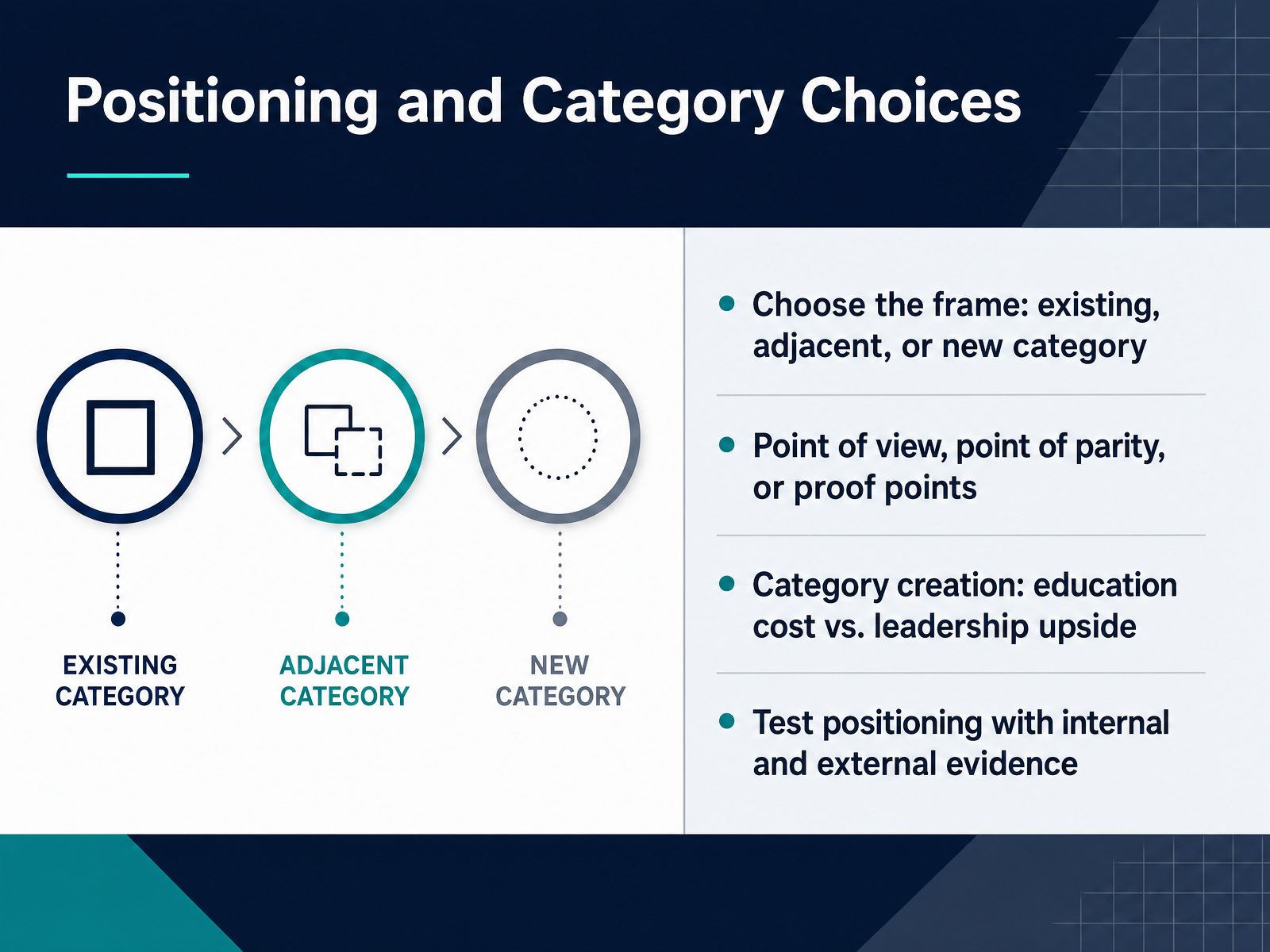
 - 05Positioning and Category ChoicesLet’s talk about the frame you choose to compete in, because that choice determines everything downstream. You can play in an existing category, an adjacent one, or you can attempt to define a new one altogether. Each comes with a different cost of education and a different ceiling on leadership. If buyers already understand the frame, you move faster, but you inherit the category leader’s shadow. If you create a new frame, you own the terms of comparison, but you pay for years of market education before the pipeline catches up. Here is the candid tradeoff: category creation is a multi-year, multi-million-dollar bet. It only makes sense if you have a genuinely controversial point of view, not just a better feature set. Most companies confuse a differentiation problem with a category creation opportunity. So, anchor your positioning in the buyer’s existing language first. Lead with proof points, third-party validation, and quantified outcomes, because in a skeptical committee, evidence beats adjectives. Test your positioning internally and externally before you commit. If your sales team can’t explain it in one sentence, it’s not a position yet. That’s how you decide whether you are fighting for share or defining the game. Now, once the frame is set, the next hard question is how your portfolio lines up behind it.
 inkbotdesign.comthestarrconspiracy.comeverything.design+21 min
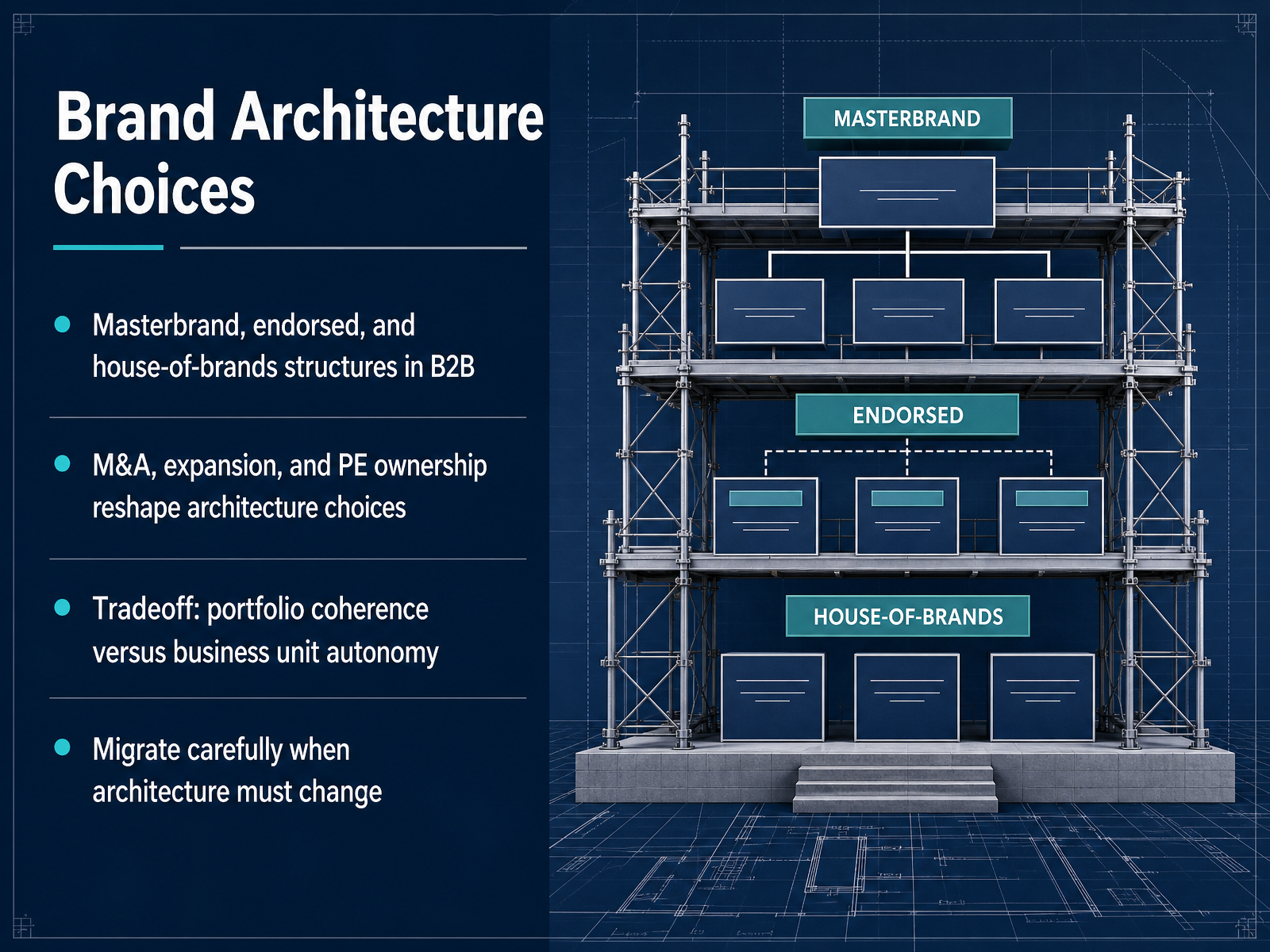
 - 06Brand Architecture ChoicesLet’s talk about architecture. Not the org chart, but how your brands sit inside it. Masterbrand, endorsed, or house of brands — each is a distinct economic bet. A masterbrand concentrates equity, making every dollar of marketing work for every product. But it concentrates risk too; a failure in one line hits the whole portfolio. Endorsed brands give you differentiation with a credibility halo, at the cost of constant governance. House of brands offers sharp separation but demands you fund multiple awareness engines from scratch. Now consider how these structures actually form. Merger and acquisition activity, ambitious expansion, or private equity ownership are the usual forces that reshape them. When a deal closes, you inherit a portfolio that likely does not match your new strategy. So, the real tradeoff: portfolio coherence versus business unit autonomy. That tension cannot be solved by clever naming. If you must change architecture, migrate carefully. A phased plan protects the equity you paid for, limits customer confusion, and gives your teams time to adopt. Force it in a quarter, and you will leave value on the table. That structural discipline sets the stage for how you deliver on your brand promise, which is exactly where we go next.
 inkbotdesign.comthestarrconspiracy.comeverything.design+21 min
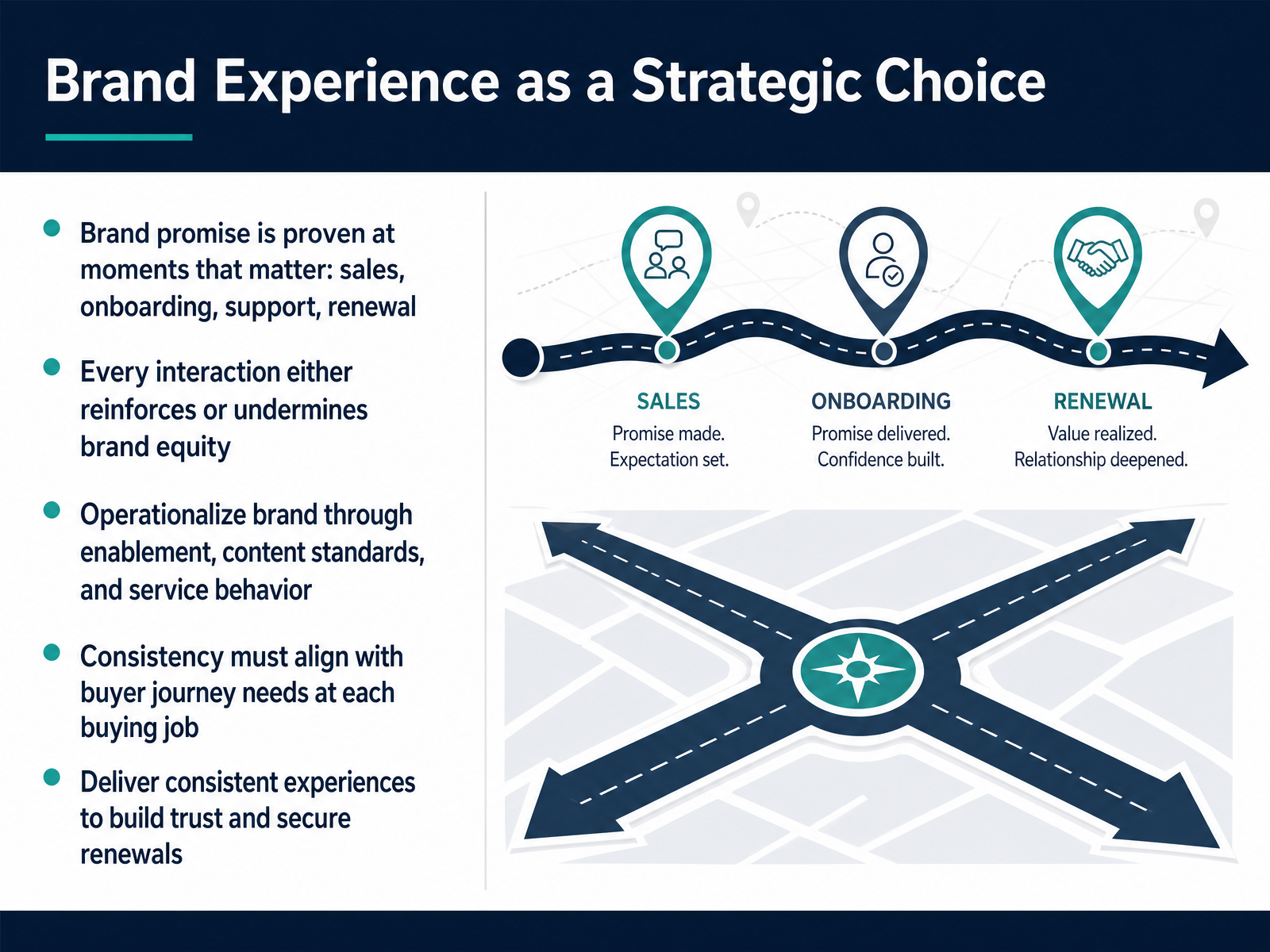
 - 07Brand Experience as a Strategic ChoiceNow, let's talk about brand experience as a strategic choice, not a delivery detail. Your brand promise is only proven at the moments that matter most: during sales, onboarding, support, and renewal. Every single interaction either reinforces your brand equity or quietly undermines it. There is no neutral ground here. To operationalize your brand, you need intentional enablement, strict content standards, and consistent service behavior across every team. But consistency does not mean uniformity. It must align with the buyer journey needs at each specific buying job. What reassures a technical evaluator differs from what a procurement team needs to see. Delivering a consistent, context-aware experience across those moments is what builds trust, secures renewals, and protects your price premium. Now, let's look at the resource and activation tradeoffs that make this possible.
 inkbotdesign.comthestarrconspiracy.comeverything.design+22 min
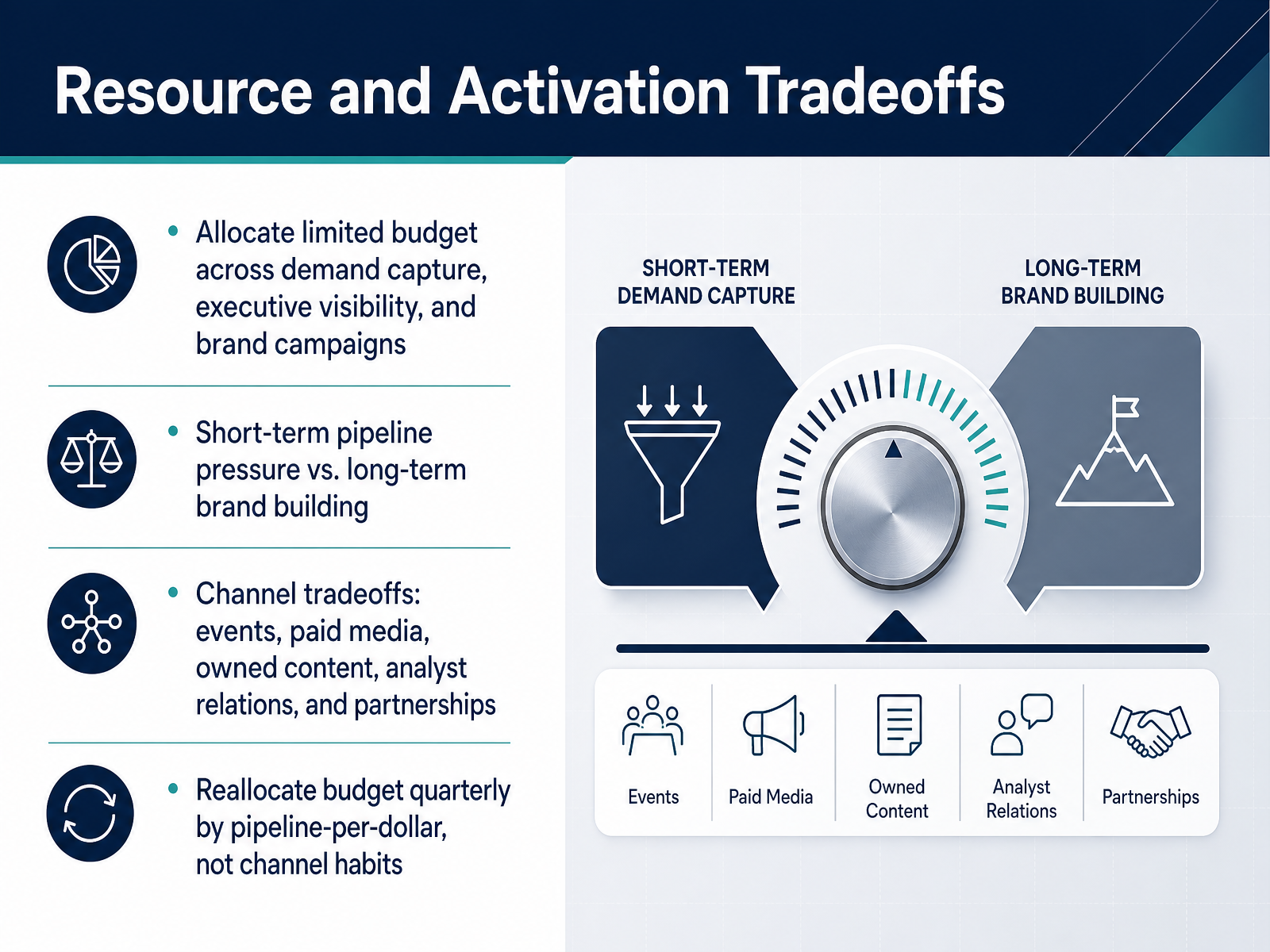
 - 08Resource and Activation TradeoffsResource allocation is where strategy gets real. You have a limited budget, and every dollar has a job. The tension is familiar: short-term pipeline pressure versus long-term brand building. Demand capture feeds this quarter. Brand feeds the next four. Both matter, but they compete for the same pool of money. Start with the split. Most B2B teams run roughly seventy percent demand and twenty-five percent brand, even though leaders say they would prefer something closer to a fifty-forty balance. That gap is a choice. Think about channels the same way. Events, paid media, owned content, analyst relations, and partnerships all pull from the same budget. Each has a different payback horizon and a different effect on pipeline. The discipline is reallocating quarterly based on pipeline per dollar, not on habit or comfort. If paid search is producing at a better rate than events, shift the weight. If analyst relations is shortening sales cycles, protect it. And when you measure brand, use leading indicators like search volume and direct traffic, not just lagging outcomes like win rate. That is how you defend brand spend with evidence. Then, when you look at rebranding, the question becomes whether the price of change is justified by the growth it unlocks.
 seicho.iewinstonfrancois.comabmatic.ai+21 min
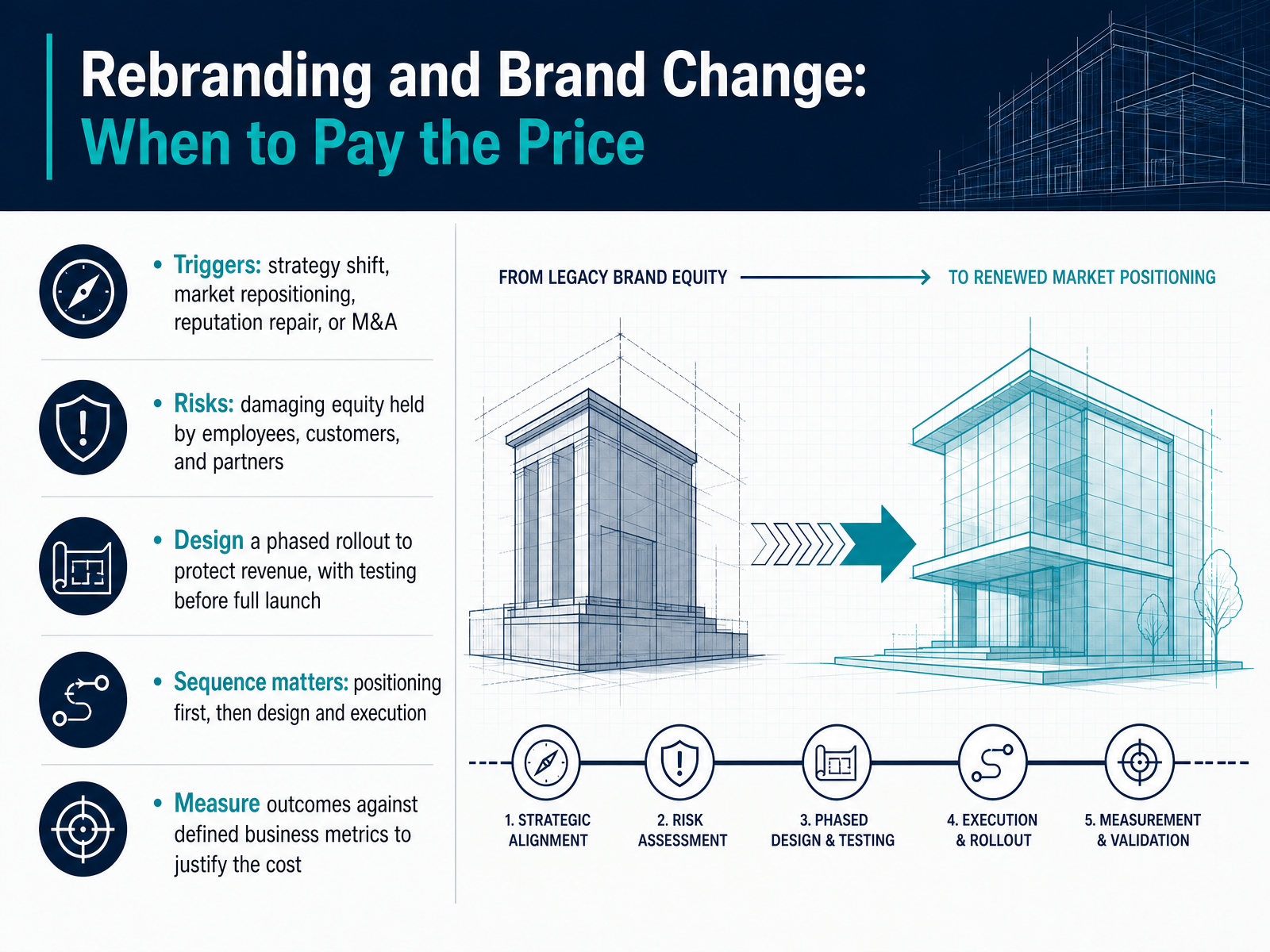
 - 09Rebranding and Brand Change: When to Pay the PriceLet's talk about rebranding, because knowing when to pay the price is as critical as knowing if you should. The triggers are familiar: a strategic pivot, a market repositioning, reputation repair, or the aftermath of M&A. But the risk is equally clear—you can damage the equity held by your employees, customers, and partners. That's a balance sheet you don't want to disrupt. The answer is a phased rollout designed to protect revenue, not a big-bang launch. Test before you commit. Sequence matters far more than speed: nail your positioning first, then execute the design and rollout. And finally, define your business metrics before you start, so you can prove the ROI of the change. A real-world example: a major platform rebrand phased its homepage changes. The result was a sales lift, not a crater. That's the value of discipline. So when you consider change, ensure it's solving a strategic problem, not a cosmetic one. With the right triggers, sequencing, and metrics, you can turn a risky move into a growth driver. This brings us to a key pivot: turning these goals and choices into a concrete decision framework.
 justin-dickinson.commmm-online.combrandactive.com+22 min
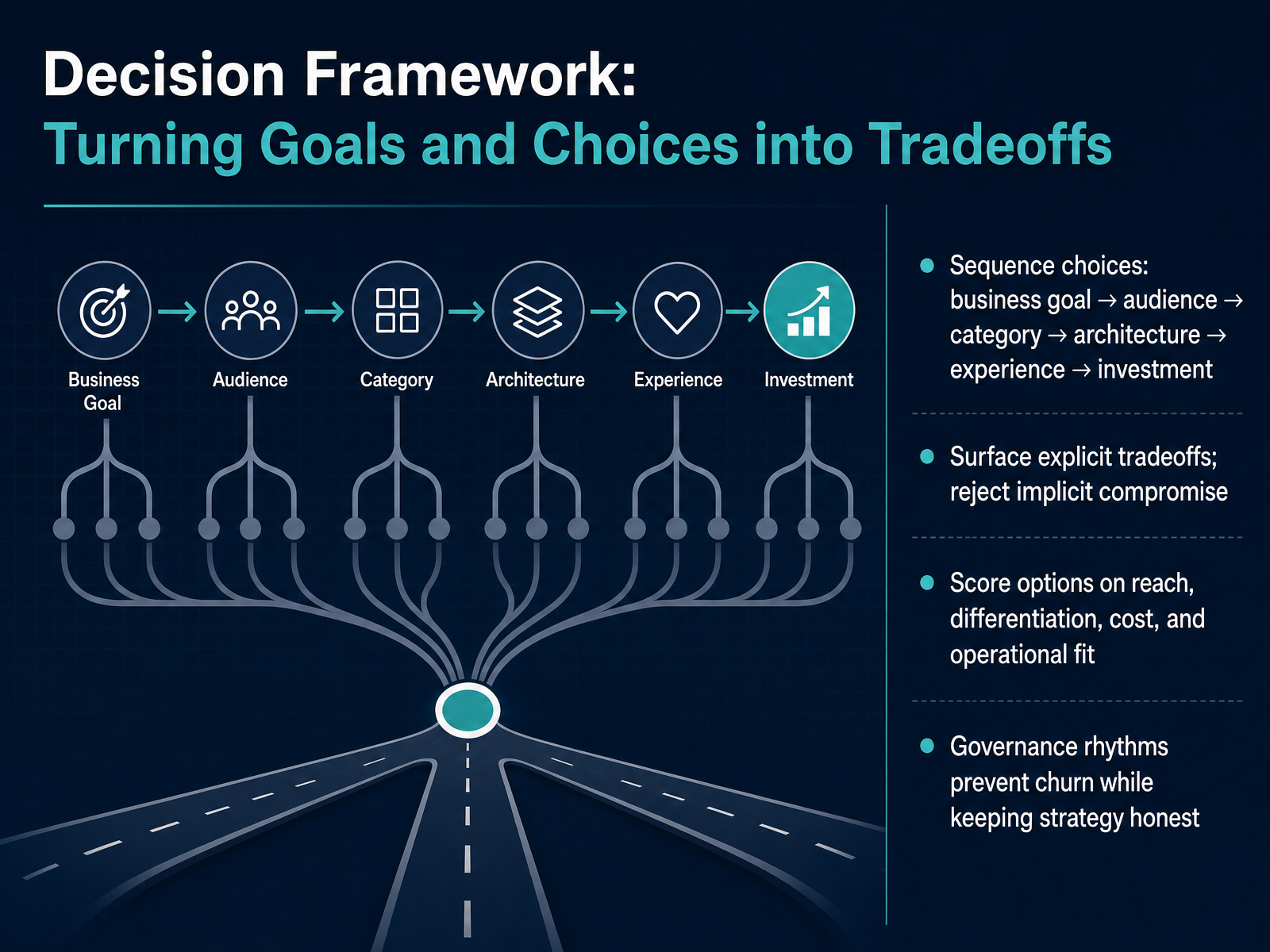
 - 10Decision Framework: Turning Goals and Choices into TradeoffsNow let’s turn this into a working decision framework. Sequence every choice in the same order: business goal, audience, category, architecture, experience, and investment. If you follow that sequence, each decision constrains the next one in a way that makes sense. If you skip ahead, you’ll end up making architecture choices before you’ve agreed on who you’re actually serving. Surface the tradeoffs explicitly. Name what you’re giving up, and why. Reject the implicit compromise that tries to keep every option alive. A strategy that doesn’t exclude anything is just a wish list. Score each option on four dimensions: reach, differentiation, cost, and operational fit. That forces a candid conversation about what you can actually execute, not just what sounds bold in a deck. And then put governance around it. A cadence of reviews—quarterly, not monthly—prevents churn while keeping the strategy honest when market conditions shift. The framework only works if you treat it as a living decision system, not a one-time exercise. Next, we’ll look at how measurement and governance keep that system accountable over time.
 inkbotdesign.comthestarrconspiracy.comeverything.design+21 min
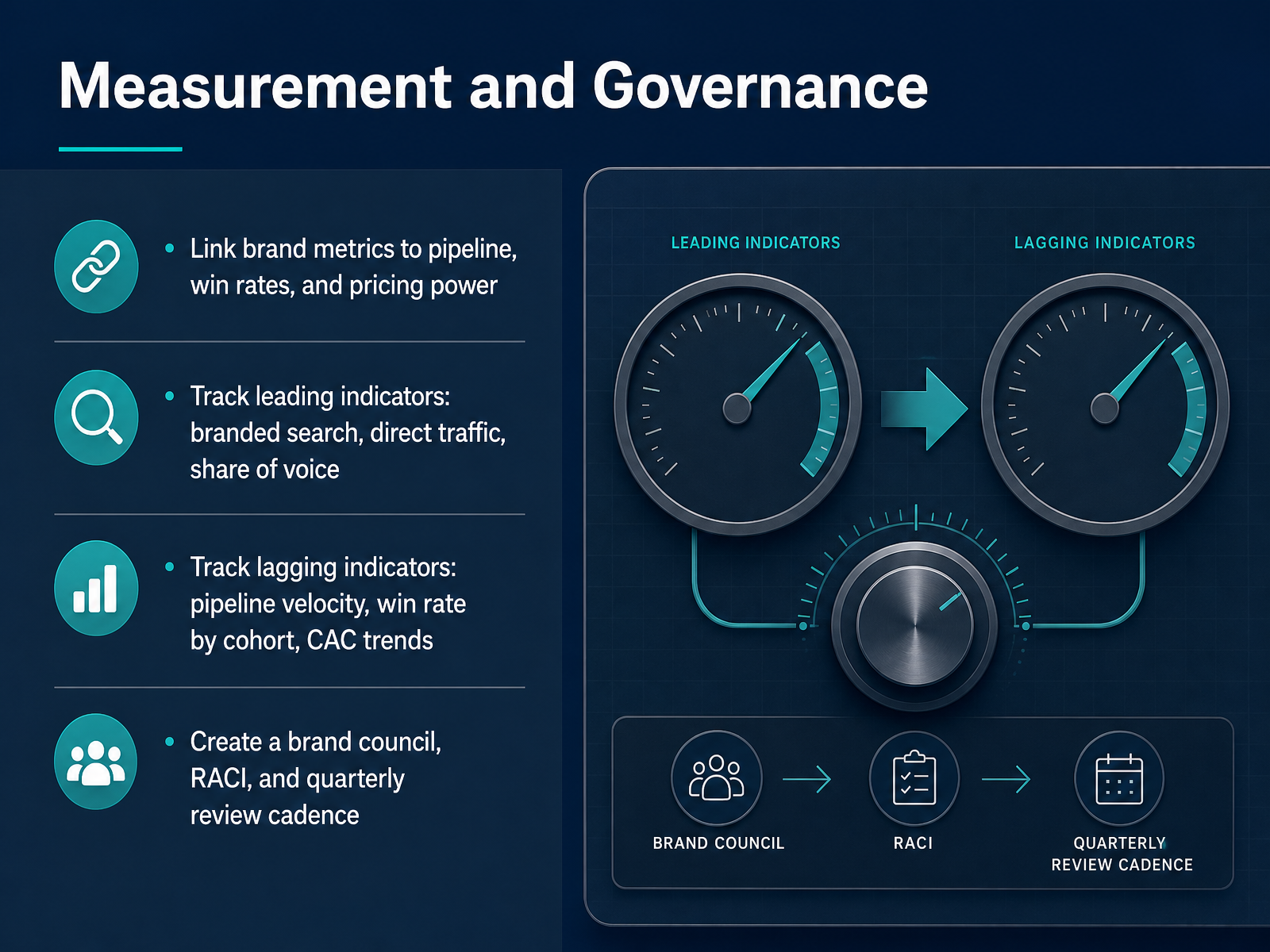
 - 11Measurement and GovernanceNow we get to the hard part: governance. Strategy without measurement is just an opinion, so let's talk about how you defend your brand investment in the boardroom. Link brand metrics directly to pipeline, win rates, and pricing power. That is the language your CFO speaks. To get there, you need to track both leading and lagging indicators. Leading indicators—like branded search, direct traffic, and share of voice—tell you if your message is cutting through within a quarter. Lagging indicators—like pipeline velocity, win rate by cohort, and CAC trends—confirm the financial payoff over the next six to twelve months. To make this stick, you need more than a dashboard. Stand up a brand council with a clear RACI, so every regional and product team knows who owns what. Then hold a quarterly review cadence where you track these metrics against your baselines and adjust strategy. Without that rhythm, brand becomes everyone's job and no one's job. Next, let's ground all of this in real examples with our case studies and evidence.
 seicho.iewinstonfrancois.comabmatic.ai+21 min
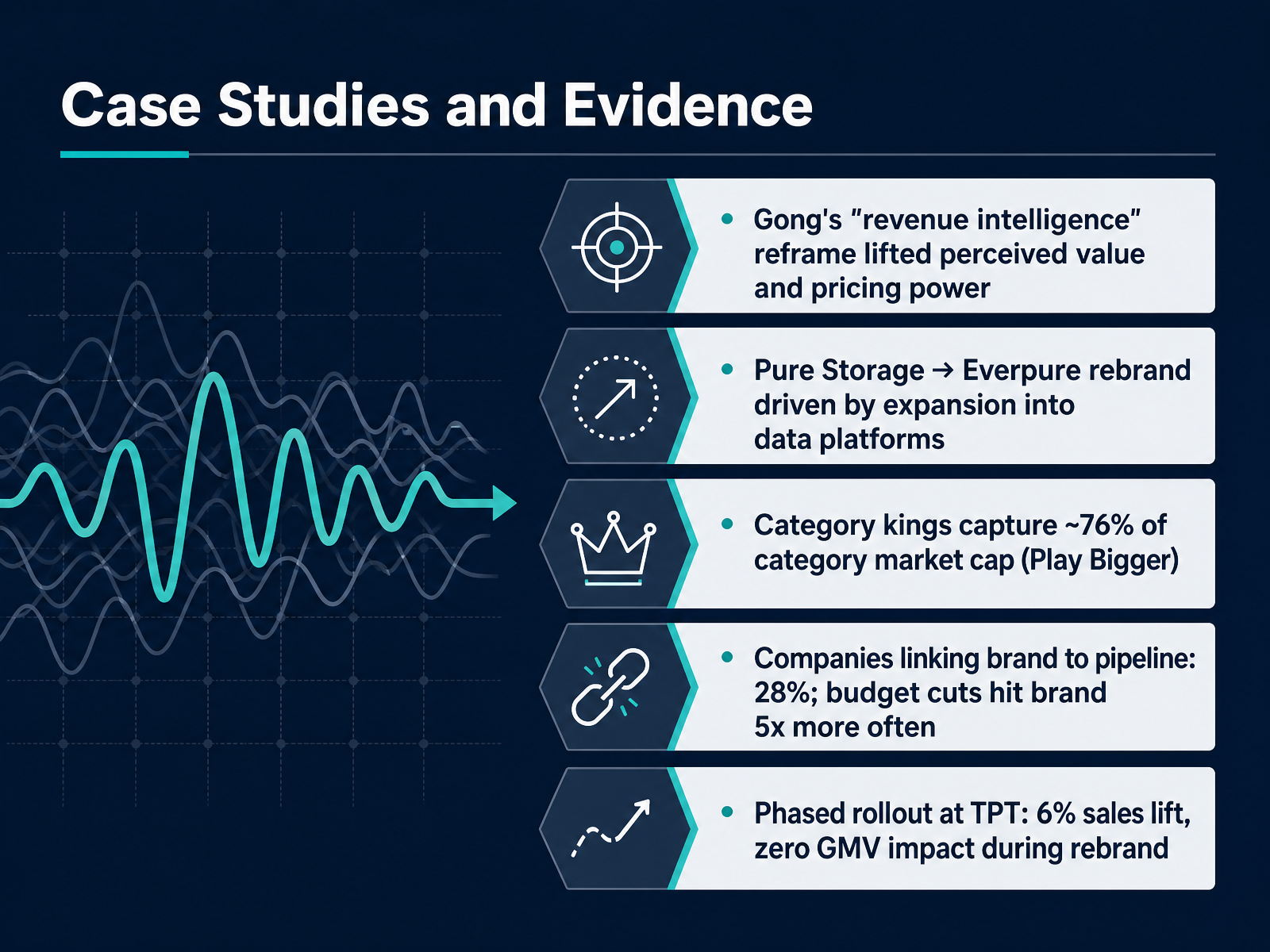
 - 12Case Studies and EvidenceLet's ground this in evidence. Gong reframed its category as revenue intelligence, moving away from feature comparisons to elevate perceived value and pricing power. Pure Storage's shift to Everpure was a strategic response to expanding beyond storage into data platforms. The numbers reinforce the stakes. Play Bigger research shows category kings capture roughly seventy-six percent of their category's market cap. Yet only twenty-eight percent of companies can directly tie brand activity to pipeline, and when budgets tighten, brand gets cut five times more often than demand. That gap is the opportunity. Executed well, rebranding carries manageable risk. TPT's phased rollout delivered a six percent sales lift with zero impact on gross merchandise value. Measured rollout, staged testing, and clear KPIs protect revenue while you reposition. The evidence points to one conclusion: brand strategy is a financial decision, not a creative exercise.
 seicho.iewinstonfrancois.comabmatic.ai+21 min
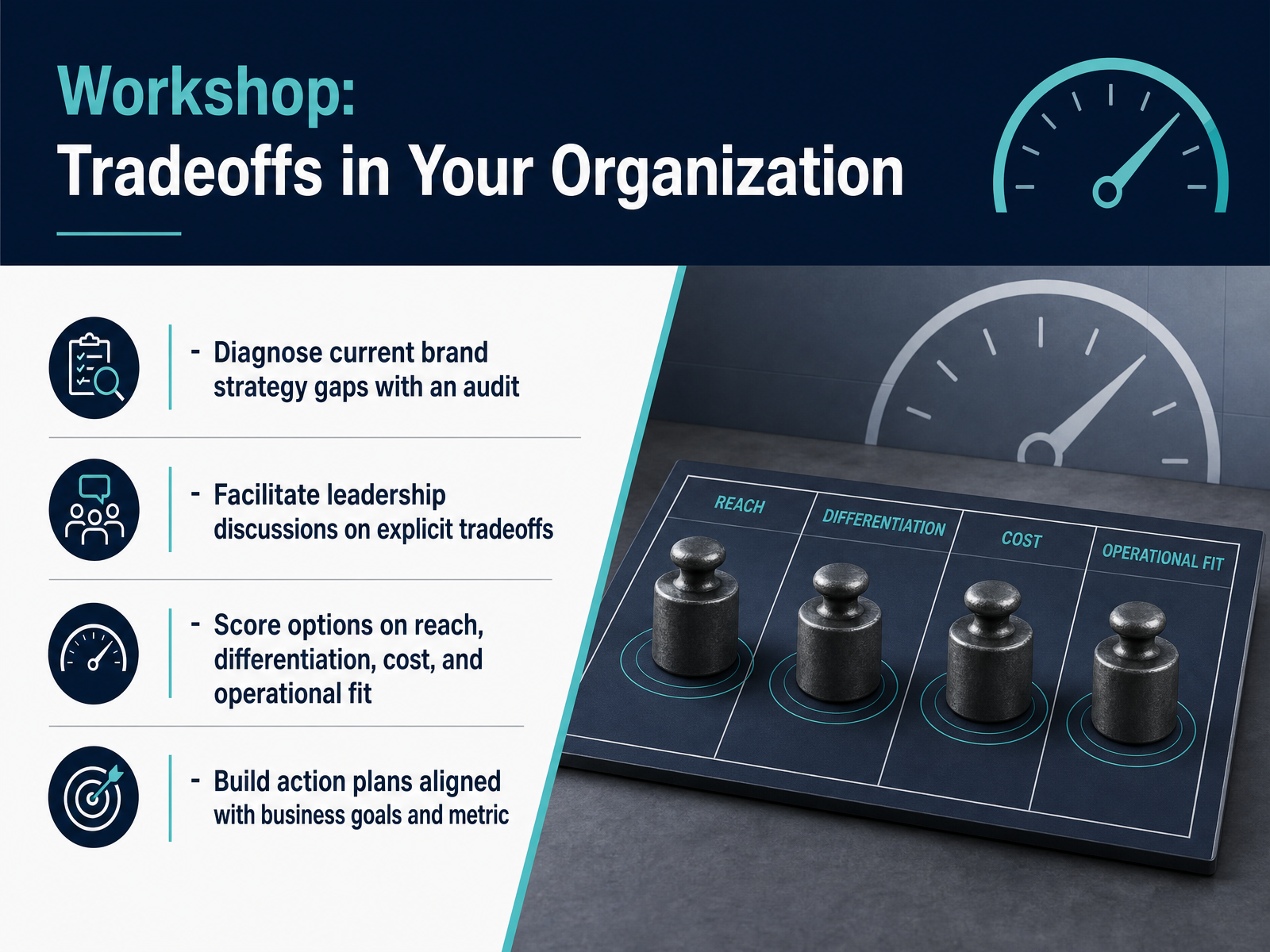
 - 13Workshop: Tradeoffs in Your OrganizationLet’s apply this thinking to your own portfolio. Start by diagnosing where the friction actually is. A structured brand audit will show you whether the gap is in strategy, in expression, or in the architecture itself. Once you see that clearly, you can move to the harder part: facilitating the conversation with your leadership about what you’re willing to give up. Position every tradeoff as a business decision, not a creative one. For each option, score it honestly against four factors. First, its reach and growth potential. Second, its differentiation and pricing power. Third, what it costs to build and maintain. And fourth, how well it fits your existing operating model and go-to-market motion. Make that a weighted score based on your stated goals. The option with the highest number may not be the one you choose, but the act of scoring forces a discipline that gut feel alone can’t deliver. Finish by building action plans that tie directly to your revenue metrics, whether that’s share of wallet, win rate, or cycle time. The output should be a decision your product and sales teams can execute on Monday morning, not a slide deck that dies in a folder. Let’s move to the key takeaways and next steps.
 inkbotdesign.comthestarrconspiracy.comeverything.design+22 min
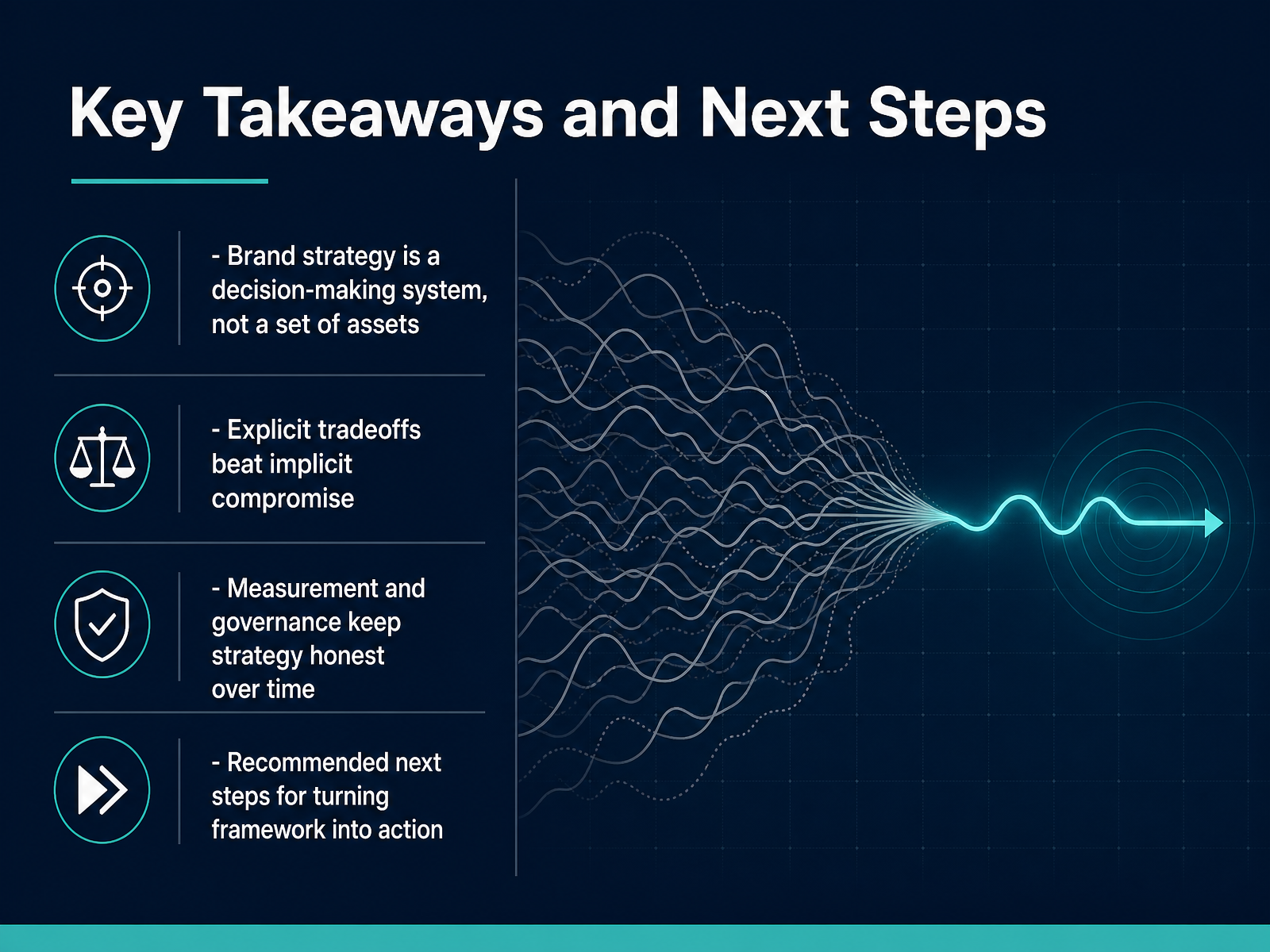
 - 14Key Takeaways and Next StepsWe’ve covered a lot of ground. Here’s what matters most. Brand strategy is a decision-making system, not a set of assets. It tells you what to stand for, who to serve, and what to refuse. Explicit tradeoffs beat implicit compromise. If you don’t decide what you’re willing to lose, you end up vague everywhere and strong nowhere. Measurement and governance keep strategy honest over time. Track mental availability, share of search, and brand-influenced pipeline. Review them quarterly, not just when a campaign ends. Now, turn this into action. Start with one honest audit question: where do we win, and where are we pretending? Then write the short, opinionated strategy document. Name your priority segments, your point of view, and your sacrifices. Make one person accountable for it. That’s your next step. Thanks for your focus. Go make the tradeoffs that compound.
 inkbotdesign.comthestarrconspiracy.comeverything.design+21 min
Take the deck with you
Download this course as a file — free, no sign-up needed.
- PDF handoutEvery slide page, ready to print or share.15 pages · 3.5 MBDownload
- Narrated PowerPointThe deck that presents itself — every slide carries the digital human's narration video.15 pages · 15.0 MBDownload
- PowerPoint slidesThe full deck as a .pptx — open it in PowerPoint, Keynote, or Google Slides.15 pages · 3.4 MBDownload
Free to use in your own training — please keep the PersonWise credit page at the end.
Have your own deck? Turn it into a course
Sources consulted
Web sources consulted while building this course.
- B2B Brand Strategy Framework: The 2026 Guide For Growth — inkbotdesign.com
- What Is B2B Brand Strategy? The Definition Most Get Wrong — thestarrconspiracy.com
- B2B Brand Strategy Foundations: 5 Frameworks That Actually Work — everything.design
- How to Build a B2B Brand Strategy That Earns the Shortlist — thegrowthsyndicate.com
- 2026 B2B Brand Strategy: How To Build Brand Equity — basisglobal.co
- Measuring Brand ROI: What B2B Leaders Actually Need to Track — seicho.ie
- How to Measure Brand ROI in B2B Marketing | Winston Francois — winstonfrancois.com
- Measuring the ROI of Demand Generation: Advanced Approaches — abmatic.ai
- Pipeline Metrics: Coverage, Velocity & KPIs | Artemis GTM — artemisgtm.ai
- How to Measure B2B Campaign ROI: 5 Procedures — thestarrconspiracy.com
- How We Rolled Out a Rebrand Without Tanking Revenue – Justin Dickinson — justin-dickinson.com
- Who better than 1,800 employees to rebrand a company? — mmm-online.com
- Global industrial tech rebrand: 8,600+ assets aligned under a climate-driven brand across 60 countries - BrandActive — brandactive.com
- Everpure's Rebrand Reflects the New Rules of B2B Marketing in the AI Era - Chief Marketer — chiefmarketer.com
- Mergers fade. New eras launch. | LBBOnline — lbbonline.com