Begin
14 pages · ~28 min
API Development Strategy Essentials
This training helps developers and architects define API development strategies by evaluating goals, technology choices, and key tradeoffs.
A digital instructor presents all 14 pages. Hold “Ask” at any point and ask out loud — the answer comes from this course. No sign-up needed.
What you’ll learn
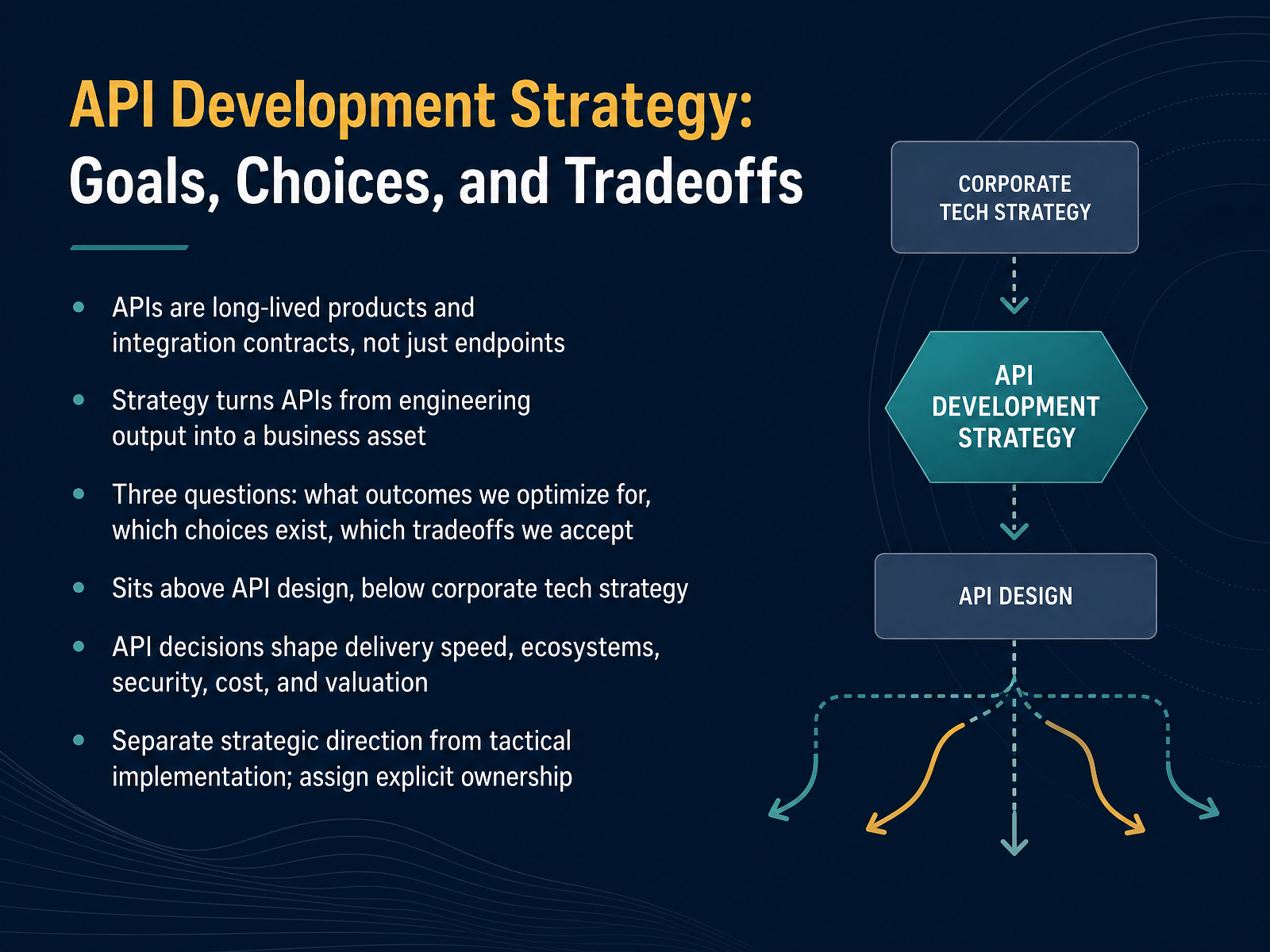
- 01API Development Strategy: Goals, Choices, and TradeoffsWelcome. Over the next few minutes, we'll set a shared direction for how your organization builds and runs APIs, and give you the criteria to make real decisions rather than accept defaults. Here's the core idea. APIs are long-lived products and integration contracts, not just endpoints. Strategy is what turns them from engineering output into a business asset. Throughout this course, we'll work through three questions. What outcomes are we optimizing for, which choices actually exist, and which tradeoffs are we willing to accept. Note where this sits. API strategy lives above individual API design and below corporate technology strategy. It's the layer that decides direction and resource allocation, while design and implementation follow. Why does it matter? Because these decisions shape delivery speed, your partner and developer ecosystems, security posture, operating cost, and even how the business is valued. So keep one discipline in mind as we go. Separate strategic direction from tactical implementation, and assign explicit ownership for each. If you can do that, the rest gets much easier. Let's start by looking at why API strategy is a leadership decision, not just an engineering one.moesif.comtreblle.comapi-portal.io+22 min
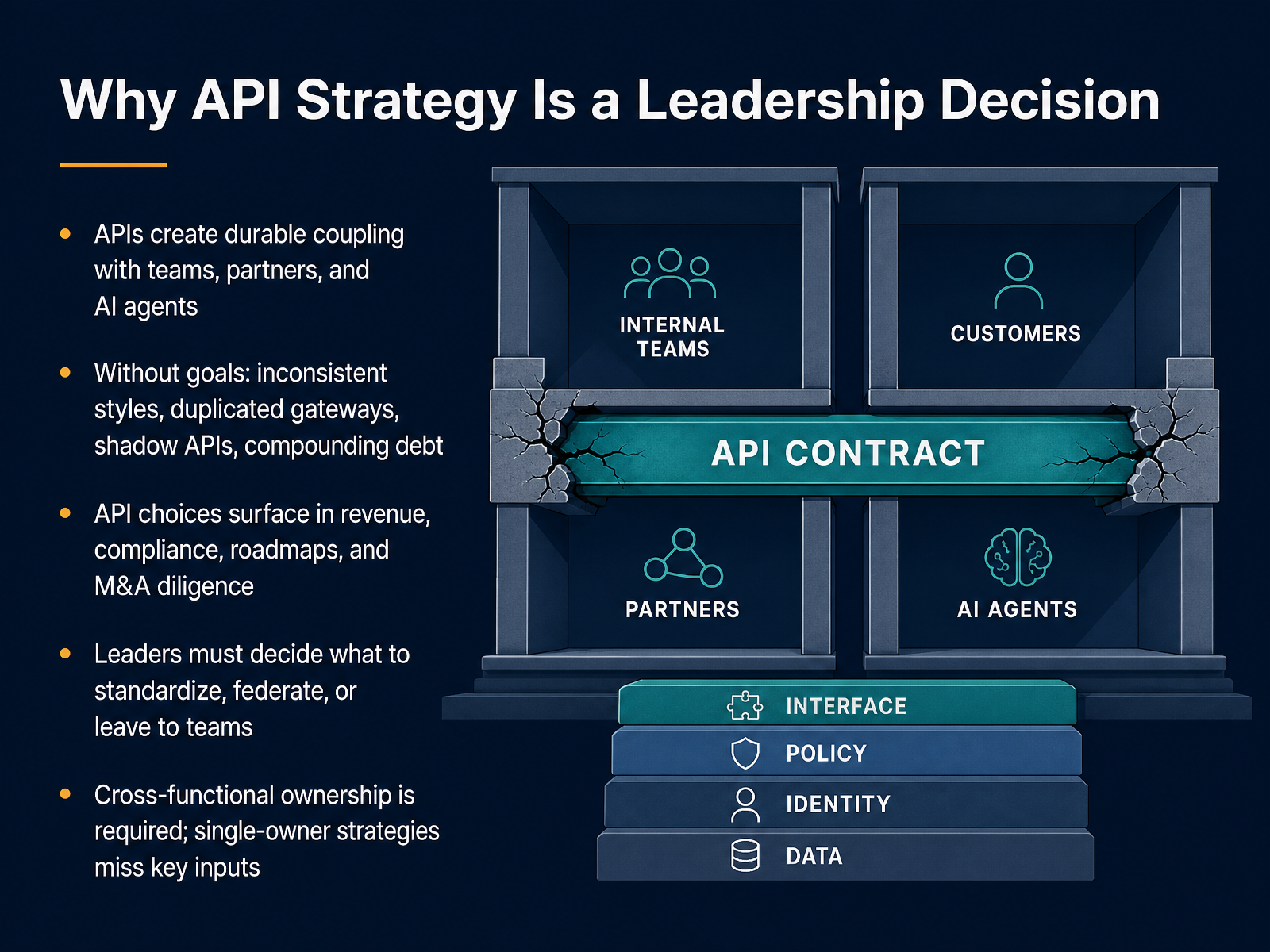
- 02Why API Strategy Is a Leadership DecisionLet us start with why this is a leadership decision, not just an engineering one. APIs create durable coupling. Once teams, partners, or AI agents depend on an interface, changing it gets expensive. Without clear goals, you get inconsistent styles, duplicated gateways, shadow APIs, and debt that compounds. And these choices surface in revenue, compliance, roadmaps, and even merger diligence. So leaders must decide what to standardize, what to federate, and what to leave to teams. That last point matters. Cross-functional ownership is required. Strategies owned by a single group miss key inputs from product, security, and platform. The takeaway: treat API strategy as a set of explicit decisions with consequences you can measure. Goals: What Are We Optimizing For?
 moesif.comtreblle.comapi-portal.io+21 min
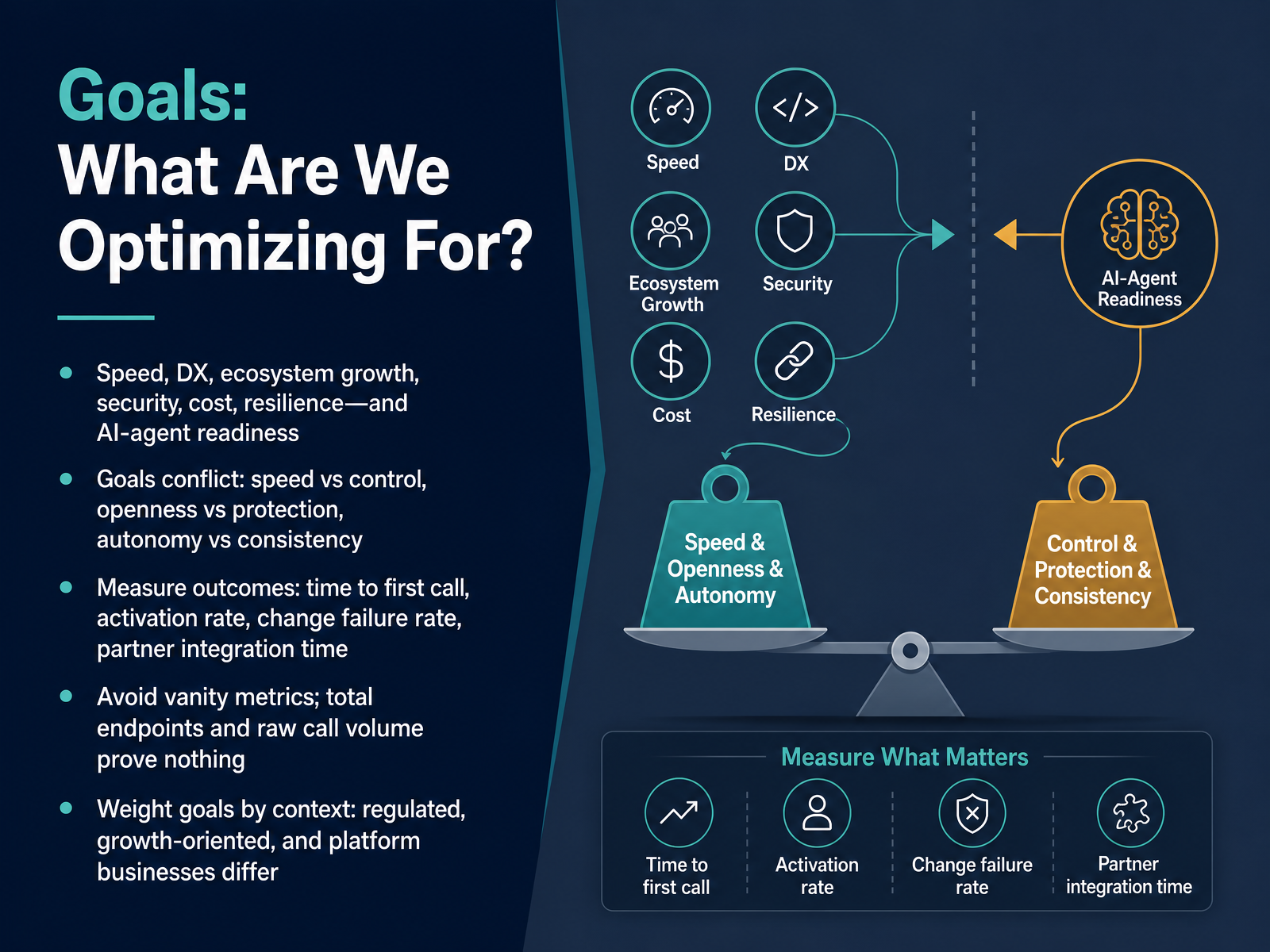
- 03Goals: What Are We Optimizing For?Let's start with goals, because every API decision downstream depends on what you're optimizing for. The candidates are speed, developer experience, ecosystem growth, security, cost, resilience, and now AI agent readiness. Here's the hard part: these goals conflict. Speed fights control. Openness fights protection. Team autonomy fights portfolio consistency. So the leadership question isn't which goal wins. It's how you weight them for your context. A regulated business leans toward control and auditability. A growth-oriented business leans toward speed and activation. A platform business leans toward consistency and ecosystem. Then measure outcomes, not activity. Time to first call, activation rate, change failure rate, partner integration time. Avoid vanity metrics. Total endpoints and raw call volume prove nothing about whether anyone built anything that matters. Be honest about your weighting, and make the tradeoffs explicit. That sets up the next decision: core choices in architecture, style, and interface.
 apiscout.devideaplan.iokompassify.com+22 min
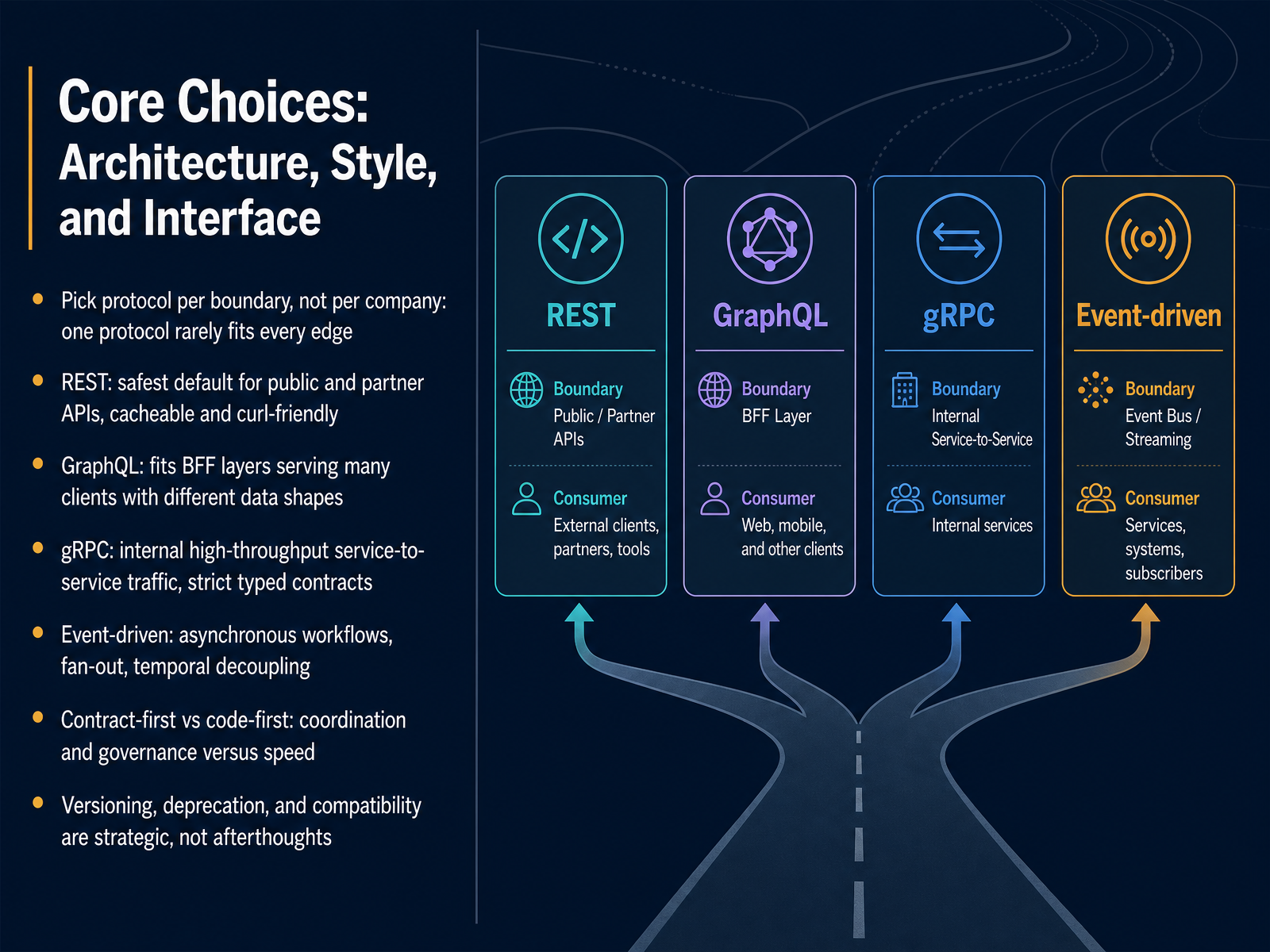
- 04Core Choices: Architecture, Style, and InterfaceLet's get into the core choices: architecture, style, and interface. The first principle is simple. Pick your protocol per boundary, not per company. One protocol rarely fits every edge. So here's how to map them. REST is your safest default for public and partner APIs. It's cacheable, and anyone with curl can call it. GraphQL fits a backend-for-frontend layer, where many clients need different data shapes from the same graph. gRPC is built for internal, high-throughput service-to-service traffic, with strict typed contracts. And event-driven messaging handles asynchronous workflows, fan-out, and temporal decoupling. Next, decide contract-first versus code-first. Contract-first buys you coordination and governance; code-first buys you speed. Finally, treat versioning, deprecation, and compatibility as strategic decisions, not afterthoughts. They shape every future migration. Next, we'll weigh the tradeoffs: performance, cost, security, and autonomy.
 freecodecamp.orgdev.tospiderhunts.com+22 min
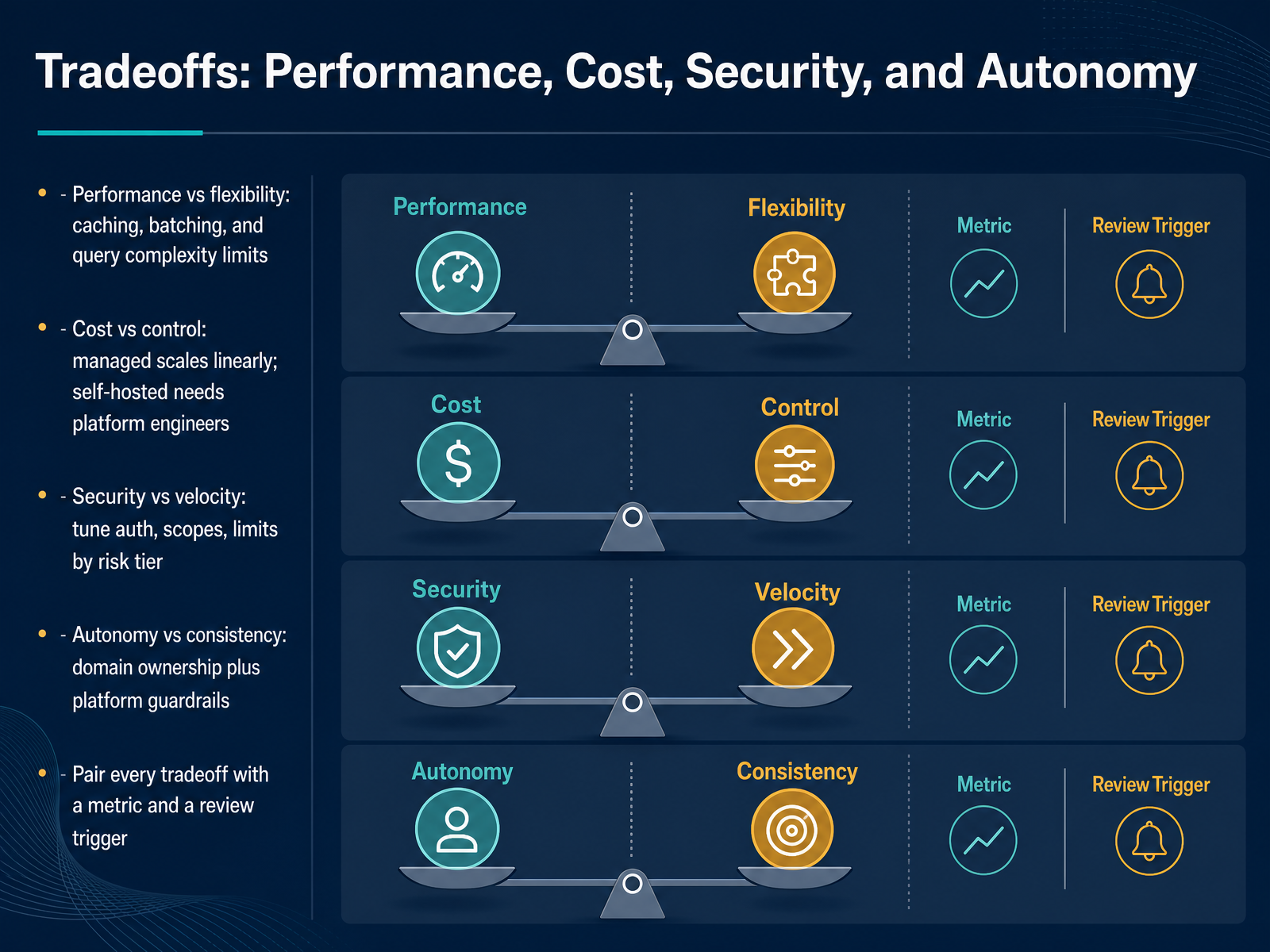
- 05Tradeoffs: Performance, Cost, Security, and AutonomyNow let's look at the tradeoffs you cannot avoid: performance, cost, security, and autonomy. Performance versus flexibility comes down to caching, batching, and query complexity limits. More flexibility usually means more runtime work, so decide what you will cache and where you will cap expensive queries. Cost versus control is the next one. Managed services scale linearly with traffic, which keeps the bill predictable. Self-hosted gateways need platform engineers, so a free license rarely means free. Security versus velocity: tune authentication, scopes, and rate limits by risk tier. Apply strict controls to sensitive, high-value flows, and lighter ones to low-risk reads. Autonomy versus consistency means giving domains ownership while the platform supplies guardrails. Finally, pair every tradeoff with a metric and a review trigger, so the decision gets revisited on evidence, not opinion. Next, we move to Governance Without Bottlenecks.
 zuplo.comgravitee.iodocs.gostoa.dev+22 min
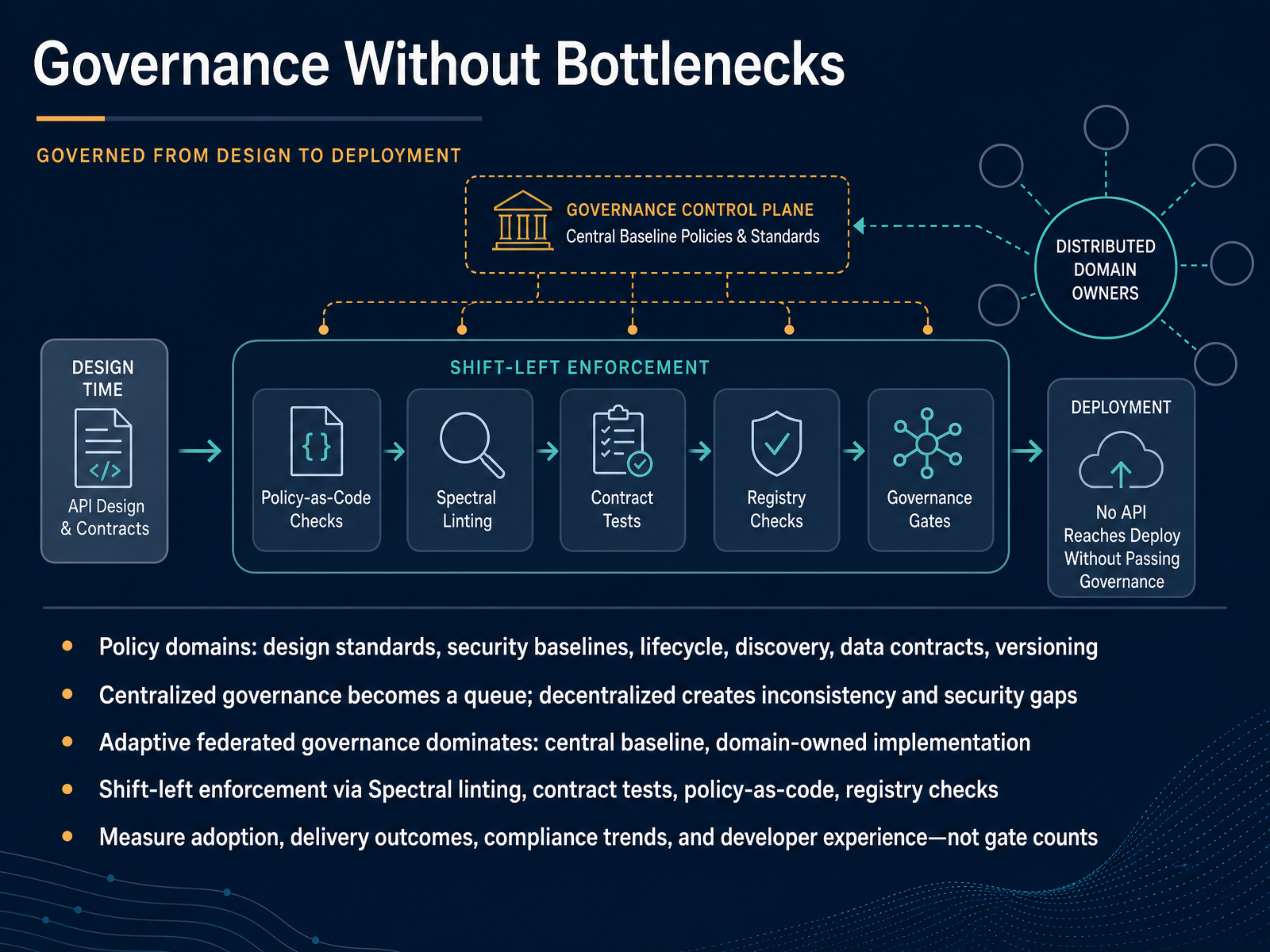
- 06Governance Without BottlenecksNow, how do you govern without creating a bottleneck? Start with policy domains: design standards, security baselines, lifecycle, discovery, data contracts, and versioning. Centralized governance gives consistency, but it becomes a queue. Decentralized governance moves fast, but it produces inconsistency and security gaps. The adaptive federated model dominates because it splits the difference. A central group holds a small, stable baseline, and domain teams own implementation inside those guardrails. Enforcement shifts left, into the pipeline. Spectral linting, contract tests, policy as code, and registry checks catch violations before code ships, so humans only review edge cases and exceptions. And measure the right things: adoption, delivery outcomes, compliance trends, and developer experience, not gate counts. The takeaway is simple. Keep the mandatory baseline small enough to explain and automate, then let domains add stricter local rules, never weaker ones. Now, let us look at platform and operating model choices.
 moesif.comtreblle.comapi-portal.io+21 min
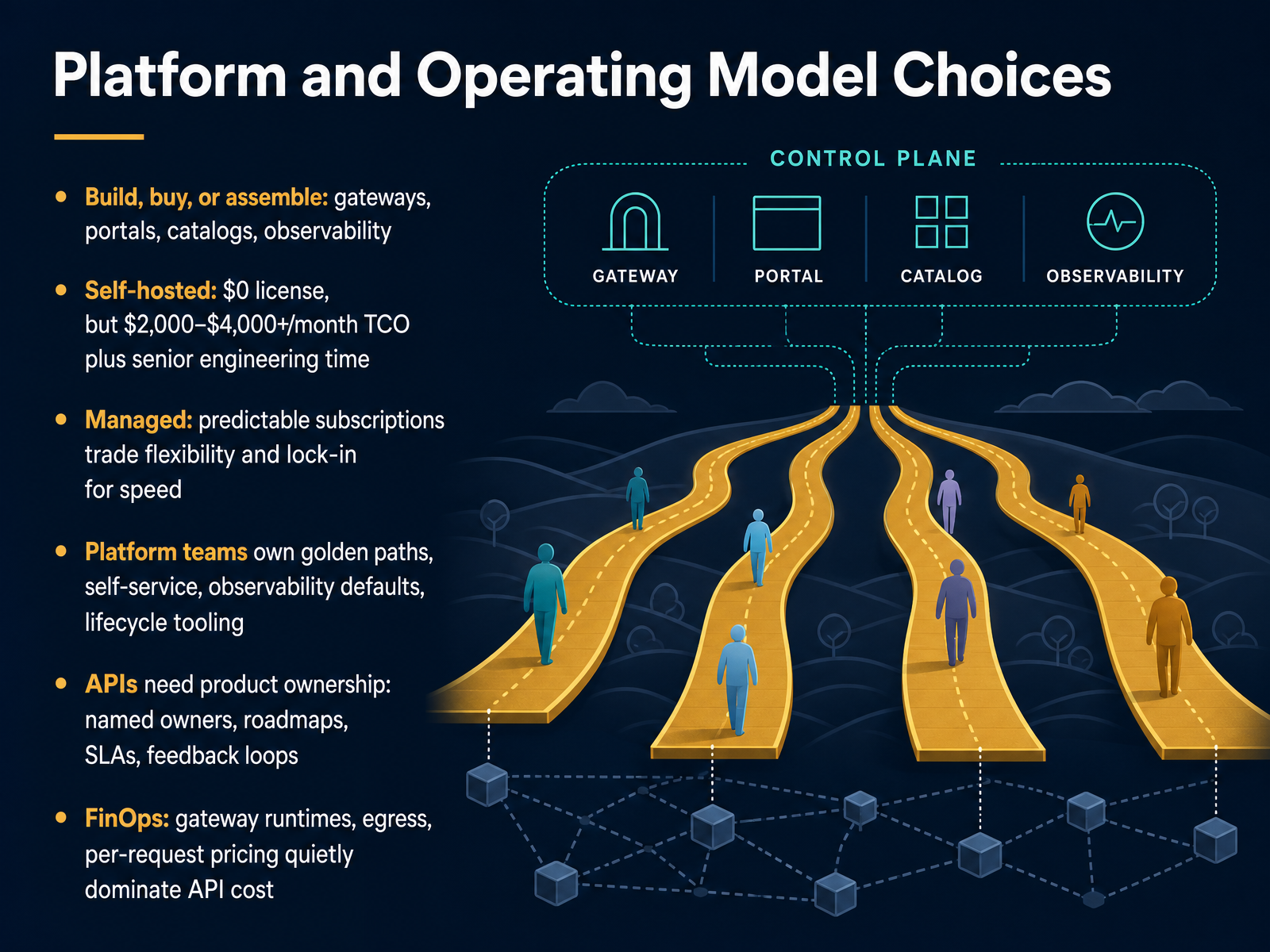
- 07Platform and Operating Model ChoicesNow, let's talk about the platform and operating model choices behind your API strategy. First, the build, buy, or assemble decision. Gateways, portals, catalogs, and observability can each be built, bought, or assembled from open-source and managed parts. Look at the numbers. A self-hosted gateway has a zero dollar license, but a realistic total cost of two to four thousand dollars or more per month, plus senior engineering time. Managed services are more predictable, but you trade flexibility and accept some lock-in for speed. Second, platform teams own the golden paths, self-service, observability defaults, and lifecycle tooling. Third, APIs need product ownership. Name an owner, publish a roadmap, define service level agreements, and close the feedback loop. Finally, watch your FinOps. Gateway runtimes, data egress, and per-request pricing quietly dominate your real API cost. The tradeoff is control versus engineering time. Pick deliberately. Now, let's turn to security, compliance, and risk posture.
 zuplo.comgravitee.iodocs.gostoa.dev+22 min
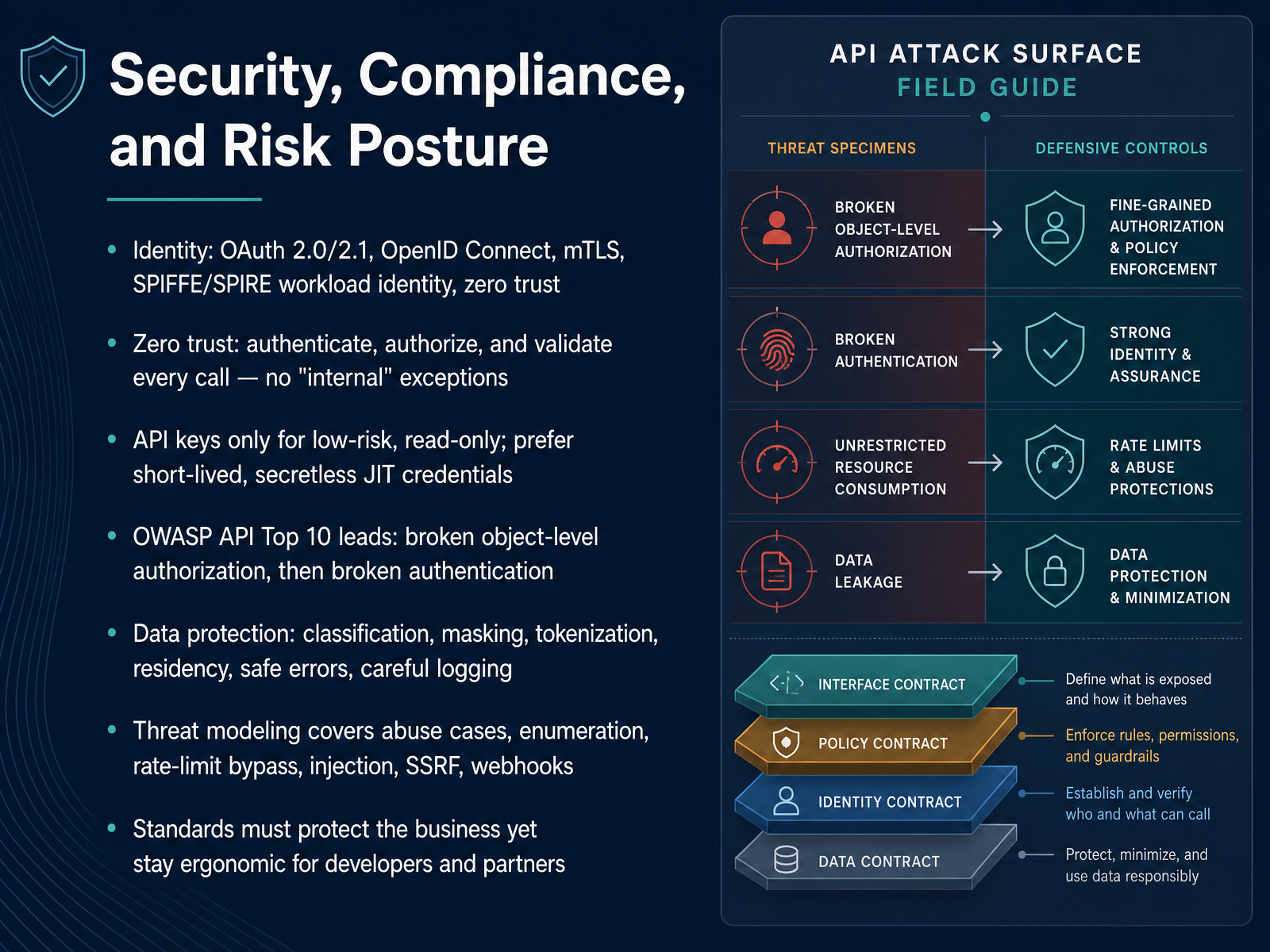
- 08Security, Compliance, and Risk PostureLet's turn to security, compliance, and risk posture. This is a strategy decision, not a checklist. Identity comes first. For users, OAuth 2.1 and OpenID Connect. For machine callers, mutual TLS, SPIFFE workload identity, and zero trust. The principle is simple. Authenticate, authorize, and validate every call. No internal exceptions. Note the tradeoff. Internal trust lowers latency and cost, but it widens blast radius. API keys only for low-risk, read-only access. Prefer short-lived, secretless credentials requested just in time. That removes the permanent attack surface of hardcoded keys, at the cost of more identity infrastructure. OWASP's leads are broken object-level authorization, then broken authentication. So enforce resource-level authorization, deny by default, and scope every query to the caller or tenant. On data, push classification, masking, tokenization, and residency decisions early. Return safe errors, minimize logs, and keep secrets out of them. Threat modeling must cover abuse cases, enumeration, rate-limit bypass, injection, server-side request forgery, and webhooks. Finally, the real tension. Standards must protect the business yet stay ergonomic for developers and partners. Controls that block integration work get bypassed. Controls baked into the gateway and pipeline get adopted. Next, let's look at maturity, metrics, and a decision roadmap.
 moesif.comtreblle.comapi-portal.io+22 min
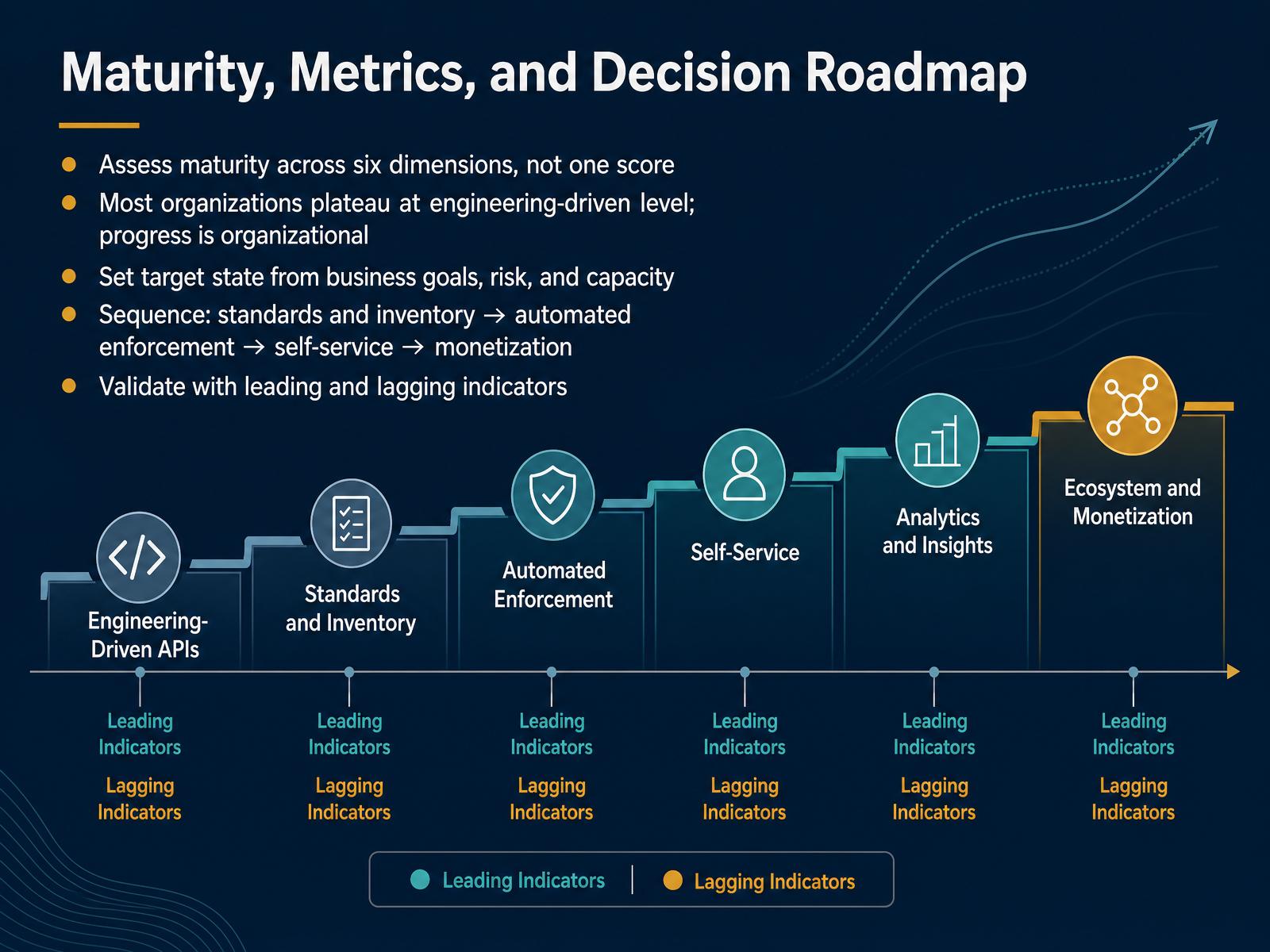
- 09Maturity, Metrics, and Decision RoadmapLet's turn all of that into a practical roadmap. First, assess maturity across six dimensions, not one score: design, documentation, governance, security, monetization, and observability. A single score hides where you are actually weak. And expect a plateau. Most organizations stall at the engineering-driven level, because the next step forward is organizational, not technical. From there, set your target state from three inputs: business goals, risk tolerance, and capacity. Do not target the highest level just because it exists. Then sequence the work: standards and inventory first, automated enforcement second, self-service third, monetization last. Skipping ahead is the most common sequencing mistake. Finally, validate with both leading and lagging indicators. Leading indicators, like time to first successful call, tell you if the path is improving. Lagging indicators, like adoption, reliability, and revenue, tell you whether it mattered. Assess broadly, target deliberately, sequence strictly, and measure both ends. Next, let's apply this in the decision workshop.
 apiscout.devideaplan.iokompassify.com+22 min
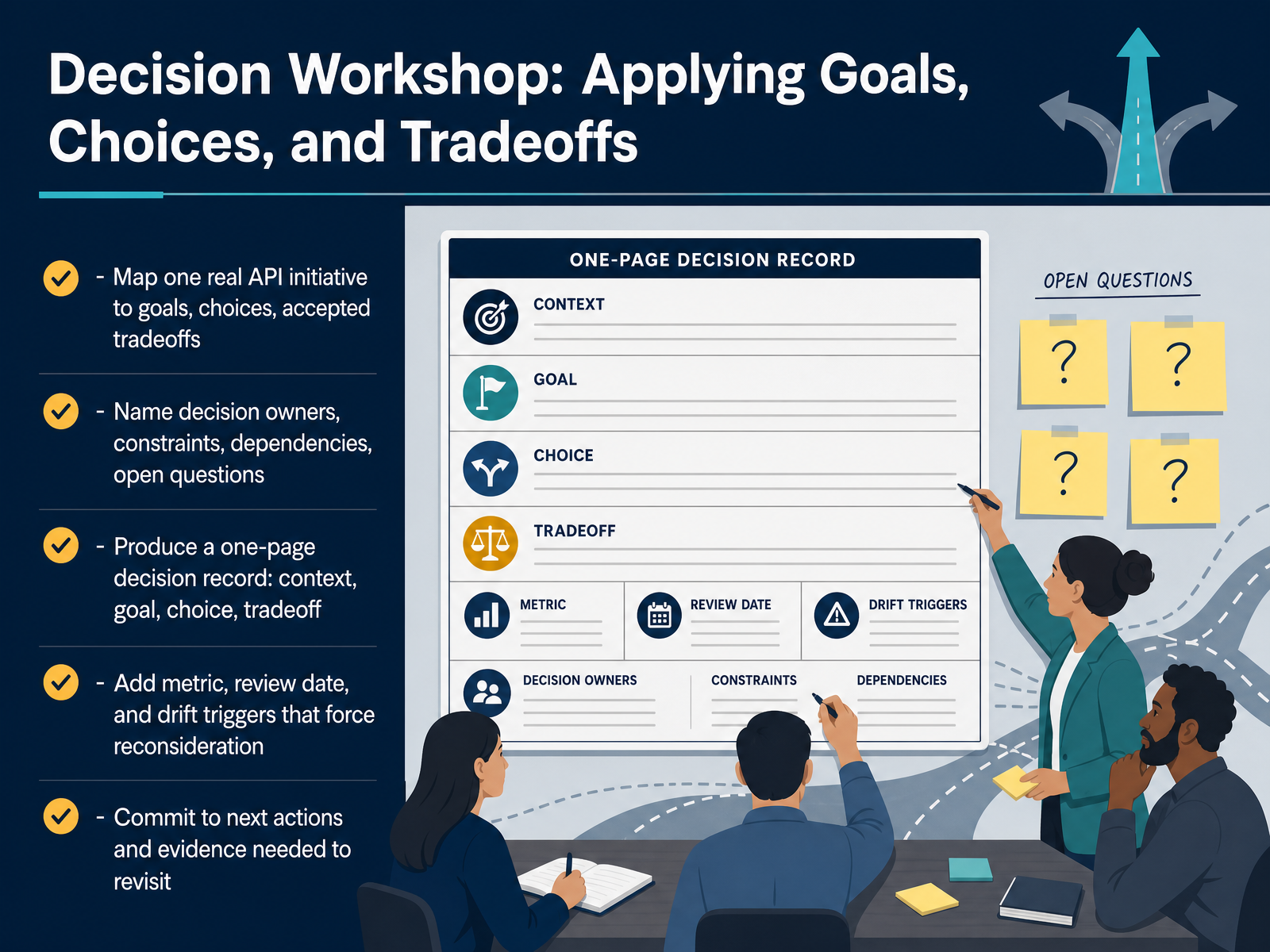
- 10Decision Workshop: Applying Goals, Choices, and TradeoffsLet's put the framework to work. Take one real API initiative, not a hypothetical, and map it against three things: the goal it serves, the choices it forces, and the tradeoffs you accept as a result. Then assign decision owners, name your constraints and dependencies, and list the open questions you cannot answer yet. Next, compress it into a one-page decision record: context, goal, choice, tradeoff. Keep it to one page, because if it needs more, the decision is not clear yet. Strong records also carry maintenance fields, so add a success metric, a review date, and explicit drift triggers. A drift trigger is the condition that forces you to reconsider, like a vendor deprecating a version, cost crossing a threshold, or volume tripling. Finally, commit to next actions and the evidence you need before you revisit. The output is accountability, not documentation. Next, we look at the common failure modes and anti-patterns.
 moesif.comtreblle.comapi-portal.io+22 min
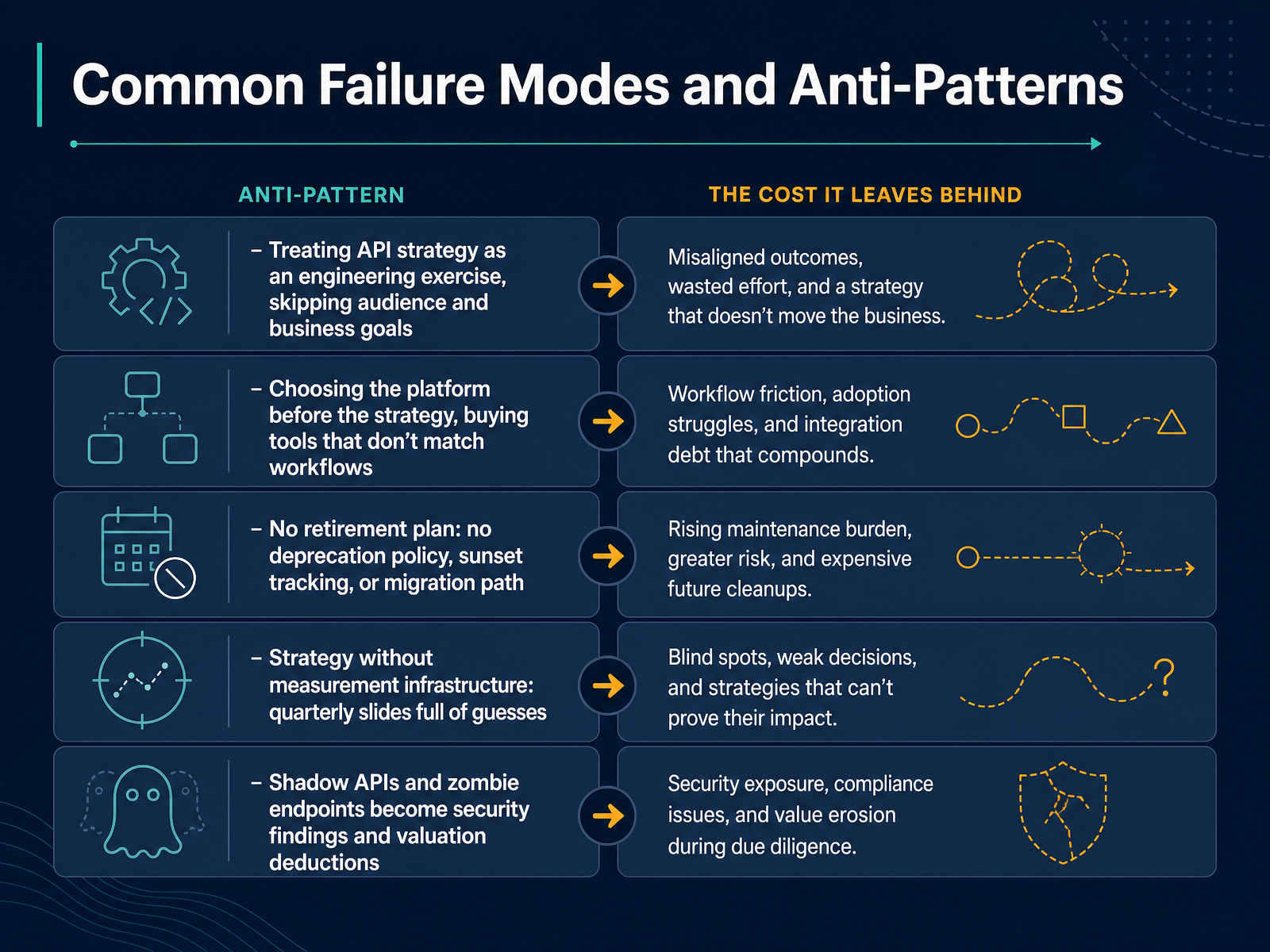
- 11Common Failure Modes and Anti-PatternsNow let's look at where API strategies most often go wrong, because these failure modes are predictable and largely avoidable. The first is treating API strategy as an engineering exercise. Strategy needs product, platform, and business input, not just architecture decisions. The strategies that fail are usually the ones written entirely by the platform team. The second is choosing the platform before the strategy. If you pick your gateway before you know what it must support, you end up with expensive tools that don't match your workflows. Strategy defines the requirements; the platform is the answer. Third, no retirement plan. Without a deprecation policy, sunset tracking, and a migration path, a three version platform becomes an eight version platform. Fourth, strategy without measurement infrastructure. If your success metrics aren't instrumented, you get quarterly slides full of guesses. Pick metrics you can actually measure, or invest in the tooling to measure them. And fifth, shadow APIs and zombie endpoints. These become security findings in diligence, and they become valuation deductions. The takeaway is simple: each of these failures is cheaper to prevent than to reverse. Next, let's look at the 2026 shift: AI agents as API consumers.
 moesif.comtreblle.comapi-portal.io+22 min
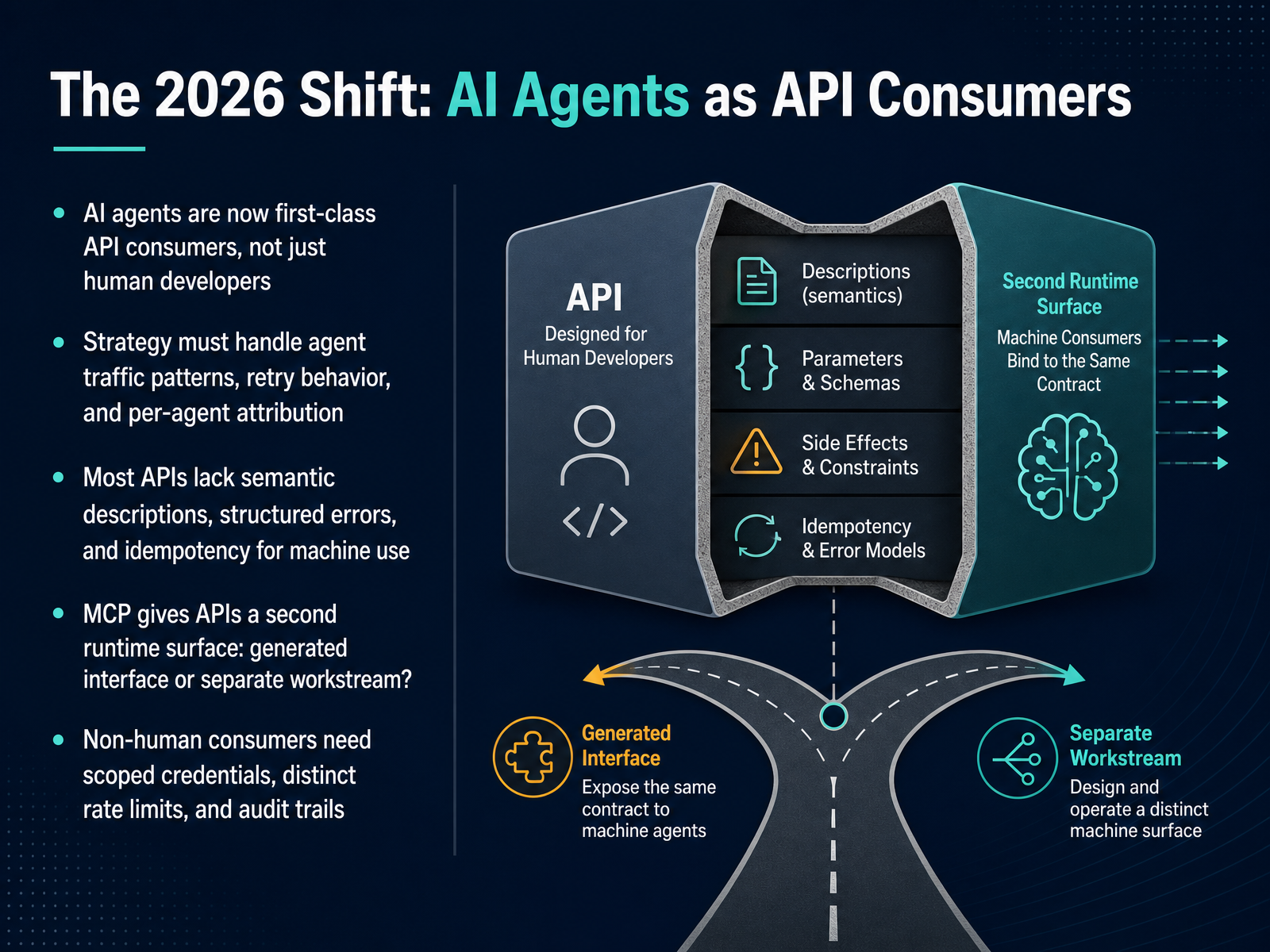
- 12The 2026 Shift: AI Agents as API ConsumersNow let's look at what changed in twenty twenty-six. Your newest API consumers are not people. They are AI agents running inside LLM applications. That changes the operating model in five concrete ways. First, agents are first-class consumers, so your strategy has to handle their traffic patterns, their retry behavior, and per-agent attribution. Second, most APIs today are not ready for machine use. They lack semantic descriptions, structured errors, and idempotency, which agents depend on. Third, MCP gives your APIs a second runtime surface. So decide now: generate it from your existing OpenAPI spec, or run it as a separate workstream. The first option keeps one source of truth, but demands clean specs. The second moves faster, but creates a second thing to govern. Fourth, non-human consumers need scoped credentials, distinct rate limits from human developers, and audit trails that name the agent, not just the account. And fifth, treat these as portfolio-level decisions, not per-team choices. If five teams solve agent identity five different ways, you get the seven authentication patterns problem all over again. The practical takeaway: assess your ten highest-traffic APIs for agent readiness before you scale agent traffic. Next, we move from tradeoffs to decisions, with Making the Strategic Choice: A Practical Checklist.
 moesif.comtreblle.comapi-portal.io+22 min
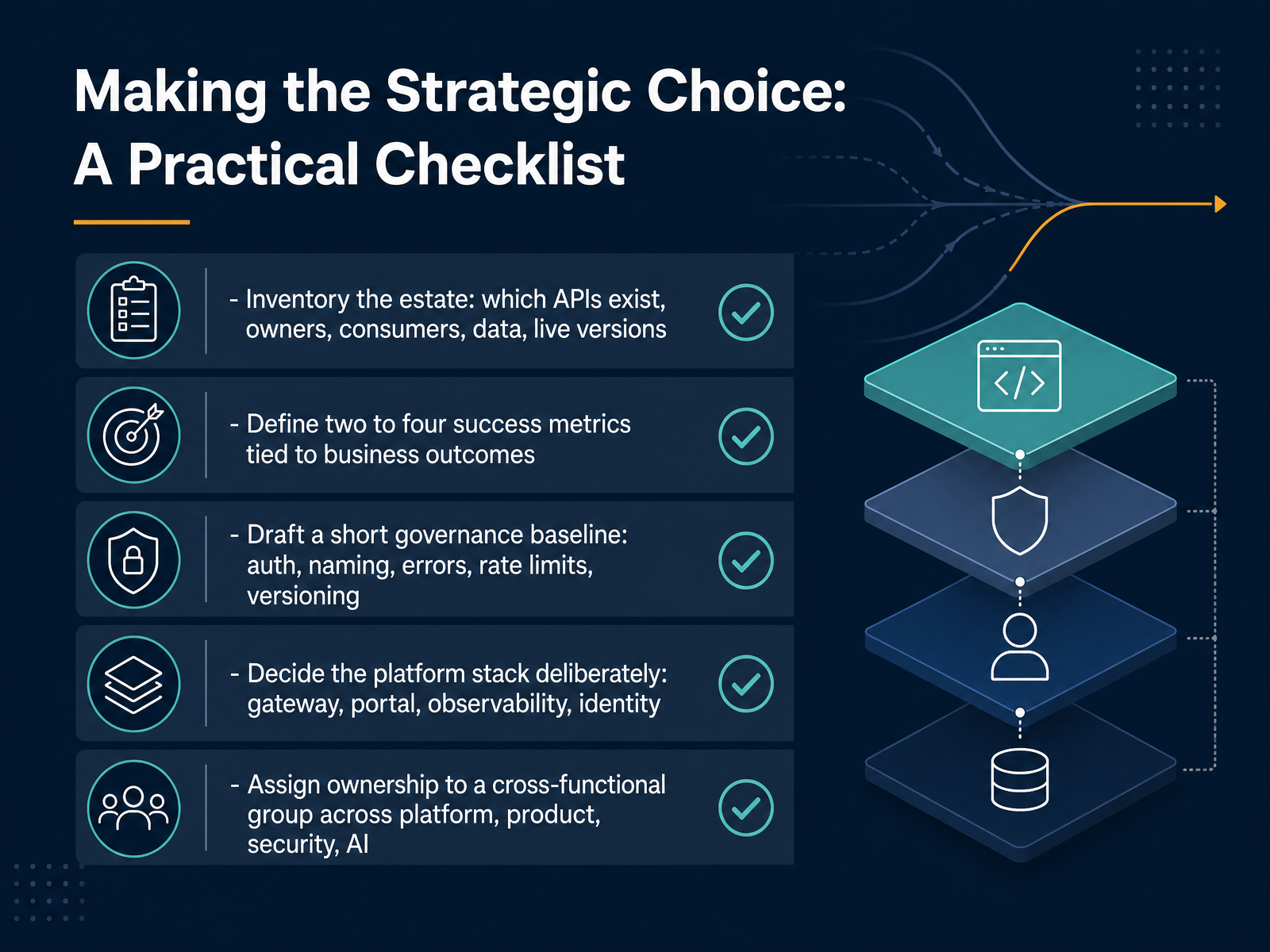
- 13Making the Strategic Choice: A Practical ChecklistLet's turn all of this into a decision you can actually make. Here is a practical checklist for choosing your API direction.
First, inventory the estate. Which APIs exist, who owns them, who consumes them, what data they touch, and which versions are still live. You cannot govern what you cannot see.
Second, define two to four success metrics tied to business outcomes, not vanity numbers like total request counts. Revenue from API consumption, or time to first call, are better examples.
Third, draft a short governance baseline covering authentication, naming, errors, rate limits, and versioning. Keep it small enough to enforce, and automate it early.
Fourth, choose your platform stack deliberately. Gateway, portal, observability, and identity. Remember the tradeoff: best-of-breed tools give flexibility, while a single platform lowers integration cost.
Finally, assign ownership to a cross-functional group spanning platform, product, security, and AI. Single-owner strategies fail because they miss a perspective.
Run this checklist once, and you have a defensible operating direction. Next, let's look at Next Steps: Turning the Outline into an Operating Direction.
 moesif.comtreblle.comapi-portal.io+22 min
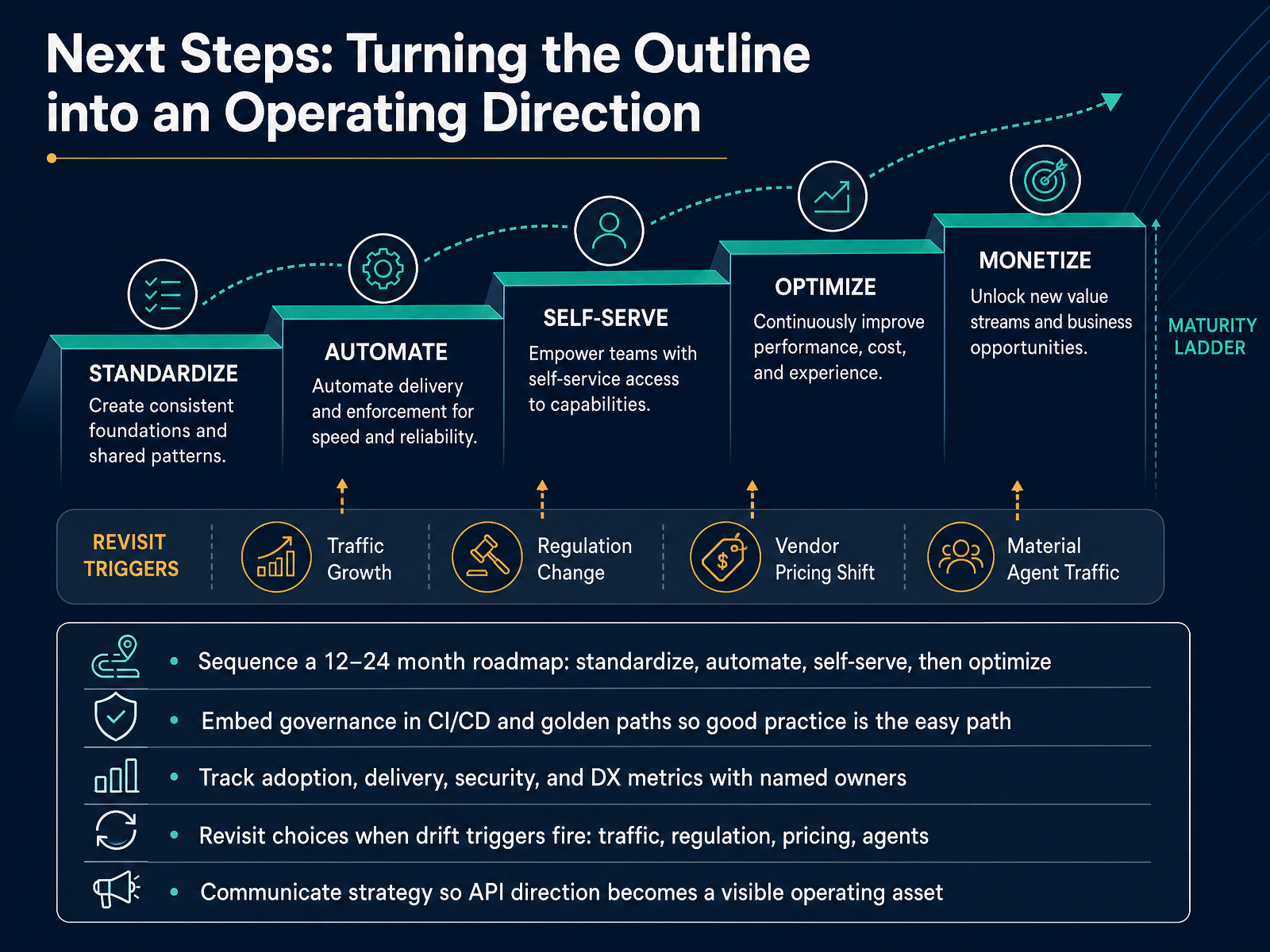
- 14Next Steps: Turning the Outline into an Operating DirectionLet's close by turning this outline into an operating direction. First, sequence a twelve to twenty-four month roadmap: standardize, then automate, then self-serve, then optimize. Trying to optimize before standards are enforced is the most common sequencing mistake. Second, embed governance in your CI and CD pipelines and golden paths, so good practice becomes the easy path, not an extra review step. Third, track adoption, delivery, security, and developer experience metrics, each with a named owner. Unowned metrics get watched, not acted on. Fourth, revisit your choices when drift triggers fire: traffic shifts, regulation, pricing changes, or agent adoption. Fifth, communicate the strategy clearly, so API direction becomes a visible operating asset rather than a slide deck. Your takeaway: sequence matters, embedding beats policing, and ownership makes it stick. Thank you for working through this outline. You now have the criteria to choose deliberately and defend those choices. Go make your API direction real.
 apiscout.devideaplan.iokompassify.com+22 min
Take the deck with you
Download this course as a file — free, no sign-up needed.
- PDF handoutEvery slide page, ready to print or share.15 pages · 3.7 MBDownload
- Narrated PowerPointThe deck that presents itself — every slide carries the digital human's narration video.15 pages · 14.8 MBDownload
- PowerPoint slidesThe full deck as a .pptx — open it in PowerPoint, Keynote, or Google Slides.15 pages · 3.6 MBDownload
Free to use in your own training — please keep the PersonWise credit page at the end.
Have your own deck? Turn it into a course
Sources consulted
Web sources consulted while building this course.
- API Strategy in 2026: A Practical Framework | Moesif Blog — moesif.com
- API Strategy: How to Build, Scale, and Govern an API Program | Treblle — treblle.com
- API Strategy and Strategic Alignment: How Organizations Use Their API Landscape as a Management Tool — api-portal.io
- API Strategy Framework for Scaling B2B SaaS — humanr.ai
- How Platform Ops Teams Should Think About API Strategy - The New Stack — thenewstack.io
- API Analytics: Measuring Developer Experience 2026 | APIScout — apiscout.dev
- API Product Metrics: What to Track and Why It Matters — ideaplan.io
- Developer Onboarding: Getting to the First Successful API Call (2026 Guide) — kompassify.com
- API Developer Experience as a Growth | productgrowth.in — productgrowth.in
- How DevRel teams measure time to first API call - Biel.ai — biel.ai
- Service-to-Service Communication: When to Use REST, gRPC, and Event-Driven Messaging — freecodecamp.org
- REST vs GraphQL vs gRPC in 2026: An Architect's Decision Matrix - DEV Community — dev.to
- API Design Best Practices: REST vs GraphQL vs gRPC (2026 — spiderhunts.com
- REST vs gRPC vs GraphQL: A Production Decision Guide | BackendBytes — backendbytes.com
- GraphQL vs REST vs gRPC: Choosing the Right API Pattern for Microservices in 2026 — askantech.com
- Managed vs Self-Hosted API Gateway: Architecture, Cost ... — zuplo.com
- Total Cost of Ownership: Managed vs Self-Hosted API ... — gravitee.io
- SMB API Gateway Guide 2026: Find the Right Fit | STOA Docs — docs.gostoa.dev
- Managed vs Self-Hosted API Gateway — api7.ai
- Build vs Buy API Gateway: True Cost Analysis for SaaS | STOA Docs — docs.gostoa.dev