Operations Management Software Comparison
Begin
14 pages · ~28 min
Operations Management Software Comparison
Compare operations management software options and learn to select the best fit for your organization's needs.
What you’ll learn
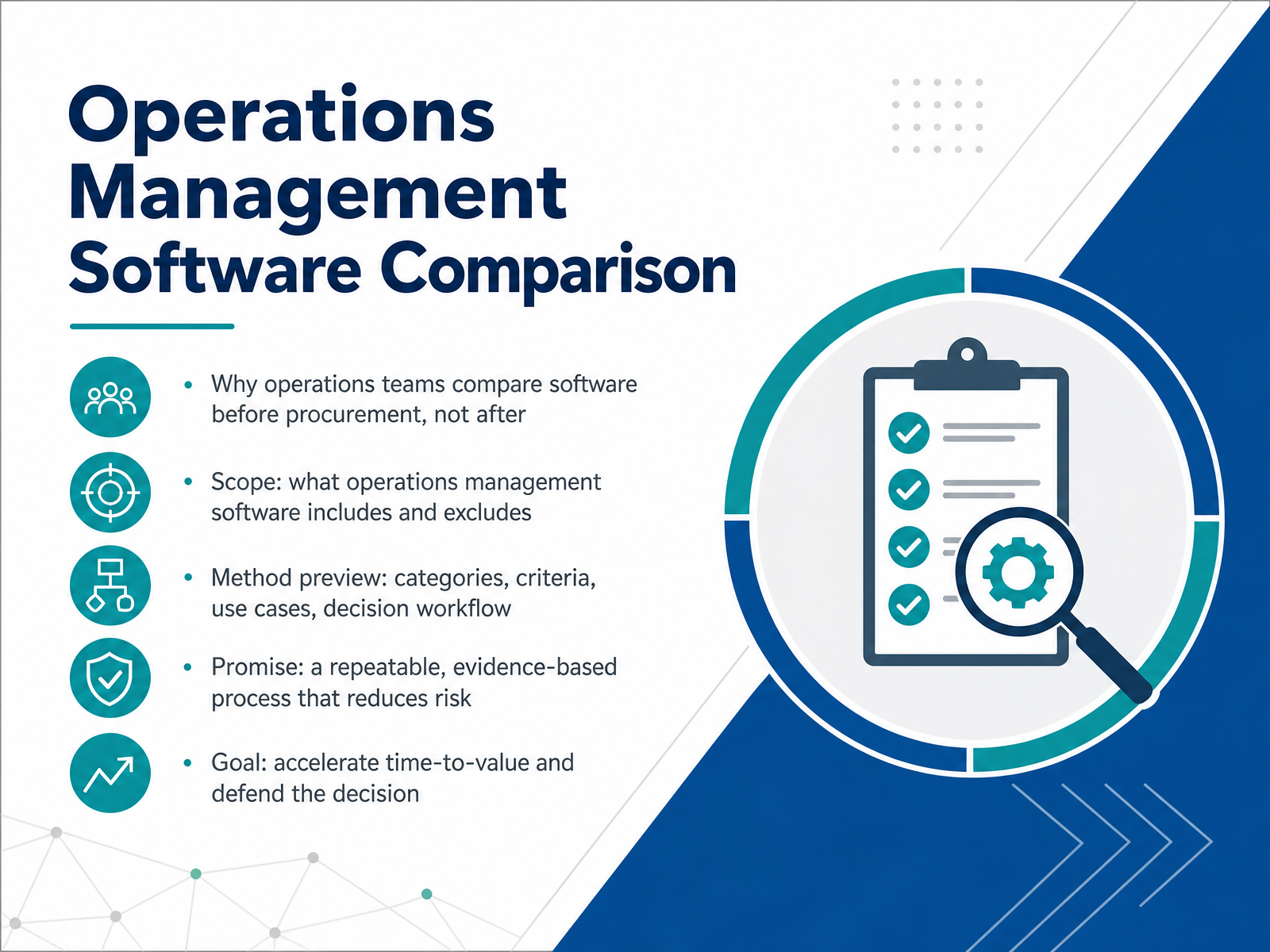
- 01Operations Management Software ComparisonWelcome. Over the next fourteen slides, we'll cover operations management software comparison, and how to run it as a disciplined, repeatable process. Here's the core premise. Operations teams should compare software before procurement, not after. Once a vendor is chosen, your leverage on price, scope, and contract terms shrinks fast.
So we'll compare first, on evidence.
Next, scope. Operations management software covers workflow execution, approvals, inventory, and audit trails. It excludes general ledger accounting and pure HR systems, though integrations matter.
We'll preview our method: categories, weighted criteria, scripted use cases, and a decision workflow.
The promise is simple: a repeatable, evidence-based process that reduces risk. The goal is faster time-to-value and a decision you can defend.
Let's begin with why software selection fails before implementation.doss.comapfx.aiepicasta.com+22 min
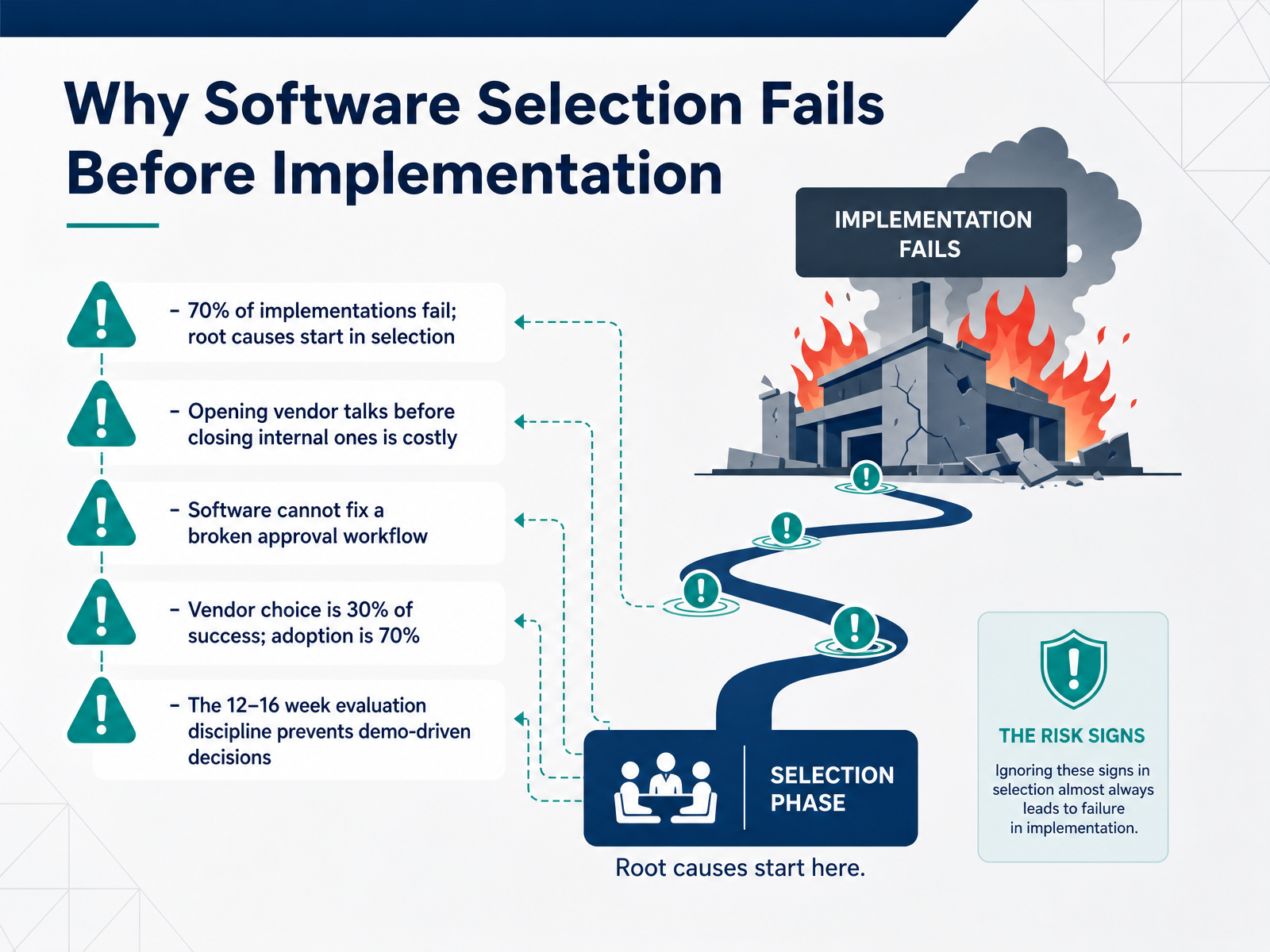
- 02Why Software Selection Fails Before ImplementationLet's move to the real problem. Most implementations fail because the damage happens before a contract is signed, not after. Seventy percent of implementations fail, and the root causes start in selection, not configuration. Opening vendor talks before closing internal ones is costly. Companies waste six months in demos, then discover stakeholders never agreed on the problem. Here's the hard truth. Software cannot fix a broken approval workflow. No platform rescues a team that does not trust incoming data. Buying technology to solve a process problem costs twice what you expected. The trade-off is simple. Vendor choice is roughly thirty percent of success. Adoption is the other seventy percent. That is why a twelve to sixteen week evaluation discipline matters. It prevents demo-driven decisions. Here's what to verify. Map your operational failures before any vendor conversation. Then move on to how the market actually segments. The Operations Software Landscape: Categories That Decide.
 doss.comapfx.aiepicasta.com+21 min
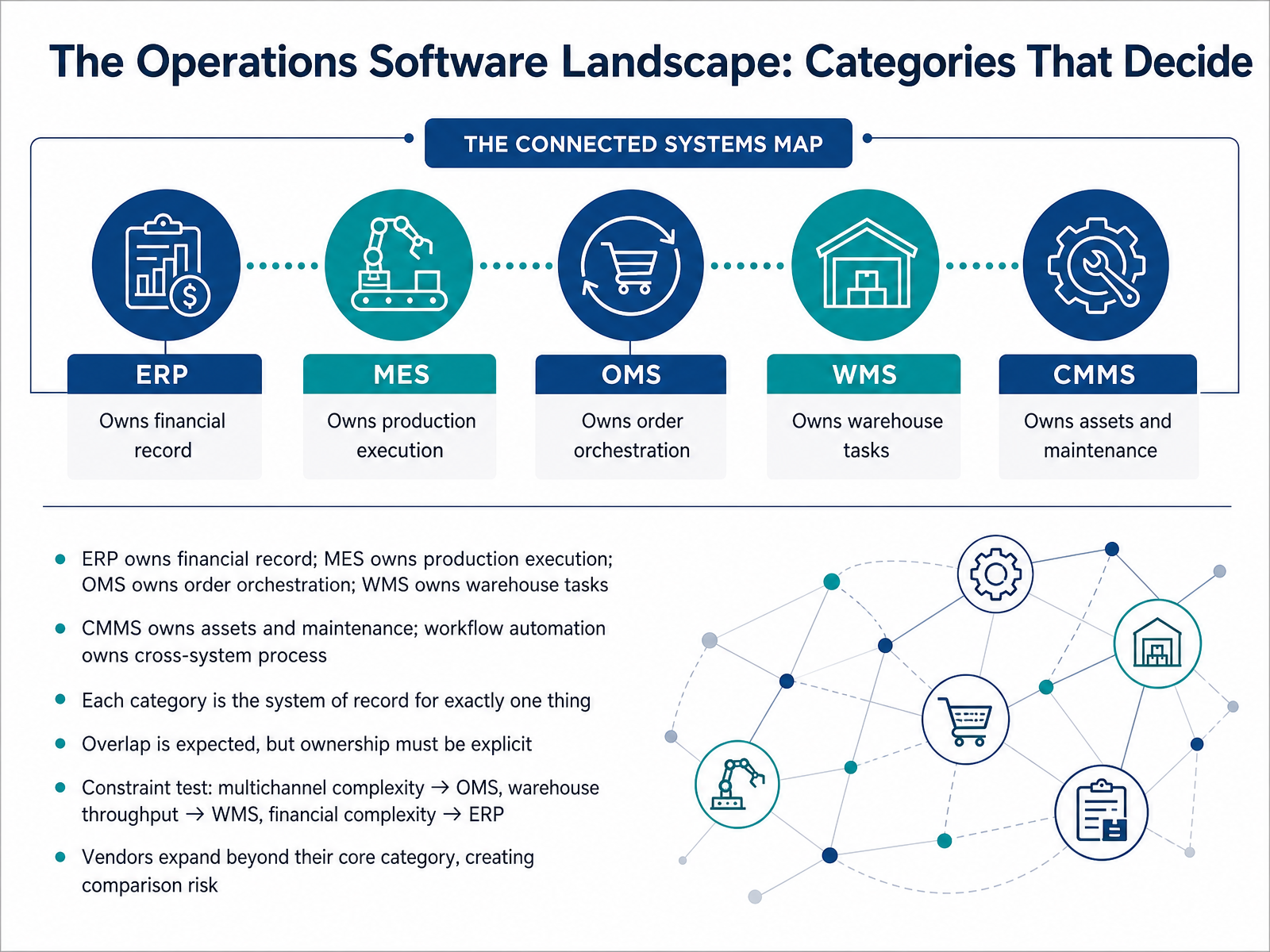
 - 03The Operations Software Landscape: Categories That DecideLet's map the operations software landscape. Each category is the system of record for exactly one thing. ERP owns the financial record. MES owns production execution. OMS owns order orchestration. WMS owns warehouse tasks. CMMS owns assets and maintenance. Workflow automation owns cross-system process. Overlap is expected, but ownership must be explicit. Here's what to verify. Run the constraint test. Multichannel complexity points to an OMS. Warehouse throughput points to a WMS. Financial complexity points to an ERP. The trade-off is real. Vendors expand beyond their core category, creating comparison risk. A warehouse system adds order routing. An ERP adds warehouse modules. That expansion blurs evaluation, so compare owners, not feature lists. Next, we will cover comparison criteria that matter for operations teams.
 skupreme.cominterlakemecalux.comthetransformagency.com+21 min
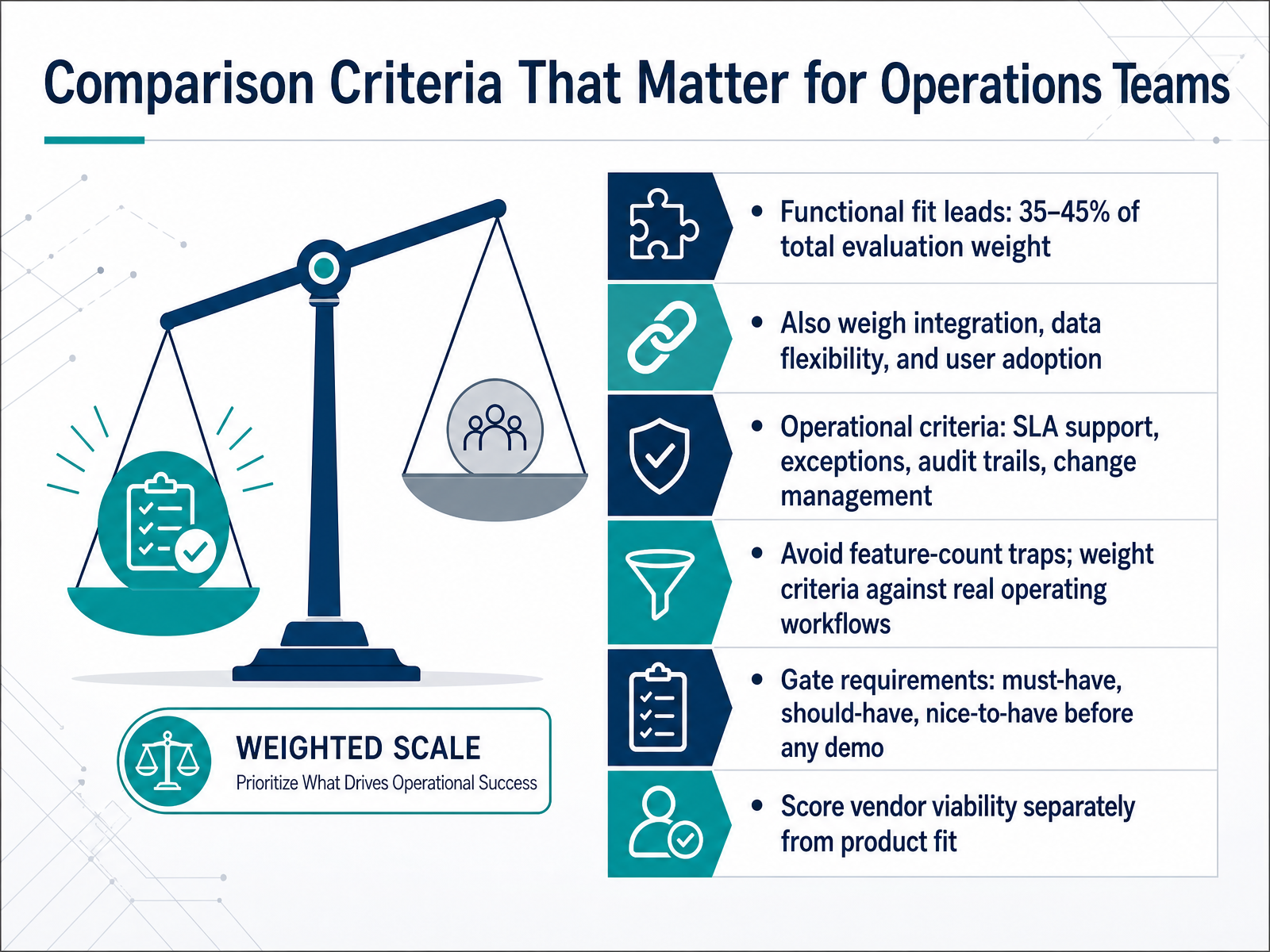
 - 04Comparison Criteria That Matter for Operations TeamsNext, let's talk about the comparison criteria that actually matter. Functional fit leads. It should carry roughly thirty-five to forty-five percent of your total evaluation weight. Next, weigh integration, data flexibility, and user adoption. Then add operational criteria: SLA support, exception handling, audit trails, and change management. Here's what to verify. Avoid feature-count traps. Weight every criterion against real operating workflows, not demo scenarios. Set gate requirements early: must-have, should-have, and nice-to-have, agreed before any vendor demo. Finally, score vendor viability separately from product fit. Financial stability and roadmap commitments affect what you actually own in three years. A vendor that scores well on features but poorly on viability is a real risk. Document the weights before demos, and the scorecard becomes defensible evidence, not opinion. That discipline is what separates a decision that holds from one that unravels. Now let's move to mapping process fit before comparing features.
 doss.comapfx.aiepicasta.com+22 min
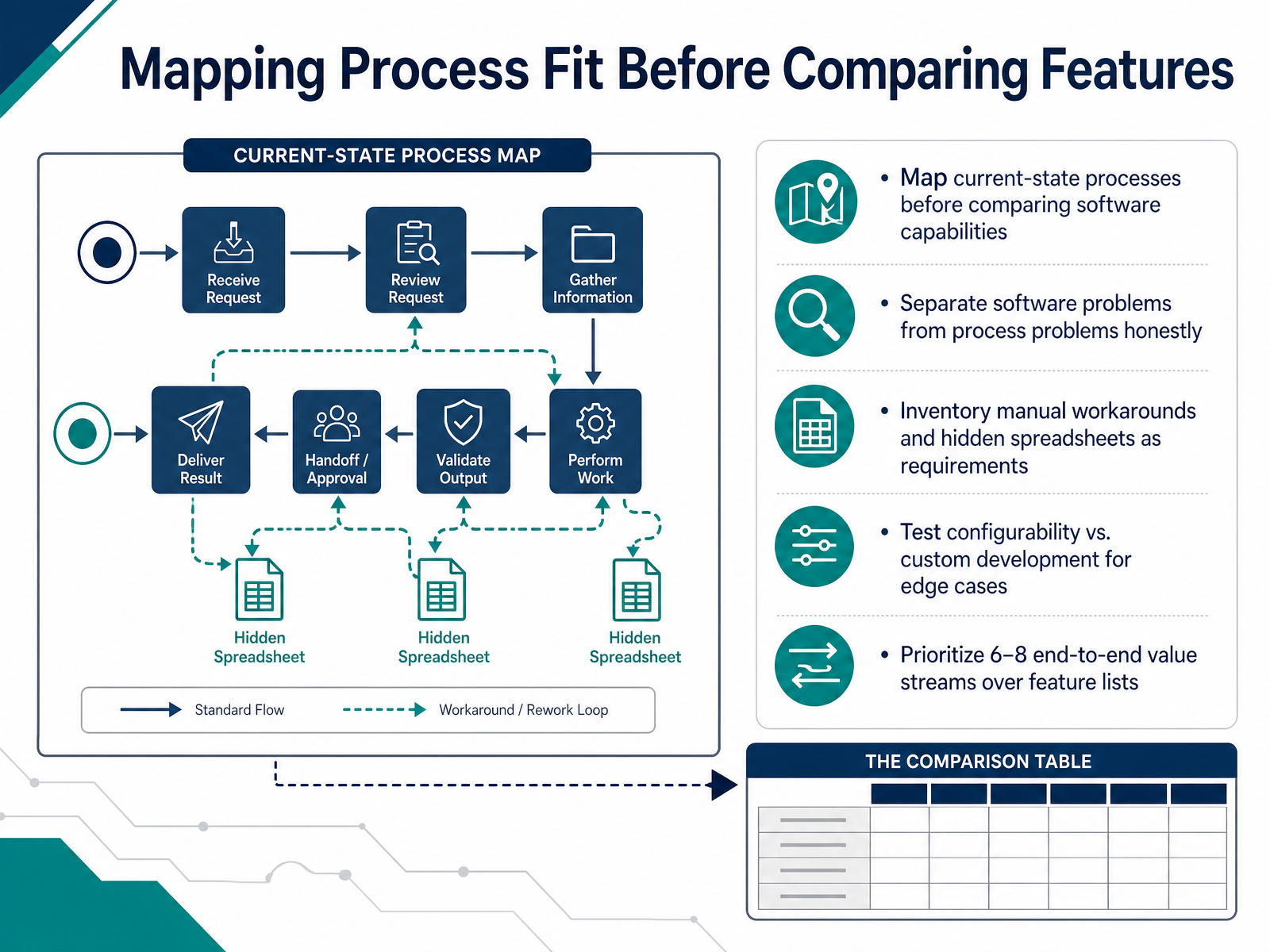
 - 05Mapping Process Fit Before Comparing FeaturesNow let's map process fit before comparing features. Start with current-state process maps, not vendor brochures. Document how work actually flows today, then separate software problems from process problems honestly. A broken approval workflow stays broken inside any platform. Next, inventory every manual workaround and hidden spreadsheet. Those workarounds are requirements written in human labor, so capture who runs them, how often, and why. Then test configurability against custom development for your edge cases. Configuration survives upgrades; custom code becomes permanent maintenance and risk. Finally, prioritize six to eight end-to-end value streams over long feature lists. Ask which workflows carry the value, and make vendors prove fit against your data. Here's the takeaway: define process fit first, and feature comparison becomes a scoring exercise instead of a beauty pageant. Next, we'll cover scripting demos that prove fit, not theater.
 doss.comapfx.aiepicasta.com+22 min
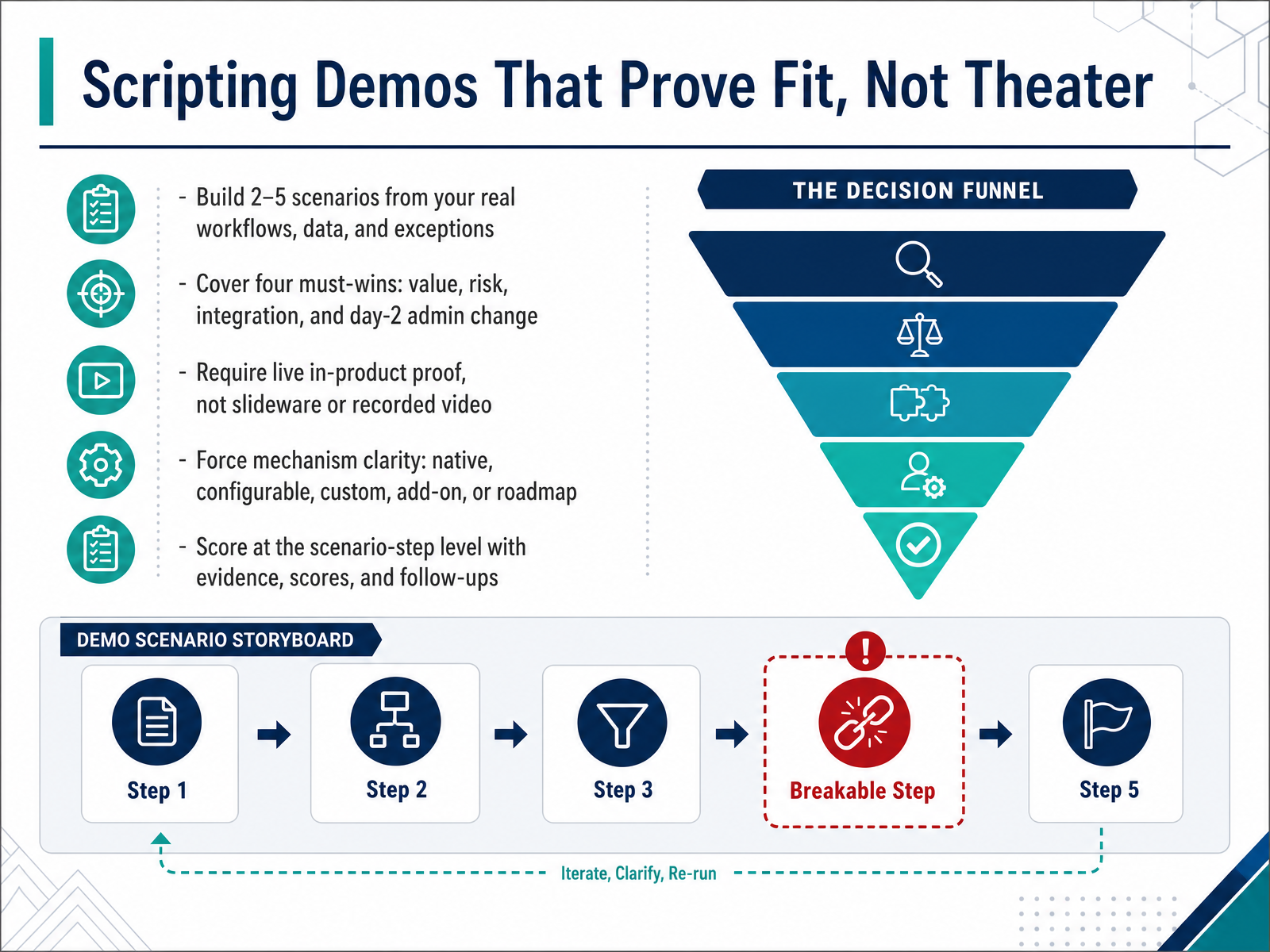
 - 06Scripting Demos That Prove Fit, Not TheaterNext, let's talk about scripting demos that prove fit, not theater. Build two to five scenarios from your real workflows, data, and exceptions. Then cover four must-wins: value, risk, integration, and day-two admin change. Here's what to verify. Require live in-product proof, not slideware or recorded video. Force mechanism clarity on every step: native, configurable, custom, add-on, or roadmap. If a vendor cannot name the mechanism, treat the capability as unproven. Score at the scenario-step level. Every step needs evidence, a score, and a follow-up. This shows exactly where each vendor is strong or brittle. That precision makes comparisons fair and follow-up requests specific. A good demo script is a test plan written in business language, so vendors perform real work under your rules. Next, we move into Integration, Data, and Operational Readiness.
 umbrex.comerpsearch.com.aucfoshortlist.com+21 min
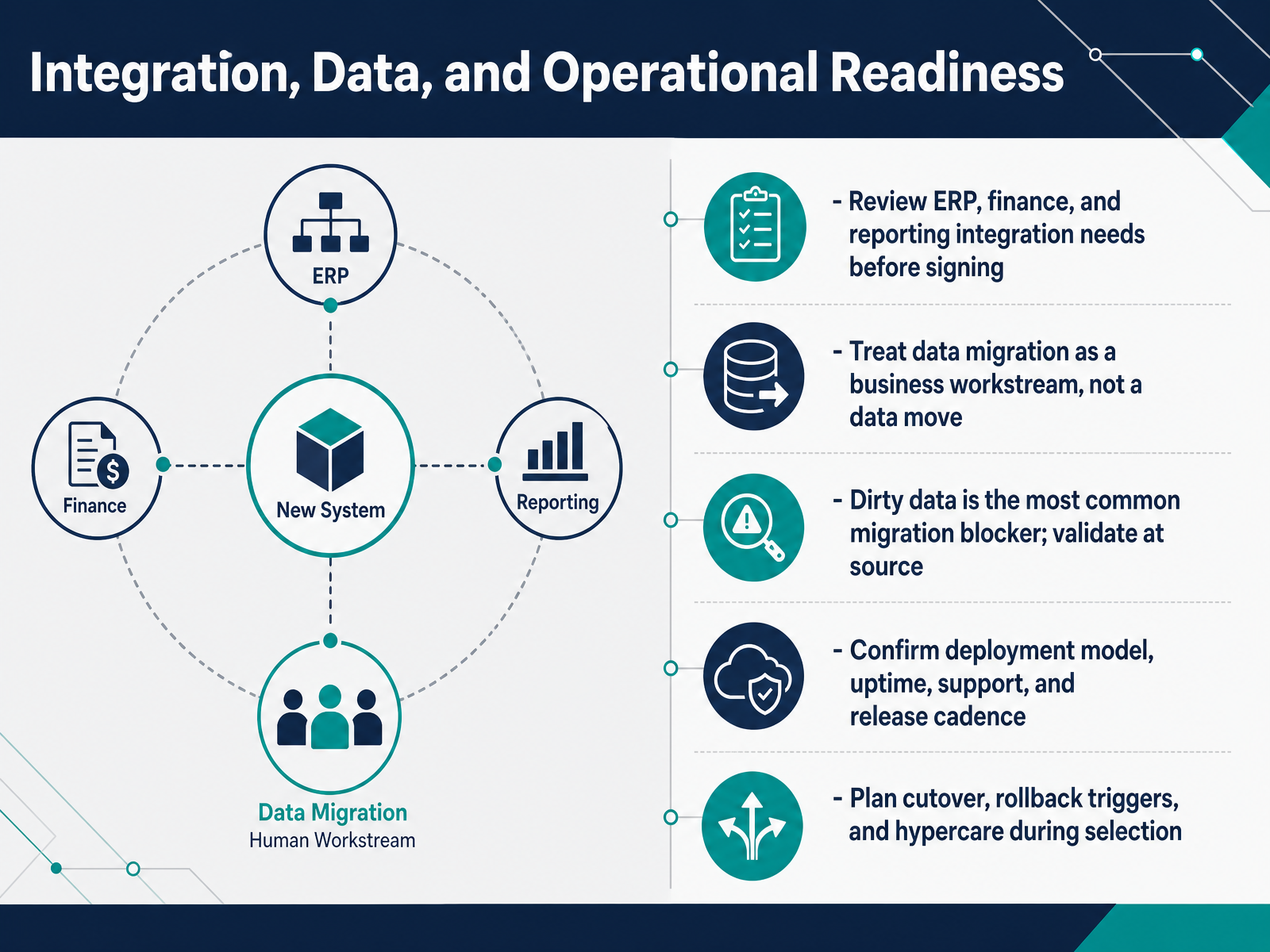
 - 07Integration, Data, and Operational ReadinessNext, let us examine integration, data, and operational readiness. Before you sign anything, review your ERP, finance, and reporting integration needs. Confirm which system is the source of truth for customers, orders, inventory, and invoices. The trade-off is simple. Loosely defined interfaces create reconciliation work every month. Then treat data migration as a business workstream, not a data move. Name an owner per domain, and validate at source. Dirty data remains the most common migration blocker. Duplicates, missing tax identifiers, and inconsistent product codes will stall your first load. Next, confirm the deployment model, uptime commitments, support hours, and release cadence. Ask how you will see failed jobs, and where audit trails live. Finally, plan cutover, rollback triggers, and hypercare during selection, not after. Rehearse with real owners and realistic volumes. That is the practical takeaway here. Integration and data readiness decide whether go live holds. Let us now turn to total cost of ownership and return on investment that survives scrutiny.
 elephas.usnextpageit.comnextpageit.com+22 min
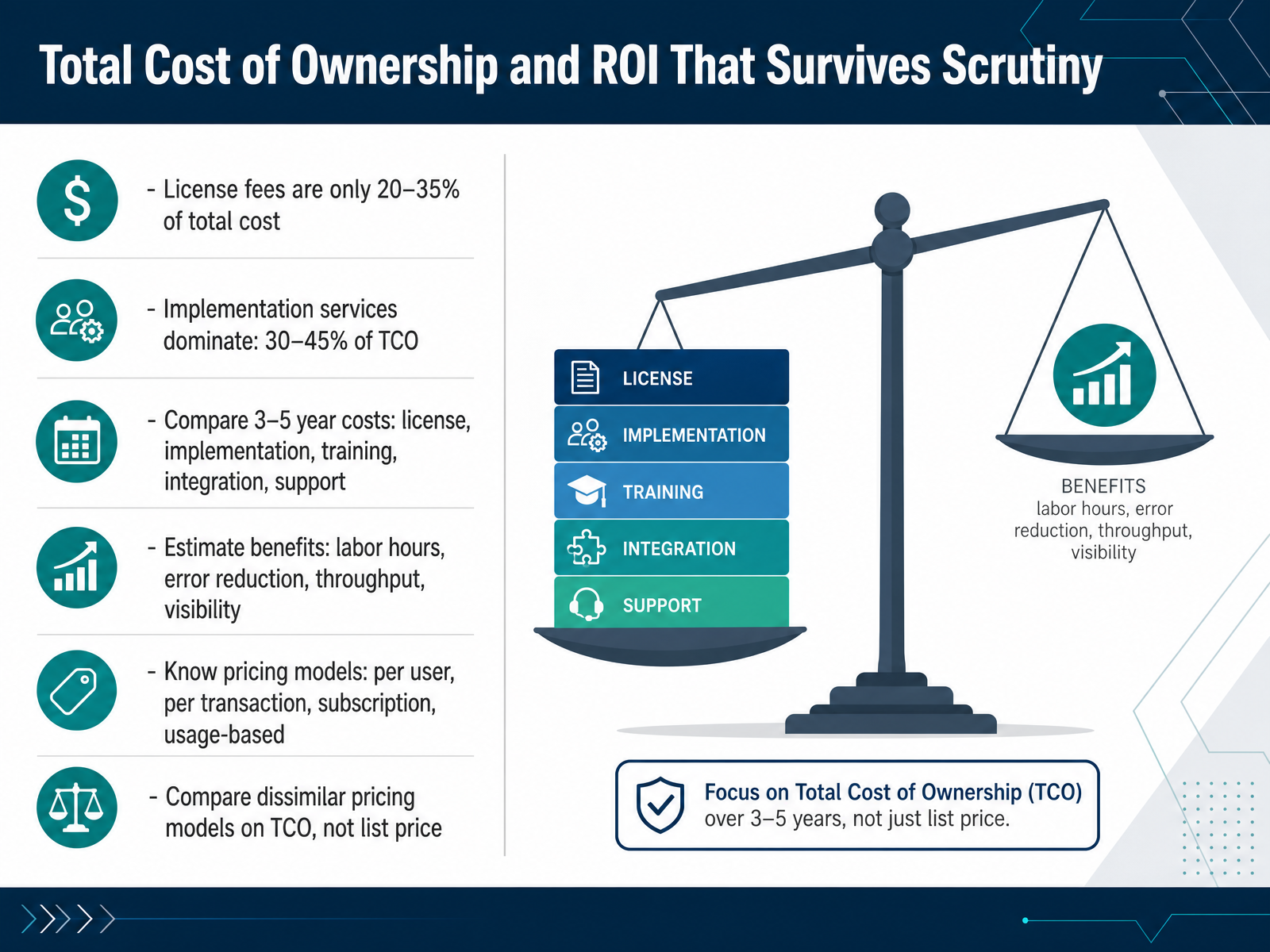
 - 08Total Cost of Ownership and ROI That Survives ScrutinyNext, let's talk about total cost of ownership and return on investment that survives scrutiny. License fees are only twenty to thirty-five percent of total cost. Implementation services dominate, at thirty to forty-five percent of T C O. So compare three to five year costs across license, implementation, training, integration, and support. Estimate benefits in concrete terms: labor hours, error reduction, throughput, and visibility. Know the pricing models you'll encounter, per user, per transaction, subscription, and usage-based. Then compare dissimilar pricing models on total cost of ownership, never on list price. As a planning heuristic, three-year cost often runs about three times first-year license spend. And remember internal costs: project time, backfill, and the go-live productivity dip, which can add fifteen to thirty percent. Here's what to verify: partner rates, data migration scope, and how support scales with growth. Next, we'll look at stakeholder alignment and evaluation team design.
 1 min
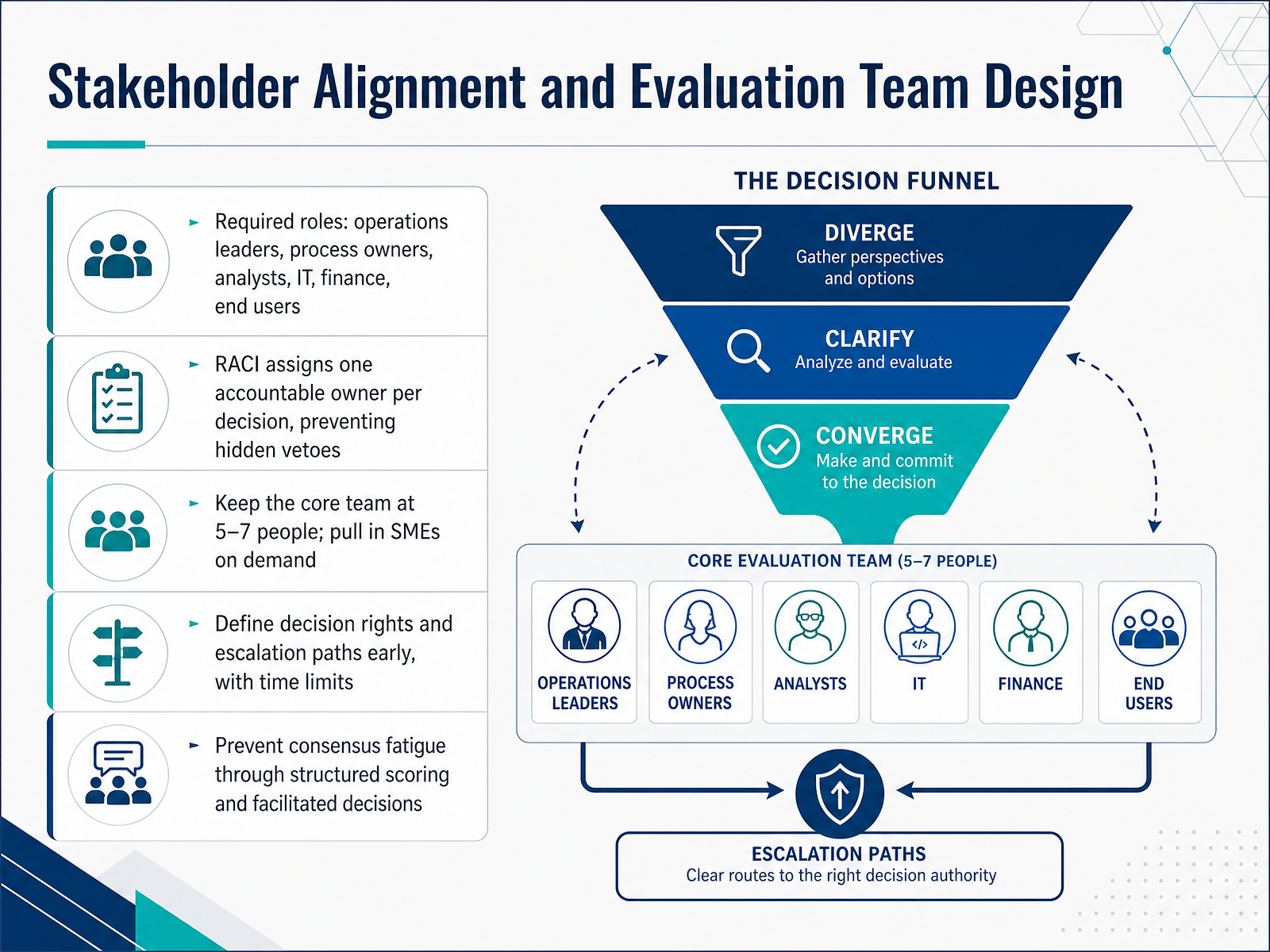
1 min - 09Stakeholder Alignment and Evaluation Team DesignNext, let's talk about stakeholder alignment and how to design your evaluation team. First, name the required roles: operations leaders, process owners, analysts, IT, finance, and end users. Each role brings a different lens, and each one will live with the outcome. Next, build a RACI that assigns one accountable owner per decision. That prevents hidden vetoes and shared accountability, where nobody actually decides. Keep the core team at five to seven people. Pull in subject matter experts on demand, not permanently. Define decision rights and escalation paths early, with time limits. Here's what to verify: a written escalation ladder, and a decision log that records rationale. The trade-off is speed versus inclusion. Too many voices slow throughput. Too few create late objections. Prevent consensus fatigue through structured scoring and facilitated decisions. That keeps handoffs clean and cycle time short. Finally, run a fair vendor comparison.
 umbrex.com1 min
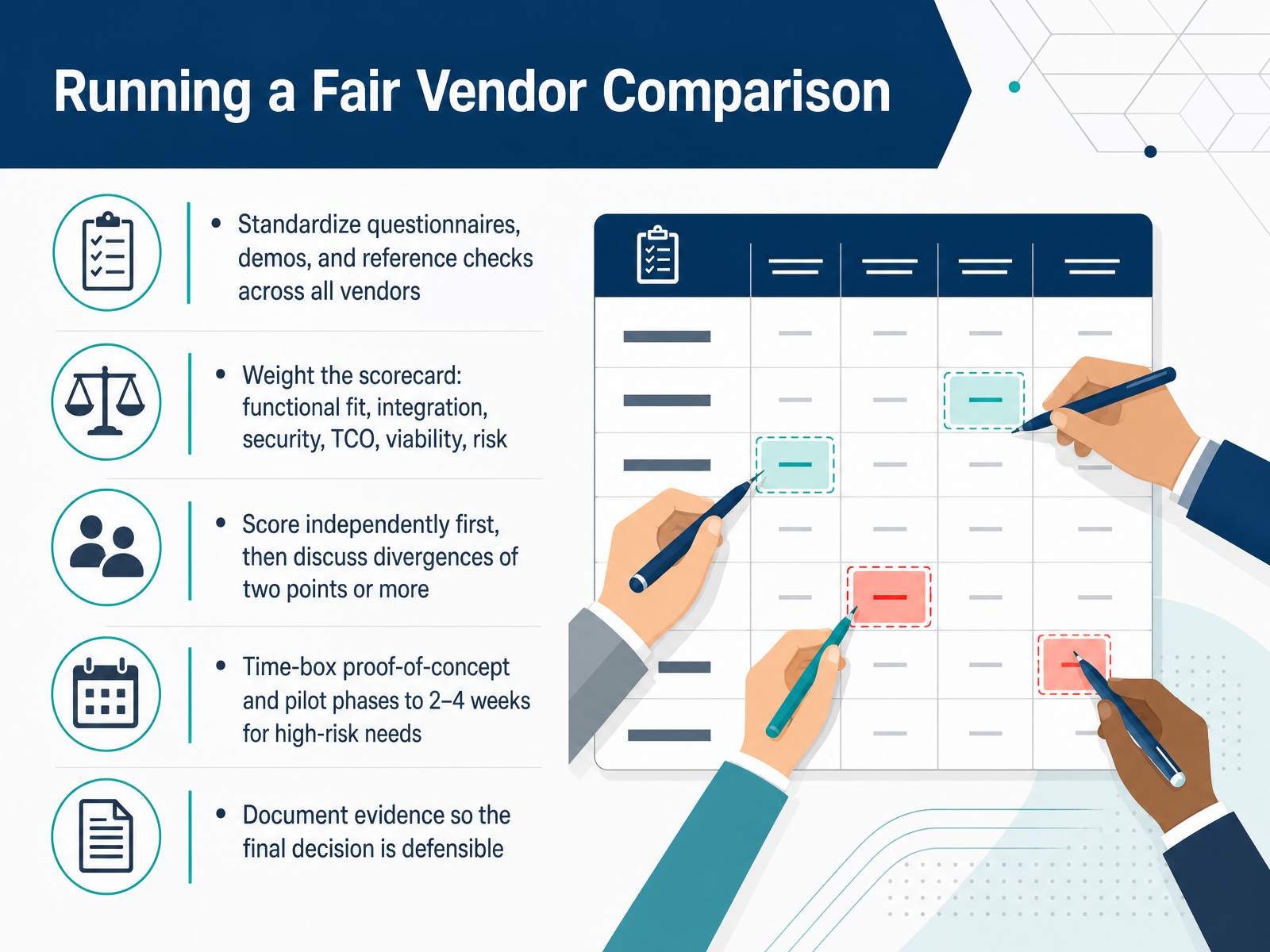
 - 10Running a Fair Vendor ComparisonNext, let's talk about running a fair vendor comparison. Fairness here is a process discipline, not a courtesy to vendors. First, standardize everything: the same questionnaire, the same demo script, the same reference questions for every vendor. Next, build a weighted scorecard. Functional fit, integration, security, total cost of ownership, viability, and risk. Lock the weights before demos begin. Then, have each evaluator score independently. Discuss any divergence of two points or more, because that gap usually signals missing evidence. Time-box proof-of-concept and pilot phases to two to four weeks. Longer than that, and it becomes an unpaid pilot. Define success criteria in writing first. Finally, document your evidence. A defensible decision is one you can explain a year later. Here's what to verify: weights frozen, scoring separate, and every score traceable to an artifact. That discipline carries directly into the next topic: vendor viability and partner due diligence.
 2 min
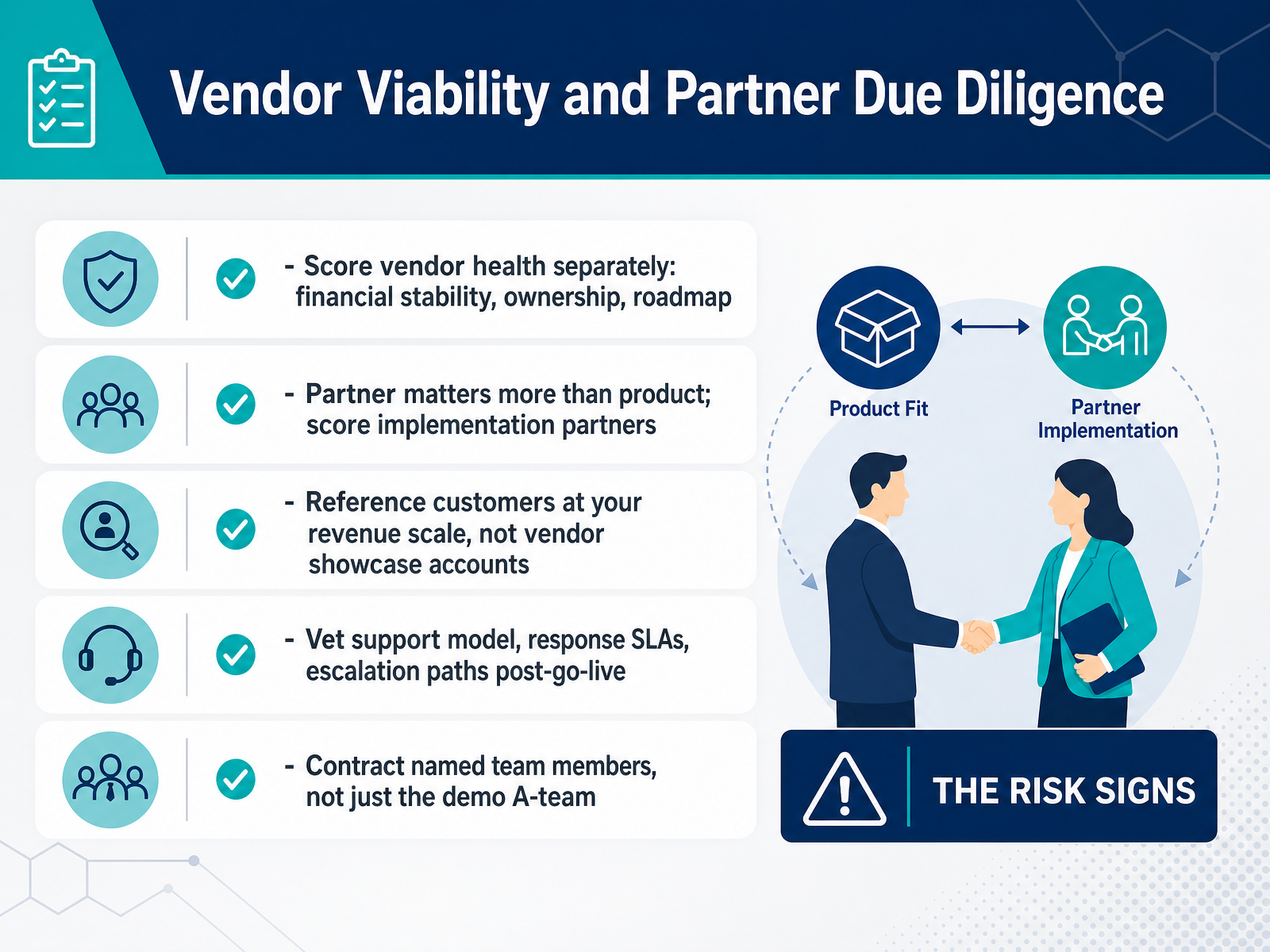
2 min - 11Vendor Viability and Partner Due DiligenceNext, vendor viability and partner due diligence. Score vendor health separately from product fit. Three signals matter: financial stability, ownership structure, and roadmap credibility. Private equity buyers often cut support and development within a year of closing. Next, the partner matters more than the product. The same platform delivered by different implementation partners produces wildly different outcomes. So score implementation partners on their own weighted criteria. When you check references, talk to customers at your revenue scale. Fortune 500 showcases tell you nothing about mid-market delivery. Ask specifically for customers who went live in the last two years. Then vet the support model carefully: response SLAs, escalation paths, and who owns issues after go-live. Finally, name team members in the contract, not just the demo A-team. If they will not name names, you have your answer. That brings us to the decision framework and business case.
 doss.comapfx.aiepicasta.com+22 min
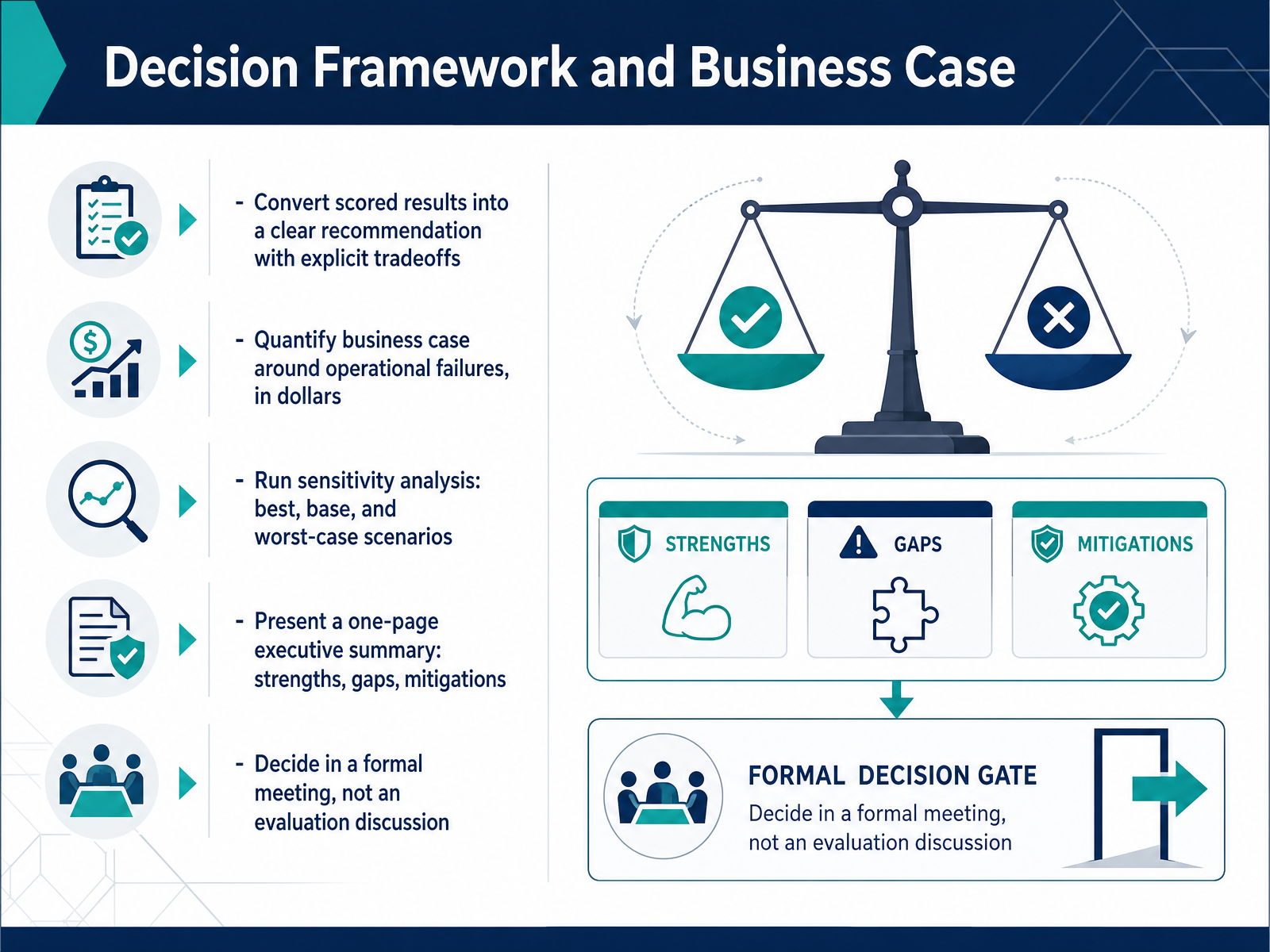
 - 12Decision Framework and Business CaseWith scoring complete, the work shifts to the decision. First, convert scored results into one clear recommendation with explicit trade-offs. Name what you accept, and what you give up. Next, quantify the business case in dollars tied to operational failures. Use real numbers: reconciliation hours, exception handling, cycle time lost at handoffs, not aspirational projections. Then run sensitivity analysis across best, base, and worst-case scenarios, so leadership sees how the math behaves when implementation slips or adoption lags. Package it into a one-page executive summary covering strengths, gaps, and mitigations. The trade-off is speed versus rigor: more scenarios take more time but survive finance scrutiny. Here is what to verify: every promised benefit traces to a documented failure with a cost. Finally, decide in a formal meeting, not an evaluation discussion. Separate deliberation from commitment, and document the rationale. That is how a selection holds up after go-live. Next, we move into post-selection transition and change management.
 doss.comapfx.aiepicasta.com+22 min
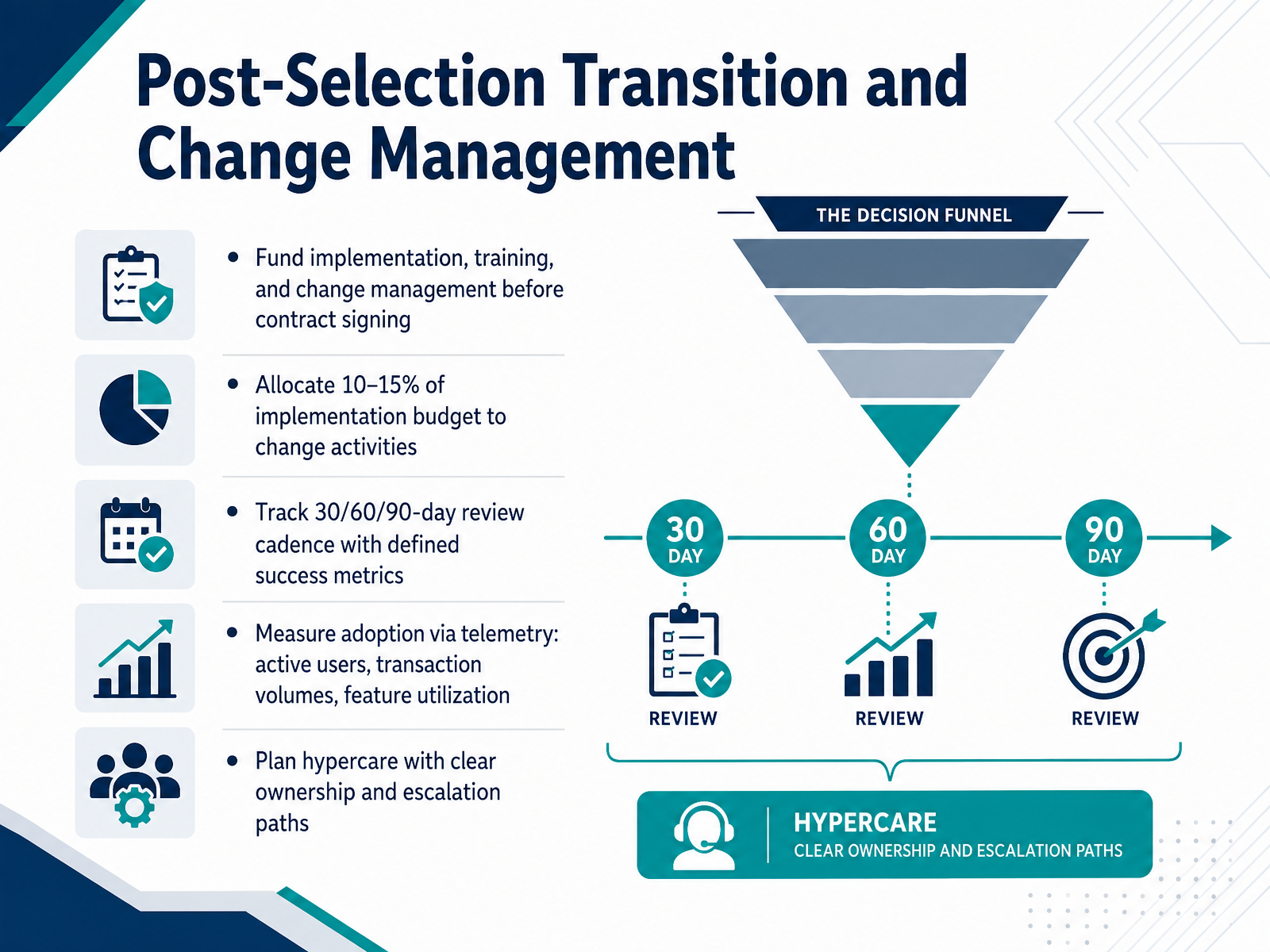
 - 13Post-Selection Transition and Change ManagementNow let's talk about life after selection. The transition is where value is won or lost. First, fund implementation, training, and change management before the contract is signed. Allocate ten to fifteen percent of your implementation budget to change activities. This is not overhead. It is the difference between adoption and expensive shelfware. Next, establish a thirty, sixty, ninety day review cadence with defined success metrics. Then measure adoption through system telemetry, not training attendance. Track active users, transaction volumes, and feature utilization. Attendance tells you who sat in a room. Telemetry tells you whether the investment is working. Finally, plan hypercare with clear ownership and escalation paths. Name a single triage owner and define severity levels before go live. Here's the takeaway. Budget, cadence, telemetry, and hypercare are the four controls that carry you from go live to real adoption. Next, we will look at common mistakes and a repeatable comparison playbook.
 2 min
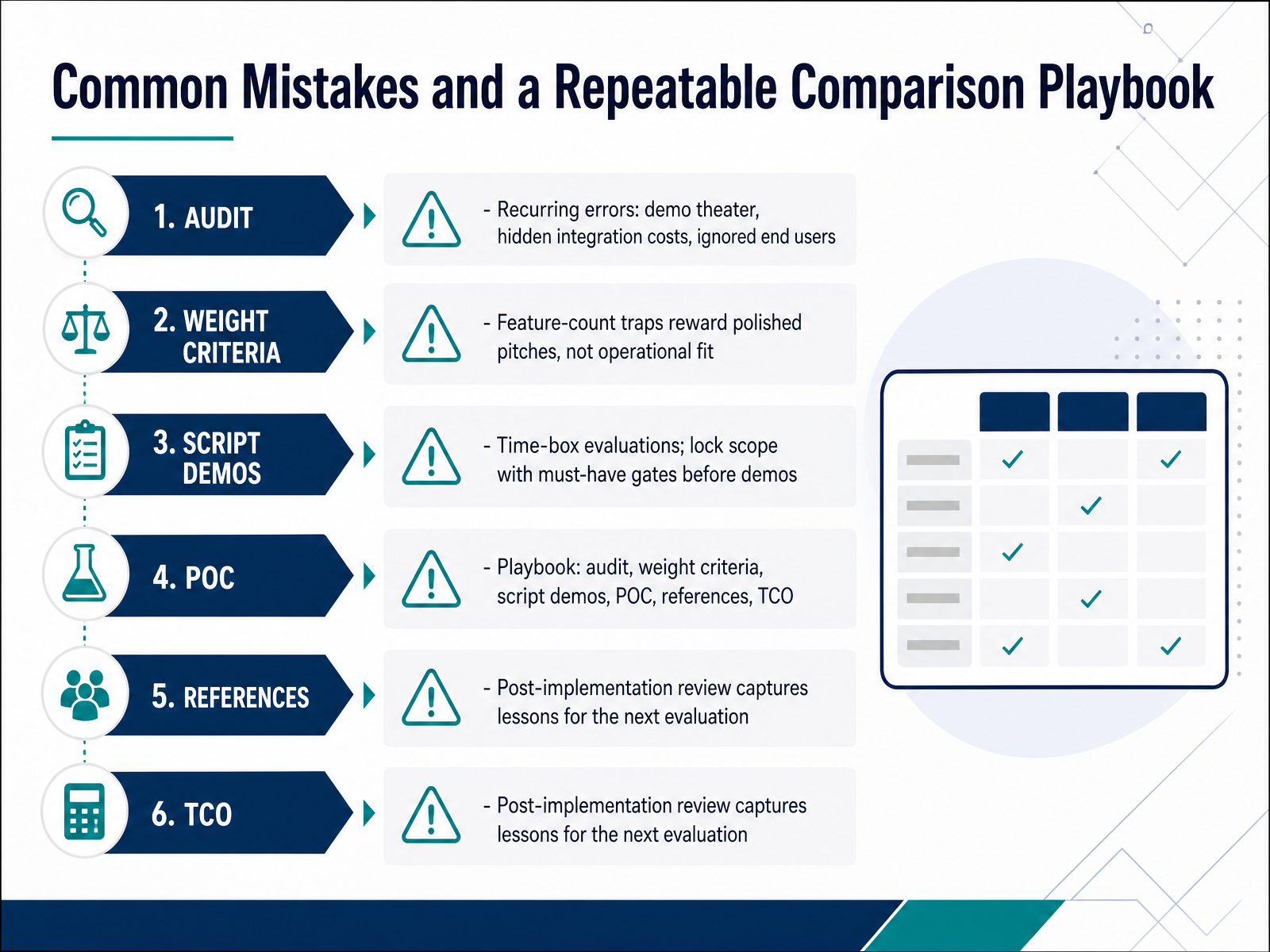
2 min - 14Common Mistakes and a Repeatable Comparison PlaybookLet's close by naming the mistakes to avoid and the playbook that prevents them. The recurring errors are demo theater, hidden integration costs, and ignored end users. Feature-count traps reward polished pitches, not operational fit. So time-box your evaluation and lock scope with must-have gates before any demo begins. Here is the repeatable playbook. First, audit your current operations. Next, weight your criteria by business impact. Then script your demos using your own messy scenarios. Run a proof of concept with real data. Check references at your scale. And model total cost of ownership, not just license fees. Finally, hold a post-implementation review and capture lessons for the next evaluation. That discipline is what separates the thirty percent of implementations that succeed from the ones that stall. Thank you for working through this comparison framework. Keep your criteria weighted, your demos scripted, and your references unfiltered. You now have a repeatable process. Go use it with confidence.
 doss.comapfx.aiepicasta.com+21 min
Take the deck with you
Download this course as a file — free, no sign-up needed.
- PDF handoutEvery slide page, ready to print or share.15 pages · 3.6 MBDownload
- Narrated PowerPointThe deck that presents itself — every slide carries the digital human's narration video.15 pages · 12.9 MBDownload
- PowerPoint slidesThe full deck as a .pptx — open it in PowerPoint, Keynote, or Google Slides.15 pages · 3.4 MBDownload
Free to use in your own training — please keep the PersonWise credit page at the end.
Have your own deck? Turn it into a course
Sources consulted
Web sources consulted while building this course.
- Buyer's Guide to Operations Software | DOSS — doss.com
- How to Evaluate Operations Software Without Getting Burned | APFX — apfx.ai
- The Software Selection Framework: How to Buy Business Software Without Regret — epicasta.com
- Enterprise Software Selection Playbook: Pick with Proof — umbrex.com
- How to Choose ERP Software: An 8-Step Selection Guide — oneadvanced.com
- OMS vs. WMS vs. ERP vs. TMS: What's the Difference? — skupreme.com
- What's a MES? How does it differ from an ERP and a WMS? — interlakemecalux.com
- OMS vs ERP vs WMS: Which System Does E-commerce Need? — thetransformagency.com
- OMS vs ERP/WMS and Future Trends | Warehouse & 3PL Logistics Encyclopedia — racklify.com
- What is an ERP, PIM, WMS, and OMS, and what's ... — dynamics.folio3.com
- Enterprise Software Selection: Demos That Prove Fit — umbrex.com
- ERP Software Demo Script: Scenarios and Scorecard | ERP Search — erpsearch.com.au
- https://www.cfoshortlist.com/reports/demo-orchestration — cfoshortlist.com
- https://www.cfoshortlist.com/epm-101/demo-best-practices — cfoshortlist.com
- https://www.spotsaas.com/resources/erp-software/demo-scorecard — spotsaas.com
- ERP Integration Readiness Checklist: 30 Questions to Answer Before You Connect Systems - Elephas — elephas.us
- ERP Data Migration Checklist: Mapping, Validation, Cutover, And Rollback — nextpageit.com
- Data Migration Checklist: Mapping, Validation, Cutover, And Rollback — nextpageit.com
- Data Migration Cutover Plan: Checklist And Risk Controls - Concentrus — concentrus.com
- ERP Migration Readiness Checklist | Talantir Guides — talantir.ai