Team Work Prioritization Framework
Begin
14 pages · ~28 min
Team Work Prioritization Framework
Master prioritizing team tasks by evaluating impact, urgency, and constraints to improve workflow efficiency and decision-making.
What you’ll learn
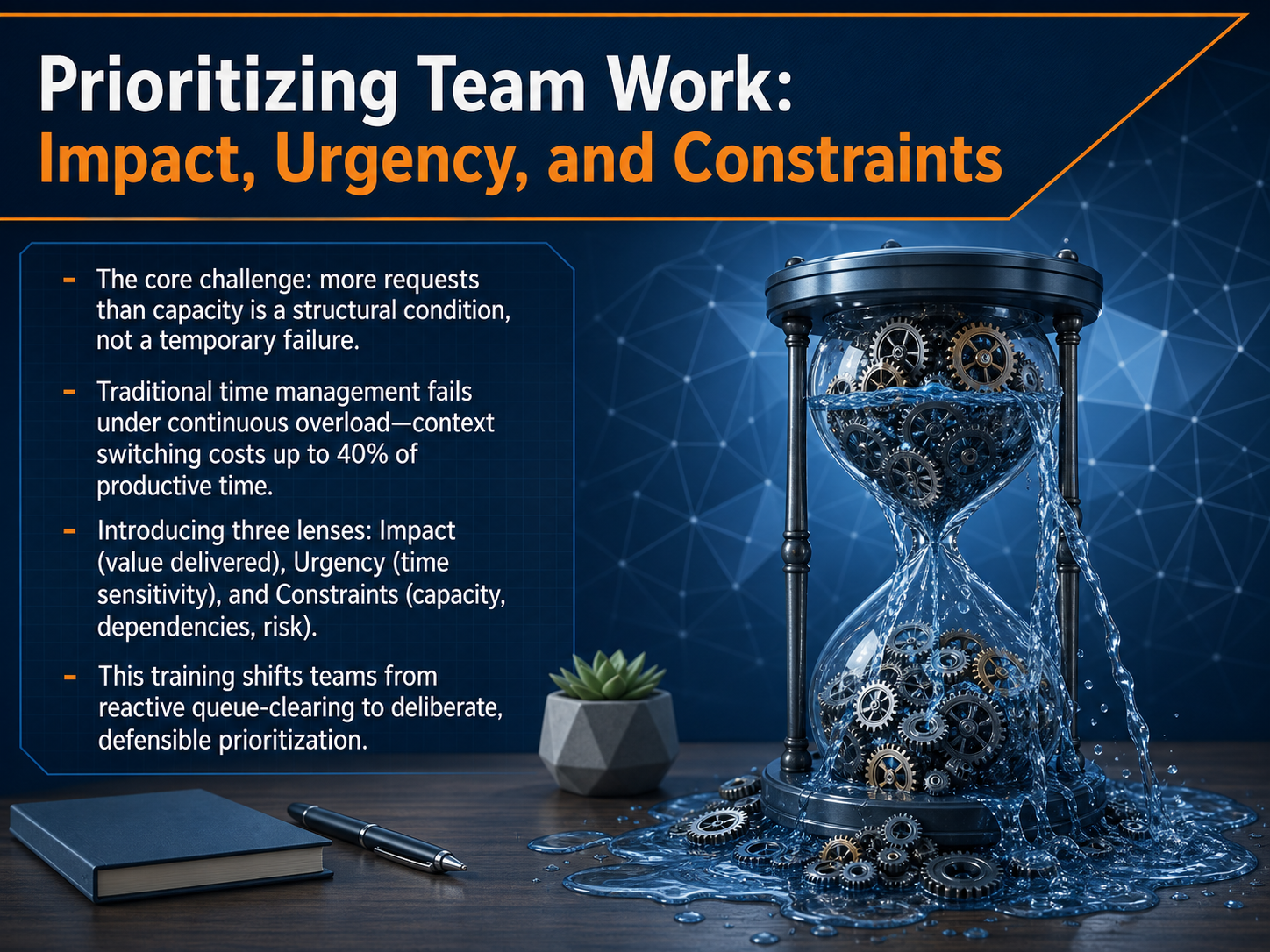
- 01Prioritizing Team Work: Impact, Urgency, and ConstraintsWelcome. Today we are tackling a challenge that every capable team faces: more requests than capacity. This is not a temporary failure. It is a structural condition, and it is not going away. The goal of this training is to move from reactive queue-clearing to deliberate, defensible prioritization. Traditional time management breaks down under continuous overload. In fact, context switching alone can steal up to 40 percent of our productive time. To solve this, we introduce three decision lenses. First, Impact: the value delivered. Second, Urgency: the time sensitivity. And third, Constraints: our capacity, dependencies, and risk. These three lenses shift the conversation from 'who shouted loudest' to 'what creates the most value right now.' Next, we will look at the real cost of a reactive backlog.boards.cloudcodersera.commonday.com+21 min
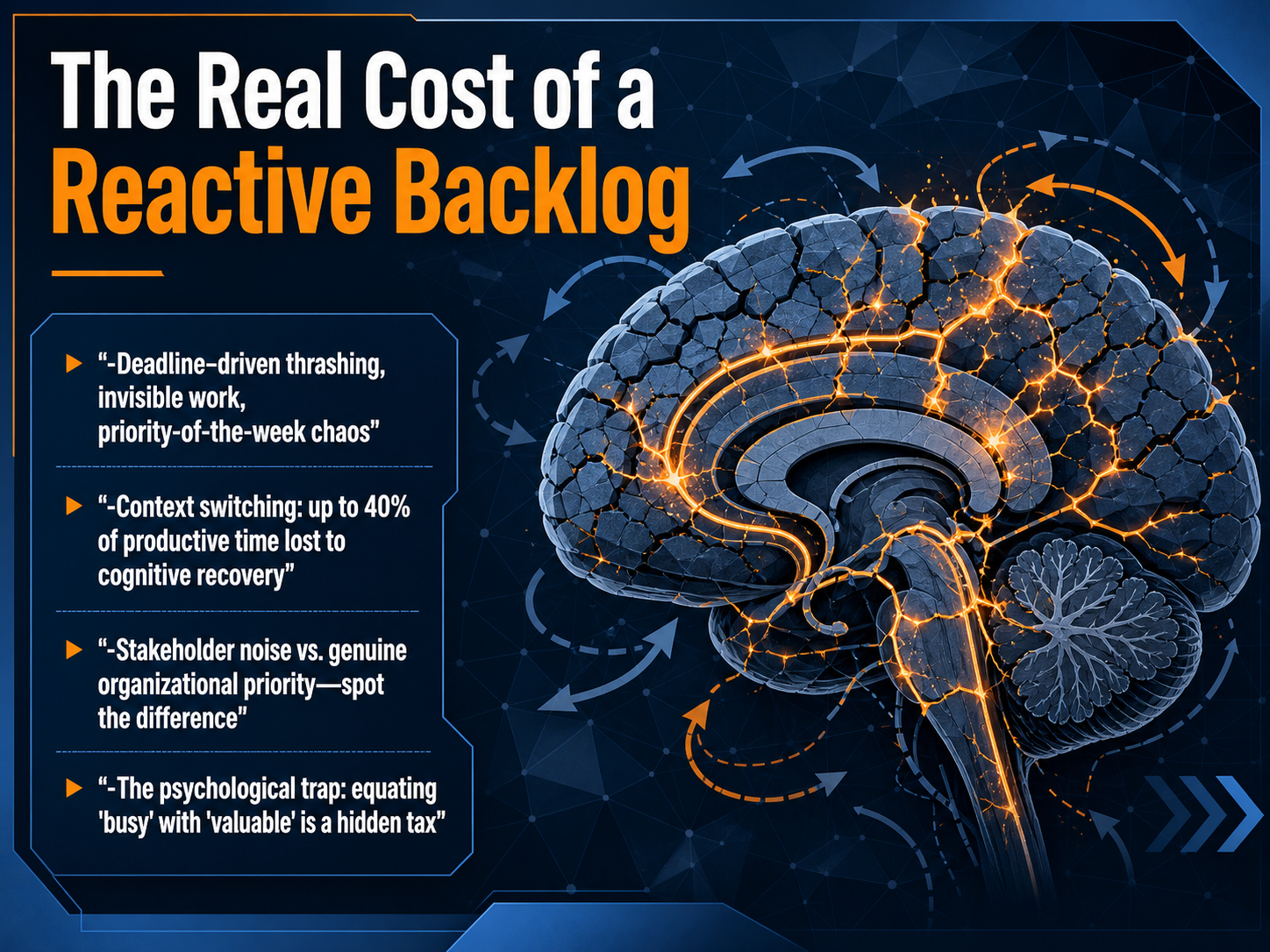
- 02The Real Cost of a Reactive BacklogSo, let's look at the real cost of a reactive backlog. When we only chase the deadline that's screaming loudest, the team starts thrashing. We jump from one priority-of-the-week to the next, and a huge amount of invisible work gets created just to manage the chaos. The biggest hidden tax here is context switching. Research shows that after an interruption, it can take over twenty-three minutes to fully regain our cognitive focus. Over a day, this can eat up as much as forty percent of our productive time. We also start to confuse stakeholder noise with genuine organizational priority. The loudest request isn't always the most valuable one. And finally, there's a psychological trap we need to name: equating 'busy' with 'valuable'. A packed calendar and a frantic pace aren't signs of impact; they're often just a hidden tax on our judgment and energy. Next, we'll move from diagnosing the problem to building the solution. We'll introduce the three lenses that ground our decisions: a framework based on impact, urgency, and constraints.
 ics.uci.eduusehaystack.iosurton.com+22 min
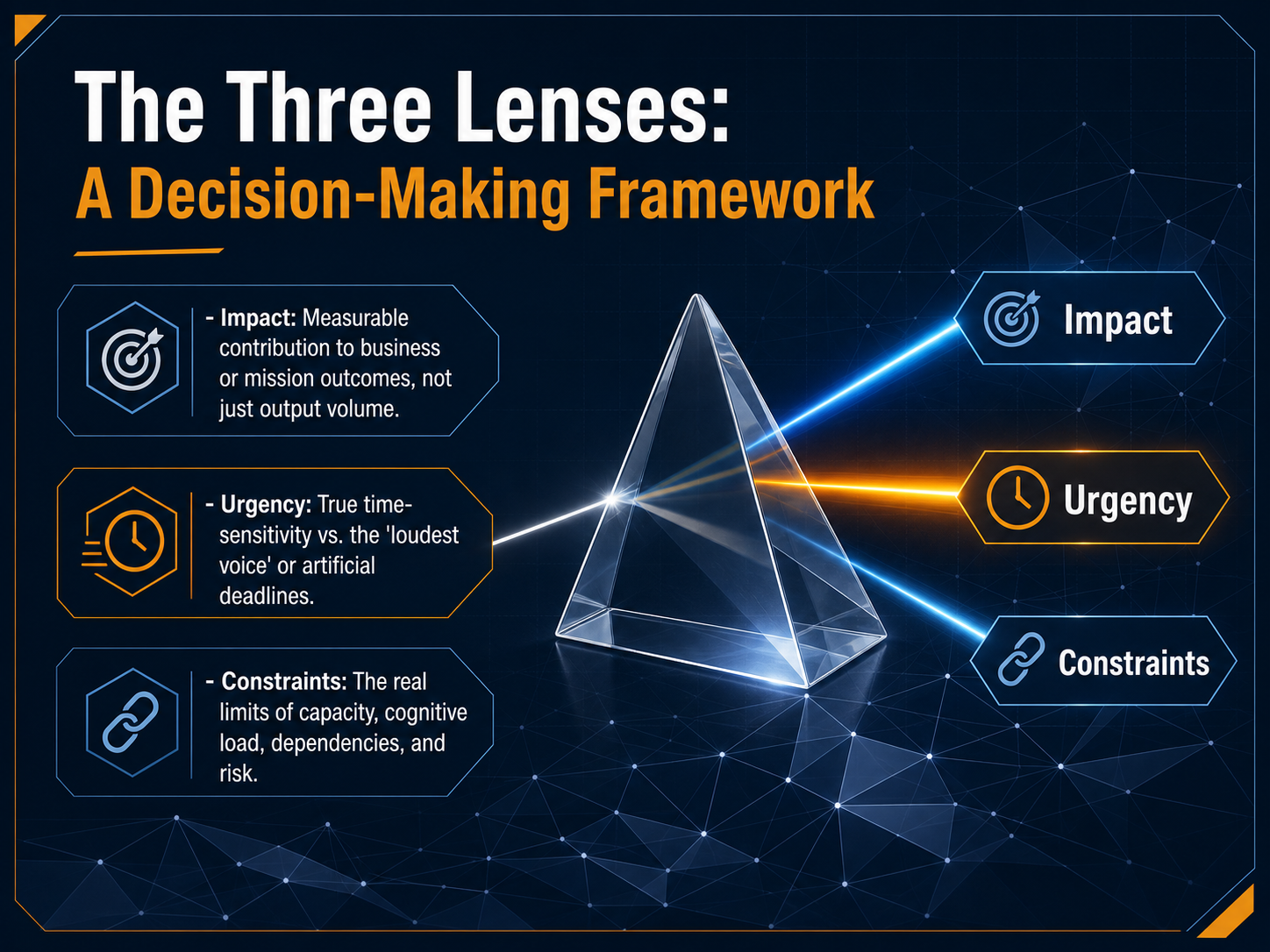
 - 03The Three Lenses: A Decision-Making FrameworkNow let's look at the framework we'll use to sort through the noise. We call it the Three Lenses: a decision-making framework built around Impact, Urgency, and Constraints. Think of these as three filters—every request needs to pass through all three before we decide where it lands.
First, Impact. This is about measurable contribution to business or mission outcomes, not just how busy we'll be. A feature that unblocks a major revenue stream has high impact, even if it's a small configuration change.
Second, Urgency. This is where we separate true time-sensitivity from the loudest voice in the room. A regulatory deadline is real urgency. A stakeholder's anxiety is not.
Third, Constraints. These are the real limits of our capacity, our cognitive load, dependencies, and risk. We can't prioritize work we don't have the space to execute well.
When we combine these three lenses, planning stops being a reaction to pressure and starts being a conscious choice. Let's start with the first lens: defining Impact for your team.
 ideaplan.iocentercode.comideaplan.io+22 min
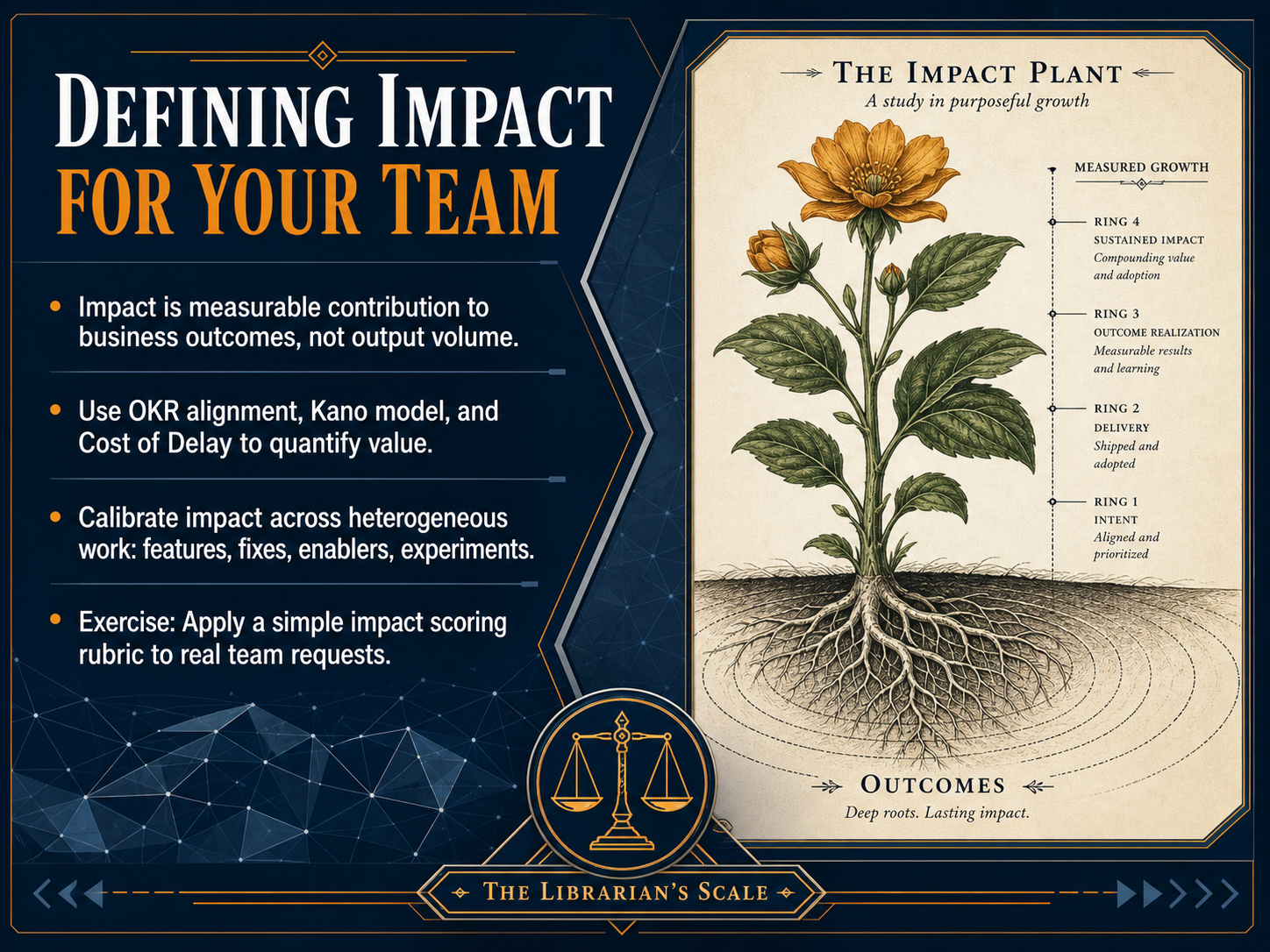
 - 04Defining Impact for Your TeamLet's get specific about what we mean by impact. Too often, teams equate impact with how many features they've shipped, how many lines of code they've written. That's output. Impact is something different. It's a measurable contribution to a real business outcome. To quantify that, we can use tools like OKR alignment, the Kano model, or Cost of Delay. These frameworks help us move from a gut feeling about value to a defensible, shared number. But here's a common challenge: your work isn't just one type of thing. You're comparing a new feature, a critical bug fix, a technical enabler, and a risky experiment. We need to calibrate impact across all of these, using the same set of criteria so a feature doesn't automatically win over a vital security patch. So, here's your exercise. You'll take a simple impact scoring rubric and apply it to a few real requests from your own backlog. The goal isn't a perfect score. It's a consistent, honest conversation about what value really means for your team. Next, we'll tackle the dimension that often causes the most panic: assessing urgency without the panic.
 ideaplan.iocentercode.comideaplan.io+22 min
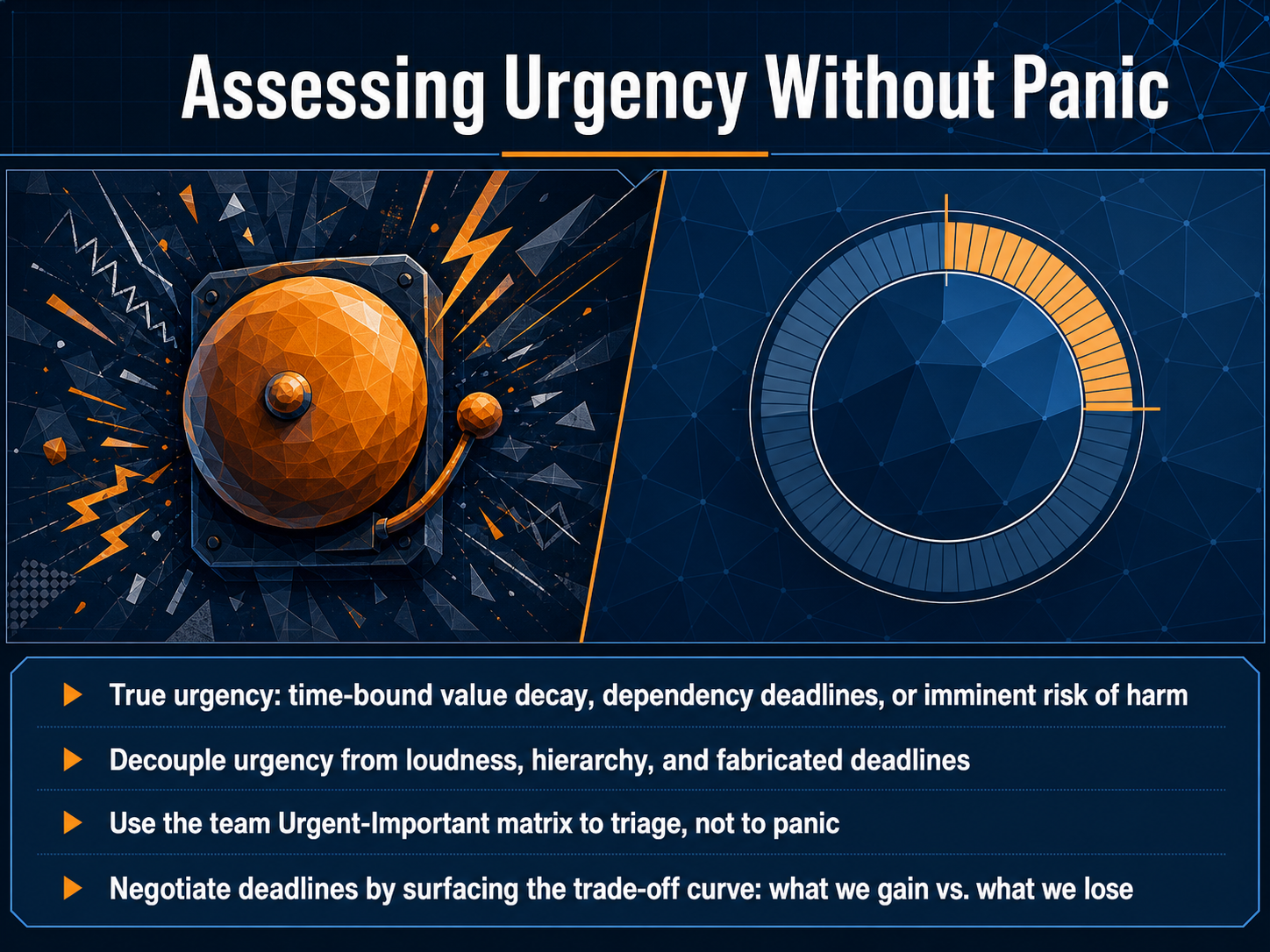
 - 05Assessing Urgency Without PanicNow let's talk about assessing urgency without letting it turn into panic. True urgency has a clear, measurable cost: time-bound value decay, hard dependency deadlines, or imminent risk of harm. It's not the same as the loudest request in the room, pressure from hierarchy, or a deadline someone fabricated because they wanted an answer by Friday. We decouple urgency from noise. A practical tool here is the team's Urgent-Important matrix, used to triage work, not to panic about it. The matrix separates what must move now from what simply feels pressured. Finally, we negotiate deadlines by surfacing the trade-off curve. Instead of just saying yes or no, we show what we gain by hitting a date and what we lose by delaying other work. This moves the conversation from emotion to economics. Next, we'll examine Constraints: the real limits of your team.
 boards.cloudcodersera.commonday.com+22 min
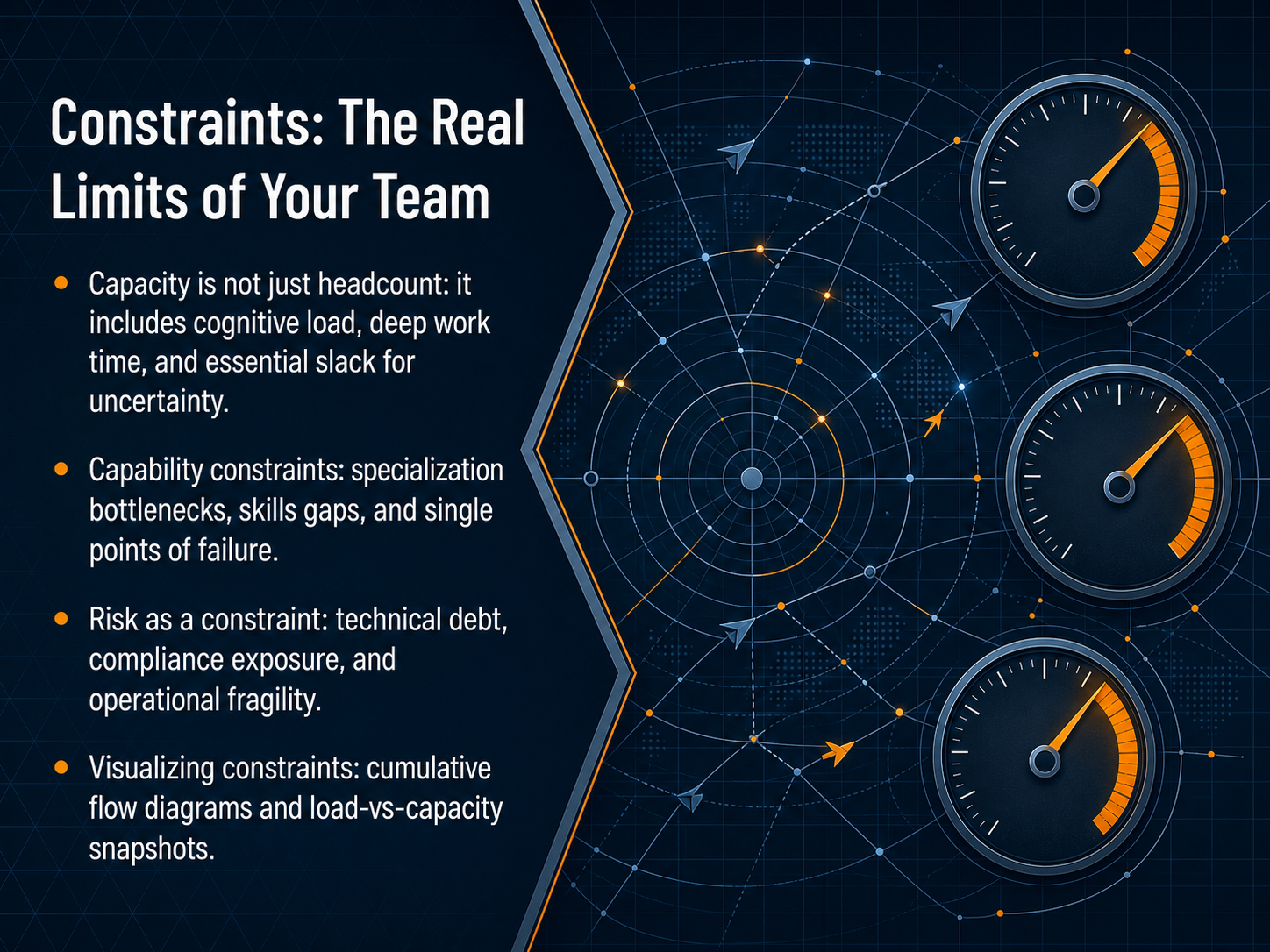
 - 06Constraints: The Real Limits of Your TeamNow let's talk about the real limits you're working within. Capacity isn't just headcount. It includes cognitive load, the need for deep work time, and essential slack for uncertainty. Without that slack, every small disruption cascades into delays. We also face capability constraints: specialization bottlenecks, skills gaps, and single points of failure. If only one person knows a critical system, we have a hard constraint. Risk acts as a constraint too. Technical debt, compliance exposure, and operational fragility silently consume capacity. We decide what's safe by visualizing these limits. Tools like cumulative flow diagrams and load-versus-capacity snapshots make over-allocation visible and explicit. Next, we'll explore how slack becomes the unsung hero of sustainable delivery.
 howtothink.aiiamagile.ioresources.rework.com+21 min
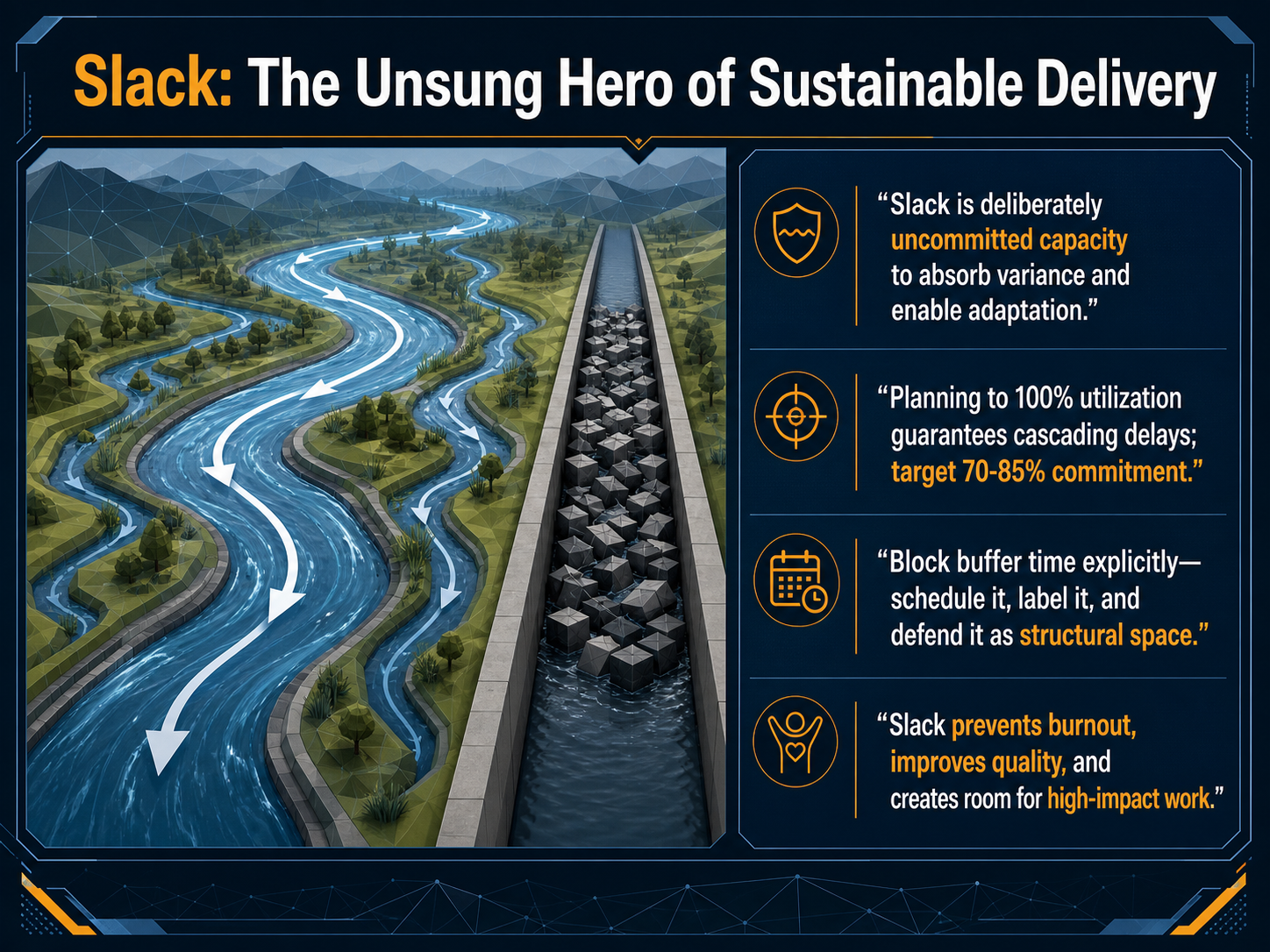
 - 07Slack: The Unsung Hero of Sustainable DeliverySo we've covered the factors that shape our decisions. Now let's talk about the space that makes those decisions actually work: slack. Slack isn't wasted time. It's deliberately uncommitted capacity that absorbs variance and allows us to adapt. When we plan to one hundred percent utilization, we guarantee cascading delays. Queuing theory shows that at full utilization, wait times spike exponentially. Our target is to commit only seventy to eighty-five percent of capacity. The remaining fifteen to thirty percent is our structural buffer. We schedule it explicitly, label it, and defend it. This buffer prevents burnout, improves quality, and creates room for the high-impact work that truly moves the needle. It's the infrastructure that makes sustained delivery possible. Next, we'll integrate all these lenses into a decision-first scoring model.
 howtothink.aiiamagile.ioresources.rework.com+21 min
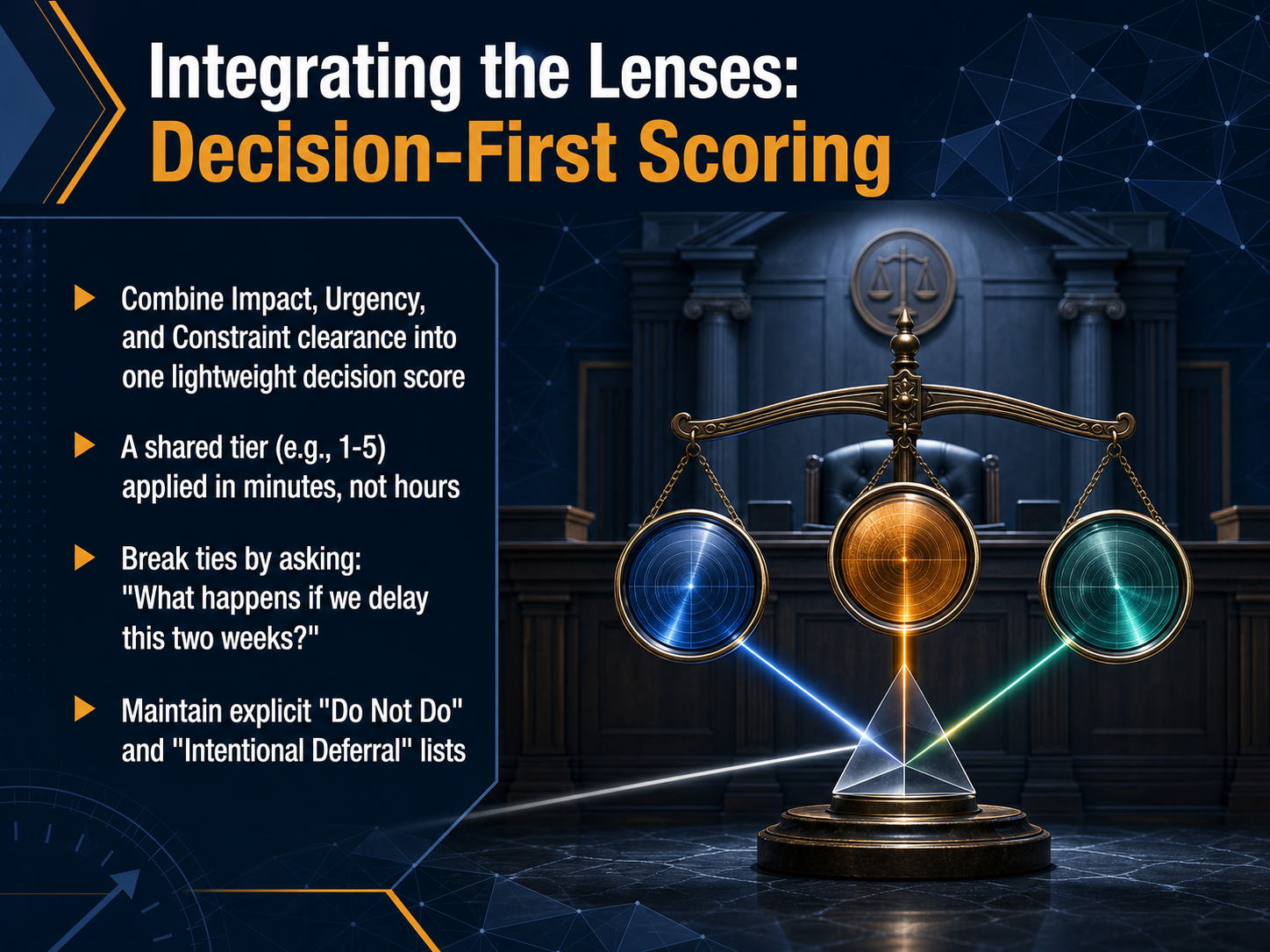
 - 08Integrating the Lenses: Decision-First ScoringSo we have three lenses: impact, urgency, and constraints. Now, instead of juggling them separately, we combine them into one lightweight decision score that we can apply in minutes, not hours. We decide using a shared tier, like one through five, to quickly position each request. When scores tie, we break the tie with one question: what happens if we delay this two weeks? That one question often reveals the true cost of waiting. And finally, we protect our focus by keeping two explicit lists. A Do Not Do list for work we are actively saying no to, and an Intentional Deferral list for valuable work that simply does not fit the current window. This keeps the backlog honest and the team aligned. Next, we are going to look at practical frameworks like RICE, WSJF, and the Action-Priority Matrix that bring these lenses to life.
 ideaplan.iocentercode.comideaplan.io+21 min
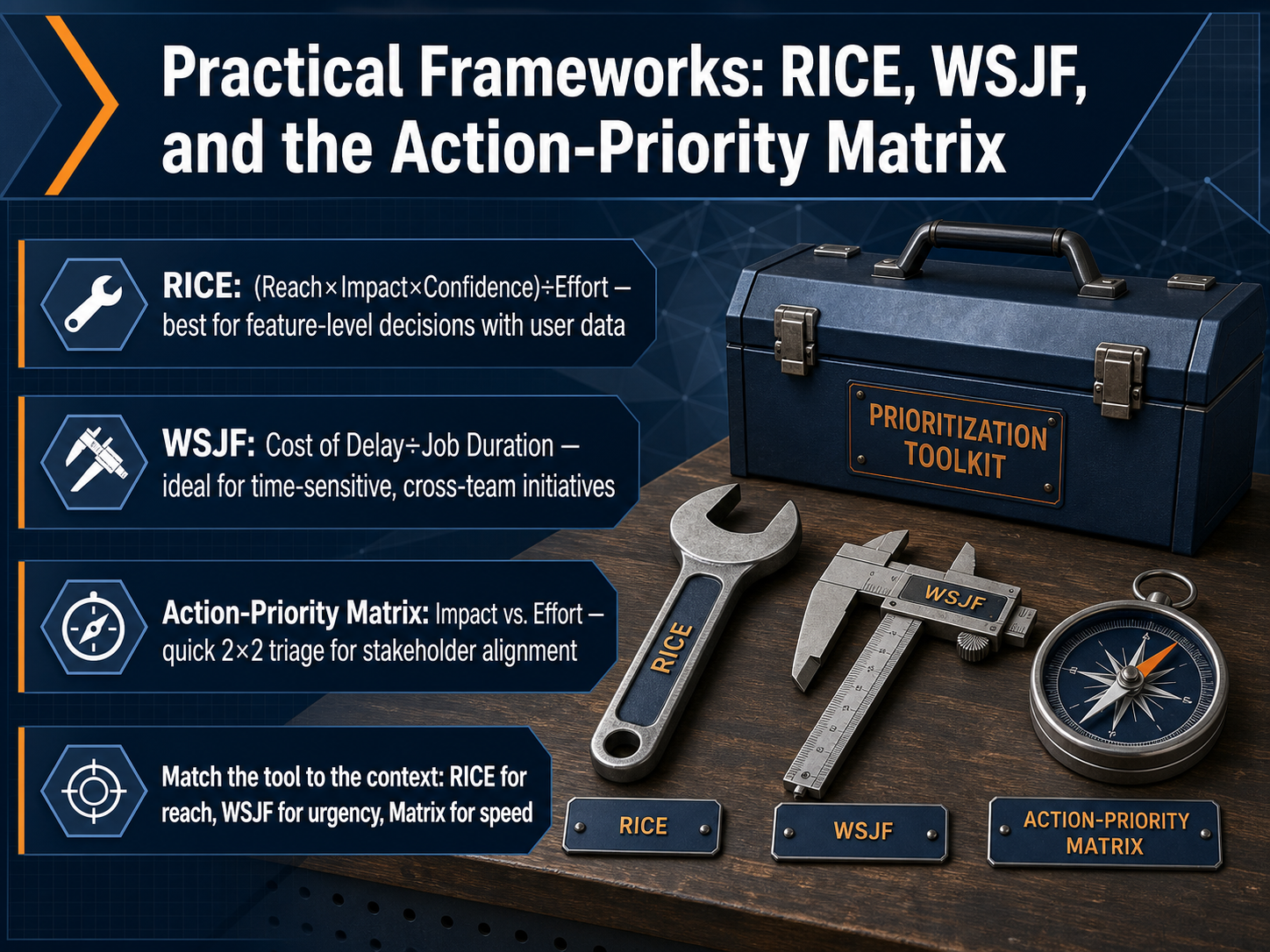
 - 09Practical Frameworks: RICE, WSJF, and the Action-Priority MatrixSo, how do we actually put these concepts into practice? We don't need to invent a new system. We decide by matching the right tool to the right job. Let's walk through three practical frameworks. First, RICE. It stands for Reach times Impact times Confidence, divided by Effort. This is our go-to for feature-level decisions when we have solid user data. It helps us choose the work that affects the most users for the least effort. Second, we have WSJF, or Weighted Shortest Job First. This is ideal for time-sensitive, cross-team initiatives. The formula is Cost of Delay divided by Job Duration. It naturally surfaces the work that loses the most value the longer we wait, like a hard regulatory deadline. And third, for quick alignment, we use the Action-Priority Matrix. It's a simple two-by-two grid comparing impact versus effort. This is perfect for rapid triage and getting stakeholders on the same page in minutes. The key is context. We use RICE for reach, WSJF for urgency, and the Matrix for speed. Now, once we have our priorities clear, we need to communicate them effectively. Let's talk about communicating prioritization upward and outward.
 ideaplan.iocentercode.comideaplan.io+22 min
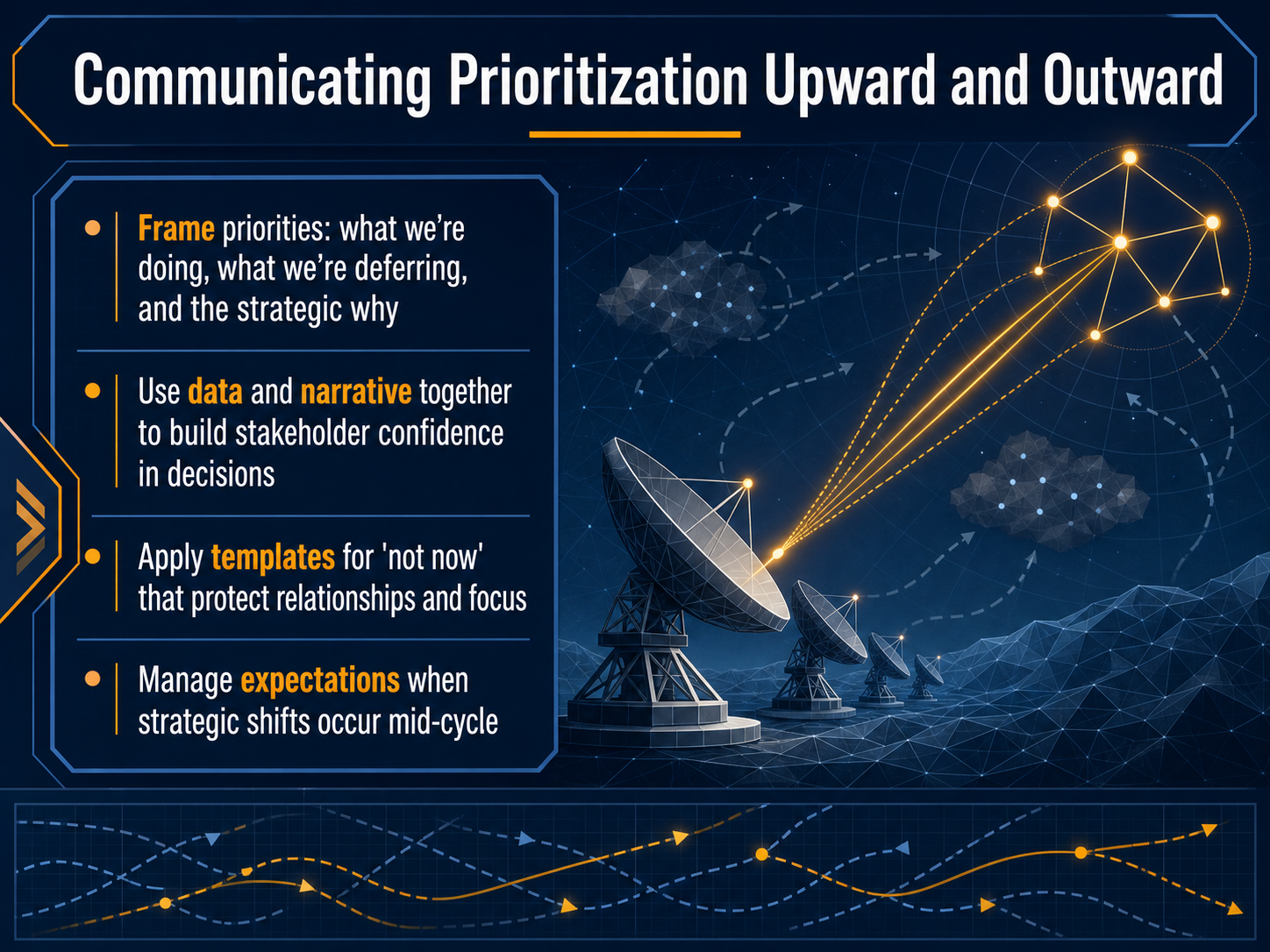
 - 10Communicating Prioritization Upward and OutwardThat framework makes sense on our side, but the real test is how we communicate these decisions upward and outward. When we talk to stakeholders, we need to frame priorities clearly: what we're doing, what we're deferring, and the strategic 'why' behind each choice. We decide by pairing data with narrative. A number alone won't build confidence; we explain the story the data tells. For those 'not now' moments, we apply consistent templates that protect the relationship. We're not just saying no; we're describing the conditions that would make this the right focus next. And when strategic shifts happen mid-cycle, we manage expectations proactively. We name the change, the reason, and the new timeline, so trust remains intact. Next, let's build your team's specific prioritization protocol.
 boards.cloudcodersera.commonday.com+21 min
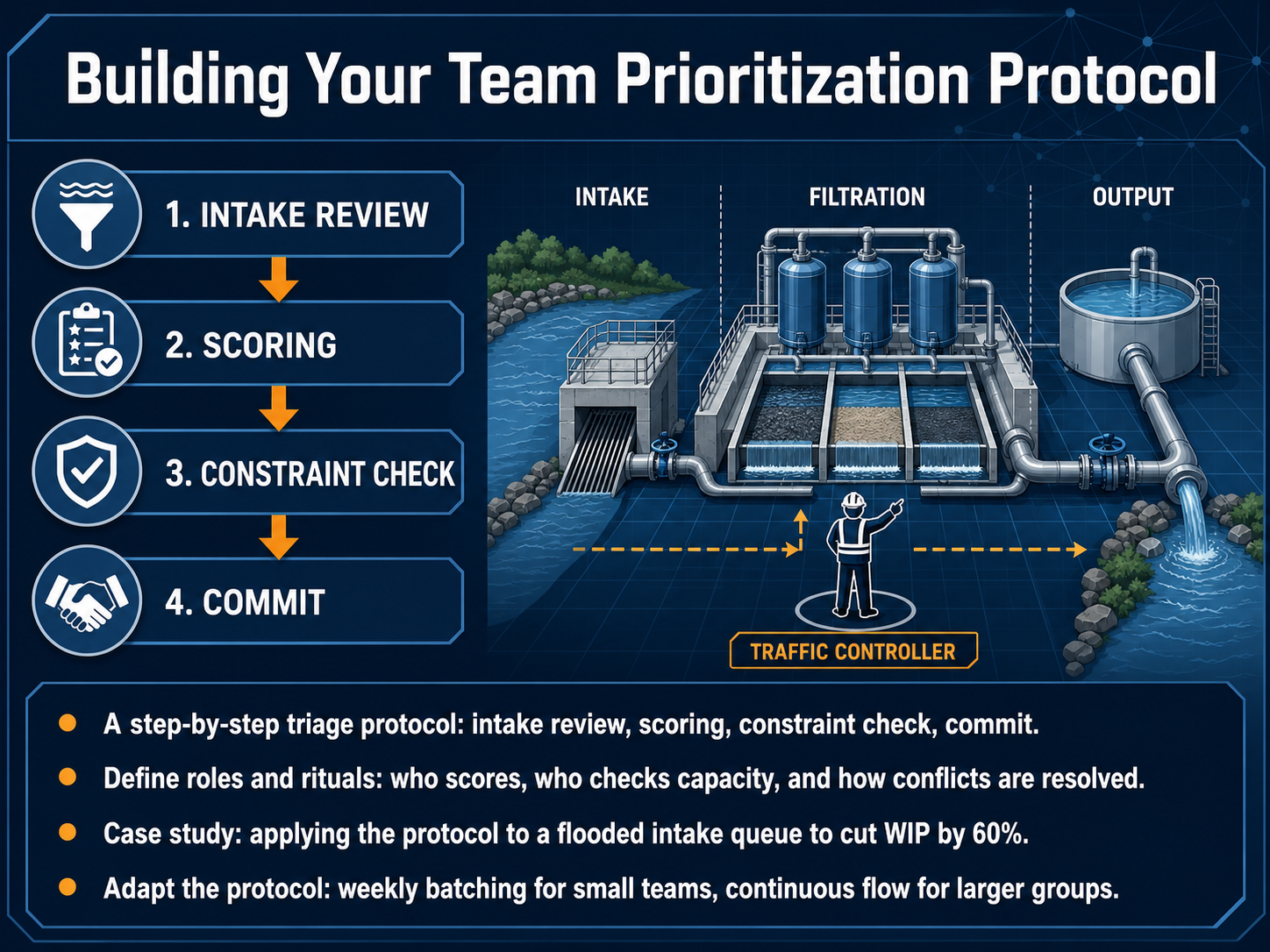
 - 11Building Your Team Prioritization ProtocolNow let's pull everything together into a team protocol you can actually run. This isn't theory. It's a step-by-step triage sequence: intake review, scoring, a constraint check, and then a clear commit. First, you review what's coming in. Then you score it against the impact, urgency, and constraints we just discussed. Next, you check capacity. Can we actually do this right now? Finally, you commit. That means you say yes with clarity, or you say no with a clear rationale. But a protocol only works if you define who does what. Who scores the requests? Who checks team capacity? And maybe most importantly, how do you resolve conflicts when two urgent items compete for the same slot? A real-world case study showed that applying exactly this protocol to a flooded intake queue cut work-in-progress by sixty percent. The team wasn't working harder. They were working on the right things. To adapt this, smaller teams often batch requests weekly. Larger groups tend to use a continuous flow model. Choose the rhythm that fits your reality. The goal is focus, not just speed. Now, let's look at the intake beast itself and how to structure it.
 ideaplan.iocentercode.comideaplan.io+22 min
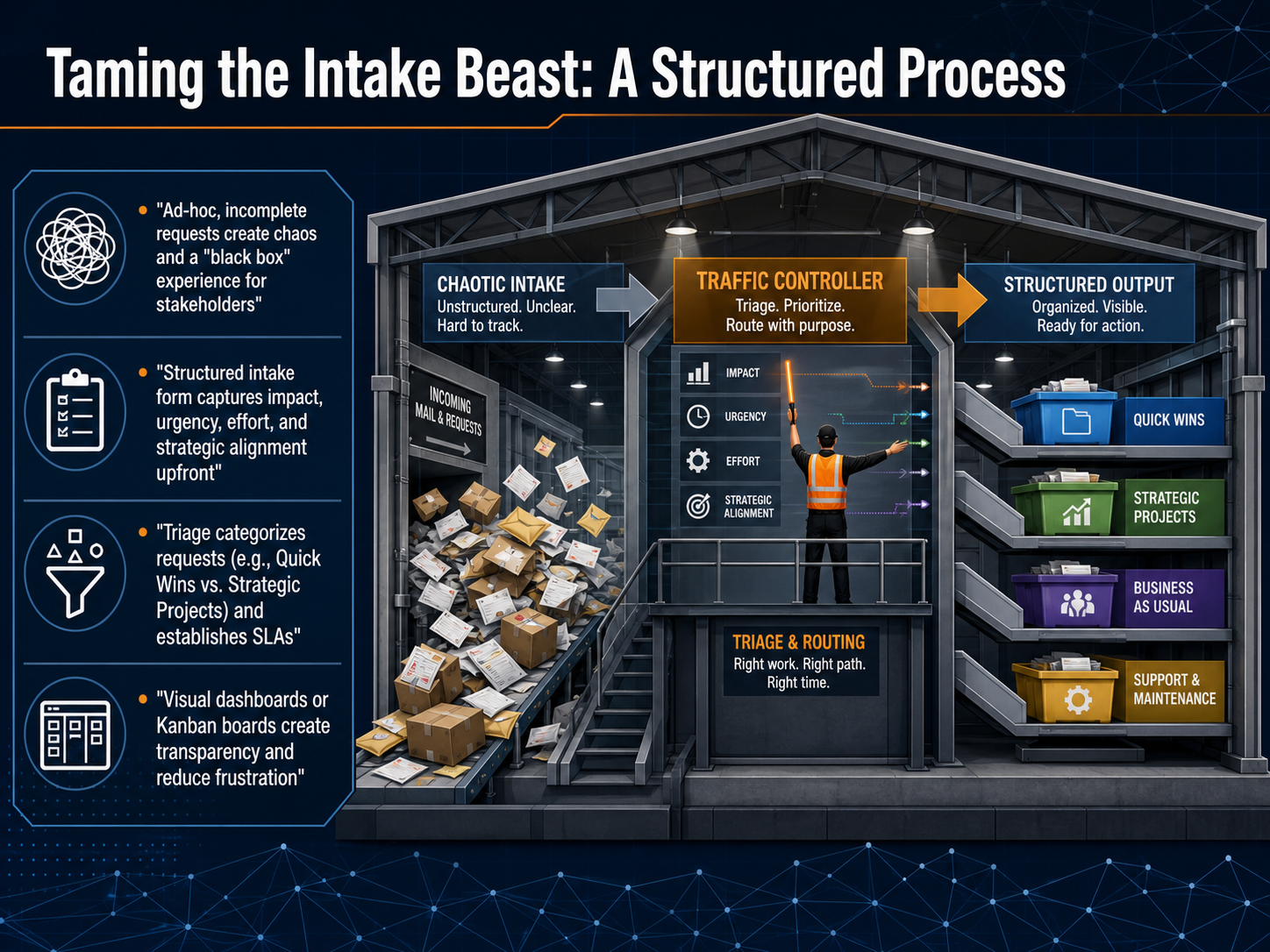
 - 12Taming the Intake Beast: A Structured ProcessLet's turn that thinking into a real process, something we call taming the intake beast. When requests arrive ad-hoc and incomplete, it creates chaos and turns our work into a black box for stakeholders. The cure is a structured intake form. It captures impact, urgency, effort, and strategic alignment right from the start. This upfront clarity replaces scattered email threads with one source of truth. Next, we triage. We categorize requests into meaningful buckets like Quick Wins versus Strategic Projects, and we establish clear service level agreements. This isn't bureaucracy; it's how we decide what to pull next with confidence. Finally, we make work visible. Visual dashboards or Kanban boards create transparency, showing everyone what's in progress and why. This visibility reduces frustration and protects the team's focus. In our next segment, we'll tackle the most human part of this entire system: navigating the 'no' and managing stakeholder pushback.
 boards.cloudcodersera.commonday.com+21 min
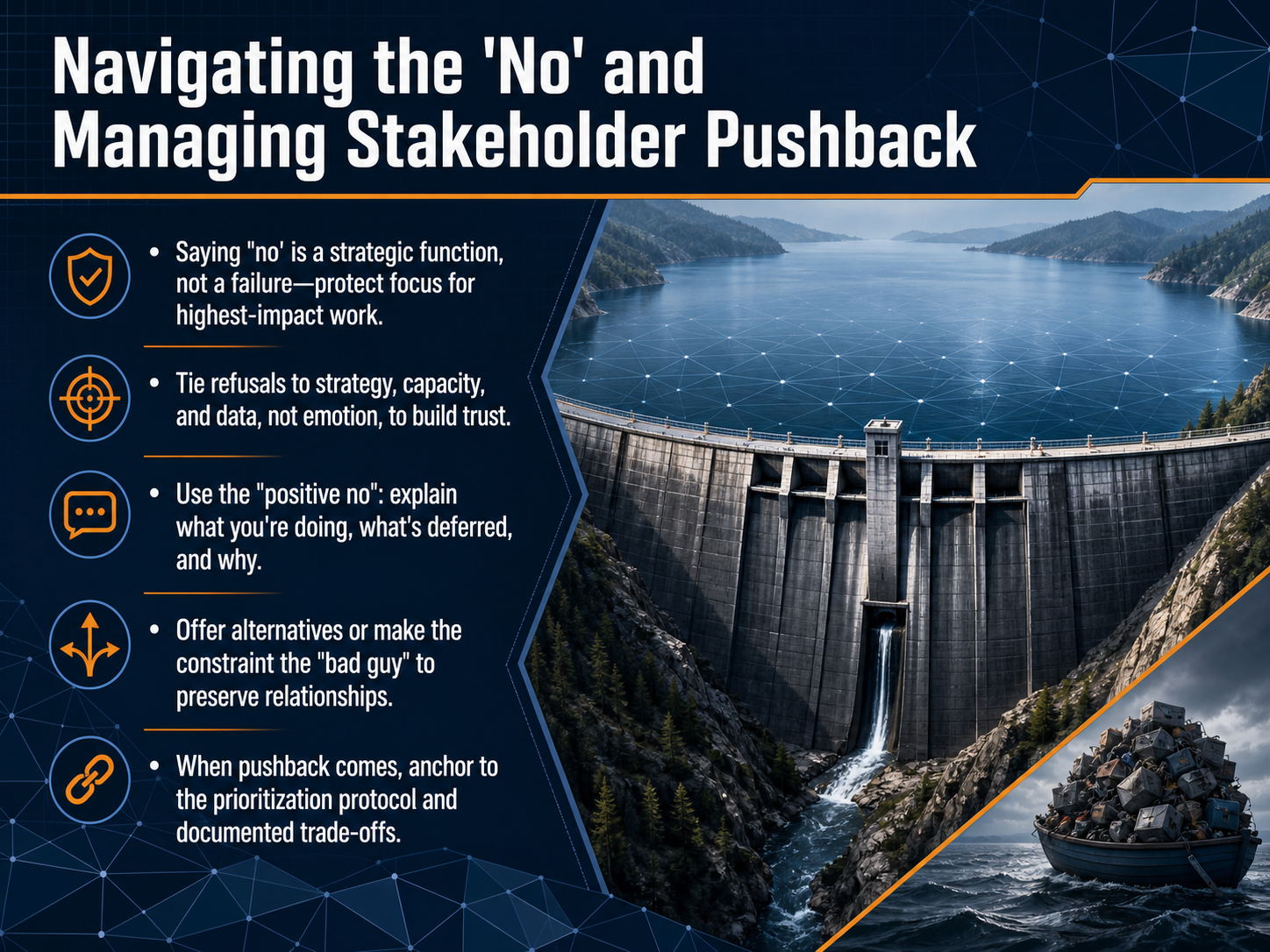
 - 13Navigating the 'No' and Managing Stakeholder PushbackLet's talk about navigating the 'no' and managing stakeholder pushback. Saying no is a strategic function, not a failure. It protects the team's focus for the highest-impact work. When we refuse a request, we tie it directly to strategy, capacity, and data, not emotion. That builds trust. We use what some call the 'positive no': we explain what we are doing, what is being deferred, and why. We can also offer alternatives, or simply make the constraint the bad guy. For example, 'Our capacity protocol doesn't allow us to start this without dropping a higher-priority initiative.' When pushback comes, we anchor back to the prioritization protocol and the documented trade-offs. The decision isn't personal; it's principled. Now, let's shift to building a sustainable prioritization culture.
 boards.cloudcodersera.commonday.com+21 min
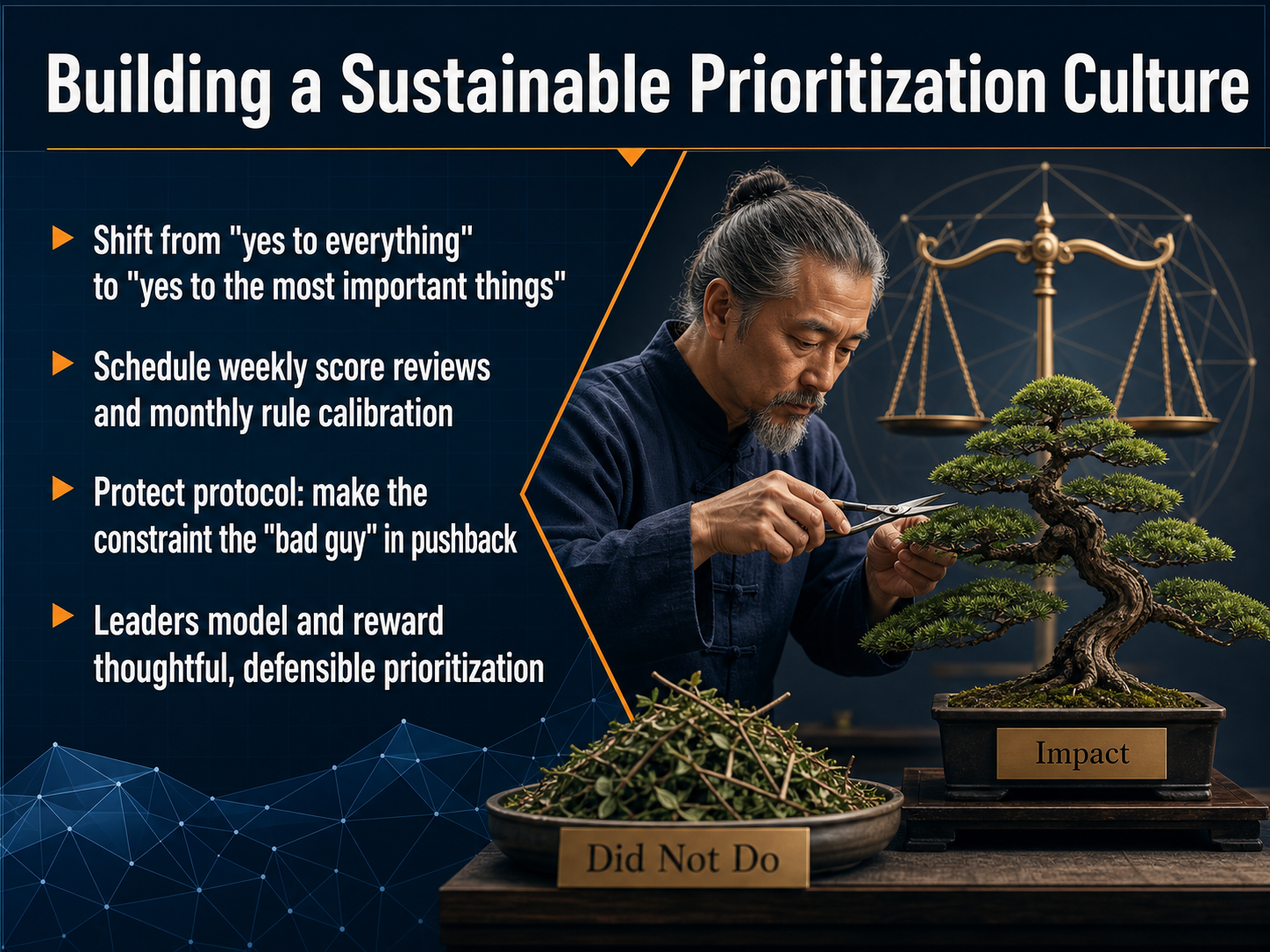
 - 14Building a Sustainable Prioritization CultureWe have reached the final, and in many ways the most important, piece: building a culture that sustains these decisions over time. This is where we shift from a team that says yes to everything, to a team that says yes to the most important things. It begins with a weekly ritual. We review the scores on new items and the top of the backlog. Then, once a month, we calibrate the rules themselves. We ask: are our definitions of impact and urgency still accurate? This prevents the drift that turns a sharp tool into a dull one. When we have to push back, we use a protect protocol. We make the constraint the bad guy, not the person. We don't say I don't want to do this. We say, based on our current capacity and the score of this request, this is where it lands. This neutral stance protects trust and keeps the conversation focused on the facts. Finally, this only works if leaders model the behavior. When a leader accepts a lower-priority item that a team member already scored and deferred, the system collapses. We must reward thoughtful, defensible decisions, even when they involve saying not right now. Prioritization is a practice. With these habits, we move from constantly reacting to the loudest voice, toward a sustainable rhythm of delivering the work that truly matters. Thank you for investing this time in building a smarter, more sustainable way to work. I am confident you will see the difference in your team's clarity and momentum.
 boards.cloudcodersera.commonday.com+22 min
Take the deck with you
Download this course as a file — free, no sign-up needed.
- PDF handoutEvery slide page, ready to print or share.15 pages · 4.9 MBDownload
- Narrated PowerPointThe deck that presents itself — every slide carries the digital human's narration video.15 pages · 13.9 MBDownload
- PowerPoint slidesThe full deck as a .pptx — open it in PowerPoint, Keynote, or Google Slides.15 pages · 4.8 MBDownload
Free to use in your own training — please keep the PersonWise credit page at the end.
Have your own deck? Turn it into a course
Sources consulted
Web sources consulted while building this course.
- Task Prioritization Matrix for Impact, Effort, Urgency — boards.cloud
- Eisenhower vs Impact-Effort vs MoSCoW (2026 Guide) — codersera.com
- Learn the ins and outs of the priority matrix in 2026 — monday.com
- Impact and Urgency Priority Matrix: How to Prioritize Work Effectively — miro.com
- Integrated approach to iterative planning and task prioritization in complex IT projects — doi.org
- The Cost of Interrupted Work: More Speed and Stress — ics.uci.edu
- The True Cost of Context Switching | Haystack — usehaystack.io
- The True Cost of Context Switching: The 2025 Surton Deep Work Framework - Surton — surton.com
- The Hidden Cost of Context Switching in Software Development — Harbor Software Blog — harborsoftware.com
- cubic blog: Context switching is killing your team's velocity — cubic.dev
- RICE vs WSJF: Which Prioritization Scoring (2026) — ideaplan.io
- RICE vs WSJF: Choosing the Right Prioritization Framework — centercode.com
- Product Prioritization Guide: Frameworks & Tools (2026) — ideaplan.io
- Product Prioritization Frameworks: The Complete Guide For 2026 — monday.com
- Product Prioritization Frameworks: 10 Methods Compared (2026) | Usero — usero.io
- Keep commitments at 70-85% of capacity — the 15-30% slack absorbs variance | How to Think AI — howtothink.ai
- Capacity Planning for Scrum Teams: 2025 Guide — iamagile.io
- "Capacity Planning Without Spreadsheets From Hell" — resources.rework.com
- Rethinking Capacity Planning | naked Agility with Martin Hinshelwood — nkdagility.com
- Data-Driven Team Capacity Planning Approach in Scrum-Based IT Projects Delivery — doi.org