Magnetism: Fields, Forces, and Earth
Begin
16 pages · ~32 min
Magnetism: Fields, Forces, and Earth
Explore the principles of magnetism, including magnetic fields, forces, and Earth's magnetic field, in this foundational physics training.
What you’ll learn
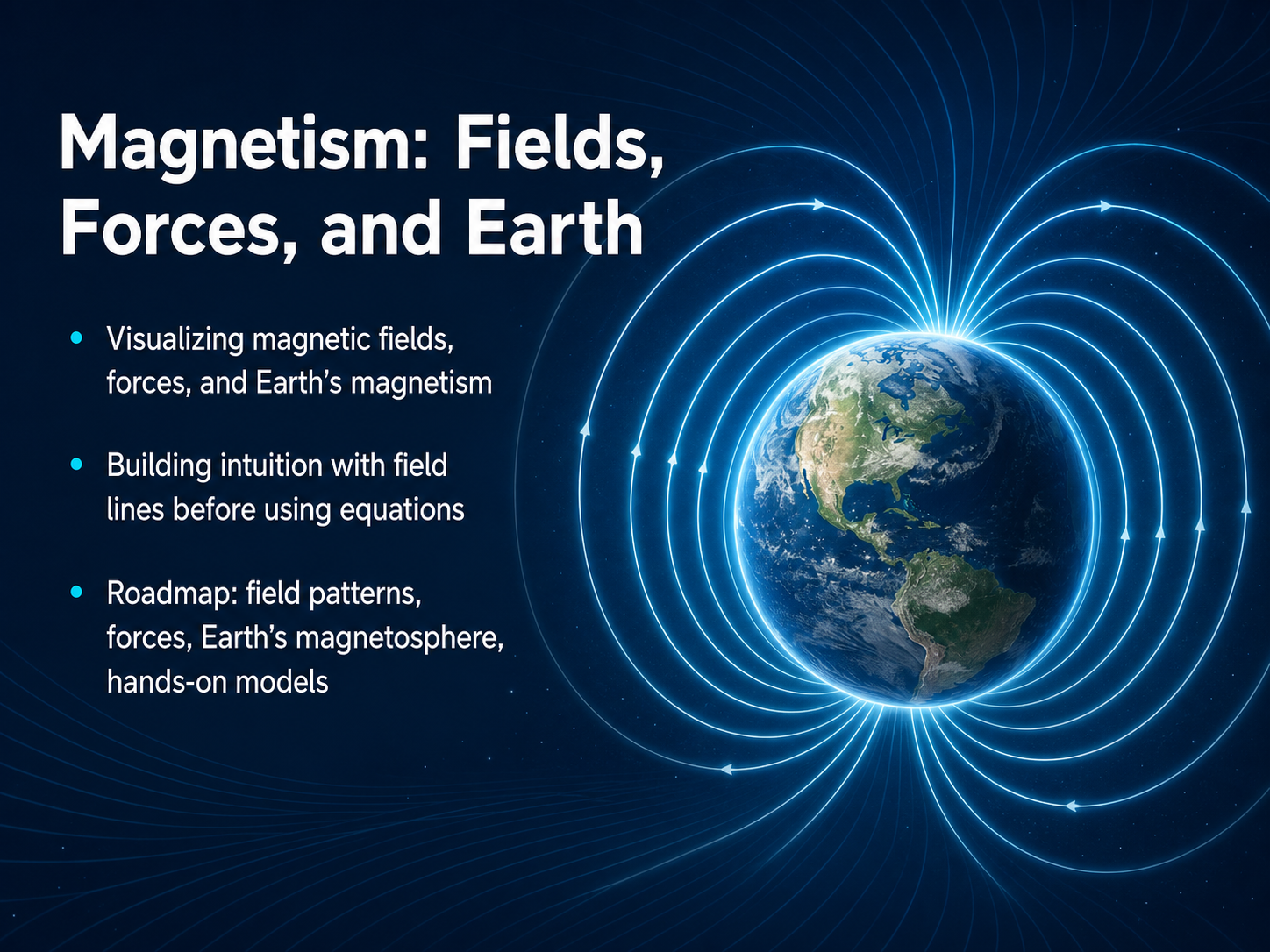
- 01Magnetism: Fields, Forces, and EarthWelcome. Today we're building a visual model of magnetism, starting with the big picture: fields, forces, and Earth's own magnetism. Instead of diving straight into equations, we'll first trace flow lines around magnets and see how they create a pull zone on moving charges. Our roadmap moves through field patterns, magnetic forces, Earth's magnetosphere, and hands-on models you can sketch and turn with your own hand. Take your time to picture each shape. Next, we'll ask: what is a magnetic field?khanacademy.orgphysics.bu.eduyoutube.com+21 min
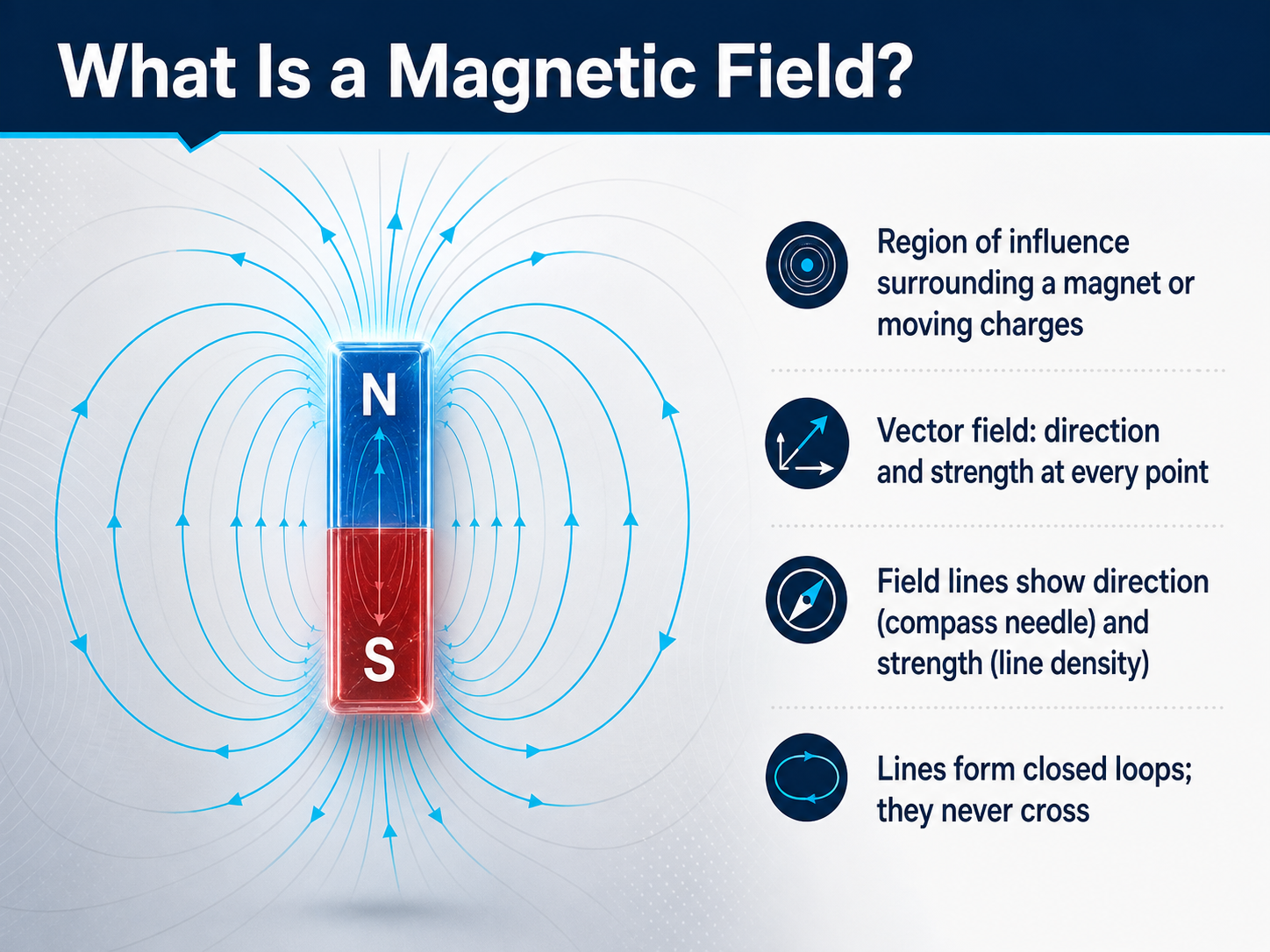
- 02What Is a Magnetic Field?Now, let's picture what a magnetic field actually is. Think of it as an invisible region of influence, a sort of pull zone that surrounds a magnet or any moving electric charges. It's a vector field, which just means that at every single point in this space, the field has both a direction and a strength. We map this out using flow lines, called field lines. A tiny compass needle shows us the direction, pointing along the line, and how close together the lines are packed tells us the strength. Dense lines mean a strong field. One key rule to remember is that these lines always form closed, continuous loops. They go out from the north pole, around, and back into the south pole, and they can never cross each other. Next, we'll use these rules to start mapping the invisible, by looking at the field around a single bar magnet.
 1 min
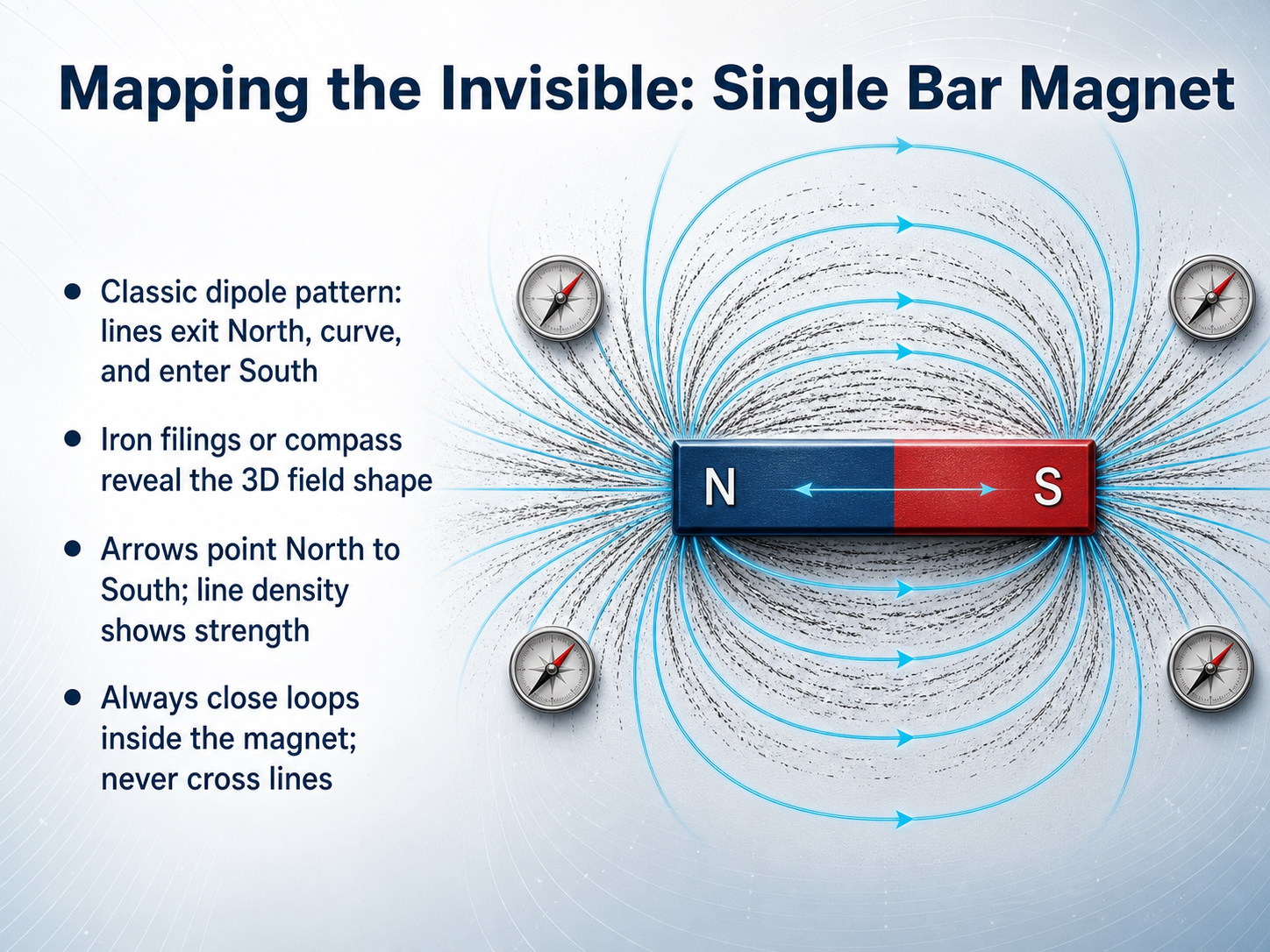
1 min - 03Mapping the Invisible: Single Bar MagnetNow, let's make the invisible visible by mapping the field around a single bar magnet. This is the classic dipole pattern. Imagine flow lines streaming out of the North pole, curving gracefully through the space around the magnet, and then sweeping back into the South pole. If you've ever seen iron filings sprinkled near a magnet, you've seen this exact 3D shape emerge. Each filing acts like a tiny compass, lining up to reveal the field. We use arrows on these lines to show direction, always pointing from North to South. The closer the lines are packed together, the stronger the pull zone. That's how line density shows field strength. And here are two critical rules for your model: the lines always form complete, closed loops, traveling right through the inside of the magnet, and they never, ever cross each other. Next, we'll apply these rules to map out the more complex field patterns between two magnets.
 1 min
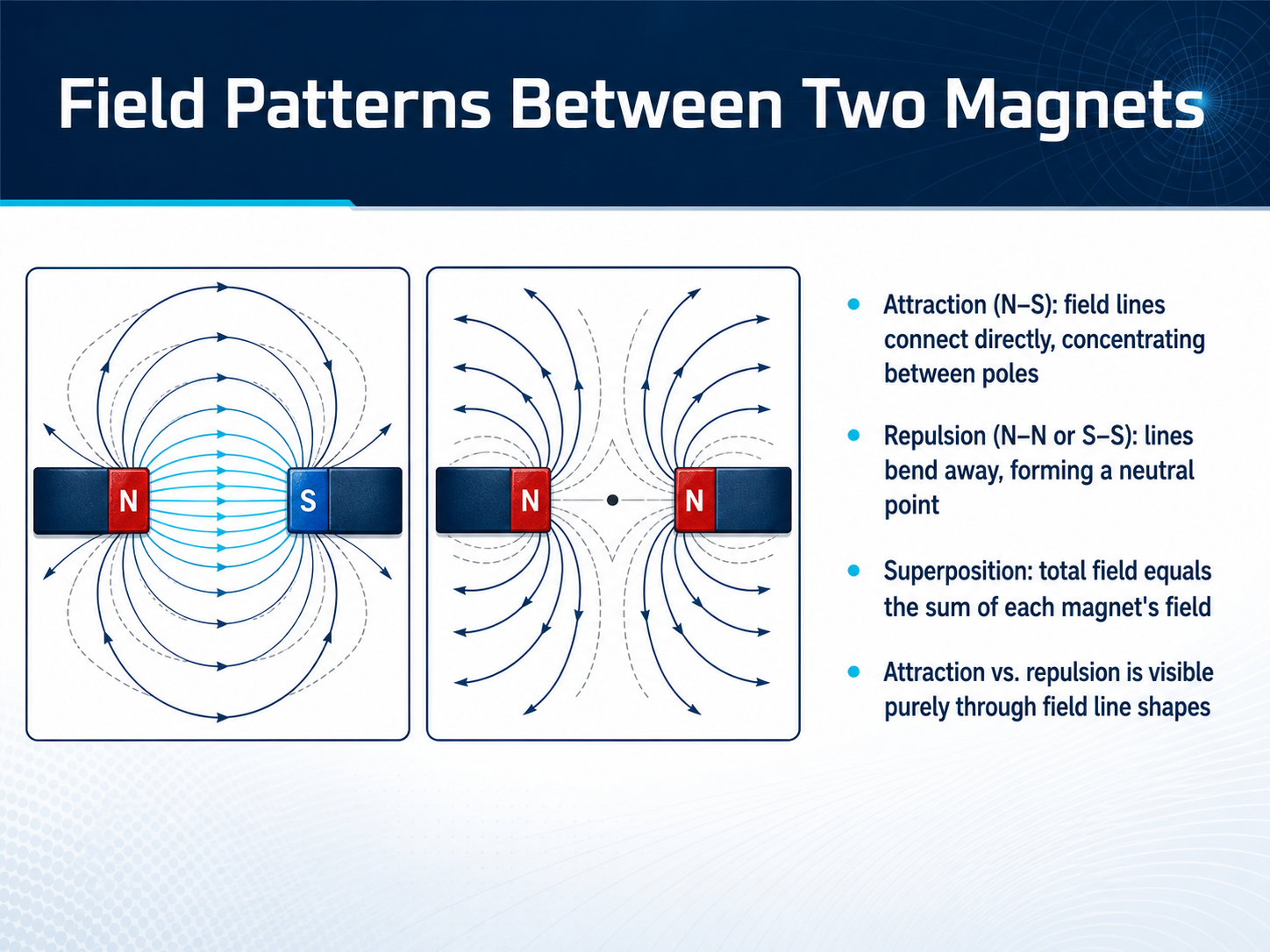
1 min - 04Field Patterns Between Two MagnetsNow let's see what happens when we place two magnets close together. When opposite poles face each other, north to south, the field lines reach out and connect directly. They form a dense, concentrated bridge between the poles. This is the pull zone, where attraction happens. But when like poles face each other, north to north or south to south, the field lines bend sharply away. They refuse to meet, creating a clear gap and a neutral point right in the middle where the magnetic influence cancels out. This visual difference is a powerful tool. The overall field is simply the sum of each magnet's individual field, a concept called superposition. You can trace the attraction or repulsion just by looking at how the flow lines bend and connect. Next, we'll explore how these magnetic forces act on moving charges.
 1 min
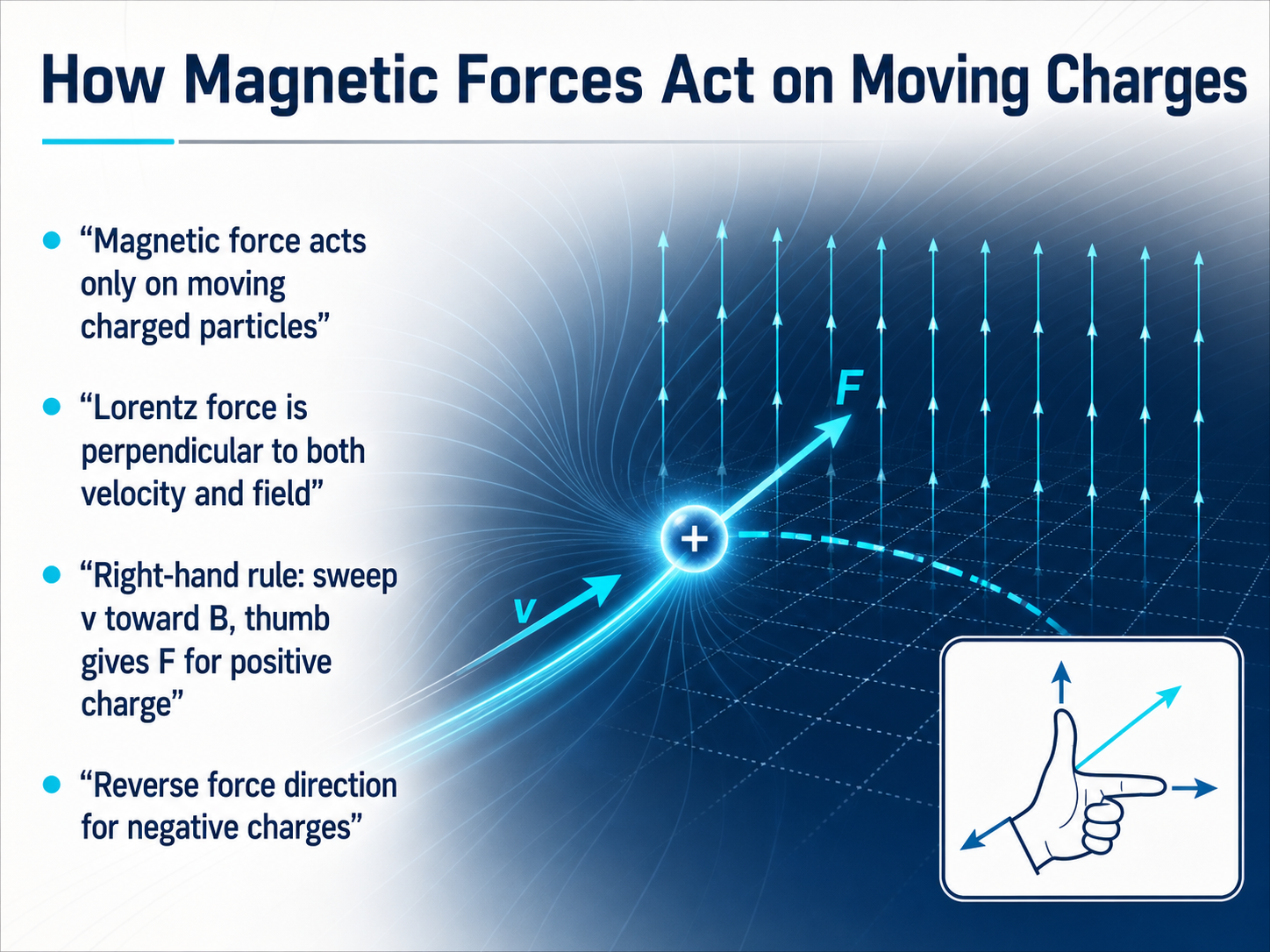
1 min - 05How Magnetic Forces Act on Moving ChargesNow, let's look at how magnetic forces actually act on a moving charge. A key thing to remember right away is that a magnetic force only acts on a charged particle that is moving. If the charge is sitting still, there is simply no magnetic force on it. When a charge does move, the force it feels is called the Lorentz force. This force is special because it is always perpendicular to both the velocity of the particle and the magnetic field lines. A good way to find the direction of this force is the right-hand rule. Hold out your right hand and point your fingers in the direction the positive charge is moving, which is its velocity. Then, sweep your fingers to point in the direction of the magnetic field. Your thumb will now point in the direction of the magnetic force on that positive charge. For a negative charge, like an electron, the force points in the exact opposite direction. So, just flip your thumb's direction. This means a magnetic field never pushes a charge forward or backward along its path, only sideways. It steers the charge, but does not speed it up or slow it down. Next, we will apply this idea to a whole wire of moving charges, and see the force on a current-carrying wire.
 2 min
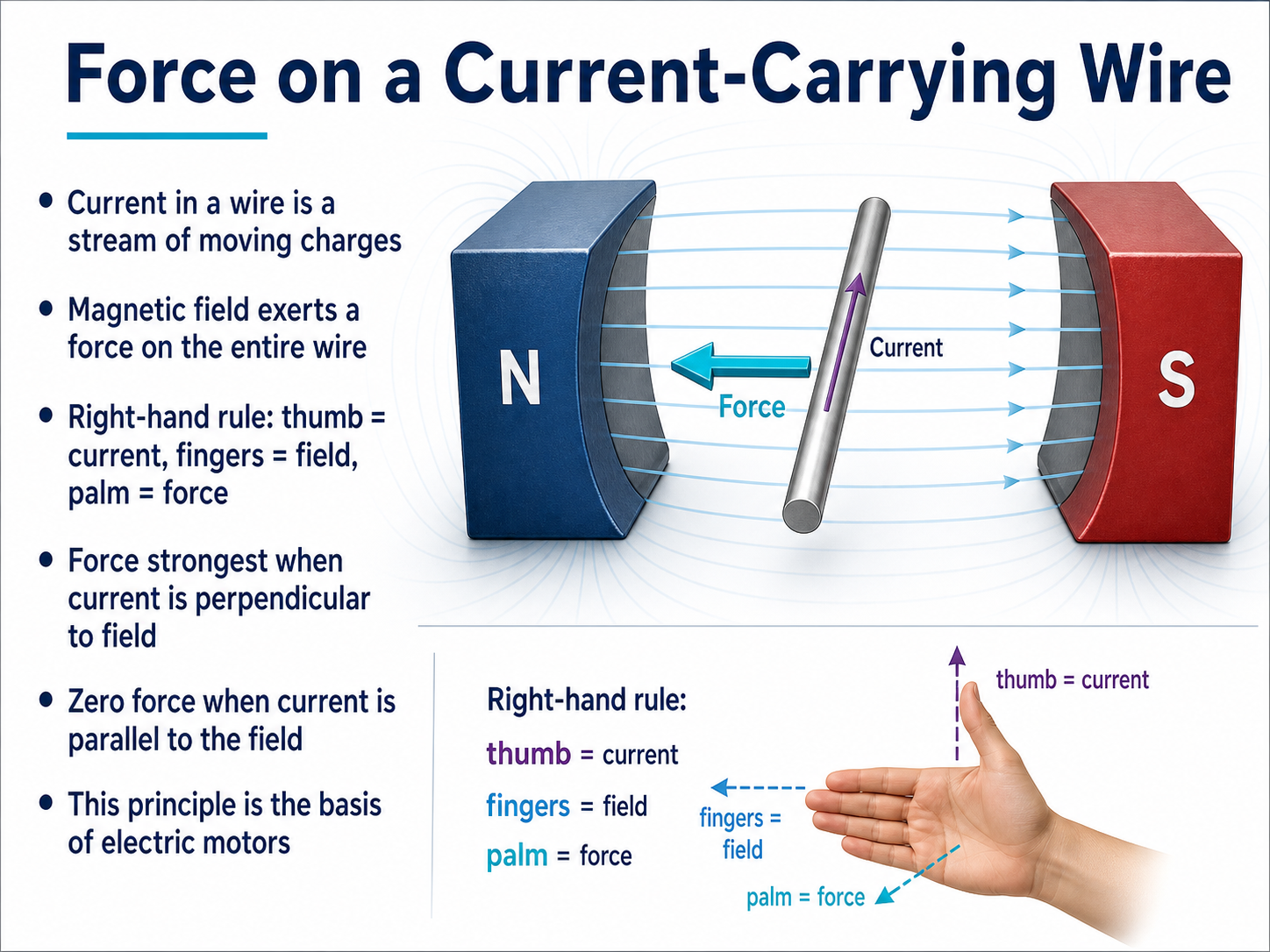
2 min - 06Force on a Current-Carrying WireNow let's bring current into the picture. When a wire carries current, you can think of it as a stream of moving charges flowing through the metal. A magnetic field touching that wire doesn't just push on one charge, it pushes on every single one along the wire, so the whole wire feels a force. To find the force direction, we use the right-hand rule. Point your thumb in the direction the current is flowing. Let your fingers curl in the direction of the field lines. Your open palm now faces the direction of the push, the force zone. The angle matters a lot here. If the current runs straight across the field, perpendicular, the force is at its strongest. But if the current flows parallel to the field lines, the force drops to zero. This simple idea is what makes electric motors spin. Up next, we'll start translating these field patterns into force predictions.
 1 min
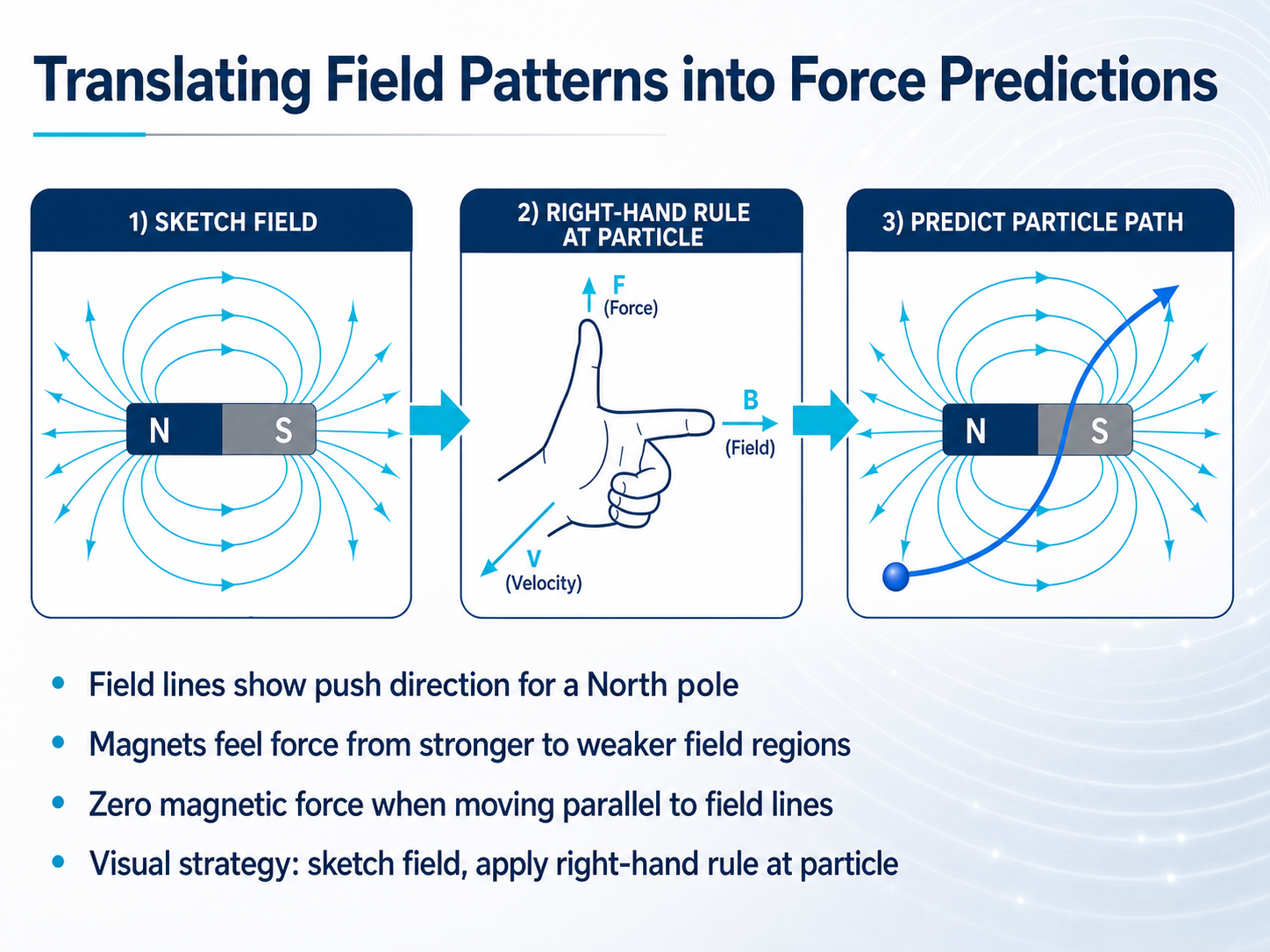
1 min - 07Translating Field Patterns into Force PredictionsNow we can turn our field maps into force predictions. Think of those flow lines we drew. The arrow on a field line tells you the push direction a North pole would feel. When a magnet sits in a field, it naturally gets pulled from the stronger region toward the weaker region, the pull zone. There is also a surprising zero force case. If a charged particle moves exactly parallel to the field lines, it glides without any magnetic push. To lock this in, try this visual strategy. First, sketch the field lines around your magnet. Then, for a moving particle, apply the right hand rule. Point your fingers along the field, thumb in the direction of motion, and your palm faces the force. It is a simple physical map. Next, we will look at the biggest magnet of all, Earth as a Giant Magnet.
 1 min
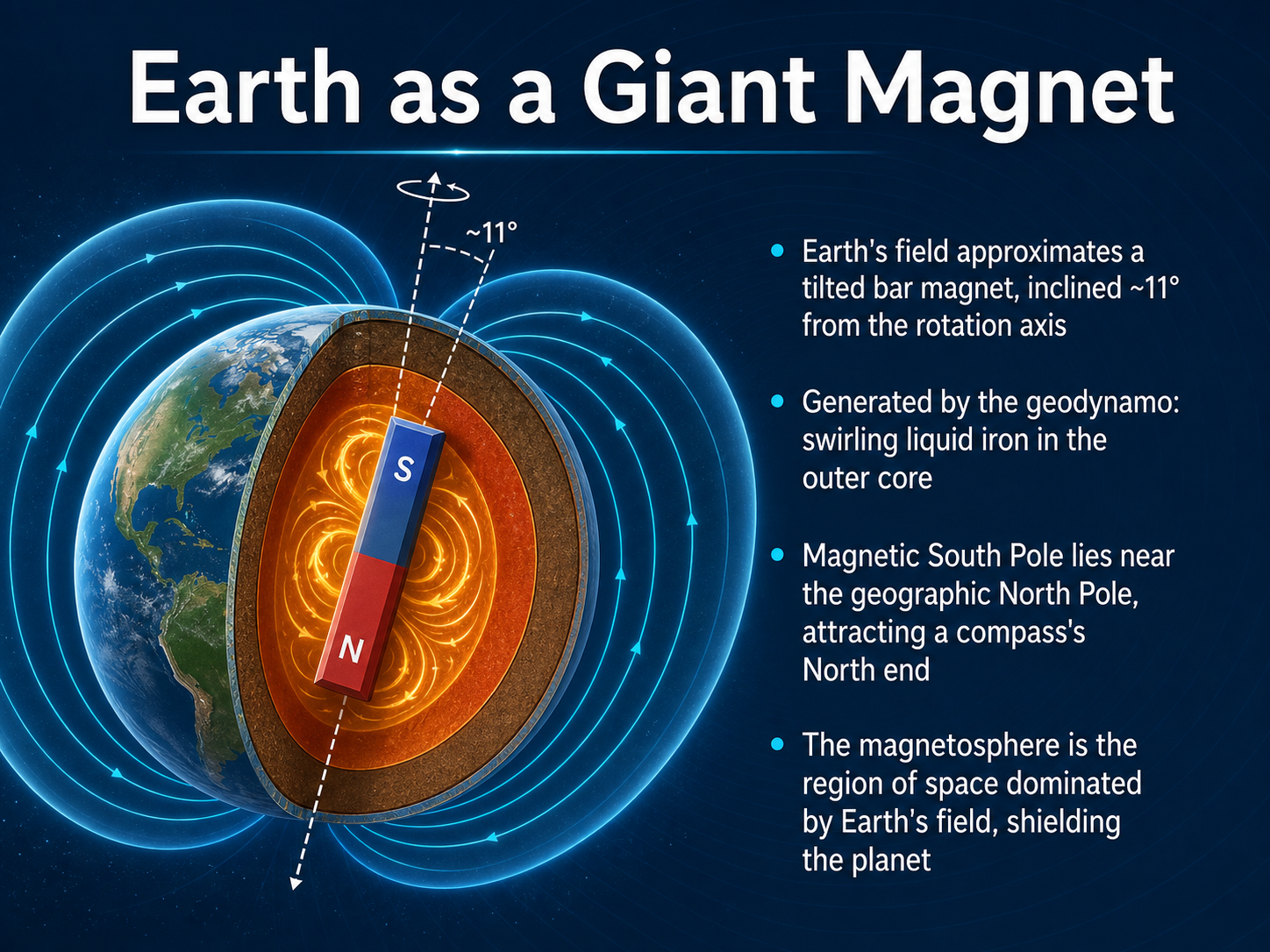
1 min - 08Earth as a Giant MagnetNow let’s pull back and see Earth as a giant magnet. If you could trace the flow lines of our planet’s magnetic field, they would look like the pattern around a simple bar magnet, tilted about 11 degrees from the rotation axis. The engine that drives this field is the geodynamo, swirling liquid iron in the outer core, which generates a huge magnetic pull zone. Here’s a detail that surprises many learners: the magnetic south pole lies near the geographic North Pole. That’s why the north-seeking end of a compass is attracted there. The entire region dominated by this field is called the magnetosphere. Think of it as a protective bubble that shields us from solar wind and keeps our atmosphere safe. Up next, we’ll explore the moving magnetic poles.
 ncei.noaa.govncei.noaa.goveconomictimes.indiatimes.com+21 min
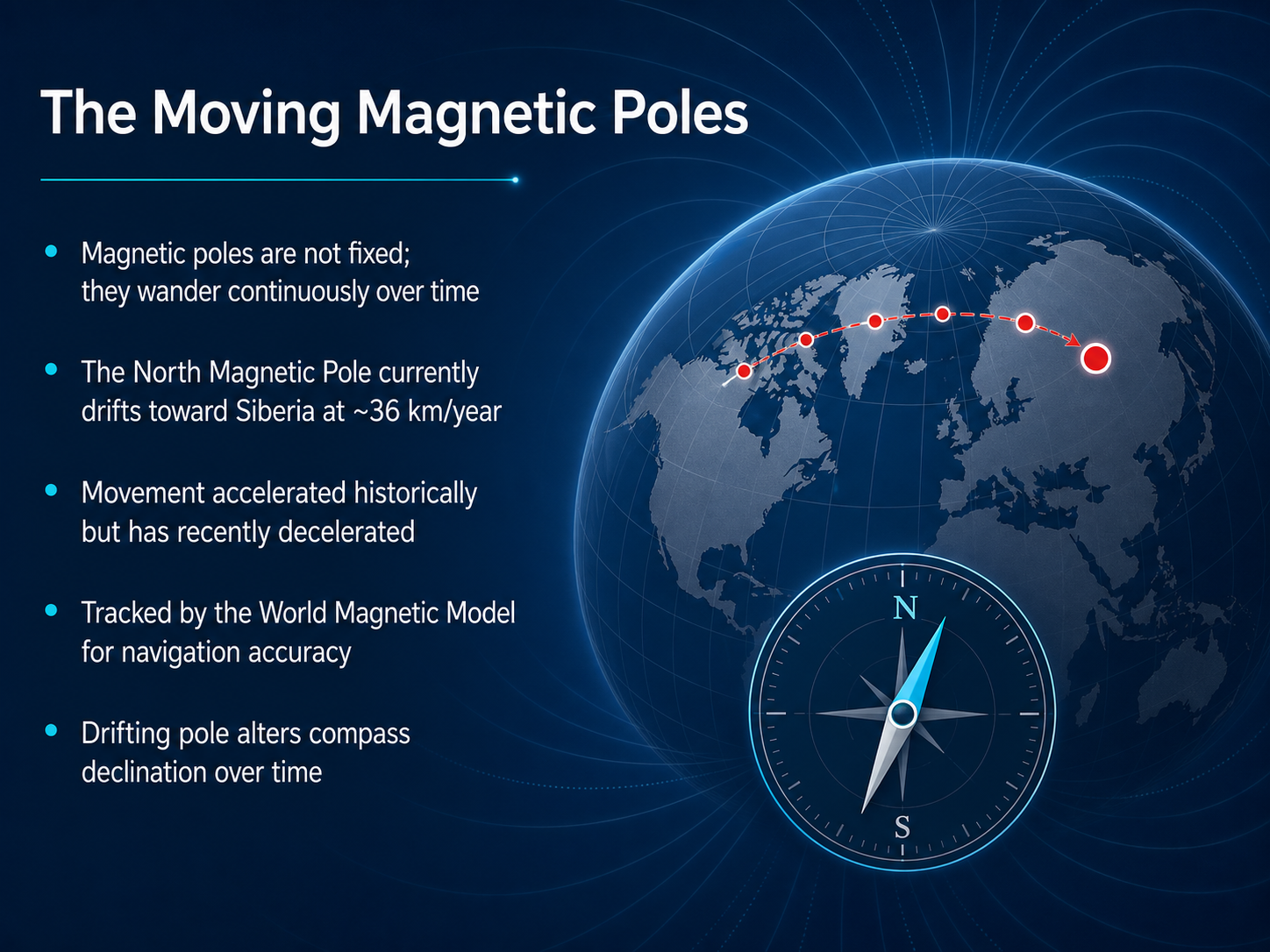
 - 09The Moving Magnetic PolesNow, let's look at a surprising detail about these poles. They are not fixed points. The magnetic poles actually wander across the planet over time. Think of them as slowly drifting anchors. Right now, the North Magnetic Pole is moving away from Canada and toward Siberia at a speed of about thirty-six kilometers per year. This movement sped up in the past, but has recently started to slow down. Scientists track this drift very carefully using something called the World Magnetic Model. It is essential for keeping navigation systems accurate. As the pole drifts, it gradually changes what we call compass declination, the angle between true north and magnetic north, on your map. This means an old map might not point you in the right direction today. Let's zoom out from the drifting poles to see the massive protective bubble they create. Next, we'll explore the magnetosphere, our shield in space.
 1 min
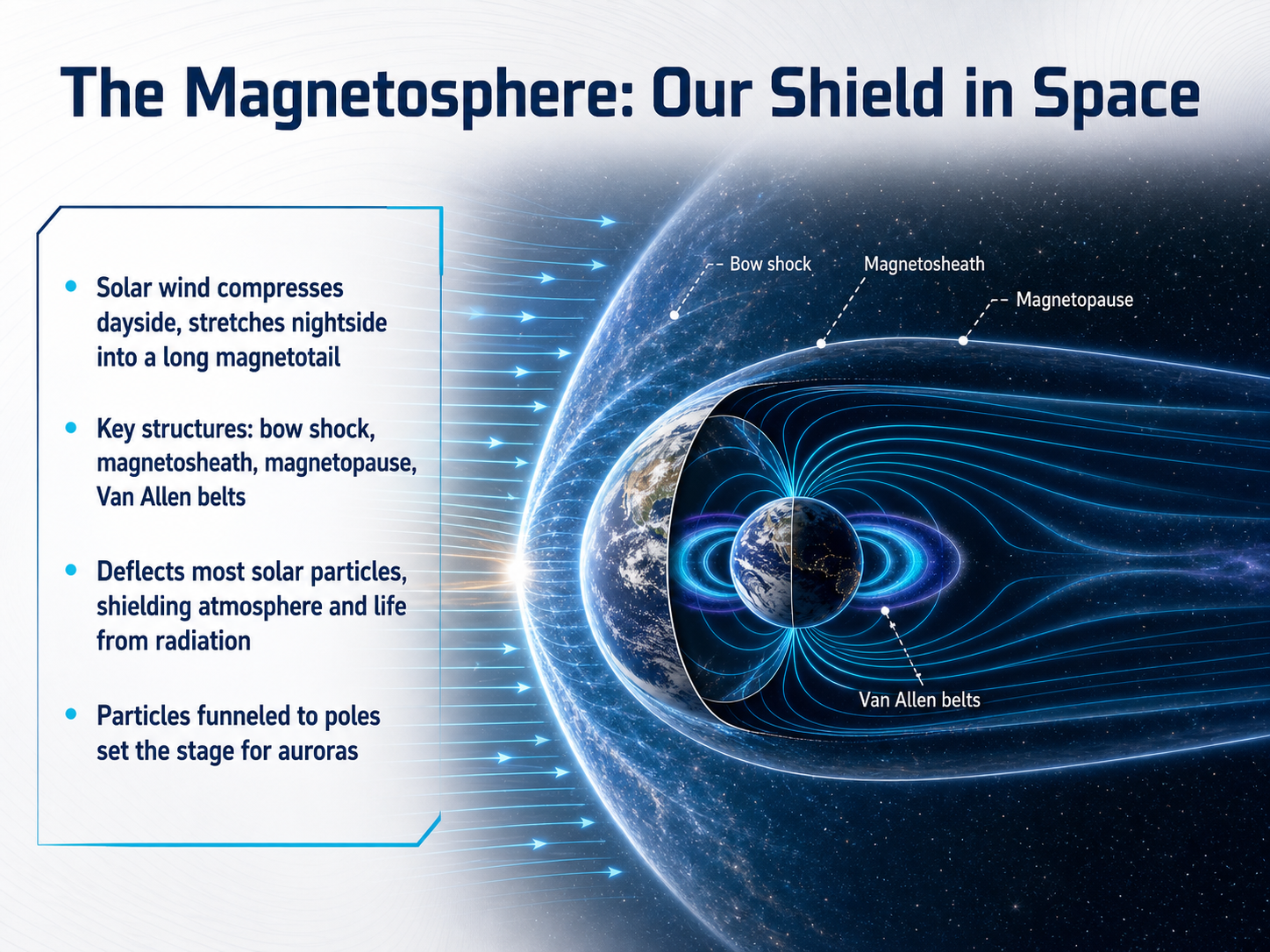
1 min - 10The Magnetosphere: Our Shield in SpaceNow, let's zoom out and look at the biggest structure in our model, the magnetosphere. Think of it as Earth’s invisible shield in space. The solar wind is a constant stream of particles rushing from the Sun. When it hits our magnetic field, it compresses it on the day side, creating a shockwave called the bow shock. Behind that is a turbulent zone, the magnetosheath, and then the outer boundary, the magnetopause. The pressure stretches the night side into a long, trailing magnetotail, like a windsock in a strong breeze. Inside this shield, the Van Allen belts are doughnut-shaped zones that trap charged particles. This whole system deflects most of the solar wind, protecting our atmosphere, and us, from harmful radiation. But some particles slip through and are funneled toward the poles, setting the stage for the auroras. Next, we’ll see how we can detect this magnetic influence using a simple compass.
 1 min
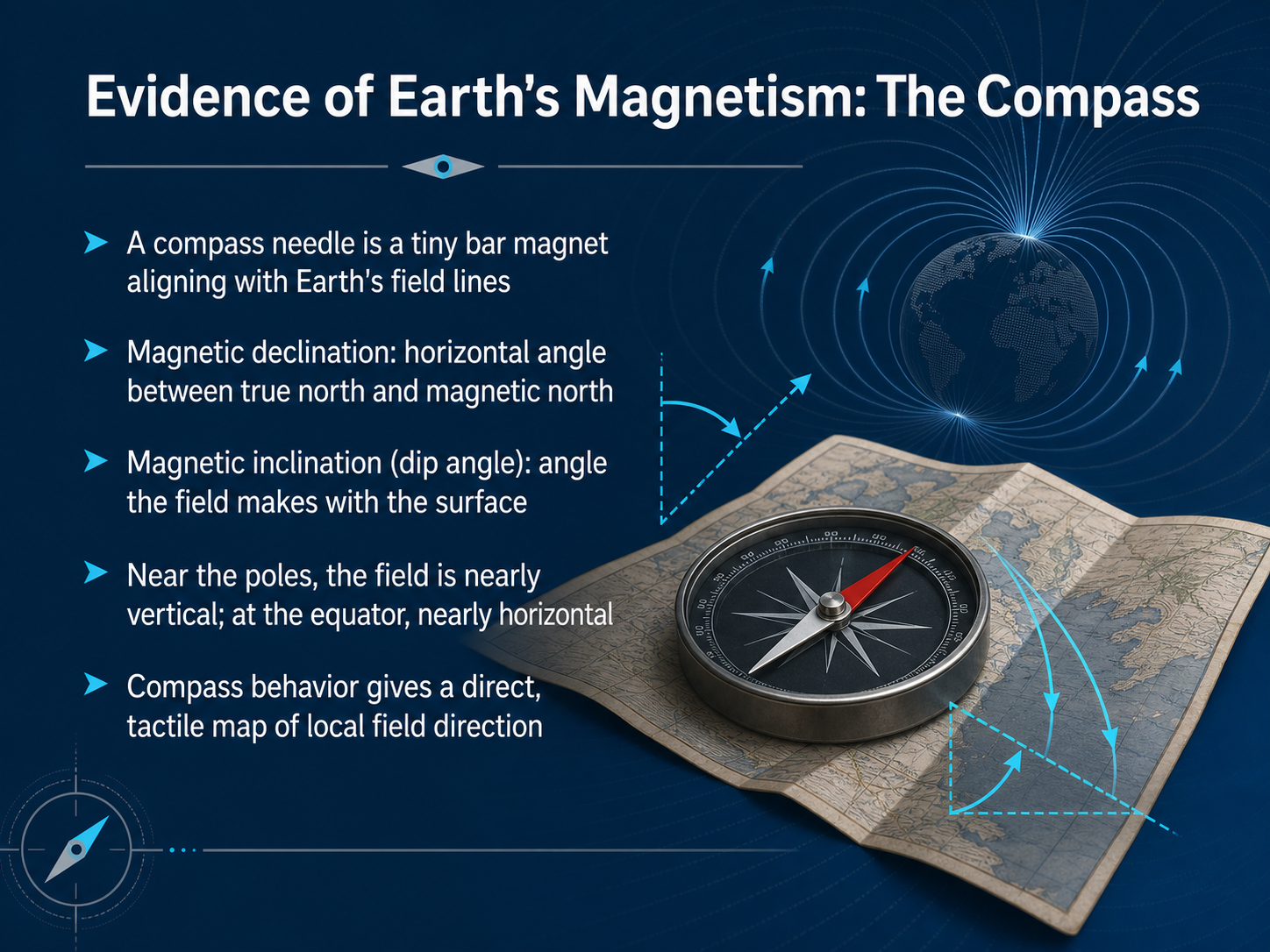
1 min - 11Evidence of Earth's Magnetism: The CompassNow, let's see the evidence of this field with a simple compass. A compass needle is a tiny bar magnet, and it aligns directly with Earth's magnetic flow lines. This gives us a tactile, visual map of the local field. When you look at a compass, the needle points to magnetic north, not true geographic north. The horizontal angle between them is called magnetic declination. There's also the dip angle, or magnetic inclination. This is the angle the field makes with the ground. Near the equator, the field runs nearly horizontal, almost flat. But as you walk toward a pole, the pull zone tilts steeply, and the field becomes nearly vertical, pulling the needle straight down. So, a compass doesn't just point; it reveals the three-dimensional shape of the magnetic field around you. Next, we'll step outside the model and see the most beautiful evidence of all: auroras, the light of the field.
 1 min
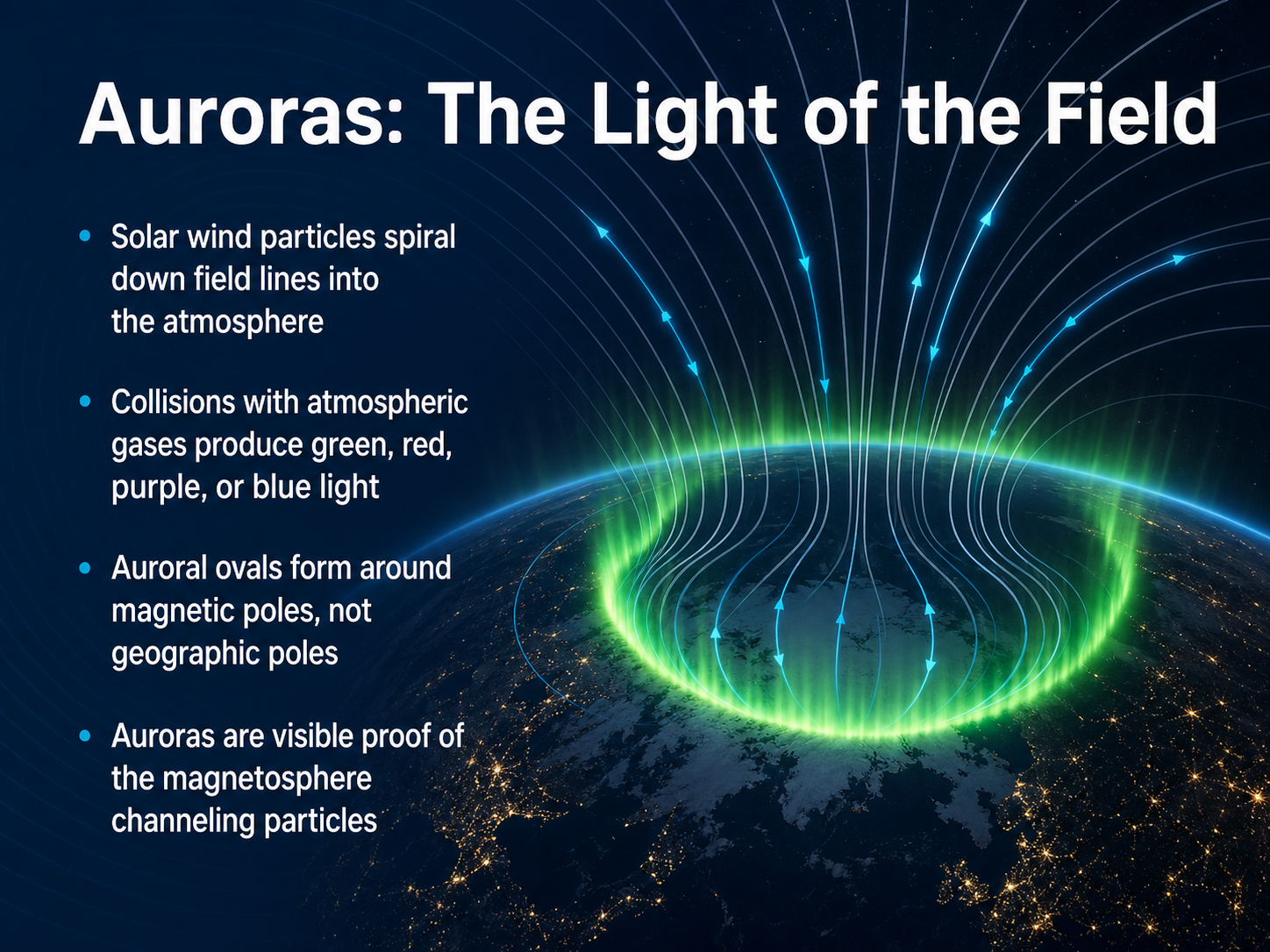
1 min - 12Auroras: The Light of the FieldNow let's look at one of the most beautiful signs of our magnetic field in action, auroras. Imagine the solar wind, a stream of charged particles from the Sun, reaching our planet. Instead of hitting us directly, these particles get caught in the magnetosphere. They spiral down along the magnetic field lines, like tiny beads sliding down invisible wires, and funnel into the atmosphere near the poles. When these fast-moving particles collide with atoms of oxygen and nitrogen in the air, they transfer energy, which is then released as light. We see this as shimmering curtains of green, red, purple, and blue. The color depends on the type of gas and the altitude of the collision. This creates glowing rings, called auroral ovals, centered around the magnetic poles, not the geographic poles you see on a map. So an aurora is a direct, visible proof of the magnetosphere's pull zone, channeling solar energy into the upper atmosphere. Next, we'll explore how rocks can record this magnetic field long after the light fades, in a process called paleomagnetism, Earth's magnetic memory.
 2 min
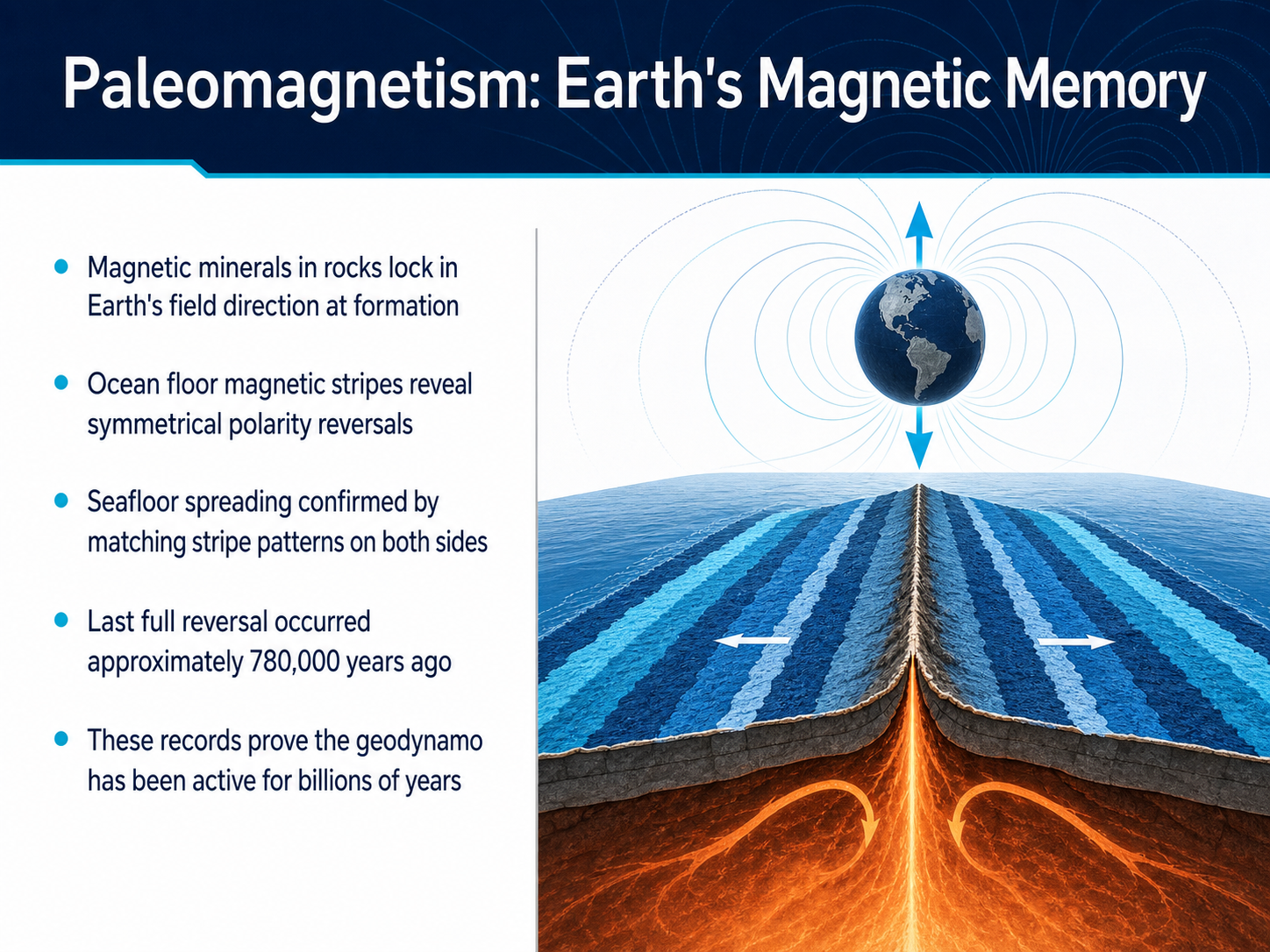
2 min - 13Paleomagnetism: Earth's Magnetic MemoryNow let's look at what rocks tell us about Earth's magnetic past, a field called paleomagnetism. When magnetic minerals cool inside a lava flow, they act like tiny compass needles. They lock in the direction of Earth's magnetic field at that moment, freezing a snapshot in time. On the ocean floor, these frozen records form visible stripes of normal and reversed polarity. Imagine pulling a tape measure across the seafloor and seeing a perfectly mirrored pattern on both sides of a mid-ocean ridge. That symmetry confirmed seafloor spreading and showed that the field flips direction. The last full reversal, called the Brunhes-Matuyama reversal, happened about seven hundred eighty thousand years ago. These ancient records prove that Earth's geodynamo has been churning continuously for billions of years. Let's carry this idea forward and apply it directly in Building Your Visual Model: Hands-On Tools.
 1 min
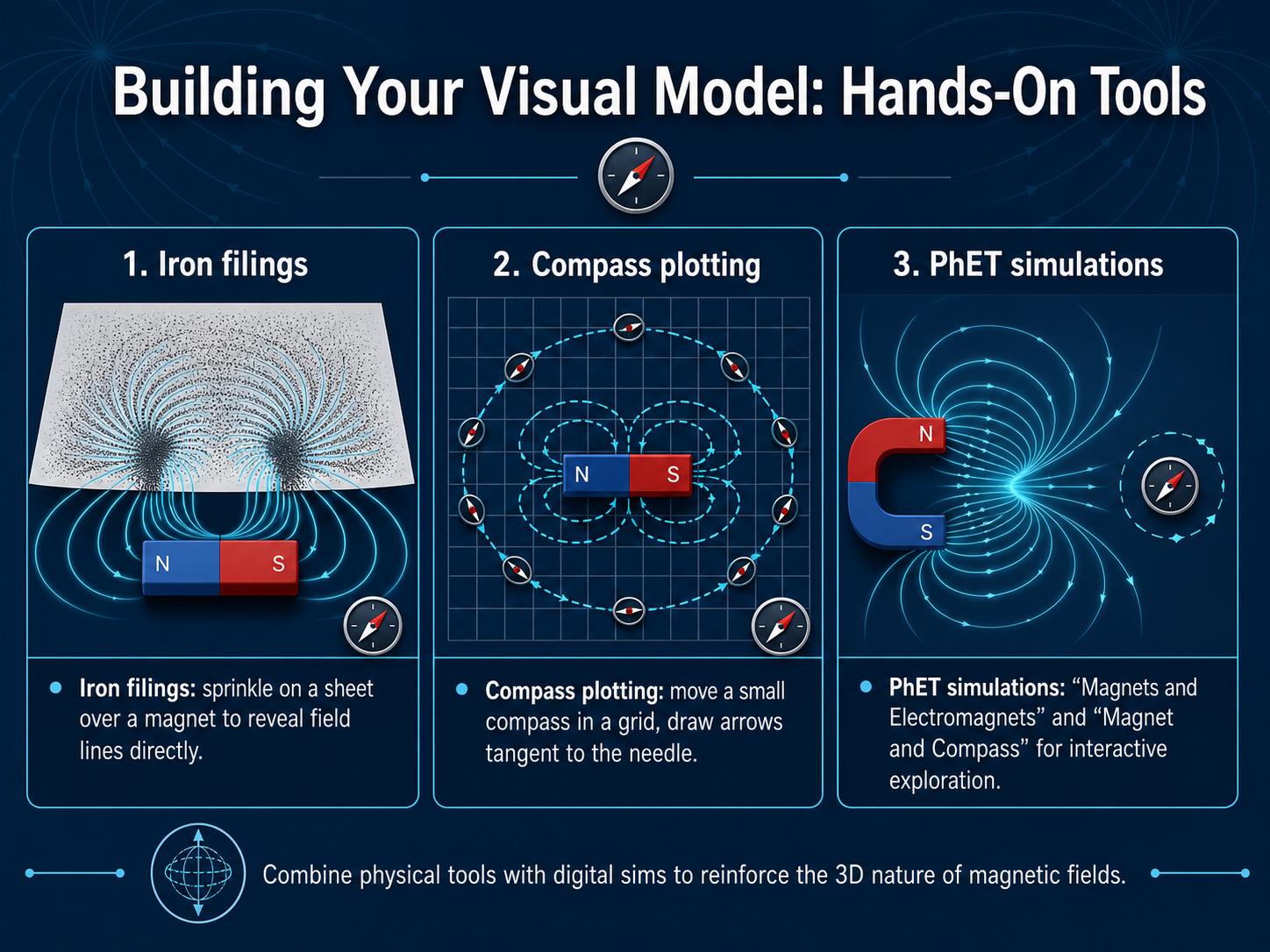
1 min - 14Building Your Visual Model: Hands-On ToolsNow let's bring your visual model to life with three hands-on tools. First, iron filings. Sprinkle them on a sheet over a magnet, and watch tiny dark lines appear. Those lines trace the flow lines of the magnetic field, making the pull zone visible all at once. Second, compass plotting. Move a small compass around the magnet in a grid, and draw an arrow at each point, tangent to the needle. This helps you map field direction step by step, training your eye to see the invisible shape. Third, digital simulations. Open the PhET simulations called Magnets and Electromagnets, or Magnet and Compass. Here you can drag a compass, change magnet strength, and even see field lines inside the magnet. Combining physical filings and compass work with digital sims reinforces the true three-dimensional nature of magnetic fields. Up next, we'll practice sketching conventions for three-dimensional fields.
 phet.colorado.eduphet.colorado.eduphet.colorado.edu+22 min
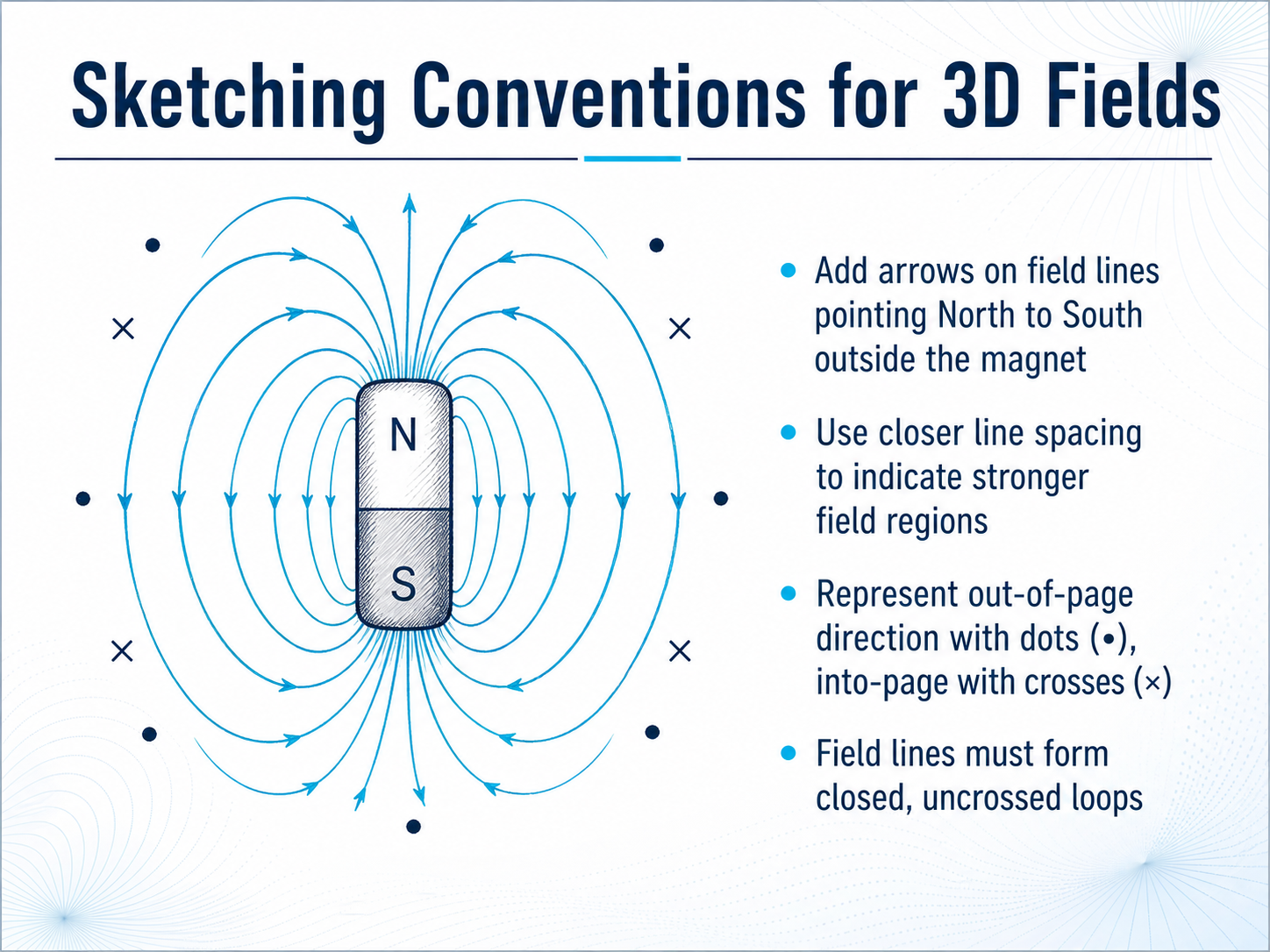
 - 15Sketching Conventions for 3D FieldsLet's establish some clear drawing rules so that our three-dimensional field maps are easy to read. First, place arrows on every field line pointing from North to South on the outside of the magnet. This shows the direction a compass needle would point. Next, use closer line spacing to indicate stronger field regions. Where the lines crowd together, like right at the poles, the pull zone is more intense. To represent depth, use dots for lines coming out of the page toward you, and small crosses for lines going into the page away from you. And here is a critical rule: field lines must always form closed, uncrossed loops. They never start or stop in empty space, and they never intersect. Now, let's pull everything together in our next slide, A Unified View: Fields, Forces, and Earth.
 1 min
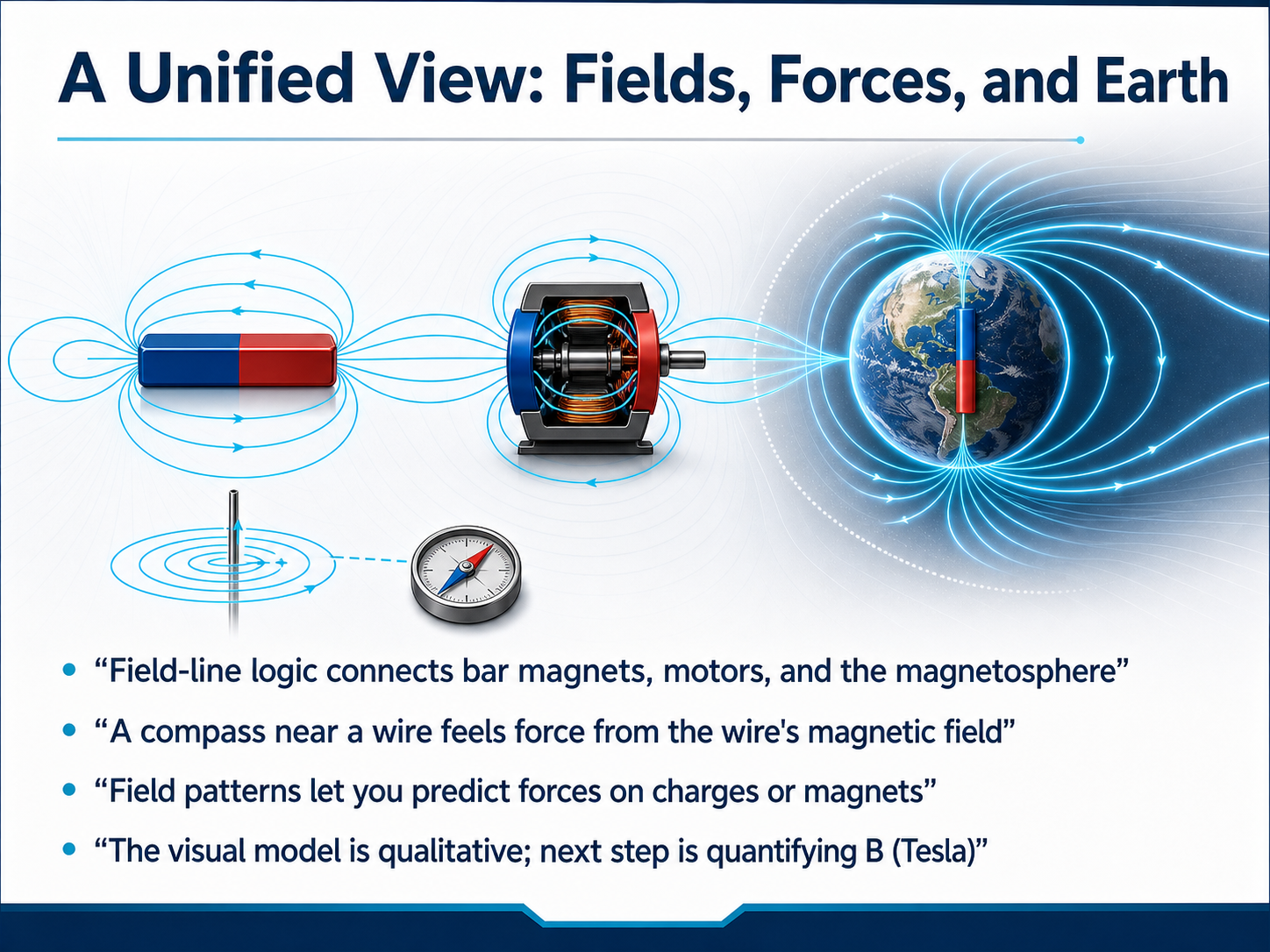
1 min - 16A Unified View: Fields, Forces, and EarthLet's bring it all together now. The same field-line logic that explains a simple bar magnet also describes the turning force inside a motor, and even the vast protective bubble around Earth, the magnetosphere. Picture a compass near a current-carrying wire. The needle feels a gentle push because the wire creates its own magnetic field, wrapping around it in circles. Once you can see those flow patterns, you can start to predict the pull zone around any charge or magnet. So far, we've built a strong visual model. Next, we'll take the next step and learn how to measure that invisible strength in units called Tesla. Thank you for tracing these field lines with me. You now have a unified picture of magnetism, from a small compass to the whole Earth. Keep that image in mind, and the numbers will click right into place.
 1 min
1 min
Take the deck with you
Download this course as a file — free, no sign-up needed.
- PDF handoutEvery slide page, ready to print or share.17 pages · 4.7 MBDownload
- Narrated PowerPointThe deck that presents itself — every slide carries the digital human's narration video.17 pages · 16.1 MBDownload
- PowerPoint slidesThe full deck as a .pptx — open it in PowerPoint, Keynote, or Google Slides.17 pages · 4.7 MBDownload
Free to use in your own training — please keep the PersonWise credit page at the end.
Have your own deck? Turn it into a course
Sources consulted
Web sources consulted while building this course.
- Using the Right-Hand Rule (article) — khanacademy.org
- 19-3 Using the Right-hand Rule — physics.bu.edu
- How to Use the Right Hand Rule in Physics E&M — youtube.com
- 8.3: Magnetic Fields - Physics LibreTexts — phys.libretexts.org
- Right Hand Force Rule Setup — physci.mesacc.edu
- Wandering of the Geomagnetic Poles — ncei.noaa.gov
- December 2025 State of the Geomagnetic Field — ncei.noaa.gov
- Earth’s magnetic north pole shift explained: Earth’s North Pole has moved 1,400 miles. What happens next has experts paying attention - The Economic Times — economictimes.indiatimes.com
- International geomagnetic reference field: the fourteenth generation | Earth, Planets and Space | Springer Nature Link — link.springer.com
- Earth's magnetic power is shifting from Canada to Siberia — watchers.news
- Magnets and Electromagnets — phet.colorado.edu
- Magnets and Electromagnets - PhET — phet.colorado.edu
- Magnets and Electromagnets — phet.colorado.edu
- Faraday's Electromagnetic Lab - PhET — phet.colorado.edu
- PhET Simulation: Magnet and Compass — phet.colorado.edu