Begin
14 pages · ~28 min
Machine Learning Platform Architecture
This training helps data and engineering teams evaluate, select, and architect machine learning platforms, balancing scalability, cost, and operational tradeoffs.
A digital instructor presents all 14 pages. Hold “Ask” at any point and ask out loud — the answer comes from this course. No sign-up needed.
What you’ll learn
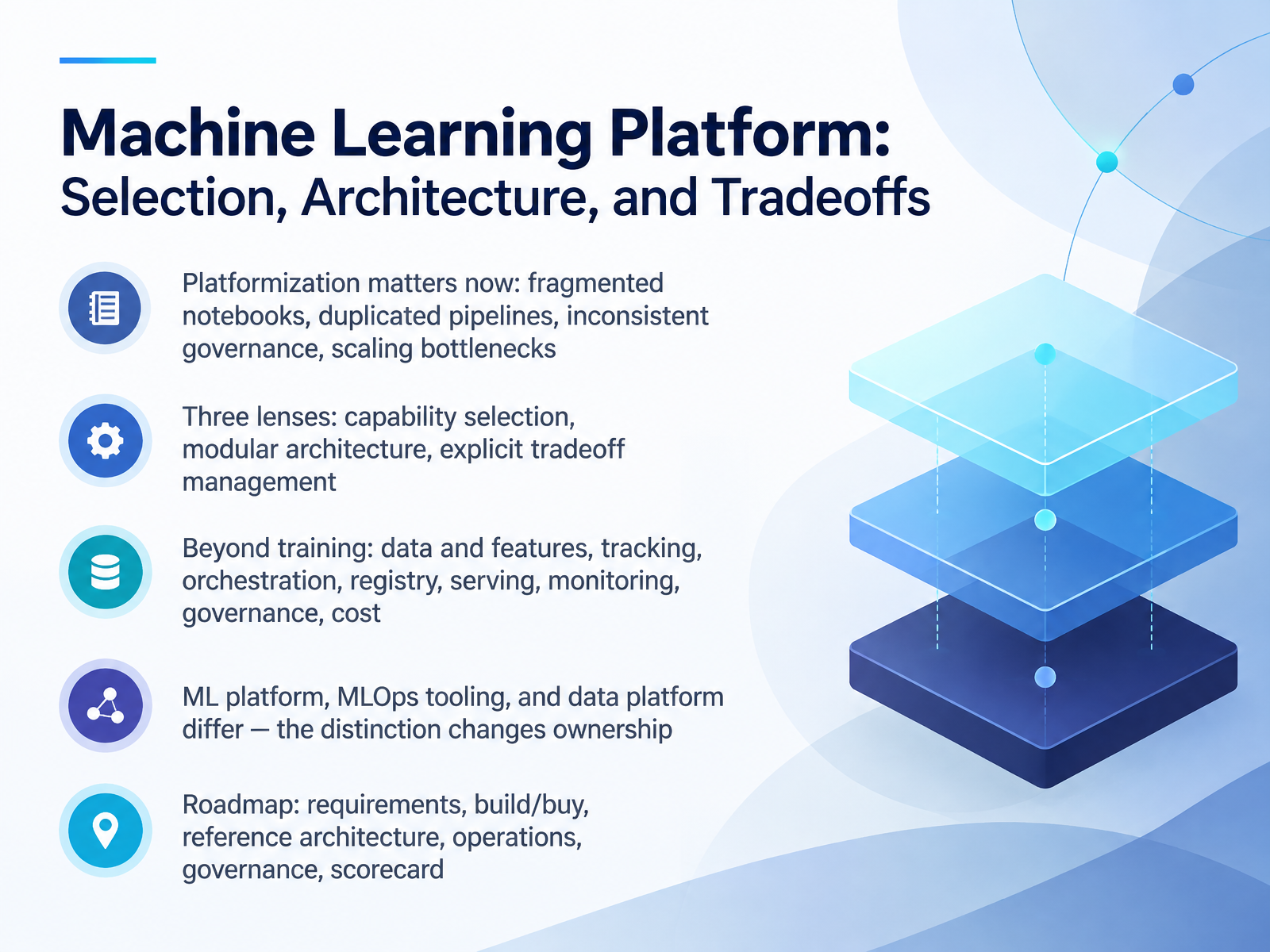
- 01Machine Learning Platform: Selection, Architecture, and TradeoffsWelcome. Over the next fourteen slides, we will work through machine learning platform selection, architecture, and tradeoffs, aimed at the people who own these decisions.
Start with why platformization matters now. Fragmented notebooks, duplicated pipelines, inconsistent governance, scaling bottlenecks. These are coordination costs, not tooling gaps. This means your first problem is ownership and interfaces.
We will use three lenses. Capability selection, modular architecture, and explicit tradeoff management. Beyond training, the scope includes data and features, tracking, orchestration, registry, serving, monitoring, governance, and cost.
One distinction matters early. An ML platform, MLOps tooling, and a data platform are not the same thing. The boundary you draw changes who owns the serving SLA and who owns the pipeline.
Our roadmap: requirements, build versus buy, reference architecture, operations, governance, and a scorecard you can take into procurement.
The next slide lays out the seven layers a platform must cover.aws.amazon.comdl.acm.orgazure.microsoft.com+22 min
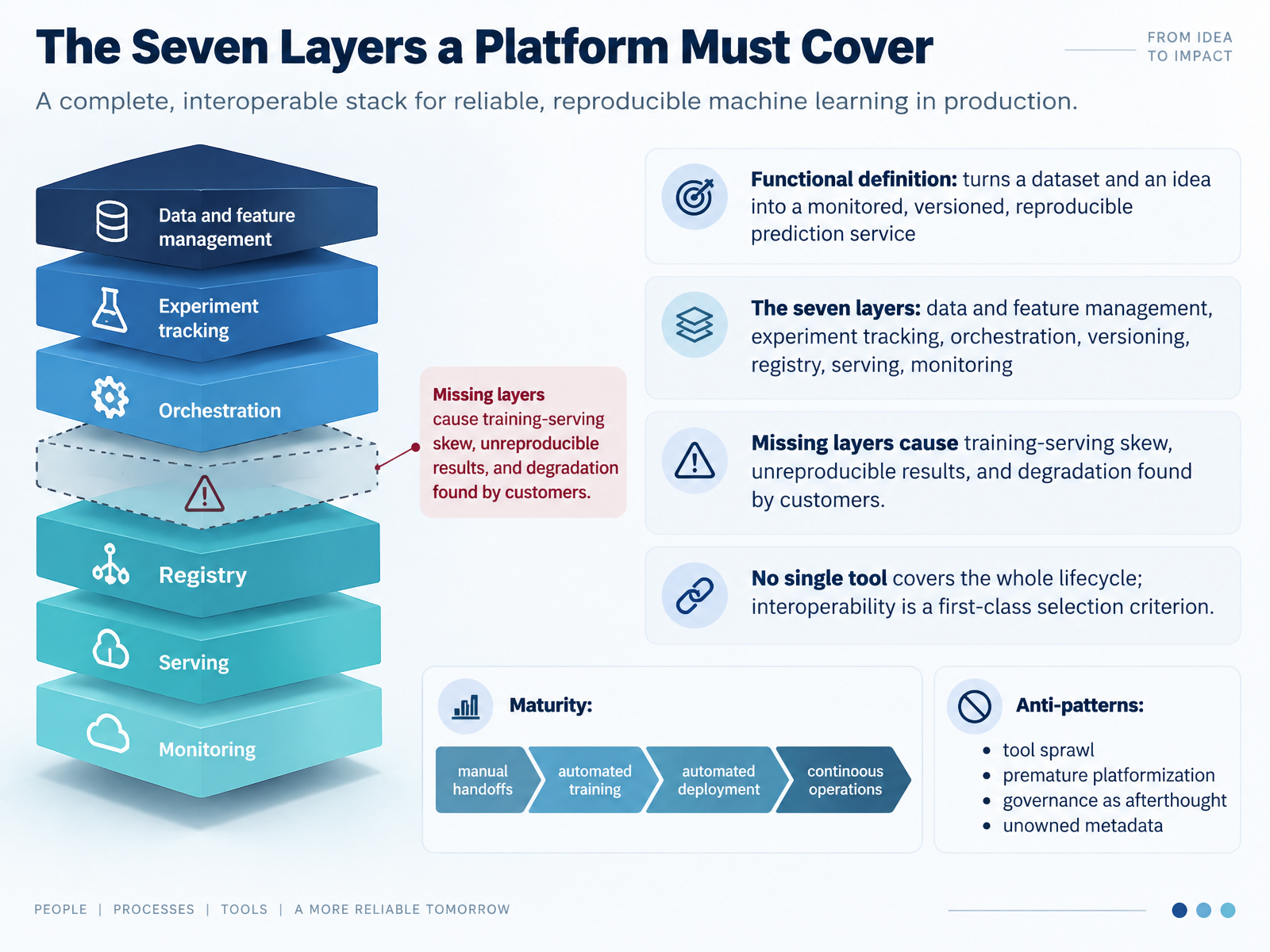
- 02The Seven Layers a Platform Must CoverBefore we compare vendors, we need a functional definition. A platform is whatever takes a dataset and an idea and turns it into a monitored, versioned, reproducible prediction service, and keeps doing so after the builder leaves. That system spans seven layers: data and feature management, experiment tracking, orchestration, versioning, registry, serving, and monitoring. The constraint is that no single tool covers the whole lifecycle, so interoperability becomes a first-class selection criterion. Miss a layer and you get training-serving skew, unreproducible results, or degradation your customers find before you do. Maturity moves from manual handoffs to automated training, automated deployment, then continuous operations. Watch four anti-patterns: tool sprawl, premature platformization, governance as afterthought, and unowned metadata. From Business Use Cases to Weighted Platform Requirements.
 aws.amazon.comdl.acm.orgazure.microsoft.com+21 min
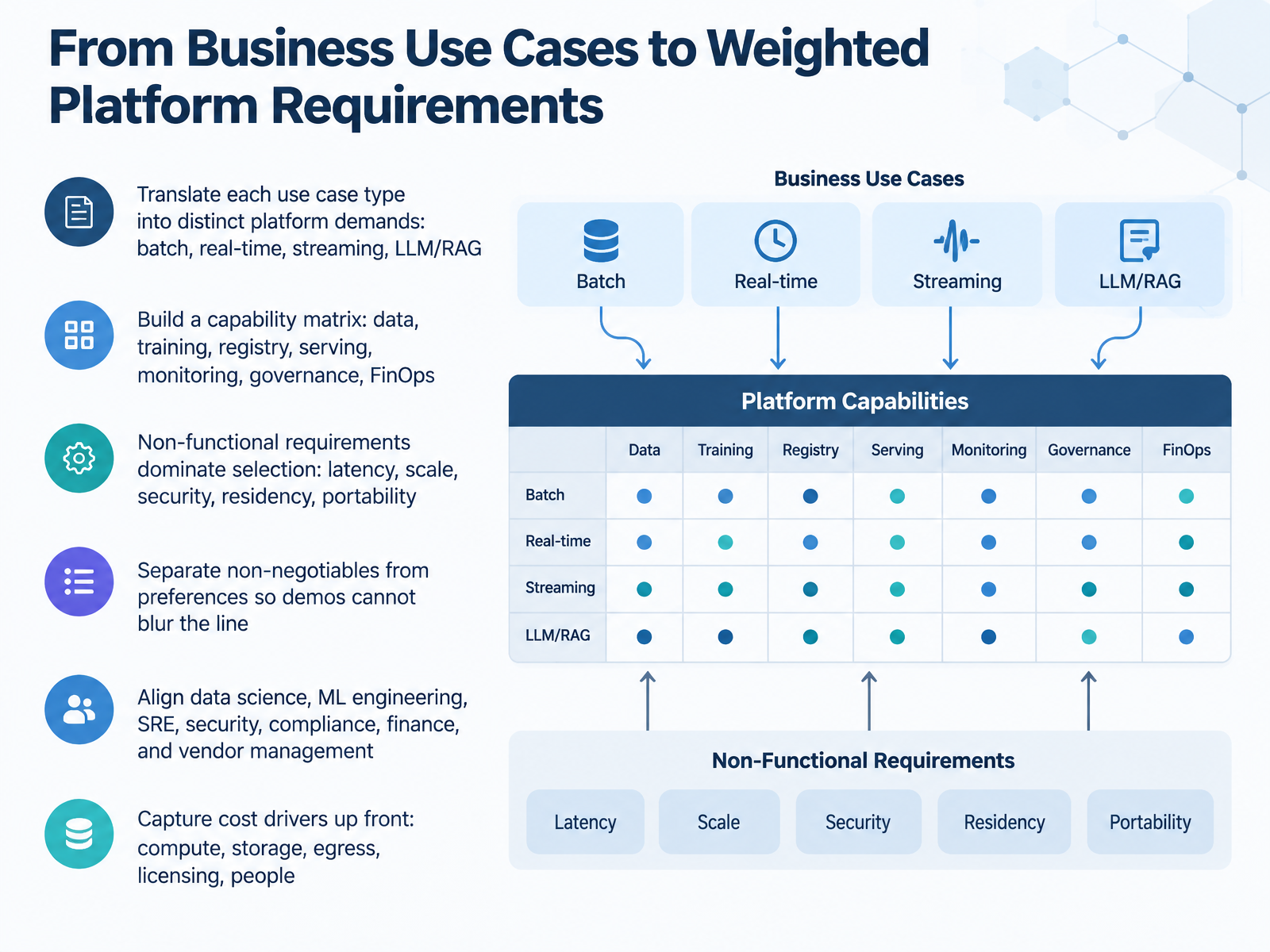
- 03From Business Use Cases to Weighted Platform RequirementsLet us move to how use cases become requirements. Each workload type creates a different platform demand. Batch favors distributed compute and orchestration. Real-time decisioning demands low-latency serving and rollback. Streaming requires event integration. LLM and RAG add retrieval, prompt management, and token cost controls. From there, build a capability matrix across data, training, registry, serving, monitoring, governance, and FinOps. Non-functional requirements dominate. Latency, scale, security, residency, and portability are procurement gates, not scoring nuances. The constraint is this. Separate non-negotiables from preferences in writing, because a polished demo blurs that line. This means aligning data science, ML engineering, SRE, security, compliance, finance, and vendor management before you score anything. Capture cost drivers up front. Compute, storage, egress, licensing, and people. If a requirement cannot be tested in a demo, treat it as unverified. Next, we turn that into a build, buy, or hybrid decision.
 enterpriseaiprocurement.com.audataiku.comgetwidget.dev+22 min
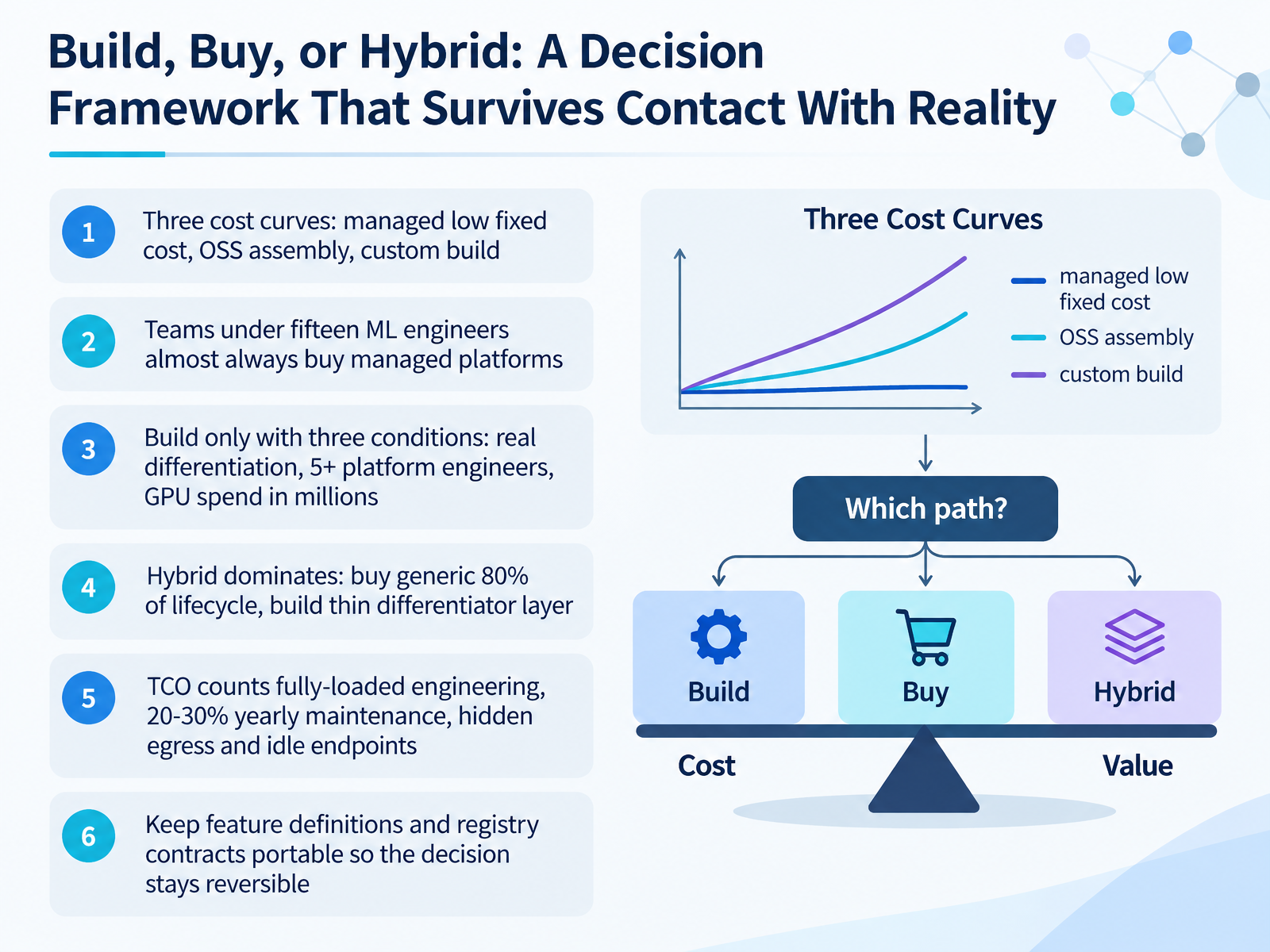
- 04Build, Buy, or Hybrid: A Decision Framework That Survives Contact With RealityLet's turn to build versus buy, and make it a framework that survives contact with reality. Start with three cost curves, not three feature lists. Managed platforms carry low fixed cost and a hard ceiling on optimisation. Open source assembly has medium fixed cost and lower marginal cost. Custom build has the highest fixed cost and the lowest floor on unit economics. Pick the curve that crosses your trajectory at the lowest total cost over three years. For teams under fifteen ML engineers, the math almost always favours managed. Platform engineering is a specialty, and a reliable training pipeline, registry, and serving layer is two to four FTE years before you ship a model. Build only when three conditions hold at once: ML is a real product differentiator, you have five or more dedicated platform engineers who will stay, and GPU spend is in the millions annually. Lose any one, and the build is an architecture decision disguising a mistake. Hybrid dominates in practice. Buy the generic eighty percent of the lifecycle, then build a thin layer for your differentiator. Now the costs that get missed. Count fully loaded engineering, add twenty to thirty percent of build cost per year for maintenance, and include egress fees and idle endpoints. An idle managed endpoint runs two hundred to four hundred dollars a month whether it serves one prediction or a million. Finally, keep feature definitions and registry contracts portable and in your own repository. This means the decision stays reversible. If definitions live in a vendor console, changing engines is a rewrite, and you will not do it. That is exactly what the pricing model assumes. Coming next, the reference architecture, where we look at planes, boundaries, and integration contracts.
 pdpspectra.comdatarekha.comadhdecode.com+22 min
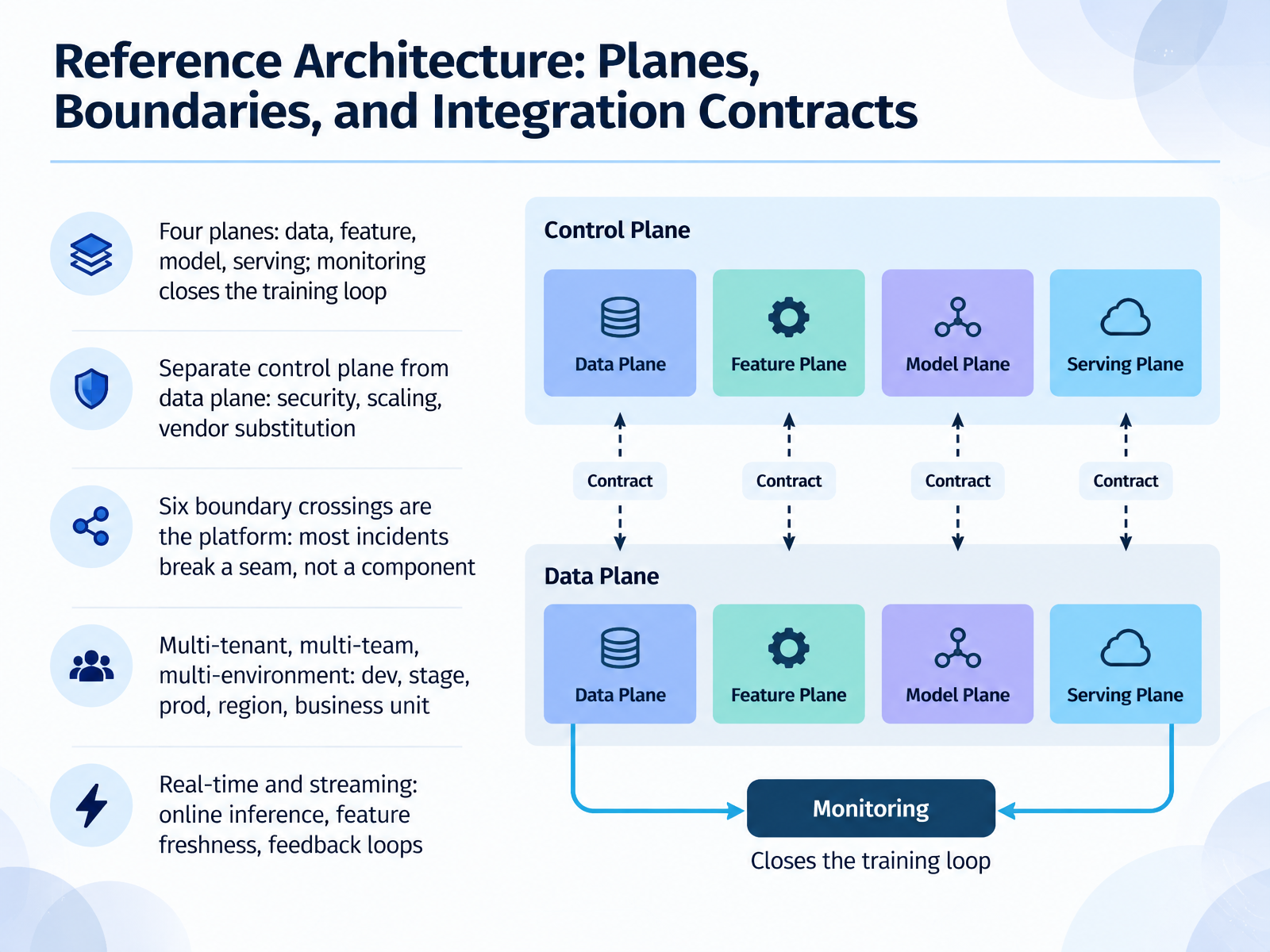
- 05Reference Architecture: Planes, Boundaries, and Integration ContractsNow let's look at the reference architecture. Treat the platform as four planes: data, feature, model, and serving, with monitoring closing the training loop. The critical design move is separating the control plane from the data plane. This means security policy, scaling decisions, and vendor substitution happen in one place, while feature reads and inference traffic stay on the hot path. Choose this split when you need to swap a serving engine without touching training. The six boundary crossings are the platform. Most incidents break a seam, not a component, so define those contracts first. The constraint is multi-tenancy: dev, stage, prod, region, and business unit all share infrastructure, and isolation has to be explicit. For real-time and streaming, online inference and feature freshness set your latency budget. This favors streaming features only where the action demands sub-minute freshness. Otherwise, batch is cheaper and simpler.
 narcismiclaus.cominfrasketch.nettutorialq.com+22 min
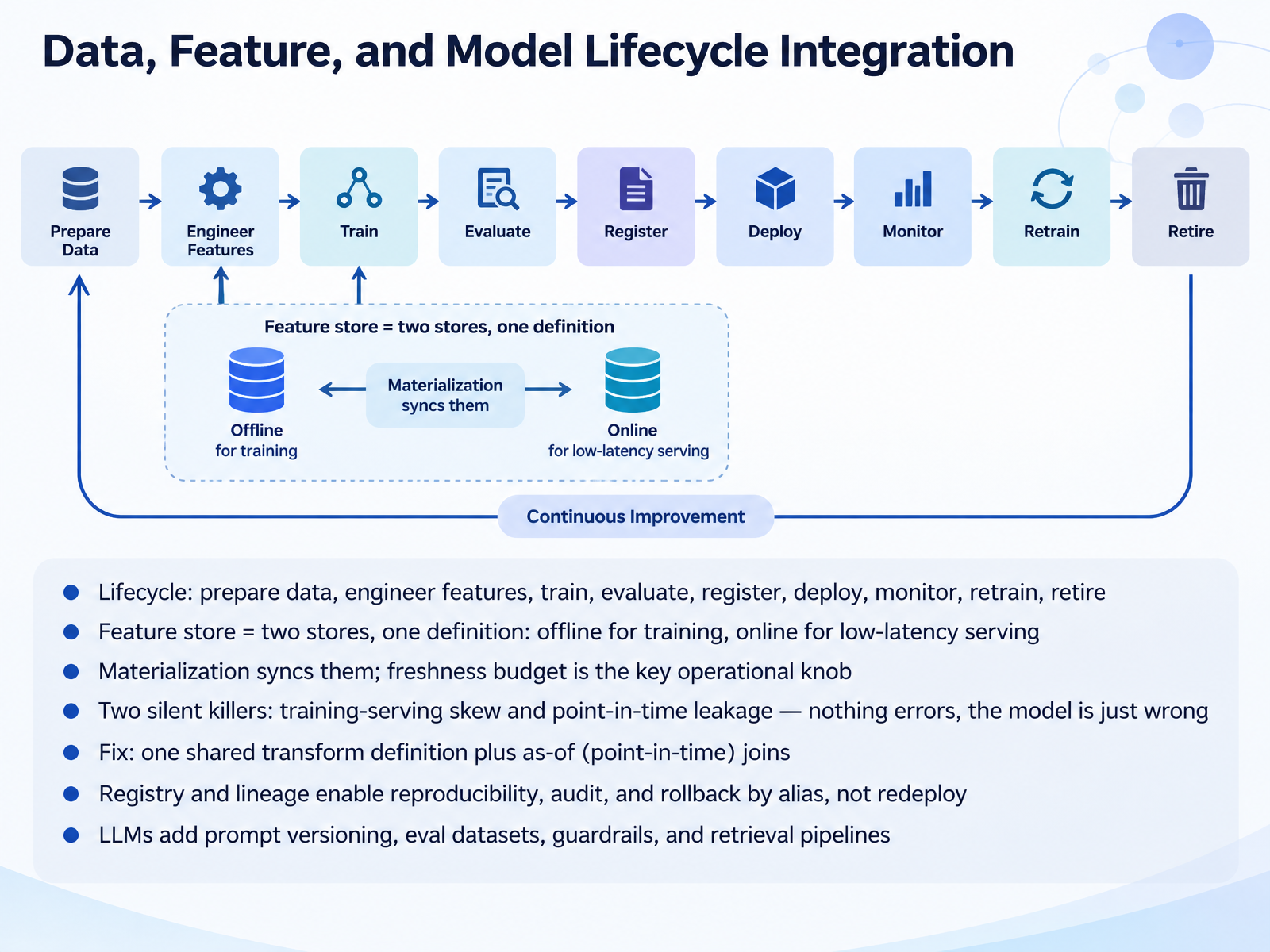
- 06Data, Feature, and Model Lifecycle IntegrationLet's talk about lifecycle integration. The full loop is prepare data, engineer features, train, evaluate, register, deploy, monitor, retrain, retire. The feature store is the piece that holds it together. It is two stores with one definition. Offline for training over full history, online for low-latency serving. Materialization syncs them, and the freshness budget is the key operational knob. Set freshness per feature, at the cheapest setting that keeps the decision correct. Now the two silent killers. Training-serving skew, and its temporal cousin, point-in-time leakage. Nothing errors. The model is just wrong. Offline metrics look fine because they never cross the boundary. The fix is architectural. One shared transform definition in code, plus as-of joins so each training row sees only values that existed at that event's timestamp. Do not hand-roll the training join. The registry and lineage give you reproducibility, audit, and rollback by alias, not redeploy. If you add LLMs, extend the same discipline to prompt versioning, eval datasets, guardrails, and retrieval pipelines. This means the guarantee is feature consistency, not model quality. Next, we move to serving, monitoring, and operating ML systems at scale.
 narcismiclaus.cominfrasketch.nettutorialq.com+22 min
- 07Serving, Monitoring, and Operating ML Systems at ScaleLet's move to serving, monitoring, and operating ML systems at scale.
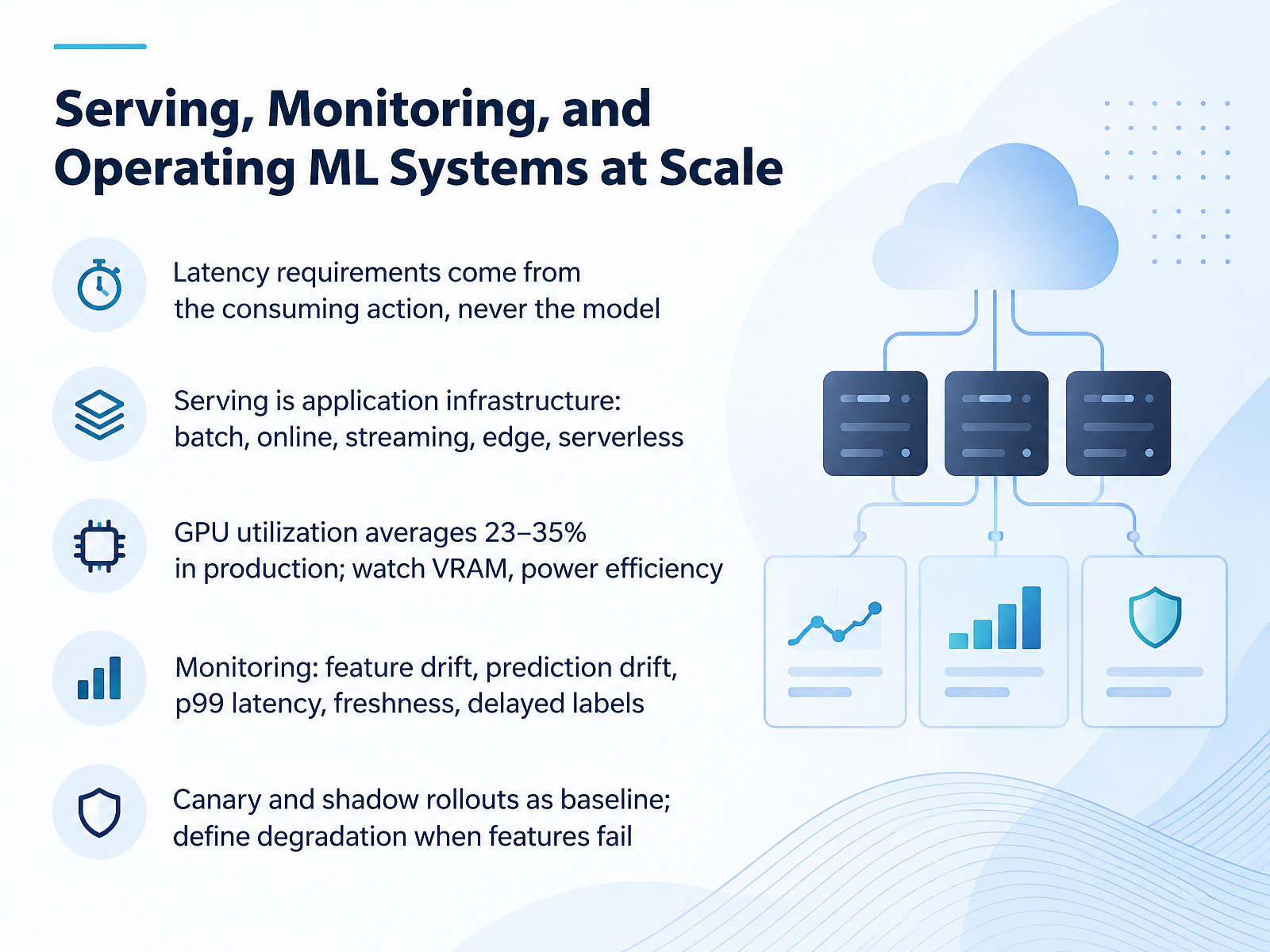
First principle: latency requirements come from the consuming action, never the model. A churn score consumed weekly needs a nightly batch job, not a real-time endpoint. Building that endpoint anyway is the most common overspend I see.
Serving is application infrastructure, not data infrastructure. Its uptime, latency, and capacity requirements track the application it serves. Choose batch for latency-tolerant scoring, online for request-response paths, streaming for event consumers, edge for offline or privacy constraints, and serverless when traffic is intermittent and cold starts are acceptable.
On cost: average GPU utilization in production inference sits between twenty-three and thirty-five percent, so most paid GPU time is wasted. Watch VRAM, and watch power efficiency. A GPU at low utilization drawing high wattage has a batch size set too low. And be honest about under-utilization: with four models behind separate containers, you may be paying for roughly three and a half idle replicas.
Monitoring has five signals you need: feature drift, prediction drift, p ninety-nine latency, feature freshness, and delayed labels. Prediction drift without feature drift usually means a model or calibration problem, not a data pipeline problem. Give drift and latency separate root-cause paths so alerts do not duplicate.
Canary and shadow rollouts are the baseline, not an advanced option. Promote by alias so rollback is a pointer reassignment, not a release. Before go-live, define degradation: when features fail, fall back to cached features, a reduced feature set, or rule-based scoring.
That operating discipline is what your governance layer has to enforce next, which brings us to governance, security, and responsible AI controls in the platform.
 narcismiclaus.cominfrasketch.nettutorialq.com+22 min
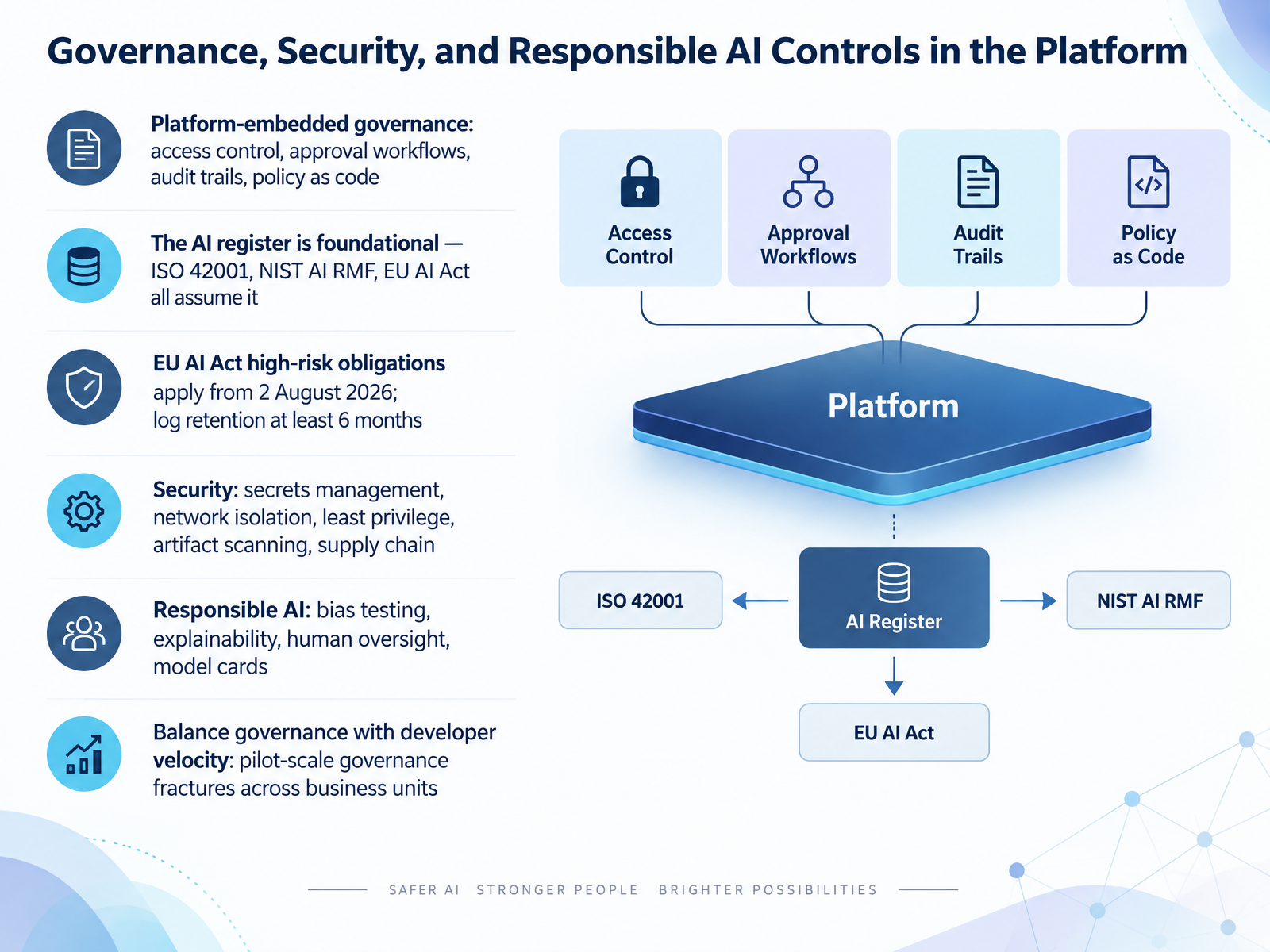
- 08Governance, Security, and Responsible AI Controls in the PlatformLet's turn to governance, security, and responsible AI controls. The principle here is platform-embedded governance. Access control, approval workflows, audit trails, and policy as code should live in the platform itself. If governance is a separate review step after deployment, it slows teams down and it gets bypassed. The foundation is the AI register, a maintained record of every AI system, its owner, its data, and its controls. This means ISO 42001, the NIST AI RMF, and the EU AI Act all assume you can produce that list. The register is where governance either exists or it does not. On regulation, the EU AI Act high-risk obligations apply from the second of August, 2026, and you must retain logs for at least six months. So build retention into the platform now, not at audit time. On security, enforce secrets management, network isolation, least privilege, artifact scanning, and supply chain controls. On responsible AI, bias testing, explainability, human oversight, and model cards belong in the release pipeline. The real tradeoff is governance against developer velocity. Too heavy, and teams route around you. Too light, and pilot-scale governance fractures across business units. Choose this when you need audit-ready evidence without slowing delivery. Next, cost, performance, and scalability tradeoffs.
 enterpriseaiprocurement.com.audataiku.comgetwidget.dev+22 min
- 09Cost, Performance, and Scalability TradeoffsNow let's talk about cost, performance, and scalability tradeoffs. Start with the cost architecture. Compute, storage, egress, licensing, and team overhead all behave differently under managed versus self-built. The constraint is this. Managed shifts cost from headcount to unit price. Self-built shifts it back, plus maintenance. Run showback before chargeback. Allocate per token, per tenant, per experiment, so teams see their consumption before budgets move. Be careful with GPU utilization. It lies. A single small kernel can report near full utilization. Track SM activity and cost per inference instead, because that maps to actual work. Commitment traps matter too. Spot and Capacity Blocks are excluded from Savings Plans and Reserved Instances, so verify eligibility before you commit. Optimize only when unit economics break. Otherwise, accept higher cost for speed and reliability. Next, let's build the evaluation scorecard.
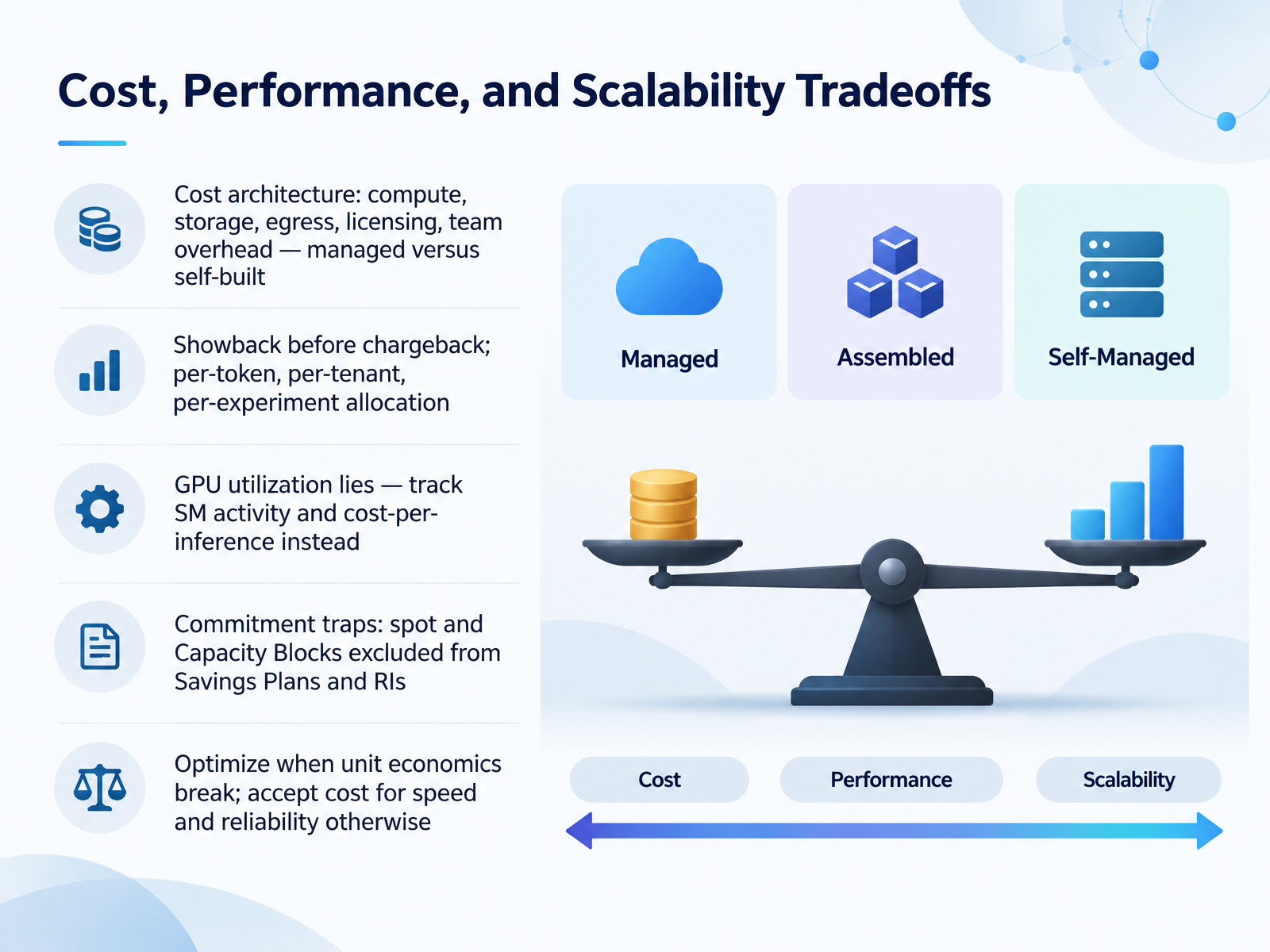 pdpspectra.comdatarekha.comadhdecode.com+21 min
- 10Evaluation Scorecard: Turning Requirements Into a Comparable NumberNow let us convert those requirements into a single comparable number. Build a weighted scorecard from three inputs: requirements, architecture fit, and risk. Default weights are technical capability, governance, security, compliance, and commercial terms. Adjust them by context. A regulated bank weights governance and regulatory higher. A consumer product may weight technical capability higher. Score on evidence, not slides. Vendor claims, plus reference customer confirmation, plus pilot results. This means a criterion you cannot test in a demo is unverified. Treat it as unverified, and record it that way. That one rule kills most demo-driven mistakes. Then apply decision bands: strong fit, shortlistable, conditional, and no-go. Anything conditional carries specific blockers you must resolve before shortlist. Finally, run two independent evaluators and reconcile their scores. The constraint is time, and it is worth it, because reconciliation keeps scores auditable and defensible in procurement. This means the scorecard becomes your negotiation input, not a vote count. Next, we move to Proof of Concept, Vendor Questions, and Contract Levers.
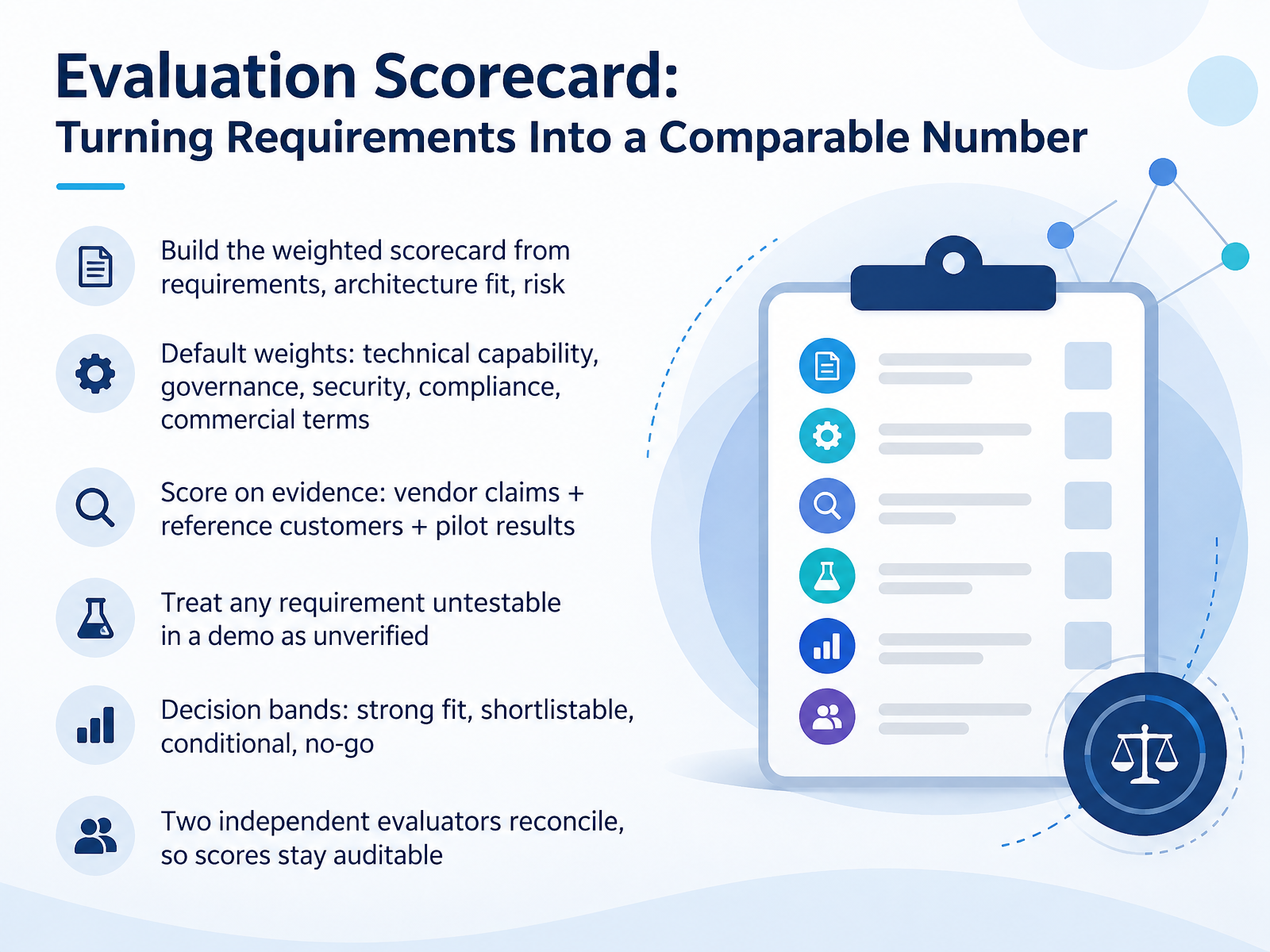 dataiku.comenterpriseaiprocurement.com.augetwidget.dev+22 min
- 11Proof of Concept, Vendor Questions, and Contract LeversLet's move to proof of concept, vendor questions, and contract levers. A POC is a decision instrument, not a demo. Give it four to six weeks, representative workloads, named success metrics, and hard go/no-go gates. Before you run it, decide what failure looks like. Then test dirty data, failed jobs, permission changes, and an actual rollback. Clean demos prove nothing about production. Demand evidence, not promises: roadmap stability, a deprecation policy, bias testing methodology, and red-team reports. Watch for these red flags. Exclusive models with no alternative. No disclosed evaluation methodology. No support for bring-your-own-key encryption. And no documented rollback path. Each one is a lock-in mechanism or an operational gap. Now the contract levers. Portability, so you can export models, metadata, and evaluation history. Training-data exclusion in writing. Audit rights. And exit assistance with defined timelines. One constraint to close on: verify the capacity commitments cover what you actually buy, and model the worst realistic case, not the average. If the contract only works at expected load, you have not finished the evaluation. Next, Adoption Roadmap: Build the Seams Before You Build the Planes.
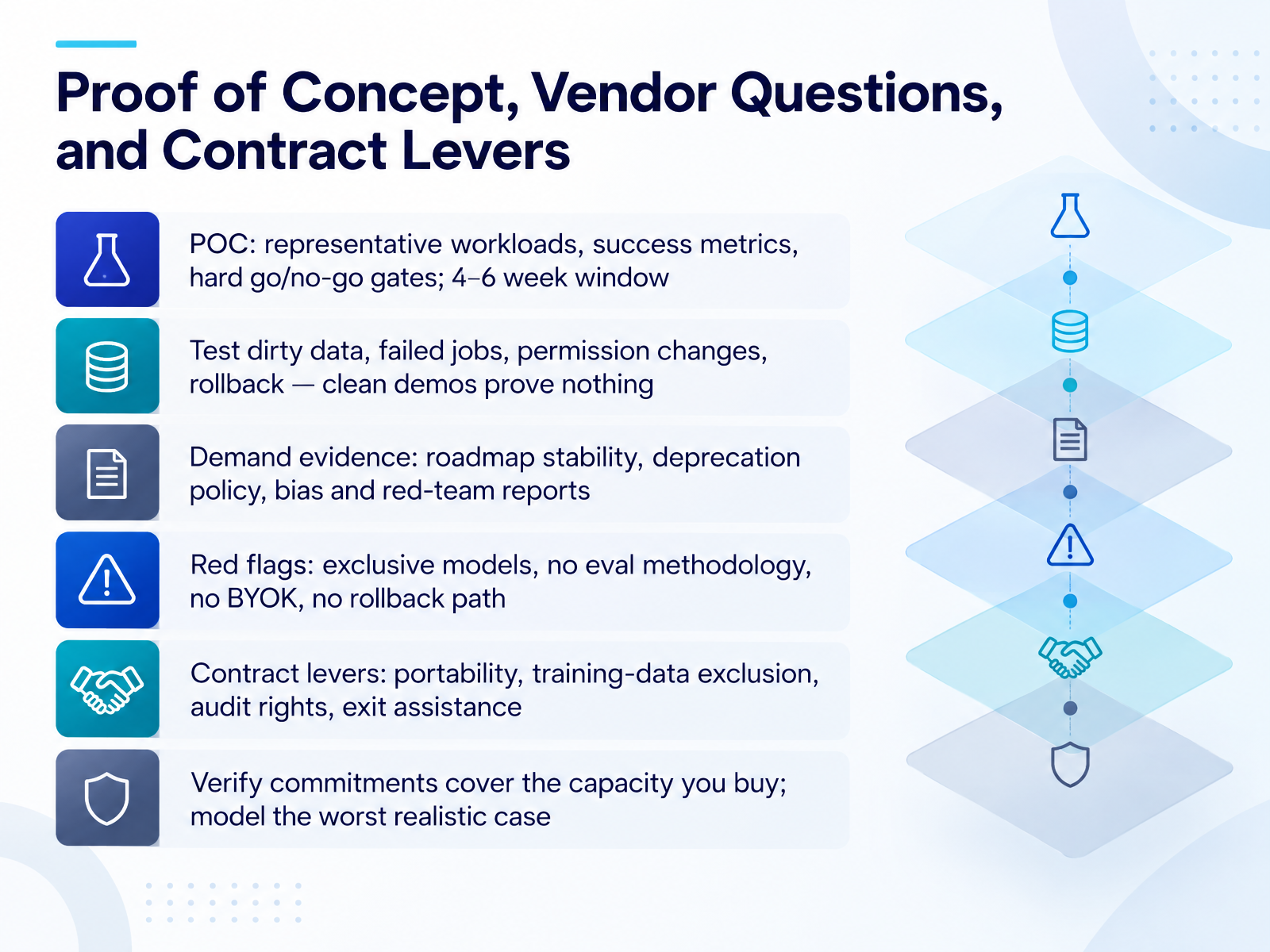 dataiku.comenterpriseaiprocurement.com.augetwidget.dev+22 min
- 12Adoption Roadmap: Build the Seams Before You Build the PlanesLet's talk about sequencing your rollout. The rule here is build the seams before you build the planes. That means shared transform logic and a registry first, then orchestration, then monitoring, then governance. The constraint is that a clean contract between training and serving outperforms an excellent feature store with no contract, because the first can be improved incrementally and the second can only be replaced. Embed platform engineers in product sprints. Let users rank the roadmap. When one team did this, their top three priorities did not appear in the users' top ten. Pilot one workload end to end, then expand by model family, not by department. Measure three things: time to first production model, adoption and platform NPS, and cost per inference. Treat every workaround as product evidence. Remember, shipped and adopted are different success criteria. Organize your handbook around practitioner workflows, not features. Next, we look at case discussions contrasting rollouts and their tradeoff decisions.
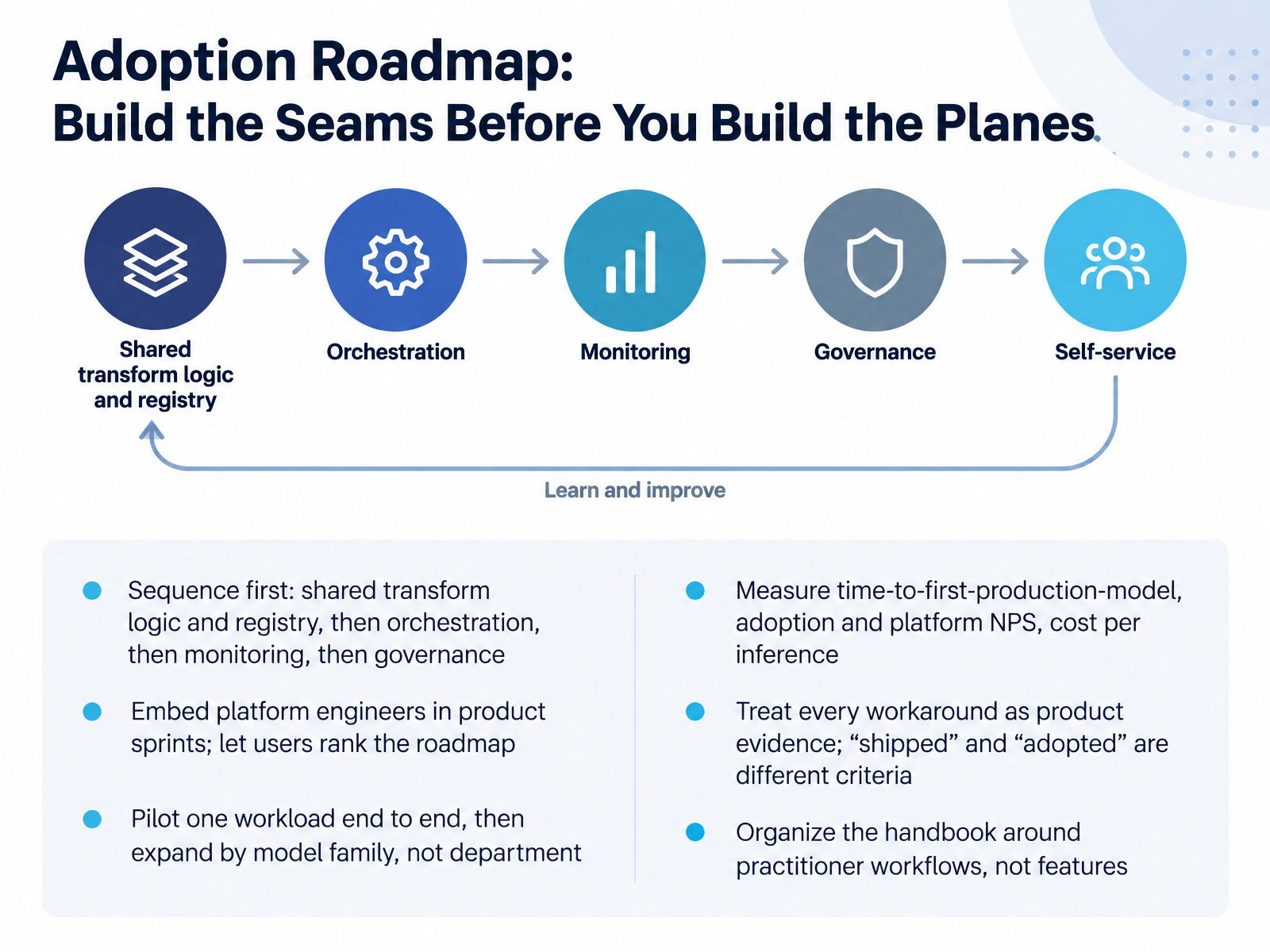 narcismiclaus.cominfrasketch.nettutorialq.com+22 min
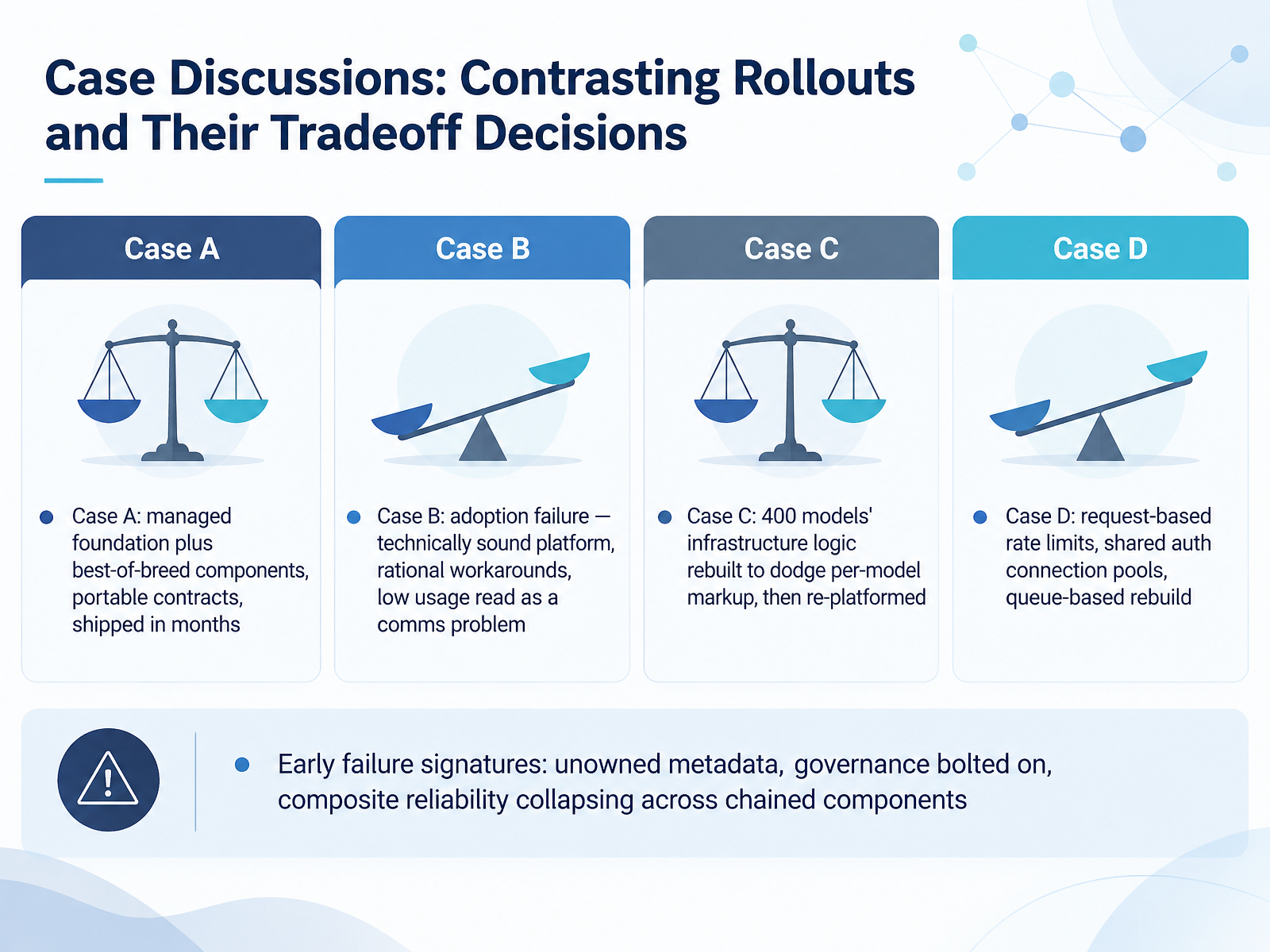
- 13Case Discussions: Contrasting Rollouts and Their Tradeoff DecisionsLet's ground the decision criteria in four real rollouts. In Case A, a managed foundation plus best-of-breed components and portable contracts shipped in months. Choose that when your workload is generic and speed matters. Case B is the harder lesson: a technically sound platform that failed on adoption. The workarounds were rational, and the team misread low usage as a comms problem. The constraint is trust, not awareness. Case C is the inverse: four hundred models, infrastructure logic rebuilt to dodge per-model markup, then re-platformed. That is roughly one point five million dollars of engineering to save four hundred thousand a year, with time-to-value as the casualty. Case D shows the cheap wins: token-based rather than request-based rate limits, and queue-based decoupling so heavy tenants cannot starve shared connection pools. Watch for early failure signatures. Unowned metadata. Governance bolted on after the fact. And composite reliability collapsing across chained components, where five steps at ninety-seven percent reliability yield about eighty-six percent end to end. Next, Action Planning, Self-Assessment, and Open Discussion.
 pdpspectra.comdatarekha.comadhdecode.com+22 min
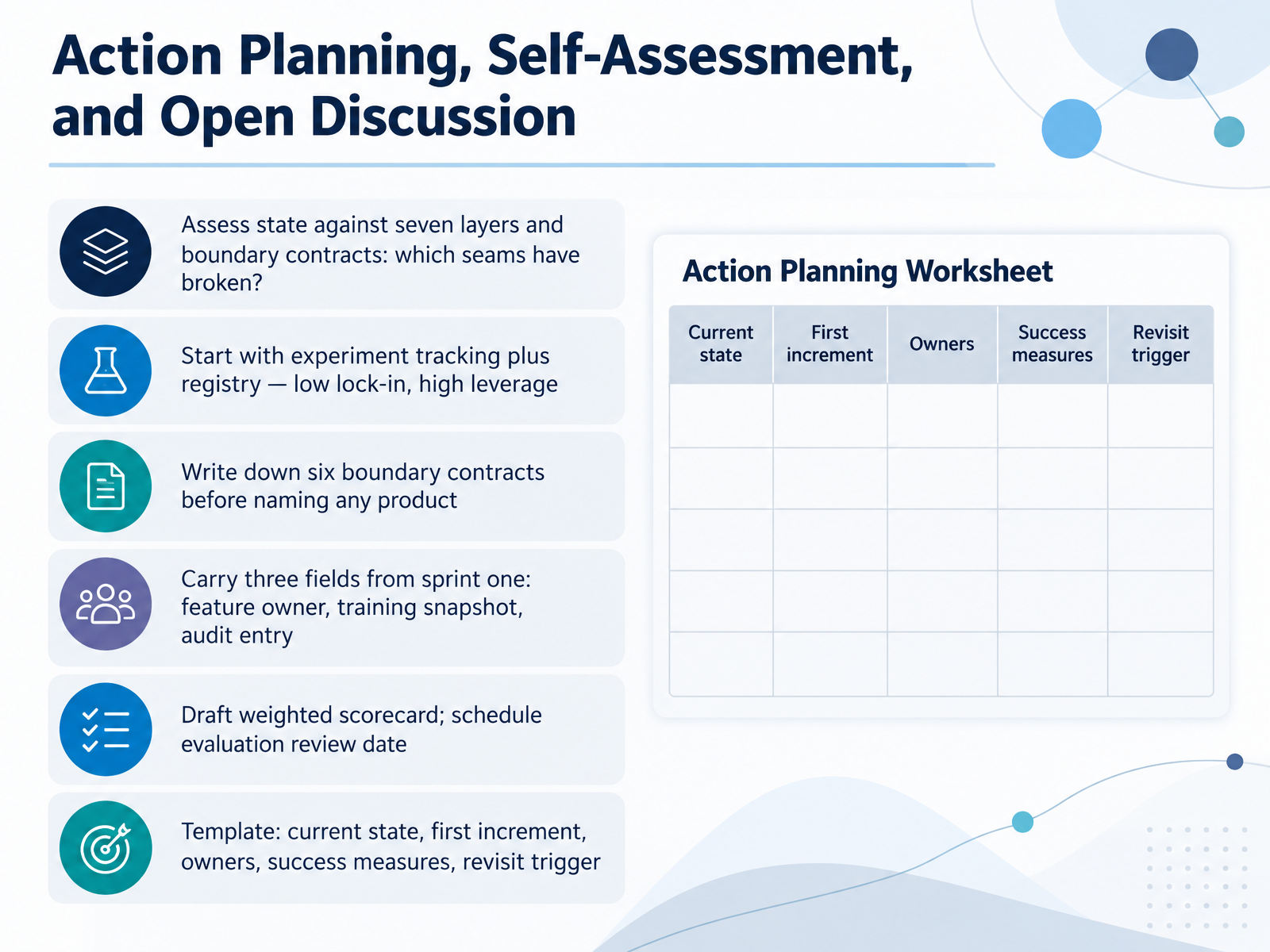
- 14Action Planning, Self-Assessment, and Open DiscussionLet's close with what you actually do on Monday. First, assess your current state against the seven layers and the boundary contracts between them. The question is not which layer is weak. It is which seam has broken. Most incidents live in the handoffs, not inside a plane. Then start with experiment tracking plus a model registry. That combination has low lock-in and high leverage. It is the cheapest way to make every other choice reversible. Before you name a single product, write down your six boundary contracts. If you cannot describe a seam precisely, you are not ready to buy anything. From sprint one, carry three fields: feature owner, training snapshot, and an audit entry naming a human. That is small enough to build in a week and sufficient to answer the three questions an auditor asks: who owns this, what did it learn from, and who approved it going live. Finally, draft a weighted scorecard and schedule a review date, so evaluation does not stall after the demo. Use this template: current state, first increment, owners, success measures, and a revisit trigger. Thank you for working through this. The architecture is standardised now, the vocabulary is shared, and your job is to own the seams. Start small, keep the contracts portable, and build from there.
 narcismiclaus.cominfrasketch.nettutorialq.com+22 min
Take the deck with you
Download this course as a file — free, no sign-up needed.
- PDF handoutEvery slide page, ready to print or share.15 pages · 3.3 MBDownload
- Narrated PowerPointThe deck that presents itself — every slide carries the digital human's narration video.15 pages · 29.9 MBDownload
- PowerPoint slidesThe full deck as a .pptx — open it in PowerPoint, Keynote, or Google Slides.15 pages · 3.2 MBDownload
Free to use in your own training — please keep the PersonWise credit page at the end.
Have your own deck? Turn it into a course
Sources consulted
Web sources consulted while building this course.
- What is MLOps? - Machine Learning Operations Explained - AWS — aws.amazon.com
- A Systematic Review of MLOps Tools: Tool Adoption, Lifecycle Coverage, and Critical Insights | Proceedings of the IEEE/ACM 5th International Conference on AI Engineering - Software Engineering for AI — dl.acm.org
- Machine Learning Operations (MLOps) | Microsoft Azure — azure.microsoft.com
- https://learn.microsoft.com/en-us/azure/architecture/ai-ml/guide/mlops-maturity-model — learn.microsoft.com
- https://learn.microsoft.com/en-us/azure/architecture/ai-ml/guide/machine-learning-operations-v2 — learn.microsoft.com
- Enterprise AI Non-Functional Requirements Australia — enterpriseaiprocurement.com.au
- Enterprise machine learning platforms: a buyer's guide for 2026 — dataiku.com
- Enterprise AI Platform Buyer's Guide: A Decision Rubric for 2026 — getwidget.dev
- How Should Enterprises Choose an MLOps Platform in 2026? | zdnetinside.com — zdnetinside.com
- Enterprise AI Platform Selection: Evaluation Criteria and Decision Frameworks | AI Stack Authority — aistackauthority.com
- ML Platform Vendor vs Build 2026 | pdpspectra — pdpspectra.com
- ML platform build vs buy: a decision framework for 2026 — datarekha — datarekha.com
- Building vs Buying ML Platform — Complete Guide | ADHDecode — adhdecode.com
- kindatechnical() - TCO Analysis: Build vs Buy for ML Infrastructure — kindatechnical.com
- Build vs Buy for ML Predictions: The Full Cost Analysis | Kumo.ai | Kumo.ai — kumo.ai
- ML platform architecture: feature store, model registry, serving · Narcis Miclaus — narcismiclaus.com
- MLOps System Design: Reference Architecture for 2026 | InfraSketch Blog — infrasketch.net
- AI Platform Design — Architecting an End-to-End ML Platform | tutorialQ — tutorialq.com
- AI System Design: A Comprehensive Reference Architecture | InfraSketch Blog — infrasketch.net
- docs/plans/forgepoint-platform-design.md — github.com