Team Decision Making
Begin
16 pages · ~32 min
Team Decision Making
A training on collaborative decision-making, teaching team members to evaluate options, build consensus, and make effective group decisions.
What you’ll learn
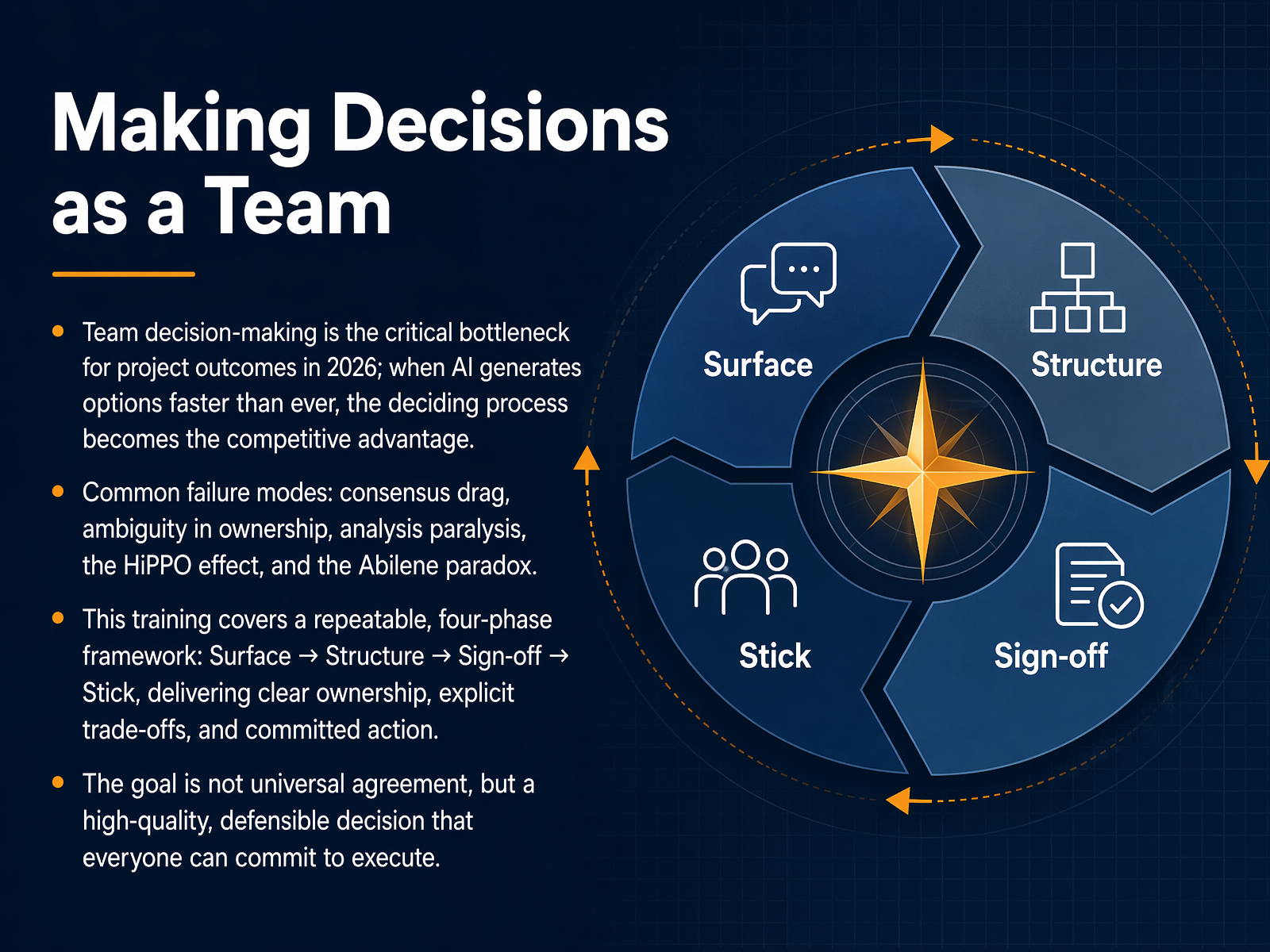
- 01Making Decisions as a TeamWelcome. This course is about making decisions as a team—specifically, how to turn the deciding process itself into your competitive advantage. In 2026, AI generates options faster than any team can consume them. Your bottleneck is no longer ideas. It's clarity of ownership, speed of choice, and commitment to action. We'll look at the failure modes that slow teams down: consensus drag, ambiguity about who decides, analysis paralysis, the HiPPO effect where the highest-paid opinion dominates, and the Abilene paradox where everyone agrees to something nobody actually wants. Our goal is a repeatable, four-phase framework: Surface, Structure, Sign-off, and Stick. It delivers clear ownership, explicit trade-offs, and a defensible decision that everyone can commit to execute—not universal agreement. Next, we'll examine the hidden cost of bad team decisions.hbr.orgquestworks.ioglobal-integration.com+22 min
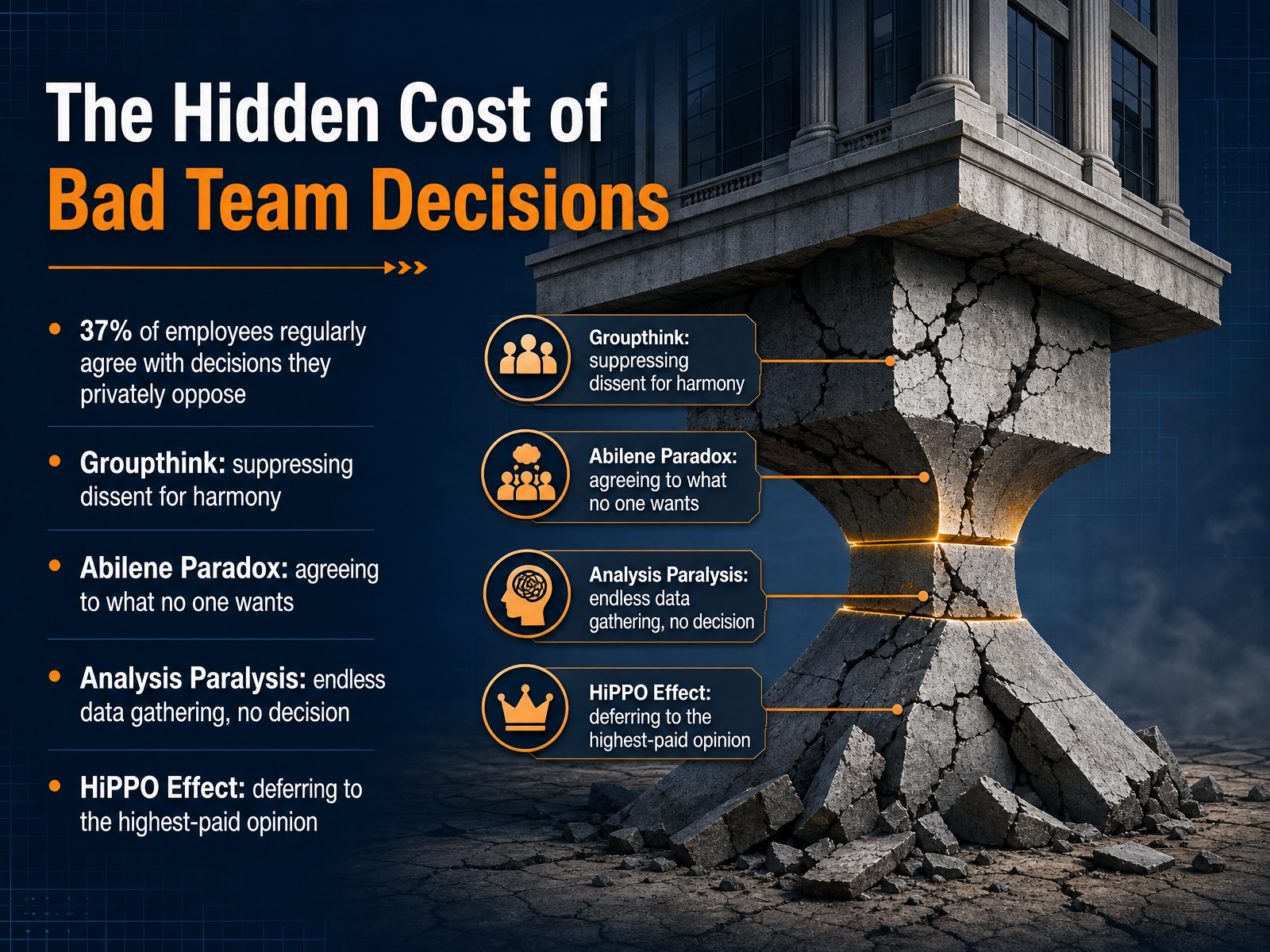
- 02The Hidden Cost of Bad Team DecisionsHere is the visible cost of bad team decisions. Research shows thirty-seven percent of employees regularly agree with choices they privately oppose. That silence is expensive. Four patterns drive this. Groupthink suppresses dissent in favor of harmony, so the room nods and real concerns stay hidden. The Abilene Paradox takes it further: a group commits to a plan that nobody actually wants, because each person assumes everyone else is on board. Analysis paralysis locks teams in endless data gathering, delaying the decision until the window closes. And the HiPPO effect, deferring to the highest-paid opinion, cuts true debate in half when the senior voice speaks first. These aren't personality flaws; they are structural traps. The fix starts with naming them. Next, we will apply this by mapping the decision spectrum, from unilateral action to full consensus, and showing you exactly when to use each mode.
 hbr.orgquestworks.ioglobal-integration.com+21 min
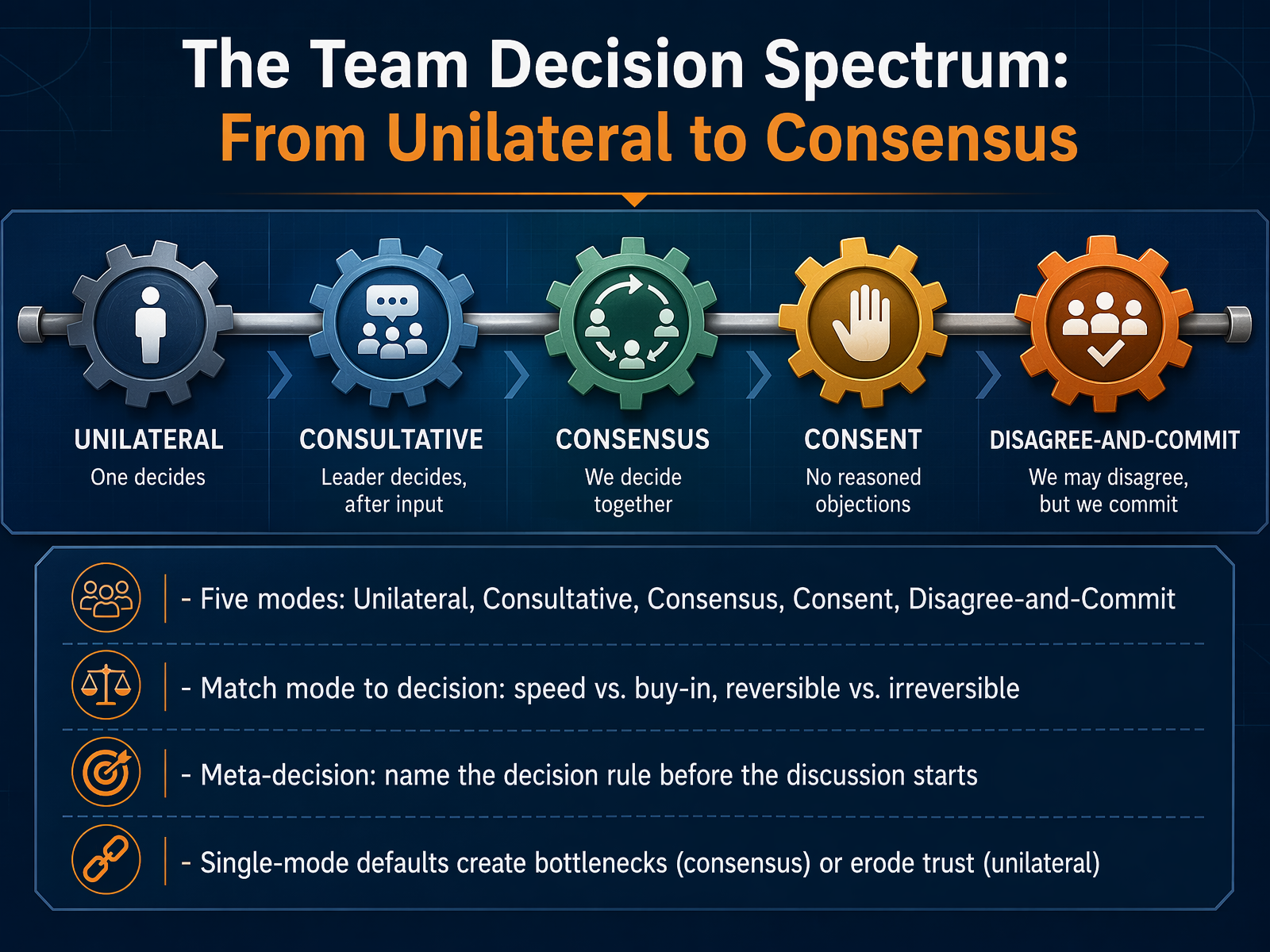
 - 03The Team Decision Spectrum: From Unilateral to ConsensusWe've seen the common traps. Now let's look at the actual decision modes you can use. Think of them as a spectrum, from unilateral to consensus. The five modes are: Unilateral—one person decides. Consultative—you gather input, then decide. Consensus—everyone must agree. Consent—the question is 'can you live with this,' not 'do you love it.' And Disagree-and-Commit—you debate, then everyone commits, even if they personally disagree. The key is to match the mode to the decision. Speed versus buy-in. Reversible versus irreversible. This is the meta-decision most teams skip: name the decision rule before the discussion starts. Don't let it become a fight during the meeting. The biggest risk? Defaulting to a single mode. Overuse consensus, and you create bottlenecks. Overuse unilateral, and you erode trust. Let's now look at how to assign clear ownership with RAPID and DACI.
 hbr.orgquestworks.ioglobal-integration.com+21 min
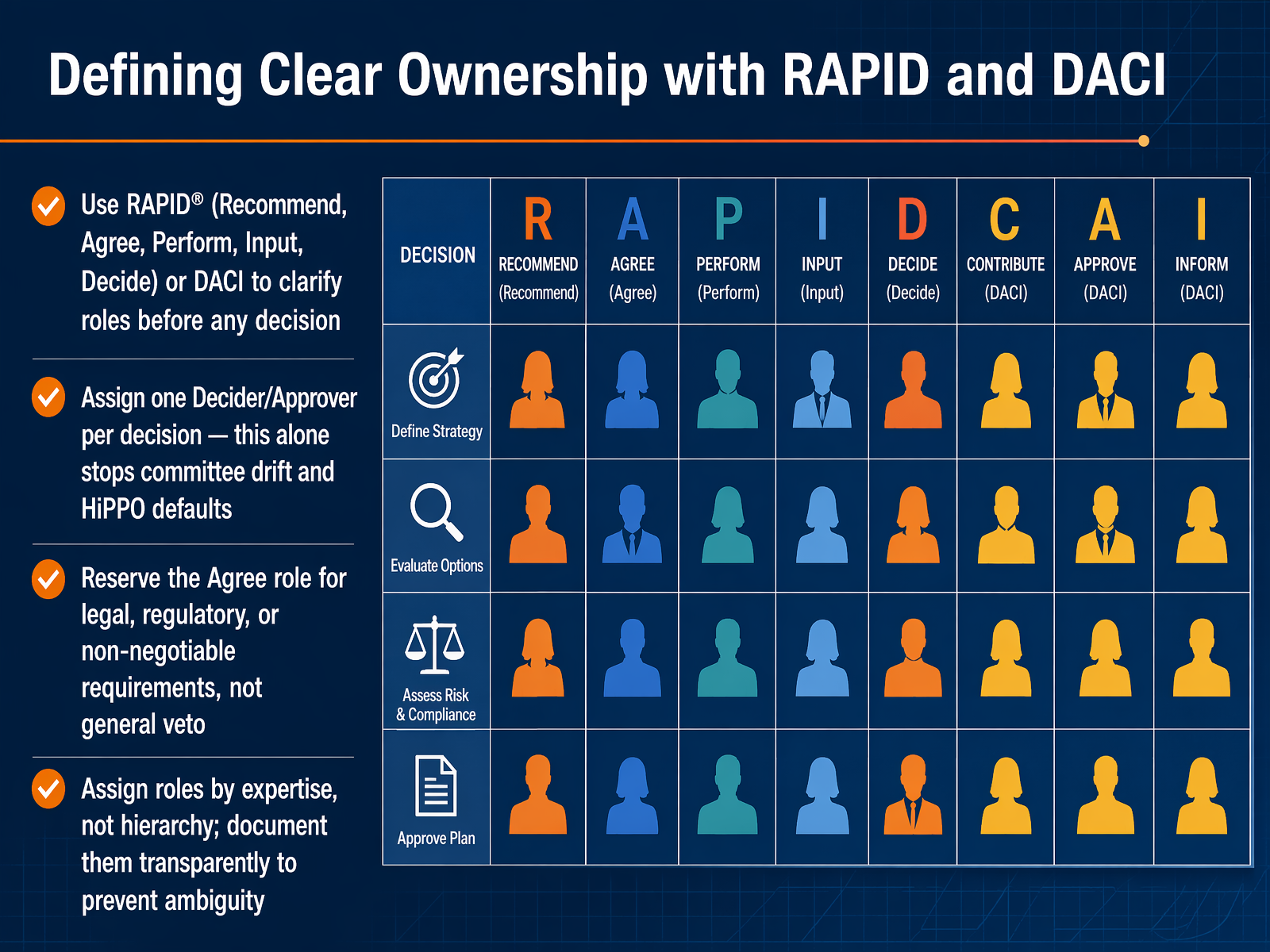
 - 04Defining Clear Ownership with RAPID and DACILet's get into defining clear ownership. The fastest way to derail a decision is confusion about who actually makes it. To fix that, we use tools like RAPID or DACI. These frameworks clarify roles before any discussion starts. First, assign one Decider. Just one person. This single move stops committee drift and prevents the highest-paid person's opinion from dominating by default. Second, use the Agree role sparingly. Reserve it for legal, regulatory, or non-negotiable requirements. It is not a general veto. Third, assign roles based on expertise, not hierarchy. Then document those assignments transparently. When everyone sees the names next to the roles, ambiguity disappears. Now, once ownership is clear, the next step is to build the actual choices on the table. Let's look at generating and structuring options.
 bain.comasana.comiapm.net+21 min
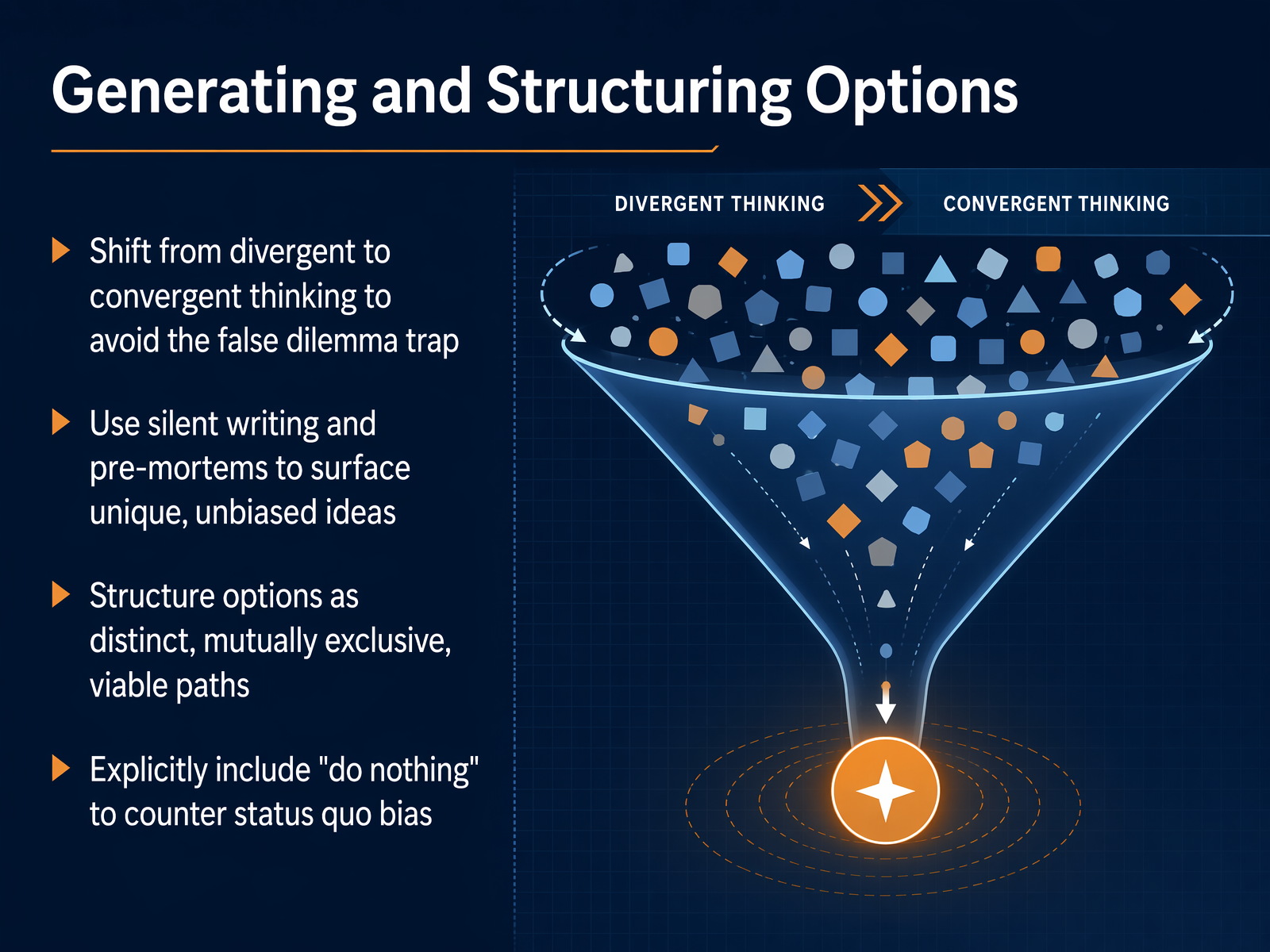
 - 05Generating and Structuring OptionsNow let's talk about generating and structuring your options. The first shift is from divergent to convergent thinking. You want to avoid the false dilemma trap where you feel stuck choosing between only two paths. Second, use silent writing and pre-mortems to surface fresh, unbiased ideas. A pre-mortem asks, 'If this fails in a year, why did it happen?' This technique pulls unique risks into the open before groupthink can bury them. Third, structure your options as distinct, mutually exclusive, and viable paths. Each option should stand alone as a real choice, not just a variation of the same idea. Finally, explicitly include a 'do nothing' option. This directly counters status quo bias by forcing you to compare action against the cost of inaction. Once you have these clear paths, you're ready to evaluate them. Next, we'll move into making trade-offs explicit with a decision matrix.
 hbr.orgquestworks.ioglobal-integration.com+21 min
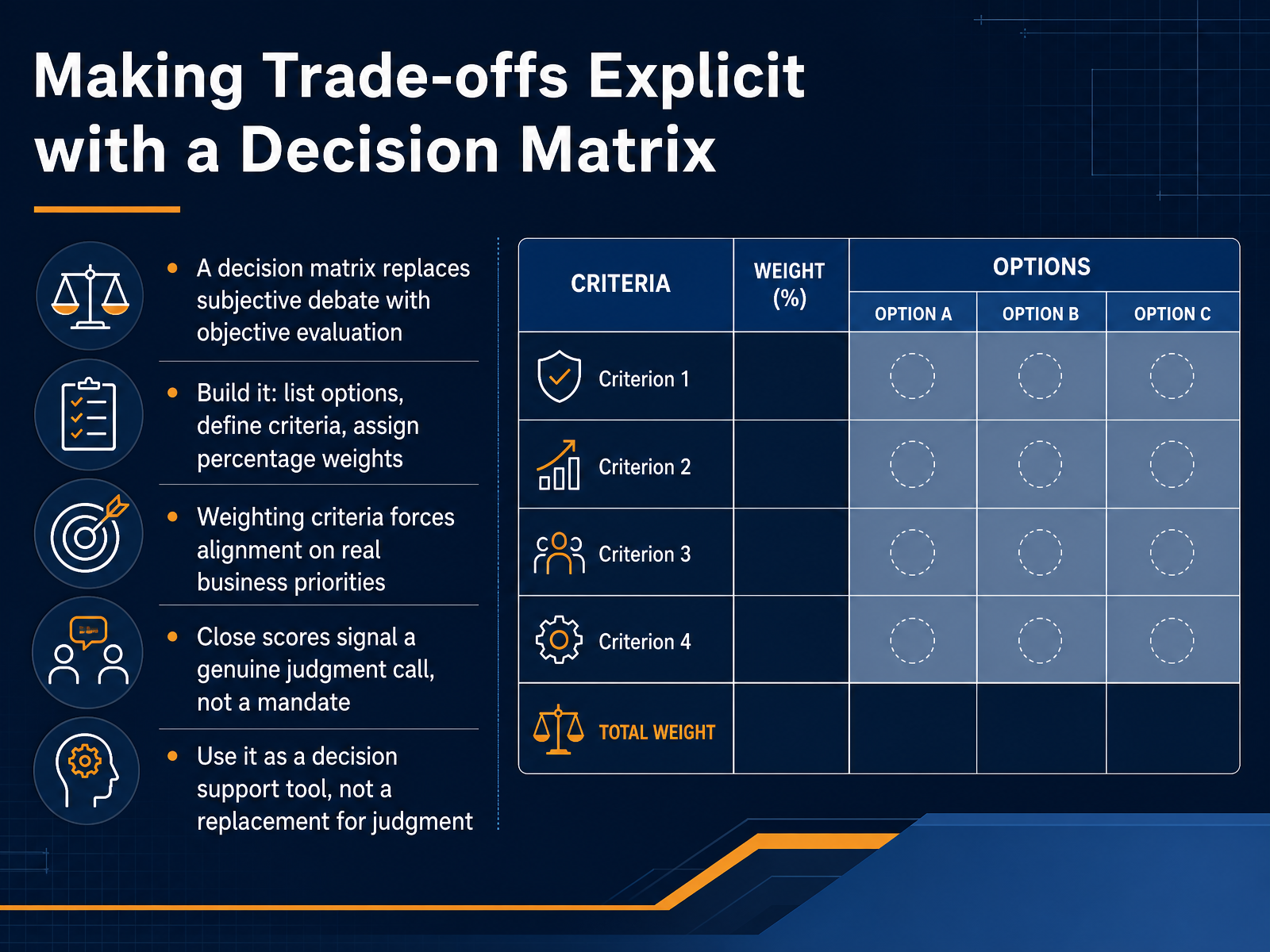
 - 06Making Trade-offs Explicit with a Decision MatrixLet's make trade-offs explicit with a decision matrix. This tool replaces subjective debate with objective evaluation. Here's how to build it. First, list your options as rows. Second, define your criteria as columns, and assign each a percentage weight. Forcing these weights upfront aligns the team on real business priorities, not just opinions. You score each option against the criteria, then multiply by the weights. A simple scale of one to five works well. Here's a key insight: when the final scores are very close, that's not a mandate. It's a genuine judgment call. The matrix is a decision support tool, not a replacement for your judgment. Use it to make the reasoning visible and the trade-offs clear. Next, we'll look at recognizing and countering cognitive biases.
 monday.comprojectmanager.comprojectmanagementformula.com+22 min
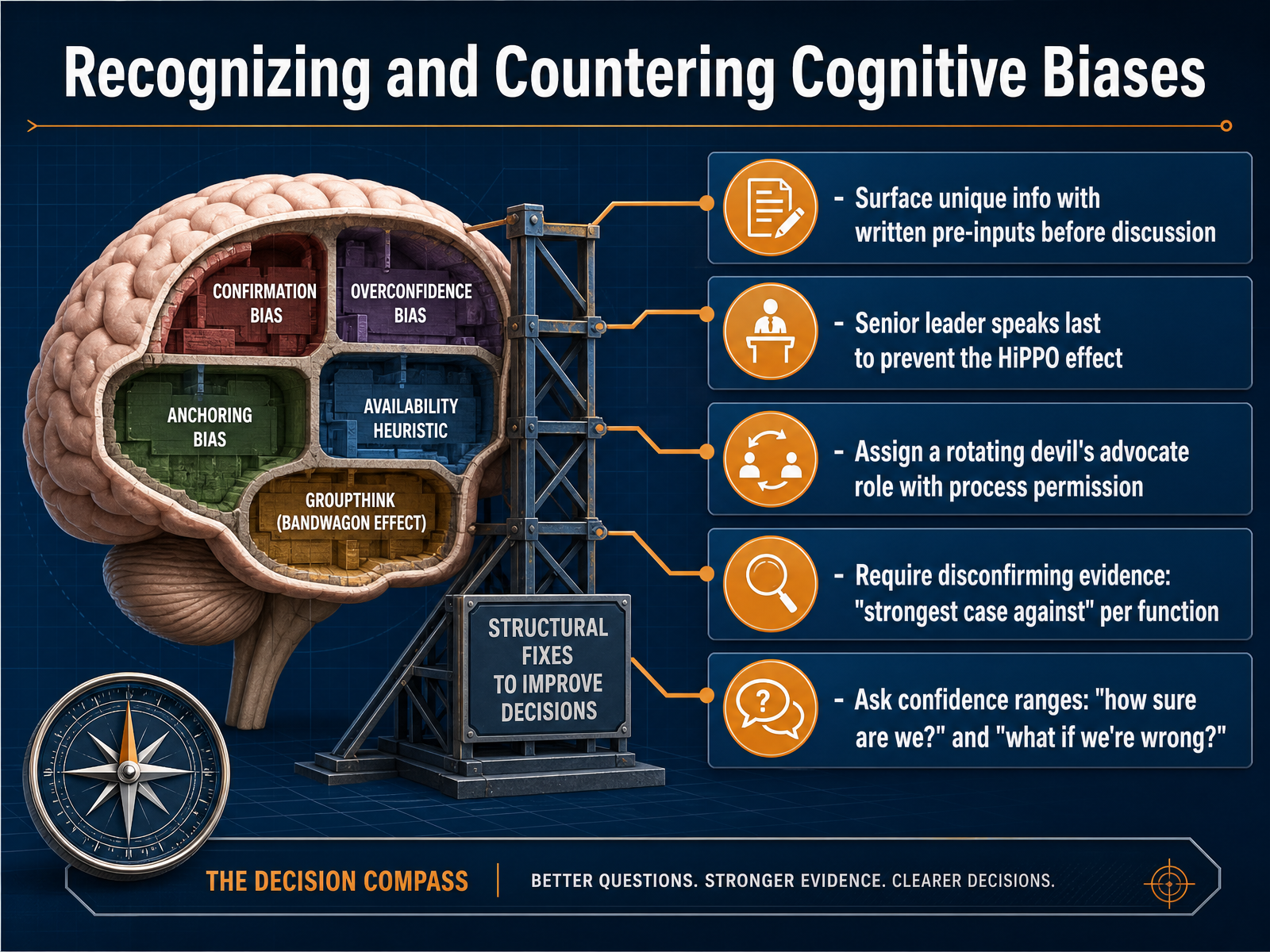
 - 07Recognizing and Countering Cognitive BiasesBiases creep in when process is loose. Here are five structural fixes. First, surface unique information. Require short written pre-inputs before anyone speaks. Second, neutralize the HIPPO effect. The most senior person speaks last, not first. Third, assign a rotating devil's advocate role with explicit permission to challenge. Fourth, mandate disconfirming evidence. Ask each function for the strongest case against its preferred option. Fifth, use confidence ranges. Ask: how sure are we? And what would we expect to see if we're wrong? These aren't soft skills. They're process rules. Next, let's apply these rules inside the decision meeting itself: design and facilitation.
 hbr.orgquestworks.ioglobal-integration.com+21 min
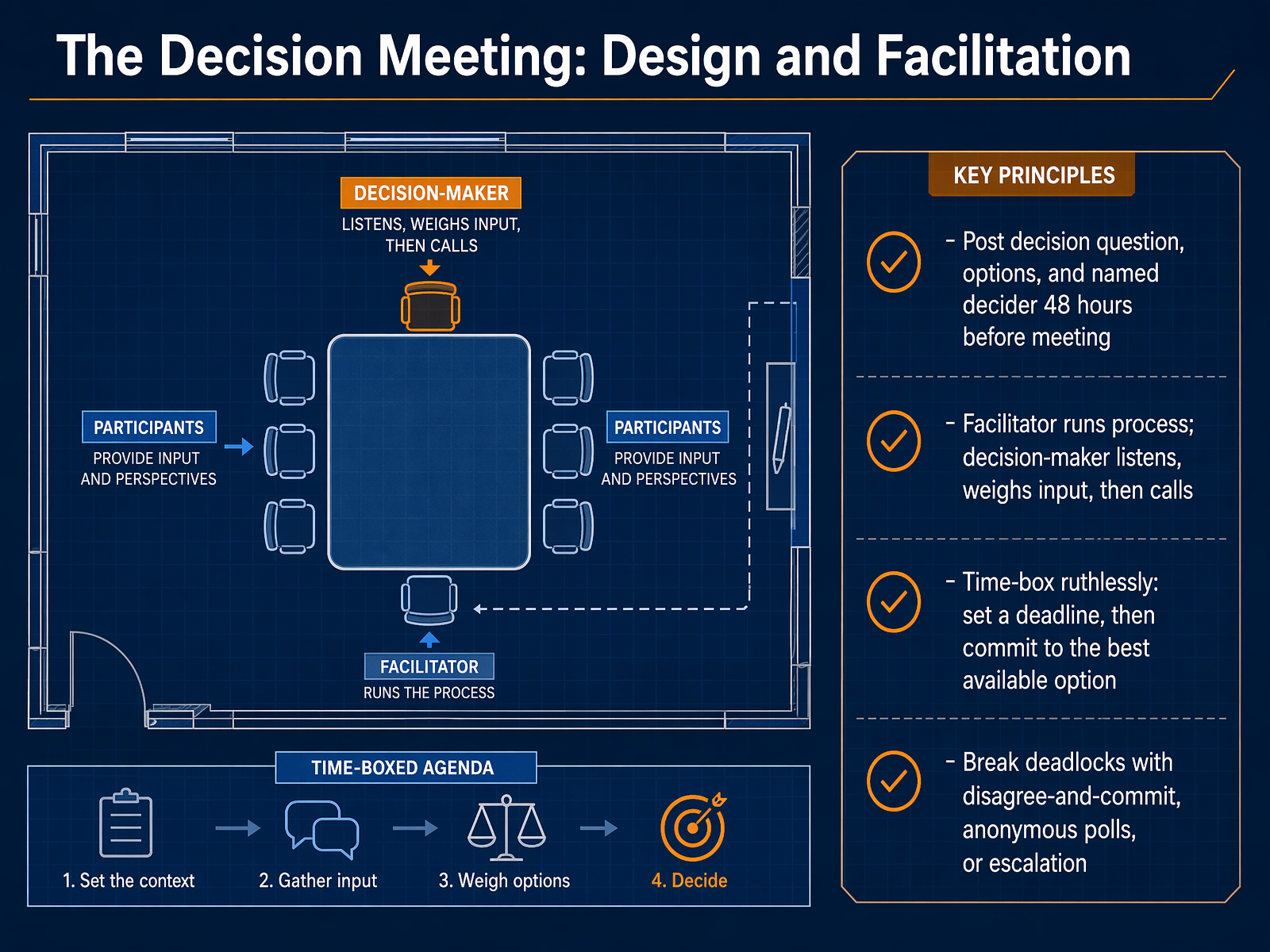
 - 08The Decision Meeting: Design and FacilitationNow let's talk about designing and facilitating the actual decision meeting. First, set the stage right. At least 48 hours before the meeting, post the decision question, the options on the table, and the name of the single decider. This gives everyone time to think, not just react. Once the meeting starts, the facilitator runs the process. The decision-maker listens, weighs all the input, and then makes the call. They do not dominate the conversation. Next, time-box ruthlessly. Set a hard deadline and commit to the best available option when time is up. Perfect clarity beats perfect analysis. If you hit a deadlock, break it. Use disagree-and-commit, anonymous polls, or a clear escalation path. These are not failures; they are design features that keep the team moving. Up next, we'll unpack the specific protocol for disagree-and-commit.
 en.wikipedia.orgcnbc.comthink.fearlessculture.design+22 min
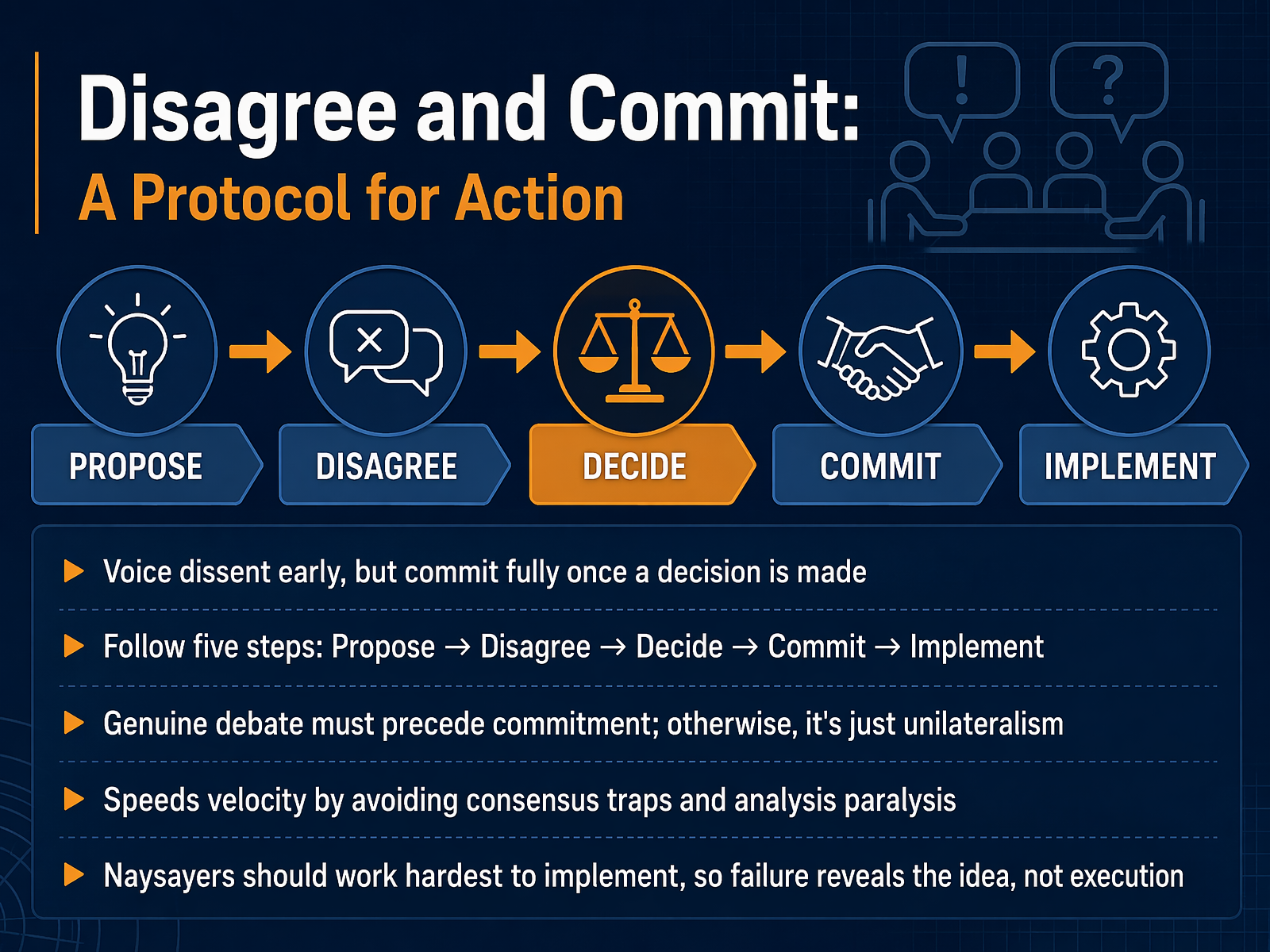
 - 09Disagree and Commit: A Protocol for ActionNow let's walk through the protocol that turns dissent into velocity. It's a five-step flow: Propose, Disagree, Decide, Commit, Implement. The sequence matters. Genuine debate must come before commitment. Otherwise, you're just dressing up a unilateral decision in polite language. Step one, Propose. Someone puts a clear recommendation on the table. Step two, Disagree. This is the critical window. Voice your dissent early, with data, not just preference. Silence here is not agreement. It’s a missed opportunity. Step three, Decide. The person with authority makes the call. They don't need consensus. They need all the facts. Step four, Commit. Once the decision is made, you commit fully. This is the acid test. Jeff Bezos frames it perfectly: 'I know we disagree on this, but will you gamble with me on it?' Step five, Implement. And here's the twist. The naysayers should work the hardest on execution. Why? So if the idea fails, you know it was the idea that was wrong, not the execution. This protocol avoids the consensus trap and kills analysis paralysis. Next, we'll look at how to communicate the decision and its rationale clearly.
 en.wikipedia.orgcnbc.comthink.fearlessculture.design+22 min
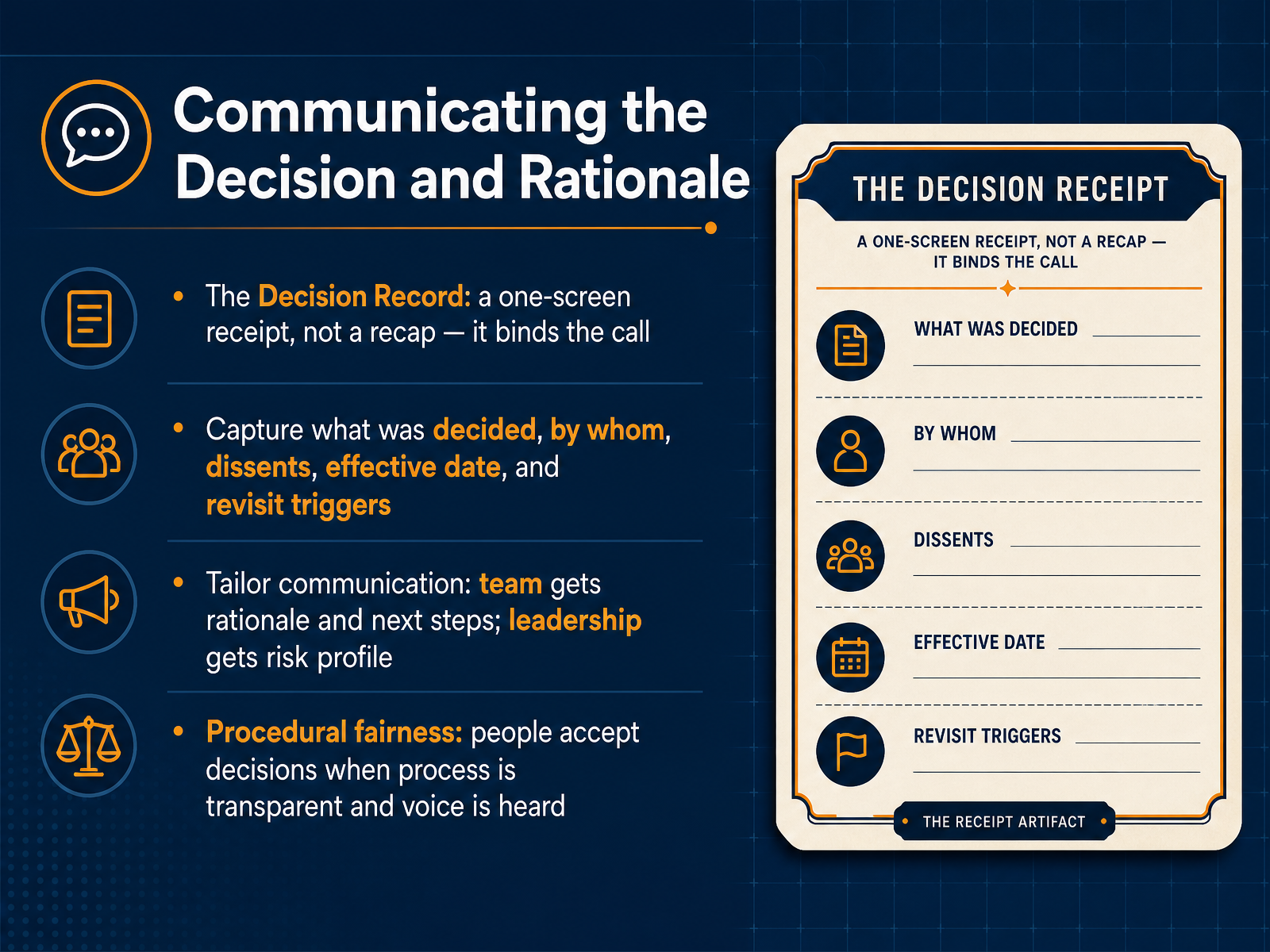
 - 10Communicating the Decision and RationaleA decision isn't finished until everyone knows the outcome and the reasoning behind it. Start with the Decision Record. This is a one-screen receipt, not a recap. It binds the call. Capture what was decided, who decided it, any dissenting views, the effective date, and the triggers that would cause a revisit. This record prevents the same debates from resurfacing later. Next, tailor your communication. The team needs the rationale and the immediate next steps to execute. Leadership needs the risk profile and the trade-offs you weighed. Finally, procedural fairness matters. People accept decisions when the process is transparent and their voice was heard. Even if the final call isn't their preference, documenting dissent shows it was considered. That's how you build trust and prevent sabotage after the meeting. Now, let's look at turning decisions into action.
 hbr.orgquestworks.ioglobal-integration.com+21 min
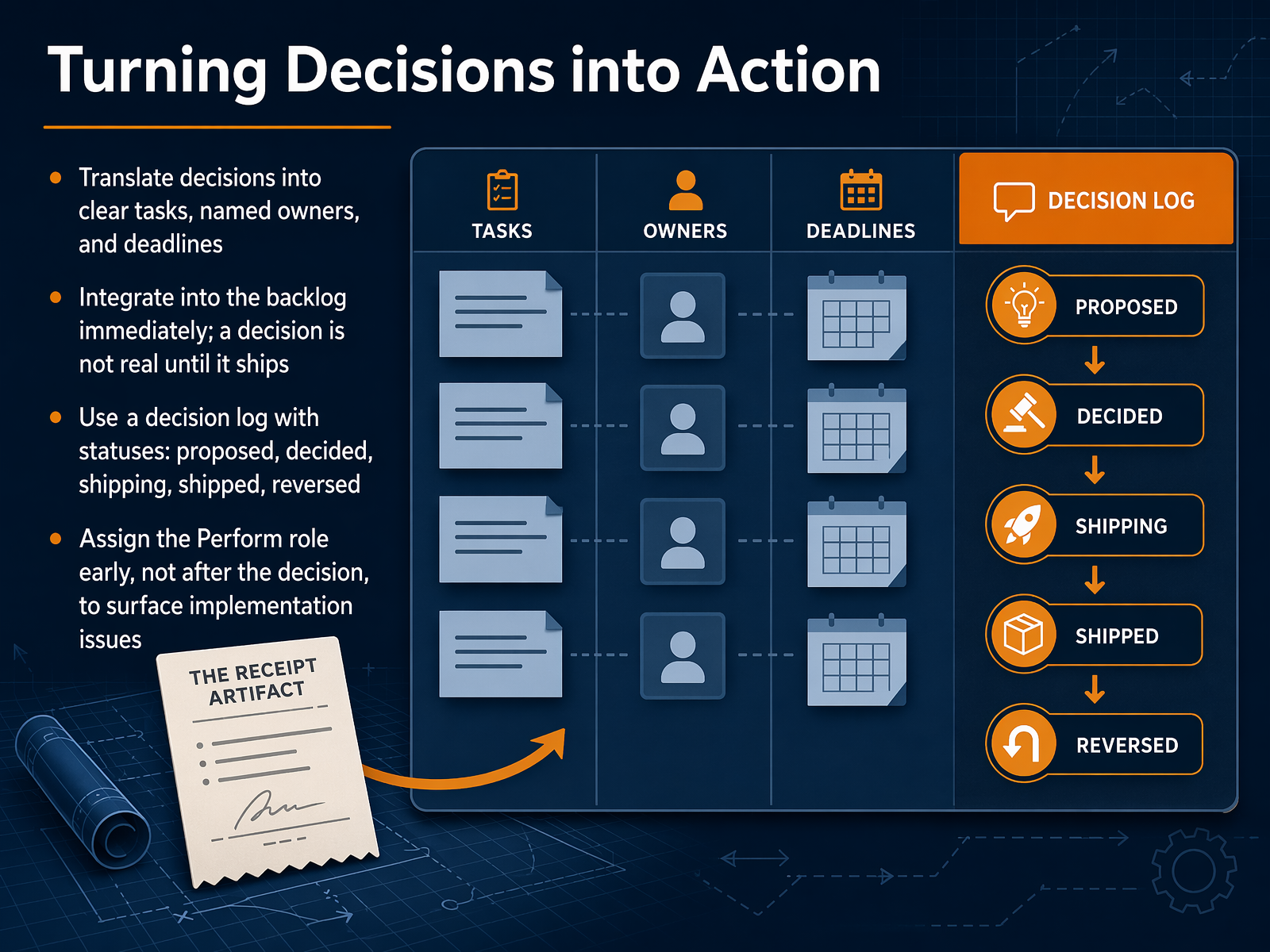
 - 11Turning Decisions into ActionA decision only counts once it moves into action. Here is how to make that happen. First, translate the decision into clear tasks, with a named owner and a deadline for each. No owner means no progress. Second, integrate these tasks into your backlog immediately. A decision is not real until it ships. Third, track every decision in a single log with clear statuses: proposed, decided, shipping, shipped, or reversed. This log is your single source of truth. Finally, assign the Perform role early, not after the decision is final. Early performers surface implementation issues while there is still time to adjust. This turns a theoretical choice into shippable work. Next, let's look at escalation paths: when and how to raise a decision.
 bain.comasana.comiapm.net+21 min
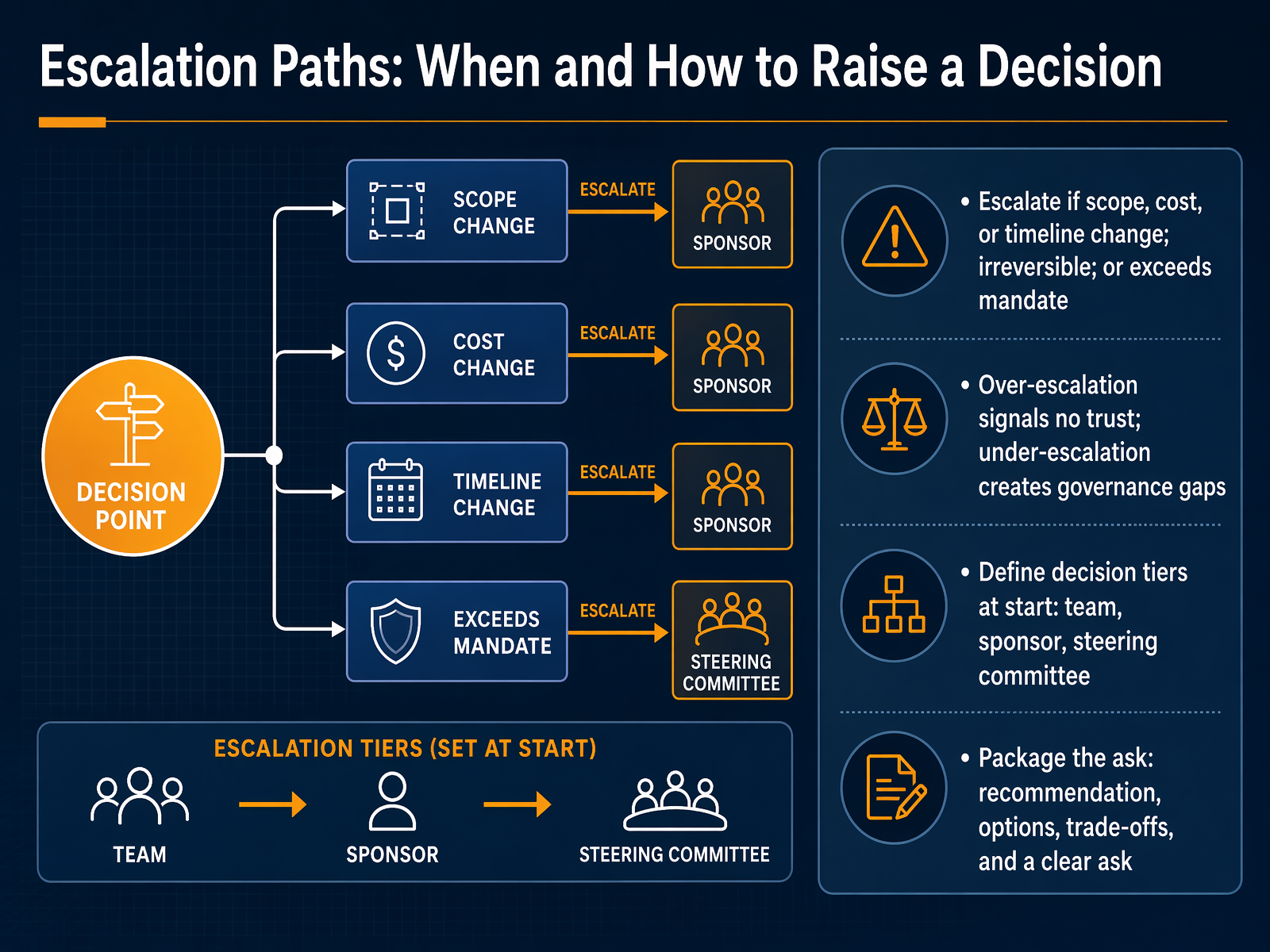
 - 12Escalation Paths: When and How to Raise a DecisionNow let's look at escalation paths, because knowing when to raise a decision is as important as knowing how to make one. There are three clear triggers. Escalate if scope, cost, or timeline change. Escalate if the decision is irreversible. And escalate if it exceeds the team's mandate. Over-escalation sends a signal of no trust. Under-escalation creates governance gaps. Define decision tiers at the start: team, sponsor, steering committee. When you do escalate, package the ask. Include your recommendation, the options you considered, the trade-offs, and a clear statement of what you need. This turns escalation into a structured handoff, not a cry for help. Next, we'll apply these principles to decision-making in distributed and hybrid teams.
 hbr.orgquestworks.ioglobal-integration.com+21 min
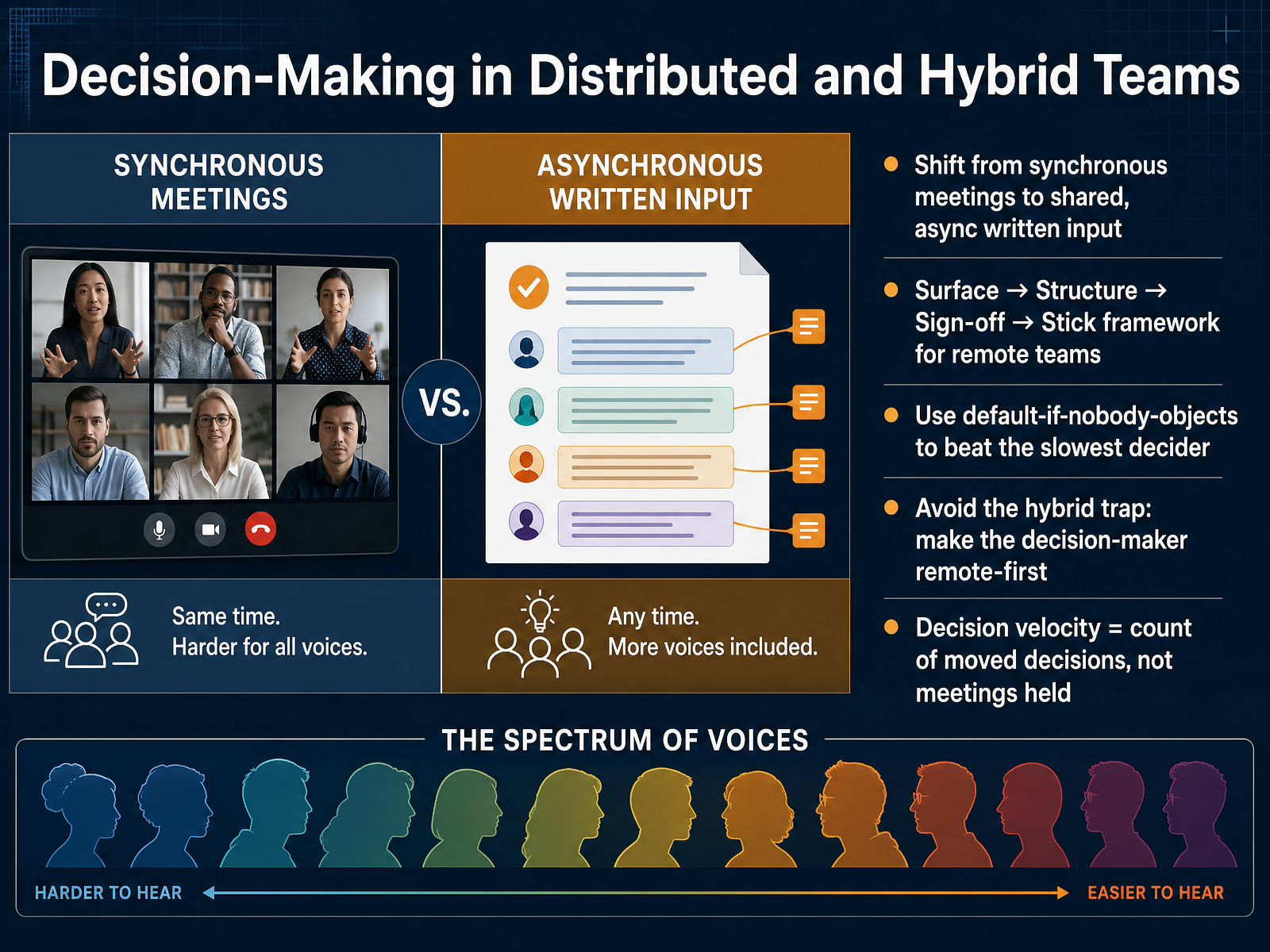
 - 13Decision-Making in Distributed and Hybrid TeamsLet's move on to decision-making in distributed and hybrid teams. The key shift is from synchronous meetings to shared, asynchronous written input. This levels the playing field across time zones. We use the framework: Surface, Structure, Sign-off, and Stick. Surface the decision early. Structure the input. Sign-off with a named decider. And stick the outcome in a tracked log. A powerful rule is default-if-nobody-objects. This beats the slowest decider by setting a deadline where silence equals consent. Avoid the hybrid trap. If the decision-maker is always in the room, remote voices become second-class. Make the decision-maker remote-first by default. Finally, measure decision velocity. It is a count of moved decisions, not meetings held. Up next: AI's role in team decision-making.
 hbr.orgquestworks.ioglobal-integration.com+21 min
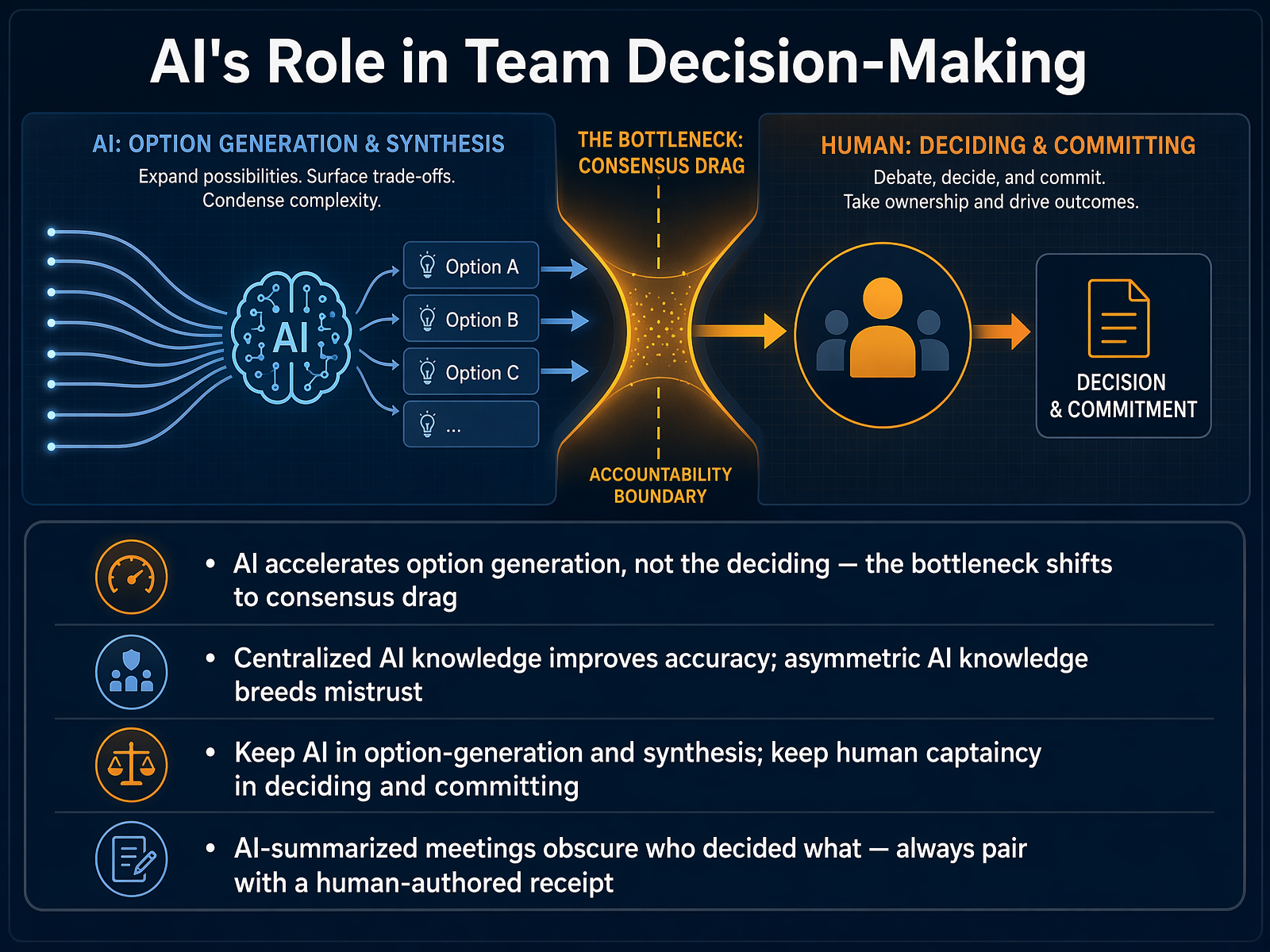
 - 14AI's Role in Team Decision-MakingNow, let’s talk about where AI fits in team decision-making. First, AI is excellent at accelerating option generation. But it doesn’t decide. The bottleneck shifts to consensus drag. When everyone can produce three options in minutes, the real work becomes choosing, not creating. Second, watch out for knowledge asymmetry. When AI has centralized knowledge, accuracy improves. When AI knowledge is unevenly distributed, it breeds mistrust and doesn’t outperform human teams. Third, keep AI in its lane. Use it for generating options and synthesizing information. Keep human captaincy for deciding and committing. Finally, a critical fix. AI-summarized meetings often obscure who decided what. Always pair the summary with a human-authored receipt. That receipt must name the decider, the dissents, and the effective date. This prevents accountability from dissolving into a polished AI recap. Next, let’s move on to reviewing and learning from past decisions.
 hbr.orgquestworks.ioglobal-integration.com+22 min
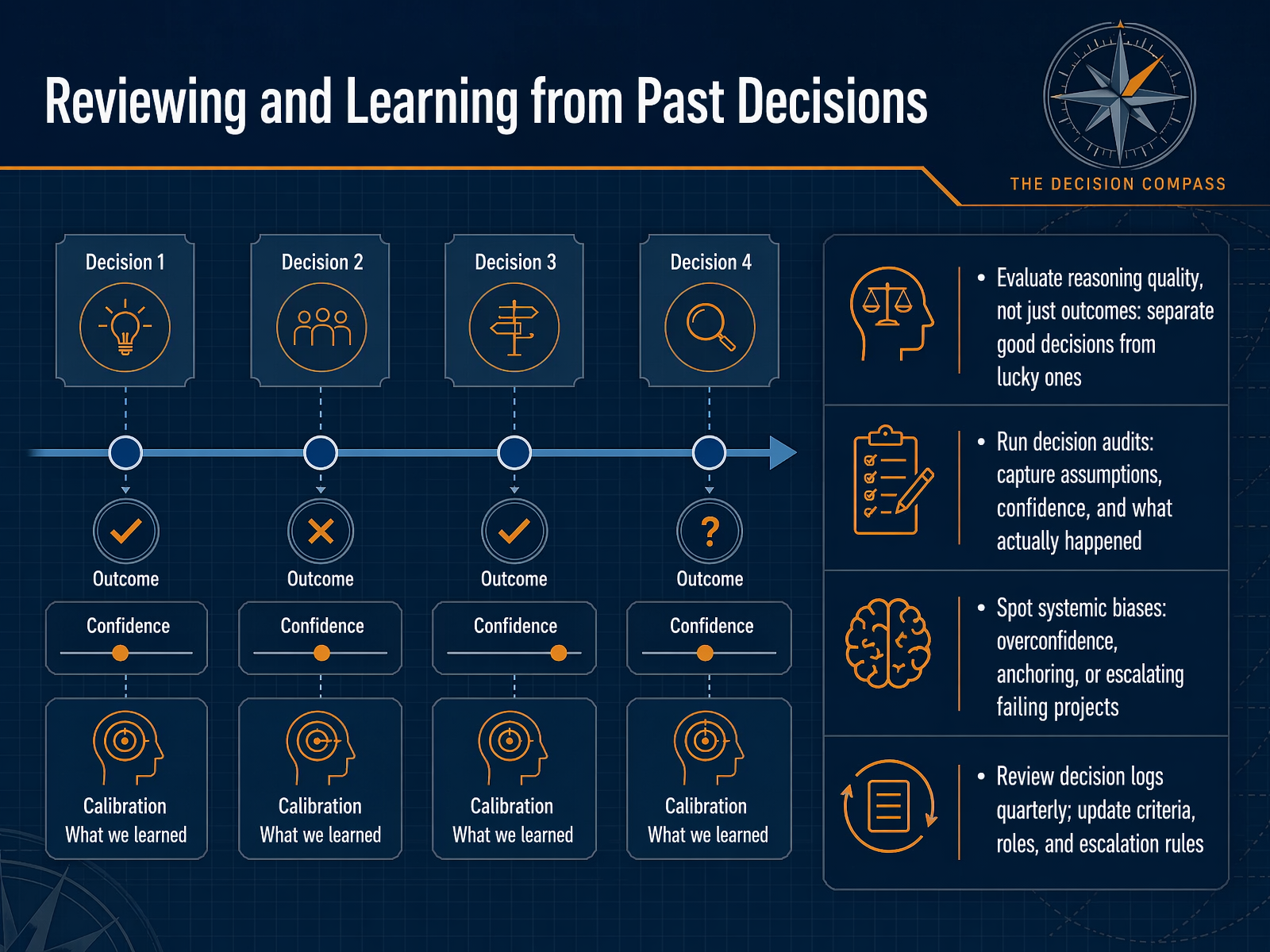
 - 15Reviewing and Learning from Past DecisionsNow let's turn to how we review and learn from the decisions we've already made. This is where a good team gets sharper over time. First, evaluate the quality of your reasoning, not just the outcome. A lucky bad process is still a bad process. Separate the two. Next, run decision audits. Write down your original assumptions, your confidence level, and what actually happened. If you don't capture it, you can't learn from it. Third, watch for systemic biases. Look for patterns like overconfidence, anchoring on the first number mentioned, or throwing good money after a failing project. Finally, review your decision log every quarter. Update your criteria, your roles, and your escalation rules based on what you learn. The goal is to make your next decision better than your last one. That brings us to our final slide: your team decision playbook, a sixteen-page summary you can use right away.
 hbr.orgquestworks.ioglobal-integration.com+22 min
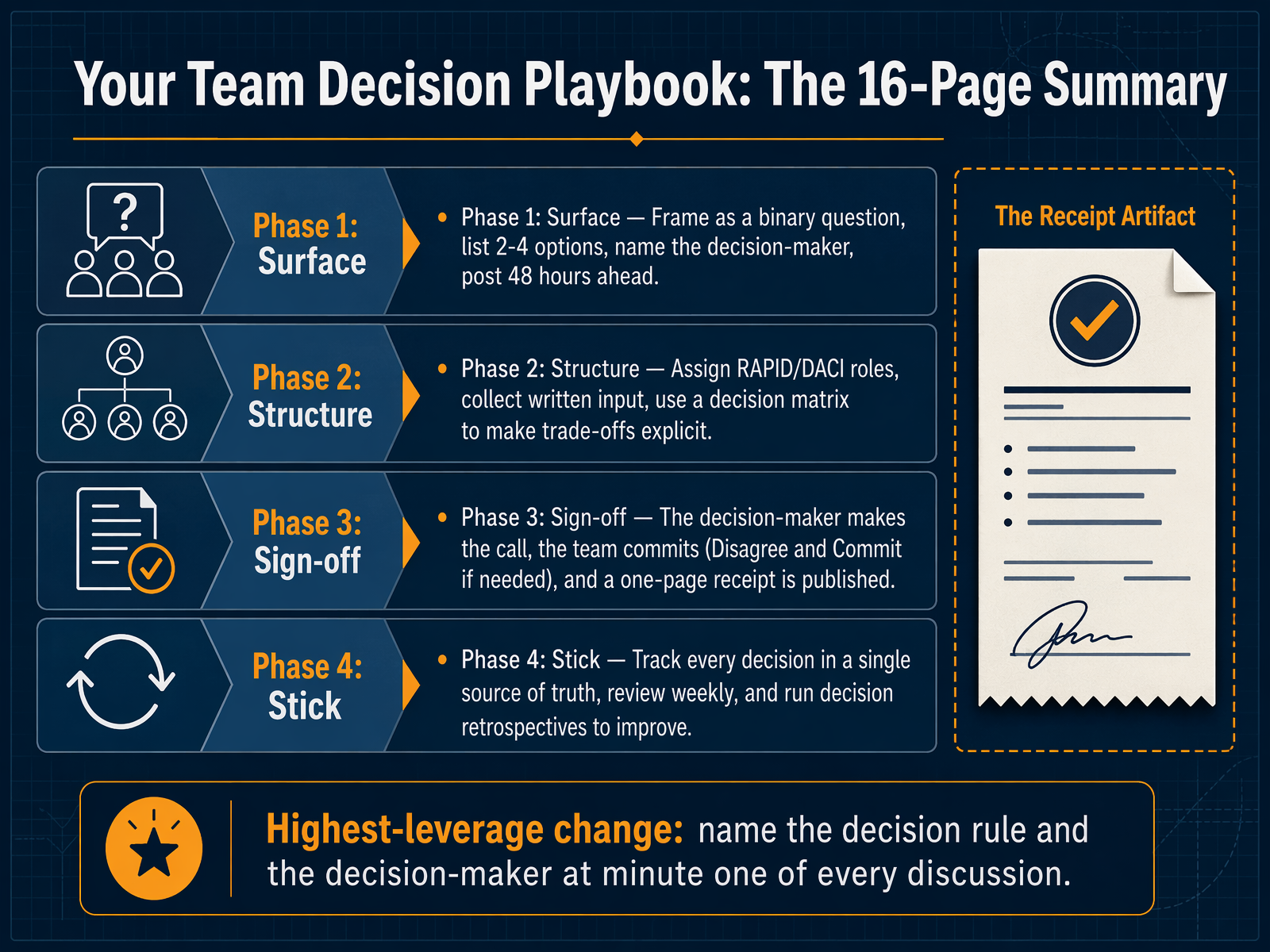
 - 16Your Team Decision Playbook: The 16-Page SummaryHere is your team decision playbook, summarized on one page. Phase one is Surface. Frame the decision as a binary question, list two to four options, name the decision maker, and post it forty-eight hours ahead. Phase two is Structure. Assign R A P I D or D A C I roles, collect written input, and use a decision matrix. This makes trade-offs explicit. For example, one option saves time, another reduces risk. Phase three is Sign-off. The decision maker makes the call. The team commits, using Disagree and Commit if needed, and publishes a one-page receipt. Phase four is Stick. Track every decision in a single source of truth, review it weekly, and run decision retrospectives to improve. The highest-leverage change is naming the decision rule and the decision maker at minute one of every discussion. Thank you for building this playbook. The discipline starts with your next decision.
 hbr.orgquestworks.ioglobal-integration.com+22 min
Take the deck with you
Download this course as a file — free, no sign-up needed.
- PDF handoutEvery slide page, ready to print or share.17 pages · 4.9 MBDownload
- Narrated PowerPointThe deck that presents itself — every slide carries the digital human's narration video.17 pages · 13.9 MBDownload
- PowerPoint slidesThe full deck as a .pptx — open it in PowerPoint, Keynote, or Google Slides.17 pages · 4.7 MBDownload
Free to use in your own training — please keep the PersonWise credit page at the end.
Have your own deck? Turn it into a course
Sources consulted
Web sources consulted while building this course.
- What Companies Get Wrong About Decision Rights — hbr.org
- How Teams Make Decisions (And Why Most Get It Wrong) | QuestWorks — questworks.io
- Decision bias in cross-functional teams: fix the process, not the people - Global Integration — global-integration.com
- Why Team Decision Making Is the New Bottleneck (2026) — coommit.com
- 4 Hidden Traps of Team Dynamics — hbr.org
- RAPID® Decision Making Framework — bain.com
- RAPID Decision Making Framework: Roles, Steps & Tips [2025] — asana.com
- RAPID model — iapm.net
- How to use RAPID Framework to Improve Decision Making — clickup.com
- What is the RAPID decision-making technique (and should you use it)? — plan.io
- Decision Matrix: Definition, Examples And How To Use It — monday.com
- What Is a Decision Matrix? (Example & Template Included) — projectmanager.com
- Decision Grid Template – Project Management Formula — projectmanagementformula.com
- The EPD Trade-Off Matrix — A Practical Tool for Fast, Aligned, and Defensible Decisions — benwebbprojectmanager.substack.com
- PUGH Matrix explained incl. Example and Template - Toolshero — toolshero.com
- Disagree and commit — en.wikipedia.org
- Jeff Bezos says using this phrase can make teams twice as productive — cnbc.com
- Disagree and Commit: A 5-Step Playbook to Make Faster, Smarter Decisions — think.fearlessculture.design
- Disagree and Commit — REWORK — 37signals.com
- Jeff Bezos Uses the 'Disagree and Commit' Rule to Overcome an Uncomfortable Truth About Teamwork — inc.com