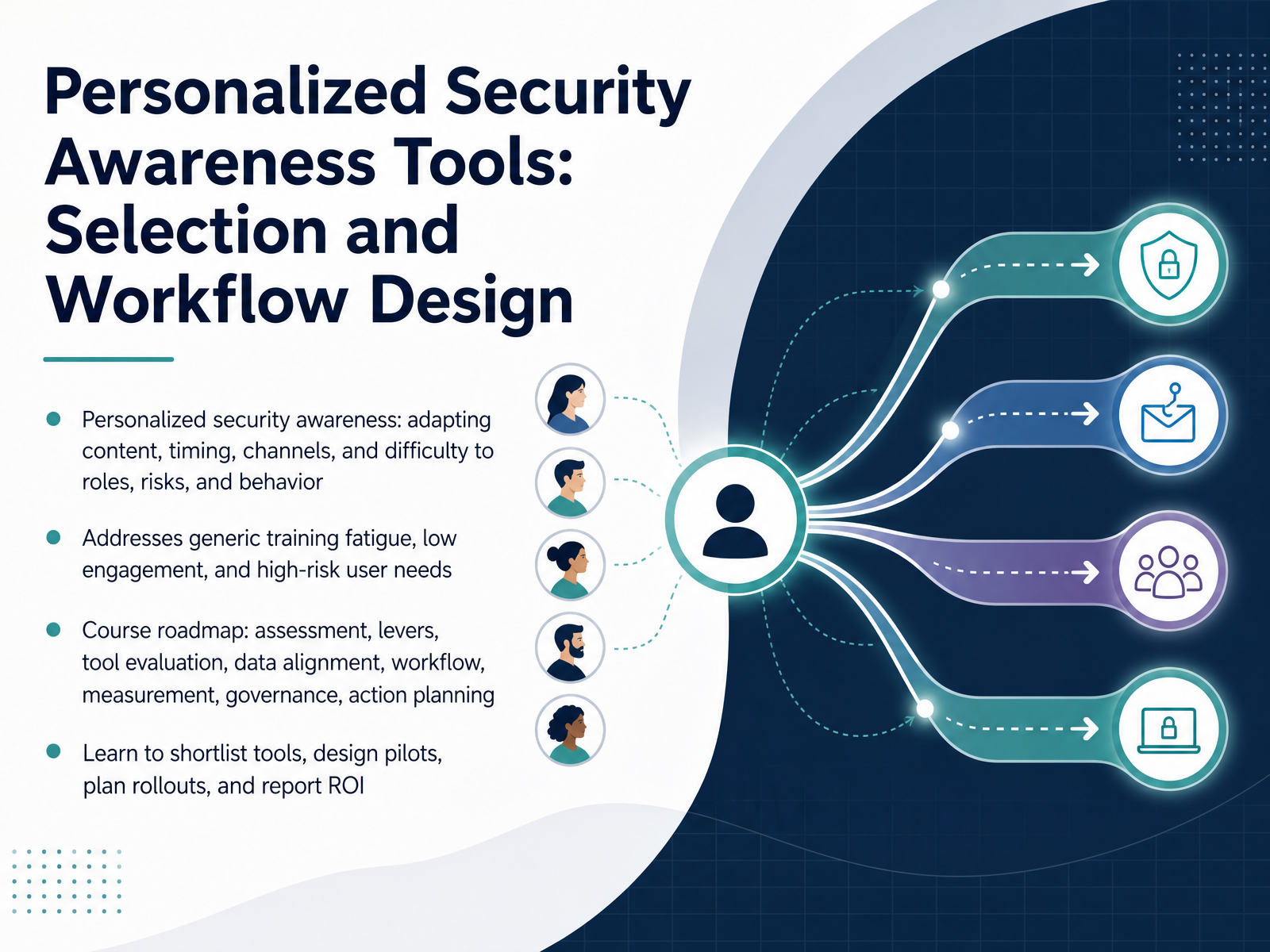
Personalized Security Awareness Training Design
Begin
14 pages · ~28 min
Personalized Security Awareness Training Design
Learn to select and design personalized security awareness tools and workflows, enabling effective, tailored training programs for your organization.
What you’ll learn
- 01Personalized Security Awareness Tools: Selection and Workflow DesignWelcome. If you own a security awareness program, you know the old model is breaking down. Generic training for everyone, once a year, doesn't move the needle for the people who matter most. Personalized security awareness changes that. It adapts content, timing, and difficulty to each person's role and actual risk. This course is your practical roadmap. We'll move from assessment through tool selection, data alignment, workflow design, and measurement. You'll learn how to shortlist vendors, structure a pilot, plan a full rollout, and report return on investment with confidence. The goal is simple: replace fatigue with relevance, and turn training into a measurable risk reduction engine. Let's get started. First, we need to understand why personalization matters in security awareness.ajsat.orgknowbe4.comblog.knowbe4.com+21 min
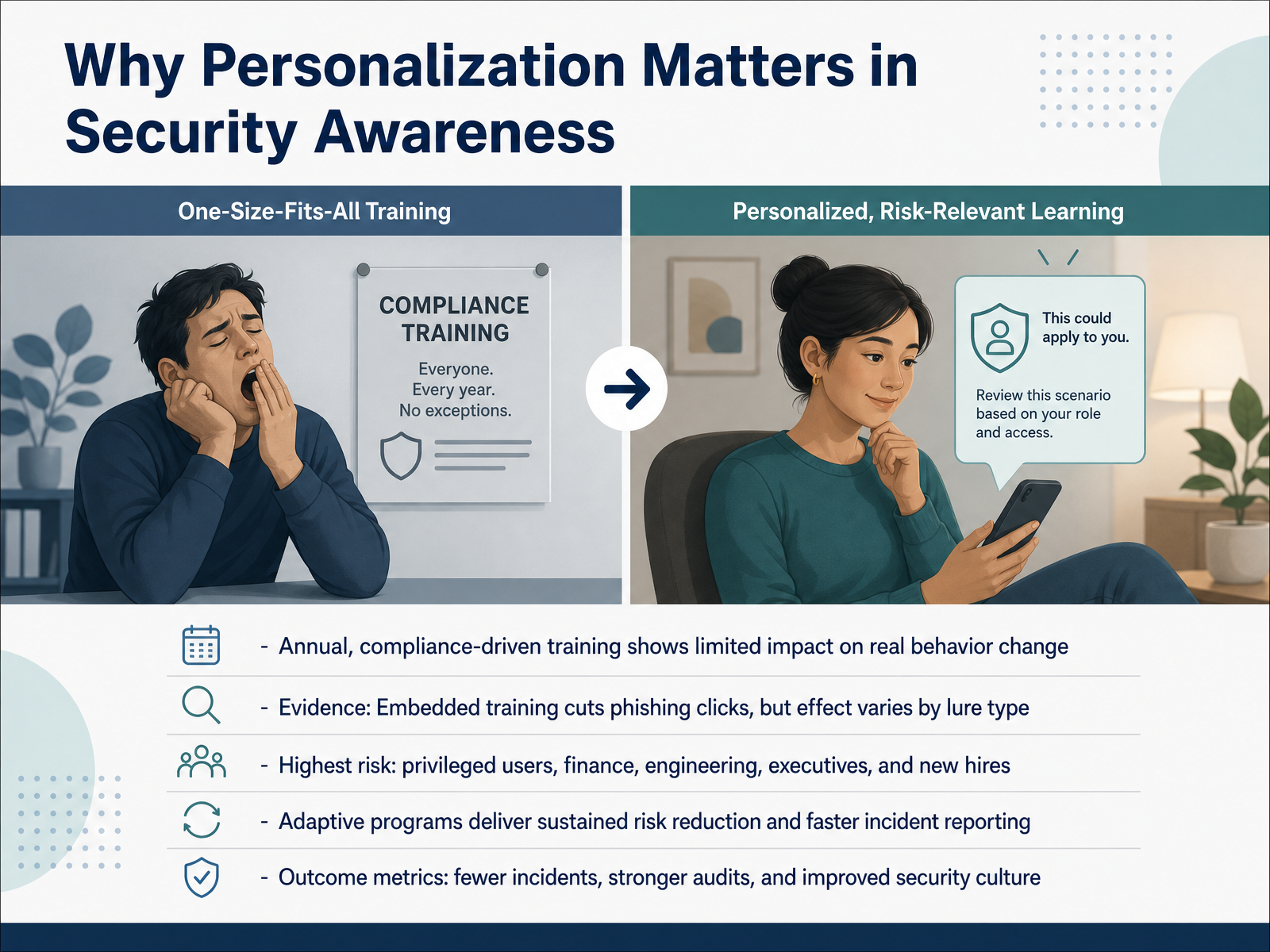
- 02Why Personalization Matters in Security AwarenessLet’s talk about why personalization matters before we dive into the tools. Annual, compliance-driven training checks a box, but it rarely changes behavior. Recent field studies show that embedded phishing training cuts clicks by only a few percentage points on average. And the effect varies by lure type. Urgency-based credential resets, for example, are almost resistant to it. Your highest risk groups are privileged users, finance, engineering, executives, and new hires. These roles face targeted attacks that generic content does not address. Adaptive programs change that. They deliver sustained risk reduction and faster incident reporting. The outcome metrics are clear. Fewer incidents, stronger audits, and a measurable shift in security culture. That is the target we are designing for. Next, we will see how moving from one-size-fits-all to human risk management makes this possible.
 ajsat.orgknowbe4.comblog.knowbe4.com+22 min
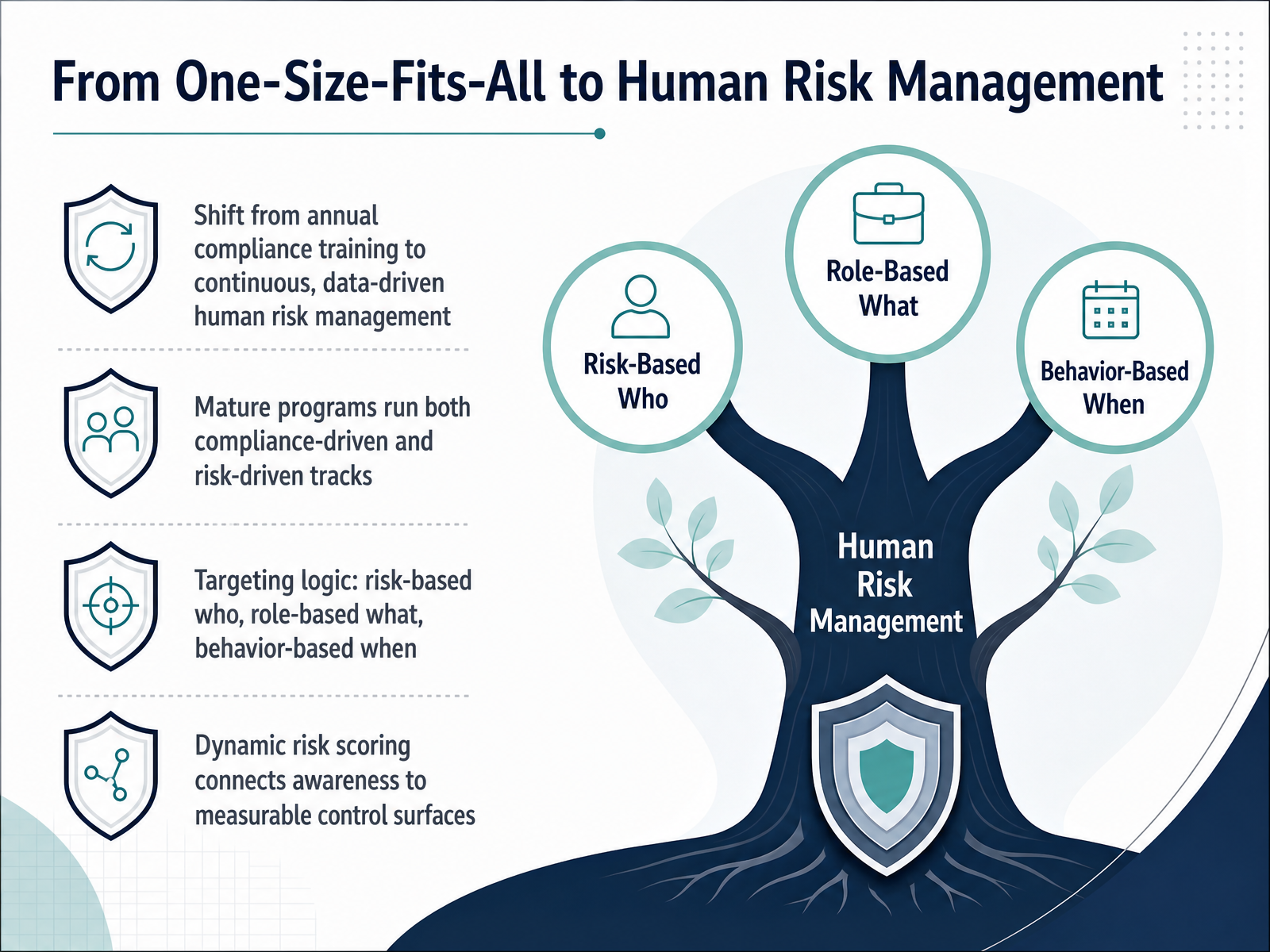
 - 03From One-Size-Fits-All to Human Risk ManagementLet's talk about the shift from one-size-fits-all programs to true human risk management. The old model treats everyone the same: same annual module, same quarterly newsletter, same completion certificate. But risk is not uniform across your workforce. An intern and a CFO face different threats. A developer and an accounts payable clerk carry different exposures. Mature programs now run two tracks simultaneously: a compliance-driven track that satisfies auditors and regulators, and a risk-driven track that targets the behaviors that actually lead to breaches. The targeting logic is straightforward. Risk-based decisions determine who needs intervention and how urgently. Role-based decisions determine what content is relevant for each job function. And behavior-based logic triggers training when a meaningful event happens, like a failed simulation. Dynamic risk scoring is what connects all of this to measurable control surfaces. Every simulation result, training interaction, and reported phish feeds into a score that updates continuously. That score tells you where exposure is concentrated and whether your program is actually moving the needle. Your goal is no longer a completed checkbox. It is a quantifiable, downward-trending risk curve. Next, let's look at the core personalization levers you can pull to build that kind of program.
 adaptivesecurity.comphishiq.ioadaptivesecurity.com+22 min
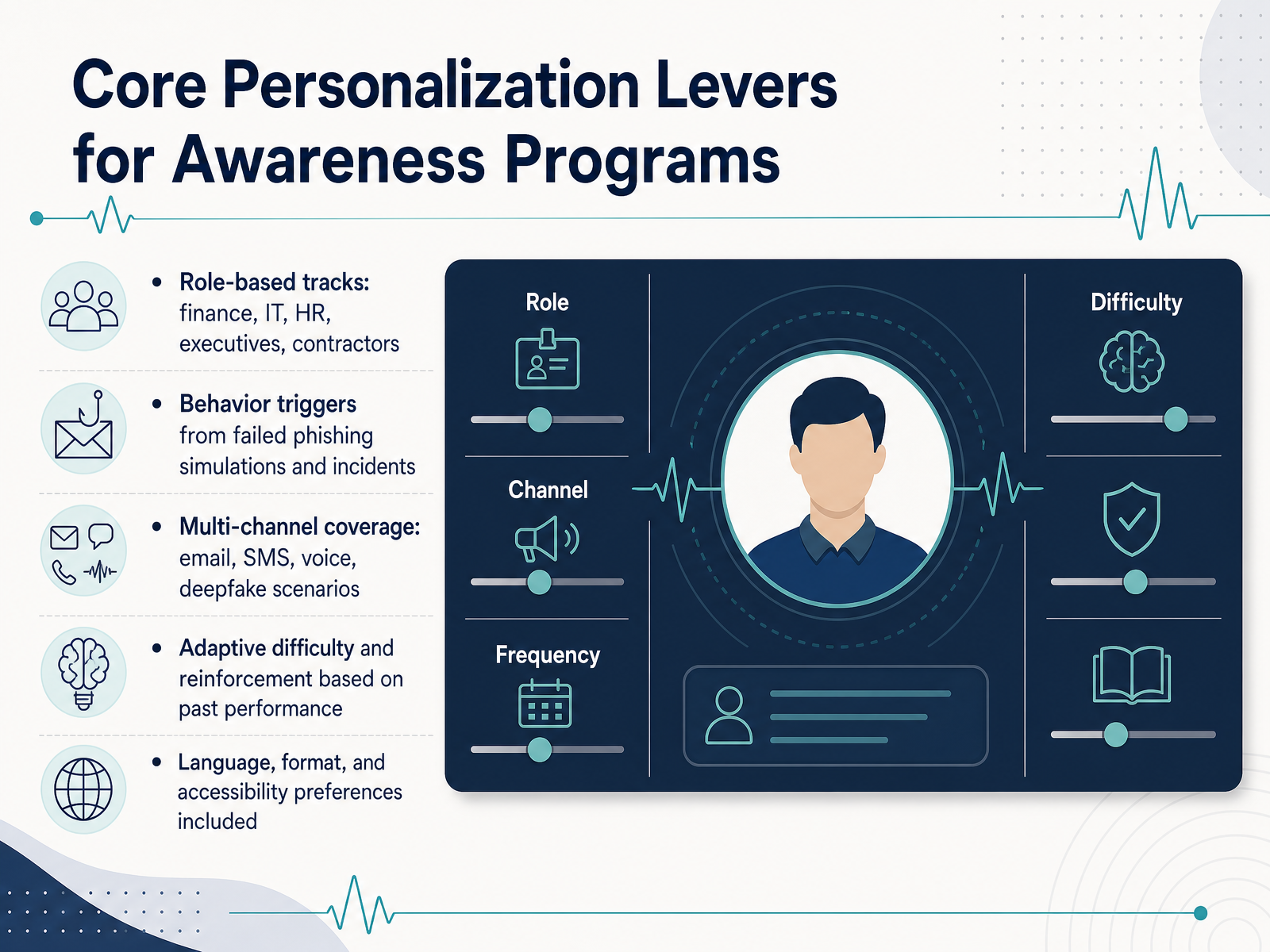
 - 04Core Personalization Levers for Awareness ProgramsLet's shift from strategy to the specific levers that make personalization work in practice. You have five core levers at your disposal. First, role-based tracks. Finance teams need business email compromise scenarios. IT staff need credential theft simulations. Executives face deepfake impersonation. Contractors need scoped content that respects their limited access. Second, behavior triggers. Don't rely on the calendar. When someone fails a phishing simulation, trigger immediate microlearning based on that specific mistake. Third, multi-channel coverage. Email is no longer enough. Your program must extend to SMS, voice calls, and deepfake video scenarios, because that's where attackers are going. Fourth, adaptive difficulty. Push harder simulations to those who demonstrate resilience and provide reinforcement to those who need it. Performance should dictate the next challenge. Finally, bake in language, format, and accessibility preferences from the start. Content only works if people can actually consume it. These levers work together. Role tells you what they face, behavior tells you when they need help, and channel coverage tells you how to test them. Let's now turn to how you evaluate the tools that deliver this personalization.
 livingsecurity.comnhimg.orgadaptivesecurity.com+22 min
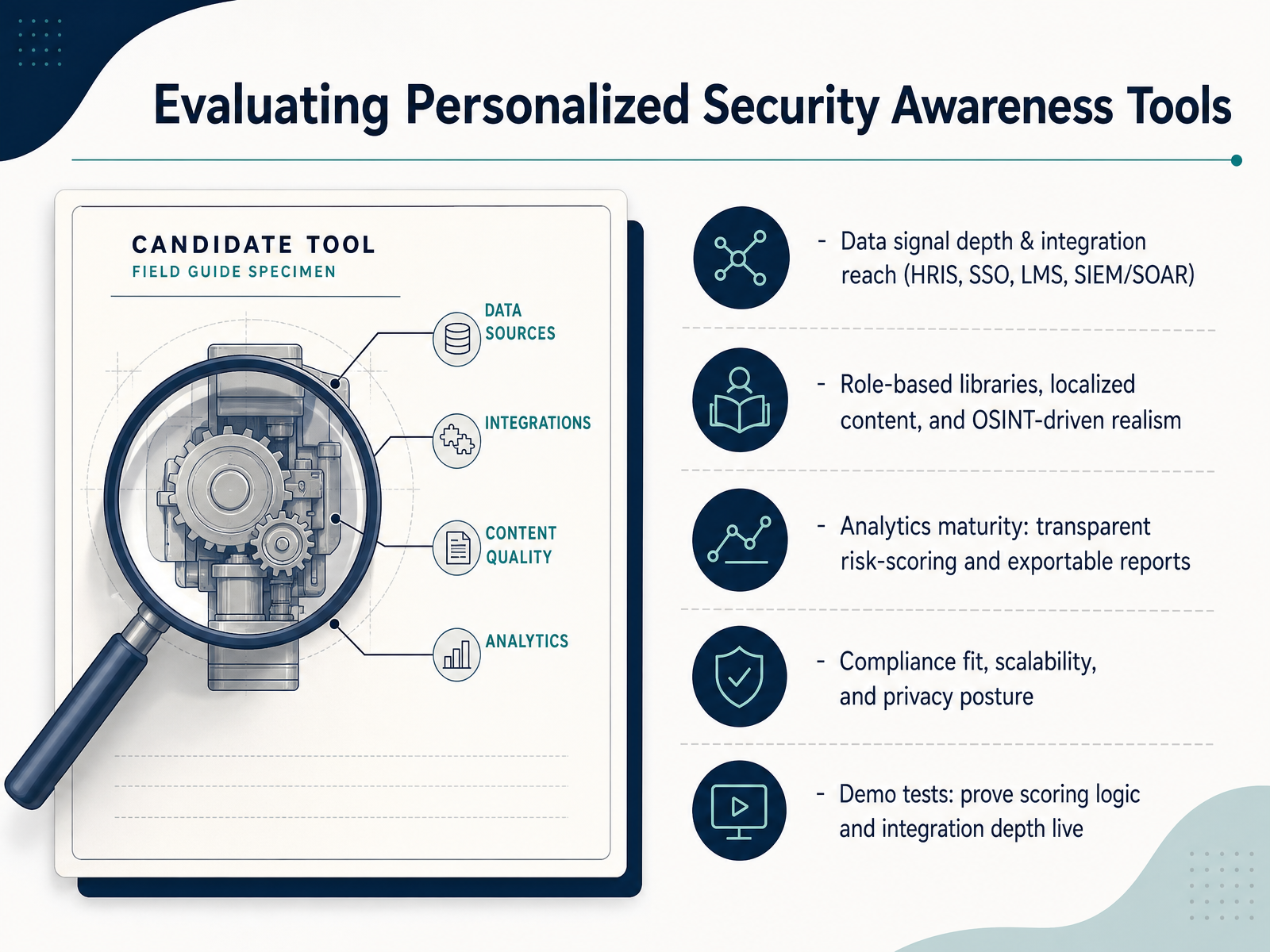
 - 05Evaluating Personalized Security Awareness ToolsLet’s talk about what to evaluate before you commit. First, consider data signal depth. A platform that only tracks simulation clicks is measuring reaction, not exposure. It should integrate with your HRIS, SSO, LMS, and ideally your SIEM or SOAR, so risk scores reflect real behavior and breach history, not just campaign results. Second, content needs to be role-based and localized. Ask if simulations use open-source intelligence to mirror what real attackers already know about your executives and finance teams. Third, analytics maturity. You need transparent risk scoring and exportable reports. If the vendor cannot explain exactly which signals feed the score and how they are weighted, the scoring is likely cosmetic. Fourth, compliance fit, scalability, and privacy posture. Confirm the platform maps to your required frameworks and can scale across regions without violating data residency rules. Finally, run live demo tests. Ask the vendor to prove scoring logic and integration depth during the call, not from a slide deck. This separates genuine capability from feature lists. Next, let’s look at how a weighted scoring framework keeps this evaluation objective.
 adaptivesecurity.comphishiq.ioadaptivesecurity.com+22 min
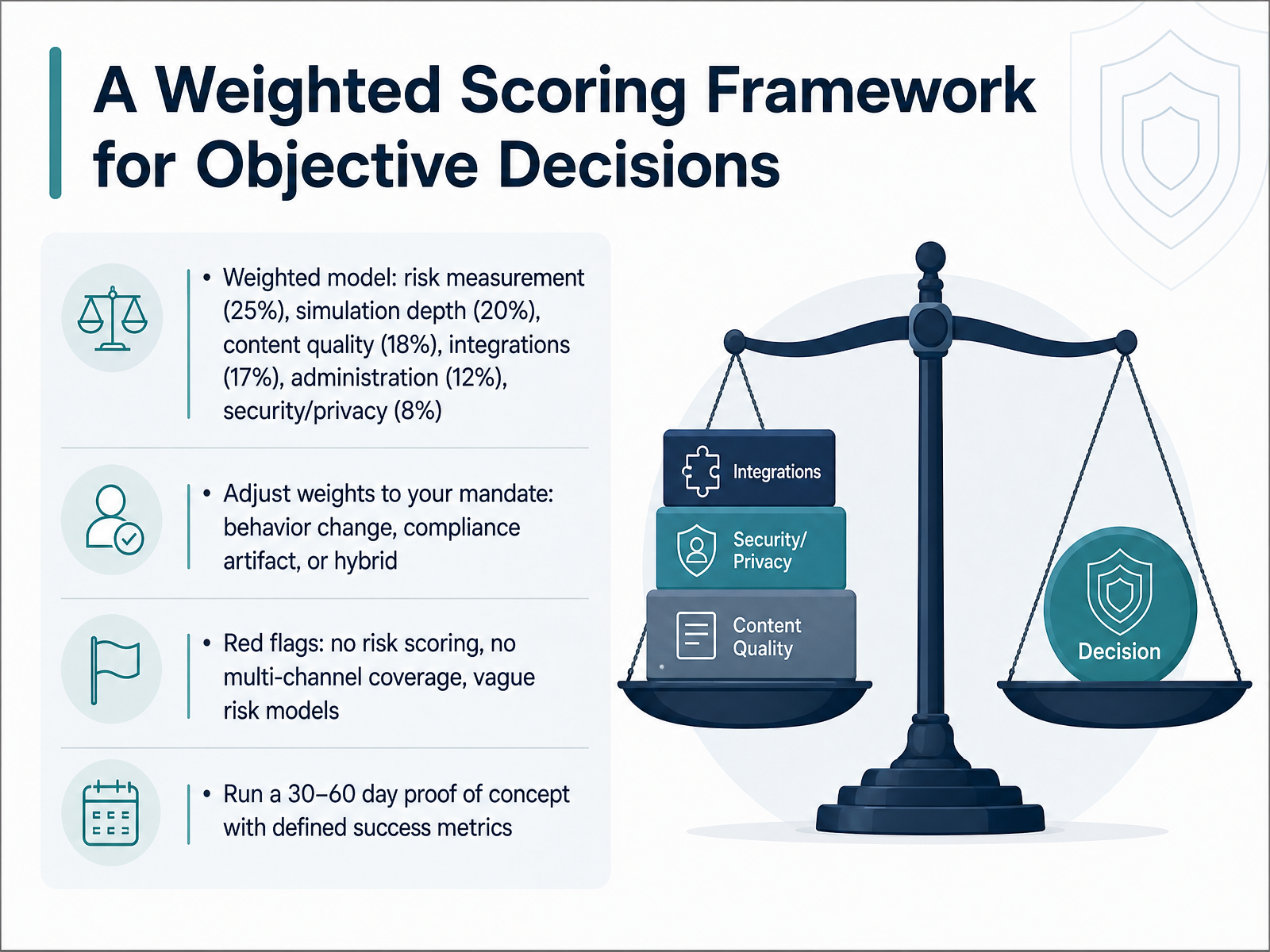
 - 06A Weighted Scoring Framework for Objective DecisionsNow let's turn those criteria into a scoring framework that keeps the decision objective. Weight what matters most for your mandate. Risk measurement leads at twenty-five percent, because you're buying a reduction in vulnerability, not just completion rates. Simulation depth follows at twenty percent. Content quality takes eighteen percent, integrations seventeen, administration twelve, and security and privacy rounds it out at eight. If your program exists mainly for compliance, shift more weight to content and reporting. If you're driving behavior change, keep risk measurement at the top. Watch for red flags during demos: no clear risk scoring methodology, email-only simulations, or vague answers about how risk is calculated. These signal a compliance tool wearing a modern label. Finally, run a thirty to sixty day proof of concept with a real employee group, not just your IT team. Define success metrics upfront, then score the vendor against this framework before the pilot ends. That discipline anchors your decision in measurable risk reduction. Next, let's look at aligning personalization data with your existing systems.
 adaptivesecurity.comphishiq.ioadaptivesecurity.com+22 min
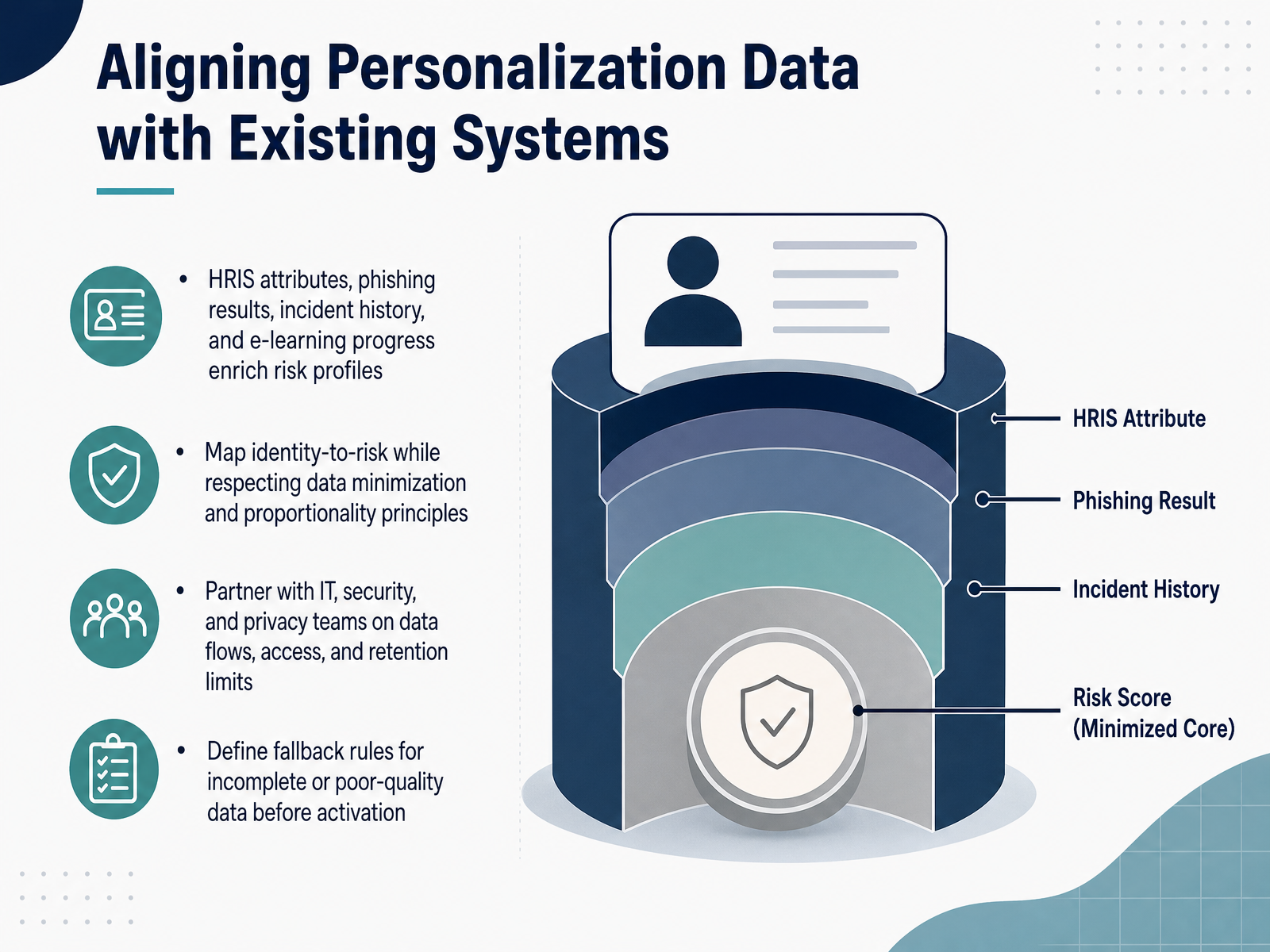
 - 07Aligning Personalization Data with Existing SystemsNow let’s talk about aligning personalization data with systems you already have. HRIS attributes, phishing results, incident history, and e-learning progress can all enrich risk profiles. But the goal is to map identity to risk, not to collect everything possible. Respect data minimization and proportionality—ask yourself what is truly necessary for the personalization to work. Partner early with IT, security, and privacy teams. You need them to define data flows, access limits, and retention rules from the start. Also, decide on fallback rules for incomplete or poor-quality data before you launch. What happens when someone has no phishing history or has just joined? Your risk model needs a default path so no employee falls outside the system. A practical example: if a manager moves roles, their past training data still applies, but their risk profile should adjust based on new responsibilities. That is where clean data mapping pays off. Keep it simple, keep it minimal, and you will build trust while improving outcomes. Next, let’s look at the wider privacy, legal, and trust considerations you need to weigh.
 aepd.eslexology.comlegiscope.com+21 min
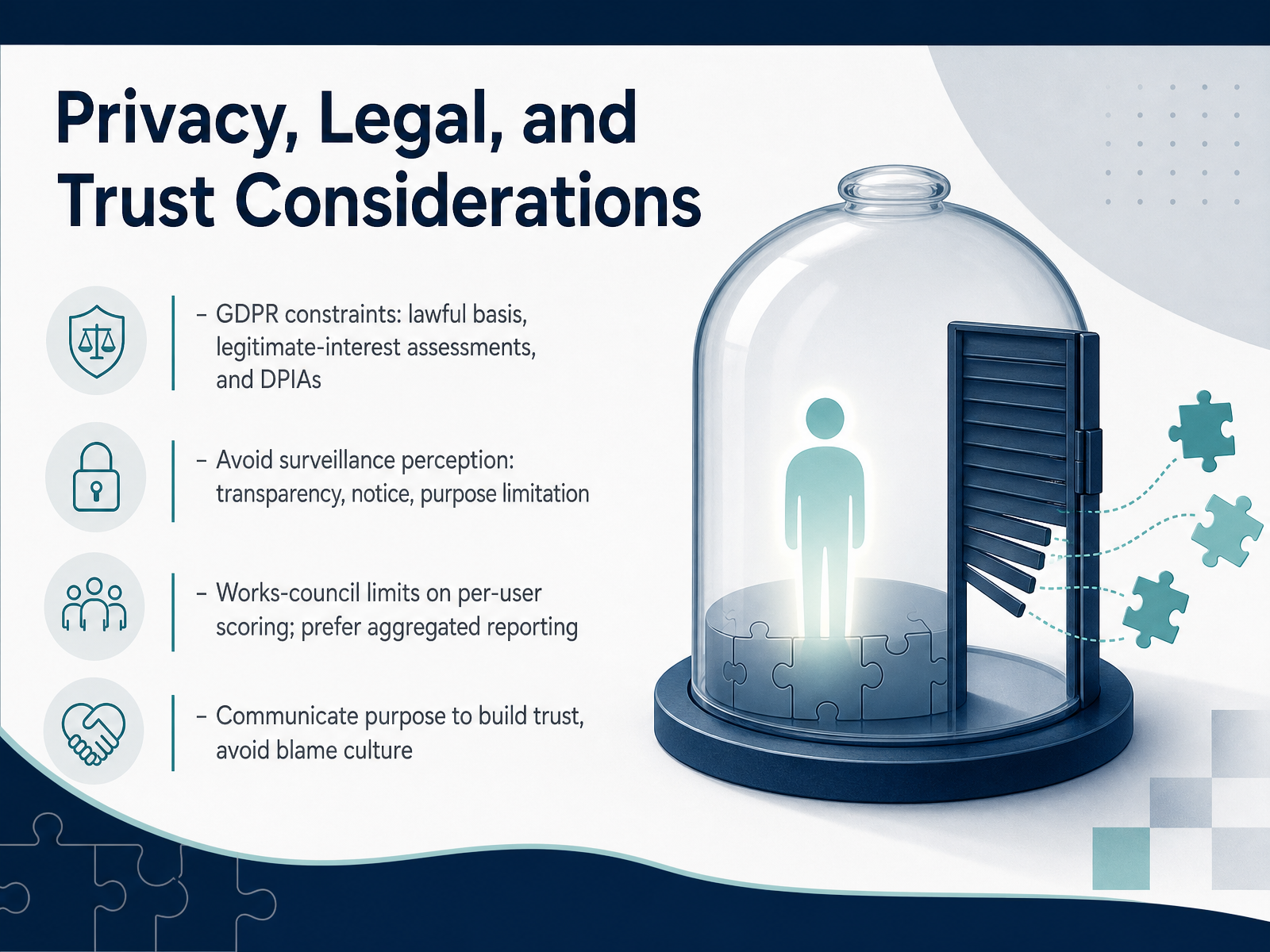
 - 08Privacy, Legal, and Trust ConsiderationsLet’s look at the privacy, legal, and trust side of personalization. This is where programs often stumble. If you’re in the EU, GDPR means you need a lawful basis for processing behavior data. Legitimate interests can work, but you’ll likely need an assessment on file documenting proportionality. And if you're doing large-scale profiling, a Data Protection Impact Assessment may be mandatory. Beyond the law, perception matters. If employees feel watched, engagement drops fast. Be transparent about what you collect and why. Publish a clear notice, limit your purpose, and don't repurpose data later. That builds trust. Also, be mindful of works councils. Many restrict per-user scoring. The safer route is aggregated reporting at the team or department level. This still gives you insight without singling anyone out. Above all, communicate your purpose openly. Frame this as support, not surveillance. Reinforce that the goal is to help people recognize threats, not to punish mistakes. When people understand the why, they’re less defensive and more willing to learn. Now let’s apply these constraints and move to workflow design, from profile to personalized training plan.
 aepd.eslexology.comlegiscope.com+22 min
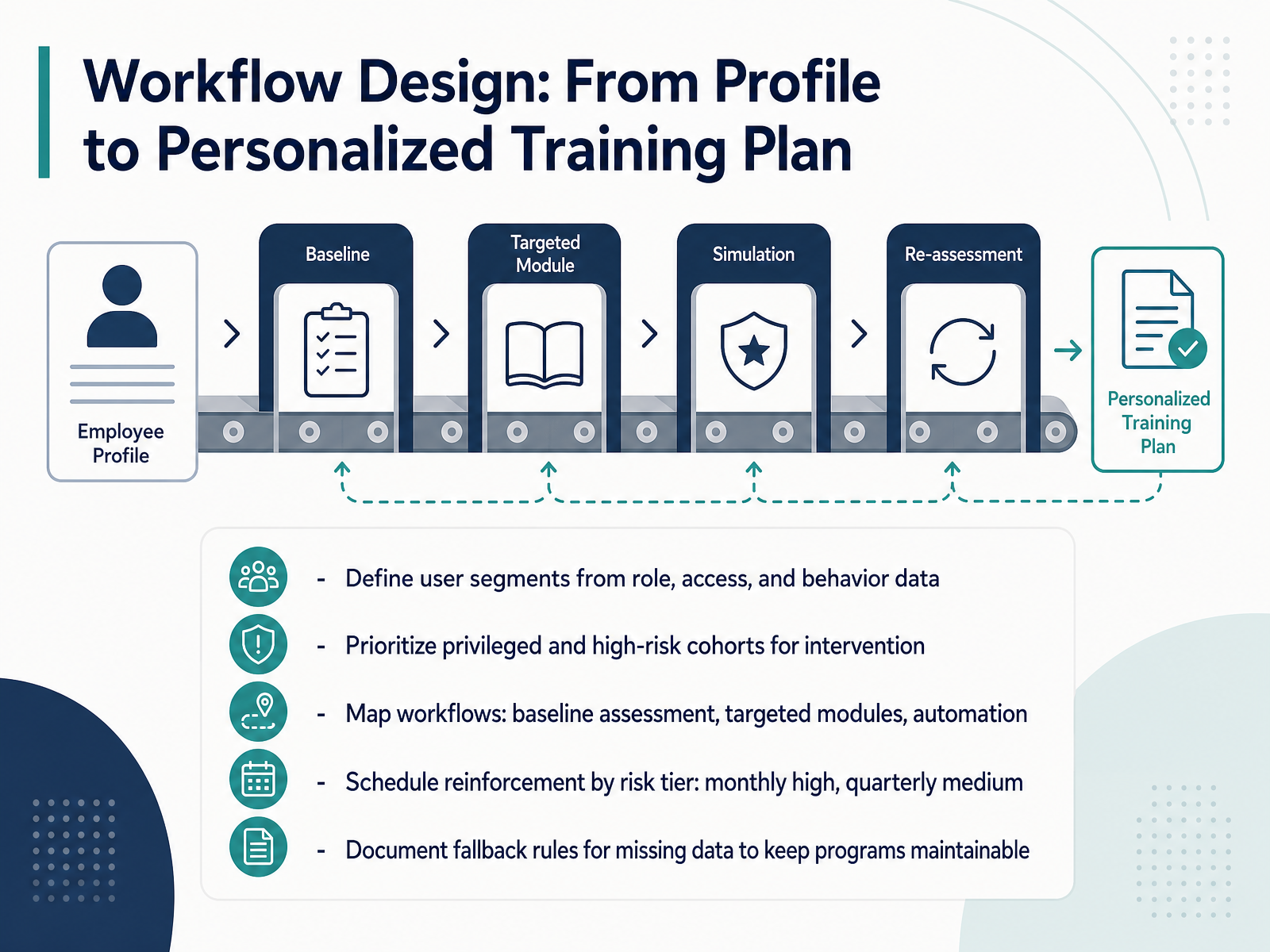
 - 09Workflow Design: From Profile to Personalized Training PlanSo how do you turn all that audience data into an actual training plan? It starts with segmentation. Group users by role, system access, and observed behavior, not just department or seniority. Then, prioritize the cohorts where a mistake would cost the most, privileged users, finance, IT admins, and anyone with broad data access. These are your high-risk segments. Now map the workflow to connect the dots: a baseline assessment establishes where everyone starts, targeted modules address demonstrated gaps, and automation handles the repetitive assignments for you. For reinforcement, think in risk tiers. High-risk cohorts get monthly touchpoints, medium-risk users move to quarterly, and low-risk staff can go to semi-annual or annual maintenance. Critically, document your fallback rules now. Decide in advance what happens when behavioral data is missing for a new hire. Without that default path, your program becomes fragile and unmanageable the moment your data feed hiccups. Next, we'll look at getting your stakeholders on board and managing the change this creates.
 livingsecurity.comnhimg.orgadaptivesecurity.com+22 min
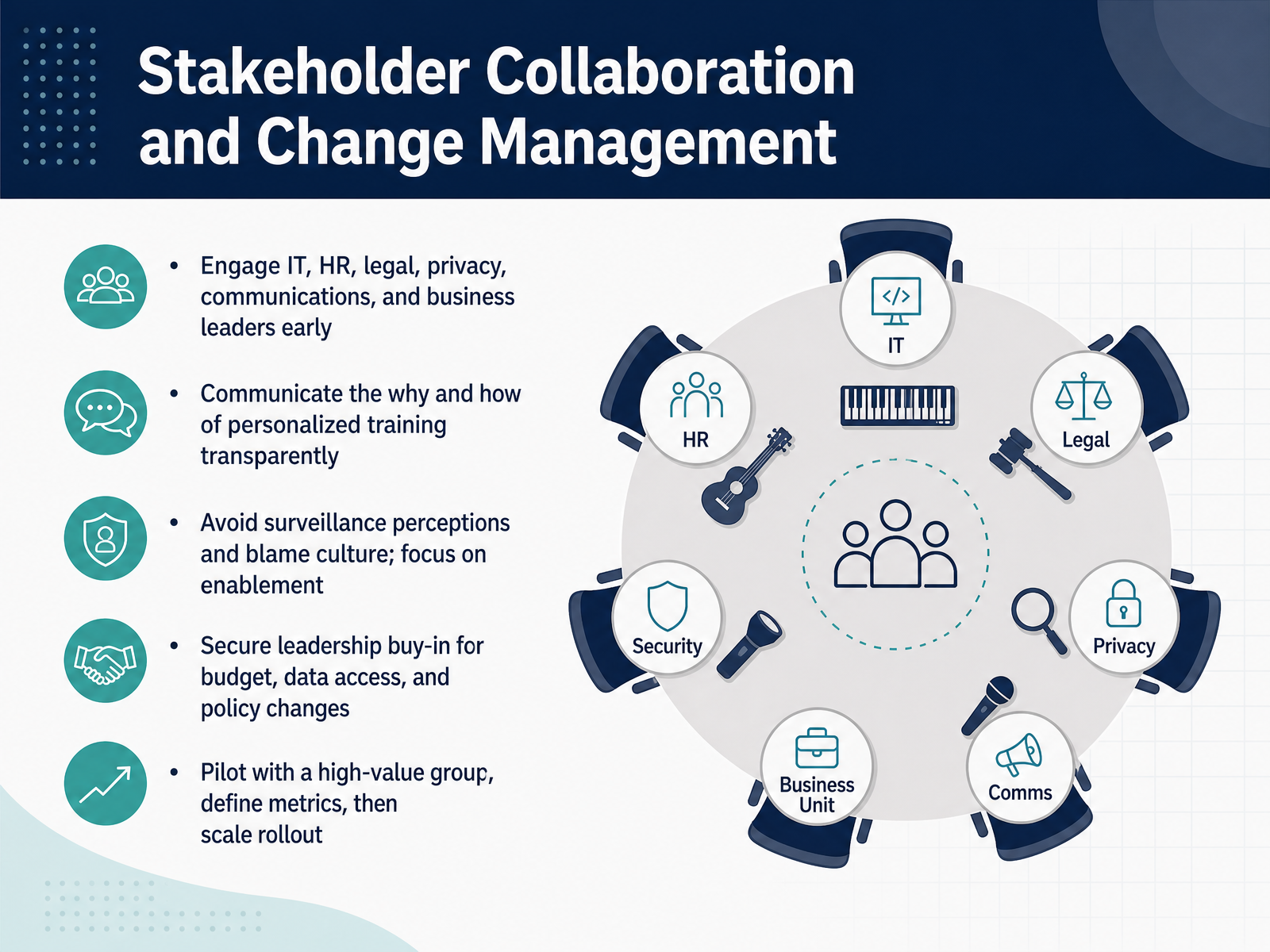
 - 10Stakeholder Collaboration and Change ManagementRolling out personalized training isn't just a technology decision, it's a change management exercise. Engage IT, HR, legal, privacy, communications, and business leaders early. Their input shapes the design, and their support clears the path. Be transparent about why you're personalizing and how it works. People accept training more readily when they understand the rationale. This is about enablement, not surveillance. Frame it that way explicitly. Secure leadership buy-in for budget, data access, and any policy changes before you start. Their backing is essential. Begin with a pilot in a high-value group. Define your success metrics, refine the workflow, and then scale. Remember that employee data is sensitive. Respect data minimization and privacy by design from the outset, and maintain clear, accessible policies. This protects your people and your program. Next, we'll look at how to measure the impact of this initiative and demonstrate its return on investment.
 aepd.eslexology.comlegiscope.com+21 min
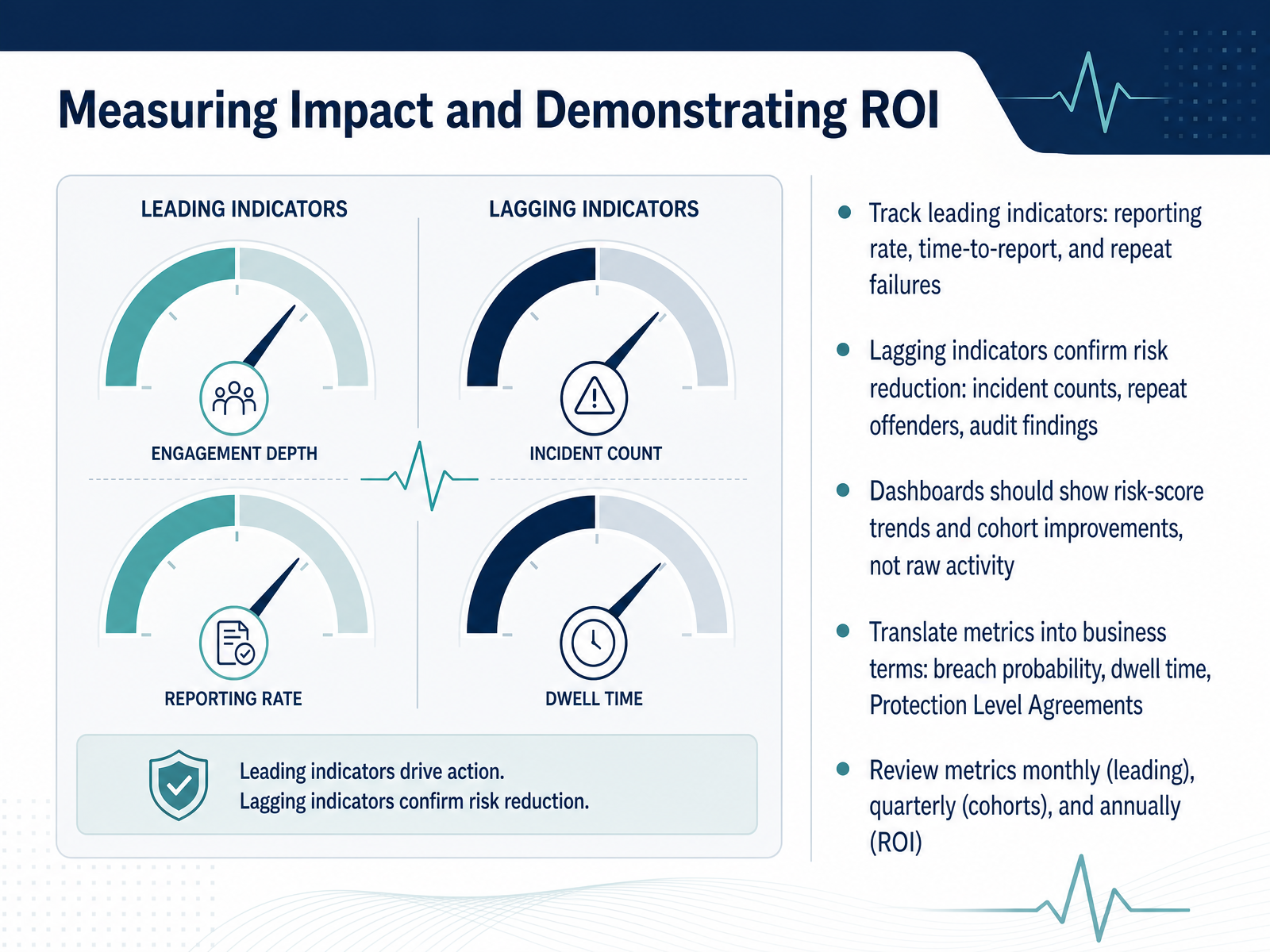
 - 11Measuring Impact and Demonstrating ROINow let’s talk about measuring impact and demonstrating ROI. Start with leading indicators. These are metrics you can act on quickly, like reporting rate, time to report, and repeat failures. They show you where behavior is shifting before problems escalate. Then pair them with lagging indicators. Incident counts, repeat offenders, and audit findings confirm that risk actually dropped over time. Remember, your dashboard should show risk-score trends and cohort improvements, not just raw activity. Stakeholders want to see progress in business terms: reduced breach probability, shorter dwell time, and how you’re meeting Protection Level Agreements. Review your leading indicators monthly to course-correct. Look at cohorts quarterly to spot patterns. And annually, step back and present the full ROI story. If you track these consistently, you’ll show impact, not just activity. Next, let’s look at common pitfalls and how to avoid them.
 1 min
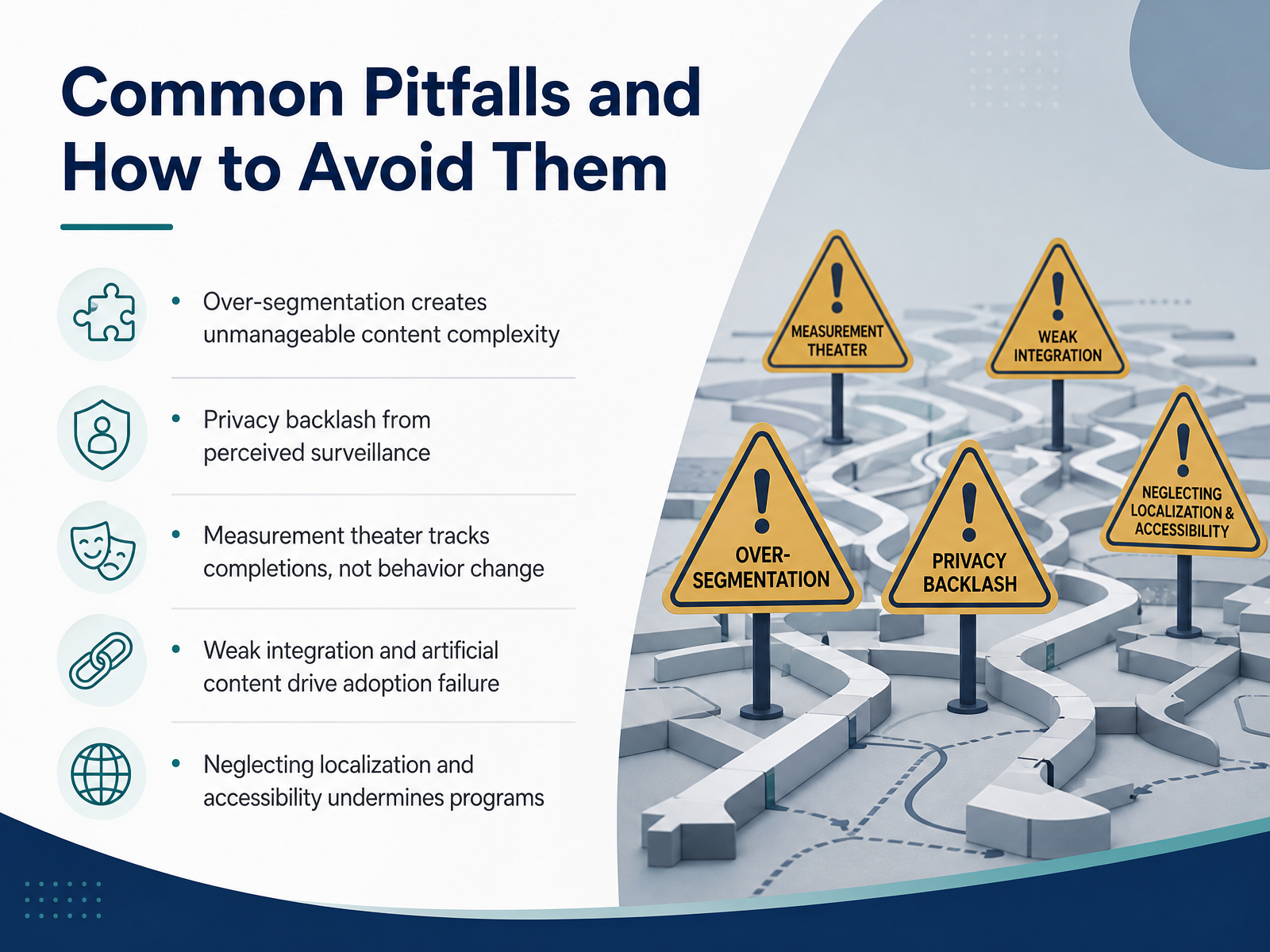
1 min - 12Common Pitfalls and How to Avoid ThemNow let's look at the common pitfalls, because knowing where programs fail is just as important as knowing what works. First, over-segmentation. Creating a unique track for every role and risk level sounds precise, but it becomes an administrative nightmare. Keep your segments meaningful but manageable. Second, privacy backlash. Employees will perceive granular tracking as surveillance if you're not transparent. Focus on aggregate risk patterns, not individual blame, and always consult your privacy team early. Third, measurement theater. Tracking completions might satisfy compliance, but it does not prove behavior change. Use leading indicators like reporting rates and time-to-report. Fourth, weak integration. If the training feels like an artificial add-on, adoption will fail. Embed micro-content into tools employees already use daily. Finally, don't neglect localization and accessibility. Content that ignores language or accessibility needs excludes part of your workforce and quietly undermines your entire program. Keep these in mind as we build your action plan next.
 ajsat.orgknowbe4.comblog.knowbe4.com+22 min
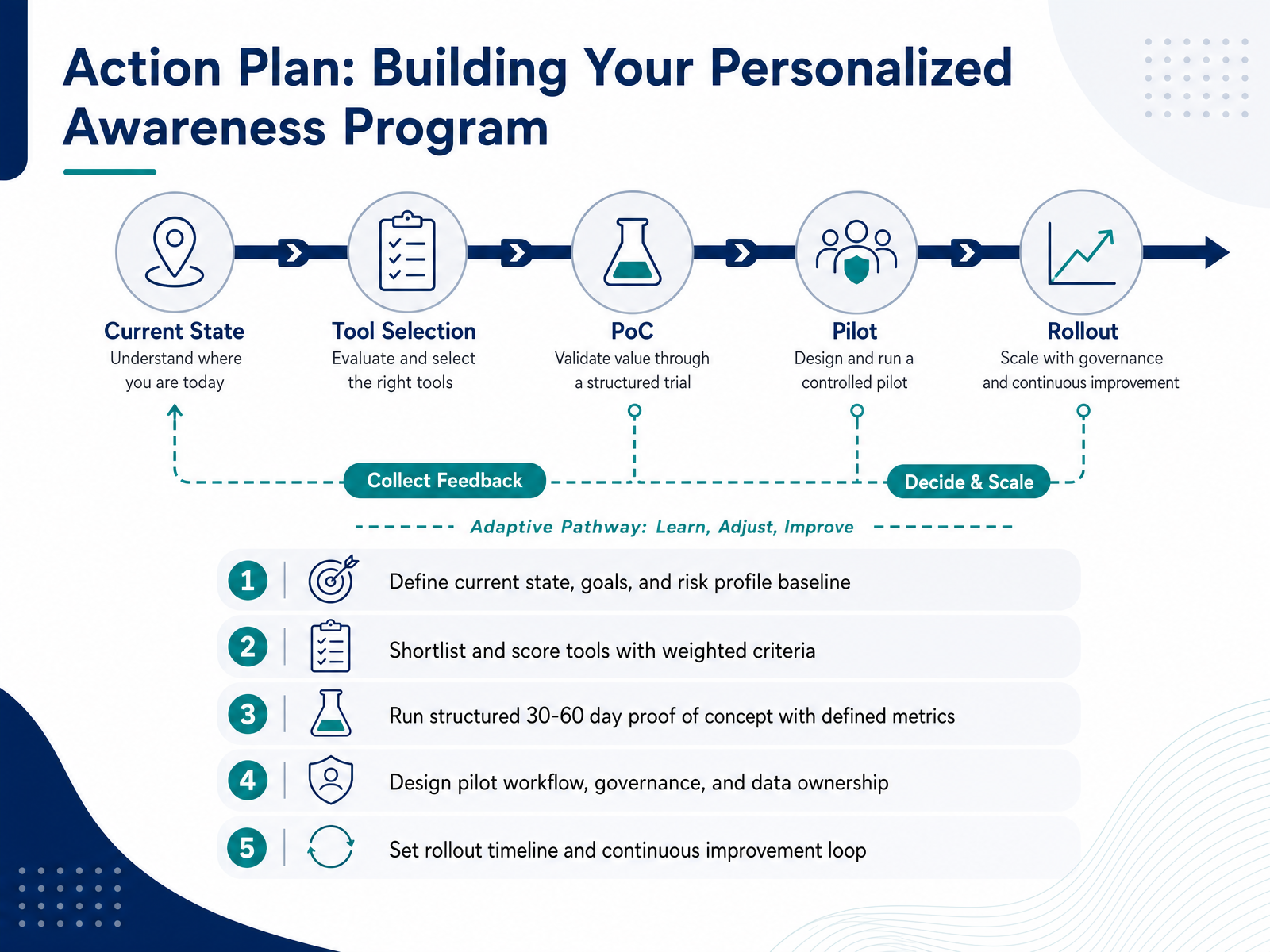
 - 13Action Plan: Building Your Personalized Awareness ProgramNow, let’s turn that evaluation into action. Start by documenting your current state, your goals, and your risk profile baseline. This gives you a clear reference point for every decision that follows. Next, shortlist tools and score them using weighted criteria that reflect your priorities, like risk measurement, simulation depth, and integration. Before you commit, run a structured proof of concept. Make it 30 to 60 days, include at least 50 employees from different departments, and measure behavior change using click rates, reporting rates, and time to report. Use that data to design your pilot workflow, including governance, data ownership, and escalation paths. Finally, set a realistic rollout timeline and build in a continuous improvement loop. Review your metrics quarterly, adjust your simulations and training content, and keep the evidence trail audit ready. This structured path turns a promising tool into a program that reduces human risk over time. Now, let’s look at how to bring these insights together into a clear set of takeaways and next steps.
 adaptivesecurity.comphishiq.ioadaptivesecurity.com+21 min
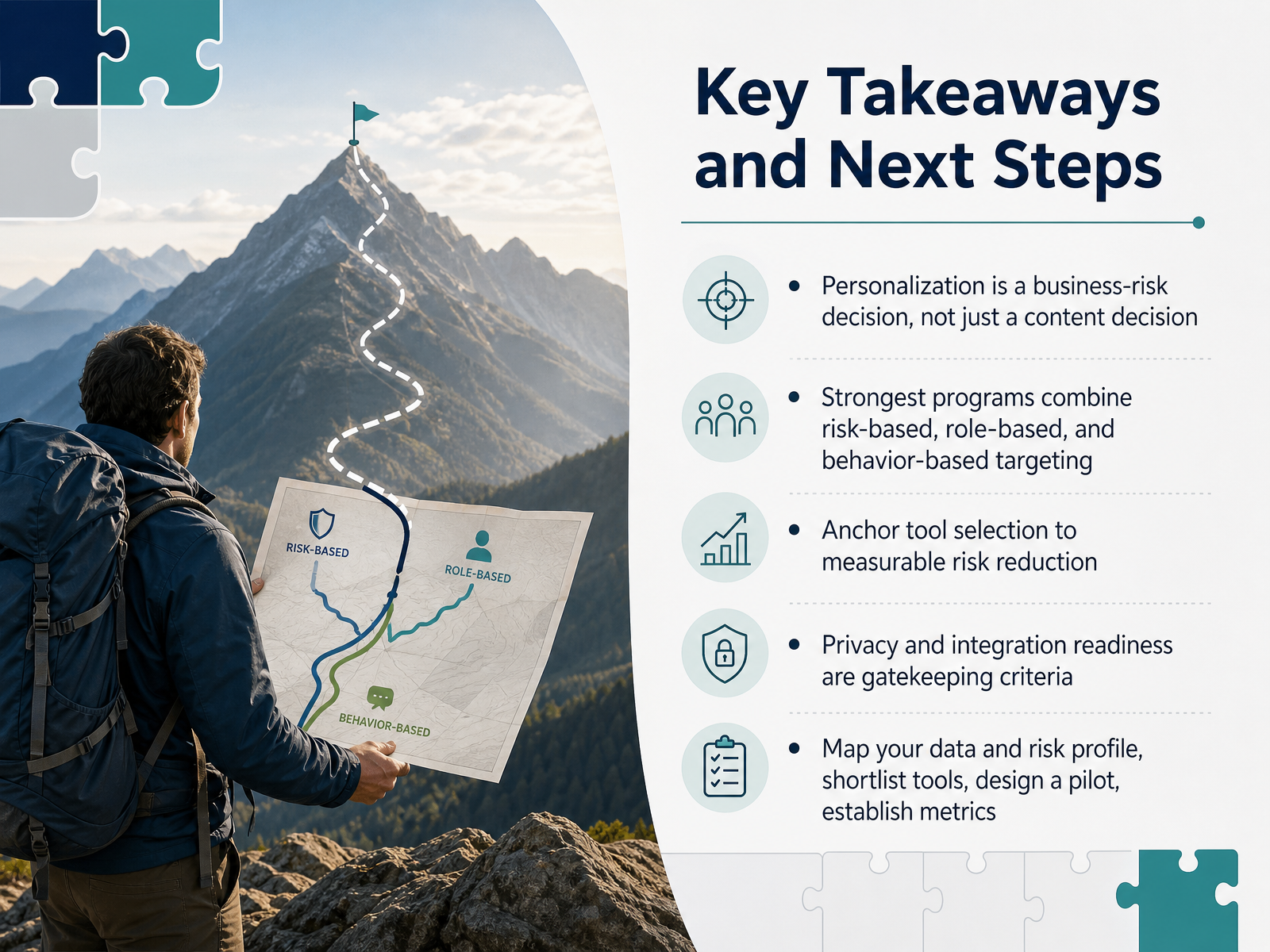
 - 14Key Takeaways and Next StepsLet’s close with what really matters. Personalization is a business risk decision, not just a content choice. The strongest programs blend risk based, role based, and behavior based targeting, so every employee gets the right intervention at the right time. Anchor every tool selection to measurable risk reduction, not feature lists. Treat privacy and integration readiness as gatekeeping criteria. If a tool can’t plug into your existing stack or respect data boundaries, it shouldn’t make the shortlist, no matter how polished the demo. Now, your next steps: map your data and risk profile, shortlist tools against that map, design a focused pilot, and establish metrics before launch. That clarity will carry you through vendor conversations and internal reviews. Thanks for your time today. You have the framework and the evidence. Go build a program that proves its value in reduced risk, not just completed modules.
 ajsat.orgknowbe4.comblog.knowbe4.com+21 min
Take the deck with you
Download this course as a file — free, no sign-up needed.
- PDF handoutEvery slide page, ready to print or share.15 pages · 3.5 MBDownload
- Narrated PowerPointThe deck that presents itself — every slide carries the digital human's narration video.15 pages · 13.8 MBDownload
- PowerPoint slidesThe full deck as a .pptx — open it in PowerPoint, Keynote, or Google Slides.15 pages · 3.4 MBDownload
Free to use in your own training — please keep the PersonWise credit page at the end.
Have your own deck? Turn it into a course
Sources consulted
Web sources consulted while building this course.
- Measuring the Impact of Embedded Phishing Training on Ransomware-Lure Click Behavior: A Field Study Across Three Organizations | Asian Journal of Science and Applied Technology — ajsat.org
- Phishing by Industry Benchmarking Report — knowbe4.com
- 2026 Phishing by Industry Benchmarking Report: Findings on Human Risk — blog.knowbe4.com
- Adaptive Phishing Simulation and Longitudinal Employee Security Behavior: Evidence from a Global Enterprise — scienpress.com
- Breaking Bad Email Habits: Bounding the Impact of Simulated Phishing Campaigns — doi.org
- Security Awareness Training Platform Requirements Guide — adaptivesecurity.com
- What Is a Human Risk Management Platform? The 2026 Buyer's Guide | PhishIQ Blog — phishiq.io
- Human Risk Management: Effective Cybersecurity Training ... — adaptivesecurity.com
- Buyer's Guide: Security Awareness Training | CIOPages Buyer Guide — ciopages.com
- 2026 Security Awareness Training Buyer's Guide | Adaptive Security — adaptivesecurity.com
- Hyper-Personalized Security Training | Living Security — livingsecurity.com
- What Is Custom Security Awareness Training? Definition — nhimg.org
- Risk-Based Security Awareness Training: A Complete Guide — adaptivesecurity.com
- Custom Security Awareness Training: A Guide — livingsecurity.com
- Role-Based Security Awareness Training: A Complete Guide | Adaptive Security — adaptivesecurity.com
- ARTICLE 29 DATA PROTECTION WORKING PARTY — aepd.es
- Are Employees Receiving Regular Data Protection Training? Are They AI Literate? - Lexology — lexology.com
- GDPR Training for Employees: Requirements and Practices — legiscope.com
- Employee Privacy Governance for GDPR and ISO/IEC 27701 - Clarysec — blog.clarysec.com
- GDPR Article 39 Staff Awareness: Moving from Checkbox Training to Verified Understanding | Talantir Guides — talantir.ai