Sales Team Communication Platforms
Begin
14 pages · ~28 min
Sales Team Communication Platforms
Training to enhance sales team communication using key platforms, focusing on efficient collaboration and streamlined client interactions for improved team performance.
What you’ll learn
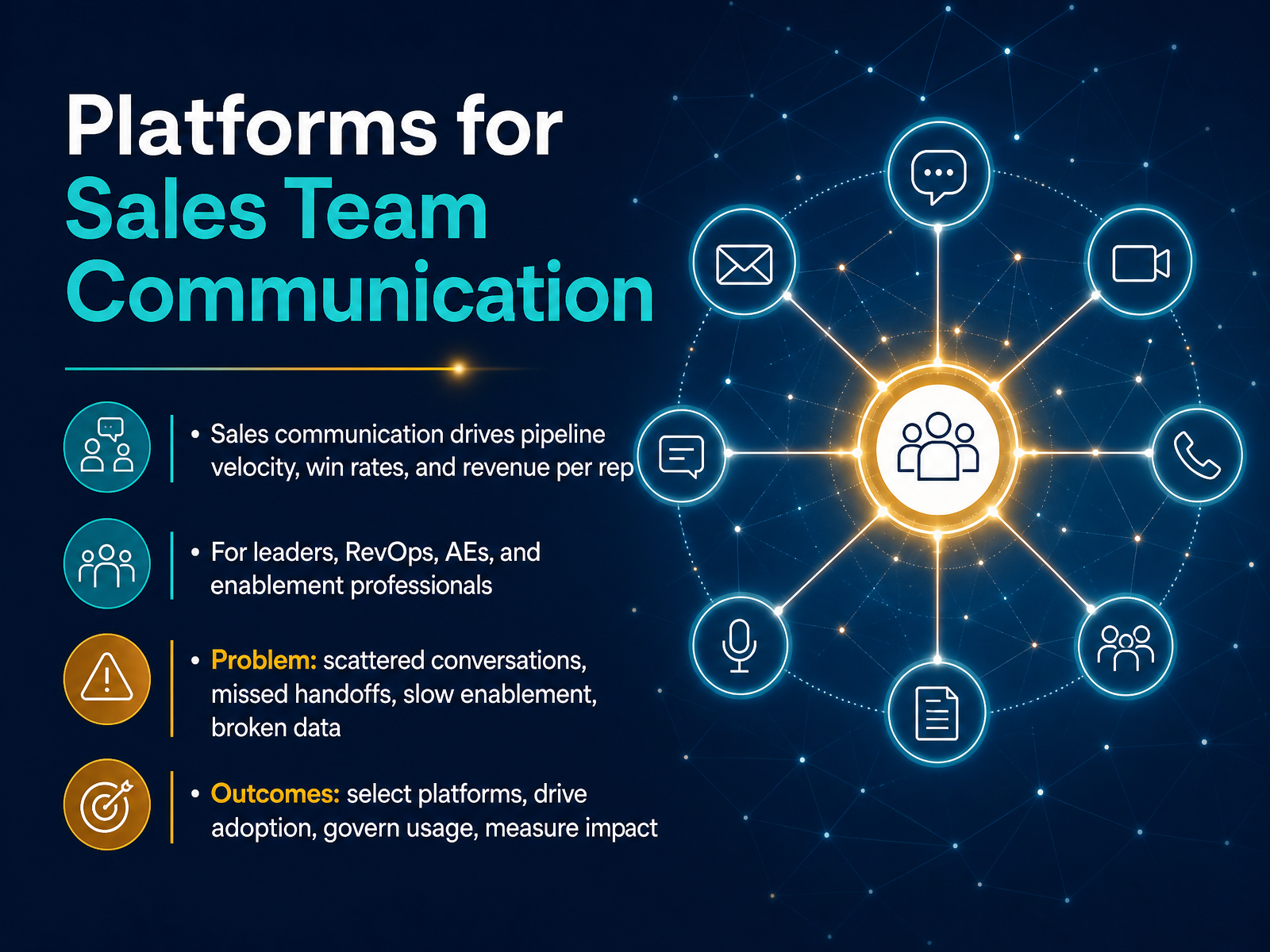
- 01Platforms for Sales Team CommunicationWelcome. This course is about turning your sales communication from a hidden cost into a revenue driver. You already know the stakes: scattered conversations, missed handoffs, slow enablement, and broken data quietly drag down pipeline velocity and win rates. But the fix isn't another point tool. It's a platform strategy. Today we'll talk about how to select the right platforms, drive real adoption, govern usage without micromanaging, and measure impact in numbers that matter to your forecast. We'll anchor everything in what high-performing teams actually do—not hype. Here's the bottom line: teams that consolidate their communication stack see sharper context in every handoff and shorter deal cycles. By the end, you'll have a practical framework for making that happen in your organization. Let's get into it. Next, we'll map the core categories of sales communication tools so you can see where your current stack has gaps or redundancies.apollo.iodebriefing.iotei.forrester.com+21 min
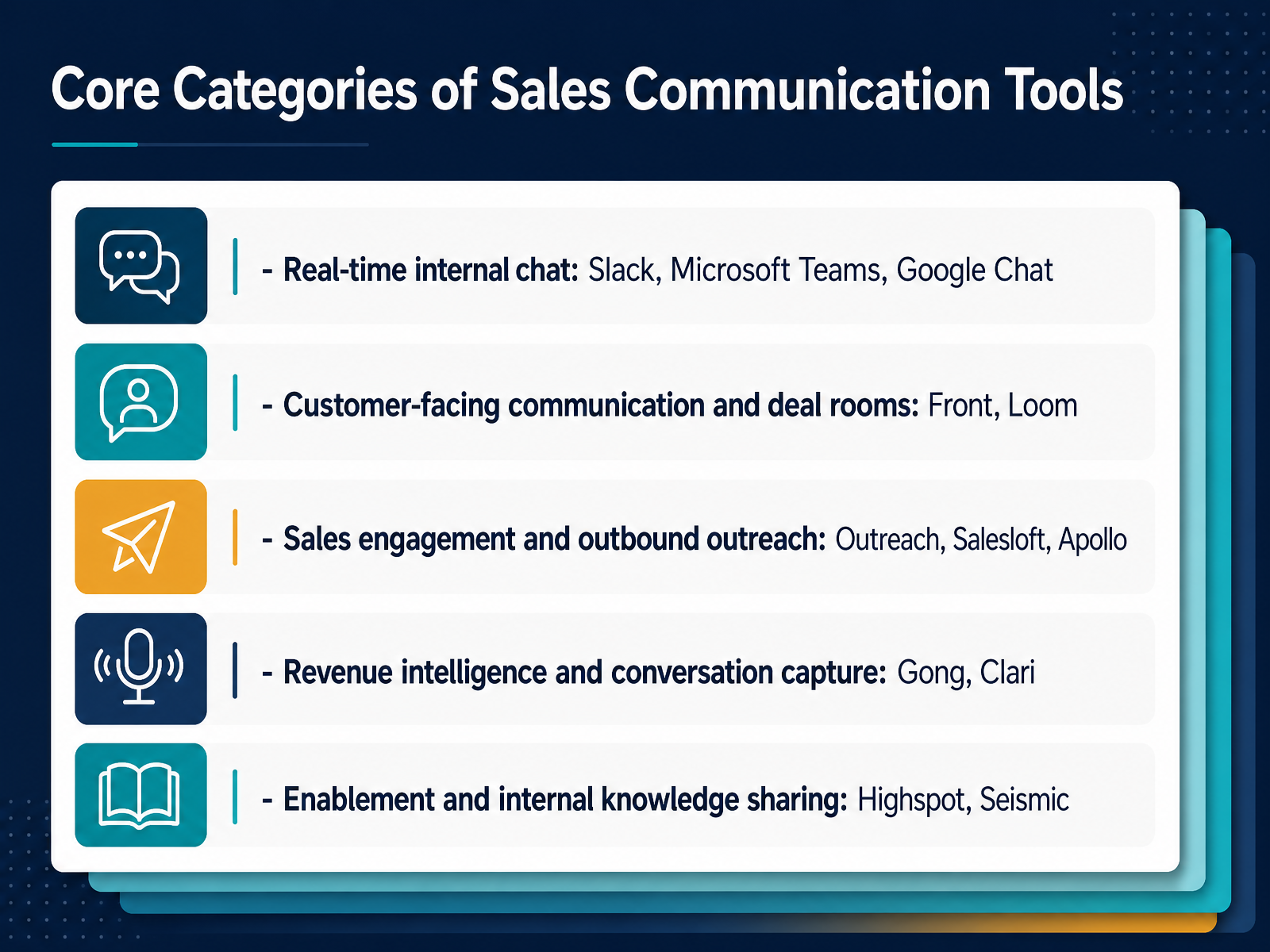
- 02Core Categories of Sales Communication ToolsBefore you add another tool to the stack, it helps to sort the landscape by job function. The market has consolidated into five core categories, and most platforms now blur the lines between them. First, real time internal chat. Slack, Teams, and Google Chat handle the immediate coordination between reps and revenue ops. Second, customer facing communication and deal rooms. Tools like Front and Loom keep buyer conversations and asynchronous video in one place. Third, sales engagement and outbound outreach. Outreach, Salesloft, and Apollo orchestrate multi channel sequencing, meaning the cadence of emails, calls, and social touches your reps execute. Fourth, revenue intelligence and conversation capture. Gong and Clari record and analyze customer interactions to surface coaching insights and forecast risks. Finally, enablement and internal knowledge sharing, with Highspot and Seismic ensuring reps access the right content at the right moment. Keep this taxonomy in mind, because the real challenge is integration. Now let's look at how these layers fit together in a modern revenue stack.
 prospeo.ioknowlee.aizipdo.co+22 min
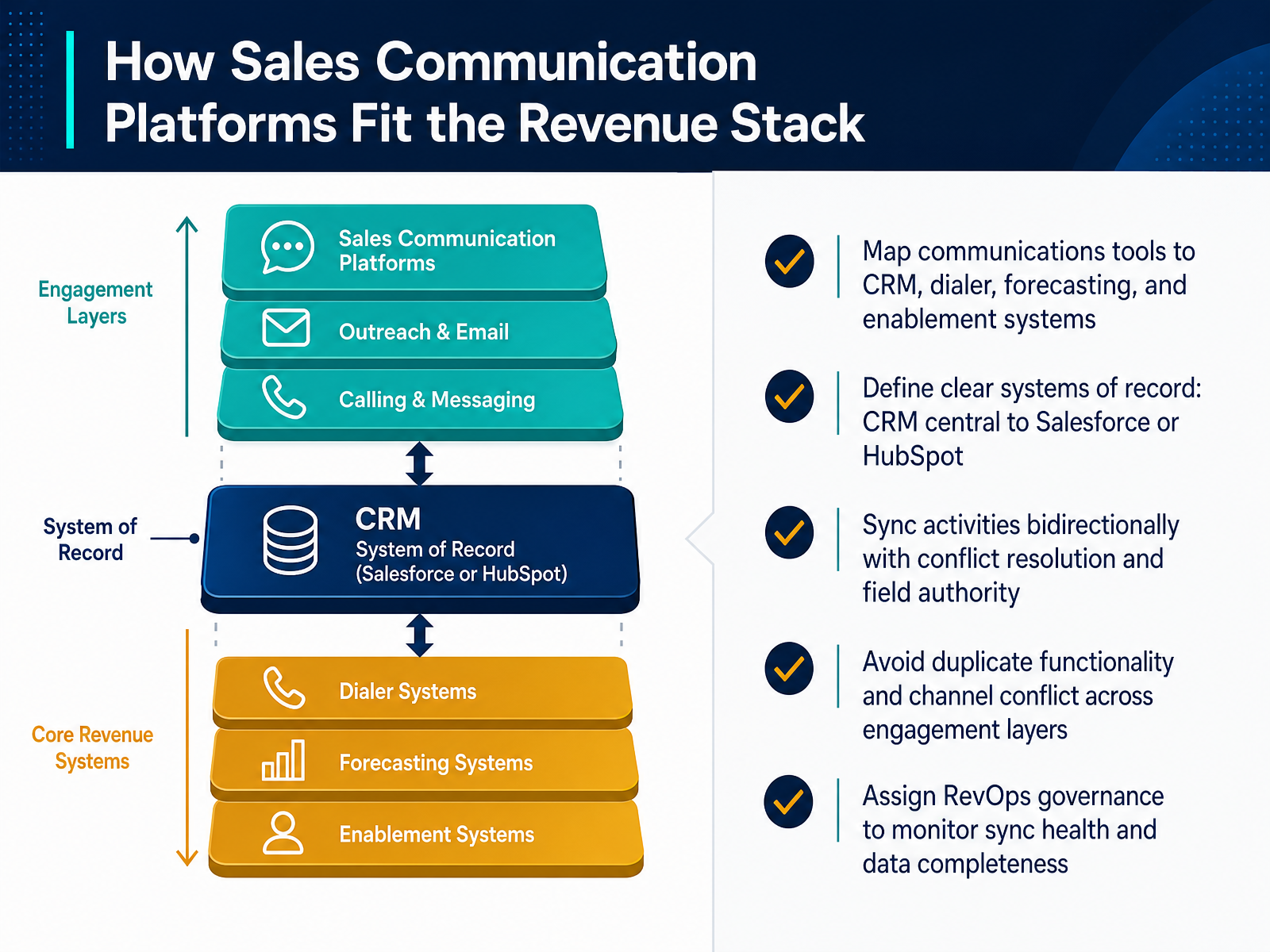
 - 03How Sales Communication Platforms Fit the Revenue StackLet's talk about where these platforms fit alongside your existing stack. Your CRM remains the system of record, whether that's Salesforce or HubSpot. The communication platform should map cleanly to your CRM, your dialer, and your forecasting tools. The key is bidirectional sync. Activities should flow both ways with defined conflict resolution rules, not last-write-wins guesswork. You need to decide which system owns each field before you enable two-way sync. Without that, you will get data corruption and rep distrust. Also, avoid duplicate functionality. If your dialer already sequences calls, don't pay for a separate tool that does the same thing across another layer. That is how channel conflict starts. Assign a dedicated RevOps owner to monitor sync health and data completeness. A quick data audit before go-live prevents dirty records from multiplying across systems. Focus on your minimum viable object set and expand deliberately. Next, we will cover the concrete evaluation criteria you should use to compare platforms, so you can make this fit without the guesswork.
 apollo.iogetgangly.comappendment.com+22 min
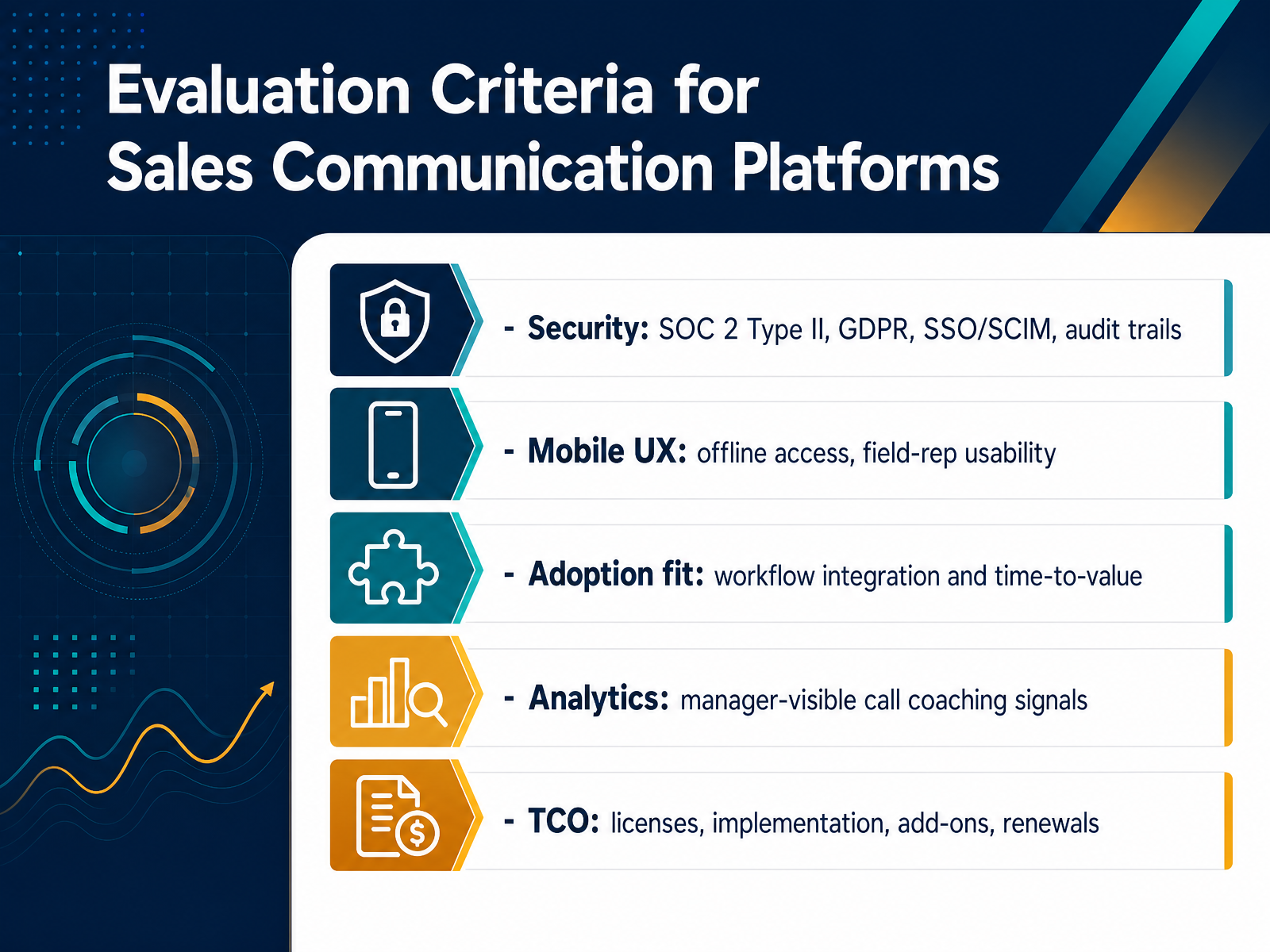
 - 04Evaluation Criteria for Sales Communication PlatformsNow let's talk about how you’ll actually score these platforms. Start with security. Don't accept a trust-page badge. Demand the full SOC 2 Type Two report under NDA, signed GDPR documentation, SSO with SCIM provisioning, and immutable audit trails. Nothing moves forward without those. Next, weigh mobile UX hard, especially for field reps. Offline access isn't a luxury; it's the difference between logging a call in the moment or losing it entirely. Third, adoption fit. Ask whether the platform lives inside your existing workflow or forces a new one. The data is blunt: nearly half of sales enablement tools go underutilized because reps revert to old habits. Fourth, analytics. Look for call coaching signals a manager can act on, not just dashboards. Finally, model total cost of ownership over three years: licenses, implementation, add-ons like dialers or conversation intelligence, and renewal caps. Licensing often covers only a third of true spend. Score these five criteria with agreed weights before you see a demo, and you'll make a decision you can defend upstairs. Now let's look at the top platform options in the current 2026 market.
 topickz.comwifitalents.comgetsalesclaw.com+22 min
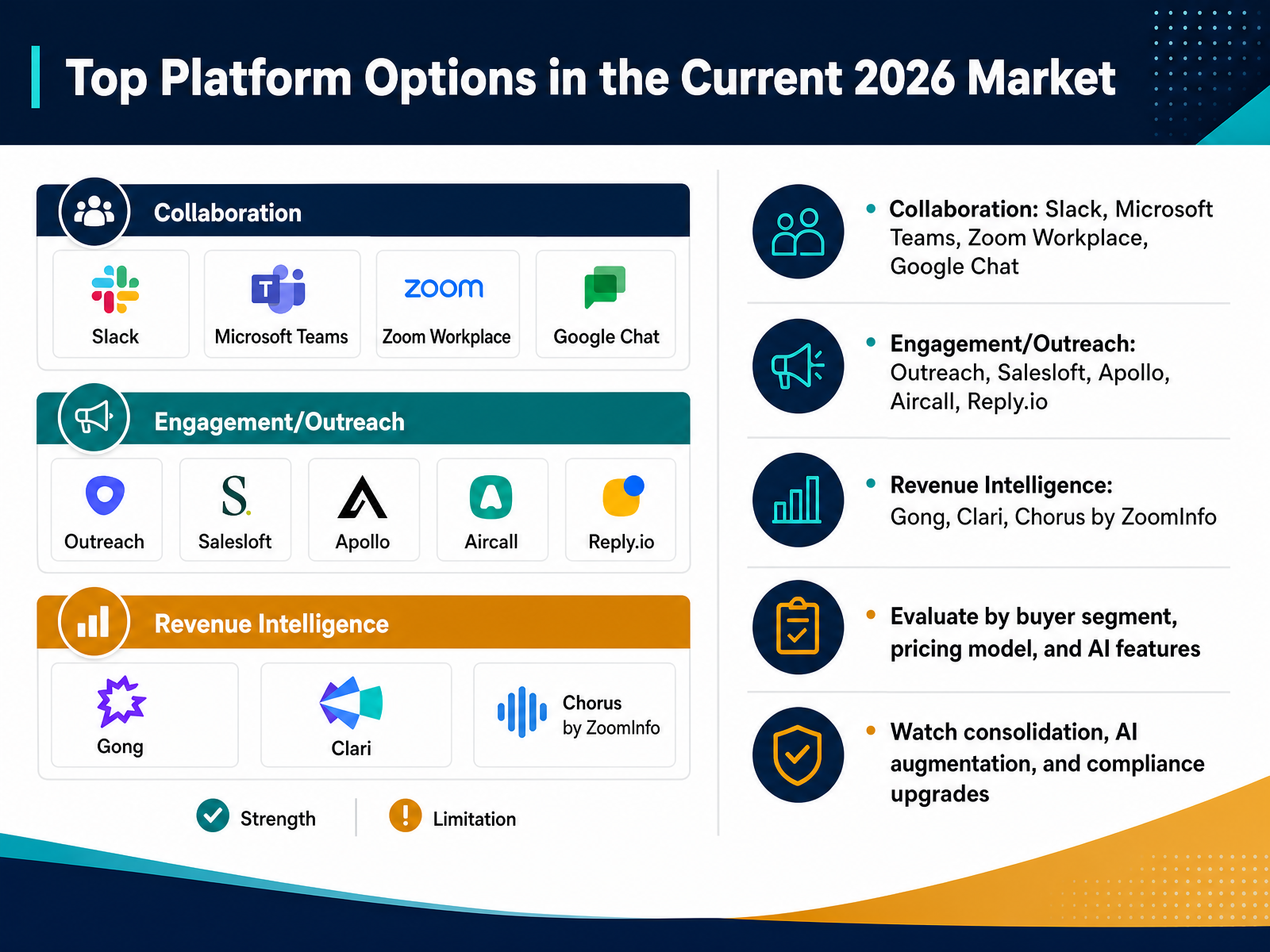
 - 05Top Platform Options in the Current 2026 MarketLet's map the current market. In collaboration, Slack and Microsoft Teams still lead, but you should weigh them against Zoom Workplace and Google Chat based on where your company already lives. For engagement and outreach, Outreach and Salesloft remain the standards for cadence control, while Apollo, Aircall, and Reply.io bring lighter-weight options for outbound speed. On the revenue intelligence side, Gong dominates conversation data, Clari owns forecasting, and Chorus by ZoomInfo is worth evaluating if you want that intelligence bundled into a broader stack. Your evaluation should start with your buyer segment, not the feature list. A mid-market team scaling outbound has different needs than an enterprise org trying to govern six regions. Pricing models are not equal here. Some tools quote per user, others quote per outcome, and several now layer AI features as paid add-ons. Watch three macro trends. Consolidation means your vendor may get acquired mid-contract. AI augmentation is moving from summarization toward rep coaching and deal scoring. And compliance upgrades are becoming table stakes, especially if you operate in regulated markets. Keep those filters in mind as we compare centralized channels against deal-specific workspaces next.
 wifitalents.com1 min
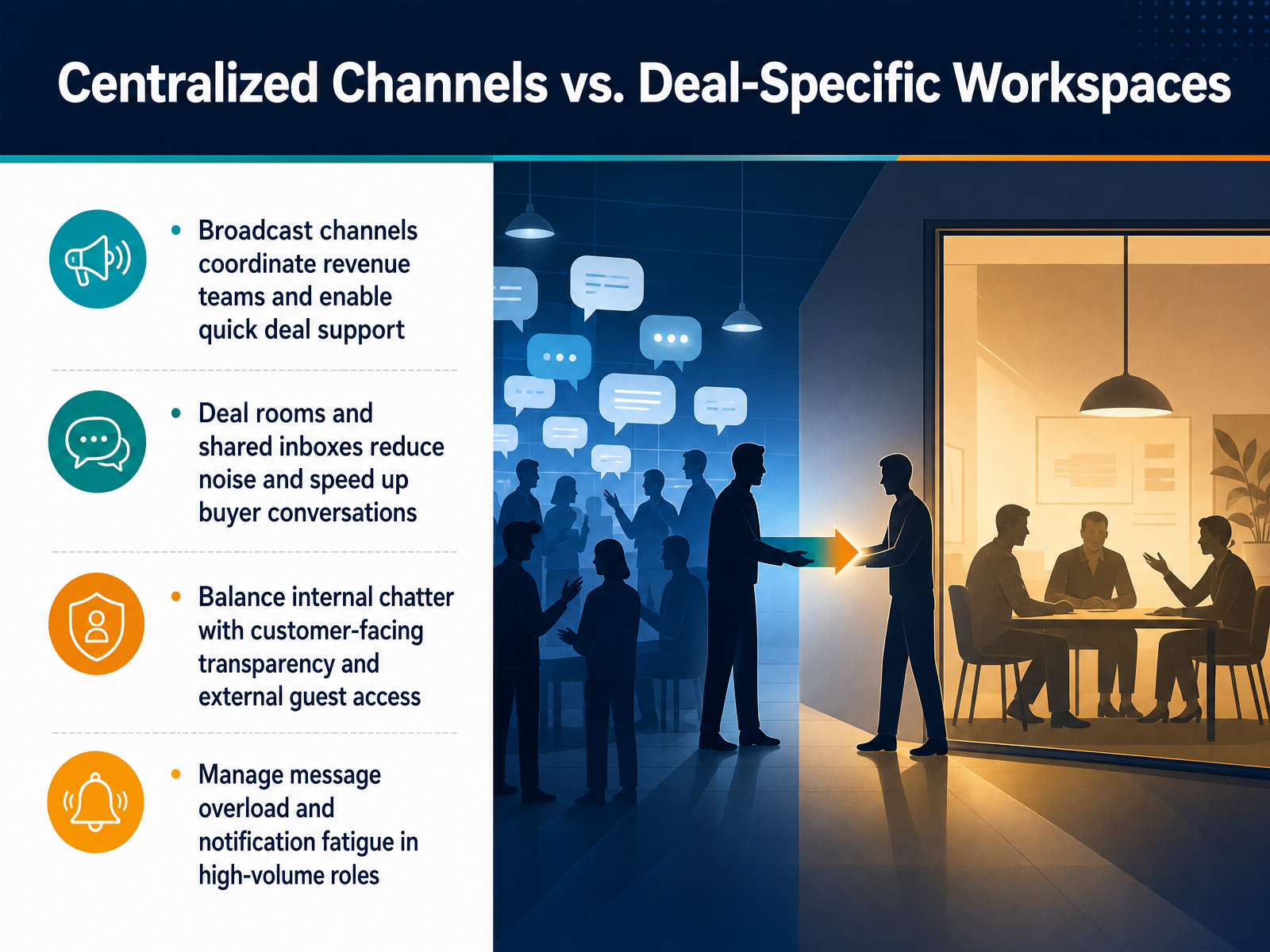
 - 06Centralized Channels vs. Deal-Specific WorkspacesLet’s talk about structure. Broadcast channels are where your revenue team coordinates. They pull in marketing, RevOps, and leadership fast, without booking another meeting. That works for deal support when a rep needs an answer quickly. But the real efficiency gain comes from moving buyer conversations into deal-specific workspaces. Think shared inboxes or dedicated deal rooms. They keep the relevant context in one place and cut the noise for everyone else. Now, be deliberate about the boundary between internal chatter and customer-facing transparency. External guest access is powerful, but it needs governance. Decide what the buyer sees and what stays internal, before you invite them in. And set a policy on notifications. High-volume roles drown fast. Defaults matter. Agree on when to tag, when to mute, and which channel gets the urgent alerts. Get this balance right, and the platform reduces friction instead of adding to it. Next, let’s look at what drives actual adoption across sales and revenue operations.
 wifitalents.com1 min
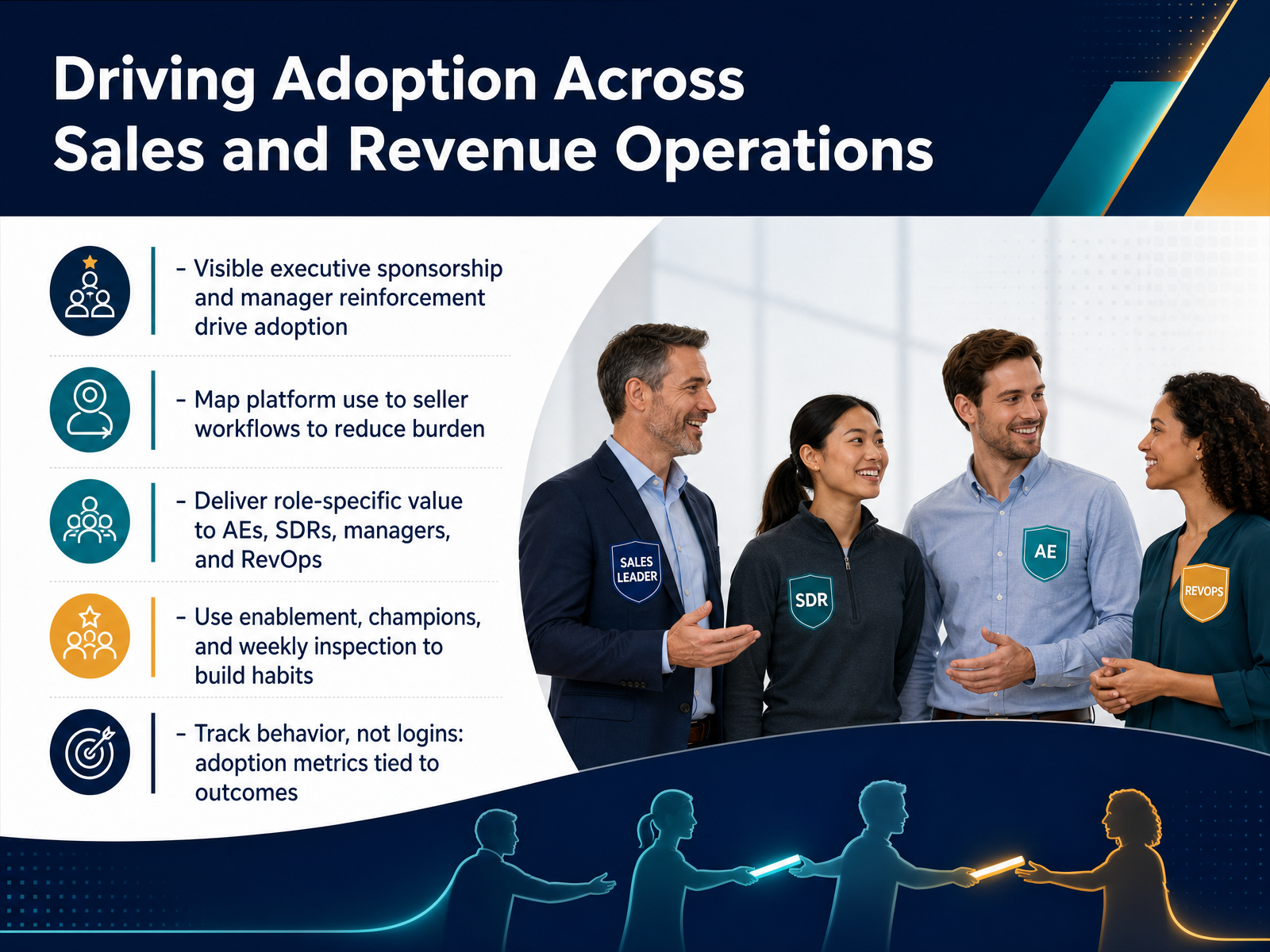
 - 07Driving Adoption Across Sales and Revenue OperationsAdoption is where most rollouts stall, not because the platform is weak, but because the rollout plan stops at go-live. Executive sponsorship has to be visible and repeated, not a single kickoff email. Managers need to reinforce the workflow in one-on-ones and team meetings, every week. Map platform use to how sellers already work, so the tool reduces burden instead of adding steps. Deliver value by role: AEs care about deal velocity, SDRs care about response time and routing, managers care about forecast accuracy, and RevOps cares about data integrity. Use enablement sessions and peer champions to build habits, and tie adoption to deal reviews. Track behavior that matters, not logins. Measure record completeness, feature depth, and pipeline impact. A rep logging in daily without creating opportunities isn't adopted. Define the three to five behaviors you expect, instrument them pre-launch, and review them weekly. Now let's turn to governance, security, and data retention.
 2 min
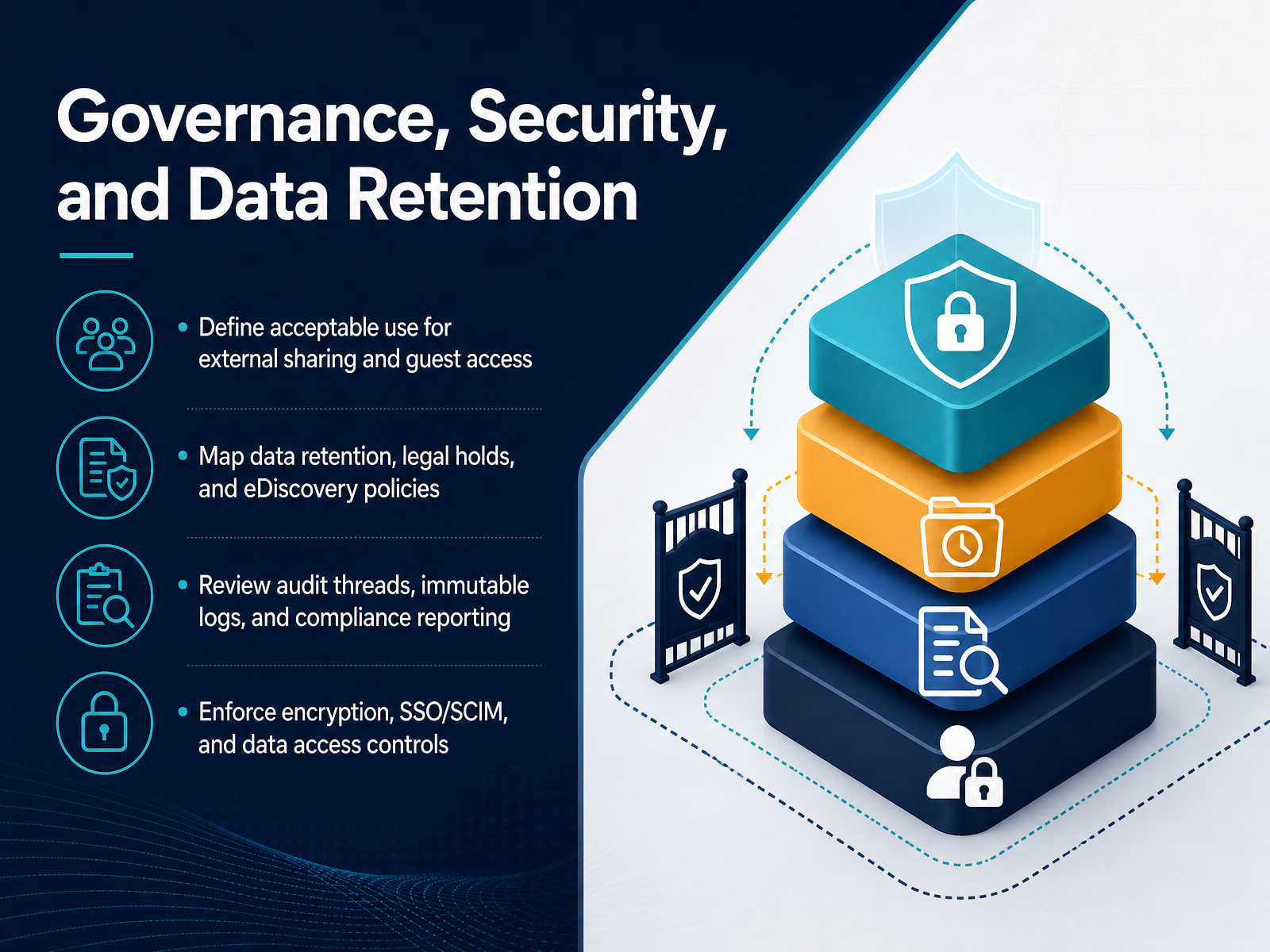
2 min - 08Governance, Security, and Data RetentionNow let's talk about the operational backbone: governance, security, and data retention. In a sales platform, these are gating criteria, not checkboxes. Before rollout, define acceptable use for external sharing and guest access. If your SDRs can share sequences with outside contractors, that privilege carries compliance weight. Map your data retention windows to legal holds and eDiscovery requirements. Know how long call recordings and email content persist, and confirm you can place a hold when litigation is foreseeable. Next, verify audit threads and immutable logs. You want the ability to prove exactly who changed a sequence or accessed a transcript. Compliance reporting must show controlled baselines that a regulator or a customer's counsel can review. Finally, enforce encryption, SSO, SCIM, and role-based access controls. This includes deprovisioning in real time when a rep leaves. The evidence is a current SOC 2 Type Two report, a signed DPA, and ISO certification documents, not a trust-page badge. Test these controls in your pilot. If a vendor resists granting access to the full report, that is a disqualifier. Up next, we'll examine how activation and adoption data translate into measurable impact on pipeline and revenue.
 topickz.comwifitalents.comgetsalesclaw.com+22 min
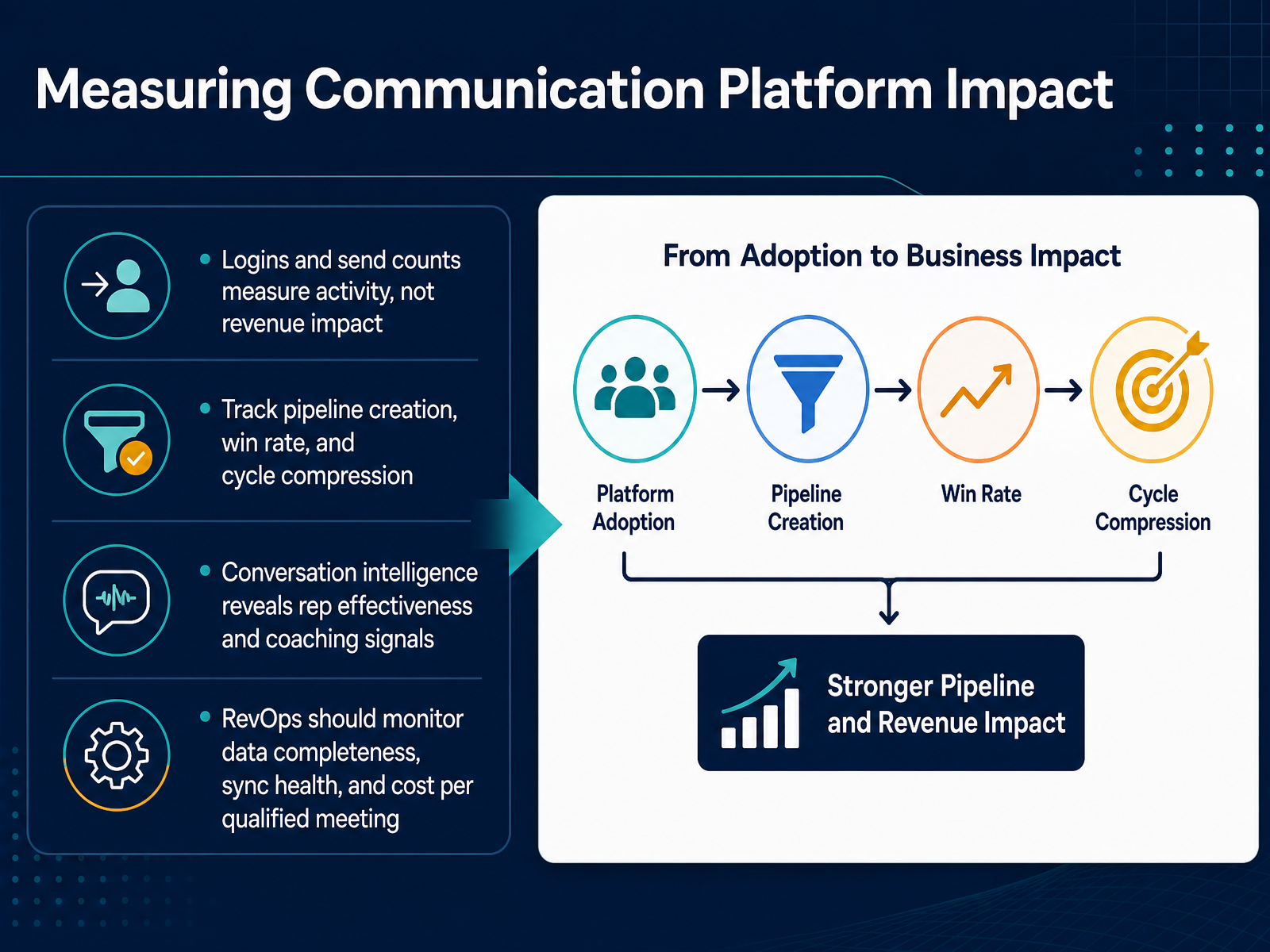
 - 09Measuring Communication Platform ImpactOnce the platforms are live, the hard part begins: proving they actually move revenue. Logins and send counts tell you about activity, not impact. Those are hygiene metrics, not business metrics. Shift your focus to what the platform should change: pipeline creation, win rate, and sales cycle compression. If those numbers do not move within two full quarters, adoption or execution is the problem, not the tool. Conversation intelligence gives you a layer beyond the numbers. It shows you rep effectiveness and surfaces coaching signals you cannot see in aggregate data. That is where you turn raw usage into behavior change. For RevOps, the mandate is data completeness, sync health, and cost per qualified meeting. If CRM records are incomplete or your sync lags, every downstream metric becomes suspect. Track cost per qualified meeting monthly; a number above five hundred dollars signals targeting or message decay. Keep the review cadence disciplined: leading indicators weekly, revenue outcomes monthly, and a data integrity check before every performance conversation. When the dashboard holds up to finance scrutiny, you have earned the right to scale. That brings us to the implementation roadmap, moving from pilot to full deployment.
 2 min
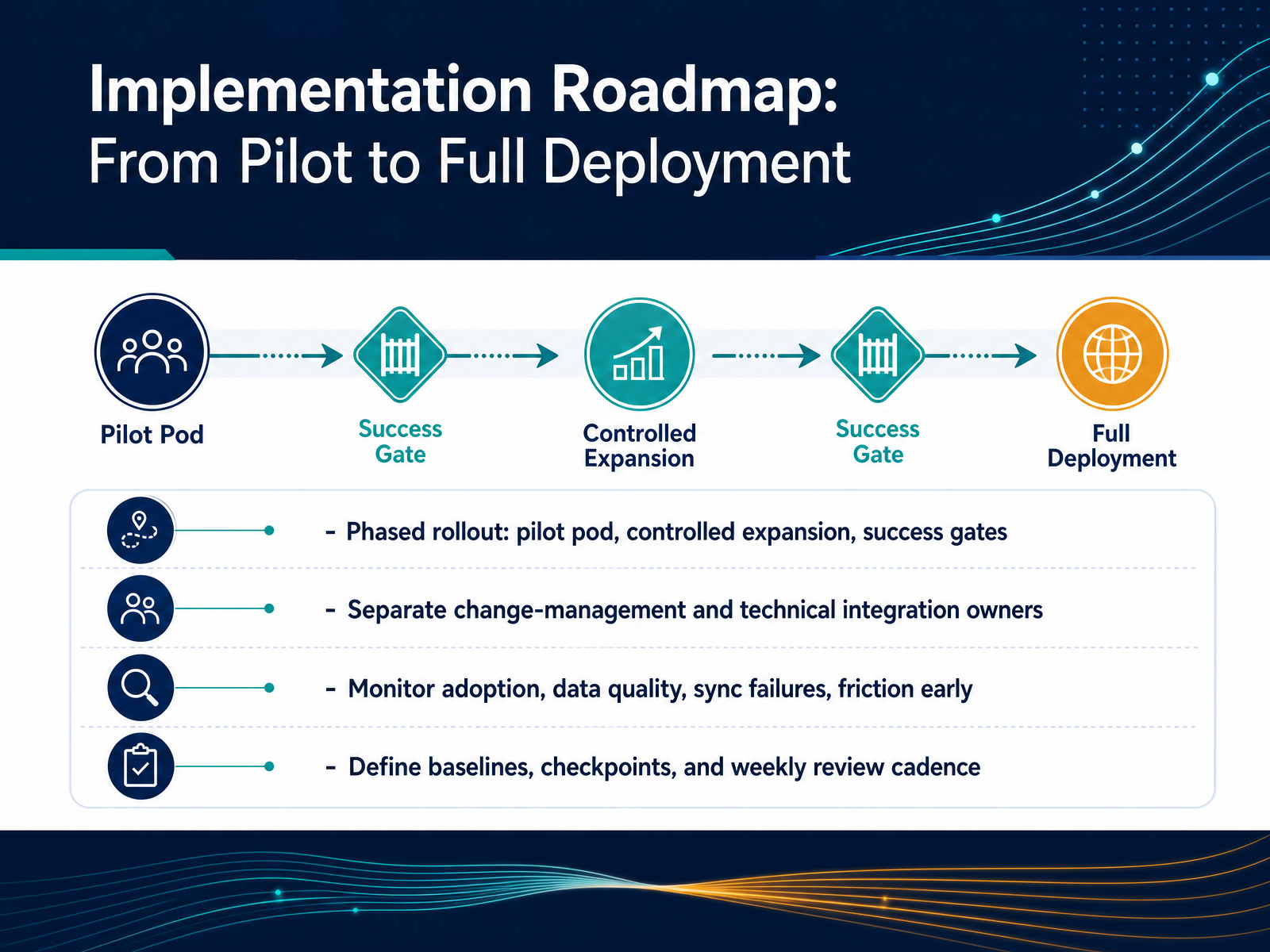
2 min - 10Implementation Roadmap: From Pilot to Full DeploymentNow let's talk about the rollout itself. The safest path is a phased one: start with a pilot pod, expand to a controlled group, and use success gates before each new wave. Don't treat this as one big switch-flip. Separate the change-management owner from the technical-integration owner. The tech person owns data integrity and cutover; the change person owns rep readiness and adoption. If one person tries to do both, field support gets sacrificed when technical issues spike. That's how rollouts stall. Monitor the early signals: adoption rates, data completeness, sync failures, and where reps are hitting friction. If records are incomplete or syncs break in the first two weeks, you'll know before the behavior becomes habit. Define baselines before launch and set a weekly review cadence with clear checkpoints. Teams that measure adoption weekly are three times more likely to succeed than those that check monthly. One more thing: protect the pilot pod from quota pressure during the learning curve. Give them room to build fluency, then use their feedback to refine training before broader rollout. Next, let's cover how to integrate this platform with your existing CRM stack. That's where the real operational payoff lives.
 2 min
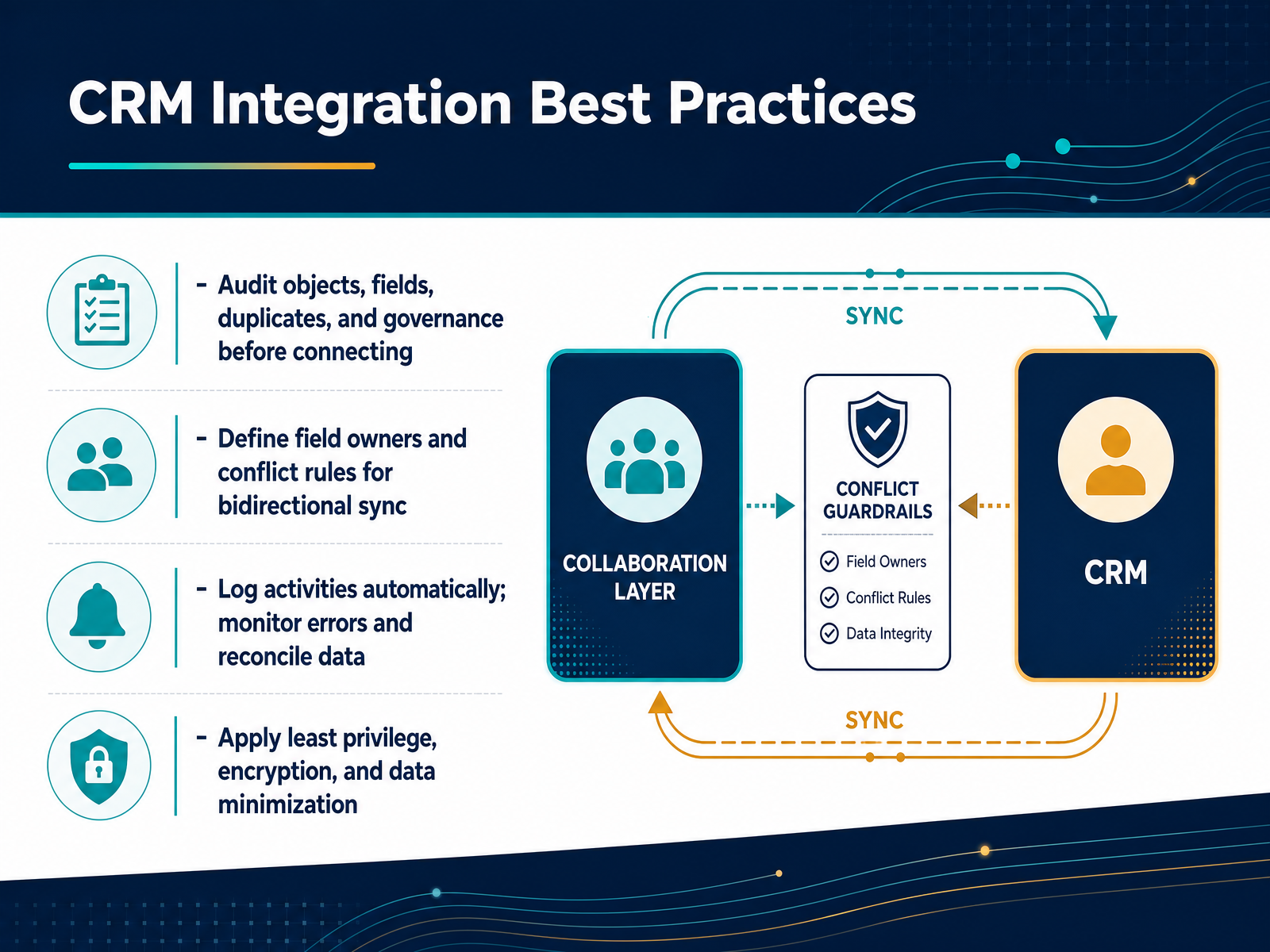
2 min - 11CRM Integration Best PracticesNow, connecting your communication platform to the CRM is where revenue operations either gains leverage or creates cleanup work. Start with a full audit before you touch a single connector. Inventory every object you plan to sync, map your fields, define deduplication rules, and name one governance owner. Skipping this step just replicates dirty data at scale. Next, define field authority. For every field, assign one system that is allowed to write it. Bidirectional sync only works when you have conflict rules like "most recent write wins" or "CRM is master for deal stage" documented before go-live. Then, automate activity logging so every call, email, and meeting lands in the CRM without reps typing it in manually. Set up alerts for sync failures and assign someone to review them weekly. Finally, apply least privilege. Only give users and integrations access to the specific fields they need. Use encryption, minimize the data you sync, and avoid copying sensitive payloads just because the API allows it. Done right, the integration becomes an AI readiness asset. Done wrong, it becomes a second system to reconcile. Coming up, we'll look at change management that actually protects revenue during the rollout.
 apollo.iogetgangly.comappendment.com+21 min
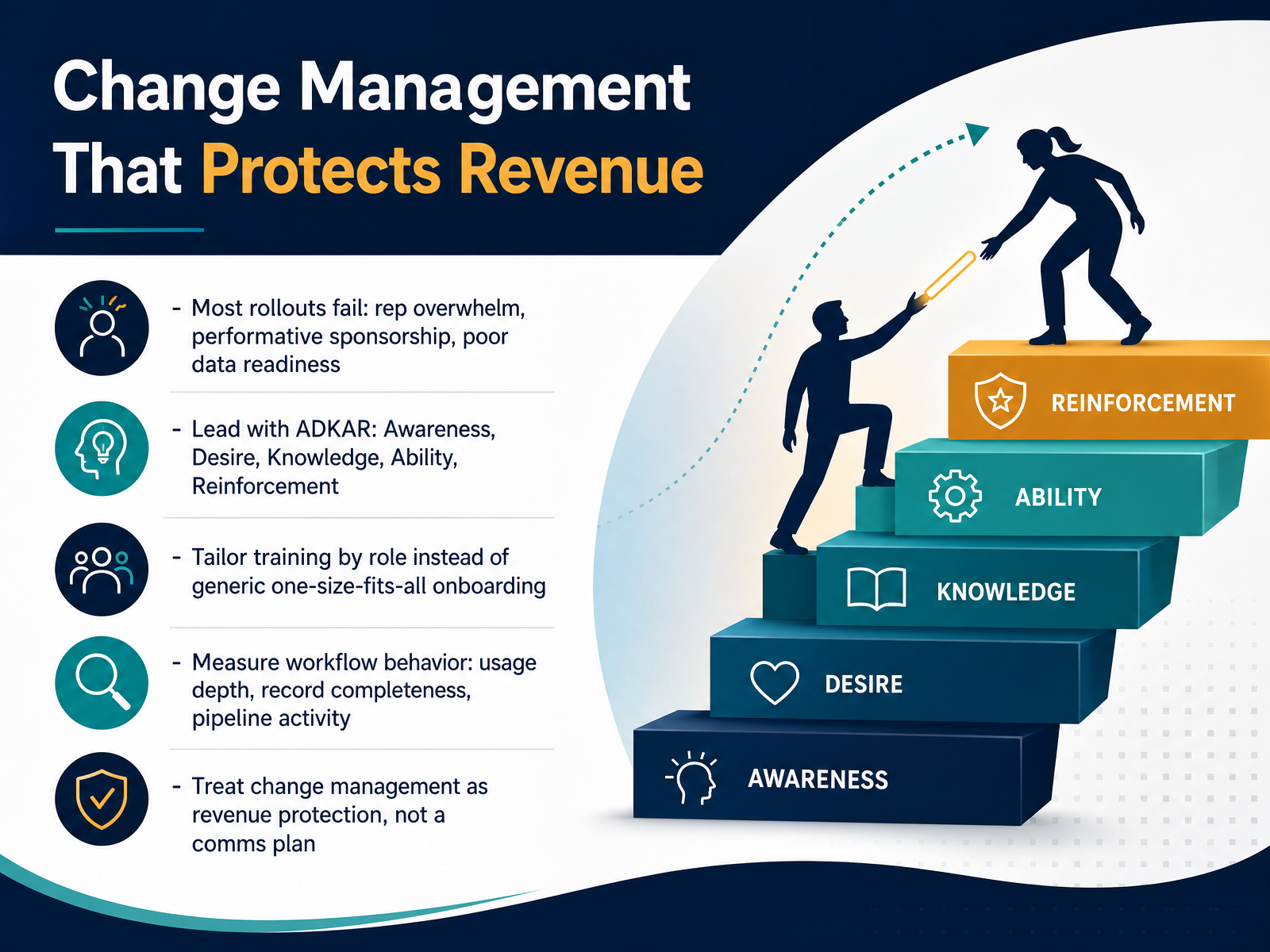
 - 12Change Management That Protects RevenueHere's where most rollouts go sideways. By now, your reps are watching—waiting to see if this becomes another tool that steals their time. You cannot afford to treat change management like a communication blitz. Treat it as revenue protection. The ADKAR model gives you the disciplined path. Awareness—paint the picture of what breaks if you stay put. Desire—connect this platform to time saved, quota hit, pipeline owned. Knowledge—show them the exact workflow. Ability—let them run a live deal end-to-end in the sandbox. Reinforcement—inspect the behaviors every week, not just at launch. And do not run generic training for everyone. Your account executives need deal-stage navigation; your RevOps needs data hygiene and reporting standards. Tailor the sessions. Then measure what matters: usage depth, record completeness, and pipeline activity—not just login counts. If you see reps logging in but not feeding the tool, that's a red flag, not a win. Redefine the goal: simpler work, protected pipeline, and a system that earns trust from day one. Build that case, and you'll be ready to put a dollar figure on the entire effort next.
 2 min
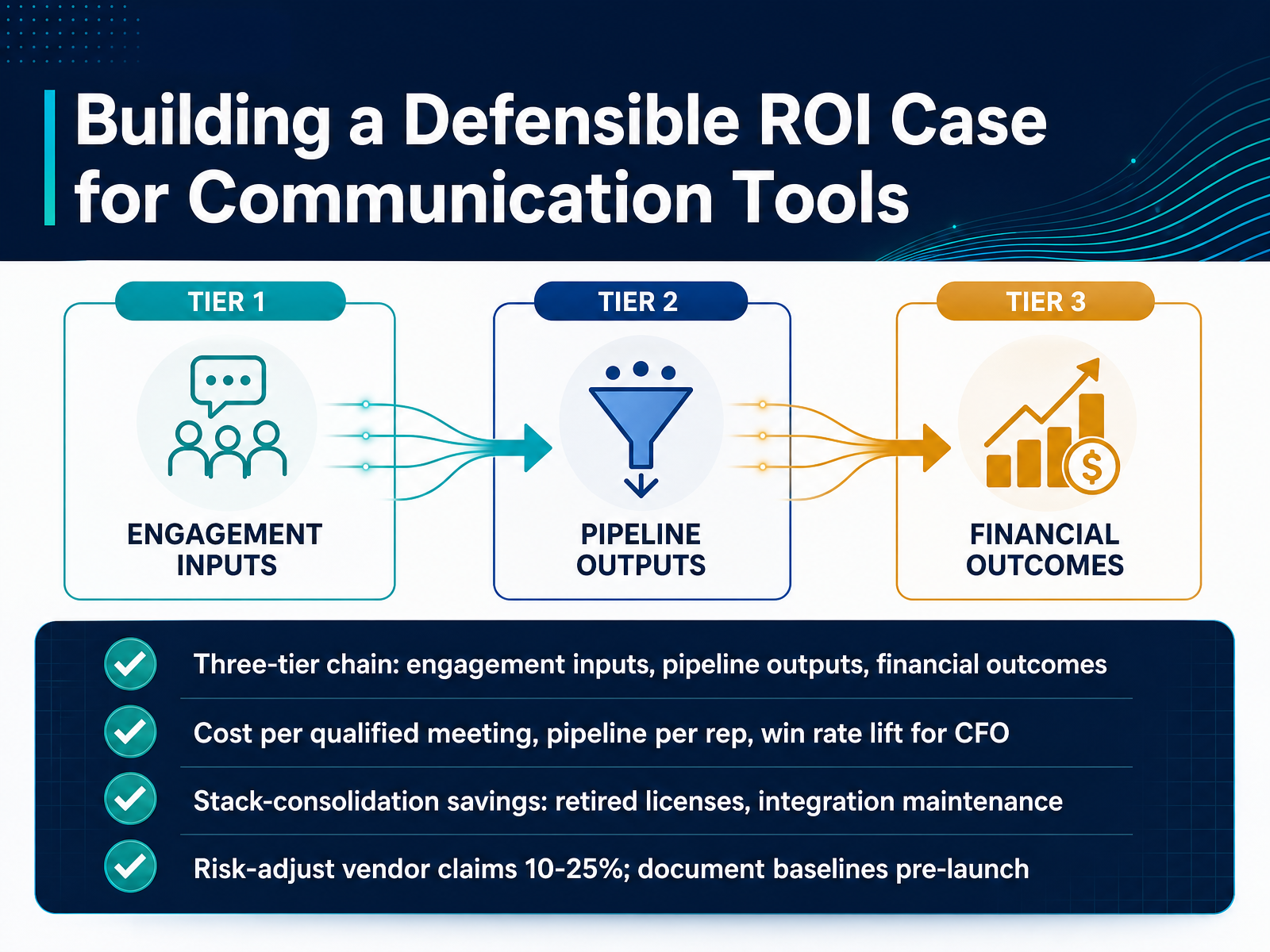
2 min - 13Building a Defensible ROI Case for Communication ToolsThis is where the business case either holds up or falls apart. Structure your ROI case in three tiers. Start with engagement inputs like reply rate and meeting set rate. Then connect them to pipeline outputs, such as qualified meetings per rep and win rate. Finally, translate that into financial outcomes your CFO can defend: cost per qualified meeting and revenue per rep. Do not skip the consolidation layer. Quantify retired licenses and the hours your ops team spent maintaining integrations. Now, the credibility piece. Vendor claims are upside scenarios, not planning baselines. Apply a risk discount of ten to twenty-five percent to every category. More importantly, document your pre-launch baseline at least ninety days before go-live. If you do not have a denominator, any post-launch improvement is just a claim. When finance sees a baseline, a risk-adjusted model, and a payback period in months, the conversation shifts from whether to invest to how quickly you scale. Next, we will move into practical next steps for sales leaders to execute this playbook.
 1 min
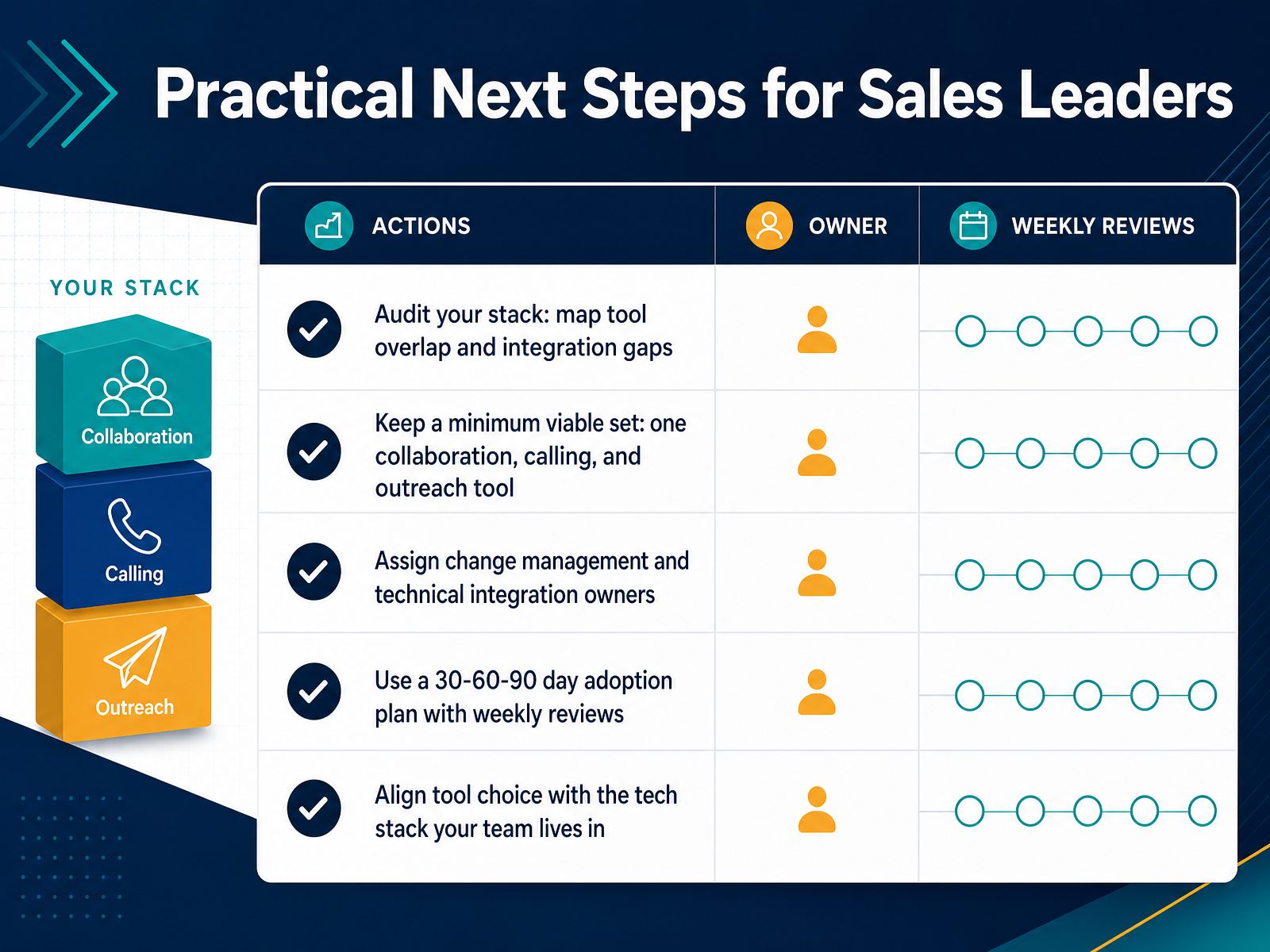
1 min - 14Practical Next Steps for Sales LeadersAs we wrap up, the principle is simple: fewer, more purposeful tools, owned by named leaders, measured relentlessly. Start by mapping your stack, then consolidate tool overlap to a minimum viable set. Name an owner for both technical integrity and the human side of change. Then structure rollout in thirty, sixty, and ninety-day cycles with weekly reviews. One final guardrail: don't force a platform that fights your central CRM and workflow. Align tool choice with the stack your team already lives in. Doing this transforms communication platforms from overhead into a direct revenue lever. Thanks for your time, and go make the stack work for your numbers.
 wifitalents.comapollo.iogetgangly.com+21 min
Take the deck with you
Download this course as a file — free, no sign-up needed.
- PDF handoutEvery slide page, ready to print or share.15 pages · 3.5 MBDownload
- Narrated PowerPointThe deck that presents itself — every slide carries the digital human's narration video.15 pages · 16.9 MBDownload
- PowerPoint slidesThe full deck as a .pptx — open it in PowerPoint, Keynote, or Google Slides.15 pages · 3.4 MBDownload
Free to use in your own training — please keep the PersonWise credit page at the end.
Have your own deck? Turn it into a course
Sources consulted
Web sources consulted while building this course.
- What Is Sales Collaboration? Teams, Tools, ROI (2026) - Apollo.io — apollo.io
- Gong's Revenue AI Report: AI-Driven Teams Generate 77% More Revenue - Debriefing — debriefing.io
- The Total Economic Impact™ Of Slack As A Work Operating System — tei.forrester.com
- Firstup's Intelligent Workforce Communications Platform Delivers $8.9 Million in Benefits and 398% ROI for Organizations with Large Frontline Workforces — prnewswire.com
- How Experian Uses AI for How Experian Uses Gong Revenue AI OS to Boost Win Rates by 25% | Applied — theapplied.co
- Best Sales Communication Tools for 2026 (By Channel) — prospeo.io
- AI Sales Tools Taxonomy 2026: Agents vs SDR Platforms vs Engagement vs Conversation Intelligence | Knowlee Blog — knowlee.ai
- Top 10 Best Sales Communication Software | Ranked for 2026 — zipdo.co
- A buyer's guide to sales automation software in 2026 — aibuildrs.com
- Sales Automation Tools in 2026, A Field Map — yalc.ai
- How Do I Integrate a Sales Platform with My CRM? | Apollo — apollo.io
- CRM Integration Best Practices: Architecture and Governance — Gangly Blog — getgangly.com
- CRM Integrations: Ultimate 2026 Strategy Guide — appendment.com
- CRM Integration: Practitioner's Guide for 2026 — prospeo.io
- CRM Integration: The 2026 Guide to Building a Unified Sales Engine - Nexdial — nexdial.com
- How to Evaluate Sales Engagement Platforms (and Defend the Spend Upstairs) | TopickZ.com — topickz.com
- Best Sales Communication Software: 2026 Comparison — wifitalents.com
- Enterprise Sales Software 2026: Buyer's Guide (10 Tested) — getsalesclaw.com
- How to choose communication platform for regulated business | Kolsetu Blog — kolsetu.com
- ISG Buyers Guide Sales Engagement 026 — salesforce.com