Begin
14 pages · ~28 min
Cybersecurity Communication for Stakeholders
This training helps professionals communicate cybersecurity risks and priorities clearly to non-technical stakeholders, enabling informed decisions and stronger organizational buy-in.
A digital instructor presents all 14 pages. Hold “Ask” at any point and ask out loud — the answer comes from this course. No sign-up needed.
What you’ll learn
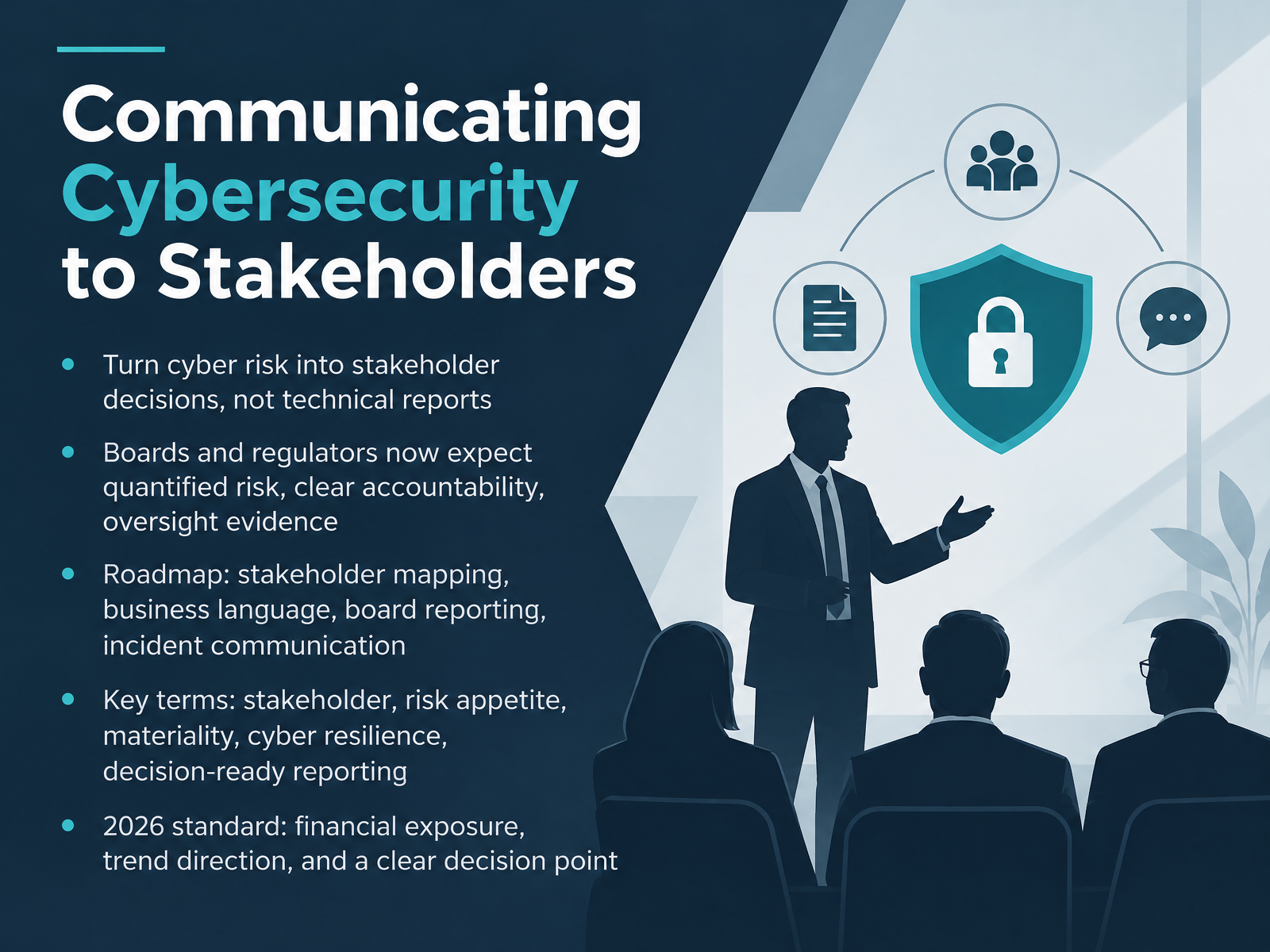
- 01Communicating Cybersecurity to StakeholdersWelcome. This course is about communicating cybersecurity to stakeholders, and the goal is practical. By the end, you will be able to turn cyber risk into decisions executives and business owners can actually make. Here is the core idea for today. Boards and regulators now expect quantified risk, clear accountability, and evidence of oversight. So a technical status report is no longer enough. You need decision-ready reporting, meaning a brief that names the financial exposure, shows the trend direction, and ends with a clear decision point. In this course we will map stakeholders, translate findings into business language, build board reporting, and plan incident communication. We will also define a few terms as we go, including risk appetite, materiality, and cyber resilience. Treat this as a working method you can apply in your next briefing. Next, let us look at the 2026 Communication Bar, and what stakeholders now expect.nacdonline.orgians.compwc.com+21 min
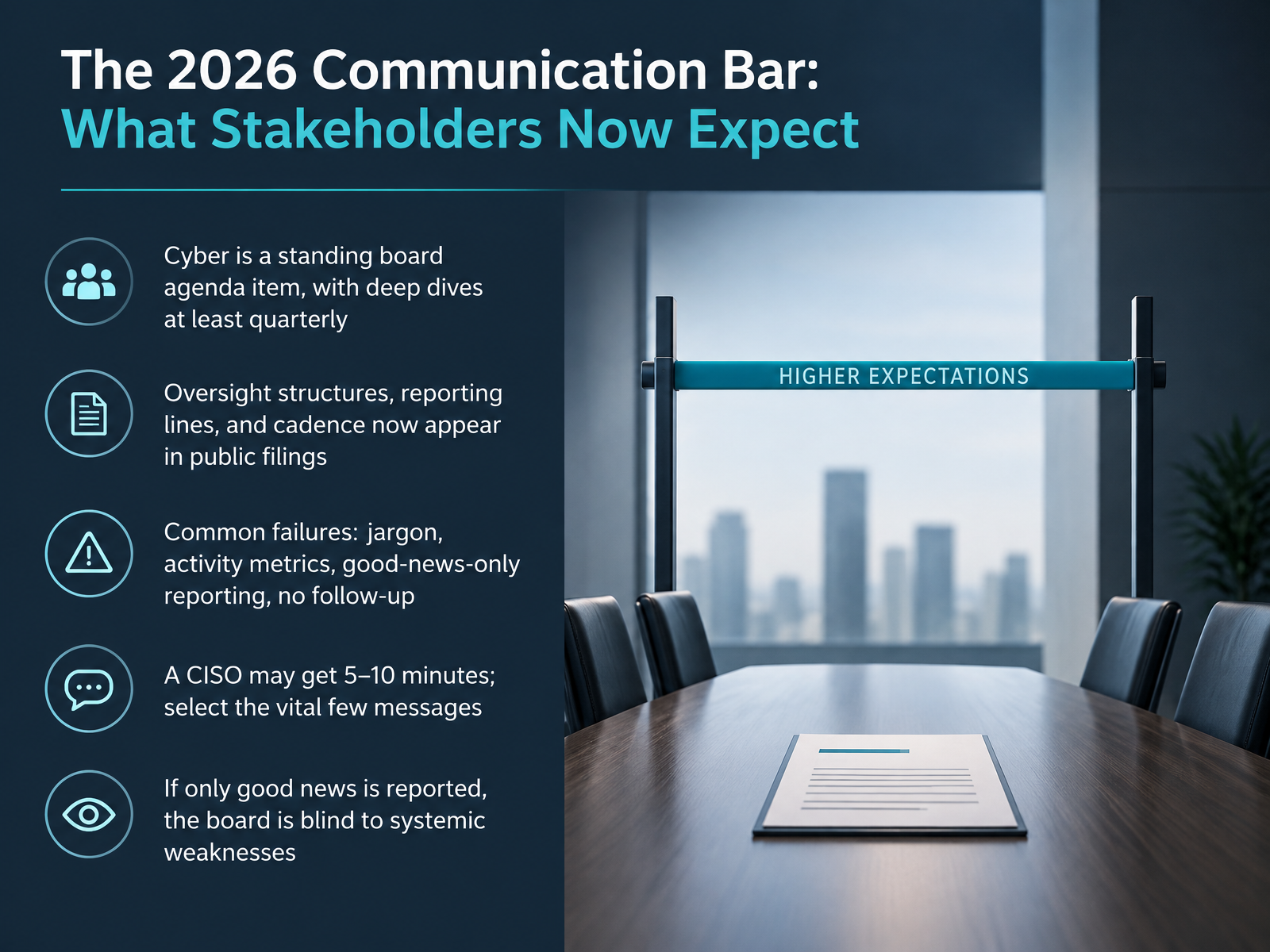
- 02The 2026 Communication Bar: What Stakeholders Now ExpectLet's look at what stakeholders expect from you in 2026. Cyber risk is now a standing board agenda item, with substantive deep dives at least quarterly. Oversight structures, reporting lines, and reporting cadence now appear in public filings, so how you brief the board can be read by investors. That raises the bar on clarity and consistency. The common failures are predictable. Jargon. Activity metrics that show effort rather than risk. Good-news-only reporting. And no follow-up after the meeting. Here is how to frame this. A security leader may get only five to ten minutes, so select the vital few messages, and let the numbers show genuine risk reduction. Above all, protect transparency. If only good news is reported, the board is blind to systemic weaknesses. So report what is not working, and what you are doing about it. Next, we will map your stakeholders and their information needs in Know Your Audience: Stakeholder Map and Information Needs.
 nacdonline.orgians.compwc.com+22 min
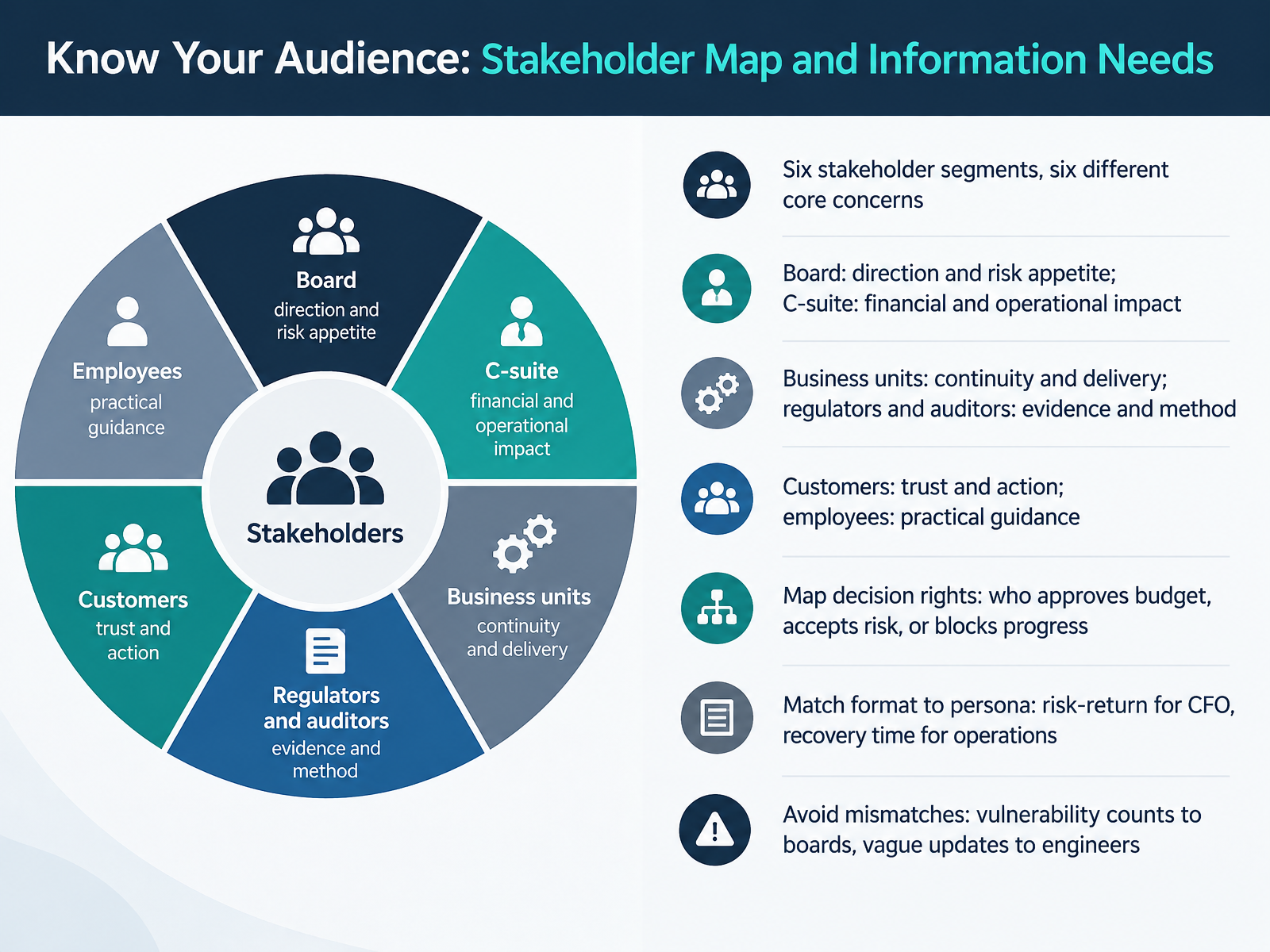
- 03Know Your Audience: Stakeholder Map and Information NeedsLet's move to audience mapping. Before you write a single slide, decide who you are briefing, because six stakeholder groups carry six different core concerns. The board wants direction and risk appetite. The executive team wants financial and operational impact. Business units care about continuity and delivery. Regulators and auditors want evidence and method. Customers want trust and a clear call to action. Employees want practical guidance they can apply today. Next, map decision rights. Be explicit about who approves budget, who accepts risk, and who can block progress. Then match format to persona. A finance leader needs risk and return. An operations leader needs recovery time. And avoid mismatches. Vulnerability counts mean little to a board, and vague updates frustrate engineers. Here is the takeaway. Brief the decision maker, in their language, at their level of detail. That naturally leads into the next step, translating technical findings into business language.
 nacdonline.orgians.compwc.com+21 min
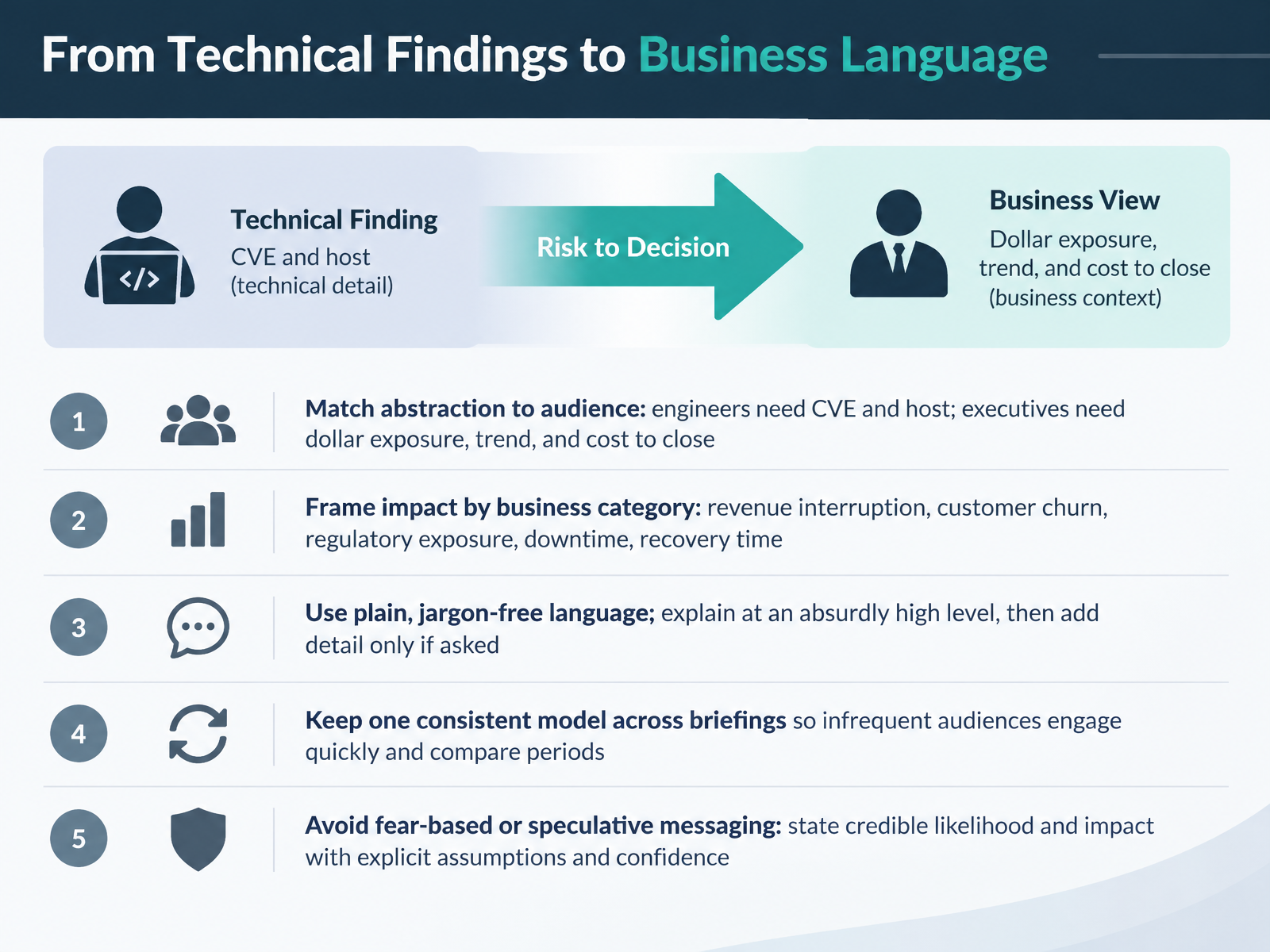
- 04From Technical Findings to Business LanguageNext, let's talk about turning technical findings into business language. Start with the right level of abstraction. Engineers need the C V E and the affected host. Executives need dollar exposure, the trend since last quarter, and the cost to close. Then frame impact by business category: revenue interruption, customer churn, regulatory exposure, downtime, and recovery time. Use plain language. Explain it at an absurdly high level first, then add detail only if someone asks. Keep one consistent model across briefings. That helps infrequent audiences engage quickly and compare periods. Finally, avoid fear-based or speculative messaging. State credible likelihood and impact, with explicit assumptions and your confidence level. Here is the takeaway: translate, do not compress. That sets up the next slide, quantifying cyber risk in financial terms.
 nacdonline.orgncsc.gov.ukisaca.org+21 min
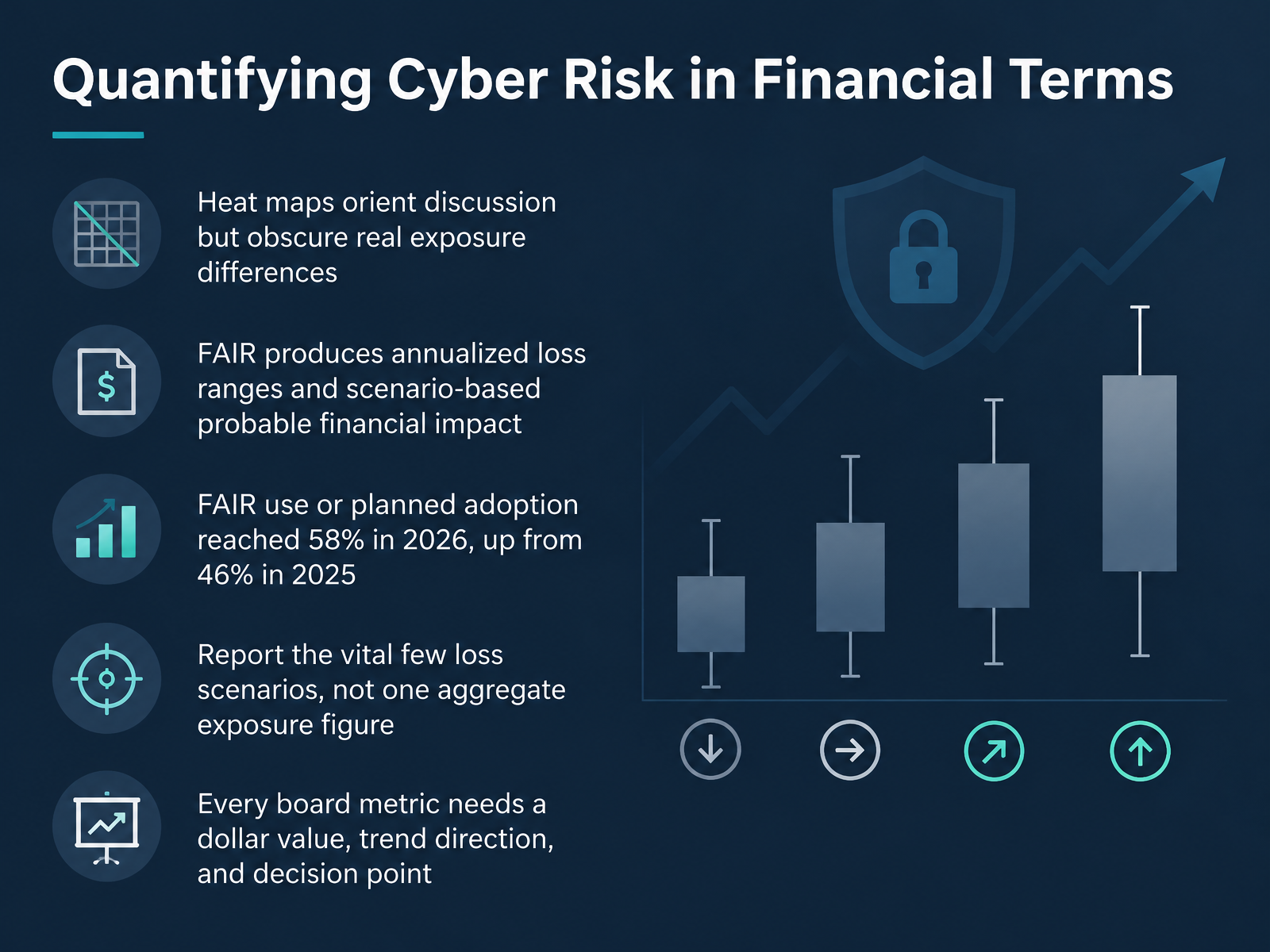
- 05Quantifying Cyber Risk in Financial TermsNext, let's talk about putting a dollar figure on cyber risk. Heat maps are useful for orienting a discussion, but they hide the real differences in exposure. Two red risks can vary by millions in probable loss. Factor Analysis of Information Risk, or FAIR, produces annualized loss ranges and scenario-based probable financial impact. Adoption is climbing. Fifty-eight percent of organizations now use or plan to adopt FAIR, up from forty-six percent in twenty twenty-five. Here is how to frame the report. Present the vital few loss scenarios, not one aggregate exposure figure. Aggregates are hard to defend and invite doubt. And every board metric needs three things: a dollar value, a trend direction, and a decision point. That gives directors something they can act on. We'll build on this as we look at framing risk against appetite, materiality, and key risk indicators.
 nacdonline.orgnacdonline.orgfairinstitute.org+21 min
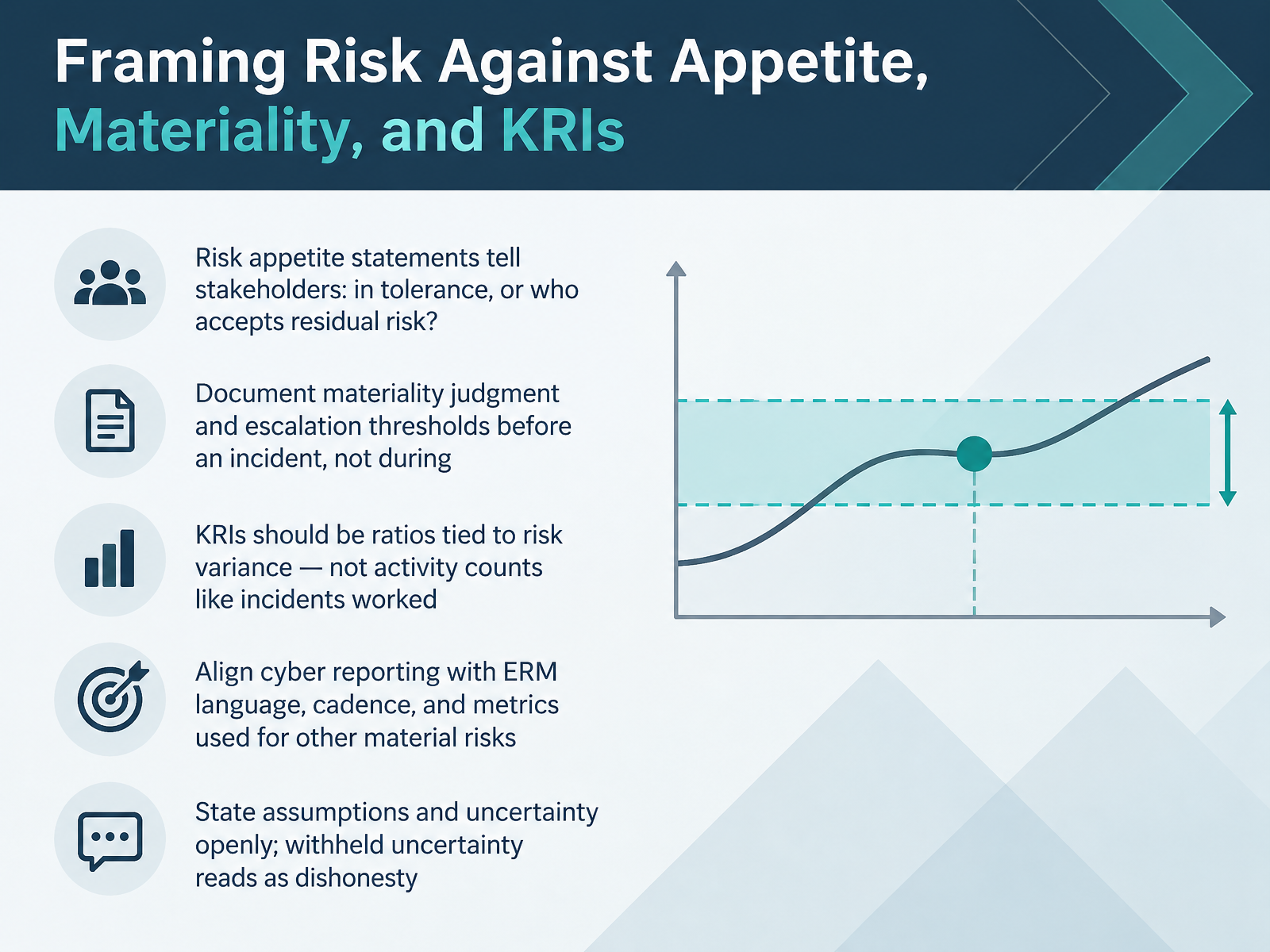
- 06Framing Risk Against Appetite, Materiality, and KRIsLet's look at how to frame risk against appetite, materiality, and key risk indicators. Your risk appetite statement answers one question for stakeholders: are we in tolerance, and if not, who accepts the residual risk? Document your materiality judgment and escalation thresholds before an incident, not during one. Key risk indicators should be ratios tied to risk variance, not activity counts like incidents worked. Align your cyber reporting with the language, cadence, and metrics your enterprise risk team already uses. And state assumptions and uncertainty openly, because withheld uncertainty reads as dishonesty. Keep those four choices simple, and stakeholders can act on what you tell them. Next, we turn to board and executive reporting that drives decisions.
 nacdonline.orgnacdonline.orgfairinstitute.org+21 min
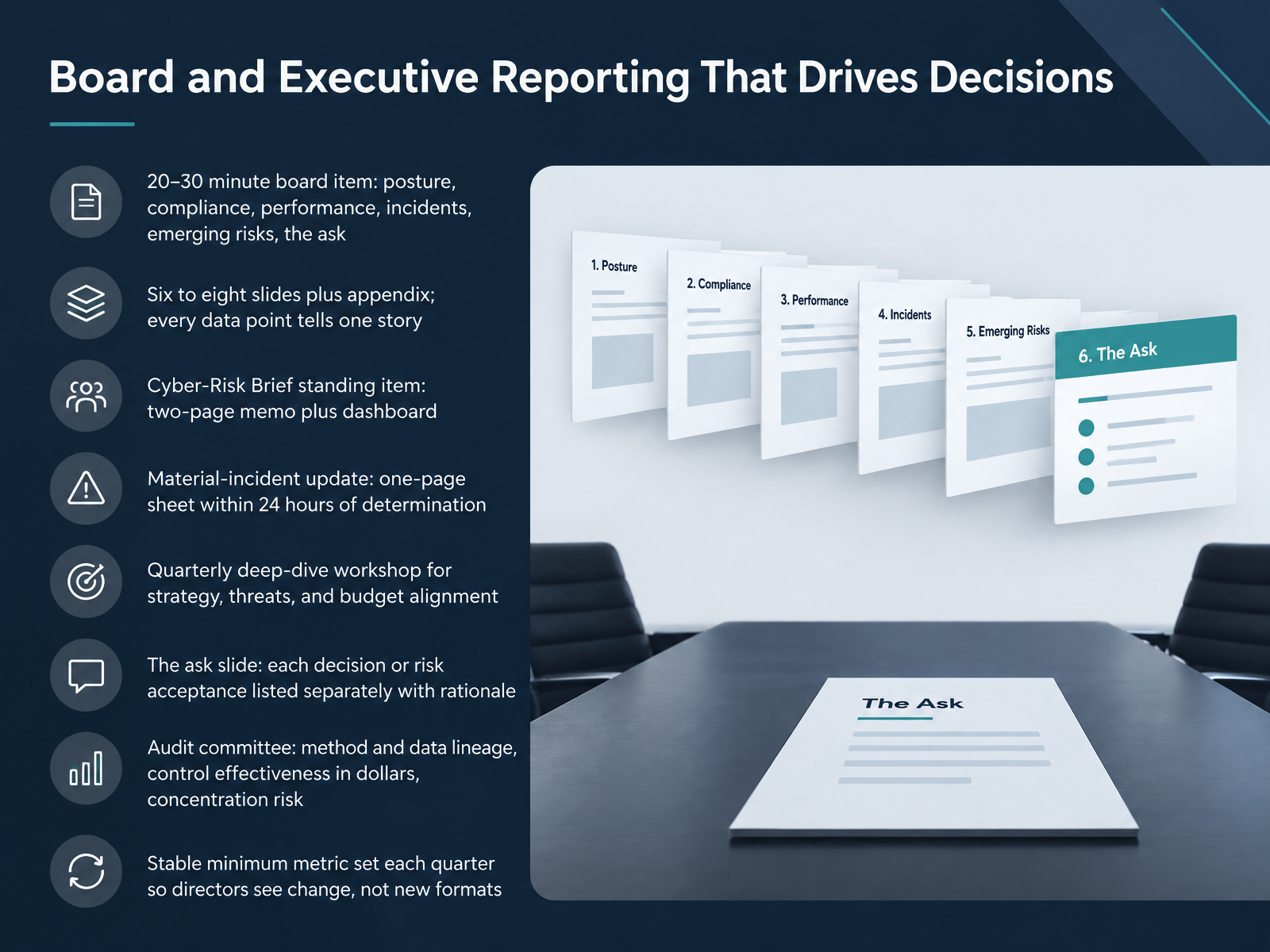
- 07Board and Executive Reporting That Drives DecisionsNow let's look at how board reporting actually drives decisions. Your board item should run twenty to thirty minutes, and cover posture, compliance, performance, incidents, emerging risks, and the ask. Keep it to six to eight slides, plus an appendix. Every data point should tell one story. Here is how to frame this. Make the Cyber-Risk Brief a standing item at every meeting, delivered as a two-page memo plus a dashboard. For a material incident, send a one-page sheet within twenty-four hours of the materiality determination. Hold a quarterly deep-dive workshop on strategy, threats, and budget alignment. On the ask slide, list each decision or risk acceptance separately, with its rationale. For the audit committee, show method and data lineage, control effectiveness in dollars, and concentration risk. And keep the same minimum metric set each quarter, so directors see change, not new formats. That consistency is what converts raw data into decisions. Next, we move on to Preparing for Tough Board Questions.
 nacdonline.orgcyberplanz.comreco.ai+22 min
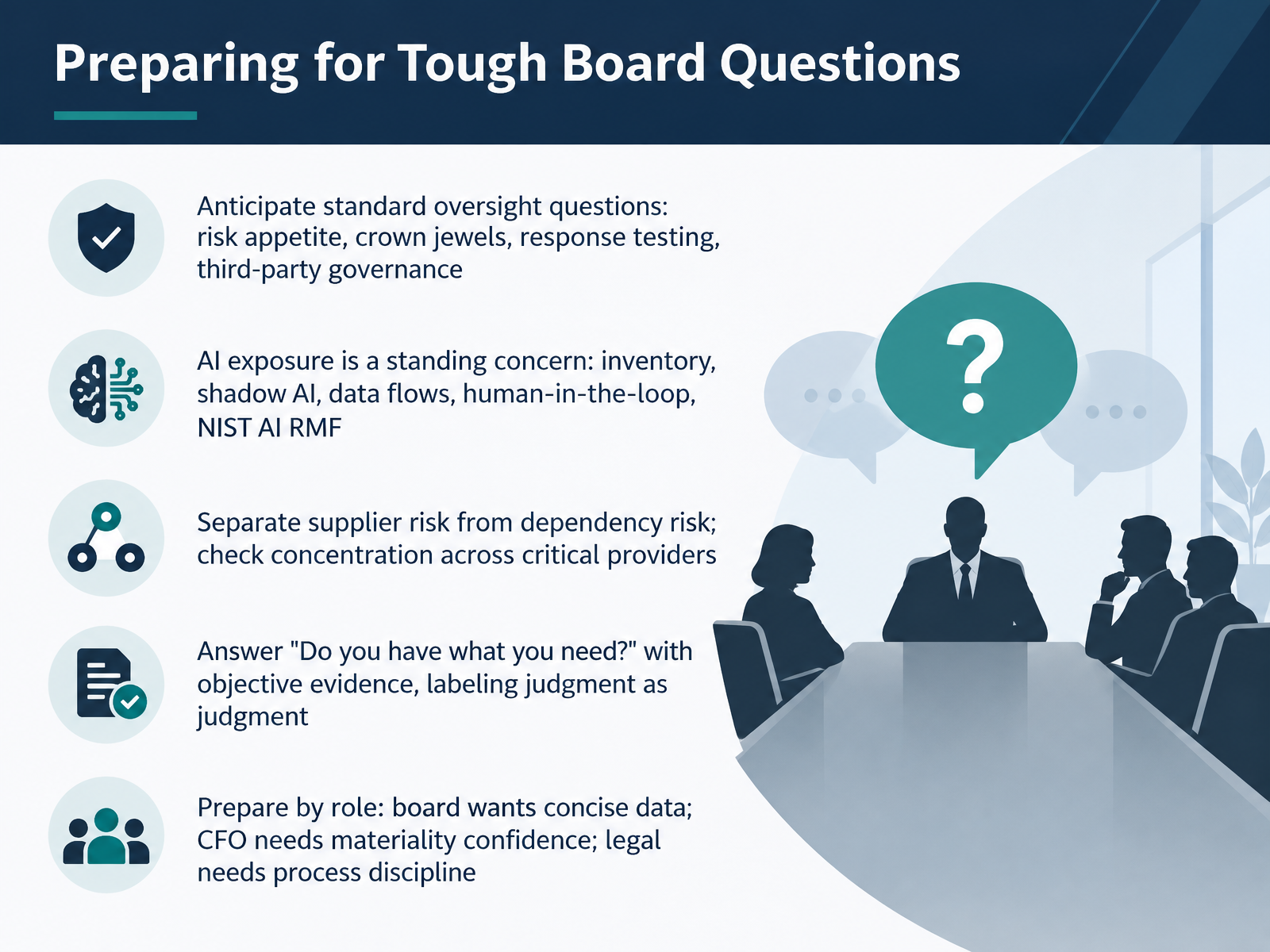
- 08Preparing for Tough Board QuestionsLet's talk about preparing for tough board questions, because the board meeting is not the place to improvise. Expect the standard oversight questions: risk appetite, your crown jewels, how response plans were tested, and how third parties are governed. AI exposure is now a standing concern, so be ready to cover your AI inventory, shadow AI, data flows, and where human review stays in the loop, framed against the NIST AI Risk Management Framework. On suppliers, separate supplier risk from dependency risk, and check concentration across critical providers, because one shared platform failure can hit several suppliers at once. When asked whether you have what you need, answer with objective evidence, and label judgment as judgment. Then tailor by role: the board wants concise data, the CFO needs confidence in materiality calls, and legal needs process discipline. Now let's look at visuals and formats for executive audiences.
 nacdonline.orgians.compwc.com+22 min
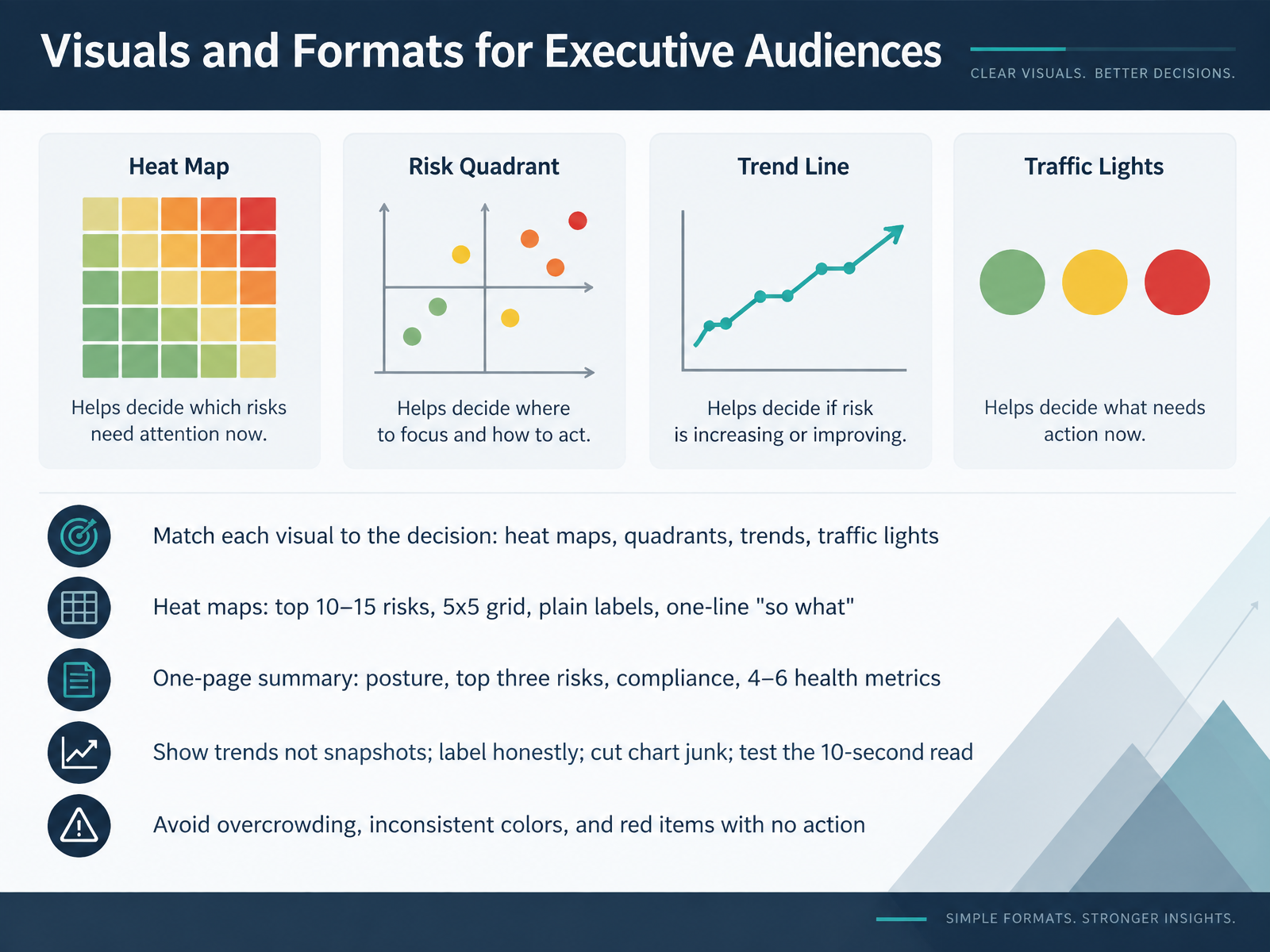
- 09Visuals and Formats for Executive AudiencesNow let's talk about the visuals themselves. The first question is not which chart looks best, but which decision the audience needs to make. A heat map shows where risk concentrates. A quadrant view helps prioritize what deserves attention now. A trend line shows whether risk is improving or getting worse. A traffic light dashboard gives instant status across several areas. For heat maps, keep to your top ten to fifteen risks on a five by five grid, use plain labels, and add one-line so what beside each red item. For executives, build a one-page summary with overall posture, your top three risks, a compliance snapshot, and four to six health metrics. Show trends rather than snapshots, label honestly, cut chart junk, and test that a non-technical reader gets the main point in ten seconds. Avoid overcrowding, inconsistent colors, and red items with no action attached. Next, we turn to communicating during a cyber incident.
 fairinstitute.orgsecurityscientist.netnacdonline.org+22 min
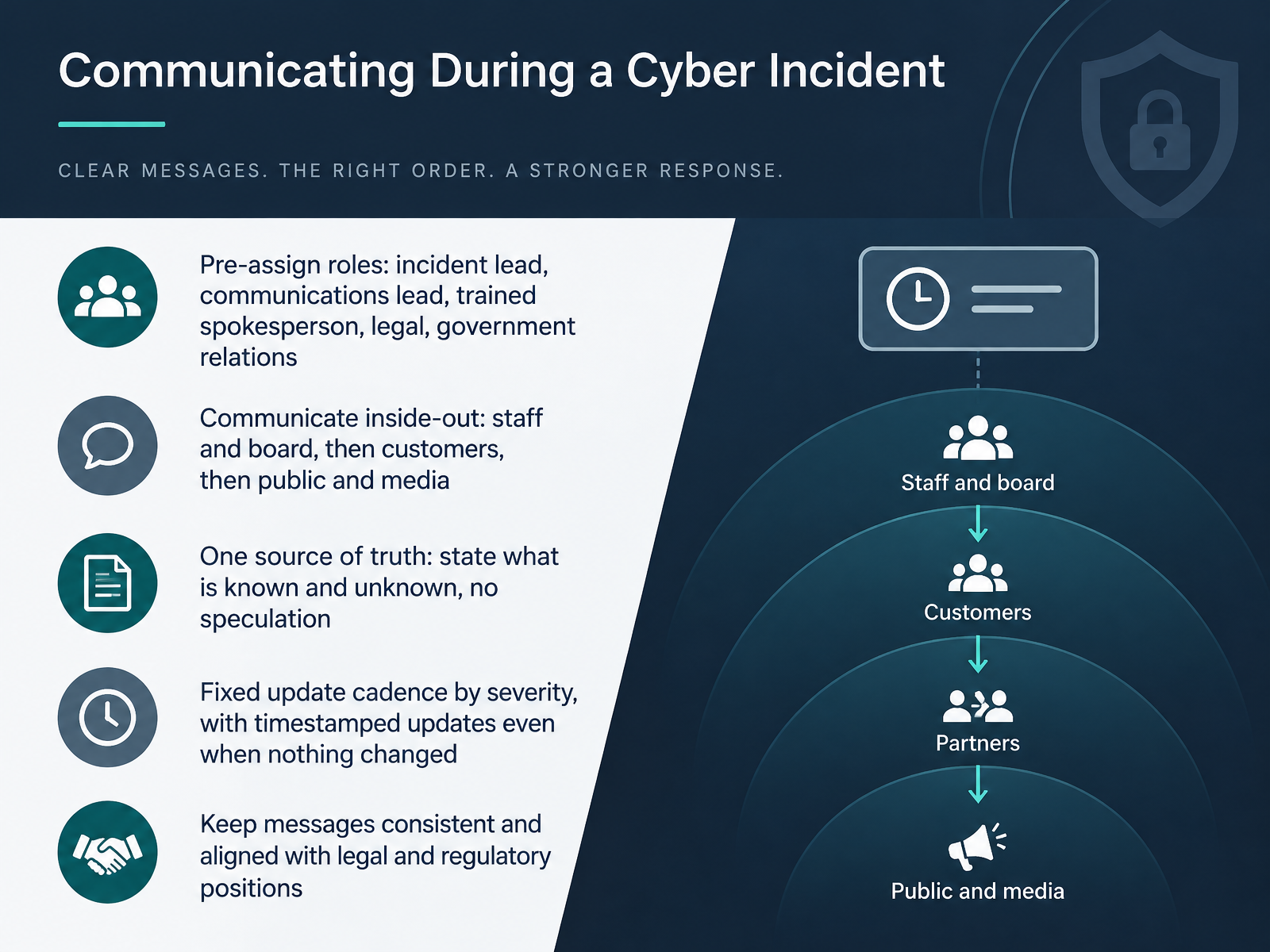
- 10Communicating During a Cyber IncidentLet's move to communicating during a live incident. Here is how to frame this for executives. Communication runs on roles, not improvisation. Pre-assign an incident lead, a communications lead, a trained spokesperson, legal counsel, and a government relations contact. Each person knows their approval path before an incident starts. Then communicate inside out. Staff and the board hear it first, then customers, then the public and media. Your staff will surface questions you missed, which sharpens the external message. Keep one source of truth, and state plainly what is known and what is unknown. No speculation about cause or attribution. Commit to a fixed update cadence tied to severity, and publish timestamped updates even when nothing has changed. A missed update reads as bad news. Finally, keep every message consistent with your legal and regulatory position, so public statements and regulator filings tell the same story. Next, we turn to the obligations behind that timeline, meeting regulatory notification and disclosure obligations.
 2 min
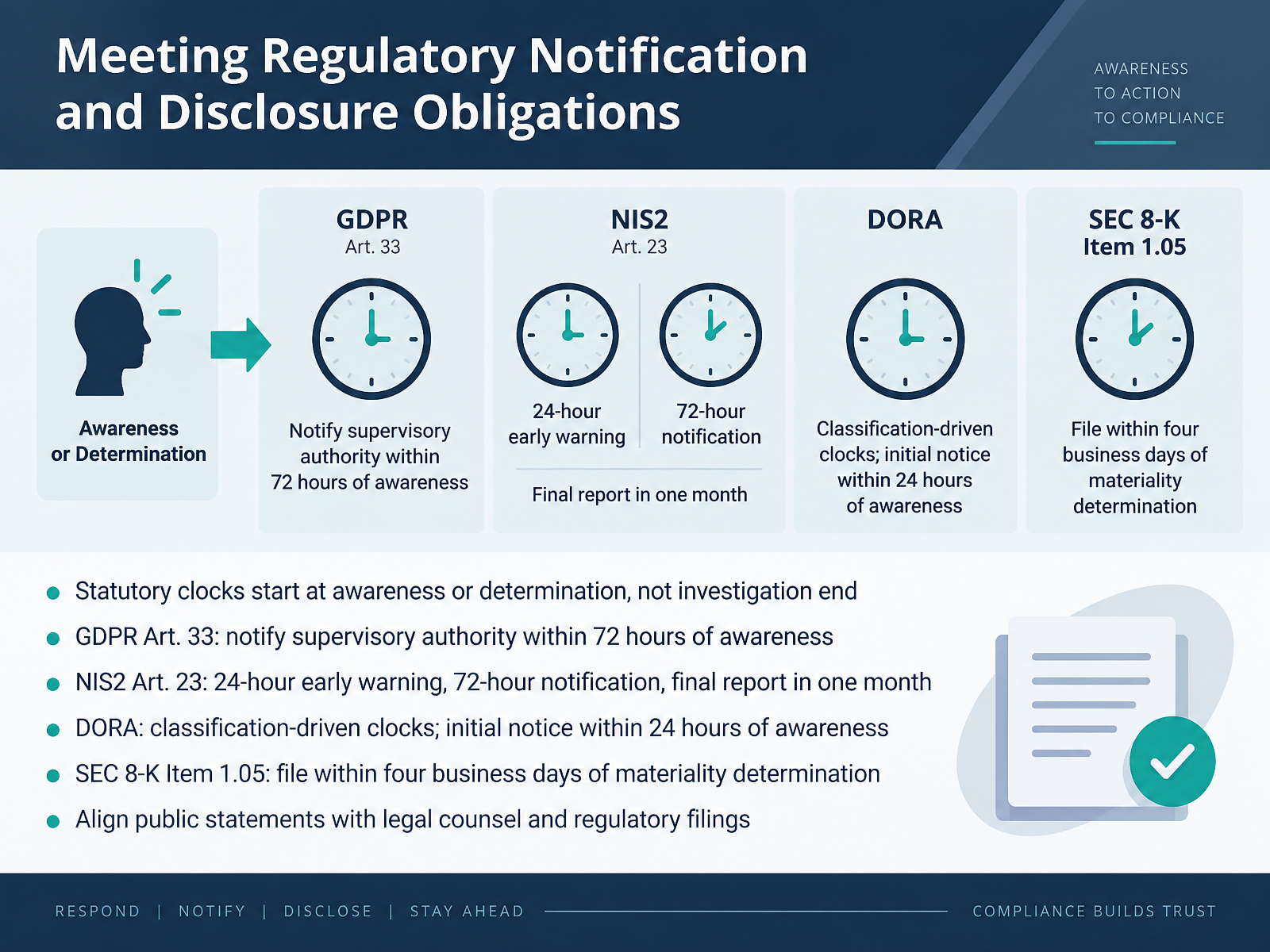
- 11Meeting Regulatory Notification and Disclosure ObligationsLet's turn to regulatory notification and disclosure. For executives, the key question is simple. When does our clock start? The answer, under every regime on this slide, is awareness or determination, not the end of the investigation. So here is how to frame each one. Under GDPR Article 33, you notify the supervisory authority within seventy-two hours of becoming aware of a personal data breach. Under NIS2 Article 23, you send an early warning within twenty-four hours, a notification within seventy-two hours, and a final report within one month. DORA uses classification-driven clocks, with an initial notice within twenty-four hours of awareness. For U.S. registrants, SEC Form 8-K Item 1.05 requires filing within four business days of your materiality determination. One practice ties this together. Align every public statement with legal counsel and your regulatory filings, so your story stays consistent across audiences. With that in mind, let's look at what comes after the incident, rebuilding trust with customers and the board.
 2 min
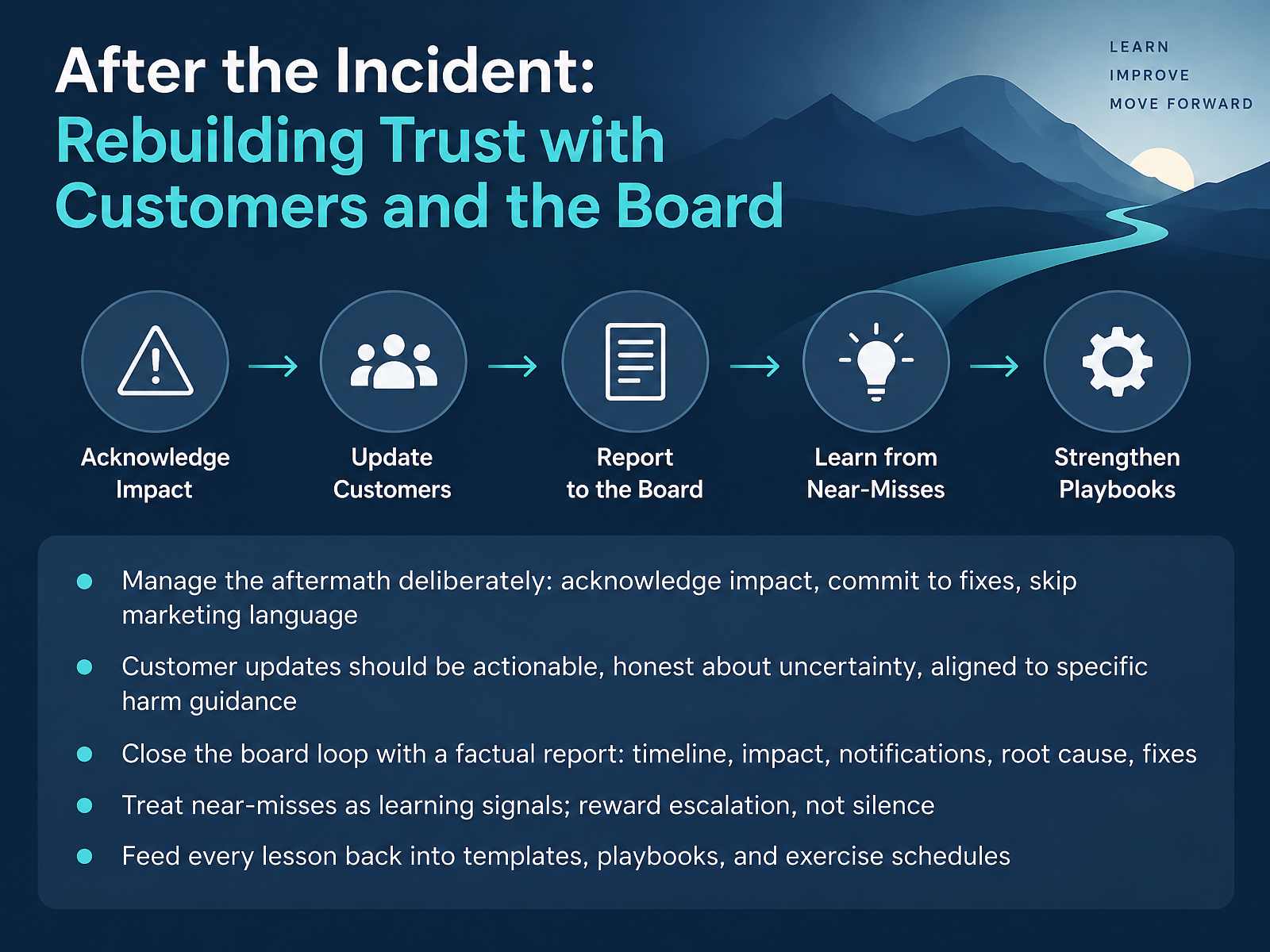
- 12After the Incident: Rebuilding Trust with Customers and the BoardLet's talk about what happens after the incident, when you have to rebuild trust. Manage the aftermath deliberately. Acknowledge the impact, commit to fixes, and skip marketing language. Reassurances front-loaded into an update read as spin, not accountability. For customer updates, be actionable and honest about what you still do not know, and point people to guidance on the specific harm they may face. Then close the board loop with a factual report: the timeline, the impact, the notifications made, the root cause, and the fixes. Treat near-misses as learning signals, and reward escalation rather than silence. Finally, feed every lesson back into your templates, playbooks, and exercise schedules, so the next response starts stronger. That habit of learning carries straight into your everyday engagement, where security becomes a business partnership.
 nacdonline.orgians.compwc.com+21 min
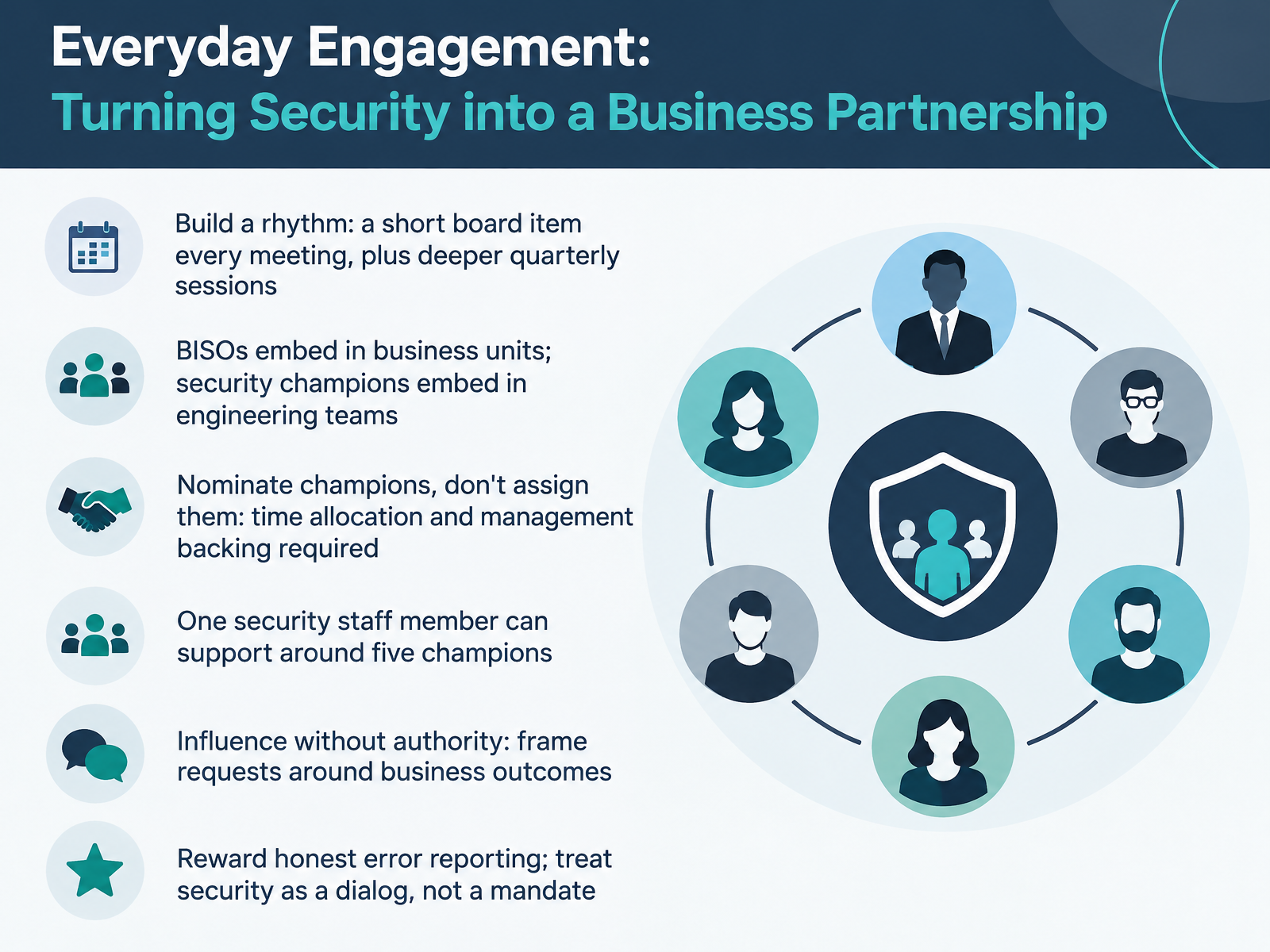
- 13Everyday Engagement: Turning Security into a Business PartnershipNow let's talk about everyday engagement, and how to turn security into a genuine business partnership. Start with rhythm. Ask for a short standing security item at every board meeting, plus a deeper session each quarter. That continuity lets directors absorb change gradually instead of all at once. Then embed people close to the work. Business information security officers sit inside business units, and security champions sit inside engineering teams. Nominate champions, don't assign them, and back the role with allocated time and visible management support. As a planning figure, one security staff member can support around five champions. Most of your influence here comes without authority, so frame each request around a business outcome. And reward honest error reporting. Treat security as a dialog, not a mandate. That is how partnership becomes routine. Next, we look at AI-assisted reporting and measuring communication effectiveness.
 nacdonline.orgncsc.gov.ukisaca.org+21 min
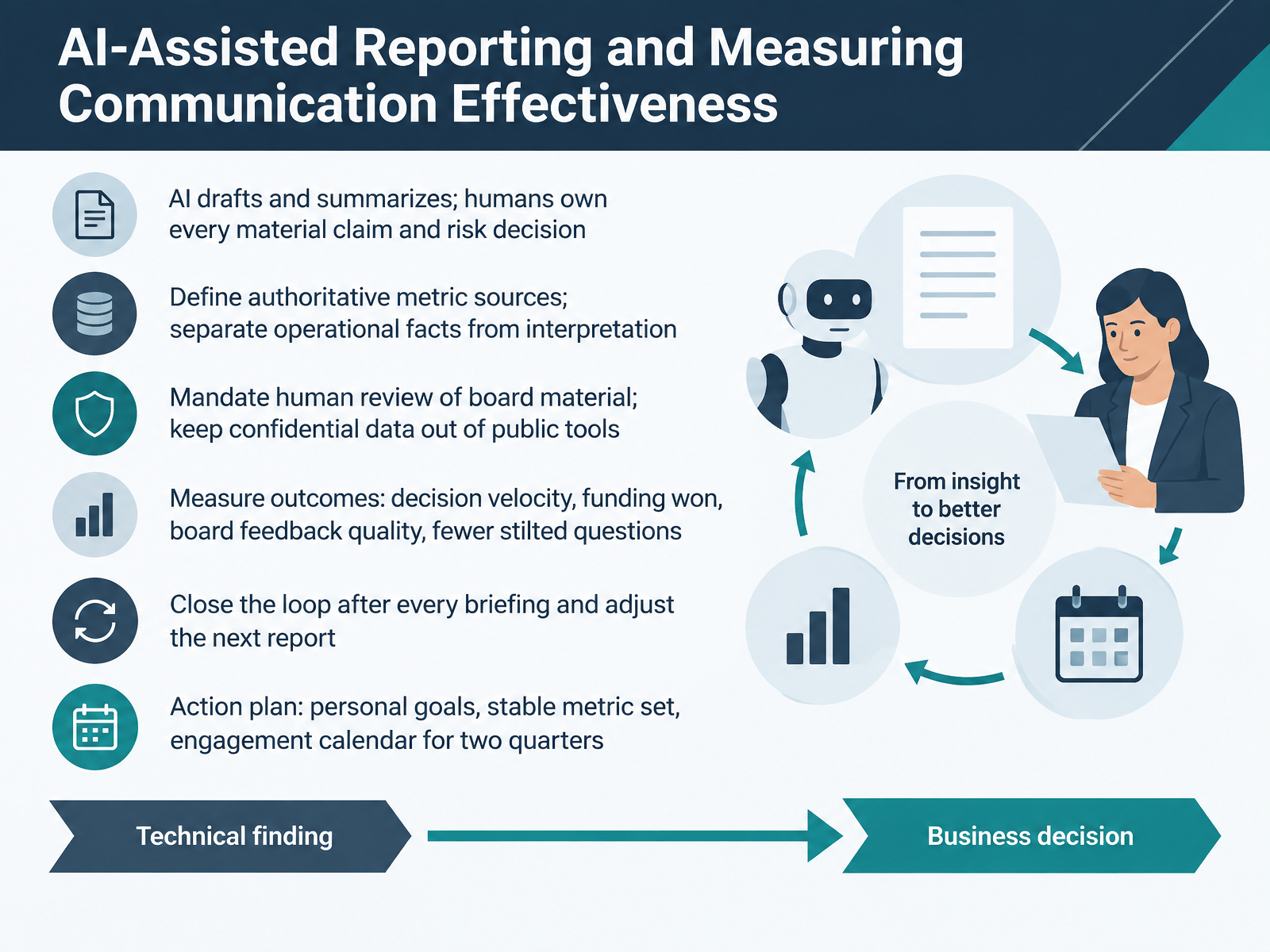
- 14AI-Assisted Reporting and Measuring Communication EffectivenessLet's close on how you use AI in reporting, and how you prove the communication is working. The principle is simple. AI drafts and summarizes. You own every material claim and every risk decision. Define which metric sources are authoritative, and keep operational facts separate from interpretation. Require human review of anything that goes to the board, and keep confidential data out of public tools. Then measure outcomes, not activity. Track decision velocity, funding won, the quality of board feedback, and whether stilted questions are declining. After each briefing, close the loop and adjust the next report. Your action plan is concrete: set personal goals, lock in a stable metric set, and build an engagement calendar covering two quarters. Thank you for your attention. Keep the narrative honest, keep the evidence traceable, and your stakeholders will keep trusting what you bring them.
 gartner.comtechtarget.comnacdonline.org+22 min
Take the deck with you
Download this course as a file — free, no sign-up needed.
- PDF handoutEvery slide page, ready to print or share.15 pages · 3.2 MBDownload
- Narrated PowerPointThe deck that presents itself — every slide carries the digital human's narration video.15 pages · 12.4 MBDownload
- PowerPoint slidesThe full deck as a .pptx — open it in PowerPoint, Keynote, or Google Slides.15 pages · 3.1 MBDownload
Free to use in your own training — please keep the PersonWise credit page at the end.
Have your own deck? Turn it into a course
Sources consulted
Web sources consulted while building this course.
- Cybersecurity Oversight Disclosures - 10 Questions for Boards | NACD — nacdonline.org
- 2026 Benchmark: 660+ CISOs and Board Directors — ians.com
- SEC’s cyber disclosure rule: PwC — pwc.com
- Cybersecurity Board Reporting Guide for CISOs | Deloitte US — deloitte.com
- Cyber and AI oversight disclosures in 2025 | EY - US — ey.com
- Building a Relationship Between the Board and CISO — nacdonline.org
- Board-level cyber discussions: communicating clearly — ncsc.gov.uk
- 2024 Volume 23 Five Key Considerations for Crafting Board Presentations on Information Risk and Security — isaca.org
- How Do CISOs Effectively Communicate Cybersecurity Metrics to the Board? — gartner.com
- From cyber risk to business risk: How CISOs should engage the board in 2026 — idc.com
- Guide Cybersecurity Risk Measurement and Reporting | NACD — nacdonline.org
- Example Cybersecurity Board Reporting — nacdonline.org
- Best Practices for Communicating Cyber Risk Using FAIR — fairinstitute.org
- Scale FAIR Risk Quantification and Report It to the Board — ians.com
- Lost in translation: Cybersecurity board reporting for CISOs | TechTarget — techtarget.com
- BOARD THIRD-PARTY CYBER & AI RISK DASHBOARD — cyberplanz.com
- CISO Board Report Template: AI Risk Metrics That Matter — reco.ai
- Quarterly Board Cybersecurity Report | Hunto AI | Hunto AI — hunto.ai
- (anonymous) — erdalozkaya.com
- Complete Guide to Visual Cybersecurity Risk Communication — securityscientist.net