Begin
14 pages · ~28 min
Sales Enablement Platform Architecture
Equips sales enablement and revenue leaders to evaluate platforms, design architecture, and weigh key tradeoffs for informed selection decisions.
A digital instructor presents all 14 pages. Hold “Ask” at any point and ask out loud — the answer comes from this course. No sign-up needed.
What you’ll learn
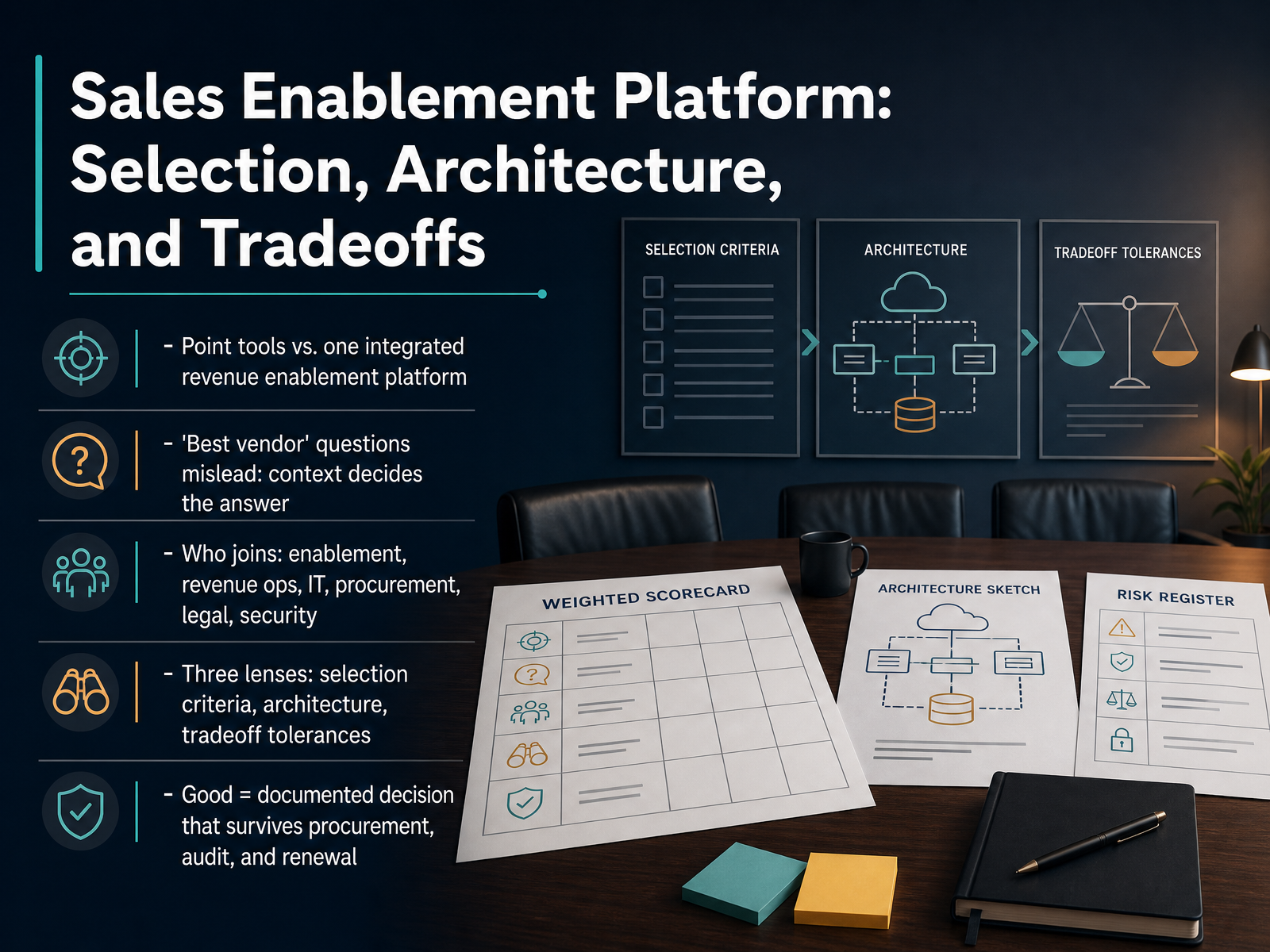
- 01Sales Enablement Platform: Selection, Architecture, and TradeoffsWelcome. Over the next several slides, we'll work through a practical framework for selecting and architecting a sales enablement platform. This isn't a product ranking. Our goal is a decision your team can defend through procurement, audit, and renewal.
Here's the core idea. The market has moved toward revenue enablement platforms, which unify content, learning, coaching, and buyer engagement in one SaaS system, deployed with mobile access and integrated with your customer relationship management, or CRM, the system of record for accounts and opportunities. But not every organization needs the full suite. Many run well on focused point tools.
So the question isn't which vendor is best. Context decides the answer. Start with the problems you need to solve, then let selection criteria, architecture, and tradeoff tolerances guide the choice.
Expect competing priorities. Enablement, revenue operations, information technology, procurement, legal, and security all have a stake, and they don't always agree.
Ultimately, good means a documented decision: one that holds up under scrutiny, not just a demo that impressed the room. Next, we'll look at market definition and category boundaries.gartner.comforrester.comforrester.com+21 min
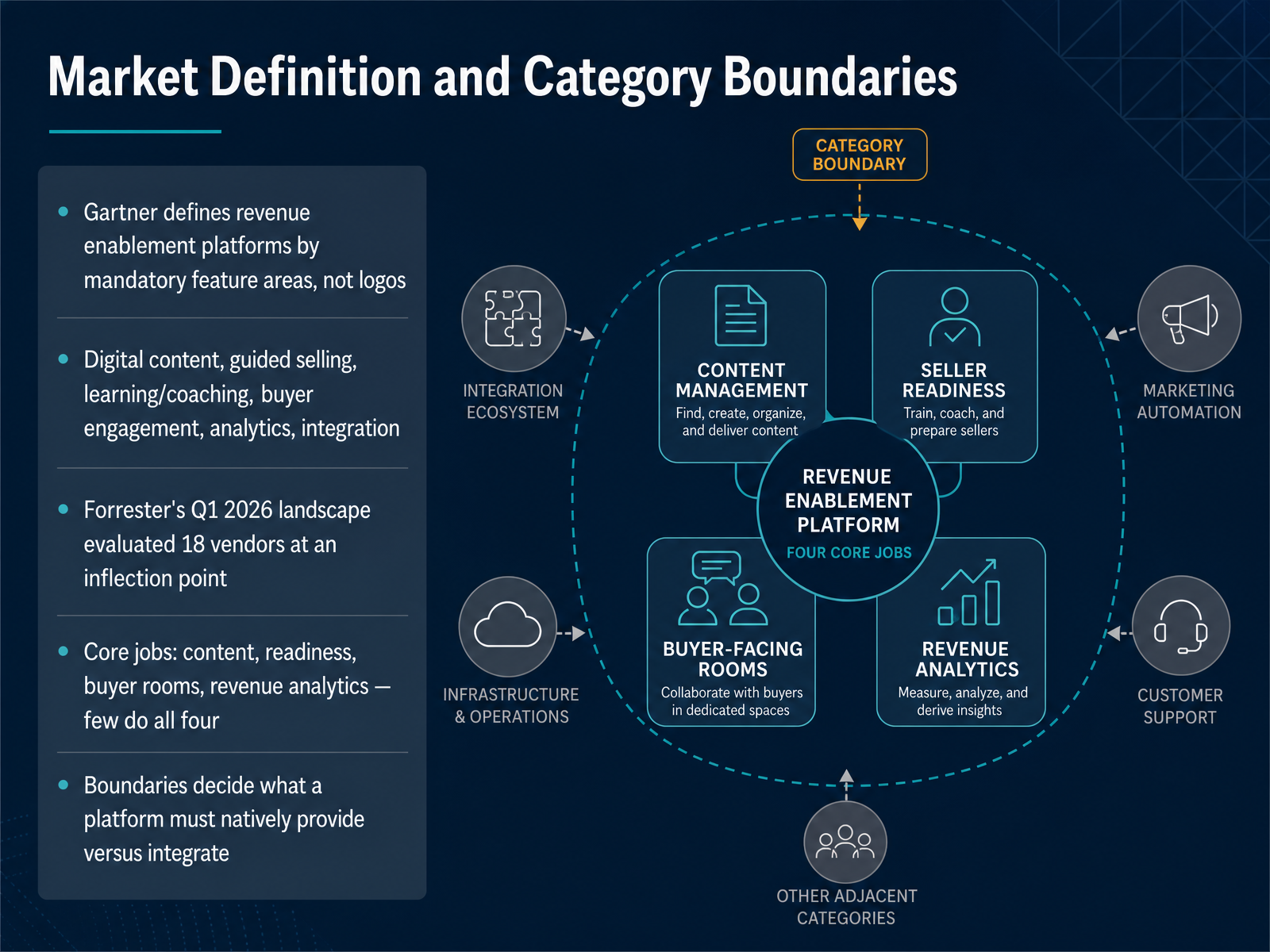
- 02Market Definition and Category BoundariesLet's start with how the market is actually defined, because boundaries shape every decision that follows. Gartner defines revenue enablement platforms by mandatory feature areas, not by vendor logos. Those areas include digital content, guided selling, learning and coaching, buyer engagement, analytics, and integration. In practice, that means any platform you shortlist must natively provide all of them, not just one or two. Forrester's Q1 2026 landscape evaluated eighteen vendors at an inflection point, with AI reshaping the category. The tradeoff is that most platforms do some jobs well and rely on integrations for the rest. The core jobs are content, readiness, buyer rooms, and revenue analytics. Few do all four natively. So your boundaries decide what the platform must provide versus what you connect. Let's look at consolidation, M and A, and what it means for buyers.
 gartner.comforrester.comforrester.com+21 min
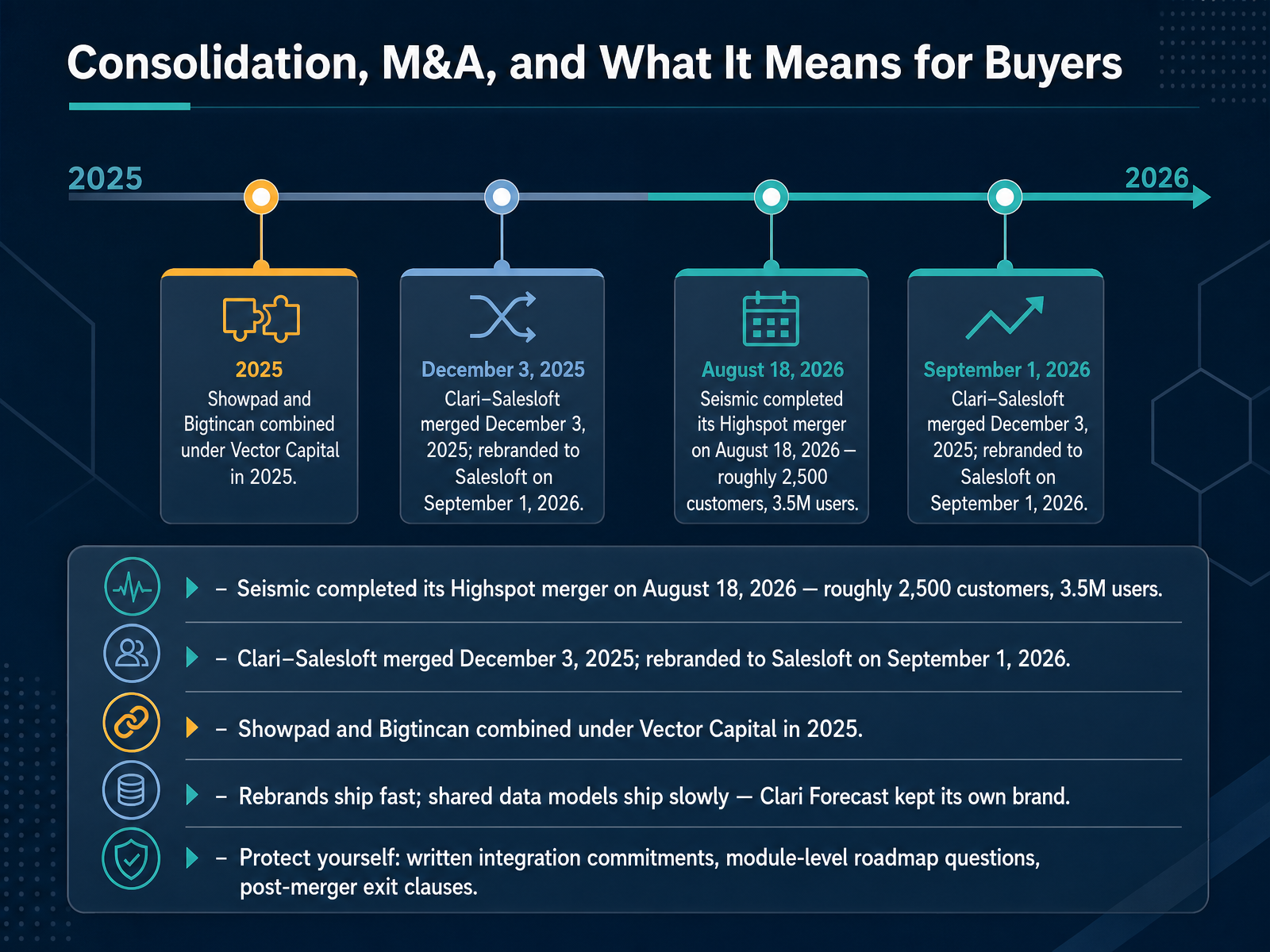
- 03Consolidation, M&A, and What It Means for BuyersNow let's look at consolidation, mergers and acquisitions, and what it means for you as a buyer. In practice, the enablement market has already reshaped itself. Seismic completed its merger with Highspot on August eighteenth, twenty twenty six, creating a combined company serving roughly twenty-five hundred customers and three and a half million users. Clari and Salesloft merged on December third, twenty twenty five, and rebranded to Salesloft on September first, twenty twenty six. And Showpad and Bigtincan combined under Vector Capital back in twenty twenty five. Here is the pattern worth remembering. Rebrands ship fast, but shared data models ship slowly. A telling detail: Clari Forecast kept its own product name after the rebrand, which signals that the hardest system to merge, the forecasting core, has not been fully folded in yet. So protect yourself. Ask for written integration commitments, ask module-level roadmap questions before you renew, and negotiate post-merger exit clauses. That way, you are not paying today's price for tomorrow's architecture. Next, we turn to Requirements Definition and Stakeholder Alignment.
 salestechedition.compulserevops.comsalestable.ai+22 min
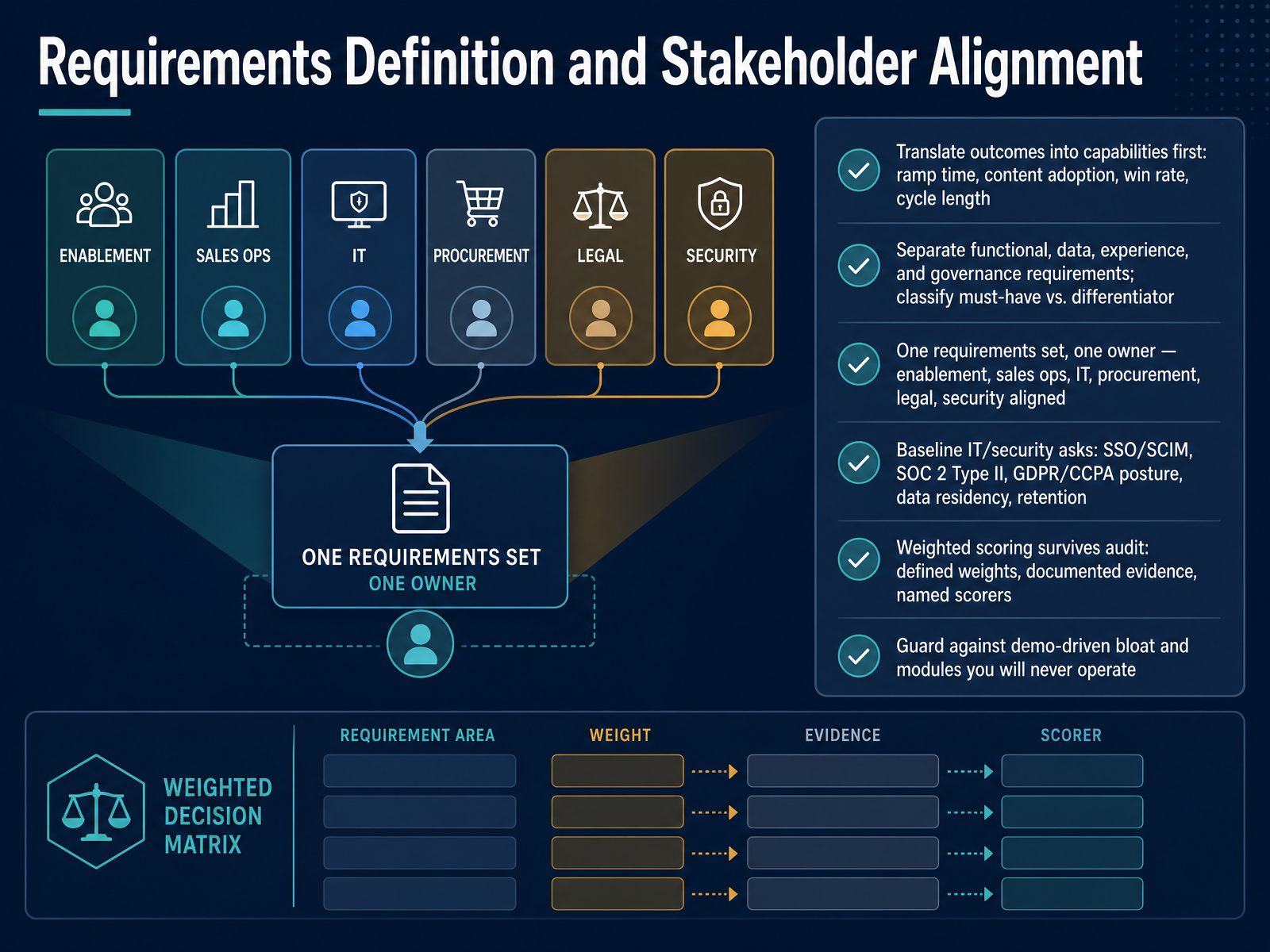
- 04Requirements Definition and Stakeholder AlignmentNow let's talk about requirements definition and stakeholder alignment. This is where good platform decisions are actually made. First, translate business outcomes into capabilities. If faster ramp time matters, ask which capability delivers it. If content adoption or win rate matters, name the capability behind it. Next, separate your requirements into four buckets: functional, data, experience, and governance. Then classify each as a must-have or a differentiator. Be disciplined here. In practice, you want one requirements set with one owner, and enablement, sales ops, IT, procurement, legal, and security all aligned to it. Baseline your IT and security asks now: single sign-on, SCIM provisioning, SOC 2 Type II, GDPR and CCPA posture, plus data residency and retention. A weighted scoring model survives audit when weights are defined, evidence is documented, and scorers are named. Above all, guard against demo-driven bloat. Do not buy modules your team will never operate. The takeaway is this: requirements built from outcomes, not features, keep the evaluation honest. Next, we move to the selection process, from longlist to decision.
 vendorbenchmark.comvendorbenchmark.comrevenue.io+22 min
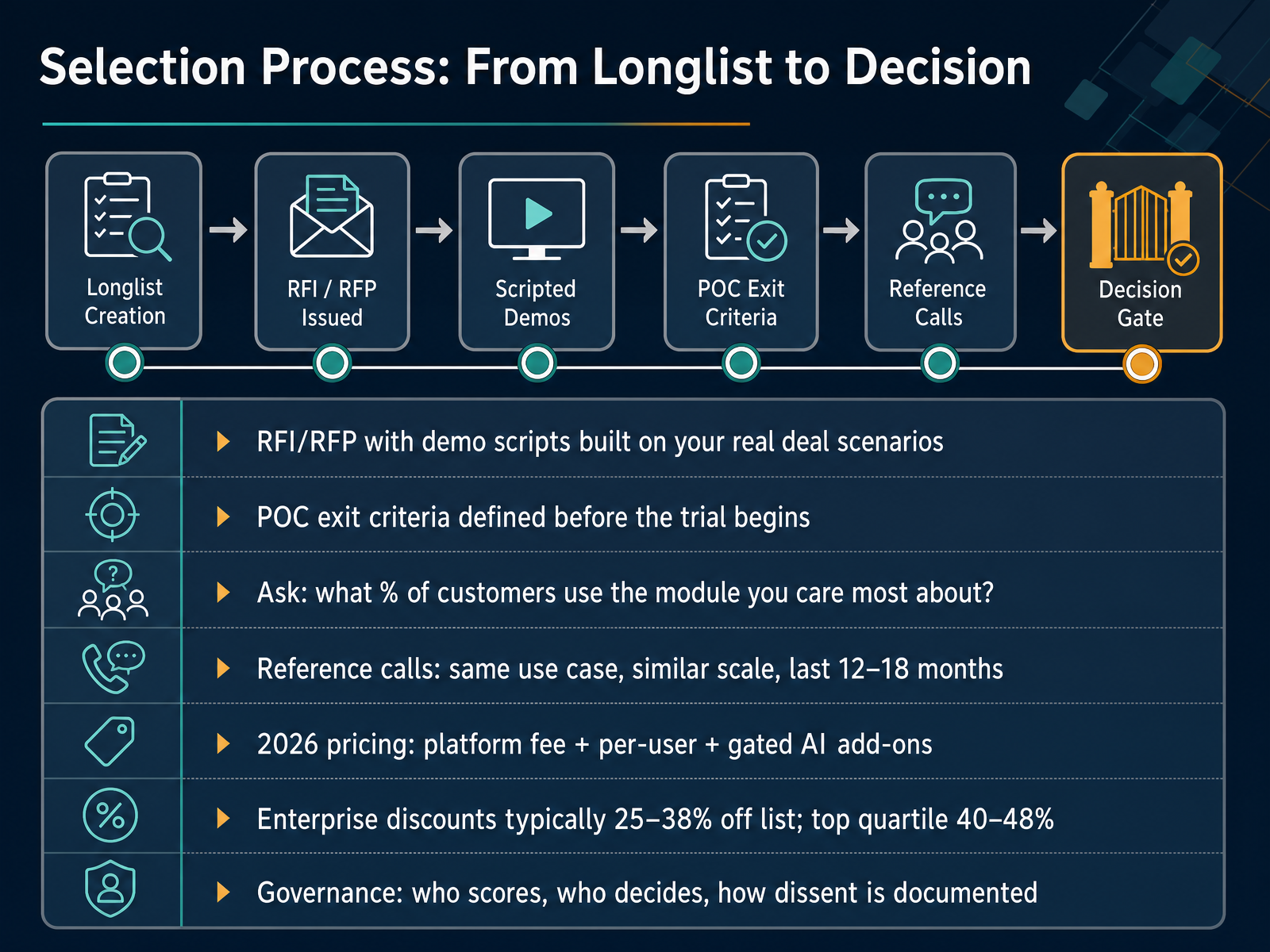
- 05Selection Process: From Longlist to DecisionLet's walk through the selection process, from longlist to final decision. First, run your RFI or RFP with demo scripts built on your real deal scenarios, not the vendor's polished demo data. Define your proof of concept exit criteria before the trial begins, so success is measurable, not negotiated afterward. Ask each vendor one blunt question: what percentage of your customers actually use the module we care most about? In practice, suites sell breadth but deliver adoption in one or two modules. Reference calls should match your use case, your scale, and the last twelve to eighteen months. On pricing, expect a platform fee plus per-user fees, with AI capabilities gated as paid add-ons. Enterprise discounts typically land between twenty-five and thirty-eight percent off list, and top-quartile negotiators reach forty to forty-eight percent. Finally, lock your governance: who scores, who decides, and how dissent gets documented. The takeaway is simple. Define exit criteria early, benchmark adoption honestly, and negotiate pricing and governance together. That sets up our next topic: total cost of ownership and contract structure.
 vendorbenchmark.comvendorbenchmark.comrevenue.io+22 min
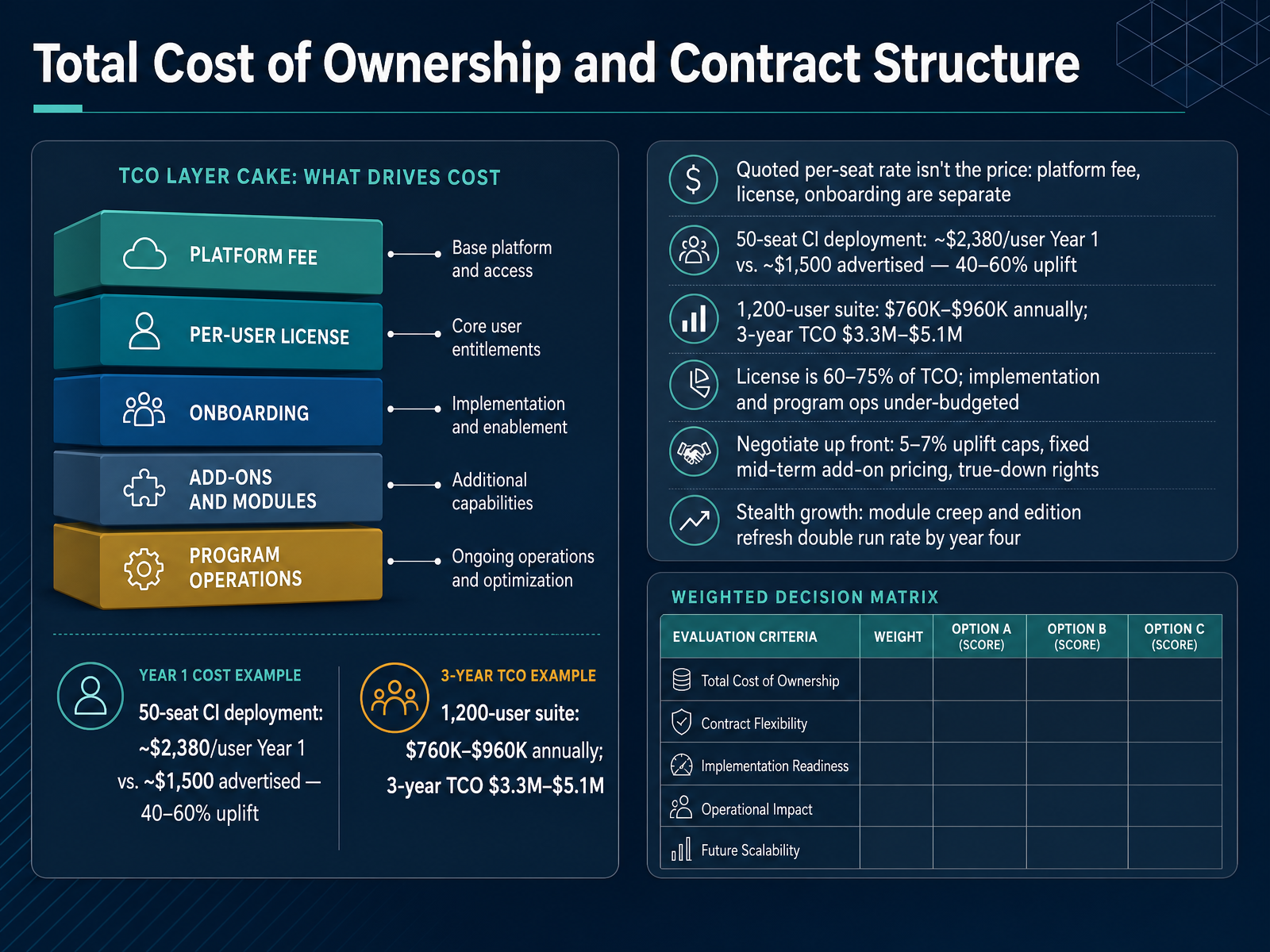
- 06Total Cost of Ownership and Contract StructureLet's talk about total cost of ownership, because the quoted per-seat rate is not the price. Platform fees, licenses, and onboarding are separate line items. In practice, a fifty-seat conversation intelligence deployment runs about two thousand three hundred eighty dollars per user in year one, against an advertised rate near fifteen hundred. That's a forty to sixty percent uplift. Scale that up, and a twelve-hundred-user suite costs seven hundred sixty thousand to nine hundred sixty thousand dollars annually, with three-year total cost of ownership between three point three and five point one million. License is sixty to seventy-five percent of that total, and implementation and program operations are routinely under-budgeted. So negotiate up front. Ask for five to seven percent uplift caps, fixed mid-term add-on pricing, and true-down rights. Otherwise, watch for stealth growth: module creep and edition refresh can double your run rate by year four. Now let's look at the reference architecture and integration patterns.
 vendorbenchmark.comvendorbenchmark.comrevenue.io+22 min
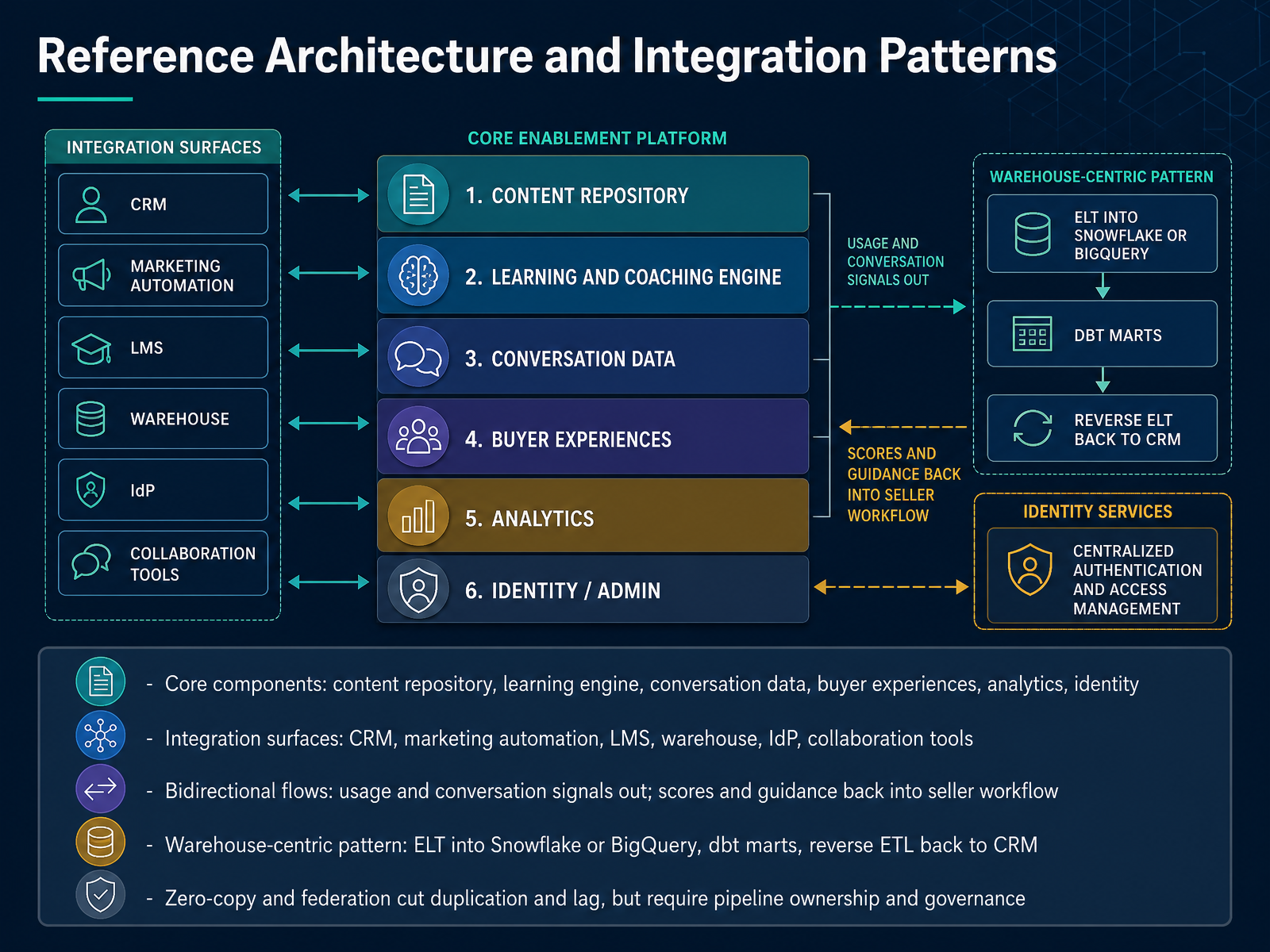
- 07Reference Architecture and Integration PatternsNow let's ground this in a reference architecture and the integration patterns that hold it together. The core components you're connecting are familiar: a content repository, a learning engine, conversation data, buyer experiences, analytics, and identity. Your integration surfaces usually include the CRM, marketing automation, a learning management system, the data warehouse, your identity provider, and collaboration tools like Slack or Teams. The flows should be bidirectional. Usage and conversation signals move out, while scores and guidance come back into the seller's daily workflow. In practice, one proven pattern is warehouse centric: extract and load into Snowflake or BigQuery, transform into tested marts with dbt, then use reverse ETL to push scores and fields back to the CRM. The tradeoff is clear. Zero copy and federation reduce duplication and lag, but they require clear pipeline ownership and governance. So ask two questions: who owns each pipeline, and how will you audit what lands back in the CRM? That discipline is what makes the architecture dependable. Next, we'll look at the data, analytics, and measurement model.
 anfloy.comarchitect.salesforce.comadriennevermorel.com+21 min
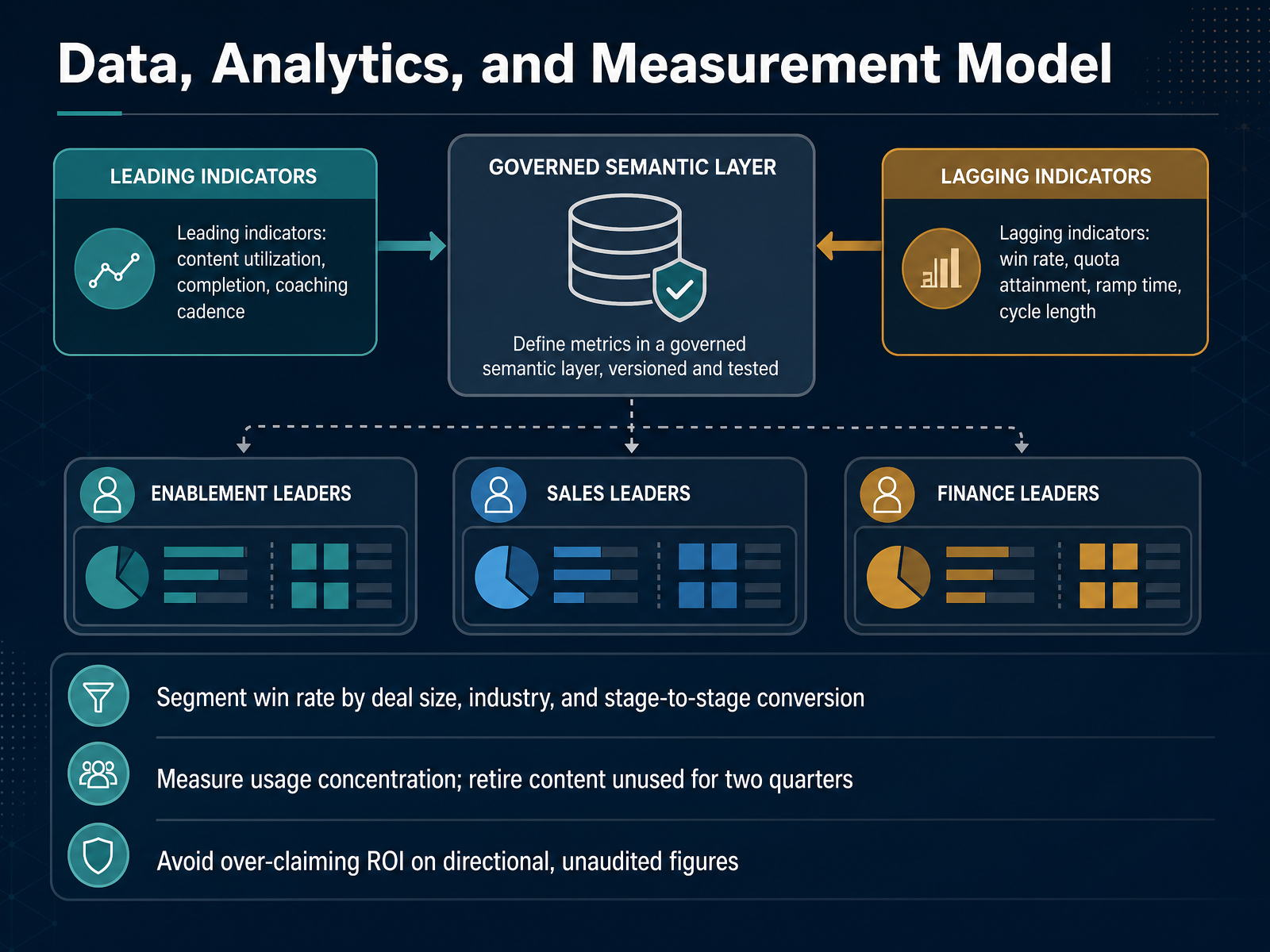
- 08Data, Analytics, and Measurement ModelLet's talk about the data, analytics, and measurement model behind your enablement platform. First, separate leading from lagging indicators. Leading indicators are things like content utilization, completion rates, and coaching cadence. Lagging indicators include win rate, quota attainment, ramp time, and cycle length. Leading indicators tell you what is happening now. Lagging indicators confirm what happened as a result. In practice, define each metric in a governed semantic layer, versioned and tested, so everyone works from one agreed definition. Then segment win rate by deal size, industry, and stage-to-stage conversion. An aggregate win rate hides where your message lands and where it does not. Also measure usage concentration. If almost all usage comes from a handful of assets, the rest is dead weight, so retire anything unused for two quarters. The tradeoff is effort versus rigor, and one caution: avoid over-claiming return on directional, unaudited figures. Next, we turn to AI features, automation, and governance.
 anfloy.comarchitect.salesforce.comadriennevermorel.com+22 min
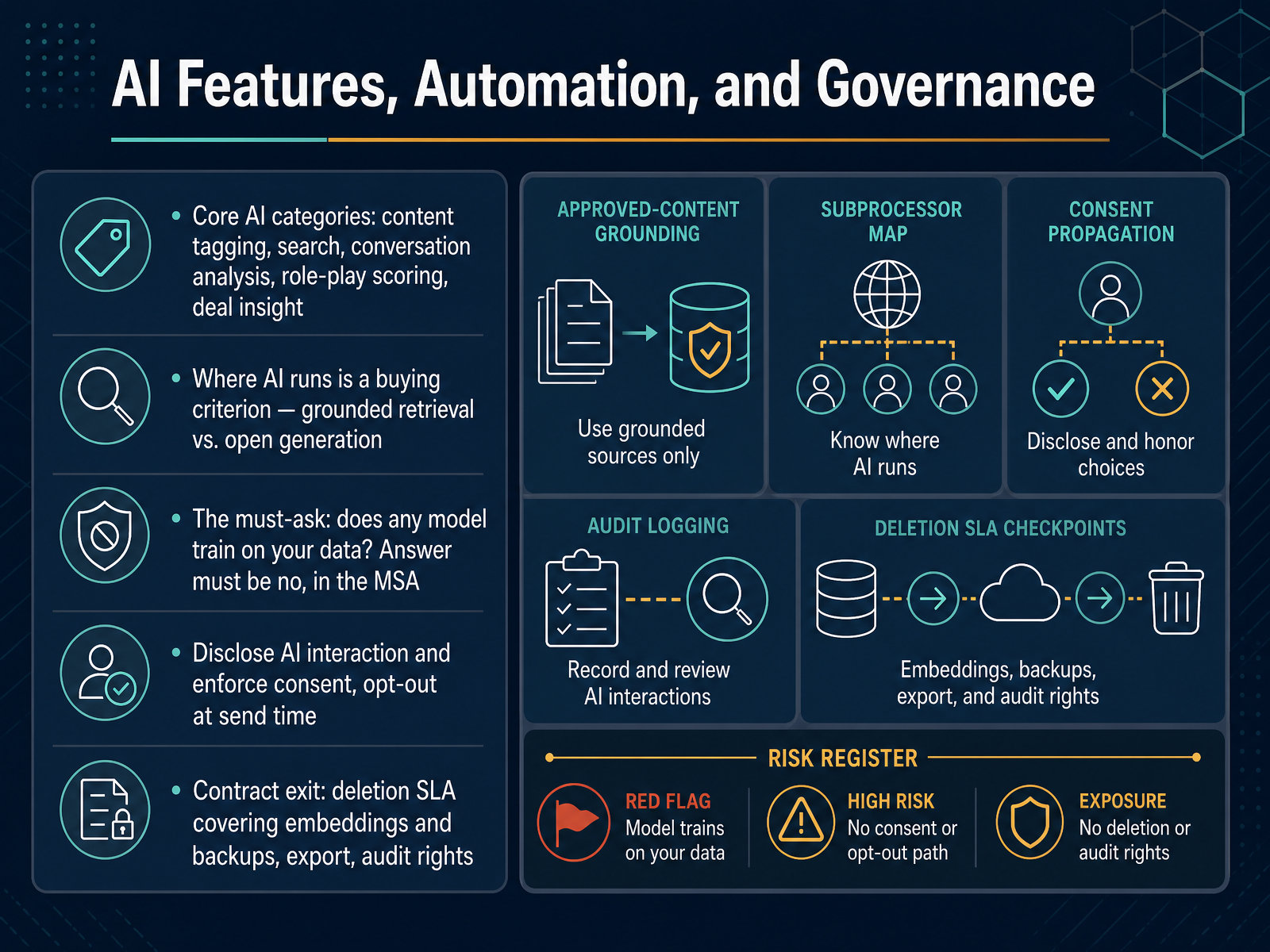
- 09AI Features, Automation, and GovernanceNow let's turn to AI features, automation, and governance. First, know the core AI categories you are evaluating: content tagging, search, conversation analysis, role-play scoring, and deal insight. In practice, they are not equal in risk or value. Second, where the AI runs is a buying criterion. Grounded retrieval pulls answers from your approved content. Open generation can produce plausible answers you never approved. The tradeoff is flexibility versus control. Then comes the must-ask question: does any model, including a third-party provider, train on your data? The acceptable answer is no, written into your master services agreement, not a help article. Next, disclose AI interaction where required, and enforce consent with opt-out checked at send time, not at list build. Finally, negotiate your exit before you sign: a deletion service level agreement covering embeddings, backups, and logs, plus usable export and audit rights. In short, govern AI like privileged access, with contract language you can verify. That leads us to architecture tradeoffs: suite, best of breed, and CRM native.
 salestechedition.compulserevops.comsalestable.ai+22 min
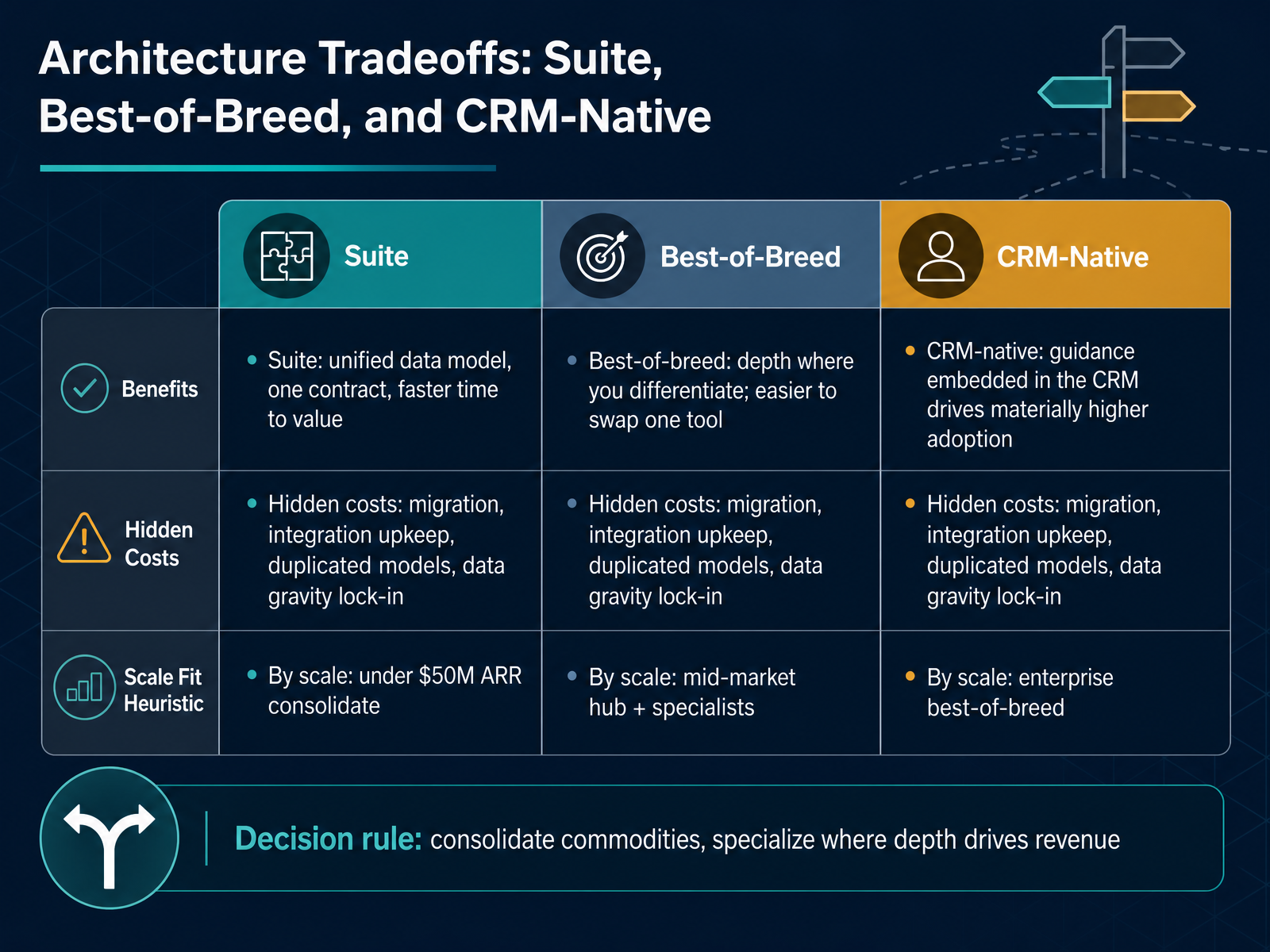
- 10Architecture Tradeoffs: Suite, Best-of-Breed, and CRM-NativeLet's turn to architecture tradeoffs. There are three common paths, and each carries a different cost. First, the suite: one vendor, one contract, and a unified data model. That usually means faster time to value, because there is less to integrate up front. Second, best-of-breed: you go deep where you differentiate and keep the flexibility to swap one tool without rebuilding the stack. Third, CRM-native: guidance lives inside the CRM, and that embedded placement tends to drive materially higher adoption than a separate login. In practice, the hidden costs decide it. Watch migration effort, integration upkeep, duplicated data models, and data gravity lock-in, where your history makes leaving expensive. The tradeoff is speed and simplicity versus depth and flexibility. By scale, teams under fifty million in annual recurring revenue should consolidate. Mid-market teams often run a CRM hub plus a few specialists. Larger enterprises lean best-of-breed by necessity. So here is the decision rule: consolidate commodities, and specialize where depth drives revenue. Next, we'll look at build versus buy versus extend.
 anfloy.comarchitect.salesforce.comadriennevermorel.com+22 min
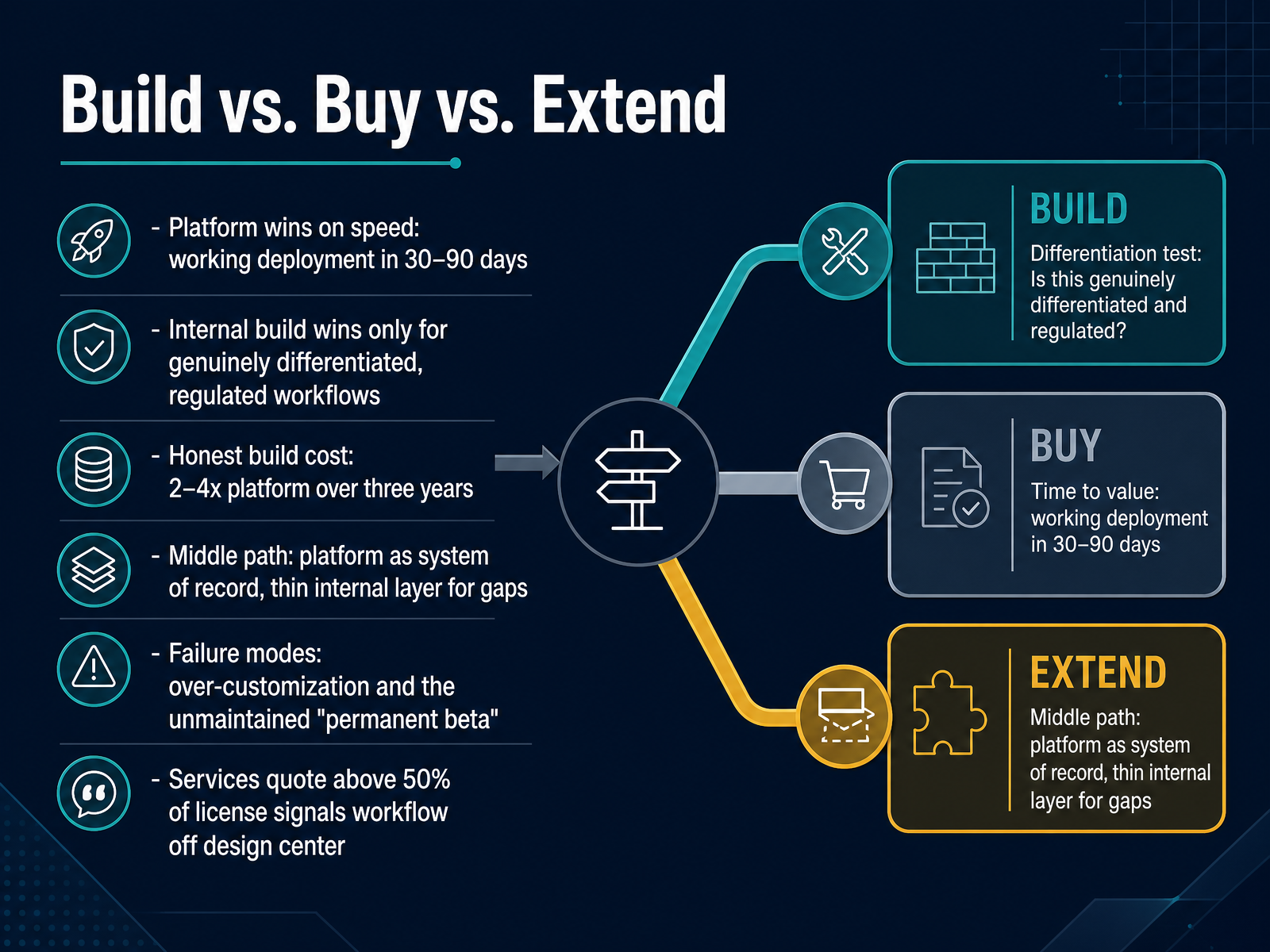
- 11Build vs. Buy vs. ExtendNow let's tackle the decision every evaluation eventually reaches: build, buy, or extend. The platform path wins on speed. Expect a working deployment in roughly thirty to ninety days. A full internal build realistically takes two to four quarters before reps touch anything usable, and its honest three-year cost usually runs two to four times the platform once you load in engineers, a product manager, infrastructure, and security review. So build only when the workflow is genuinely differentiated and regulated, something vendors do not serve well. For most teams, the middle path is best: use the platform as your system of record for content, training, and coaching, then add a thin internal layer for the few truly proprietary workflows. Watch two failure modes. Over-customization forces the vendor to replicate your legacy process and delays value. The unmaintained permanent beta is its internal twin. The tradeoff is control versus speed. And one signal worth remembering: if a services quote climbs above fifty percent of annual license cost, your workflow likely sits too far from the platform's design center. Next, we look at change management, adoption, and value realization.
 anfloy.comarchitect.salesforce.comadriennevermorel.com+22 min
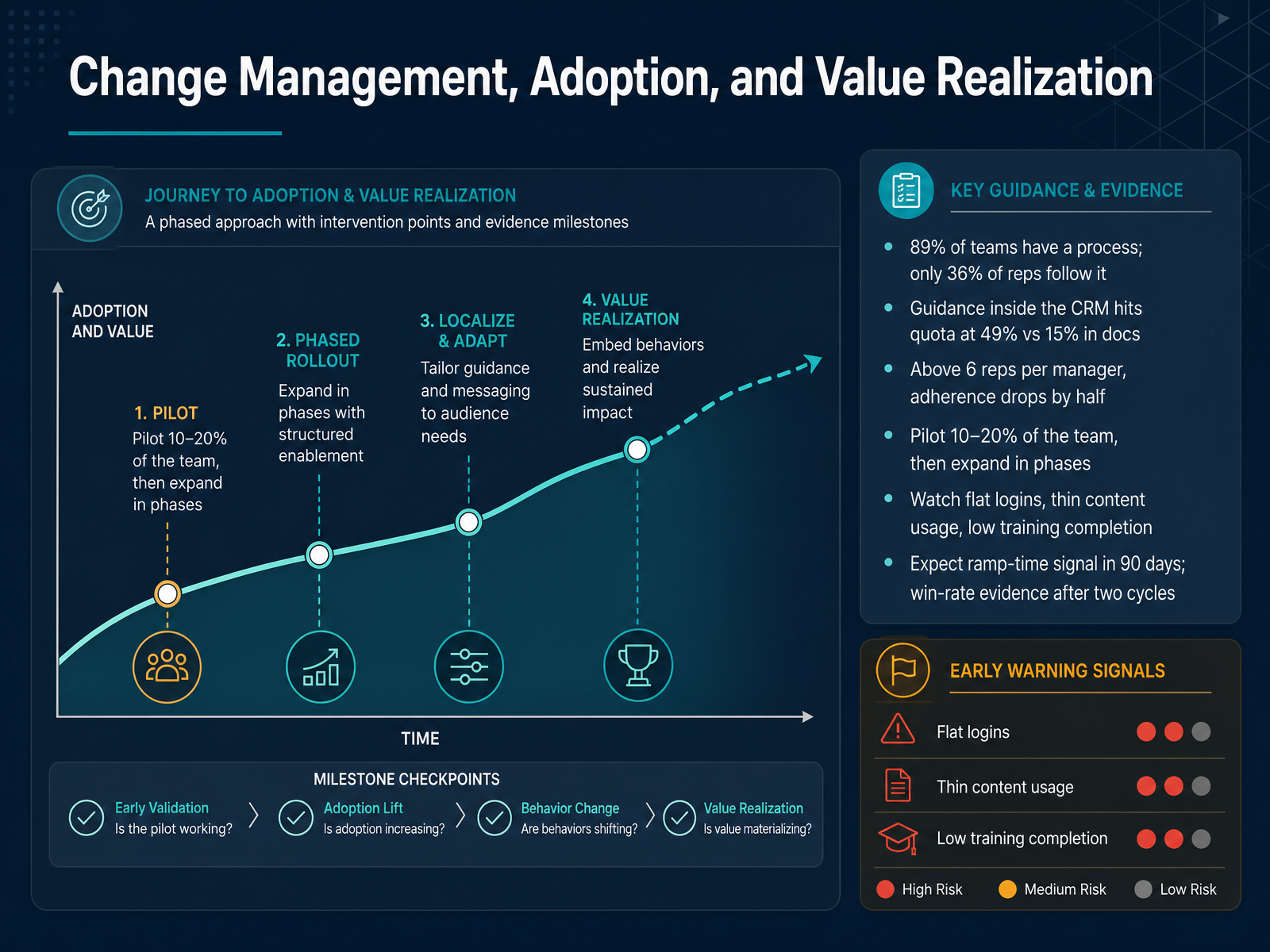
- 12Change Management, Adoption, and Value RealizationNow let's talk about change management, adoption, and value realization, because this is where most platform investments are won or lost. The data is sobering. Eighty-nine percent of teams have a process on paper, but only thirty-six percent of reps consistently follow it. That fifty-three point gap is the largest single predictor of quota performance. Location matters too. When guidance lives inside the CRM, teams hit quota at forty-nine percent, versus fifteen percent when it sits in documents. So embed enablement where reps already work. Capacity also constrains adoption. Above six reps per manager, adherence drops by half, so hold that ratio, or automate the inspection layer. On rollout, pilot with ten to twenty percent of the team, then expand in phases. Watch for flat logins, thin content usage, and low training completion as early warning signs. Expect ramp-time signal in ninety days, and win-rate evidence after two sales cycles. Next, we'll look at the Risk Register for Enablement Platform Decisions.
 vendorbenchmark.comvendorbenchmark.comrevenue.io+22 min
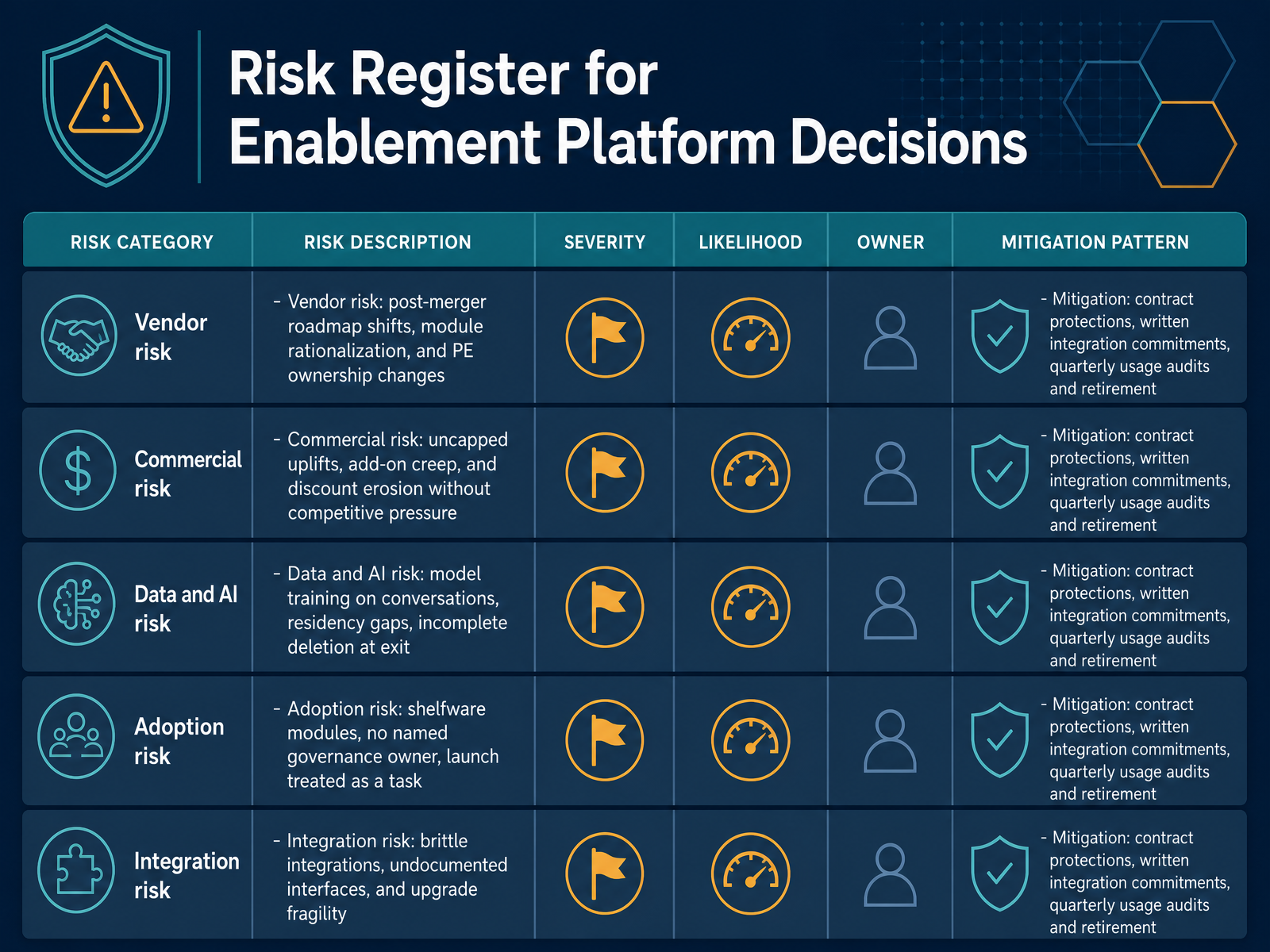
- 13Risk Register for Enablement Platform DecisionsBefore you sign, build a risk register. That discipline turns a platform conversation into a governance one. First, vendor risk. Post-merger roadmap shifts, module rationalization, and private-equity ownership changes can quietly retire the feature you bought. Ask where your module sits on the combined roadmap, and get it in writing. Second, commercial risk. Uncapped uplifts, add-on creep, and discount erosion happen when competitive pressure fades. Cap annual increases, lock add-on pricing at your year-one rate, and require written integration commitments. Third, data and AI risk. Does the vendor train models on your conversations? Where does data reside? What happens to embeddings and deletion at exit? Under the EU AI Act, specific answers matter. Fourth, adoption risk. Shelfware modules, no named governance owner, and a launch treated as a task. The mitigation is simple: contract protections, written commitments, quarterly usage audits, and a real retirement plan. Now let's move to the decision framework and a ninety-day action plan.
 vendorbenchmark.comvendorbenchmark.comrevenue.io+22 min
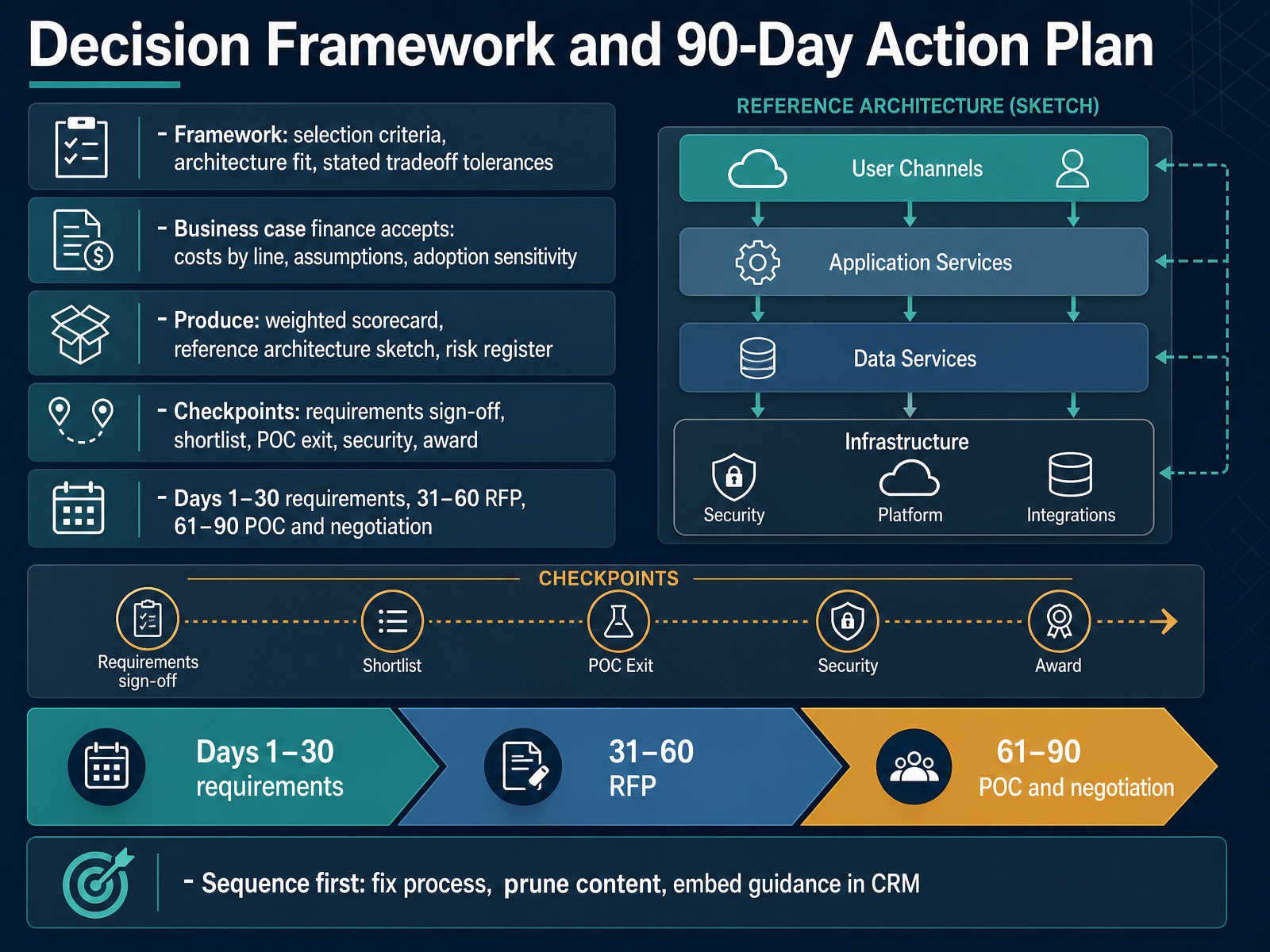
- 14Decision Framework and 90-Day Action PlanLet's bring this all together. Your framework rests on three things: selection criteria, architecture fit, and stated tradeoff tolerances. In practice, put all three in writing before you shortlist a vendor, because each one shapes what you can accept later. Build a business case your finance team will accept: costs by line, the assumptions behind them, and adoption sensitivity, meaning how the numbers change if only half your reps actually use the tool. Then produce three artifacts: a weighted scorecard, a reference architecture sketch, and a risk register. And hold firm checkpoints: requirements sign-off, shortlist, proof-of-concept exit, security review, and award. Now the sequence. Fix your process first. Prune your content. Embed guidance inside your CRM. Then, and only then, buy the platform. So to close: the framework, the finance-ready numbers, and the ninety-day plan in three stages. Days one to thirty for requirements, days thirty-one to sixty for the R F P, and days sixty-one to ninety for the proof of concept and negotiation. Thank you for your time and attention. You now have the framework, the evidence, and the sequence to make a defensible decision. Go apply it, and good luck with your evaluation.
 vendorbenchmark.comvendorbenchmark.comrevenue.io+22 min
Take the deck with you
Download this course as a file — free, no sign-up needed.
- PDF handoutEvery slide page, ready to print or share.15 pages · 4.0 MBDownload
- Narrated PowerPointThe deck that presents itself — every slide carries the digital human's narration video.15 pages · 28.4 MBDownload
- PowerPoint slidesThe full deck as a .pptx — open it in PowerPoint, Keynote, or Google Slides.15 pages · 3.8 MBDownload
Free to use in your own training — please keep the PersonWise credit page at the end.
Have your own deck? Turn it into a course
Sources consulted
Web sources consulted while building this course.
- Best Revenue Enablement Platforms Reviews 2026 - Gartner — gartner.com
- The Revenue Enablement Platforms Landscape, Q1 2026 | Forrester — forrester.com
- The Revenue Enablement Platform Market Has Hit An Inflection Point, With AI Reshaping Everything — forrester.com
- Magic Quadrant for Revenue Enablement Platforms — research.oz.spotlightar.com
- Sales Enablement Software: 2026 Buyer's Guide & Top Tools - Masset — getmasset.com
- Revenue Intelligence Enters Its Consolidation Era as Platforms Race to Own the Full Funnel – SalesTech Edition — salestechedition.com
- What is happening with revenue intelligence vendor… in 2027? — pulserevops.com
- Sales Enablement Is Consolidating. Here's What's Actually Going On. — salestable.ai
- Salesloft & Clari Unite: A new Era for Revenue Teams — salesloft.com
- Clari + Salesloft Extends Salesloft Conversation Intelligence — salesloft.com
- Seismic Pricing 2026: What Enterprises Actually Pay — vendorbenchmark.com
- Highspot Pricing 2026: What Enterprises Actually Pay — vendorbenchmark.com
- How Much Does Gong Actually Cost in 2026? Pricing, Hidden Fees, and What to Watch For | Revenue — revenue.io
- Sales Enablement Software Pricing: What 9 top platforms cost in 2026 — dock.us
- Highspot Review 2026: Features, Pricing & Merger | TechnologyInSales — technologyinsales.com
- Composable Data Architecture for GTM Stacks: Practical Guide | Anfloy — anfloy.com
- Data 360 Integration Patterns | Data 360 and Integration | Fundamentals | Salesforce Developers — architect.salesforce.com
- Reverse ETL Patterns for CRM Activation — adriennevermorel.com
- Integration Patterns | Data 360 and Integration — architect.salesforce.com
- GTM data architecture - GTM Skills — gtmskills.com