Begin
14 pages · ~28 min
API Development Tools: Types and Patterns
Learn the types, patterns, and examples of API development tools and how to apply them effectively.
A digital instructor presents all 14 pages. Hold “Ask” at any point and ask out loud — the answer comes from this course. No sign-up needed.
What you’ll learn
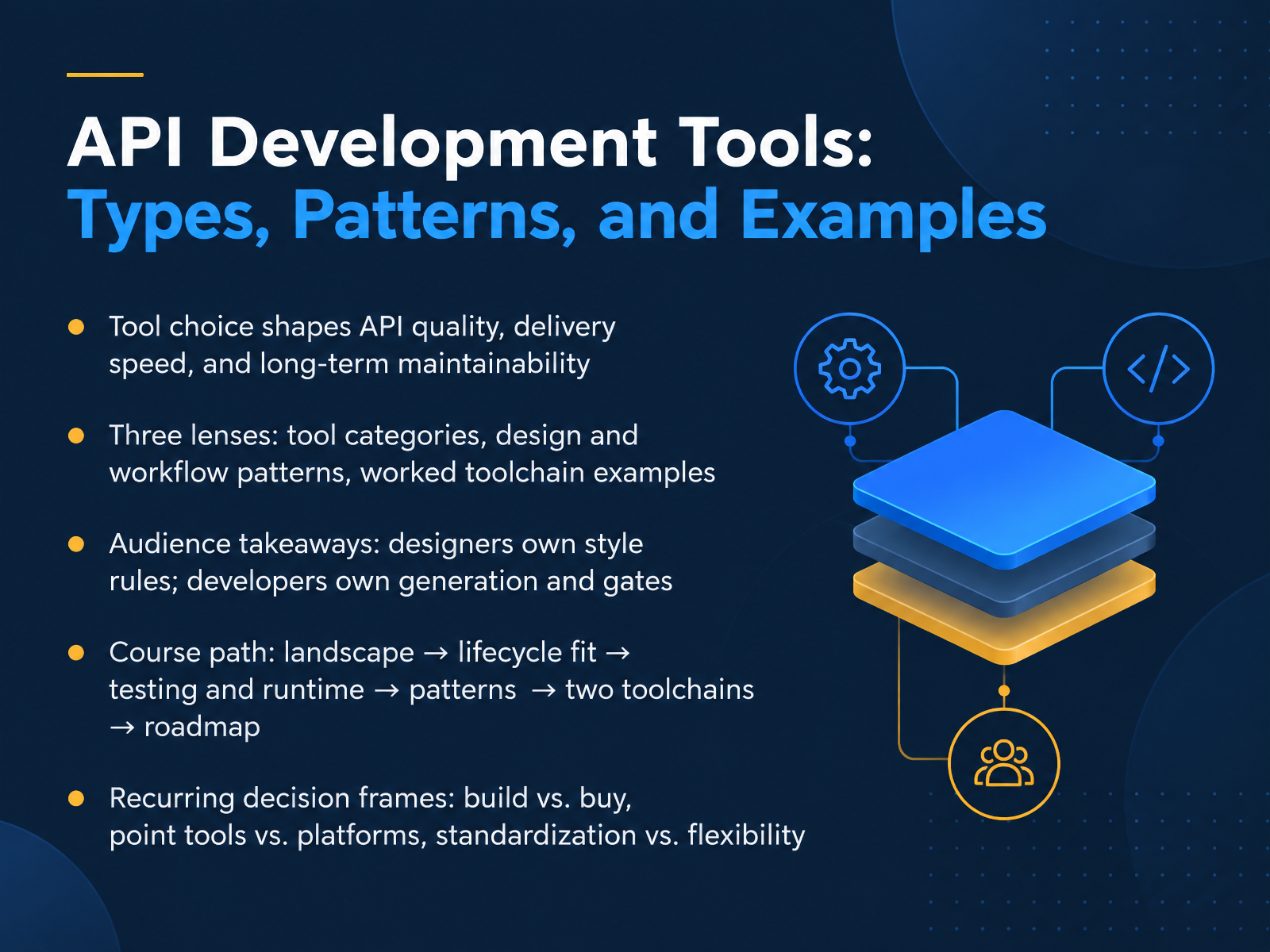
- 01API Development Tools: Types, Patterns, and ExamplesWelcome. This course is about API development tools, and the goal is practical: help you choose tools deliberately, not by habit. Here is the core idea for today. Tool choice shapes three things at once: API quality, delivery speed, and long-term maintainability. So we will look through three lenses: tool categories, design and workflow patterns, and two worked toolchain examples. On ownership, designers own the style rules, and developers own generation and the gates that enforce them. The path runs from the landscape, to lifecycle fit, to testing and runtime, then patterns, two toolchains, and a roadmap. Three decision frames will recur throughout: build versus buy, point tools versus platforms, and standardization versus flexibility. Take the next slide to orient yourself in the 2026 API tooling landscape at a glance.apiguide.devapilandscape.apiscene.ioguideflow.com+21 min
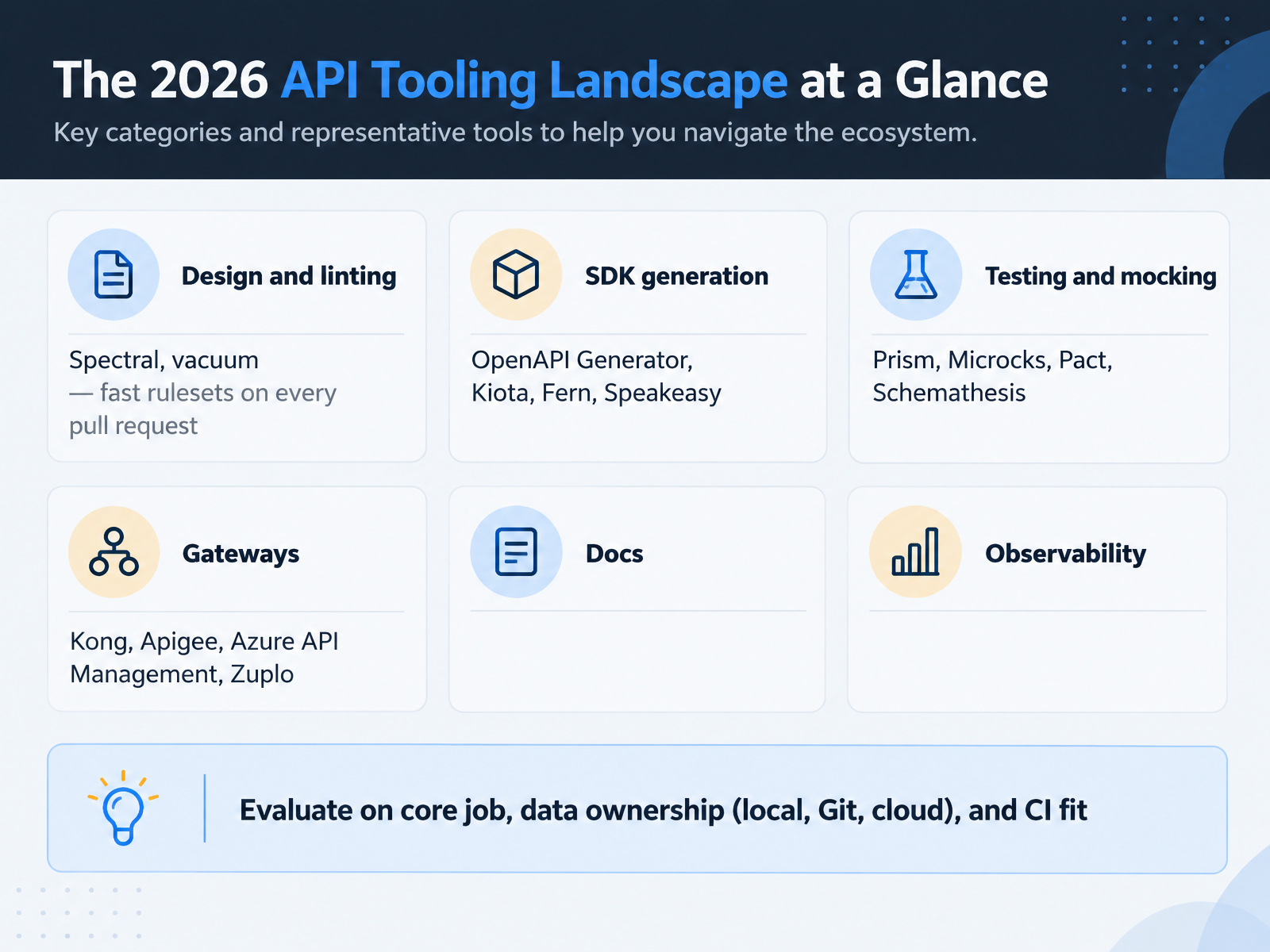
- 02The 2026 API Tooling Landscape at a GlanceBuilding on that, here is the tooling landscape at a glance. You can sort most API tools into six categories: design and linting, SDK generation, testing and mocking, gateways, documentation, and observability. Here is where that matters in practice. For linting, Spectral and vacuum apply fast rulesets to every pull request, so style problems surface before review. For generation, OpenAPI Generator, Kiota, Fern, and Speakeasy turn a spec into typed clients. For testing, Prism and Microcks mock your endpoints, Pact checks consumer contracts, and Schemathesis generates requests from the schema. For gateways, Kong, Apigee, Azure API Management, and Zuplo handle routing, auth, and rate limits. So how do you choose? Evaluate each tool on three things: its core job, where the data lives, whether that is local files, Git, or cloud, and how cleanly it fits your CI pipeline. A tool that fails any one of those will cost you more than it saves. Next, we look at the API Lifecycle and Where Tools Fit.
 apiguide.devapilandscape.apiscene.ioguideflow.com+22 min
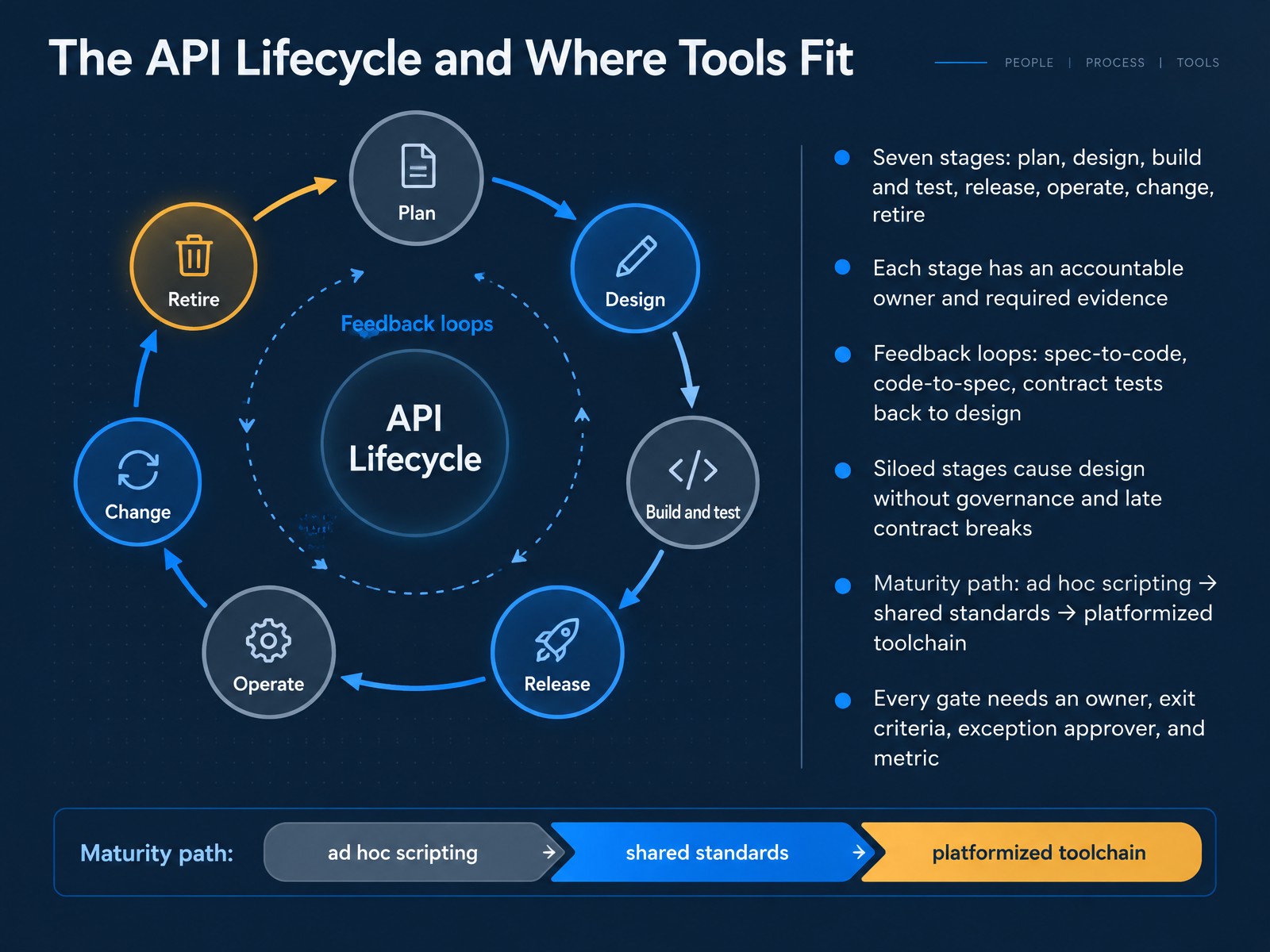
- 03The API Lifecycle and Where Tools FitLet's look at the API lifecycle, and where tools actually fit. Seven stages: plan, design, build and test, release, operate, change, and retire. Each stage has an accountable owner and required evidence. For example, design exits with a reviewed, versioned contract. Release exits with a rollback target. Now, the feedback loops. Spec to code, code to spec, and contract tests feeding back to design. Here's where that matters in practice. Siloed stages cause design without governance and late contract breaks. So maturity moves from ad hoc scripting, to shared standards, to a platformized toolchain. And every gate needs four things: an owner, exit criteria, an exception approver, and a metric. Next, we move into design and specification tools.
 developer.dhl.comapi7.aigravitee.io+21 min
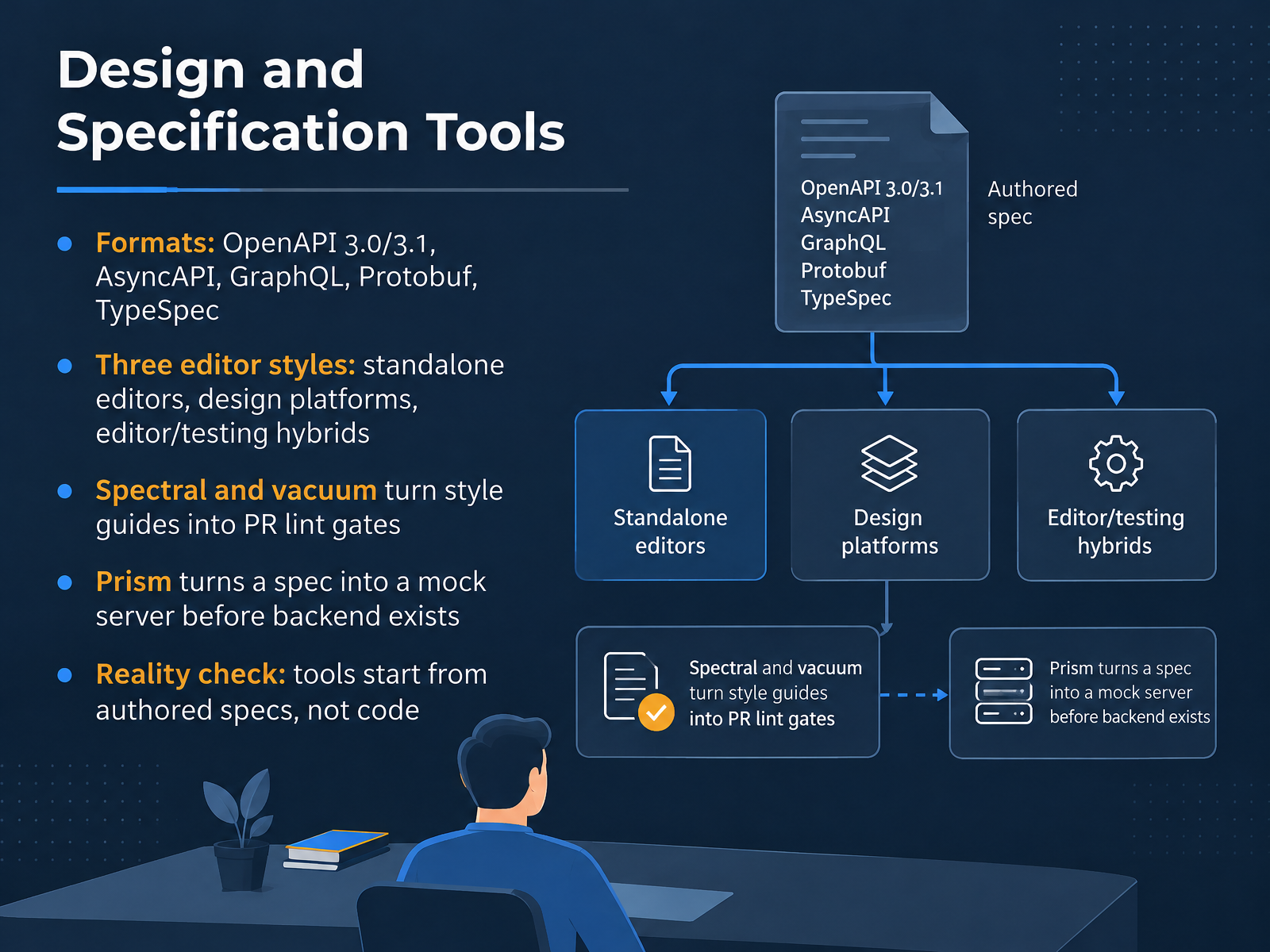
- 04Design and Specification ToolsNext, let's look at the design and specification tools that turn your API contracts into a working process. You will encounter several formats here: OpenAPI three point zero and three point one for REST, AsyncAPI for event-driven APIs, GraphQL schemas, Protobuf definitions, and TypeSpec, which compiles to OpenAPI and JSON Schema. Editors come in three styles. Standalone editors validate a single document. Design platforms add version history, review, and linting across many specs. Editor and testing hybrids put spec editing and live request testing in one workspace. Here's where that matters in practice. Spectral and vacuum take your style guide and turn it into a pull request lint gate, so naming and description rules fail the build before merge. Prism takes the same spec and runs a mock server, so frontend teams can start before the backend exists. One reality check: these tools all start from an authored spec, not from your code. Keep that in mind as we move on to build, code generation, and SDK tooling.
 getelva.aizuplo.comapidog.com+22 min
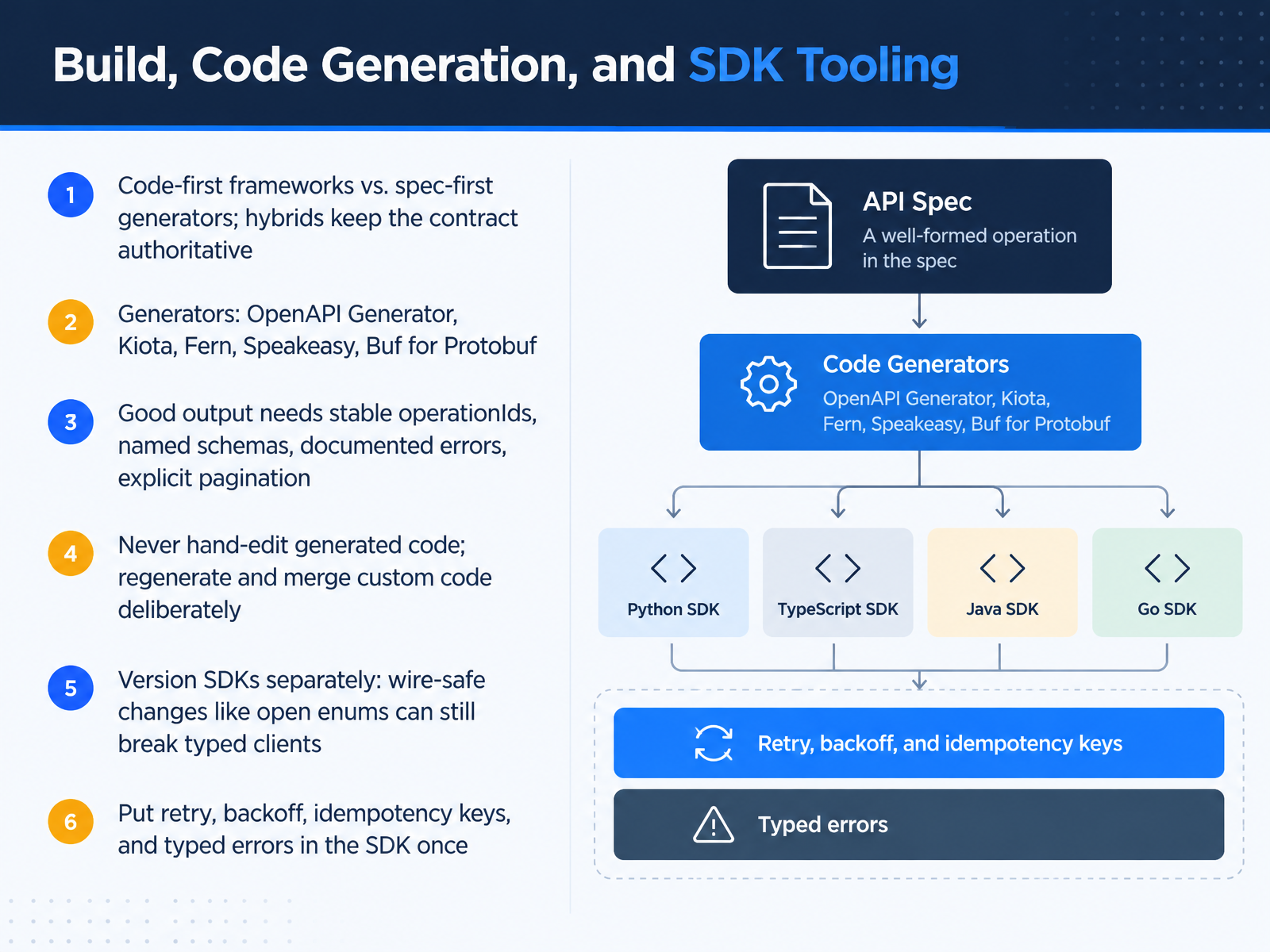
- 05Build, Code Generation, and SDK ToolingLet's look at build tooling. Here you choose between code-first frameworks and spec-first generators, and in practice hybrids work well: the contract stays authoritative while code is generated from it. Common generators include OpenAPI Generator, Kiota, Fern, Speakeasy, and Buf for Protobuf. Good output depends on good input. Give every operation a stable operationId, name your schemas, document error responses, and describe pagination explicitly. Otherwise you get strange types and SDKs that quietly return a single page. One rule to keep: never hand-edit generated code. Regenerate, and merge custom code deliberately through the generator's extension points. Version SDKs separately from the API. A wire-safe change, like adding an open enum value, can still break typed clients. Finally, put retry, backoff, idempotency keys, and typed errors in the SDK once, so every consumer inherits correct behavior. Next, we move on to testing, mocking, and contract validation.
 matthewpalma.devbuildwithfern.comoctri.dev+22 min
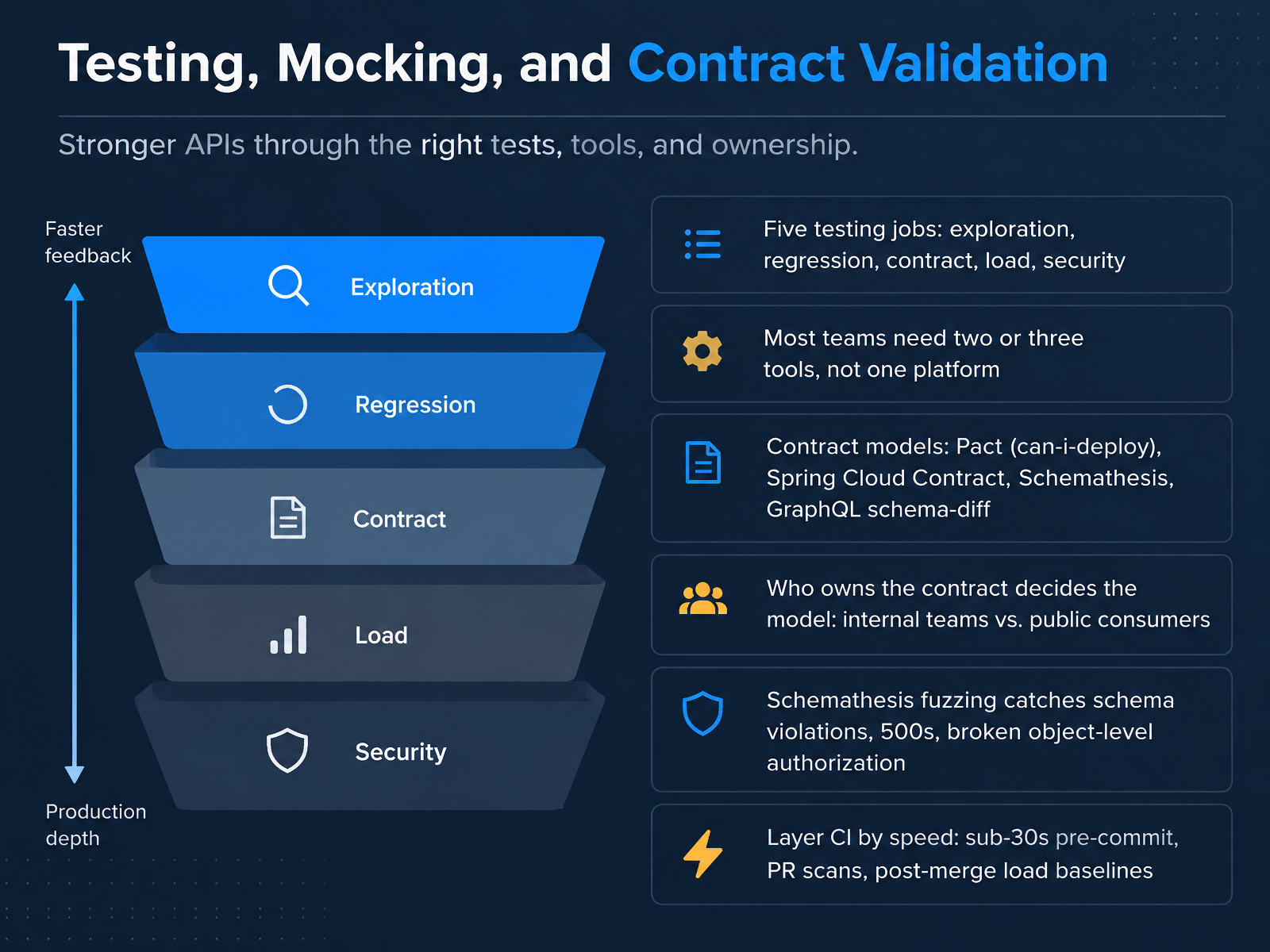
- 06Testing, Mocking, and Contract ValidationLet's look at testing, mocking, and contract validation. The practical purpose here is choosing the right check for the right risk. Five testing jobs hide behind that one phrase: exploration, regression, contract, load, and security. Most teams need two or three tools, not one platform. Contract models differ, and who owns the contract decides which one you use. For internal teams who can write expectations, Pact's can-i-deploy step is a strong fit. For provider-driven JVM work, Spring Cloud Contract. For spec-driven fuzzing, Schemathesis catches schema violations, five hundred errors, and broken object-level authorization. For GraphQL, schema-diff on pull requests. Here's where that matters in practice: layer CI by speed. Sub-thirty-second checks before commit, PR scans that block merge, and post-merge load baselines. Next, we move into gateways, deployment, and runtime operations.
 qodex.aigetelva.aizuplo.com+22 min
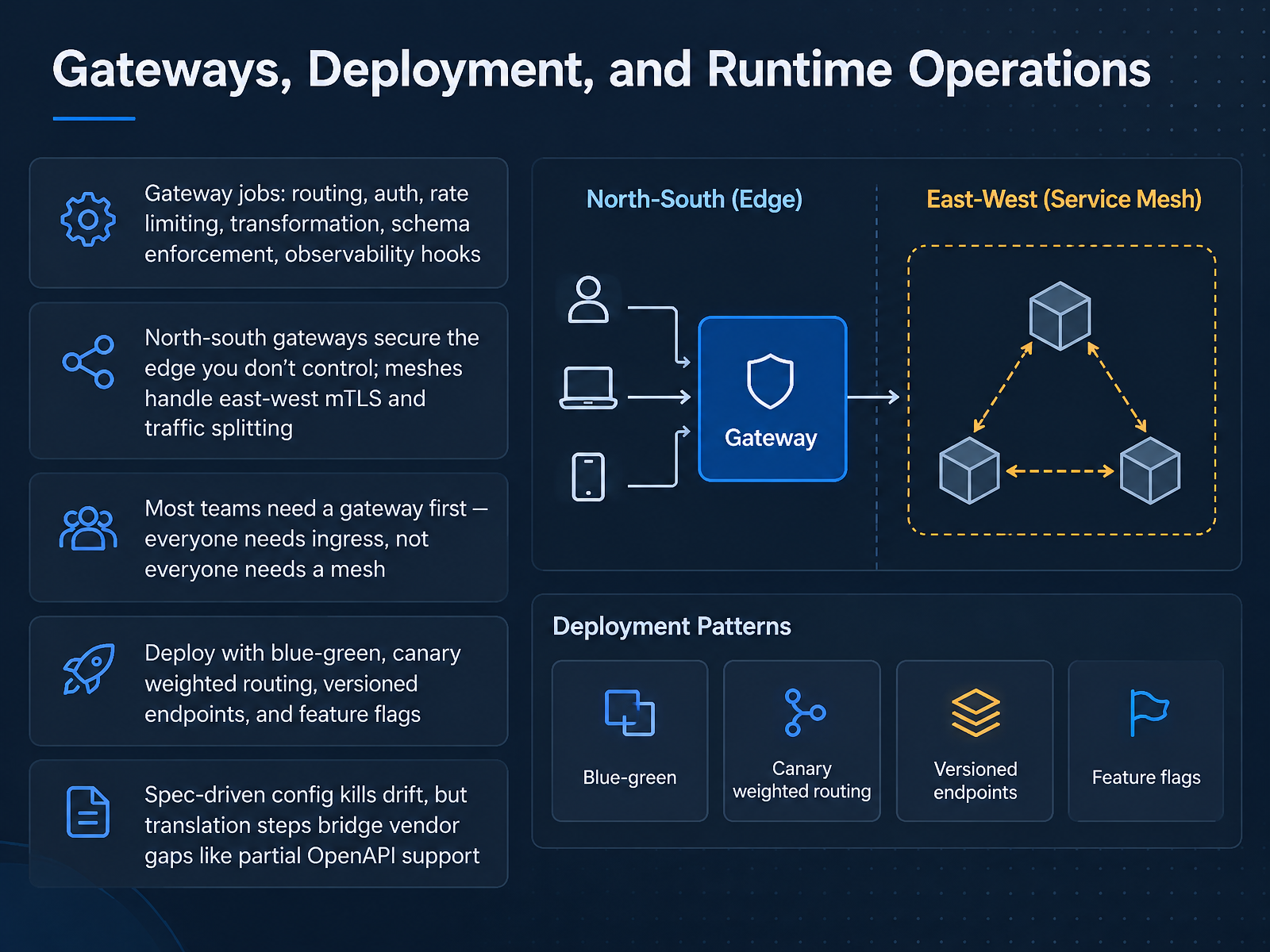
- 07Gateways, Deployment, and Runtime OperationsLet's move from design into runtime. This slide covers gateways, deployment, and day-two operations. A gateway does a lot of jobs on the request path: routing, authentication, rate limiting, payload transformation, schema enforcement, and observability hooks. Here's where that matters in practice. North-south gateways secure the edge, where you don't control the client. Service meshes handle east-west traffic between your own services, with mutual TLS and traffic splitting. Most teams need a gateway first. Everyone needs ingress, not everyone needs a mesh. For deployment, use blue-green, canary weighted routing, versioned endpoints, and feature flags, so you can shift traffic gradually and roll back fast. One more point: spec-driven configuration kills drift, but expect translation steps. For example, many gateways support OpenAPI only partially, so you may need a mapping layer between your spec and vendor config. Treat that layer as code, and test it. Next, we turn to documentation, developer portals, and experience.
 2 min
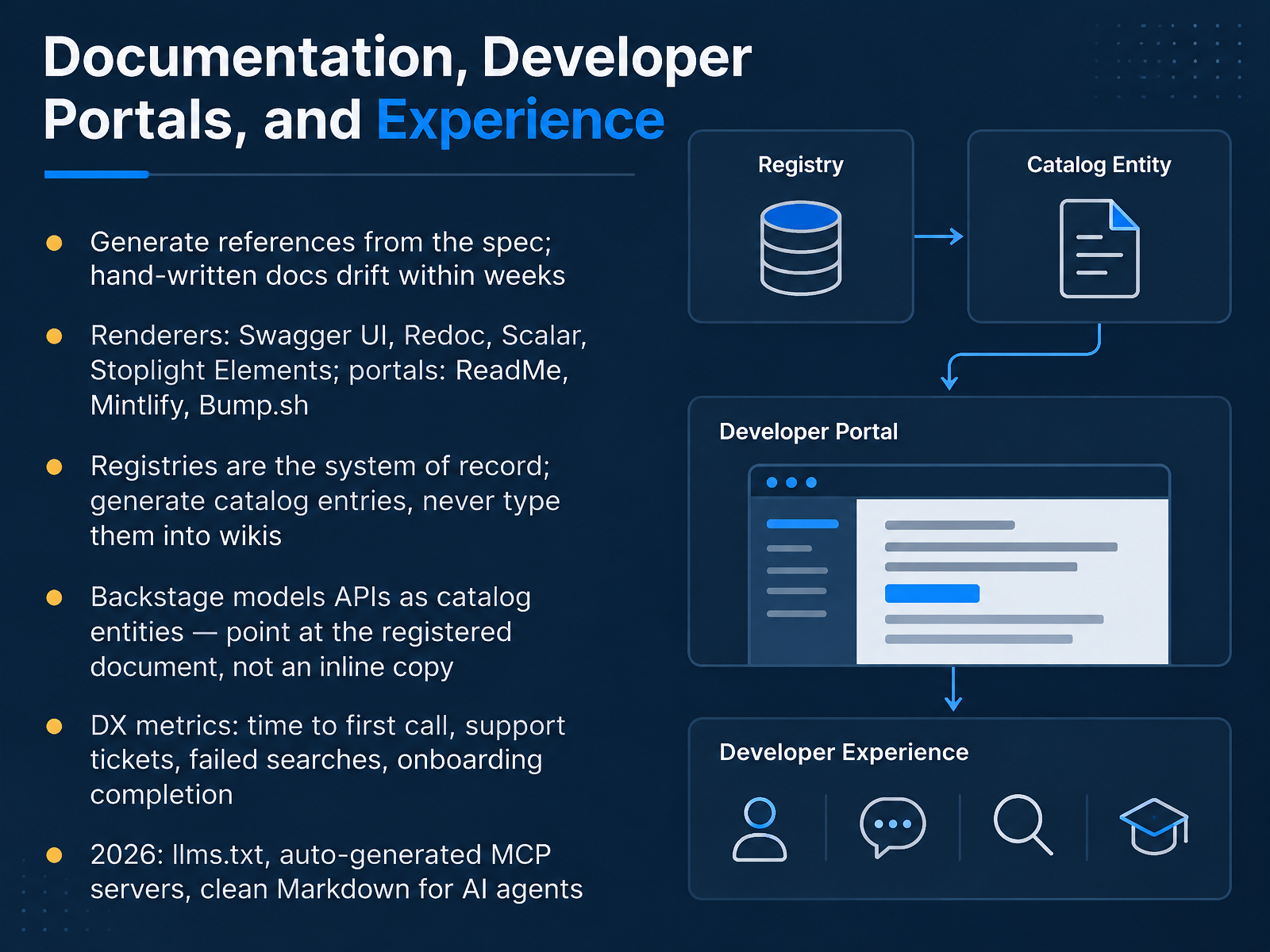
- 08Documentation, Developer Portals, and ExperienceNext, let's look at documentation, developer portals, and the experience you create for the people consuming your APIs. The practical rule here is simple. Generate your reference from the spec. Hand-written docs drift within weeks. On the rendering side, you have Swagger UI, Redoc, Scalar, and Stoplight Elements. For full portals, ReadMe, Mintlify, and Bump.sh. Here's where that matters in practice. Treat your registry as the system of record. Generate catalog entries from it, and never type them into a wiki. The same holds for Backstage. It models APIs as catalog entities, so point at the registered document, not an inline copy. Then measure developer experience with real signals, such as time to first call, support tickets, failed searches, and onboarding completion. Looking ahead to twenty twenty-six, add llms dot txt files, auto-generated MCP servers, and clean Markdown for AI agents. The takeaway is to generate documentation, measure the experience, and keep one source of truth. That leads us into design and workflow patterns in practice.
 2 min
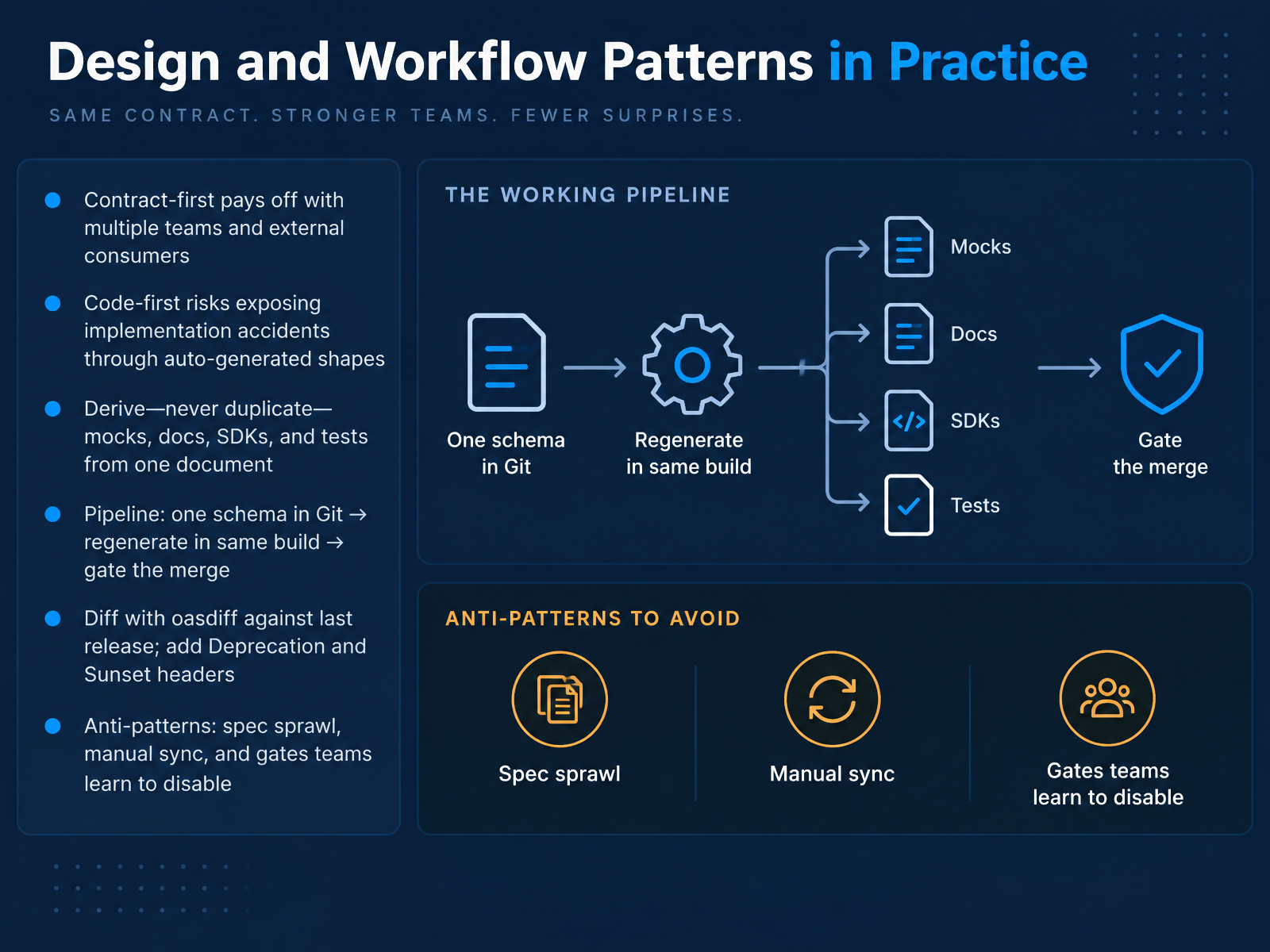
- 09Design and Workflow Patterns in PracticeNow let's look at how these design and workflow patterns hold up in practice. Contract-first pays off most when several teams, or external consumers, depend on your API, because the document becomes the shared agreement. Code-first is faster to start, but it risks exposing implementation accidents, since shapes get auto-generated from your code rather than chosen deliberately. The core habit is to derive, never duplicate: mocks, docs, SDKs, and tests all come from one document. In the pipeline, that schema lives in Git, gets regenerated in the same build, and gates the merge. Diff with oasdiff against the last release, and add Deprecation and Sunset headers when something has to go. Watch for the anti-patterns: spec sprawl, manual sync, and gates teams learn to disable. Next, we'll see this in a worked example: a small team ships a public REST API.
 api7.aimatthewpalma.devbuildwithfern.com+22 min
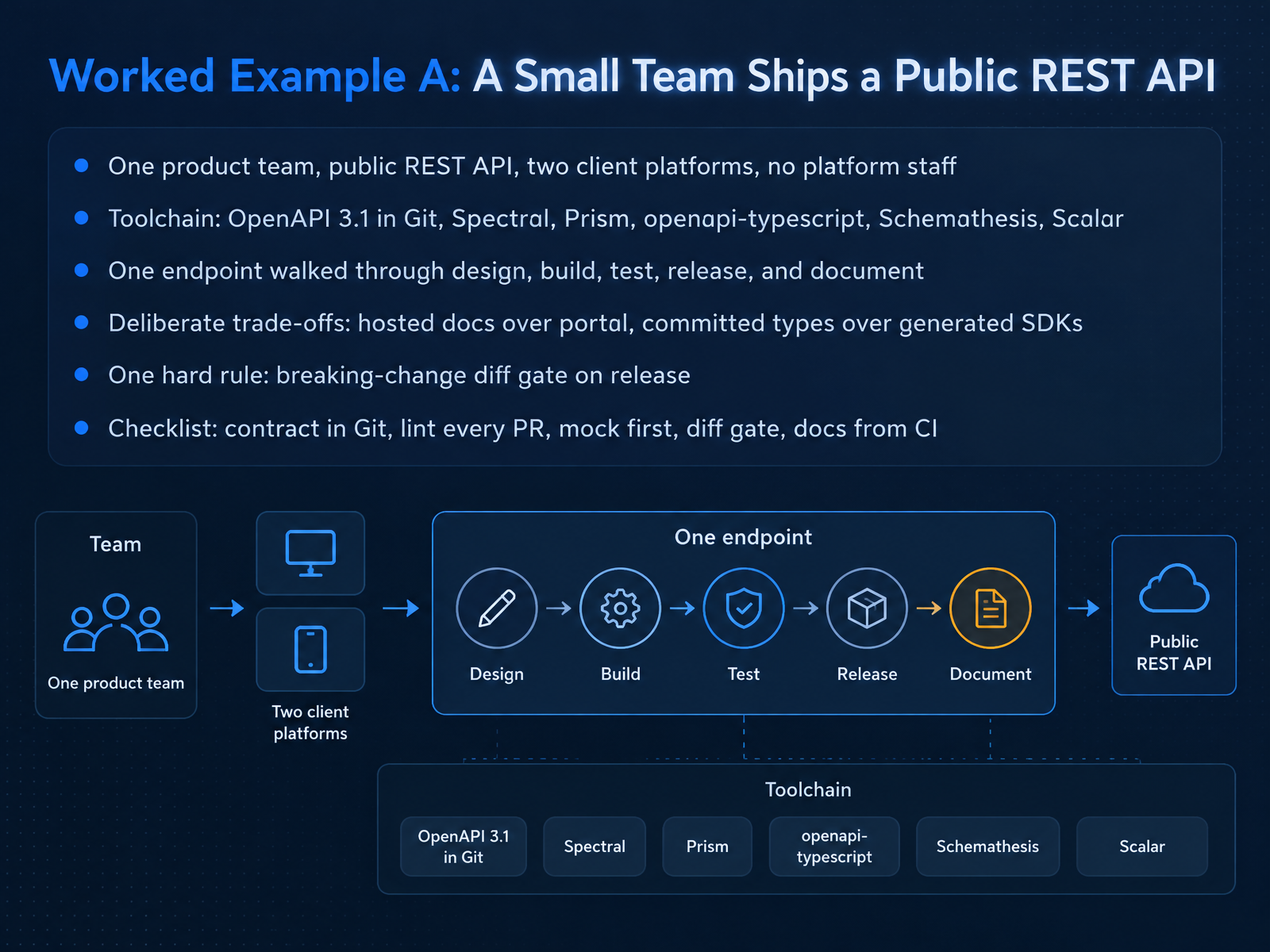
- 10Worked Example A: A Small Team Ships a Public REST APILet's ground this in a worked example: a small team shipping a public REST API. Picture one product team, two client platforms, and no platform staff to lean on. So every tool has to earn its place. Their chain is OpenAPI 3.1 in Git, Spectral for linting, Prism for mocking, openapi-typescript for typed clients, Schemathesis for property-based testing, and Scalar for documentation. They take one endpoint all the way through design, build, test, release, and docs, so the full loop gets exercised, not just the happy path. Two trade-offs are worth naming. They chose hosted docs over building a full developer portal, and committed generated types over maintaining hand-written SDKs. Both decisions trade customization for upkeep they can actually sustain. Then one hard rule: a breaking-change diff gate on every release. If the contract breaks existing clients, the pipeline stops it. Here's the checklist in practice: contract in Git, lint every pull request, mock first, diff gate before release, and docs generated from continuous integration. That's a small team using a lean toolchain to keep the contract honest. Next, we scale up to Worked Example B: An Enterprise Platformizes the API Toolchain.
 getelva.aizuplo.comapidog.com+22 min
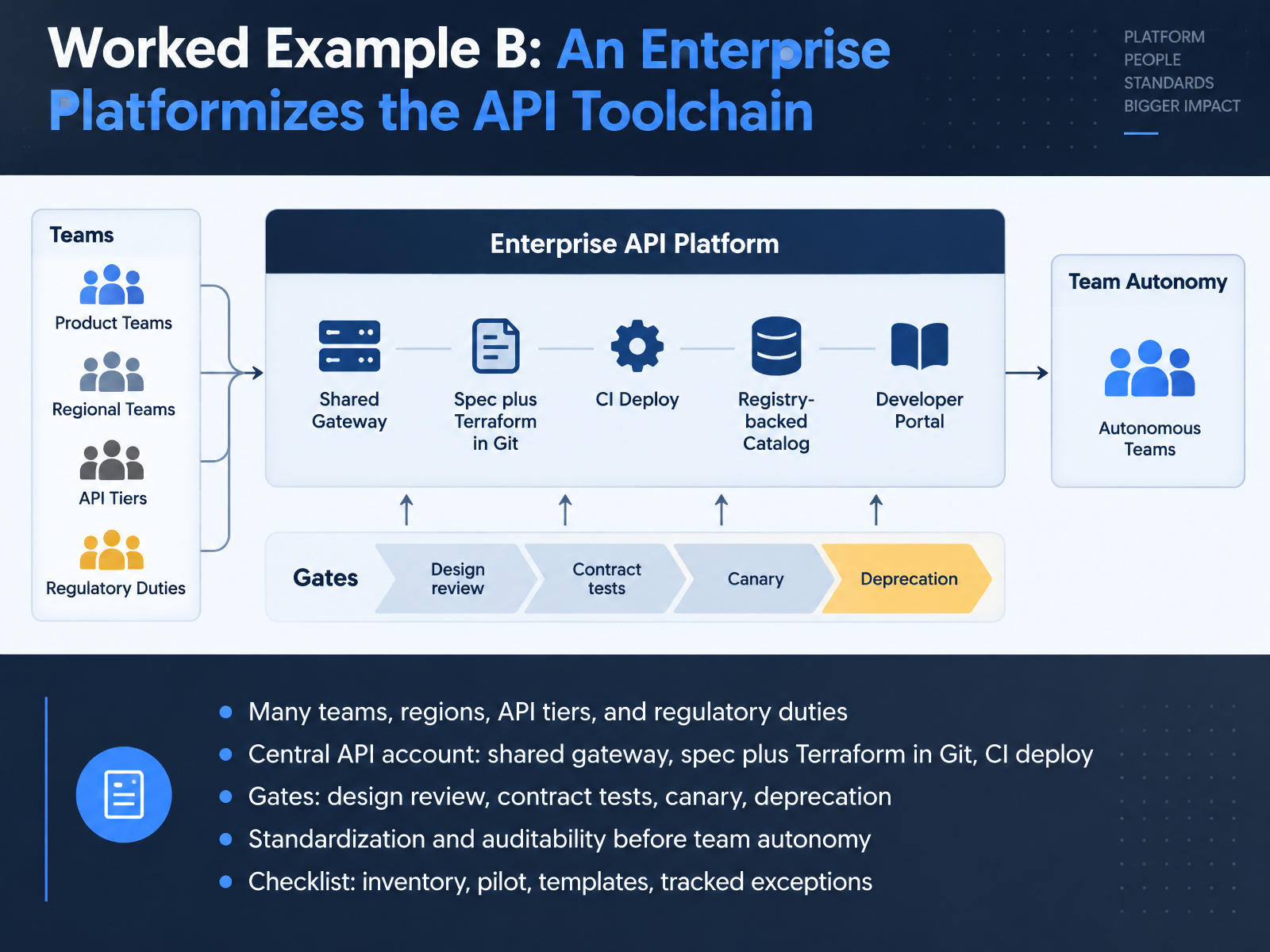
- 11Worked Example B: An Enterprise Platformizes the API ToolchainLet's walk through a second worked example, where an enterprise platformizes its API toolchain. The situation is familiar. Many teams, multiple regions, different API tiers, and regulatory duties that vary by market. The organization's answer is a central API account, run by a shared services team. All APIs sit behind one shared gateway, and integration to backend services uses private networking. Each team writes an OpenAPI specification, embeds it in Terraform, checks both into Git, and deploys through continuous integration. Here's where that matters in practice. No one configures the gateway by hand, so environments stay consistent and every change is reviewable. Four gates govern the lifecycle. Design review signs off the contract. Contract tests confirm the implementation matches the spec. A canary release limits blast radius. And a deprecation process gives consumers notice before anything is retired. The sequencing is deliberate. Standardization and auditability come before team autonomy, so the guardrails exist before teams move fast. And the rollout checklist is short. Inventory what exists, pilot two or three representative APIs, publish self-service templates, and track exceptions with an owner and an expiry date instead of letting local workarounds quietly become permanent. Next, we compare the two toolchains on speed, consistency, and overhead.
 developer.dhl.comapi7.aigravitee.io+22 min
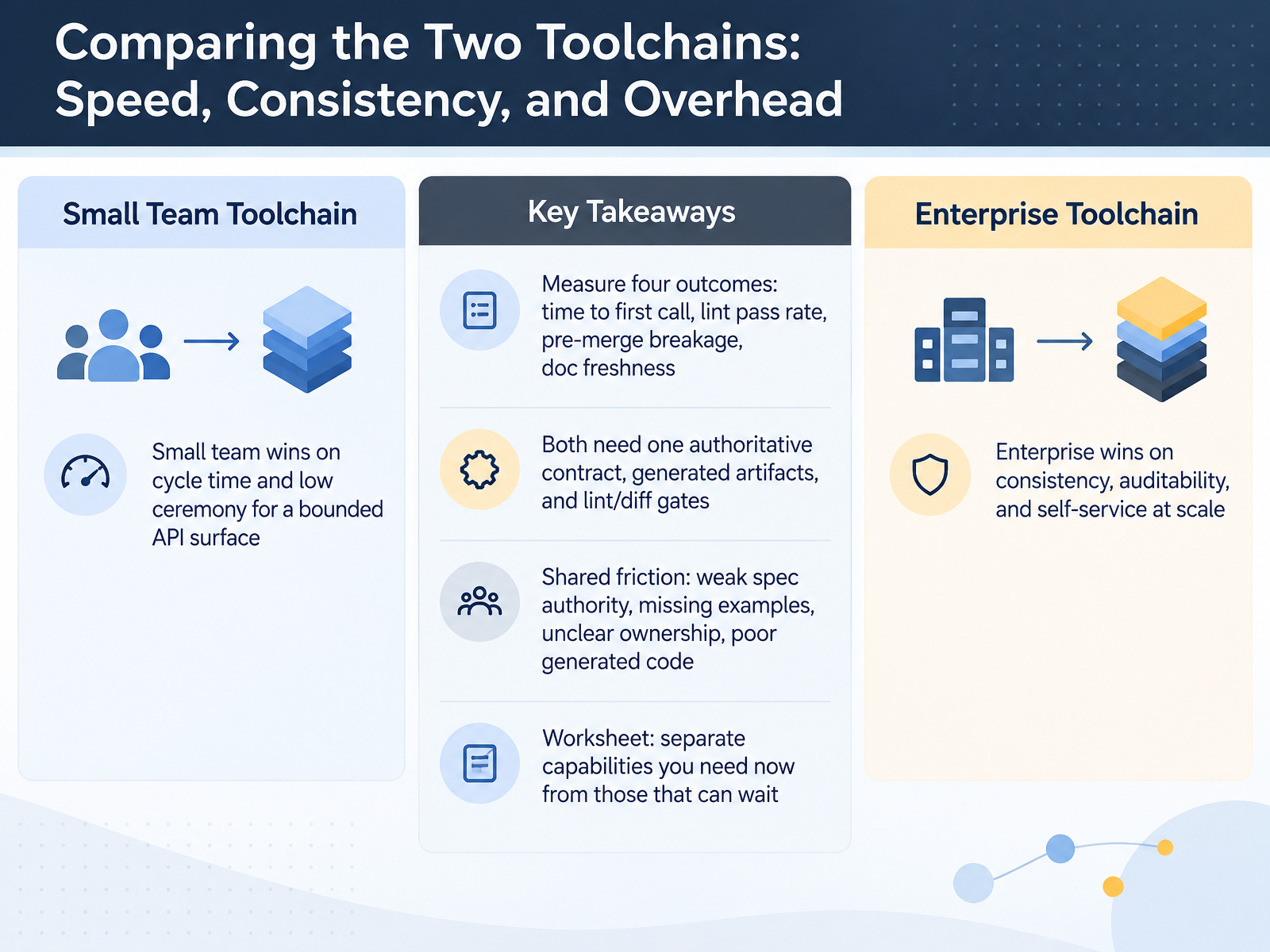
- 12Comparing the Two Toolchains: Speed, Consistency, and OverheadLet's compare the two toolchains on speed, consistency, and overhead. Measure four outcomes: time to first call, lint pass rate, pre-merge breakage, and documentation freshness. Here's where that matters in practice. A small team usually wins on cycle time and low ceremony, which is fine for a bounded API surface. An enterprise wins on consistency, auditability, and self-service at scale. But both need the same foundation: one authoritative contract, generated artifacts, and lint and diff gates in the pipeline. And both hit the same friction: weak spec authority, missing examples, unclear ownership, and poor generated code. So use the worksheet to separate the capabilities you need now from those that can wait. Next, we'll look at assessing your toolchain and planning incremental adoption.
 matthewpalma.devbuildwithfern.comoctri.dev+21 min
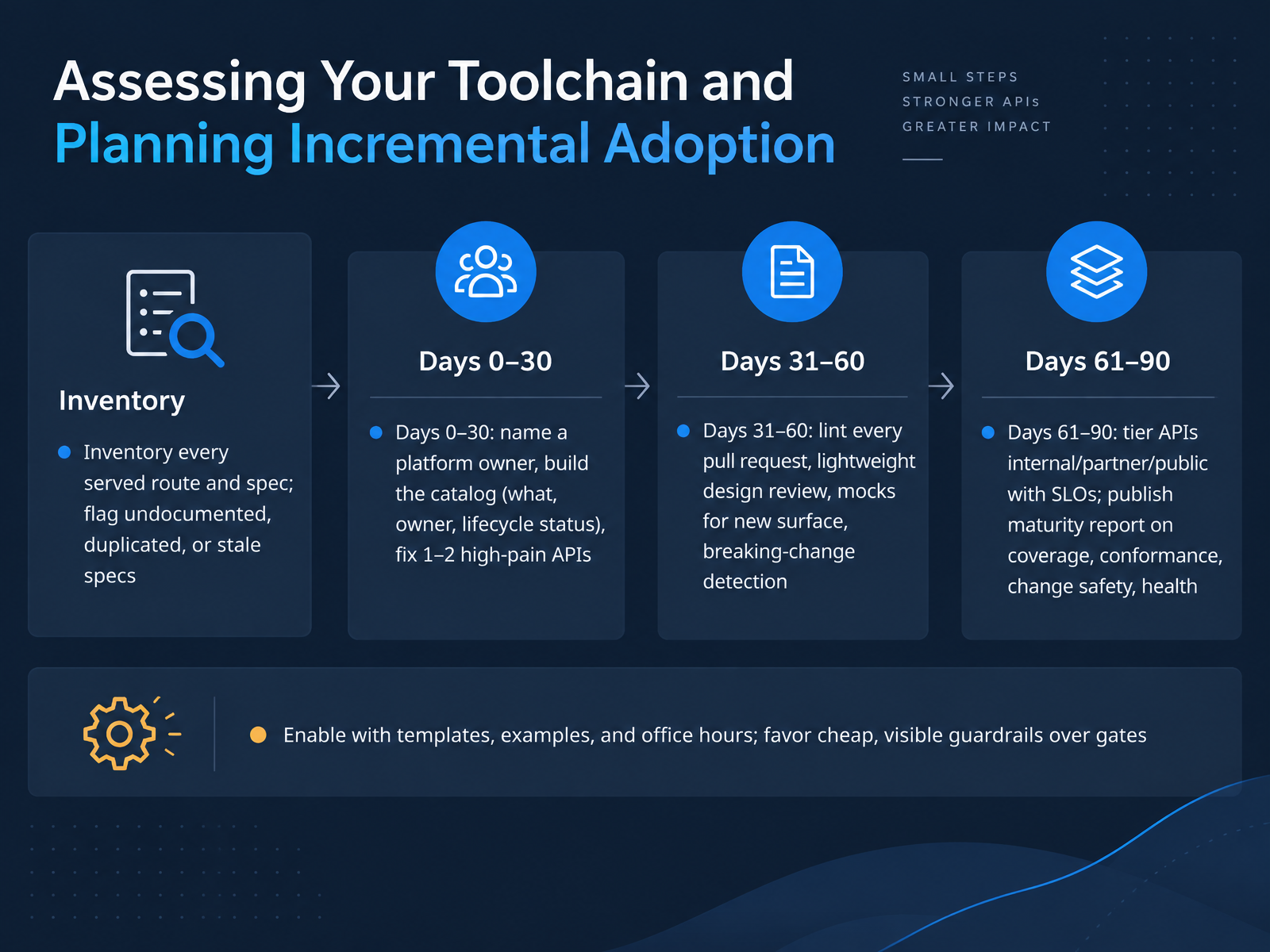
- 13Assessing Your Toolchain and Planning Incremental AdoptionNow let's look at how you assess your toolchain and plan adoption in stages. Start with an inventory of every served route and every spec. Flag anything undocumented, duplicated, or stale. In the first thirty days, name a platform owner, build a catalog that records what each API is, who owns it, and its lifecycle status, and fix one or two high-pain APIs so teams feel the benefit. From day thirty-one to sixty, lint every pull request, add a lightweight design review, provide mocks for new surface area, and detect breaking changes. From day sixty-one to ninety, tier APIs as internal, partner, or public with service-level objectives, then publish a maturity report covering coverage, conformance, change safety, and health. Enable people with templates, examples, and office hours. Favor cheap, visible guardrails over hard gates. Next, we'll consolidate key takeaways and your next three actions.
 developer.dhl.comapi7.aigravitee.io+22 min
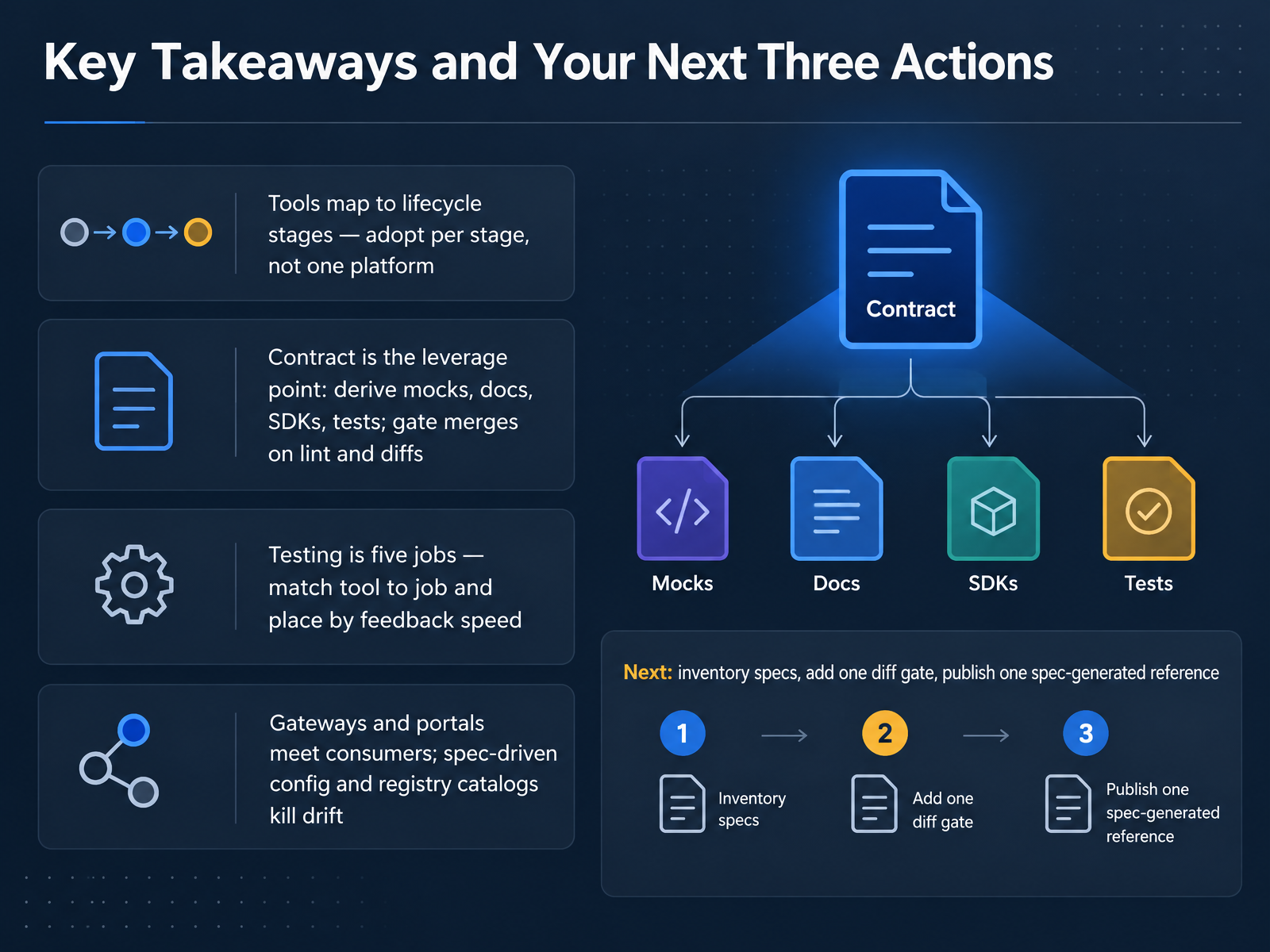
- 14Key Takeaways and Your Next Three ActionsLet's bring this together, and leave you with three things to do next. First, tools map to lifecycle stages. Adopt per stage, not one platform. A linter at design time, a diff gate at merge time, a gateway at runtime. Second, the contract is your leverage point. From one OpenAPI description, derive mocks, docs, SDKs, and tests. Then gate merges on lint and diff so drift never ships. Third, testing is five jobs, from unit to load. Match the tool to each job, and place tests by feedback speed, fast ones first. Gateways and portals serve your consumers. Keep them driven by the spec, and let a registry catalog kill drift. So here are your next three actions. Inventory your specs. Add one diff gate to your pipeline. And publish one spec-generated reference. Thank you for working through this with me. You already have the pieces. Start with that single diff gate this week, and build from there. Good luck.
 apiguide.devapilandscape.apiscene.ioguideflow.com+22 min
Take the deck with you
Download this course as a file — free, no sign-up needed.
- PDF handoutEvery slide page, ready to print or share.15 pages · 3.1 MBDownload
- Narrated PowerPointThe deck that presents itself — every slide carries the digital human's narration video.15 pages · 13.1 MBDownload
- PowerPoint slidesThe full deck as a .pptx — open it in PowerPoint, Keynote, or Google Slides.15 pages · 3.0 MBDownload
Free to use in your own training — please keep the PersonWise credit page at the end.
Have your own deck? Turn it into a course
Sources consulted
Web sources consulted while building this course.
- API Lifecycle Tooling Directory | apiguide.dev — apiguide.dev
- The API Landscape — apilandscape.apiscene.io
- 12 best API development tools for 2026 - Guideflow Blog — guideflow.com
- spinov001-art/awesome-api-tools-2026 — github.com
- API Design & Testing Tools 2026 — Bruno / Insomnia / Postman / Hoppscotch / Scalar / Mintlify / Buf Deep Dive | Chaos and Order — youngju.dev
- API Lifecycle — developer.dhl.com
- API Lifecycle Governance: Owners, Stage Gates, and Metrics - API7.ai — api7.ai
- API Governance That Scales: Automate Contracts, Security & Lifecycle — gravitee.io
- API Lifecycle Management: Strategies and Platform Comparison for Long-Term Stability - Zuplo — zuplo.com
- API-First Development: From Contract to Production - API7.ai — api7.ai
- OpenAPI Spec & Design Editor Tools, Compared · Elva — getelva.ai
- Best OpenAPI Tools and Documentation Platforms in 2026: Complete Comparison Guide — zuplo.com
- 6 Best API Design Tools in 2026 — Reviewed & Compared — apidog.com
- API Development Platform: How to Choose One in 2026 — devhunt.org
- OpenAPI as the source of truth: codegen, drift detection, and breaking-change gates | Matthew Palma — matthewpalma.dev
- Stopping schema drift: a guide to coupling SDKs with documentation (August 2026) | Fern — buildwithfern.com
- How to Choose an OpenAPI SDK Generator | Octri — octri.dev
- Generating SDKs from OpenAPI | Developer Guide — apiguide.dev
- OpenAPI codegen: tools, SDK output, and mistakes to avoid — sourced.sh
- 13 Best API Testing Tools in 2026, Tested in CI | Qodex.ai — qodex.ai