Collaborative API Development Platforms
Begin
14 pages · ~28 min
Collaborative API Development Platforms
This training provides a comprehensive overview of platforms used for collaborative API development, equipping learners with the knowledge to select and utilize effective tools for team-based projects.
What you’ll learn
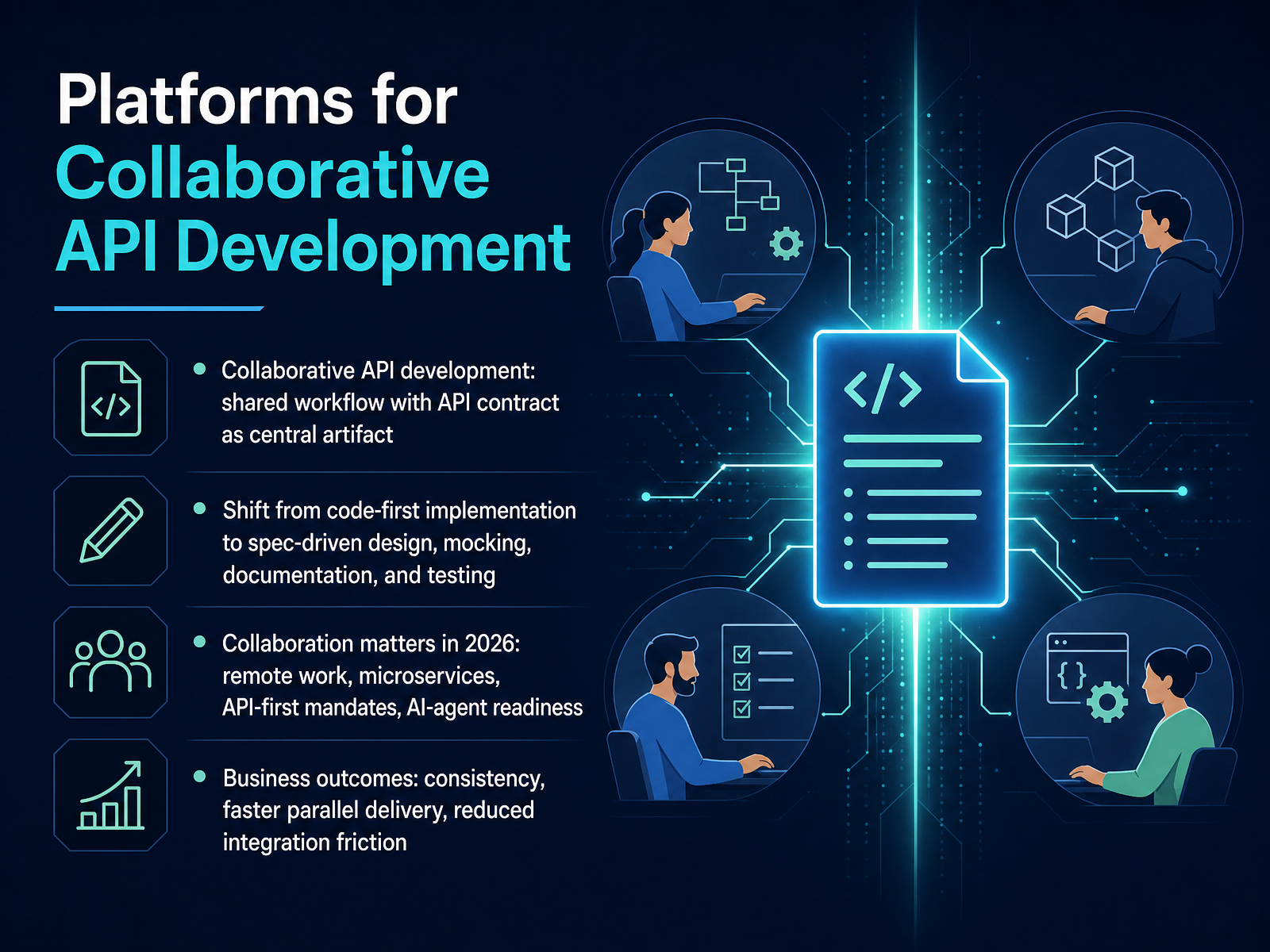
- 01Platforms for Collaborative API DevelopmentWelcome. If you design APIs, build backends, or write the docs that tie them together, this course is for you. We are going to look at platforms that make collaborative API development actually work in practice. The core idea is simple: the API contract becomes the central artifact of your shared workflow. Instead of starting with code and hoping the spec catches up, we shift to spec-driven design, where mocking, documentation, and testing all flow from one agreed definition. Why does this matter now? Because in 2026, your team is distributed, your services are many, and your APIs need to be ready for AI agents, not just human clients. The payoff is real. Teams that collaborate around a shared contract deliver in parallel, avoid integration friction, and keep their systems consistent. Over the next few minutes, we will explore how these platforms support that collaboration, and we will start with why collaboration around APIs has become strategic.api-contract-testing.comapiscout.devapi-documentation-hub.com+21 min
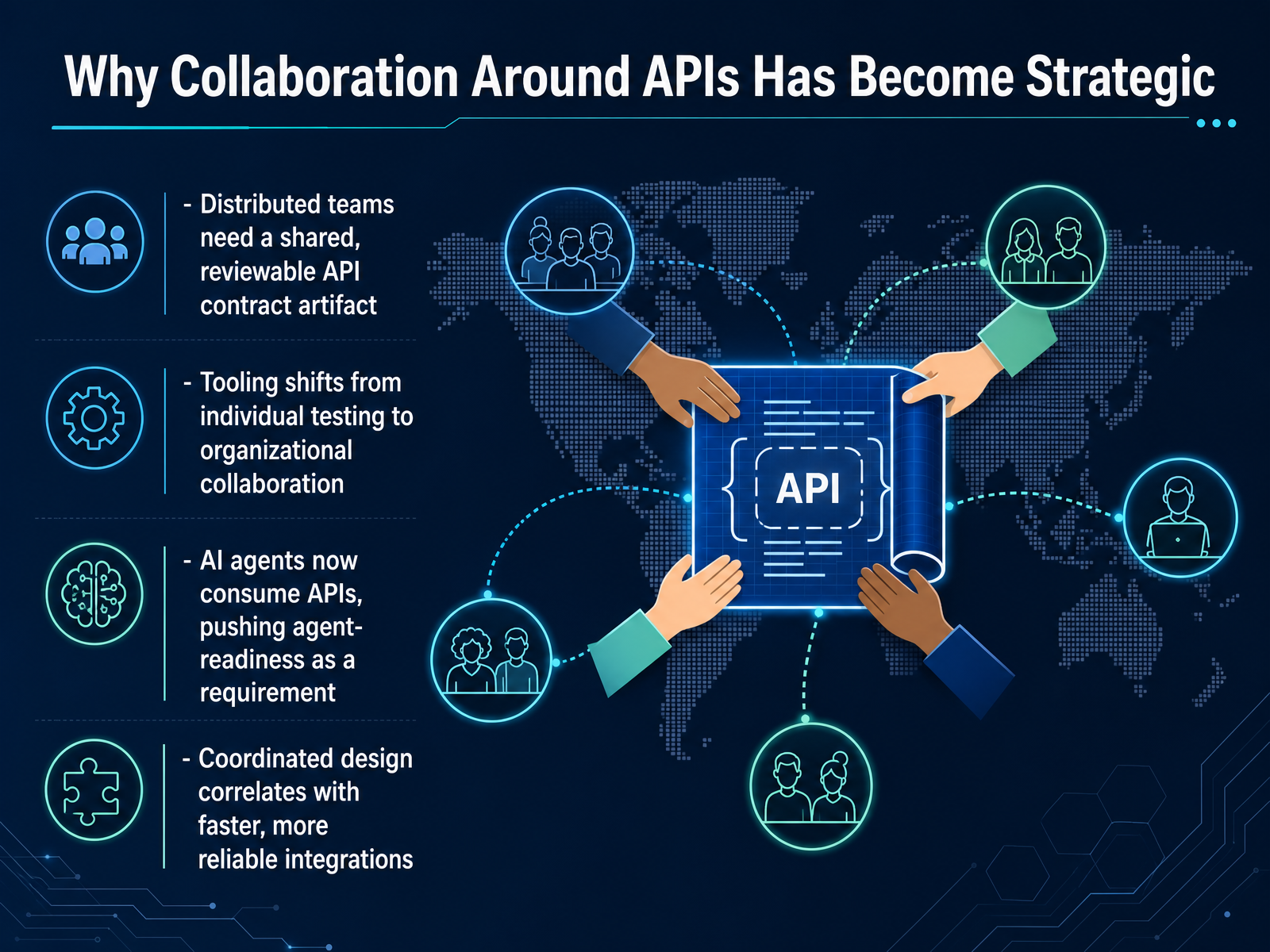
- 02Why Collaboration Around APIs Has Become StrategicLet’s talk about why collaboration around APIs is now a strategic concern. For distributed teams, the API contract is the one artifact everyone can review. It’s the shared reference point for design, for implementation, and for documentation. Tooling has shifted too. Individual testing tools still matter, but the real value now sits in organizational collaboration. Reviewing a proposed change before it ships, catching a contract break early, giving feedback asynchronously across time zones. And there is a new participant in these reviews. AI agents are consuming APIs at scale. In fact, public APIs are now more likely to document a Model Context Protocol server than to publish an OpenAPI spec. Being agent-ready has moved from an experiment to a design requirement. That changes how we define a complete contract. When teams coordinate around the API design itself, the payoff is measurable. Shared context means fewer surprises. Faster, more reliable integrations. Less rework. The platform is not just a tool for sending requests. It is becoming the workspace where the contract is negotiated, versioned, and trusted. Let’s move on to the core concepts and shared terminology we’ll use throughout this session.
 apiterms.comudadvisory.coyoungju.dev+21 min
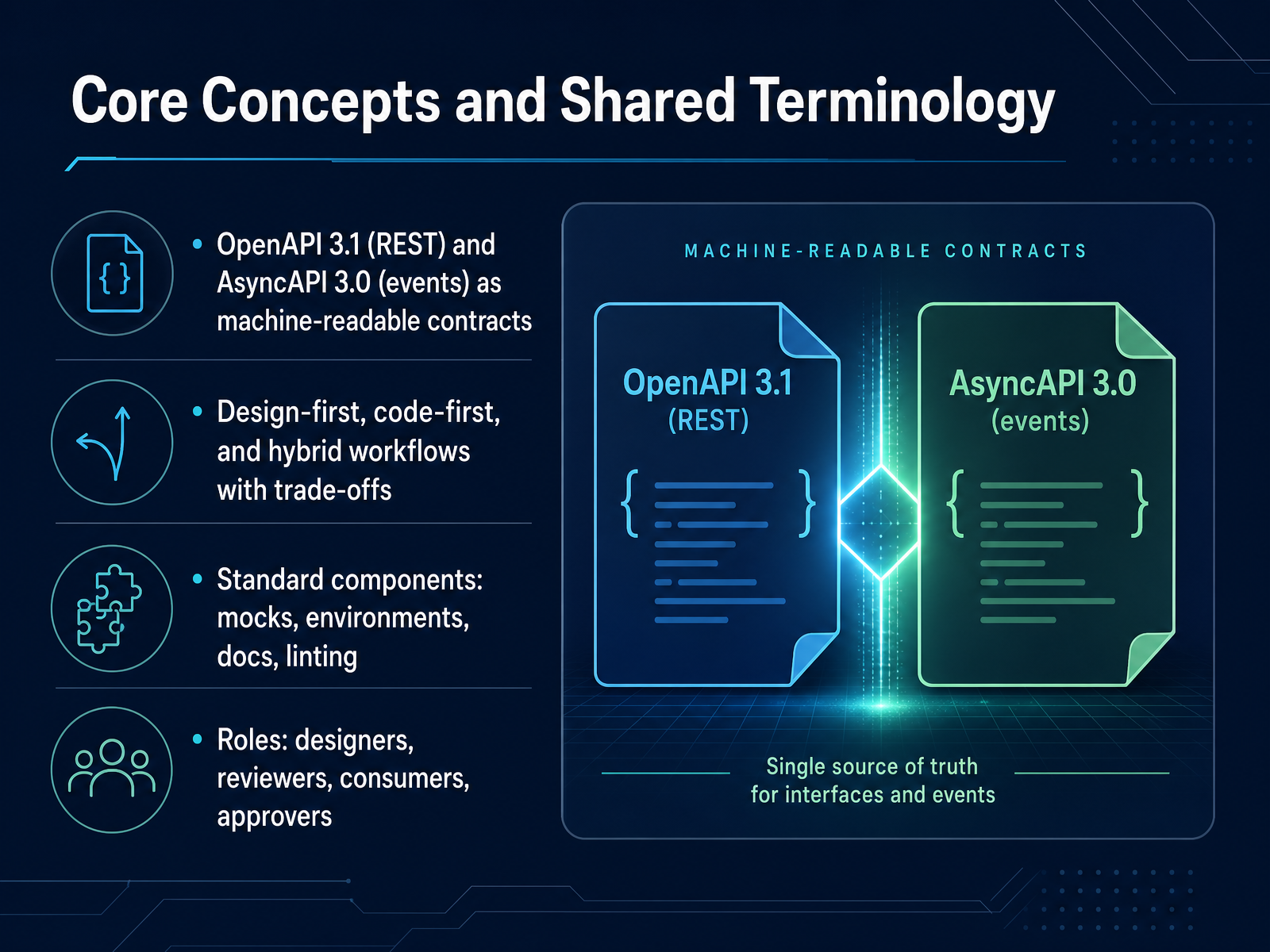
 - 03Core Concepts and Shared TerminologyNow let's align on the core concepts and the shared language we'll use throughout. At the heart of any modern API platform are machine-readable contracts. For REST APIs, that's OpenAPI 3.1. For event-driven systems, it's AsyncAPI 3.0. These files define the endpoints, the message formats, the data schemas, and the security rules. They're the single source of truth that everything else flows from. Next, the workflow. You have three options: design-first, code-first, or a hybrid. Design-first means writing the spec before any code. Code-first generates the spec from your implementation. Hybrid picks design-first for public or cross-team APIs, and code-first for internal prototypes. Each has trade-offs in drift risk, tooling overhead, and how early other teams can start. Then there are the standard building blocks. Mock servers from the spec let frontend and QA start early. Environments hold configurable hosts and tokens. Docs generate directly from the same contract. And linting catches style issues and breaking changes before they reach production. Finally, know the roles. Designers own the contract's shape. Reviewers, often backend leads, check for feasibility and consistency. Consumers, like frontend and mobile teams, build against mocks. And approvers, maybe a platform lead, sign off before merge. These are the terms and roles we'll use in every workflow we compare next, as we look at design-first versus code-first.
 api-contract-testing.comapiscout.devapi-documentation-hub.com+21 min
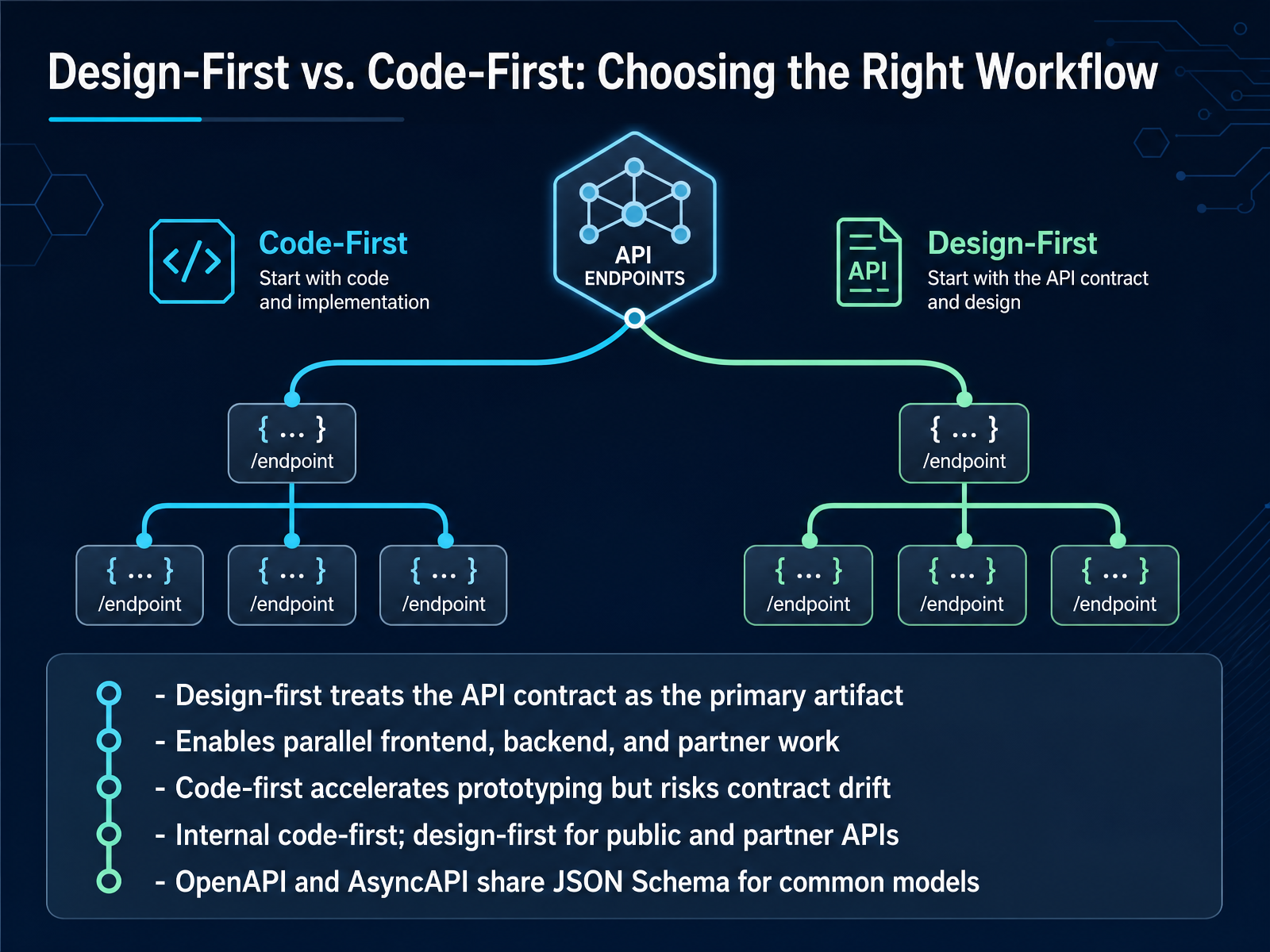
 - 04Design-First vs. Code-First: Choosing the Right WorkflowLet’s talk about choosing your workflow: design-first or code-first. Design-first treats the API contract as the primary artifact. You write the OpenAPI or AsyncAPI document before any handler code exists. That spec becomes the agreement between teams. The payoff is parallel work. Frontend, backend, and partner teams can all start on day one. The frontend builds against a mock server generated from the spec. The backend implements to the same contract. When they meet at integration, nothing is a surprise. Code-first accelerates prototyping. You write the implementation, and the spec is generated from annotations. That is fast. But the risk is contract drift. Rename a field in a refactor, and the spec silently renames it too. Your consumers find out in production. So how do you choose? Use code-first for internal prototypes and single-team services. Use design-first for public and partner APIs, where the contract is load-bearing. And remember, OpenAPI and AsyncAPI share JSON Schema for common models. That means you can keep REST and event-driven specs side by side, referencing the same schema files. The principle is simple: if multiple teams or external consumers depend on the contract, design it first. Now, let’s look at how to design those APIs collaboratively.
 api-contract-testing.comapiscout.devapi-documentation-hub.com+22 min
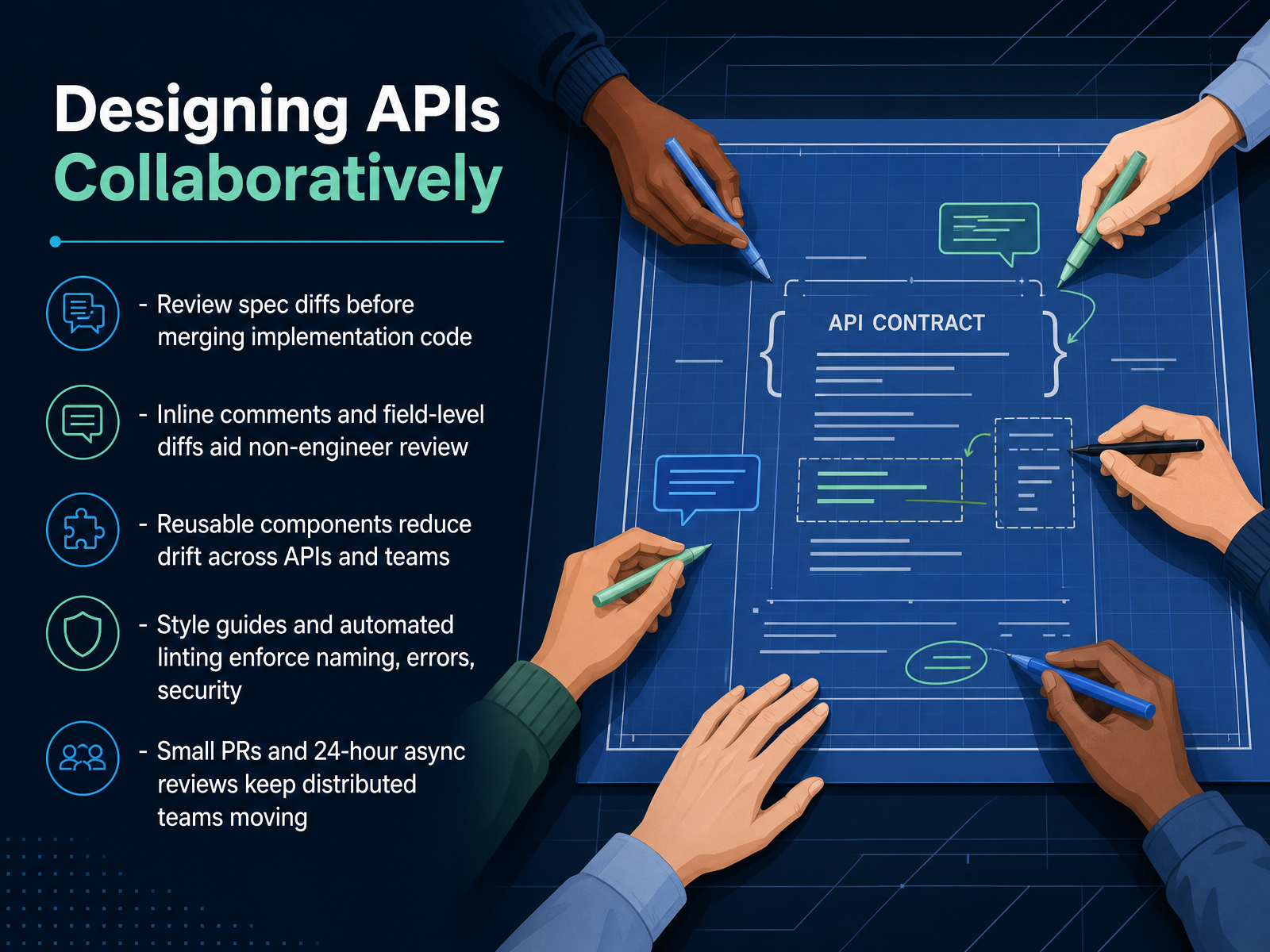
 - 05Designing APIs CollaborativelyDesigning collaboratively starts where the real leverage is: reviewing the contract before the code. Open up a pull request that contains only the spec diff and a short design note, not the implementation. That keeps attention on the interface, where mistakes are cheapest to fix. Field-level diffs help here. Non-engineers, like technical writers and product managers, can comment on specific changes. They never need to read YAML or stare at raw JSON. Inline comments turn awkward meetings into focused conversations. Review speed matters when teams are distributed. Keep pull requests small, spec-only, and set a twenty-four hour review window. Version control diffing catches drift, but design drift is the subtler issue. When teams copy models and paste them across specs, consistency slowly erodes. Build a shared component library. One schema for pagination, one envelope for errors, one set of enums should serve every endpoint. Naming, error codes, and security patterns should come from a style guide enforced by linting in CI. Spectral is a common choice. Automation handles the mechanical rules so human reviewers can focus on judgment, like whether the field you added today will lock you into a migration tomorrow. Next, let’s look at mocking and testing during development.
 letsbuildsolutions.comdocs.stoplight.ioletsbuildsolutions.com+22 min
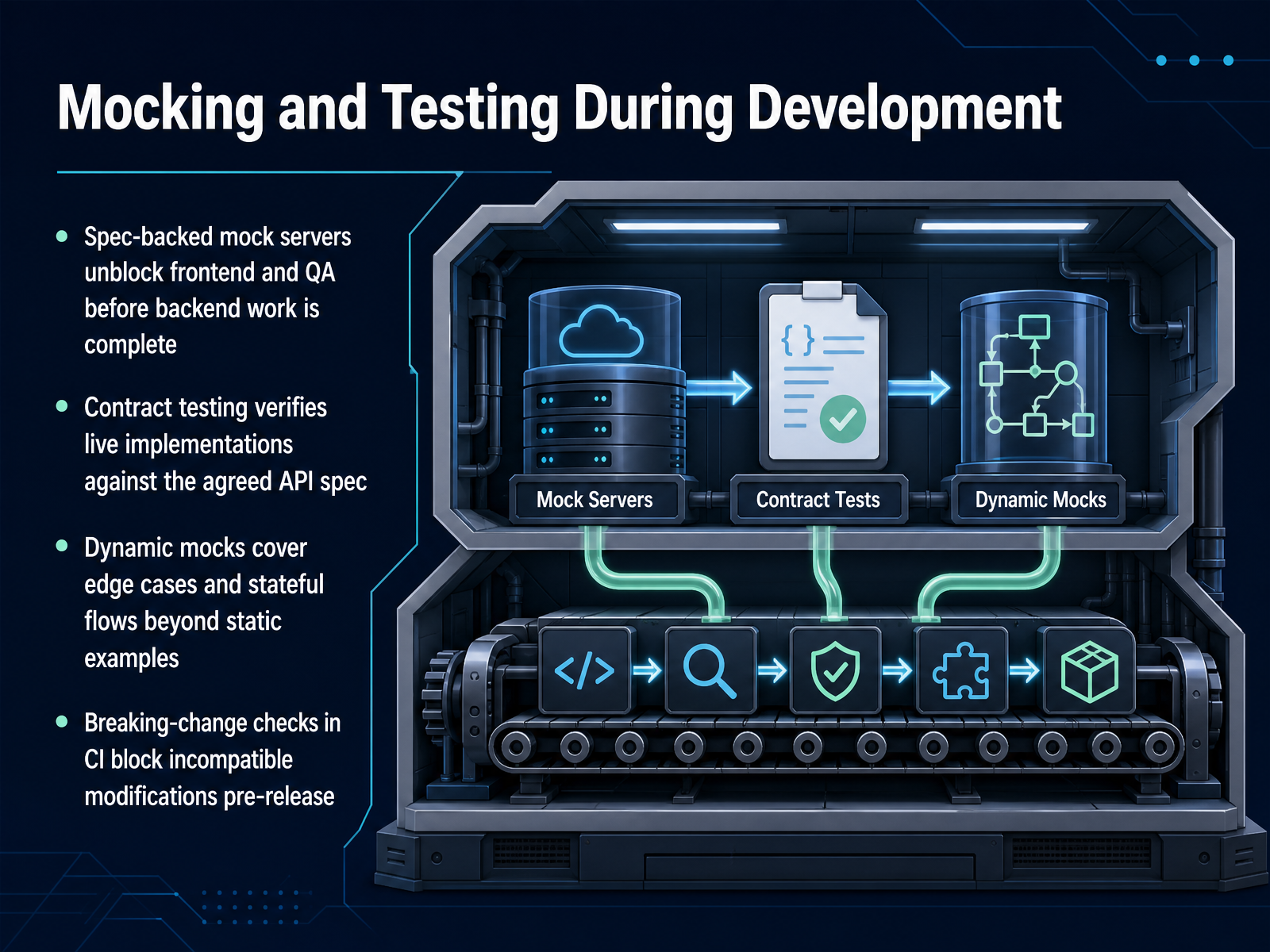
 - 06Mocking and Testing During DevelopmentLet’s talk about mocking and testing during development. The goal here is simple: don’t let anyone wait on the backend. A spec-backed mock server turns your API contract into a working endpoint instantly. Frontend teams and QA can build against realistic data before a single line of backend code exists. This unblocks parallel work and catches mismatches early, when they are cheap to fix. Beyond mocks, contract testing verifies the live implementation against the agreed spec. It answers one question: does the real service behave as documented? Dynamic mocks extend this further, covering edge cases and stateful flows. Think authentication failures, rate limits, or a checkout sequence that changes after a post. Static examples just cannot express those scenarios. Finally, breaking-change checks in CI. These block incompatible modifications before release. A small change to a field type or a required header gets flagged right in the pipeline, not in production. The pattern to remember: mock early for speed, contract test for trust, and let CI guard the contract’s stability. Next, let’s look at documentation as a shared artifact.
 docs.apidog.comapi-contract-testing.comgithub.com+22 min
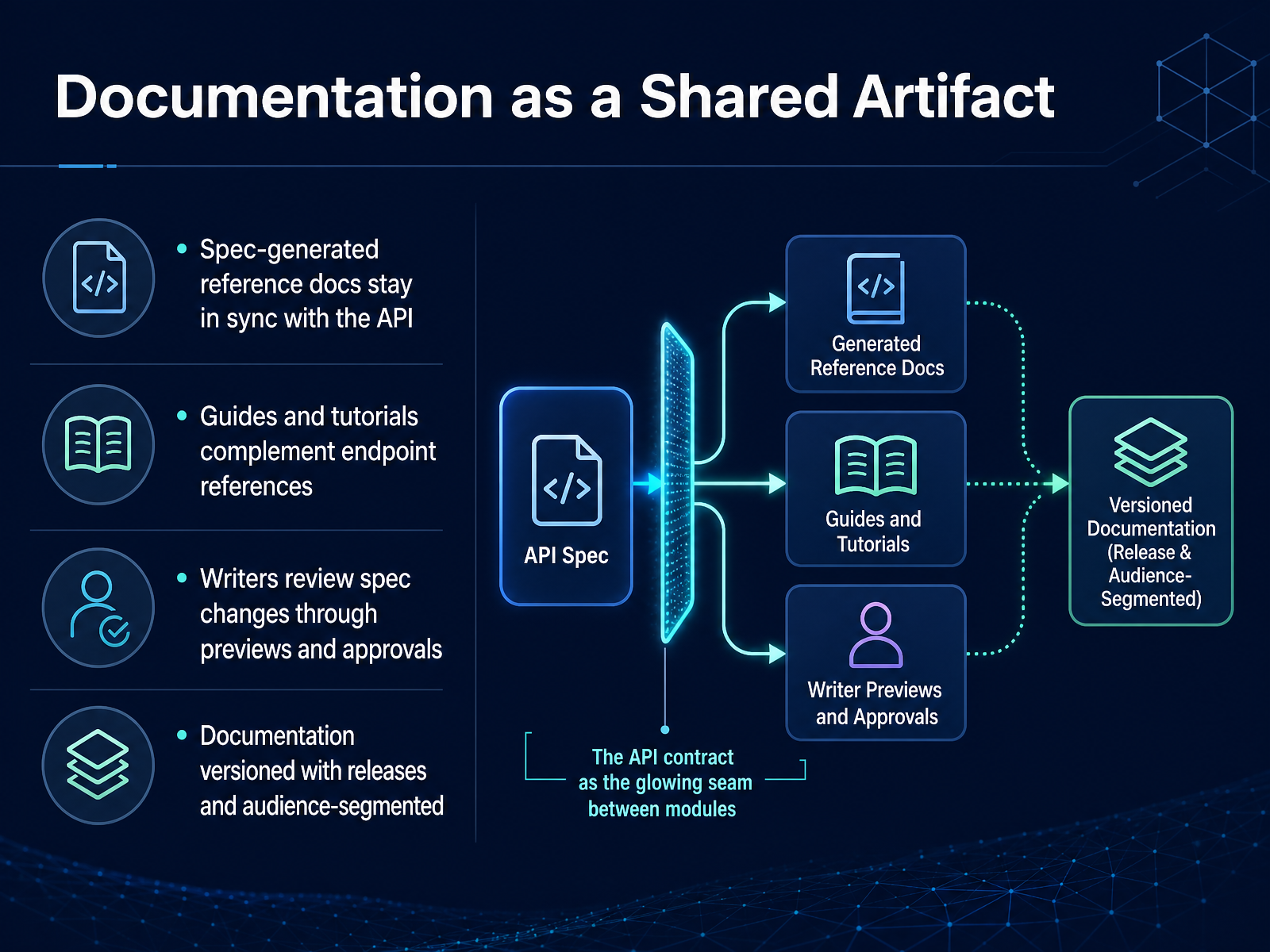
 - 07Documentation as a Shared ArtifactNow let’s talk about documentation as a shared artifact. In an API-first workflow, the spec-generated reference docs stay in sync with the code automatically. That means the endpoint descriptions your readers see are never a stale copy. But reference docs are only half the story. Guides and tutorials complement them, and those need the same rigor. When a spec changes, writers don’t just hear about it. They review those changes through previews and structured approvals, exactly like a code review. A rendered preview lets them judge the layout and clarity, not just the raw text. And because documentation is versioned with each release, you can segment it by audience. For example, one version for internal teams and another for public consumers. The practical takeaway is this: treat docs as a first-class artifact with its own review loop. When writers and engineers share the same pipeline, the handoff becomes explicit, reviewable, and trustworthy. That naturally leads us to governance, access, and release management.
 2 min
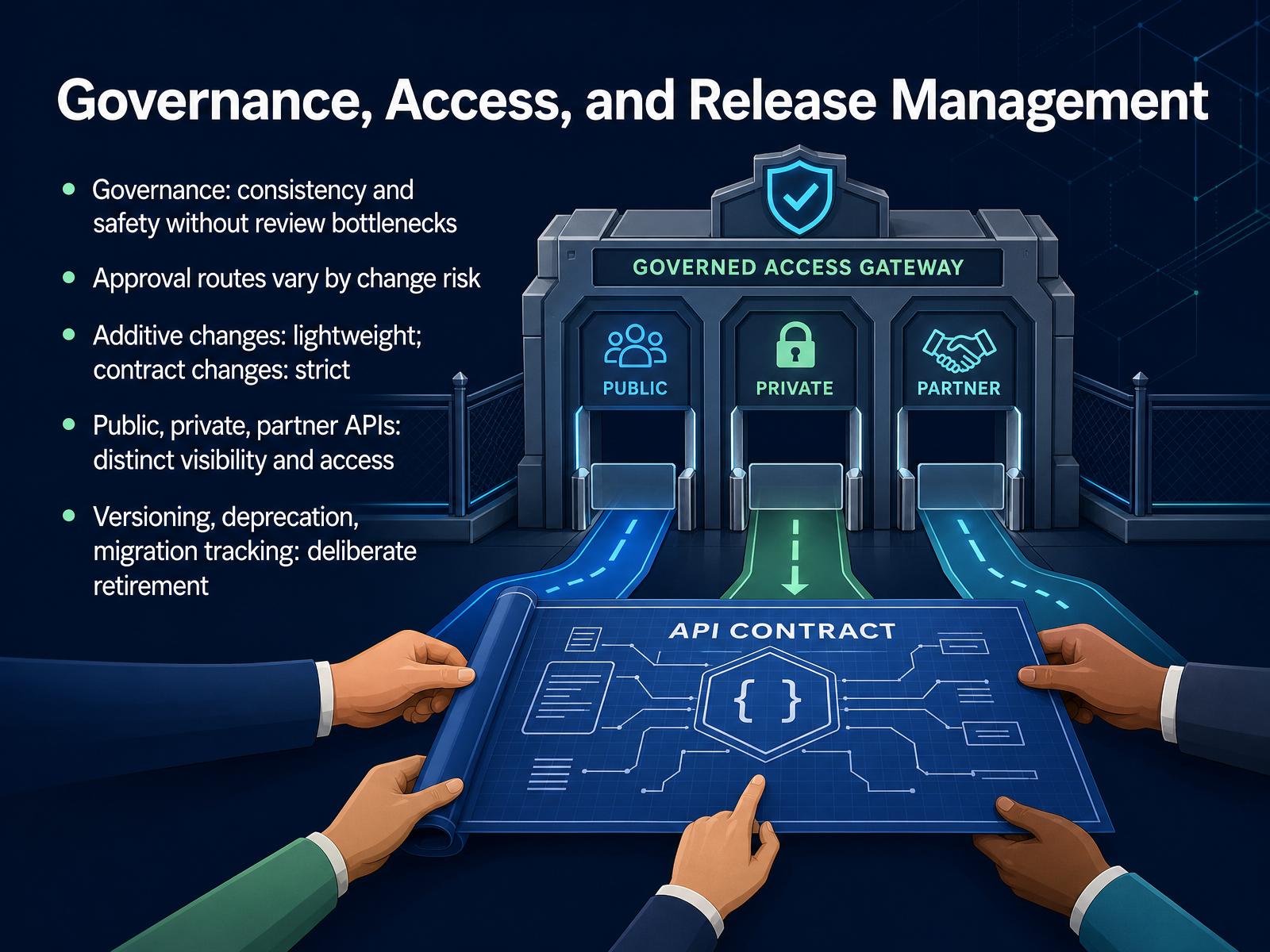
2 min - 08Governance, Access, and Release ManagementNow let’s talk about governance, access, and release management. Governance is about enforcing consistency and safety without creating review bottlenecks. The trick is matching the approval route to the actual risk of a change. An additive change, like adding a new optional field or endpoint, should move through a lightweight review, often just an async pull request check. A change to an existing contract is riskier. That should trigger a stricter path, one that requires a synchronous review and notifies known consumers before anything merges. Visibility and access should also scale with audience. Public, partner, and internal APIs are not the same. They each need distinct visibility rules and access controls. Public APIs get the most exposure, partner APIs restrict access to vetted organizations, and internal ones stay scoped to the team or project. And finally, deliberate retirement. Versioning, deprecation, and migration tracking are part of this governance layer. An API version should never just vanish. It needs a defined retirement path with tracked consumer migration. That is how you keep the platform safe and trustworthy. Next, we will look at breaking changes and deprecation as a lifecycle practice.
 letsbuildsolutions.comdocs.stoplight.ioletsbuildsolutions.com+22 min
 - 09Breaking Changes and Deprecation as a Lifecycle PracticeLet’s move to how breaking changes and deprecation should feel like a normal lifecycle practice, not an emergency. First, you need to identify a breaking change clearly: removed fields, altered types, tightened constraints. Those are structural breaks. Automated diffing tools catch most of them reliably. But semantic issues—like a field meaning something subtly different now—still need human review. That is where your design reviewers add real value. Once a break is confirmed, treat deprecation as a disciplined process. Publish sunset headers immediately. Do not wait until the replacement version is ready. Write a migration guide that maps every removed field to its new equivalent. Maintain a consumer registry so notifications reach real people, not a general mailing list. The timeline for sunset scales with exposure. Internal APIs might need thirty days. External partners may need six to twelve months. The clock starts when consumers are notified, not when you decide internally. Finally, instrument deprecated endpoints. Track call volume by consumer, and do not complete a sunset until traffic has been at zero for a meaningful observation window. That data-driven approach turns a calendar guess into a confident decision. Up next, we will look at how to choose and adopt a platform that supports these practices at your organization's scale.
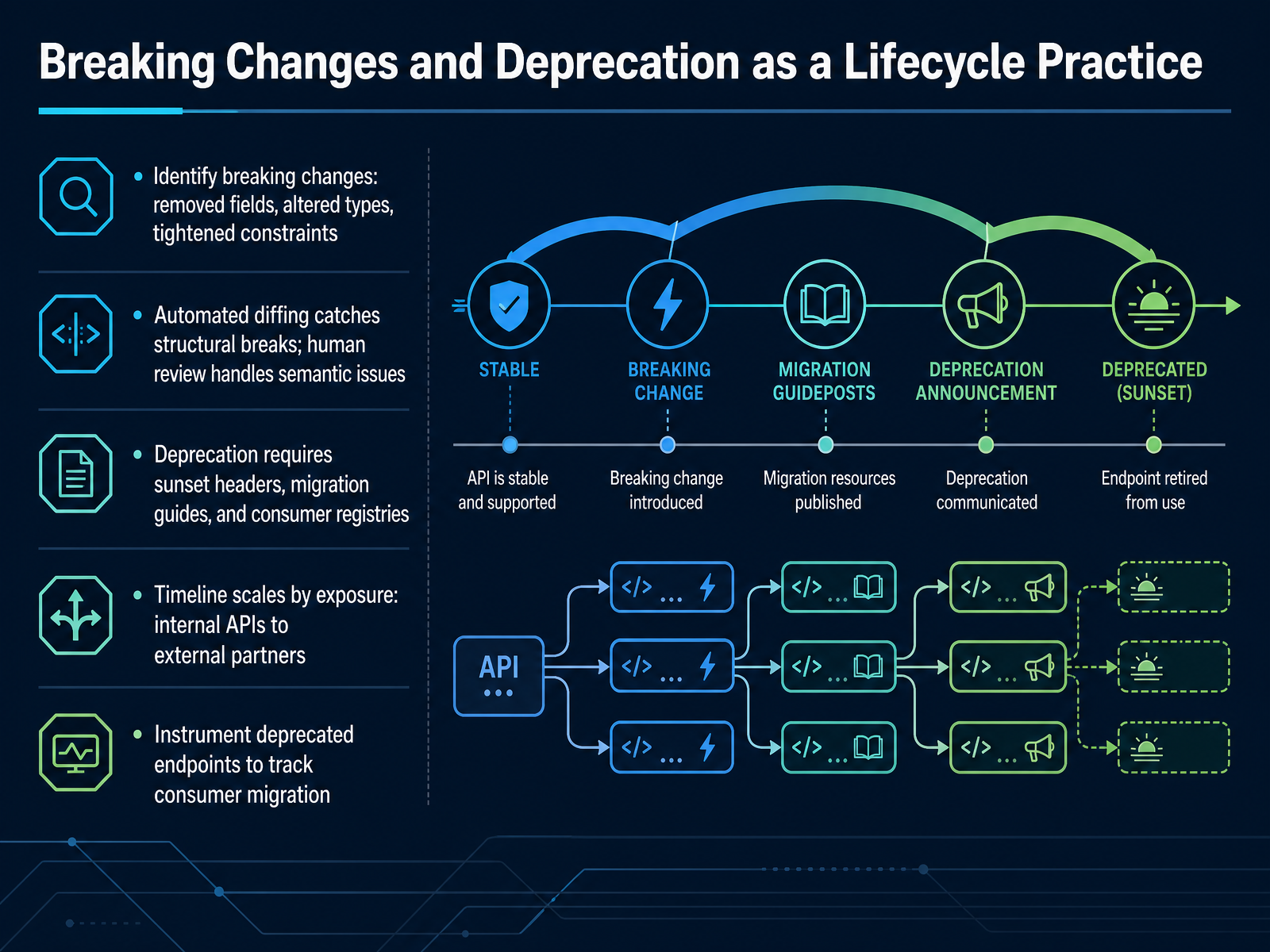 letsbuildsolutions.comdocs.stoplight.ioletsbuildsolutions.com+22 min
 - 10Choosing and Adopting a PlatformLet’s talk about choosing and adopting a platform. The right choice depends on your team’s size, workflow maturity, existing toolchain, and compliance needs. For a large organization, an all-in-one lifecycle tool like Postman makes sense. For governance-heavy teams, design-first platforms like SwaggerHub or Stoplight enforce consistency. And for Git-native teams, Bruno or Insomnia let collections live as code. Don’t standardize on a tool just because it’s popular. Match it to your actual pain point. Start small. Pick one pilot project, integrate CI/CD, and define measurable success criteria before rollout. Watch for common pitfalls: fragmented workspaces where specs live in multiple places, over-restrictive permissions that slow down reviews, and tool sprawl that forces your team to stitch together four vendors. One spec, one source of truth, keeps the workflow clean. Next, we’ll look at the platform landscape in 2026 and what’s shifting in the market.
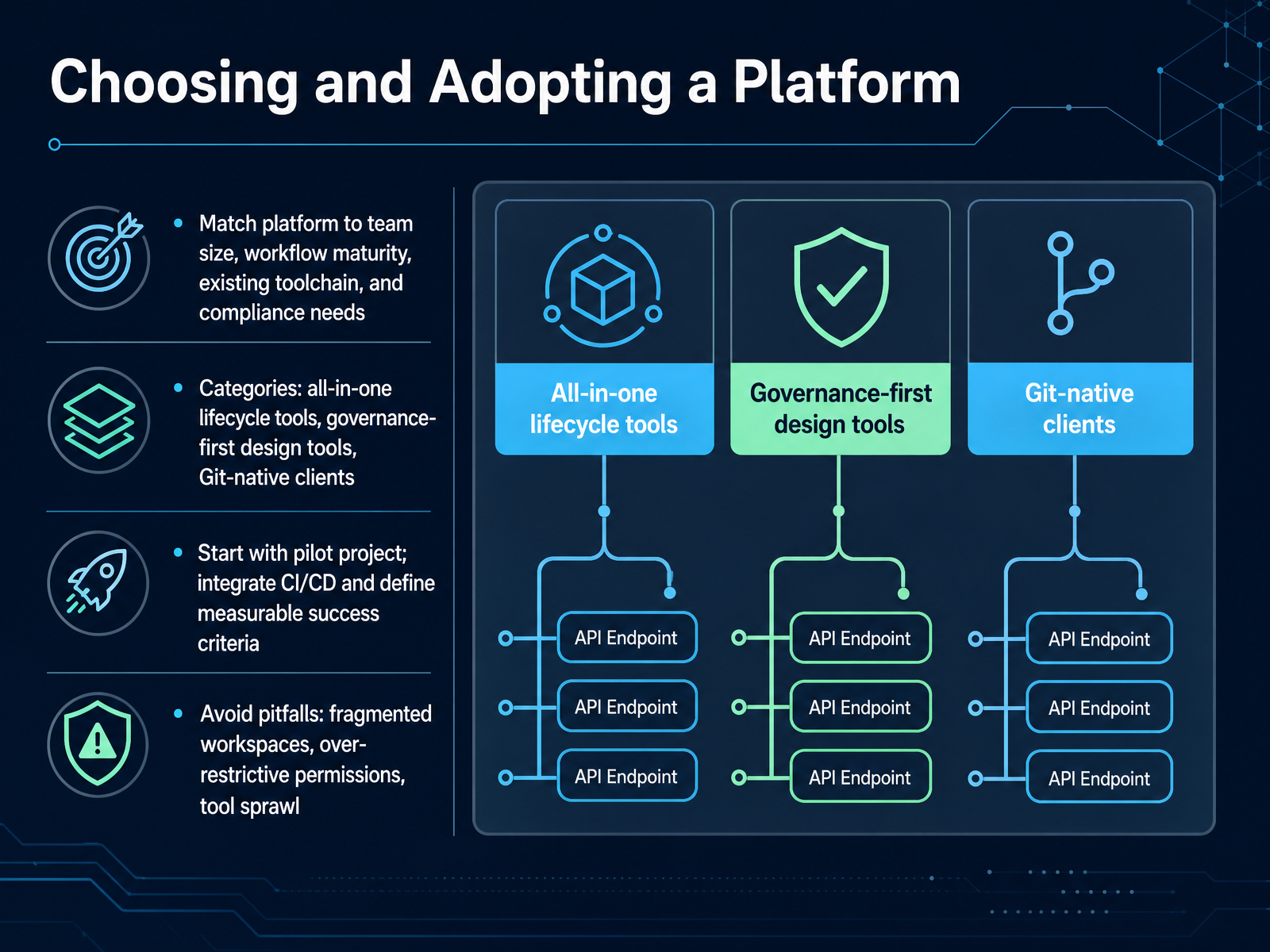 youngju.devapiterms.comudadvisory.co+21 min
 - 11Platform Landscape: What to Expect in 2026Now, let's look at the platform landscape and what you can expect this year. The market splits into two main camps. On one side, you have all-in-one platforms like Postman and Apidog that cover the entire lifecycle. On the other, governance-first tools like SwaggerHub and Stoplight, which put the OpenAPI spec at the center. Beyond that split, a few trends now define the baseline. AI-assisted authoring is no longer a differentiator; it is table stakes. Most serious tools now ship their own official MCP support, letting coding agents read specs and generate code directly. You should also expect data ownership to be a key factor. Self-hosted, git-native options like Bruno and Hoppscotch now compete strongly for teams with strict residency requirements. So, how do you choose? Stop looking at the longest feature list and start with your dominant pain point. If your problem is standardization across many teams, governance tools like Stoplight make sense. If your bottleneck is handoffs and speed, an all-in-one suite may serve you better. Match the platform's core philosophy to that pain, and you will avoid buyer's remorse. Next, we will turn that insight into practical strategies for your distributed team.
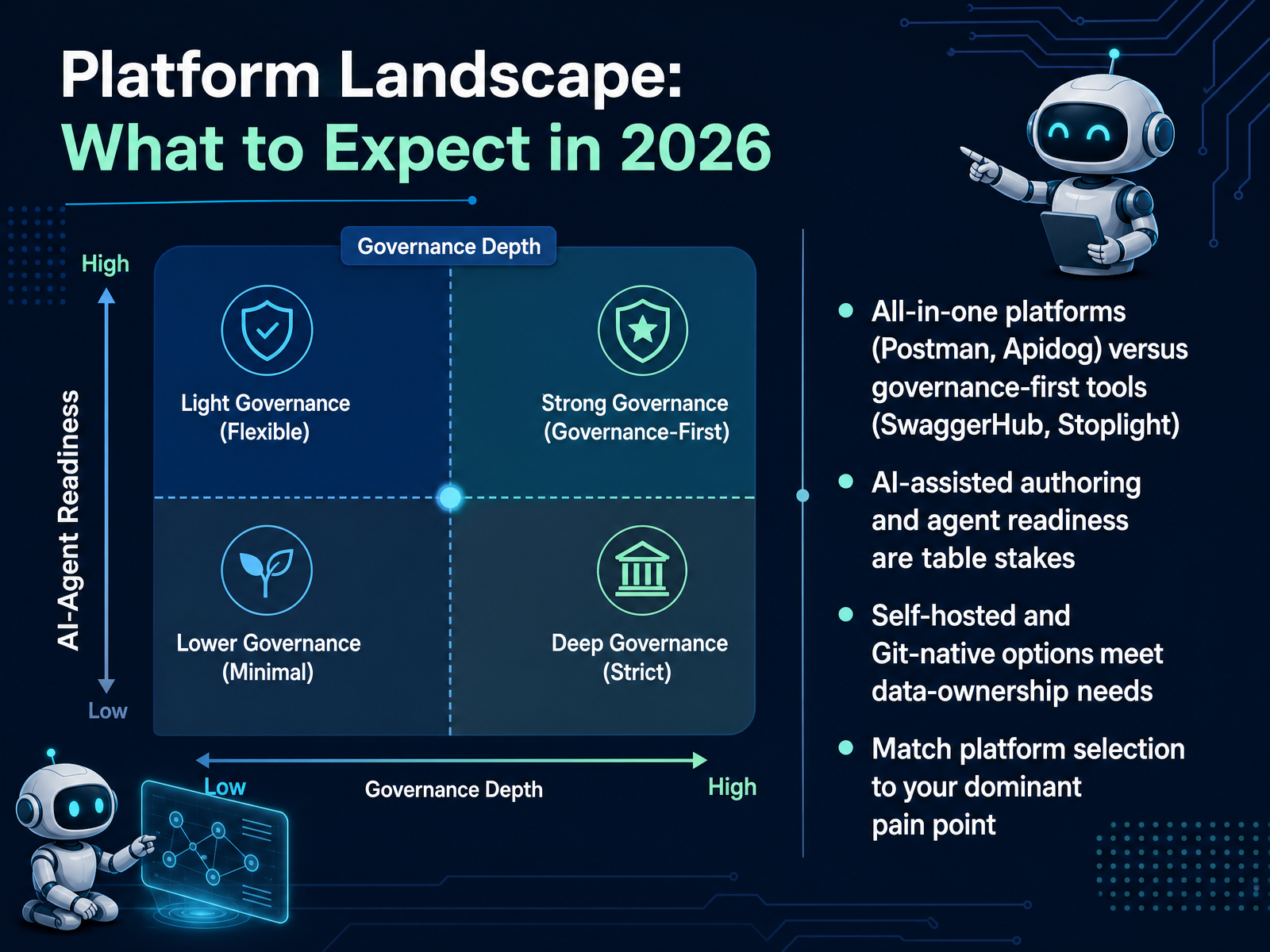 youngju.dev2 min
 - 12Practical Strategies for Distributed TeamsSo how do these practices come together for a distributed team? Start with small, short-lived branches. One endpoint, one change, one pull request. That keeps the spec diff tiny, and tiny diffs get real reviews instead of a skim. Pair that with asynchronous reviews and a twenty-four-hour window. You don't need a meeting to debate a field name. You need a comment thread that lets people in different time zones weigh in when they're actually at work. Then automate the tedious parts. Lint the spec, generate mocks, and run compatibility gates straight in CI. Let the machine catch formatting and breaking changes before a human ever looks at it. That leaves reviewers free to focus on design judgment. Finally, make feedback loops explicit. Spin up a preview environment and a mock server from each merge request. Frontend developers can start building immediately, and consumers can try the change before it's final. That's not just convenient, it prevents surprises. Remember these four levers: short-lived branches, async reviews with real windows, automation in CI, and explicit previews. Together they turn chaos into cadence. Next, let's look at how collaboration scales when you add more teams and formal stewardship.
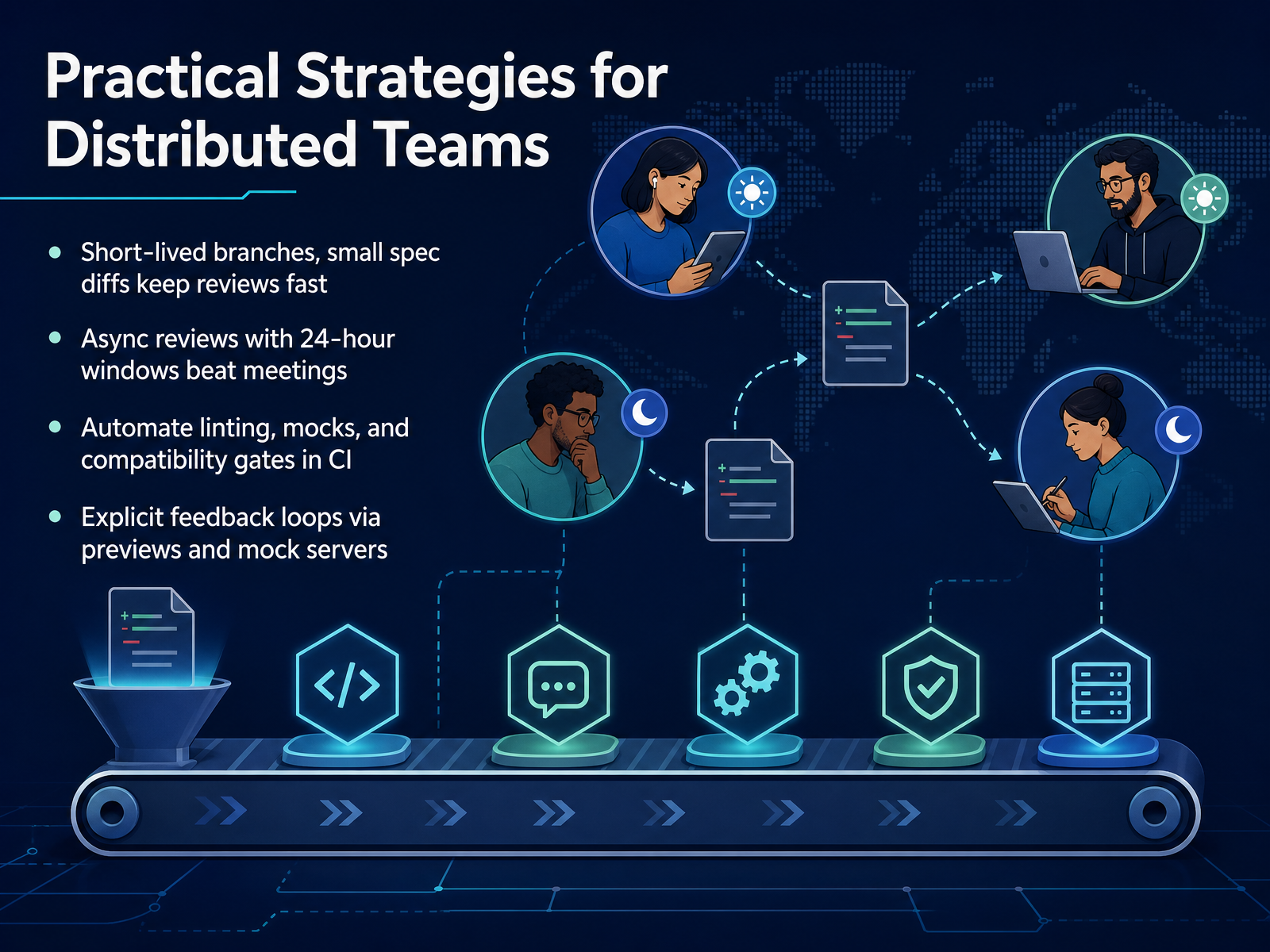 letsbuildsolutions.comcodelit.ioletsbuildsolutions.com1 min
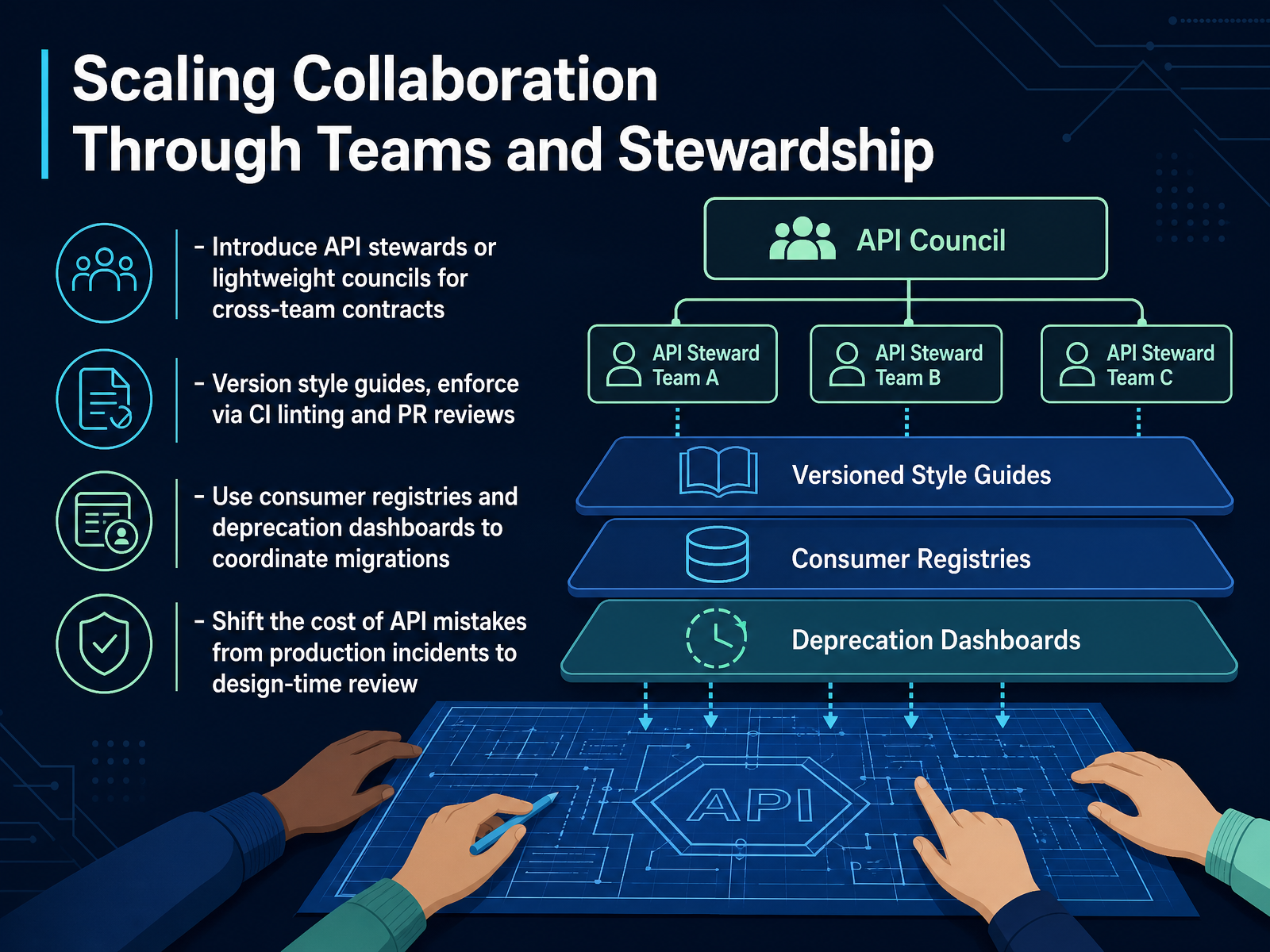
 - 13Scaling Collaboration Through Teams and StewardshipAs your platform grows, let's talk about scaling collaboration itself. The goal is to move the cost of API mistakes from production incidents back to design-time review. Start by introducing API stewards or a lightweight council. Their job is to oversee cross-team contracts, not to block progress. They maintain the style guide, review spec changes, and track the deprecation backlog. Next, version your style guide and enforce it automatically. Run linting in CI on every pull request. This catches naming and structural issues before a human ever looks at the diff. Use consumer registries and deprecation dashboards to coordinate migrations. You need to know who calls each endpoint before you change it. Track consumer traffic on deprecated APIs. Only sunset an endpoint when real traffic reaches zero over a meaningful window. With this structure, a breaking change becomes a deliberate, reviewed decision. It stops being an incident that surprises your consumers at runtime. The result is a platform that scales from a handful of engineers to several hundred without the API surface deteriorating. Stewardship and automation keep the quality bar high while keeping the process fast. Up next, we will turn this into a practical action plan you can start implementing this sprint.
 letsbuildsolutions.comcodelit.ioletsbuildsolutions.com+21 min
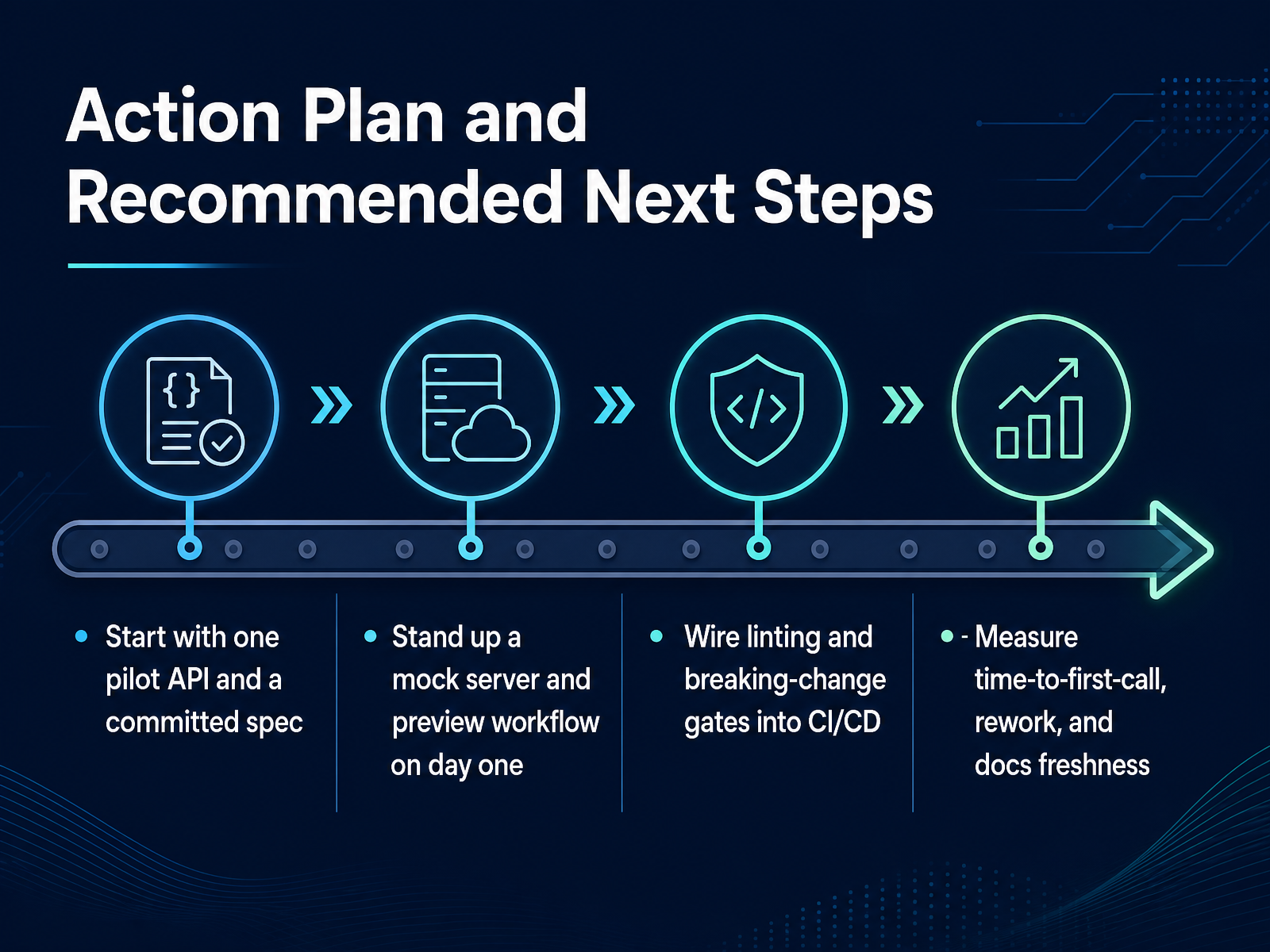
 - 14Action Plan and Recommended Next StepsLet’s wrap this up with a concrete plan you can start on Monday. Begin with one pilot API and a committed specification. Pick something real, but not mission-critical. Get that contract into your repository and treat it like source code. On day one, stand up a mock server and review the workflow. Frontend can build against it while backend catches up. That alone removes the biggest bottleneck. Next, wire linting and breaking-change checks into your CI pipeline. These gates catch problems before your consumers do. A style violation should fail the build, and a breaking change should require explicit approval. That is how you make the spec authoritative. Finally, measure what matters. Track time-to-first-call for new consumers, rework caused by unclear contracts, and how fresh your documentation stays. These numbers will tell you if the process is working. The tools are ready. The workflow exists. Start small, stay consistent, and let the contract lead. Thank you for your attention, and good luck with your rollout.
 letsbuildsolutions.comcodelit.ioletsbuildsolutions.com+22 min
Take the deck with you
Download this course as a file — free, no sign-up needed.
- PDF handoutEvery slide page, ready to print or share.15 pages · 3.7 MBDownload
- Narrated PowerPointThe deck that presents itself — every slide carries the digital human's narration video.15 pages · 16.9 MBDownload
- PowerPoint slidesThe full deck as a .pptx — open it in PowerPoint, Keynote, or Google Slides.15 pages · 3.6 MBDownload
Free to use in your own training — please keep the PersonWise credit page at the end.
Have your own deck? Turn it into a course
Sources consulted
Web sources consulted while building this course.
- Schema-First vs Code-First API Workflows | API Contract Testing — api-contract-testing.com
- API-First vs Code-First Development 2026 | APIScout — apiscout.dev
- OpenAPI & AsyncAPI Schema Authoring: The Complete Guide for Automated Developer Portals | API Docs & Portal Automation Hub — api-documentation-hub.com
- Design-First vs. Code-First API Development — Routebase — routebase.dev
- API Schema Landscape 2026 — JSON Schema, OpenAPI 3.1, AsyncAPI, GraphQL, gRPC, Smithy, TypeSpec in One Map | Chaos and Order — youngju.dev
- The State of the API Economy 2026 — API Terms — apiterms.com
- The Toolkit Gets Context – UD Advisory Co. — udadvisory.co
- API Design & Testing Tools 2026 — Bruno / Insomnia / Postman / Hoppscotch / Scalar / Mintlify / Buf Deep Dive | Chaos and Order — youngju.dev
- Best API Lifecycle Management Platforms (2026) — zuplo.com
- The State of API Documentation Tooling in 2026: AI Auto-Generation Meets the Agent Era — hackernoon.com
- Running API Design Reviews: Contracts, Backward Compatibility, and Change Management — Let's Build — letsbuildsolutions.com
- Review API Designs | API Best Practices — docs.stoplight.io
- API Design Governance for Growing Teams: Style Guides, Review Processes, and Evolving APIs Without Breaking Consumers — Let's Build — letsbuildsolutions.com
- API-First Design Methodology — Design Before You Implement | Codelit.io — codelit.io
- 5 Tips for a Game-Changing API Design Review — blog.postman.com
- https://docs.apidog.com/apidog-collaboration-workflow-646333m0 — docs.apidog.com
- Mock Server Strategies | API Contract Testing — api-contract-testing.com
- fcucullu/api-contract-hub — github.com
- Apidog: API Lifecycle Platform | LeadAI Review | AI Dev Setup — aidevsetup.com
- OpenAPI Contract Verification with AI | MockServer — mock-server.com