Begin
20 pages · ~40 min
Introduction to Geology
This training introduces the fundamentals of geology, covering Earth's structure, processes, and materials for beginners.
A digital instructor presents all 20 pages. Hold “Ask” at any point and ask out loud — the answer comes from this course. No sign-up needed.
What you’ll learn
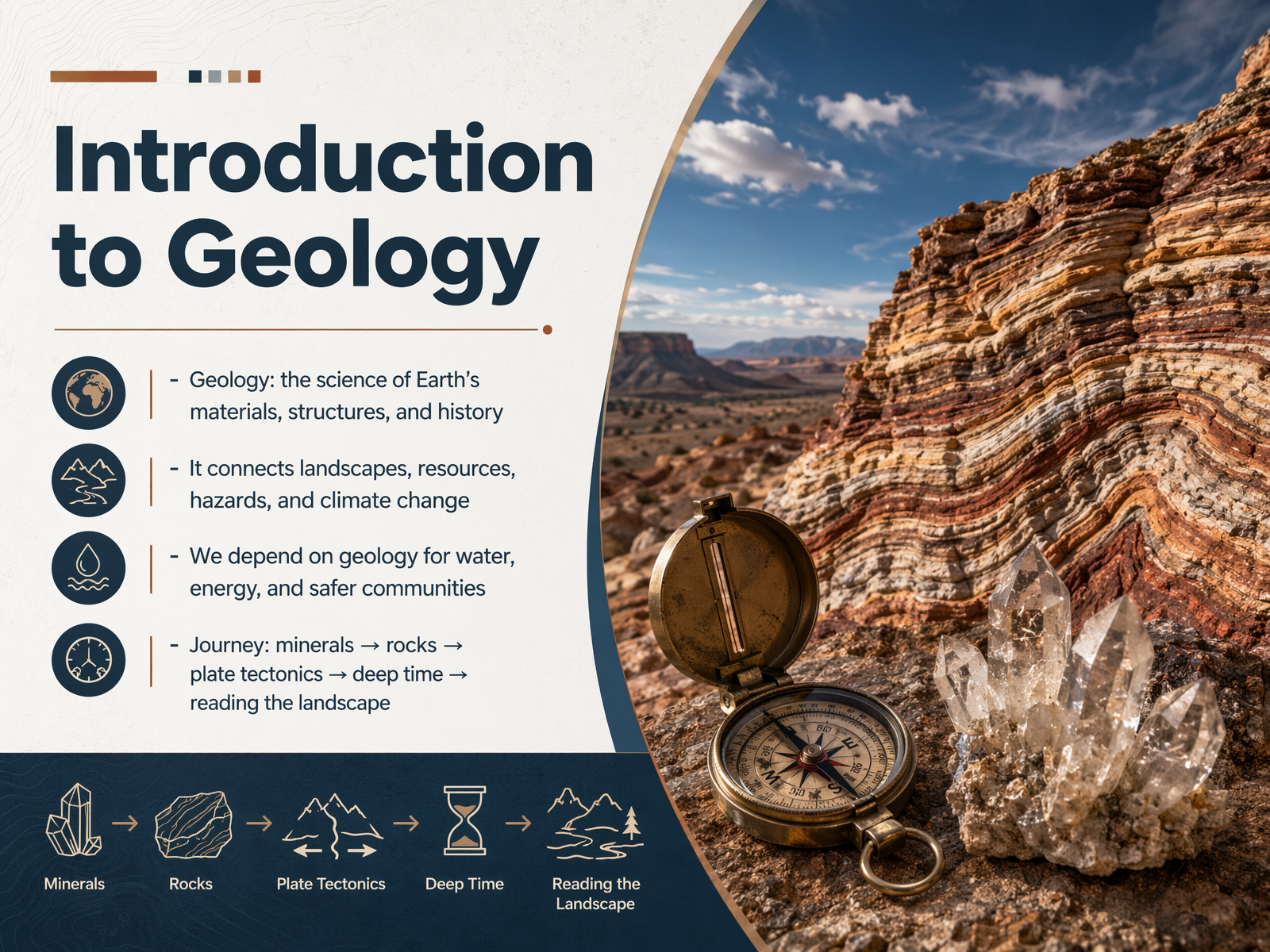
- 01Introduction to GeologyWelcome to our introduction to geology. I'm so glad you're here. Think of this course as a guided field trip where we explore the story of our planet. Geology is the science of Earth's materials, structures, and long history. It connects everything from the landscapes we hike to the resources we use every day and even the hazards we prepare for. It also helps us understand climate change by reading the planet's past. We depend on geology for clean water, energy, and building safer communities. Over our journey, we will start with tiny minerals, build those into rocks, discover how continents drift, travel through deep time, and learn to read the landscape around us. It's a big story, and it all starts with a simple question. Next, we will define exactly what geology is and why it matters to you.1 min
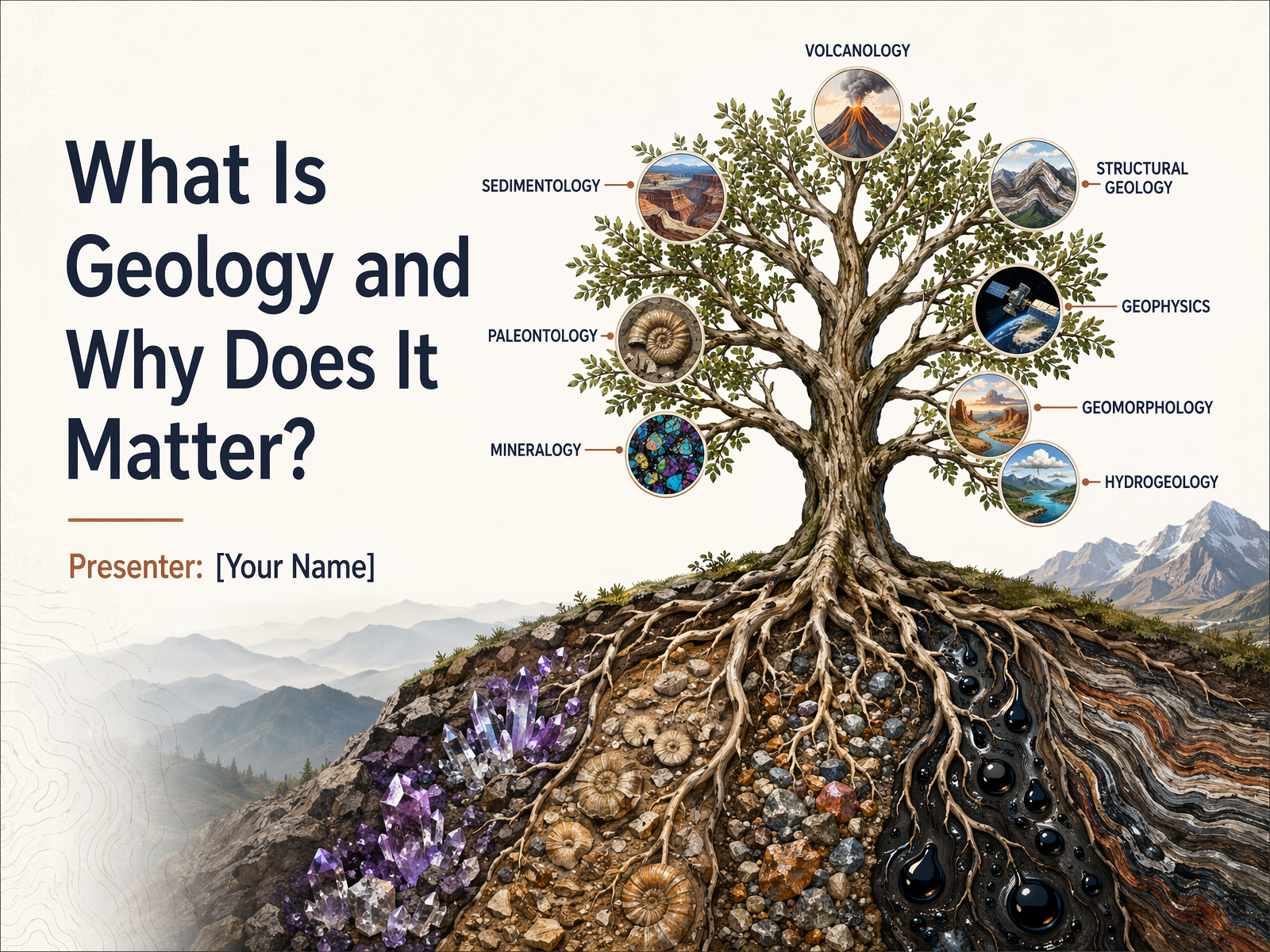
- 02What Is Geology and Why Does It Matter?So, what exactly is geology? Simply put, it's the science of our planet Earth. Geologists study the solid materials that make up our world, like rocks and minerals, but also the incredible processes that shape it over time. Think of Earth as a dynamic, living machine that’s constantly changing, and geology is the instruction manual. Understanding this manual matters more than you might think. It helps us find clean water, discover the resources we use every day, and understand natural hazards like earthquakes and volcanoes so we can build safer communities. It even helps us decipher the history of climate change, giving us clues about our planet's future. Let's start that journey by looking at the tiniest fundamental pieces: minerals, Earth's building blocks.
 1 min
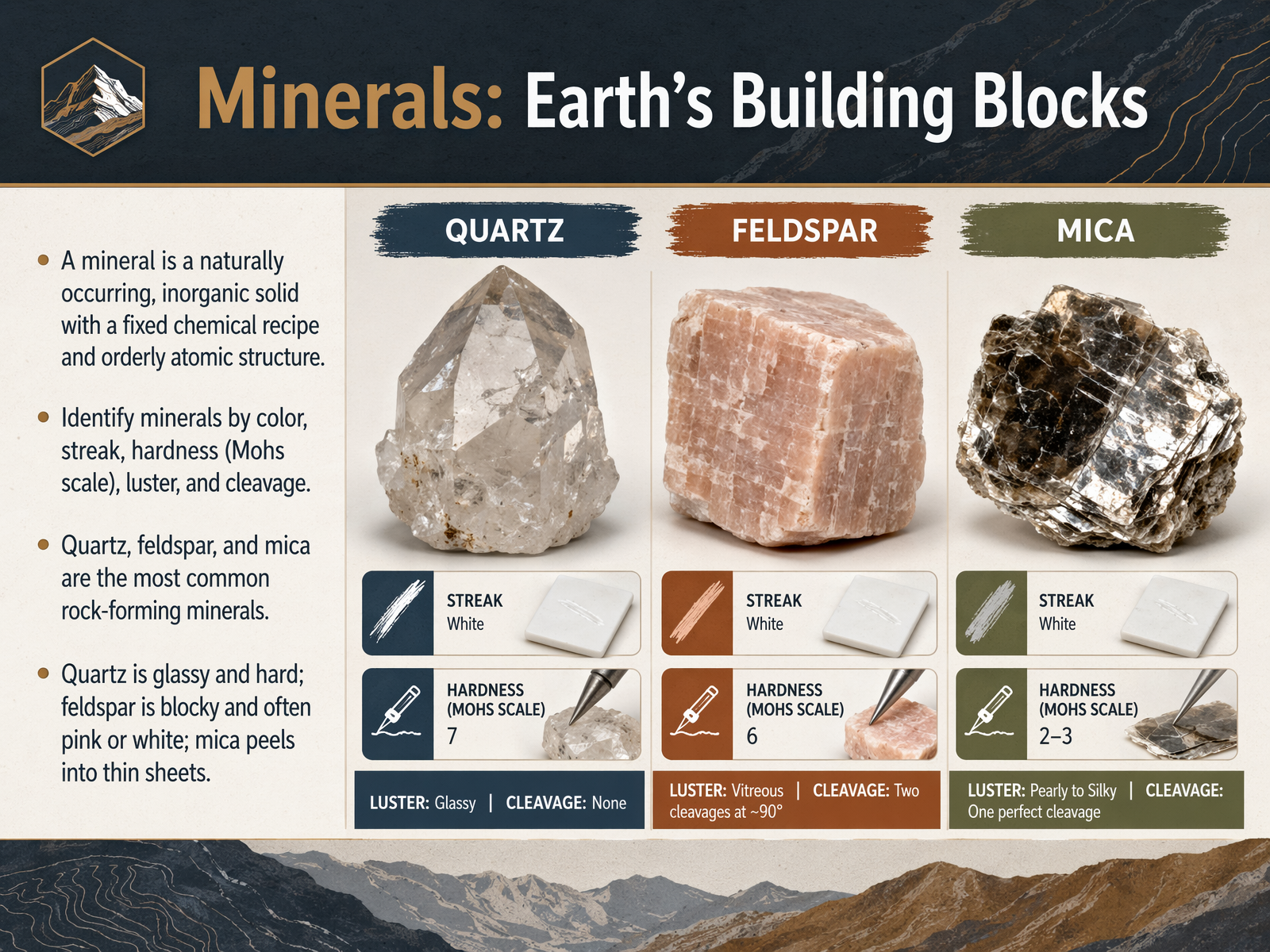
1 min - 03Minerals: Earth’s Building BlocksNow let's zoom in even closer and look at what rocks are actually made of -- minerals, the building blocks of our planet. Think of a mineral as a solid ingredient that nature makes, not a living thing, with a specific chemical recipe and an internal structure that is beautifully organized at the atomic level. This internal order is what lets a mineral grow into perfect crystal shapes. We can identify them in the field using a few simple clues: their color, the color of the powder streak they leave behind, their hardness on a scale of one to ten, how they reflect light, which we call luster, and how they break along flat planes. The most common minerals you'll encounter are quartz, feldspar, and mica. Quartz is often glassy and so hard it can scratch a steel knife blade. Feldspar, which can be pink or white, breaks into blocky shapes with flat surfaces. Mica is the one that peels apart into incredibly thin, flexible, transparent sheets. These three minerals are the primary ingredients in most of the rocks you see around you. Keeping their properties in mind, let's see how they combine to form the three great rock families in the rock cycle.
 2 min
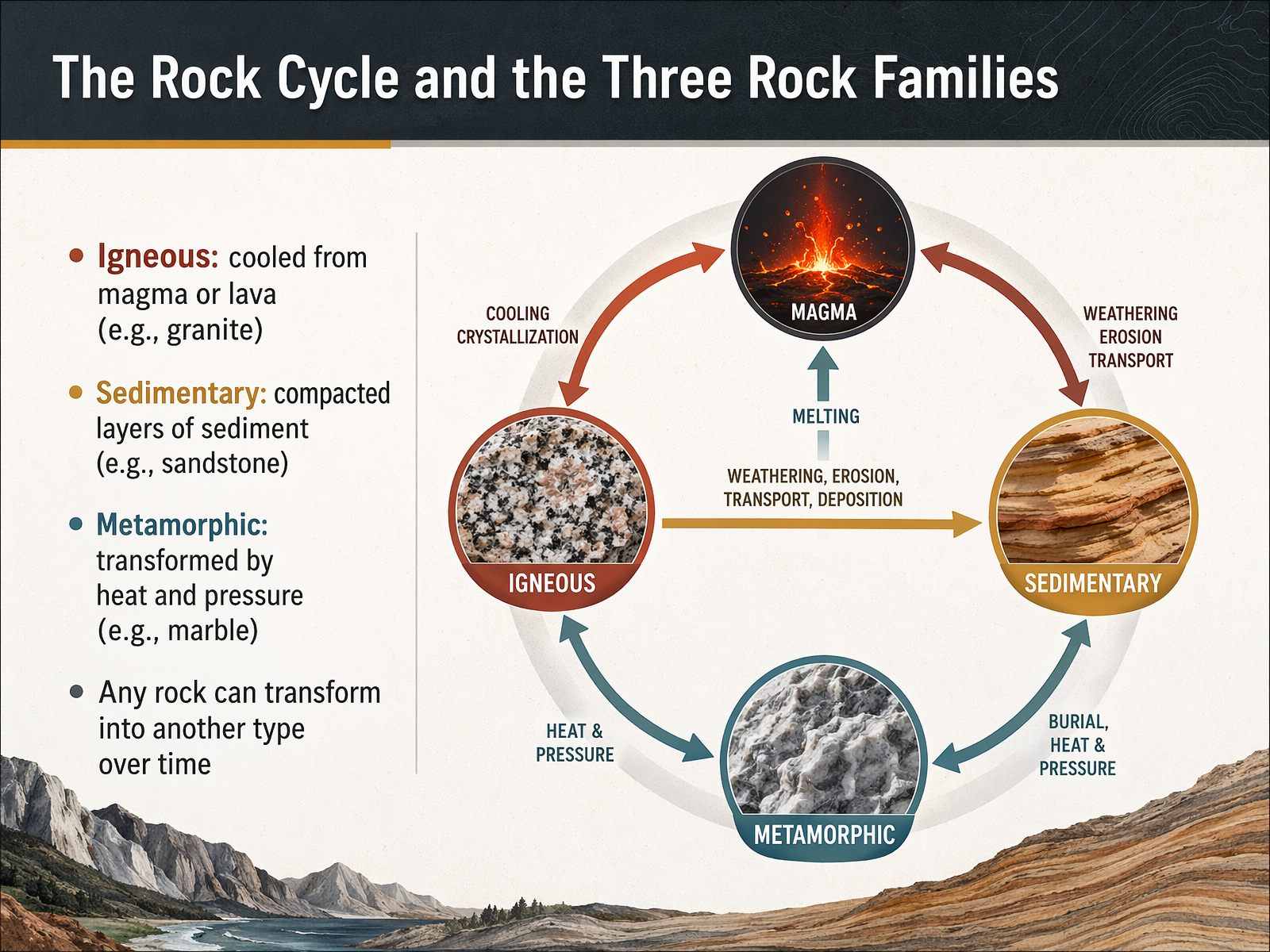
2 min - 04The Rock Cycle and the Three Rock FamiliesNow let's look at the heart of how rocks form and transform—the rock cycle. Geologists group all rocks into three big families, based on how they came to be. First, we have igneous rocks. These are born from fire, cooling and hardening from molten magma or lava. Granite is a classic example, speckled with crystals you can see. Next, sedimentary rocks are built from layers. Imagine sand, mud, or even tiny shells piling up over time and getting compacted into solid stone like sandstone, often with visible bands. Finally, metamorphic rocks are the great transformers. They start as one rock type but are cooked and squeezed deep underground by intense heat and pressure until they change into something new. Marble, for instance, began as limestone before it was transformed. The magic of this cycle is that no rock is permanent. Any rock can be melted, weathered, squeezed, or buried to become a completely different type over vast stretches of time. This constant recycling shapes the ground beneath our feet. Coming up next, we'll peel back the layers to see Earth's internal structure.
 2 min
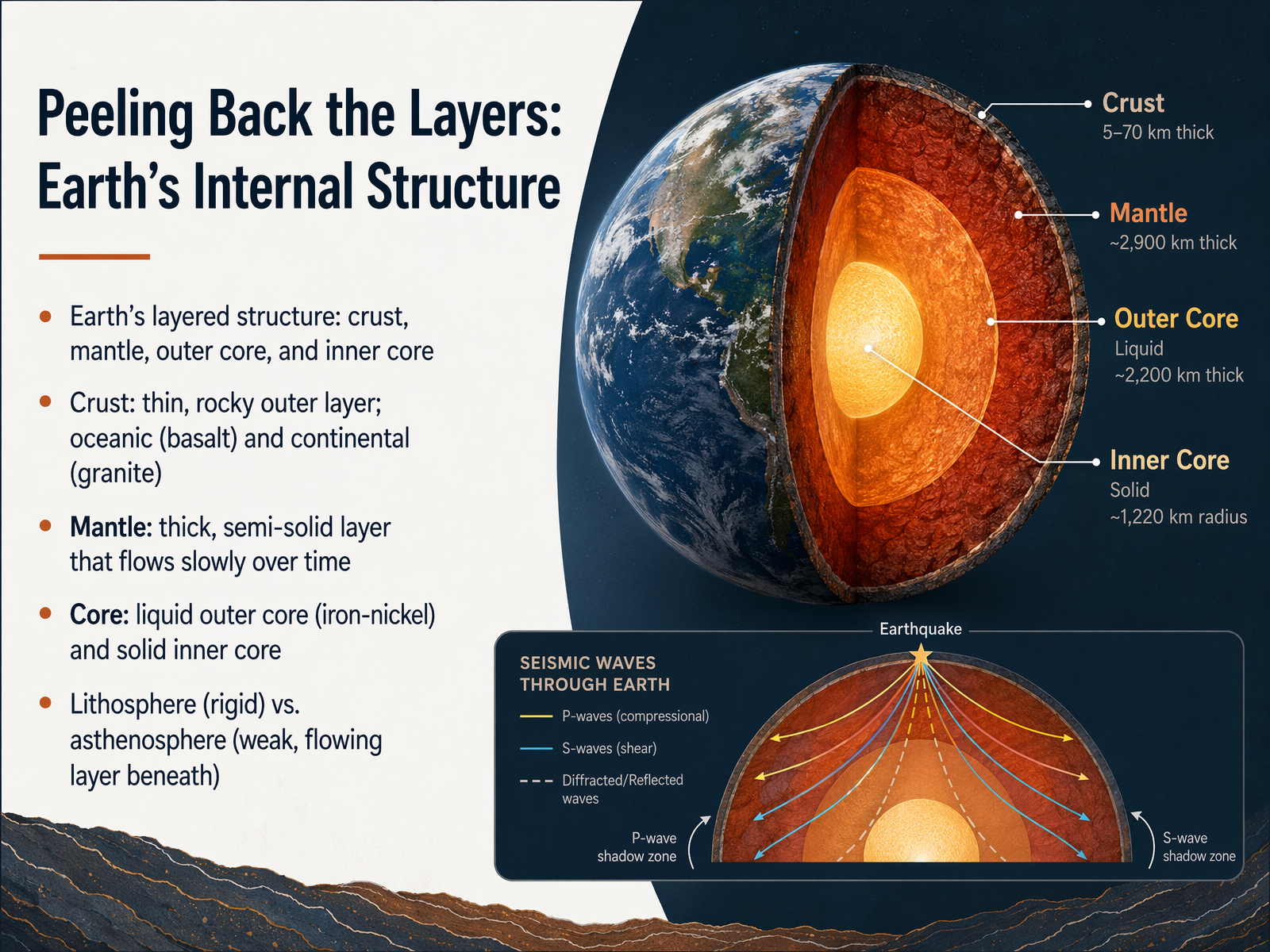
2 min - 05Peeling Back the Layers: Earth’s Internal StructureNow, let's peel back those layers and take a journey to the center of our planet. Imagine Earth as a giant peach. The very thin skin is our crust, the rocky outer layer we live on. There are actually two types of crust. Oceanic crust, found under the seas, is made of dense, dark rock called basalt. Continental crust, where we have our continents, is thicker and made of lighter rock, like granite. Beneath the crust is the mantle, which is like the fruit's flesh and makes up most of Earth's volume. It's a thick layer of semi-solid rock that's so hot and under so much pressure that it flows incredibly slowly over millions of years. Deeper still, at the very center, is the core, divided into two parts. The outer core is a churning ocean of liquid iron and nickel, and its movement generates Earth's magnetic field. At the very heart is the solid inner core, a ball of iron and nickel as hot as the surface of the sun, but held solid by immense pressure. Now, geologists also talk about the rigid lithosphere, which includes the crust and the cool, uppermost mantle, and the weaker, flowing asthenosphere it sits on. This setup is the key to the next part of our story, plate tectonics, the engine that drives our dynamic planet.
 usgs.govbbc.co.uknasa.gov+22 min
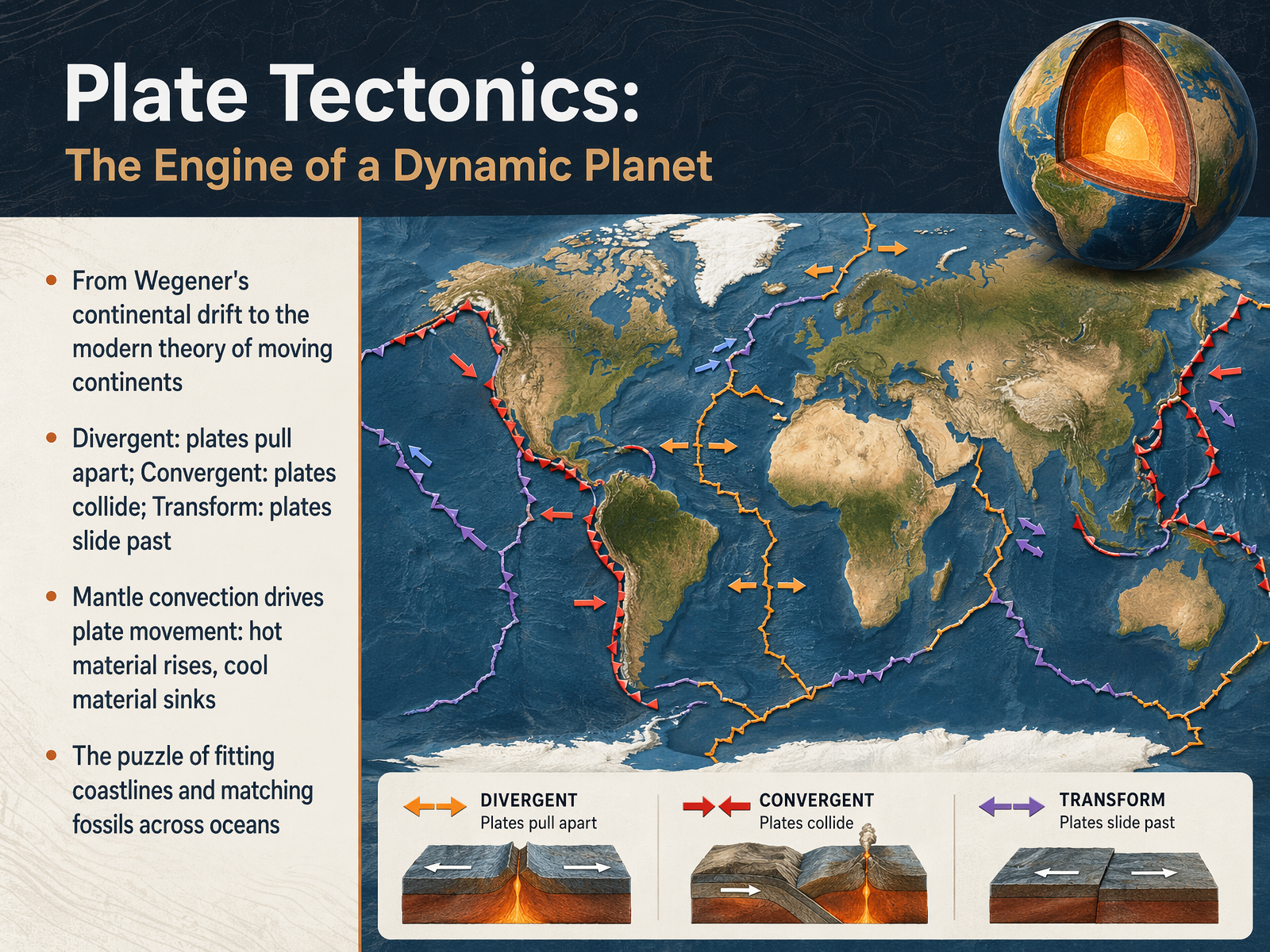
 - 06Plate Tectonics: The Engine of a Dynamic PlanetNow, let's step back and see the big picture, the engine behind all this movement. You may have looked at a world map and thought, do South America and Africa fit together like puzzle pieces? That simple observation sparked a huge idea. A meteorologist named Alfred Wegener first proposed continental drift, suggesting the continents were once joined. He pointed to matching coastlines and identical fossils found on opposite sides of the ocean. But how could continents plow through solid rock? That mystery was solved with the modern theory of plate tectonics. Earth's outer shell is broken into giant plates that are constantly moving. The real driver is deep below, in the mantle, where hot, buoyant rock slowly rises, spreads out, cools, and then sinks back down. This cycle, like a giant conveyor belt, drags the plates along. Where plates pull apart, we call it a divergent boundary. Where they crash together, it's a convergent boundary. And where they grind past each other, it's a transform boundary. These interactions are the reason our planet is so dynamic. Now, let's zoom in to where these colossal plates meet, and see how that creates earthquakes and volcanoes.
 2 min
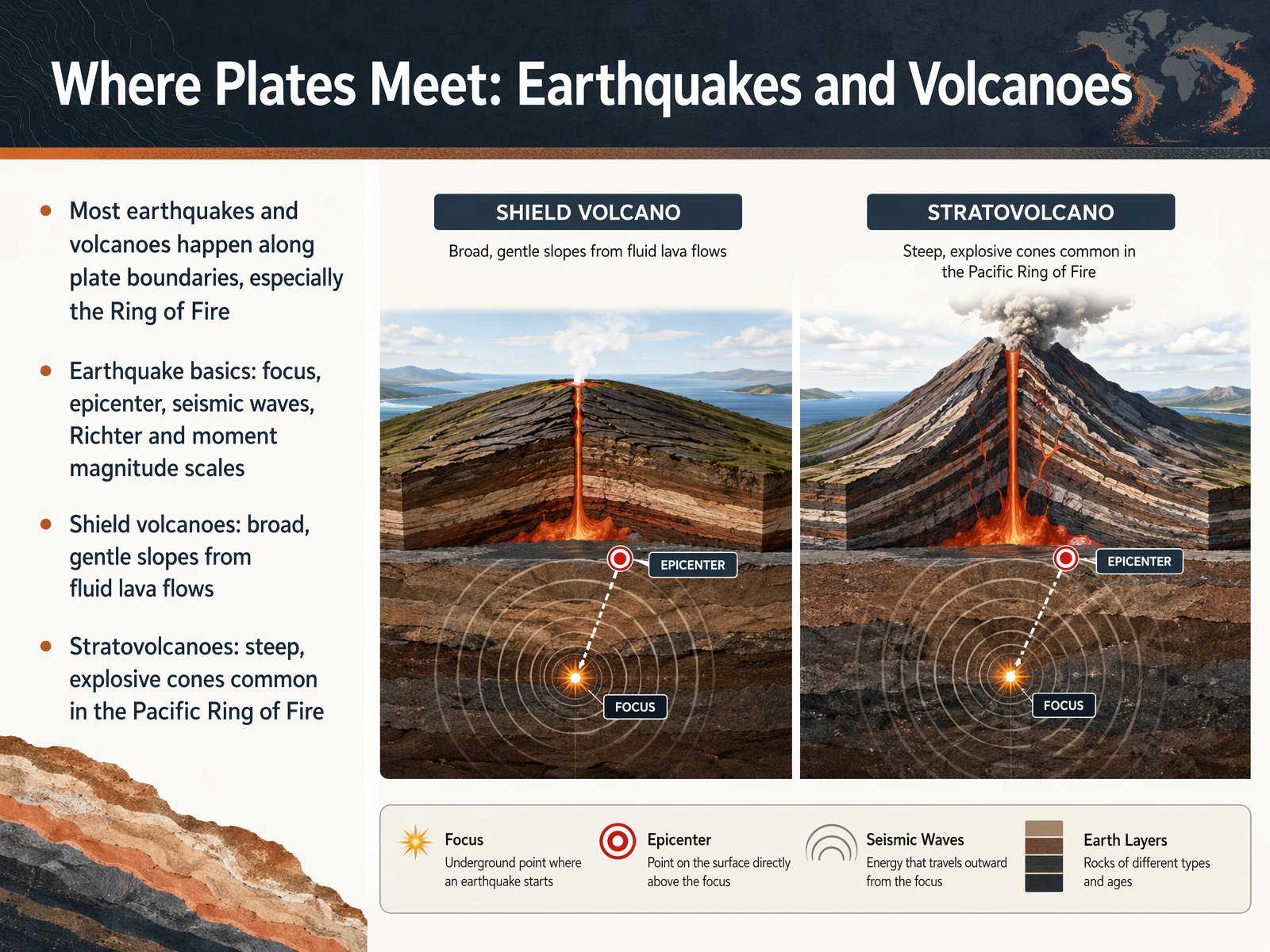
2 min - 07Where Plates Meet: Earthquakes and VolcanoesNow let's zoom in on what happens where plates meet. Most of the world's earthquakes and volcanoes don't happen randomly; they concentrate along plate boundaries, and nowhere is this more dramatic than the Ring of Fire. That's the horseshoe-shaped belt that wraps around the Pacific Ocean, where about 75 percent of Earth's active volcanoes and 90 percent of all earthquakes occur. When we talk about earthquakes, a few terms help us understand what's going on. The focus is the exact spot underground where the rock snaps. Directly above it, on the surface, is the epicenter. From that point, seismic waves ripple outward, like the rings you see when you drop a pebble into a pond. Scientists measure these quakes using the Richter scale and the more precise moment magnitude scale. Volcanoes at these boundaries come in two main styles. First, shield volcanoes, like those in Hawaii. They develop broad, gentle slopes because their lava is very fluid and flows easily over long distances. Second, stratovolcanoes. These are the steep, towering cones built from layers of ash and lava. They often erupt explosively and dominate the Pacific Ring of Fire. Next, we'll explore the Ring of Fire in more detail, the planet's most restless and active zone.
 usgs.govcommons.wikimedia.orgearthquakes.volcanodiscovery.com+22 min
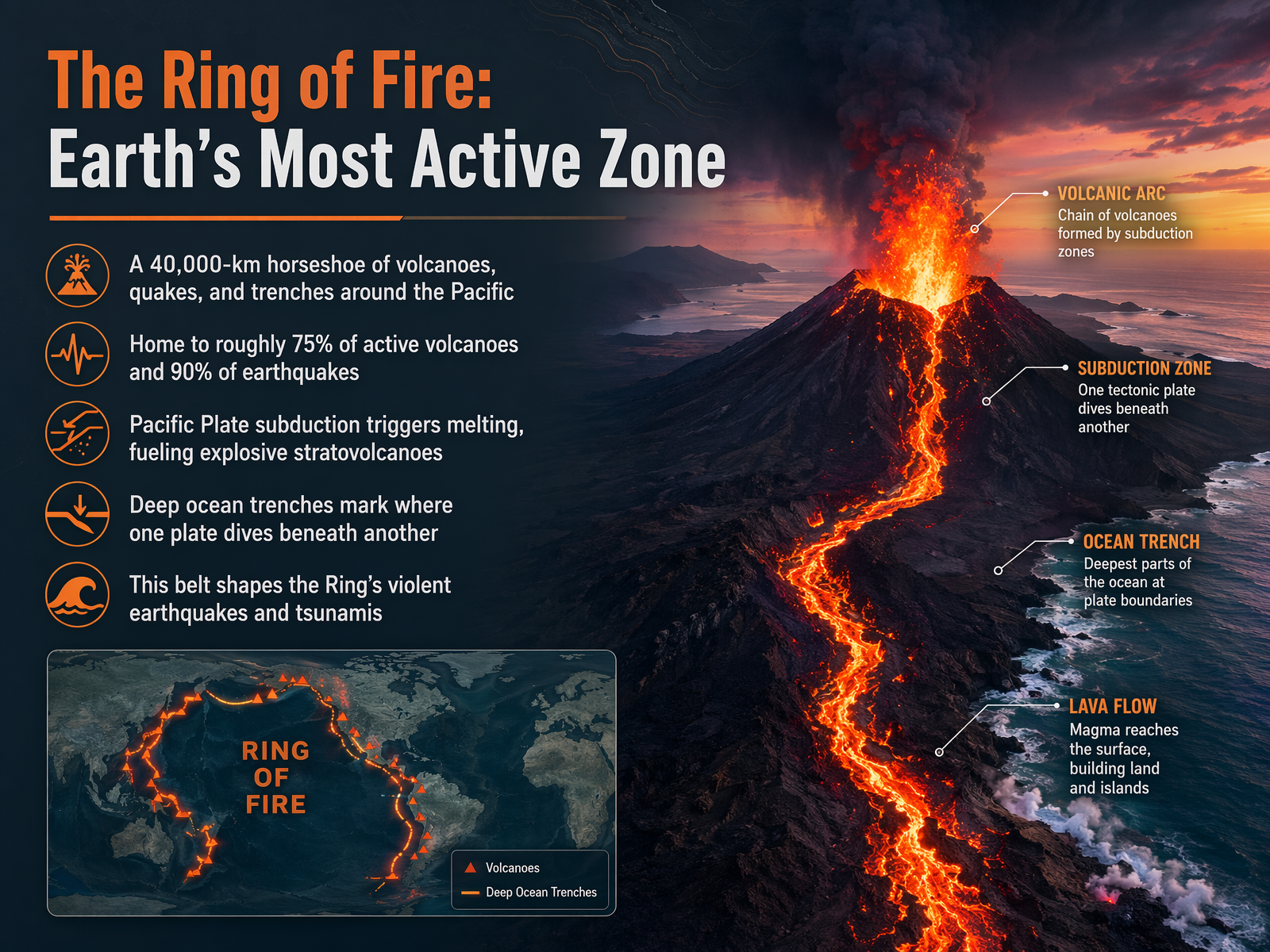
 - 08The Ring of Fire: Earth’s Most Active ZoneNow let's zoom into one of the most restless places on the planet, the Ring of Fire. Picture a giant horseshoe, about forty thousand kilometers long, wrapped around the edge of the Pacific Ocean. This belt is a true geological powerhouse. It's home to roughly seventy-five percent of all the world's active volcanoes, and a staggering ninety percent of all earthquakes happen right here. The engine behind this activity is the Pacific Plate. It is slowly sliding, or subducting, beneath the surrounding plates. As it dives deep into the Earth, water gets squeezed out, which lowers the melting point of the rock above. This creates pockets of magma that rise to fuel explosive, cone-shaped volcanoes we call stratovolcanoes, like Mount Fuji in Japan or Mount St. Helens. Where the plate takes its plunge, it carves the deepest scars on the Earth's surface, enormous ocean trenches. And it's this very process of one plate grating beneath another that also unleashes the violent earthquakes and tsunamis that shape the Ring's history. Now, let's shift our focus from these deep, powerful forces to the ones that wear down the landscape right before our eyes. Next up, we'll explore surface processes: weathering, erosion, and deposition.
 usgs.govcommons.wikimedia.orgearthquakes.volcanodiscovery.com+22 min
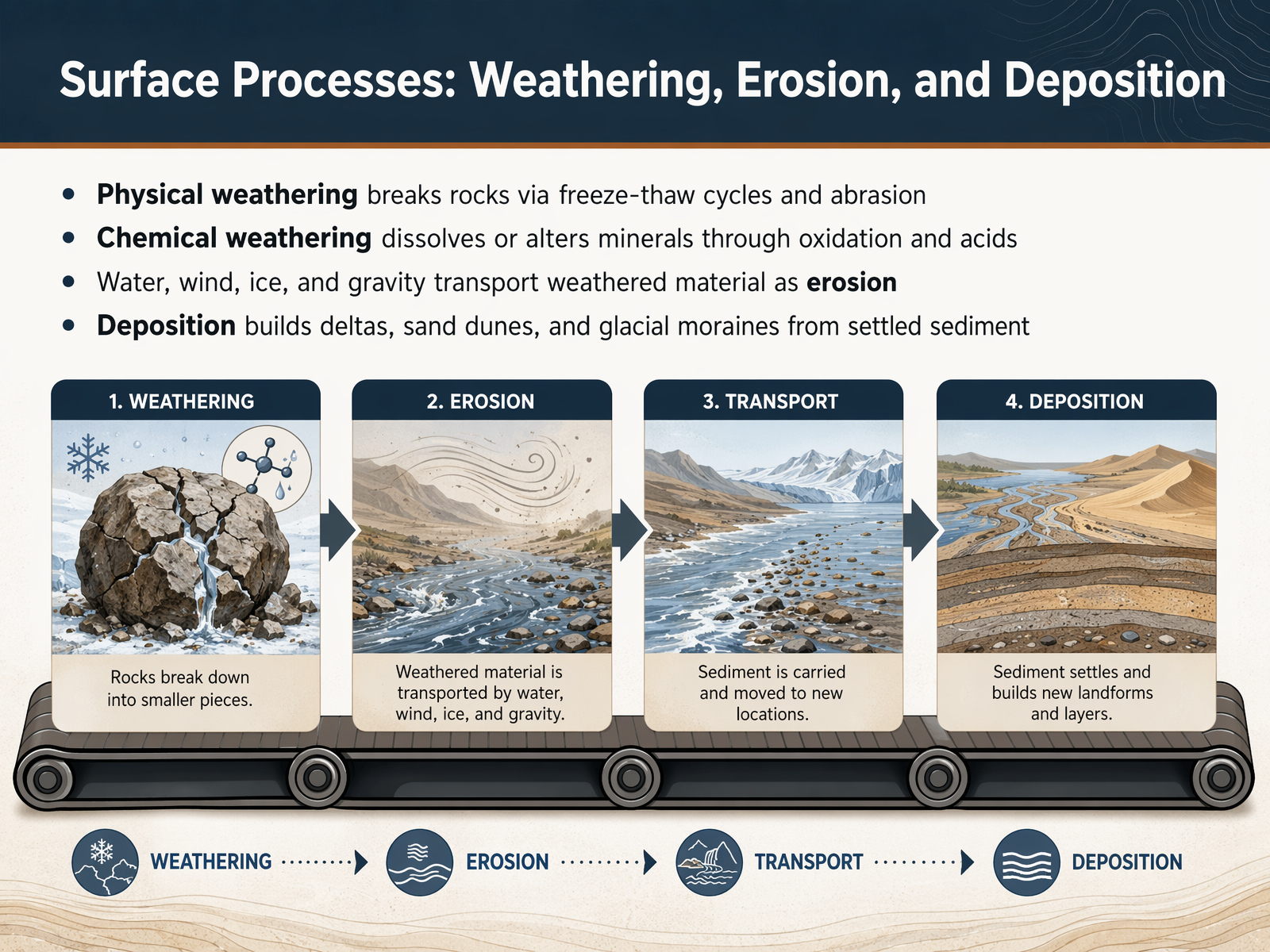
 - 09Surface Processes: Weathering, Erosion, and DepositionNow let's look at the surface processes that constantly reshape the world around us: weathering, erosion, and deposition. Think of these as Earth's demolition and construction crew. First, rocks are broken down through weathering. Physical weathering happens when water seeps into cracks, freezes, and expands, slowly prying the rock apart. Or wind-blown sand scours a cliff face like natural sandpaper. Chemical weathering works differently, dissolving minerals or changing them through reactions like rusting, which is oxidation, or through slightly acidic rainwater. Once those pieces are loosened, erosion takes over. Water, wind, ice, and gravity act like conveyor belts, picking up the weathered material and moving it away. Finally, that transported sediment gets dropped in a new location through deposition. This is how we get beautiful features like river deltas, vast sand dunes, and the rocky ridges called glacial moraines. So, rocks are broken down, moved, and then settled as sediment. Next, we'll follow that sediment on its journey from sediment to stone: how sedimentary rocks form.
 2 min
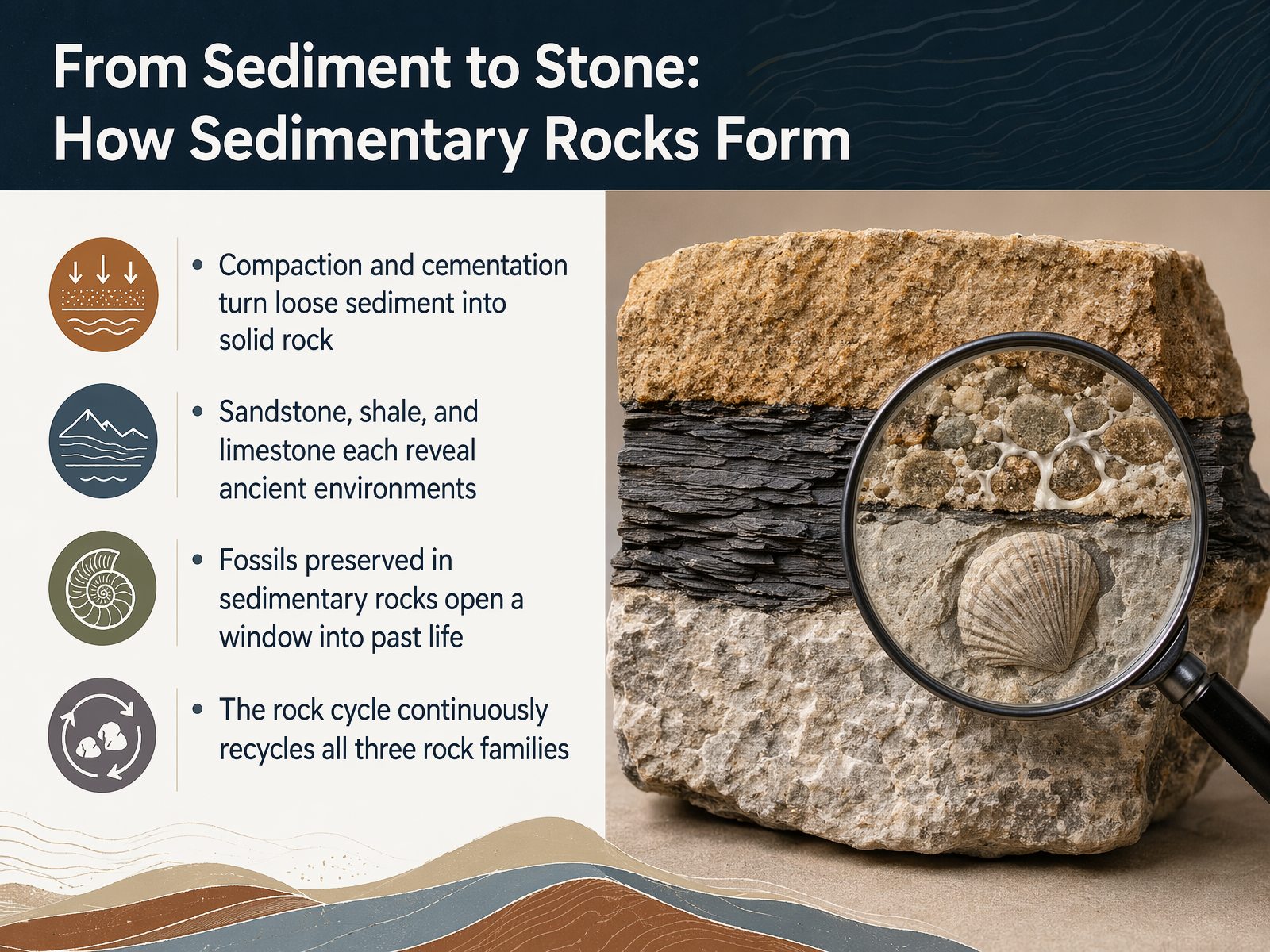
2 min - 10From Sediment to Stone: How Sedimentary Rocks FormNow let's turn our attention to how loose sediment becomes solid rock. Imagine picking up a handful of wet sand and squeezing it as hard as you can. Over millions of years, nature does something similar, just on a much grander scale. Layers of sediment pile up, and the immense weight compacts the grains together. Then, water rich in dissolved minerals seeps through the tiny spaces. These minerals crystallize, acting like a natural glue, or cement, that locks the grains in place. This two-step process of compaction and cementation is what creates sedimentary rocks like sandstone and shale. Limestone is a bit different, often forming from the accumulated shells and skeletons of ancient sea creatures. Because these rocks form in layers at the Earth's surface, they are fantastic at preserving clues about the past. A dinosaur bone or a delicate leaf impression can be trapped inside, frozen in time. This transforms the rock into a history book, opening a window into ancient rivers, deserts, and oceans. And remember, this is just one part of a much larger story. These rocks won't stay this way forever; the rock cycle will eventually transform them into something else entirely. Next, we'll use these rocky clues to decode Earth's history as we explore geologic time and fossils.
 2 min
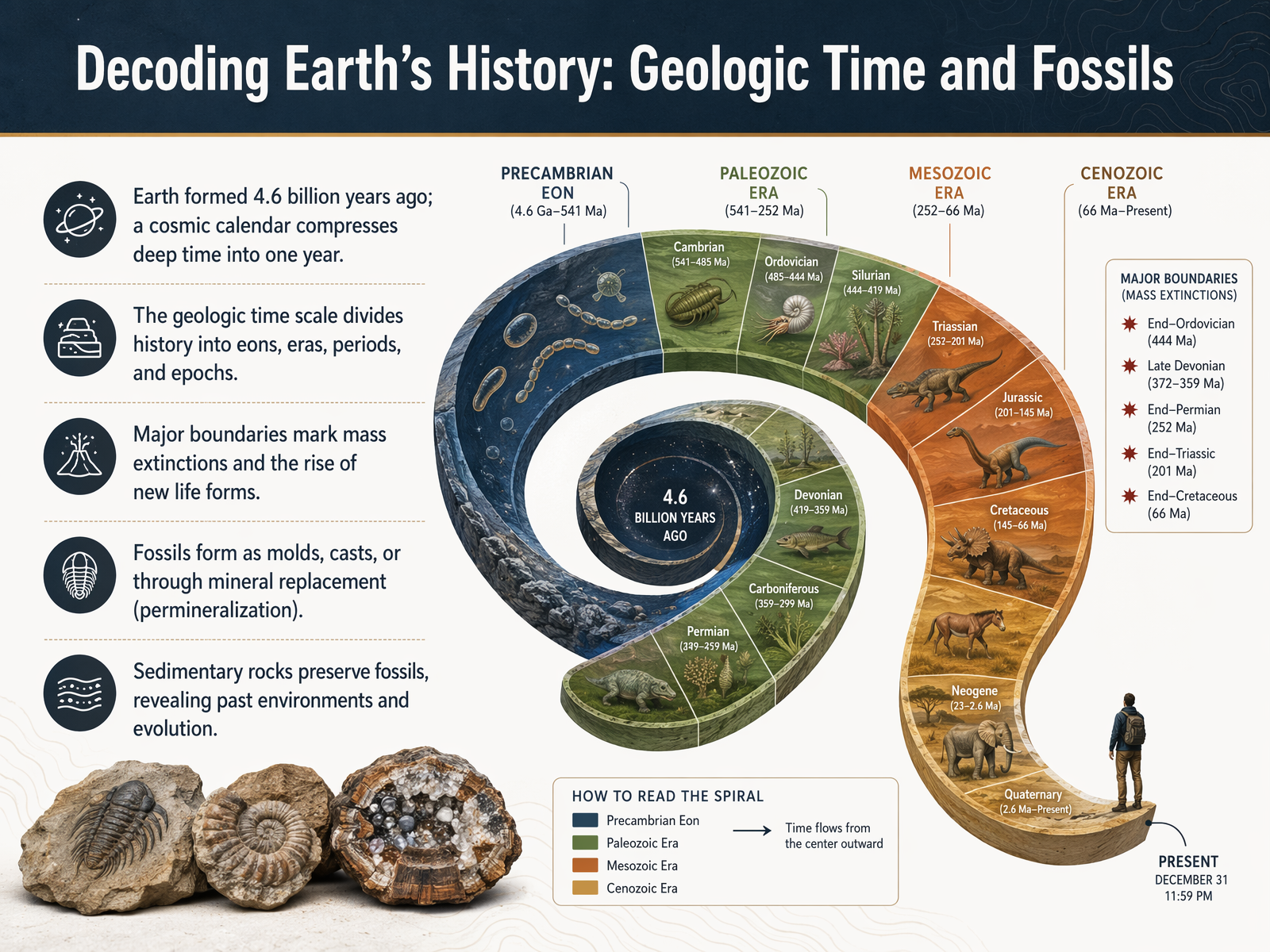
2 min - 11Decoding Earth’s History: Geologic Time and FossilsTo understand our planet, we need a way to read its history. Earth formed about 4.6 billion years ago. That’s such a vast stretch of time it’s hard to grasp. Imagine compressing all of Earth’s history into a single calendar year. On that cosmic calendar, simple life doesn’t appear until late March, and dinosaurs don’t show up until mid-December. Humans? We arrive just minutes before midnight on New Year’s Eve. To organize this deep time, geologists use the geologic time scale. It divides Earth’s history into major chapters, from the largest, eons, down to eras, periods, and epochs. The boundaries between these chapters are not random. They often mark dramatic events, like mass extinctions or the sudden rise of new life forms. So how do we actually read the pages of this ancient book? The answer is fossils. Fossils are the preserved remains or traces of past life. They can form in several ways. A shell can dissolve and leave a hollow mold, or that mold can fill with minerals to create a cast. In other cases, minerals slowly replace the original bone or wood, cell by cell, in a process called permineralization. Most fossils are found in sedimentary rocks, which act like a layered archive, preserving snapshots of past environments and the story of evolution. Next, we’ll walk through the major chapters in Earth’s story.
 pubs.usgs.govstratigraphy.orgrock.geosociety.org+22 min
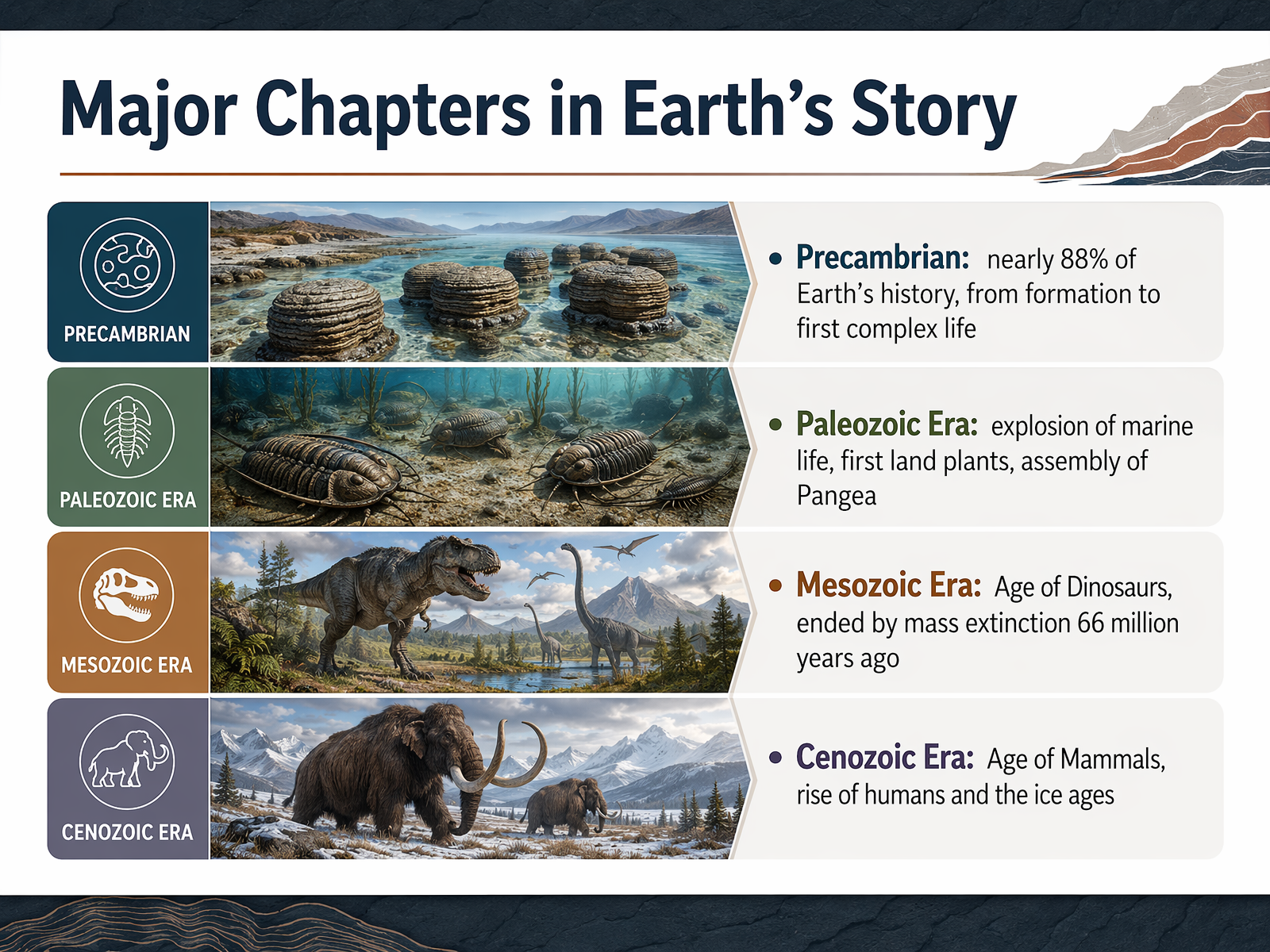
 - 12Major Chapters in Earth’s StoryNow let’s zoom out and look at the major chapters in Earth’s story. Think of our planet’s history as a giant book—and most of it is a very long opening chapter called the Precambrian. It covers nearly 88 percent of Earth’s timeline, from the planet’s formation all the way to the first complex life. Then we turn the page to the Paleozoic Era, an incredible explosion of marine life, the arrival of the first land plants, and the assembly of the supercontinent Pangea. After that comes the Mesozoic Era, the Age of Dinosaurs, which ends dramatically with a mass extinction 66 million years ago. Finally, we enter the Cenozoic Era, the Age of Mammals, where we see the rise of humans and the great ice ages. So, in just a few minutes, we’ve traveled from the deep, quiet beginnings all the way to the world we know today. Next, we’ll learn how geologists read the landscape.
 pubs.usgs.govstratigraphy.orgrock.geosociety.org+22 min
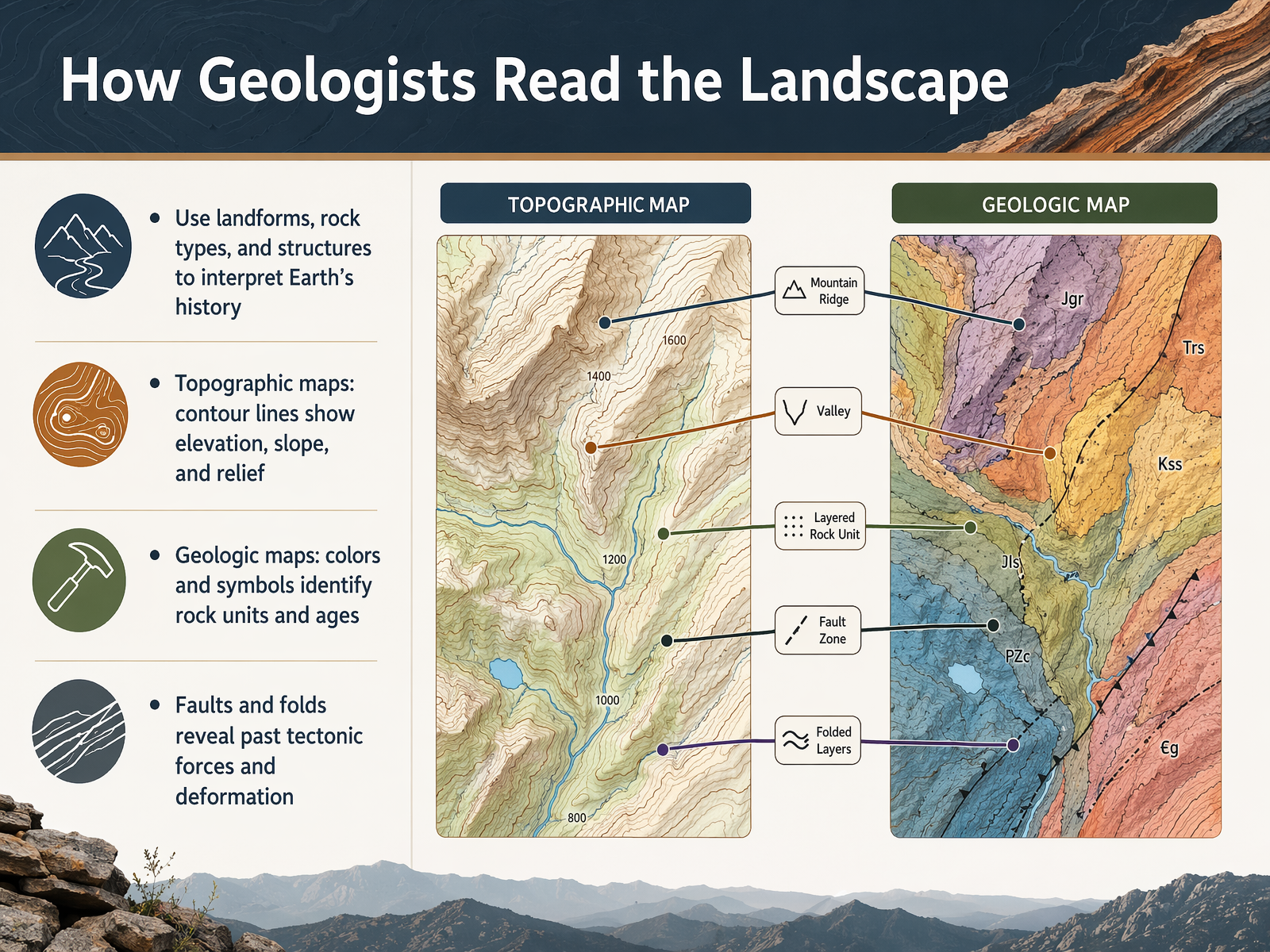
 - 13How Geologists Read the LandscapeNow, let's pull everything together and see how geologists actually read the landscape. Think of it like detective work, where the land itself holds the clues. Geologists use landforms, rock types, and structures to interpret Earth's history. A key tool is a topographic map. The curving contour lines on these maps show elevation, and the closer the lines are together, the steeper the slope. Another essential tool is the geologic map. Here, different colors and symbols identify rock units and their ages, giving us a peek at what lies beneath the surface. Finally, we look for faults and folds. A fault is a fracture where rocks have moved, and a fold is a bend in the rock layers. These features reveal the powerful tectonic forces that have stretched, squeezed, and deformed the crust over millions of years. Every ridge and valley tells a story. Next, we'll get hands-on by exploring a geologist's toolkit, from a simple hand lens all the way up to satellites.
 2 min
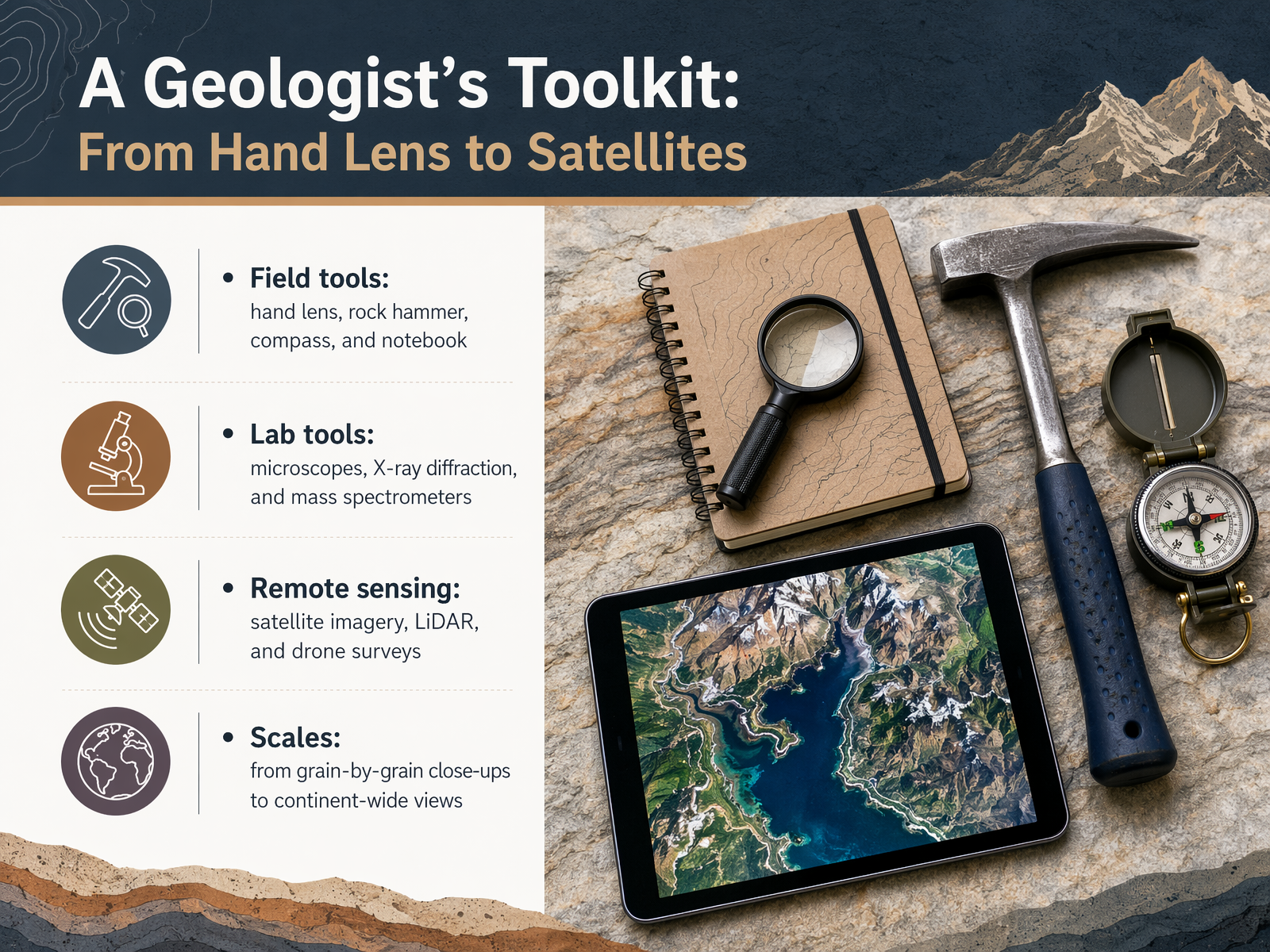
2 min - 14A Geologist’s Toolkit: From Hand Lens to SatellitesNow let's open the geologist's toolkit and see how we observe the Earth. It all starts in the field with simple, trusted tools. A geologist might carry a hand lens to magnify mineral grains, a rock hammer to break open a fresh surface, a compass to measure rock orientations, and a sturdy notebook to sketch and record exactly what they see. Back in the lab, the toolkit becomes much more powerful. Thin sections of rock go under a microscope, revealing the crystal structure. X-ray diffraction identifies minerals by their atomic fingerprint, and mass spectrometers measure tiny amounts of elements to date a rock or trace its origin. But the view gets even bigger. With remote sensing, we can step back to see the whole planet. Satellite imagery captures sweeping landscapes, LiDAR uses lasers to map the ground beneath the forest canopy, and drone surveys give us a bird's-eye view of an active volcano or a fault line. So a geologist's toolkit spans scales, from a single grain of sand to an entire continent. Next, we will see how these tools help us understand geology in the news, from climate challenges to finding critical resources and assessing hazards.
 2 min
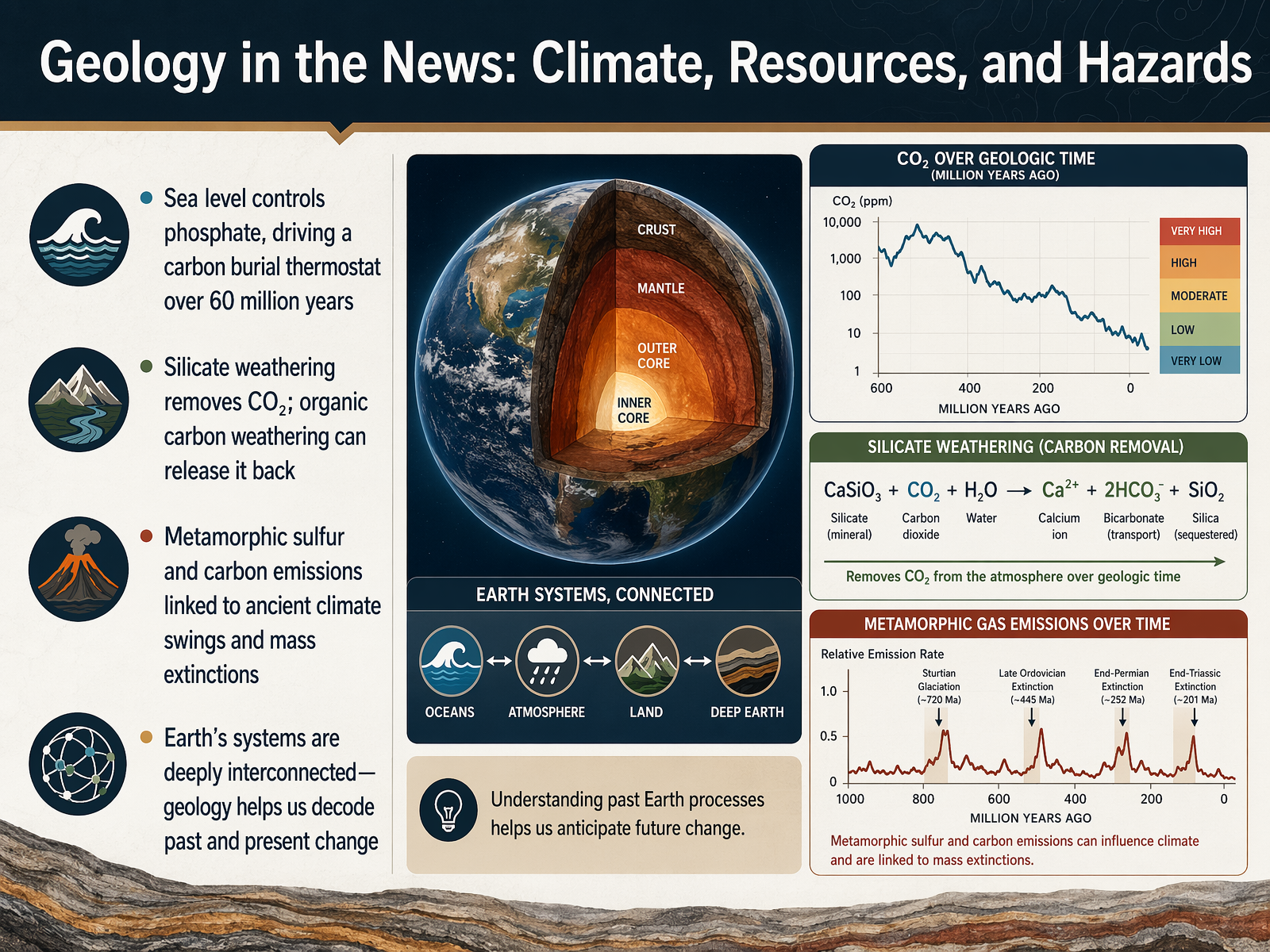
2 min - 15Geology in the News: Climate, Resources, and HazardsGeology helps explain long-term links among rocks, water, air, and life. Scientists study these connected systems to understand how landscapes and environments change over time.
 news.syr.eduarstechnica.comphys.org+22 min
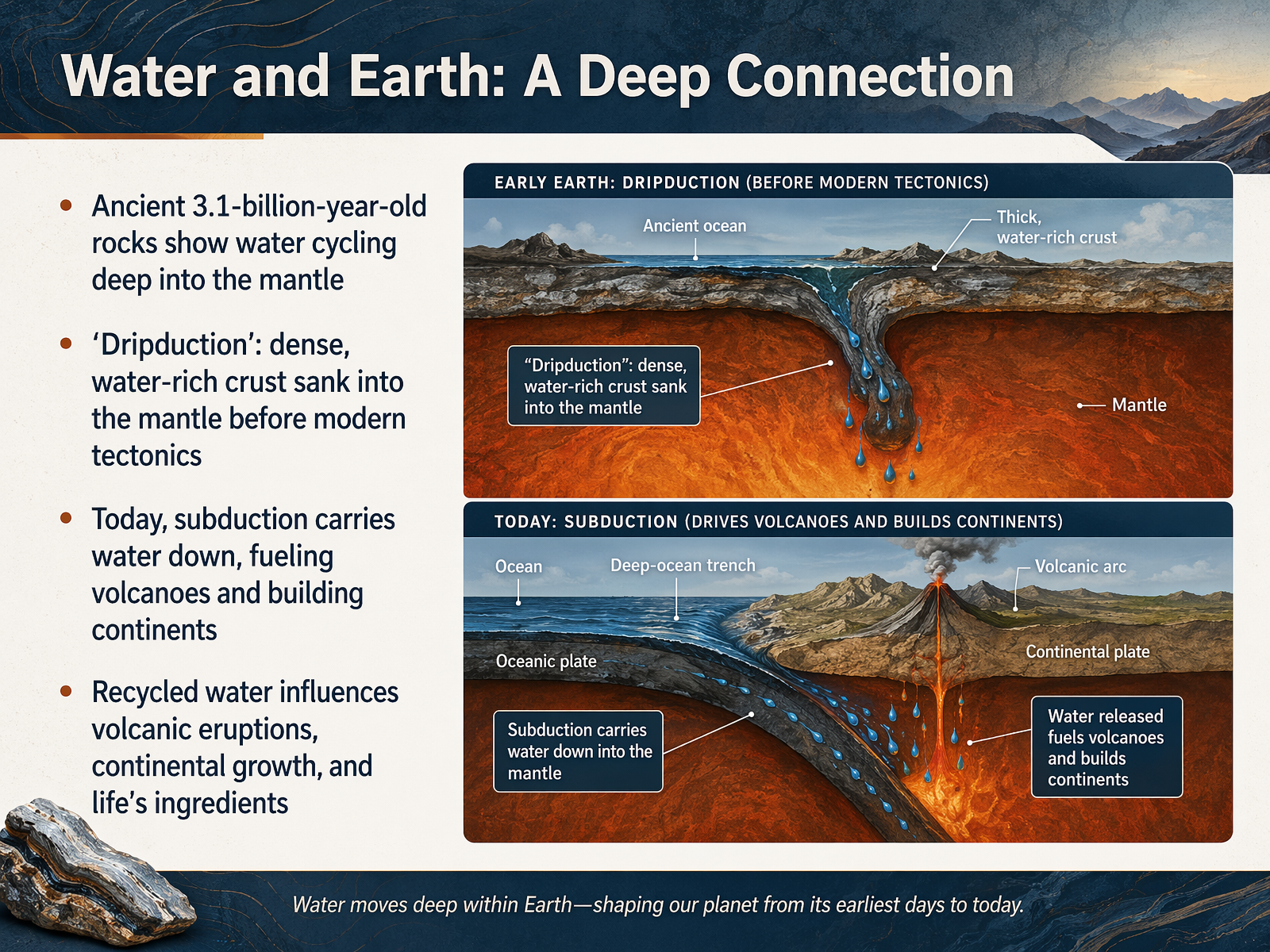
 - 16Water and Earth: A Deep ConnectionNow, let's turn to the deep connection between water and our planet. We often think of water as something on the surface, but geologists have found it plays a huge role deep inside the Earth. In fact, ancient rocks from Western Australia, dating back three point one billion years, show water was cycling into the mantle even then. Back before modern plate tectonics, a process called 'dripduction' was at work. Imagine dense, water-soaked sections of the crust sagging and slowly dripping down into the hotter mantle, carrying water with them. Today, this recycling continues through subduction. As tectonic plates dive into the mantle, they carry water down. This water lowers the melting point of rock, fueling the volcanoes that build our continents. It is a planet-wide cycle. Recycled water influences volcanic eruptions, helps grow continents, and even delivers ingredients essential for life. Next, we will explore a dramatic result of these forces in 'Building Mountains: The Roof of the World.'
 news.syr.eduarstechnica.comphys.org+22 min
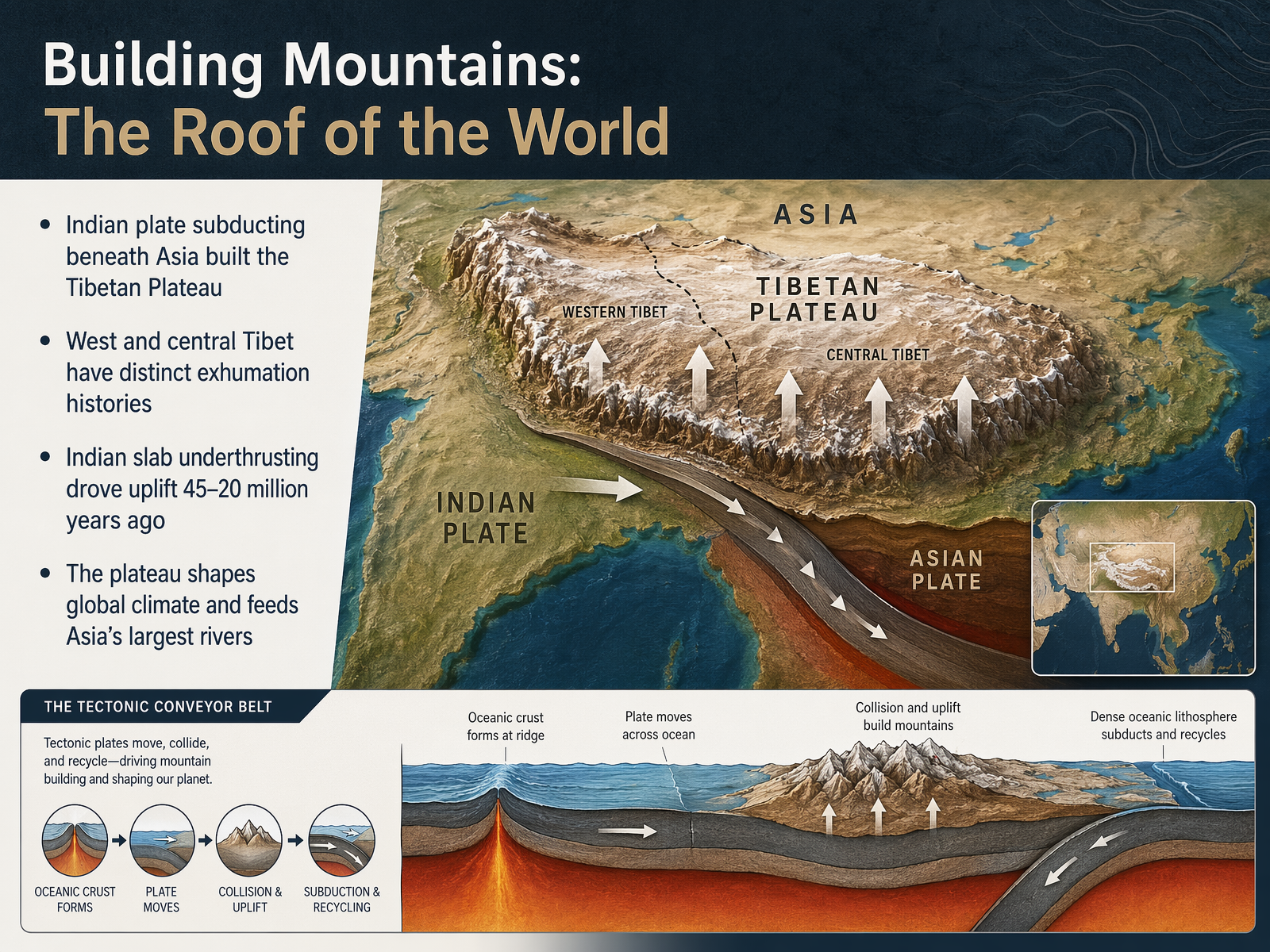
 - 17Building Mountains: The Roof of the WorldNow let's turn to one of the most dramatic examples of mountain building on Earth: the Tibetan Plateau, often called the Roof of the World. Imagine the entire country of India, a massive piece of continental crust, slowly slamming into Asia. The Indian plate didn't just collide; it slid beneath the Asian plate, a process called subduction. This ongoing push has thickened the crust to about twice the normal thickness, lifting the landscape to an average elevation over fourteen thousand eight hundred feet. New research using advanced dating techniques reveals that the western and central parts of Tibet rose at different times. Between forty-five and twenty million years ago, the Indian plate slid under the western side first, driving rapid uplift there before it reached beneath the central plateau. This massive highland isn't just a geological wonder. It acts as a heat engine for the atmosphere, helping to drive the Asian monsoon, and it feeds ten of Asia's largest rivers, providing water for billions of people. Next, we will explore how geology shapes the resources and energy we depend on.
 news.syr.eduarstechnica.comphys.org+22 min
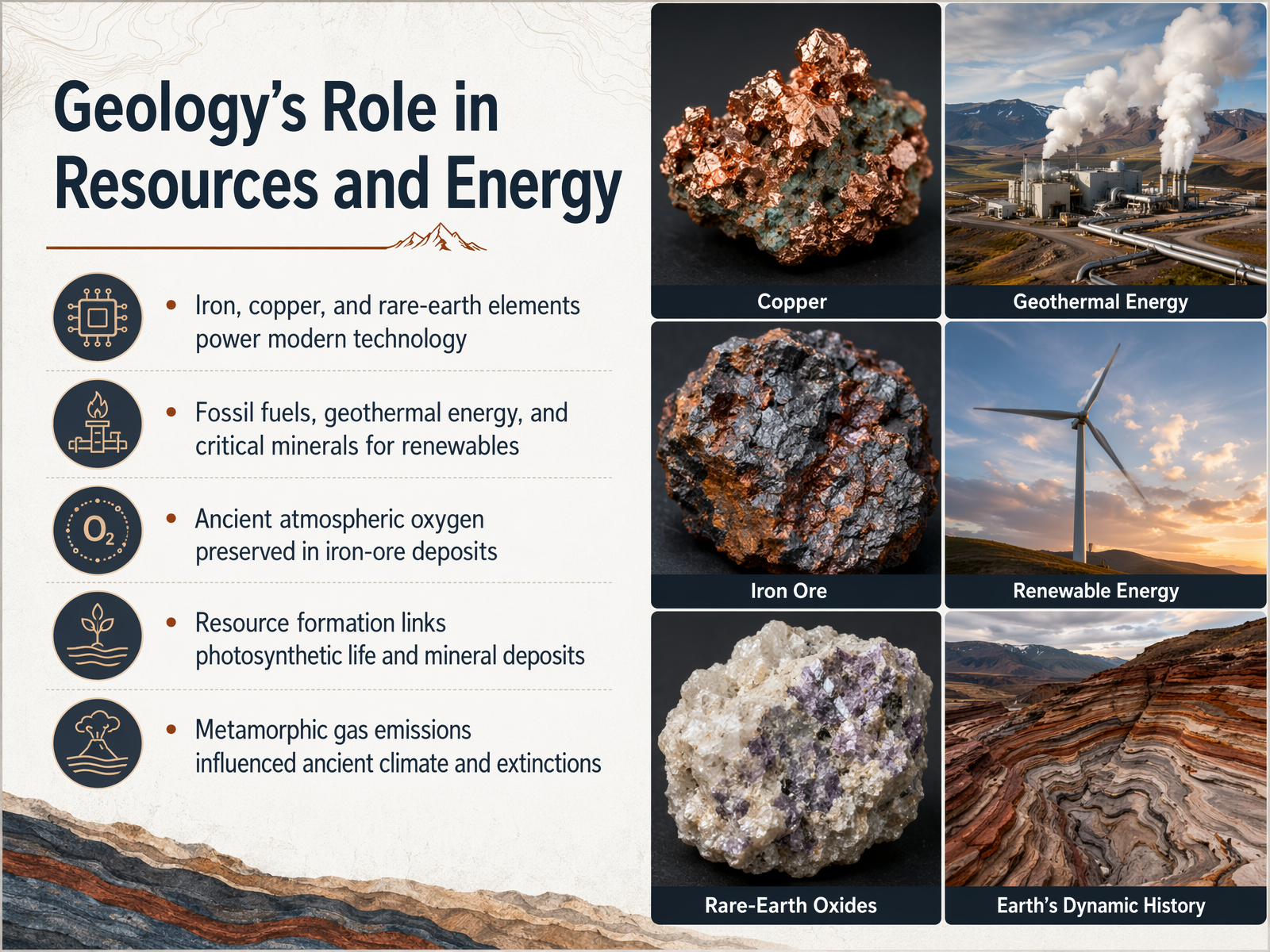
 - 18Geology’s Role in Resources and EnergyNow let's connect geology to the resources we use every day. Iron, copper, and rare-earth elements aren't just abstract minerals; they power our smartphones, vehicles, and renewable energy technologies. We also rely on fossil fuels and geothermal energy, all formed by deep Earth processes over millions of years. But here's something fascinating: recent research shows that ancient oxygen, produced by early photosynthetic life, is actually preserved in iron-ore deposits. This means the very air those microbes breathed is locked inside the metal we mine. On a larger scale, Earth's climate has been shaped by this interplay between life and rocks. When metamorphic rocks are heated deep underground, they can release sulfur and carbon gases, driving ancient climate swings and even contributing to mass extinctions. In short, the resources we depend on are intimately tied to the story of life and the planet's dynamic interior. Next, we'll step back and see how all these threads come together in 'Putting It All Together: Geology in Your World.'
 news.syr.eduarstechnica.comphys.org+22 min
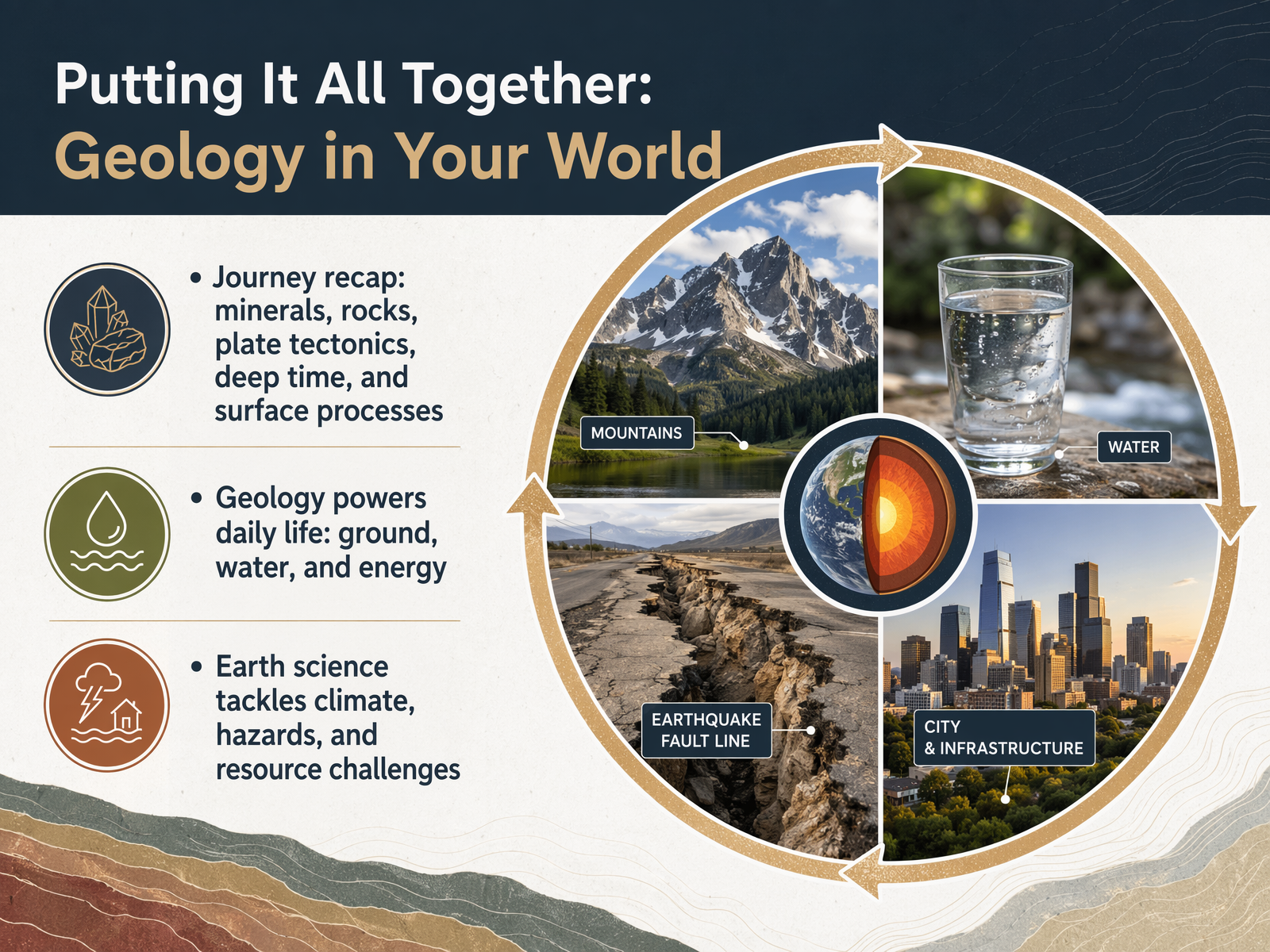
 - 19Putting It All Together: Geology in Your WorldWe have covered a lot of ground together. From the sparkling symmetry of a single mineral crystal to the slow, unstoppable drift of continents, you have seen how rocks, deep time, and surface processes all connect to tell the story of Earth. This story is not just about the distant past. Geology powers your daily life. The ground beneath your home, the water you drink, and the energy that fuels your world all come from the Earth. Right now, geologists are using this same knowledge to tackle some of our biggest challenges, like finding clean water, navigating climate change, and preparing for natural hazards. As we wrap up our journey, let’s look at how you can stay curious and keep exploring on your own.
 1 min
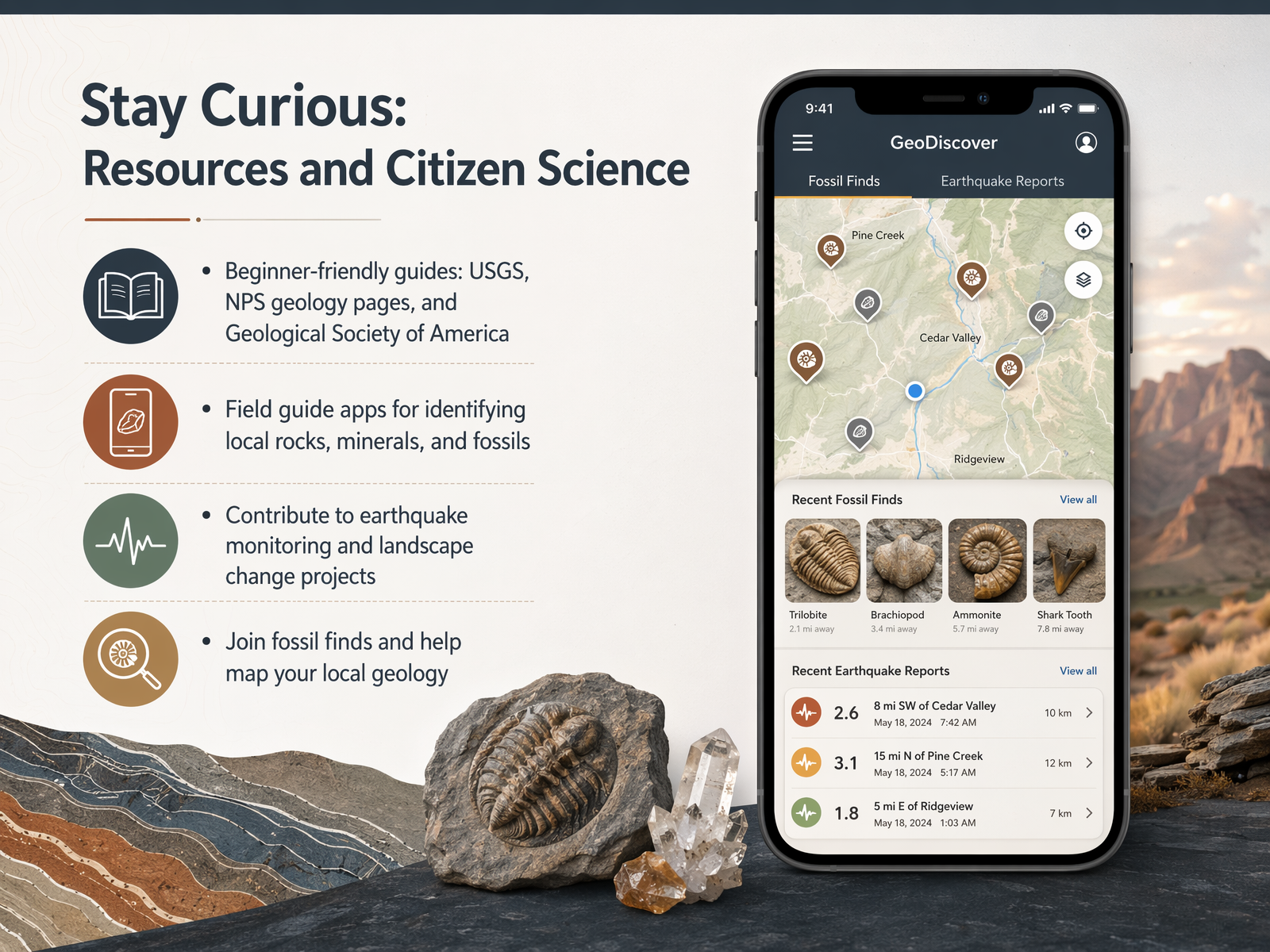
1 min - 20Stay Curious: Resources and Citizen ScienceWe've covered a lot of ground together, from the heart of a crystal to the drift of entire continents. But this is just the beginning of your own exploration. If you're eager to keep going, great resources are waiting for you. The U S Geological Survey, the National Park Service, and the Geological Society of America all offer wonderful, beginner-friendly guides. You can also turn your phone into a field kit. There are apps that help you identify local rocks, minerals, and even fossils right in your own backyard. And you can go a step further by becoming a citizen scientist. You can contribute to real earthquake monitoring networks, help track landscape changes in your area, or join a local fossil find to map the geology beneath your feet. The Earth is an open book, and now you know how to read its first few pages. Thank you for joining me on this field trip. Stay curious, keep looking closely at the ground you walk on, and never stop wondering about the incredible story it has to tell.
 2 min
2 min
Take the deck with you
Download this course as a file — free, no sign-up needed.
- PDF handoutEvery slide page, ready to print or share.21 pages · 8.4 MBDownload
- Narrated PowerPointThe deck that presents itself — every slide carries the digital human's narration video.21 pages · 22.2 MBDownload
- PowerPoint slidesThe full deck as a .pptx — open it in PowerPoint, Keynote, or Google Slides.21 pages · 8.3 MBDownload
Free to use in your own training — please keep the PersonWise credit page at the end.
Have your own deck? Turn it into a course
Sources consulted
Web sources consulted while building this course.
- Crust, Mantle, and Core of the Earth | U.S. Geological Survey — usgs.gov
- Structure of the Earth - The Earth and atmosphere - KS3 Chemistry - BBC Bitesize — bbc.co.uk
- Cut-away Diagram of Earth's Interior - NASA — nasa.gov
- Inside the Earth [This Dynamic Earth, USGS] — pubs.usgs.gov
- Earth's Internal Structure - Crust Mantle Core — geology.com
- The Ring of Fire | U.S. Geological Survey — usgs.gov
- File : Pacific Ring of Fire - Map - 2025 - Smithsonian Institution Global Volcanism Program.svg — commons.wikimedia.org
- Interactive Map of Active Volcanoes and recent Earthquakes world-wide — earthquakes.volcanodiscovery.com
- Plate Tectonics and the Ring of Fire — education.nationalgeographic.org
- What is the Pacific Ring of Fire? Here's what you need to know | Fox Weather — foxweather.com
- Chapter C of PP 1879 Volume 1: Stratigraphic Notes—Volume 1, 2022, "Divisions of geologic time—Major chronostratigraphic and geochronologic units" — pubs.usgs.gov
- ChronostratChart2023-06 — stratigraphy.org
- Geologic Time Scale v. 6.0 - The Geological Society of America — rock.geosociety.org
- Resource Hub | Geologic Timescale — geosociety.org
- Geological timechart - British Geological Survey — bgs.ac.uk
- Study Links Sea Level to Earth's Carbon Thermostat | Syracuse University Today — news.syr.edu
- Feedbacks upon feedbacks: Rock weathering and the climate - Ars Technica — arstechnica.com
- Ancient atmospheric oxygen found in iron ore deposits — phys.org
- Scientists find gas emissions from rocks may have contributed to ancient climate swings, mass extinctions — phys.org
- FSU scientists find gas emissions from rocks may have contributed to ancient climate swings, mass extinctions - Florida State University News — news.fsu.edu