Begin
14 pages · ~28 min
Americans' Perspectives on Data Privacy
This training explores how Americans perceive data privacy, helping professionals understand public attitudes and expectations to inform privacy practices and policies.
A digital instructor presents all 14 pages. Hold “Ask” at any point and ask out loud — the answer comes from this course. No sign-up needed.
What you’ll learn
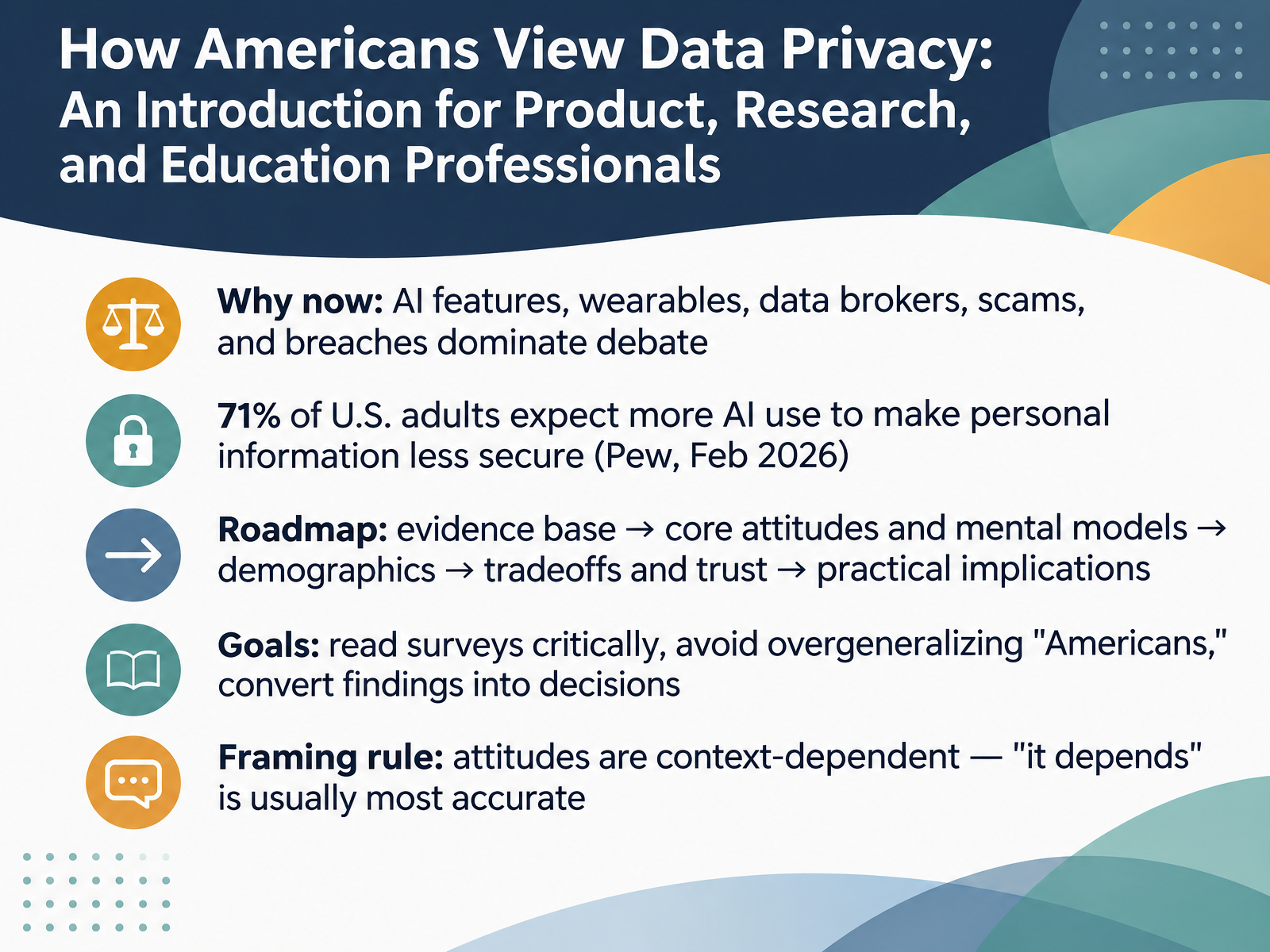
- 01How Americans View Data Privacy: An Introduction for Product, Research, and Education ProfessionalsWelcome. Today we're looking at how Americans view data privacy, and why it matters for the products we build and the research we run. This isn't a story about panic. It's a story about evidence. The topic is timely for a reason. AI features, wearables, data brokers, which are companies that buy and resell personal information, along with scams and breaches, all keep privacy in the national conversation. Here's one number to hold onto. Seventy one percent of U.S. adults expect more AI use to make their personal information less secure. That comes from Pew Research Center data collected in February twenty twenty six. So what does that mean for us? Expect skepticism when you introduce AI features, especially before you have explained the data flow. In the next few sections, we'll move through the evidence base, core attitudes and mental models, demographics, tradeoffs and trust, and practical implications. Our goals are simple. Read surveys critically, avoid overgeneralizing Americans, and turn findings into decisions. One framing rule to carry throughout. Attitudes are context dependent, so it depends is usually the most accurate answer. Next, let's look at the evidence base and how we know what Americans think.pewresearch.orgpewresearch.orgpewresearch.org+22 min
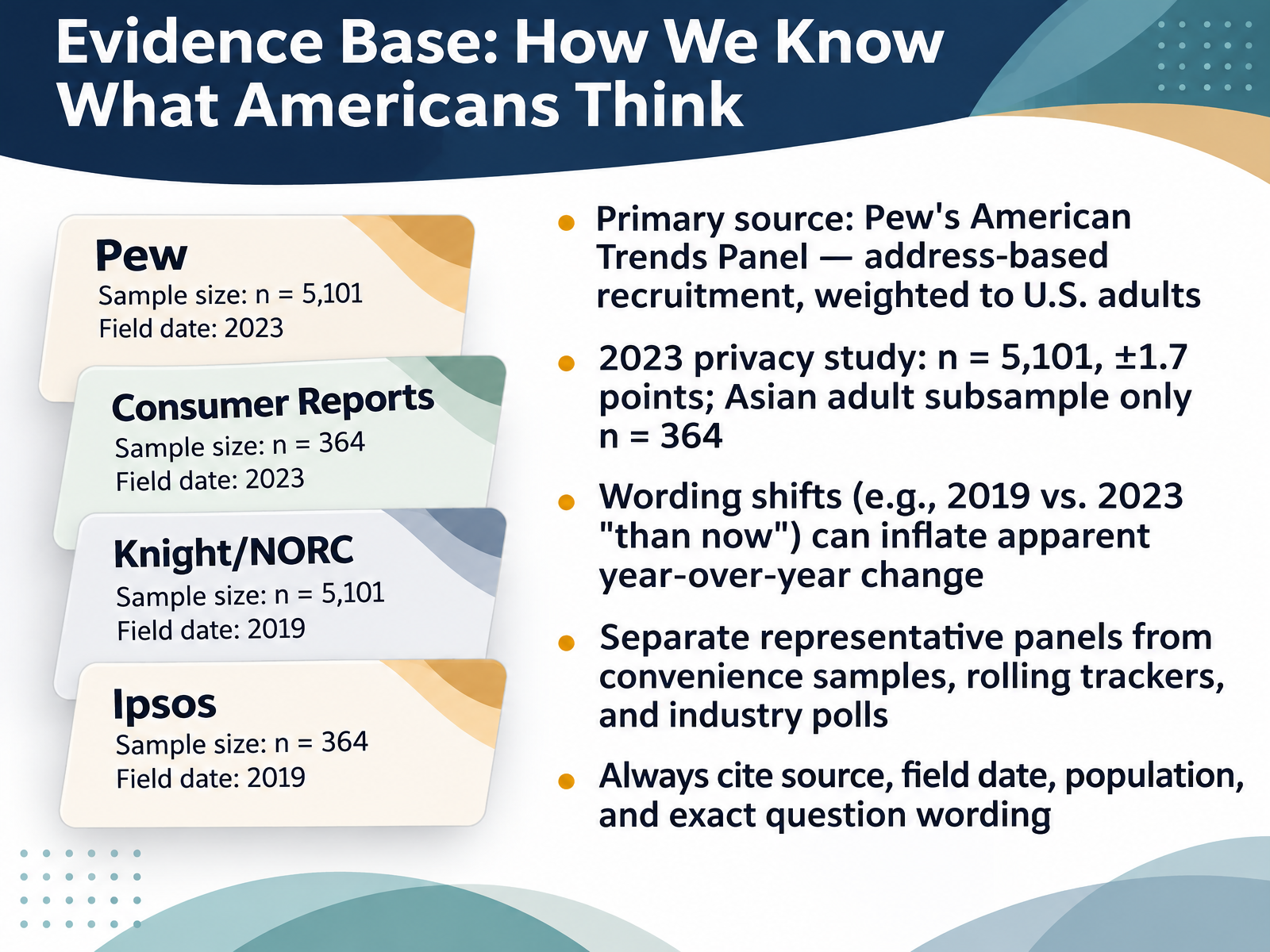
- 02Evidence Base: How We Know What Americans ThinkSo before we interpret any percentage, let's establish where this evidence comes from. The main source here is Pew's American Trends Panel, a nationally representative panel recruited through random sampling of residential addresses, then weighted to match United States adults. Here is the practical takeaway. That address-based recruitment means nearly every adult has a chance of selection, not just people who happen to be online. The twenty twenty three privacy study surveyed five thousand one hundred one adults, with a margin of error of plus or minus one point seven points for the full sample. A beat on that. Subgroup estimates are far less precise. The Asian adult subsample was only three hundred sixty four people, so treat those breakdowns as directional. Also watch wording shifts, like comparing twenty nineteen and twenty twenty three phrases such as than now. Small wording changes can inflate apparent year-over-year change. So separate representative panels from convenience samples, rolling trackers, and industry polls. And always cite source, field date, population, and exact question wording. Your decision: build that four-part citation into your research brief template today. Next, we turn to core attitudes, where concern is high and confidence is low.
 pewresearch.orgpewresearch.orgpewresearch.org+22 min
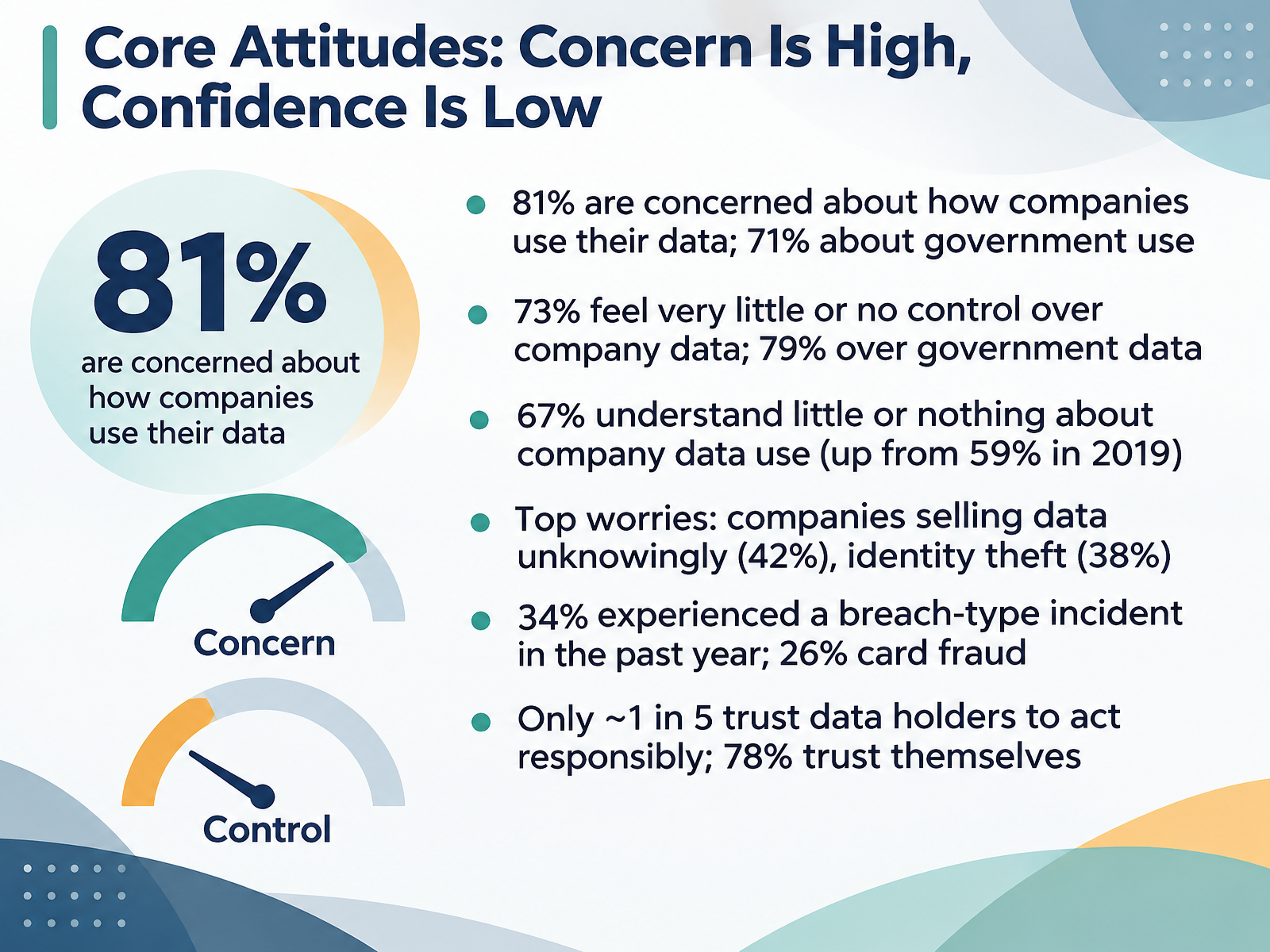
- 03Core Attitudes: Concern Is High, Confidence Is LowLet's look at what these attitudes add up to. The pattern here is high concern paired with low confidence. Concern about how companies use personal data sits at eighty one percent, and concern about government use at seventy one percent. Here is the practical takeaway. People are not asking whether privacy matters. They already believe it does. They are asking whether anyone is handling it well. Seventy three percent feel very little or no control over company data, and seventy nine percent say the same about government data. Sixty seven percent understand little or nothing about what companies do with their data, up from fifty nine percent in twenty nineteen. The top worries are concrete, like a loyalty program selling your purchase history without your knowledge, at forty two percent, and identity theft at thirty eight percent. Those fears are grounded. Thirty four percent experienced a breach-type incident in the past year, and twenty six percent dealt with card fraud. Trust is thin. Only about one in five trust data holders to act responsibly, while seventy eight percent trust themselves. So when you write a consent screen or an opt-out, which is a request to stop data collection, design for a skeptical but capable user. Next, we turn to the Privacy Paradox Reconsidered.
 pewresearch.orgpewresearch.orgpewresearch.org+22 min
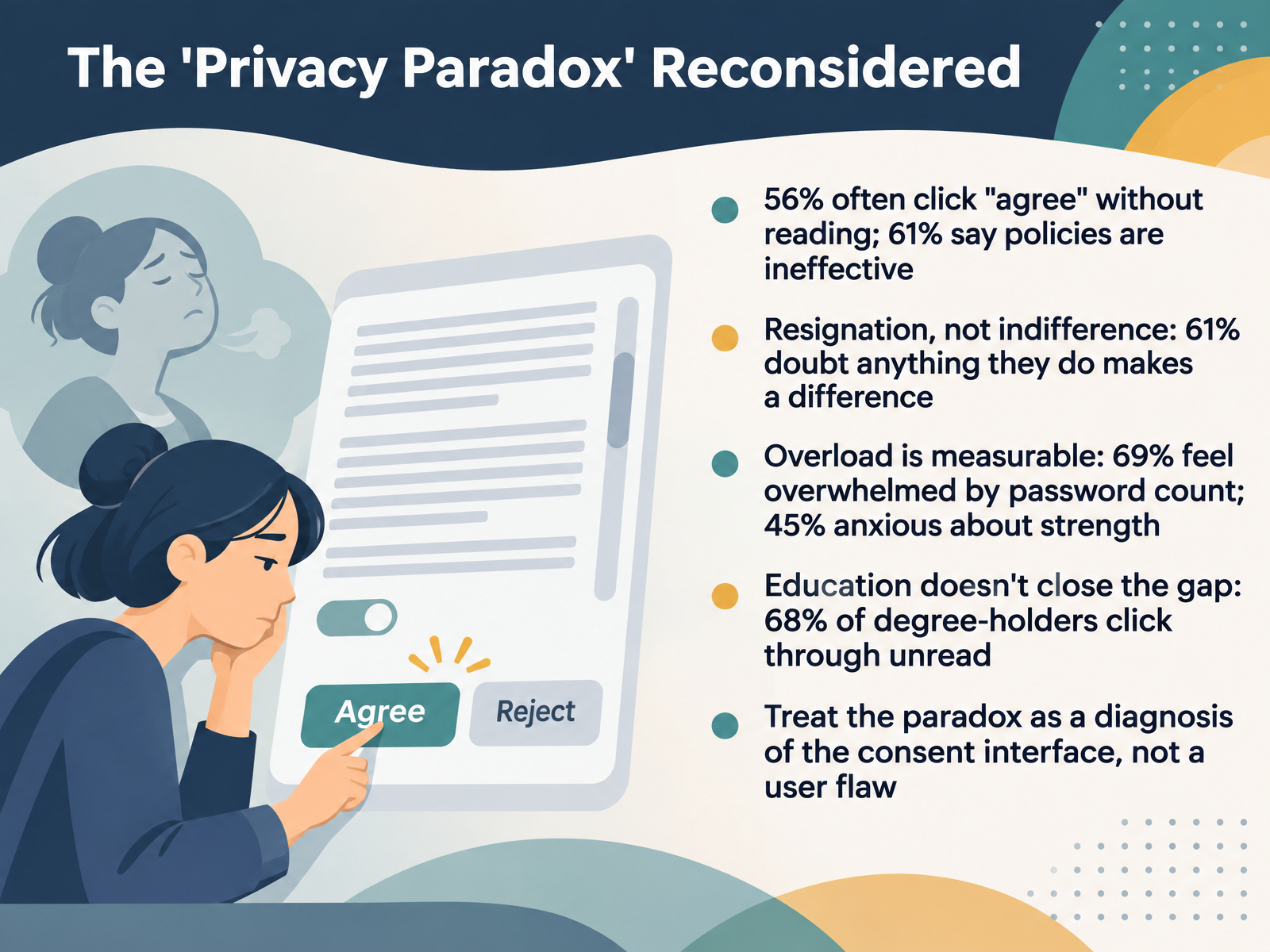
- 04The 'Privacy Paradox' ReconsideredLet us turn to the privacy paradox, reconsidered. The meaning first: what looks like carelessness is often resignation, not indifference. Just over half of Americans, fifty six percent, say they often click agree without reading a policy. A beat here. And sixty one percent say those policies are ineffective at explaining what companies do with data. Here is the practical takeaway: people have stopped expecting the document to tell them anything useful. Overload is measurable too. Sixty nine percent feel overwhelmed by the number of passwords they manage, and forty five percent worry about password strength. Education does not close the gap, since sixty eight percent of degree holders also click through unread. So treat the paradox as a diagnosis of the consent interface, not a user flaw. One decision for your next design review: ask whether a person could make an informed choice in the seconds the screen actually allows. That leads us to mental models, how people picture data flows.
 pewresearch.orgpewresearch.orgpewresearch.org+22 min
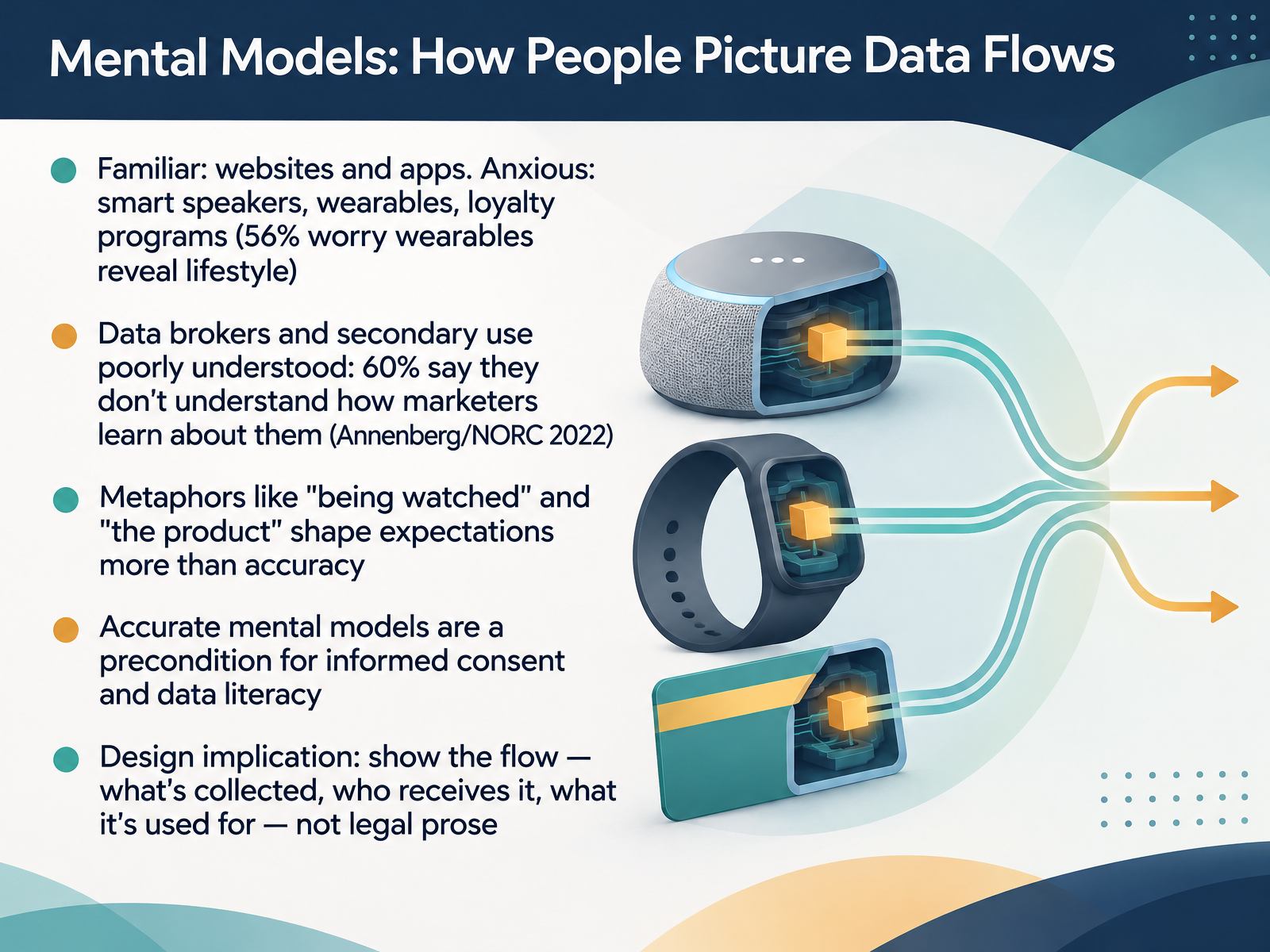
- 05Mental Models: How People Picture Data FlowsNext, let's look at mental models, meaning the pictures people form in their heads about how data actually moves. The finding here is that people picture data flows unevenly. Websites and apps feel familiar. Smart speakers, wearables, and loyalty programs feel more anxious. In fact, fifty six percent worry that wearables could reveal lifestyle details. Here's the practical takeaway. People reason from vivid devices, not from the plumbing behind them. Data brokers, third parties who buy and resell personal information, and secondary use, where data collected for one purpose is reused for another, are poorly understood. Sixty percent say they don't understand how marketers learn about them, according to Annenberg and NORC in twenty twenty two. So metaphors like being watched or being the product shape expectations more than accuracy does. Here's the design decision for you. Rather than legal prose, show the flow on one screen: what's collected, who receives it, and what it's used for. And as we move on, we need to ask who exactly we mean when we say the American public, so let's turn to Who Is The American Public? Demographic Differences.
 pewresearch.orgpewresearch.orgpewresearch.org+22 min
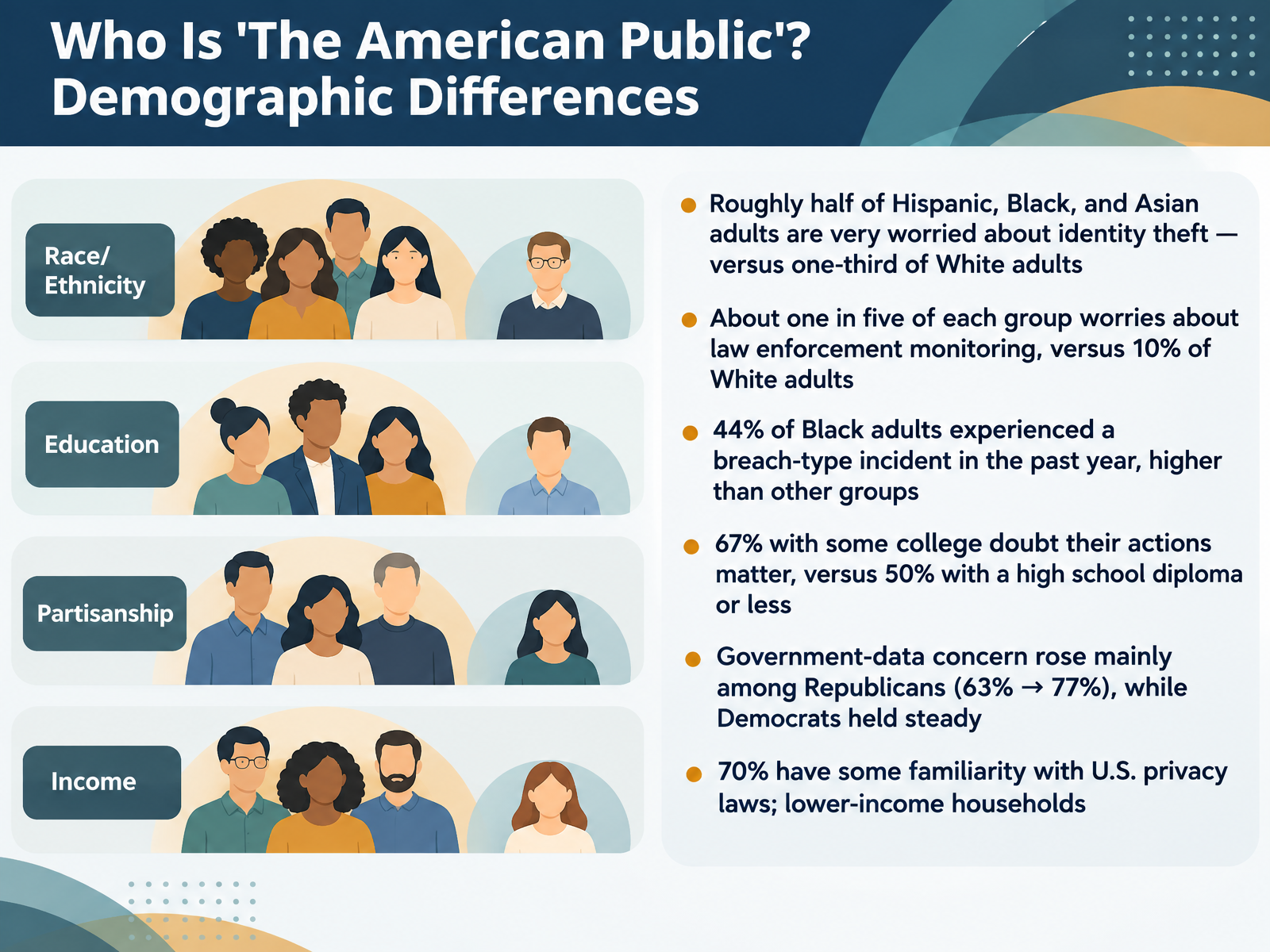
- 06Who Is 'The American Public'? Demographic DifferencesNext, let's ask who we actually mean by the American public. The short answer is that privacy concern is not evenly distributed, and that matters for how you design and communicate. Roughly half of Hispanic, Black, and Asian adults are very worried about identity theft, compared with about one third of White adults. Here is the practical takeaway. A single reassuring message will land differently across your user base, so segment your research before you segment your product. Experience explains part of the gap. Forty four percent of Black adults experienced a breach type incident in the past year, higher than other groups, so concern here is earned, not abstract. Education shapes efficacy. Sixty seven percent of people with some college doubt their actions matter, versus half of those with a high school diploma or less. In practice, a user who has been hacked before may read your privacy setting as a lifeline, while another reads it as paperwork. One decision to make is to test your privacy messaging by lived experience, not just demographics, before you ship it. Generational and Life-Stage Patterns comes next.
 pewresearch.orgpewresearch.orgpewresearch.org+22 min
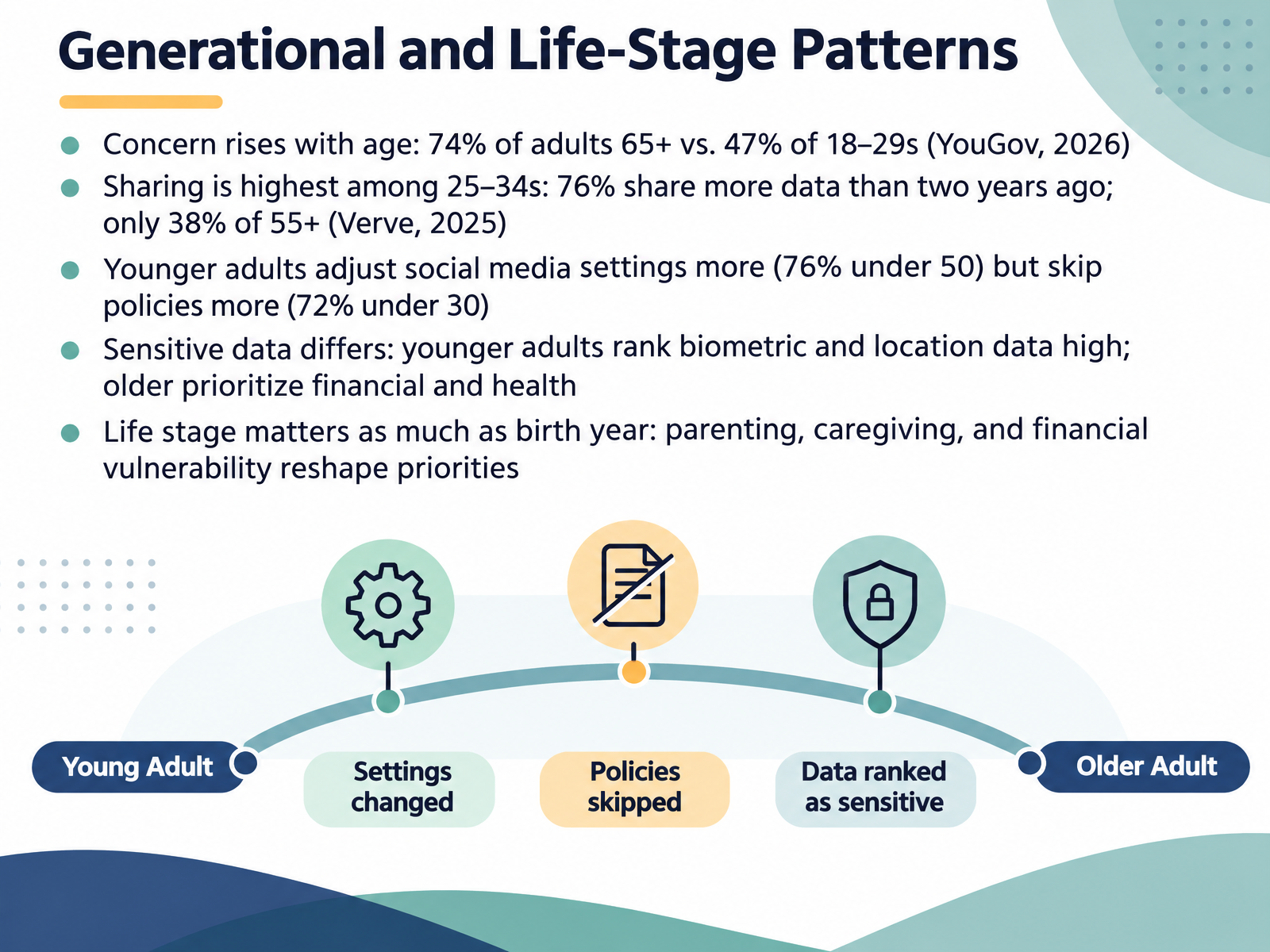
- 07Generational and Life-Stage PatternsNext, let's look at how privacy attitudes shift across generations and life stages. The finding here is that age tells you something about concern, but not always about behavior. Concern rises with age. Seventy four percent of adults sixty five and older say they are concerned, versus forty seven percent of those eighteen to twenty nine. Think of a retired parent watching a fraud alert on a bank app. Here is the practical takeaway. Older users are not less engaged. They carry more worry, often because they have more to lose. Sharing, by contrast, peaks in the middle. Seventy six percent of adults twenty five to thirty four say they share more data than two years ago, compared with thirty eight percent of those fifty five and older. Younger adults also tune social settings more, seventy six percent under fifty, but skip privacy policies more, seventy two percent under thirty. What counts as sensitive differs too. Younger adults rank biometric and location data high, while older adults prioritize financial and health data. The design problem is that a single consent screen cannot serve a caregiver monitoring a parent's accounts, a young renter sharing location for a delivery app, or a vulnerable adult guarding health records. Life stage matters as much as birth year. So the decision for you is to segment by life stage, not only age, and test one opt out flow per group. That leads us to tradeoffs and trust, and what people will share, and with whom.
 verve.comresources.verve.comusercentrics.com+22 min
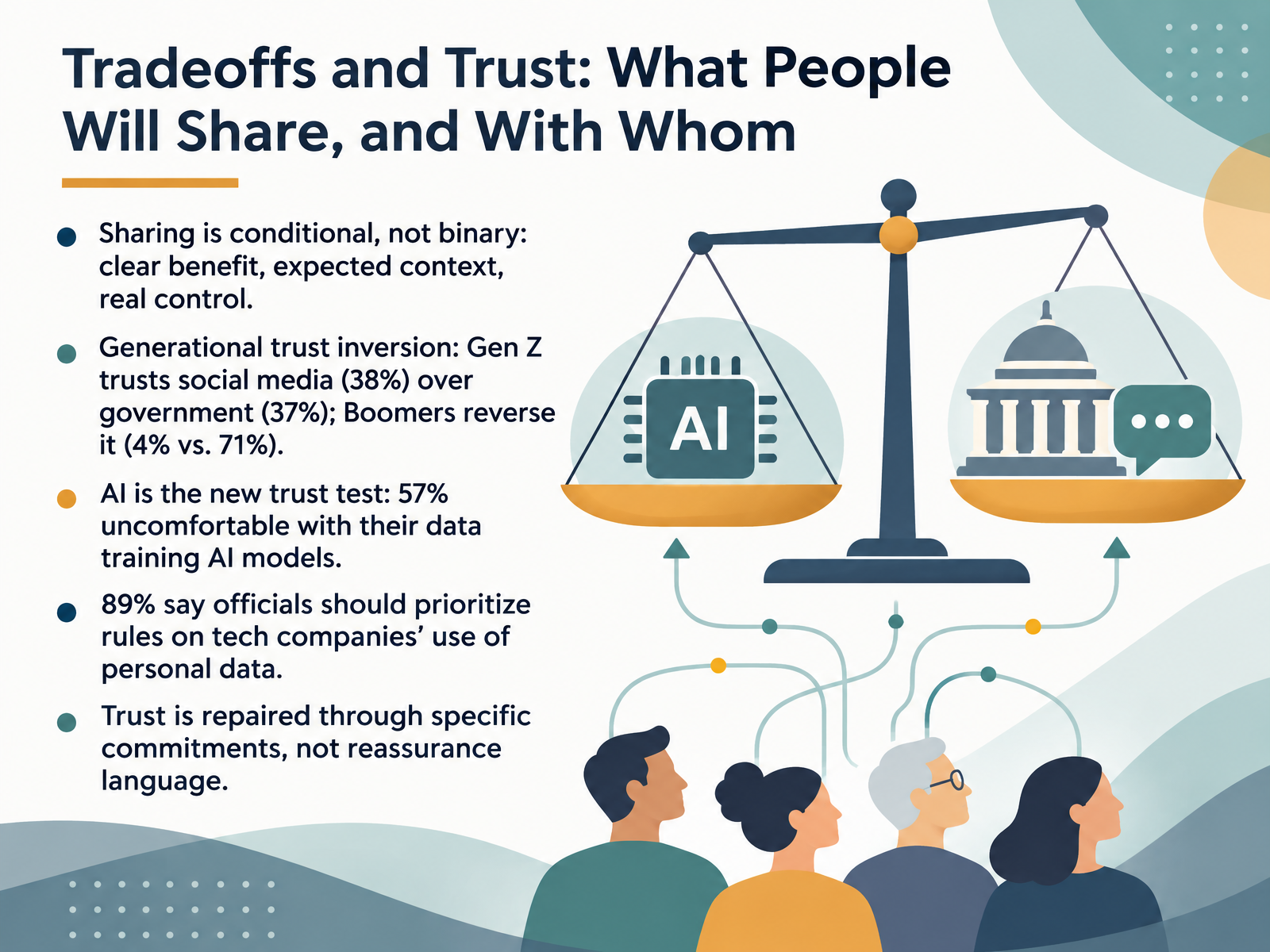
- 08Tradeoffs and Trust: What People Will Share, and With WhomLet's look at what sharing actually depends on. People treat sharing as conditional, not binary. They will share when there is a clear benefit, when the context matches their expectation, and when they have real control, like adjusting app permissions or understanding why a loyalty program wants their purchase history. Here is the practical takeaway. Trust is specific, not general. And it splits by generation. Gen Z trusts social media at thirty eight percent, slightly above government at thirty seven percent. Boomers reverse that, with only four percent trusting social media and seventy one percent trusting government. Artificial intelligence is the new trust test. Fifty seven percent of consumers are uncomfortable with their data training AI models. And eighty nine percent say officials should prioritize rules on how tech companies use personal data. So repair trust through concrete commitments, not reassurance language. Pick one commitment you can state plainly today and show people how to verify it. That leads naturally into control, consent, and what people actually want.
 verve.comresources.verve.comusercentrics.com+22 min
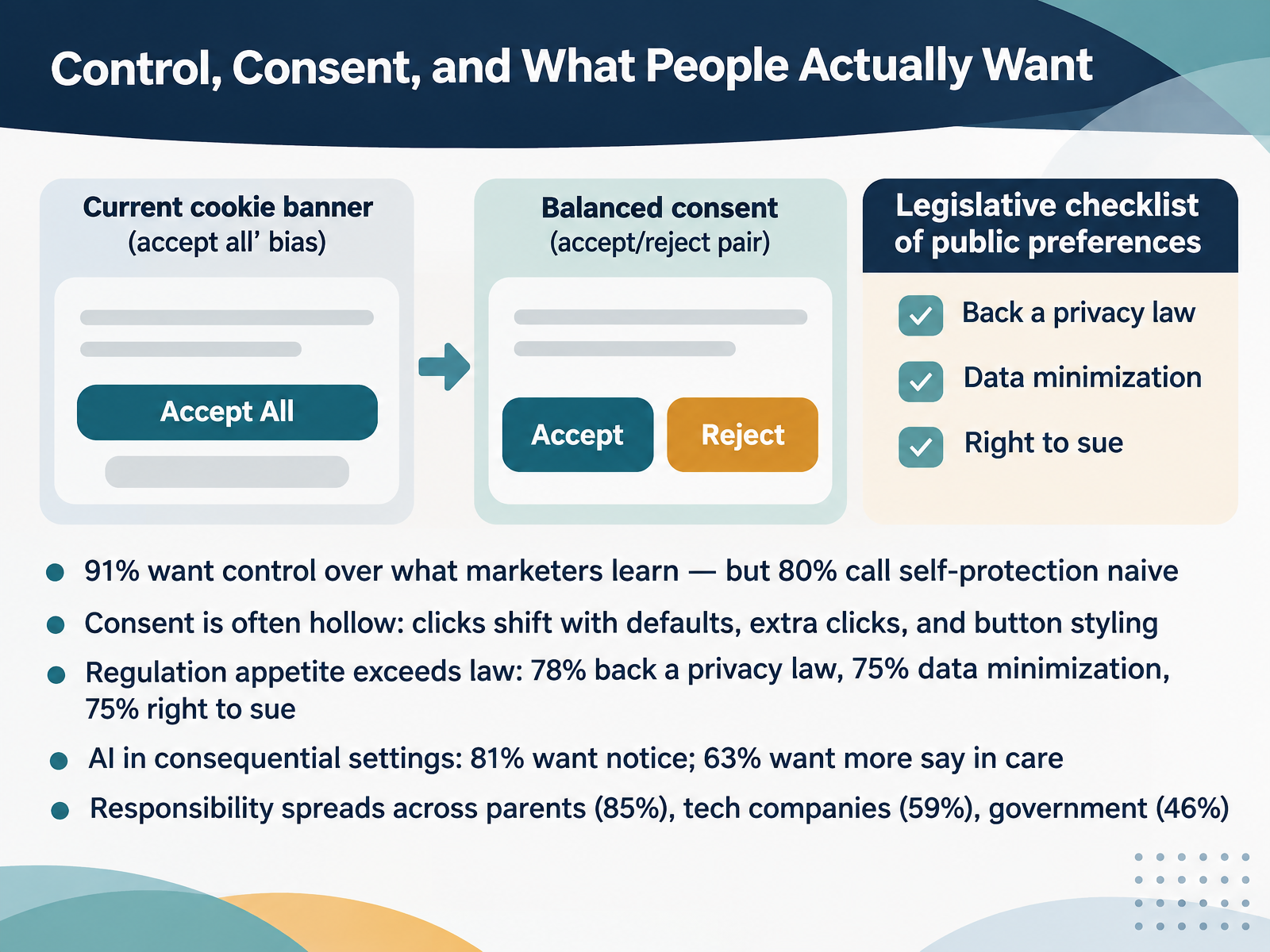
- 09Control, Consent, and What People Actually WantNow let us look at control, consent, and what people actually want. Here is what the finding means. People want a say, but many doubt that a say changes anything. Ninety one percent want control over what marketers learn about them, yet about eighty percent call self-protection naive, and nearly as many feel they have little control. Consent itself is often hollow. In practice, acceptance shifts with defaults, extra clicks, and button styling. So a cookie banner that buries reject behind three taps is not a real choice. Here is the practical takeaway. Regulation appetite also exceeds law. Seventy eight percent back a privacy law, seventy five percent support data minimization, meaning collecting only what a service needs, and seventy five percent want a right to sue. For AI in consequential settings, like medical triage, eighty one percent want notice and sixty three percent want more say in care. Responsibility spreads across parents at eighty five percent, tech companies at fifty nine percent, and government at forty six percent. So the decision for your team is this. Audit one consent flow for default bias and click asymmetry, then fix it. From Evidence to Product Decisions.
 pewresearch.org2 min
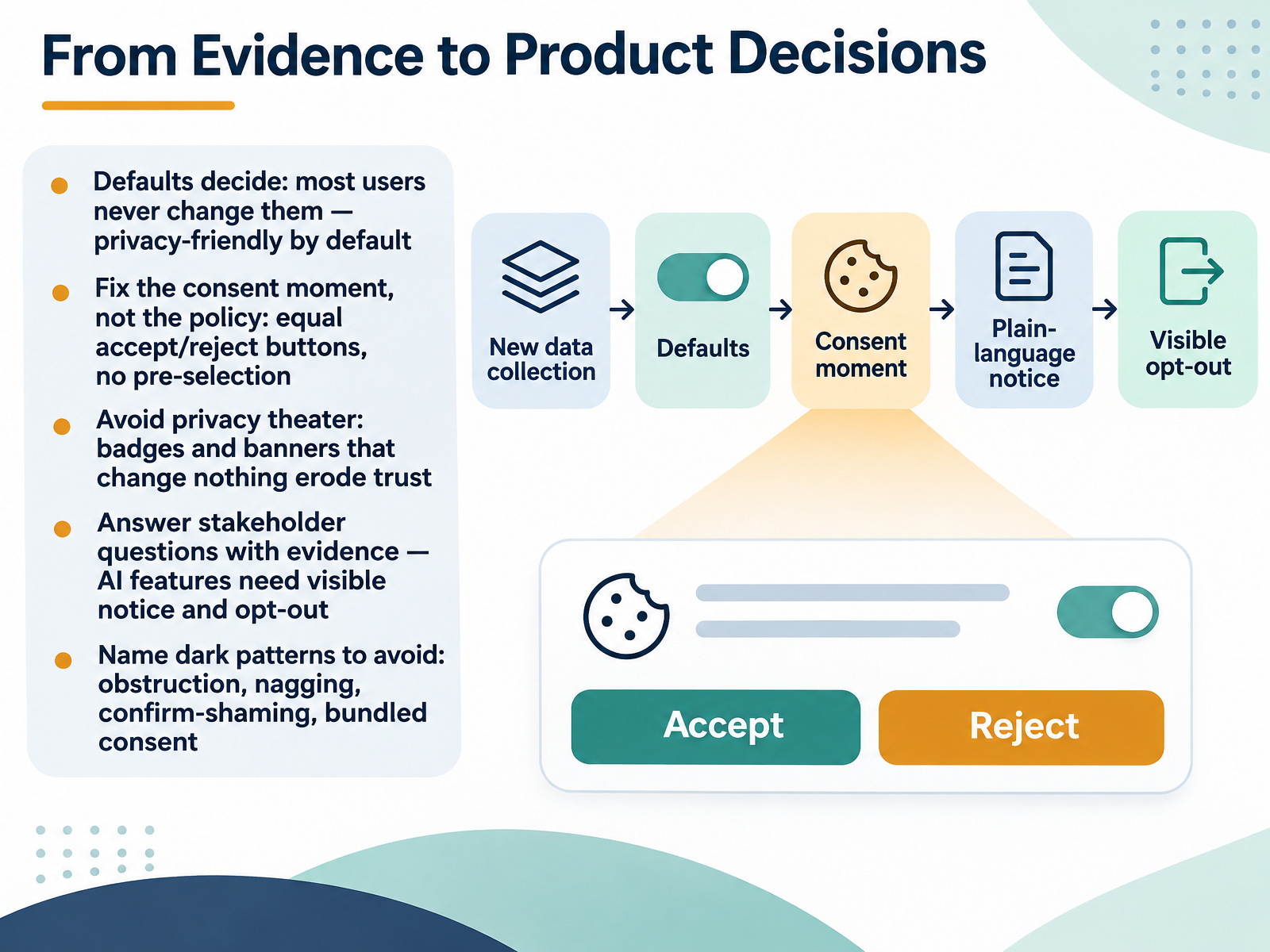
- 10From Evidence to Product DecisionsNow let's turn evidence into product decisions. Defaults decide, because most users never change them, so make the privacy-friendly setting the starting point. Here is the practical takeaway: fix the consent moment, not the policy. Equal accept and reject buttons, and nothing pre-selected. Avoid privacy theater, because badges and banners that change nothing erode trust. When stakeholders ask about AI features, answer with evidence, and note that Americans overwhelmingly want to be told when AI touches their data. Give visible notice and a real opt-out. And name the dark patterns to avoid: obstruction, nagging, confirm-shaming, and bundled consent. One decision you can make today is to audit a single consent screen against these five points. Next, we look at research methods for context-specific privacy expectations.
 pewresearch.orgpewresearch.orgpewresearch.org+21 min
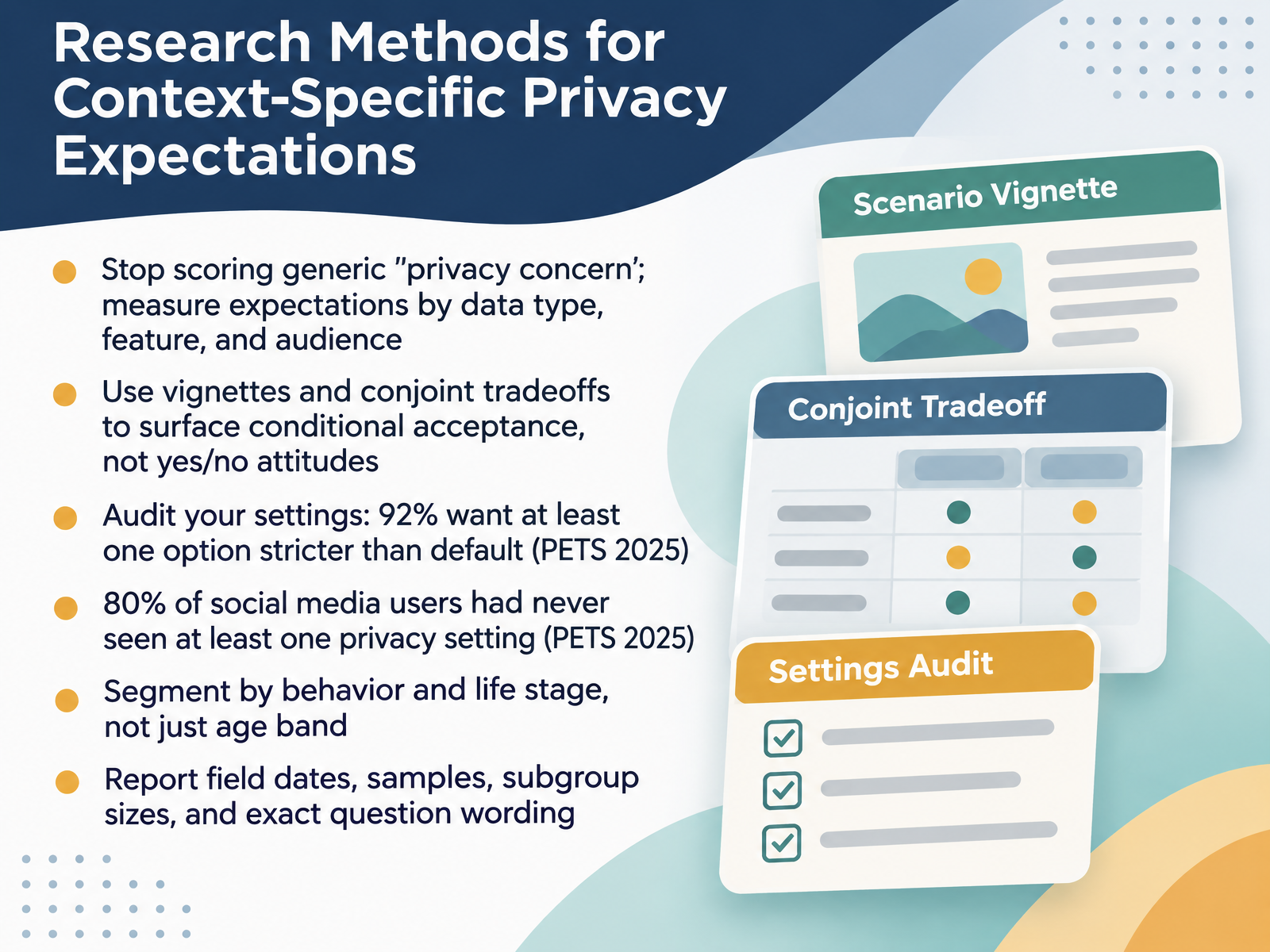
- 11Research Methods for Context-Specific Privacy ExpectationsLet us turn to how we actually measure privacy expectations. The core shift is this: stop scoring a single, generic privacy concern. Instead, measure expectations by data type, feature, and audience. A user who guards health data closely might happily share a loyalty card number. Here is the practical takeaway: use vignettes and conjoint tradeoffs, where people choose between realistic bundles of features, to surface conditional acceptance rather than yes or no attitudes. A quick settings audit also matters. Ninety two percent of users want at least one option stricter than the default, and eighty percent of social media users had never seen at least one privacy setting. Segment by behavior and life stage, not just age band. And always report field dates, sample sizes, subgroup sizes, and exact question wording, because that is what makes findings trustworthy. Our next step is applying these ideas in teaching. That brings us to Teaching Data Privacy: Strategies for Educators and Trainers.
 verve.comresources.verve.comusercentrics.com+22 min
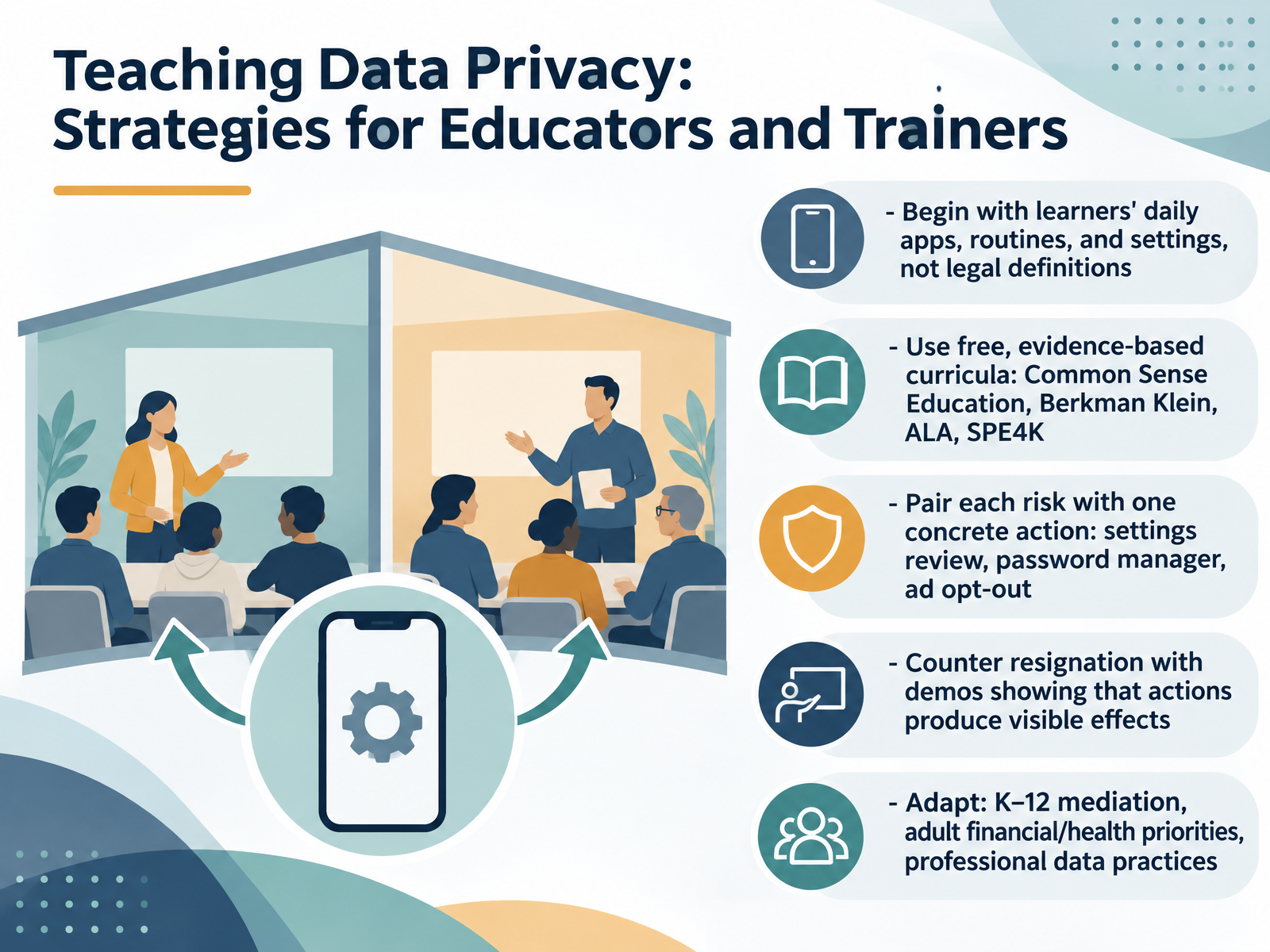
- 12Teaching Data Privacy: Strategies for Educators and TrainersNow let's turn to how we teach this. Start with learners' daily apps, routines, and settings, not legal definitions. A quick morning-routine walkthrough makes data collection visible in about ten minutes. Build on free, evidence-based curricula: Common Sense Education's K through twelve lessons, the Berkman Klein Center's modular activities, the American Library Association's privacy training, and S P E four K, which serves K through eight. Here is the practical takeaway: pair every risk with one concrete action. If you cover targeted ads, show the settings review and the ad opt-out in the same session. If you cover account breaches, introduce a password manager and let people set it up. Counter resignation with demos, because actions need visible effects. Then adapt: mediation for K through twelve, financial and health priorities for adults, and professional data practices for workplace audiences. One decision to make: pick one curriculum and one paired action for your next session. Let's consider some common misconceptions and cautions next.
 2 min
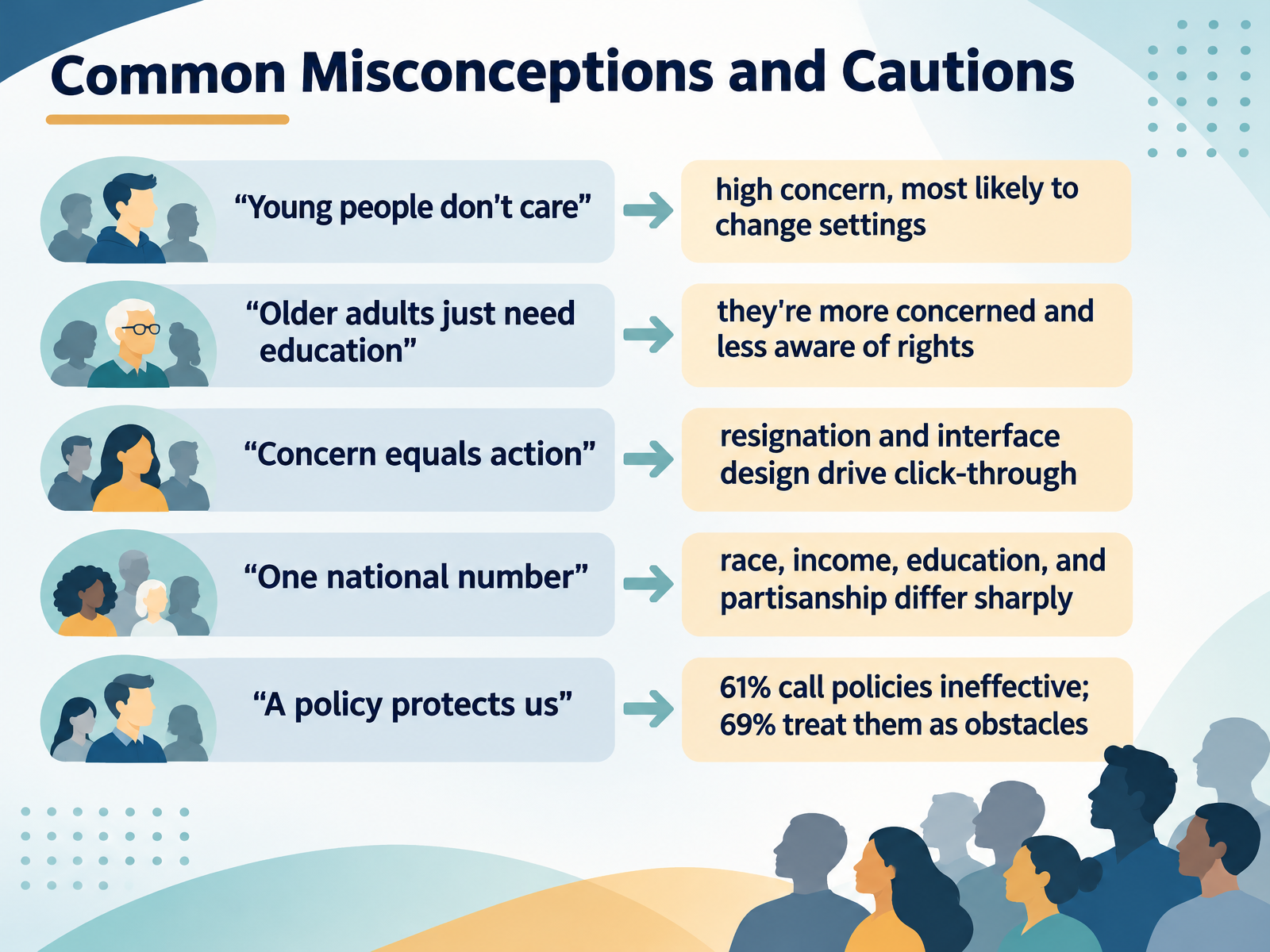
- 13Common Misconceptions and CautionsLet's turn to some misconceptions and cautions. First, the idea that young people don't care does not hold up. Concern is high across ages, and younger adults are often the most likely to change their settings. Here is the practical takeaway. Design for informed, active users of every age. Second, older adults don't just need education. They report more concern, and they are less aware of their privacy rights. So make rights findable and plain, not buried in a menu. Third, concern does not equal action. Even worried people click through when interfaces nudge them, and many feel resigned. Test your consent screens against real behavior. Fourth, there is no single national number. Race, income, education, and partisanship differ sharply, so segment your research. Finally, a policy alone does not protect people. Sixty-one percent call privacy policies ineffective, and sixty-nine percent treat them as obstacles to get past. The shared design problem is making privacy understandable and usable. Next, we'll move to key takeaways and role-specific next steps.
 verve.comresources.verve.comusercentrics.com+22 min
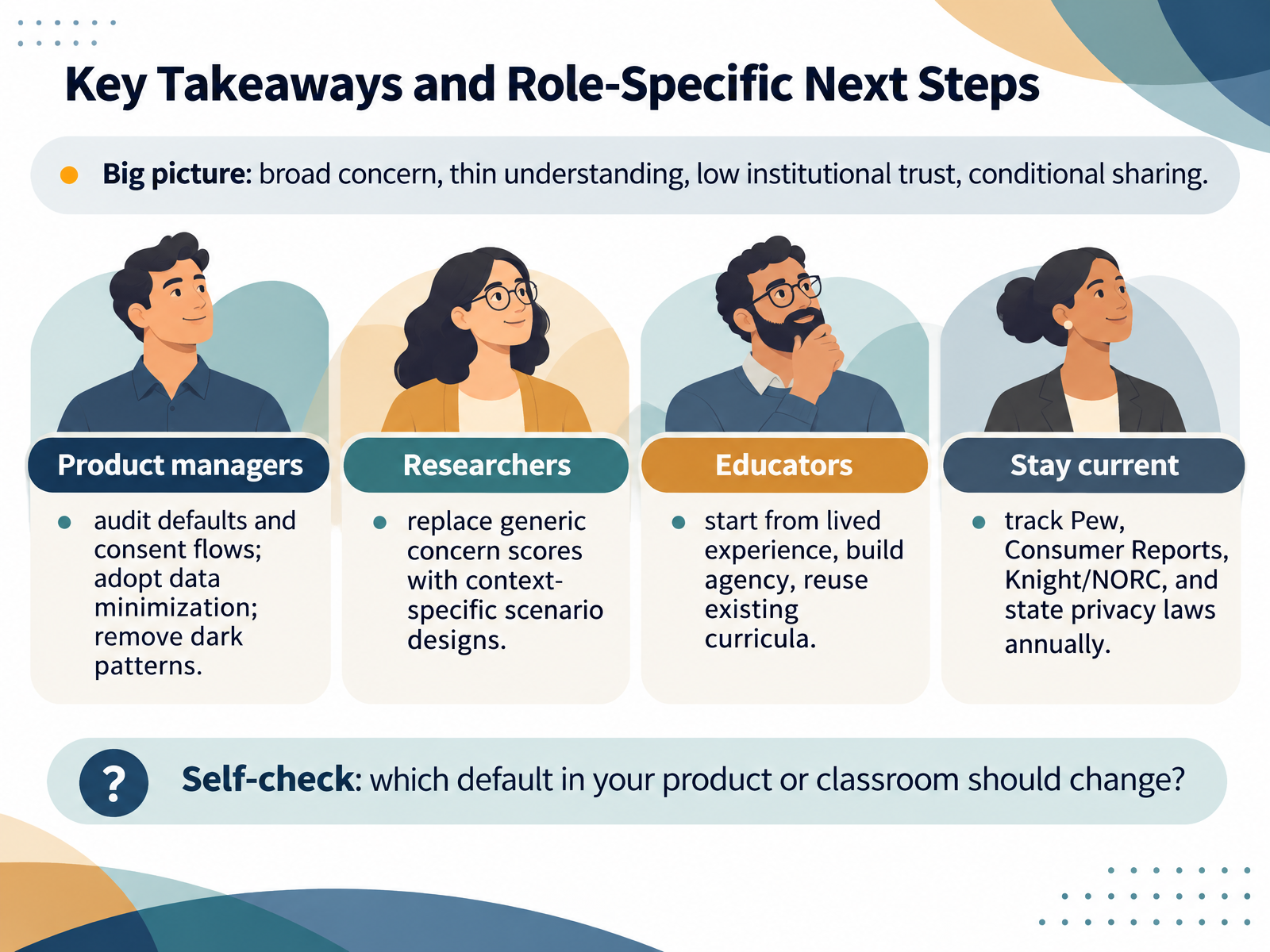
- 14Key Takeaways and Role-Specific Next StepsLet's pull this together. The big picture is broad concern, thin understanding, low institutional trust, and sharing that is conditional. People are wary, but they often lack the knowledge to act on it.
For product managers, here is the practical takeaway. Audit your defaults and consent flows, adopt data minimization, meaning collect only what the service actually needs, and remove dark patterns, those interface tricks that nudge people toward choices they would not make freely.
For researchers, replace generic concern scores with context-specific scenario designs, because a person's answer about app permissions may differ from their answer about a loyalty program.
For educators, start from lived experience, build agency, and reuse existing curricula rather than rebuilding from scratch. Terms like data broker, a company that buys and resells personal data, and opt-out, the right to decline or withdraw consent, land better when anchored to real tasks.
Stay current by tracking Pew, Consumer Reports, Knight and N O R C, and state privacy laws annually. And close with one self-check: which default in your product or classroom should change?
Thank you for your attention, and for treating this as a shared design problem rather than a reason for alarm. You now have a concrete next step in every role. Go make one default better.
 pewresearch.org2 min
Take the deck with you
Download this course as a file — free, no sign-up needed.
- PDF handoutEvery slide page, ready to print or share.15 pages · 3.7 MBDownload
- Narrated PowerPointThe deck that presents itself — every slide carries the digital human's narration video.15 pages · 27.9 MBDownload
- PowerPoint slidesThe full deck as a .pptx — open it in PowerPoint, Keynote, or Google Slides.15 pages · 3.7 MBDownload
Free to use in your own training — please keep the PersonWise credit page at the end.
Have your own deck? Turn it into a course
Sources consulted
Web sources consulted while building this course.
- Americans largely think AI will make their personal information less secure | Pew Research Center — pewresearch.org
- How Americans View Data Privacy: Tech Companies, AI, Regulation, Passwords and Policies | Pew Research Center — pewresearch.org
- Lack of interest, concerns around privacy and accuracy are common reasons why people don’t use chatbots | Pew Research Center — pewresearch.org
- Online Privacy & Security - Research and data from Pew Research Center — pewresearch.org
- Data privacy day US 2026: How concerned are Americans about data security? — yougov.com
- Methodology | Pew Research Center — pewresearch.org
- Methodology — pewresearch.org
- Americans and Privacy in 2019 - Concerned, Confused and Feeling Lack of Control Over Their Personal Information | Pew Research Center — pewresearch.org
- Key findings about Americans and data privacy — pewresearch.org
- Topline questionnaire — pewresearch.org
- Pew Research Data Privacy Statistics 2024 — enzoic.com
- Americans’ experiences with data security | Pew Research Center — pewresearch.org
- Views of data privacy risks, personal data and digital privacy laws in America | Pew Research Center — pewresearch.org
- Americans Consider Certain Kinds of Data to be More Sensitive than Others | Pew Research Center — pewresearch.org
- Americans’ Perceptions of Privacy are Varied | Pew Research Center — pewresearch.org
- How different generations view user data privacy | Verve — verve.com
- 2025 In-app User Privacy Report — resources.verve.com
- Usercentrics Report_Gen Z_Digital Trust — usercentrics.com
- Striking the Balance — iab.com
- 2025z — edelman.com