Begin
13 pages · ~26 min
Project Management Fundamentals
Learn core project management concepts, purpose, and real-world examples to effectively plan, execute, and oversee projects.
A digital instructor presents all 13 pages. Hold “Ask” at any point and ask out loud — the answer comes from this course. No sign-up needed.
What you’ll learn
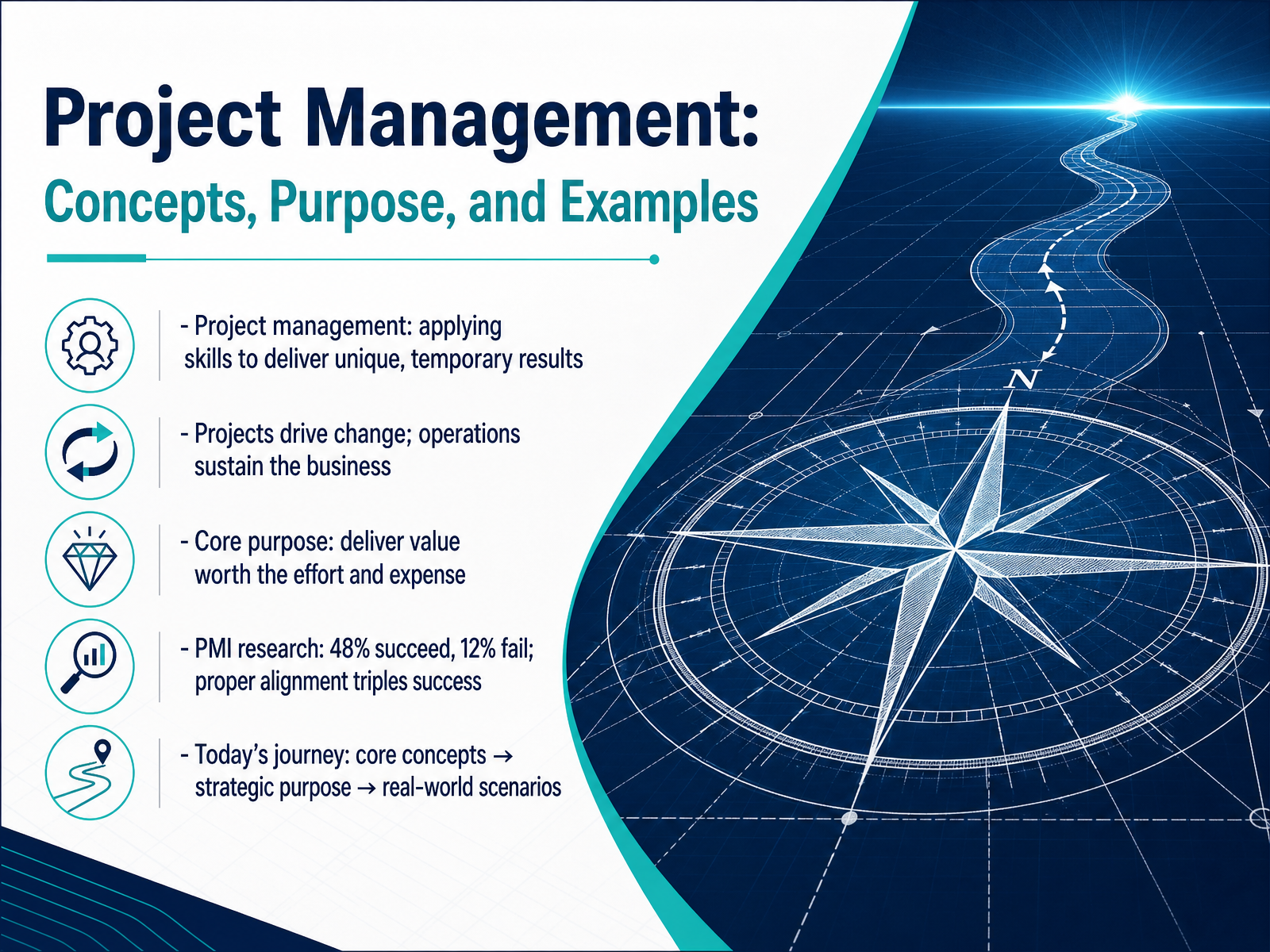
- 01Project Management: Concepts, Purpose, and ExamplesWelcome. If you have ever led a team task, launched a product, or coordinated a cross-functional effort, you have already been managing projects. Today, we are going to give that work a clear structure and name: project management. At its core, project management is simply applying skills to deliver unique, temporary results. Think of a project as the engine that drives change, while day-to-day operations keep the business running. The core purpose is not just to finish on time and on budget. According to the Project Management Institute, real success means delivering value that is truly worth the effort and expense. Here is a key stat to anchor us: PMI research shows that forty-eight percent of projects succeed, while twelve percent fail outright. But when teams use the right alignment practices, they can more than triple their success rates. So here is our path. We will start with core concepts, then explore the strategic purpose behind projects, and finally walk through real-world scenarios that you will recognize from your own work. Let us begin with the foundation.pmi.orgpmi.orgpmi.org+22 min
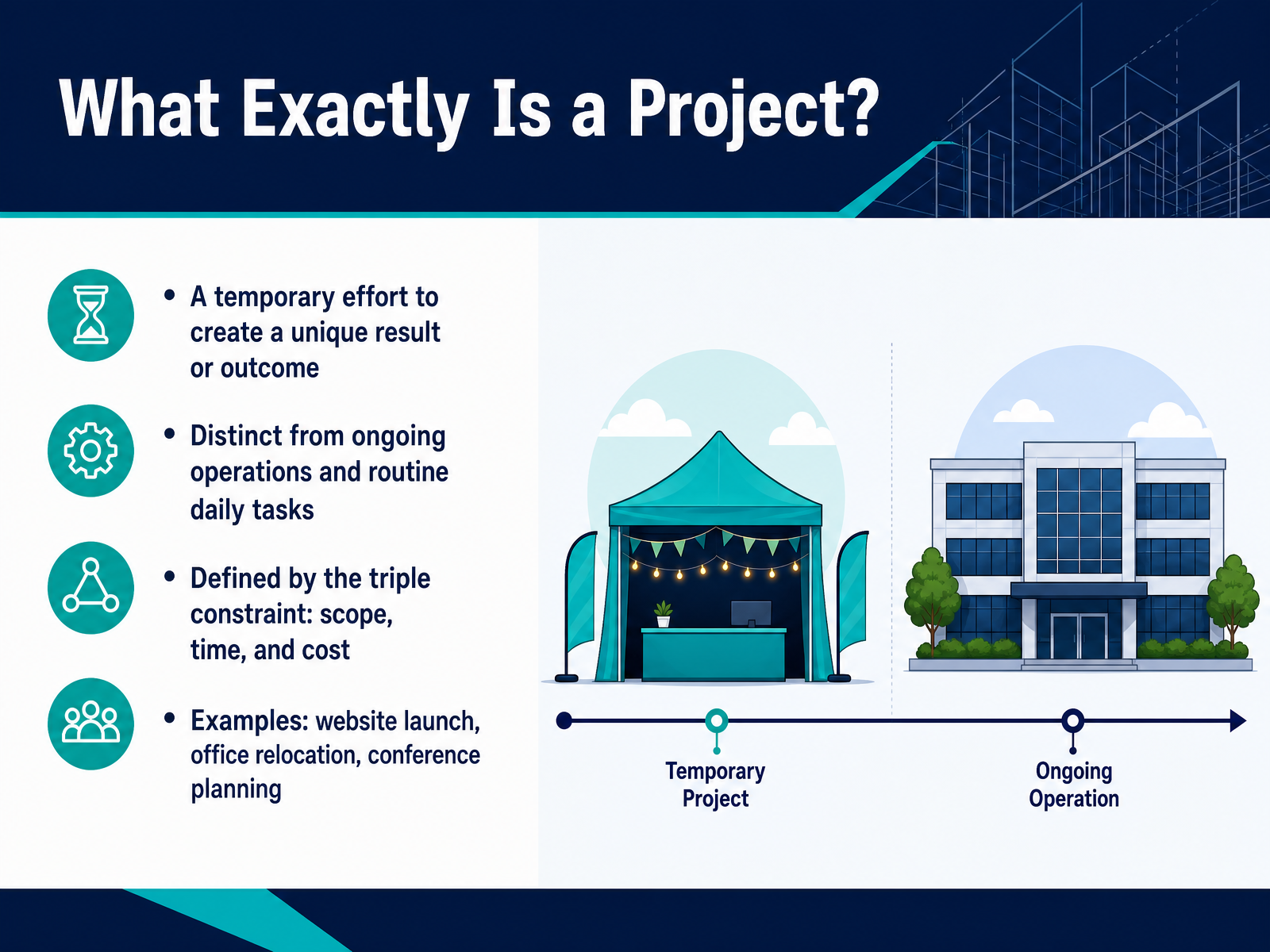
- 02What Exactly Is a Project?So, let’s get grounded in the fundamentals. What exactly is a project? At its core, a project is a temporary effort designed to create a unique result or outcome. That word ‘temporary’ is key. It has a clear start and a clear finish. This is what separates it from your ongoing operations or routine daily tasks, like answering emails or attending recurring team meetings. Those repeat forever, but a project doesn’t. Every project is also defined by what we call the triple constraint: scope, time, and cost. Scope is the work that needs to be done. Time is the schedule, and cost is the budget. Think of these three as a balancing act. If you adjust one, it typically impacts the others. To make this concrete, think about real work. Launching a new website is a project. Relocating an entire office to a new floor is a project. Planning a three-day industry conference? That’s a project too. All of these have a specific goal, a deadline, and a budget. Now that we’ve defined what a project is, let’s talk about why managing one well actually matters.
 2 min
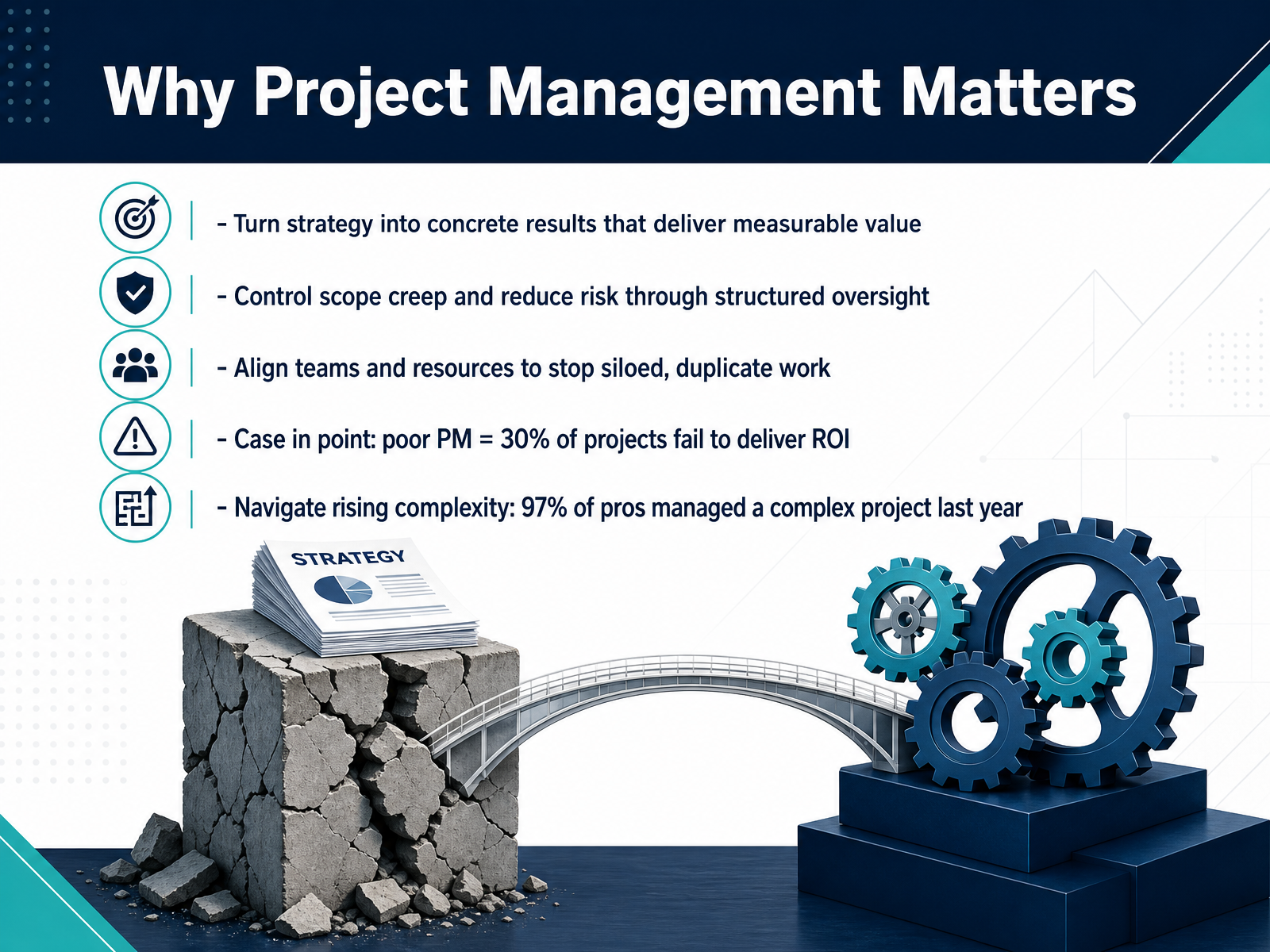
2 min - 03Why Project Management MattersSo, why should we care about structured project management? Because it's the difference between a great idea and a result that actually moves the needle. It turns strategy into concrete, measurable value. Instead of just talking about goals, you create a system to achieve them. This also gives you the oversight to control what's called scope creep and reduce risk. Without it, teams often work in silos, duplicating effort or pulling in different directions. Project management aligns everyone and their resources. The stakes are real. Research shows that nearly one in every three projects, thirty percent, fails to deliver a meaningful return on investment. And complexity is the new normal. Ninety-seven percent of project professionals managed at least one complex project just last year. That means structured project management isn't a nice-to-have, it's a survival skill in today's workplace. Next, we'll build on this by redefining what project success really looks like, moving beyond just time, scope, and budget.
 tempo.iomonday.compmsolutions.com+22 min
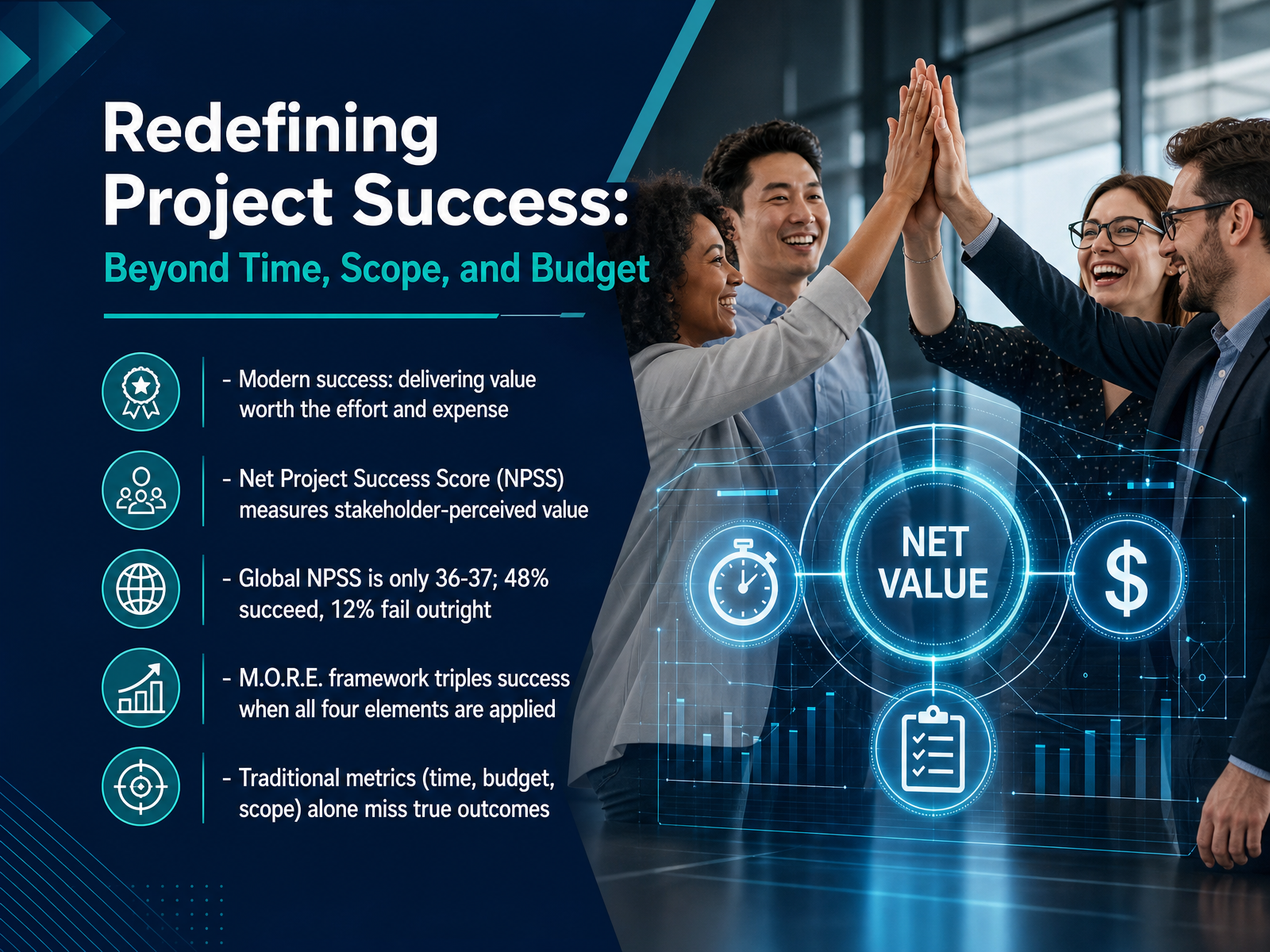
 - 04Redefining Project Success: Beyond Time, Scope, and BudgetLet's pull back for a moment and redefine what it really means for a project to be successful. In the past, we tended to judge success purely by the triple constraint: did we deliver on time, on scope, and on budget? But modern project management has evolved. PMI’s latest global research establishes a clear, value-centered definition: a successful project delivers value that is worth the effort and expense. So, you could technically hit every deadline and stay within budget, but if the outcome doesn't provide real value to your stakeholders, the project can't be called a true success. To measure this, PMI uses a Net Project Success Score, or NPSS, which gauges stakeholder-perceived value. The current global NPSS sits at just thirty-six, meaning only forty-eight percent of projects succeed while twelve percent fail outright. So how do we improve? PMI identified a framework called M.O.R.E. that more than triples success rates when all four elements are applied. This proves that traditional metrics alone simply miss the true outcomes that matter to your business. Now that we know what success truly looks like, let's ground this in the structure that makes it possible. Next, we'll walk through the project lifecycle.
 pmi.orgpmi.orgpmi.org+22 min
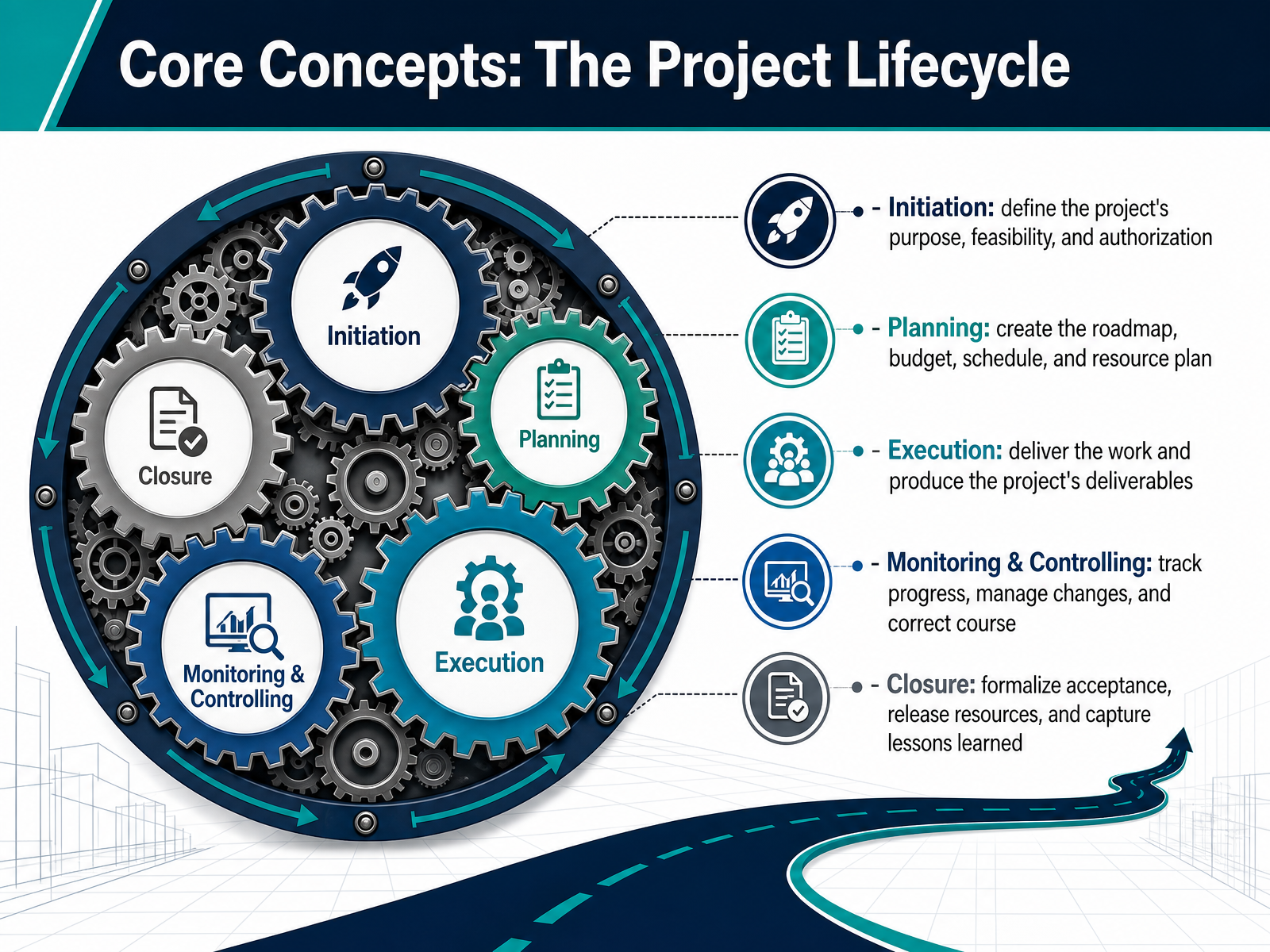
 - 05Core Concepts: The Project LifecycleNow, let's walk through the project lifecycle. Think of this as the backbone of any project. It breaks the work into five natural phases. First, Initiation. This is where you define the purpose. You ask, 'Is this project doable? And should we even start it?' Next comes Planning. Here, you build the roadmap. You set the budget, the schedule, and figure out who you need on the team. Then you move into Execution. This is where the actual work happens and your team starts producing the deliverables. But you can't just set it and forget it. The fourth phase is Monitoring and Controlling. Here, you're tracking progress against the plan, managing any changes, and correcting course if things go off track. Finally, there's Closure. You get formal sign-off, release your team members, and capture those valuable lessons learned for next time. Up next, we'll explore how these phases connect to the triple constraint and how that concept has evolved.
 1 min
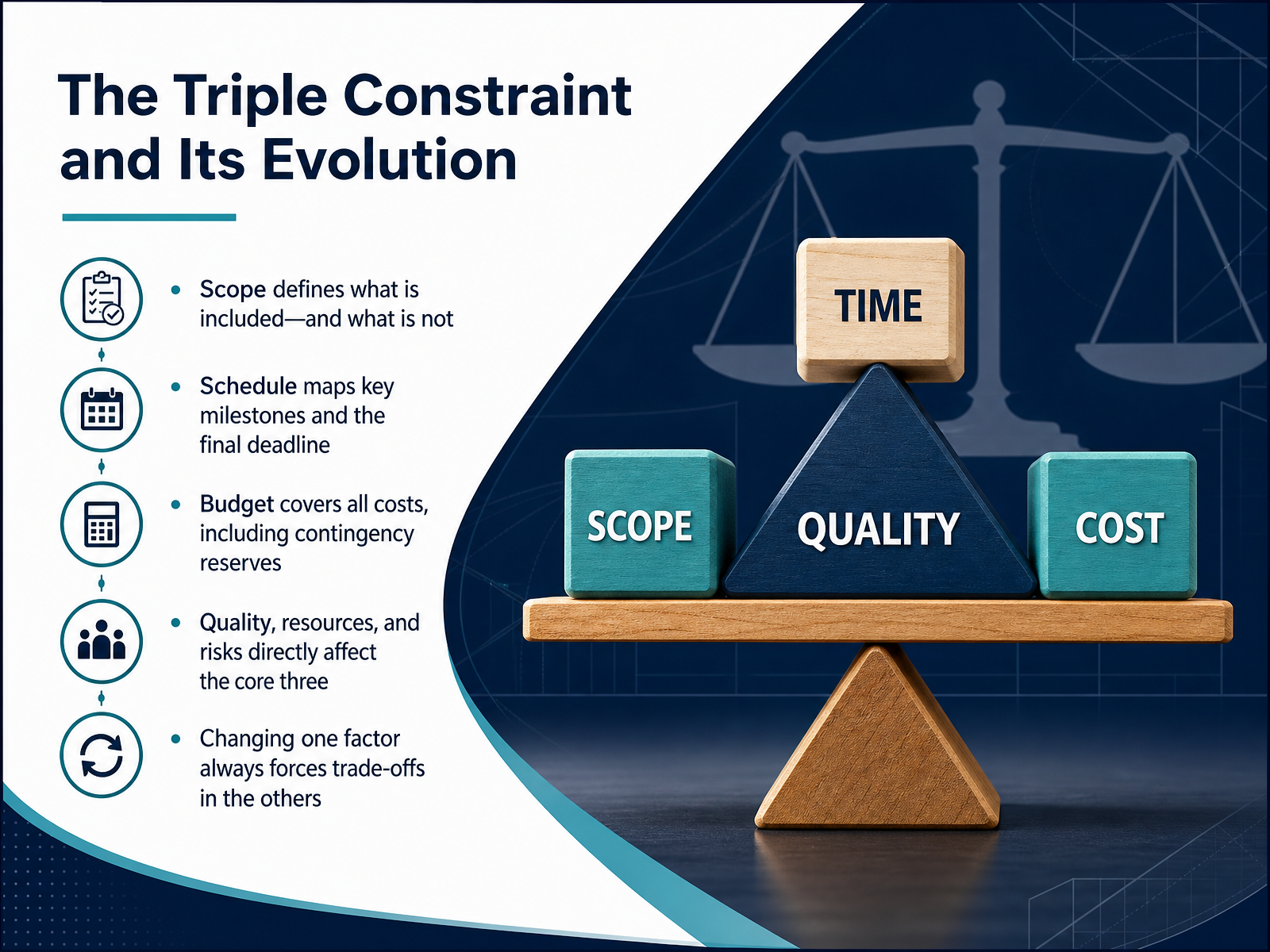
1 min - 06The Triple Constraint and Its EvolutionLet's look at a core idea in project management—the triple constraint. Think of it as the three-legged stool that holds up any project. The first leg is scope. This defines what work is included in the project, and just as importantly, what's not included. The second leg is your schedule. This maps out key milestones and the final deadline. And the third leg is your budget, which covers all costs, including a contingency reserve for unexpected surprises. Now, these three are directly influenced by other factors like quality, available resources, and potential risks. Here's the critical part: if you change one leg of the stool, you almost always have to adjust the others. For example, if new features are added to your scope, you'll need more time, more money, or both. Understanding these trade-offs is what makes the triple constraint so powerful. Let's move on and see the key roles that manage these trade-offs.
 1 min
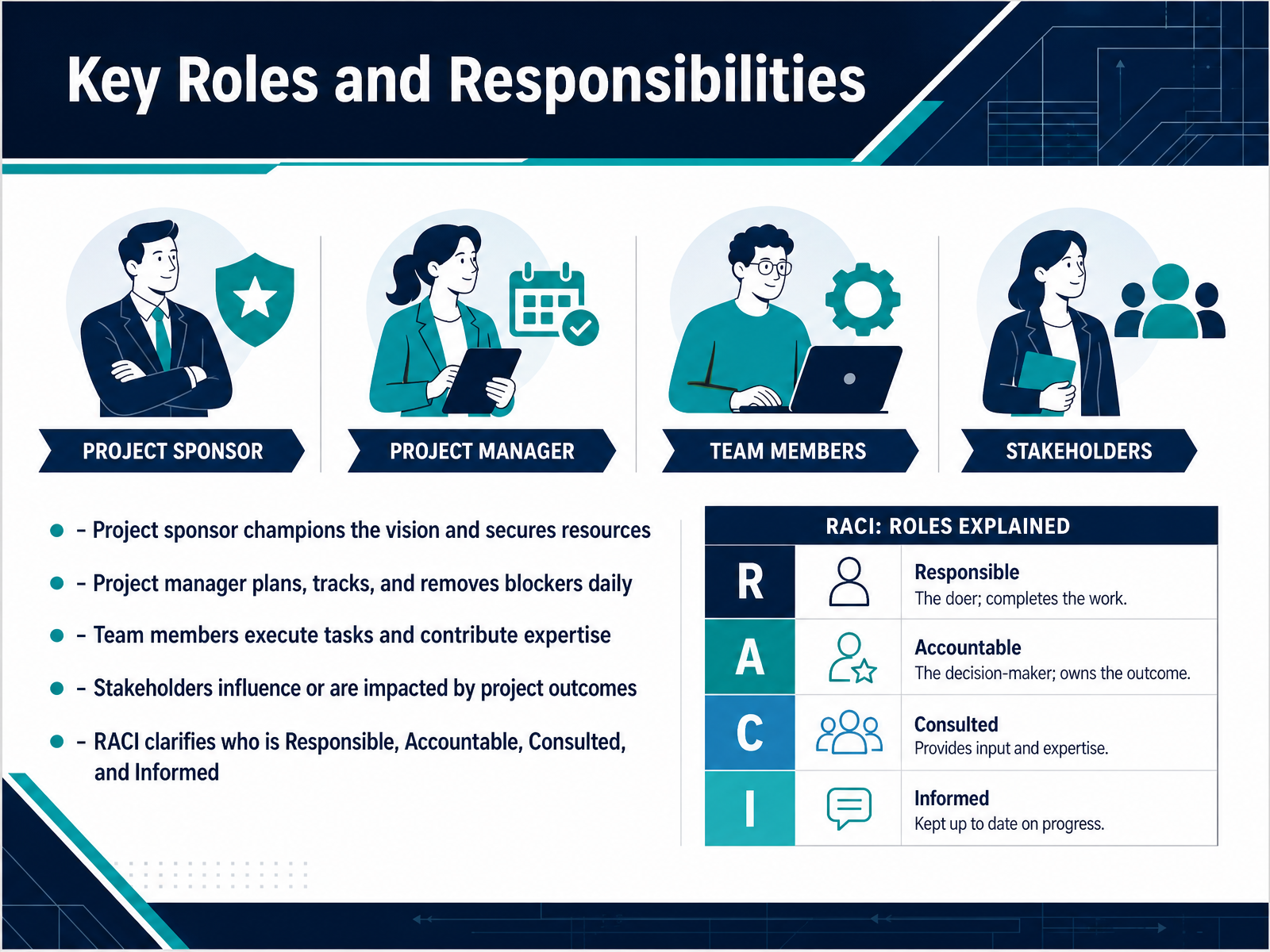
1 min - 07Key Roles and ResponsibilitiesLet's talk about the people who make a project happen. When a project is moving, confusion about who does what is one of the fastest ways to lose momentum. So, let's get clear on the key roles. First, you have the project sponsor. This person champions the vision. They secure the budget and resources. They are the ultimate decision-maker when things get stuck at a higher level. Next is the project manager. That's the person planning the work, tracking progress, and removing blockers daily. They keep the team focused and the timeline real. Then we have the team members. These are the experts executing the tasks and creating the deliverables. Their deep skills drive the actual output. Outside the core team, you have stakeholders. These are people who can influence or are impacted by the project outcome. A stakeholder might be a department head who will use the final product, or a legal team that needs to approve a step. To keep all this clear, many teams use a simple tool called a RACI chart. It clarifies who is Responsible for doing the work, who is Accountable for the final sign-off, who needs to be Consulted before a decision, and who just needs to be Informed after it's made. Knowing these roles turns a chaotic group effort into a coordinated team. Now, once you have your team roles clear, the next question is how you'll actually work together. Let's explore popular methodologies like Waterfall, Agile, and Hybrid.
 2 min
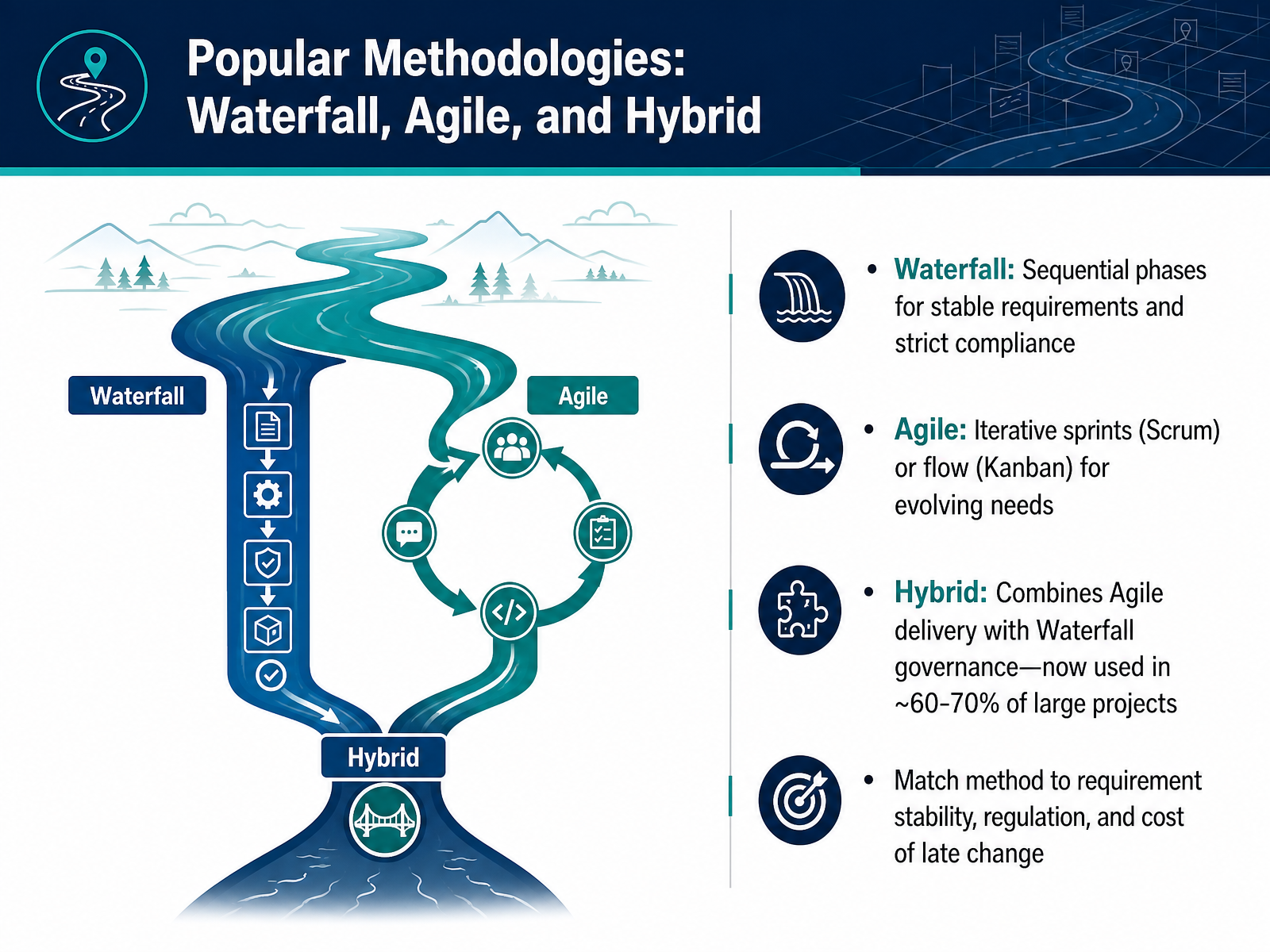
2 min - 08Popular Methodologies: Waterfall, Agile, and HybridLet's move from the big picture into the three main delivery methodologies you'll encounter. We have Waterfall, Agile, and Hybrid. Think of Waterfall as a classic, sequential approach. One phase finishes completely before the next begins. It excels when your requirements are stable, compliance is strict, and the cost of late change is high. For instance, a construction project or a government contract with rigid specifications. Next, Agile. This is built for evolving needs. It uses iterative cycles called sprints, like in Scrum, or a continuous flow model, like Kanban. Digital product teams use this to release small increments, get user feedback, and pivot quickly. It reduces the cost of discovery. Now, Hybrid. This is now the practical reality for sixty to seventy percent of large projects. It's not a compromise. It intentionally combines Agile delivery at the team level with Waterfall-style governance, funding gates, and executive milestones. Your core question is this: which method matches your requirement stability, regulatory environment, and the cost of late change? Let's see these concepts in action with real-world examples across industries.
 apmic.orgpmi.orgmy.idc.com+22 min
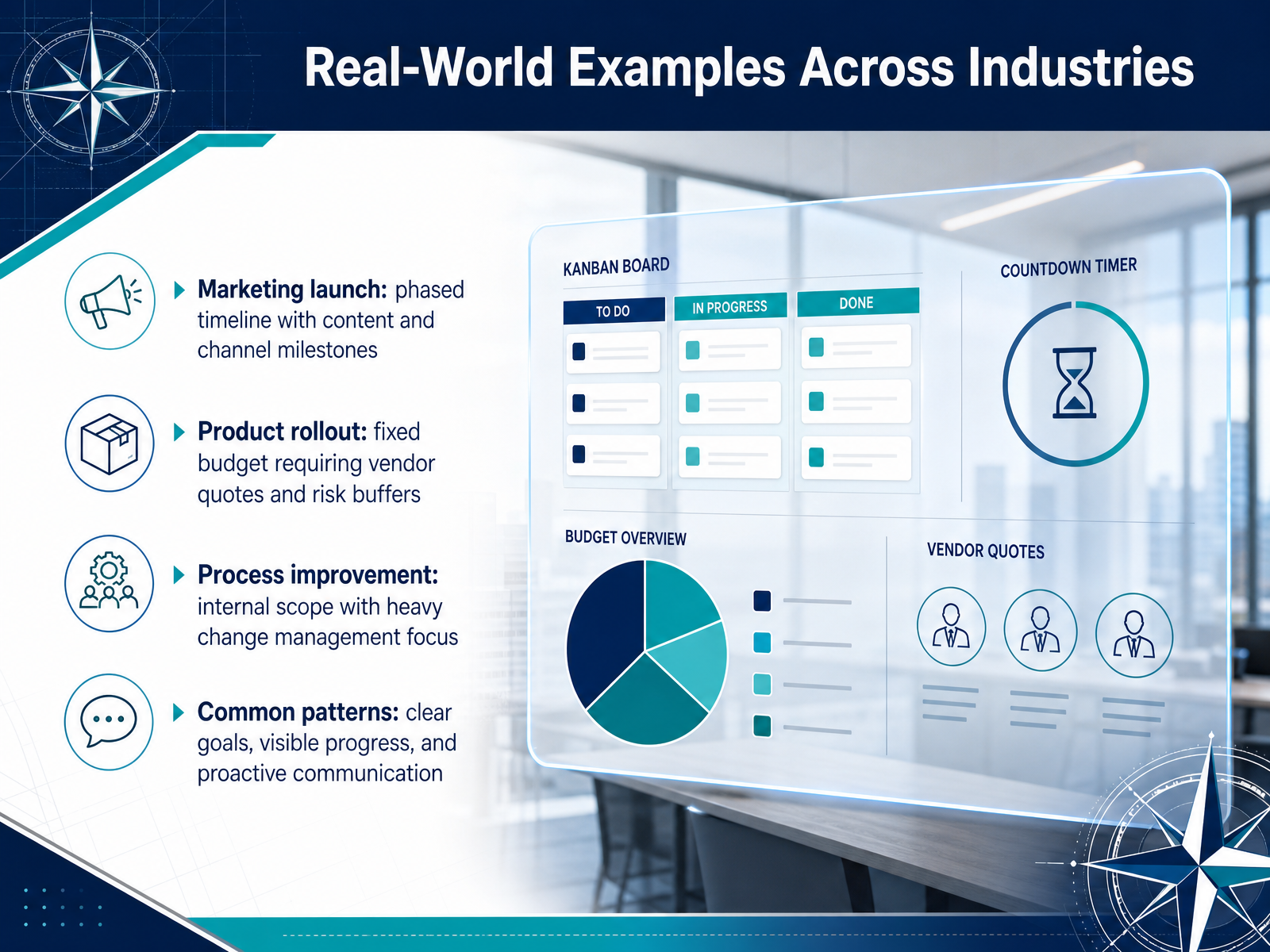
 - 09Real-World Examples Across IndustriesLet’s make this tangible with a few real-world examples. Picture a marketing campaign launch. You'd build a phased timeline, with clear milestones for content creation, reviews, and channel rollouts. This keeps the whole team aligned on what goes live, and when. Now think of a physical product rollout. Here, you’re often locked into a fixed budget. Your plan must include detailed vendor quotes, plus a risk buffer for unexpected costs like shipping delays or material changes. Then there’s a process improvement initiative. The scope is usually internal, but the real challenge is change management, getting people to adopt the new way of working. That requires extra communication and training time in your plan. Across all these, notice the common patterns. Every successful project starts with a clear goal, maintains visible progress everyone can see, and runs on proactive communication. Coming up next, we’ll look at common pitfalls you’ll want to avoid, and how to handle them.
 1 min
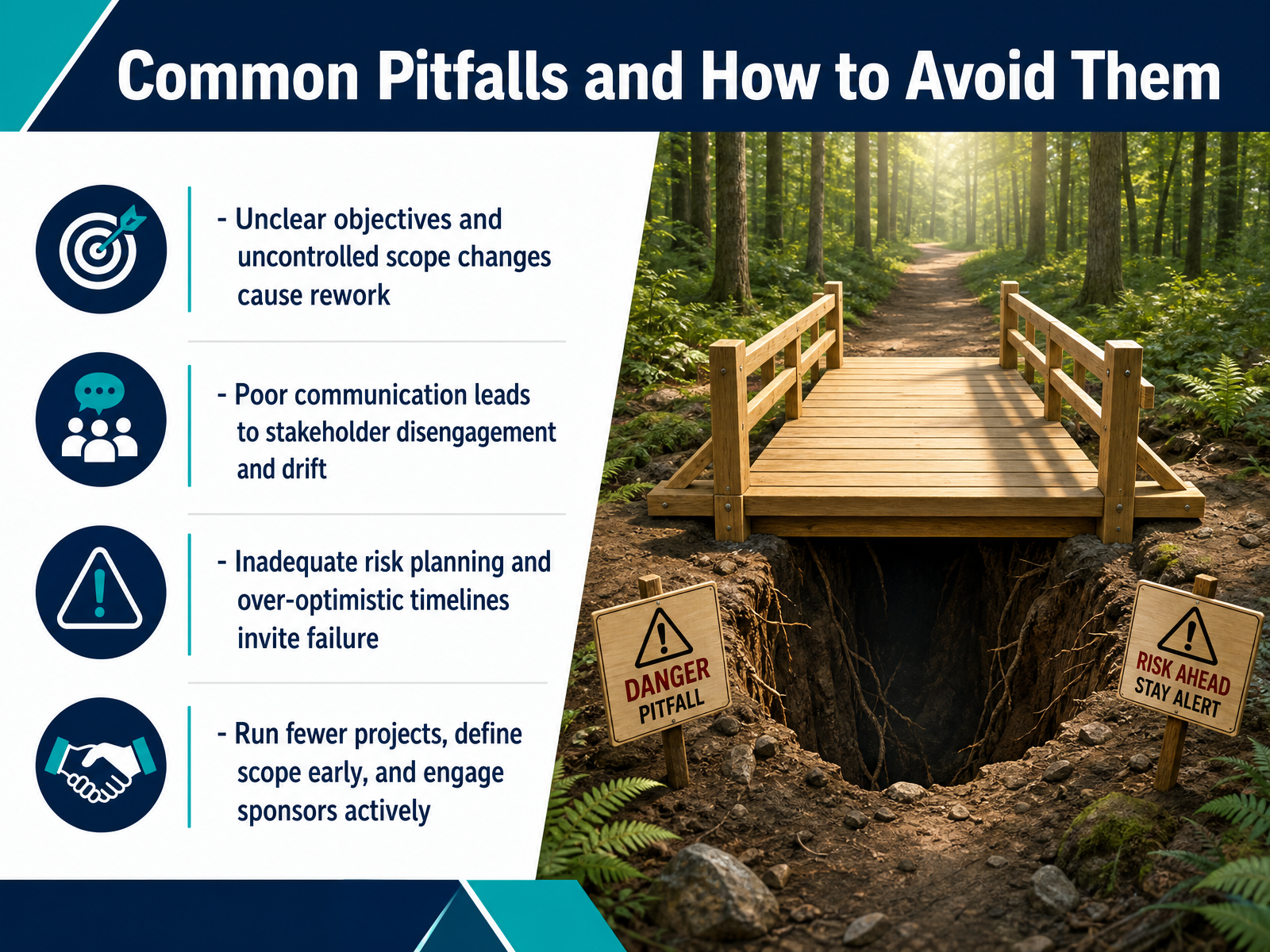
1 min - 10Common Pitfalls and How to Avoid ThemNow, let's talk about pitfalls. You know that feeling when a small request turns into weeks of rework? That's usually a scope problem. Research consistently shows that unclear objectives and uncontrolled changes are top reasons projects fail. Think of scope as your project's fence. Without it, work keeps expanding, and your timeline breaks. Another big warning sign is communication breakdown. When stakeholders go silent or drift away, it's often because they don't feel involved. Silence is not agreement. It's a risk. The data also warns against over-optimistic timelines and skipping risk planning. If you never ask what could go wrong, you're planning to be surprised. And a practical takeaway from top-performing teams is simpler than you might think. Run fewer projects at once. Define your scope early with clear inclusions and exclusions. And actively engage your sponsors so they champion the work, not just approve it. Avoiding these pitfalls isn't about perfect paperwork. It's about having honest, early conversations.
 hs-143758361.f.hubspotemail-eu1.netpmi.orgpmi.org+22 min
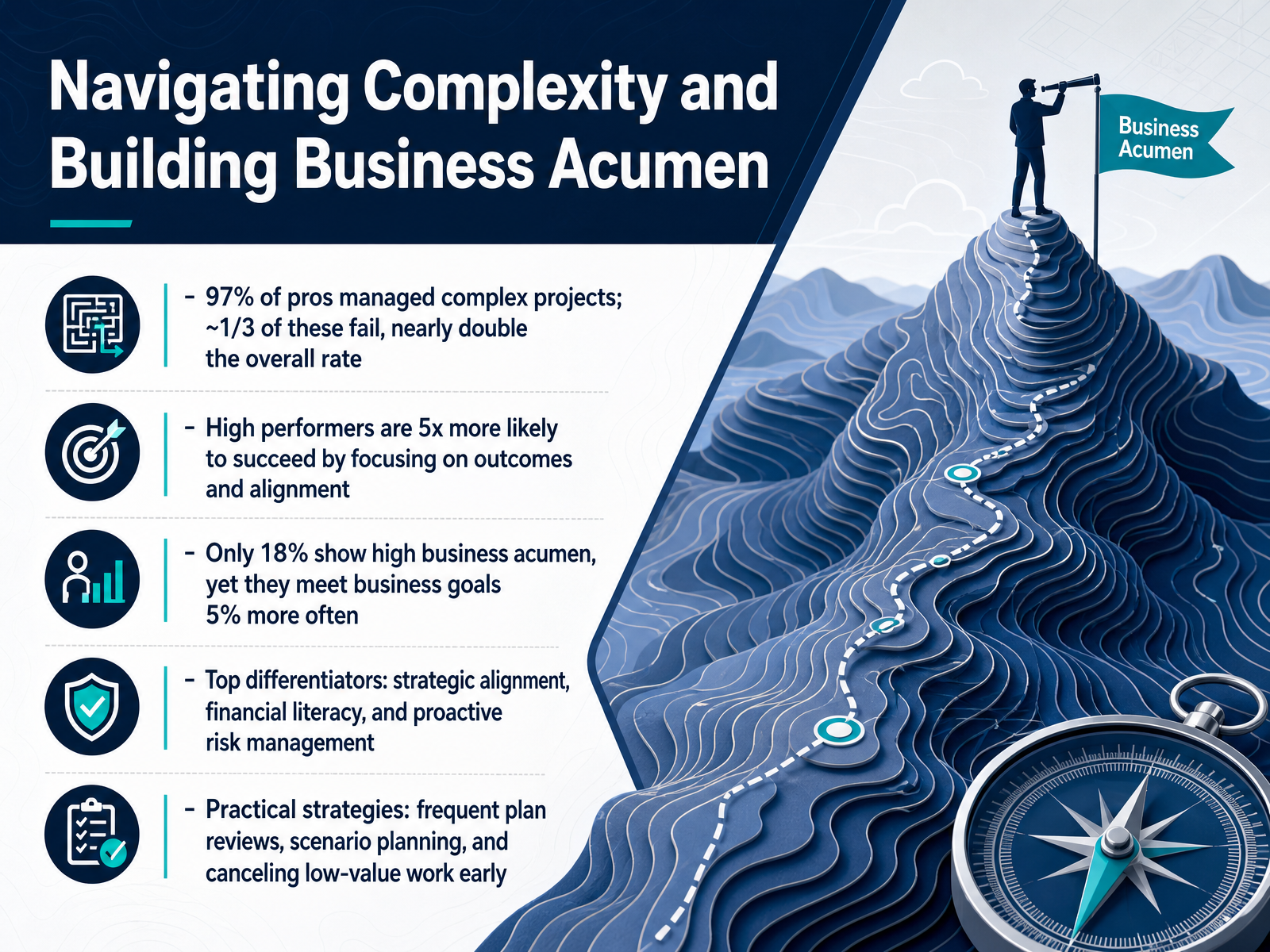
 - 11Navigating Complexity and Building Business AcumenNow let’s look at a powerful combo: navigating complexity and strengthening business acumen. The data tells a clear story. Ninety-seven percent of professionals managed at least one complex project last year, and about one-third of those fail. That’s nearly double the overall failure rate. But here’s the upside. High performers who focus on outcomes and alignment are five times more likely to succeed. So what sets them apart? Business acumen is a big one. Only eighteen percent of project professionals show high business acumen, yet they meet their business goals five percent more often. The top differentiators are strategic alignment, financial literacy, and proactive risk management. In practice, this means connecting your project to the bigger business picture, not just the immediate deliverables. You can start building these muscles right now. Review your project plan frequently, use scenario planning to stay flexible, and don’t be afraid to cancel low-value work early. Cutting a project that won’t deliver saves resources for ones that will. Up next, we’ll cover recommended tools and templates for beginners.
 hs-143758361.f.hubspotemail-eu1.netpmi.orgpmi.org+22 min
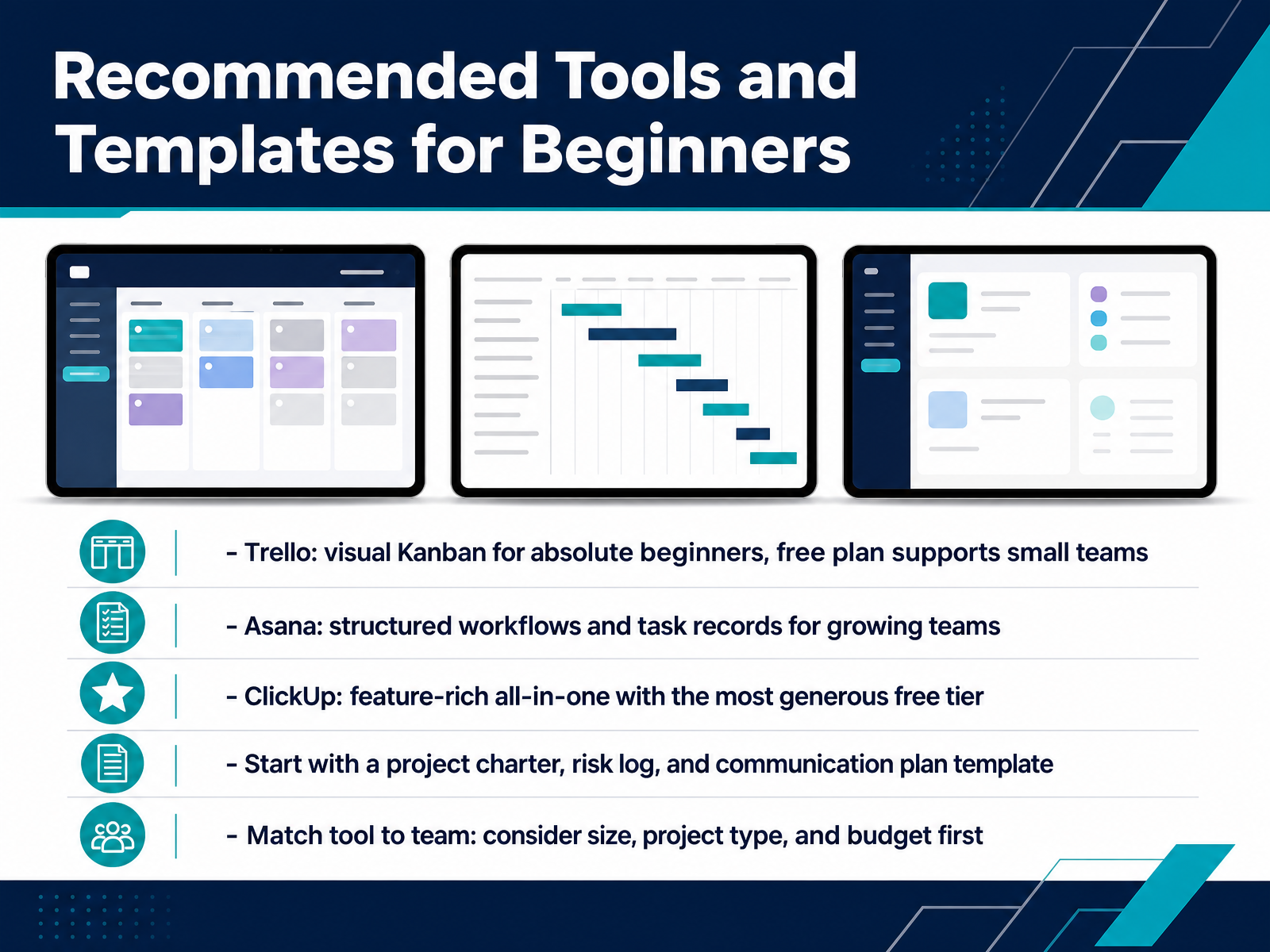
 - 12Recommended Tools and Templates for BeginnersNow, let's get practical with tools and templates you can actually start using today. For absolute beginners, Trello is your best friend. Its visual Kanban boards let you drag and drop tasks, and the generous free plan supports small teams beautifully. It's the fastest way to get a real project running, often in under twenty minutes. As your team grows and you need more structure, Asana is a smart next step. It treats every task as a permanent record, so six months later you can still see exactly why a decision was made. If you want a ton of features on a budget, ClickUp offers the most generous free tier of any tool, but it does have a steeper learning curve. Beyond software, I strongly recommend you always start with three simple templates: a project charter to define your scope, a risk log, and a communication plan. Remember, the right tool depends on your team's size, the type of project, and your budget. Don't pay for features you haven't actually needed yet. In fact, the best tool is simply the one your team will actually open on a Tuesday morning. Up next, we'll map out your very first concrete steps in project management.
 techstackdaily.comrelvnt.io2 min
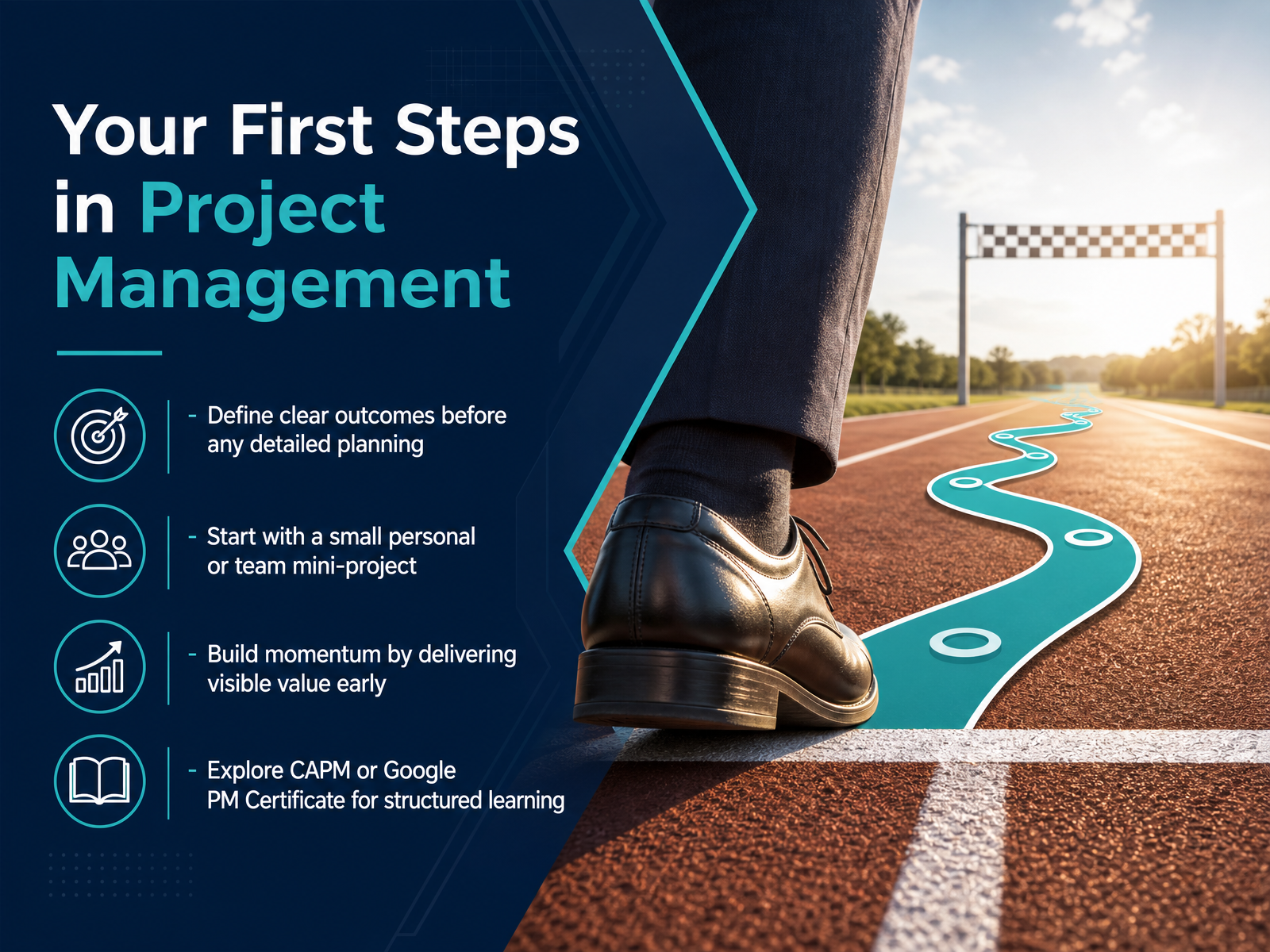
 - 13Your First Steps in Project ManagementAnd here we are at your first steps. Before you dive into detailed planning, get very clear on what done looks like. Define the concrete outcome you want to achieve. Then, pick a small project to practice with. Something low risk, like organizing team onboarding docs or planning a simple offsite. The goal is to deliver visible value fast. When people see quick, useful results, momentum builds naturally. And if you want a structured path to build these skills, a certification like the CAPM or the Google Project Management Certificate gives you a solid, practical foundation. Start small, clarify your outcome, and build from there. You have everything you need to begin. Thank you for joining, and good luck on your very first project.
 1 min
1 min
Take the deck with you
Download this course as a file — free, no sign-up needed.
- PDF handoutEvery slide page, ready to print or share.14 pages · 4.1 MBDownload
- Narrated PowerPointThe deck that presents itself — every slide carries the digital human's narration video.14 pages · 13.5 MBDownload
- PowerPoint slidesThe full deck as a .pptx — open it in PowerPoint, Keynote, or Google Slides.14 pages · 4.0 MBDownload
Free to use in your own training — please keep the PersonWise credit page at the end.
Have your own deck? Turn it into a course
Sources consulted
Web sources consulted while building this course.
- Project Success: Definition and Key Drivers | PMI Blog — pmi.org
- https://www.pmi.org/-/media/pmi/documents/public/pdf/learning/thought-leadership/project_success_report_2024.pdf — pmi.org
- Pulse of the Profession® 2026: Driving Success in Complex Projects | PMI — pmi.org
- New PMI Research Reveals Strategy-Execution Gap Is Undermining Transformation And How to Close It — pmi.org
- Pulse of the Profession — pmi.org
- New data: The 2026 State of SPM report | Tempo — tempo.io
- 135+ project management statistics and trends for 2026 — monday.com
- The State of Project Management 2026 — pmsolutions.com
- Project Success — pmi.org
- Project Management Methodology Adoption: Waterfall vs. Agile vs. Hybrid (2026-27 Data) — apmic.org
- Agile, Traditional, and Hybrid — pmi.org
- IDC Survey Spotlight: Has Agile Peaked as a Development Framework? — my.idc.com
- Deliberate or Emergent? How Organizations Adopt Hybrid Project Management — sage.cnpereading.com
- Back to Basics, Part 3: The Approach — velociteach.com
- The State of Project Management — hs-143758361.f.hubspotemail-eu1.net
- https://www.pmi.org/-/media/pmi/documents/public/pdf/learning/thought-leadership/pulse/pulse_of_the_profession_2025-1.pdf?rev=2910b8cb04c04fb6a47ef24f854175c9 — pmi.org
- 2026 Top Challenges and Solutions: Project Management | APQC — apqc.org
- 2026-27 Report on Project Failure Rates & Root Causes: Original Data & Analysis — apmic.org
- Best Project Management Tools for Beginners… | Tech Stack Daily — techstackdaily.com
- Best Project Management Software for Small Teams in 2026: Verified Pricing & Honest Verdicts — relvnt.io