Begin
15 pages · ~30 min
Responsible AI in Business Decisions
Equips business leaders to understand how Responsible AI principles influence decision-making, covering ethics, risk, and governance in AI adoption.
A digital instructor presents all 15 pages. Hold “Ask” at any point and ask out loud — the answer comes from this course. No sign-up needed.
What you’ll learn
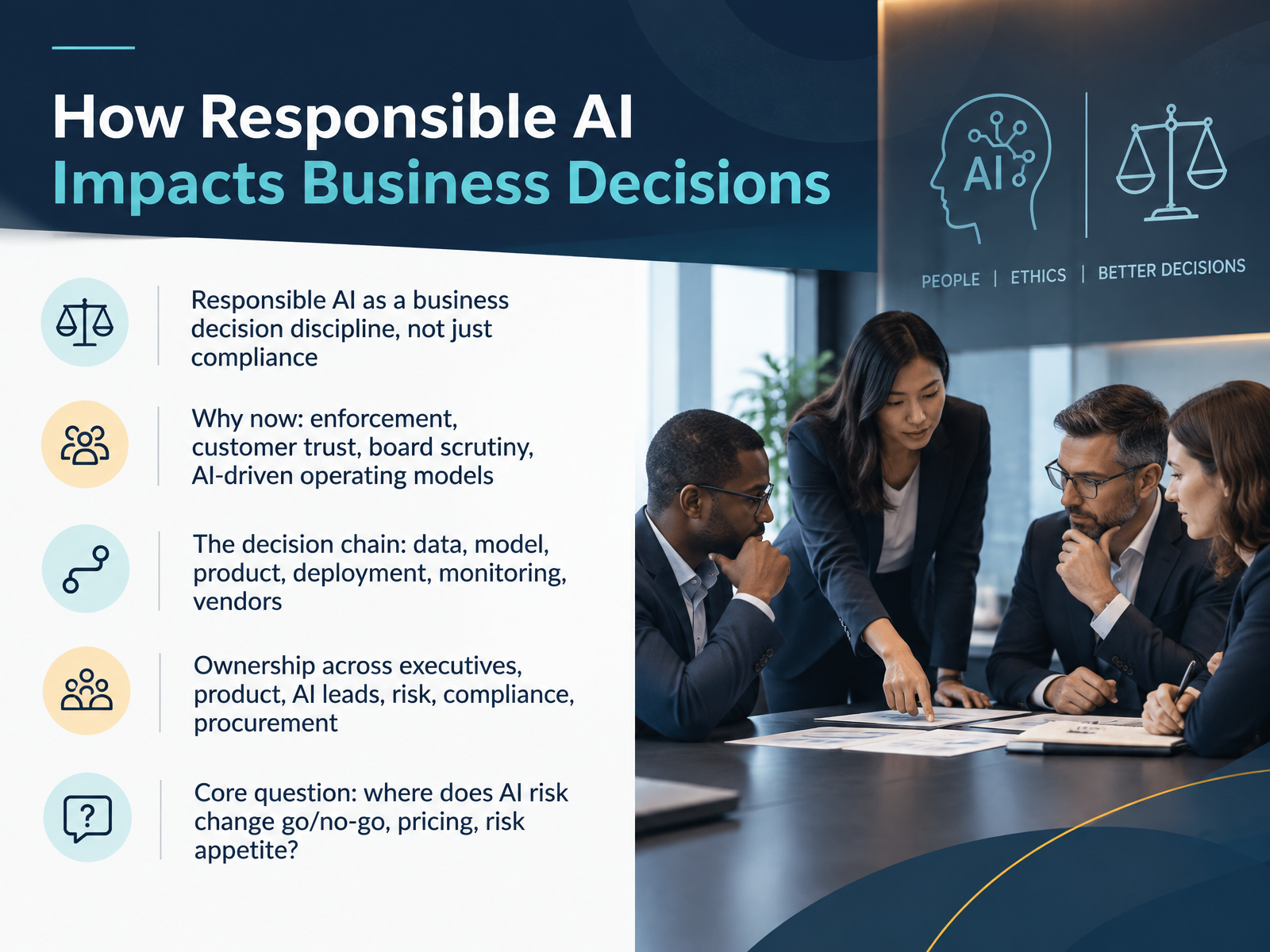
- 01How Responsible AI Impacts Business DecisionsWelcome. This course is about how responsible AI changes business decisions, not just how it satisfies regulators. We will treat responsible AI as a decision discipline. It should shape what you build, what you price, what you approve, and what you refuse. Why now? Enforcement is real. Customer trust is measurable. Boards are asking harder questions. And AI now sits inside operating models, not beside them. So the decision chain matters. Data, model, product, deployment, monitoring, and vendors. A weak control anywhere in that chain weakens the whole decision. Ownership must be explicit across executives, product, AI leads, risk, compliance, and procurement. If a model owner is unnamed, risk acceptance becomes guesswork. If human review is undefined, a go decision is harder to defend. The core question for this course is simple. Where does AI risk change your go or no-go call, your pricing, or your stated risk appetite? Keep that question in mind. Next, we look at why responsible AI is now an executive priority.oecd.orgblogs.microsoft.comtheboardaiguide.com+22 min
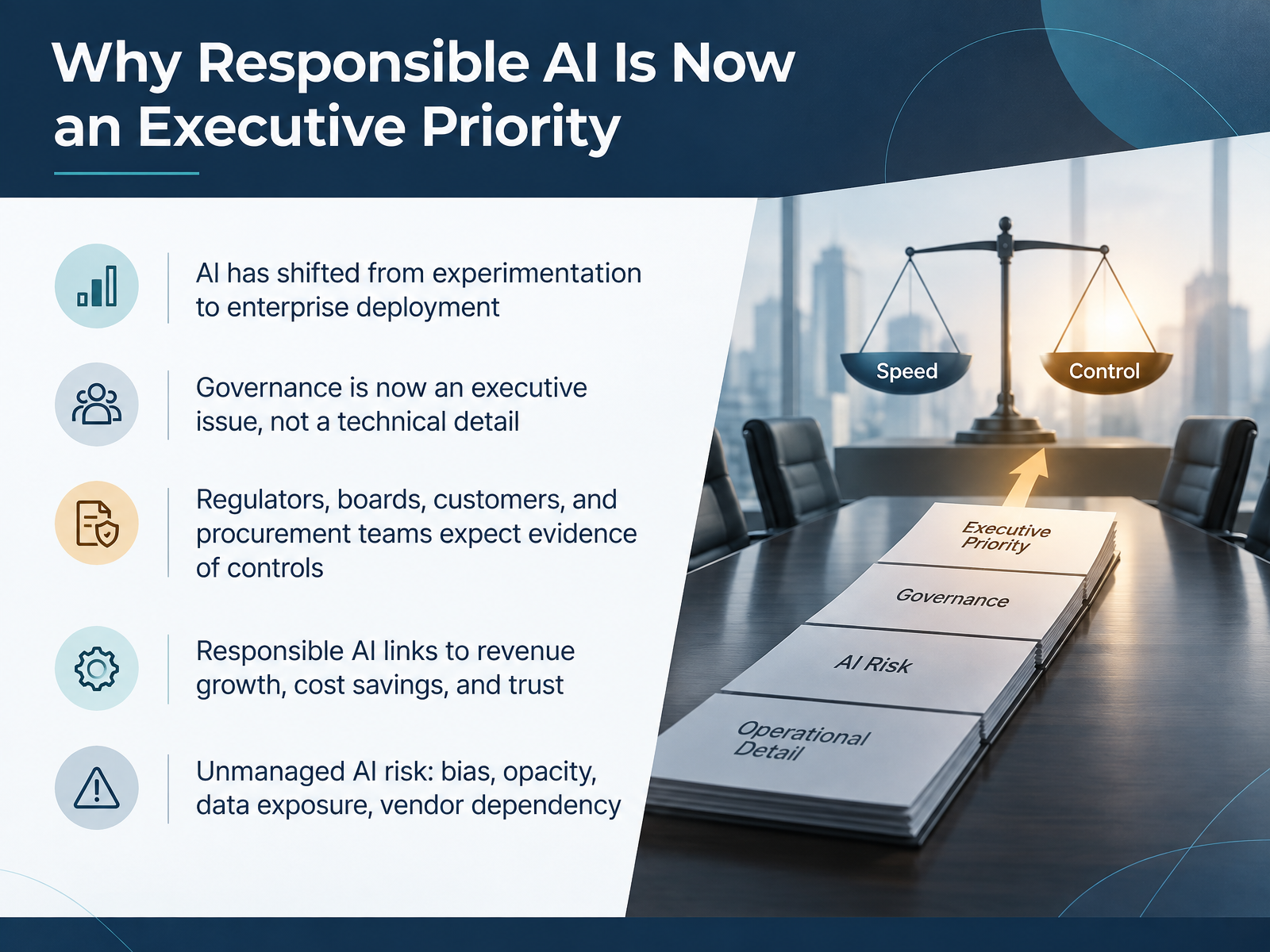
- 02Why Responsible AI Is Now an Executive PriorityLet's talk about why Responsible AI has become an executive priority, not just a technical topic. AI has shifted from experimentation to enterprise deployment. It now shapes decisions in finance, HR, supply chain, and customer operations. That means governance sits with the executive team, not only with engineers. Regulators, boards, customers, and procurement teams now expect evidence of controls. If that evidence is missing, a deal can stall, or a board question becomes hard to answer. Responsible AI is also tied to growth and cost. Research from EY found that companies with real-time monitoring and oversight committees were far more likely to report revenue growth and cost savings. So governance is not a brake. It is a condition for scaling AI with confidence. Unmanaged AI risk shows up as bias, opacity, data exposure, and vendor dependency. The practical question for your team is this: who owns the model, who accepts the risk, and where does human review apply? Hold those three answers, because next we move from principles to the decision criteria you will use in practice. Core Concepts: From Principles to Decision Criteria.
 oecd.orgblogs.microsoft.comtheboardaiguide.com+22 min
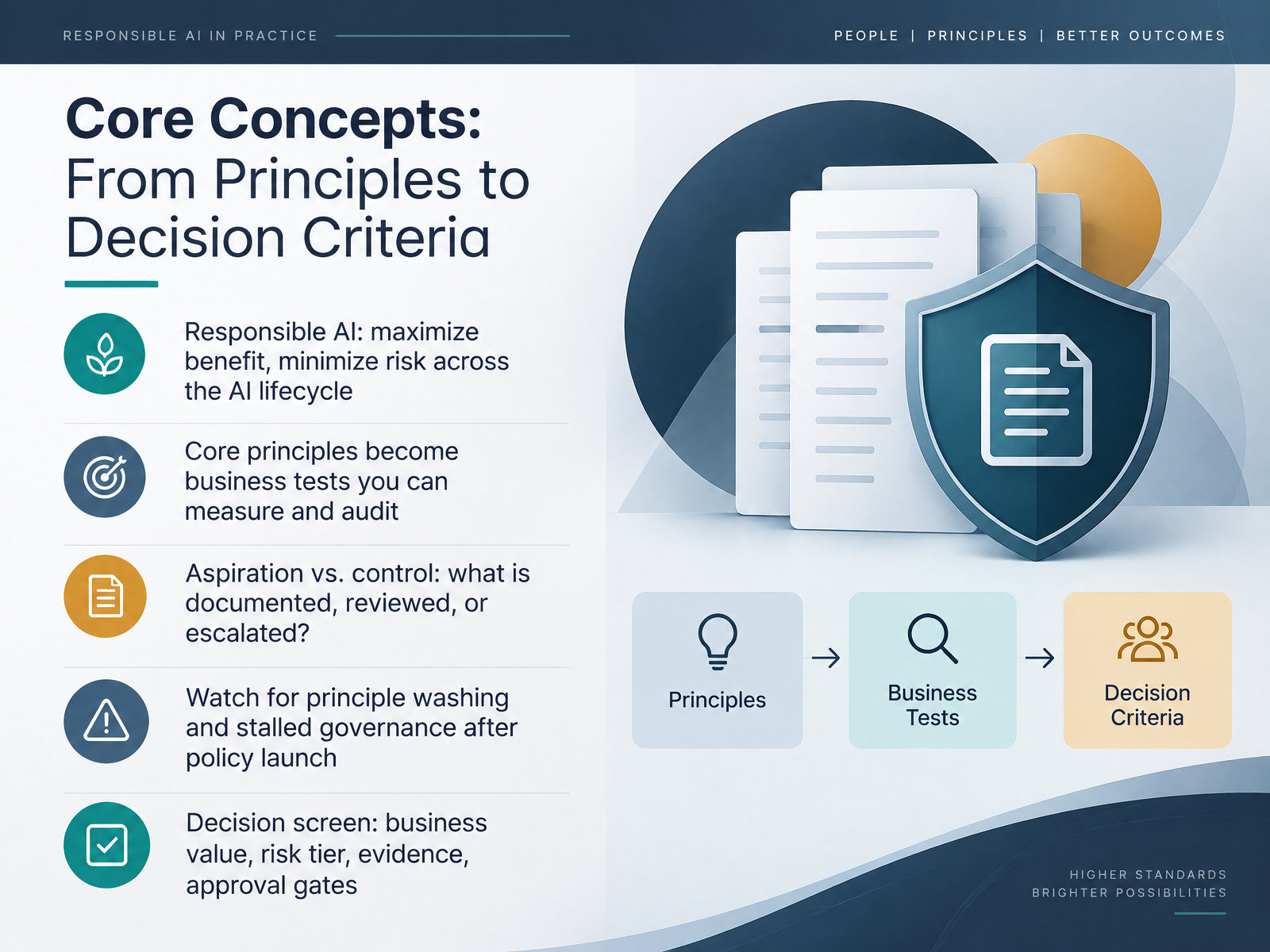
- 03Core Concepts: From Principles to Decision CriteriaLet's move from principles to something you can actually apply: decision criteria. Responsible AI means maximizing benefit while minimizing risk across the entire AI lifecycle. That definition only matters if your core principles become business tests you can measure and audit. So ask a blunt question. Is this aspiration, or is it control? In practice, control means something is documented, reviewed, or escalated. If a model owner can't show you which of those three happened, the principle hasn't been operationalized. Watch for two failure patterns. Principle washing, where the language stays broad and nothing changes in the workflow. And stalled governance, where a policy launches but the approval process doesn't move. A practical decision screen has four parts: business value, risk tier, evidence, and approval gates. Take a hiring model. High value, high risk tier. Evidence might include bias testing and human review records. The gate is a named approver accepting the residual risk. If that control is missing, the deployment decision becomes harder to defend. Where uncertainty remains, state it plainly, and ask the next practical question: who accepts this risk, and what evidence do they need to see? Next, let's look at Where AI Risk Enters the Business Decision Chain.
 docs.aws.amazon.comoecd.orgey.com+22 min
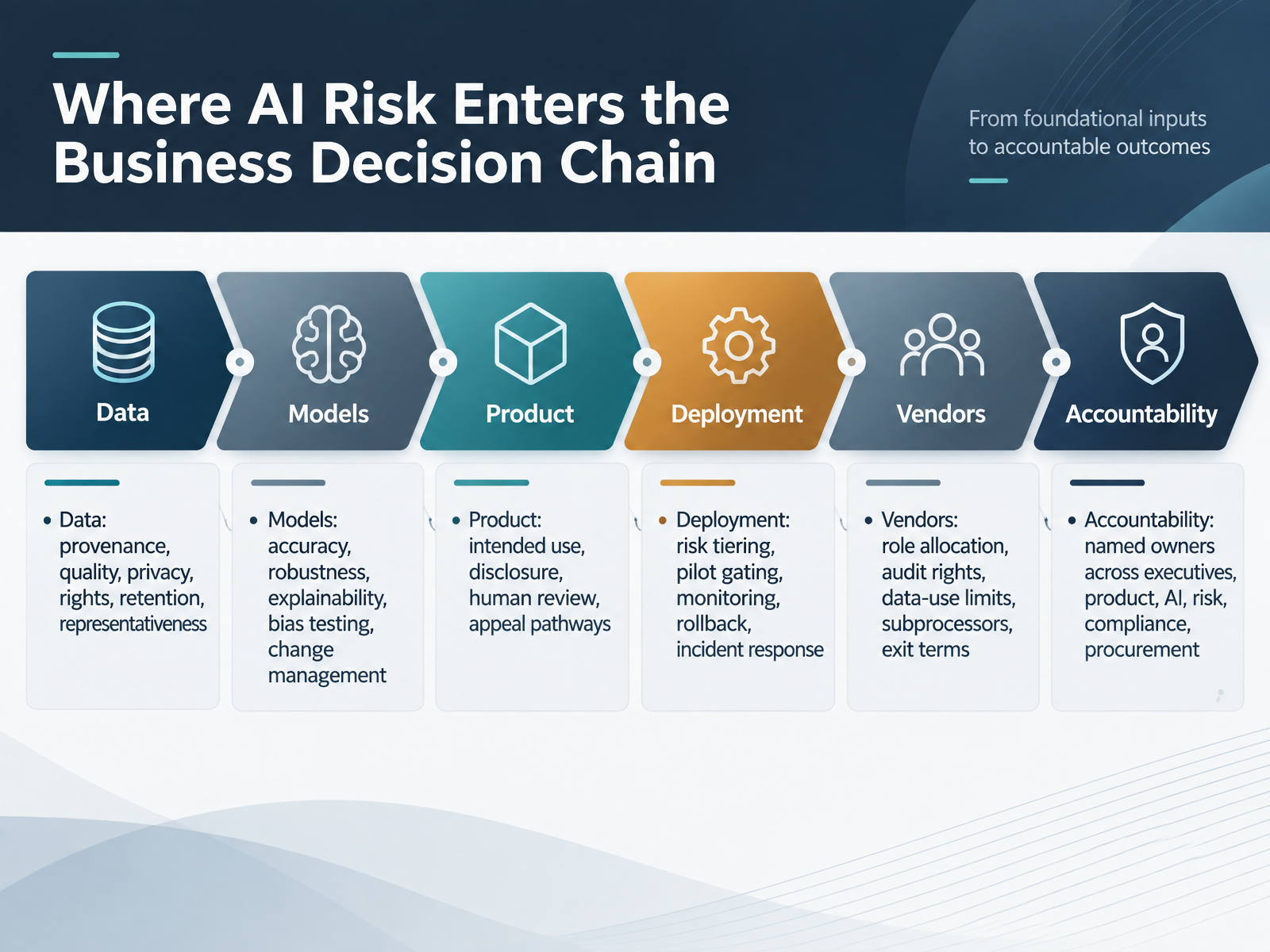
- 04Where AI Risk Enters the Business Decision ChainLet's walk through where AI risk actually enters the business decision chain. It enters at six points. First, data: provenance, quality, privacy, rights, retention, and representativeness. If provenance is unclear, your privacy sign-off becomes harder to defend. Second, models: accuracy, robustness, explainability, bias testing, and change management. A silent model update can quietly invalidate last quarter's approval. Third, product: intended use, disclosure, human review, and appeal pathways. If there is no appeal route, every contested decision lands on your support and legal teams. Fourth, deployment: risk tiering, pilot gating, monitoring, rollback, and incident response. Fifth, vendors: role allocation, audit rights, data-use limits, subprocessors, and exit terms. If audit rights are missing, you cannot verify what the vendor claims. Sixth, accountability: named owners across executives, product, AI, risk, compliance, and procurement. One practical question to ask now: for each of these six layers, who is the named owner, and where is that documented? Next, we move to the regulatory and compliance landscape.
 oecd.orgblogs.microsoft.comtheboardaiguide.com+22 min
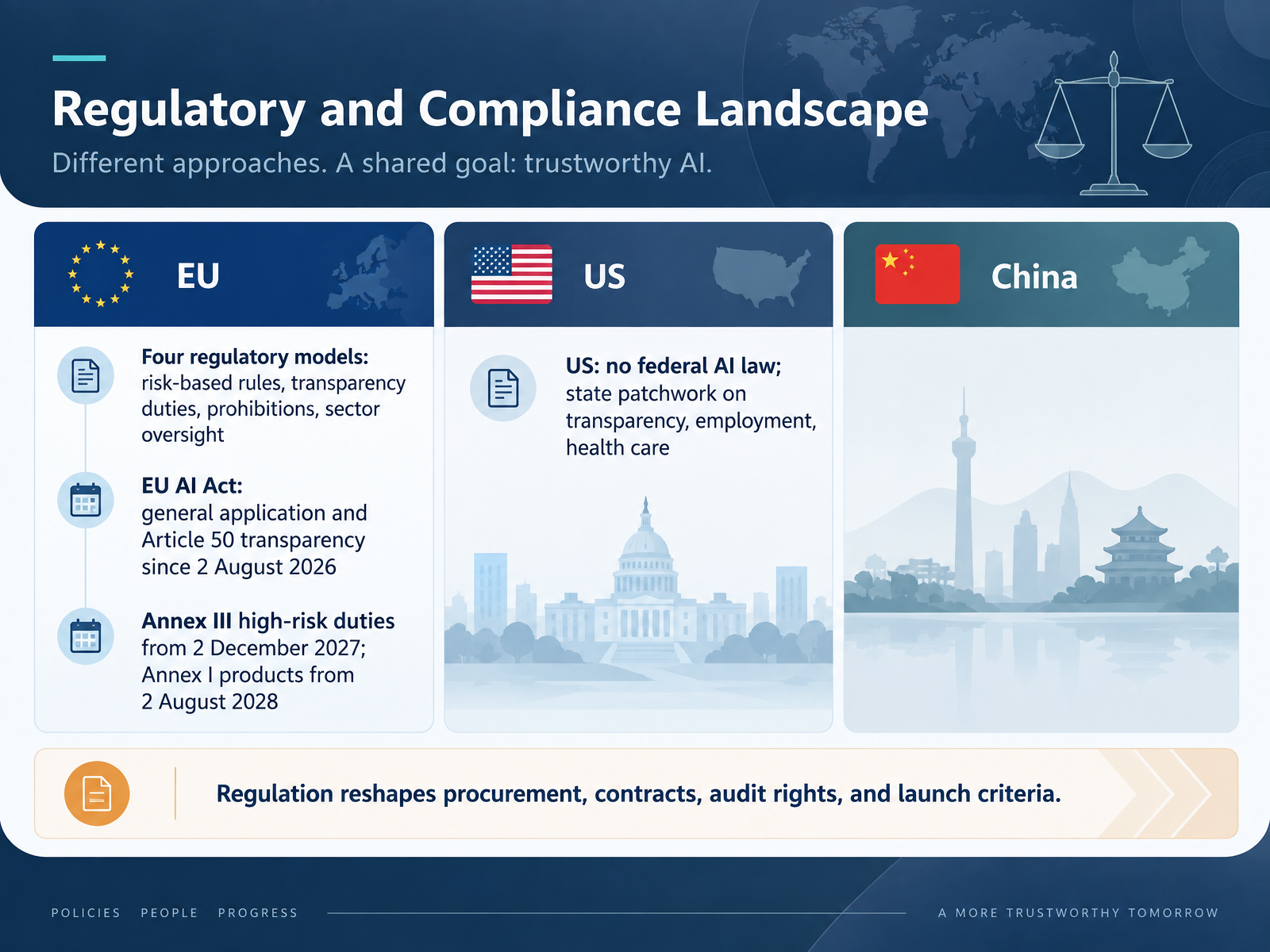
- 05Regulatory and Compliance LandscapeLet's look at the regulatory and compliance landscape. There are four models to plan for: risk-based rules, transparency duties, outright prohibitions, and sector oversight. In the EU, general application and Article 50 transparency have applied since August 2, 2026. Annex III high-risk duties, covering areas like hiring and credit, apply from December 2, 2027. Annex I product-embedded systems follow on August 2, 2028. In the US, there is no federal AI law, so state rules on transparency, employment, and health care form a patchwork. If you sell or operate across borders, the strictest applicable rule becomes your real baseline. Regulation does not stay in legal review. It reshapes your procurement terms, contract clauses, audit rights, and launch criteria. So ask now: for each AI system, which regulatory model applies, and which approval gate does that trigger? Next, we turn to risk assessment and decision frameworks.
 digital-strategy.ec.europa.eupraxikon.comsummumconsultoria.es+22 min
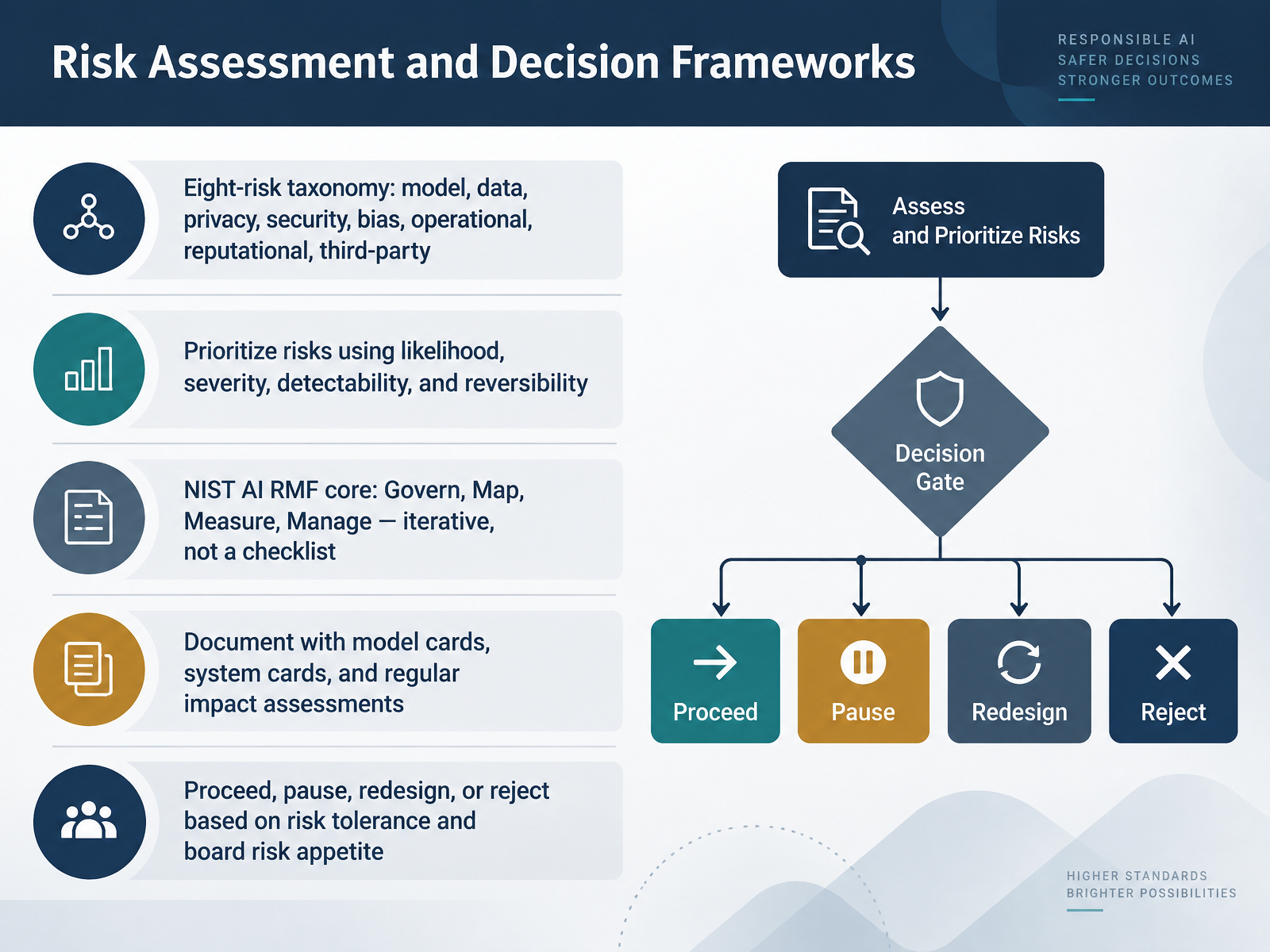
- 06Risk Assessment and Decision FrameworksLet's look at risk assessment and decision frameworks. Start with an eight-risk taxonomy: model, data, privacy, security, bias, operational, reputational, and third-party. Use it to force coverage. If a risk category has no named owner, that gap becomes your first action item. Then prioritize. Ask four questions: How likely is it? How severe? How detectable? And how reversible? A reversible incident is a different decision than an irreversible one. The NIST AI RMF core gives you four functions: Govern, Map, Measure, and Manage. Treat them as iterative, not a checklist. Govern sets policy and risk tolerance. Map frames context and impacts. Measure tests and benchmarks. Manage allocates treatment and response. Document as you go, with model cards, system cards, and regular impact assessments. Clear ownership and human review are what make those documents defensible. Then decide. Proceed, pause, redesign, or reject, based on your risk tolerance and board risk appetite. Before approving, ask who owns the residual risk. Next, we move to bias, fairness, and business consequences.
 nist.govairc.nist.govairc.nist.gov+22 min
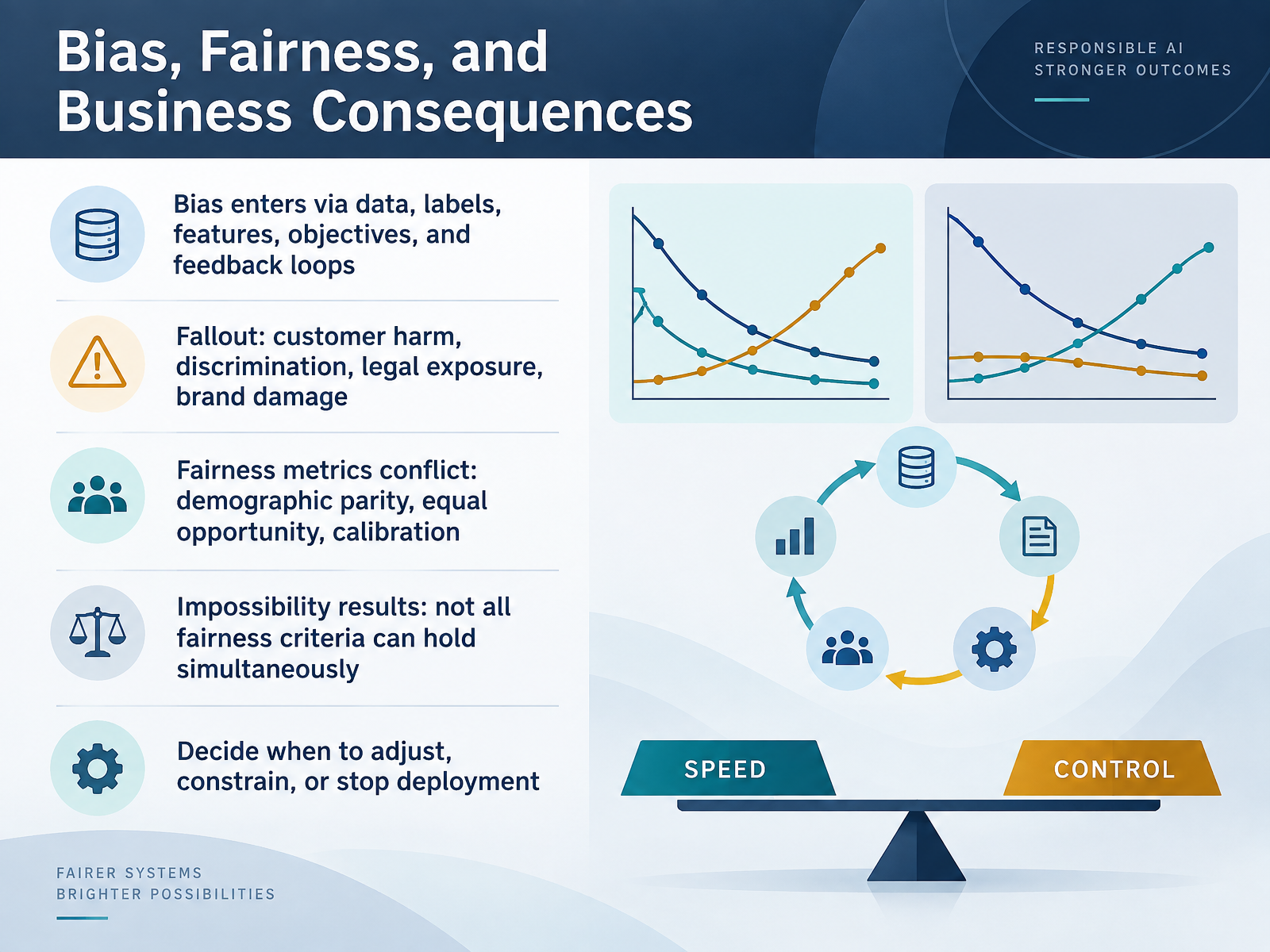
- 07Bias, Fairness, and Business ConsequencesNow let's talk about bias, fairness, and business consequences. Bias rarely enters through one door. It comes in through data, labels, features, objectives, and feedback loops. If your model learns from biased labels or proxy variables like postal code, that harm will show up in production, not in the demo. The fallout is concrete. Customer harm. Discrimination claims. Legal exposure. Brand damage. And once it is public, it is hard to contain. Fairness metrics also conflict. Demographic parity, equal opportunity, and calibration cannot all hold at the same time. That is not a modeling failure. It is a mathematical impossibility result. So the real decision is not which metric is correct. It is which tradeoff your organization can defend, document, and monitor. Ask a practical question. When do we adjust the model, constrain deployment, or stop it altogether? Name the model owner, define the risk acceptance, and set the trigger for human review. That turns a fairness debate into a governance decision. Transparency, explainability, and customer trust come next.
 2 min
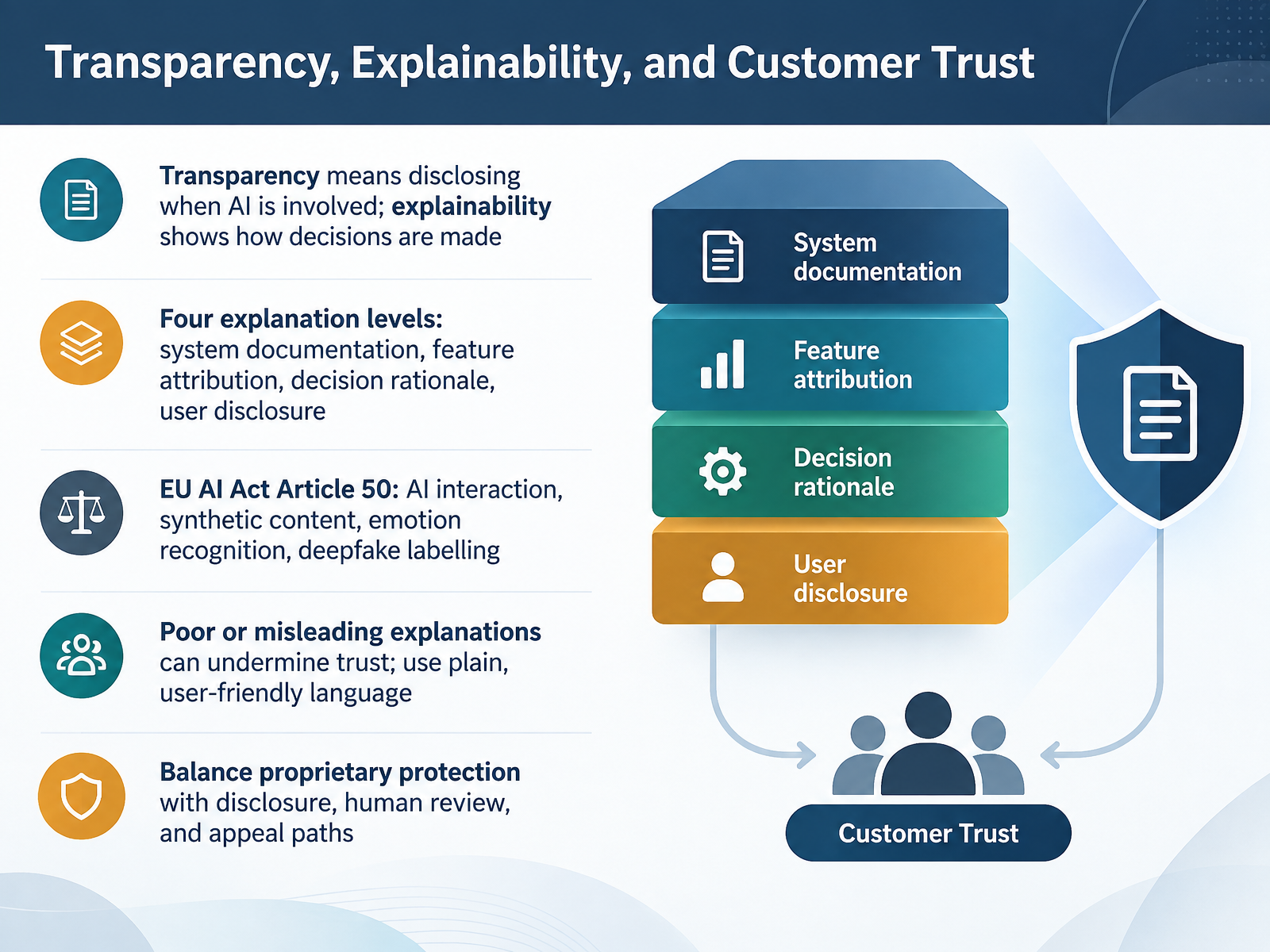
- 08Transparency, Explainability, and Customer TrustNow let's look at transparency, explainability, and customer trust. Transparency means disclosing when AI is involved. Explainability shows how a decision was made. If a customer cannot tell they are talking to a virtual agent, trust erodes fast. If a lender cannot explain why a loan was declined, that decision becomes harder to defend. There are four explanation levels to plan for. System documentation describes what the model is and what it is not. Feature attribution shows which inputs drove an output. Decision rationale gives the reason for a specific outcome. User disclosure tells people plainly that AI is in play. Under EU AI Act Article 50, disclosure is required for AI interaction, synthetic content, emotion recognition, and deepfake labelling. One caution. Poor or misleading explanations can undermine trust more than silence. So use plain, user-friendly language, and balance proprietary protection with disclosure, human review, and appeal paths. Next, accountability, governance, and human oversight.
 1 min
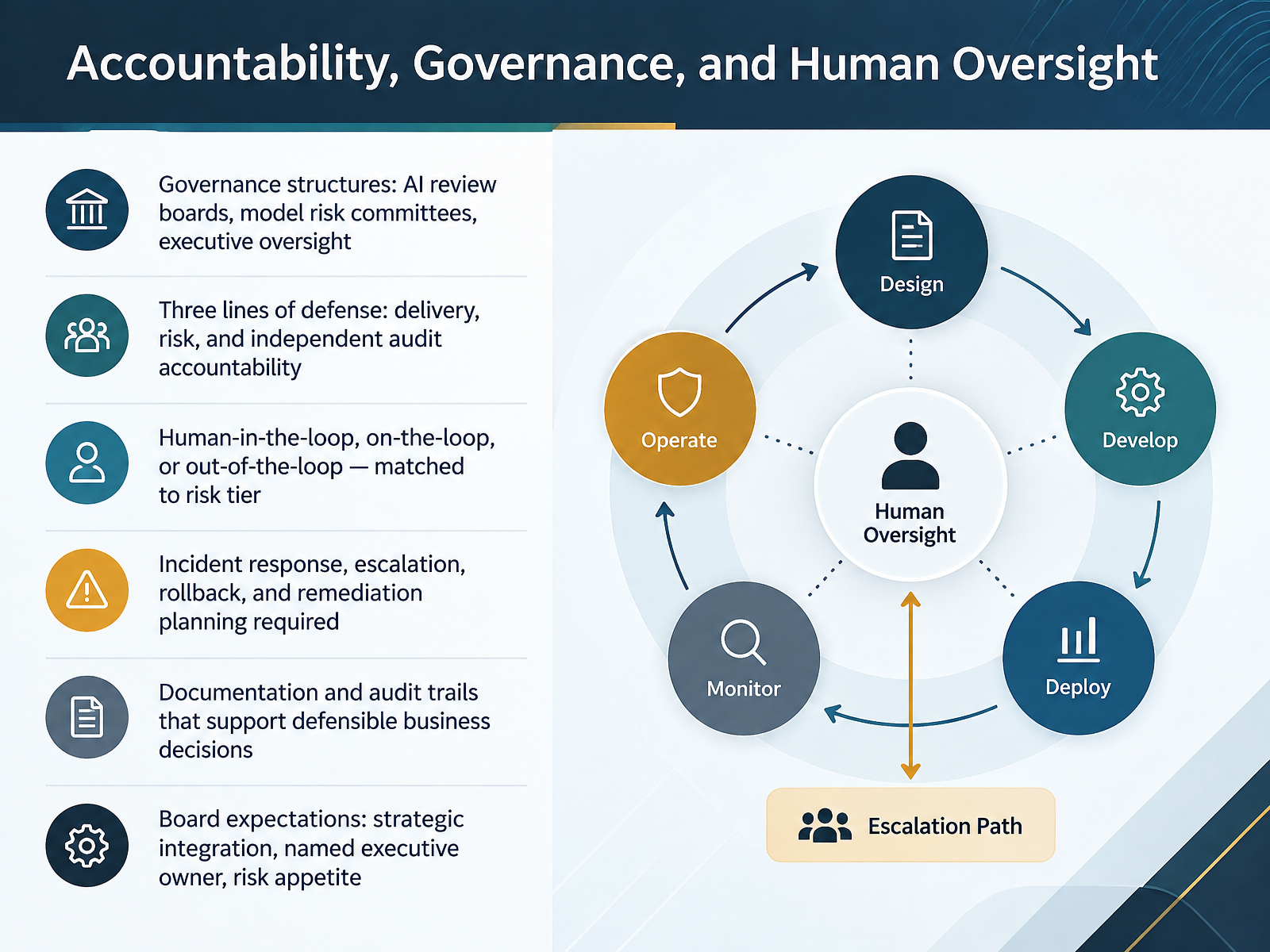
- 09Accountability, Governance, and Human OversightNow let's talk about accountability, governance, and human oversight. Governance structures matter because someone has to own the decision. An AI review board, a model risk committee, and executive oversight are the three places that ownership usually sits. If no named executive owns AI strategy, risk acceptance becomes harder to defend. The three lines of defense apply here too. Delivery builds it. Risk reviews it. Independent audit checks it. No single function should hold all three roles. Human oversight should match the risk tier. High-stakes decisions need human-in-the-loop, where a person must approve before action. Lower-risk systems can run human-on-the-loop, where someone monitors and can intervene. Out-of-the-loop only fits tightly constrained, low-risk tasks. And you need incident response. Escalation paths, rollback, and remediation plan, tested before you need them. Documentation and audit trails make decisions defensible. Your board should expect strategic integration, a named executive owner, and a clear risk appetite. Ask yourself: could you show an auditor who approved this system, and why? Next, we look at procurement and third-party AI risk.
 theboardaiguide.comoecd.orgblogs.microsoft.com+22 min
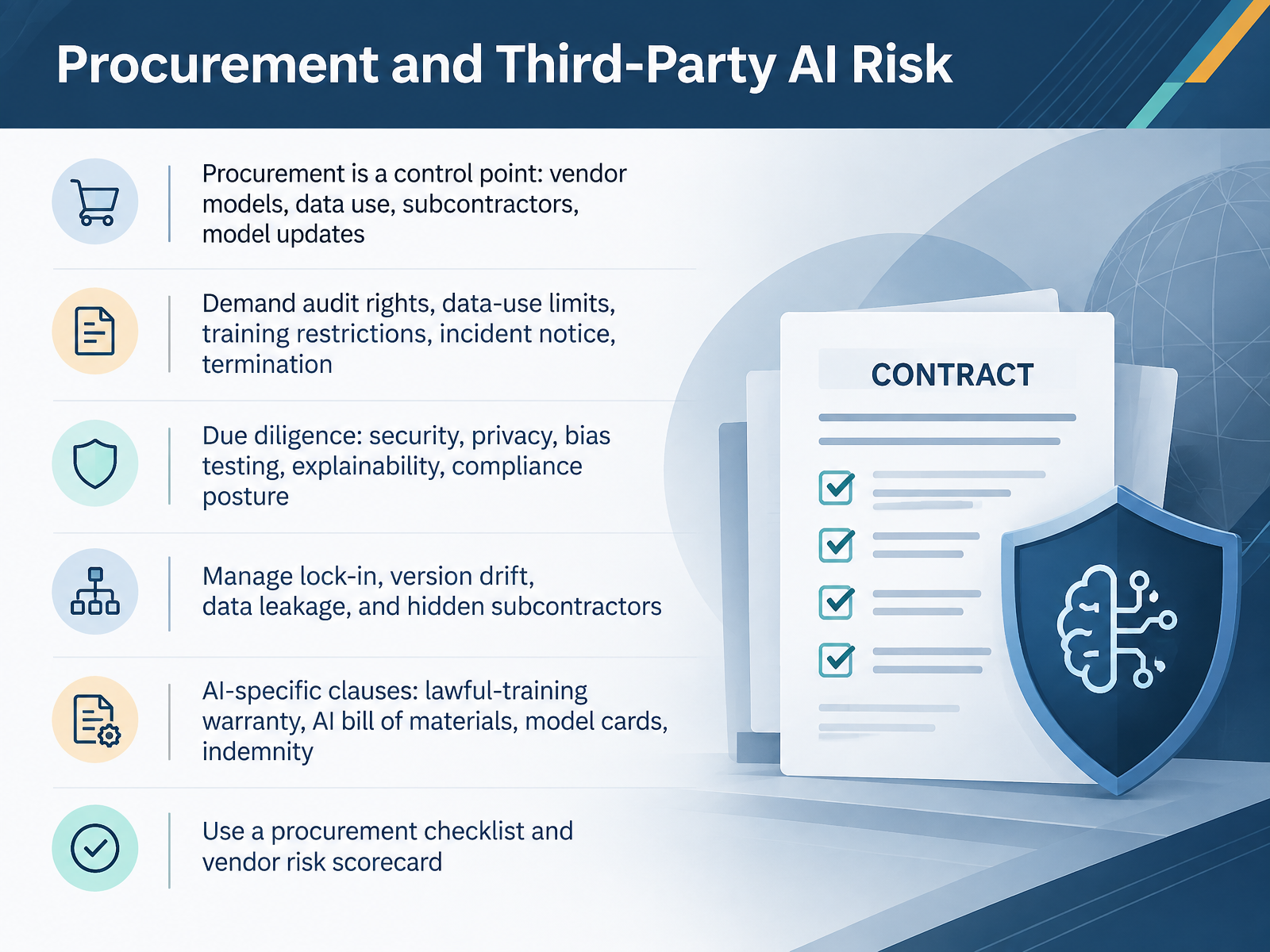
- 10Procurement and Third-Party AI RiskLet's talk about procurement and third-party AI risk. Procurement is a control point. Vendor models, data use, subcontractors, and model updates all sit here. If this control is missing, your business decisions become harder to defend. So demand audit rights, data-use limits, training restrictions, incident notice, and clean termination terms. Run due diligence on security, privacy, bias testing, explainability, and compliance posture. Then manage lock-in, version drift, data leakage, and hidden subcontractors. Add AI-specific clauses: a lawful-training warranty, an AI bill of materials, model cards, and indemnity. The practical next question is simple: does your contract actually bind these promises into obligations, or are they just sales claims? Use a procurement checklist and a vendor risk scorecard, so every AI buy gets the same disciplined review. That brings us to measuring business impact and return on investment.
 1 min
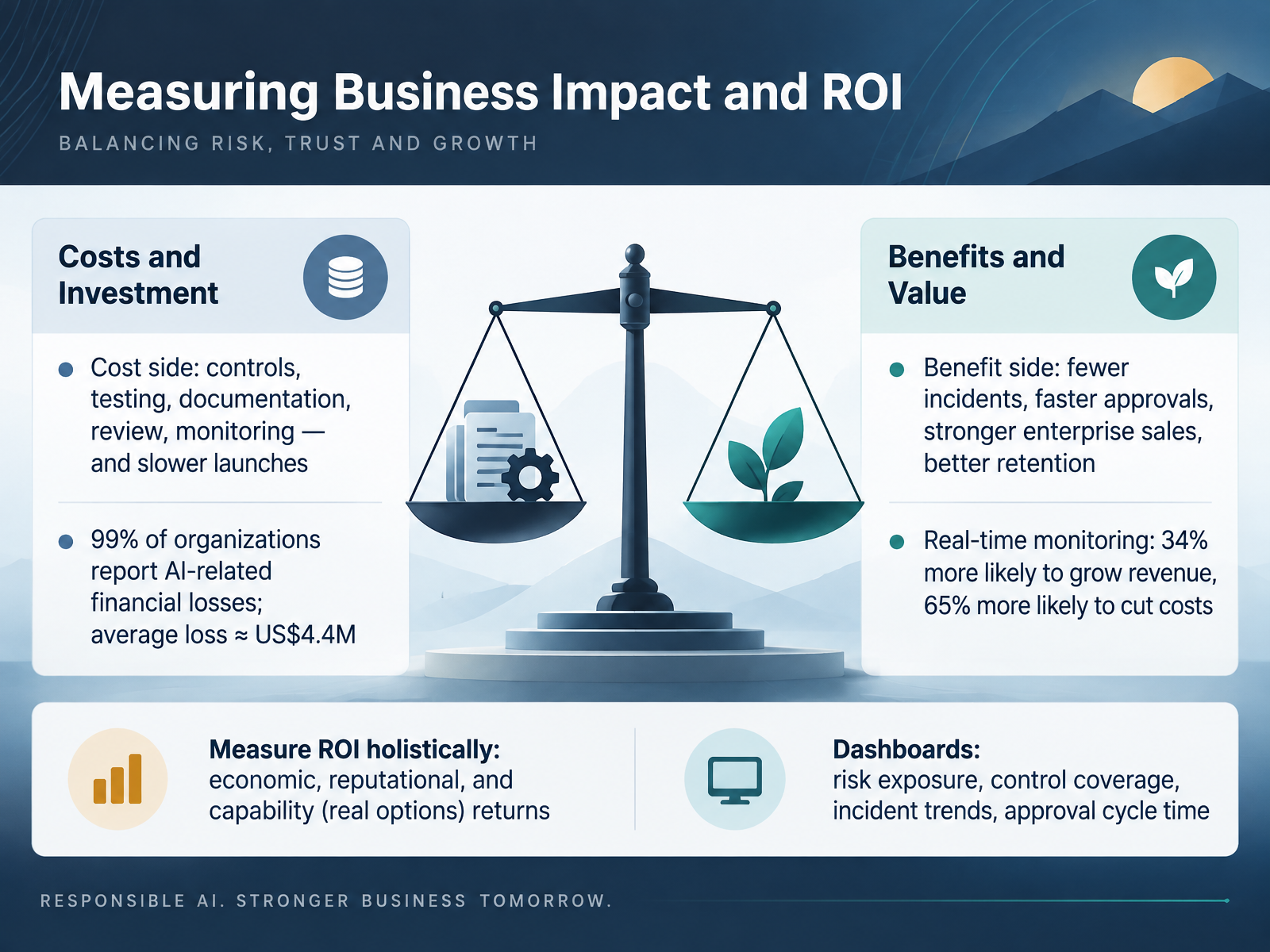
- 11Measuring Business Impact and ROINow let's look at how you measure the business impact and ROI of responsible AI. Start with the cost side. Controls, testing, documentation, human review, monitoring, and slower launches. These are real, and they show up early. The benefit side arrives later. Fewer incidents, faster approvals, stronger enterprise sales, better retention. Here is the case for urgency. Ninety-nine percent of organizations report AI-related financial losses, averaging approximately four point four million dollars. Now compare that with firms using real-time monitoring. They are thirty-four percent more likely to grow revenue, and sixty-five percent more likely to cut costs. So measure ROI holistically. Economic returns, reputational returns, and capability returns, what some call real options. For example, a governance platform built for one model can be reused across many. If you only track cost avoidance, your business case will look defensive. If you track capability and reputation, it becomes a growth story. Your next practical question: which three metrics will you put on the dashboard? Risk exposure, control coverage, incident trends, and approval cycle time are a strong start. That gives you evidence, not opinion, when you defend the investment. Next, we move into the regulatory landscape, with Regulatory Deep Dive: EU AI Act and US State Laws.
 oecd.org2 min
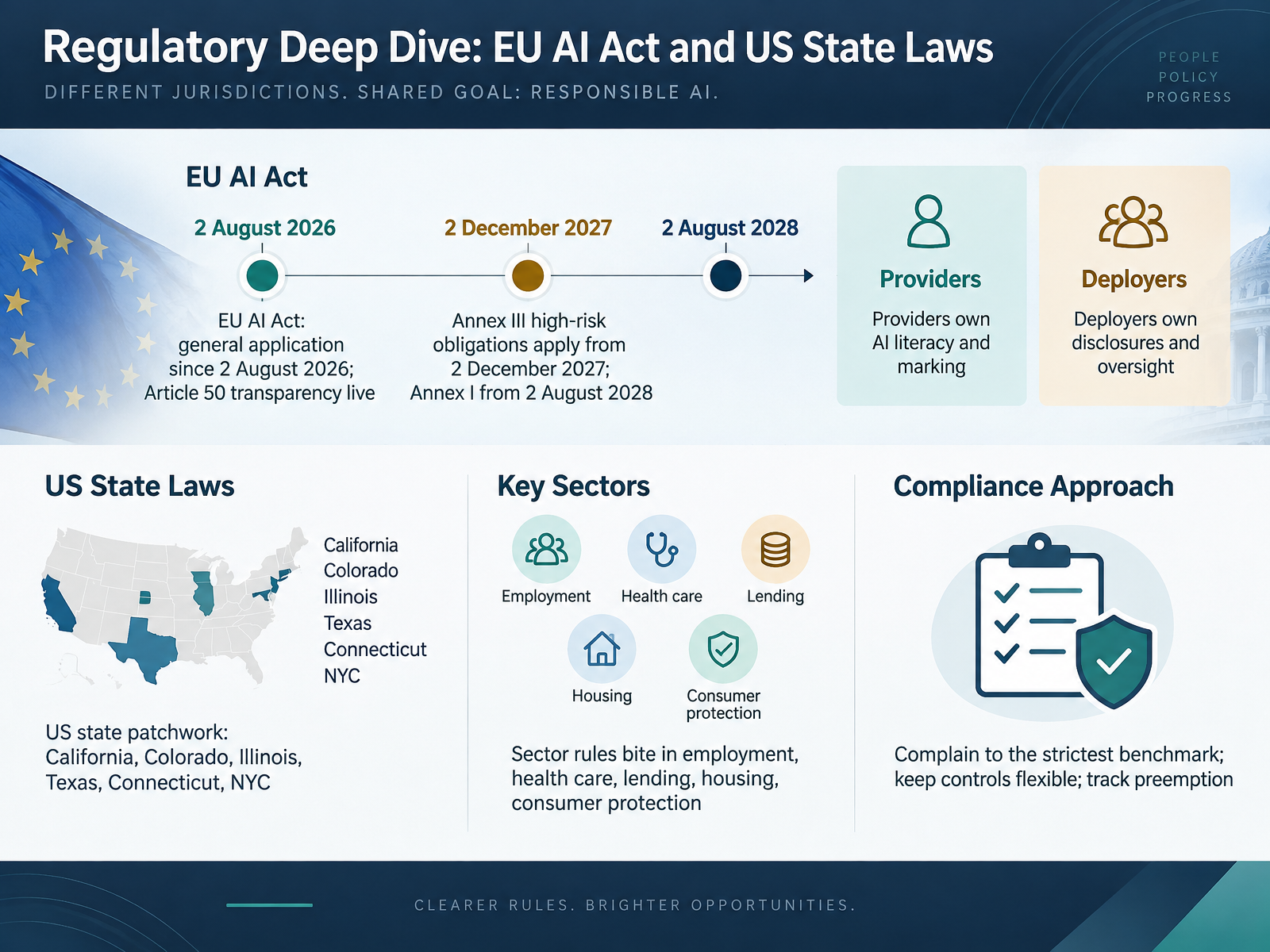
- 12Regulatory Deep Dive: EU AI Act and US State LawsLet's look at the regulatory picture, starting with Europe. The EU AI Act has applied generally since the second of August, 2026, and Article 50 transparency is live now. The high-risk obligations land later. Annex III, the sensitive use cases, apply from the second of December, 2027. Annex I product-embedded systems, from the second of August, 2028.
So who owns what? Providers own AI literacy and content marking. Deployers own disclosures and oversight. If a chatbot disclosure is missing, that is your deployer obligation, and no procurement clause moves it.
Then there is the US patchwork. California, Colorado, Illinois, Texas, Connecticut, and New York City all impose different duties. Sector rules bite hardest in employment, health care, lending, housing, and consumer protection. Your practical benchmark: comply to the strictest standard, keep controls flexible, and track preemption. That is how you stay defensible in every jurisdiction. Next, our implementation roadmap and action plan.
 digital-strategy.ec.europa.eupraxikon.comsummumconsultoria.es+22 min
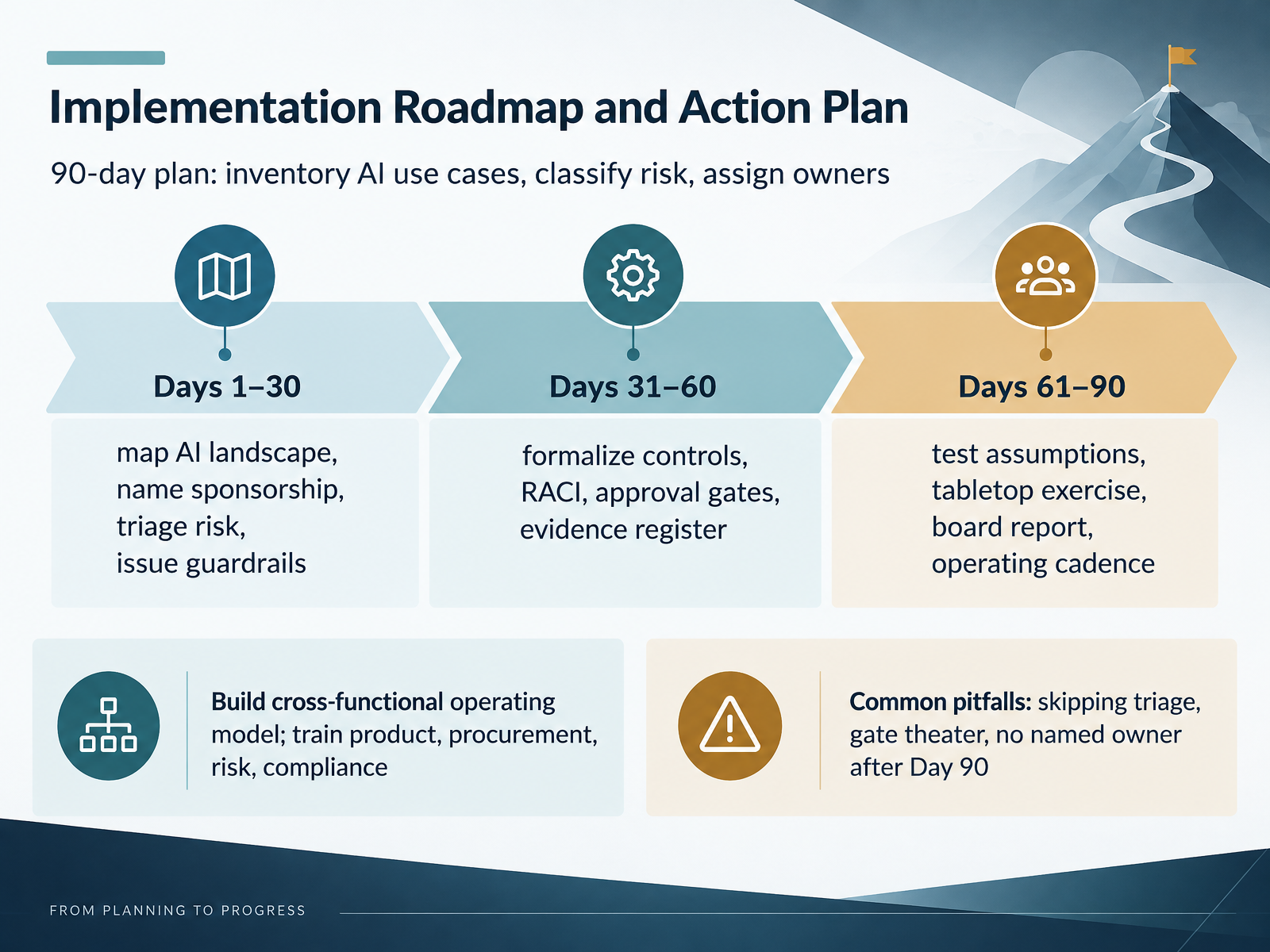
- 13Implementation Roadmap and Action PlanLet's turn the strategy into a plan you can actually defend. Ninety days, three phases. Days one to thirty: map your AI landscape, name an executive sponsor, triage risk, and issue interim guardrails. If nobody owns the inventory, your approvals later have no foundation. Days thirty-one to sixty: formalize controls, define a RACI, stand up approval gates, and open an evidence register. A gate without evidence is just theater. Days sixty-one to ninety: test your assumptions, run a tabletop exercise, report to the board, and set an operating cadence. Build a cross-functional model and train product, procurement, risk, and compliance together. Three pitfalls to avoid: skipping triage, gate theater, and having no named owner after day ninety. That last one is how systems quietly degrade. So ask now: who owns this on day ninety-one? Next, we'll apply this to real decisions in Decision Scenarios and Role-Based Applications.
 oecd.orgblogs.microsoft.comtheboardaiguide.com+22 min
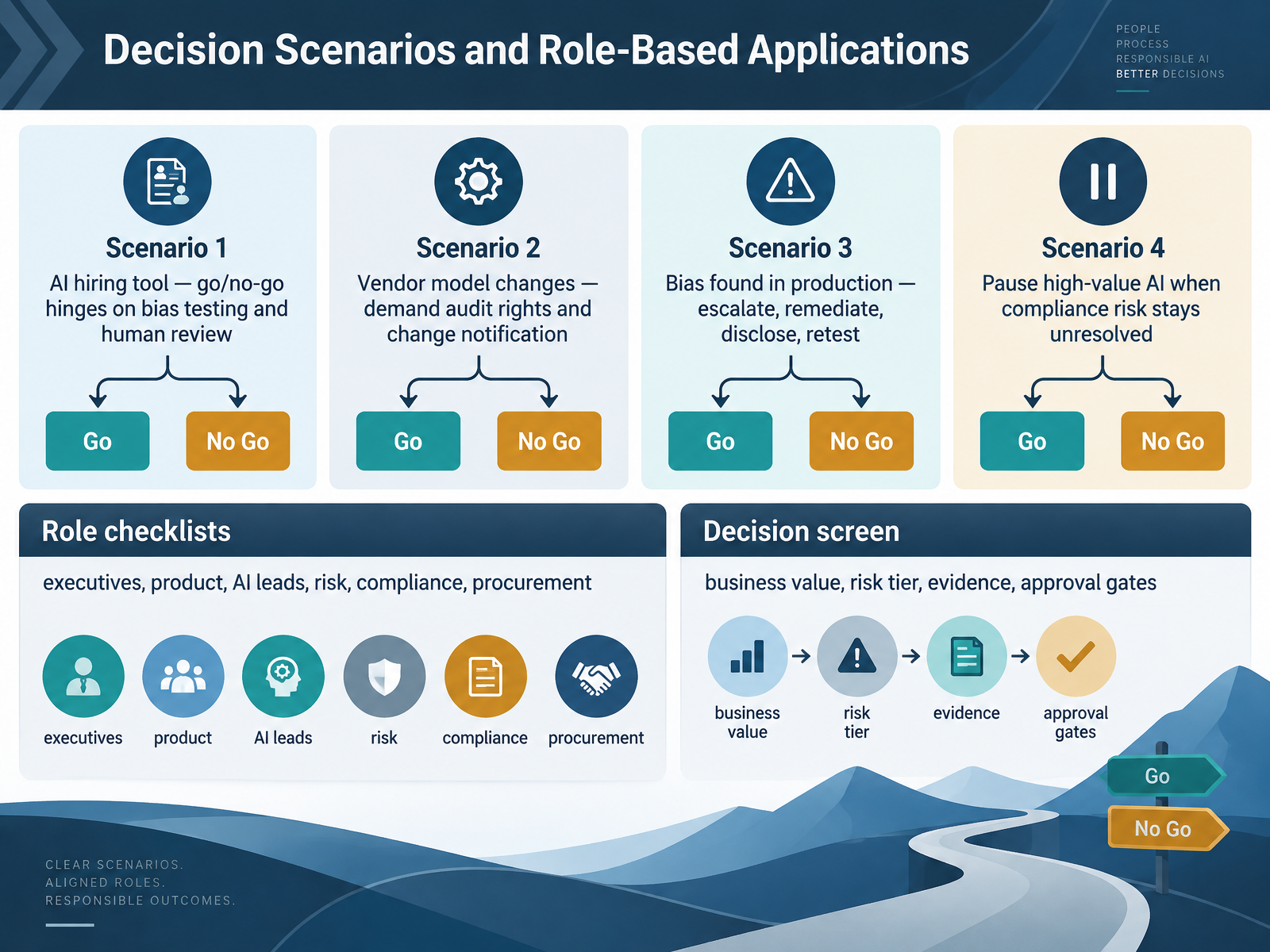
- 14Decision Scenarios and Role-Based ApplicationsLet's put all of this into decision scenarios you can recognize. Scenario one: an AI hiring tool. Go or no-go hinges on bias testing and documented human review. If you cannot show both, that hiring decision becomes hard to defend.
Scenario two: a vendor changes the model. Demand audit rights and advance change notification. Without notice, you discover a new risk tier during an audit, not before.
Scenario three: bias found in production. Escalate, remediate, disclose, retest. Skipping the disclosure step turns a technical fix into a trust problem.
Scenario four: pause high-value AI when compliance risk stays unresolved. Value does not override an open risk acceptance.
Now run the role checklists: executives set risk appetite; product owns use-case evidence; AI leads own model performance; risk and compliance challenge it; procurement locks in audit and change clauses. Then apply the decision screen: business value, risk tier, evidence, and approval gates. That screen is what makes a go decision defensible.
Next, let's pull this together with key takeaways and next steps.
 theboardaiguide.com1 min
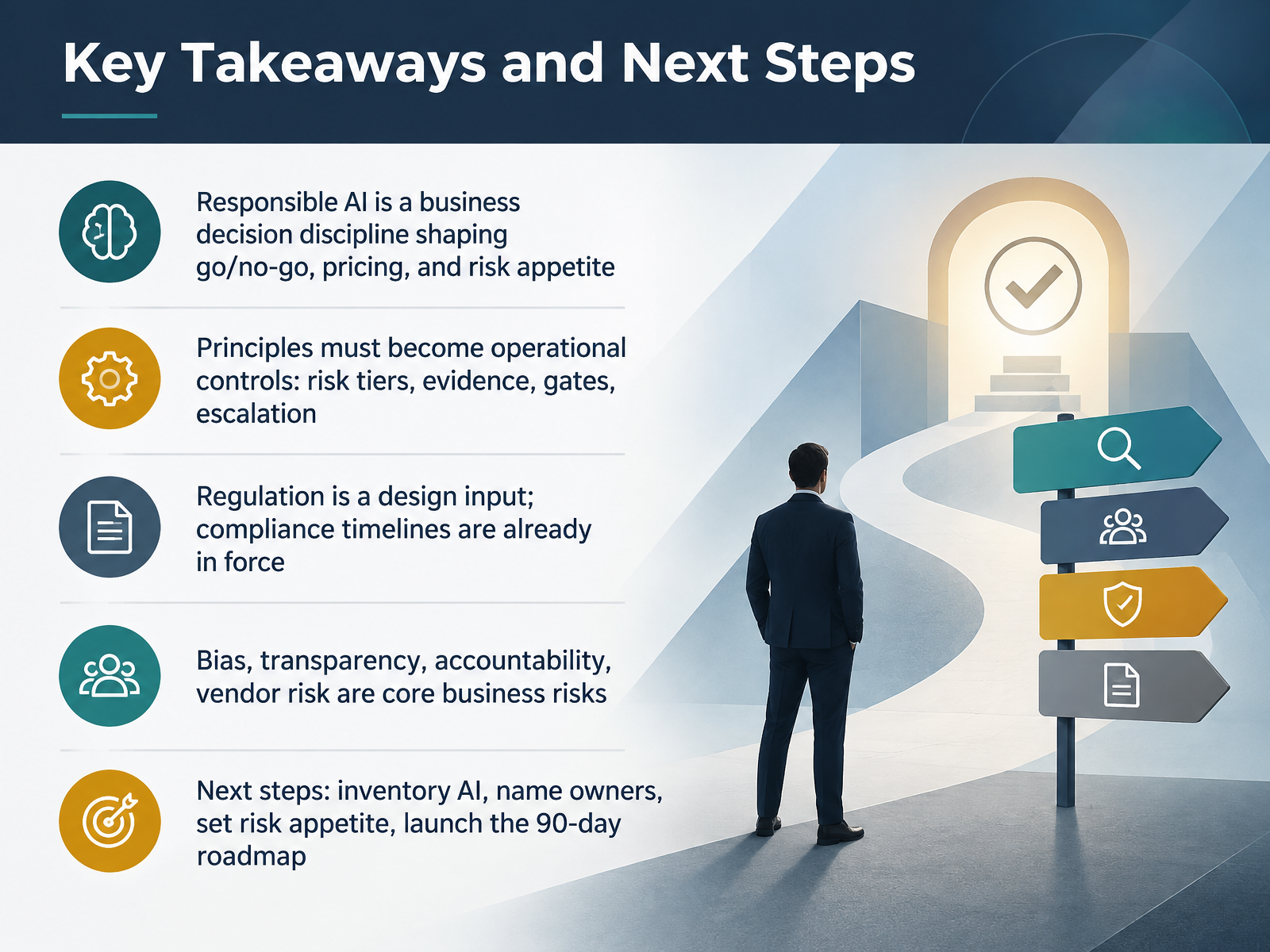
- 15Key Takeaways and Next StepsLet's close with what matters. Responsible AI is a business decision discipline. It shapes go, no-go, pricing, and risk appetite, not just engineering choices. Principles only count once they become operational controls: risk tiers, evidence, approval gates, and escalation paths. If a control is missing, the decision behind it becomes harder to defend. Regulation is a design input, and compliance timelines are already in force, so treat them as requirements, not future planning. Bias, transparency, accountability, and vendor risk are core business risks, and they belong in your enterprise risk register, not a side list. Your next steps are concrete. Inventory your AI systems. Name an owner for each. Set a written risk appetite. Then launch the ninety-day roadmap with real gates. Thank you for your attention, and go make your first decision defensible.
 oecd.orgblogs.microsoft.comtheboardaiguide.com+21 min
Take the deck with you
Download this course as a file — free, no sign-up needed.
- PDF handoutEvery slide page, ready to print or share.16 pages · 3.6 MBDownload
- Narrated PowerPointThe deck that presents itself — every slide carries the digital human's narration video.16 pages · 16.5 MBDownload
- PowerPoint slidesThe full deck as a .pptx — open it in PowerPoint, Keynote, or Google Slides.16 pages · 3.5 MBDownload
Free to use in your own training — please keep the PersonWise credit page at the end.
Have your own deck? Turn it into a course
Sources consulted
Web sources consulted while building this course.
- OECD Due Diligence Guidance for Responsible AI (EN) — oecd.org
- Responsible AI in 2026: How we are adapting for what’s ahead - Microsoft On the Issues — blogs.microsoft.com
- The Corporate AI Governance Code — theboardaiguide.com
- Responsible AI: From Emerging Technology to Executive ... — isaca.org
- The business advantage of strong AI governance — weforum.org
- https://docs.aws.amazon.com/wellarchitected/latest/responsible-ai-lens/responsible-ai-lens.html — docs.aws.amazon.com
- Due diligence framework and practical examples for identifying and addressing risks: OECD Due Diligence Guidance for Responsible AI | OECD — oecd.org
- Responsible AI — ey.com
- Responsible AI Principles and Approach — microsoft.com
- Advancing Responsible AI Innovation: A Playbook — astrid-online.it
- AI Act | Shaping Europe's digital future - European Union — digital-strategy.ec.europa.eu
- AI Act deadlines 2026, 2027 and 2028: what applies now? — praxikon.com
- EU AI Act 2026: obligations for businesses step by step — summumconsultoria.es
- EU AI Act Application-Date Tracker | EU AI Compass — euaicompass.com
- EU AI Act Compliance Timeline: Every Deadline from 2024 to 2028 — EU AI Act Navigator — euai.app
- Artificial Intelligence Risk Management Framework (AI RMF 1.0) | NIST — nist.gov
- AI RMF - AIRC — airc.nist.gov
- AI RMF Core - AIRC — airc.nist.gov
- AI RMF PLAYBOOK — airc.nist.gov
- Framing Risk - AIRC — airc.nist.gov