Event-Driven Systems Fundamentals
Begin
13 pages · ~26 min
Event-Driven Systems Fundamentals
This training introduces event-driven architecture concepts, explaining events, producers, and consumers for technical learners new to asynchronous systems.
What you’ll learn
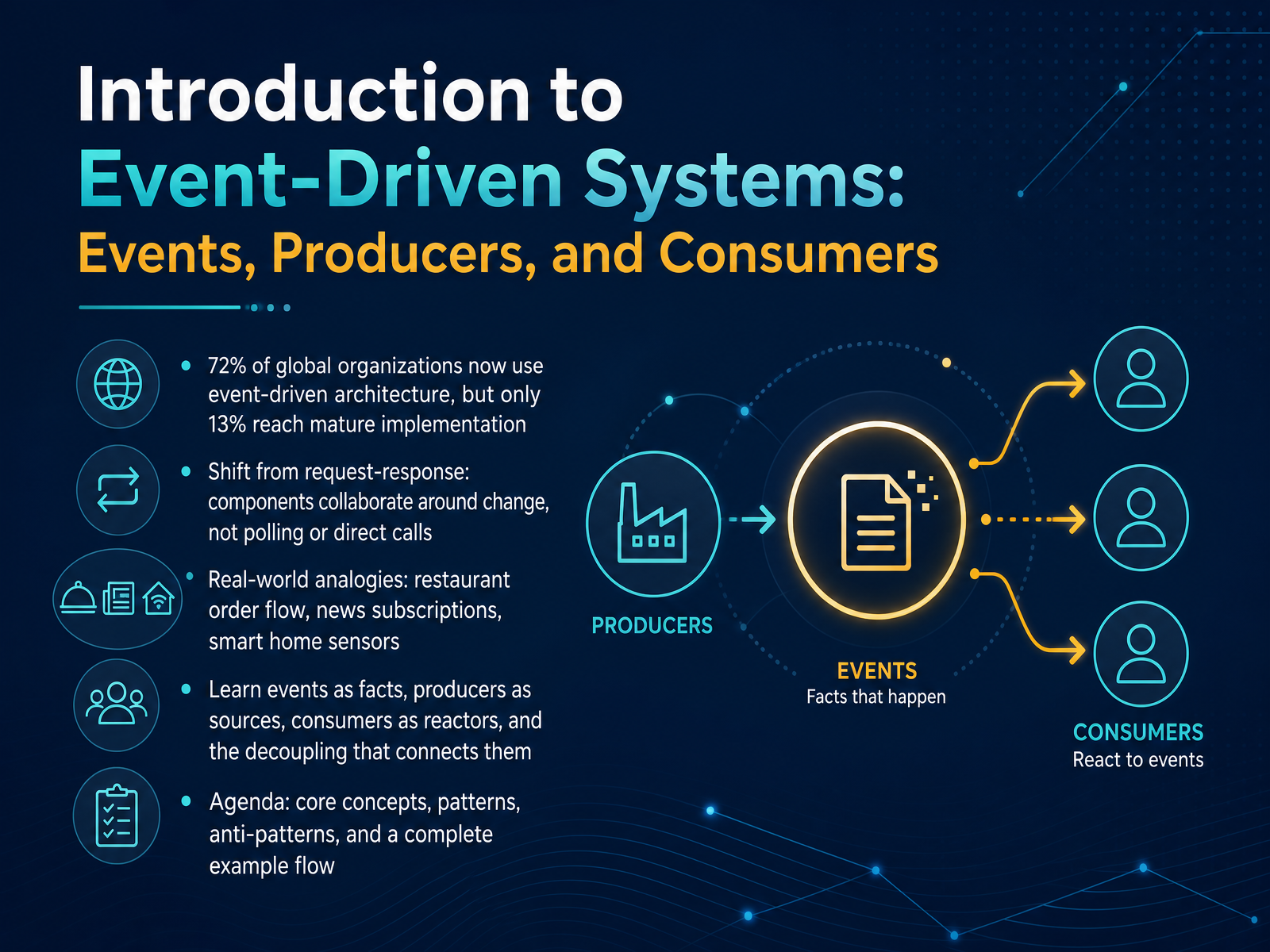
- 01Introduction to Event-Driven Systems: Events, Producers, and ConsumersWelcome. Today, we are going to explore a design approach that is reshaping how modern systems handle change: event-driven architecture. By the time we finish, you will understand how events, producers, and consumers work together to keep components in sync without tight coupling. Let us start with a clear picture of where we are. Close to three out of every four global organizations now use event-driven architecture. But only about thirteen percent have achieved mature, organization-wide adoption. That gap is worth paying attention to, because it tells us the real challenge is not just adopting the tools, it is designing systems that genuinely collaborate around change. Think about it this way: instead of one service constantly asking another, 'Are we there yet?', we shift to a model where components simply announce what happened. A restaurant order flow, a news subscription, or a smart home sensor all work this way. An event is a recorded fact that has already occurred. The producer is the source that publishes that fact. The consumer is the component that reacts to it. The real power comes from the decoupling that connects them. Over the next few slides, we will walk through the core concepts, key patterns, common anti-patterns, and a complete example flow. Let us begin that journey by looking at why event-driven thinking matters and the mindset behind it.integrate.ioresearch.isg-one.combirjob.com+22 min
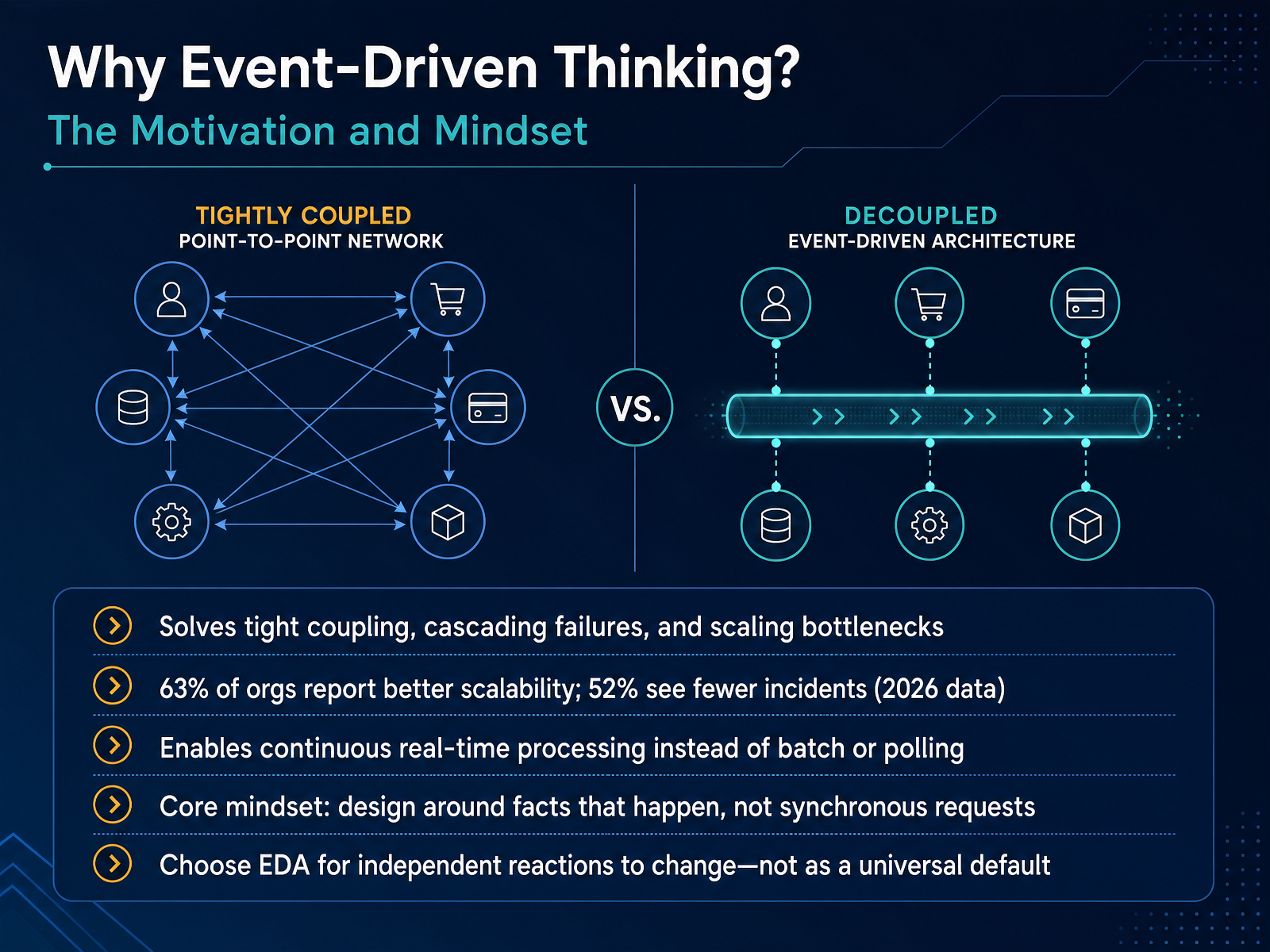
- 02Why Event-Driven Thinking? The Motivation and MindsetNow that we have set the stage, let's look at why event-driven thinking matters, focusing on the motivation and the mindset shift. The first big reason is that it solves real architectural pain points. Traditional systems often suffer from tight coupling, where one failing service takes down another, creating cascading failures and scaling bottlenecks. Event-driven architecture directly addresses these by letting components communicate through facts instead of direct, synchronous commands. The numbers back this up. Looking at recent enterprise data, sixty-three percent of organizations report better scalability after adopting event-driven architecture, and fifty-two percent see fewer production incidents. But beyond fixing problems, this approach enables a new capability: continuous, real-time processing. Instead of waiting for batch jobs or constantly polling for updates, systems can react the moment something happens. The core mindset shift is this: we design around facts that happen, not synchronous requests. We are not just asking another service to do something. We are stating a business fact, like 'an order was placed,' and letting other parts of the system react independently to that change. Finally, a critical point: choose event-driven architecture for independent reactions to change, but do not treat it as a universal default. It is a powerful tool for specific decoupling needs, not a one-size-fits-all solution. Next, let's solidify these concepts by asking a fundamental question: what is an event? We will explore facts, structure, and semantics.
 integrate.ioresearch.isg-one.combirjob.com+22 min
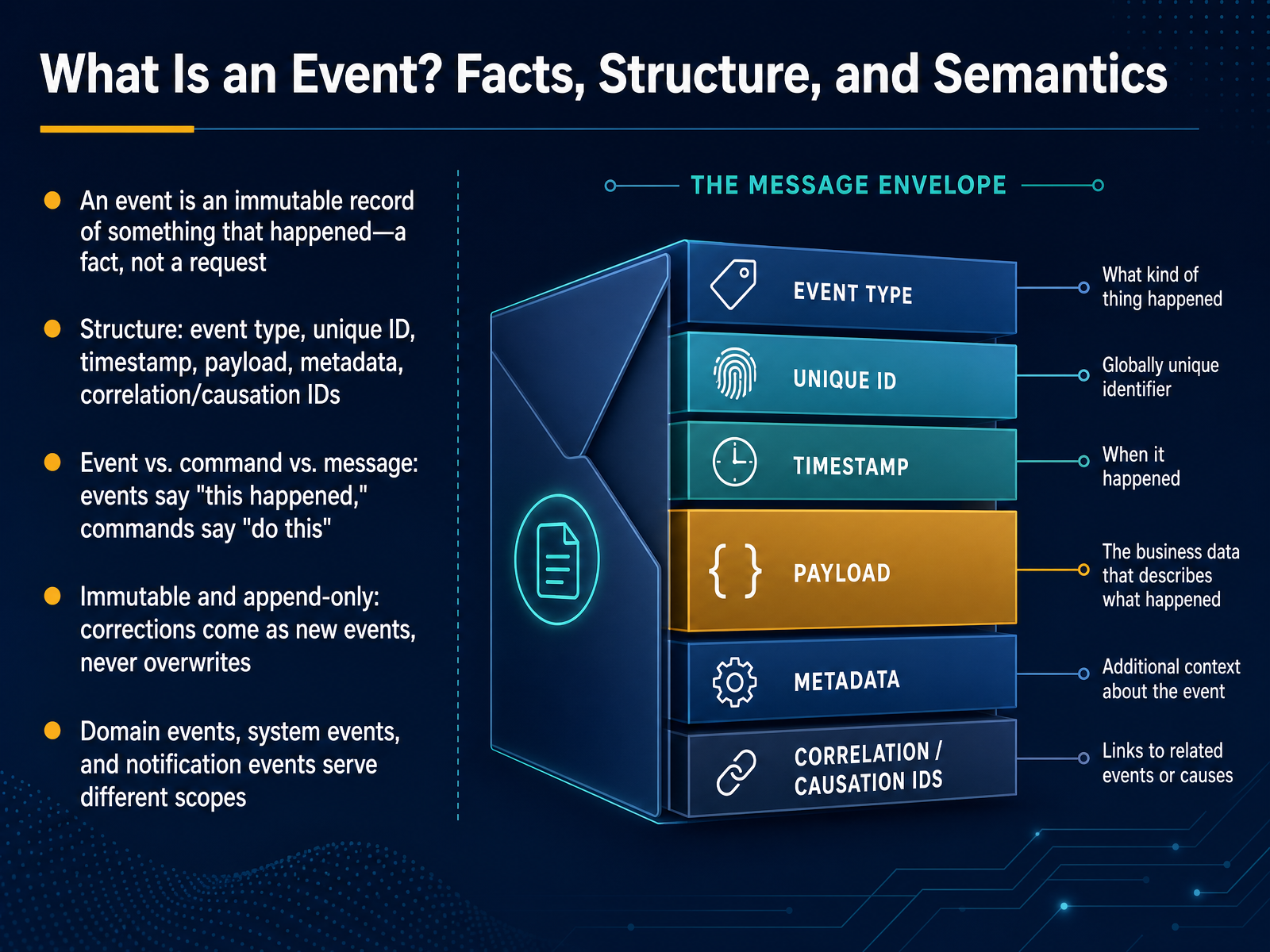
 - 03What Is an Event? Facts, Structure, and SemanticsNow let's get precise about what an event actually is. In plain terms, an event is an immutable record of something that already happened. It's a fact, not a request. Think of it as a done deal: 'Order was placed,' not 'Please place an order.' Because it's a historical fact, we never change or overwrite an event. If we need a correction, we publish a new event that compensates for it. This keeps our audit trail clean. Structurally, an event has a few key parts. There is an event type, a unique identifier, a timestamp, the core payload, and some metadata. That metadata often includes correlation and causation IDs, which help us trace cause and effect across services. This is critical to understand: an event says 'this happened.' A command is different. A command says 'do this' and can be rejected. A message is just the envelope that carries either one. We also see different scopes of events. Domain events capture significant business moments. System events deal with infrastructure. Notification events let other parts of the system know something changed, without demanding a specific reaction. The real benefit here is clarity. When every component reacts to clear, unchangeable facts, your system becomes easier to reason about, extend, and debug. Next, we'll meet the entities that create these facts: the producers.
 martinfowler.commartinfowler.compracticalserverless.blog+22 min
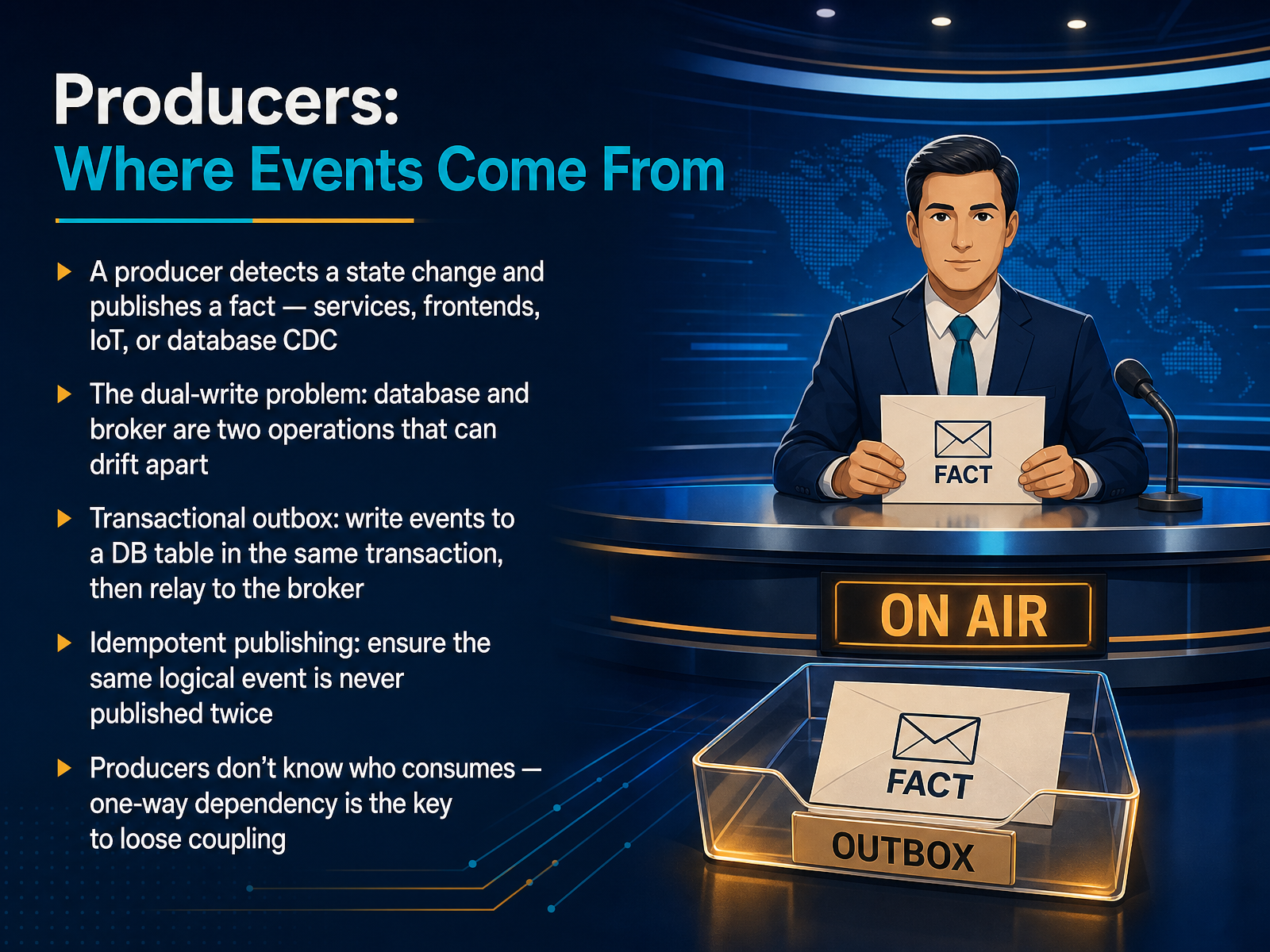
 - 04Producers: Where Events Come FromSo if events represent a change, where do they actually come from? That is the producer's job. A producer detects a state change, something that just became true, and publishes it as a fact. This could be a web service, a frontend application, an Internet of Things sensor, or even a database change-data-capture connector. The important part is that the producer owns the truth of that moment. Now, there is a classic pitfall here called the dual-write problem. Imagine updating a database row and then publishing an event. Those are two separate operations, and they can drift apart. If one succeeds and the other fails, your system is inconsistent. The most reliable fix is the transactional outbox pattern. You write the business change and the event into a database table inside the same transaction. Then a separate process safely relays that event to the broker. You also want to protect against publishing the same logical event twice. Careful design ensures idempotent publishing, so retries never create duplicate side effects. Finally, and this is key for loose coupling, the producer never knows who is listening. It simply declares a fact and moves on. That one-way dependency is what keeps our architecture flexible. Next, let's look at the other end of the pipe: consumers, and how they react to these events.
 andrew-jones.comandrew-jones.commatheuspalma.com+22 min
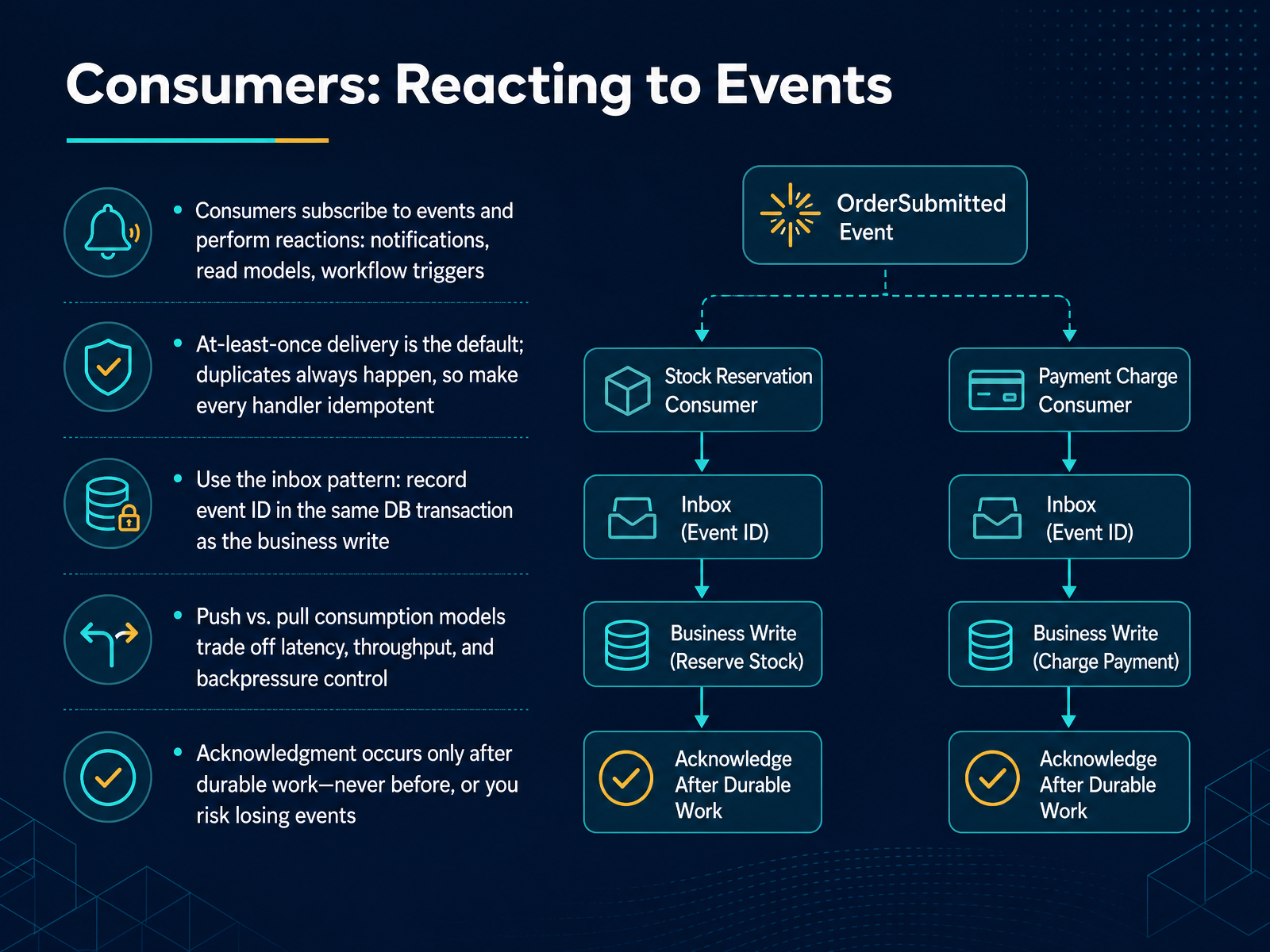
 - 05Consumers: Reacting to EventsSo events announce a change. Consumers are the pieces that actually respond. A consumer subscribes to events it cares about and triggers a reaction: maybe it sends a notification, updates a read model, or kicks off a longer workflow. The first thing to know about consuming is that duplicates are not a bug. Every mainstream broker delivers at least once by default. If a consumer crashes between finishing its work and sending the acknowledgment, the broker will redeliver the same event. The fix is to make every handler idempotent, meaning processing the same event twice produces the same business outcome as processing it once. The canonical way is the inbox pattern. Before doing any business work, open a database transaction. Try to insert the event ID into a dedicated inbox table. If that insert succeeds, you are the first to process this event, so execute your business logic and commit everything together. If the row already exists, the event is a duplicate. Simply acknowledge and skip without repeating any side effects. You also choose between push and pull consumption models, which trade off latency, throughput, and backpressure control. But regardless of the model, the golden rule is the same: acknowledge only after durable work is committed, never before. Now that we understand producers and consumers, let's connect them through channels, brokers, and streams.
 distributedrequest.commatheuspalma.comswehelper.com+22 min
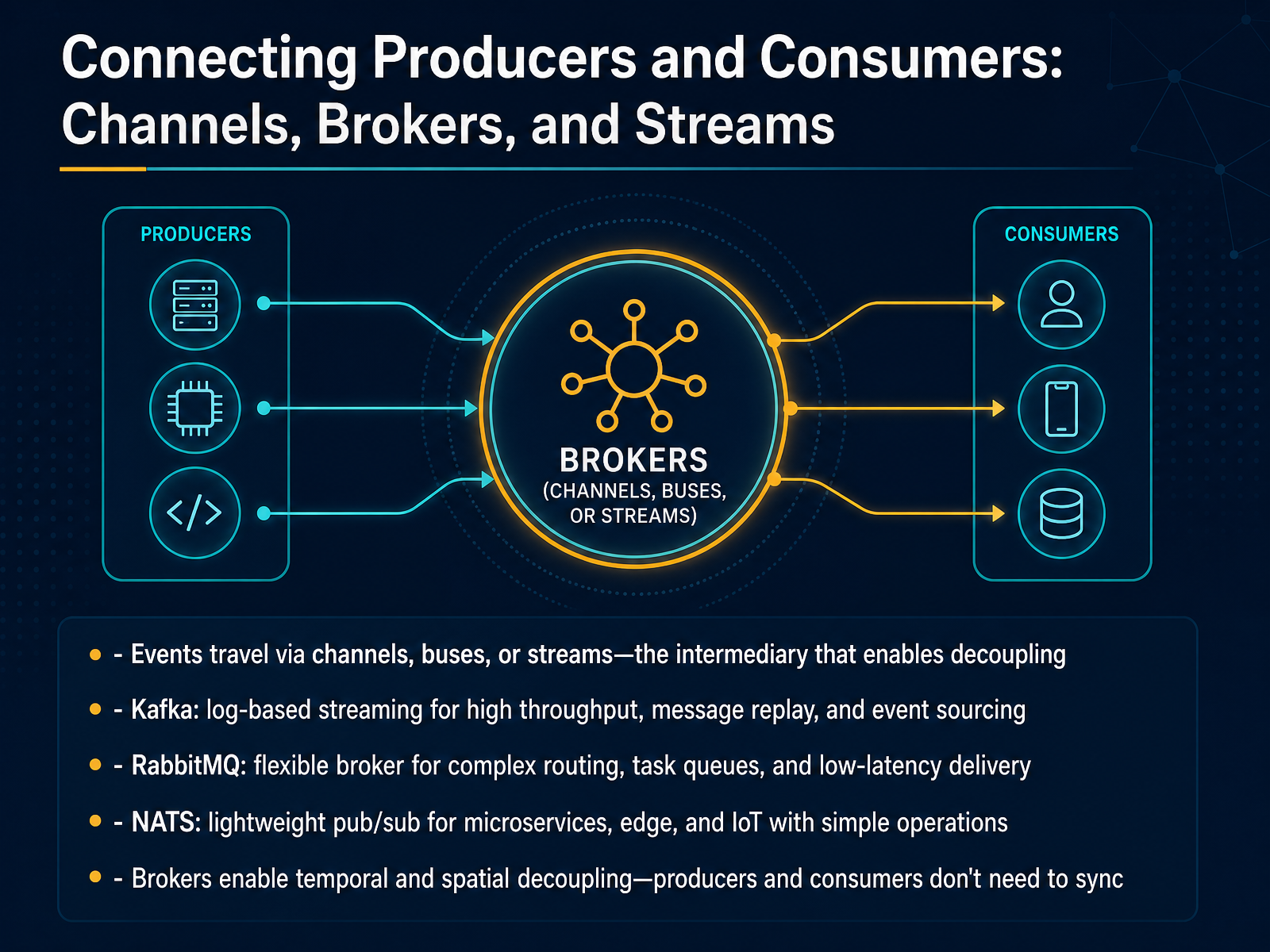
 - 06Connecting Producers and Consumers: Channels, Brokers, and StreamsNow let's make this tangible. How do events actually get from a producer to a consumer without them being directly connected? That is what we call the intermediary. It goes by different names—channels, buses, or streams—but its job is always decoupling. It ensures the producer just publishes, and the consumer just listens, without knowing about each other. Three common technologies illustrate the range of choices. Apache Kafka is built as a high-throughput, log-based stream. It stores events durably, so consumers can replay history or catch up from any point—perfect for event sourcing and analytics. RabbitMQ, on the other hand, is a flexible broker. It excels at complex routing and low-latency task delivery, using exchanges and queues. Then there is NATS, a lightweight pub-sub engine. It is designed for operational simplicity, making it great for microservices, edge computing, and IoT where you want minimal overhead. All these brokers provide both temporal and spatial decoupling. The producer and consumer don't need to be active at the same time, and they don't need to know the other's network location. The intermediary absorbs the change. Next, let's look at the core benefits that make organizations adopt this style.
 2 min
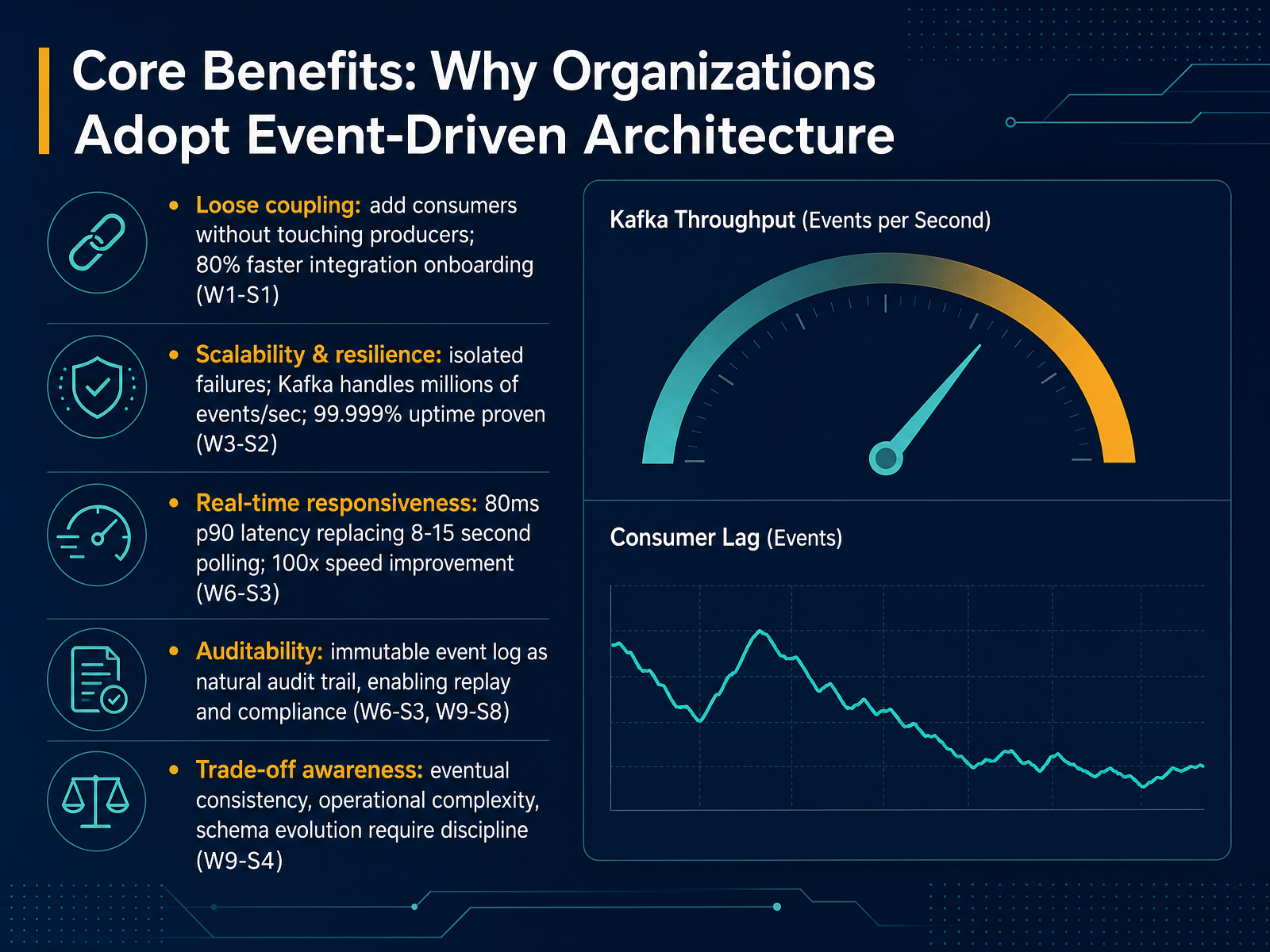
2 min - 07Core Benefits: Why Organizations Adopt Event-Driven ArchitectureNow that we understand what event-driven architecture is, let's look at why it's worth the effort. The first major benefit is loose coupling. When a producer publishes an event, it doesn't need to know which consumers are listening. Adding a new consumer—say, a fraud detection service—means simply subscribing to the event stream. You never touch the producer code. The Amazon Key team found this reduced service integration time by eighty percent, from five days down to one. Next, scalability and resilience improve dramatically. Because consumers are isolated, a failure in one doesn't cascade to others. Platforms like Kafka routinely handle millions of events per second and have proven ninety-nine-point-nine-nine-nine percent uptime in production. Real-time responsiveness is another key gain. One platform replaced an eight-to-fifteen-second polling loop with an event-driven pipeline that delivers results in roughly eighty milliseconds at the ninetieth percentile—a hundred-fold speed improvement. Auditability also becomes natural. The event log is an immutable record of everything that happened, providing a built-in audit trail that supports replay and compliance. However, we must be clear about the trade-offs. Event-driven systems introduce eventual consistency, operational complexity, and require disciplined schema evolution. The benefits are real, but they demand thoughtful engineering. Next, we'll explore the common patterns that make event-driven design work in practice.
 2 min
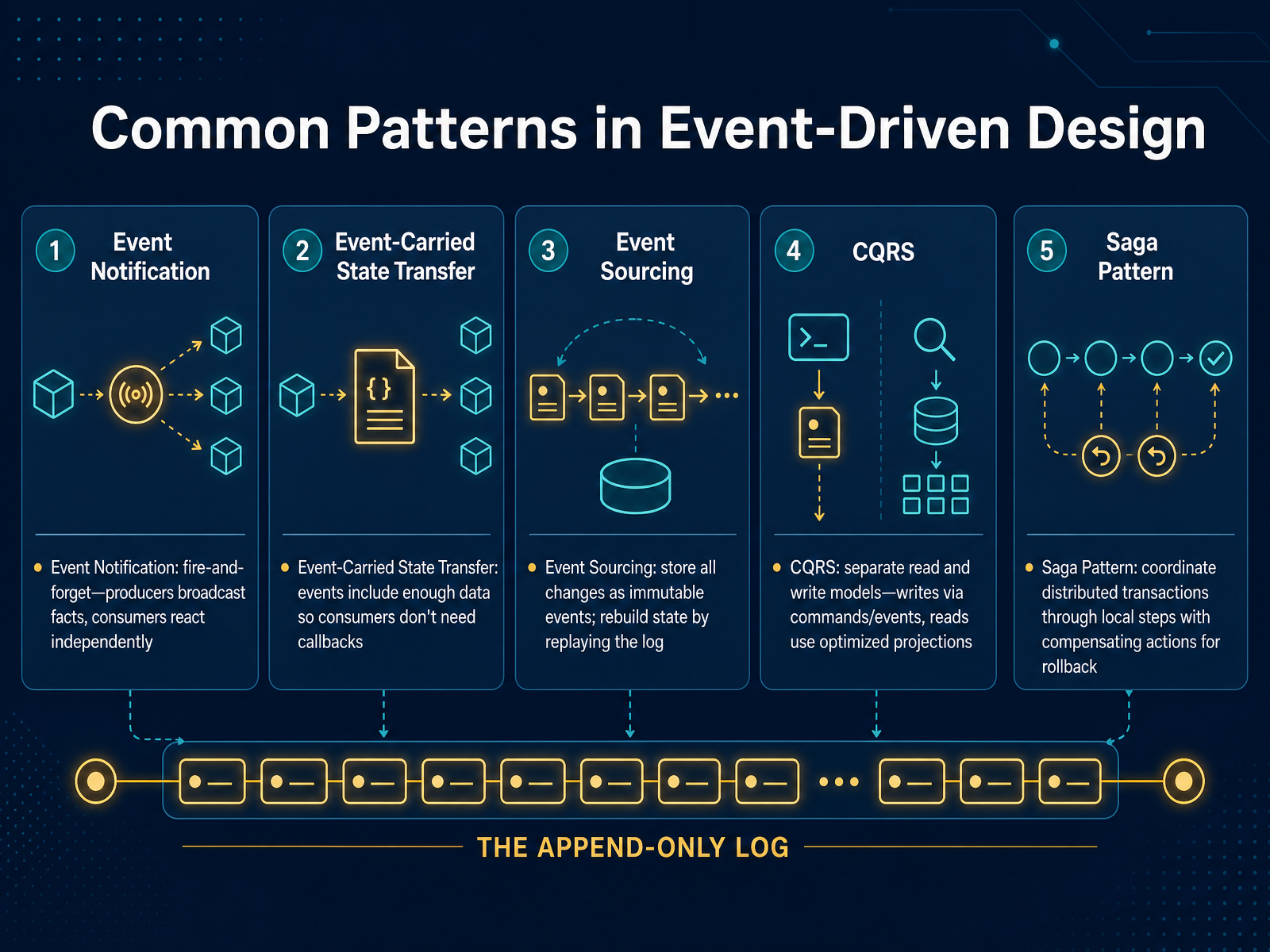
2 min - 08Common Patterns in Event-Driven DesignNow that we have a foundation, let's walk through the patterns you will actually reach for when designing an event-driven system. Think of these as recognizable blueprints, not abstract theory. First, Event Notification. This is the simplest pattern: a producer broadcasts a fact and forgets about it. Consumers react independently, which gives you extremely loose coupling. Next is Event-Carried State Transfer. Instead of sending a thin notification that forces consumers to call back for details, the event itself contains enough data so that consumers can act immediately. This reduces latency and avoids creating hidden coupling. Event Sourcing takes a different approach. You do not just update a database row; you store every change as an immutable event in an append-only log. The current state is rebuilt by replaying that history, which gives you a perfect audit trail. CQRS, or Command Query Responsibility Segregation, builds on this by physically separating the write model from the read model, so each side can scale and optimize independently. Finally, the Saga Pattern tackles long-running business transactions that span multiple services. Instead of a single database lock, a saga coordinates a sequence of local steps, and if something fails, it runs compensating actions to undo the work, keeping the system consistent. These patterns give you a toolbox for letting components collaborate around change, each solving a specific part of the decoupling puzzle. Let's turn next to the other side of the coin: Anti-Patterns, and what to avoid from day one.
 2 min
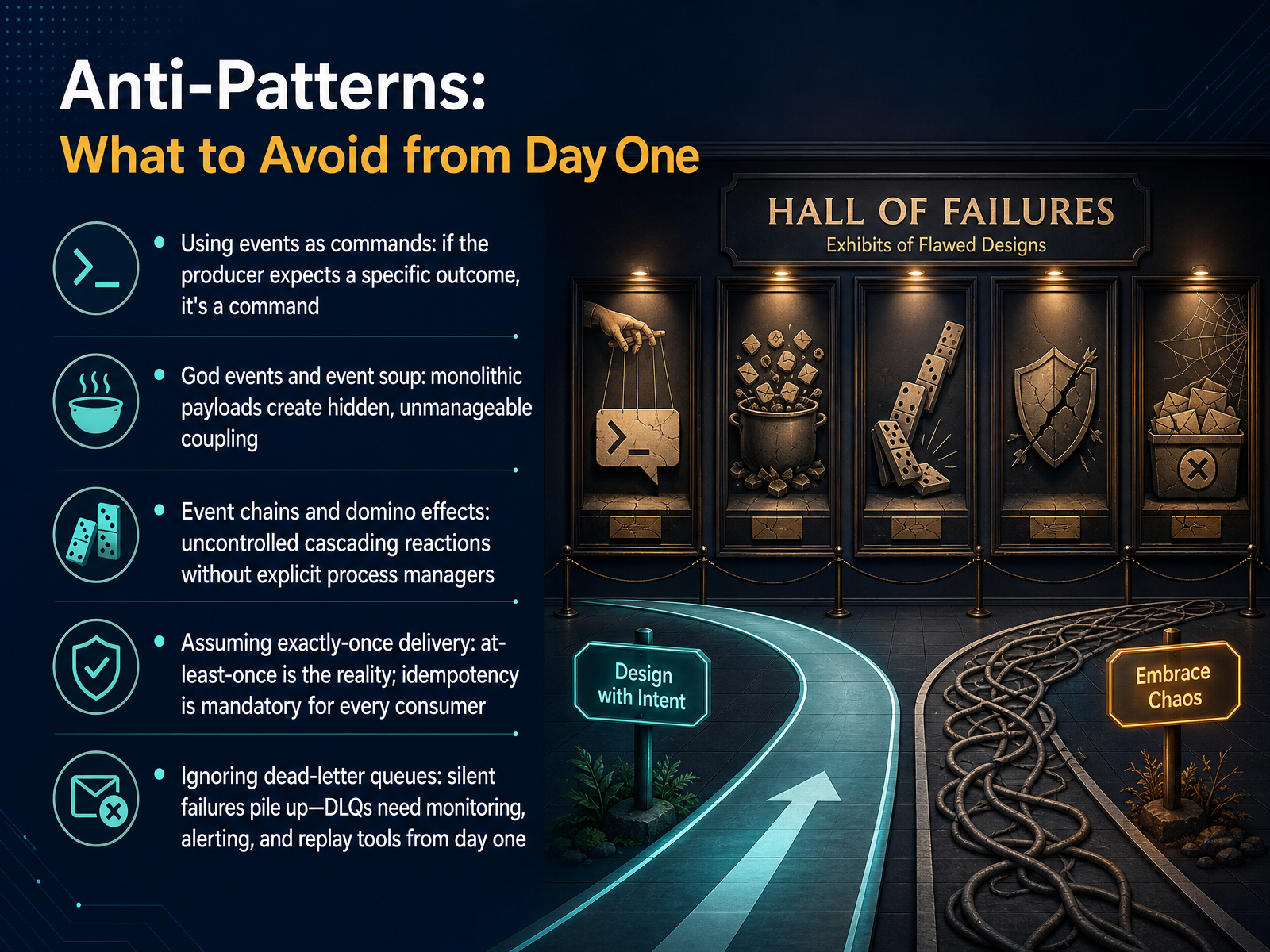
2 min - 09Anti-Patterns: What to Avoid from Day OneNow let's talk about what to avoid from day one—the anti-patterns that can quietly turn a well-intentioned event-driven system into a tangled mess. First, watch out for using events as commands. If the producer expects a specific outcome or is waiting for a reply, that is not really an event—it is a synchronous call in disguise. Second, avoid god events and event soup. Monolithic payloads that carry everything create hidden coupling, and publishing every internal state change makes the system impossible to understand. Third, beware of event chains and domino effects. When one event triggers another in an uncontrolled cascade, you lose sight of the business process. For complex workflows, you need an explicit process manager. Fourth, never assume exactly-once delivery. At-least-once is the reality with every production broker. That means every consumer must be idempotent from day one. And finally, do not ignore your dead-letter queue. Silent failures pile up fast. You need monitoring, alerting, and a replay plan before the first message ever lands there. These pitfalls all share one trait: they look fine in a happy-path demo. The discipline you build now is what keeps the system manageable a year from now. Next, let's tackle the key challenges: ordering, consistency, and observability.
 2 min
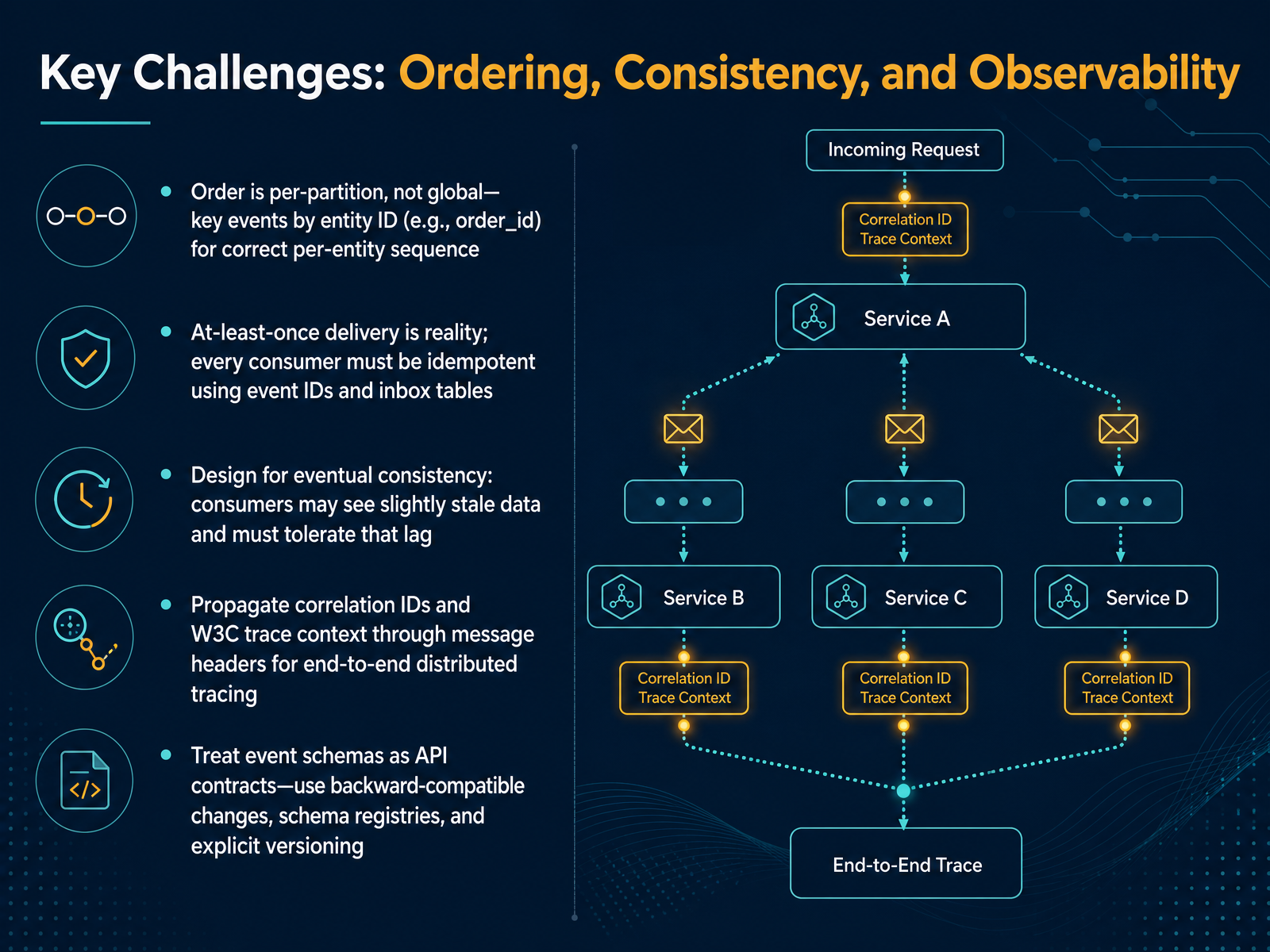
2 min - 10Key Challenges: Ordering, Consistency, and ObservabilityLet's talk honestly about the challenges you'll face with event-driven systems — and how to handle each one concretely. First, ordering. Most brokers only guarantee order within a partition, not globally. The fix is simple: key events that belong to the same entity — like an order ID — so that entity's sequence stays correct. Second, delivery guarantees. In production, at-least-once delivery is reality. Your consumers will see duplicates, so every consumer must be idempotent. Use event IDs and an inbox table to record what you've processed, and skip duplicates. Third, eventual consistency. Consumers may read slightly stale data. Design your business logic to tolerate that lag, not fight it. Fourth, observability. Propagate a correlation ID and W3C trace context through your message headers. This gives you end-to-end distributed tracing so you can follow an event across every service. Finally, treat event schemas as API contracts. Use backward-compatible changes, a schema registry, and explicit versioning. These five challenges have practical answers, and we'll walk through a complete example next.
 distributedrequest.commatheuspalma.comswehelper.com+22 min
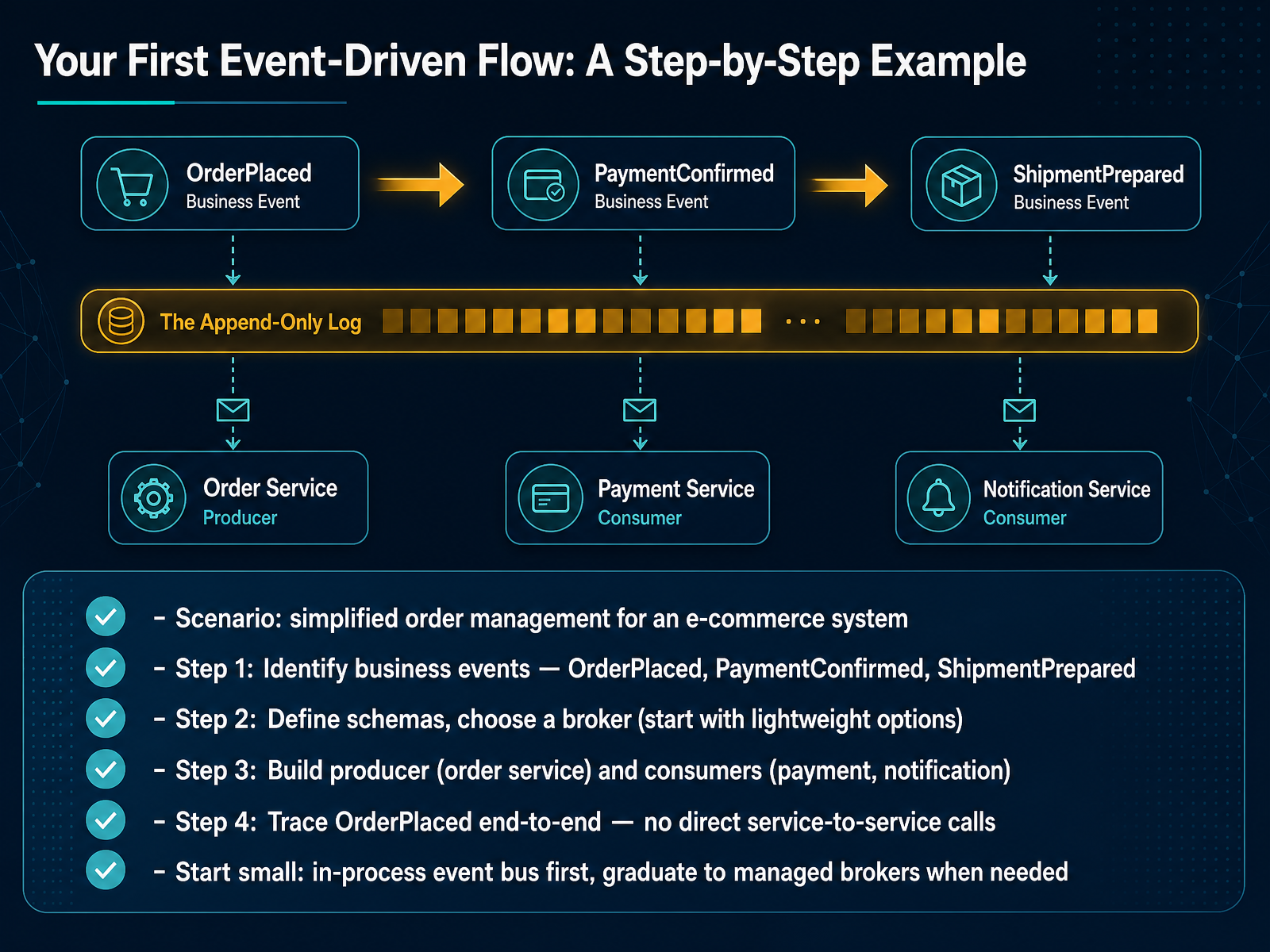
 - 11Your First Event-Driven Flow: A Step-by-Step ExampleLet's walk through a concrete example so you can see how everything fits together. Imagine we're building a simplified order management system for an e-commerce platform. The first step is to identify the business events. In our flow, these are OrderPlaced, PaymentConfirmed, and ShipmentPrepared. Once we know our events, we define their schemas and choose a broker. To keep things simple, you can start with a lightweight, in-process event bus rather than a fully managed broker like Kafka. Next, we build our components. The order service acts as the producer, and we create separate consumers for payment processing and notifications. Now, trace the flow of an OrderPlaced event. The producer publishes it, and the broker routes it to both consumers without any direct service-to-service calls. This is the power of decoupling in action. The key takeaway is to start small. You can graduate to a managed, persistent broker like RabbitMQ or SQS only when you need cross-service delivery or guaranteed persistence. This gradual path keeps complexity low while you learn. Next, we'll shift our focus to operational readiness, covering dead letters, retries, and how to monitor your event flows effectively.
 2 min
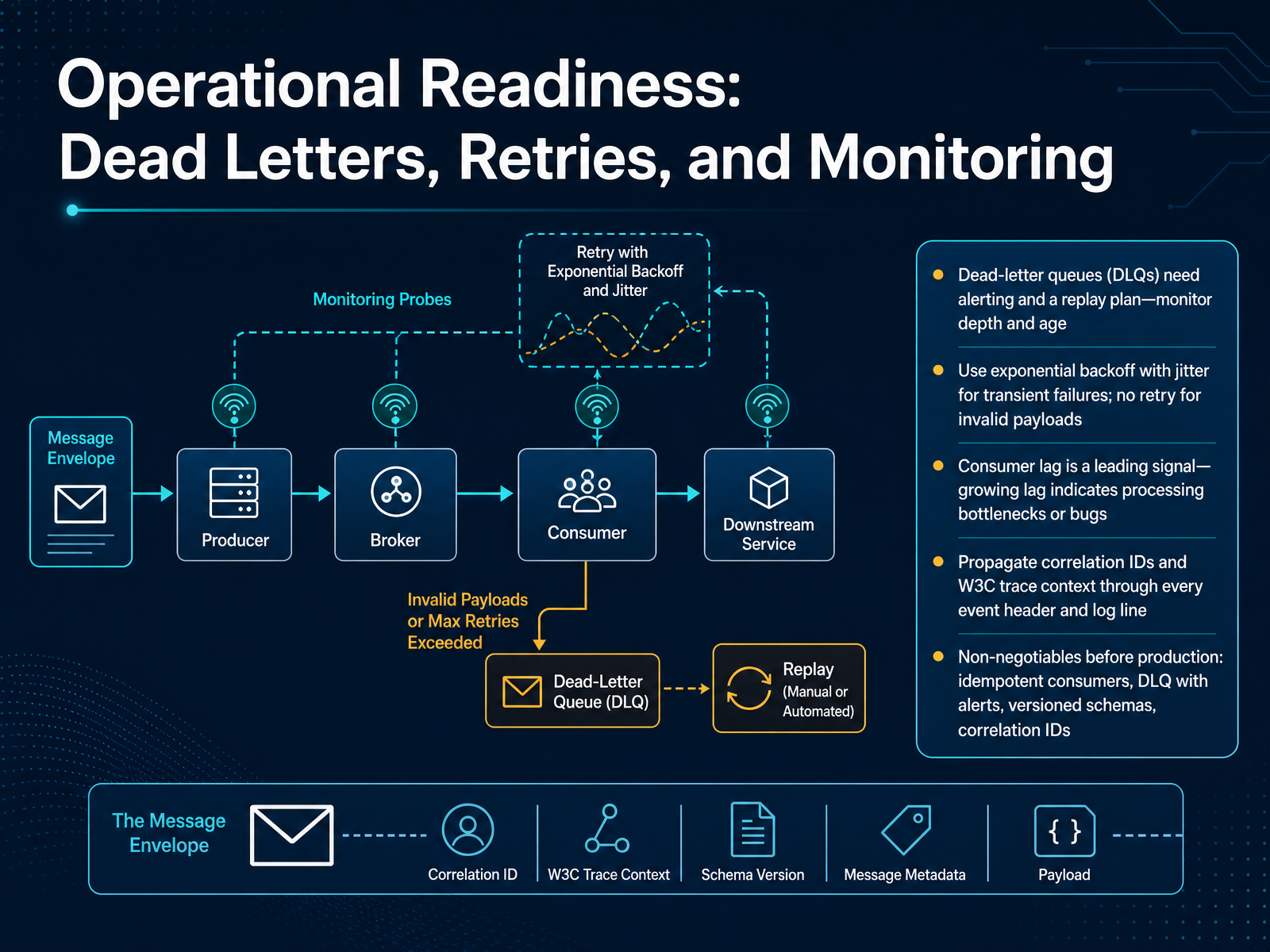
2 min - 12Operational Readiness: Dead Letters, Retries, and MonitoringWith the right patterns in place, we have to talk about what keeps the system healthy in production. We call this operational readiness. First, dead-letter queues. A dead-letter queue is where events go after they fail processing too many times. It is not a black hole. You need an alert that fires the moment something lands there, and you need a clear replay plan, because a silent dead-letter queue is hidden data loss. Monitor both the depth and the age of messages inside it. Second, retry strategy. For temporary failures, like a brief network timeout, use exponential backoff with jitter. That spaces out retries with some randomness so you do not flood a recovering service. But for permanent failures, like an invalid payload, do not retry at all. Send it straight to the dead-letter queue. Next, watch consumer lag. Lag is the gap between events produced and events processed. If lag keeps growing, it is a leading signal that tells you something is bottlenecked or broken before any user reports it. Finally, propagate correlation identifiers and W three C trace context through every event header and every log line. Without that, debugging an asynchronous chain is just guesswork. Before you go to production, there are several non-negotiables. Make every consumer idempotent, so duplicates do not cause harm. Have a dead-letter queue with alerts. Use versioned schemas for your event contracts. And always pass correlation identifiers. Now let's pull everything together in our wrap-up, key takeaways, and next steps.
 2 min
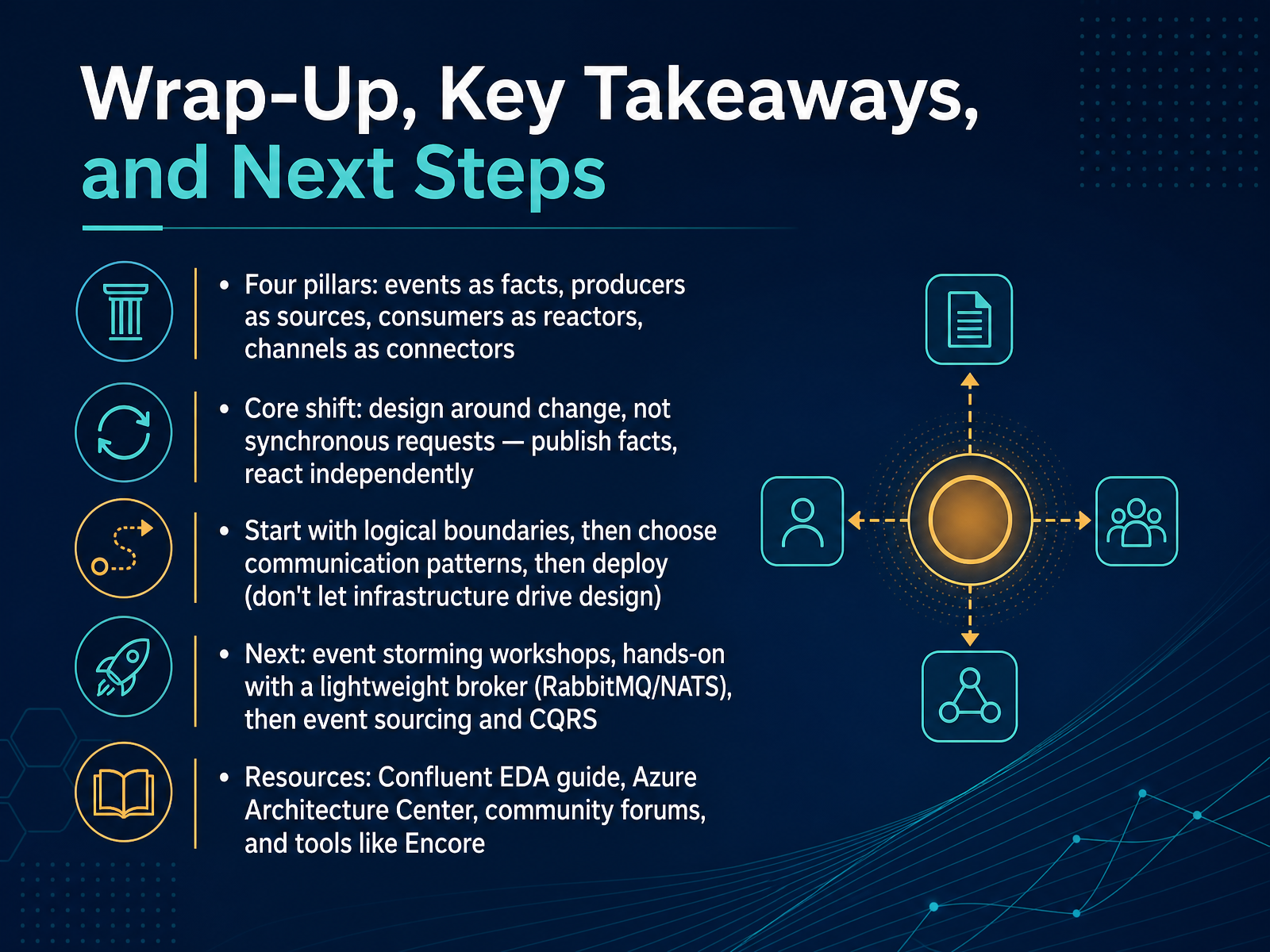
2 min - 13Wrap-Up, Key Takeaways, and Next StepsLet's bring it all together with the big picture. We built on four pillars: events as immutable facts, producers as the sources of those facts, consumers as independent reactors, and channels as the connectors that tie them together. The core shift is designing around change, not synchronous requests—publish a fact and let services react on their own. And remember, logical boundaries come first. Decide what your bounded contexts are, then choose whether they talk synchronously or through events, and only then think about deployment. Don't let infrastructure drive your design. For next steps, a hands-on workshop like event storming is a great way to map out those boundaries. From there, spin up a lightweight broker like RabbitMQ or NATS to get a feel for the patterns. After that, you'll be ready to explore event sourcing and CQRS. I've included a short list of resources in your materials—guides from Confluent and the Azure Architecture Center, community forums, and tools like Encore to help you get started. Thank you for joining me. This architecture is a journey, and every system that embraces change starts with a single, well-modeled event. You've got this.
 2 min
2 min
Take the deck with you
Download this course as a file — free, no sign-up needed.
- PDF handoutEvery slide page, ready to print or share.14 pages · 3.7 MBDownload
- Narrated PowerPointThe deck that presents itself — every slide carries the digital human's narration video.14 pages · 29.8 MBDownload
- PowerPoint slidesThe full deck as a .pptx — open it in PowerPoint, Keynote, or Google Slides.14 pages · 3.6 MBDownload
Free to use in your own training — please keep the PersonWise credit page at the end.
Have your own deck? Turn it into a course
Sources consulted
Web sources consulted while building this course.
- Real-Time Data Integration Statistics – 39 Key Facts Every Data Leader Should Know in 2026 | Integrate.io — integrate.io
- Messaging and Event Processing 2025 Buyers Guide Executive Summary — research.isg-one.com
- Event-Driven Architecture in 2026: From 'Should We Stream?' to 'How Do We Unify?' | BirJob — birjob.com
- Real-Time Data Buyers Guide 2026 Executive Summary — research.isg-one.com
- Event-Driven Architecture: Patterns, Pitfalls, and Enterprise Adoption — CIOPages — ciopages.com
- What do you mean by “Event-Driven”? — martinfowler.com
- Focusing on Events — martinfowler.com
- Events vs Commands vs Messages in Serverless Architecture: — practicalserverless.blog
- What's the difference between a command and an event? - Event-Driven.io — event-driven.io
- Back to Basics: commands, events, and messages — milestone.topics.it
- The outbox pattern for publishing events · Andrew Jones — andrew-jones.com
- Patterns for publishing events · Andrew Jones — andrew-jones.com
- The transactional outbox: publishing events without losing data or doubling work | Matheus Palma — matheuspalma.com
- Exactly-Once Processing Using Outbox Pattern | ThreadSafe — medium.com
- The Transactional Outbox: Publishing Events Without Losing Them | Codemia — codemia.io
- Idempotent Consumer Patterns for Event Streams — DistributedRequest — distributedrequest.com
- The consumer inbox pattern: idempotent message processing under at-least-once delivery | Matheus Palma — matheuspalma.com
- Delivery Semantics: At-Most-Once, At-Least-Once, and Exactly-Once Explained | SWE Helper — swehelper.com
- Delivery semantics for Kafka consumers — docs.conduktor.io
- Queues 101 — At‑Least‑Once (and Why “Exactly‑Once” Is a Myth) · caduh — caduh.com