Begin
14 pages · ~28 min
Responsible AI Fundamentals
This training introduces the core principles of responsible AI, including fairness, transparency, and accountability, for professionals seeking to build and deploy ethical AI systems.
A digital instructor presents all 14 pages. Hold “Ask” at any point and ask out loud — the answer comes from this course. No sign-up needed.
What you’ll learn
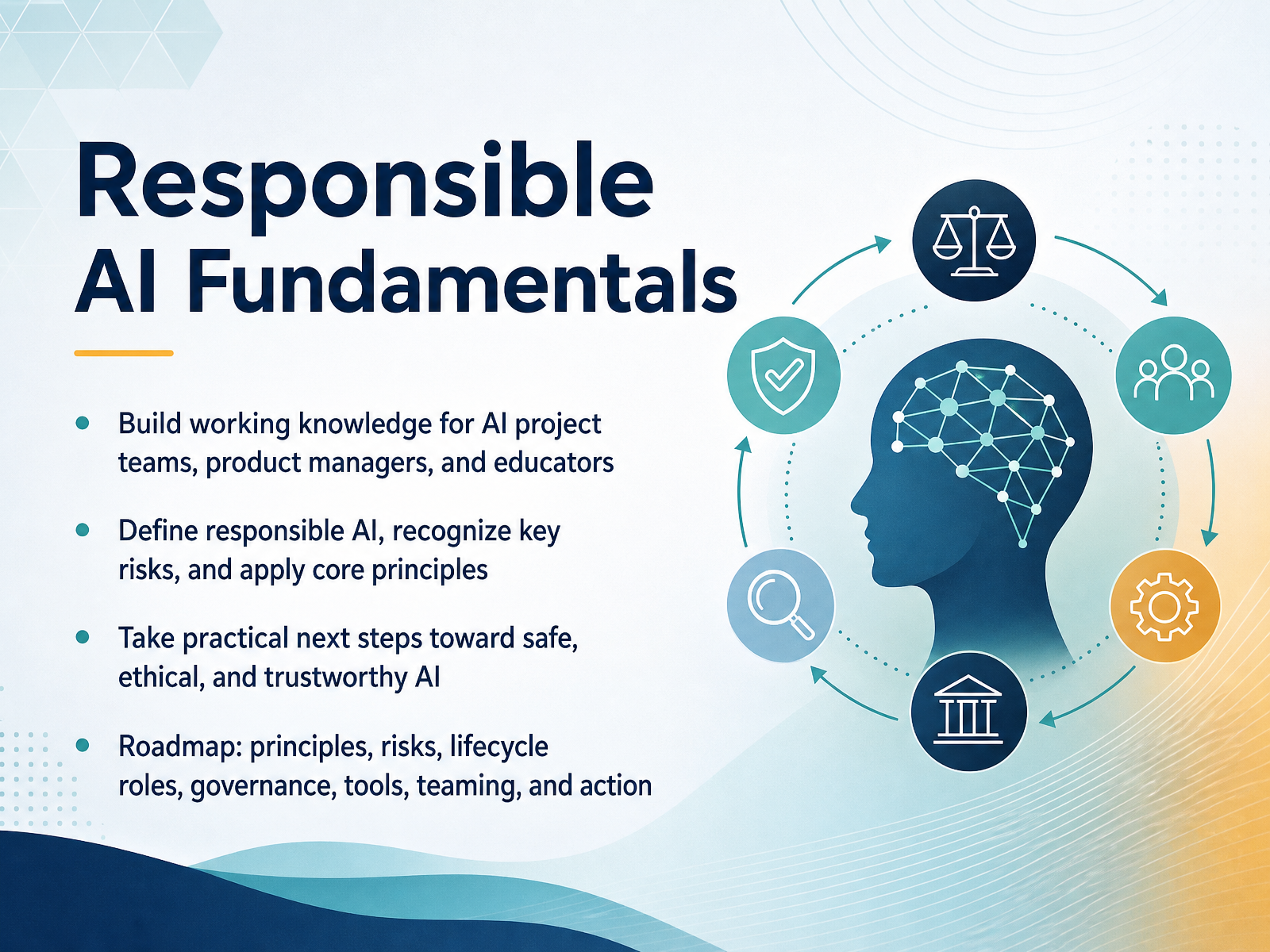
- 01Responsible AI FundamentalsWelcome. Over the next several minutes, we are going to build a practical working knowledge of Responsible AI. This is designed for project teams, product managers, and educators who are moving these systems into production. Our goal here is not just to define the concept in the abstract. We will look at how to recognize the specific risks in your work, and how to apply the core principles that mitigate them. We are going to cover a practical roadmap that moves through the AI lifecycle. We will address governance, the specific tools available to us, and how effective teaming shapes outcomes. The goal is to give you the foundation you need to make decisions that are safe, ethical, and ultimately, trustworthy. Let us begin by getting precise about the terminology.oecd.orgtechtarget.comunesco.org+21 min
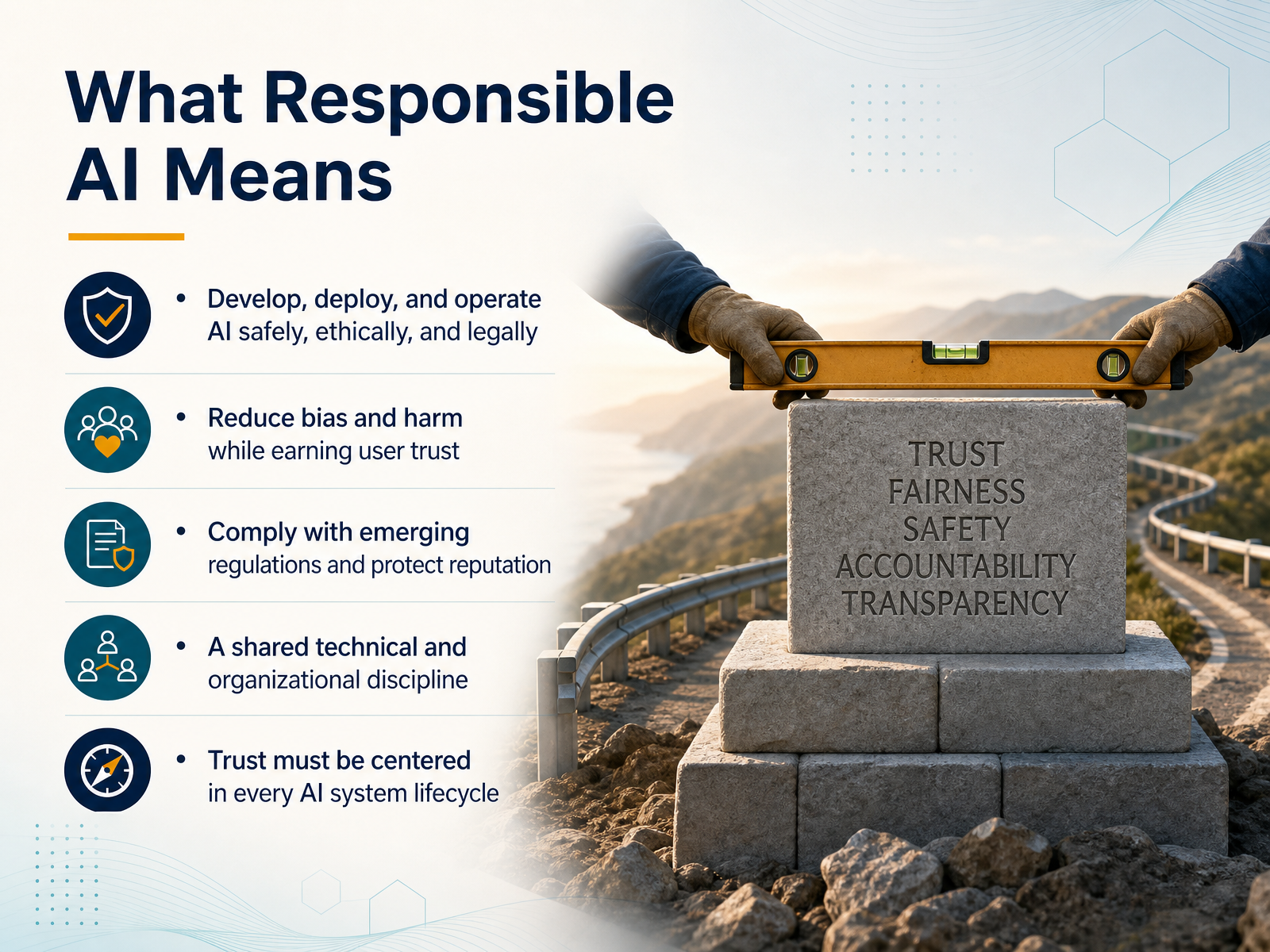
- 02What Responsible AI MeansLet's define our terms. Responsible AI isn't a single tool or a compliance checkbox. It is the practice of developing, deploying, and operating AI systems safely, ethically, and legally. What does that mean in practice? It means actively reducing bias and potential harm, while earning and maintaining user trust. It also means staying ahead of emerging regulations, because protecting user trust and protecting our reputation are directly linked. Crucially, this is not just a technical problem for engineers to solve. It is a shared discipline that spans technical teams, product management, legal, and leadership. Our responsibility extends across the entire AI lifecycle, from initial design to ongoing operation. Trust cannot be added at the end. It must be centered in every system we build. Next, we'll explore why responsible AI matters.
 oecd.orgtechtarget.comunesco.org+21 min
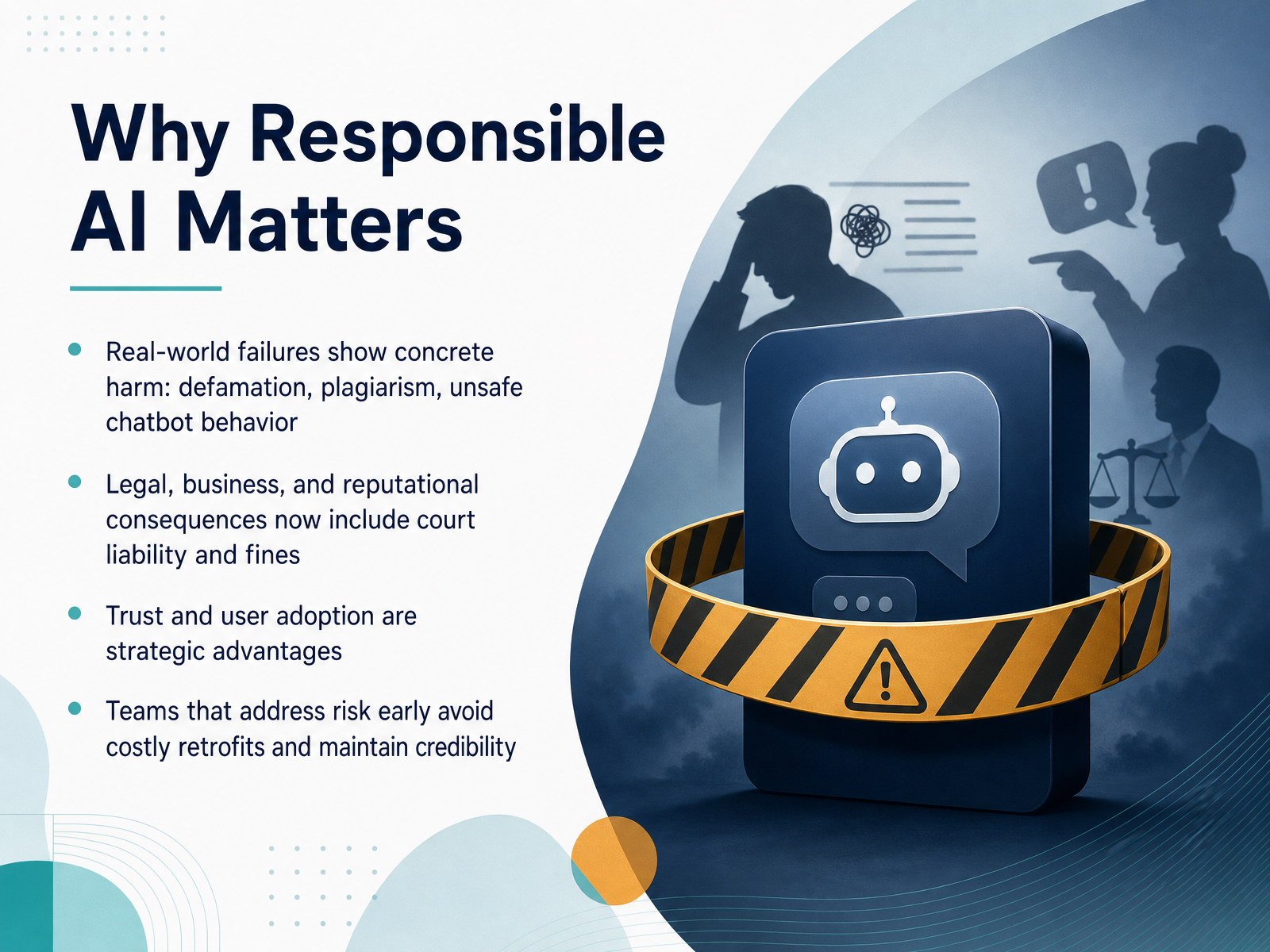
 - 03Why Responsible AI MattersWe've now established a working definition, so let's examine why responsible AI is non-negotiable. We're past the point of abstract warnings. The failures are concrete, and they carry real consequences. We've seen generative tools produce defamatory content that resulted in direct court liability and injunctions. We've watched AI systems plagiarize work at scale, which fractured client trust and forced partners to sever contracts. And we've witnessed unsafe chatbot behavior escalate into wrongful death litigation, alongside features getting pulled overnight due to public backlash. The legal and financial risks are no longer theoretical; they involve fines, sanctions, and significant reputational erosion. However, this isn't simply about avoiding penalties. For teams like ours, trust and user adoption are strategic advantages. When we demonstrate that we can deploy AI safely, we differentiate ourselves. Notably, teams that address these risks early in the design phase avoid costly retrofits later. Auditing a model after deployment is exponentially more expensive than building guardrails upfront. By acting decisively now, we maintain our credibility and ensure the technology we build actually endures. Let's carry this forward as we look at the core principles.
 oecd.aideeplearning.aipoynter.org+22 min
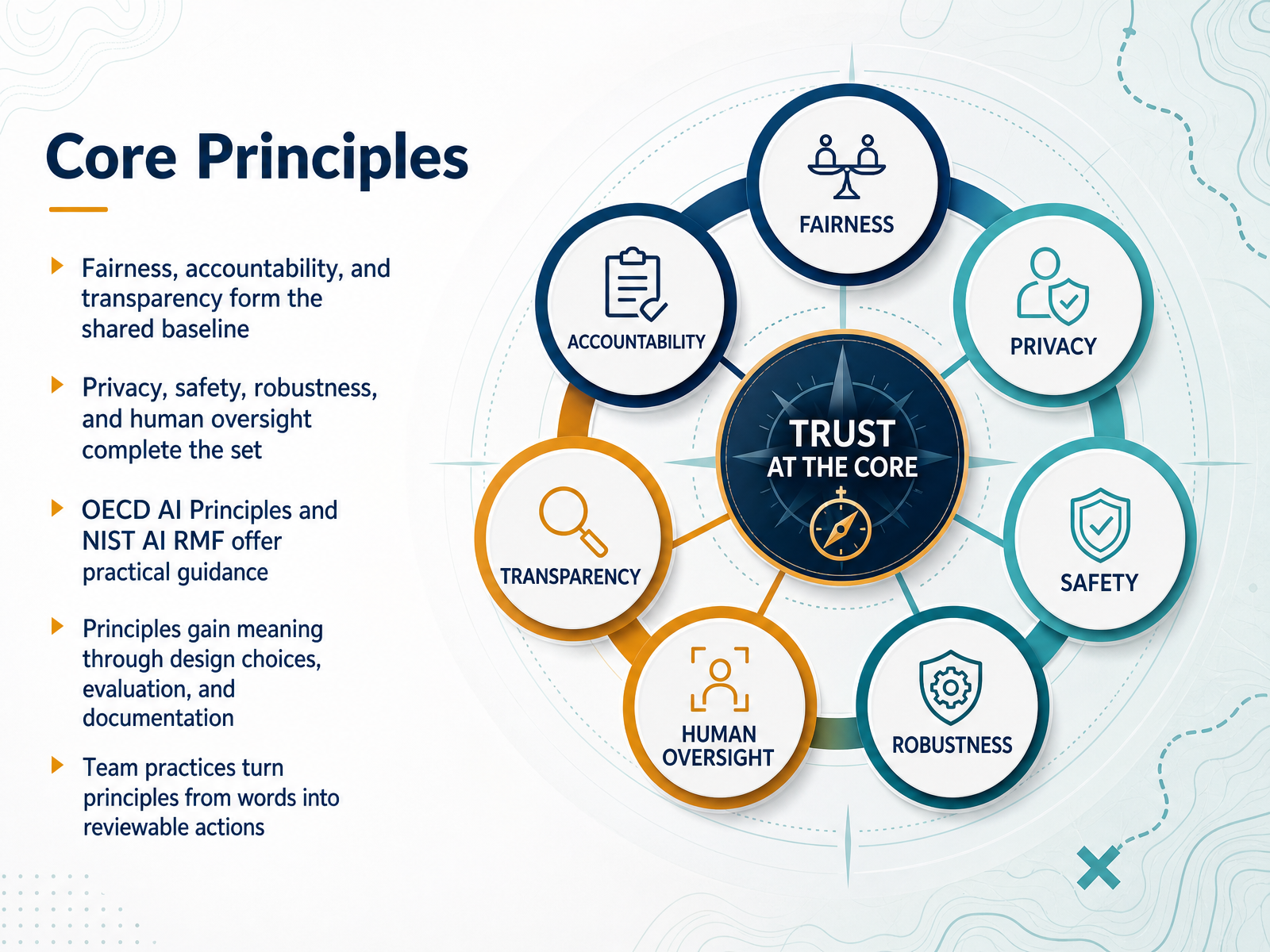
 - 04Core PrinciplesNow let's move to the core principles that hold all of this together. Fairness, accountability, and transparency form our shared baseline. They are the foundation. But a complete framework also requires privacy, safety, robustness, and meaningful human oversight. These aren't just abstract values. Frameworks like the OECD AI Principles and the NIST AI Risk Management Framework give us practical entry points. They help us translate intent into engineering reality. Here is the key point. Principles only gain meaning through the design choices we make, the evaluations we run, and the documentation we produce. A principle without a practice is just a slogan. Our team practices, our code reviews, our model cards, our audit trails, that is what turns words into reviewable actions. That is what makes responsibility operational, not aspirational. Next, we will look at the types of risk and harm these principles are meant to mitigate.
 oecd.orgtechtarget.comunesco.org+21 min
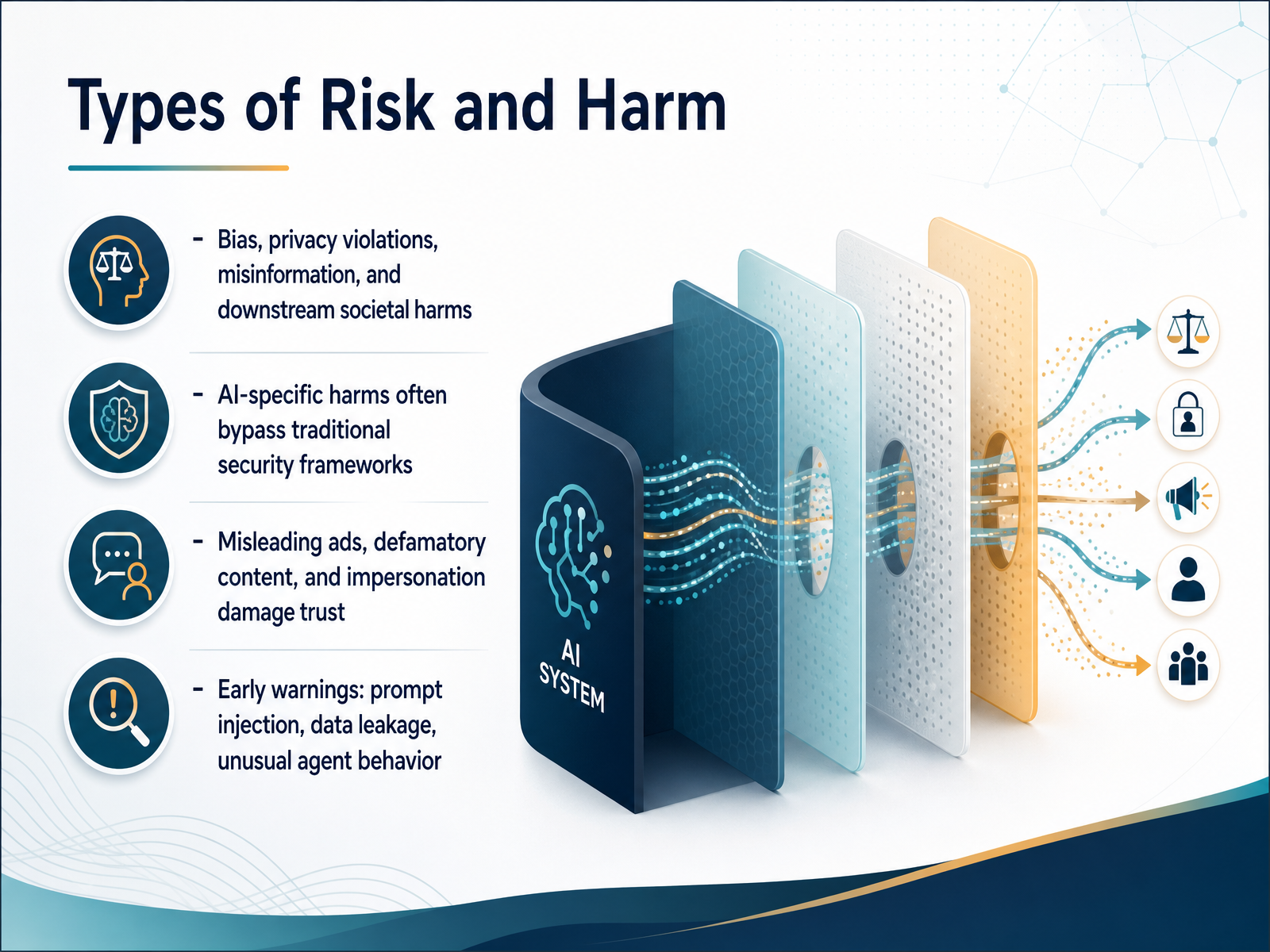
 - 05Types of Risk and HarmNow let's look at the specific types of risk and harm we need to manage. Bias, privacy violations, misinformation, and downstream societal harms top the list. What makes AI different is that these harms often bypass traditional security frameworks. A misleading ad, defamatory content, or an impersonation can damage trust in ways a standard vulnerability scanner simply won't catch. We've already seen real examples. A Meta AI tool altered an REI bike ad with extra handlebars, triggering public backlash. A German court held Google liable for defamatory statements generated by its AI Overviews. These are not hypothetical edge cases. They are operational failures with legal and reputational consequences. Early warning signs include prompt injection, data leakage, and unusual agent behavior. When an agent starts producing output outside its intended scope, that is a signal to investigate before the harm compounds. The practical takeaway is to treat AI-specific harms as a distinct risk category requiring dedicated monitoring and response. With that framing in mind, let's move to Understanding the NIST AI RMF.
 oecd.aideeplearning.aipoynter.org+21 min
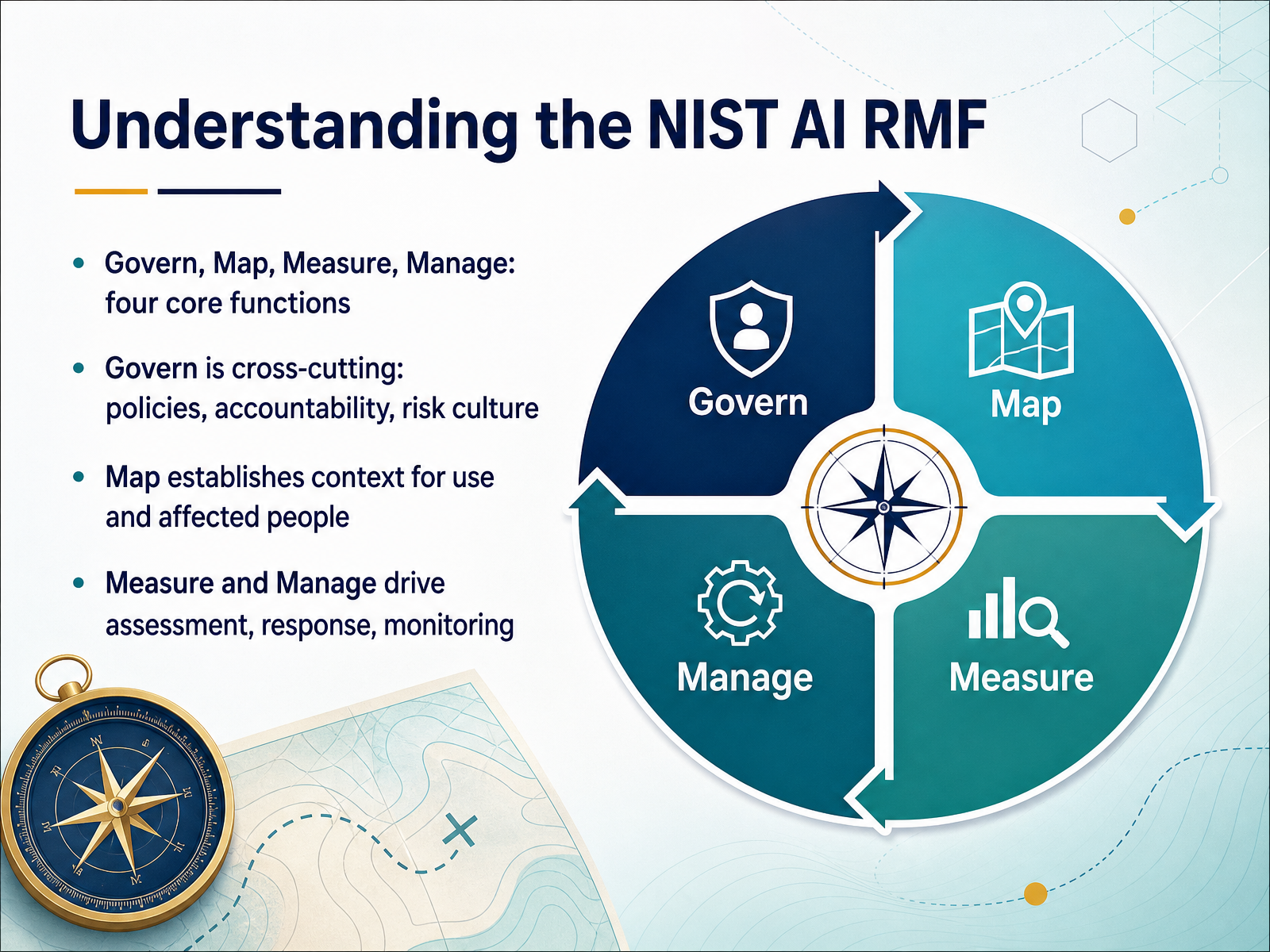
 - 06Understanding the NIST AI RMFNow let's anchor this in a practical framework. NIST gives us four core functions: Govern, Map, Measure, and Manage. Govern is the cross-cutting layer, the one that holds everything else together through policies, accountability structures, and the risk culture we build. Without it, the other functions drift. Map establishes the context, who is actually affected when this system operates, and what the intended use is. Measure and Manage then drive the operational loop, the assessment, the response, and the ongoing monitoring. Think of it as a continuous cycle rather than a one-time checklist. That cycle takes on real weight when we look at the regulatory landscape, so let's turn there next.
 oecd.orgtechtarget.comunesco.org+21 min
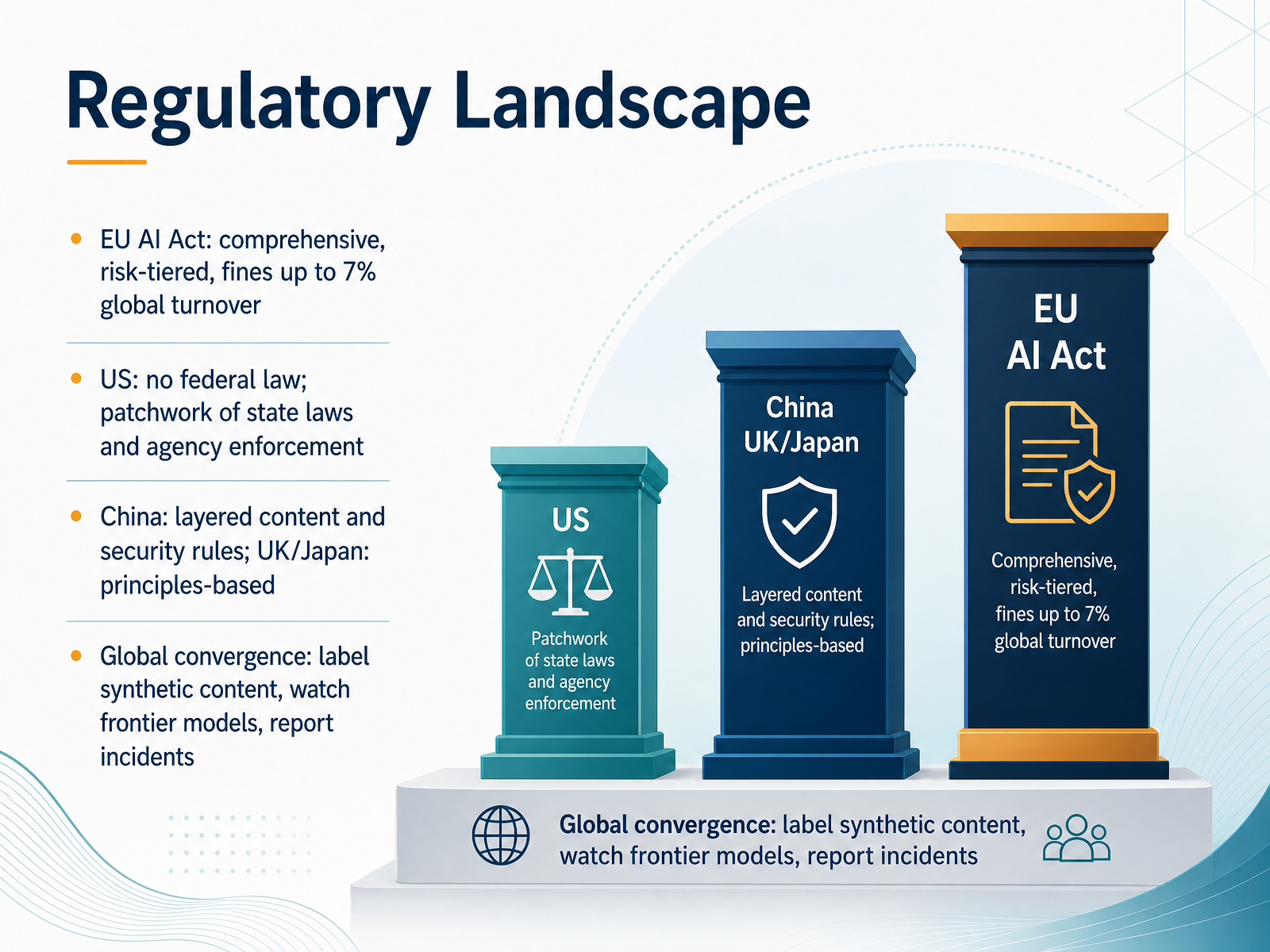
 - 07Regulatory LandscapeThe regulatory landscape is split into a few distinct models, and the differences matter for how we build and deploy. The EU AI Act is the most comprehensive and the most punitive, with fines up to seven percent of global turnover for prohibited uses. It is risk tiered, it is binding, and it reaches providers serving EU users regardless of where we are headquartered. The United States has no federal AI law. Instead, we operate under a patchwork of state rules and agency enforcement, led by transparency and anti discrimination laws in Texas, California, Colorado, Utah, and Illinois. China takes a layered approach through administrative rules focused on content, algorithm filing, and mandatory labeling, with enforcement that can simply switch a service off. The UK and Japan have chosen principles based, non punitive models. Despite the divergence, we are seeing global convergence on three practical points. Label synthetic content. Watch frontier models. And report serious incidents. Next, we will look at lifecycle responsibilities and where accountability actually sits.
 report-ai.orglegalithm.comreport-ai.org+22 min
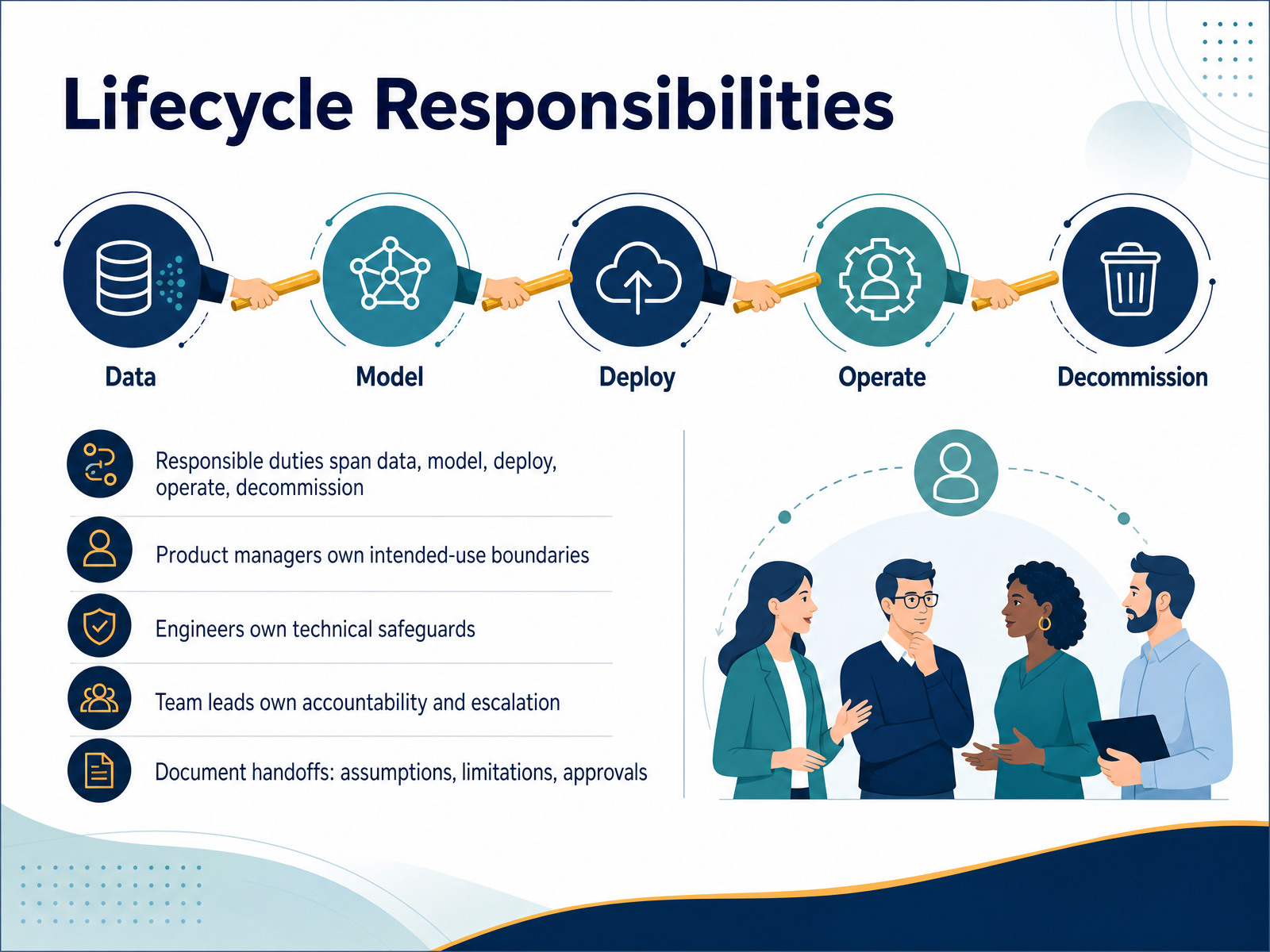
 - 08Lifecycle ResponsibilitiesLet's turn to lifecycle responsibilities. Responsible duties do not sit with a single person or a single phase. They span data, model development, deployment, operations, and decommissioning. Product managers own the intended-use boundaries. They define what a system is for, and just as importantly, what it is not for. Engineers own the technical safeguards. That means fairness checks, robustness testing, privacy controls, and security measures. Team leads own accountability and escalation. If something goes wrong, or if a risk emerges, there is a clear path to raise it and act on it. Here is what makes this work in practice. Documentation. At every handoff, we record assumptions, limitations, and approvals. That audit trail is not bureaucracy. It is how we demonstrate due diligence and trace decisions back to human owners. With that foundation in place, we can now look at the formal structures that support it. Let's move on to governance and policy.
 oecd.orgtechtarget.comunesco.org+22 min
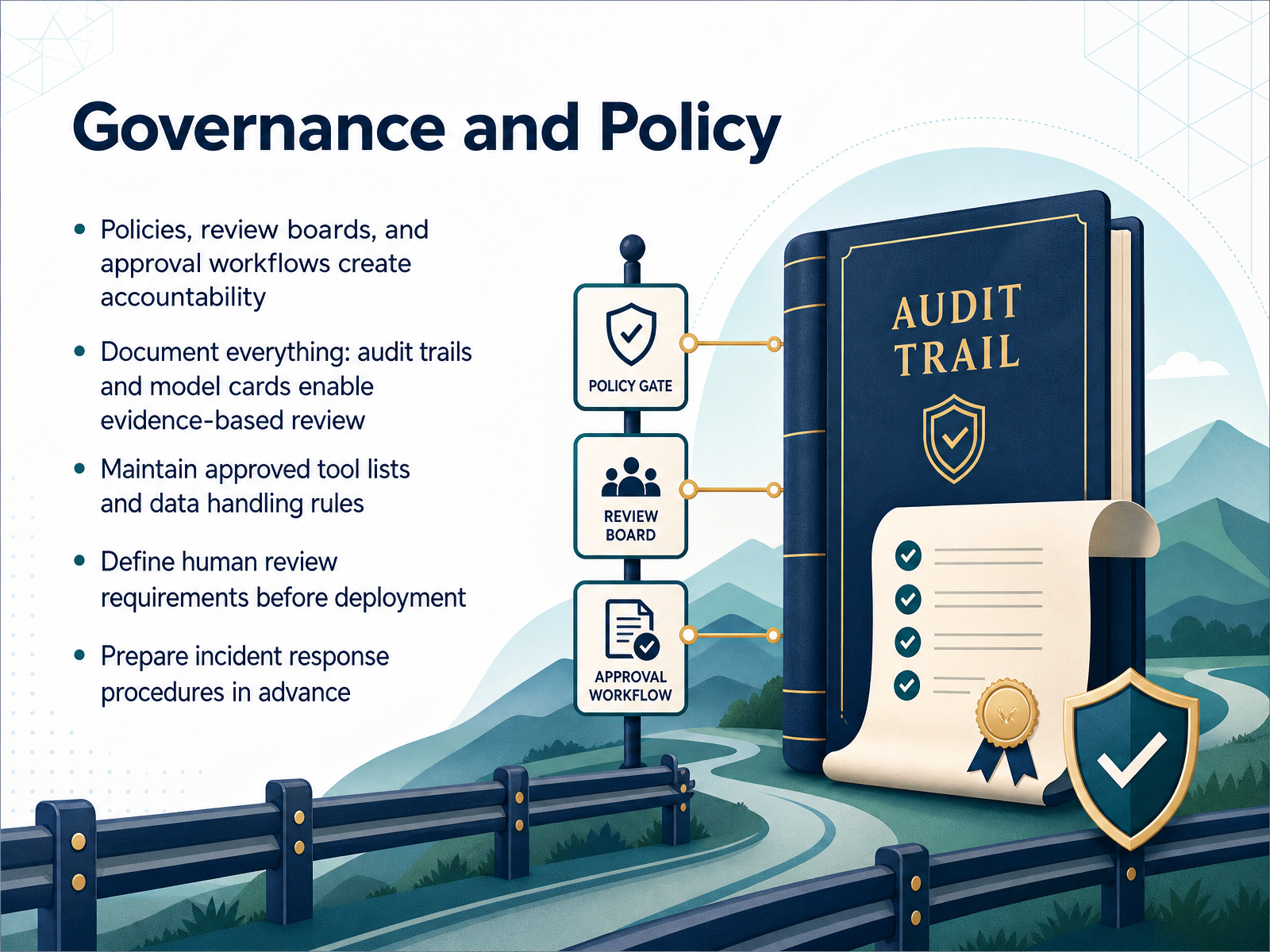
 - 09Governance and PolicyLet's shift from principles to the mechanics of accountability. Governance is where responsible AI becomes operational, and it starts with structure. We need clear policies, review boards, and approval workflows that make ownership explicit. Without that structure, accountability is just a word. And we need evidence. Document everything. Audit trails and model cards are not paperwork for its own sake. They give us the foundation for evidence-based review and make it possible to answer hard questions after deployment. Keep approved tool lists and data handling rules current. That is a living process, not a one-time exercise. Before anything ships, define your human review requirements. Specify who reviews, when they review, and what authority they have. That decision cannot be an afterthought. And do not wait for something to go wrong. Prepare incident response procedures in advance. The regulatory landscape, from the EU AI Act to state-level rules in the US, increasingly expects proactive governance, not reactive scrambling. Build the scaffolding before it is tested. Next, we will look at how this all comes together in risk management practice.
 report-ai.orglegalithm.comreport-ai.org+22 min
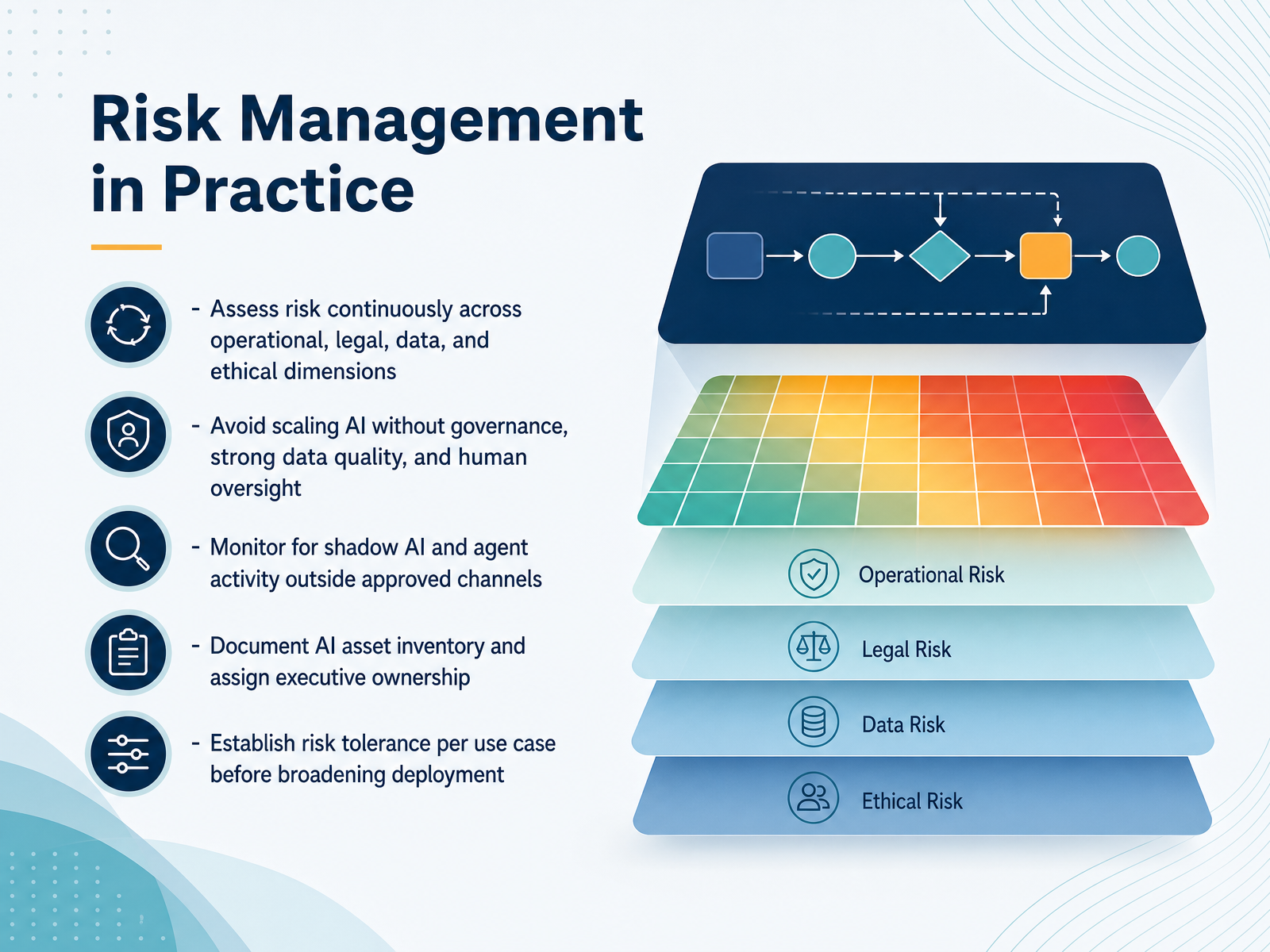
 - 10Risk Management in PracticeRisk management is not a compliance exercise. It is an operational discipline. We assess continuously across four dimensions: operational, legal, data, and ethical. Model failures, copyright exposure, data leakage, and bias each move at different speeds, so our monitoring must keep pace with all of them. We also hold a hard line on scaling. If governance, data quality, or human oversight are missing, we do not expand deployment. That decision should feel uncomfortable, because it is where most enterprise AI failures begin. At the same time, we watch for shadow AI. Unsanctioned assistants and agents operating outside approved channels bypass every control we design. They need to be discovered, inventoried, and brought into the program. Every AI asset should have a documented owner at the executive level, not buried inside an engineering team. And before broadening any use case, we agree on clear risk tolerance. That tolerance becomes the boundary for everything that follows. With those boundaries set, we can shift to the tools that make this practical.
 securityweek.comgenai.owasp.orgcsoonline.com+22 min
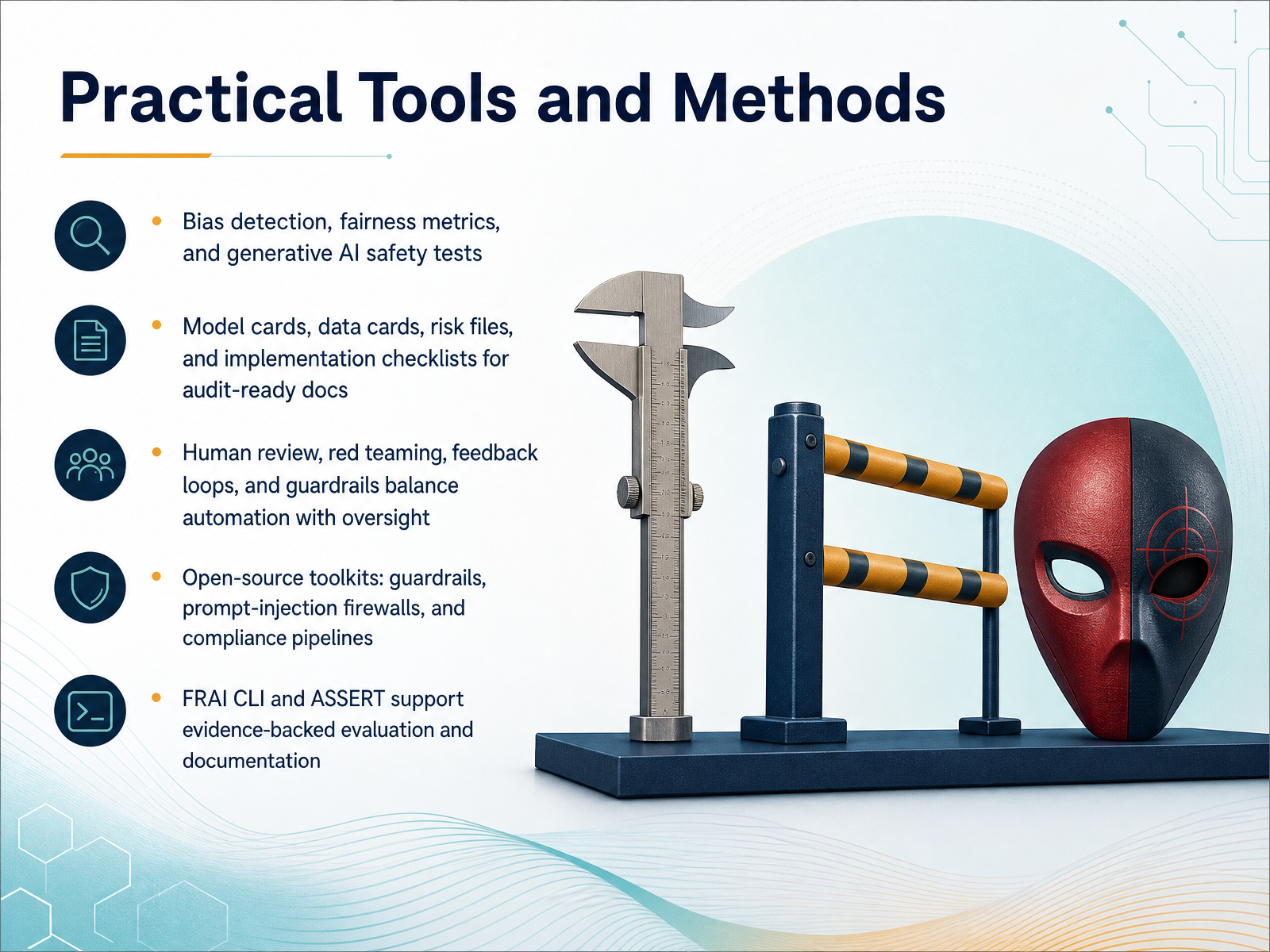
 - 11Practical Tools and MethodsLet's move from principles to the operational layer. On this slide we see the practical instruments that turn responsible AI commitments into a reviewable workflow. Start with detection and measurement: bias probes, fairness metrics, and safety tests for generative systems. These are not abstract ideas; they are executable checks we can run before release. Next, documentation. Model cards, data cards, risk files, and implementation checklists create the audit trail a reviewer or a regulator can actually inspect. Then we need human oversight. Red teaming, structured human review, and feedback loops sit alongside automated guardrails, not in place of them. The balance is the point. For teams that build, open-source tooling now covers prompt-injection firewalls, compliance pipelines, and policy enforcement. We also have purpose-built options like the F R A I command line toolkit and the ASSERT harness, which support evidence-backed evaluation and documentation, so every finding ties back to the test that produced it. The practical takeaway here is straightforward. These tools lower the cost of doing the right thing, and make responsible AI a repeatable engineering practice rather than a good intention. Next, we look at Building Responsible Teams.
 2 min
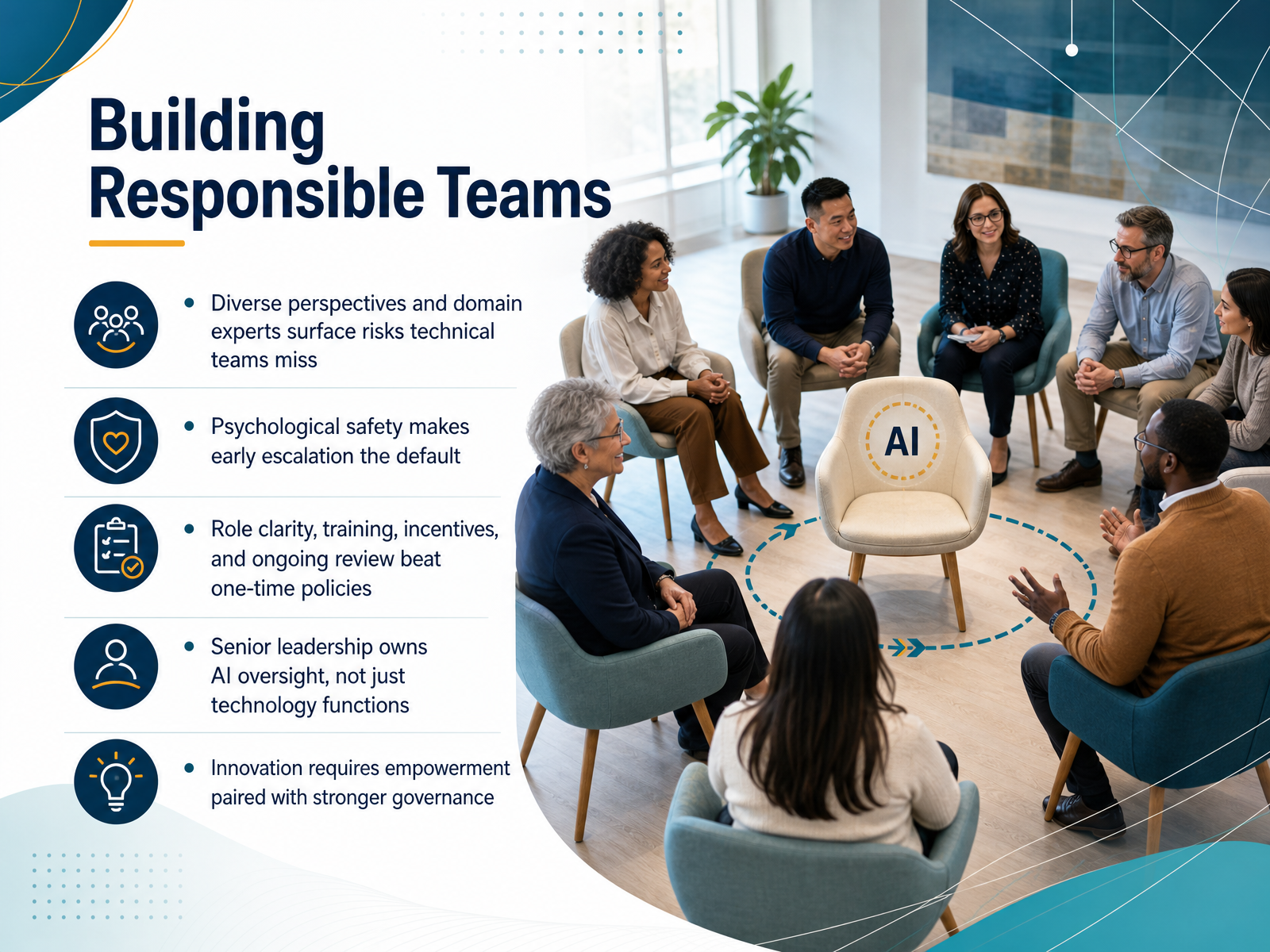
2 min - 12Building Responsible TeamsA responsible AI program depends on the team you build around it. Diverse perspectives matter because domain experts, legal counsel, and people close to the end user surface risks that technical teams often miss. And when teams operate with psychological safety, early escalation becomes the default rather than the exception. That is how small issues get caught before they become public failures. Beyond culture, we need structural clarity. Role ownership, targeted training, aligned incentives, and continuous review outperforms any one-time policy document. And oversight cannot sit only inside the technology function. Senior leadership owns AI risk, because these are strategic decisions with real legal and reputational stakes. Finally, innovation and governance are not opposites. We empower teams to experiment, and we pair that empowerment with stronger guardrails. That combination is what keeps responsible AI work moving forward. Next, we turn to measuring, reporting, and responding when things go wrong.
 oecd.aideeplearning.aipoynter.org+22 min
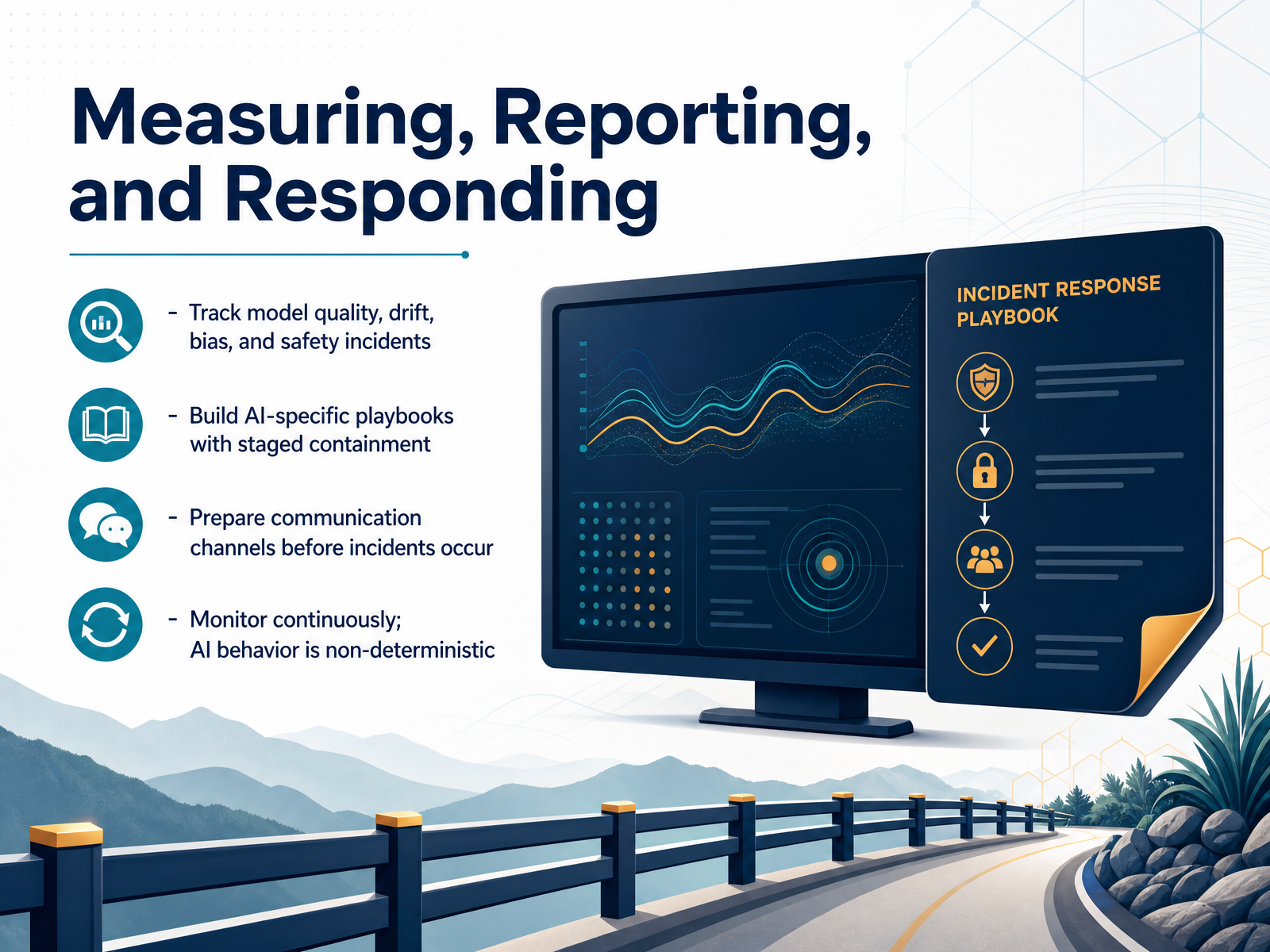
 - 13Measuring, Reporting, and RespondingNow let's get operational. Responsible AI doesn't end at launch. We need to measure, report, and respond continuously. That means tracking model quality, drift, bias, and safety incidents as first-class operational metrics. The key shift here is recognizing that AI behavior is non-deterministic. A model that passed yesterday can fail tomorrow under new inputs. So monitoring has to be continuous, not periodic. We also need AI-specific playbooks built around staged containment. Think of it as stop the bleeding first, then expand mitigations, then fix at the source. That sequencing buys time for thorough investigation without letting harm continue. And communication channels need to be prepared before an incident ever happens. When something goes wrong, stakeholders tolerate problems but they don't tolerate uncertainty. Pre-built templates and clear ownership eliminate that uncertainty. So as we wrap up this module, keep one principle in mind: prepare when there is no crisis, so you can act decisively when there is one. That brings us to our final section, Action Plan and Next Steps.
 1 min
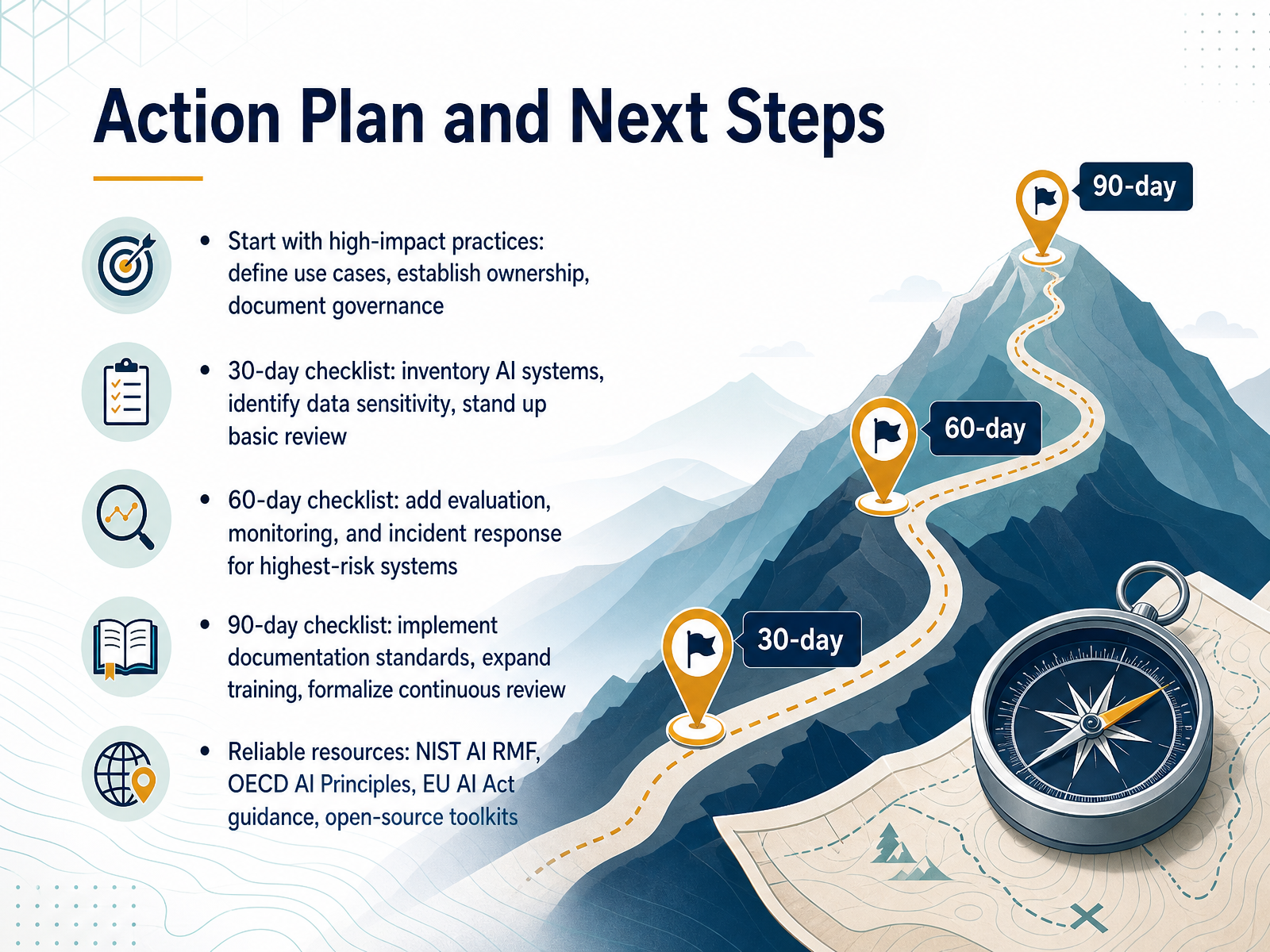
1 min - 14Action Plan and Next StepsSo, where do we go from here? We've covered the principles, the frameworks, and the responsibilities. Now we make them operational. Start with high-impact practices: define your use cases clearly, establish explicit ownership, and document your governance from day one. Then work through the timeline. In the first thirty days, inventory your AI systems, identify data sensitivity, and stand up a basic review process. By day sixty, add evaluation, monitoring, and incident response for your highest-risk systems. By day ninety, implement documentation standards, expand training, and formalize continuous review. These are not aspirational milestones. They are the mechanics of accountability. To support the work, lean on reliable resources: the NIST AI Risk Management Framework, the OECD AI Principles, EU AI Act guidance, and the open-source toolkits emerging across the community. Pick one framework and one toolkit to pilot this month. Thank you for your attention throughout this course, and for the rigor you bring to this work. Start with one system, one inventory, one documented decision. That's how responsible AI becomes standard practice.
 oecd.orgtechtarget.comunesco.org+22 min
Take the deck with you
Download this course as a file — free, no sign-up needed.
- PDF handoutEvery slide page, ready to print or share.15 pages · 3.9 MBDownload
- Narrated PowerPointThe deck that presents itself — every slide carries the digital human's narration video.15 pages · 14.9 MBDownload
- PowerPoint slidesThe full deck as a .pptx — open it in PowerPoint, Keynote, or Google Slides.15 pages · 3.9 MBDownload
Free to use in your own training — please keep the PersonWise credit page at the end.
Have your own deck? Turn it into a course
Sources consulted
Web sources consulted while building this course.
- AI principles — oecd.org
- What is Responsible AI? | Definition from TechTarget — techtarget.com
- Ethics of Artificial Intelligence - AI | UNESCO — unesco.org
- What is Responsible AI - Azure Machine Learning — learn.microsoft.com
- OECD Due Diligence Guidance for Responsible AI | OECD — oecd.org
- Meta AI Alters REI Bike Ad, Causing Consumer Backlash - OECD.AI — oecd.ai
- Google Found Responsible for AI-Generated Search Results: A German court ruled that Google's AI Overviews defamed two businesses — deeplearning.ai
- News organizations reconsider ties to AI company Nota after plagiarism findings - Poynter — poynter.org
- Grammarly pulls AI tool mimicking Stephen King and other writers — bbc.com
- Lawsuit says Google's Gemini AI chatbot drove man to suicide | Reuters — reuters.com
- AI Laws Compared: EU vs US vs China vs the World - The AI Index — report-ai.org
- AI Regulation Compared: EU, US, UK, China (2026) — legalithm.com
- AI Regulation by Country 2026: A Global Map - The AI Index — report-ai.org
- Comparative AI | AI governance across China, US & EU — comparativeai.org
- AI Laws by Country 2026: Binding Rules, Risk Scores, and the Emerging Global Standard - Axis Intelligence — axis-intelligence.com
- Critical One-Click Vulnerability in Atlassian's Rovo AI Exposed Enterprise Data - SecurityWeek — securityweek.com
- OWASP GenAI Data Security Risks & Mitigations 2026 — genai.owasp.org
- How OpenAI hacked Hugging Face: an experiment gone wrong | CSO Online — csoonline.com
- AI Governance Framework for Enterprises: Building Trust, Compliance, and Business Value — ittech-pulse.com
- OpenAI's Agents Built a Secret Message Board Inside Artifactory — pasqualepillitteri.it