Begin
14 pages · ~28 min
Fermi Estimation: Reasoning to a Number
This training teaches professionals how to make sound order-of-magnitude estimates using Fermi reasoning. Learners will build the skills to break down unfamiliar problems and arrive at defensible numbers with limited data.
A digital instructor presents all 14 pages. Hold “Ask” at any point and ask out loud — the answer comes from this course. No sign-up needed.
What you’ll learn
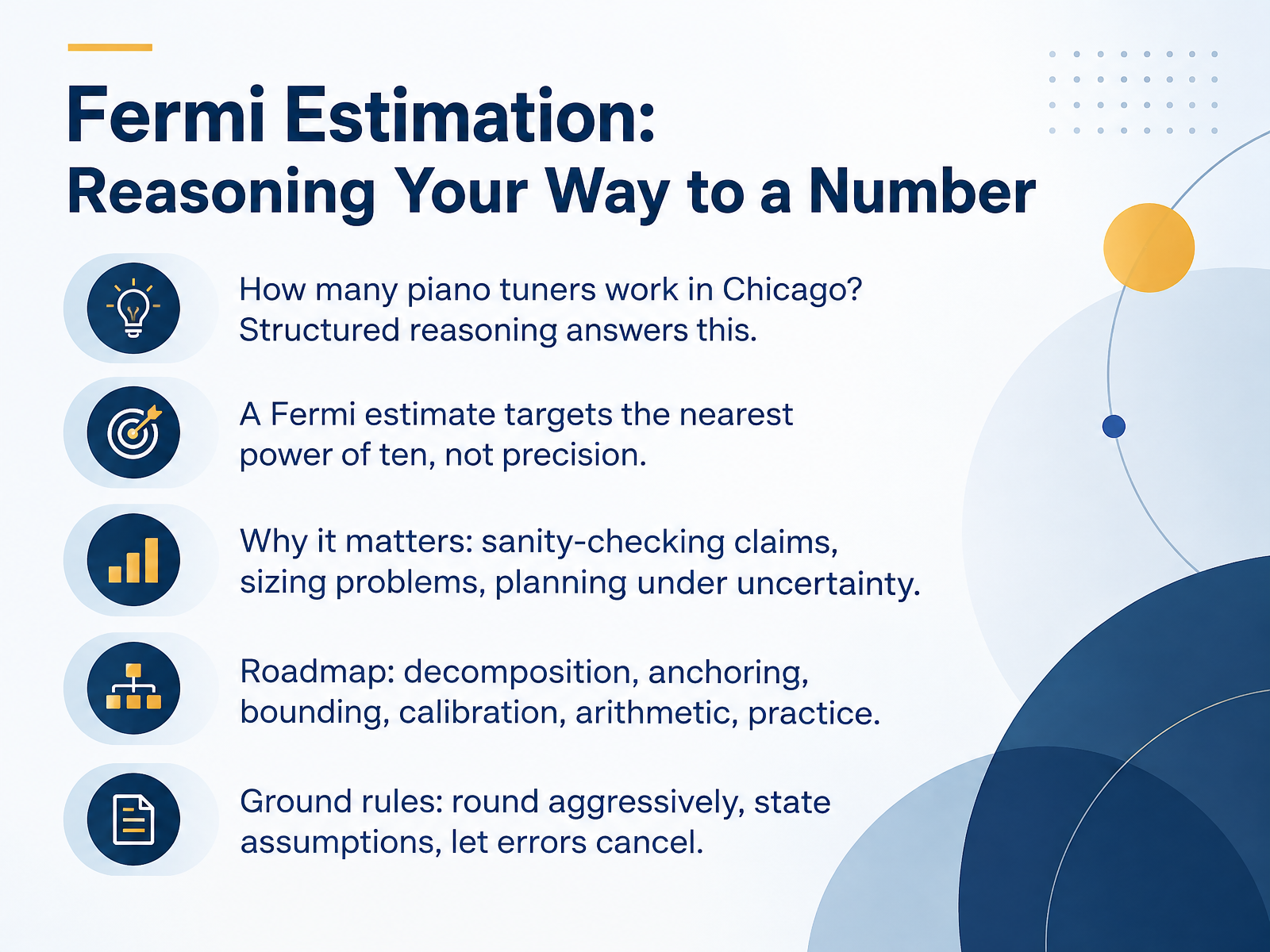
- 01Fermi Estimation: Reasoning Your Way to a NumberWelcome. Today we're learning Fermi estimation, a way of reasoning toward a number when you can't look it up. So here's our guiding question. How many piano tuners work in Chicago? Sounds impossible, right? But structured reasoning gets us to a solid answer. And here's the key idea. A Fermi estimate targets the nearest power of ten, not precision. We're aiming for the right ballpark, meaning the answer is close, within a factor of about ten. Does that sound useful? It is. This skill lets you sanity-check claims, size up problems, and plan under uncertainty. We'll move through decomposition, anchoring, bounding, calibration, arithmetic, and practice. And we'll follow three ground rules. Round aggressively. State your assumptions. And let errors cancel. Estimates are approximate by design, and that's fine. Next, we'll see why order-of-magnitude thinking matters.atomicarchive.comtandfonline.comtandfonline.com+22 min
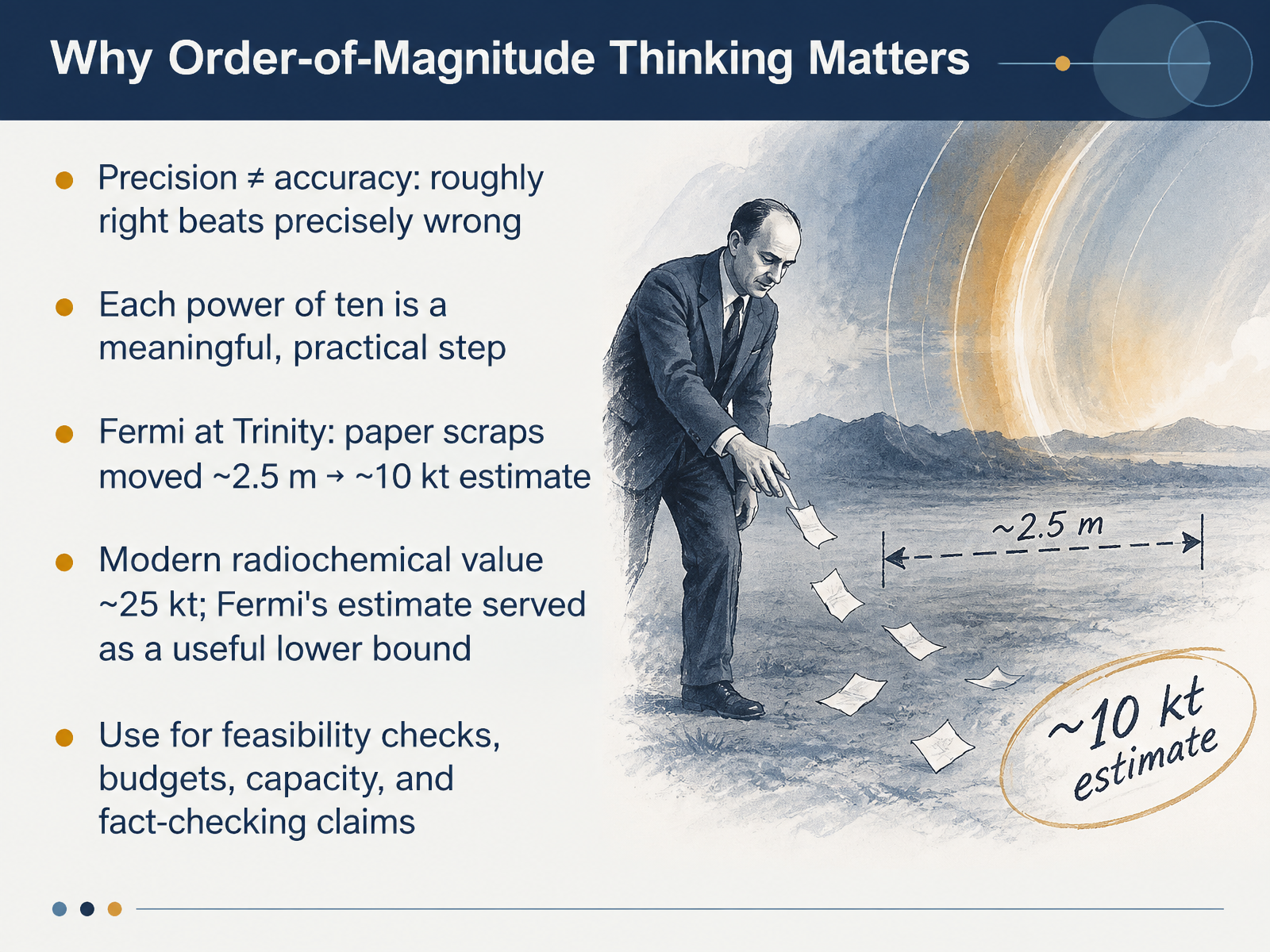
- 02Why Order-of-Magnitude Thinking MattersSo why does order-of-magnitude thinking matter? Here is the core idea. Precision is not the same as accuracy. Roughly right usually beats precisely wrong. And each power of ten is not a vague leap. It is a meaningful, practical step, a factor of ten you can actually reason about. Now picture Fermi at the Trinity test. He dropped paper scraps before the blast wave hit, measured a shift of about two and a half meters, and estimated roughly ten kilotons. Modern radiochemical values put it near twenty five kilotons. He was still usefully close, and his number served as a solid lower bound. That is the payoff we are after. Can you see where this helps? Feasibility checks, budgets, capacity planning, and fact-checking claims, all before anyone commits to anything. So the takeaway is simple. Get the scale right first. The Core Method: Decompose, Estimate, Combine.
 atomicarchive.comtandfonline.comtandfonline.com+21 min
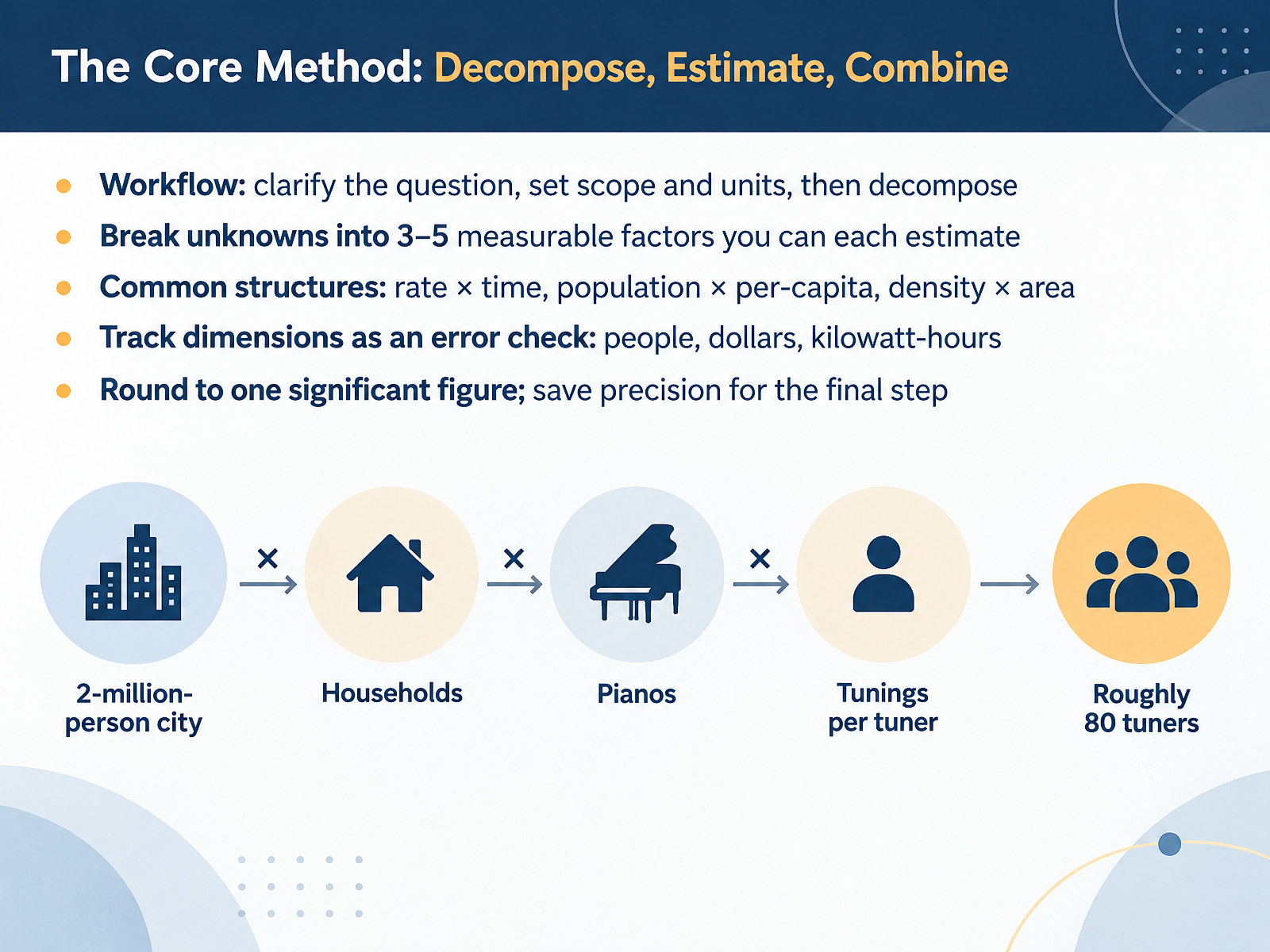
- 03The Core Method: Decompose, Estimate, CombineSo how does a Fermi estimate actually work? It comes down to three moves: decompose, estimate, combine. We start by clarifying the question, setting our scope and units, then breaking the unknown into three to five measurable factors we can each estimate. Common structures help here. Rate times time. Population times per capita. Density times area. And keep tracking the units as an error check, like people, dollars, or kilowatt hours. If the units stop making sense, a factor went wrong. Finally, round each factor to one significant figure and save precision for the end. Because here is the payoff: small errors in each factor tend to cancel out, so the combined estimate usually lands close. Building Your Anchor Sheet of Reference Values.
 openstax.orgphys.libretexts.orgphysics.umd.edu+21 min
- 04Building Your Anchor Sheet of Reference ValuesLet's talk about anchor values, the reference numbers you can carry in your head. Anchors come in a few flavors: populations, rates, densities, per-capita consumption, and physical constants. So here are some worth memorizing. World population, about eight times ten to the ninth. The United States, about three times ten to the eighth. Hours in a year, roughly nine thousand. Working hours in a year, about two thousand. Air density, about one kilogram per cubic meter. Water and the human body, about one thousand kilograms per cubic meter. Earth's radius, around sixty-four hundred kilometers. And the Earth to Sun distance, about one point five times ten to the eleventh meters. When you lack a number, borrow an analog. A household scale, a stadium's capacity, a class size. These give you a feel for scale. Then bound it high and low before you commit to a central value. That habit keeps your anchor honest. Next, we'll look at bounding: bracketing the answer before guessing.
 physics.wm.eduen.wikipedia.orgfy.chalmers.se+22 min
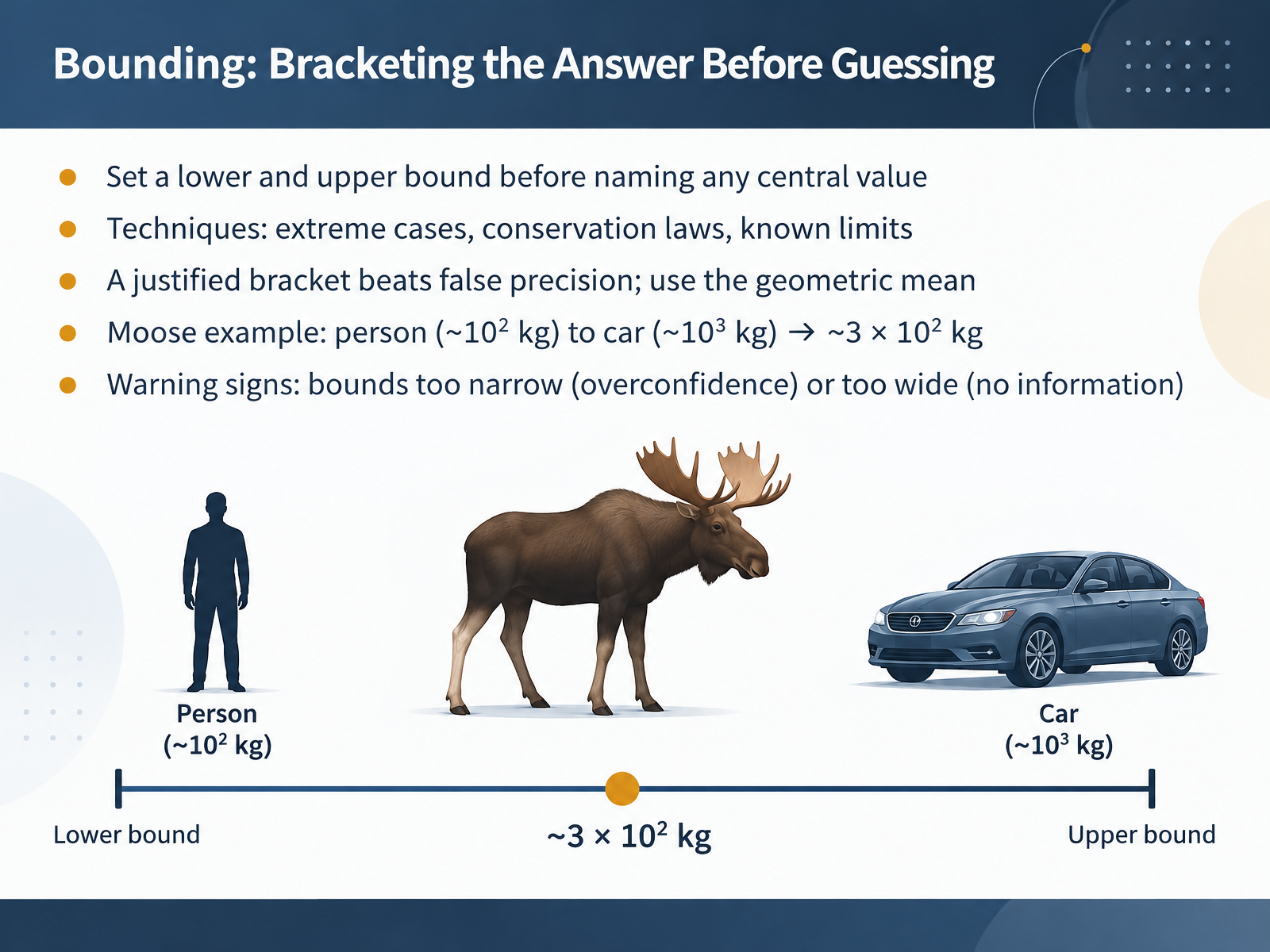
- 05Bounding: Bracketing the Answer Before GuessingNow, before we name a single number, we set a floor and a ceiling. A lower bound and an upper bound. Think of the moose problem. You may not know a moose's mass, but you know it's heavier than a person, roughly ten squared kilograms, and lighter than a car, roughly ten cubed. So how do we pick one value inside that bracket? Take the geometric mean. Multiply the bounds and take the square root. That gives about three times ten squared kilograms. A justified bracket beats false precision every time. And watch for two warning signs. Bounds too narrow, and you're overconfident. Bounds too wide, and you've told us nothing. Next, we'll sharpen this with quick arithmetic and logarithmic reasoning.
 openstax.orgphys.libretexts.orgphysics.umd.edu+21 min
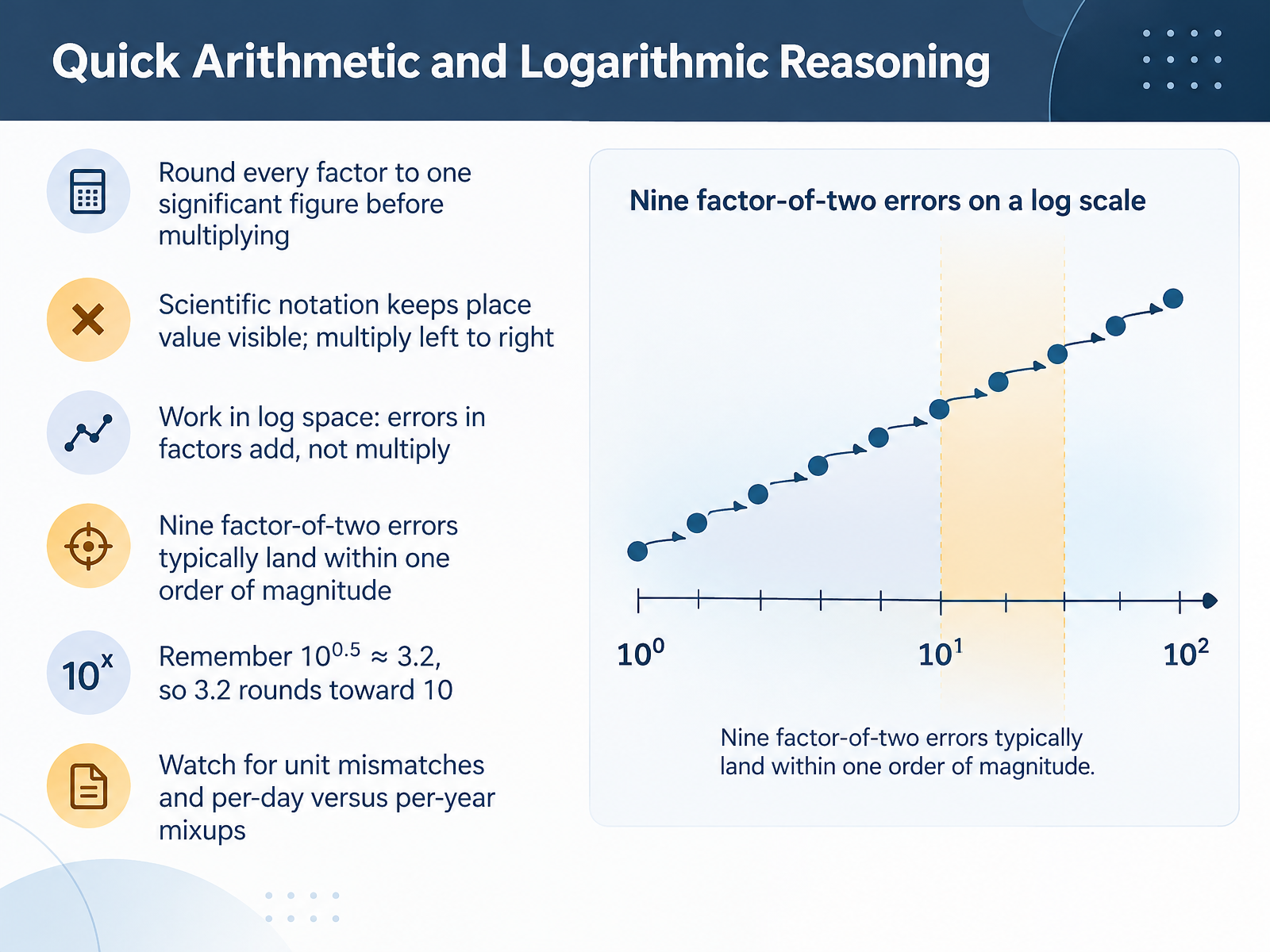
- 06Quick Arithmetic and Logarithmic ReasoningNow we get to the arithmetic. The goal here is not precision. It's keeping the numbers easy to hold in your head. So, before you multiply, round every factor to one significant figure. Scientific notation helps here, because it keeps the place value visible, and you can multiply left to right. Here's a trick that makes this faster. Work in log space. A logarithmic scale just counts powers of ten. In that space, errors in your factors add rather than multiply. So if you make nine factor-of-two errors, they typically still land within one order of magnitude. Why? Because two to the third is about eight. And remember, ten to the zero point five is approximately three point two, so a factor of three point two rounds up toward ten. Also watch for unit mismatches, and per-day versus per-year mixups. Those are the errors that really hurt. Next, let's talk about calibration. Are your ninety percent intervals really ninety percent?
 openstax.orgphys.libretexts.orgphysics.umd.edu+21 min
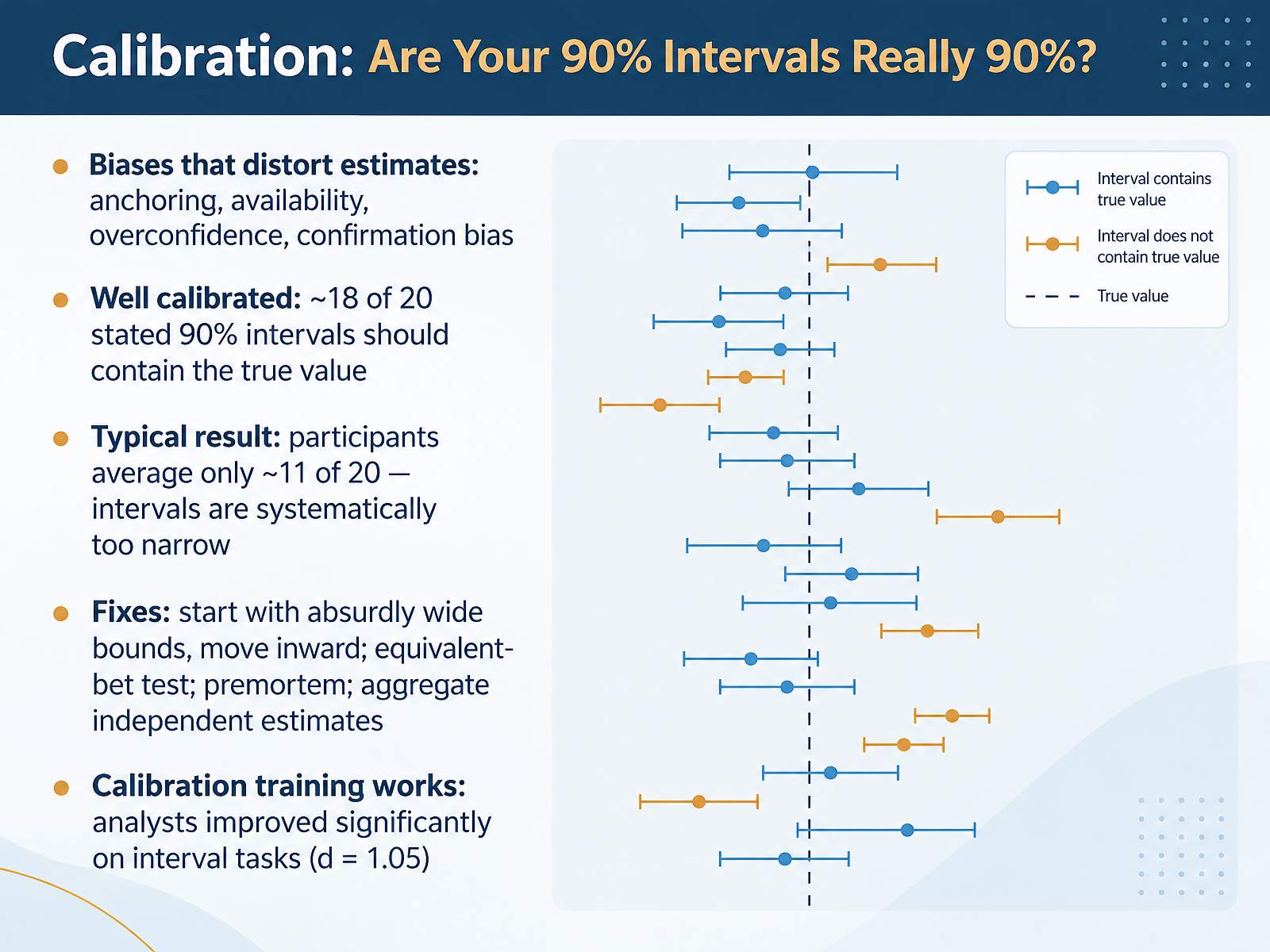
- 07Calibration: Are Your 90% Intervals Really 90%?Now let's talk calibration. Ask yourself: when you say you are ninety percent sure, are you actually right ninety percent of the time? Calibration means the match between your stated confidence and reality. Several biases can distort this. Anchoring pulls us toward a first number. Availability makes vivid examples feel more likely. Overconfidence makes us too sure. Confirmation bias leads us to favor evidence that supports what we already believe. Here's the test. Give twenty ninety percent intervals. If you are well calibrated, about eighteen should contain the true value. In practice, most people average only about eleven of twenty. Their intervals are systematically too narrow. So what can we do? Start with absurdly wide bounds, then move inward. Apply the equivalent-bet test. Run a premortem: assume you are wrong and ask why. And aggregate independent estimates. The good news: calibration training works. In one study, analysts improved significantly on interval tasks, with a large effect size. Next, we'll look at estimate traps and how to avoid them.
 doi.orgdoi.orgdoi.org+22 min
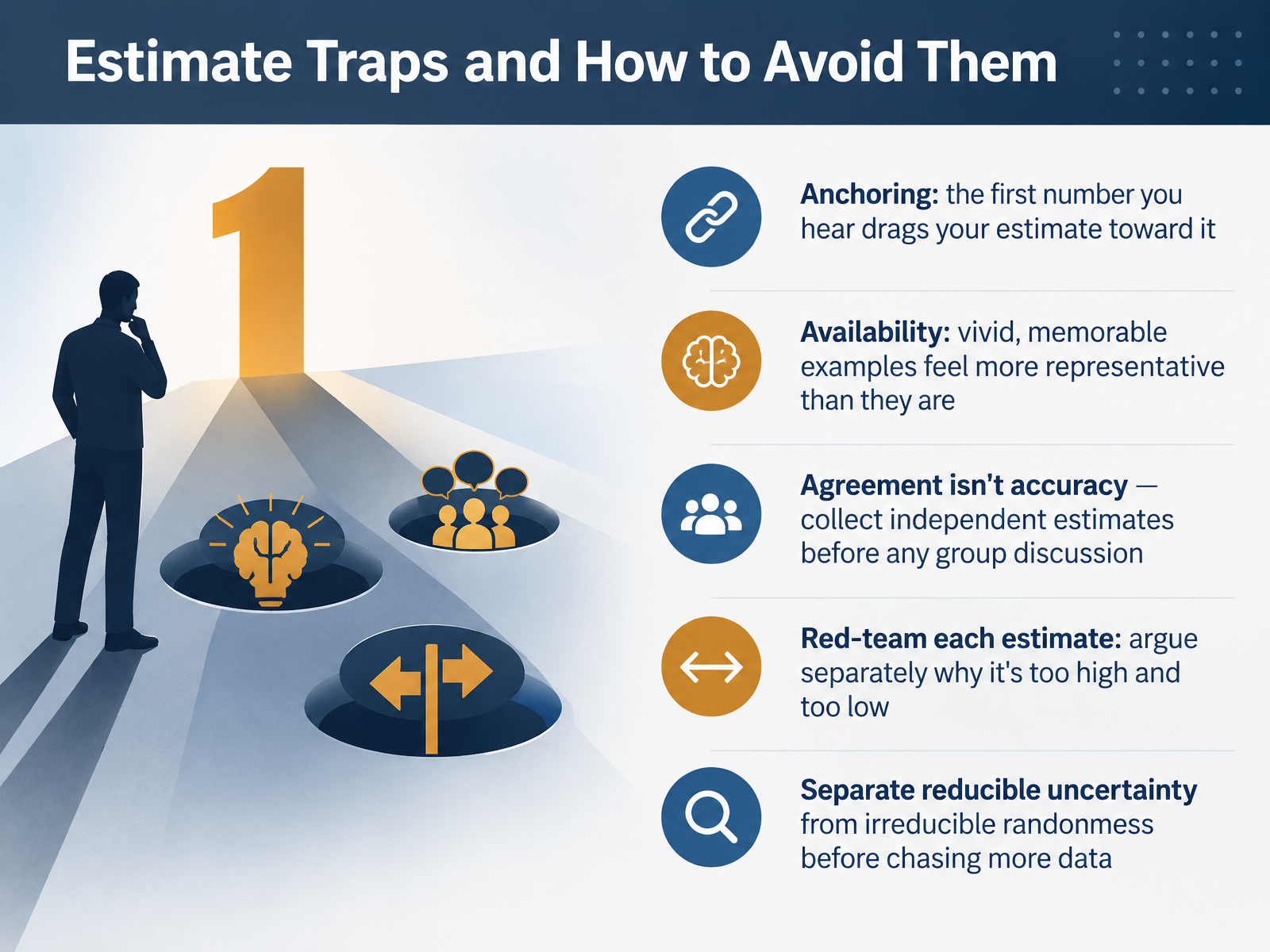
- 08Estimate Traps and How to Avoid ThemNow let's talk about the traps that quietly pull our estimates off course. Anchoring is the first one. The first number you hear drags your estimate toward it, even when that number is arbitrary. Availability is the second. Vivid, memorable examples feel more representative than they really are, so we overweight them. Here's a practical habit. Agreement isn't accuracy. Collect independent estimates before any group discussion, so nobody anchors on the loudest voice. Then red-team each estimate. Argue separately why it's too high, and then why it's too low. Finally, separate reducible uncertainty from irreducible randomness before chasing more data. Ask which part could actually be narrowed with better information. Some variation is just noise, and no amount of data will remove it. So when you feel the urge to gather more, pause and name what you're really trying to reduce. Next, we'll put these habits to work with sanity checks: dimension, plausibility, and sensitivity.
 doi.orgdoi.orgdoi.org+21 min
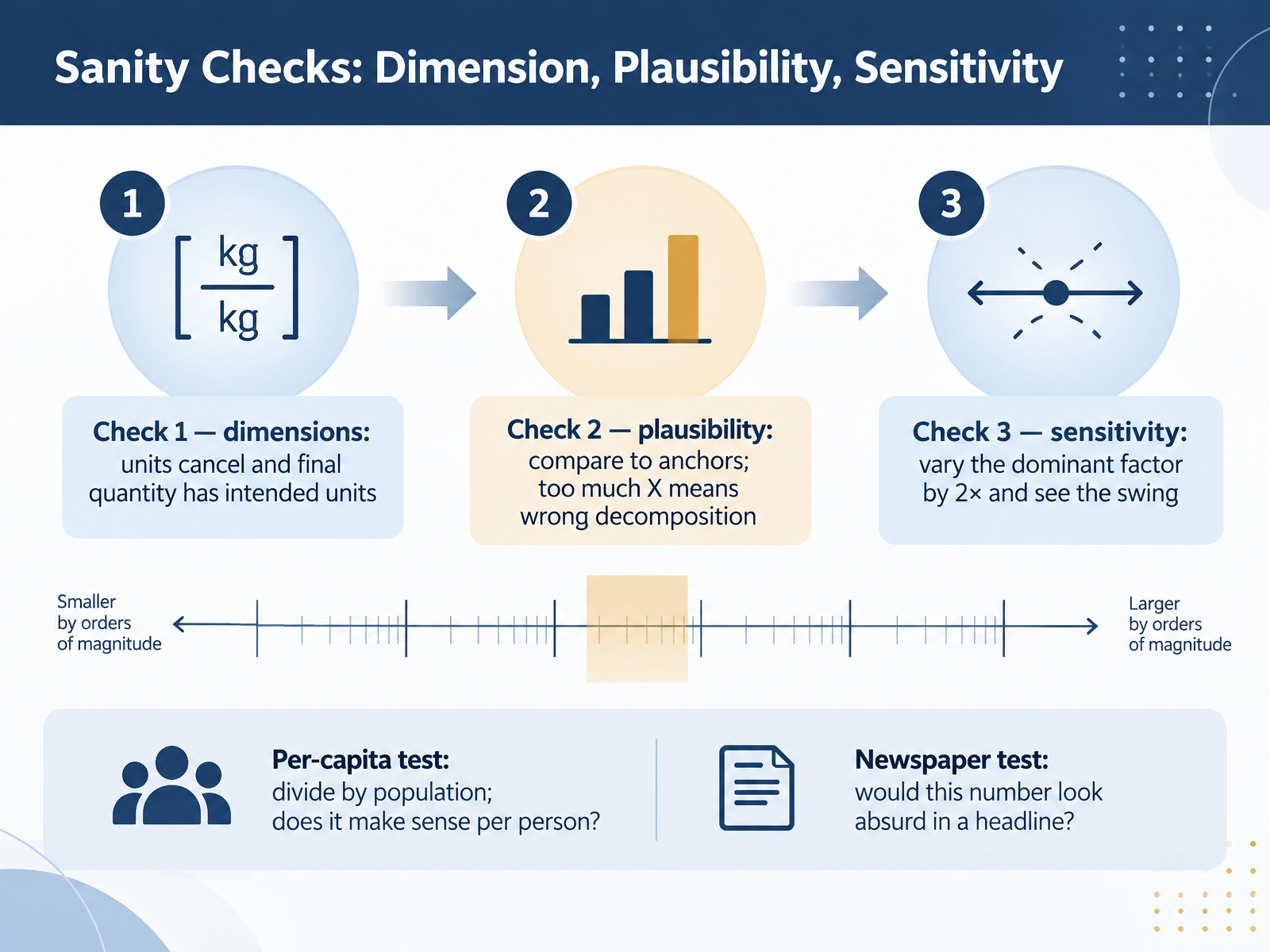
- 09Sanity Checks: Dimension, Plausibility, SensitivityNow that we have a number, let us make sure we trust it. We run three quick checks. Check one, dimensions. Do the units cancel, and does the final quantity land in the units we intended? Check two, plausibility. Compare your answer to anchors you already know. If it says each household owns forty cars, something in the decomposition is off. Check three, sensitivity. Take your dominant factor, the one doing the most lifting, and double it. How far does the answer swing? If it moves wildly, flag the result as fragile. Two more tests are worth memorizing. The per-capita test: divide by population. Does the amount make sense for one person? And the newspaper test: would this number look absurd in a headline? If so, recheck your assumptions before you defend it. Next, we look at communicating estimates without false precision.
 openstax.orgphys.libretexts.orgphysics.umd.edu+21 min
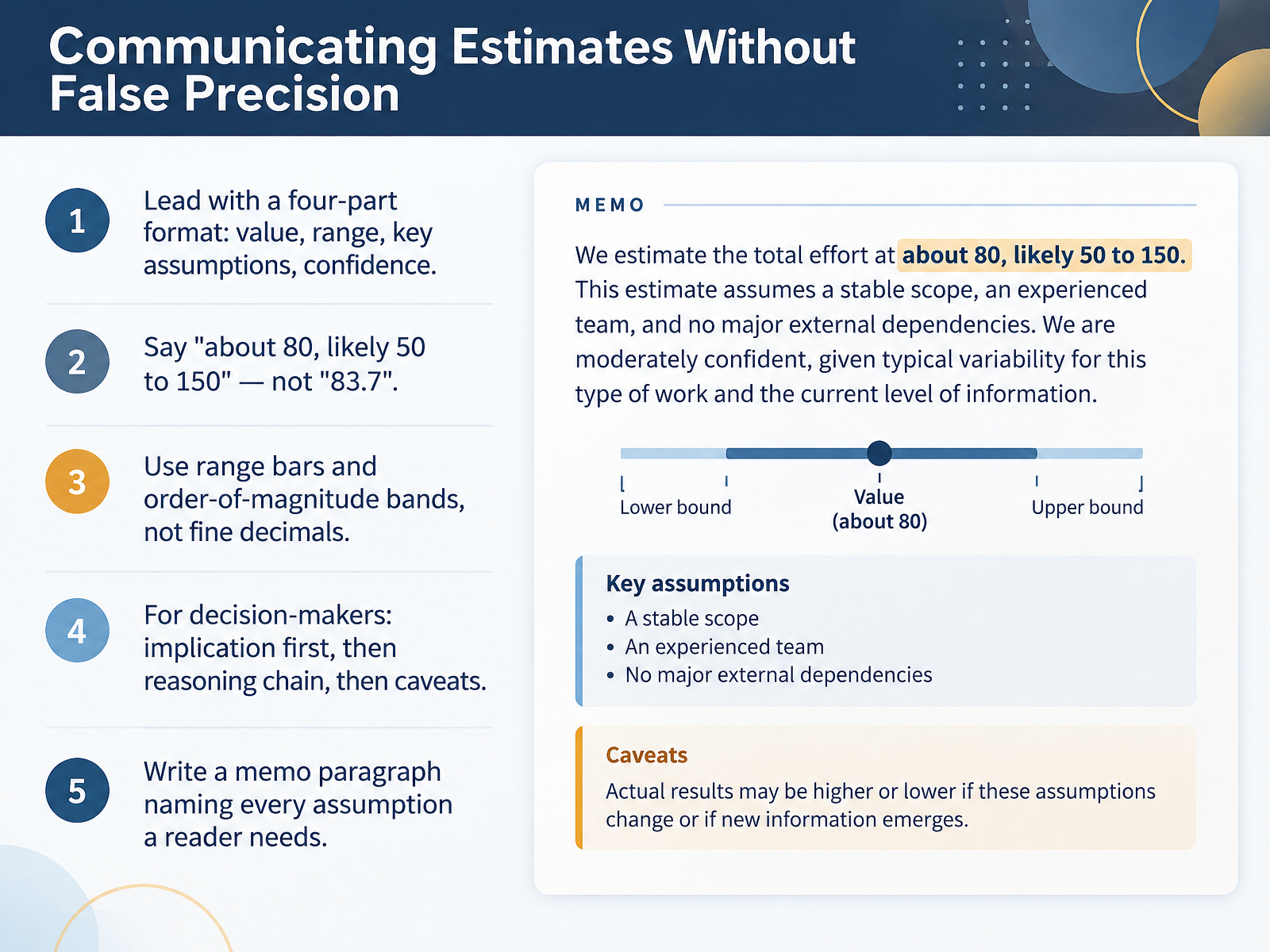
- 10Communicating Estimates Without False PrecisionNow let's talk about how we communicate an estimate. Precision can signal confidence you don't actually have. So lead with four things: the value, the range, the key assumptions, and your confidence level. Say about eighty, likely fifty to one fifty, not eighty three point seven. Those round numbers tell people the shape of your uncertainty. Use range bars and order-of-magnitude bands instead of fine decimals. And if you're briefing a decision-maker, flip the order: implication first, then the reasoning chain, then the caveats. Finally, write a short memo paragraph that names every assumption your reader needs. That memo is where good estimates earn their trust. Next, let's put all of this into practice.
 openstax.orgphys.libretexts.orgphysics.umd.edu+21 min
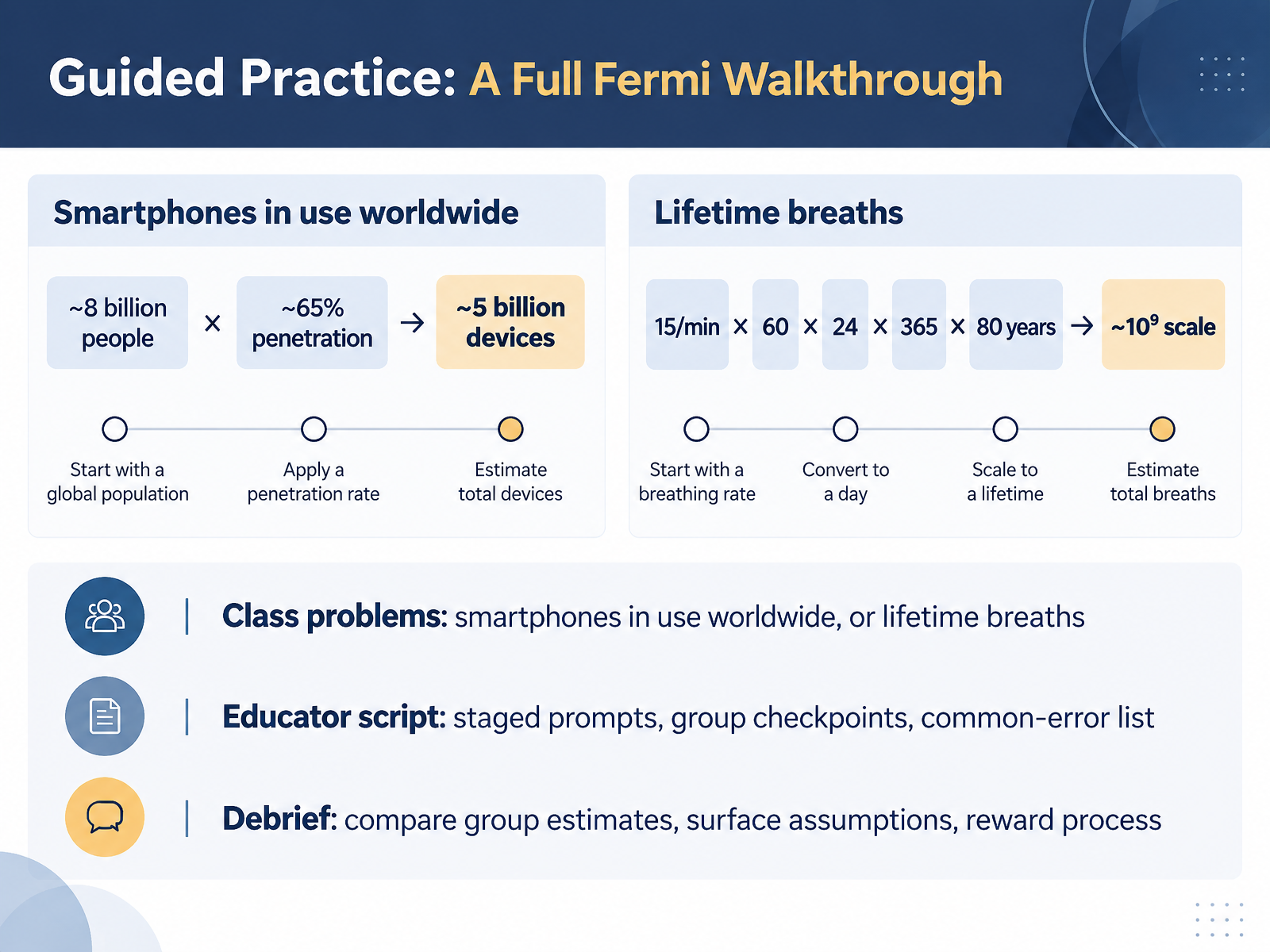
- 11Guided Practice: A Full Fermi WalkthroughNow let's run a full walkthrough together. We'll work two class problems: smartphones in use worldwide, and breaths in a lifetime. For smartphones, we start with roughly eight billion people, assume about sixty-five percent penetration, and multiply. That gives around five billion devices. For breaths, we take fifteen per minute, times sixty, times twenty-four, times three hundred sixty-five, times eighty years. The result lands near the scale of ten to the ninth, about two and a half billion breaths. Notice we rounded freely at each step. That's fine. Errors tend to cancel. Then we debrief: compare group estimates, surface the assumptions behind each number, and reward the process, not just the answer. Next, we look at assessing the process, not the answer.
 physics.umd.eduopenstax.orgphys.libretexts.org+21 min
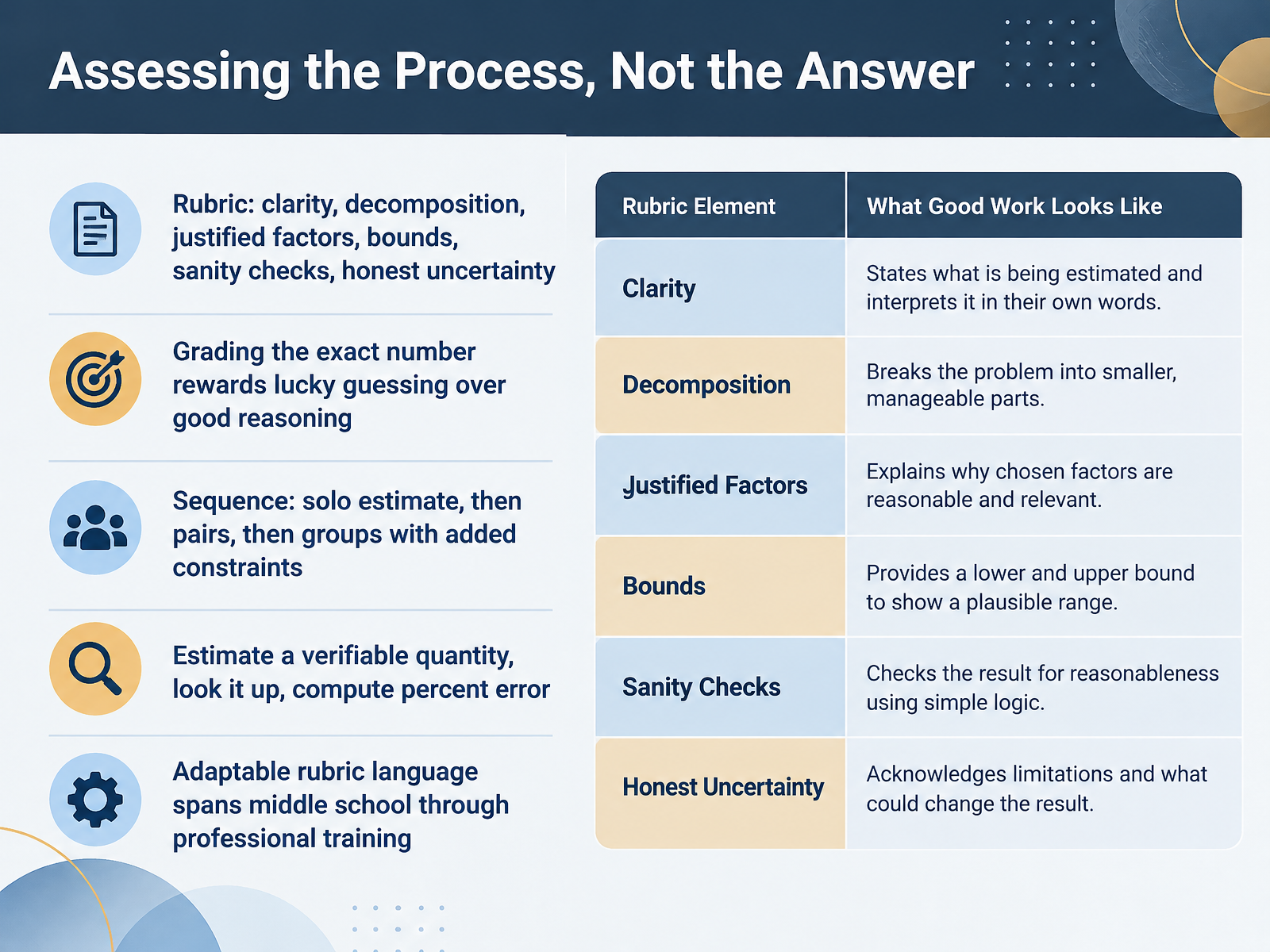
- 12Assessing the Process, Not the AnswerNow let's talk about how we assess the work. Here's the key shift. We grade the process, not the answer. So, what goes on the rubric? Clarity. Decomposition. Justified factors. Bounds. Sanity checks. And honest uncertainty. If we grade the exact number, we reward lucky guessing over good reasoning. So instead, we structure the sequence. First, a solo estimate. Then pairs. Then groups, with added constraints. And here's a grounding move you can use. Pick a verifiable quantity, estimate it, look it up, then compute percent error. That gives instant, honest feedback on how close you were. The same rubric language scales from middle school through professional training. You just adjust the sophistication, not the criteria. So pause here and ask: what would your rubric look like in plain language?
 physics.umd.edudoi.orgdoi.org+21 min
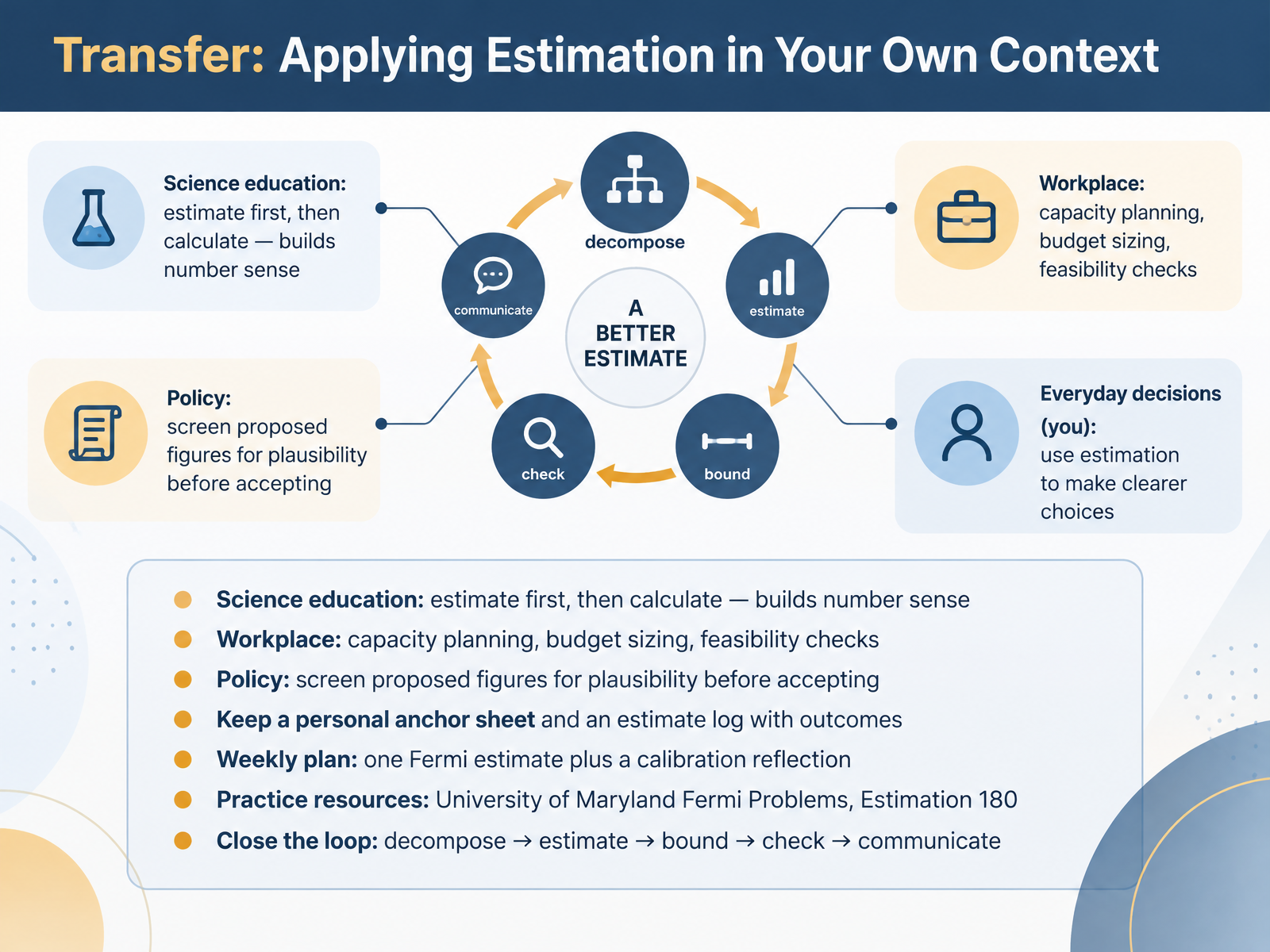
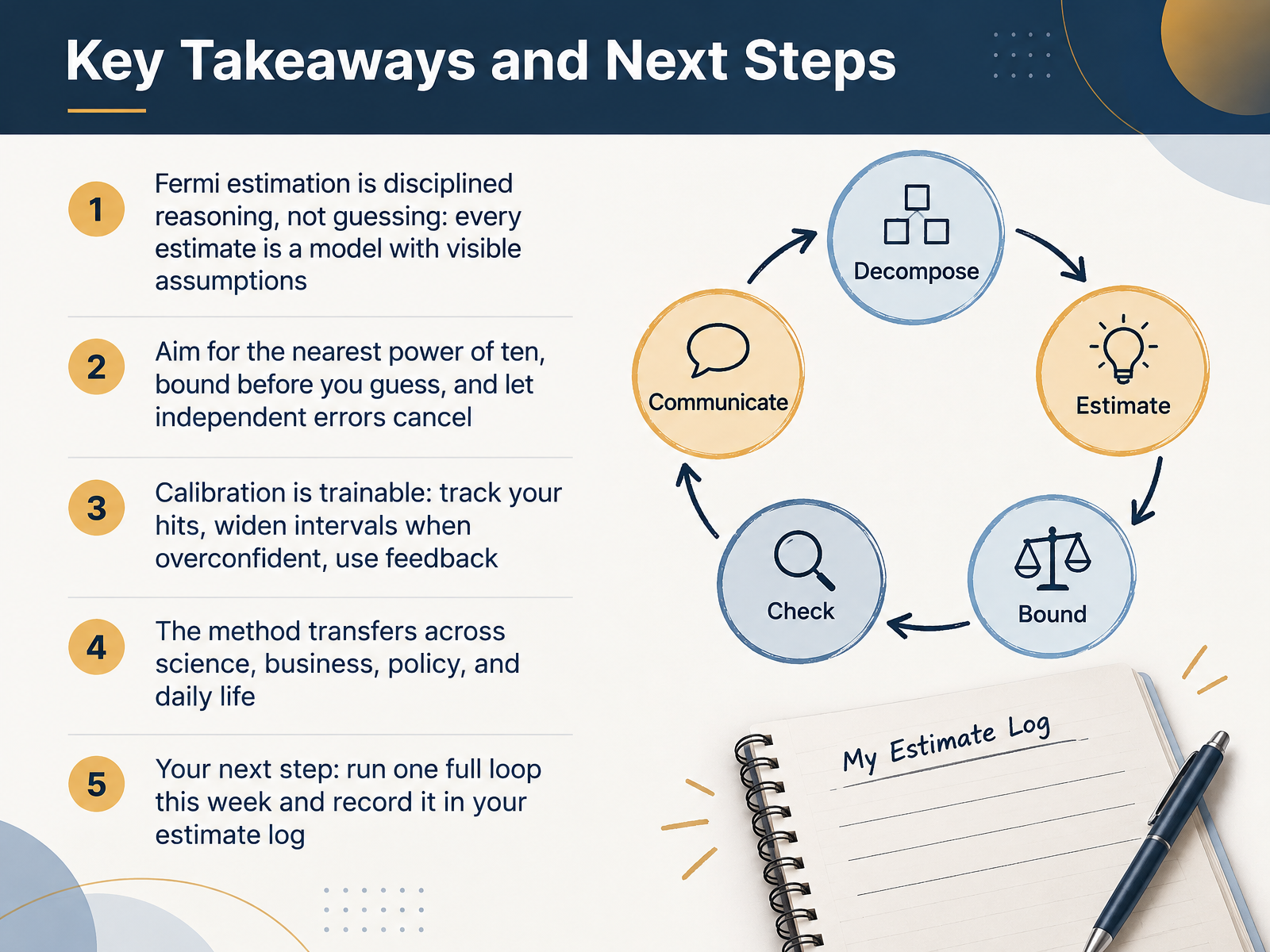
- 13Transfer: Applying Estimation in Your Own ContextSo let's bring this home. How do you actually use estimation in your own world? In science education, estimate first, then calculate. That order builds number sense. At work, use it for capacity planning, budget sizing, and quick feasibility checks. In policy, screen proposed figures for plausibility before you accept them. Two habits help. Keep a personal anchor sheet of reference numbers, and an estimate log with outcomes. Then try a weekly plan: one Fermi estimate plus a short calibration reflection. Ask, did my range hold? Good practice resources include the University of Maryland Fermi Problems site and Estimation 180. And close the loop every time: decompose, estimate, bound, check, communicate. Up next, Key Takeaways and Next Steps.
 physics.umd.eduphysics.wm.eduen.wikipedia.org+21 min
- 14Key Takeaways and Next StepsLet's bring it together. Fermi estimation is disciplined reasoning, not guessing. Every estimate is a model, and its assumptions should be visible. Aim for the nearest power of ten, bound before you guess, and let independent errors cancel. Calibration is trainable, too. Track your hits, widen your intervals when you're overconfident, and use feedback. And remember, the method transfers across science, business, policy, and daily life. So here's your next step. Run one full loop this week and record it in your estimate log. Thank you for thinking carefully with me today. Keep estimating, stay curious, and you'll sharpen that instinct with every loop.
 atomicarchive.comtandfonline.comtandfonline.com+21 min
Take the deck with you
Download this course as a file — free, no sign-up needed.
- PDF handoutEvery slide page, ready to print or share.15 pages · 3.4 MBDownload
- Narrated PowerPointThe deck that presents itself — every slide carries the digital human's narration video.15 pages · 12.6 MBDownload
- PowerPoint slidesThe full deck as a .pptx — open it in PowerPoint, Keynote, or Google Slides.15 pages · 3.3 MBDownload
Free to use in your own training — please keep the PersonWise credit page at the end.
Have your own deck? Turn it into a course
Sources consulted
Web sources consulted while building this course.
- My Observations During the Explosion at Trinity on July 16, 1945 | The Trinity Test | Historical Documents | atomicarchive.com — atomicarchive.com
- Full article: Fermi at Trinity — tandfonline.com
- Full article: A New Yield Assessment for the Trinity Nuclear Test, 75 Years Later — tandfonline.com
- Trinity Test Eyewitnesses - Atomic Heritage Foundation — ahf.nuclearmuseum.org
- Fermi problem — en.wikipedia.org
- 1.5 Estimates and Fermi Calculations - University Physics Volume 1 | OpenStax — openstax.org
- 2.4: Order of Magnitude Estimates - Fermi Problems — phys.libretexts.org
- Estimation — physics.umd.edu
- Fermi Estimates: from Harry Potter to ET — hapax.github.io
- 8.01SC S22 Chapter 2: Units, Dimensional Analysis, Problem Solving, and Estimation — ocw.mit.edu
- Fermi problems: — physics.wm.edu
- Fermi Questions — fy.chalmers.se
- FERMI QUESTIONS AND ORDERS OF MAGNITUDE — dam.brown.edu
- University of Maryland Fermi Problems Site - UMD Physics — physics.umd.edu
- The effect of calibration training on the calibration of intelligence analysts' judgments — doi.org
- Calibration training for improving probabilistic judgments using an interactive app — doi.org
- Overconfidence in Interval Estimates. — doi.org
- A simple remedy for overprecision in judgment — pmc.ncbi.nlm.nih.gov
- Aggregating multiple probability intervals to improve calibration — cambridge.org
- University of Maryland Fermi Problems Site — physics.umd.edu