Begin
14 pages · ~28 min
DevOps Engineer Role Overview
This training explains the role and responsibilities of a DevOps Engineer, helping aspiring professionals and career changers understand what DevOps engineers do and what the role involves.
A digital instructor presents all 14 pages. Hold “Ask” at any point and ask out loud — the answer comes from this course. No sign-up needed.
What you’ll learn
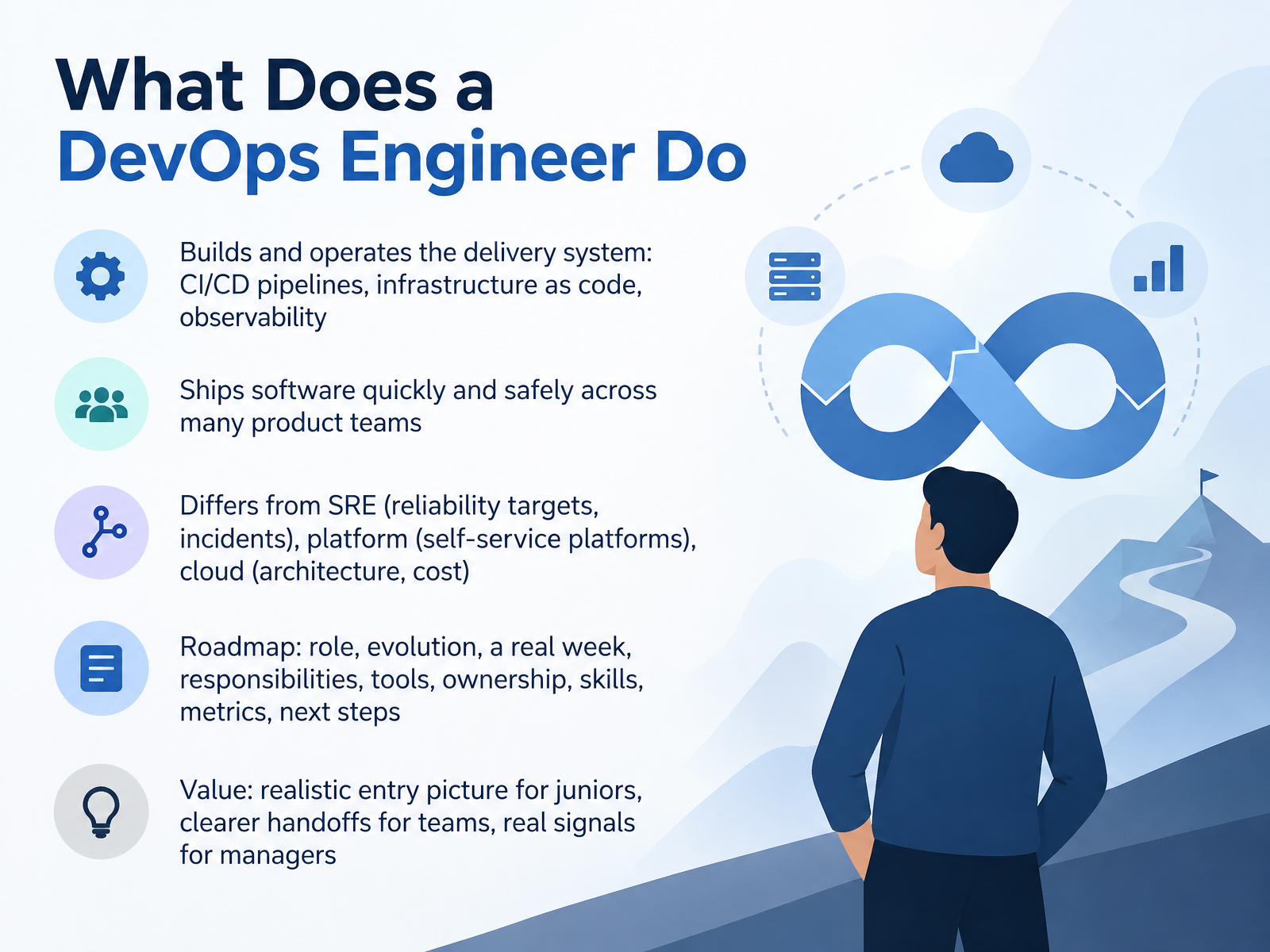
- 01What Does a DevOps Engineer DoWelcome. This course explains what a DevOps engineer actually does, in plain language. Whether you're early in your career, working on a software or infrastructure team, or managing one, the goal is the same: a realistic picture of the role, so you can plan and collaborate with confidence.
At its core, a DevOps engineer builds and operates the delivery system. That means continuous integration and continuous delivery pipelines, often shortened to CI/CD, which automate building, testing, and releasing software. It means infrastructure as code, where servers and environments are defined in files instead of set up by hand. And it means observability, the metrics, logs, and alerts that show whether a system is healthy.
The result is simple to state. Software ships quickly and safely across many product teams. You may also hear about adjacent roles. Site reliability engineers focus on reliability targets and incidents. Platform engineers build self-service platforms for developers. Cloud roles lean toward architecture and cost. They overlap, but the day-to-day work differs.
Over the next slides, we'll cover the role, how it evolved, a real week, responsibilities, tools, ownership, skills, and metrics. By the end, juniors should have a realistic entry picture, teams should see clearer handoffs, and managers should have real signals to work with.
Let's begin with the shift from separate teams to shared ownership, in our next slide, From Silos to Shared Ownership.splunk.comredhat.comabout.gitlab.com+22 min
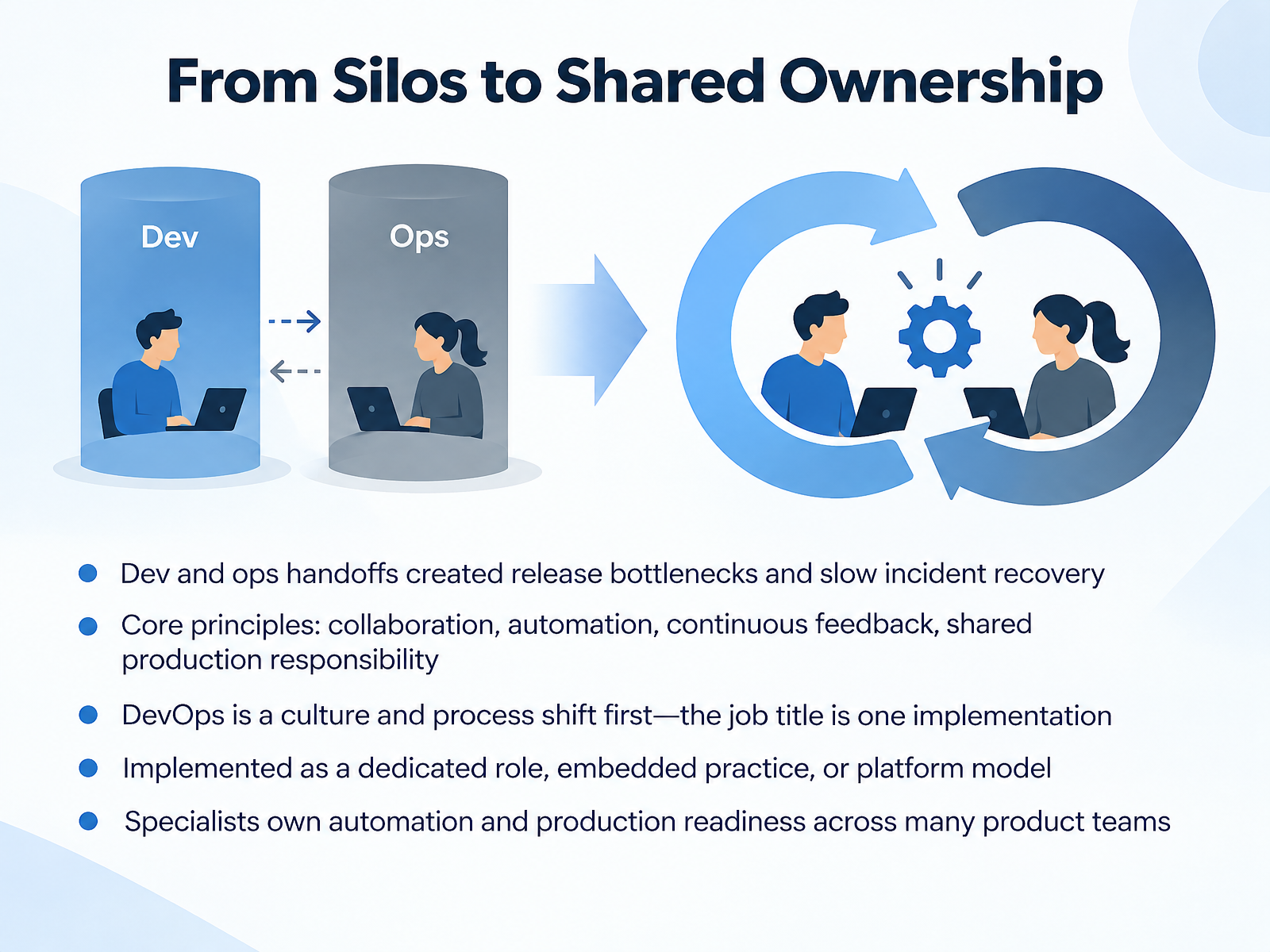
- 02From Silos to Shared OwnershipLet's look at why DevOps exists. In many organizations, development and operations worked as separate teams. Developers handed code over a wall, and operations teams deployed it. Those handoffs created release bottlenecks, and when something broke in production, recovery was slow because no one team owned the whole path. DevOps responds with four core ideas: collaboration, automation, continuous feedback, and shared responsibility for production. And here's an important point for anyone weighing a career move. DevOps is a culture and process shift first. The job title is just one way to implement it. Teams apply it through a dedicated role, an embedded practice inside product teams, or a platform model. In the dedicated form, specialists own automation and production readiness across many product teams. Next, we'll look at the daily work and what a week in the life actually looks like.
 splunk.comredhat.comabout.gitlab.com+21 min
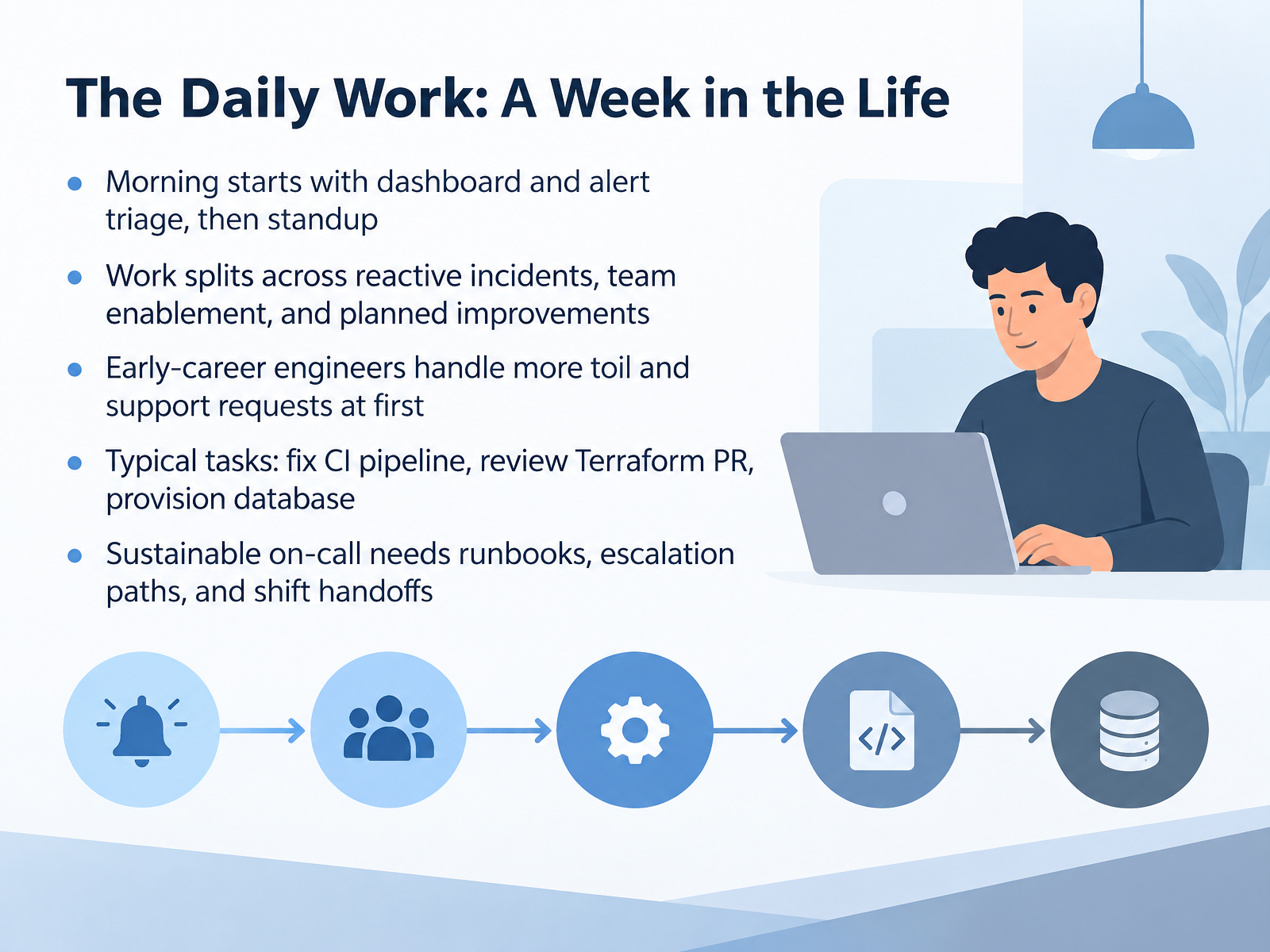
- 03The Daily Work: A Week in the LifeLet's look at what a typical week actually involves. Most mornings start the same way. You check dashboards for service health, then triage alerts, meaning you rank each one by customer impact and urgency. After that comes standup, a short team meeting to share status and blockers. From there, the work splits three ways. Reactive incidents need a fix now. Team enablement means helping other engineers unblock their builds or deployments. And planned improvements cover work like automating a manual step. Early in your career, expect more toil, meaning repetitive support requests, while you build context. Typical tasks include fixing a broken CI pipeline, reviewing a Terraform pull request, or provisioning a database. Sustainable on-call depends on runbooks, escalation paths, and clear shift handoffs. Next, we turn to Core Responsibilities and Deliverables.
 sre.googledevops.comoreilly.com+22 min
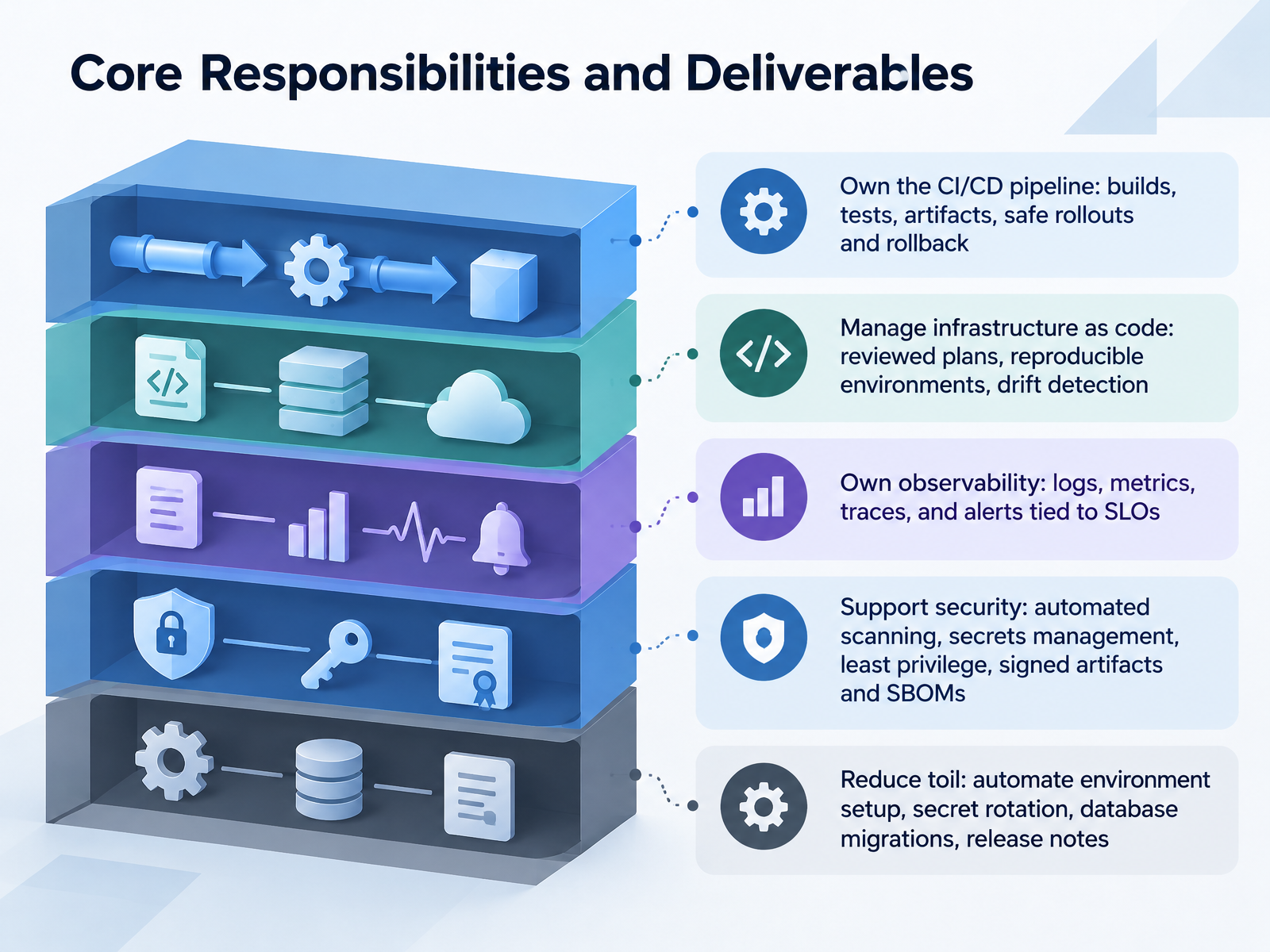
- 04Core Responsibilities and DeliverablesLet's look at what a DevOps engineer actually owns day to day. First, the CI/CD pipeline. That's the automated path from commit to production, covering builds, tests, and artifacts, plus safe rollouts and rollback when a release goes wrong. Second, infrastructure as code. The team defines servers and networks in files, so changes are reviewed in pull requests, environments can be rebuilt identically, and drift is detected when live systems stray from the plan. Third, observability. Logs, metrics, and traces feed alerts tied to SLOs, which are service level objectives describing the reliability users should expect. Fourth, security support. That means automated scanning, secrets management, least privilege, and signed artifacts with SBOMs, or software bills of materials. Finally, reducing toil, the repetitive manual work. Think environment setup, secret rotation, database migrations, and release notes. The takeaway is that these deliverables make delivery faster, safer, and easier to repeat. Next, we'll map the toolchain and where AI fits.
 ryzlabs.comtreegarden.iodevopsschool.com+22 min
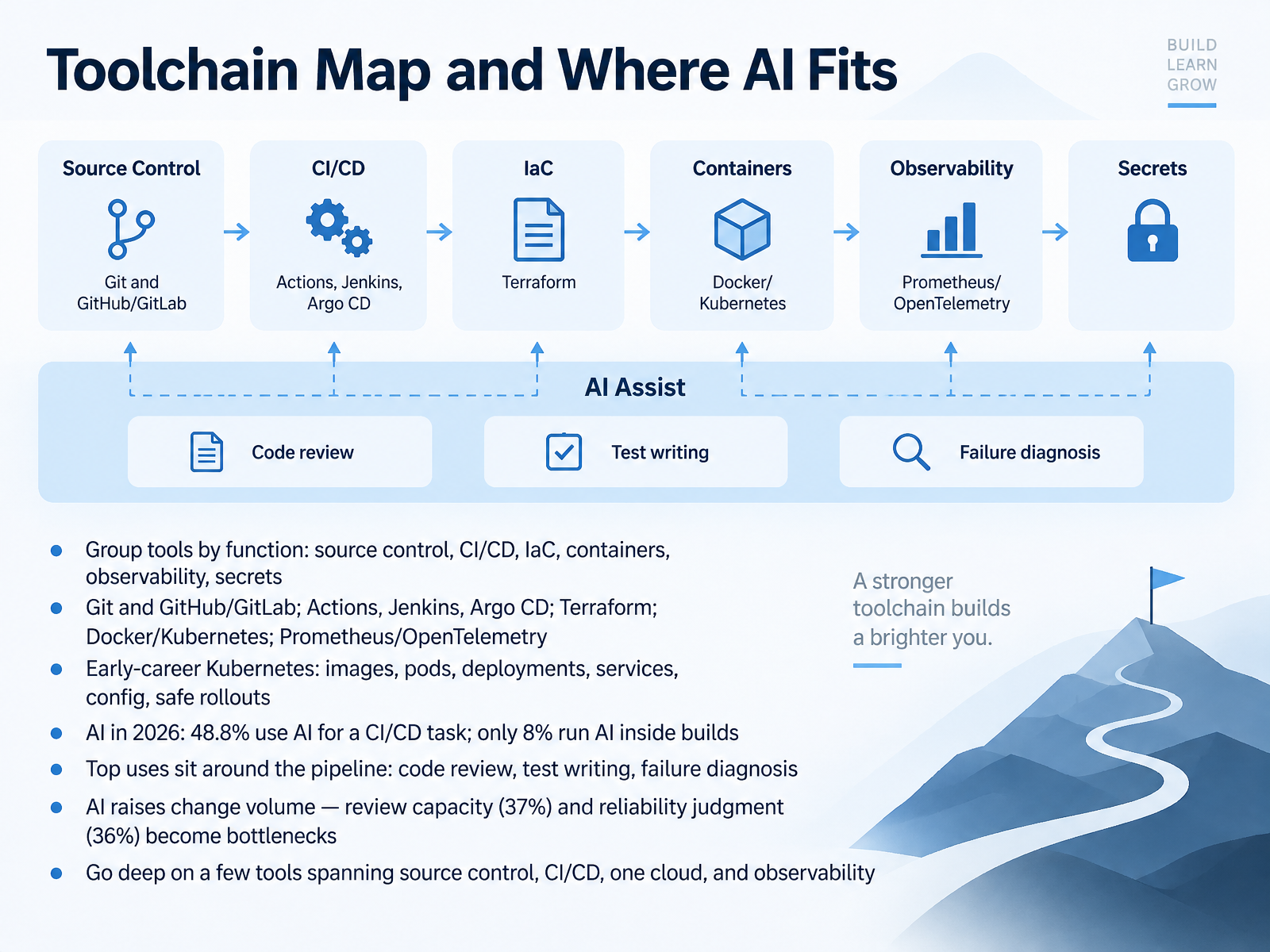
- 05Toolchain Map and Where AI FitsLet's map the toolchain by function. Source control, like Git with GitHub or GitLab, stores and reviews your code. CI/CD tools such as GitHub Actions, Jenkins, or Argo CD build, test, and deploy it. Infrastructure as code, usually Terraform, defines servers in files. Containers, with Docker and Kubernetes, package and run applications. Observability, through Prometheus and OpenTelemetry, shows what is happening. And secrets tools keep credentials out of code. If Kubernetes feels large early on, start small: images, pods, deployments, services, and config, then practice safe rollouts. AI mostly sits around the pipeline. About forty-nine percent of organizations use AI for at least one CI/CD task, but only eight percent run AI inside builds. Top uses are code review, test writing, and failure diagnosis. AI raises change volume, so review capacity and reliability judgment become bottlenecks. A practical takeaway: go deep on a few tools spanning source control, CI/CD, one cloud, and observability. Next, we look at Collaboration Boundaries: Who Owns What.
 jetbrains.comperforce.comdevopsil.com+22 min
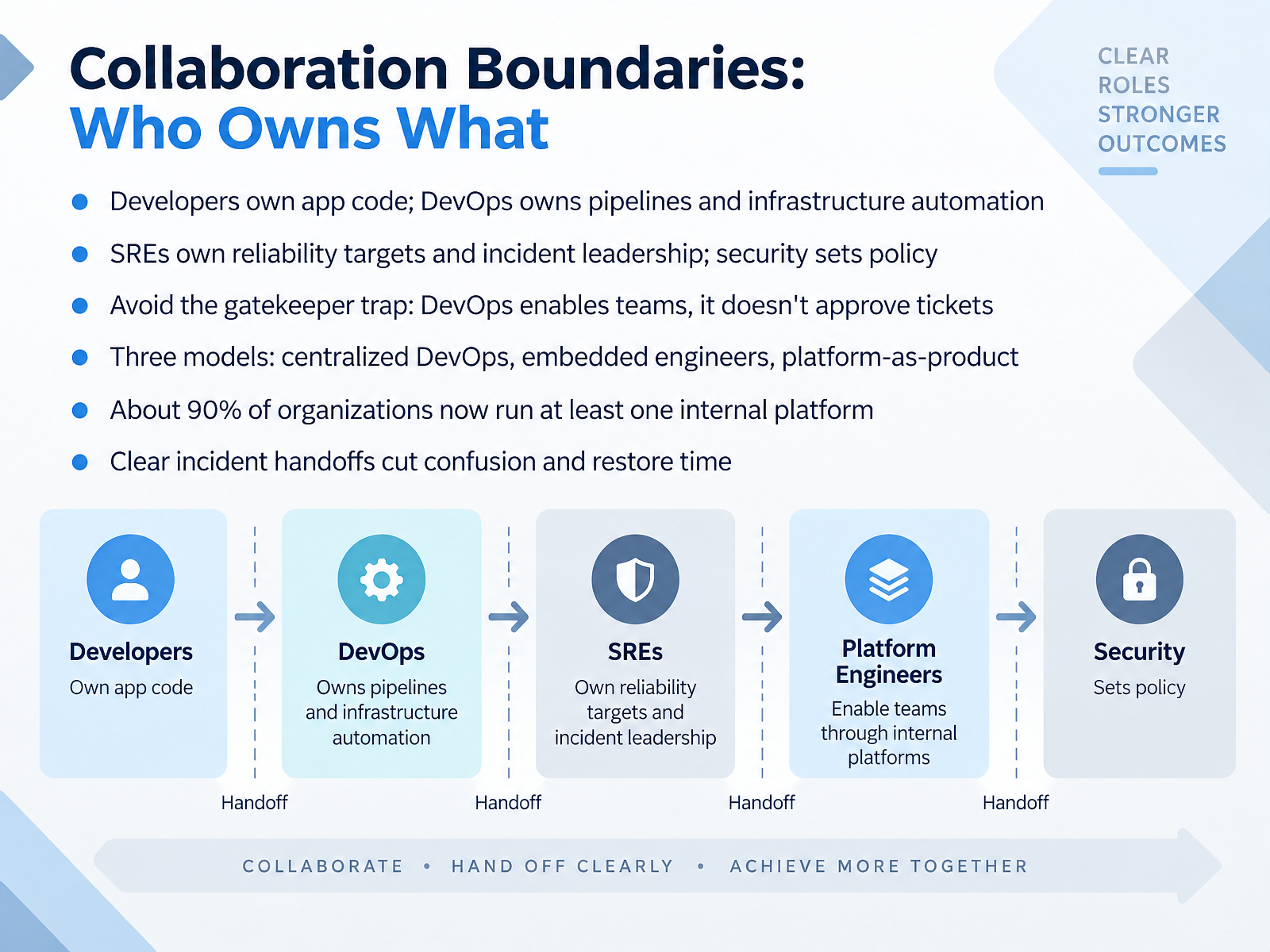
- 06Collaboration Boundaries: Who Owns WhatLet's talk about collaboration boundaries, and who owns what. Developers own the application code. DevOps owns the pipelines and the infrastructure automation that carry that code to production. Site reliability engineers, or SREs, own reliability targets and lead incident response. Security teams set policy. One trap to avoid is the gatekeeper model. DevOps exists to enable teams, not to approve tickets. In practice, you will see three models: a centralized DevOps team, engineers embedded in product teams, and a platform treated as a product with its own users and roadmap. That last model is now common. According to DORA, the DevOps research group, about ninety percent of organizations run at least one internal platform. Whichever model you use, agree on clear incident handoffs. When everyone knows who leads and who supports, confusion drops and recovery time gets shorter. Next, we will look at skills, certifications, and career path.
 splunk.comredhat.comabout.gitlab.com+22 min
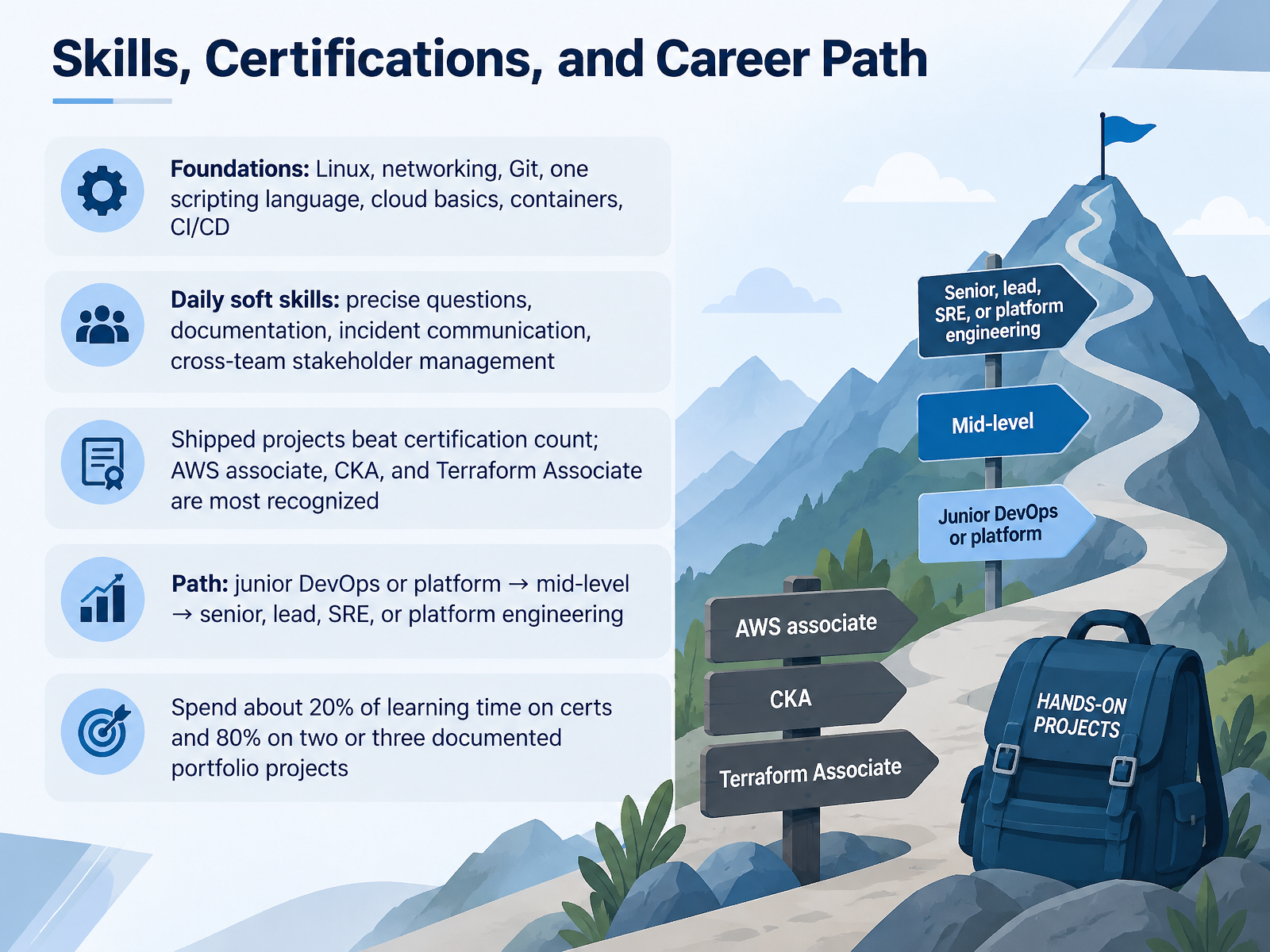
- 07Skills, Certifications, and Career PathLet's talk about the skills, certifications, and career paths that support this role. Start with foundations: Linux, networking, Git for version control, one scripting language, cloud basics, containers, and continuous integration and continuous delivery, or CI/CD. Just as important are daily soft skills. Ask precise questions. Write documentation. Communicate clearly during incidents. And manage stakeholders across teams. Here is a useful rule. Shipped projects matter more than the number of certifications you hold. Two or three well-documented portfolio projects carry real weight. The certifications most recognized are the AWS associate level, the C K A for Kubernetes administration, and the Terraform Associate. Spend about twenty percent of your learning time on certifications, and eighty percent on practice. The path usually runs from junior DevOps or platform engineer, to mid-level, then senior. From there, people move into lead roles, site reliability engineering, or platform engineering. Next, we will look at measuring success and avoiding anti-patterns.
 splunk.comredhat.comabout.gitlab.com+22 min
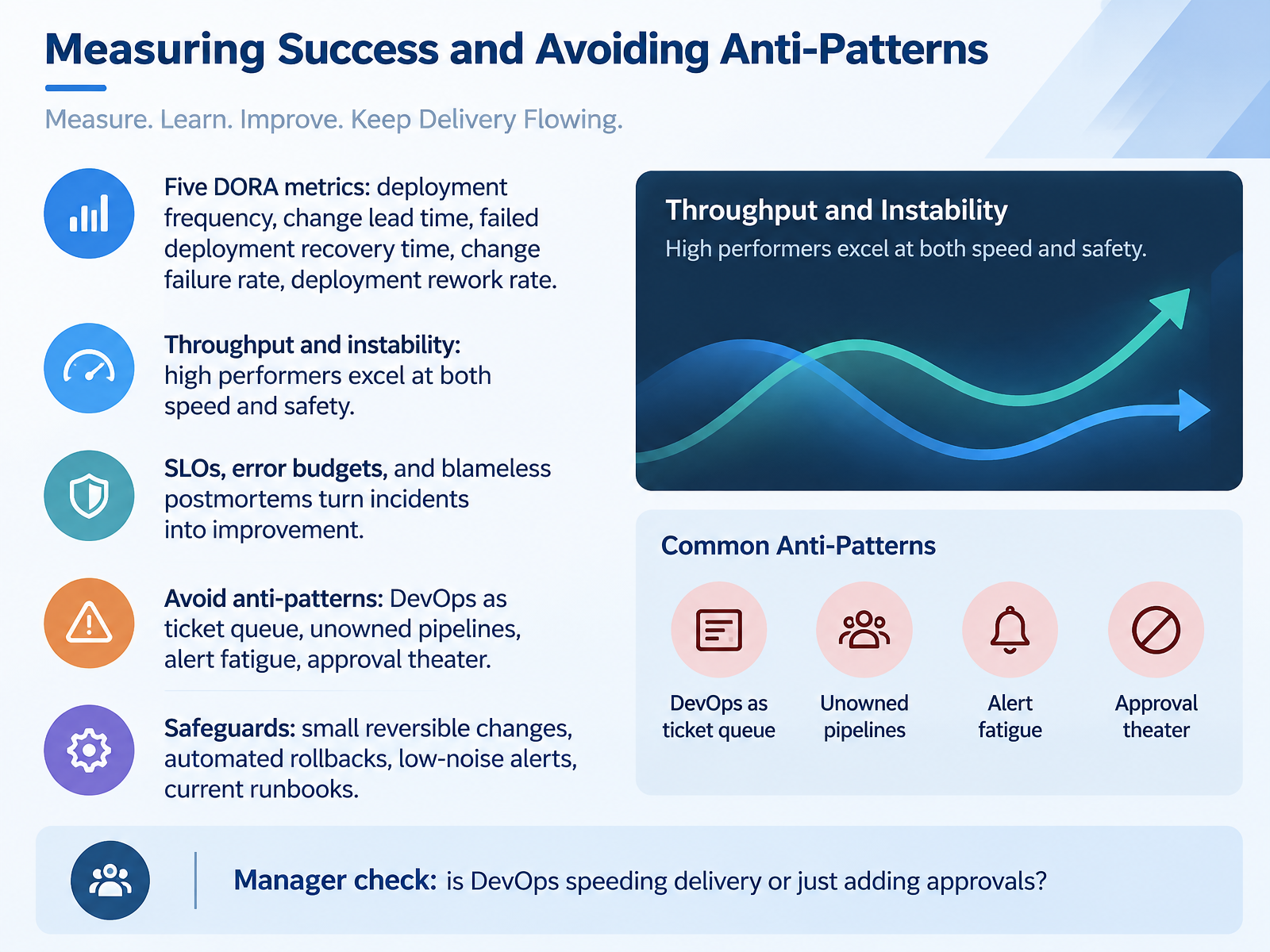
- 08Measuring Success and Avoiding Anti-PatternsSo how do we know DevOps is actually working? Start with the five DORA metrics. DORA stands for DevOps Research and Assessment, a research program that studies software delivery performance. The five metrics are deployment frequency, change lead time, failed deployment recovery time, change failure rate, and deployment rework rate. Deployment frequency asks how often you ship to production. Change lead time measures how long a change takes from commit to production. Throughput metrics cover speed. Instability metrics cover safety. High performers do well on both. You do not trade one for the other. To make incidents useful, use service level objectives, or SLOs, internal reliability targets. Pair them with error budgets, which set how much unreliability you can accept, and run blameless postmortems that look at systems rather than people. Now watch for anti-patterns. DevOps becoming a ticket queue. Pipelines nobody owns. Alert fatigue, where too many noisy alerts train people to ignore them. And approval theater, where approvals add delay without real risk reduction. Add safeguards instead. Small reversible changes. Automated rollbacks. Low-noise alerts. Runbooks that stay current. Managers, ask one question. Is DevOps speeding delivery, or just adding approvals? Next, we'll pull this together in Key Takeaways and Next Steps.
 sre.googledevops.comoreilly.com+22 min
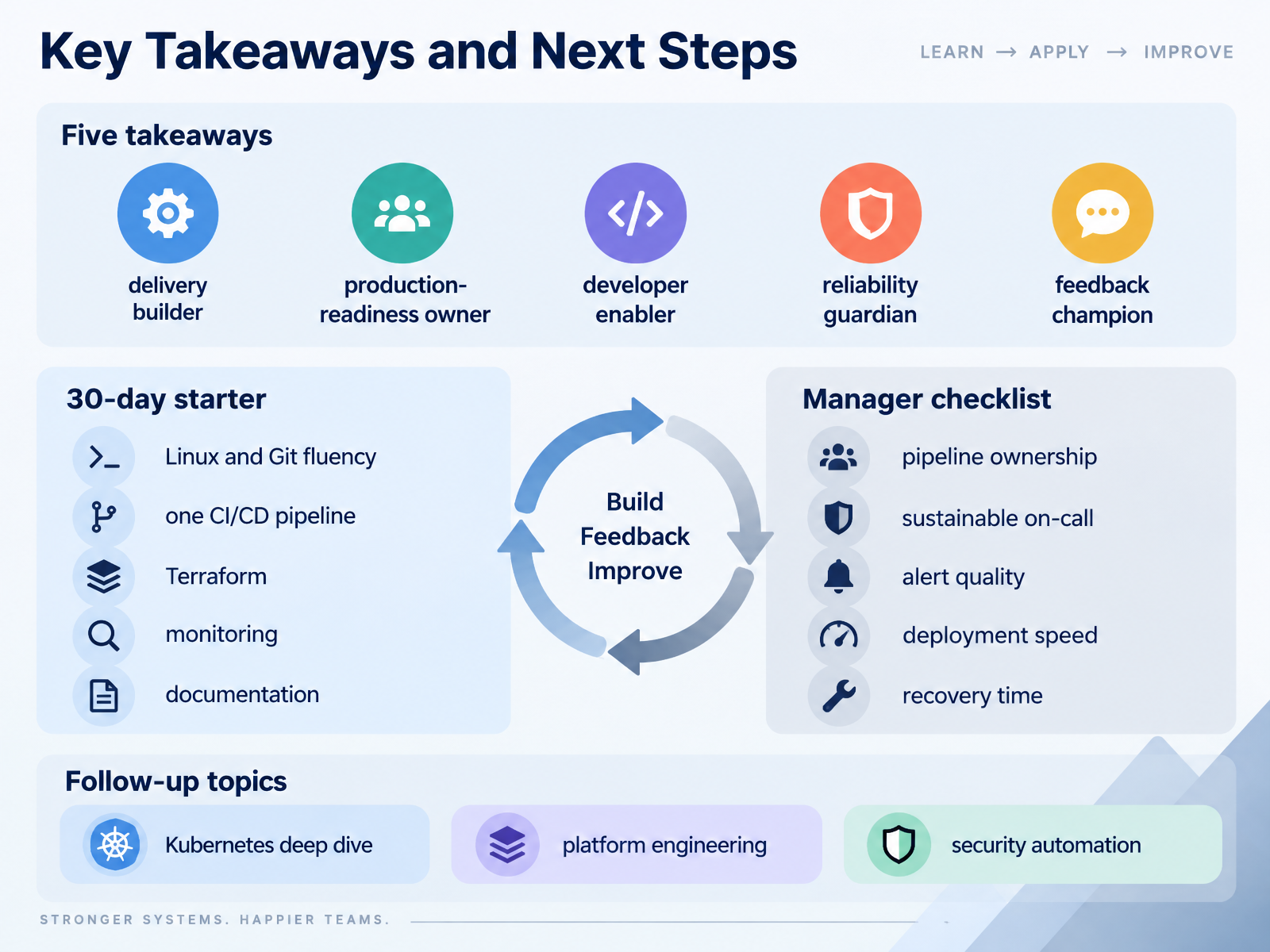
- 09Key Takeaways and Next StepsLet's pull this together with five takeaways. A DevOps engineer is a delivery builder, a production-readiness owner, a developer enabler, a reliability guardian, and a feedback champion. If you want a starting point, try a thirty-day plan. Build fluency in Linux and Git. Ship one CI/CD pipeline, which means continuous integration and continuous delivery. Add basic Terraform for infrastructure as code, set up monitoring, and write the documentation. Managers, here is your checklist. Assign clear pipeline ownership. Keep on-call sustainable. Improve alert quality so people are not woken for noise. Track deployment speed and recovery time. If you want to go deeper, revisit Kubernetes, platform engineering, and security automation. The 2026 Context: What Changed and Why It Matters.
 splunk.comredhat.comabout.gitlab.com+22 min
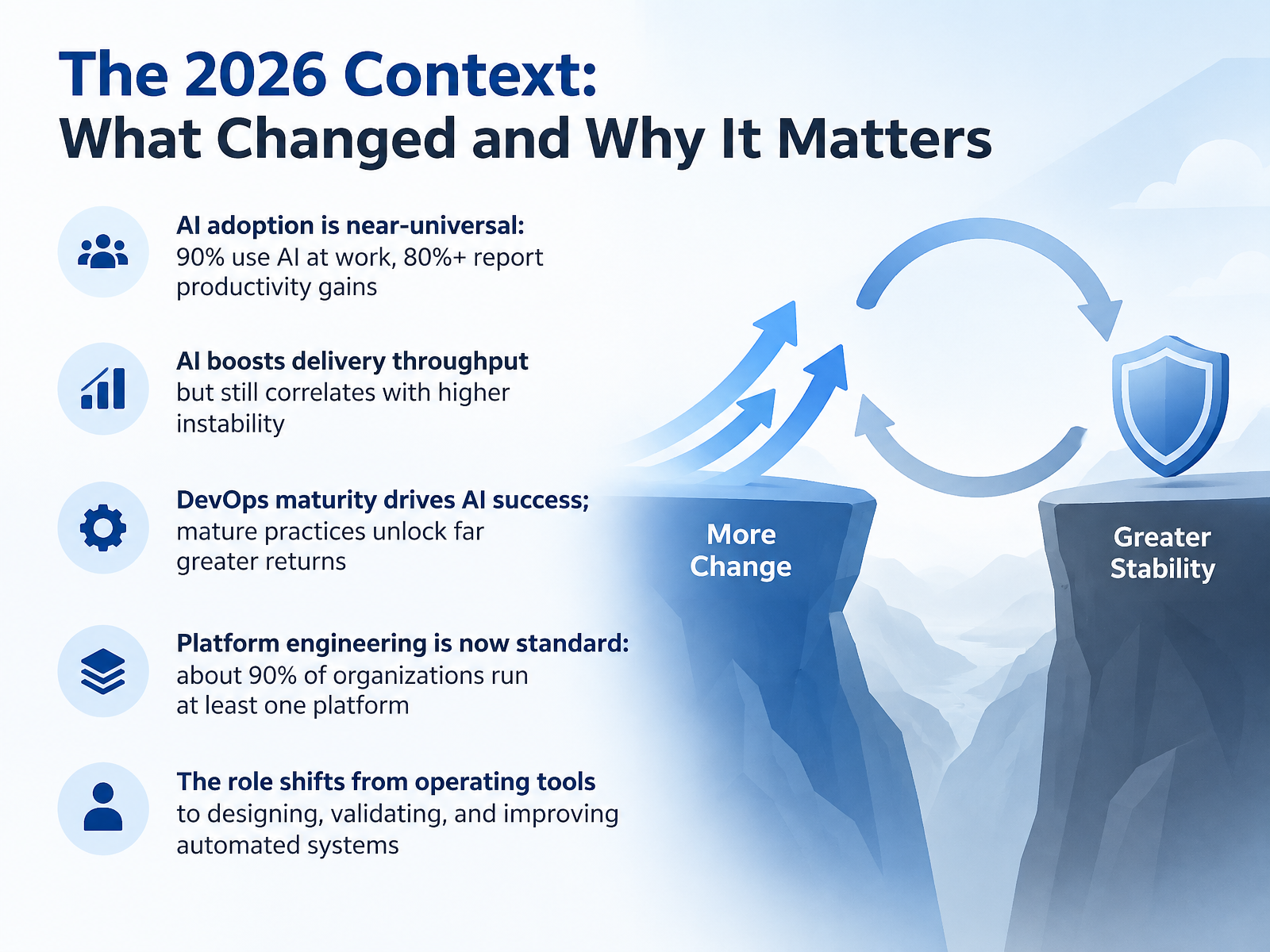
- 10The 2026 Context: What Changed and Why It MattersSo what changed by 2026, and why does it matter for your role? Start with adoption. About ninety percent of technology professionals now use AI at work, and more than eighty percent report productivity gains. But faster delivery still comes with higher instability. One DORA study found more change failures and more rework, because testing and review couldn't keep pace. The deciding factor is DevOps maturity. AI is an amplifier. It magnifies good practices and bad ones. Teams with solid automation and fast feedback see real returns, while struggling teams see problems intensify. Platform engineering is now standard too, with roughly ninety percent of organizations running at least one internal platform. That platform is a self-service layer developers build and deploy on. So the day-to-day role shifts. You spend less time operating individual tools, and more time designing, validating, and improving automated systems. Your judgment, not just your commands, becomes the deliverable. That shift also explains why some old assumptions about the role persist. We'll unpack those next, in Myths and Misconceptions to Correct Early.
 jetbrains.comperforce.comdevopsil.com+22 min
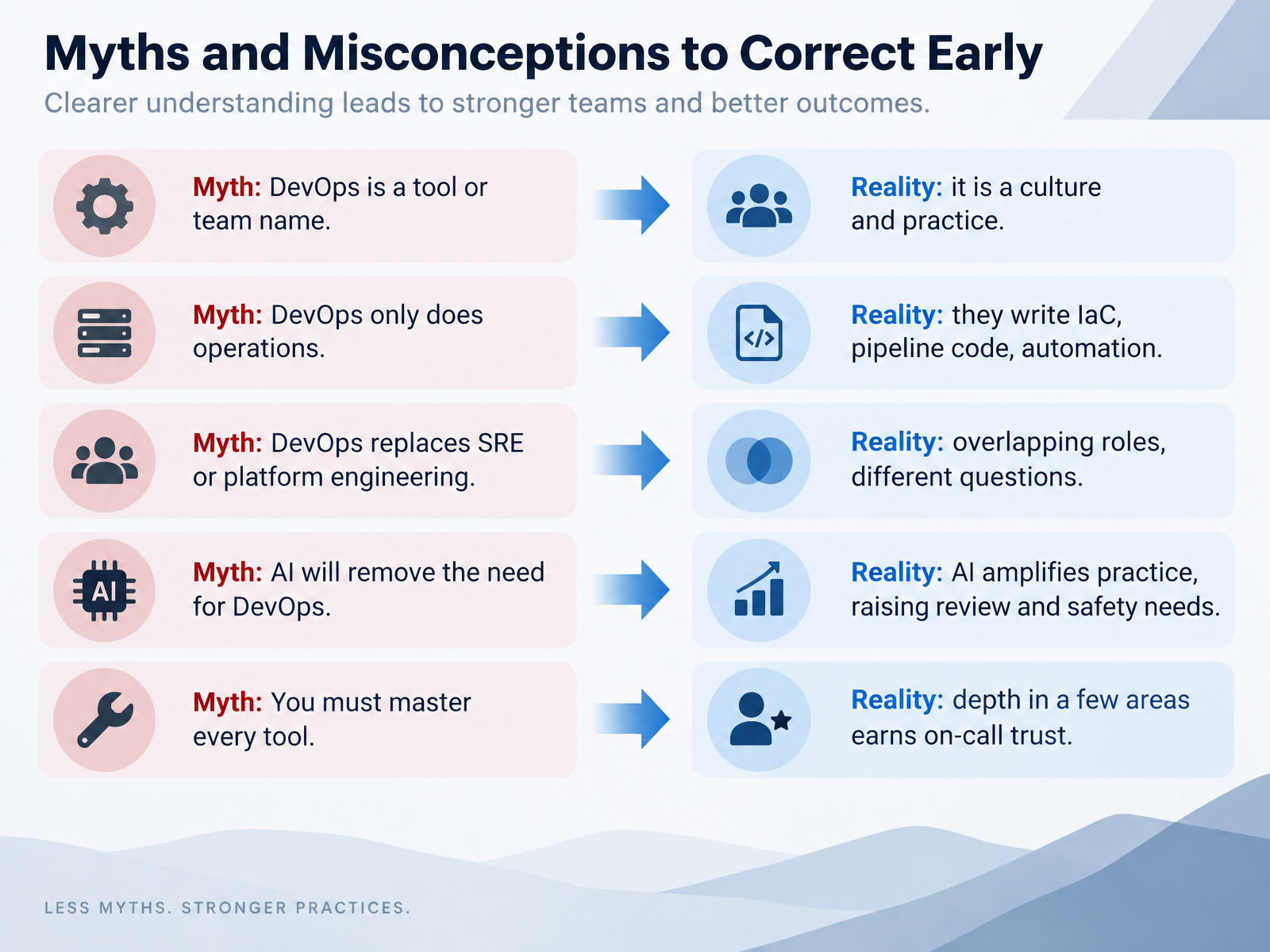
- 11Myths and Misconceptions to Correct EarlyLet's clear up a few common myths before they take hold. The first is that DevOps is a tool or a team name. In reality, it is a culture and a practice. It brings development and operations together through collaboration and automation. The second myth is that DevOps only does operations. In fact, DevOps engineers write infrastructure as code, pipeline code, and automation. For example, they maintain the continuous integration and delivery pipelines that build and deploy software. The third myth is that DevOps replaces site reliability engineering or platform engineering. These roles overlap, but they ask different questions. Site reliability engineering focuses on production reliability and service level objectives. Platform engineering builds self-service tools for developers. DevOps focuses on delivery speed, pipelines, and infrastructure automation. The fourth myth is that AI will remove the need for DevOps. AI amplifies existing practice. It raises the need for review and safety checks, because AI-generated changes still need verification. The fifth myth is that you must master every tool. Depth in a few areas, such as infrastructure as code or pipeline design, earns on-call trust. Curious about where to start? Next, we look at a realistic first ninety days in the role.
 splunk.comredhat.comabout.gitlab.com+22 min
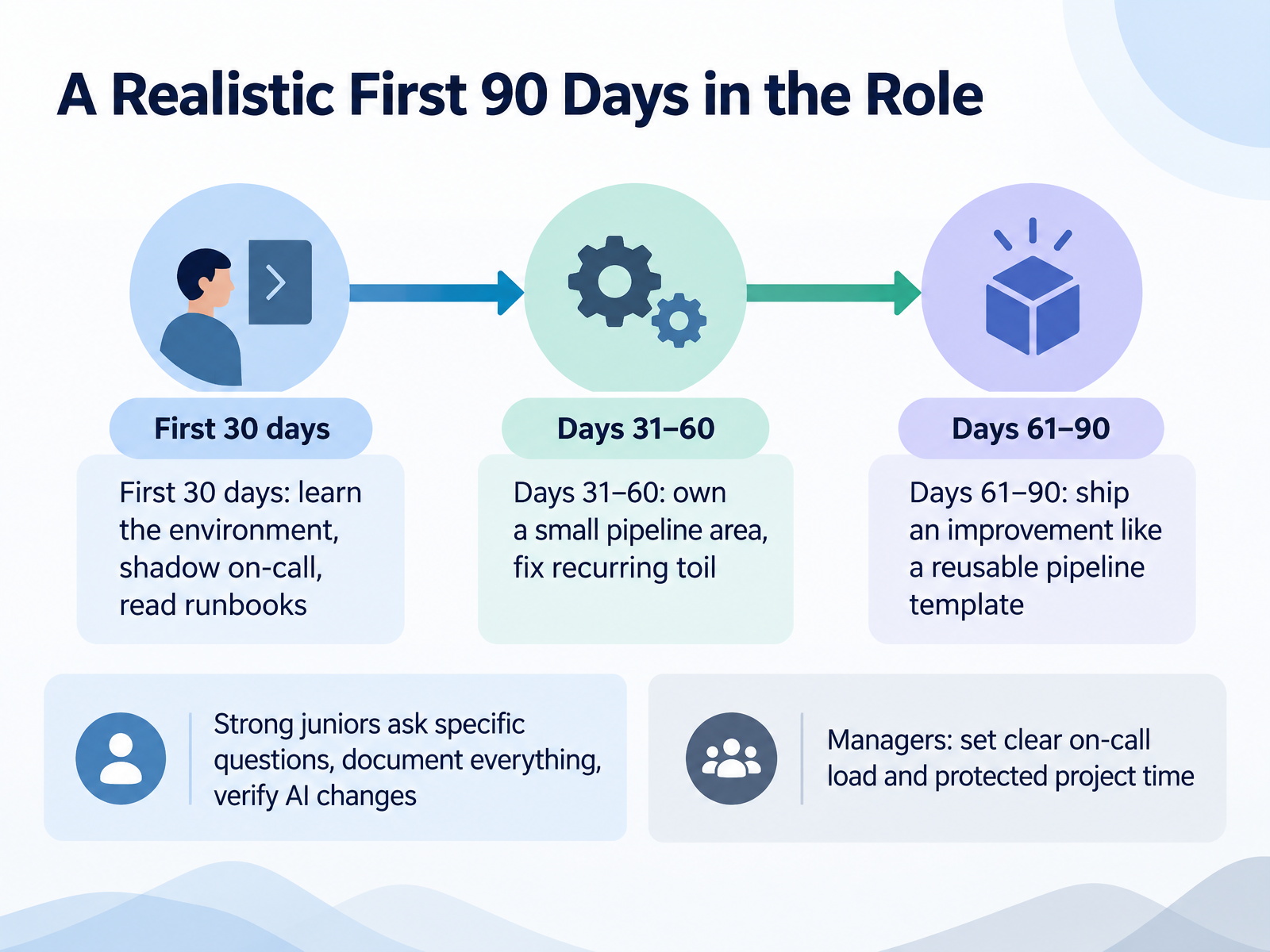
- 12A Realistic First 90 Days in the RoleLet's look at what a realistic first ninety days actually looks like. In the first thirty days, focus on learning the environment. Shadow on-call shifts, read the runbooks, and don't rush to change anything yet. A runbook is a written checklist for handling a known alert. From day thirty-one to sixty, own a small area of the pipeline and start fixing recurring toil. Toil means repetitive manual work that should be automated, like rebuilding the same job by hand each week. By day sixty-one to ninety, ship one improvement, such as a reusable pipeline template other teams can adopt. Strong juniors ask specific questions, document everything, and verify changes, especially AI-generated ones. And managers, protect your engineers by setting a clear on-call load and guarding project time. That is what makes three months feel structured rather than overwhelming. Next, we turn to working with AI-assisted delivery safely.
 sre.googledevops.comoreilly.com+22 min
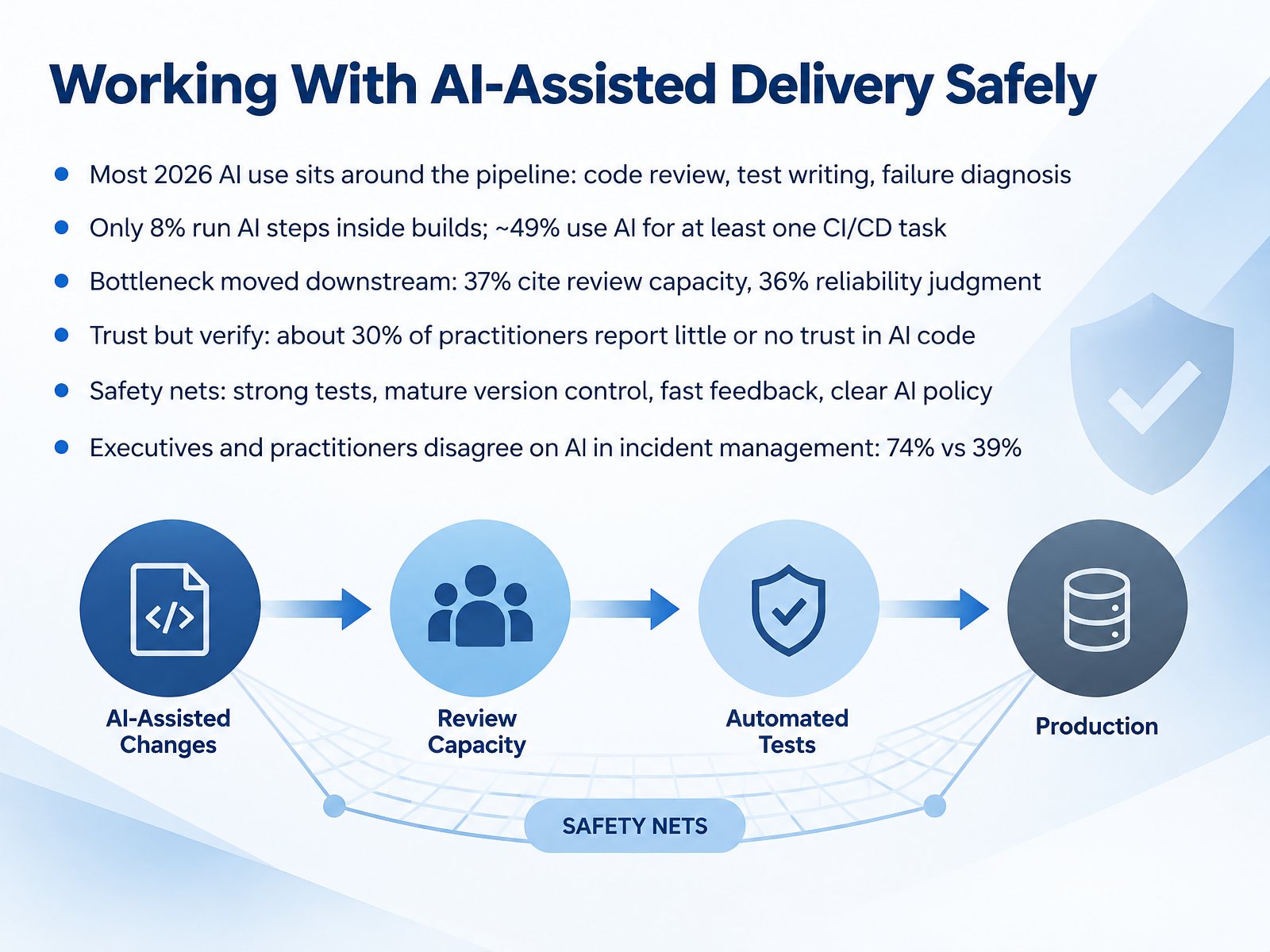
- 13Working With AI-Assisted Delivery SafelyNow, let's talk about using AI safely in everyday delivery. In twenty twenty-six, most AI use happens around the pipeline, not inside it. Teams lean on it for code review, writing tests, and diagnosing failures. About forty-nine percent use AI for at least one continuous integration or continuous delivery task, but only eight percent run AI steps directly inside the build. That shift has moved the bottleneck downstream. Thirty-seven percent point to review capacity, and thirty-six percent to judging whether AI changes are reliable. So keep a trust but verify mindset. Around thirty percent of practitioners report little or no trust in AI-generated code, which is healthy skepticism, not resistance. Your safety nets are simple: strong tests, mature version control, fast feedback, and a clear AI policy. And watch for the perception gap. Executives and practitioners disagree on AI in incident management, seventy-four percent versus thirty-nine percent. Next, we'll bring this together in the wrap-up, applying this to your team.
 jetbrains.comperforce.comdevopsil.com+22 min
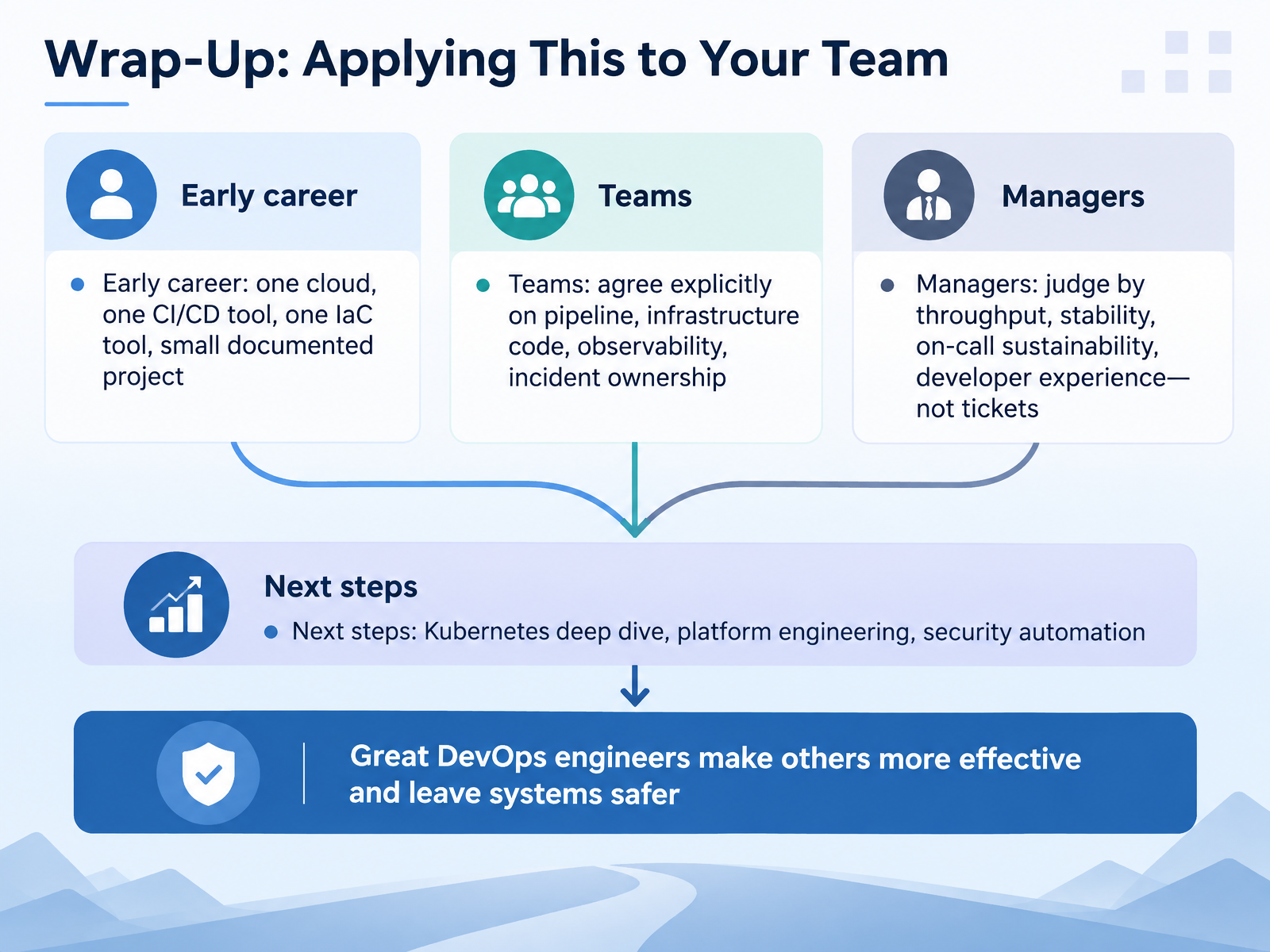
- 14Wrap-Up: Applying This to Your TeamLet's bring this together and make it practical for your team. If you're early career, pick one cloud, one continuous integration and delivery tool, and one infrastructure as code tool. Then build one small project and document it. Written evidence beats a long list of tools you have only read about. For teams, agree explicitly on four things: who owns the pipeline, who owns the infrastructure code, who owns observability, and who is on call when something breaks. Write it down, so ownership doesn't stay assumed. Managers, measure the team by throughput, stability, on-call sustainability, and developer experience, not by the number of tickets closed. Those four signals tell you whether the system is healthy. When you're ready to go deeper, look at Kubernetes, platform engineering, and security automation. And keep one idea in mind. Great DevOps engineers make the people around them more effective, and they leave systems safer than they found them. Thank you for following along. Pick one next step this week, and start small. You've got this.
 1 min
Take the deck with you
Download this course as a file — free, no sign-up needed.
- PDF handoutEvery slide page, ready to print or share.15 pages · 3.2 MBDownload
- Narrated PowerPointThe deck that presents itself — every slide carries the digital human's narration video.15 pages · 14.7 MBDownload
- PowerPoint slidesThe full deck as a .pptx — open it in PowerPoint, Keynote, or Google Slides.15 pages · 3.2 MBDownload
Free to use in your own training — please keep the PersonWise credit page at the end.
Have your own deck? Turn it into a course
Sources consulted
Web sources consulted while building this course.
- SRE vs. DevOps vs. Platform Engineering: Differences ... — splunk.com
- Platform engineering vs. DevOps — redhat.com
- What is a DevOps platform engineer? — about.gitlab.com
- Platform Engineering vs DevOps vs SRE (2026 Guide) — akshayghalme.com
- EP 37: The Rings of Software: DevOps, SRE and Platform Engineering — devops.com
- Google SRE: What it Means Being On-Call? | Devops On-Call — sre.google
- Sign up for our newsletter! — devops.com
- The Site Reliability Workbook by Betsy Beyer, Niall Richard Murphy, David K. Rensin, Kent Kawahara, Stephen Thorne — oreilly.com
- A DAY IN LIFE OF A DEVOPS ENGINEER — united.cloud
- Day in the Life of a DevOps Engineer: Skills and Challenges – ITU Online IT Training — ituonline.com
- DevOps Engineer Job Description Template (2026) | Ryz Labs — ryzlabs.com
- DevOps Engineer Job Description Template (Free, 2026) — treegarden.io
- Staff CI/CD Engineer: Role Blueprint, Responsibilities, Skills, KPIs, and Career Path — devopsschool.com
- DevOps Engineer Roadmap 2026 — prepnplaced.com
- DevOps Engineer Job Description GCC 2026 | MenaJobs — menajobs.me
- The State of CI/CD in 2026 | JetBrains TeamCity — jetbrains.com
- State of DevOps Report | Perforce — perforce.com
- State of DevOps 2026 — DevOpsil — devopsil.com
- State of SRE Report: 2026 Edition - Full version — dynatrace.com
- 2026 State of Production Reliability and AI Adoption Report — downloads.ctfassets.net