Begin
14 pages · ~28 min
Public Speaking Confidence Workflow
Learn a practical workflow to build confidence in public speaking, designed for professionals seeking to reduce anxiety and deliver impactful presentations with clarity and composure.
A digital instructor presents all 14 pages. Hold “Ask” at any point and ask out loud — the answer comes from this course. No sign-up needed.
What you’ll learn
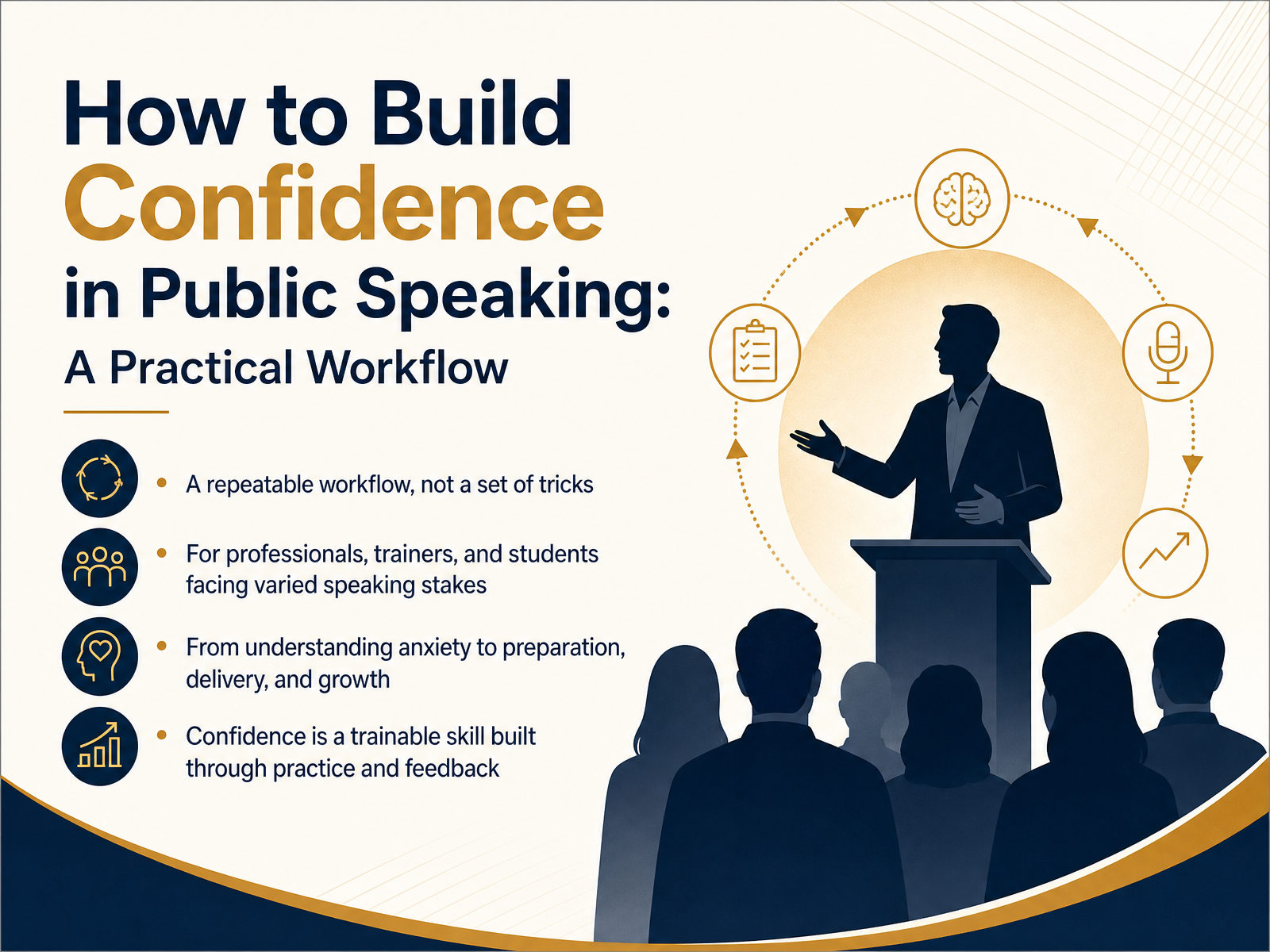
- 01How to Build Confidence in Public Speaking: A Practical WorkflowWelcome. If the thought of speaking in front of others makes your heart race, you are in good company. Many professionals, trainers, and students feel the same way. That is why this course is designed as a practical workflow, not a bag of tricks. You will learn a repeatable process that works whether you are leading a team meeting, teaching a class, or presenting to executives. We will start by understanding where speaking anxiety really comes from, then move into solid preparation, confident delivery, and how to grow from every experience. The key idea to hold onto is this: confidence is not something you are born with. It is a trainable skill, built through practice and feedback. By the end of this journey, you will have a clear system to follow, so you can walk into any room with greater ease. Let’s begin by looking at how speaking anxiety actually works.upskilldevelopment.comusf.eduntuclearninghub.com+22 min
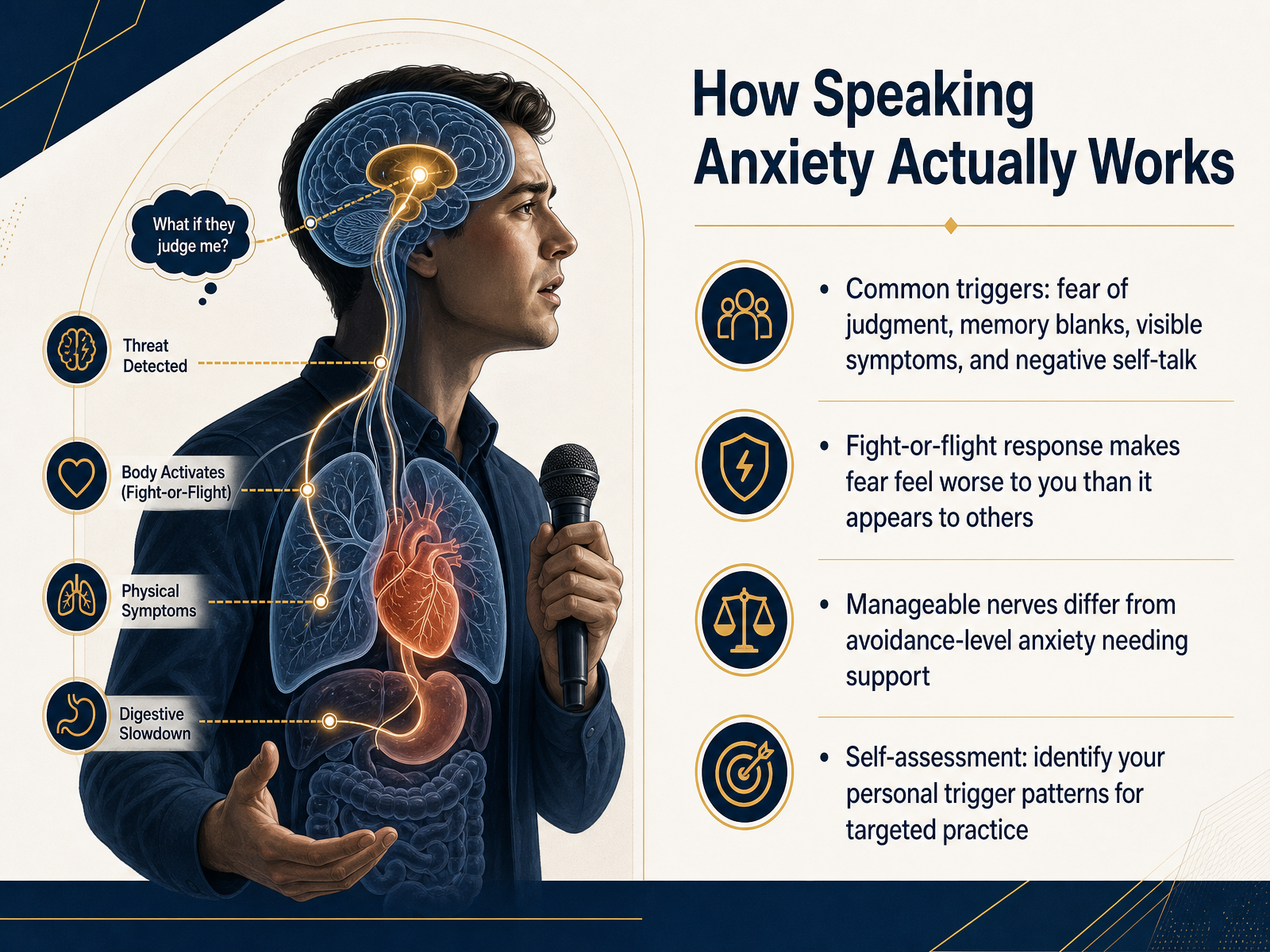
- 02How Speaking Anxiety Actually WorksLet's look at what actually happens when you feel that rush of nerves before speaking. It's not a personal weakness—it's a hardwired response. Common triggers include fear of being judged, worrying your mind will go blank, noticing physical symptoms like shaking or blushing, and that inner voice telling you you're not good enough. Here's the key insight: your body's fight-or-flight response makes the fear feel far more intense to you than it looks to anyone else. The shaking you feel is often invisible. That pounding heart? Probably not noticeable from the third row. Now, there's a difference between manageable nerves—the kind that sharpen your focus—and the level of anxiety that makes you avoid speaking altogether. If you're avoiding opportunities because of fear, that's a sign you need a structured approach, which we'll build together. For now, take a moment to identify your personal triggers. Do you dread the anticipation, the first sentence, or the Q&A? Knowing your pattern is the first step to targeting your practice. And here's a reassuring truth we'll explore next: your audience notices far less than you think. Let's talk about the perception gap.
 psychcentral.comosmosis.orgmedia.sciltp.com+21 min
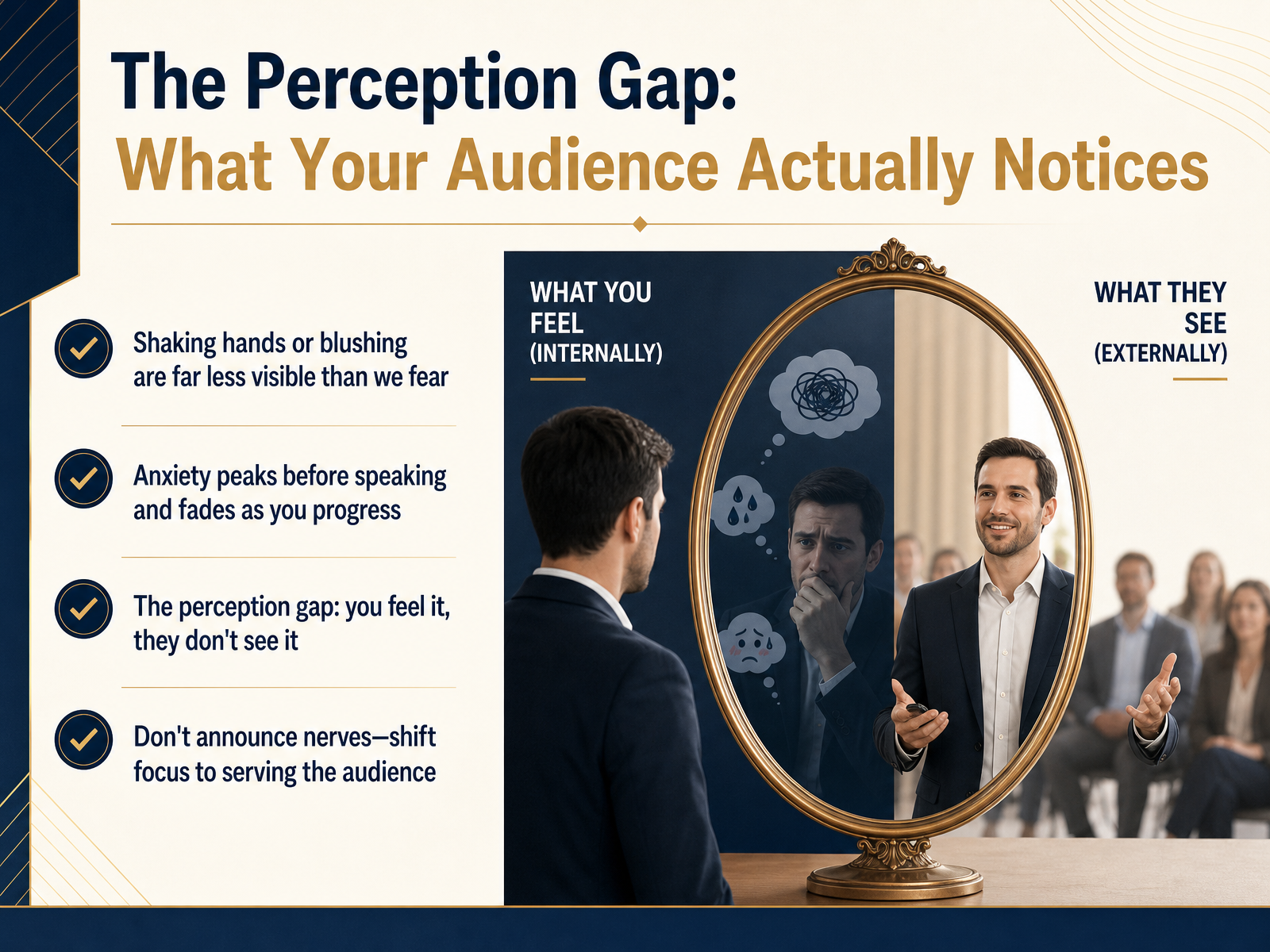
 - 03The Perception Gap: What Your Audience Actually NoticesLet’s talk about something that might surprise you: the gap between how you feel on the inside and what the audience actually sees. When you’re nervous, your heart races, your palms sweat, and you might feel like everyone can tell. But here’s the truth: most of what you’re feeling is invisible. A slight tremor or a blush is far less noticeable than you imagine. Your anxiety also peaks right before you start speaking, and it fades naturally as you get into your rhythm. That’s the perception gap: you feel it intensely, but they don’t see it. So, here’s the practical takeaway: don’t announce your nerves. Saying 'I’m so nervous' only draws attention to something no one noticed. Instead, shift your focus outward. Think about the value you’re offering. Serve your audience, and your confidence will follow. Next, we’ll look at how confidence is a skill you can build, not a trait you’re born with.
 psychcentral.comosmosis.orgmedia.sciltp.com+21 min
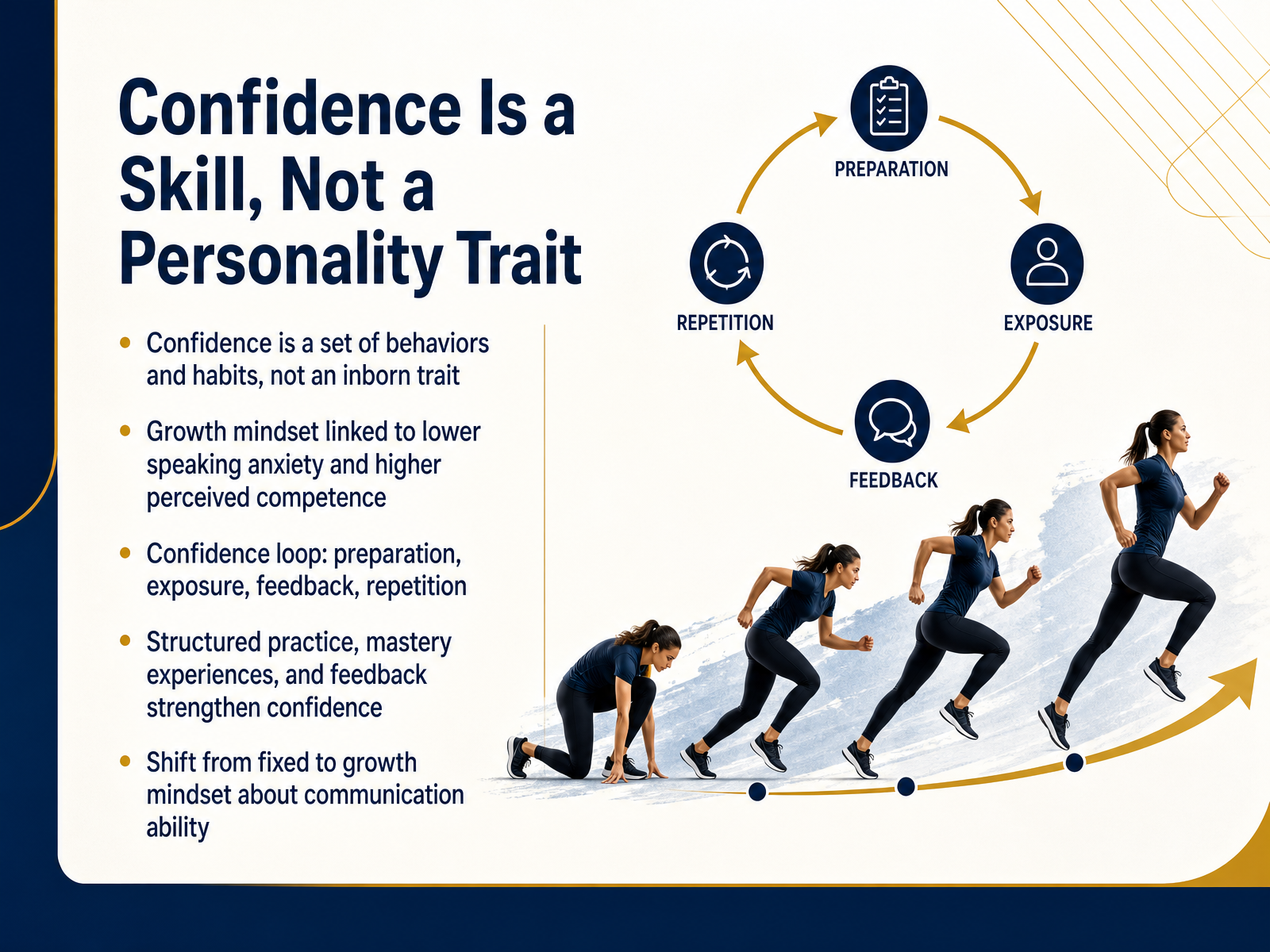
 - 04Confidence Is a Skill, Not a Personality TraitLet's clear up a common misconception right now: confidence is not something you're born with. It's a skill, made up of specific behaviors and habits you can learn and strengthen over time. Think of it like a muscle. Research in communication psychology shows that people who believe their speaking ability can improve—what we call a growth mindset—actually experience less anxiety and rate themselves as more competent speakers. So how do you build this muscle? It comes down to a simple loop: prepare, expose yourself to speaking situations, gather feedback, and repeat. Each time you practice in a structured way, you have what's called a mastery experience. And those experiences are the single strongest predictor of public speaking confidence. The key is to shift from thinking, 'I'm just not a good speaker,' to 'I'm learning to become a better speaker.' That one shift in perspective changes everything. Next, let's talk about why the way you frame your purpose matters so much—it's time to speak to serve, not to be judged.
 doi.orgso06.tci-thaijo.orgdoi.org+21 min
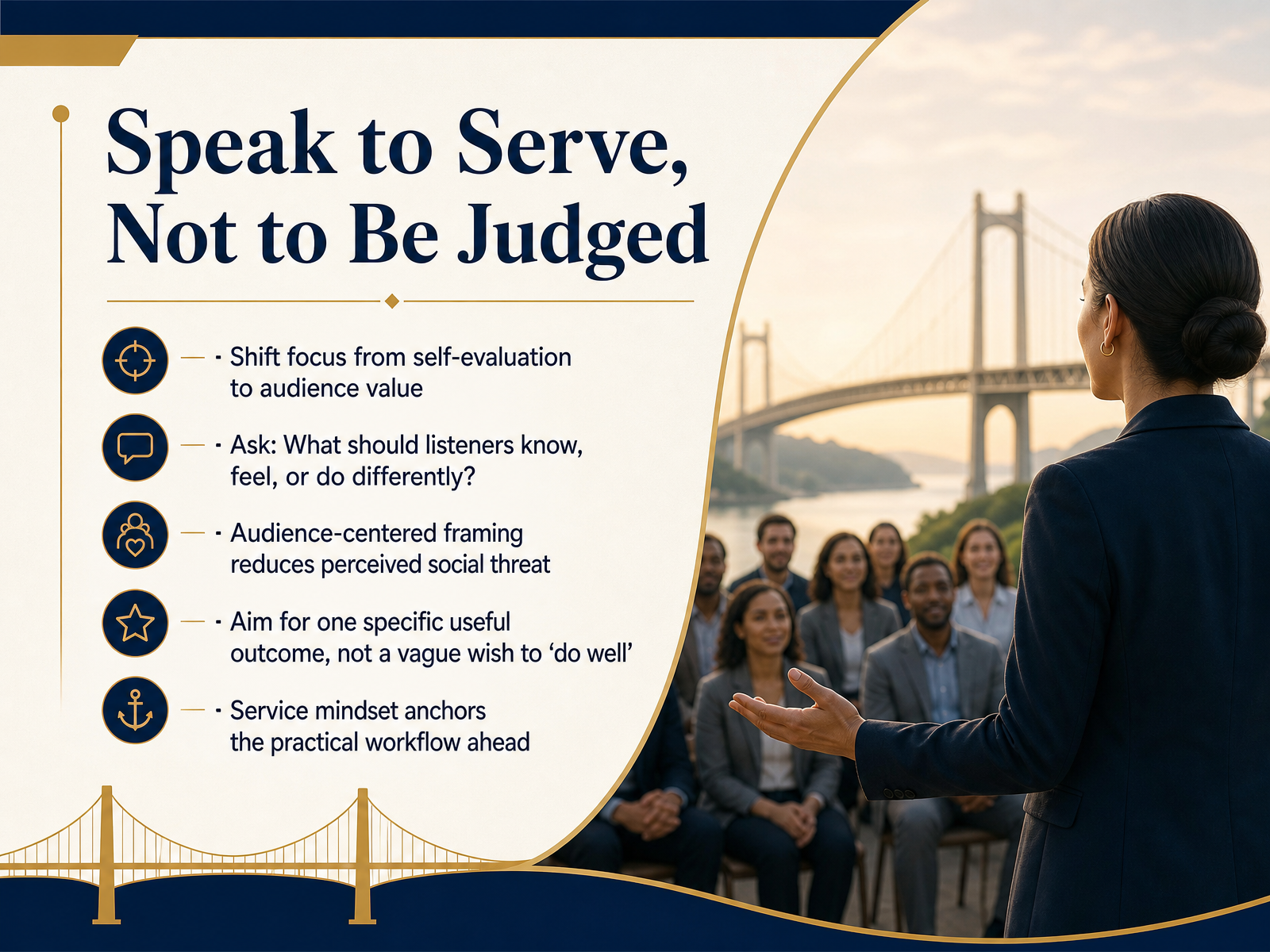
 - 05Speak to Serve, Not to Be JudgedNow, let's talk about one of the most powerful mindset shifts you can make. Instead of seeing a presentation as a test of your worth, think of it as a chance to serve your audience. When you focus on what your listeners need, the pressure on you starts to fade. Ask yourself one simple question: what should the people in this room know, feel, or do differently after I speak? If you can give them one clear, useful takeaway, you have done your job. A service mindset also quiets that inner critic. When you are focused on giving value, you are no longer the center of attention; your message is. So, before your next talk, write down the one outcome you want to achieve. That clarity will anchor you and keep you calm and purposeful. Next, we will look at a practical, six-step workflow that reduces uncertainty and makes that service mindset actionable.
 winningpresentations.comwinningpresentations.comritwikjoshi.com+21 min
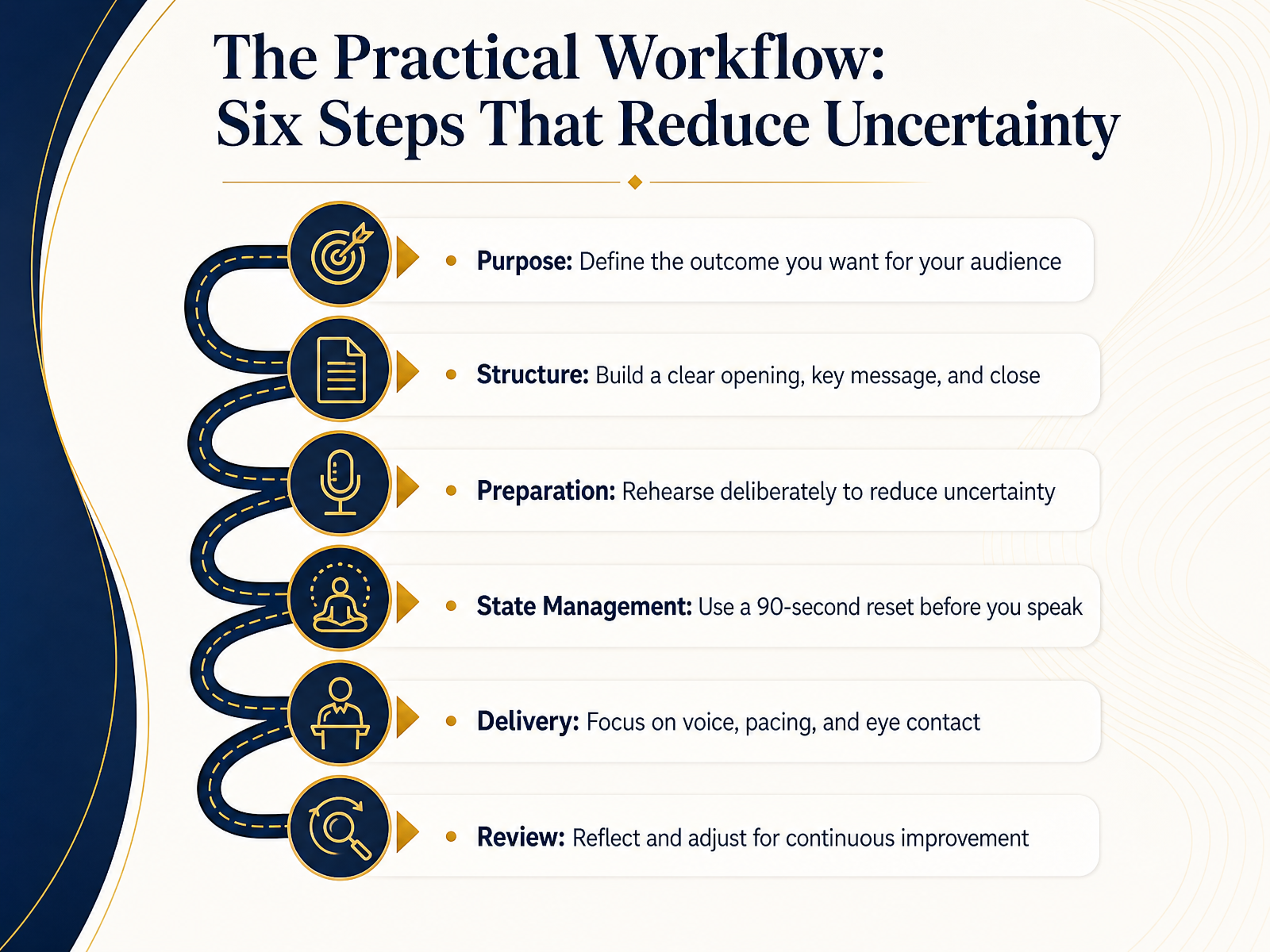
 - 06The Practical Workflow: Six Steps That Reduce UncertaintyLet’s turn this into a simple, repeatable workflow. Six steps that reduce uncertainty and build real confidence. First, define your purpose. Decide exactly what you want your audience to feel, know, or do by the time you finish. That clarity becomes your anchor. Second, structure your content. Build a clear opening, a strong key message, and a memorable close. A simple beginning, middle, and end removes the guesswork for both you and your listeners. Third, prepare deliberately. Rehearse out loud, time yourself, and practice your transitions. Familiarity breeds confidence. Fourth, manage your state. Use a quick ninety-second reset before you speak. Breathe deeply, roll your shoulders, and ground yourself in the moment. This shifts your focus from fear to presence. Fifth, focus on delivery. Keep your voice steady, control your pacing, and make genuine eye contact. These small actions create a powerful connection with the room. And sixth, review and refine. After each talk, reflect on what worked and what you’d adjust. Improvement is a continuous loop, not a one-time fix. Keep this workflow handy. Next, let’s look at how to prepare a clear structure without overloading your audience.
 upskilldevelopment.comusf.eduntuclearninghub.com+22 min
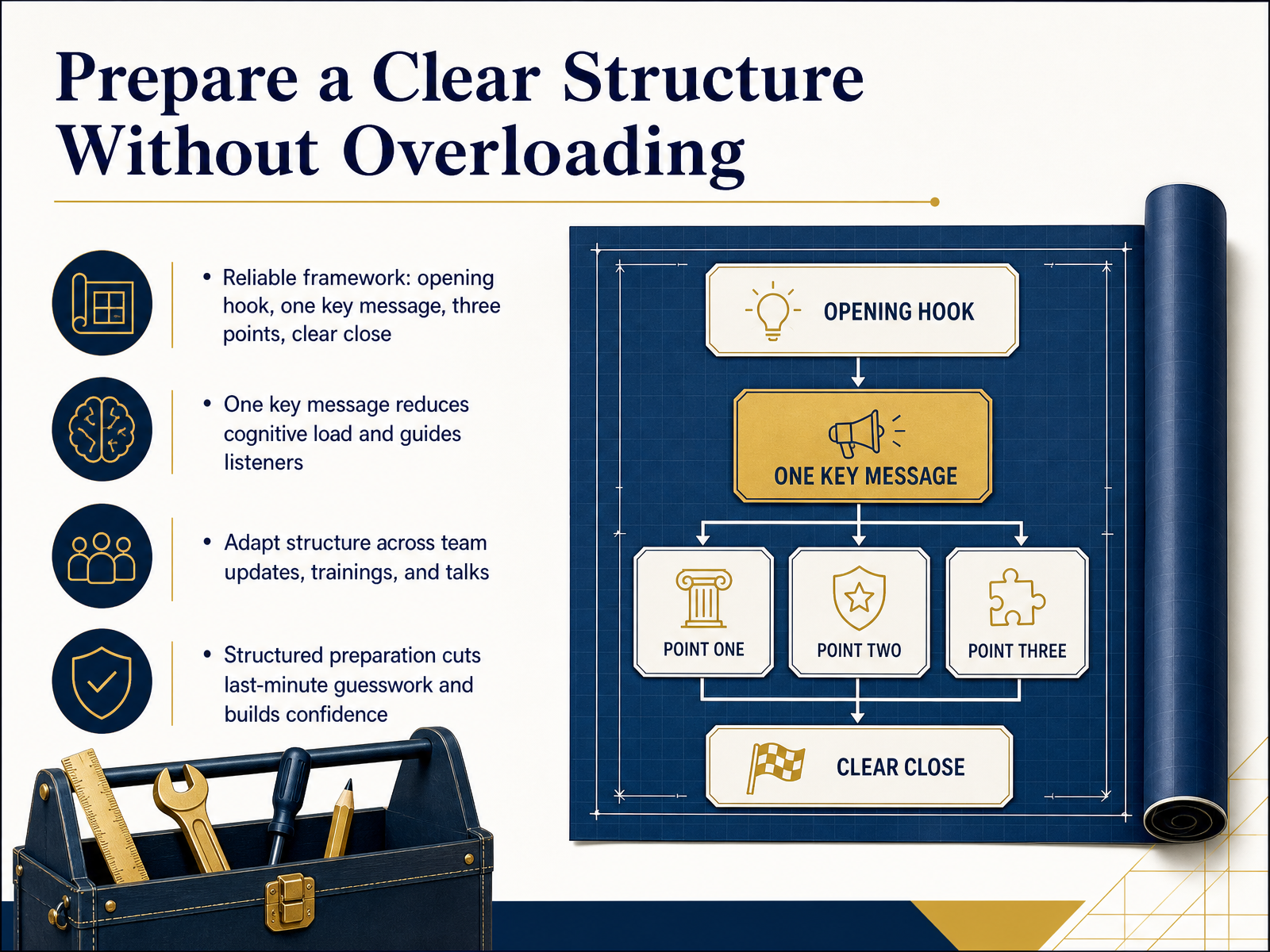
 - 07Prepare a Clear Structure Without OverloadingNow let's talk about structure. A clear structure doesn't constrain you—it liberates you. When you know exactly where you're going, your mind is free to focus on delivery. Start with a simple framework: an opening hook, one key message, three supporting points, and a clear close. That's it. One key message is the anchor; it keeps you from overloading your audience and yourself. Less really is more. This framework adapts to any context—a team update, a training session, an academic talk. The shape is the same. When you prepare with structure, you eliminate last-minute guesswork, which is a direct source of confidence. You know your path, so you can walk it with assurance. Next, let's look at how to rehearse in a way that builds real confidence.
 1 min
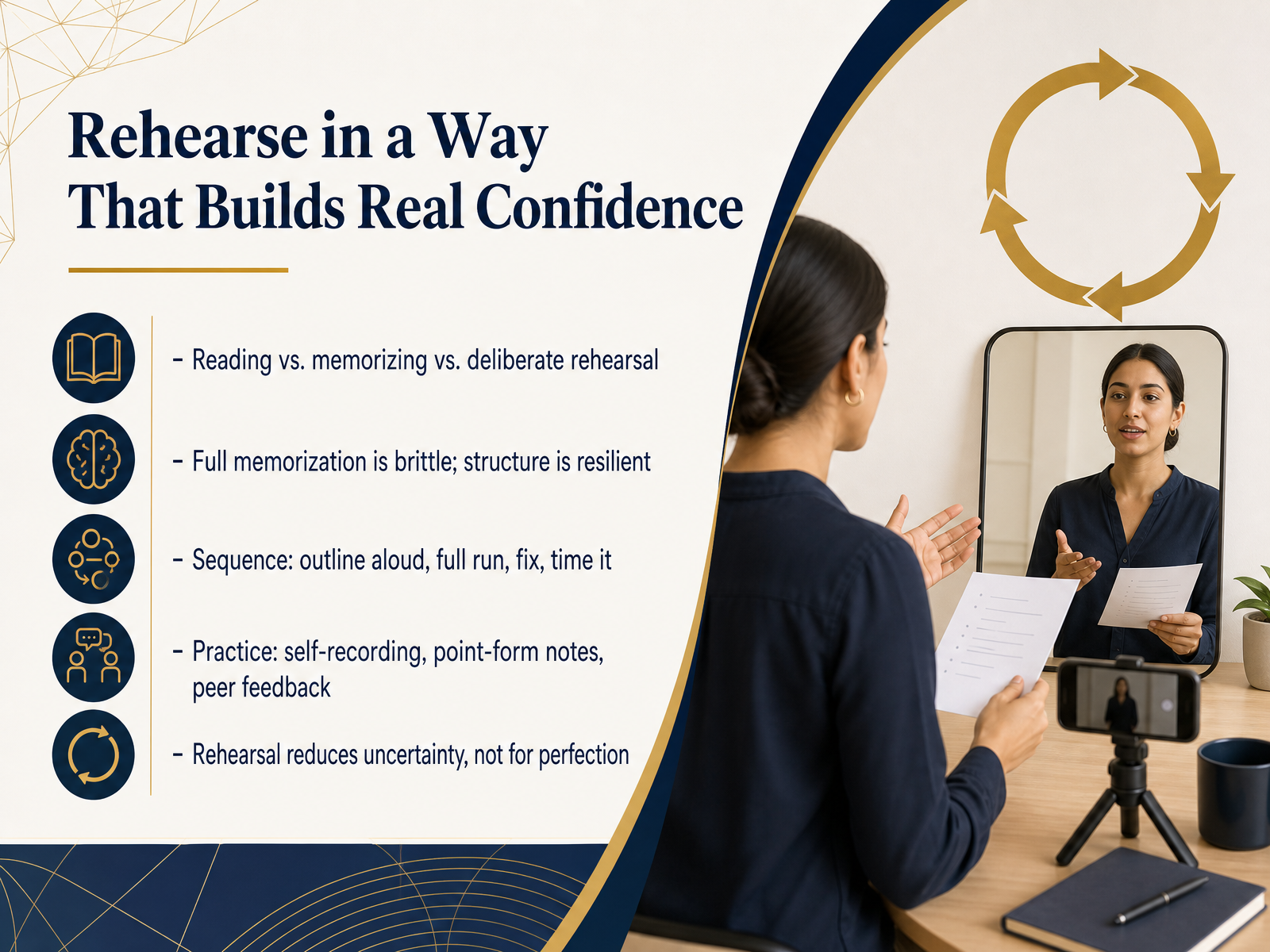
1 min - 08Rehearse in a Way That Builds Real ConfidenceLet's talk about rehearsal, because this is where real confidence is built. Many people think they need to memorize their speech word for word. But full memorization is brittle. If you lose one line, the whole thing can collapse. Instead, rehearse from structure. Know your key points, not every sentence. Here is a practical sequence. First, speak your outline aloud to get comfortable with the flow. Second, do a full run-through, just as you would on stage. Third, identify the rough spots and fix them. Finally, time yourself to make sure you fit the allotted slot. For practice, record yourself and watch it back. It feels awkward, but it shows you what the audience sees. Then, practice with point-form notes, not full sentences. And get feedback from a peer you trust. Remember, rehearsal reduces uncertainty, not perfection. You are not trying to be flawless. You are building a structure that holds up even when you feel nervous. Keep this in mind as we look at managing your physical and mental state in the final minutes before you speak.
 upskilldevelopment.comusf.eduntuclearninghub.com+22 min
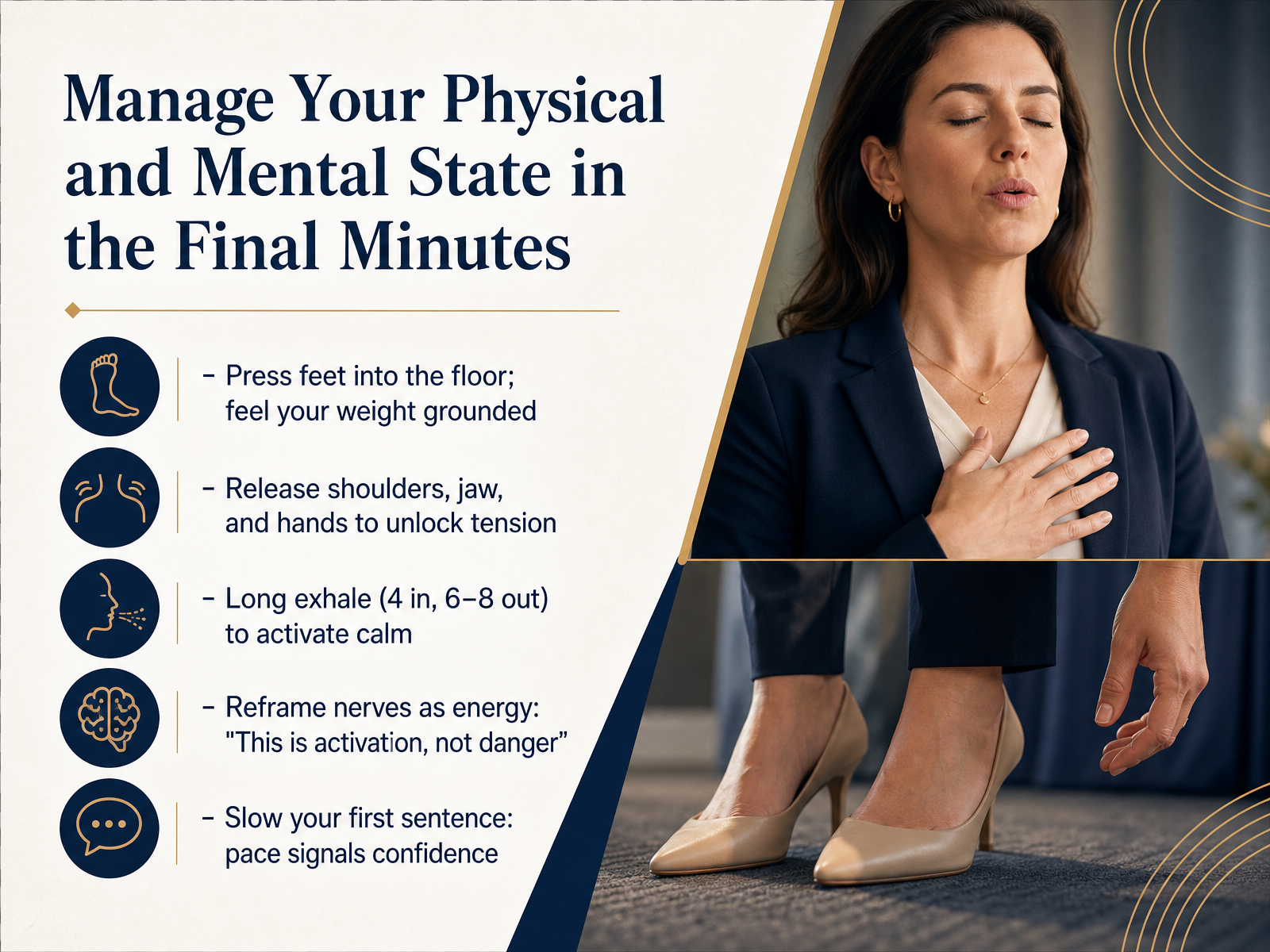
 - 09Manage Your Physical and Mental State in the Final MinutesNow, let's talk about the final minutes before you speak. This is when anxiety peaks, but it's also when you have the most control. Start with your body. Press your feet firmly into the floor and feel your weight grounded. This simple action interrupts the stress response and brings you back to the present. Next, release the tension you're holding. Drop your shoulders, unclench your jaw, and open your hands. Anxiety locks into your muscles, so deliberately letting go sends a signal of safety to your brain. Then, take a long, slow exhale. Breathe in for four counts, and breathe out for six to eight. A longer exhale activates your calm response and slows your heart rate. Now, reframe what you're feeling. Those butterflies, the racing heart—that's not danger, that's activation. Tell yourself: this is energy I can use. Finally, plan to slow down your first sentence. When you start slower than feels natural, you sound measured and confident, and it gives your voice a steady pace to follow. Remember: in these final moments, your body leads, and your mind follows. Master this sequence, and you'll step in grounded, calm, and ready. Next, let's look at the delivery cues that signal and create confidence.
 winningpresentations.comwinningpresentations.comritwikjoshi.com+21 min
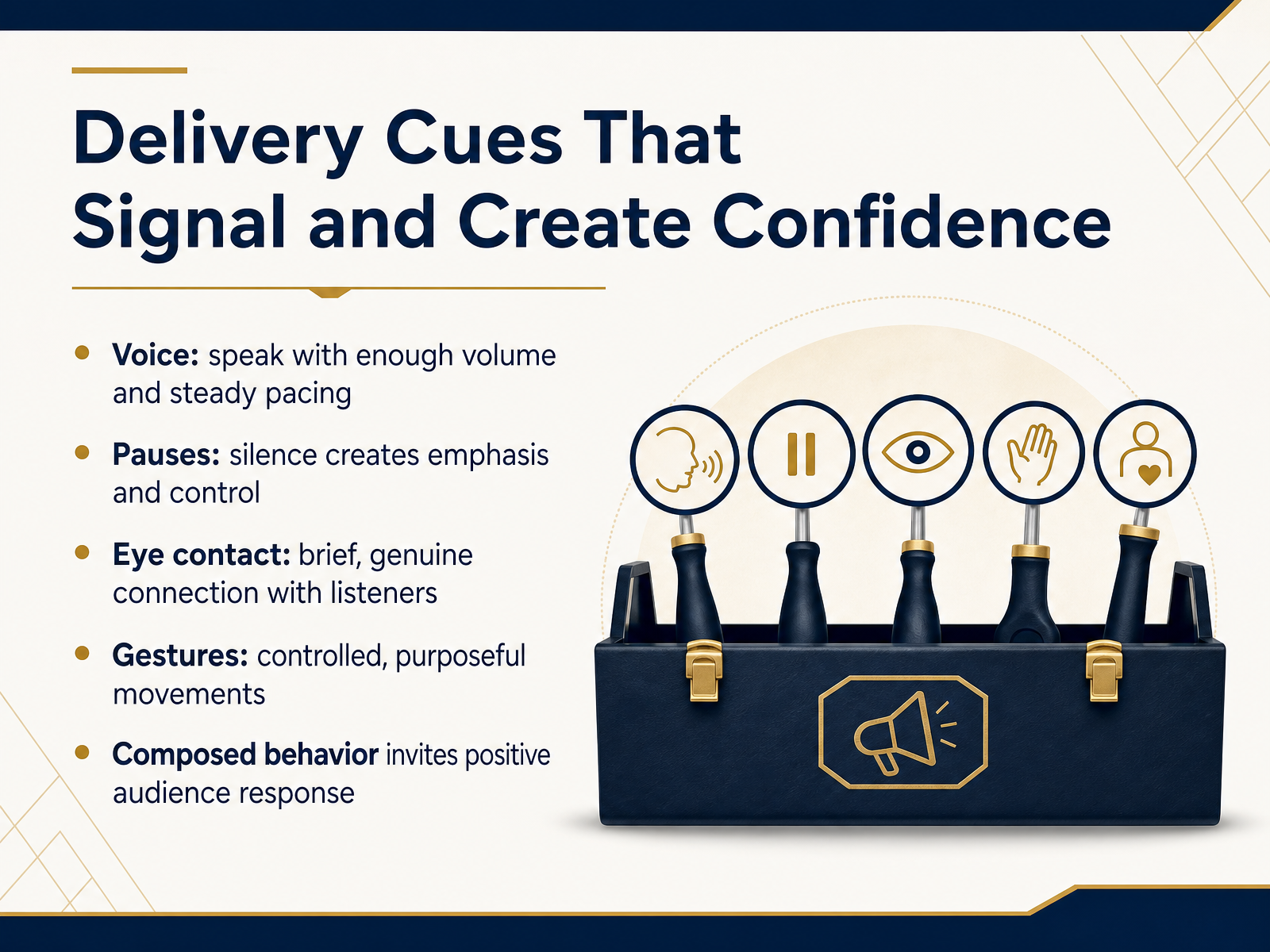
 - 10Delivery Cues That Signal and Create ConfidenceNow let’s look at the delivery cues that do two things at once: they signal confidence to your audience, and they actually create that confidence inside you. First, your voice. Speak with enough volume and a steady pace. When you slow down slightly, you sound more controlled. Second, use pauses. Silence is not your enemy. A brief pause before a key point tells the audience you are in charge. Third, eye contact. Hold a genuine, brief connection with one person at a time, then move to another. This feels personal, not scanning. Fourth, gestures. Keep them purposeful and controlled, not frantic. Let your hands support your words. And here is the rewarding part: when you act composed, your audience responds positively. That positive response feeds back into your own confidence. It becomes a cycle that works for you. Remember, most of your nervousness is invisible to others. So let your body lead, and your mind will follow. Next, we will cover how to recover smoothly when you blank out, make a mistake, or face a difficult audience.
 psychcentral.comosmosis.orgmedia.sciltp.com+22 min
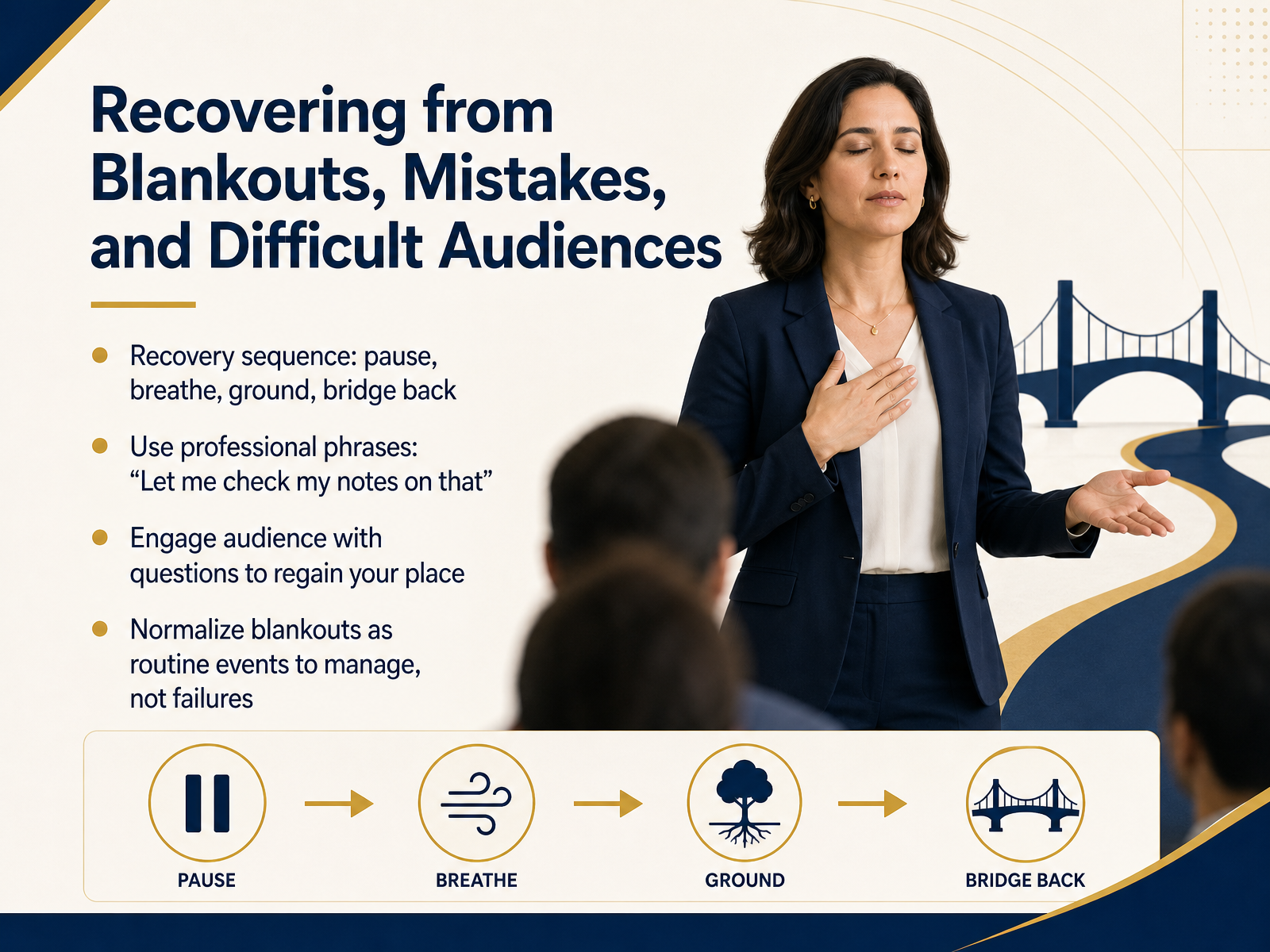
 - 11Recovering from Blankouts, Mistakes, and Difficult AudiencesLet’s talk about what to do when things don’t go perfectly—when you blank out, make a mistake, or face a tough audience. First, remember that a blank moment feels like an eternity to you, but to your audience, it’s usually just a thoughtful pause. The key is to have a simple recovery sequence ready: pause, breathe, ground, and bridge back. Pause means you stop talking and let a brief silence sit, no apologies. Breathe means take one slow exhale to calm your nervous system. Ground means press your feet into the floor to bring yourself back to the present. Then bridge back with a professional phrase like, “Let me check my notes on that,” or “Let me come back to that point.” These phrases sound composed, not panicked. Another great tool is to engage your audience by asking a question. Something like, “Has anyone else experienced this?” buys you time and keeps them involved. And remember, these moments are normal even for experienced speakers. It’s how you recover that builds trust. Practice this sequence in advance, and it will feel automatic when you need it. Next, we’ll look at how feedback and reflection can turn every presentation into a confidence-building step forward.
 1 min
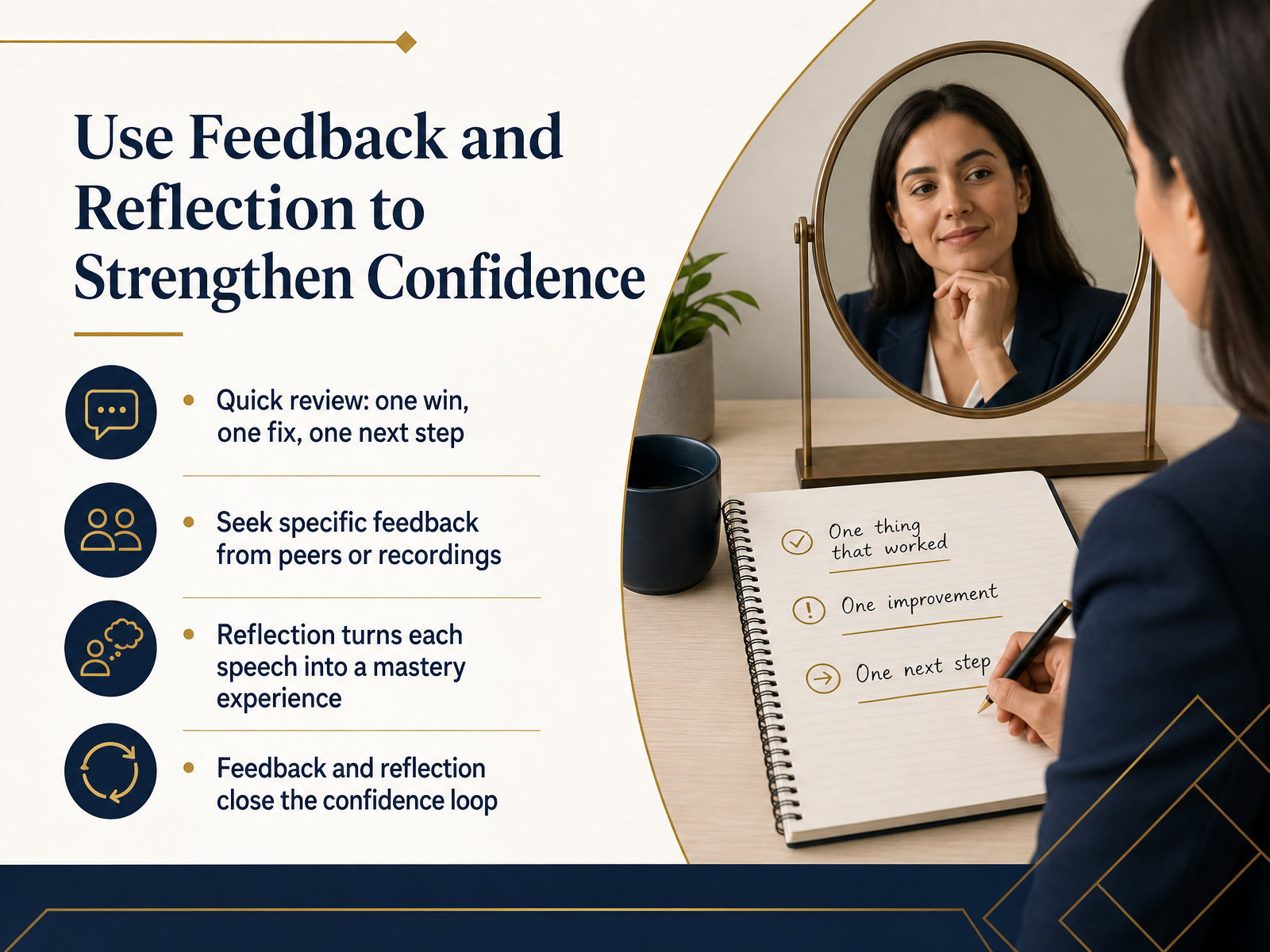
1 min - 12Use Feedback and Reflection to Strengthen ConfidenceNow, let's talk about how feedback and reflection can truly anchor your confidence. Here is the core idea: every speech you give is a chance to learn, not a final judgment on your ability. After each presentation, take a few minutes for a quick review. Ask yourself three things. One win: what went well that you want to repeat? One fix: what is one specific thing you would change? And one next step: what action will you take before your next talk? Keep it simple. This tiny ritual turns a single experience into a building block. Next, seek feedback from people you trust, or better yet, record yourself. Watching yourself on video can feel uncomfortable, but it is one of the most honest ways to see your real progress. You will notice things like pacing, filler words, or gestures. Pay attention to what you do well, not just what needs work. The research is clear: people who believe their speaking skills can improve, engage more, feel less anxious, and keep showing up. That is the growth mindset in action. So reflect, adjust, and give yourself credit for the effort. Each cycle of feedback closes the loop, turning practice into mastery. Now, let's look at how to design a sustainable practice plan for professionals, trainers, and students.
 doi.orgso06.tci-thaijo.orgdoi.org+22 min
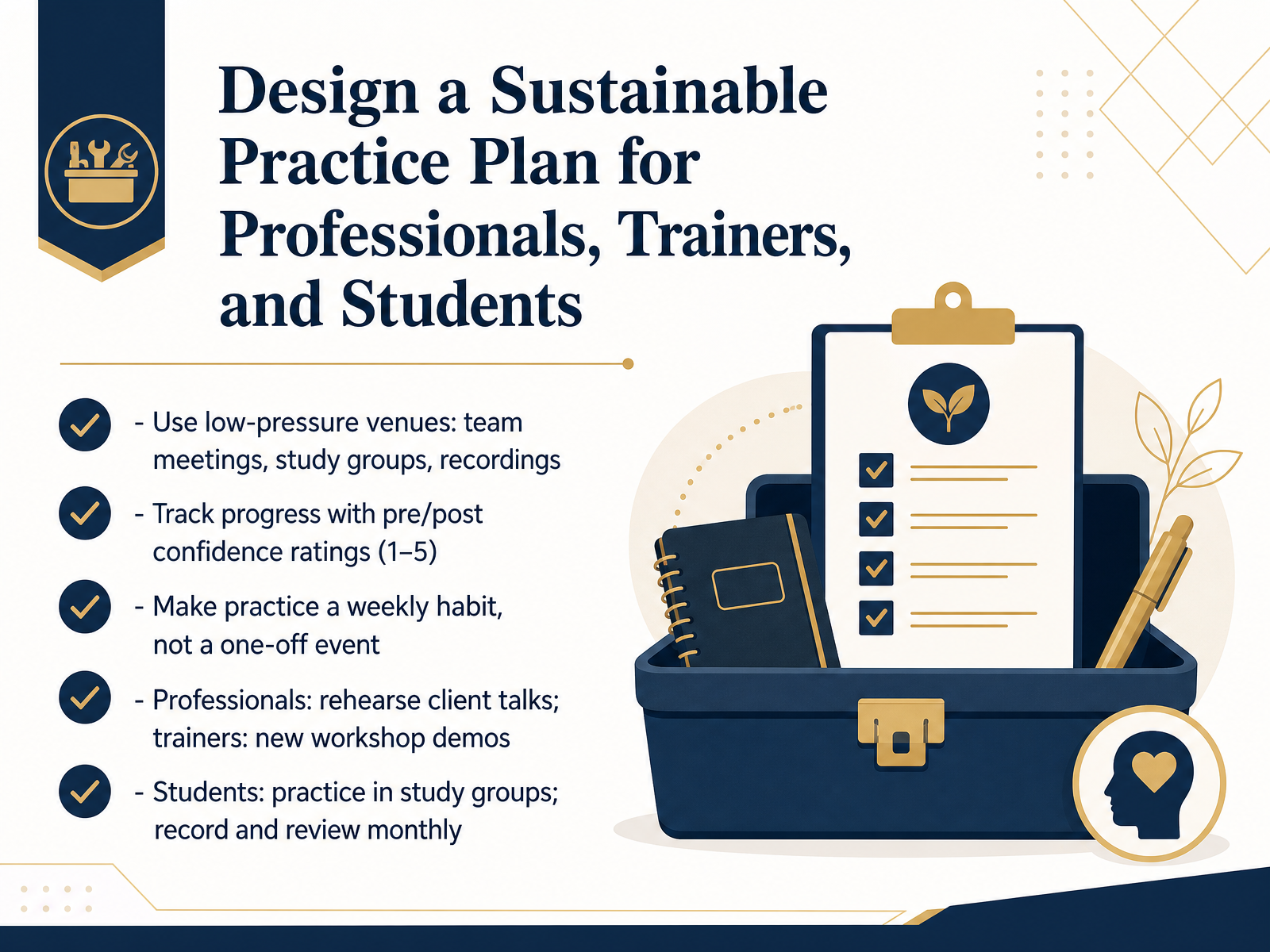
 - 13Design a Sustainable Practice Plan for Professionals, Trainers, and StudentsNow, let's turn all of this into a sustainable practice plan. The key is to make practice a regular habit, not a one-time event. Start with low-pressure venues. Volunteer to speak at team meetings, lead a study group, or simply record yourself on your phone. These are safe spaces to experiment and grow. To see real progress, track it. Give yourself a confidence rating from one to five before each practice session, and then rate yourself again after. Watching that number climb over weeks is incredibly motivating. For professionals, rehearse client talks with a colleague. For trainers, demo new workshop segments to a peer. And for students, practice in study groups and review your recordings monthly. These small, consistent actions build momentum. And they set you up perfectly for the final step: designing your one-week action plan.
 doi.orgso06.tci-thaijo.orgdoi.org+21 min
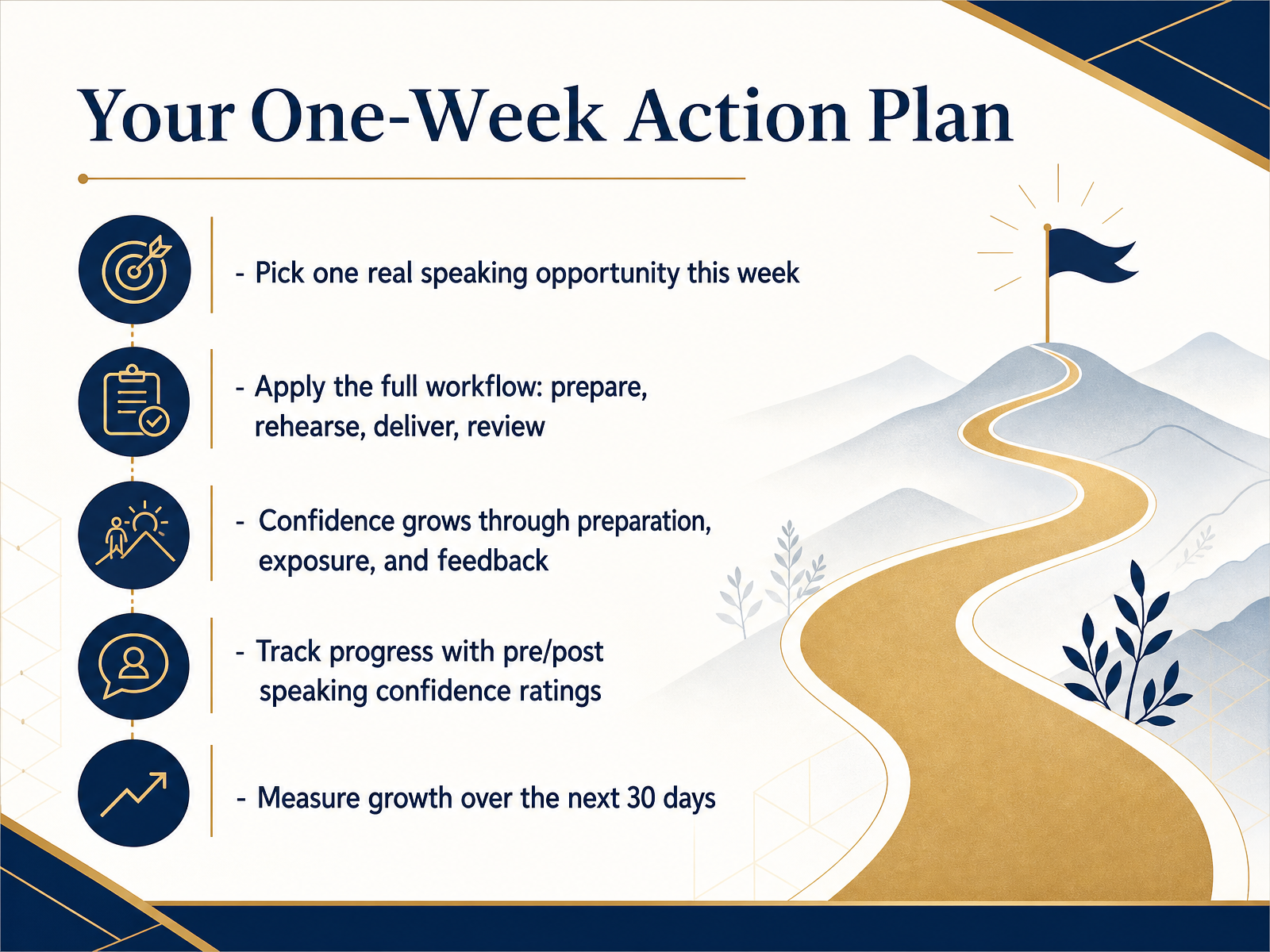
 - 14Your One-Week Action PlanYou've reached the final and most important stage. Now it's time to turn everything you've learned into a sustainable habit. Start by choosing one real speaking opportunity this week. It could be a team update, a class presentation, or even a short toast at a family gathering. Apply the full workflow you now know. Prepare thoroughly, rehearse out loud, deliver with focus, and review your performance honestly. Remember, confidence doesn't come from talent alone. It grows through preparation, repeated exposure, and learning from feedback. To see your progress clearly, rate your confidence before and after each speaking event. Use a simple one-to-ten scale. Write both numbers down. After a few weeks, you'll see a pattern. Those numbers will climb. Revisit your ratings after thirty days. The evidence of your growth will be there. Every expert speaker started where you are now. Take that first step this week, and trust the process. You have everything you need. Be patient with yourself, stay curious, and keep speaking. Thank you for your commitment, and enjoy the journey ahead.
 doi.orgso06.tci-thaijo.orgdoi.org+22 min
Take the deck with you
Download this course as a file — free, no sign-up needed.
- PDF handoutEvery slide page, ready to print or share.15 pages · 3.8 MBDownload
- Narrated PowerPointThe deck that presents itself — every slide carries the digital human's narration video.15 pages · 14.5 MBDownload
- PowerPoint slidesThe full deck as a .pptx — open it in PowerPoint, Keynote, or Google Slides.15 pages · 3.7 MBDownload
Free to use in your own training — please keep the PersonWise credit page at the end.
Have your own deck? Turn it into a course
Sources consulted
Web sources consulted while building this course.
- Public Speaking and Presentation Skills Coaching Course — upskilldevelopment.com
- Courses - Public Speaking for Professionals — usf.edu
- HSWC: WSQ HOSTING AND SPEAKING WITH CONFIDENCE - NTUC LearningHub — ntuclearninghub.com
- Introduction to Public Speaking | Coursera — coursera.org
- Speaking with Confidence Course Online & Washington, D.C. — register.graduateschool.edu
- Public Speaking Anxiety: What It Is, Signs, and More — psychcentral.com
- Glossophobia: What Is It, Causes, Diagnosis, Treatment, ... — osmosis.org
- Occupational stress, Glossophobia, and Impostor Cognitions: An Integrative Clinical Case Study of Anxiety and Maladaptive Psychotropic Coping — media.sciltp.com
- Identifying demographic and personality correlates of public speaking anxiety among adult workers — doi.org
- Fear of public speaking: How can I overcome it? — mayoclinic.org
- An Initial Exploration of Students’ Mindsets, Attitudes, and Beliefs About Public Speaking — doi.org
- Development of a Growth Mindset and Problem-Based Learning Model to Enhance Public Speaking Skills of Undergraduate Students | Dhammathas Academic Journal — so06.tci-thaijo.org
- Assessing Student Mindset, Interest, Participation, and Rapport in the Post-Pandemic Public Speaking Classroom: Effects of Modality Change and Communication Growth Mindset — doi.org
- Supporting Self-Efficacy Through Mindset: The Impact of a Growth Mindset Innovation on the Self-Efficacy of Middle School Students in a Teen Leadership Course — scholarcommons.sc.edu
- The Effectiveness of Public Speaking Instruction in Enhancing Students' Confidence and Communication Skills — doi.org
- Grounding Techniques for Presentation Anxiety: How to Anchor Yourself Before You Speak — winningpresentations.com
- Presentation Warm-Up Routine: The 10-Minute Protocol That Stops Nerves Before They Start — winningpresentations.com
- The Pre-Stage Protocol: Peak Performance Blueprint | Ritwik Joshi | Public Speaker with a Purpose — ritwikjoshi.com
- Breathwork for Public Speaking: How to Stay Calm, Confident, and Clear - Hope Zvara — hopezvara.com
- Embodied strategies for public speaking anxiety - PMC - NIH — pmc.ncbi.nlm.nih.gov