Data Engineering Core Skills
Begin
14 pages · ~28 min
Data Engineering Core Skills
This training provides aspiring data engineers with core skills in data pipelines, ETL processes, and data modeling through hands-on practice.
What you’ll learn
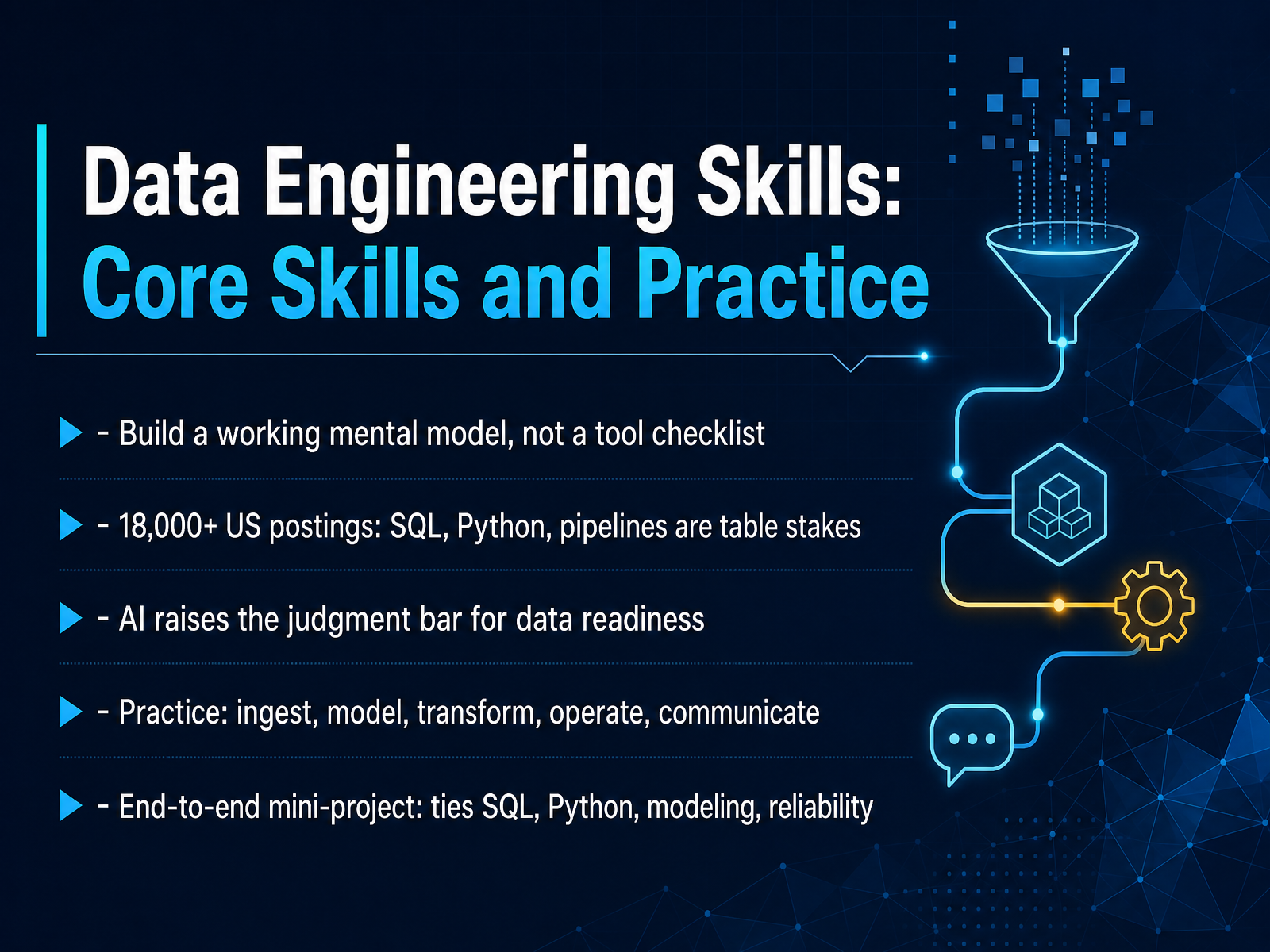
- 01Data Engineering Skills: Core Skills and PracticeWelcome. If you are stepping into data engineering, or you have been in the trenches for a while, this course is built for you. Here is the honest truth about the field: it is not about collecting tool badges. It is about building a working mental model of how data moves, breaks, and gets fixed. The job market confirms this. Across over eighteen thousand recent US postings, the same three skills appear again and again: SQL, Python, and pipeline building. Those are the table stakes. So what has changed? AI. It now writes basic code, which means the bar has moved up to judgment. Can you decide if data is ready to use? Can you spot why a pipeline breaks on a retry? That is the new core skill. Here is our plan. We will practice the five pillars of the craft: ingest, model, transform, operate, and communicate. Then, we will tie it together with an end-to-end mini-project. You will connect SQL, Python, modeling, and reliability into one complete system. By the end, you will not just know the terms. You will know how to ship work that holds up in production. Let us begin with the foundation and define what data engineering actually is.datadriven.iodataquest.ioaxialsearch.com+22 min
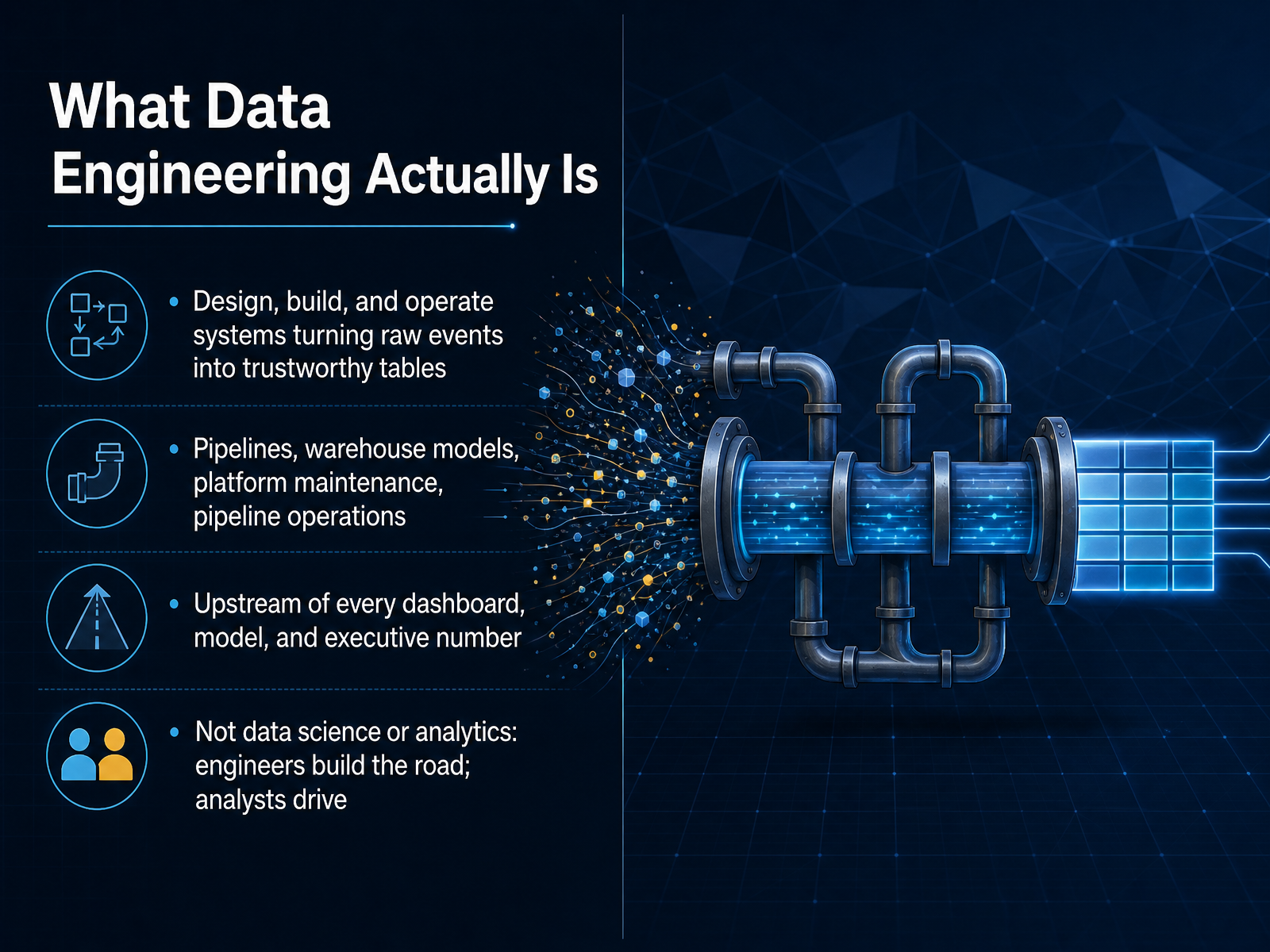
- 02What Data Engineering Actually IsLet’s get precise about what data engineering actually is. At its core, it is the discipline of designing, building, and operating the systems that turn raw events into trustworthy tables. That means building pipelines that move data from source systems into a warehouse. It means modeling that data into shapes analysts can query. And it means maintaining the platform so everything runs on time, every day. This work sits upstream of every dashboard, every model, and every executive number you see. If the data is wrong at this layer, everything downstream is wrong too. That’s why it’s important to separate this role from data science and analytics. A data scientist builds models. An analyst interprets results. An engineer builds the road they both drive on. If the road is broken, no analysis can save you. So, when you see a clean dashboard, remember someone built the foundation underneath it. That’s the engineer’s craft. Next, let’s look at where data engineers actually sit within the wider organization.
 kore1.comibm.comelevano.com+21 min
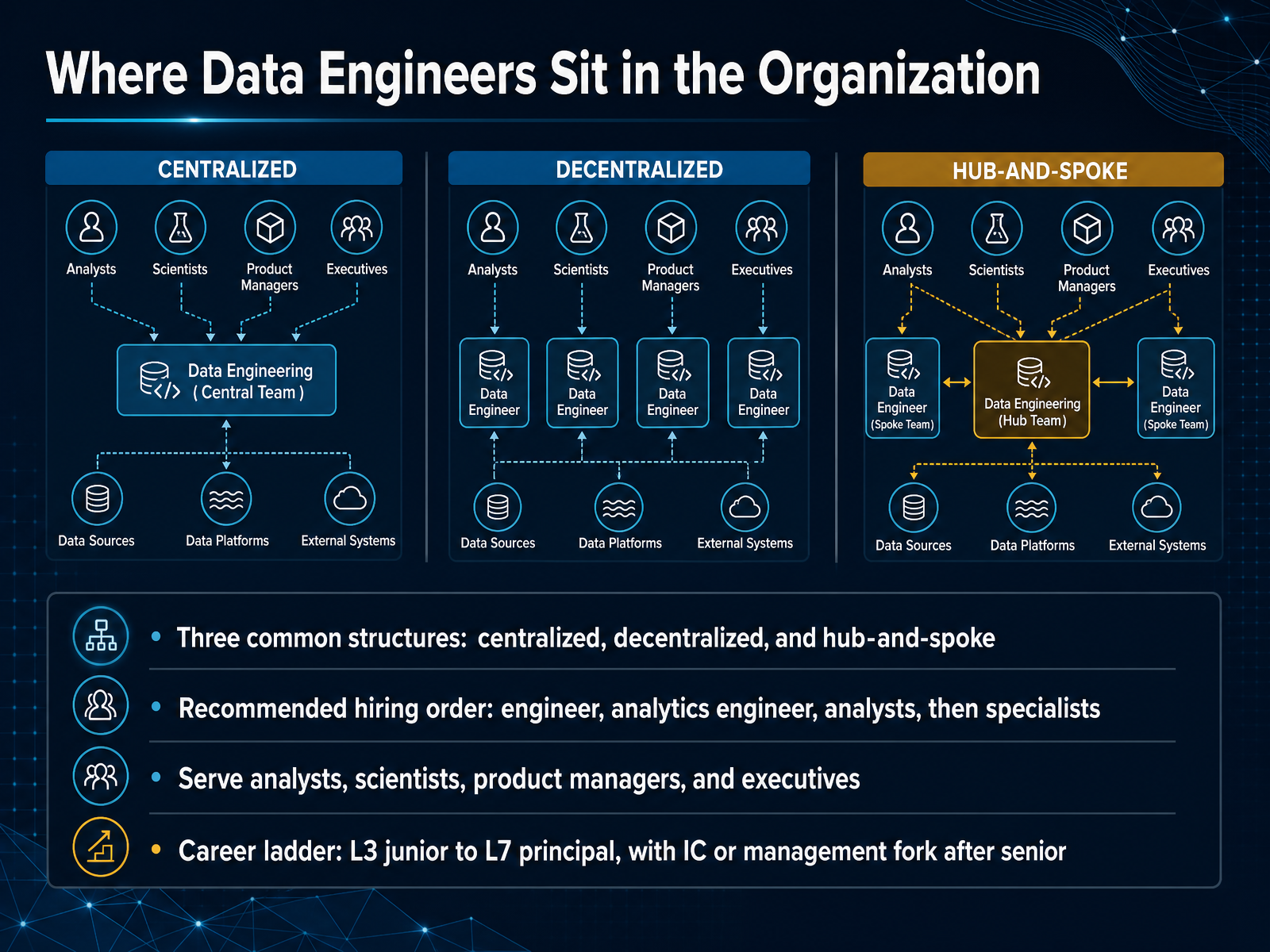
 - 03Where Data Engineers Sit in the OrganizationLet’s zoom out and look at where you fit in the organization. There are three common team structures. Centralized means one data team serves the whole company. It’s consistent and efficient, but it can become a bottleneck. Decentralized means each business unit has its own embedded engineers. That’s fast and tailored, but you risk duplicated work and conflicting definitions. The third option is hub-and-spoke. A central hub owns the platform, the warehouse, and the governance. Embedded specialists sit with the business units, but they build on the hub’s foundation. Most companies land here as they scale. Now, who gets hired first? The data engineer, almost always. Next is the analytics engineer who builds the trusted transformation layer. Then come analysts, and finally specialists like data scientists and architects. You serve a wide audience: analysts, scientists, product managers, and executives. And the career path is clear. It runs from L3 junior, through mid and senior, up to L7 principal. After senior, you choose either the individual contributor track or the management track. Both are valid. Pick the one that fits how you like to work. Next, we’ll get into the modern data stack in one picture.
 kore1.comibm.comelevano.com+22 min
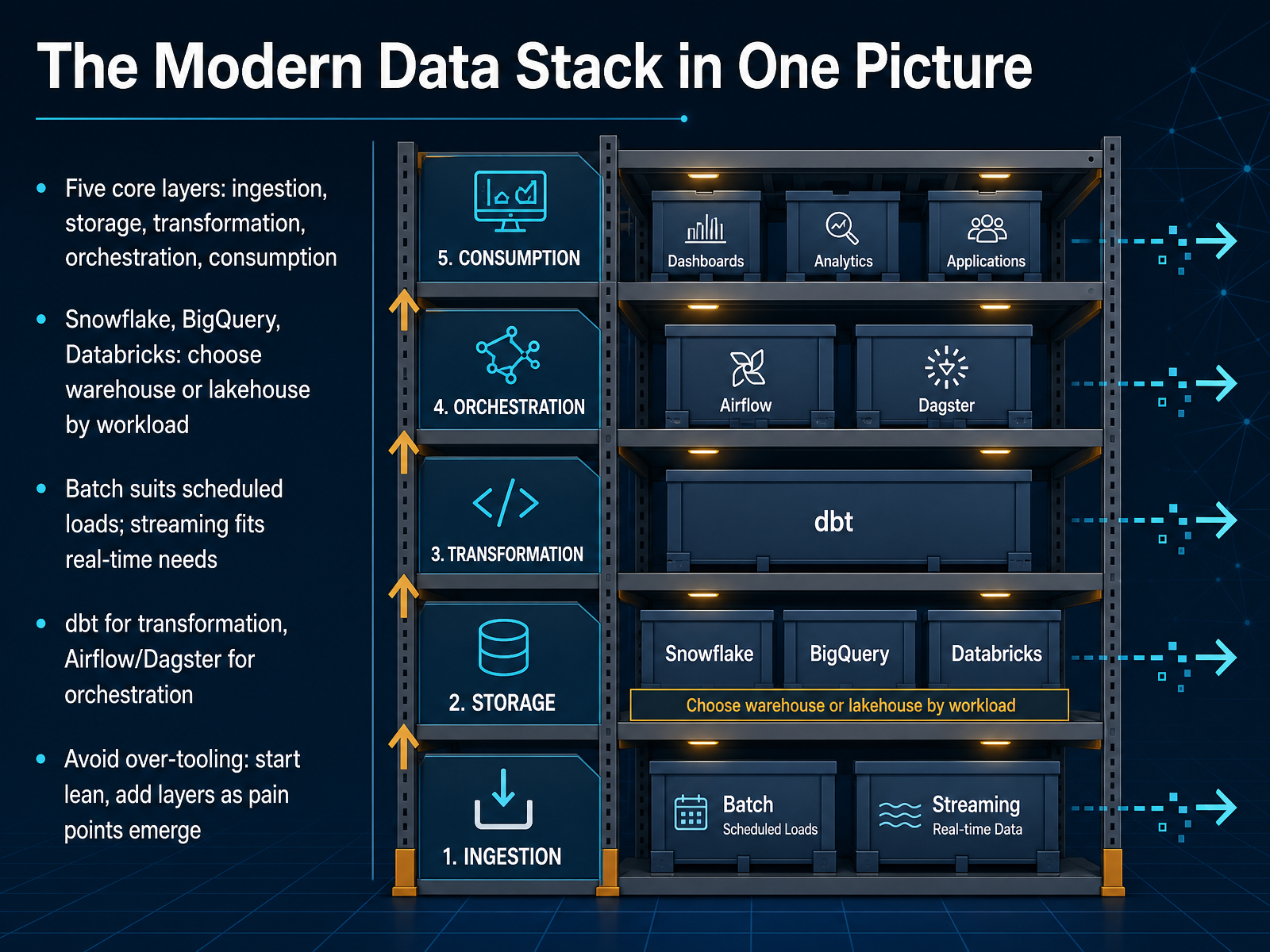
 - 04The Modern Data Stack in One PictureLet’s put the modern data stack into one clear picture. It’s a modular system with five core layers: ingestion, storage, transformation, orchestration, and consumption. Think of it as a pipeline — data enters at one end and becomes insight at the other. Ingestion tools pull data from your sources. Storage keeps it centralized. For most teams, the real choice is between a warehouse like Snowflake or BigQuery, or a lakehouse like Databricks. Pick based on your workload. If you run scheduled loads, batch processing works well. If you need real-time answers, streaming is the way to go. For transformation, dbt is the industry standard, with SQLMesh as a rising alternative. And for orchestration, Airflow remains the incumbent, while Dagster offers a more modern experience. Here’s the key point — resist the urge to over-tool. Start lean. A small stack with one tool per layer is enough. Add more only when you feel a real pain point. This keeps your system simple, cost-effective, and easy to maintain. Next, let’s tackle the skill that ties it all together — SQL, the highest-weighted skill in data engineering.
 modern-datatools.comatscale.comtechtarget.com+22 min
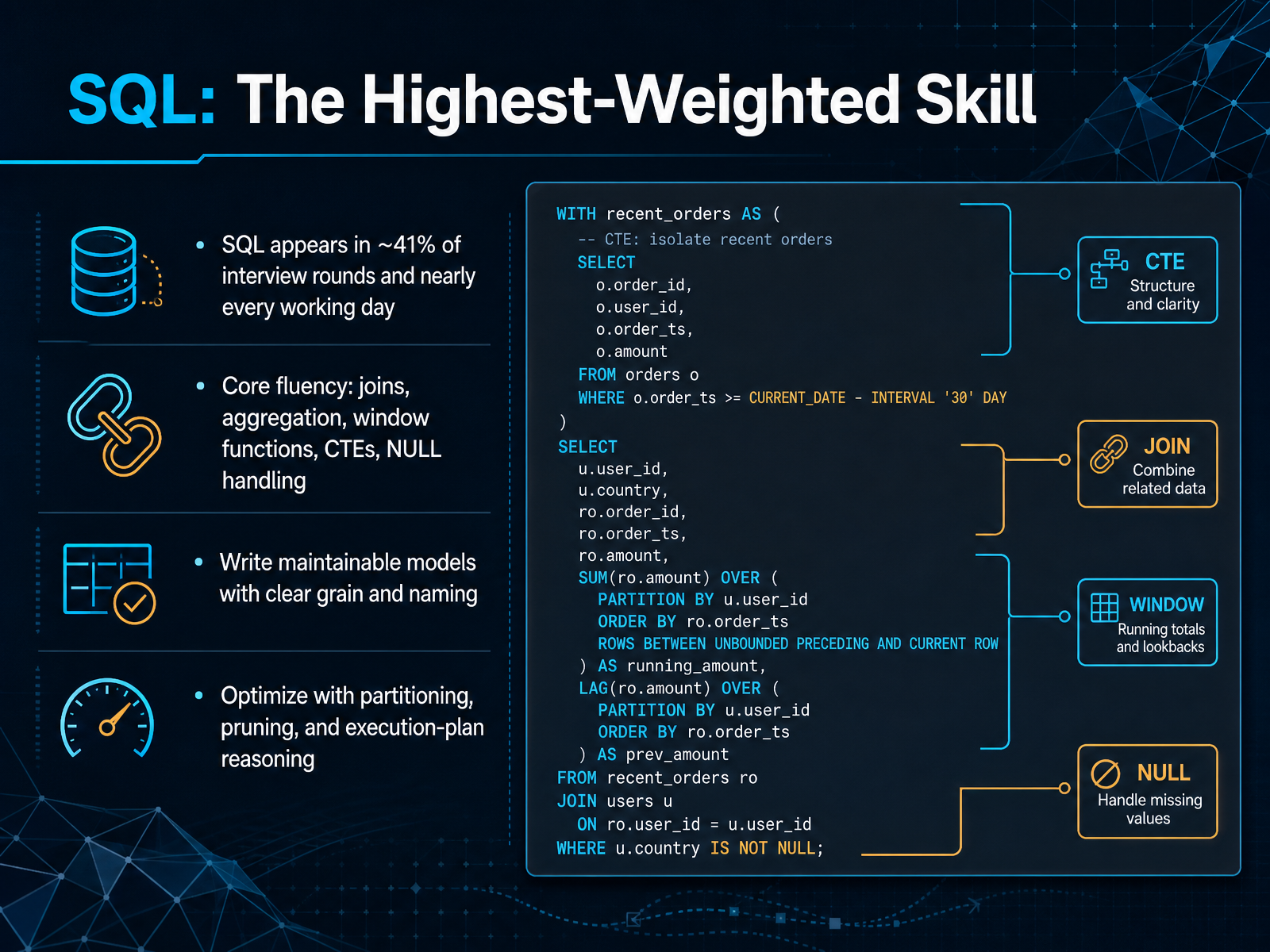
 - 05SQL: The Highest-Weighted SkillNow, let’s talk about the skill that carries the most weight in your loop: SQL. Across hundreds of companies, SQL appears in about forty-one percent of all interview rounds. And once you’re on the job, it’s part of nearly every working day. So, what does fluency actually mean? Start with the fundamentals: joins, aggregation, window functions, common table expressions, and how to handle nulls. Those aren’t just interview topics; they’re the tools you’ll use to write maintainable models. Always define the grain clearly and use consistent naming, so the next engineer can actually read your work. When performance matters, think beyond the query itself. Learn to partition your tables, rely on partition pruning, and read an execution plan. The ability to reason about why a query runs slowly is what separates a script from a real system. Master these, and you’re building on the strongest foundation this field has. Once that’s in place, we’ll move on to the other core language: Python, which serves as pipeline glue rather than LeetCode prep.
 datadriven.iodataquest.ioaxialsearch.com+22 min
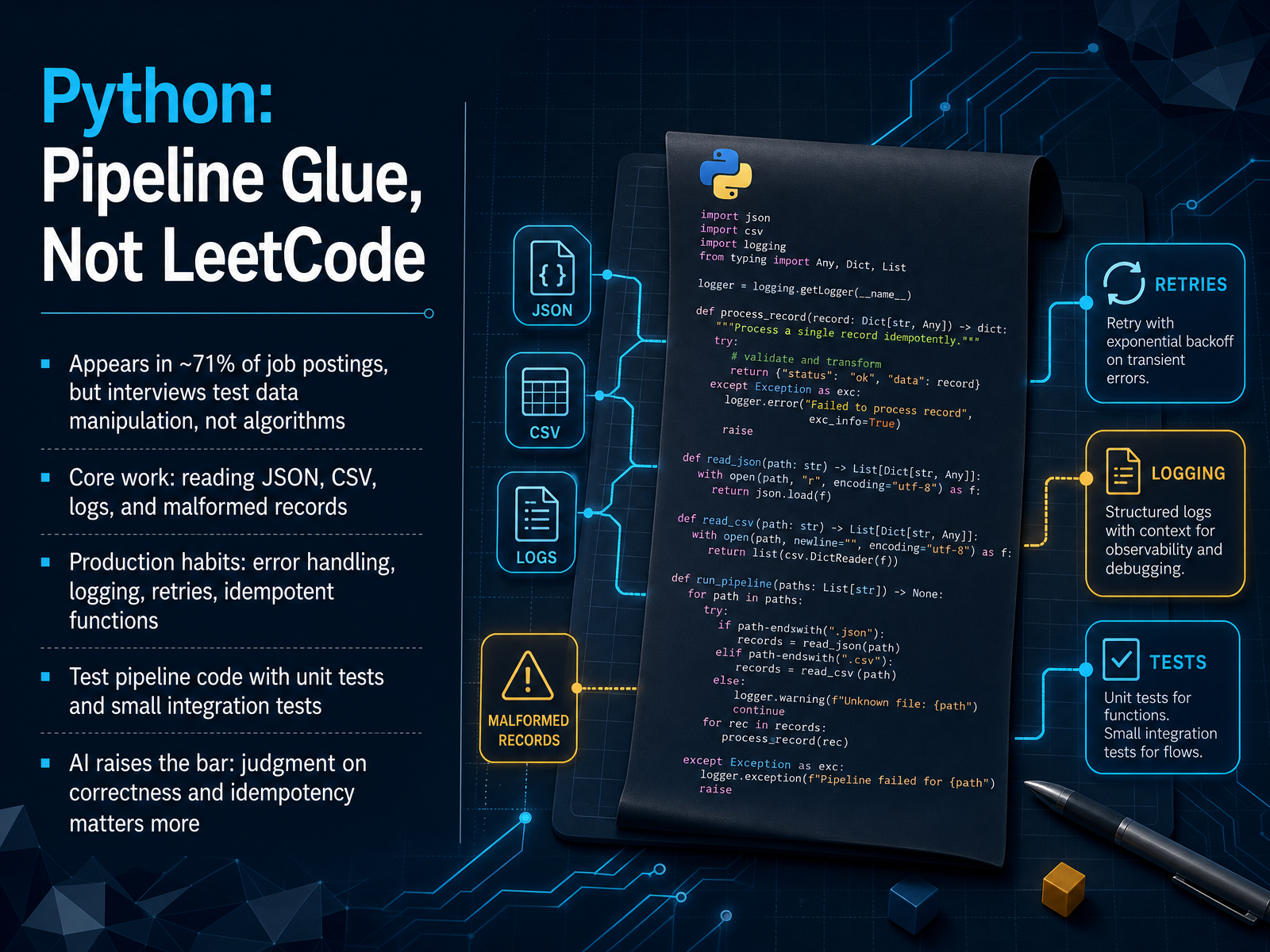
 - 06Python: Pipeline Glue, Not LeetCodeHere’s a common misconception about data engineering interviews: they’re not LeetCode marathons. Python appears in most job postings, but interviews test how you manipulate data, not how you solve abstract algorithm puzzles. The real work is reading JSON files, parsing CSV files, and handling logs with malformed records. So, shift your focus to production habits. Write code that handles errors gracefully, logs its progress, retries failed steps, and uses idempotent functions—meaning your pipeline can run twice without duplicating results. Test that code with unit tests and small integration tests to catch issues early. And with AI writing a lot of boilerplate code now, your judgment matters more than ever. You need to spot why a retry might double-count rows, and you need to know when a transformation is correct. That’s the value you bring. Next, we’ll walk through data modeling and schema design, where this kind of precision really pays off.
 datadriven.iodataquest.ioaxialsearch.com+22 min
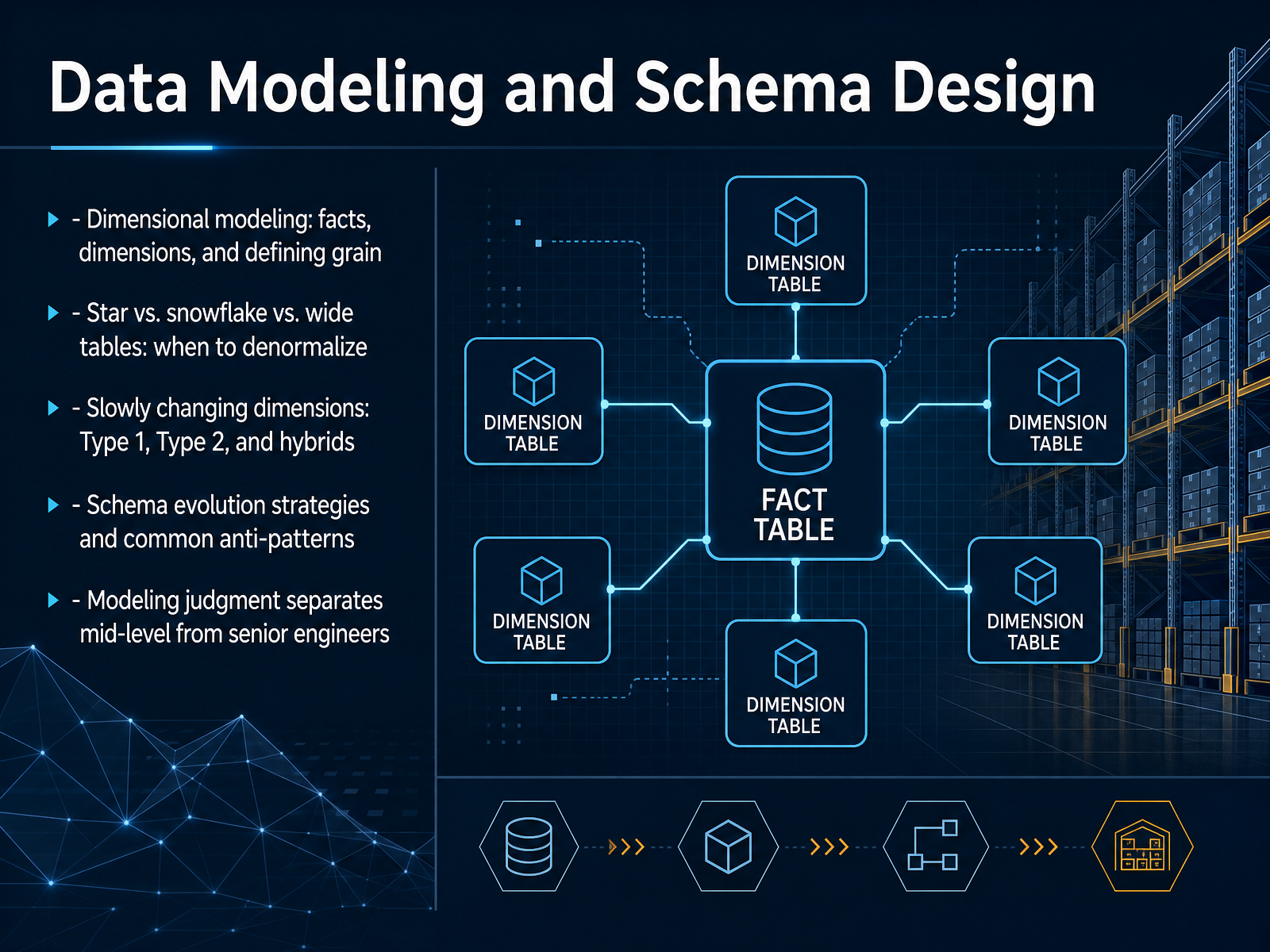
 - 07Data Modeling and Schema DesignLet’s talk about data modeling and schema design. This is where the real separation happens between mid-level and senior engineers. Start with dimensional modeling. You need facts, dimensions, and above all, the grain. State the grain before you draw a single table. It defines exactly what one row represents, and everything downstream depends on it. Next, star schema versus snowflake versus wide tables. In an analytical warehouse, you denormalize on purpose. Star schemas are the default because they’re simple and fast. Snowflakes normalize dimensions more, but they add joins and complexity. Wide tables make sense when analysts need to query directly without joins. You don’t choose one style for everything—you choose based on the query patterns. Then there are slowly changing dimensions. Type 1 overwrites history. Type 2 tracks history with new rows and effective dates. Most real systems need a hybrid, and you need to know which one to use when the business asks, “what did this look like last month?” Finally, plan for schema evolution. Sources change. Columns get added, renamed, or disappear. Avoid the anti-pattern of letting drift break your pipelines silently. Build in checks. The judgment you show in these decisions is what gets you the senior title. Next, we move on to building reliable pipelines.
 datadriven.iodataquest.ioaxialsearch.com+22 min
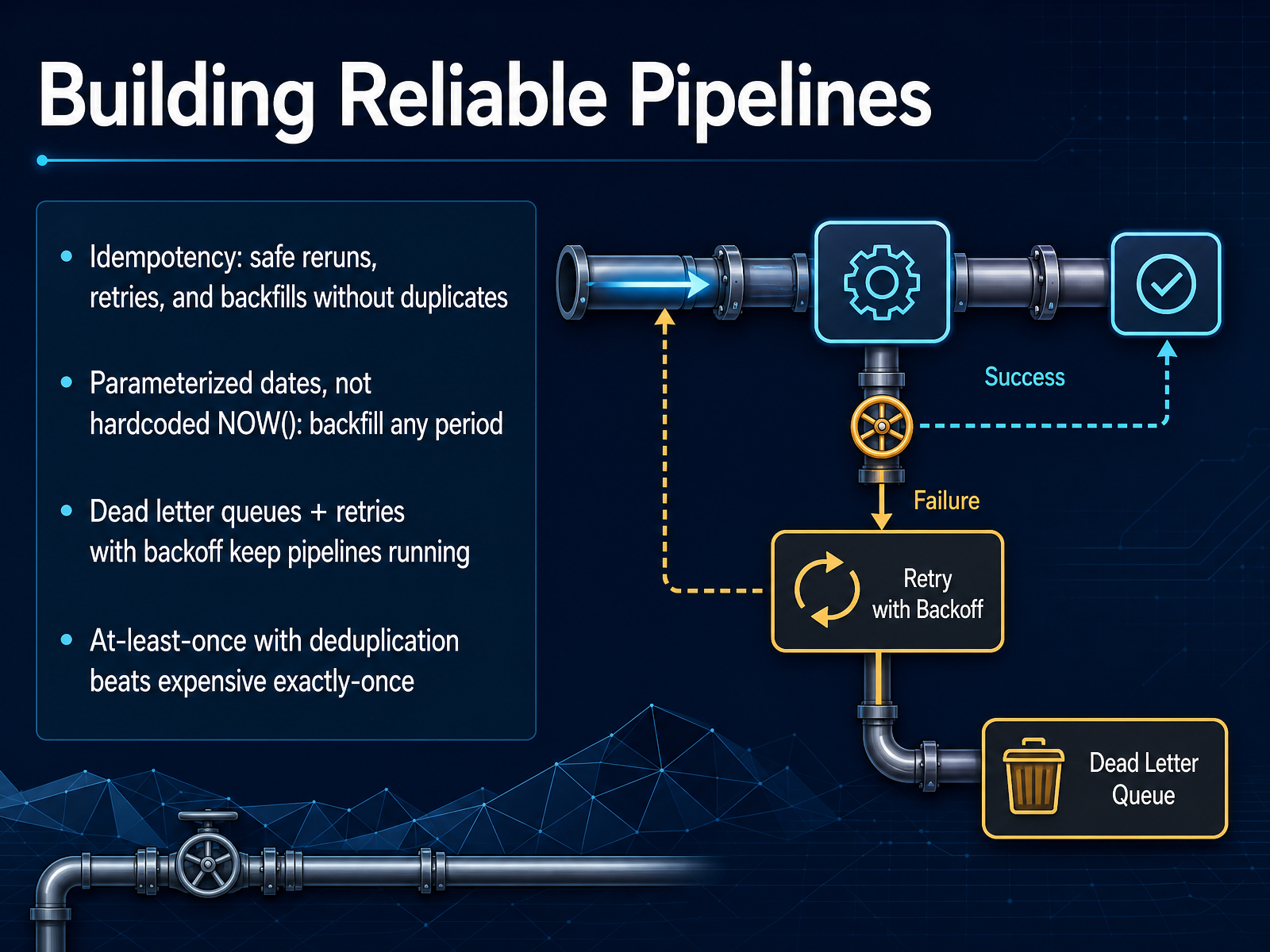
 - 08Building Reliable PipelinesLet’s talk about building pipelines that don’t break at three a.m. The first rule is idempotency. If you run the same pipeline twice with the same input, you should get the same output. No duplicates, no double-counted rows. This makes retries and backfills safe. Second, never hardcode the current date. Use a date parameter instead. That way, you can reprocess any historical period without rewriting logic. Third, plan for failure. Route bad records to a dead letter queue so one bad row doesn’t kill the whole run. Add retries with exponential backoff and jitter to handle transient issues without overloading your sources. Finally, think about delivery guarantees. True exactly-once processing is expensive and complex. In practice, at-least-once delivery combined with idempotent consumers is simpler and nearly as effective. You get the same correctness with far less overhead. Keep these four patterns in mind and your pipelines become much easier to operate. Next, we’ll look at orchestration and failure recovery.
 dataworkers.iodatabricks.comsre.google+22 min
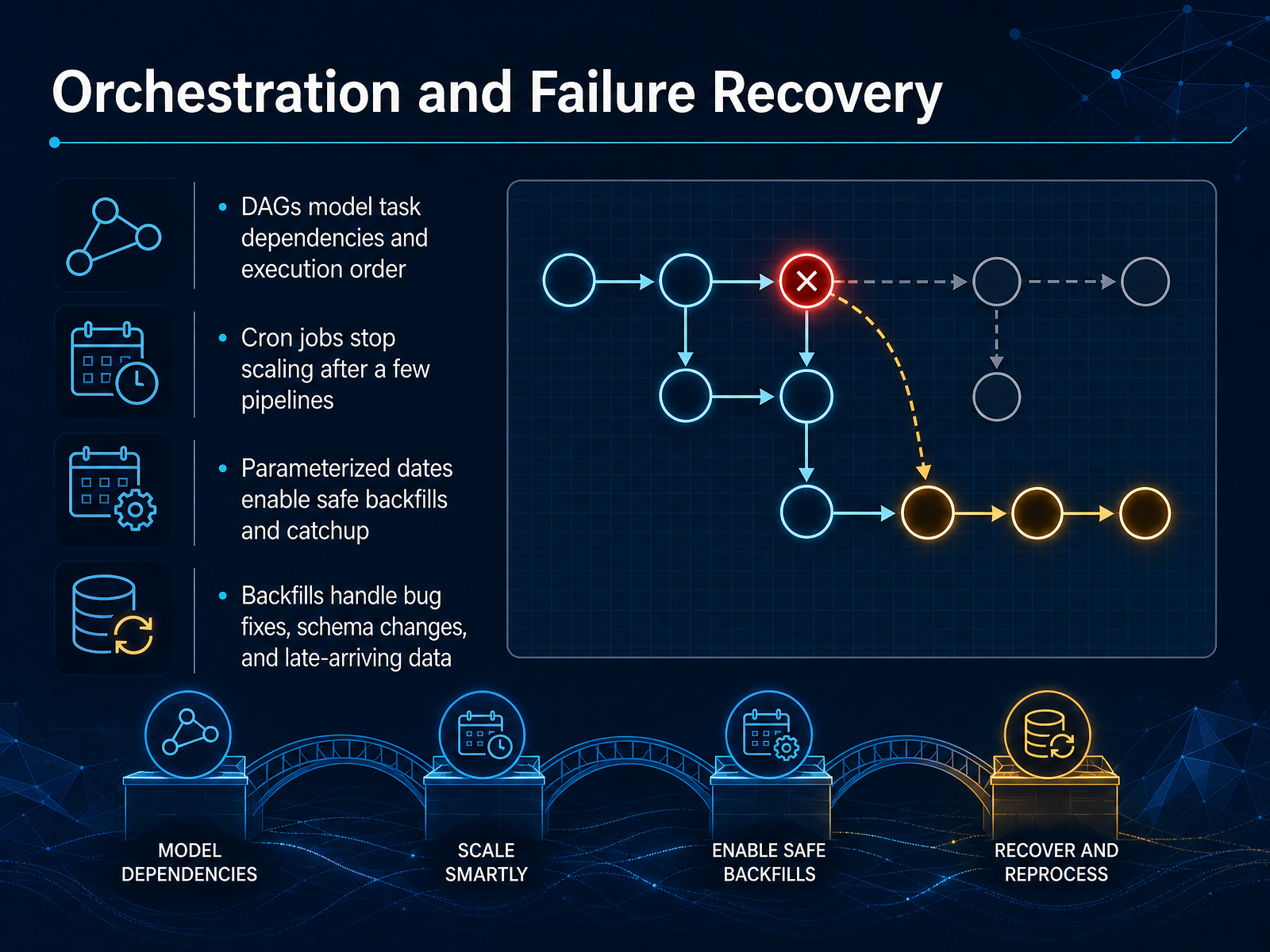
 - 09Orchestration and Failure RecoveryNow let's talk about orchestration and failure recovery. At the heart of modern orchestration is the DAG, or directed acyclic graph. It's the model that defines task dependencies and execution order. Think of it as a map that says task B cannot start until task A finishes. That's what makes multi-step pipelines manageable. If you rely on cron jobs, you already know the pain. They work for one or two scripts, but they stop scaling after a few pipelines. You lose visibility into dependencies, and debugging a failed run means tailing log files on a server. An orchestrator like Airflow or Dagster gives you the structure you need. Now, a key concept here is parameterized dates. Instead of hardcoding today's date into your logic, you pass the execution date as a parameter. This simple practice makes backfills and catchup runs safe. It lets you reprocess any historical date range without breaking anything. You'll need backfills more often than you think. Bug fixes, schema changes, and late-arriving data all require reprocessing. If your pipeline only handles 'now', it can't go back in time. But with date parameters and idempotent tasks, you can safely re-run any past date. That's the difference between a pipeline that's fragile and one that's production-ready. Next, we'll cover how monitoring, data quality, and observability keep these systems honest.
 datadriven.iodataquest.ioaxialsearch.com+22 min
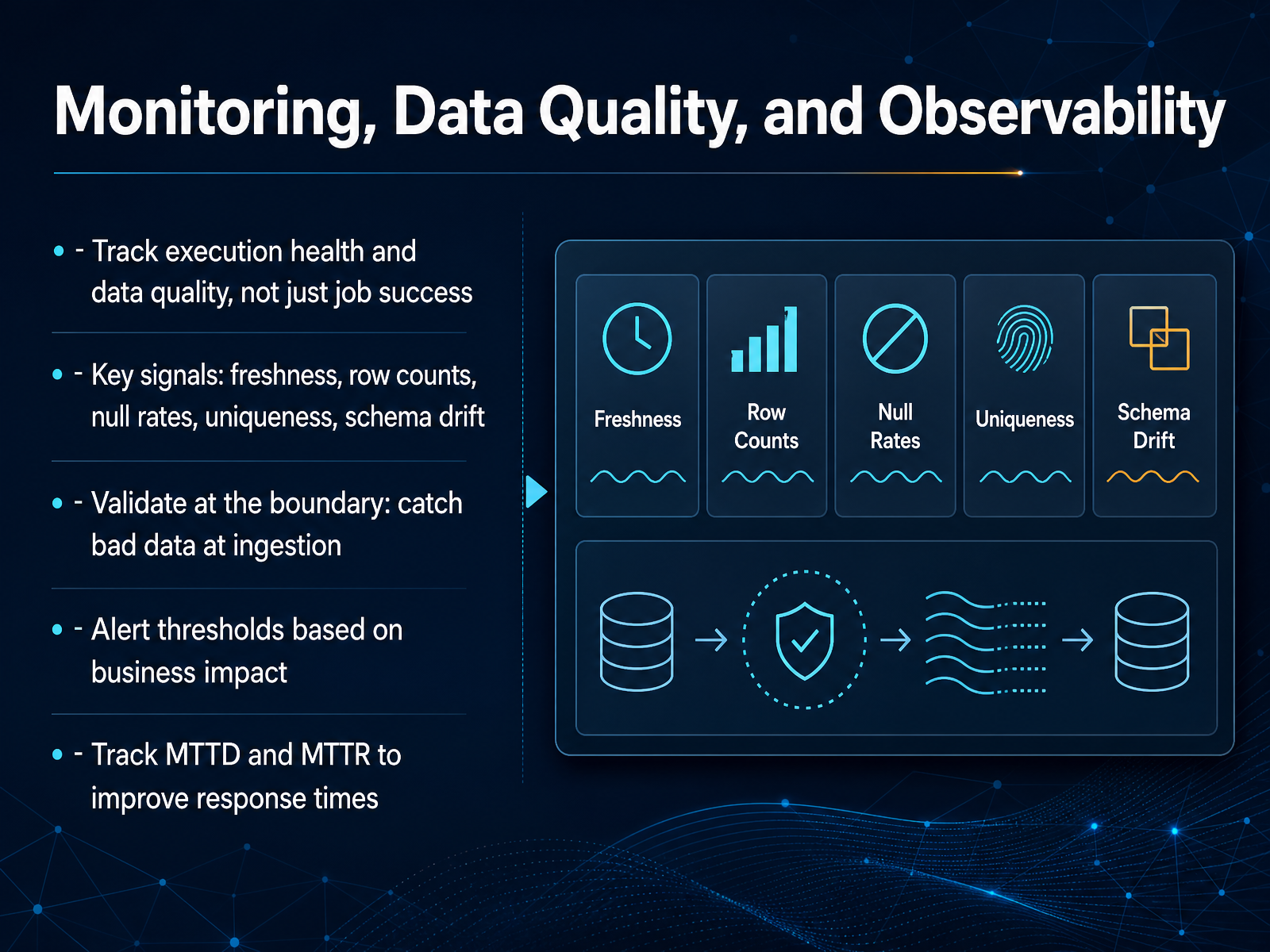
 - 10Monitoring, Data Quality, and ObservabilityNow let’s talk about monitoring, data quality, and observability. Job success is not the same as data health. A pipeline can finish on time and still deliver wrong data. So track signals that reflect the quality of the output, not just the status of the run. Start with freshness. When was the table last updated? Then volume, row counts compared to historical baselines. Then completeness, null rates in required fields. And uniqueness, duplicate keys break analytics. Also watch for schema drift — a new column or a type change can break downstream models. Validate data at the boundary. Catch bad records at ingestion, before they propagate through dozens of transformations. Use automated checks and route failures to a dead letter queue instead of failing the whole run. Set alert thresholds based on business impact, not technical perfection. A revenue dashboard deserves a tight SLA; an internal analytics table can tolerate more. Track your ability to respond as well. Measure MTTD and MTTR to know if your detection and recovery are improving over time. Good monitoring turns silent failures into actionable alerts. Now let’s look at governance without slowing delivery.
 dataworkers.iodatabricks.comsre.google+22 min
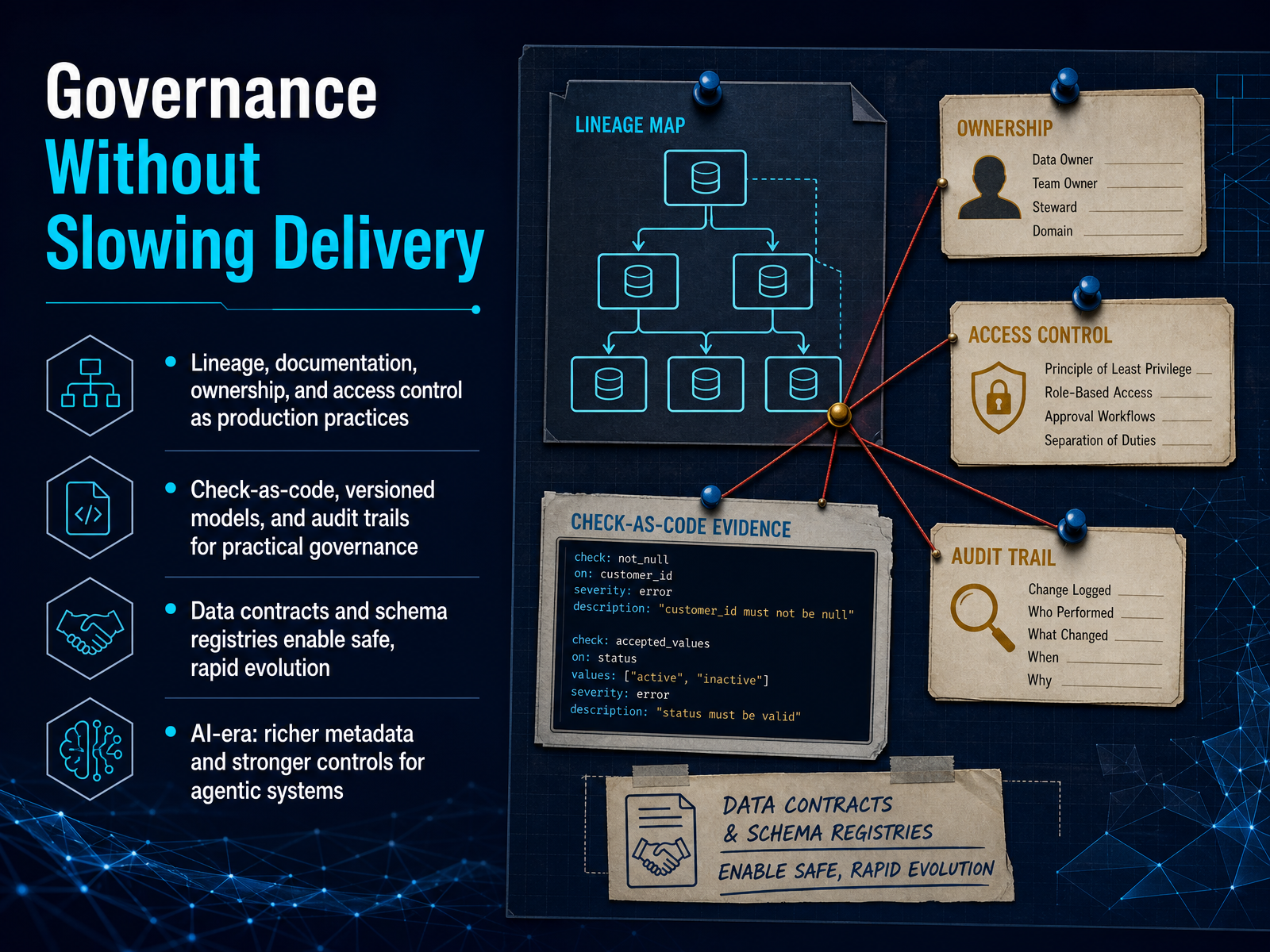
 - 11Governance Without Slowing DeliveryLet's shift from building to protecting. Governance often sounds like a bottleneck, but when it is done right, it actually speeds delivery. The key is treating it as a production practice, not an afterthought. We bake lineage, documentation, ownership, and access control directly into our pipelines. Think of it this way: governance is not a wall; it is the guardrails that let you move fast without going off the road. We can automate these checks by writing them as code. Version-controlled models and audit trails mean every change is reviewable and reversible, giving you the confidence to evolve. Data contracts and schema registries formalize the agreement between producers and consumers, so teams can change schemas safely without breaking downstream. And with the rise of agentic AI, the stakes are higher. Agents need richer metadata and stronger controls to act reliably. By embedding governance into our workflows, we empower teams to innovate quickly while keeping the system secure and trustworthy. This shared responsibility, with clear ownership, is what keeps data valuable and safe. Next, let's look at the collaboration and production practices that keep these pipelines healthy and the whole team aligned.
 modern-datatools.comatscale.comtechtarget.com+21 min
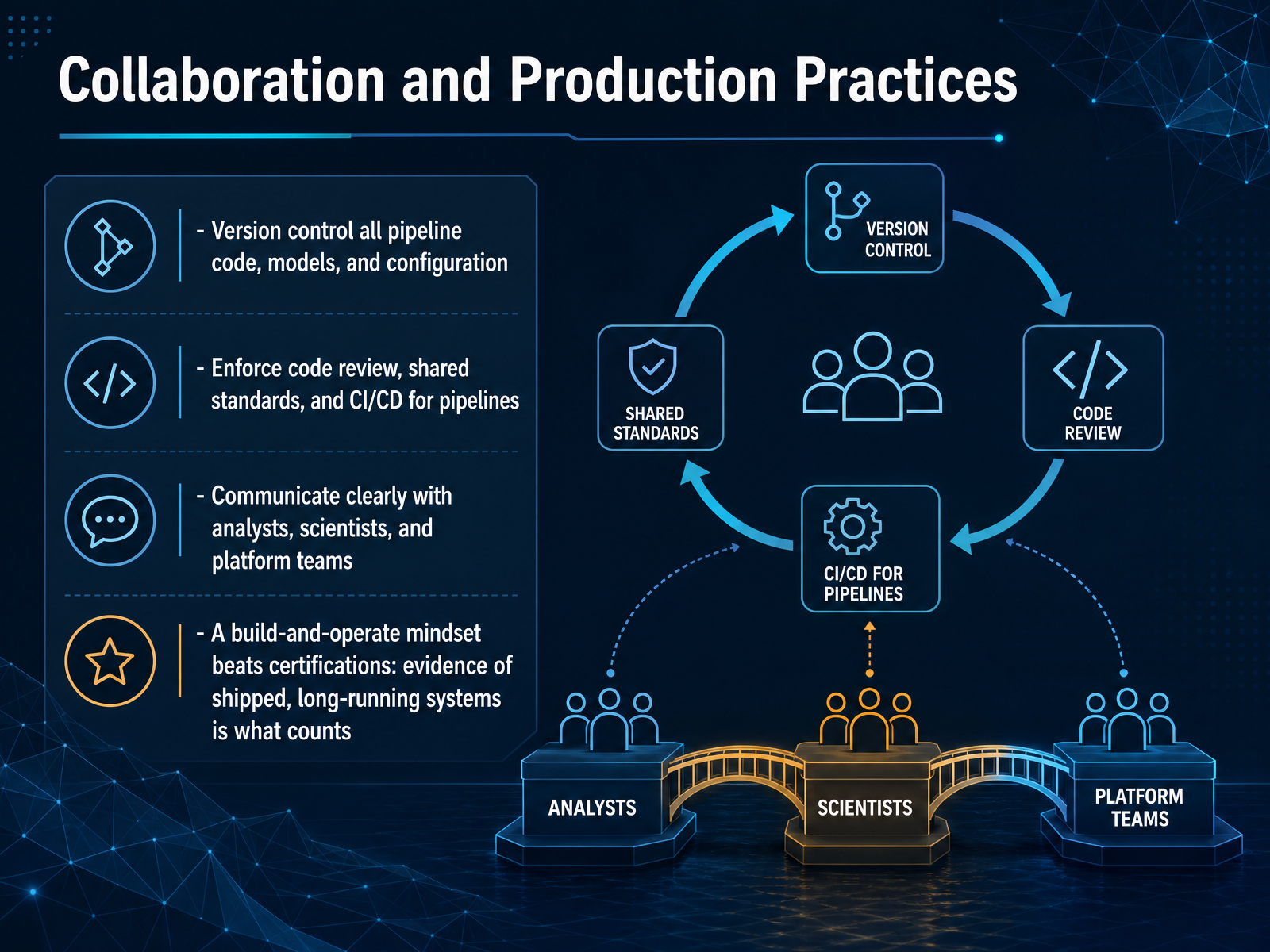
 - 12Collaboration and Production PracticesLet's move into the practices that turn good engineering into dependable production work. First, put everything under version control. Pipeline code, models, and configuration. If it isn't in Git, it doesn't exist. Second, enforce shared standards. Review each other's code, run automated tests, set up CI/CD for every pipeline change. This is what catches silent data quality issues before they reach your dashboards. Third, communicate clearly with your analysts, scientists, and platform teams. The pipeline you build is only as good as how well others understand its limits and its freshness. Finally, remember this. A build-and-operate mindset beats certifications every time. What counts is evidence of shipped, long-running systems. Not credentials. When you interview or hire, look for the person who can explain what broke at three in the morning and how they fixed it. That track record is the real signal. Which brings us to putting core skills into practice.
 datadriven.iodataquest.ioaxialsearch.com+22 min
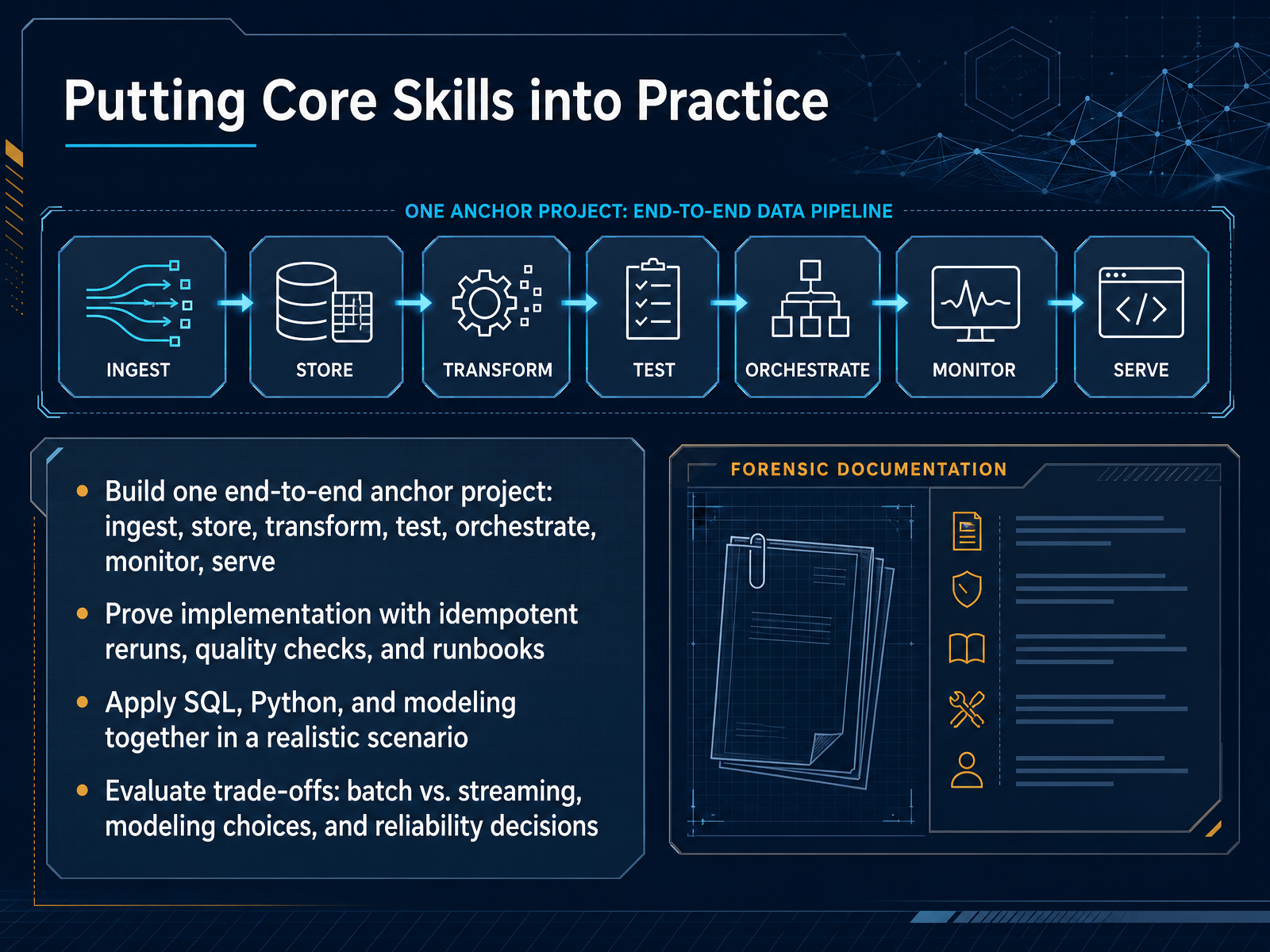
 - 13Putting Core Skills into PracticeNow let’s talk about putting these core skills into practice. The goal is to build one end-to-end anchor project. That means you cover ingestion, storage, transformation, testing, orchestration, monitoring, and serving. Don’t just build a script that reads a file and loads it into a table. Build a real pipeline that handles messy source data and produces something queryable. Prove your implementation works by making it idempotent. Reruns should produce the same result, without duplication. Add quality checks like not-null, uniqueness, and freshness. And write a runbook that explains what to do when something breaks. Use SQL, Python, and data modeling together in a realistic scenario. Pick a domain you understand, and make the trade-offs explicit. Batch versus streaming. Modeling choices. Reliability decisions. Justify your choices, and document what you would change at ten times the scale. A project like this proves you can ship and operate a pipeline, and that is exactly the signal hiring managers are looking for. So build one strong project, and make it observable. That will set you up well for the next step: focusing on continued practice and growth.
 2 min
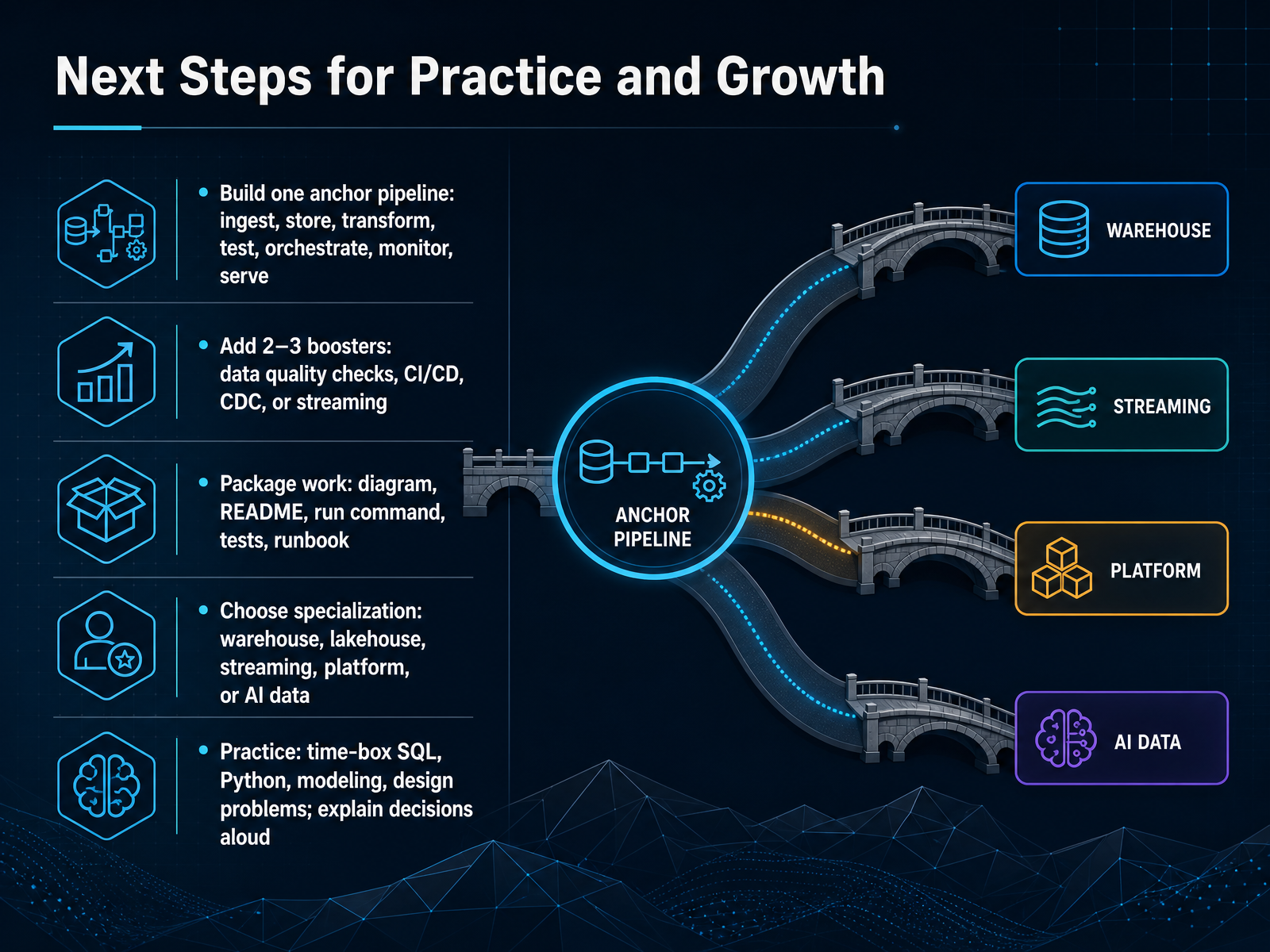
2 min - 14Next Steps for Practice and GrowthLet's wrap this up with a clear path forward. The fastest way to grow is to build one anchor pipeline that covers ingestion, storage, transformation, testing, orchestration, monitoring, and serving. Pick one project and see it through. Then, layer on two or three boosters. Data quality checks, CI/CD, change data capture, or streaming. Each one proves you can handle reliability, not just move data. Package your work like a senior engineer would. Include a diagram, a README, the run command, tests, and a runbook for when things break. That packaging is what shows employers you can operate a system, not just write code. Next, choose a specialization. Warehouse, lakehouse, streaming, platform, or AI data. Depth beats breadth in this field. Finally, practice deliberately. Time-box your SQL, Python, and modeling problems. And make it a habit to explain your design decisions out loud. That skill alone will set you apart in interviews. Thank you for sticking with this course. You have the core skills. Now go build something real, and make it reliable.
 2 min
2 min
Take the deck with you
Download this course as a file — free, no sign-up needed.
- PDF handoutEvery slide page, ready to print or share.15 pages · 4.0 MBDownload
- Narrated PowerPointThe deck that presents itself — every slide carries the digital human's narration video.15 pages · 17.7 MBDownload
- PowerPoint slidesThe full deck as a .pptx — open it in PowerPoint, Keynote, or Google Slides.15 pages · 3.9 MBDownload
Free to use in your own training — please keep the PersonWise credit page at the end.
Have your own deck? Turn it into a course
Sources consulted
Web sources consulted while building this course.
- Data Engineer Job Description: What It Really Means (2026) | DataDriven — datadriven.io
- Data engineering skills that actually matter in 2026 — dataquest.io
- The State of the Data Engineering Job Market in 2026 — axialsearch.com
- Data Engineer Skills in 2026: $128K Median, Just 3% Entry-Level | InterviewStack.io — interviewstack.io
- Data Engineer Roadmap 2026: What to Skip | DataDriven — datadriven.io
- Data Team Structure: 2026 Data Org Chart Guide - KORE1 — kore1.com
- How to Structure a Modern Data Team | IBM — ibm.com
- The Ideal Data Engineering Team Structure: Roles, Models & Tips — elevano.com
- Data Engineer Job Description Template 2026 - KORE1 — kore1.com
- Data Engineer Job Description [Updated for 2026] — indeed.com
- Modern Data Stack 2026: Complete Guide to Tools & Architecture | Modern DataTools — modern-datatools.com
- What is a Modern Data Stack? Definition, Key Components | AtScale — atscale.com
- Understanding the layers of the AI‑ready modern data stack | TechTarget — techtarget.com
- How to Build a Modern Data Stack in 2026 | A Practitioner's Guide | Modern DataTools — modern-datatools.com
- What Is A Modern Data Stack & Why It Matters — thoughtspot.com
- Data Pipeline Best Practices 2026 | Dataworkers — dataworkers.io
- Data Pipeline Best Practices: Architecture, Modern ... - Databricks — databricks.com
- Google SRE - Improve and Optimize Data Processing Pipelines — sre.google
- Data Pipeline Design Patterns: Idempotency, DLQ, CDC and 5 More (2026) | dataskew.io Blog — dataskew.io
- Observability for Data Pipelines: A Complete Guide (2026) - CubeAPM — cubeapm.com