Begin
14 pages · ~28 min
ML Governance Essentials
This training introduces machine learning governance principles, covering model risk management, compliance, and ethical considerations for professionals overseeing ML systems.
A digital instructor presents all 14 pages. Hold “Ask” at any point and ask out loud — the answer comes from this course. No sign-up needed.
What you’ll learn
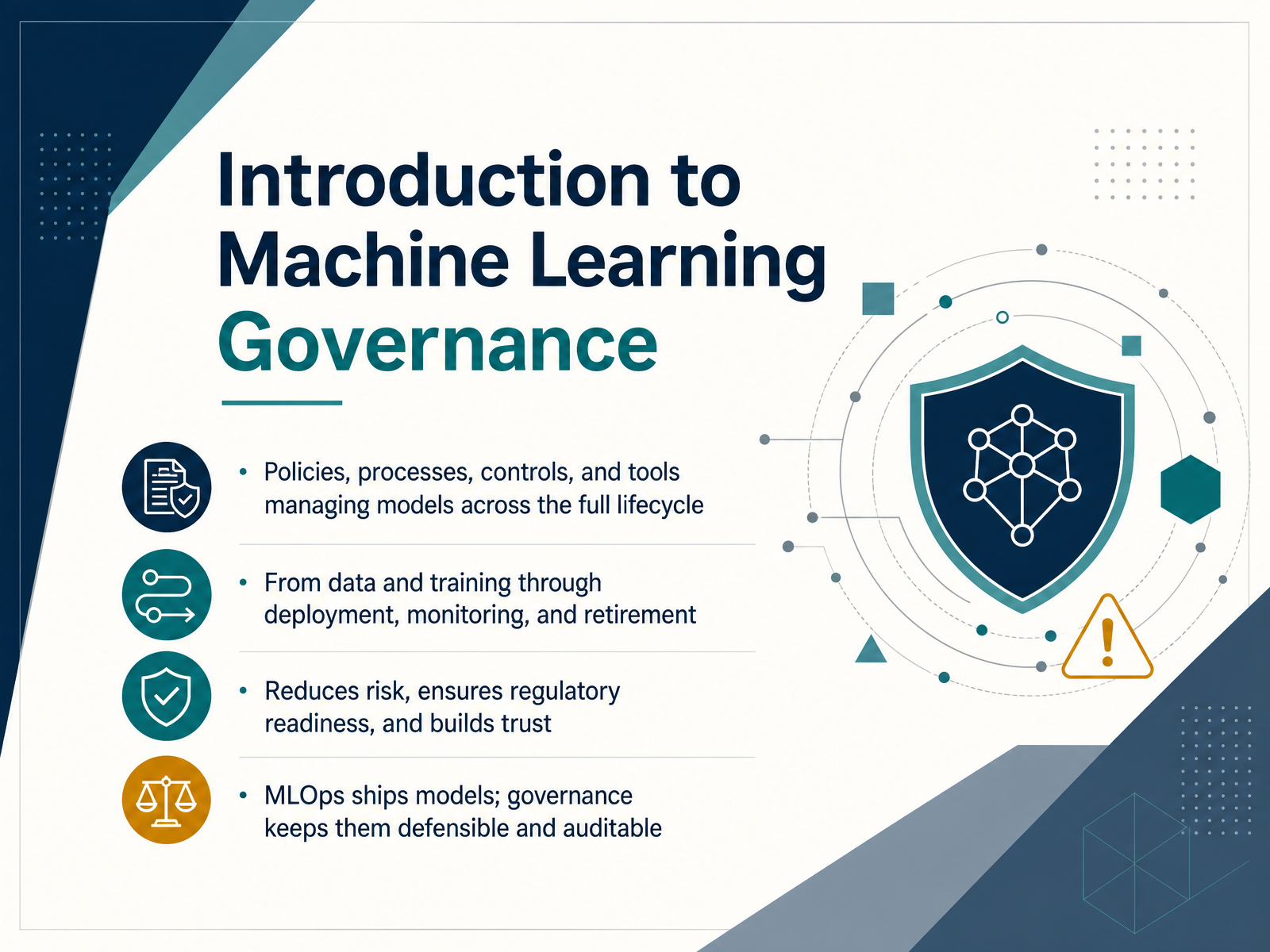
- 01Introduction to Machine Learning GovernanceWelcome. This course is designed for AI product leaders and technical practitioners who need to move machine learning governance from policy documents into daily operations. The goal is to give you a clear, decision-oriented framework for managing models as business assets. So let us start with a working definition. Machine learning governance is the full set of policies, processes, controls, and tools that manage a model across its entire lifecycle. That lifecycle runs from data sourcing and training through validation, deployment, monitoring, and retirement. In practice, governance does three things. It reduces operational and regulatory risk. It ensures you are ready when auditors or regulators ask for evidence. And it builds the trust your customers and partners need to accept model-driven decisions. Here is a useful distinction to anchor the rest of this course. MLOps is the engineering layer that ships models. It gets a model into production reliably. Governance is the control layer that keeps that model defensible once it is live. It answers the questions of who approved the release, what risk controls are attached, and how you prove all of that later. Throughout this course, we will focus on the review steps and decision points that make governance practical, not theoretical. We will begin with the core concepts, the key stakeholders, and the machine learning lifecycle.latentview.comappinventiv.comfreeformagency.com+22 min
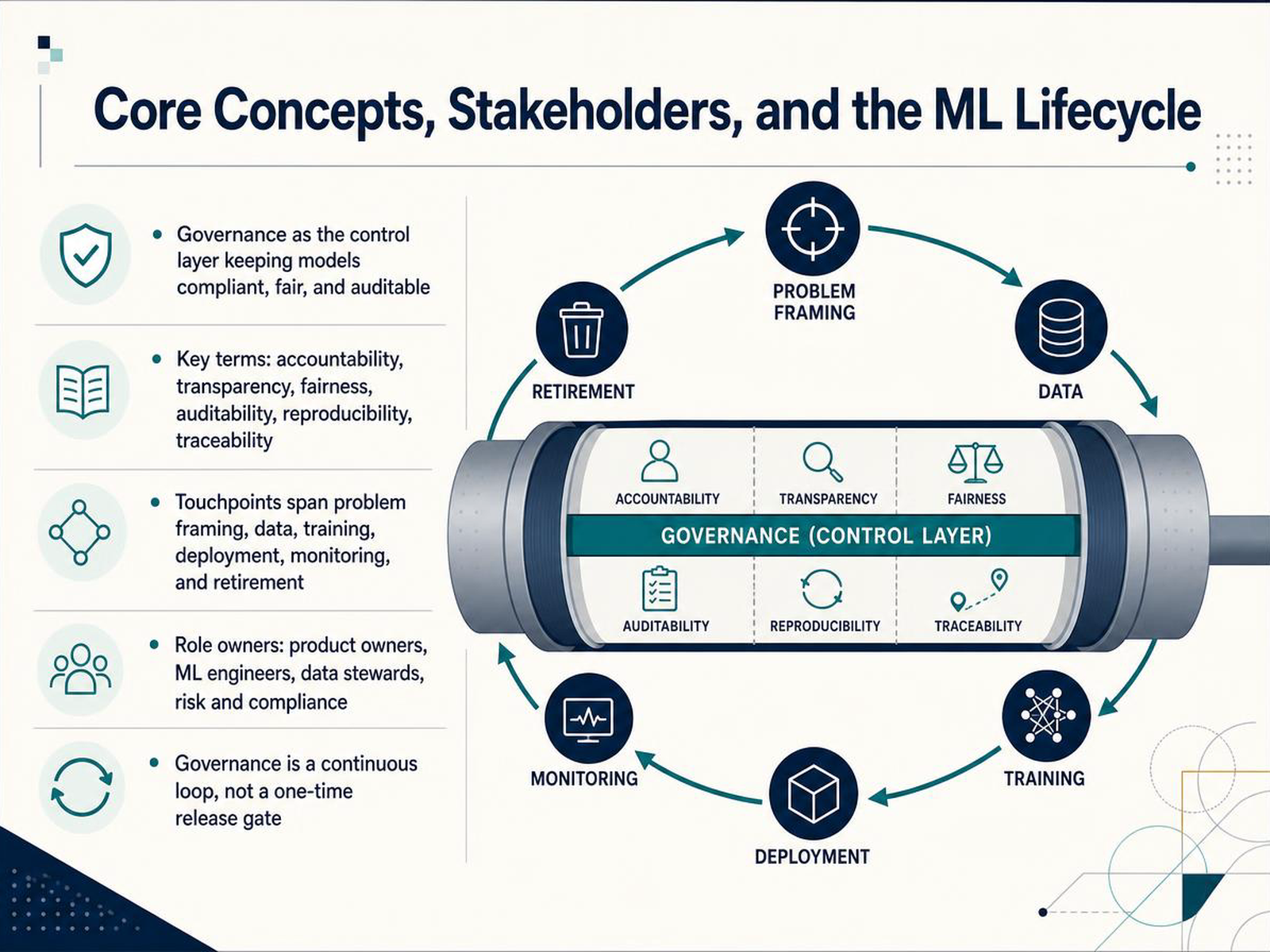
- 02Core Concepts, Stakeholders, and the ML LifecycleLet's move to the core concepts, stakeholders, and the machine learning lifecycle. Governance functions as the control layer that keeps models compliant, fair, and auditable across their entire lifespan. It is not the same as MLOps, which engineers the model into production. Governance is what keeps that model defensible once it is live. The key terms you will use repeatedly are accountability, transparency, fairness, auditability, reproducibility, and traceability. Each one must show up in your workflows, release gates, and evidence logs. Governance touchpoints span problem framing, data sourcing, training, deployment, monitoring, and retirement. This means the risk conversation starts before data collection and continues well after launch. You also need clear role owners at each stage. Product owners own business impact. ML engineers own technical performance. Data stewards own data quality and lineage. Risk and compliance own independent challenge and audit readiness. One point to internalize now: governance is a continuous loop, not a one-time release gate. Every model should have named owners, defined approval states, and monitoring that produces evidence on demand. Next, we will look at the regulatory landscape, focusing on the EU AI Act and current deadlines.
 latentview.comappinventiv.comfreeformagency.com+22 min
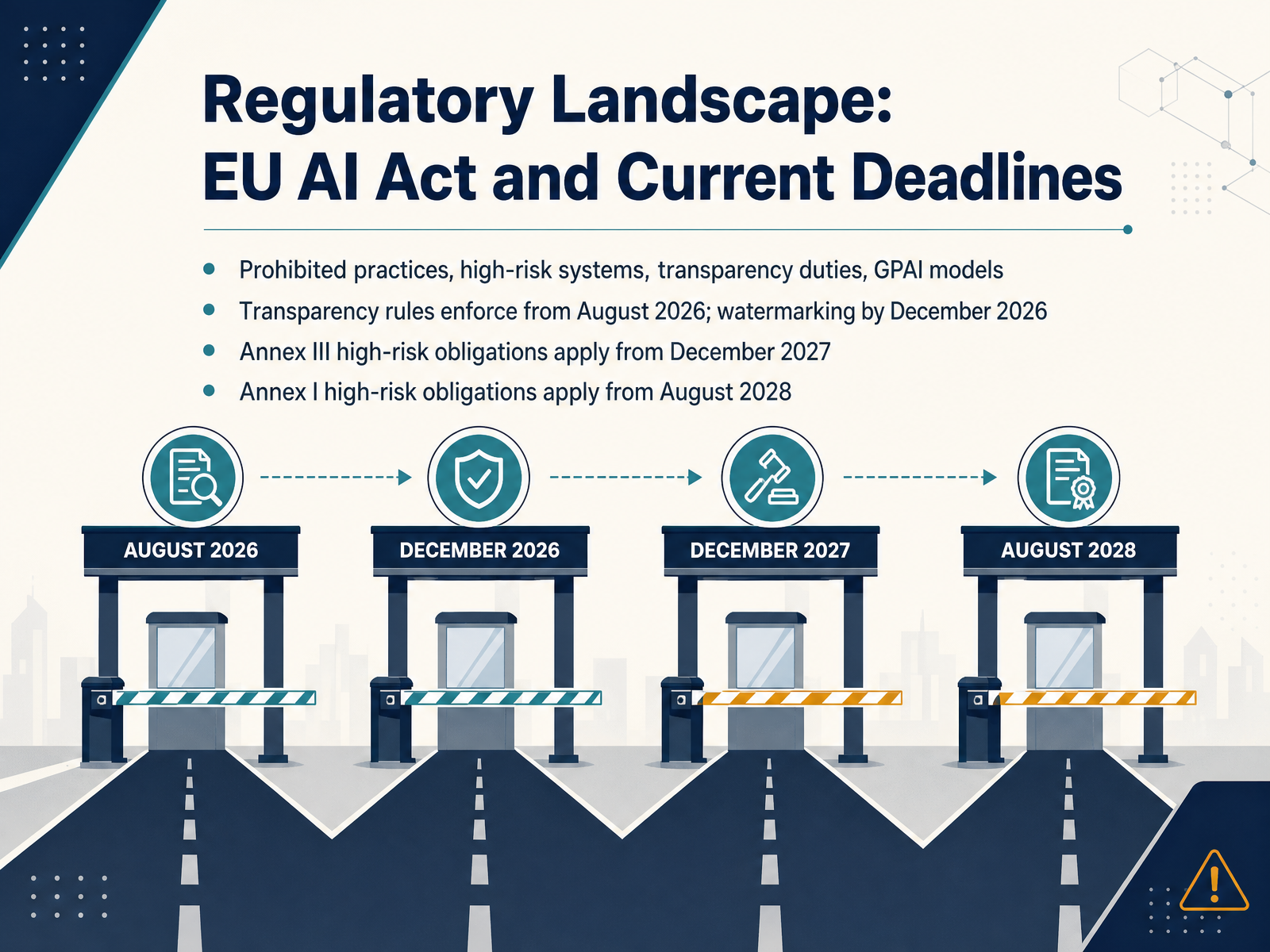
 - 03Regulatory Landscape: EU AI Act and Current DeadlinesNow let’s focus on the EU AI Act, because its staggered deadlines directly shape your compliance roadmap. The regulation organizes AI into four main categories: prohibited practices, high-risk systems, transparency duties, and general-purpose AI models, often called GPAI. Your first decision is to classify every model or product under one of these categories. Transparency duties are already active from August 2, 2026. That means chatbots must disclose they are AI, and deepfakes must be labeled. Machine-readable watermarking for AI-generated content starts December 2, 2026. High-risk obligations follow later. Annex III systems, like those used in employment or critical infrastructure, apply from December 2, 2027. Annex I systems, which are safety components embedded in physical products like machinery or toys, apply from August 2, 2028. Treat these dates as implementation gates, not policy discussions. Next, we will compare this with the US rules and examine cross-border implications.
 eur-lex.europa.eudigital-strategy.ec.europa.eudigital-strategy.ec.europa.eu+22 min
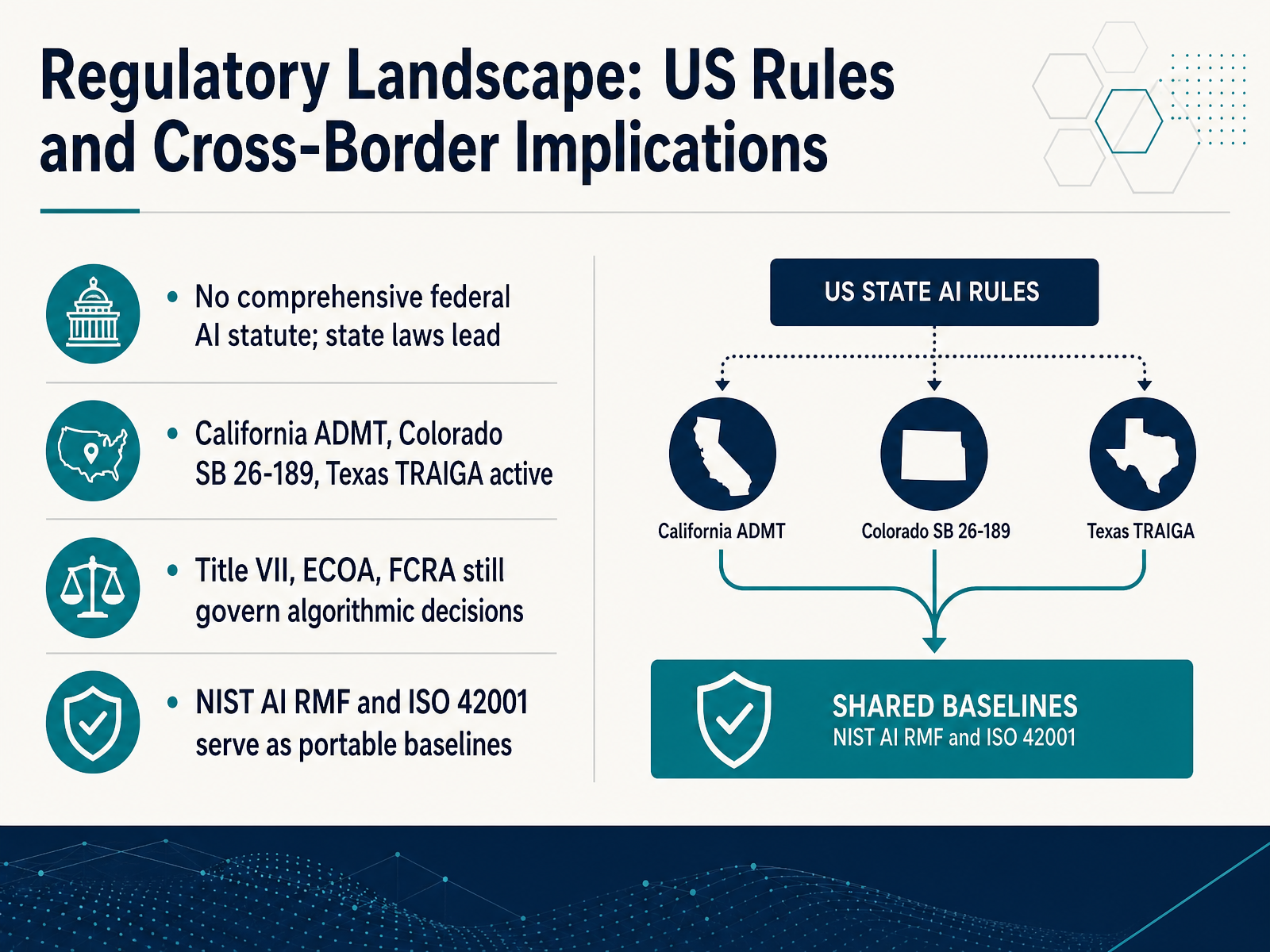
 - 04Regulatory Landscape: US Rules and Cross-Border ImplicationsLet me frame the current regulatory terrain, because it drives where governance effort must be concentrated first. The United States still has no comprehensive federal AI statute. Instead, state laws are setting the binding compliance requirements. The three regimes you need on your review checklist are California ADMT, which stands for Automated Decision-Making Technology, Colorado SB twenty-six dash one eighty-nine, and the Texas Responsible AI Governance Act, often called TRAIGA. These laws differ in scope. California and Colorado impose disclosure, impact assessment, and consumer appeal obligations. The Texas statute is narrower, focusing on prohibitions and government use. At the same time, sectoral federal law still governs algorithmic decisions. Title Seven covers employment discrimination, the Equal Credit Opportunity Act covers credit, and the Fair Credit Reporting Act covers consumer reporting. These apply regardless of whether state AI rules are in force. For a durable control baseline, align your governance program with the NIST AI Risk Management Framework or ISO forty-two thousand one. Both are voluntary, but they operate as portable baselines and can support defensibility across jurisdictions. In short, do not wait for federal preemption. Build against the stricter state requirements now. Up next, we turn to fairness, bias, and ethical review gates.
 alston.comastraea.lawcongress.gov+22 min
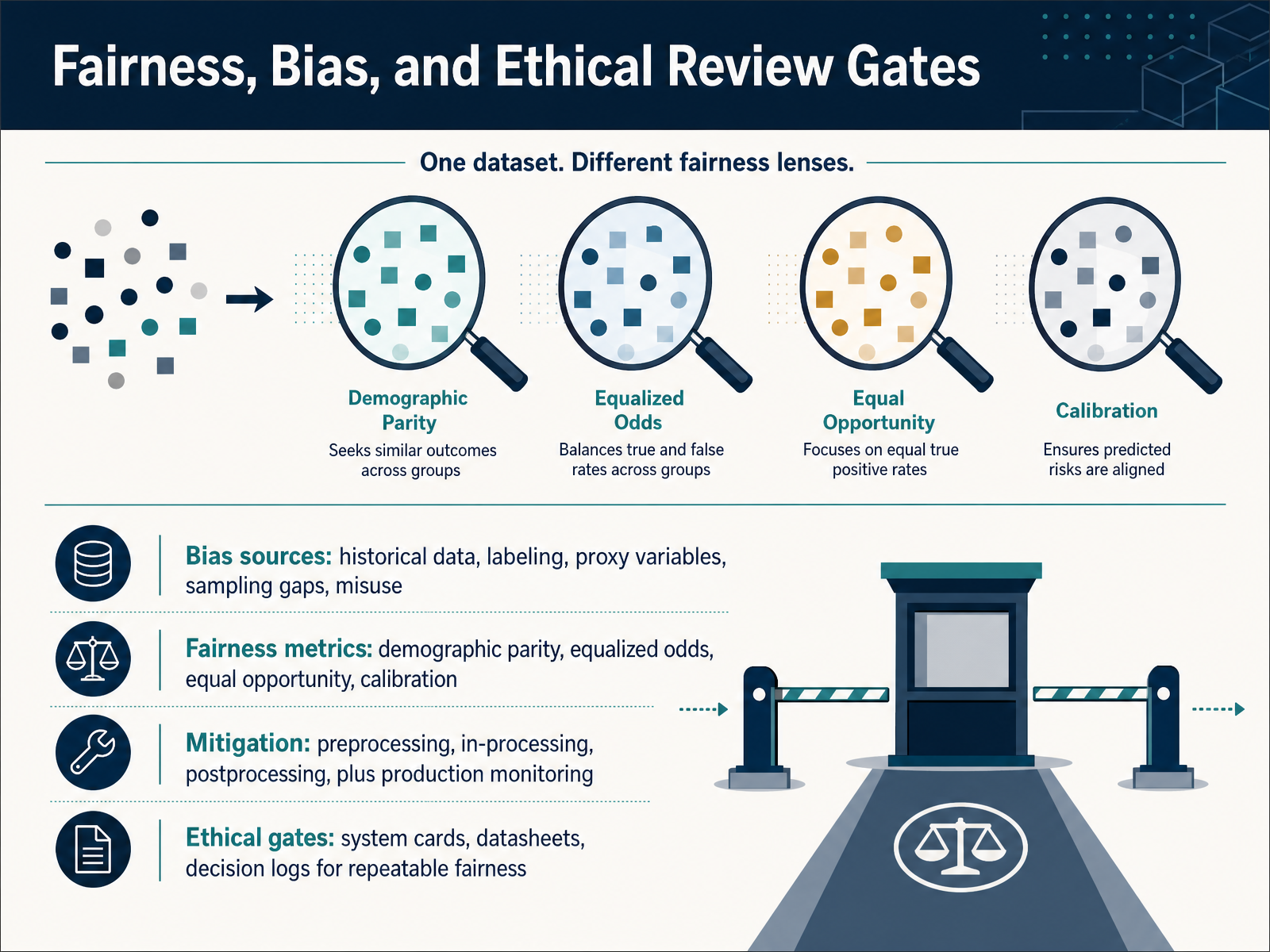
 - 05Fairness, Bias, and Ethical Review GatesLet's move to the review gates for fairness and bias. This slide shifts from detecting risk to enforcing decisions at specific points in the model lifecycle. Bias typically enters through five channels: historical patterns in training data, inconsistent labeling, proxy variables that stand in for protected attributes, sampling gaps, and operational misuse. Before mitigation, you need to select the right fairness metric. Demographic parity checks equal selection rates. Equalized odds requires equal true and false positive rates. Equal opportunity focuses only on true positive rates. And calibration measures whether scores mean the same thing across groups. These definitions conflict mathematically, so document which metric you prioritize and why. Mitigation happens at three stages. Preprocessing fixes data before training. In-processing adds fairness constraints during optimization. Postprocessing adjusts thresholds after prediction. All three still require production monitoring, because fairness degrades under drift and feedback loops. To make these decisions repeatable, treat system cards, datasheets, and decision logs as release gates, not optional documentation. This establishes the audit trail regulators will ask for. Next, we will apply these controls to Model Risk Management.
 oneuptime.cominnovativehumancapital.comaiunpacking.com+22 min
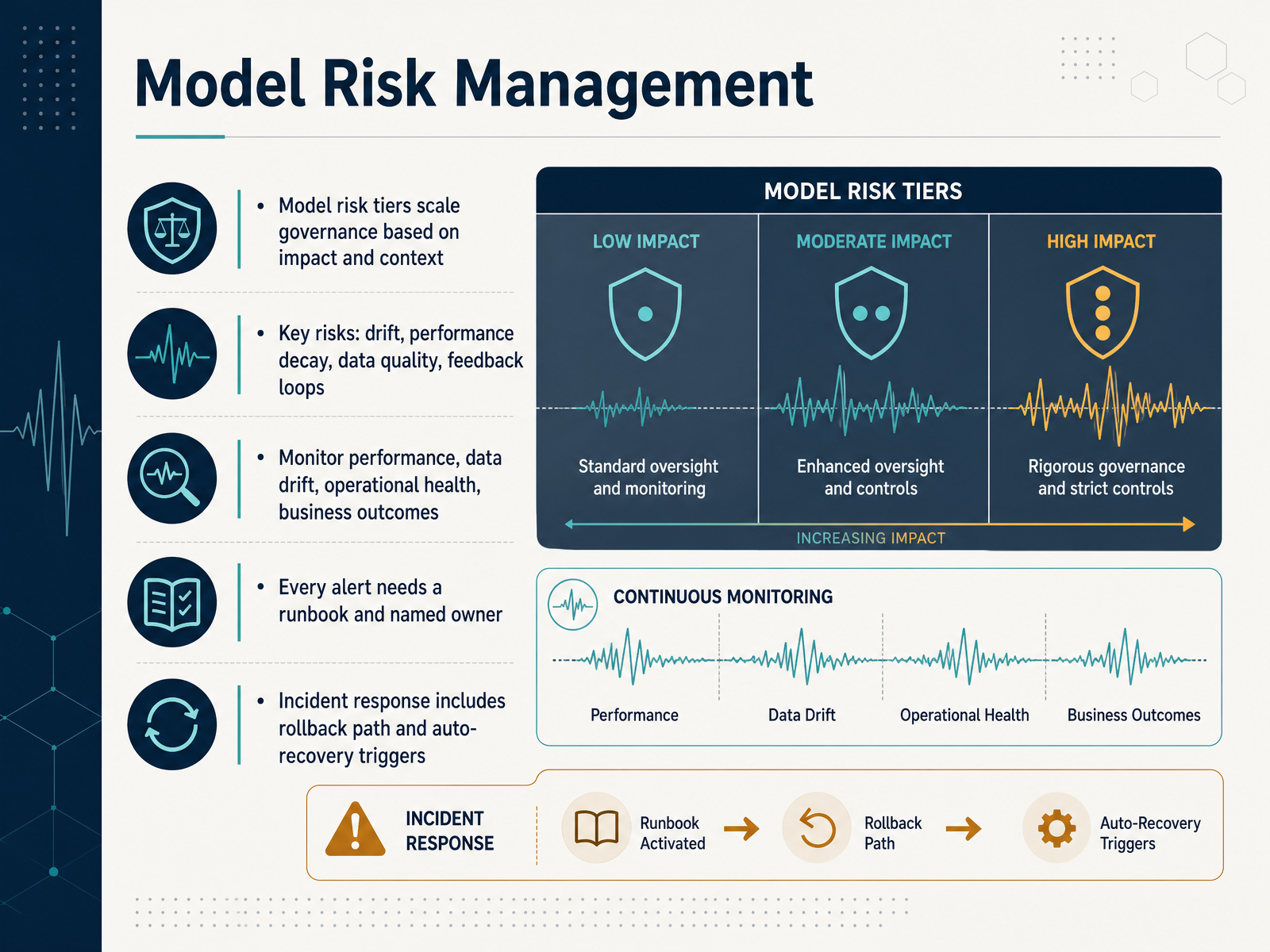
 - 06Model Risk ManagementNow let's turn to model risk management. This is where governance becomes operational accountability. Risk tiers should scale your controls. A low-impact internal tool does not need the same review depth as a customer-facing credit model. Start by classifying each model by its potential business impact and regulatory exposure. The key risks to monitor are not static. Drift, performance decay, data quality issues, and feedback loops all degrade a model silently over time. Your monitoring needs to cover four areas. Technical performance, data drift, operational health, and business outcomes. Seeing a latency spike is not enough. You need to know if the model is actually driving the result your business expects. Every alert must have a runbook and a named owner. An alert without a response procedure is just noise, and noise trains teams to ignore warnings. Incident response is not just detection. Define your rollback path in advance, and configure auto-recovery triggers where the risk is high and the rollback is safe. This gives you a controlled, rehearsed response instead of a rushed decision under pressure. Next, we'll look at how to make that response credible: reproducibility, lineage, and audit evidence.
 2 min
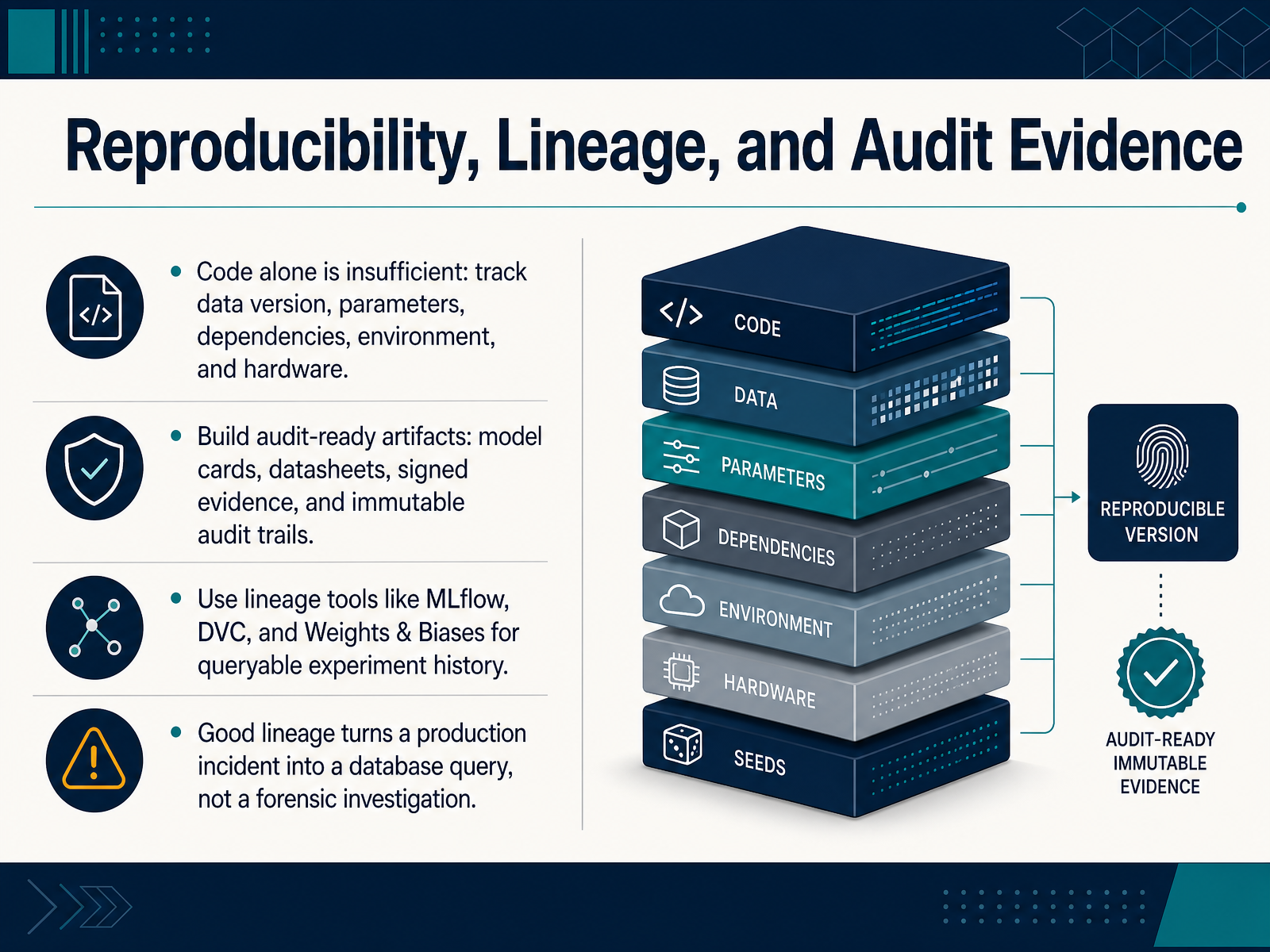
2 min - 07Reproducibility, Lineage, and Audit EvidenceLet's look at reproducibility, lineage, and audit evidence. For governance, code alone is never sufficient. You need to track the data version, parameters, dependencies, runtime environment, and hardware configuration. Those details determine whether a model can actually be reproduced. Your audit-ready artifacts should include model cards, datasheets, signed evidence, and immutable audit trails. Regulators do not accept memory as documentation. Use lineage tools such as MLflow, D V C, and Weights and Biases to build a queryable experiment history. Good lineage turns a production incident into a database query, not a forensic investigation. When a model misbehaves, you should be able to trace the exact dataset version, code commit, and hyperparameters in one structured record. That is the practical standard for auditability. Next, we will examine governance gates across the M L lifecycle.
 1 min
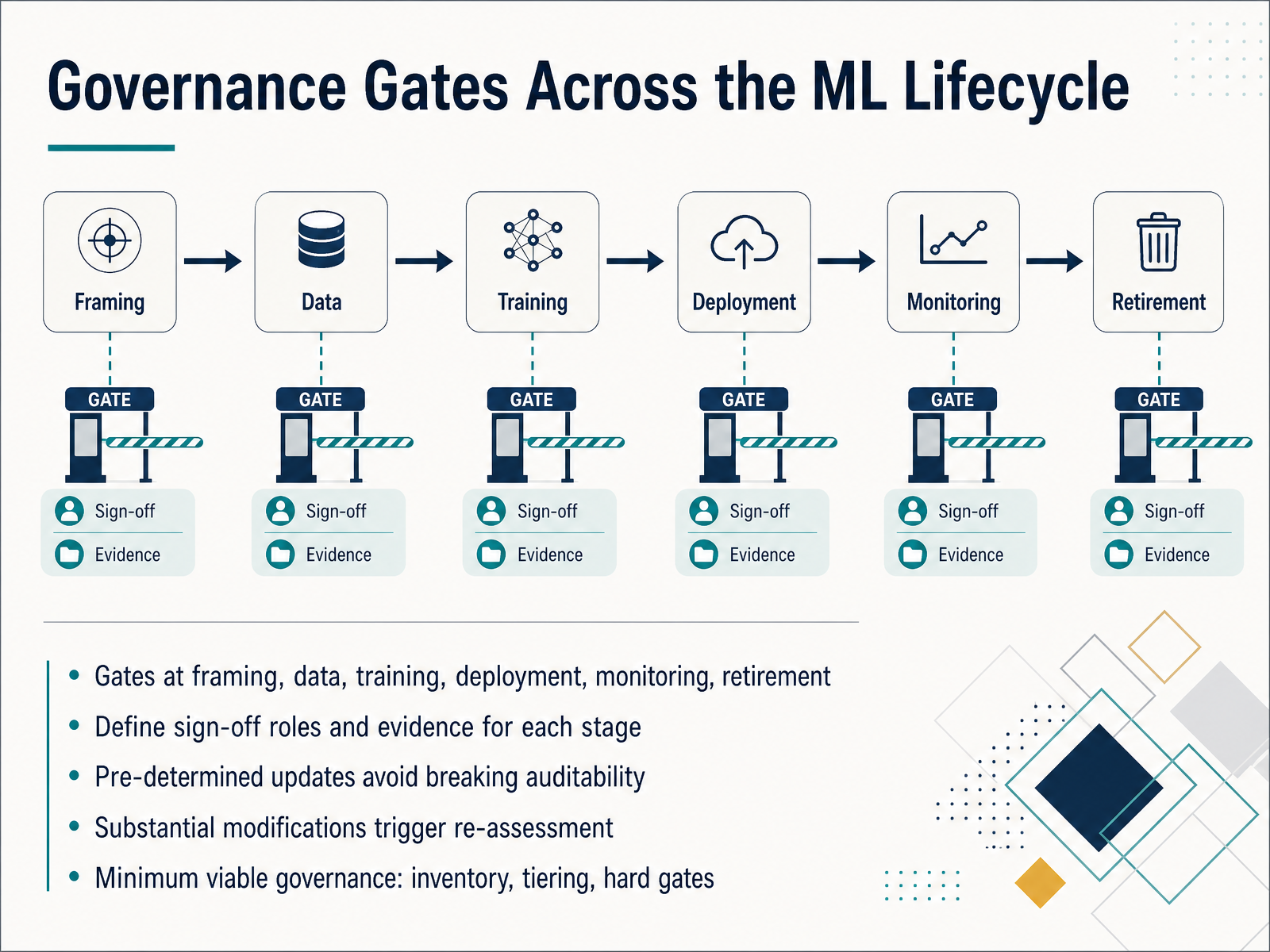
1 min - 08Governance Gates Across the ML LifecycleNow let's map governance gates across the full model lifecycle. In practice, that means inserting formal review checkpoints at six stages: framing, data, training, deployment, monitoring, and retirement. For each gate, define two things. First, who has sign-off authority. Second, what evidence they need to approve advancement. This is the difference between a governance review and a governance gate. Pre-determined updates, such as scheduled retraining within approved bounds, should not break auditability. The EU AI Act confirms that changes described in technical documentation before deployment do not count as substantial modification. But substantial modifications, like a new intended purpose or a change that affects compliance, should trigger a full re-assessment. If you're starting now, focus on minimum viable governance. Build an inventory of your models. Apply a risk tier to each one. Then enforce hard gates only where the tier justifies them. This gives you auditability without adding process overhead everywhere. Next, we'll look at how to automate these gates through governance as code.
 eur-lex.europa.eudigital-strategy.ec.europa.eudigital-strategy.ec.europa.eu+22 min
 - 09Governance Automation and Policy-as-CodeLet's move into governance automation and policy as code. The core principle here is making compliance executable inside your deployment pipelines, not something you manage with paper checklists. Think of policy as code as the mechanism that turns your risk controls into automated, repeatable checks. Automated gates act as the enforcement points. These include data validation checks before training, model evaluation against a champion, fairness and bias tests, security scans, and risk tiering based on your regulatory classification. Your CI CD pipeline should block promotion to staging or production unless both the required evidence and the necessary human approvals exist. Design decisions matter here. A hard gate fails the pipeline and stops deployment, which is what you want for high risk models. A soft gate logs a warning and allows the process to continue, which is appropriate only for low risk internal tooling. But automation does not remove accountability. Human approval steps, a well defined exception process, and an expiry date on those exceptions are what keep your automated governance controls trustworthy and auditable. Next, we'll look at model registries, deployment strategies, and rollback.
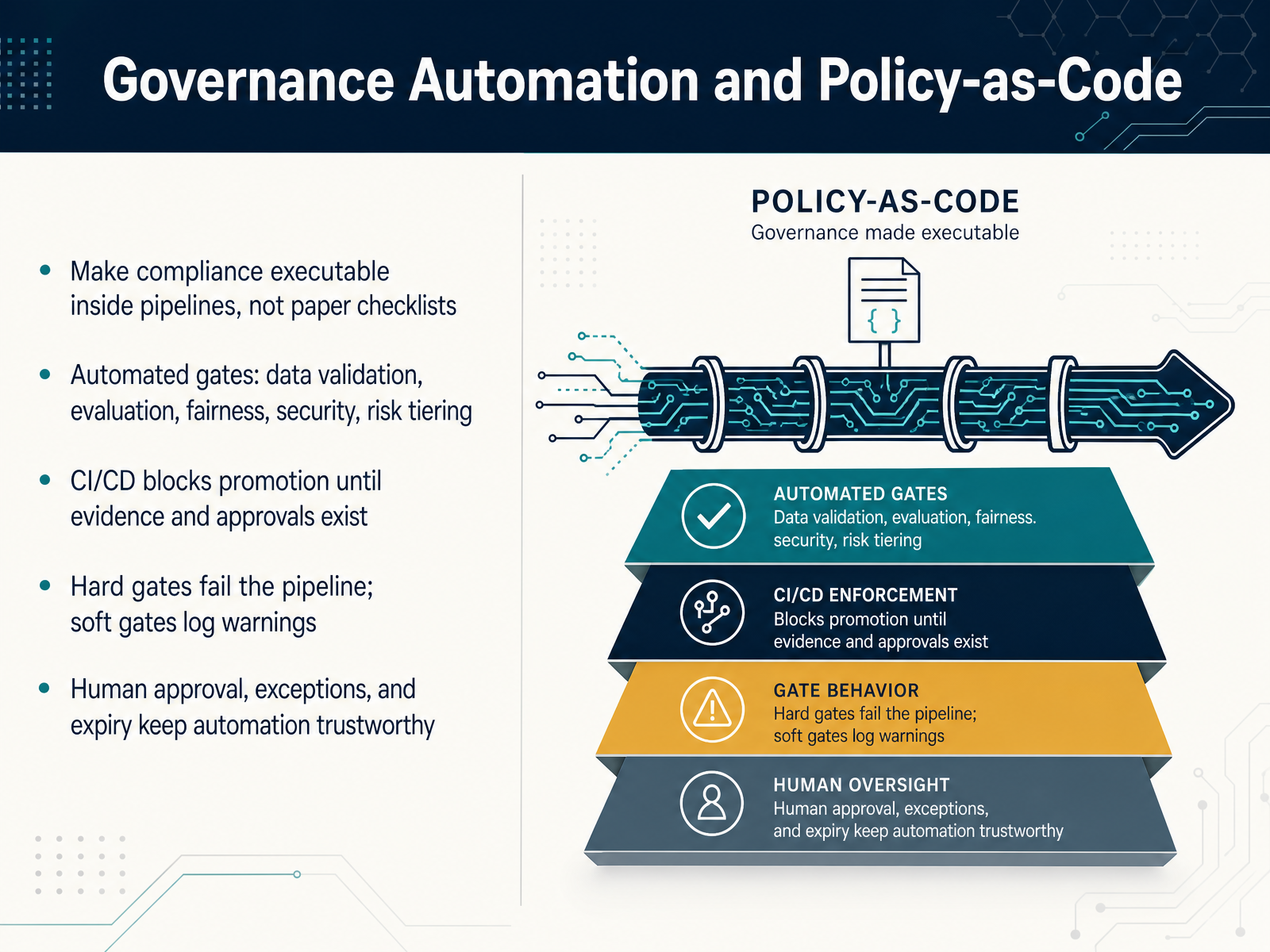 1 min
1 min - 10Model Registries, Deployment Strategies, and RollbackLet's move into the operational machinery of deployment. The model registry is your canonical record. It tells you which version is live, who owns it, and what data and code produced it. If a model misbehaves, this registry is where you find the answer in one query, not a forensic investigation. Next, use deployment strategies to manage risk before full traffic. Shadow deployment copies live traffic to validate quietly. Canary shifts a small percentage. And blue-green gives you an instant cutover with a warm fallback. These are not theoretical options; they are risk controls. Promotion events must be immutable. Every state change, from staging to production, and every approval, gets an append-only audit trail. This proves why a model was deployed and who signed off. Rollback must be automated. If metrics regress or drift passes a defined threshold, the system should revert to the previous champion without waiting for human approval. Define rollback thresholds in your canary or serving configuration. Point from a canary error rate doubling the baseline within thirty minutes to see why this matters. Finally, retirement is a first-class workflow. Set a deprecation target at registration time. When the target is reached, route traffic to the replacement, revoke serving credentials, and archive the artifact. A retired model with live credentials is a security incident waiting to happen. These practices prepare you for the next step: evaluating the tools and technology landscape.
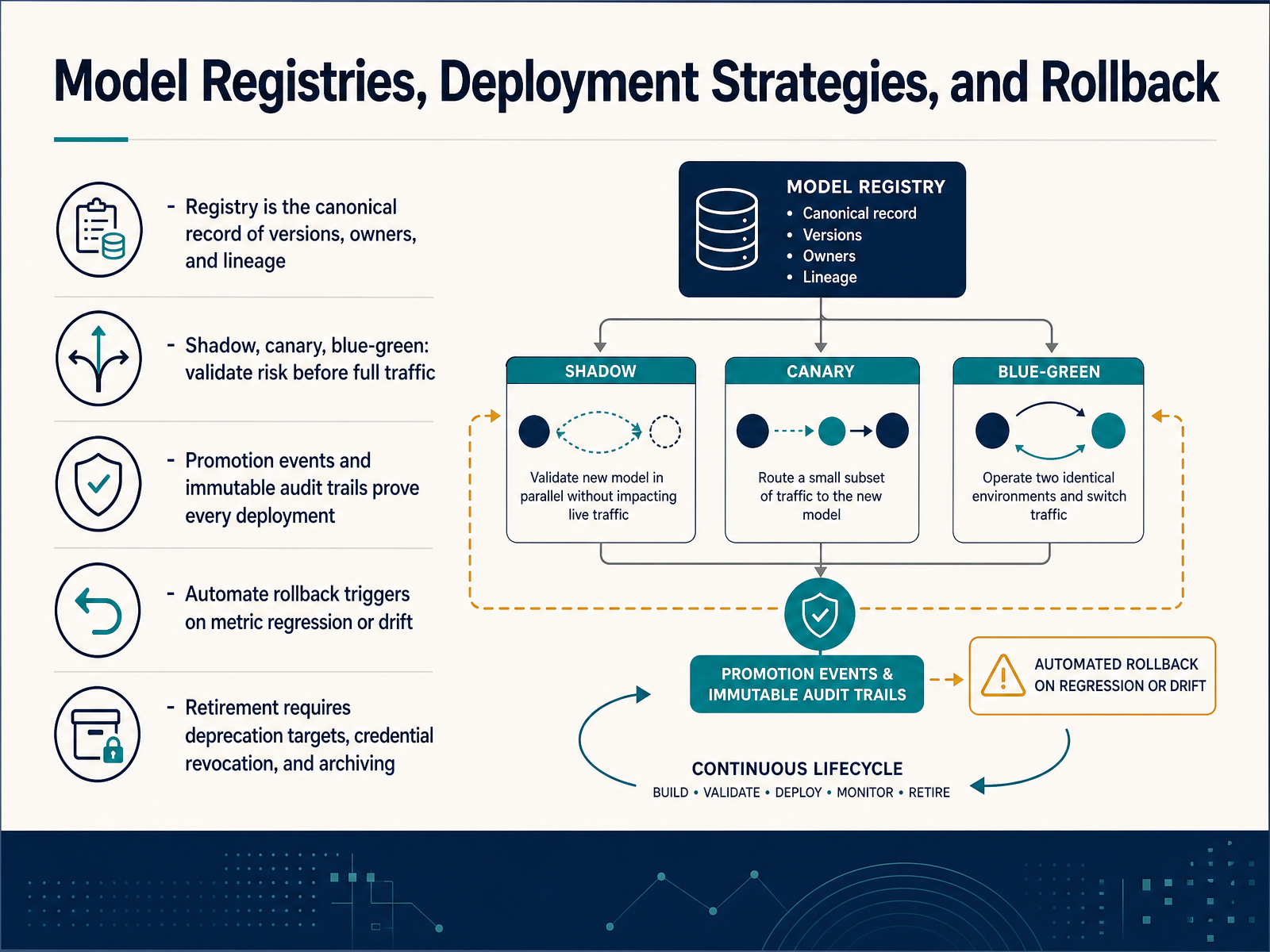 2 min
2 min - 11Tools and Technology LandscapeNow let's look at how the tooling actually maps to those governance layers. The market currently breaks into four practical categories. First, there is GRC, meaning governance, risk, and compliance. Tools like Credo AI, Holistic AI, IBM watsonx.governance, and OneTrust manage the documented system, covering policy libraries, risk registers, and framework alignment. Second, there are registries and lifecycle systems, such as MLflow, that track model lineage and promotion workflows. Third, runtime gateways sit on the request path. They handle the per-decision audit record that EU AI Act Article 12 requires. Fourth, observability platforms like Fiddler AI and Arthur AI monitor drift, bias, and performance in production. The key takeaway is that no single vendor covers all four categories with real depth. Most mature teams will combine at least two, typically a GRC platform for the documented system and a runtime gateway for enforcement. When you evaluate these tools, focus on framework depth, enforcement strength, audit trail integrity, and integration cost. That brings us to the practical question of how to start light and scale.
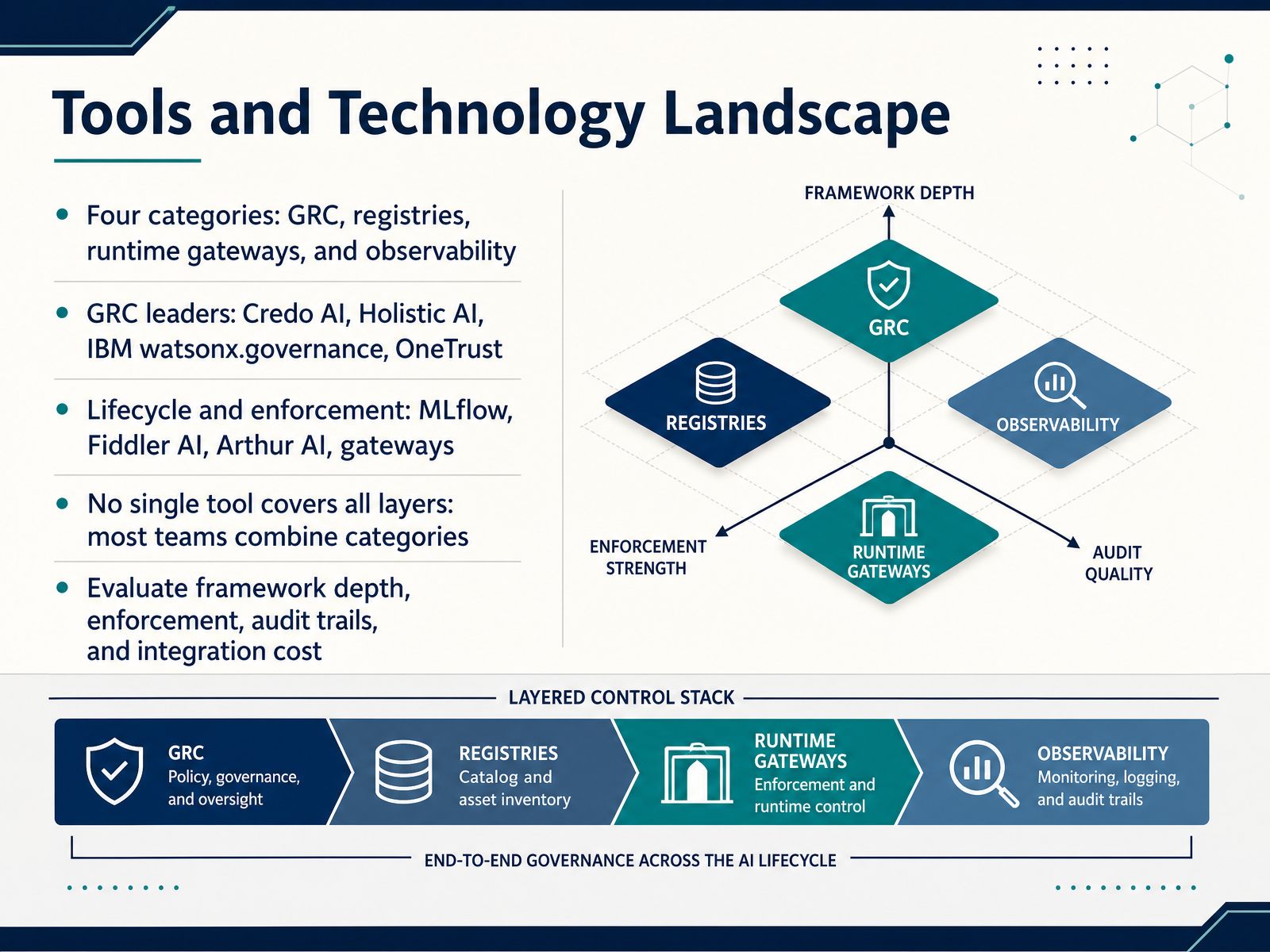 2 min
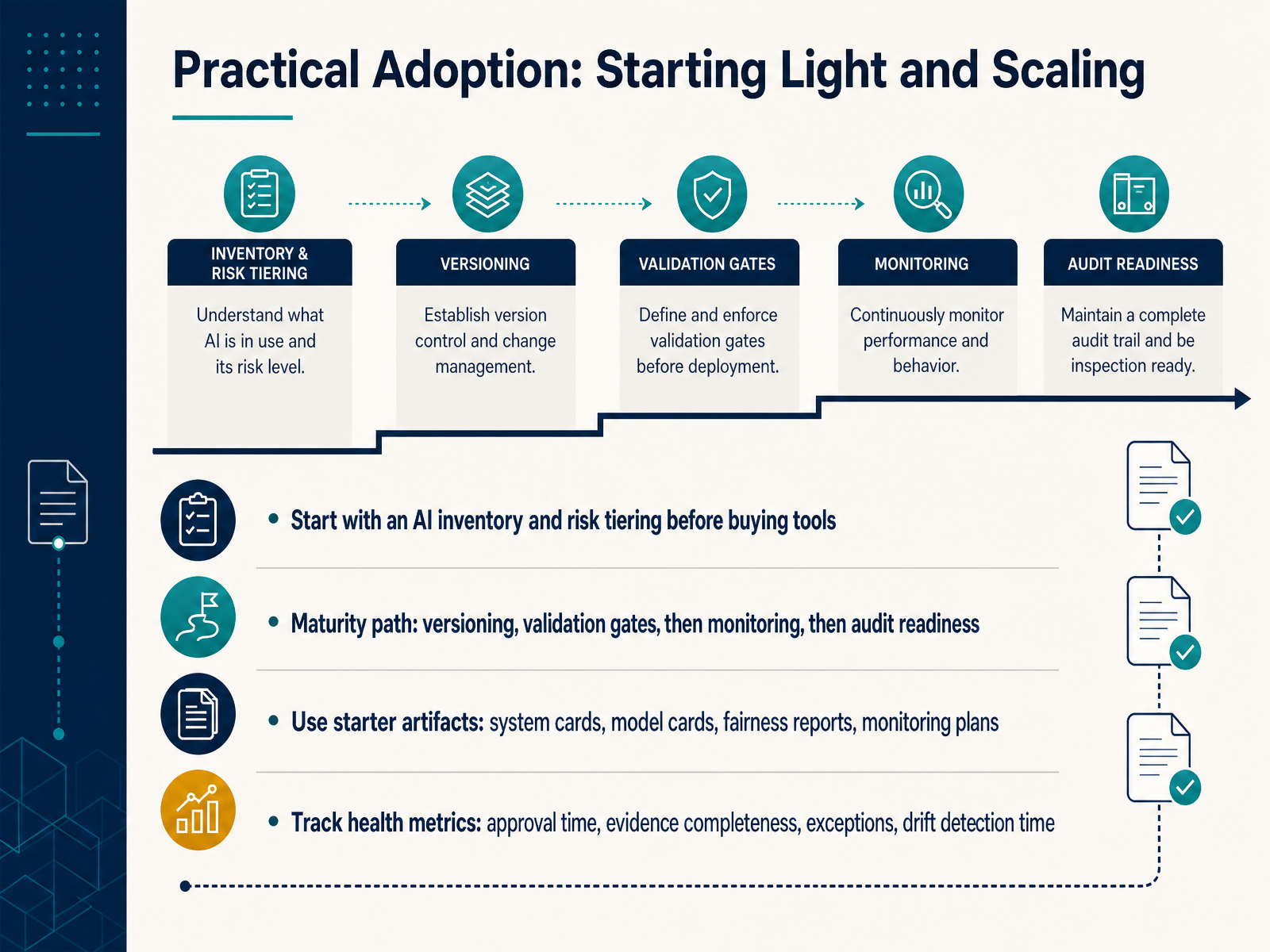
2 min - 12Practical Adoption: Starting Light and ScalingNow let's talk about how to put this into practice without overbuilding. Start with an AI inventory and risk tiering before you buy any governance tools. You need to know what models exist, who owns them, and which ones carry real risk. That baseline defines your gap analysis.
Then scale on a maturity path. First get versioning and validation gates working. Next add production monitoring. Only then push toward full audit readiness. Each layer addresses a specific failure mode you have already observed.
Use starter artifacts to keep the process lightweight. System cards, model cards, fairness reports, and monitoring plans give you durable evidence without heavy tooling.
Finally, measure the governance workflow itself. Track approval time, evidence completeness, exception volume, and drift detection time. If those health metrics do not improve, your governance is documentation, not control.
Keep that focus as we move to the next section: common failure modes and how to avoid them.
 oneuptime.cominnovativehumancapital.comaiunpacking.com+22 min
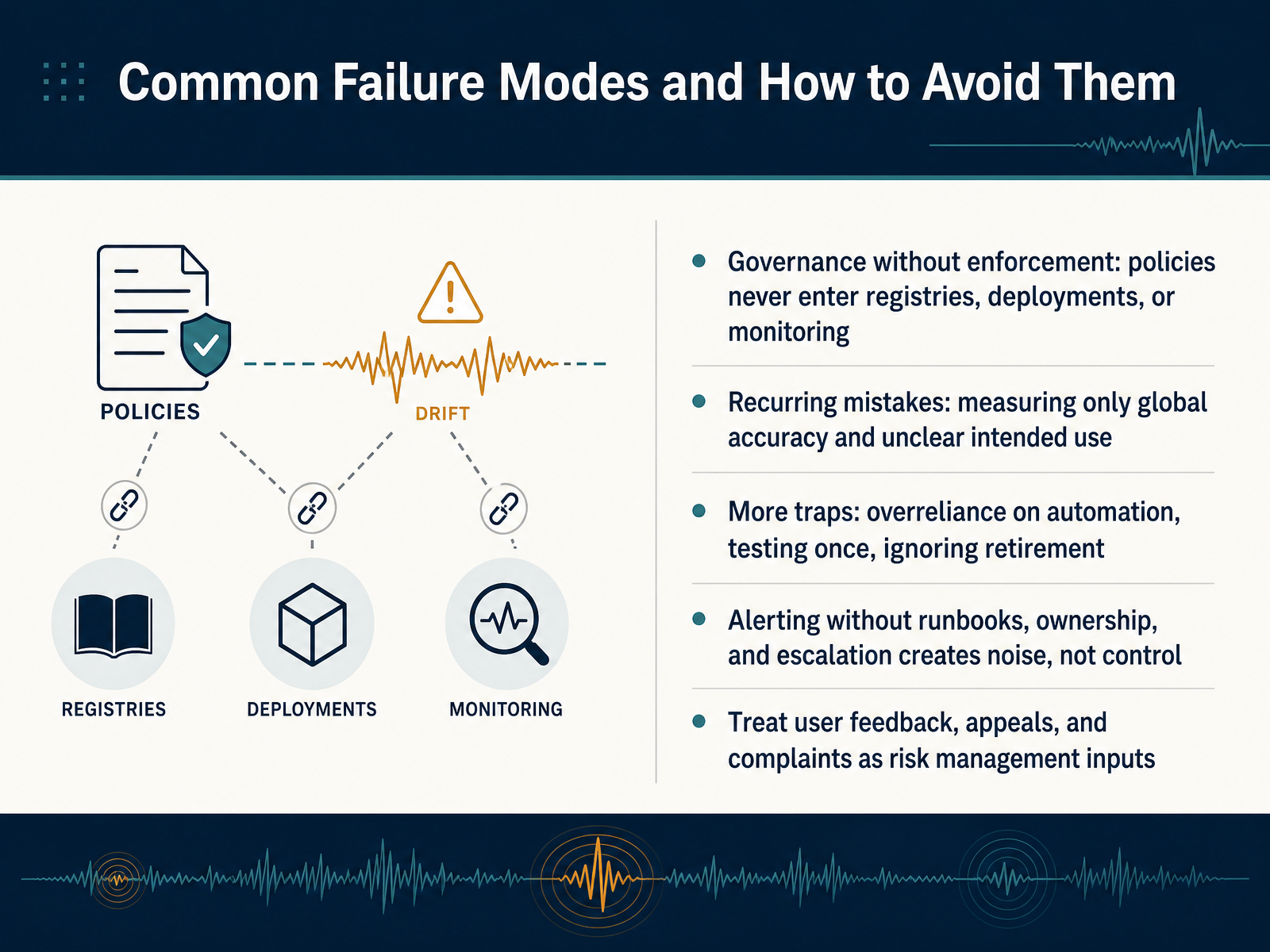
 - 13Common Failure Modes and How to Avoid ThemLet us turn to the failure modes that undermine governance even when the right policies exist. The first is governance without enforcement. Policies that never enter the registry, the deployment pipeline, or monitoring are documentation, not control. If a promotion cannot be blocked by a missing approval, the policy does not function. The second recurring mistake is measuring only global accuracy. Average metrics hide subgroup failures. Pair every global metric with segment-level evaluation and a clearly documented intended use. A model without a defined scope will be used outside it. A third trap is overreliance on automation. Automated checks are controls, not accountability. Assign a named owner for alert response and approval decisions. Testing once is not enough either. Drift, data shifts, and feedback loops change risk over time. Schedule re-evaluation, especially for high-impact systems. Ignoring retirement is a fourth failure. Set a deprecation target at registration. A retired model with live credentials is a liability. Finally, alerting without runbooks and escalation paths creates noise, not control. Every alert should link to a defined response procedure and an owner. Treat user feedback, appeals, and complaints as risk management inputs, not support tickets. These signals often surface harm before metrics do. Next, we will cover an implementation roadmap and next steps.
 oneuptime.cominnovativehumancapital.comaiunpacking.com+22 min
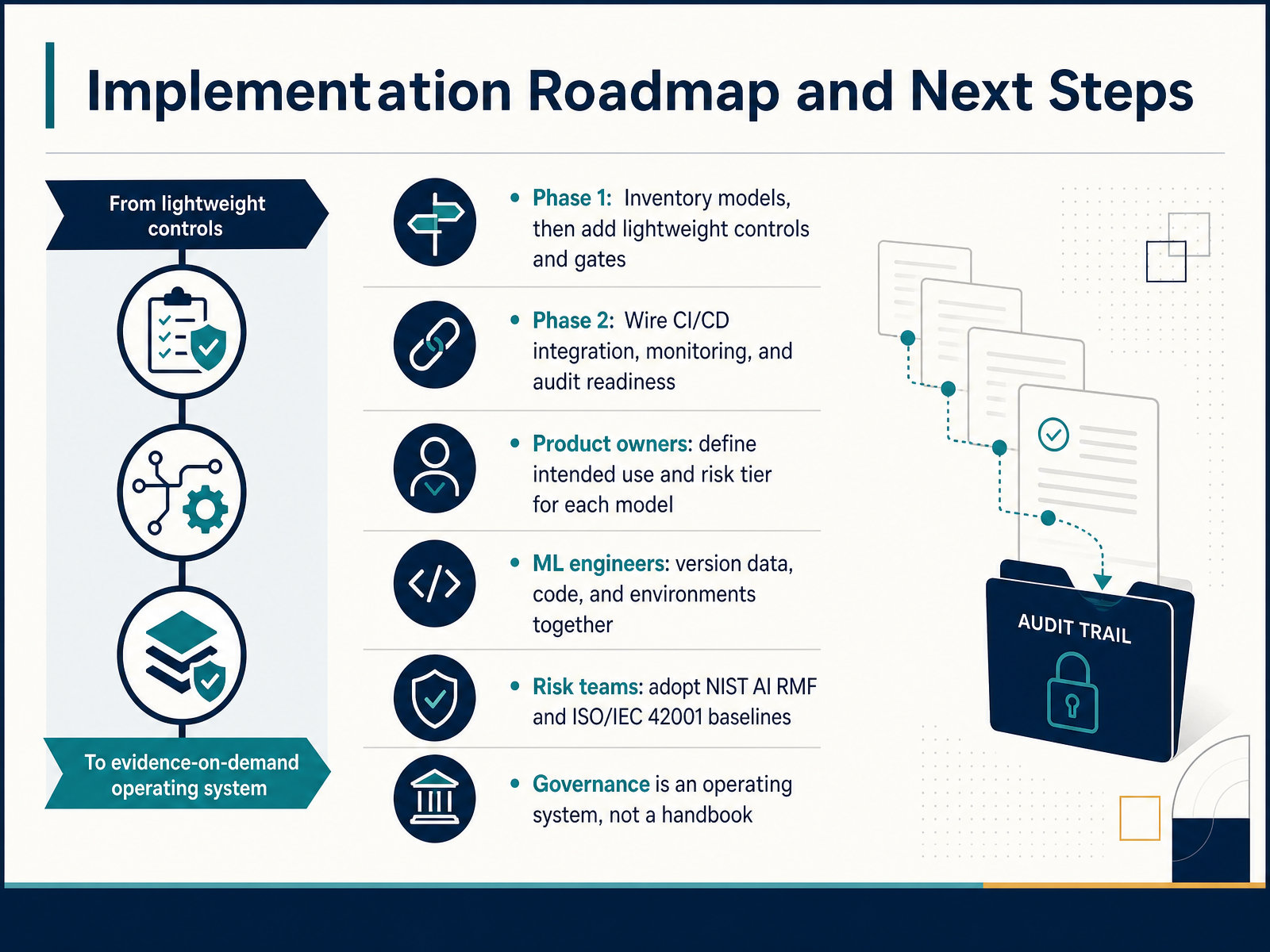
 - 14Implementation Roadmap and Next StepsThat brings us to the implementation roadmap. Phase one is inventory and lightweight controls. Catalog every model in production before adding heavy tooling. Then introduce basic gates like owner assignment, intended-use documentation, and risk tiering. Phase two is where controls become executable. Wire CI/CD integration, monitoring, and audit readiness into the model registry and deployment pipeline. Concretely, product owners should define intended use and risk tier for each model. ML engineers should version data, code, and environments together so every deployment is reproducible. Risk teams should align on common baselines such as the NIST AI Risk Management Framework and ISO/IEC 42001, which act as reference points rather than a complete rulebook. The core idea is this: governance is an operating system, not a handbook. A policy document does not stop a bad release. Gates inside the pipeline do. Start lean, then layer controls where evidence shows risk is real. Thank you for sticking with this material. The next step is to open your model inventory and pick one control to implement this week.
 latentview.comappinventiv.comfreeformagency.com+21 min
Take the deck with you
Download this course as a file — free, no sign-up needed.
- PDF handoutEvery slide page, ready to print or share.15 pages · 3.6 MBDownload
- Narrated PowerPointThe deck that presents itself — every slide carries the digital human's narration video.15 pages · 18.3 MBDownload
- PowerPoint slidesThe full deck as a .pptx — open it in PowerPoint, Keynote, or Google Slides.15 pages · 3.4 MBDownload
Free to use in your own training — please keep the PersonWise credit page at the end.
Have your own deck? Turn it into a course
Sources consulted
Web sources consulted while building this course.
- Machine Learning Governance: Components, Frameworks & Best Practices — latentview.com
- Enterprise Machine Learning Governance Guide for 2026 — appinventiv.com
- Machine Learning Governance Your Enterprise Guide for 2026 — freeformagency.com
- What is AI Governance? | Databricks — databricks.com
- What is AI Governance? | IBM — ibm.com
- Regulation - EU - 2026/1744 - EN - EUR-Lex — eur-lex.europa.eu
- AI Omnibus enters into force | Shaping Europe’s digital future — digital-strategy.ec.europa.eu
- Commission starts enforcing AI Act rules and new transparency requirements on 2 August | Shaping Europe’s digital future — digital-strategy.ec.europa.eu
- Implementation Guidance for the EU AI Act — futurium.ec.europa.eu
- Regulation (EU) 2026/1744 of the European Parliament and of the Council of 8 July 2026 amending Regulations (EU) 2024/1689, (EU) 2018/1139 and (EU) 2023/1230 as regards the simplification of the implementation of harmonised rules on artificial intelligence (Digital Omnibus on AI) (Text with EEA rele — eur-lex.europa.eu
- Midyear Review of U.S. AI Regulation, Enforcement & Policy Trends | Alston & Bird — alston.com
- Federal AI Regulation Landscape: Where Things Stand in 2026 | Astraea Counsel — astraea.law
- Regulating Artificial Intelligence: U.S. and International Approaches and Considerations for Congress — congress.gov
- White House National Policy Framework for AI - Legislative Recommendations — whitehouse.gov
- AI Watch: Global regulatory tracker - United States — whitecase.com
- How to Implement Model Fairness — oneuptime.com
- Embedding Fairness into AI Governance: A Practitioner's Guide to Lifecycle-Based Bias Mitigation — innovativehumancapital.com
- AI Bias Detection and Mitigation Guide: Identifying, Measuring, and Reducing Bias in AI Systems | AIUnpacking — aiunpacking.com
- Bridging principles and practice: ethical machine learning in production for developers | AI and Ethics | Springer Nature Link — link.springer.com
- Model Bias and Fairness Governance: A Practical Guide for AI and Machine Learning Teams — jacobianengineering.com