English Grammar Fundamentals
Begin
14 pages · ~28 min
English Grammar Fundamentals
This training helps learners improve their English grammar skills to communicate more clearly and confidently in everyday professional and personal contexts.
What you’ll learn
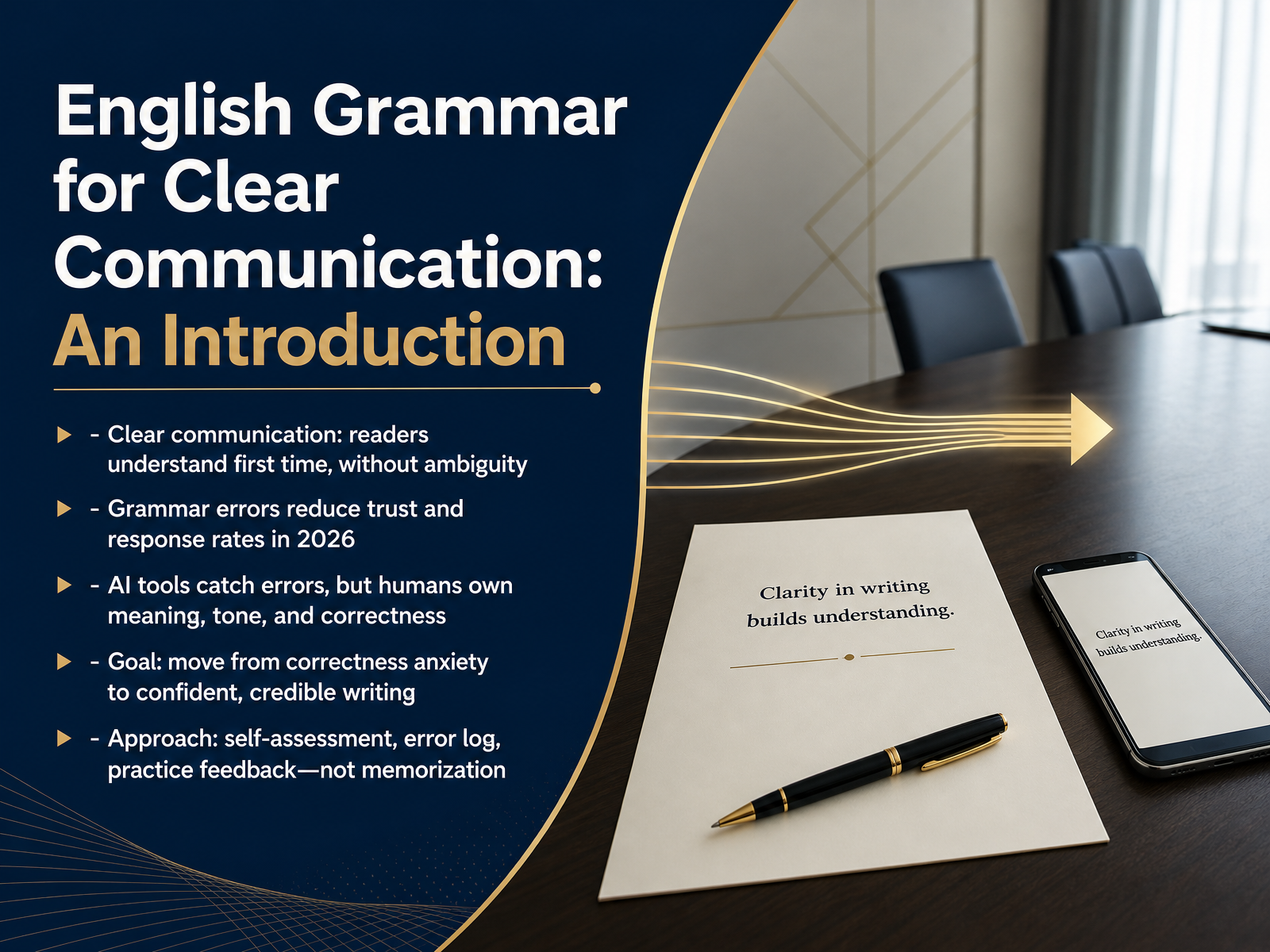
- 01English Grammar for Clear Communication: An IntroductionWelcome. I'm glad you're here. This course is called English Grammar for Clear Communication, and I want to start with a simple idea: grammar is a tool, not a test. It's how we make sure readers understand us the first time, without guessing. In 2026, clear writing matters more than ever. Studies show that grammar errors reduce trust, lower response rates, and even hurt hiring decisions. Yes, AI tools can catch many mistakes for us, but they can't own our meaning, our tone, or our correctness. That responsibility stays with us. So our goal today isn't to memorize rules. It's to move from correctness anxiety to confident, credible writing. We'll use self-assessment, keep an error log, and practice with real feedback. No drills, no fear. Just practical steps you can use in your next email, your next meeting, your next message. Let's begin by looking at which grammar errors actually matter most in professional English.pearson.comtutorialdeep.comtheodorehq.com+22 min
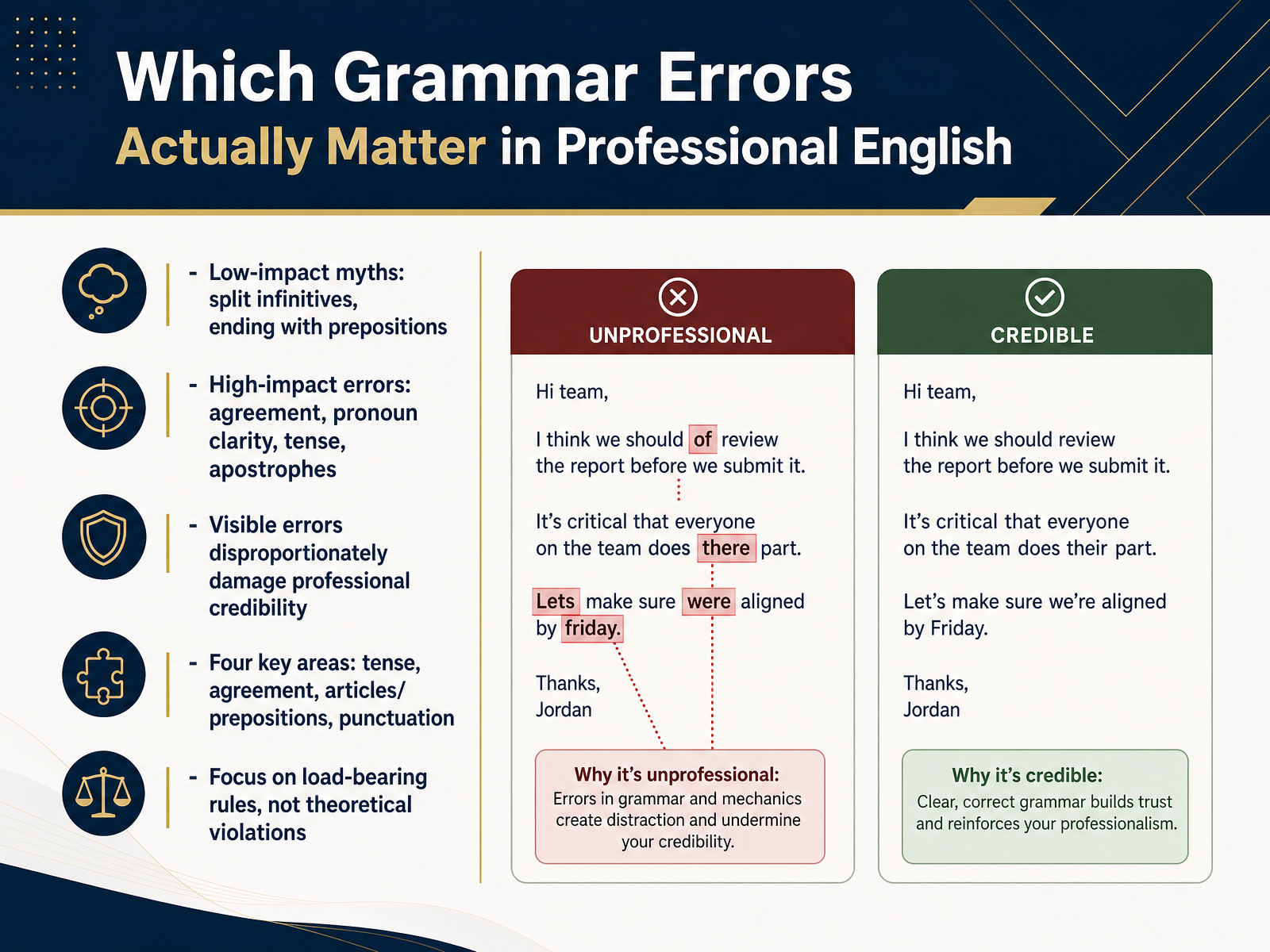
- 02Which Grammar Errors Actually Matter in Professional EnglishNow let's talk about which grammar errors actually matter in professional English. Here's the good news: some of the rules you might have worried about, like never splitting an infinitive or avoiding a preposition at the end of a sentence, are low-impact myths. They simply don't hurt your credibility. In fact, trying to avoid them often makes your writing sound awkward. What does matter is a smaller set of high-impact errors. These are the ones that damage trust in a professional setting. We'll focus on four key areas: tense, agreement, articles and prepositions, and punctuation. These are the load-bearing rules, not theoretical violations. Miss one of these, and your reader may misunderstand you. Getting them right, though, builds confidence in your professionalism. Remember, it's about being clear, not being perfect. Next, let's look at core sentence patterns for clear workplace writing.
 jobcannon.ioengleish.comenglishlesson.com+22 min
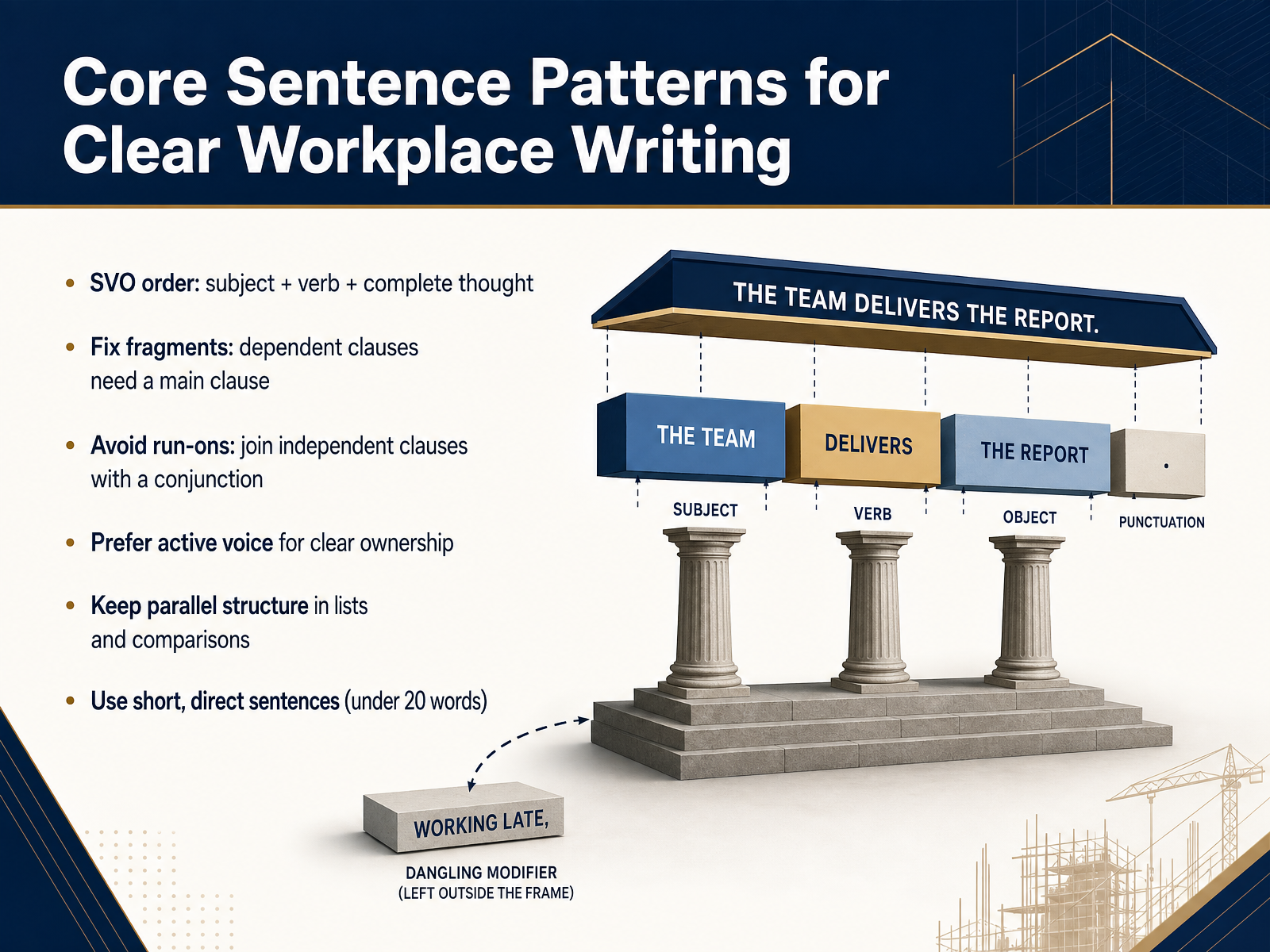
 - 03Core Sentence Patterns for Clear Workplace WritingLet's look at the building blocks of clear writing. The most powerful pattern in English is simple: subject, verb, complete thought. In a workplace email, you might write, 'I reviewed the report.' That is clear and complete. But sometimes sentences break down. A fragment is an incomplete thought, like 'Because the deadline moved.' It needs a main clause, so you'd say, 'Because the deadline moved, we need extra time.' And a run-on happens when two full thoughts are joined without a connection. Fix it with a conjunction: 'The meeting was long, but we finished on time.' Whenever you can, use the active voice. It shows ownership. Say, 'Priya sent the invoice,' not 'The invoice was sent.' Also, keep lists parallel. If you start with verbs, keep using verbs: 'We plan, we draft, and we deliver.' And keep sentences short, under twenty words when possible. Short sentences are easier to read and harder to misinterpret. Next, we'll explore how subjects and verbs need to agree, and how to use pronouns without confusion.
 spscc.pressbooks.pubfluentatdesk.comjobcannon.io+21 min
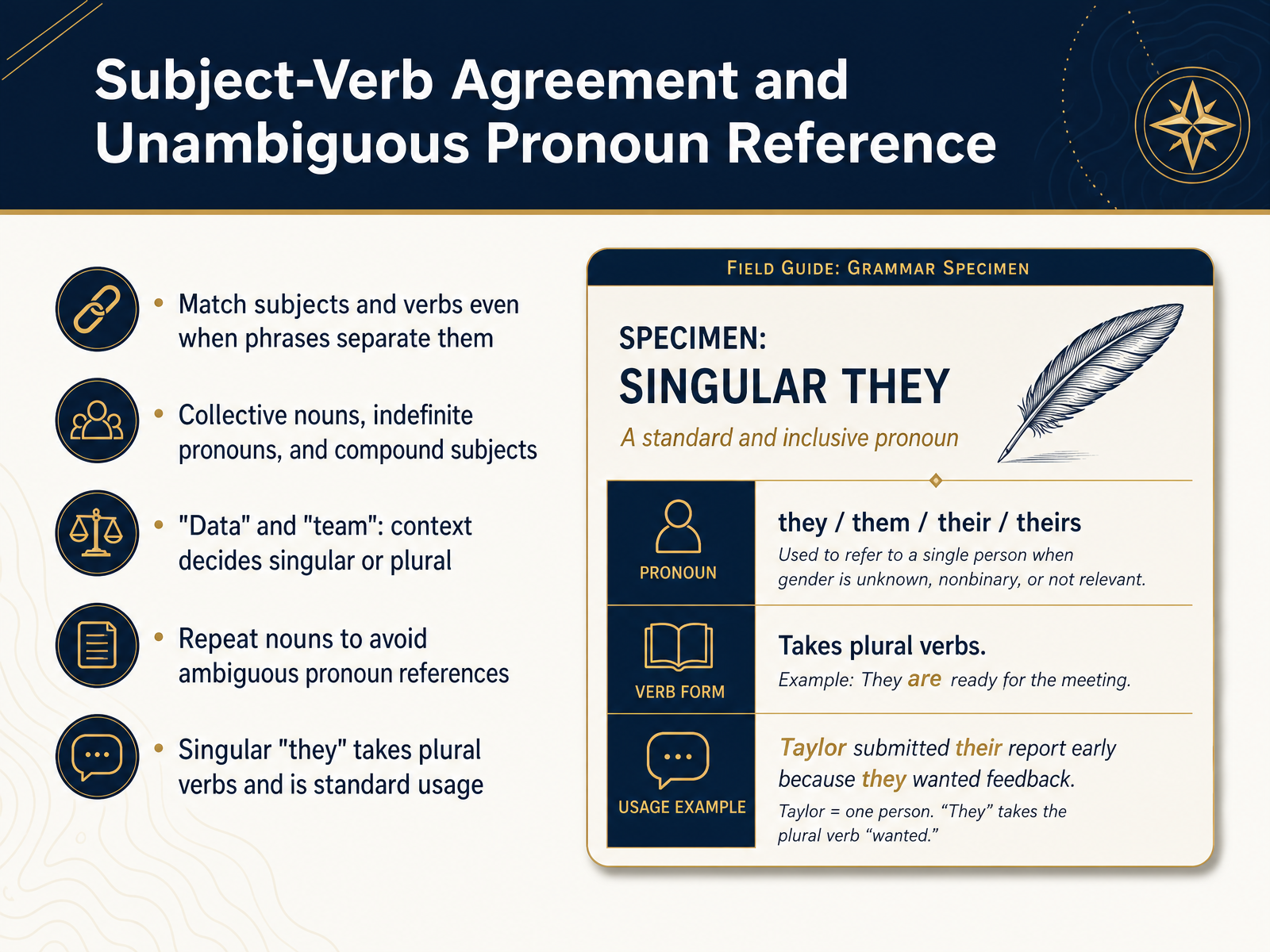
 - 04Subject-Verb Agreement and Unambiguous Pronoun ReferenceLet’s talk about keeping your subjects and verbs in agreement, even when other words get in between. For example, say “The report from the managers is ready,” not “are ready.” With collective nouns like team and data, context decides. If the team acts as one unit, use singular verbs. If you mean individual members, use plural. Now, a tip for clarity: repeat the noun when a pronoun might confuse. “Sara told Laura that Sara’s proposal was approved” is clearer than “she told her.” Finally, singular they is standard usage. Even though it’s singular, it always takes plural verbs, like “they are.” This keeps your writing inclusive and natural. Next, we’ll move into how verb tenses work with time logic in your emails and reports.
 our-languages.canada.castyle.mla.orgdevelopers.google.com+21 min
 - 05Verb Tenses and Time Logic in Emails and ReportsLet's look at how verb tenses carry time logic in emails and reports. The simple past states a past fact, but the present perfect states a present fact. So when you say, “I sent the report,” you are talking about the action in the past. But when you say, “I have sent the report,” you are telling the reader about the current situation—the report is available now. That's usually what they actually want to know. Also, watch your time markers. Words like “already,” “since,” and “by the time” must match the tense you choose. For example, “I have already sent the report” sounds natural, but “I already sent the report” is less clear about the present result. Conditionals also show commitment. “If we receive the files today, we deliver Friday” is a firm promise. But “If we received the files today, we would deliver Friday” sounds uncertain, like a possibility, not a commitment. In client emails, this makes a real difference in how you are understood. Finally, keep your tense consistent within the same email or section. Don't jump between past and present without a clear reason. Choose your time frame and stick to it. So the takeaway is: match your tense to your meaning, let time markers guide you, and keep it consistent. Now, let's turn to clarity in modifiers and comparisons.
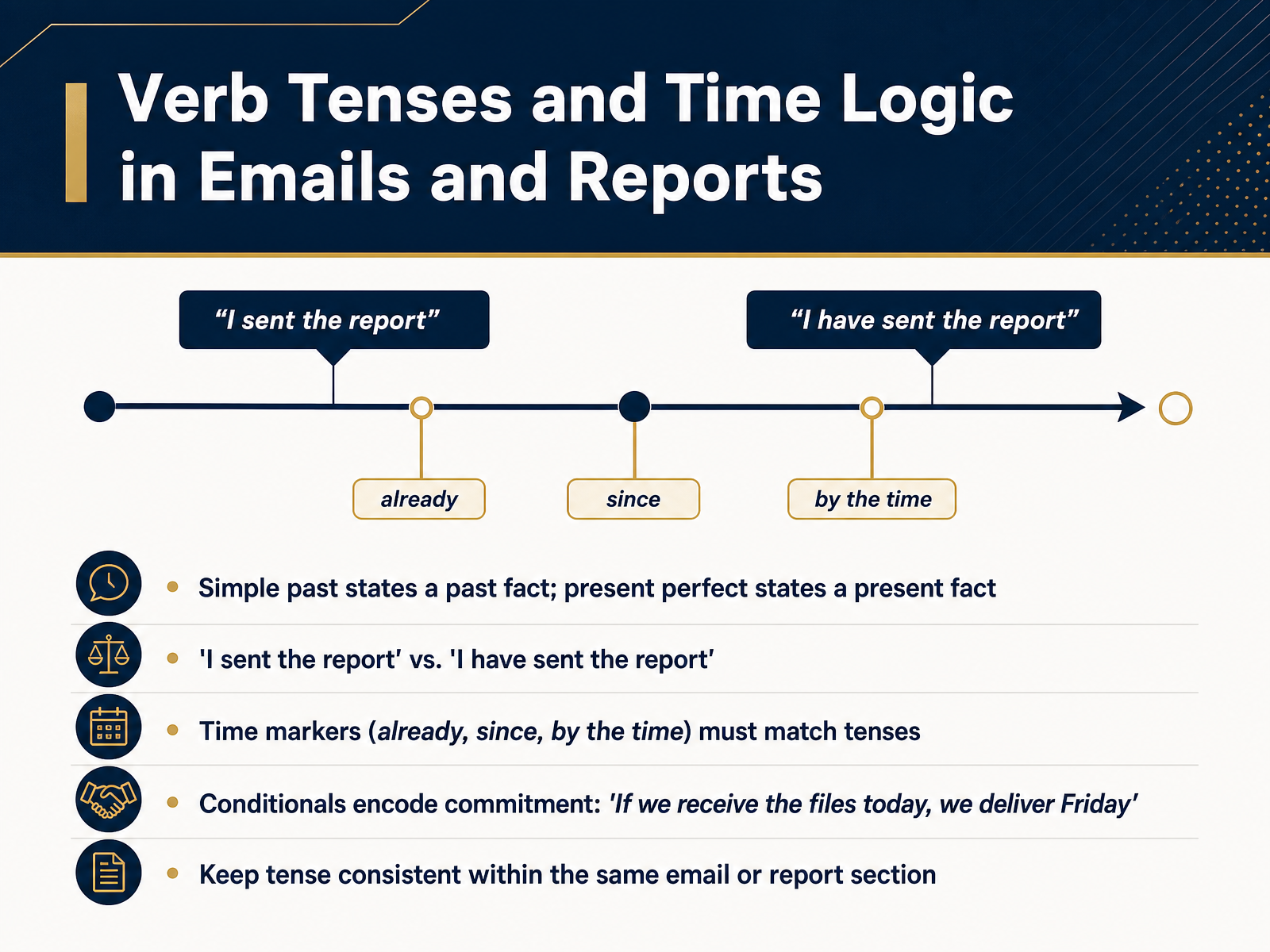 spscc.pressbooks.pubfluentatdesk.comjobcannon.io+22 min
 - 06Clarity in Modifiers and ComparisonsNow let's talk about clarity in modifiers and comparisons, because this is where ambiguity usually sneaks into an email or a meeting note. The key idea is simple: put modifiers next to the words they describe. For example, say 'I reviewed the report you sent on Monday' not 'I reviewed the report on Monday you sent.' Also watch out for dangling modifiers, which describe something that is not actually in the sentence. A sentence like 'Walking to the office, the deadline seemed impossible' is confusing because it sounds like the deadline was walking. Next, make sure you use comparative forms correctly. Use 'better' not 'more better,' and avoid illogical comparisons. For instance, saying 'Our sales are higher than last year' is wrong because it compares sales to a year, not to sales from that year. Say 'Our sales are higher than last year's sales' or 'our sales are higher than they were last year.' Finally, check for missing information in your comparisons, so readers do not have to guess what you mean. These small fixes make your writing clearer, and they are easy to apply once you know what to look for. Next, we will move on to punctuation that protects meaning and credibility.
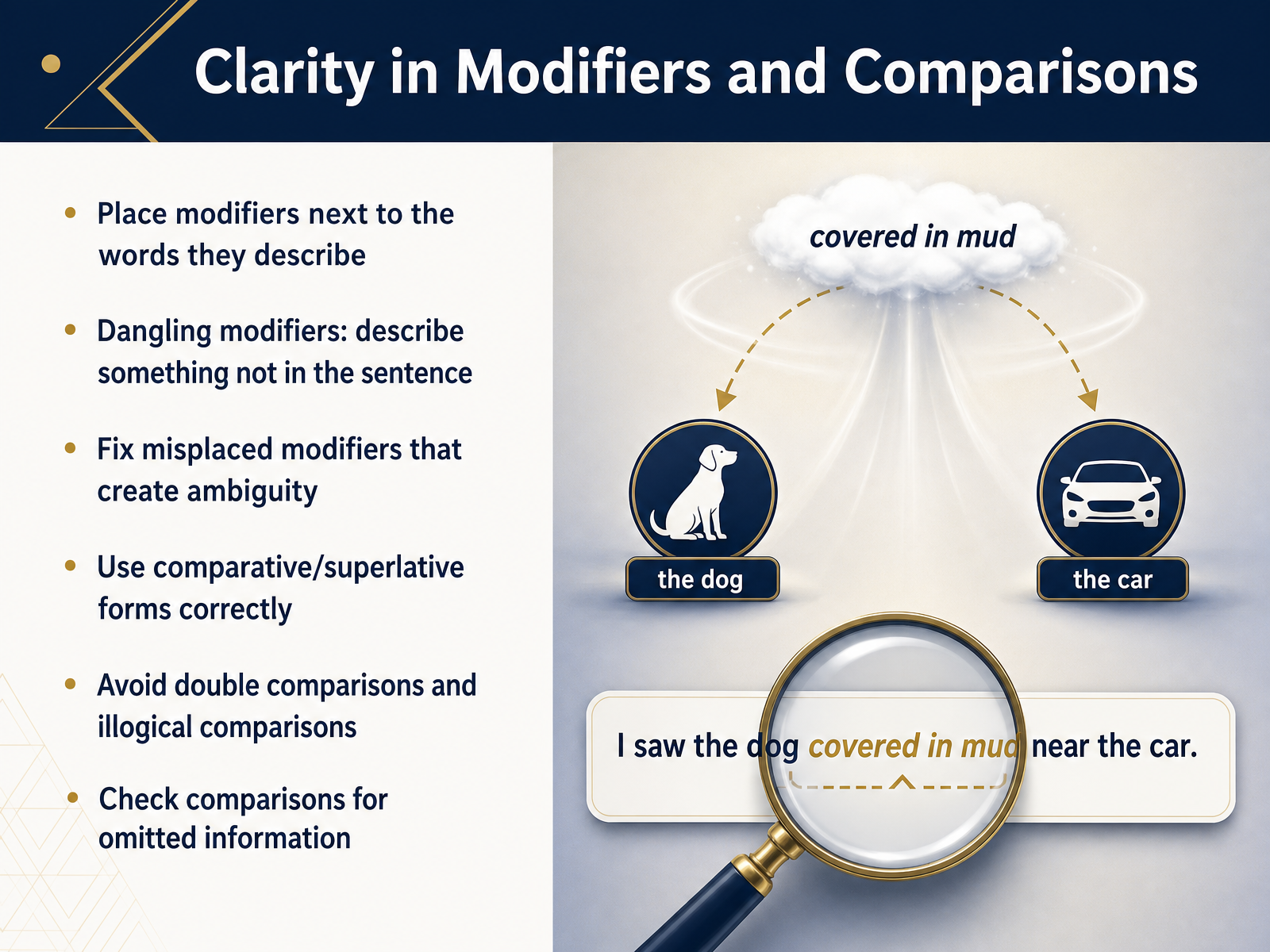 spscc.pressbooks.pubfluentatdesk.comjobcannon.io+21 min
 - 07Punctuation That Protects Meaning and CredibilityNow let's talk about punctuation as a tool that protects both your meaning and your credibility. Small marks can change a message completely. For example, the Oxford comma before the final item in a list can prevent costly misunderstandings—even legal ones. Also, watch the difference between restrictive and non-restrictive clauses. Add commas around a clause, and it becomes extra information; leave them out, and it becomes essential to the meaning. Semicolons join related thoughts, and colons introduce lists. Apostrophes matter too. Mixing up its and it's is one of the most visible errors and can hurt your professionalism quickly. Greetings and sign-offs follow conventions: a comma after the greeting, capital on the first word only in the sign-off. And use exclamation marks sparingly—one is warm, several look anxious. Avoid scare quotes around ordinary words. They add doubt, not emphasis. Remember, punctuation is here to guide your reader. Master these patterns and your writing will look careful, clear, and credible. Next, we'll explore common word confusions that can quietly undermine your professional image.
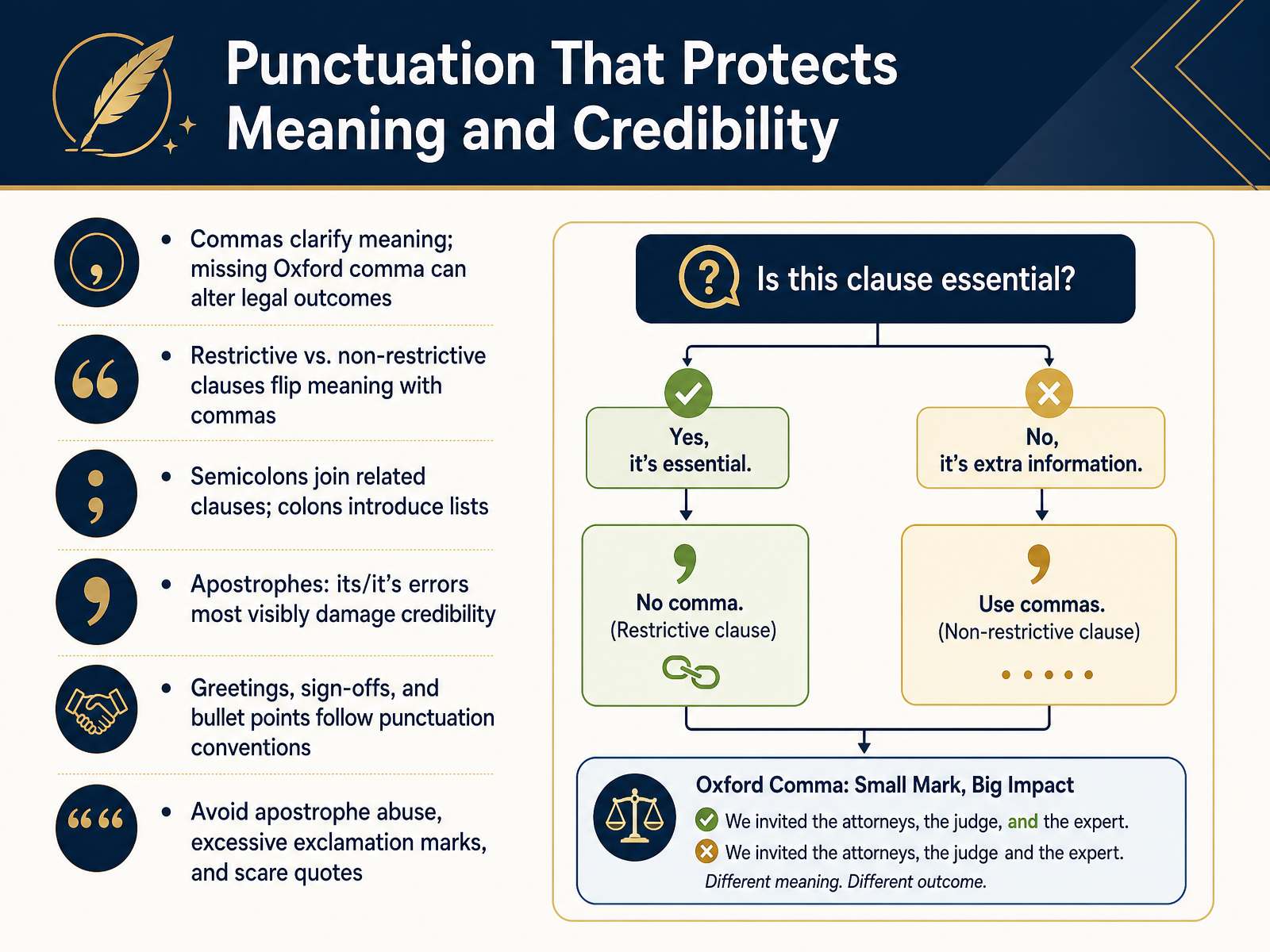 paperdirect.comcopykate.co.ukjobcannon.io1 min
 - 08Common Word Confusions That Undermine Professional CredibilityLet’s talk about word confusions that can quietly undermine your professional credibility. These are the small errors that readers notice immediately. First, the classic homophones: affect versus effect, your versus you’re, its versus it’s, and their, there, they’re. Each pair sounds the same but means something different, so spellcheck won’t help you. Then we have smart word pairs. Remember, comprise means the whole contains the parts, so you say the team comprises five members, not is comprised of. Use fewer for things you can count, like fewer emails, and less for things you can’t, like less time. Disinterested means impartial, not bored. And i.e. means that is, while e.g. means for example. Also, avoid nonstandard forms. Say regardless, not irregardless. Say revert, not revert back. Say past, not past history. And only use literally when something is physically true, not for emphasis. Here’s a practical tip: start a personal error log. Note the words you mix up most often and review it before sending high-stakes messages. This small habit will sharpen your writing fast. Next, we’ll explore prepositions, articles, and modals: the small words with big impact.
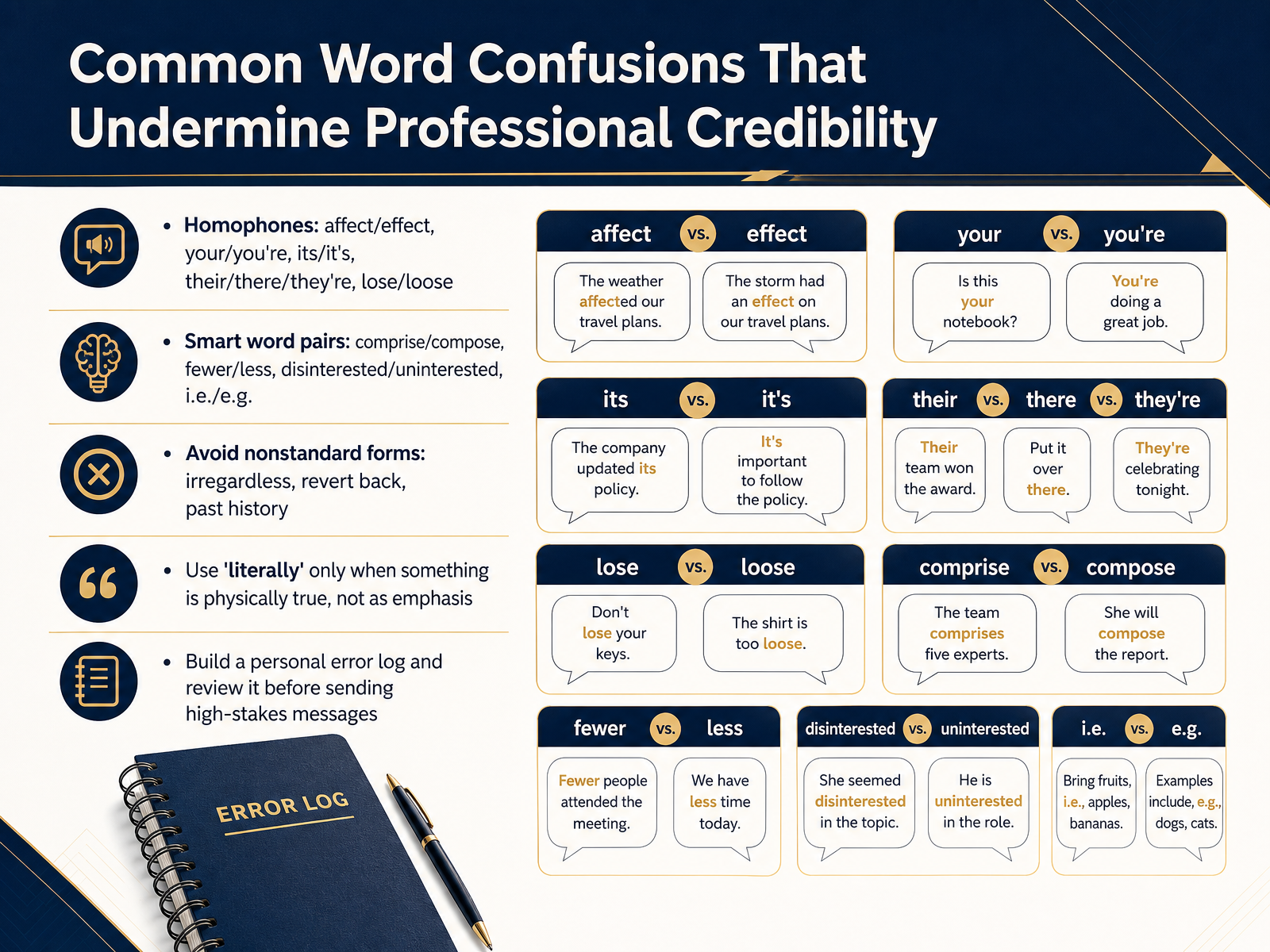 jobcannon.ioengleish.comenglishlesson.com+21 min
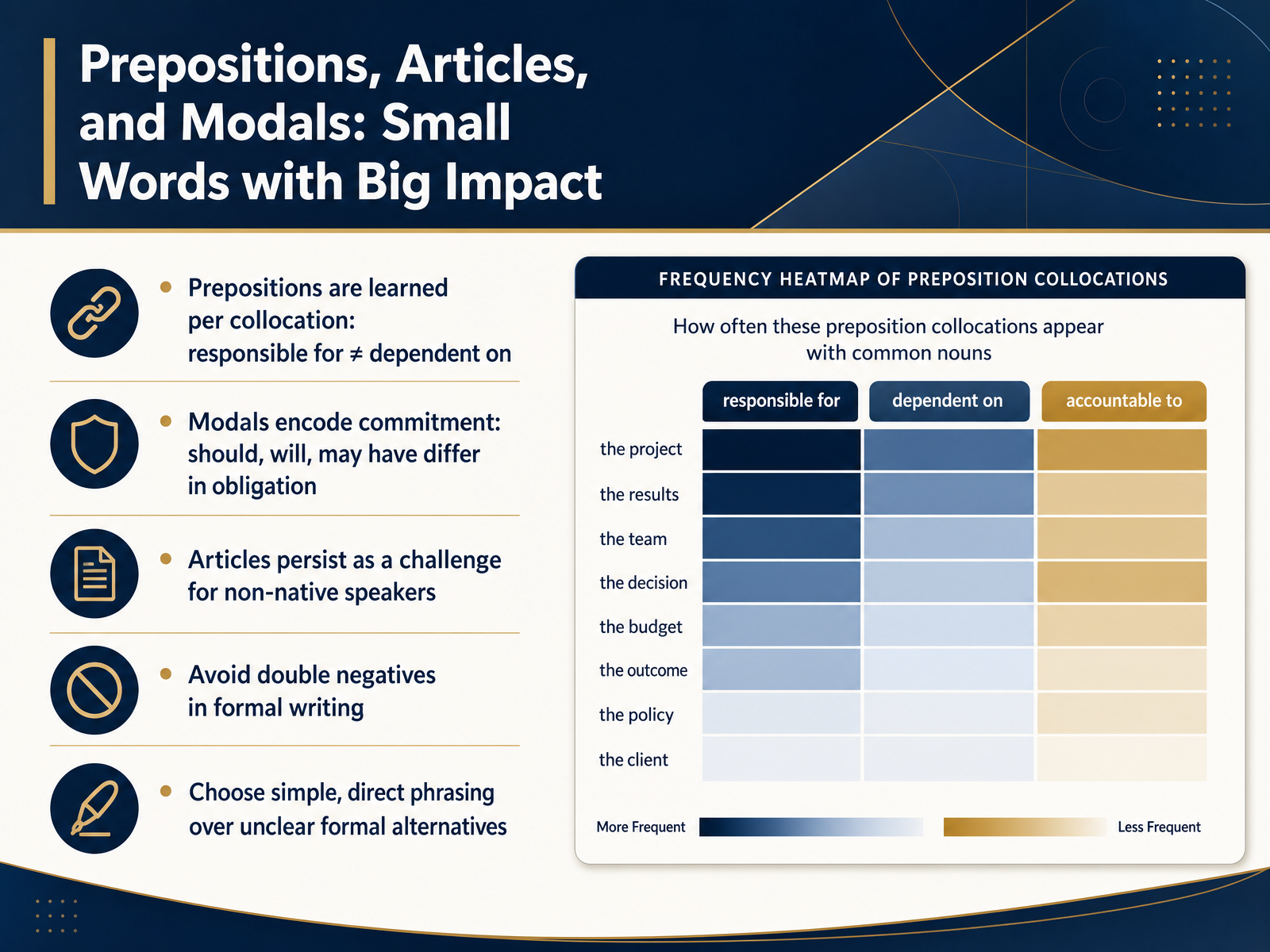
 - 09Prepositions, Articles, and Modals: Small Words with Big ImpactNow let's talk about some small words that cause big problems. Prepositions like responsible for and dependent on. You might think responsible for and dependent on follow the same rule, but they don't. You have to learn each phrase on its own. Next, modals. Should, will, and may all sound similar, but they mean different things. We should have the report by Friday sounds like a hope. We will have the report by Friday is a promise. And we may have the report by Friday means maybe. Each one is a different level of commitment. Articles, like a, an, and the, are tricky for many speakers, and that is completely normal. Keep practicing. Also, avoid double negatives in formal writing. Saying I don't have no time might sound fine in casual talk, but in a formal email, it is confusing. Instead, say I have no time. And remember, simple and direct is best. Clear beats fancy. Now let's move on to some editing strategies for clearer sentences.
 spscc.pressbooks.pubfluentatdesk.comjobcannon.io+21 min
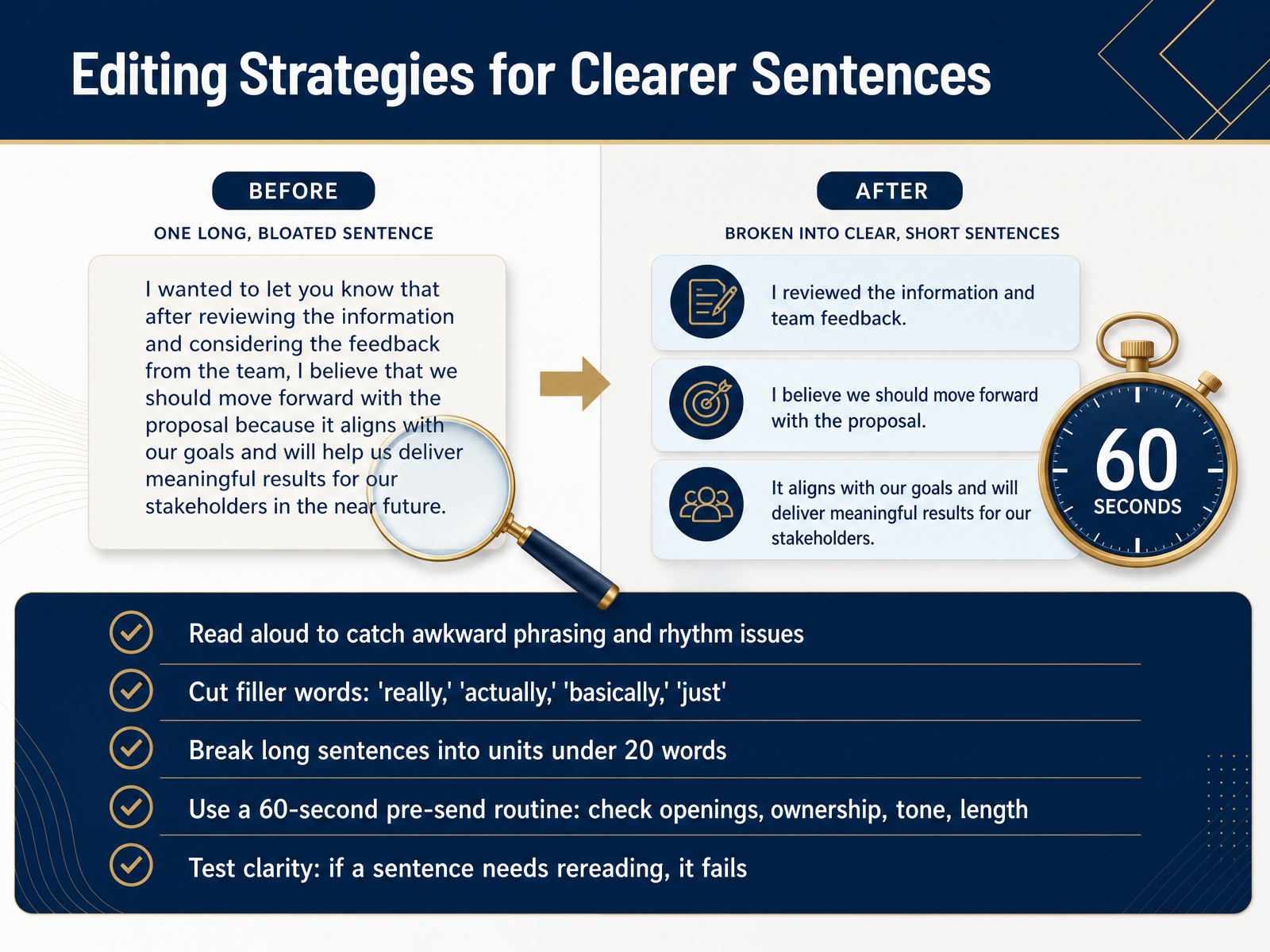
 - 10Editing Strategies for Clearer SentencesLet's look at some practical editing strategies to make your sentences clearer. First, try reading your message aloud. If it sounds awkward or the rhythm feels off, that's a signal to revise. Next, cut filler words like really, actually, basically, and just. They add noise without adding meaning. For example, instead of saying, we basically just need to finalize the report, say, we need to finalize the report. Also, break long sentences into shorter ones. Aim for under twenty words per sentence. It's easier for the reader to follow. A useful routine is the sixty-second pre-send check. Look at your opening, check who owns each action, review the tone, and assess the length. Finally, test your clarity. If a sentence needs rereading, it fails. Rewrite it. These small edits make a big difference. Next, we'll see how grammar shapes tone in emails, from greetings to high-stakes messages.
 2 min
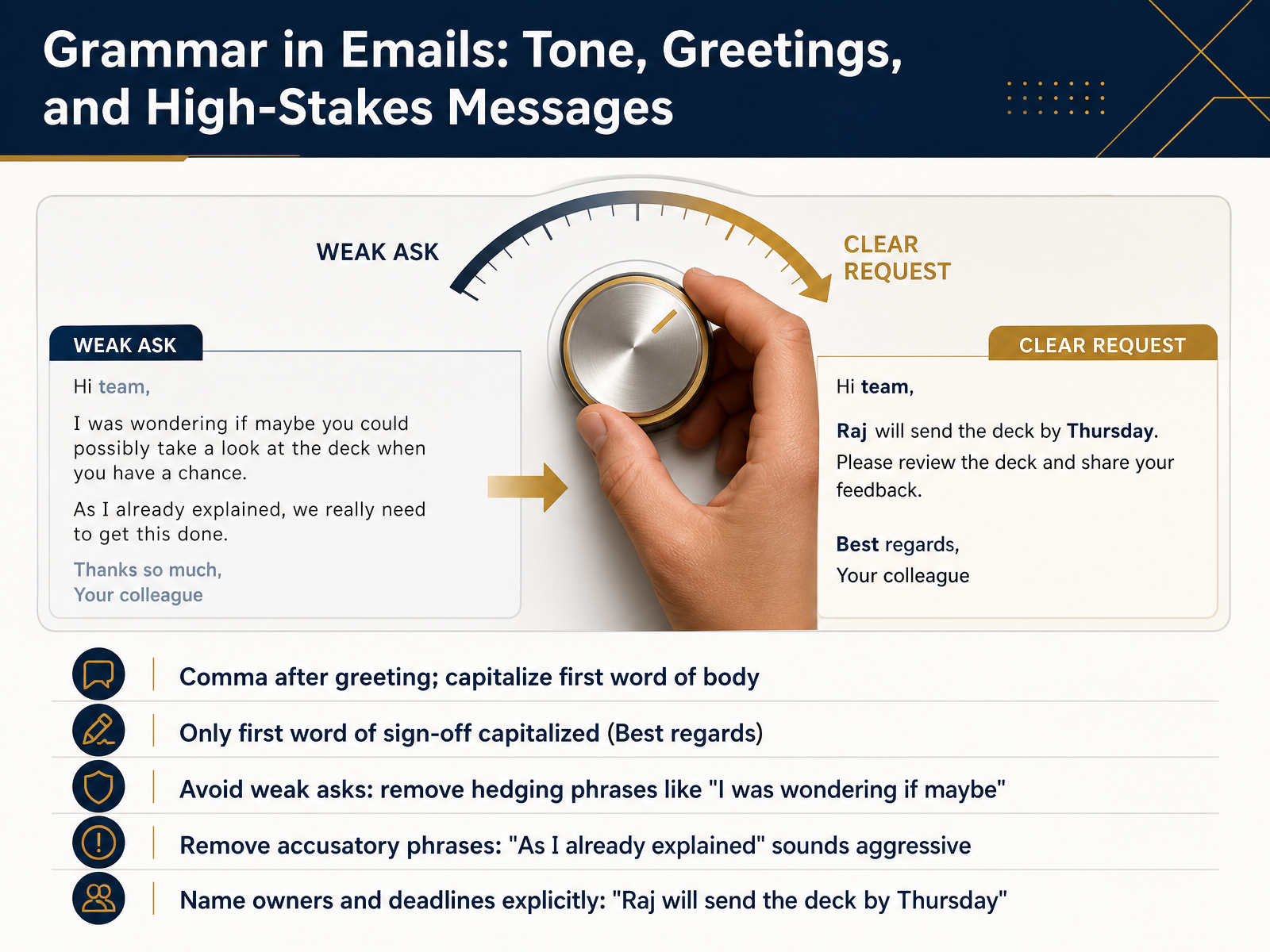
2 min - 11Grammar in Emails: Tone, Greetings, and High-Stakes MessagesLet's turn now to one of the most practical places grammar matters: your emails. A few small adjustments can make a big difference in how your message is received. First, the basics of format. Always place a comma after your greeting: “Hi Priya,” not “Hi Priya”. And capitalize the first word of your body text. It starts a new sentence. For your sign-off, only the first word gets a capital letter. So it’s “Best regards,” not “Best Regards.” Now, the tone. Avoid weak asks. Hedging phrases like “I was wondering if maybe” bury your request. Instead, be direct: “Could you review the Q3 numbers by Thursday?” Also, watch out for accusatory phrases. “As I already explained” sounds aggressive, even if you don’t intend it. Focus on what happens next. Finally, name the owner and the deadline explicitly. “Raj will send the deck by Thursday” is clear. “The team will handle it” is not. These small changes build trust and get work done. Up next, we’ll look at how these same principles apply to reports and formal documents.
 spscc.pressbooks.pubfluentatdesk.comjobcannon.io+21 min
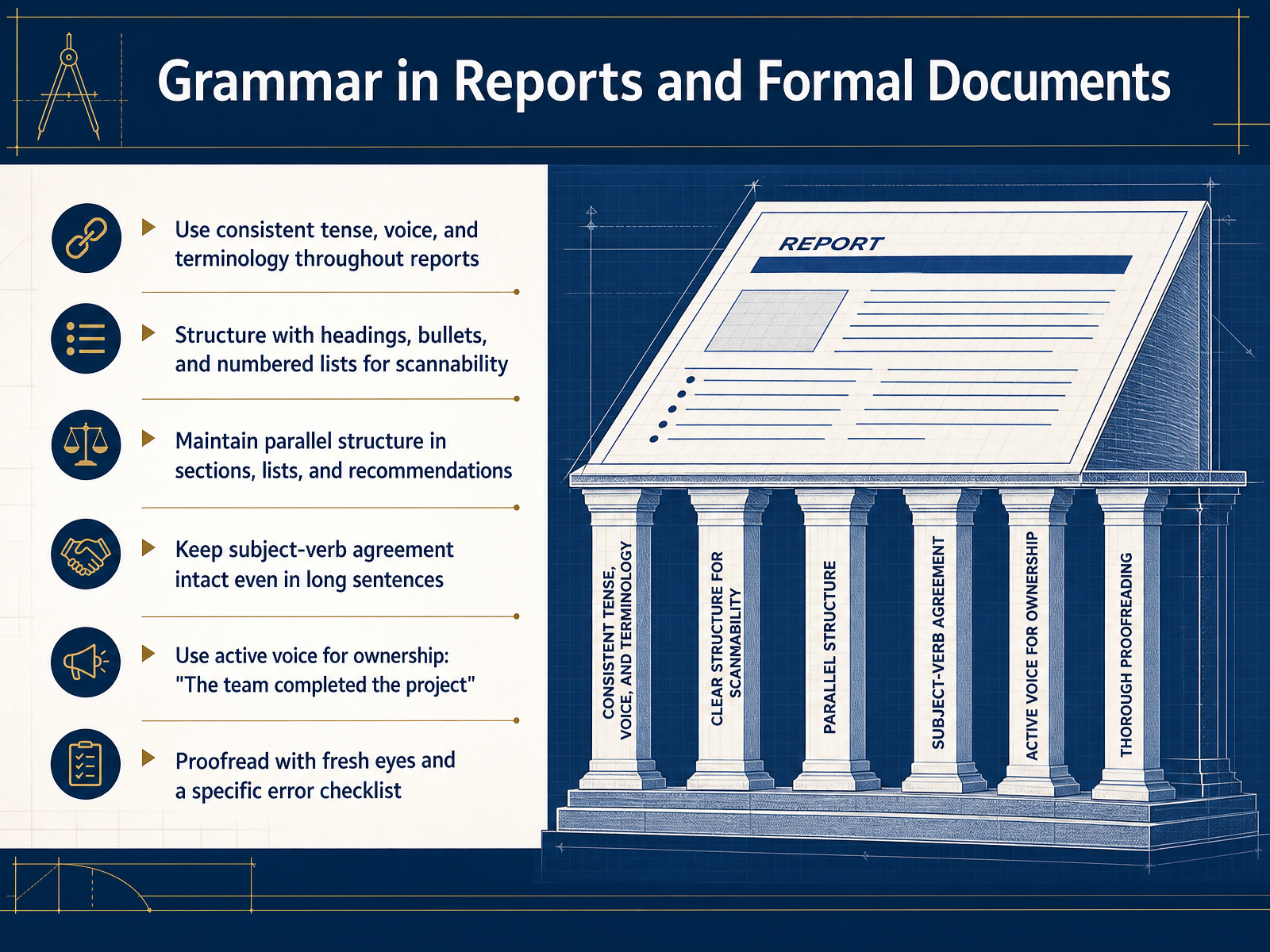
 - 12Grammar in Reports and Formal DocumentsNow let's turn to reports and formal documents, where clarity really matters. When you write a longer document, keep your tense consistent throughout. If you start in the past tense, stay there. Mixing tenses confuses readers. The same goes for voice and terminology. Pick your words and stick with them. Structure is your friend. Use headings, bullet points, and numbered lists so people can scan quickly. And keep your lists parallel. If one item starts with a verb, the next ones should too. Watch subject-verb agreement, even in long sentences. It's easy to lose track, but the reader will notice. Use active voice to show ownership. Say, the team completed the project, not the project was completed by the team. Finally, proofread with fresh eyes. Use a simple checklist, like checking verb tense, punctuation, and spelling. Reading your work out loud helps too. Making these habits will make your reports clear and professional. Up next, we'll look at how feedback and error logs can help you improve your grammar over time.
 2 min
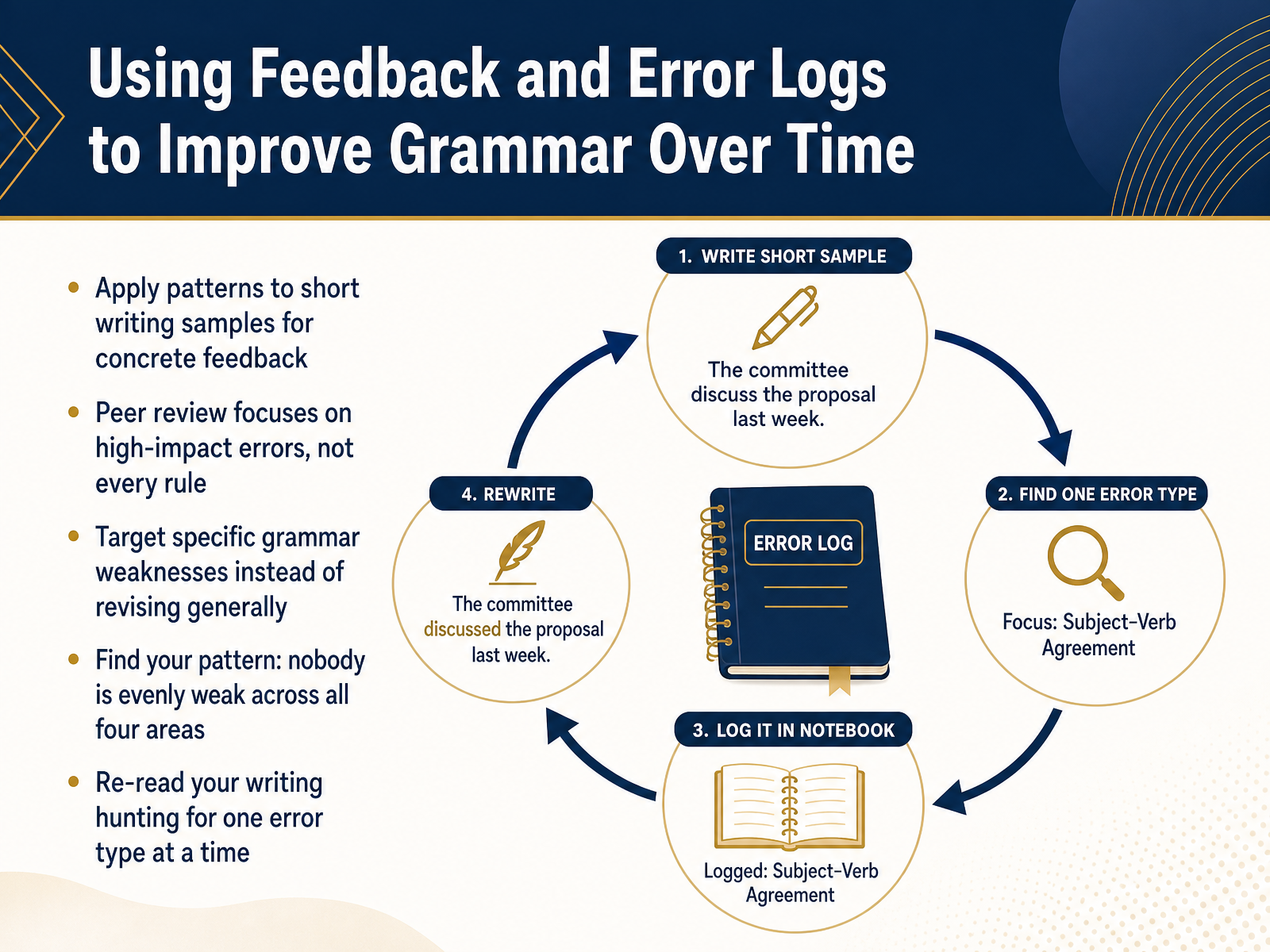
2 min - 13Using Feedback and Error Logs to Improve Grammar Over TimeLet’s talk about how to actually improve your grammar over time. The secret is feedback and a simple habit called an error log. Instead of trying to revise your grammar in general, you want to target your specific weaknesses. Here’s the key insight: nobody is evenly weak across all areas. You might struggle with verb tense, but have solid articles and prepositions. So, apply what you learn to short writing samples. Write a few sentences, an email, or a short message, and get concrete feedback on just that. In peer review, focus on high-impact errors, not every single rule. That keeps the feedback useful and encouraging. Once you spot a pattern, target it. For example, if you notice you often mix up "I sent" and "I have sent," re-read your own writing hunting for only that error type. One error at a time. This narrow focus helps the rule stick in your mind. Remember, mistakes are a normal part of the process. Treat your error log as a map, not a report card. Now, let’s move on to a practical practice cycle to put all of this into action.
 spscc.pressbooks.pubfluentatdesk.comjobcannon.io+22 min
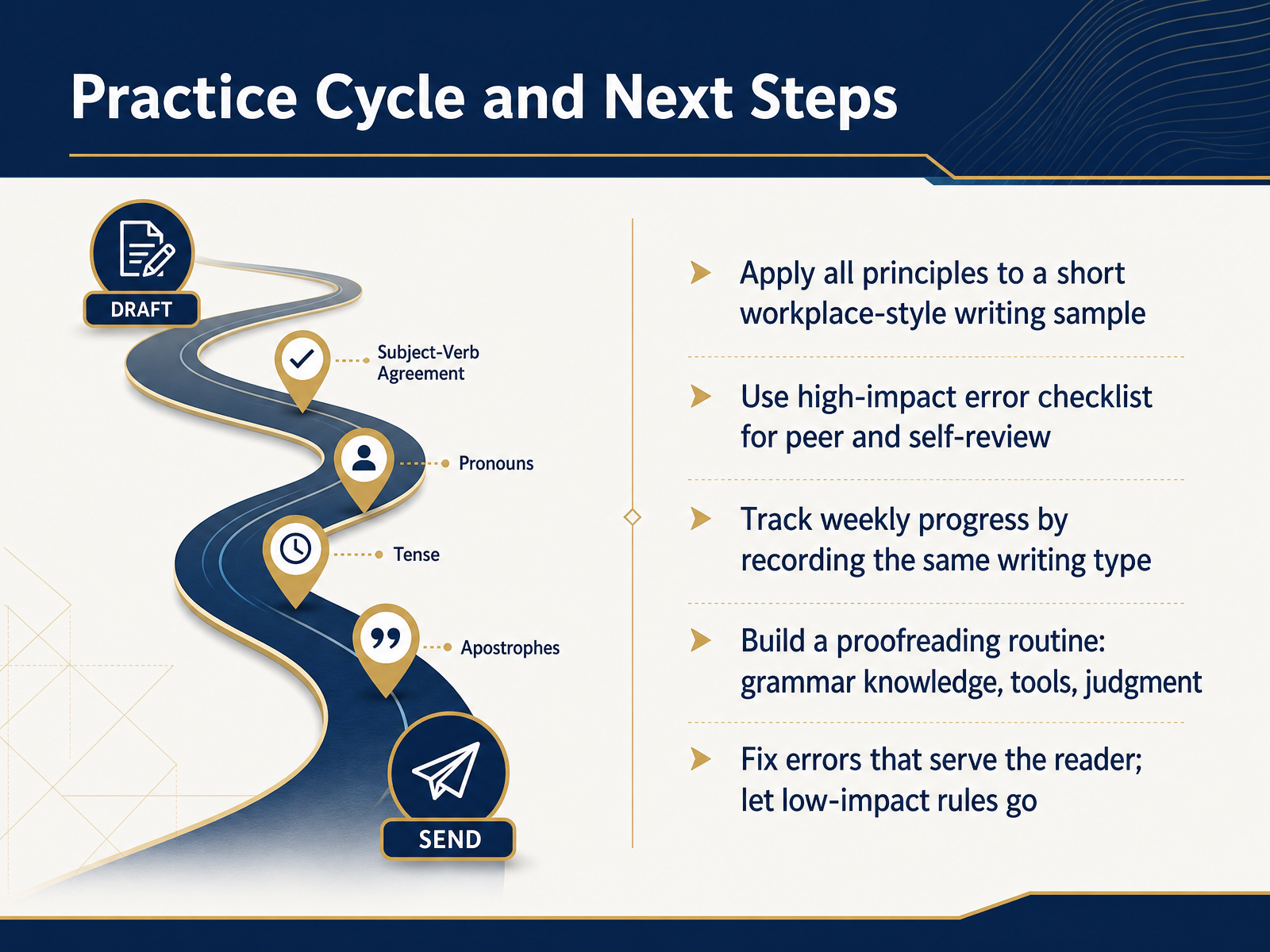
 - 14Practice Cycle and Next StepsYou've made it to the final step, and this is where the real growth happens. First, take everything you've learned and apply it to one short workplace-style writing sample. It could be an email to a colleague, a status update, or a brief message to your manager. Next, use a simple error checklist for review. Look for subject-verb agreement, modifier placement, parallel structure, and a clear, direct ask. Ask a peer to review it too. Then, track your progress. Write the same type of message each week, such as a request email to a client, and record it. After a few weeks, you'll clearly see your improvements. Finally, build a quick proofreading routine. Use your grammar knowledge, a tool like spell-check for support, and the final judgment to decide what matters. The goal is to fix errors that serve the reader. If a small error doesn't cause confusion, let it go. Perfection is not the goal. Clear, confident communication is. Thank you for your time and effort today. Now, start with one small piece of writing and put these tips into practice. You've got this.
 spscc.pressbooks.pubfluentatdesk.comjobcannon.io+22 min
Take the deck with you
Download this course as a file — free, no sign-up needed.
- PDF handoutEvery slide page, ready to print or share.15 pages · 3.9 MBDownload
- Narrated PowerPointThe deck that presents itself — every slide carries the digital human's narration video.15 pages · 13.9 MBDownload
- PowerPoint slidesThe full deck as a .pptx — open it in PowerPoint, Keynote, or Google Slides.15 pages · 3.8 MBDownload
Free to use in your own training — please keep the PersonWise credit page at the end.
Have your own deck? Turn it into a course
Sources consulted
Web sources consulted while building this course.
- Why grammar skills matter more Than ever in the AI era — pearson.com
- Why Good Grammar Still Matters in 2026 (Even With AI Tools) — tutorialdeep.com
- Why Grammar Checking Matters for Professional Writing — theodorehq.com
- Students' awareness of the importance of using proper English ... - Frontiers — frontiersin.org
- The Grammar Rules That Actually Matter in Professional English — and the Ones That Do Not — engleish.com
- Common English Grammar Mistakes at Work: The... · JobCannon — jobcannon.io
- 12 Grammar Mistakes That Make You Sound Unprofessional In English - englishlesson.com — englishlesson.com
- The most common English mistakes professionals make — ecenglish.com
- grammarguide-2026 — englishgrammar.org
- 4.4 Common Sentence Errors – Intro to Business English — spscc.pressbooks.pub
- Business Writing Mistakes Non-Native Speakers Should Avoid | FluentAtDesk — fluentatdesk.com
- An Analysis of Sentences Error in Business Email Writing of Thai EFL Students | Journal of Education Studies, Chulalongkorn University — so02.tci-thaijo.org
- 4: Employment and Workplace Communication - Humanities LibreTexts — human.libretexts.org
- Gender-inclusive writing: Use the singular “they” – Writing Tips Plus – Writing Tools – Resources of the Language Portal of Canada – Canada.ca — our-languages.canada.ca
- How do I use singular they? - MLA Style Center — style.mla.org
- Pronouns | Google developer documentation style guide | Google for Developers — developers.google.com
- Inclusive Language Guide - American Psychological Association — apa.org
- Pronoun Guide — cdn.vanderbilt.edu
- Punctuation for Business Letters & Writing - PaperDirect Blog — paperdirect.com
- Trip Hazards: Six Common Punctuation Errors to Avoid in Business Copy — copykate.co.uk