SEO Strategy: Goals, Choices, Tradeoffs
Begin
14 pages · ~28 min
SEO Strategy: Goals, Choices, Tradeoffs
This training teaches SEO professionals how to define strategic goals, make informed choices, and navigate tradeoffs to build effective, results-driven SEO strategies.
What you’ll learn
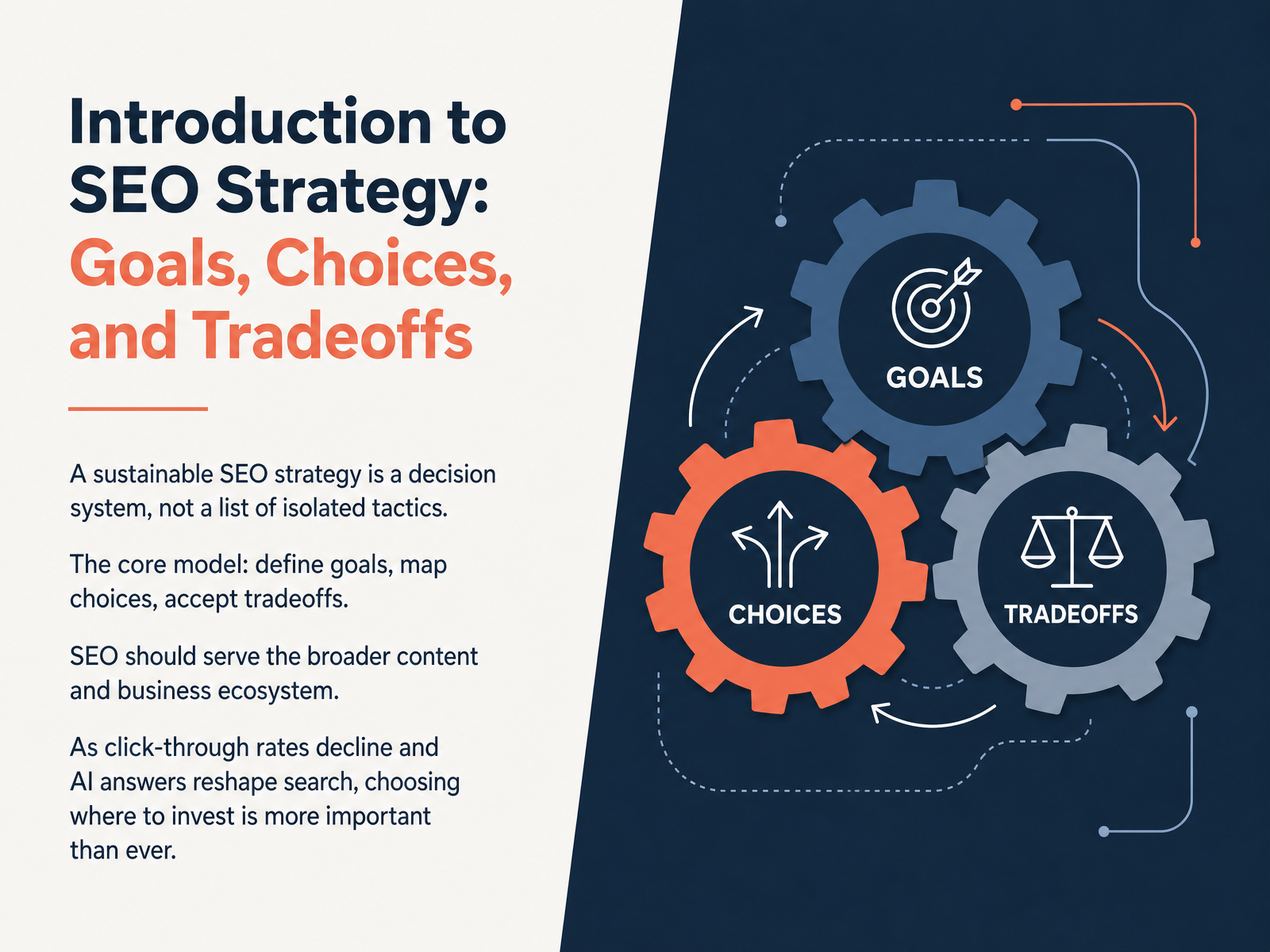
- 01Introduction to SEO Strategy: Goals, Choices, and TradeoffsWelcome. If you're responsible for content strategy, you already know the old playbook is breaking down. Rankings alone no longer guarantee visibility, and clicks are giving way to answers. This course is about building a sustainable SEO strategy as a decision system, not a list of tactics. We'll start with defining clear goals, then map the real choices those goals force, and finally, we'll face the tradeoffs honestly. Because the real competition today isn't page versus page, it's site versus site. And in a world where AI answers reshape how people search, where you choose to invest matters more than ever. Let's build the framework that makes those calls confidently. Next, we'll look at why tactical thinking falls short and how to shift into strategic decision-making.ranktracker.comaristral.comadvancedgedigital.com+22 min
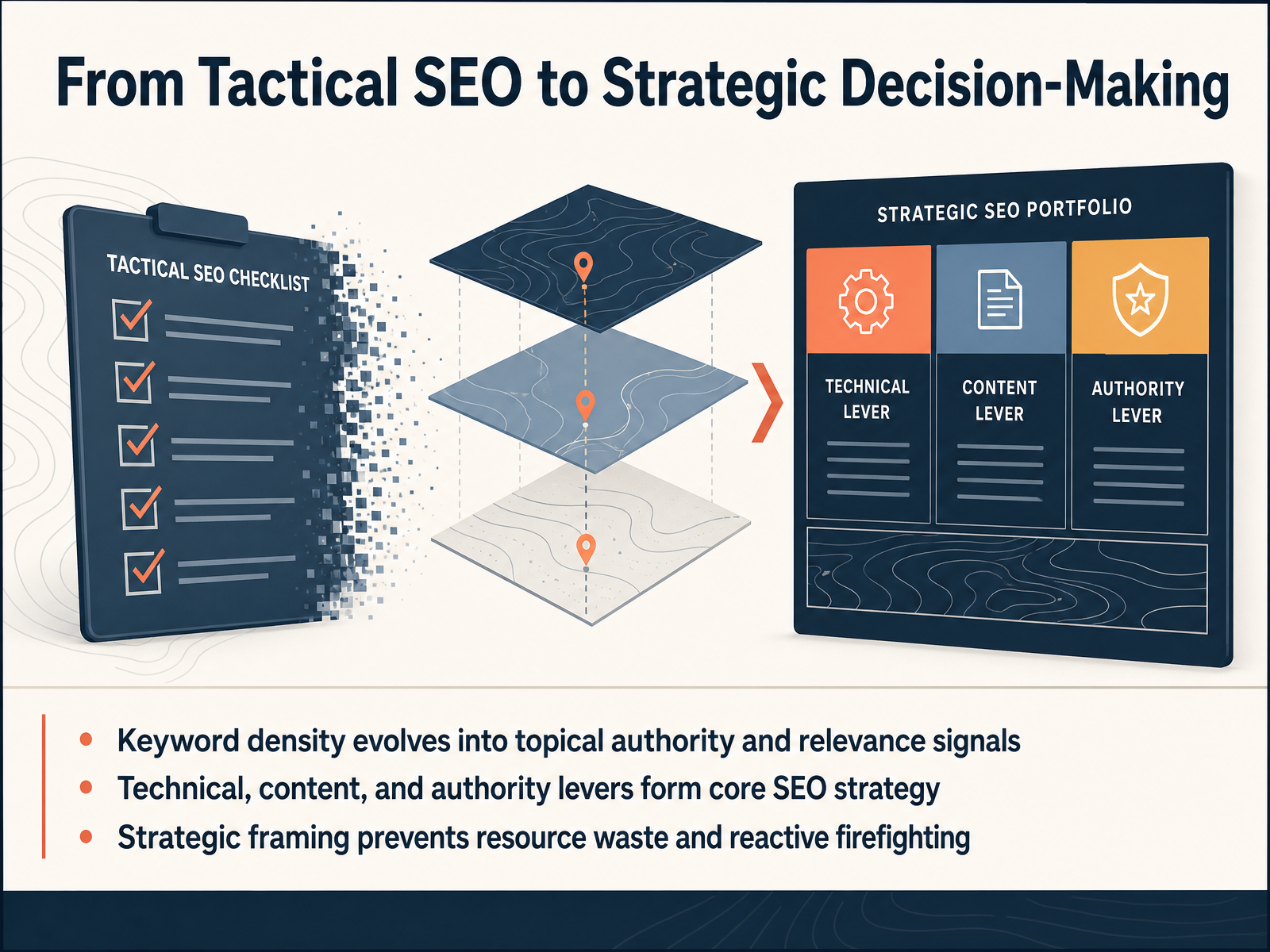
- 02From Tactical SEO to Strategic Decision-MakingLet's take a hard look at how SEO decisions really get made. Most teams start with a list of keywords and try to rank page by page. That approach worked for a long time, but search engines have shifted their focus. Today, they evaluate who understands a topic best across an entire site, not just who matches a phrase on a single page. That moves us from tactical execution to strategic decision-making. The levers we control now fall into three categories: technical health, content depth, and authority signals. Technical levers make sure search engines can crawl and index us. Content levers prove we cover a subject with genuine relevance and depth. Authority levers build the trust that makes our pages hard to ignore. The tradeoff is real. Chasing isolated keywords is fast, but fragile; building topical authority takes longer, but compounds. Without strategic framing, teams waste resources firefighting algorithm changes or publishing pages that never connect to business outcomes. Choosing the right lever for each situation is what turns SEO from a checklist into a discipline. Next, let's talk about setting SEO goals that actually serve your business.
 ranktracker.comaristral.comadvancedgedigital.com+22 min
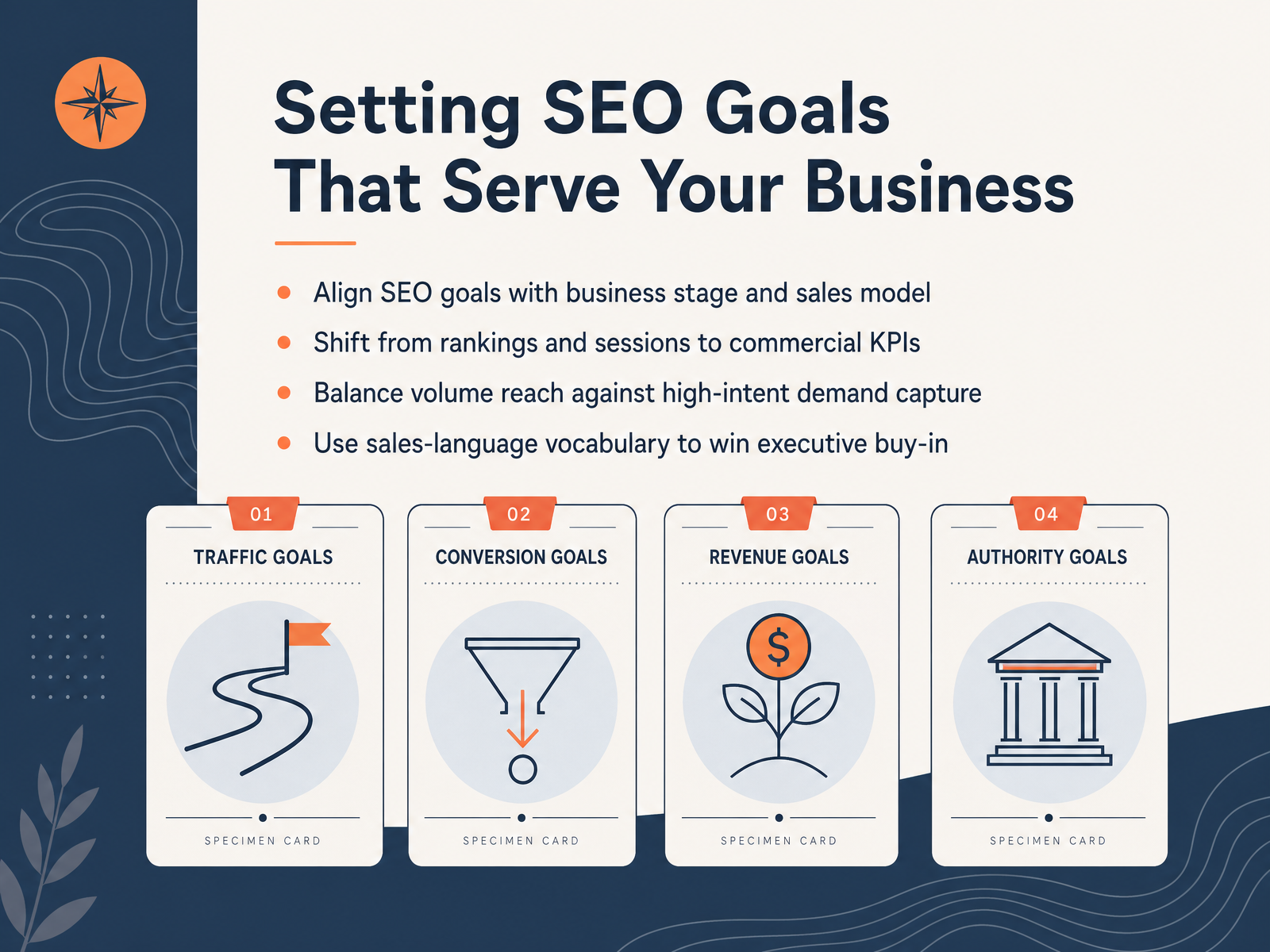
 - 03Setting SEO Goals That Serve Your BusinessNow let's talk about setting SEO goals that actually serve your business. The first move is to align those goals with where your company is right now. A brand-new site trying to build a footprint needs a different strategy than a mature business with a long sales cycle. Your business model matters just as much. If you're high-touch and consultative, you'll weigh decisions differently than a self-serve product that lives or dies on volume. The second move is to shift your focus. Stop leading with rankings and sessions. Start leading with commercial KPIs. Things like leads generated, qualified opportunities, or even revenue influenced. Those are the numbers that prove content is an asset, not an expense. But there's always a tradeoff here. Broad reach captures a large audience, but much of it is informational and unlikely to buy. High-intent capture is efficient, but the audience is smaller and the competition is fierce. You have to balance the two based on your growth constraints. Finally, use sales language when you present this. Say generate, grow, and retain instead of brand awareness, credibility, or education. That vocabulary is how you win executive buy-in and the budget that follows. Next, we'll look at how to measure what actually matters.
 contentmarketinginstitute.comcontentmarketinginstitute.comcontentmarketinginstitute.com+22 min
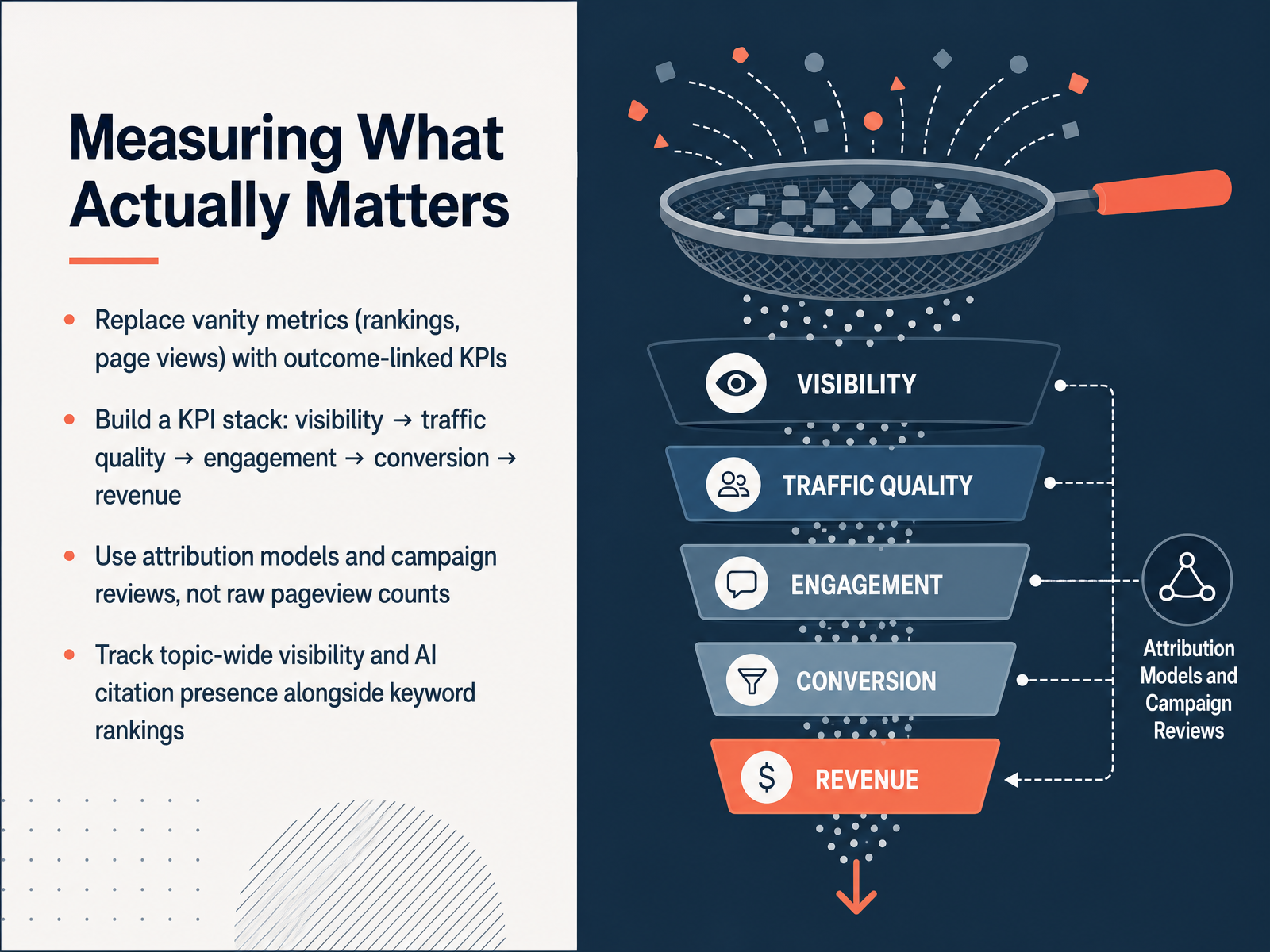
 - 04Measuring What Actually MattersLet's talk about measurement, because this is where strategy either gets validated or falls apart. The trap is measuring rankings and page views like they're the goal. They're not. They're activity. What you want is impact. So start by replacing vanity metrics with outcome-linked KPIs. Instead of asking, did we rank? ask, did the right people find us, and did they take action? Build a KPI stack that connects visibility to results. Track traffic quality, then engagement, then conversion, and finally revenue. Each layer tells you whether the layer below is actually working. For attribution, don't rely on raw pageview counts. Use attribution models and campaign reviews that show how content influences the journey. And remember that keyword rankings are just one slice of visibility now. Track topic-wide presence and whether AI engines cite you. If you're getting cited in AI answers, you're winning even without a click. The shift is simple: measure what moves the business, not what flatters a dashboard. Now, this leads directly to your first core choice, keyword targeting versus topical authority.
 contentmarketinginstitute.comcontentmarketinginstitute.comcontentmarketinginstitute.com+21 min
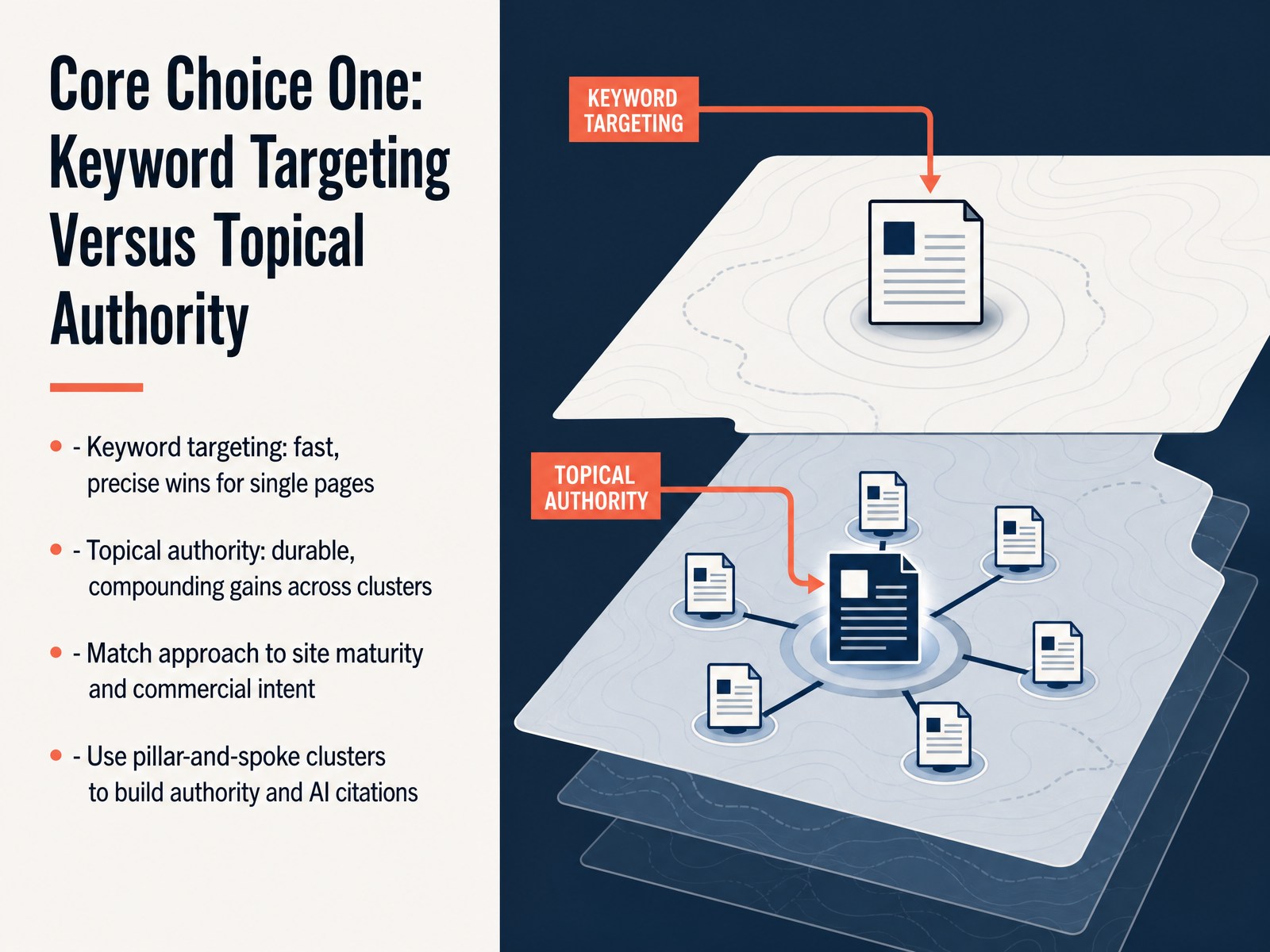
 - 05Core Choice One: Keyword Targeting Versus Topical AuthorityNow let’s talk about the first core choice: keyword targeting versus topical authority. Keyword targeting is precise and fast. You match one page to one query, and you can win position in weeks. It still works best for transactional pages, comparison searches, and pricing pages — the bottom-of-funnel terms where intent is clear. But here’s the limit. That single page is fragile. It can be summarized by an AI Overview, and it doesn’t build any surrounding trust. Topical authority is the opposite. It’s slower at first, but it compounds. When you cover a subject in depth — with a pillar page and supporting pieces — you start ranking for long-tail variations you never targeted. That’s what gets you cited by AI systems and what survives core updates. So how do you choose? Match the approach to your current position. If your site is new and you need early wins, lead with keywords on your money pages. Once you have those beachheads, shift your effort into building topical depth. The structural pattern is pillar-and-spoke: one comprehensive pillar, several focused spokes, and internal links flowing both ways. That cluster is what convinces search engines you’re the authority. Keywords win clicks. Topics win trust. And trust is what compounds. Next, let’s look at the second core choice: where to invest between technical foundation, content, and authority building.
 ranktracker.comaristral.comadvancedgedigital.com+22 min
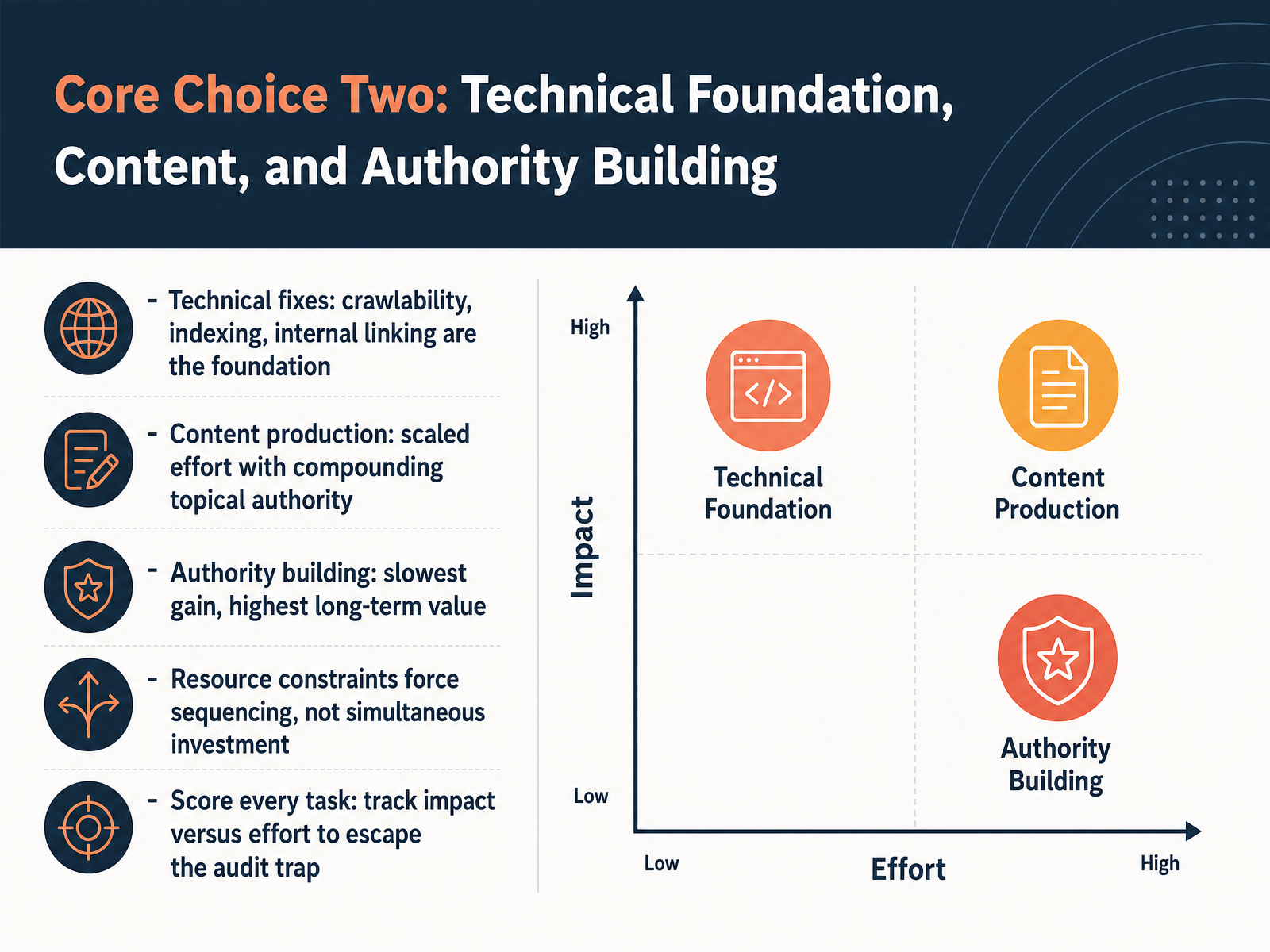
 - 06Core Choice Two: Technical Foundation, Content, and Authority BuildingNow let's look at the second core choice. Your work will fall into three buckets. Technical fixes, content production, and authority building. Technical fixes, like crawlability, indexing, and internal linking, are the foundation. They are sprintable, they lift the performance of every other page, and for most teams they offer the fastest return on hours invested. Content production is a scaled effort. It compounds through topical authority, but the gains are slower because they depend on consistency over time. Authority building is the slowest of all. It has the highest long-term value, but it rarely moves a quarterly report. Here's the reality. Resource constraints force sequencing, not simultaneous investment. You cannot do all three at full strength, so you have to choose. That's where the audit trap comes in. Tools will surface hundreds of issues, and chasing them all is a waste of your time. Instead, score every task on impact and effort. A fix on your pricing page is a ten. The same fix on a three-year-old post about a deprecated feature is a one. Build a simple matrix, defend what ranks, advance what is close, and let the scoring system decide. This keeps your roadmap tied to outcomes, not to the loudest issue in the report. In the next section, we will look at the tradeoff layer, what you actually give up when you choose one path over another.
 tenspeed.iogetspike.aiseolearningcenter.com+22 min
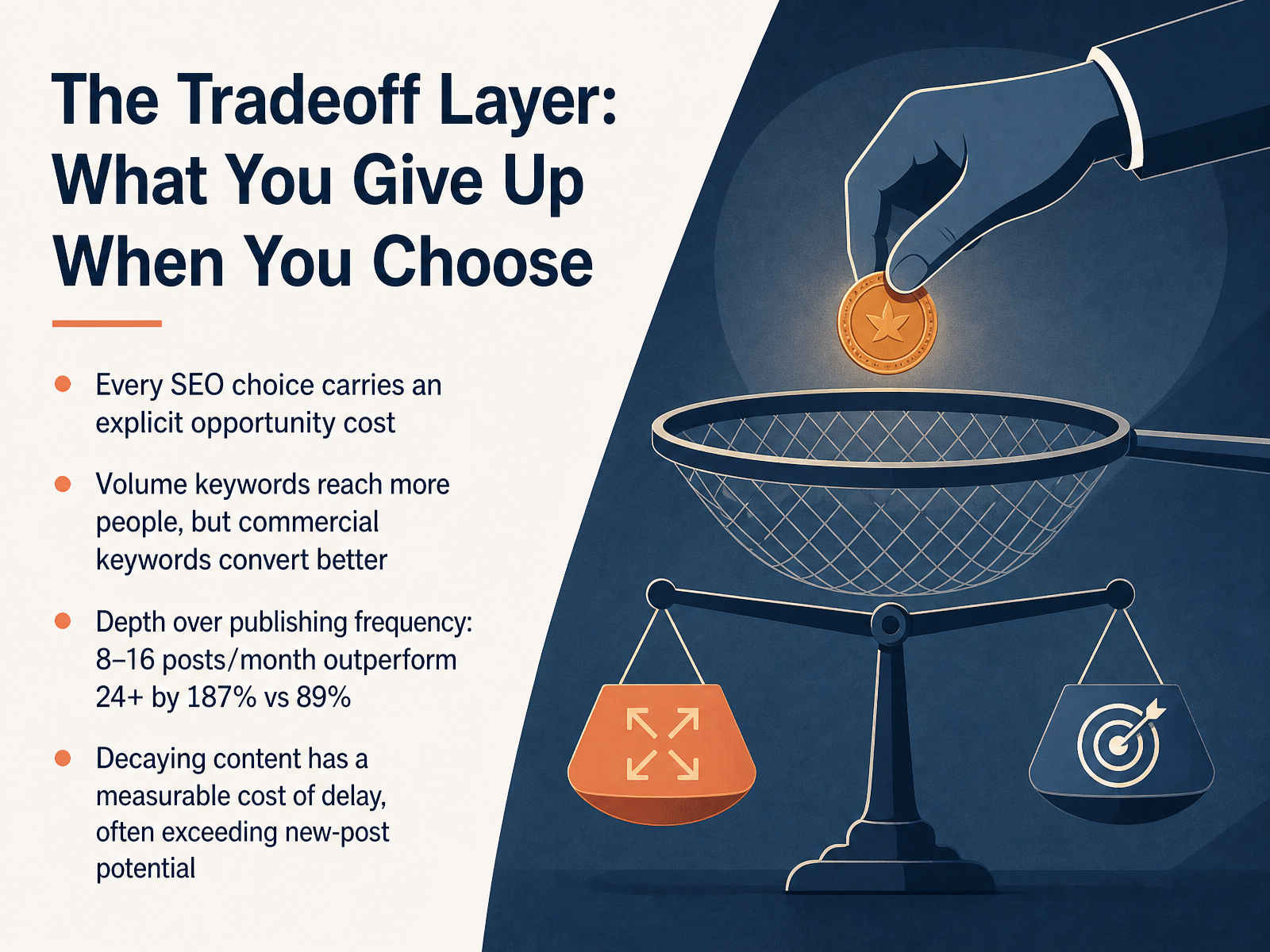
 - 07The Tradeoff Layer: What You Give Up When You ChooseLet’s talk about what you actually give up when you choose. Every SEO decision carries an explicit opportunity cost. Volume keywords reach more people, but commercial keywords convert better. The question isn’t which is smarter—it’s which serves your goal right now. The same logic applies to publishing frequency. Data shows that sites publishing eight to sixteen posts a month see an average traffic jump of 187 percent. Push past twenty-four, and that number drops to 89 percent, with rankings declining by about 14 percent after the third month. Why? Because quality collapses. That’s the cost of over-publishing. There’s another tradeoff hiding in your existing content. A decaying post carries a measurable cost of delay. Let it slip from position four to position seven, and you might lose 65 visits a month—nearly a thousand dollars in pipeline value, depending on your conversion rate. That’s often more than a brand-new post would bring in over the same period. So the tradeoff isn’t just new versus more. It’s new versus refreshed. Protecting what you already have is frequently the higher-leverage move. Keep that in mind as we look at the cadence question next: how to balance depth against speed in your publishing rhythm.
 searchengineland.comblog.hubspot.cominblog.ai+22 min
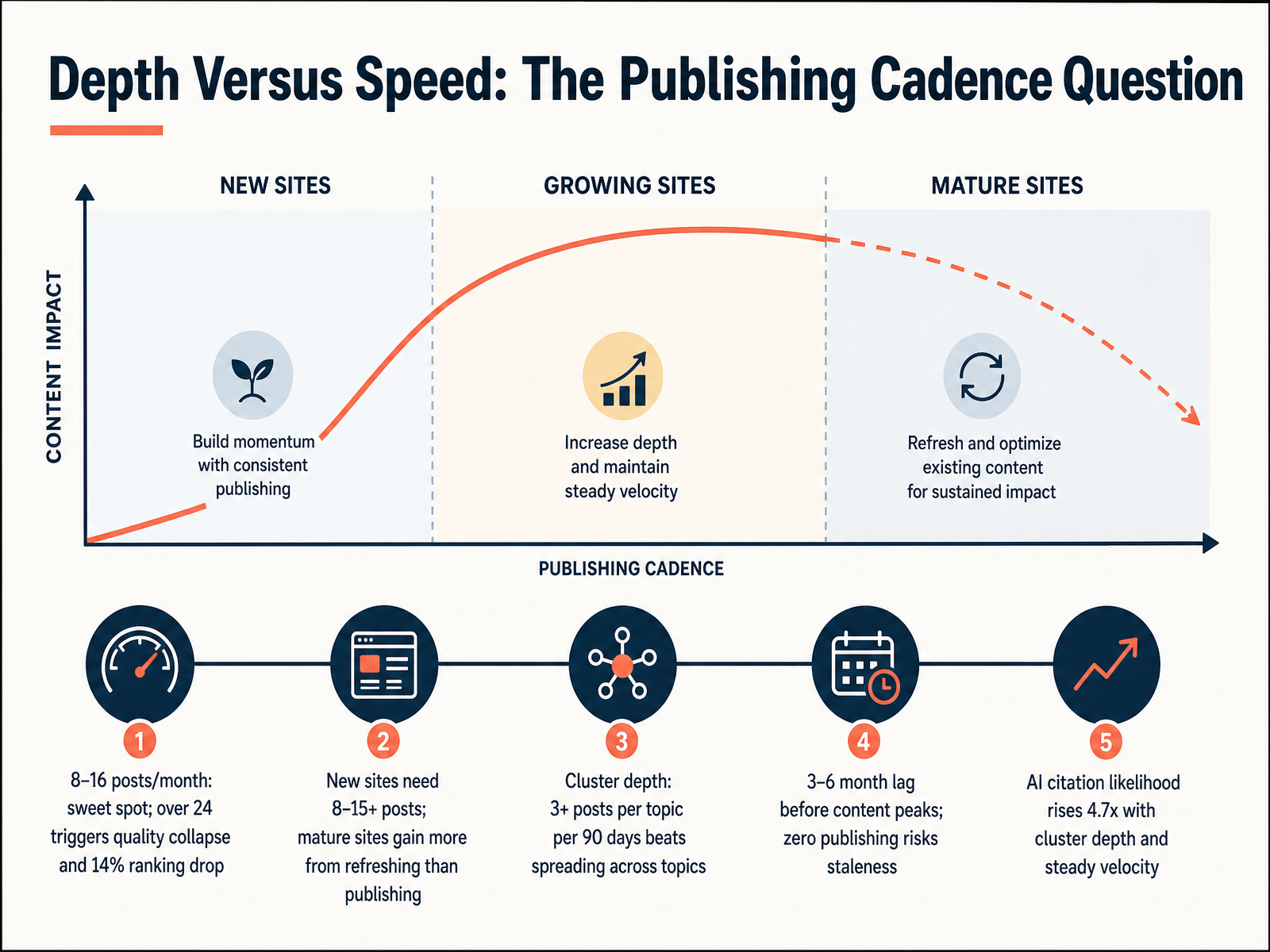
 - 08Depth Versus Speed: The Publishing Cadence QuestionNow let's look at the publishing cadence question. The data keeps pointing to a clear sweet spot: eight to sixteen posts per month. Above twenty-four, you hit a quality collapse and rankings drop by fourteen percent. But that range isn't universal. New sites need more volume—eight to fifteen posts or more—just to build a footprint. Mature sites, by contrast, get more from refreshing existing content than from adding new pages. Cluster depth matters more than raw output. Three or more posts per topic cluster within a ninety-day window consistently beats spreading the same effort across many topics. And remember the lag: content takes three to six months to peak, so don't expect immediate returns. Publishing nothing for months risks staleness, and the data shows organic traffic plateaus without fresh fuel. AI citation likelihood is four point seven times higher with cluster depth and steady velocity. So the decision is clear: match cadence to your site's maturity, and prioritize cluster depth over spread.
 searchengineland.comblog.hubspot.cominblog.ai+22 min
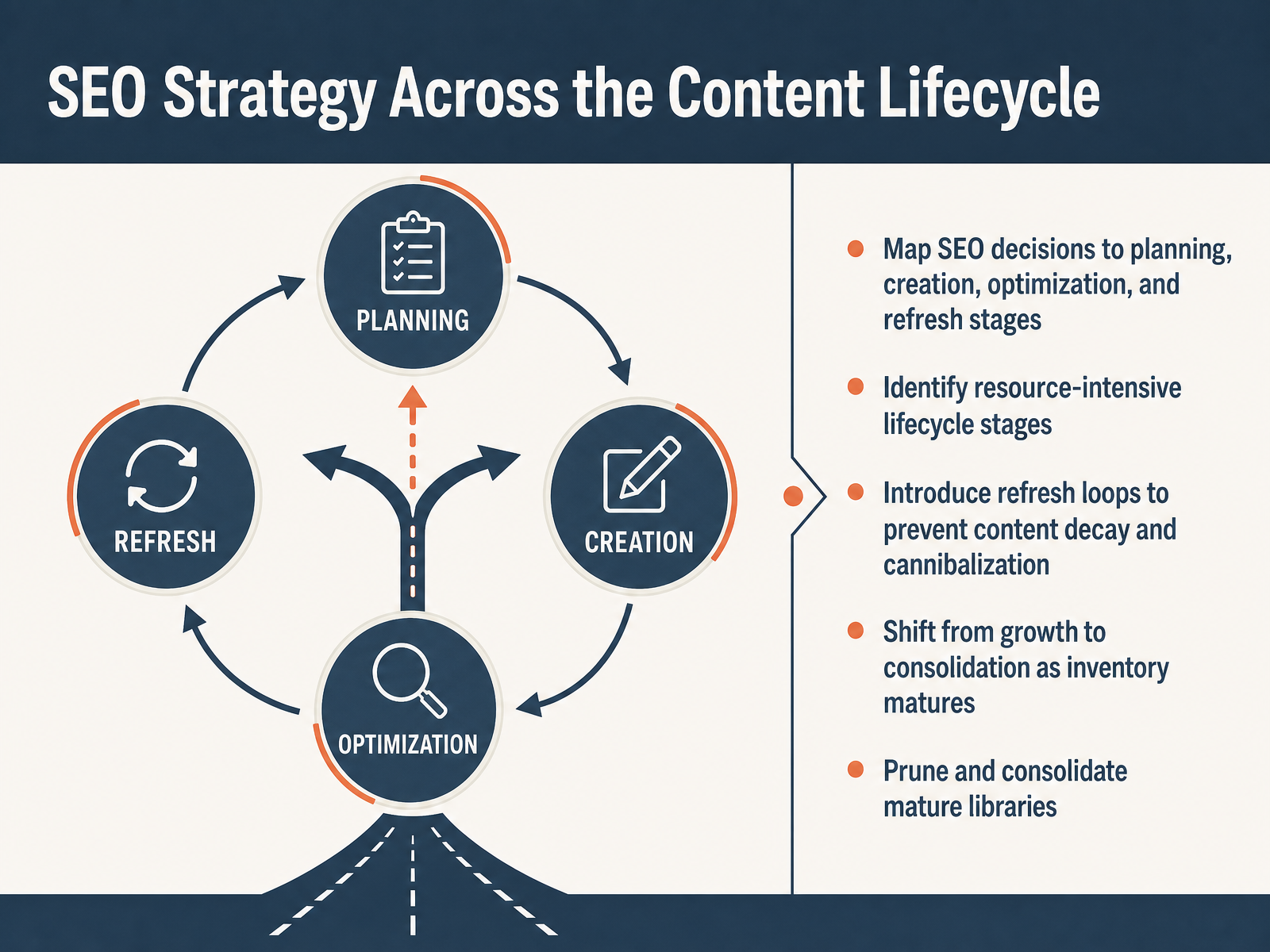
 - 09SEO Strategy Across the Content LifecycleLet’s now map those strategic decisions onto the content lifecycle itself. Planning, creation, optimization, and refresh are not phases you work through once. They are a continuous loop. As your library matures, the resource-heavy stage shifts. Early on, creation consumes nearly everything. Later, two things quietly become the real cost: maintenance and cannibalization. The fix is a refresh loop. Schedule it monthly. Pull a ninety-day delta from Search Console, and for any page where impressions drop by a quarter or click-through slips, update the headers, add a fresh section, and rewire internal links. That prevents decay before it forces a drastic response. And once your inventory reaches maturity, the smart move is consolidation, not expansion. Prune thin pages that rank for nothing. Merge overlapping targets instead of letting them compete. This is how you shift from growth into consolidation without losing your edge. Now, let’s look at the decision frameworks that will help you make these ongoing choices consistently.
 searchengineland.comblog.hubspot.cominblog.ai+22 min
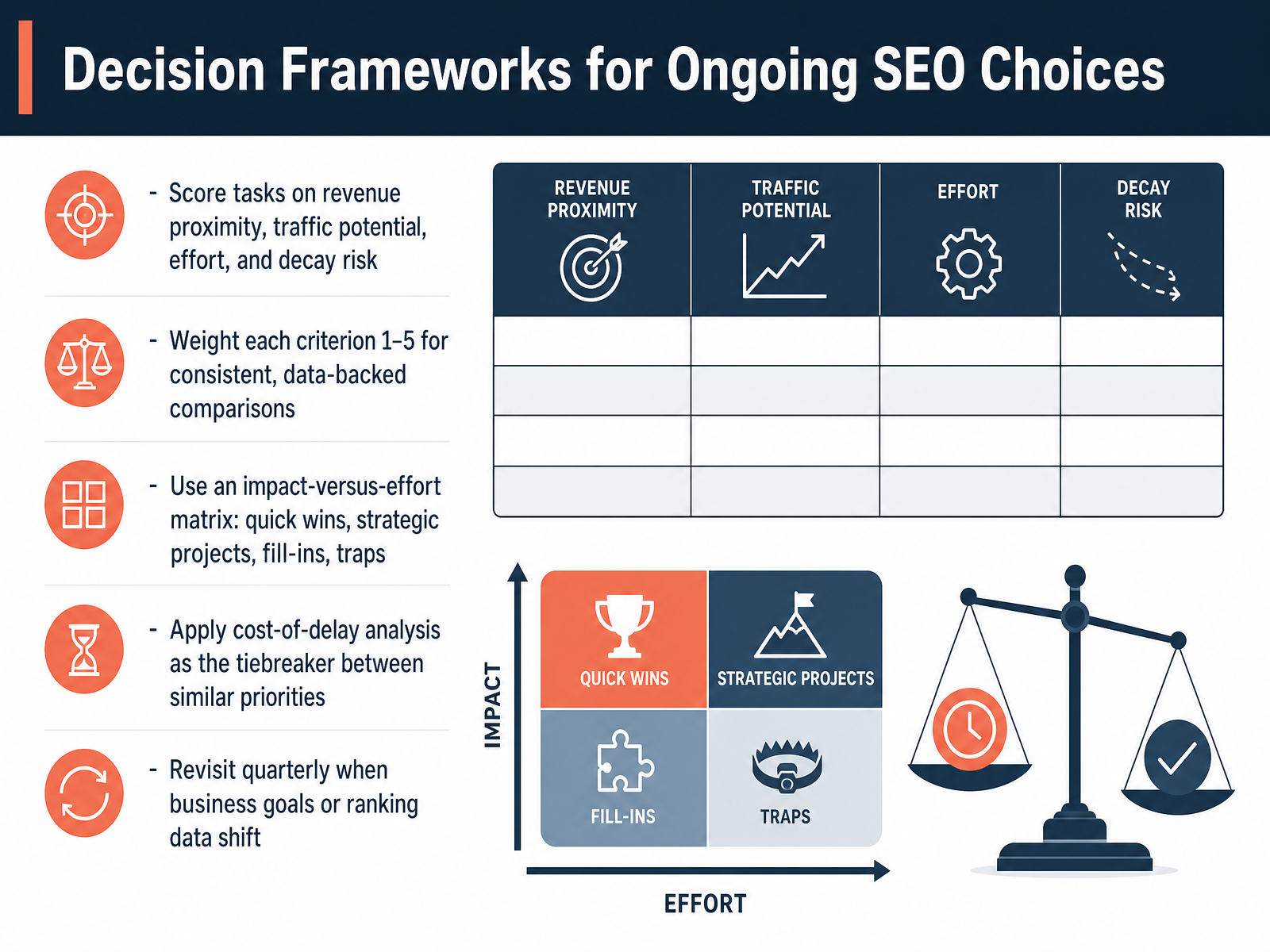
 - 10Decision Frameworks for Ongoing SEO ChoicesOnce you have your scoring model in place the real work begins—deciding what to ship this week. The impact-versus-effort matrix gives you four clear buckets. Quick wins are high impact, low effort. Do these first. Strategic projects are high impact but expensive—schedule them deliberately. Fill-ins are low impact, low effort. Batch them in spare time. And traps are low impact, high effort. Ignore them entirely. Score every task on revenue proximity, traffic potential, effort, and decay risk, using a one-to-five scale. That consistency turns opinion into debate. When two priorities score similarly, run a cost-of-delay analysis. Ask what it costs to wait a month. A page sliding from position four to seven is losing tangible pipeline every week. Revisit your scoring quarterly—business goals shift, rankings shift, and last quarter’s quick win may be this quarter’s trap. The framework keeps you honest. It ensures you are always shipping the right task, not just the loudest one. Next, let’s talk about how to communicate these tradeoffs to stakeholders.
 tenspeed.iogetspike.aiseolearningcenter.com+22 min
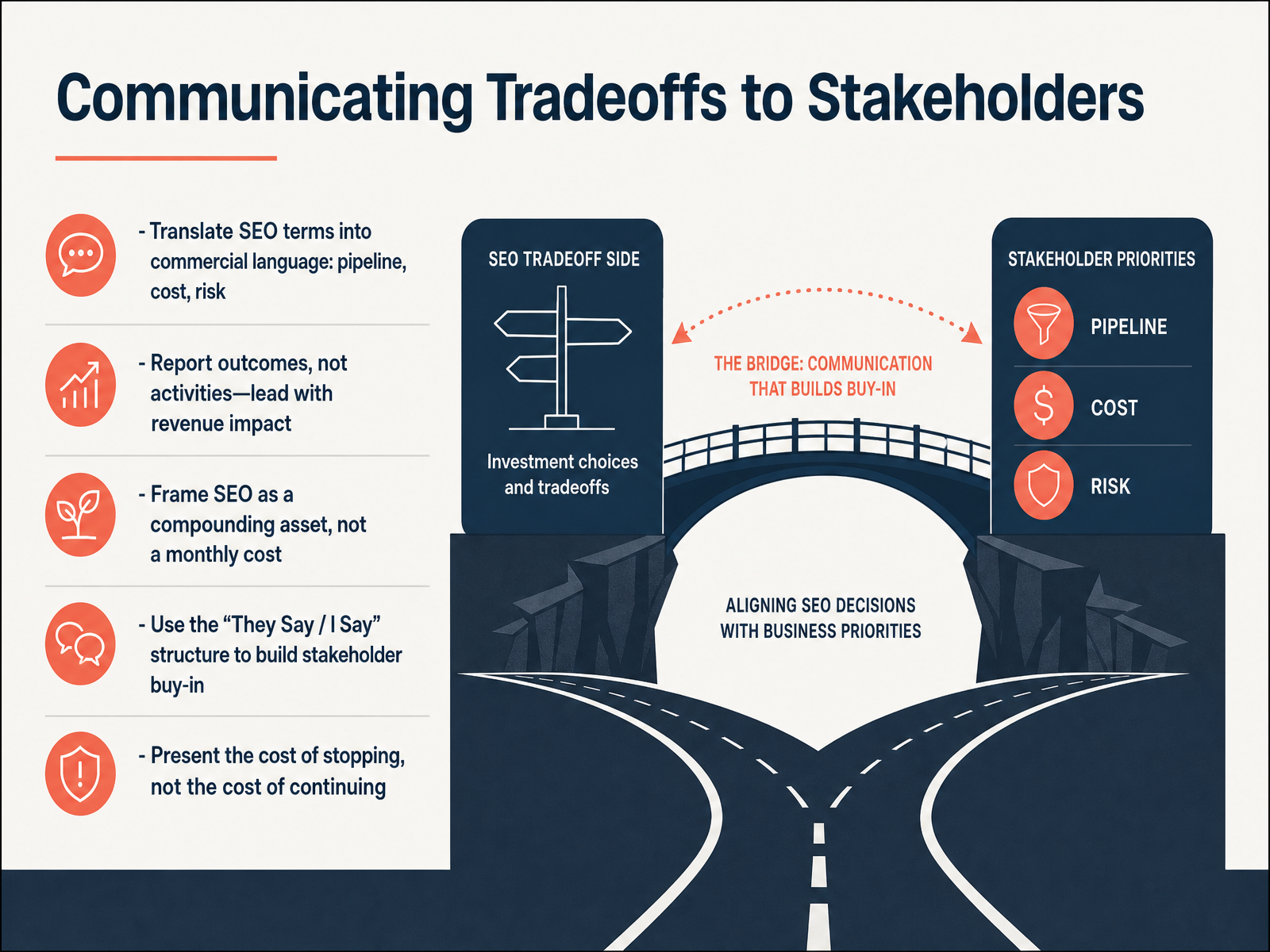
 - 11Communicating Tradeoffs to StakeholdersNow let's talk about how you communicate these tradeoffs to the people who control the budget. The first step is translation. Stop talking about keywords, rankings, and crawl budgets. Talk about pipeline, cost, and risk instead. Second, report outcomes, not activities. Nobody needs a list of the forty-seven pages you optimized. They need to know that organic revenue grew twelve percent while acquisition cost dropped. Lead with the revenue impact. Third, frame SEO as a compounding asset, not a monthly cost. Unlike paid search, which stops the moment you stop paying, organic rankings keep working for you months after the work is done. Fourth, use the They Say, I Say structure. Acknowledge the common belief, then present your data-driven perspective. For example, they say SEO takes too long to show results; you say here is the compounding curve from our Q4 investment. Finally, present the cost of stopping, not the cost of continuing. If we pause now, rankings decay over six to twelve months, and rebuilding them takes another year. That's the real risk. When you frame it this way, you're not asking for a favor. You're making a case for protecting an asset. Now, let's look at the traps that can derail this whole strategy.
 contentmarketinginstitute.comcontentmarketinginstitute.comcontentmarketinginstitute.com+21 min
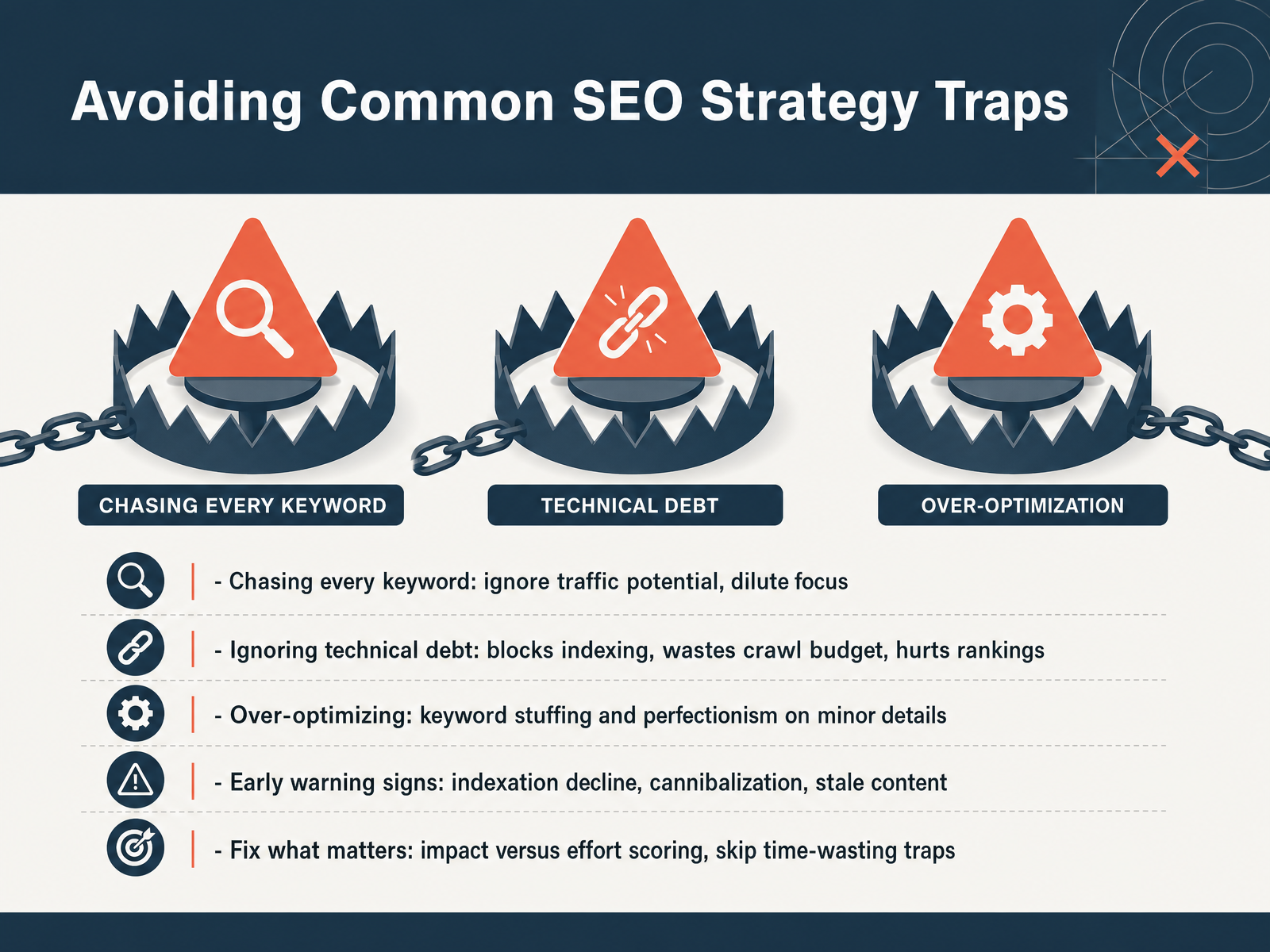
 - 12Avoiding Common SEO Strategy TrapsAvoiding common SEO strategy traps is as much about restraint as it is about action. The first trap is chasing every keyword. If a term lacks genuine traffic potential or doesn't serve your business goals, it's just noise that dilutes your focus. Second, ignoring technical debt. Broken pages and indexing errors block Google from evaluating your work. They waste crawl budget and quietly hurt rankings. Third, over-optimization. Keyword stuffing is a clear risk, but so is perfectionism on minor details like chasing flawless Core Web Vitals scores across every page. Both waste effort. Watch for the early warning signs: declining indexation, keyword cannibalization, or stale content losing position. When you spot these, resist the urge to fix everything at once. Use an impact versus effort score. This is your filter. Fix what moves the needle for your actual business outcomes. Skip the traps that simply eat hours. In short, treat SEO as a prioritization discipline. Concentrate effort where it matters, and you will compound results while avoiding the most costly mistakes. Now, let's look at how these tradeoffs play out across different industries with some case studies.
 tenspeed.iogetspike.aiseolearningcenter.com+21 min
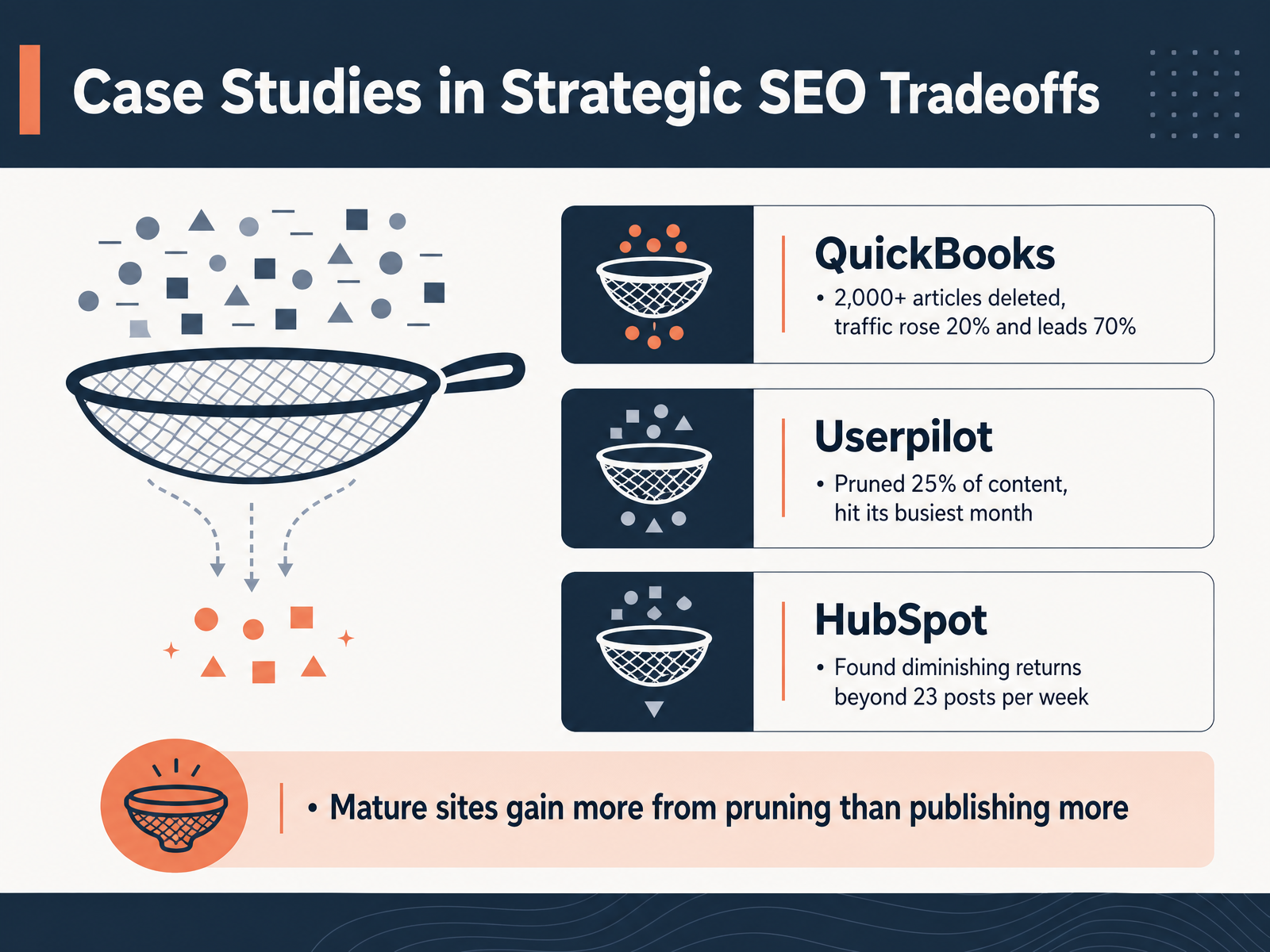
 - 13Case Studies in Strategic SEO TradeoffsLet's ground all of this in real examples, because the tradeoffs become much clearer when you see them play out. QuickBooks deleted more than two thousand articles from its resource center. Within weeks, traffic rose twenty percent, and leads jumped seventy percent. Deleting content felt risky, but the low performers were draining crawl budget and diluting authority. Userpilot pruned twenty-five percent of its content and hit its busiest month ever. Same mechanism, same result. HubSpot, on the other hand, ran a controlled experiment and found clear diminishing returns beyond twenty-three posts per week. Publishing more didn't add traffic, it just added maintenance. The pattern across all of these cases is consistent: mature sites gain more from pruning than from publishing more. The cost of keeping weak content isn't just the hosting, it's the crawl budget, the internal link equity, and the diluted topical authority that bury your best pages. So the strategic choice isn't between publishing more or less. It's about identifying where your content is already compounding, and redirecting effort there. That's the mindset you'll need for the final piece, planning your next ninety days.
 searchengineland.comblog.hubspot.cominblog.ai+22 min
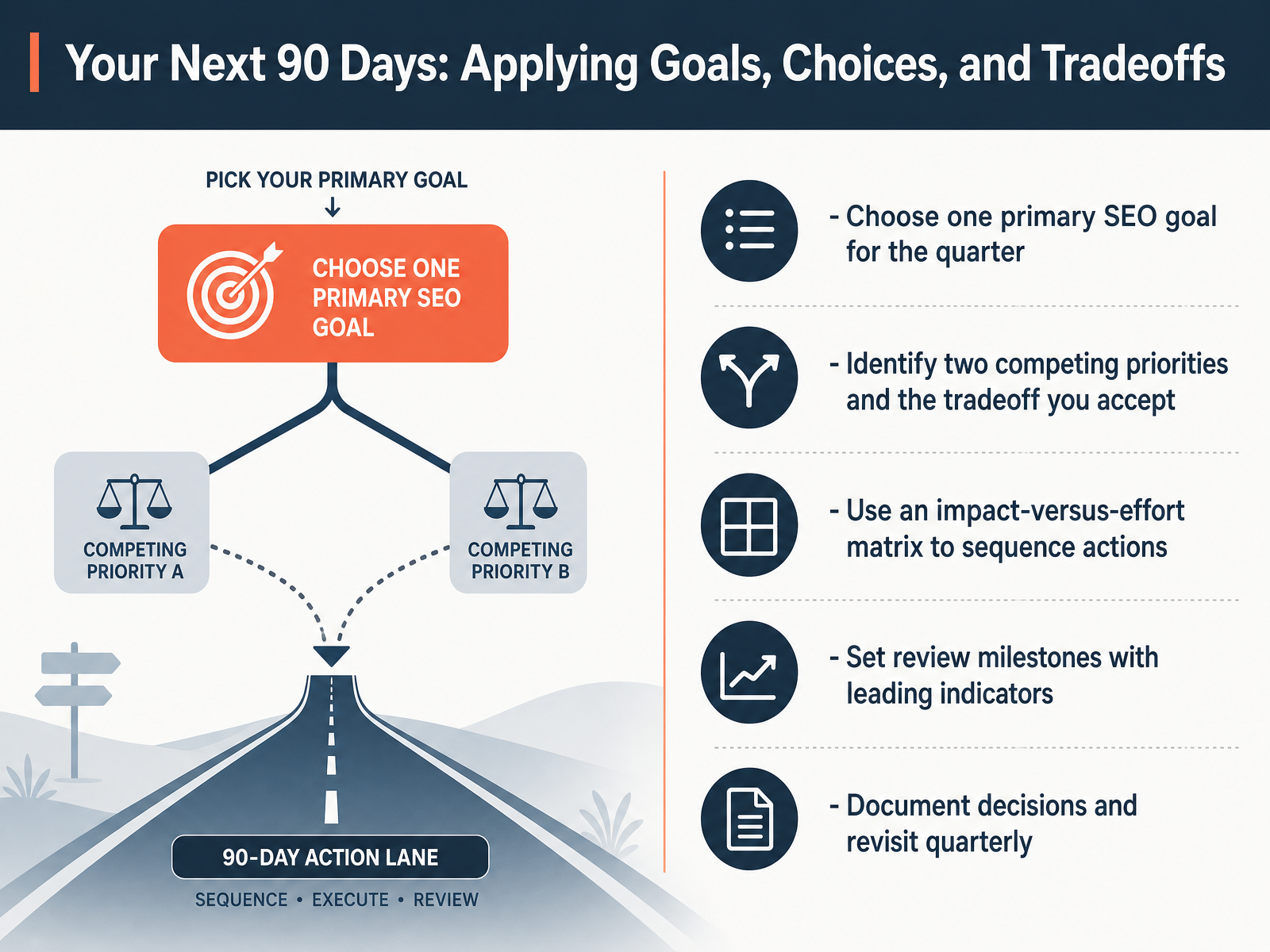
 - 14Your Next 90 Days: Applying Goals, Choices, and TradeoffsAs we wrap up, let's turn this framework into your next ninety days. Pick one primary SEO goal for the quarter—defending rankings, advancing mid-tier keywords, or opening new whitespace. This becomes your anchor, and it forces the next decision. Identify two competing priorities, and name the tradeoff you are accepting. If you choose mid-tier advancement, accept that new category expansion waits. If you choose whitespace, accept that position eleven to thirty pages may not move this quarter. Write that tradeoff down; it will protect you from second-guessing later. Next, sequence your actions using an impact-versus-effort matrix. High-impact, low-effort items go first. High-impact, high-effort items get planned carefully. Everything else waits or gets dropped. Set review milestones with leading indicators—impressions, click-through rate, and position distribution—so you can see movement before revenue shows up. Finally, document every decision and revisit it in ninety days. You are not locking in a plan forever; you are building a decision log you can audit. Thank you for working through this. You now have the tools to make strategic calls with confidence, not just execute tactics. Go make the tradeoffs that matter.
 tenspeed.iogetspike.aiseolearningcenter.com+21 min
Take the deck with you
Download this course as a file — free, no sign-up needed.
- PDF handoutEvery slide page, ready to print or share.15 pages · 3.3 MBDownload
- Narrated PowerPointThe deck that presents itself — every slide carries the digital human's narration video.15 pages · 17.1 MBDownload
- PowerPoint slidesThe full deck as a .pptx — open it in PowerPoint, Keynote, or Google Slides.15 pages · 3.2 MBDownload
Free to use in your own training — please keep the PersonWise credit page at the end.
Have your own deck? Turn it into a course
Sources consulted
Web sources consulted while building this course.
- Topical Authority vs Keyword Targeting: What Wins in 2026? — ranktracker.com
- Topical Authority SEO vs Keyword Targeting: What Actually Moves Rankings | Aristral — aristral.com
- Topical Authority vs Traditional Keyword Strategy: What Wins in 2026? — advancedgedigital.com
- Keywords vs Key Topics: Main Differences & SEO Strategy — miniloop.ai
- Topical Authority vs Keyword Volume: What Should Your SEO Strategy Prioritize? — stellites.com
- Check Your SEO Strategy Vitals With These 5 Questions — contentmarketinginstitute.com
- 19+ Ideas To Update Your Traditional SEO Strategy — contentmarketinginstitute.com
- How To Build a Content Strategy That Survives AI Search — contentmarketinginstitute.com
- How To Design Content Marketing Metrics To Answer Key ... — contentmarketinginstitute.com
- SEO Content Plan Tips — contentmarketinginstitute.com
- SEO Priority: A Framework for B2B Marketing Teams | Ten Speed — tenspeed.io
- SEO Prioritization: A Scoring Framework for Shipping What Matters First | Spike — getspike.ai
- SEO Prioritization Matrix - SEO Learning Center — seolearningcenter.com
- The Impact-Effort Framework for Prioritizing SEO Audit Findings — licheo.com
- SEO Prioritization Framework for Growth Teams — growths.xyz
- The data-backed case for publishing less content — searchengineland.com
- Quality vs. Quantity: A 6-Month Analysis of the Age-Old Blogging Debate — blog.hubspot.com
- How Often Should You Publish Blog Posts? Here's What Our 12-Month Data Says - inblog's blog — inblog.ai
- Content Velocity 2026: The Sweet Spot Data Reveals — thestacc.com
- Why more content is no longer a reliable way to grow SEO — searchengineland.com