Begin
14 pages · ~28 min
Critical Thinking Skills and Applications
Develop critical thinking skills by exploring thinking types, patterns, and practical examples to enhance decision-making and problem-solving.
A digital instructor presents all 14 pages. Hold “Ask” at any point and ask out loud — the answer comes from this course. No sign-up needed.
What you’ll learn
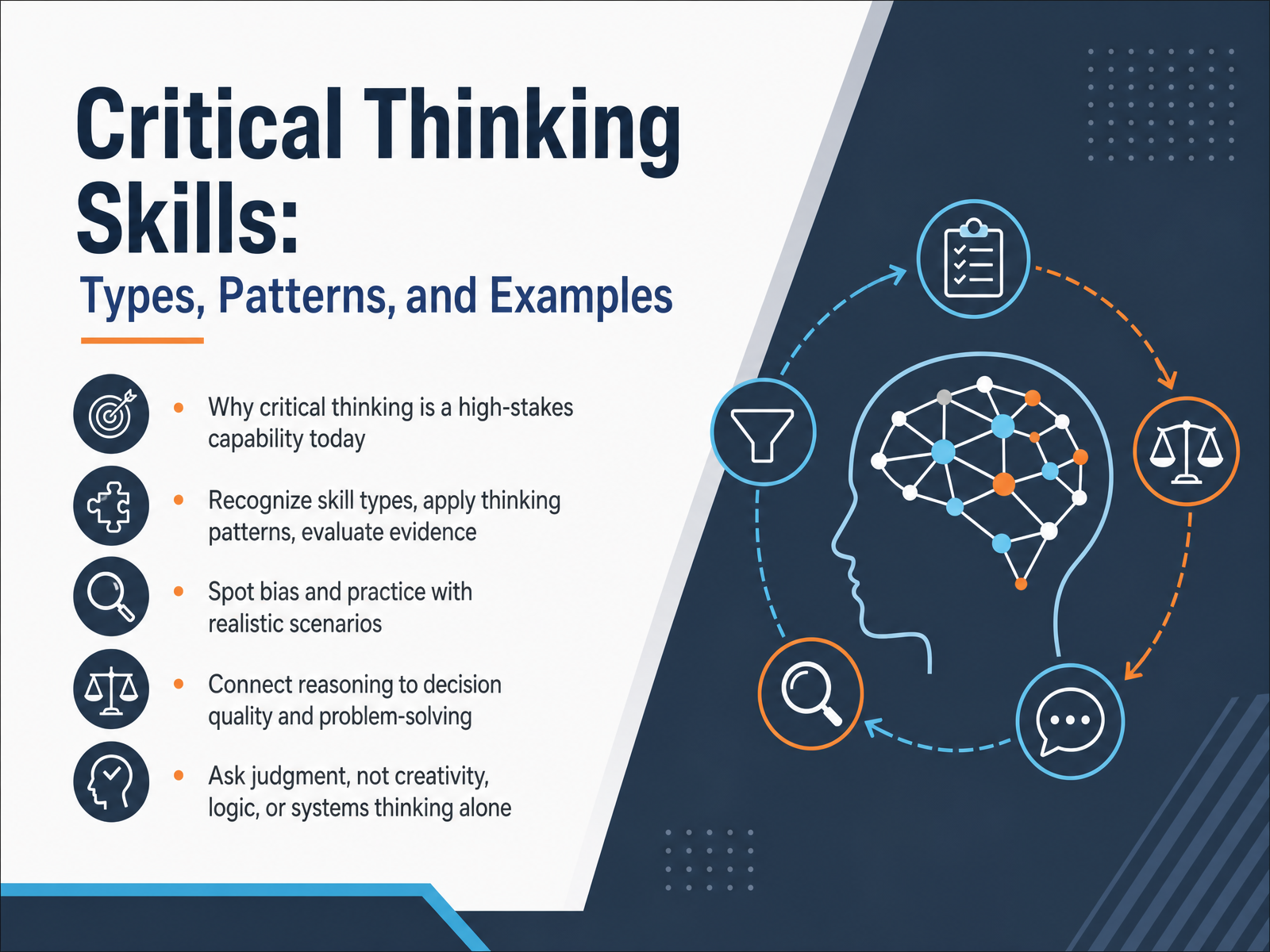
- 01Critical Thinking Skills: Types, Patterns, and ExamplesWelcome. Think about the last time your team made a decision that didn’t go as planned. Was the problem a lack of data, or was it a gap in how you reasoned through that data? Today, we’re going to build a capability that is rapidly becoming non-negotiable in the modern workplace: critical thinking. We’ll move past vague definitions and focus on skills you can actually use. You’ll learn to recognize different types of critical thinking, apply specific reasoning patterns, and evaluate evidence like a professional. You’ll also get to spot bias as it happens and practice with realistic scenarios that mirror the challenges on your desk right now. The goal here is simple: connect sharper reasoning directly to better decisions and stronger problem-solving. And remember, we aren't talking about creativity, raw logic, or systems thinking in isolation. We are focusing on judgment. By the end of this, you should have a practical toolkit to improve the quality of your team’s choices. Let’s start by looking at why this skill matters so much right now.uschamber.comgov.scotuschamber.com+21 min
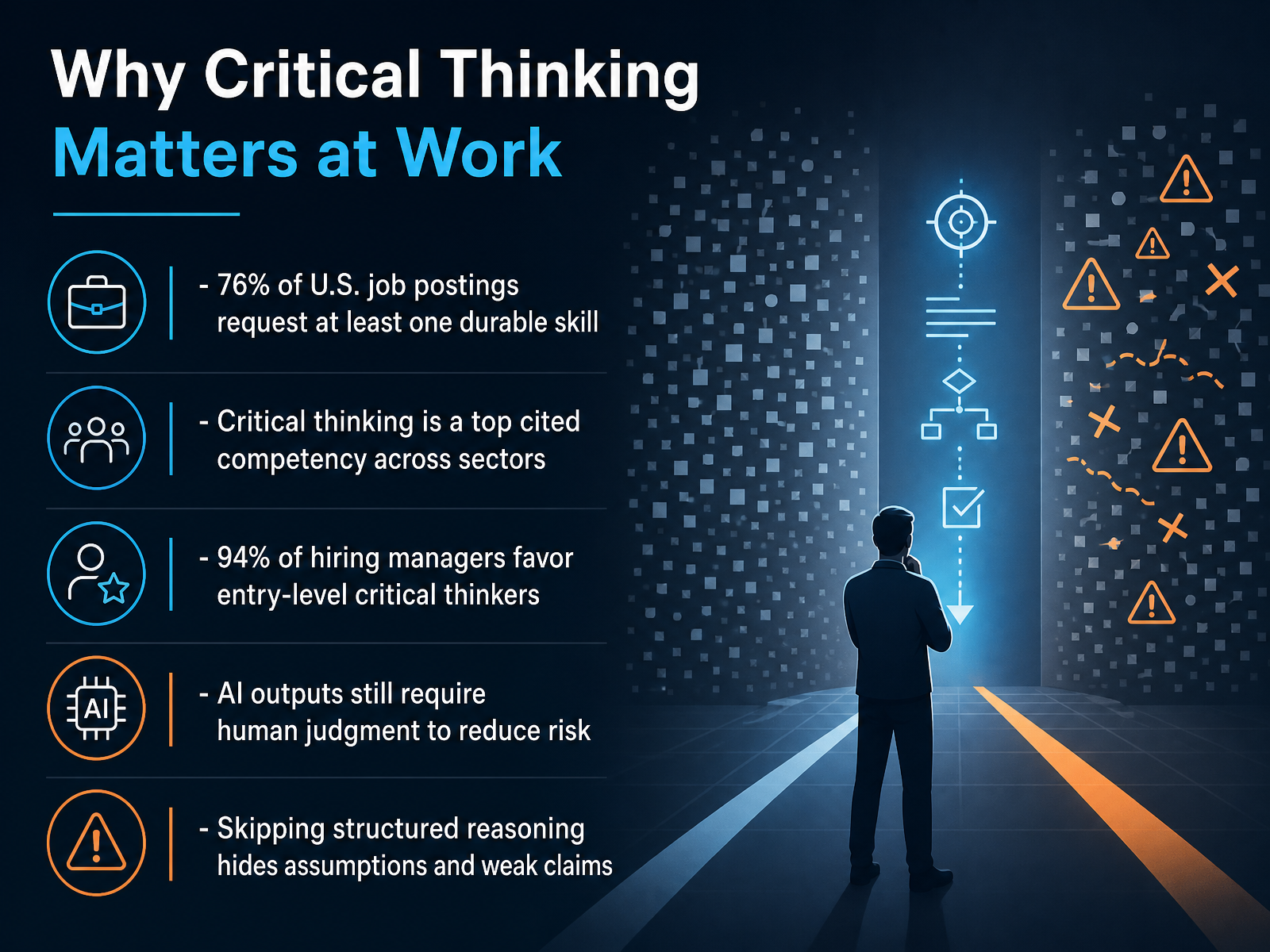
- 02Why Critical Thinking Matters at WorkThink about the last time your team made a decision under pressure. How confident were you that the reasoning was solid? That's what this slide is about. Employer demand for critical thinking has become impossible to ignore. A 2025 report analyzing millions of job postings found that seventy-six percent now request at least one durable skill like critical thinking. Hiring managers consistently rank it among the top competencies across sectors. In fact, ninety-four percent say they are more likely to hire an entry-level candidate who can demonstrate critical thinking and problem solving. Adding to this urgency is the rise of AI. Tools can generate fast answers, but they cannot replace human judgment. Blindly accepting an output without scrutiny creates real risk. When teams skip structured reasoning, assumptions go unchallenged, and weak claims slip through. But when you make reasoning explicit, decisions become defensible and stronger. Keep this in mind as we move into our next section, where we break down a working definition of critical thinking.
 uschamber.comgov.scotuschamber.com+22 min
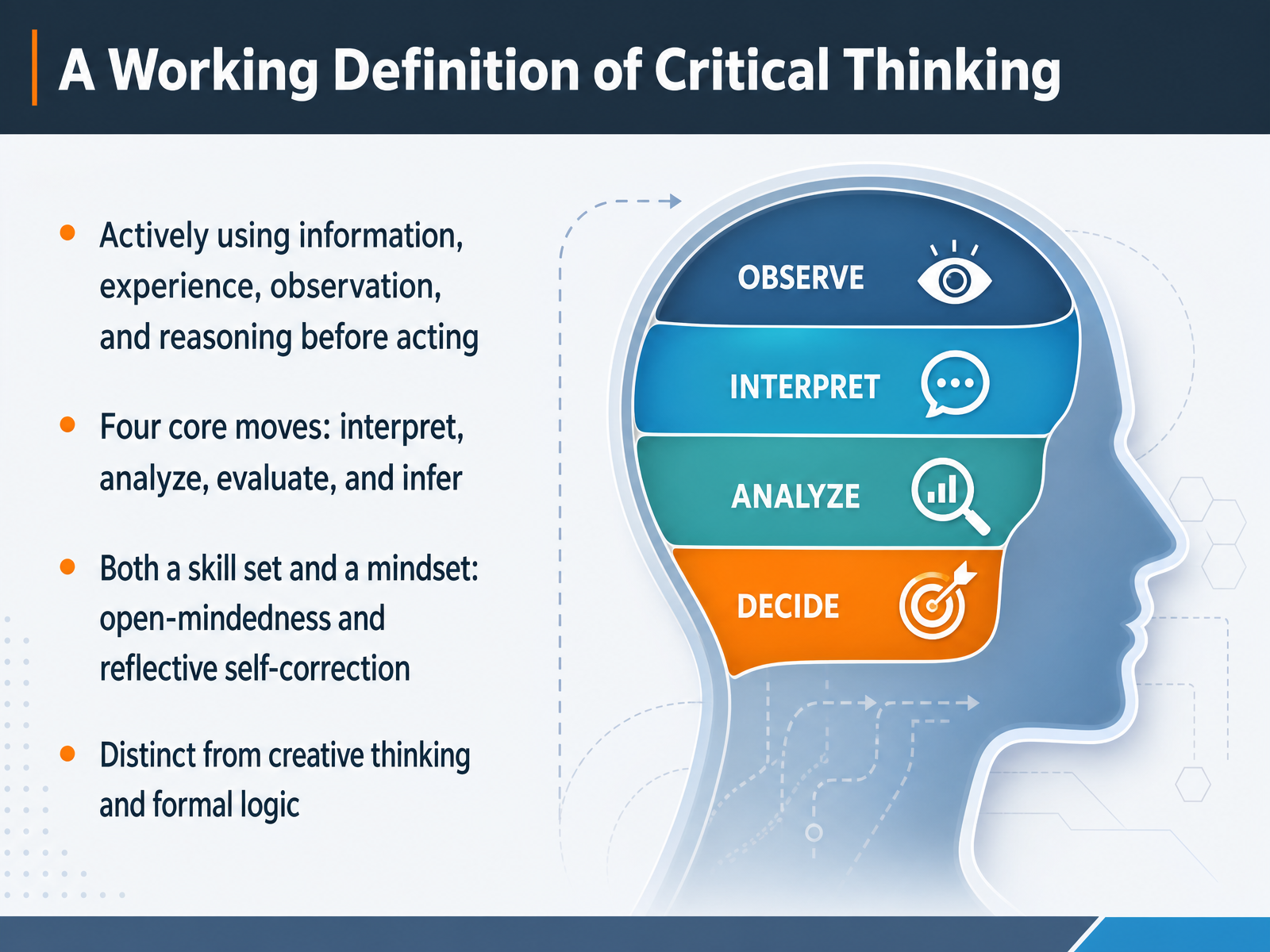
 - 03A Working Definition of Critical ThinkingSo, what do we actually mean by critical thinking at work? It is not about being negative or finding fault with every idea. Think of it as actively using information, experience, observation, and reasoning before you act. When you do this, you are making four core moves. You interpret the situation to understand what is really being said. You analyze the available information. You evaluate the evidence. And you infer what is likely to happen next. But this is not just a checklist of skills. It is also a mindset. It means staying open-minded and willing to correct your own thinking when new evidence shows you were wrong. And to keep that clear, critical thinking is distinct from creative thinking, which generates new ideas, and from formal logic, which applies strict rules. Critical thinking is the practical judgment you apply in real decisions. Next, let's look at the core types of critical thinking.
 ets.orgoreilly.comcareer.ucf.edu+21 min
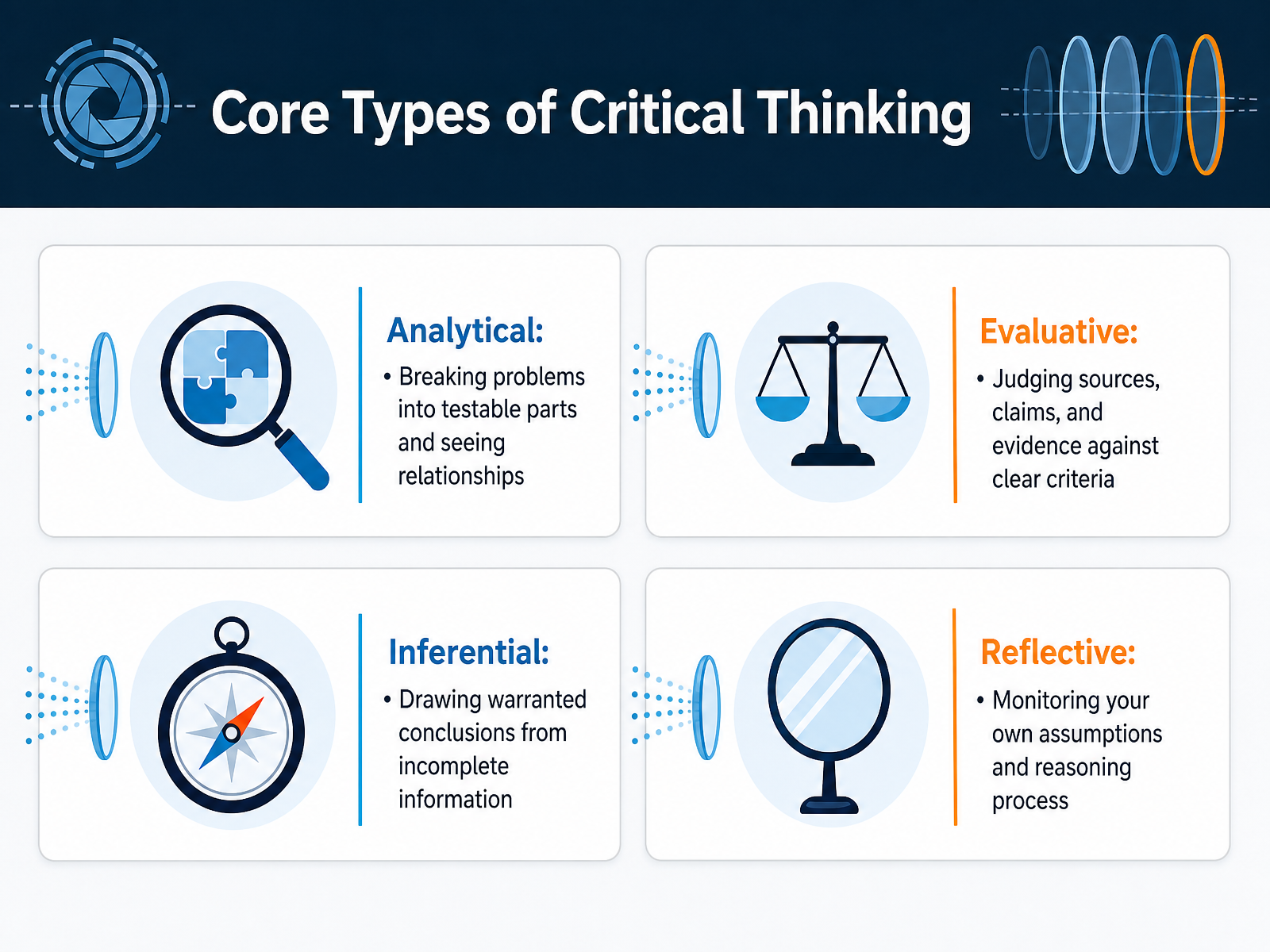
 - 04Core Types of Critical ThinkingLet’s get specific about the four core types of critical thinking you and your team can apply right away. First is analytical thinking. This means breaking a messy problem into smaller, testable parts so you can see how they connect. For example, when a project falls behind, you might separate scope, staffing, and tool issues instead of treating them as one big failure. Second is evaluative thinking. Here you judge the quality of sources, claims, and evidence against clear criteria. If a vendor promises a forty percent cost reduction, evaluative thinking asks what data backs that claim and whether the comparison is fair. Third is inferential thinking. That is drawing warranted conclusions from incomplete information. You rarely have perfect data, but you can still identify the most reasonable next step and explain why. Fourth is reflective thinking. This is about monitoring your own assumptions and reasoning process. It is the pause that lets you catch bias before it becomes a bad decision. Each type gives you a different lens, but the real power comes from combining them.
 ets.orgoreilly.comcareer.ucf.edu+21 min
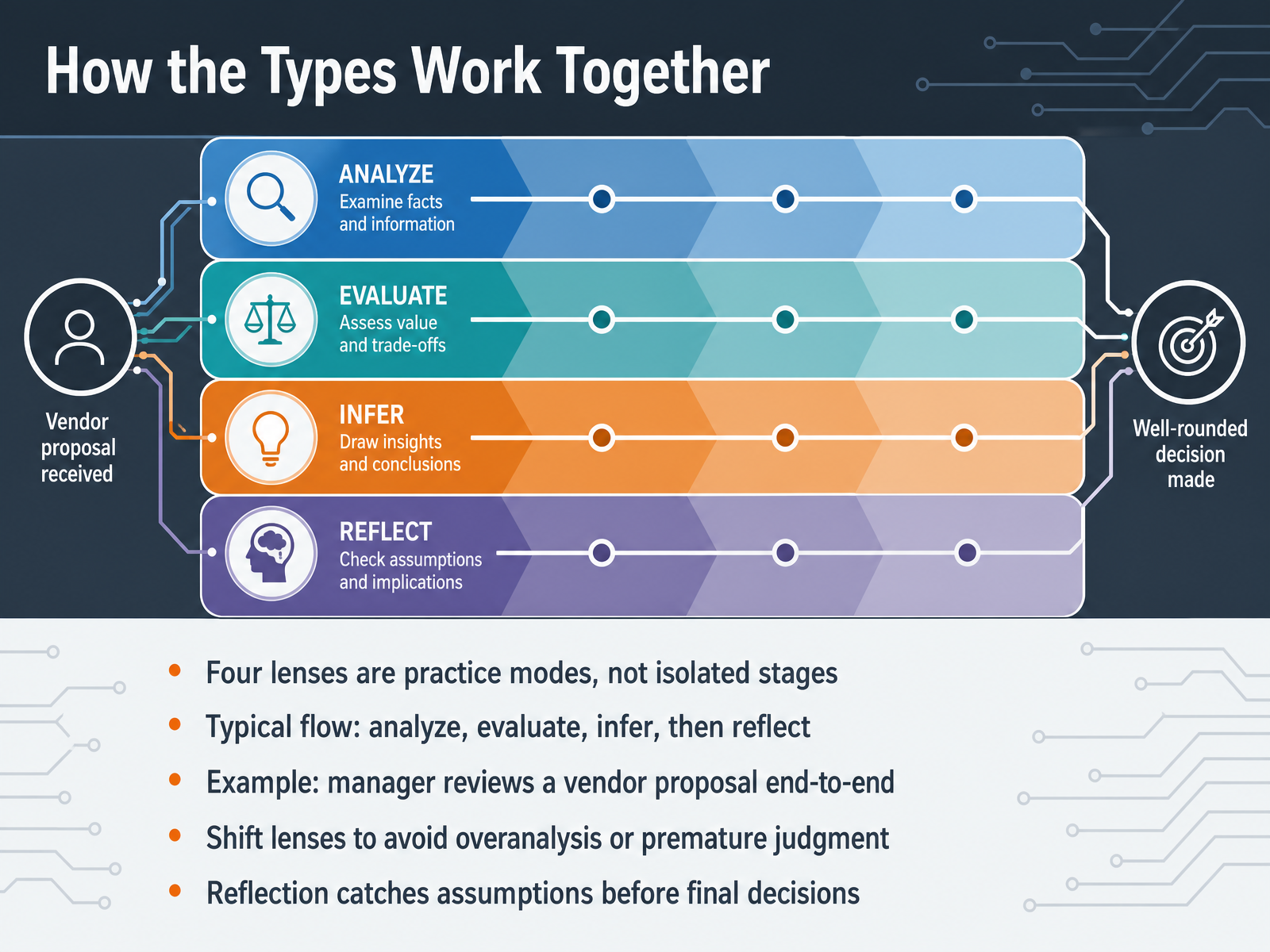
 - 05How the Types Work TogetherNow let's see how these lenses work together in practice. Think of analysis, evaluation, inference, and reflection as four practice modes, not isolated checkpoints. In a real decision, your team flows from one to the next. Say you're a manager reviewing a vendor proposal end to end. You might start by analyzing the proposal, breaking down the pricing, the timeline, and the scope. Then you evaluate, asking whether the claims hold up and whether the vendor can actually deliver. From there you infer, drawing a reasoned conclusion about fit. Finally, you reflect on the process itself, catching any assumptions before you commit. The key is shifting lenses deliberately. Too much analysis without evaluation can stall a decision. Moving too quickly to judgment can miss weak evidence. When your team practices moving through all four modes, you avoid both overanalysis and premature judgment. Up next, we'll look at the reasoning patterns that show up again and again in everyday decisions.
 files.eric.ed.govlearninglab.rmit.edu.aueducation.illinois.edu+21 min
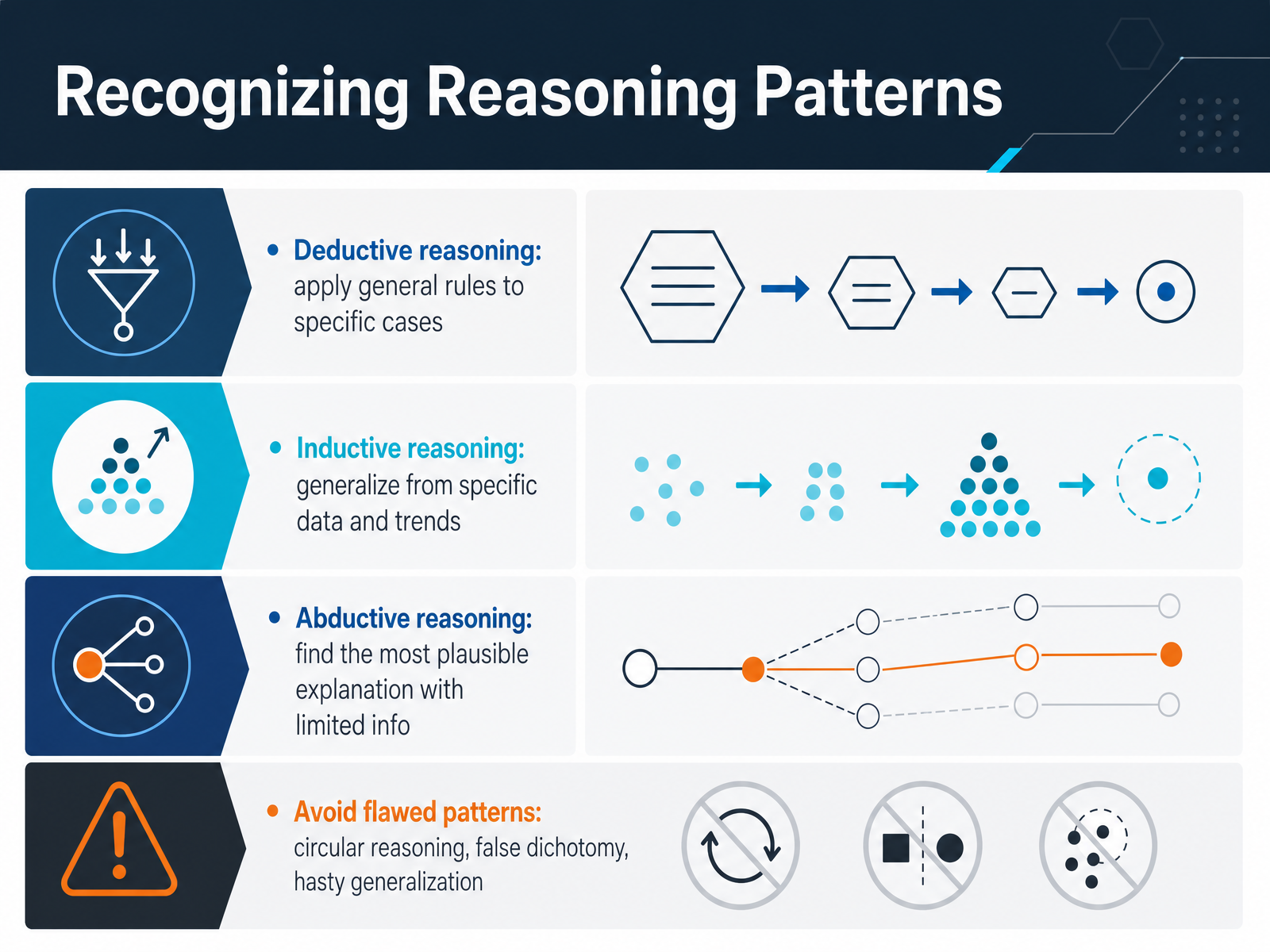
 - 06Recognizing Reasoning PatternsLet’s talk about recognizing reasoning patterns, because you and your team are already using these every day, often without naming them. Deductive reasoning is your top-down tool. You start with a general rule or policy, say, our refund policy requires a receipt, and you apply it to a specific case. Inductive reasoning works bottom-up. You notice a trend in your data, like sales spiking every Friday, and you generalize from it to plan staffing. Abductive reasoning is your best-guess engine when information is limited. You walk into a meeting and see a half-finished whiteboard and coffee cups everywhere. The most plausible explanation? A brainstorming session just ended. Now, watch out for flawed patterns. Circular reasoning just restates the claim as proof. A false dichotomy forces an either-or choice when more options exist. And a hasty generalization jumps to a conclusion from too little evidence. Naming the pattern is the first step to using it well, or catching it when it goes wrong. Next, let’s match these patterns to workplace problems.
 cris.ulima.edu.pedesignsociety.orgmerriam-webster.com+22 min
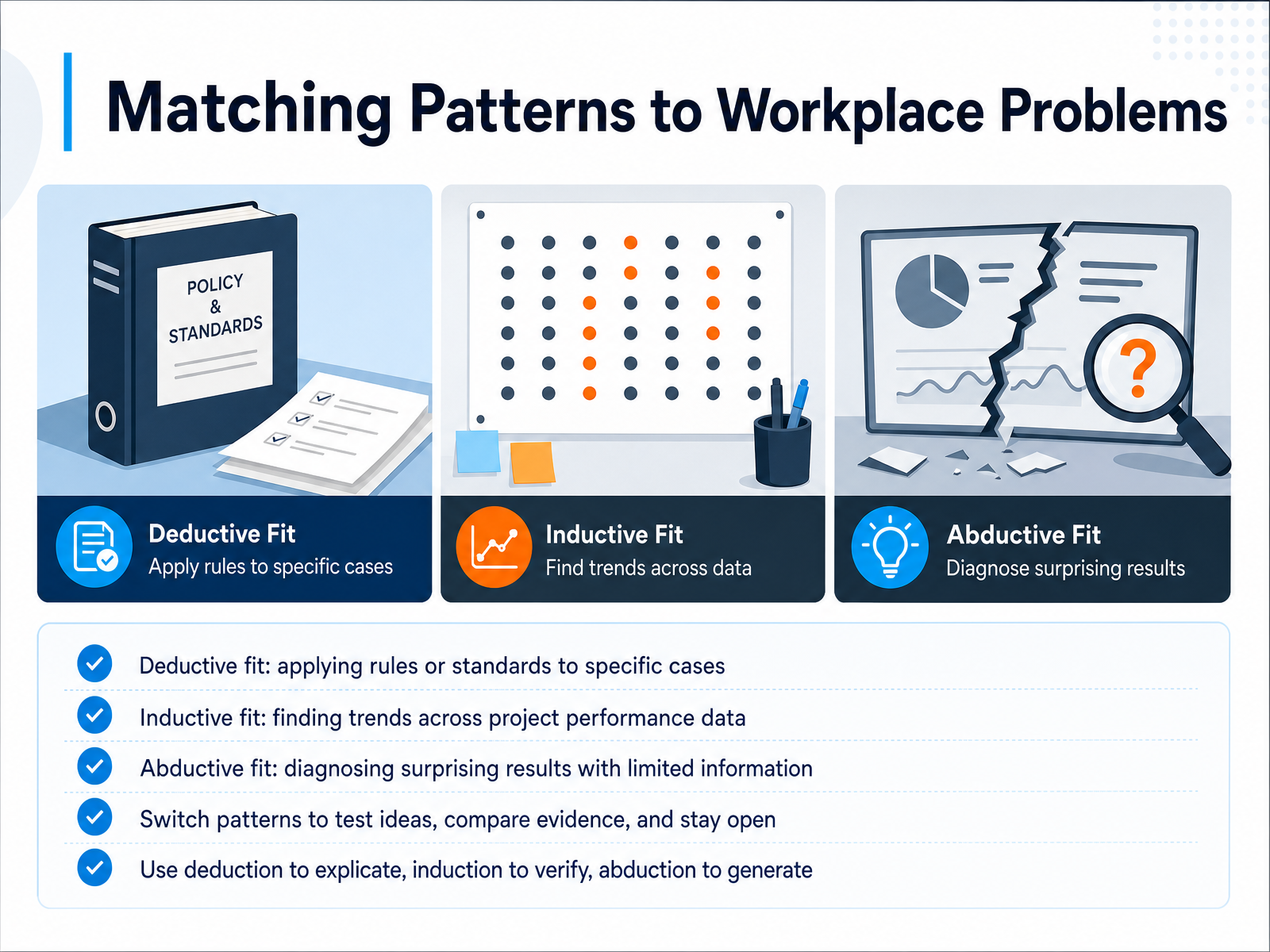
 - 07Matching Patterns to Workplace ProblemsLet's talk about matching these reasoning patterns to the problems you actually face. Deduction works best when you need to apply an established rule or standard to a specific case, like checking a purchase request against your budget policy. That's a fit. Induction helps you find trends, like reviewing your team's project data over the last six months to see where delays usually happen. Abduction is your go to when something surprising shows up with limited information, like a sudden drop in customer satisfaction. You gather the clues and ask, what's the most likely explanation? The real skill is knowing when to switch. Use deduction to explain, induction to verify, and abduction to generate new ideas. If one pattern gets stuck, try another and compare what you find. That flexibility keeps your thinking open instead of locked into one route. Up next, we'll look at how to sharpen this with better questions.
 cris.ulima.edu.pedesignsociety.orgmerriam-webster.com+21 min
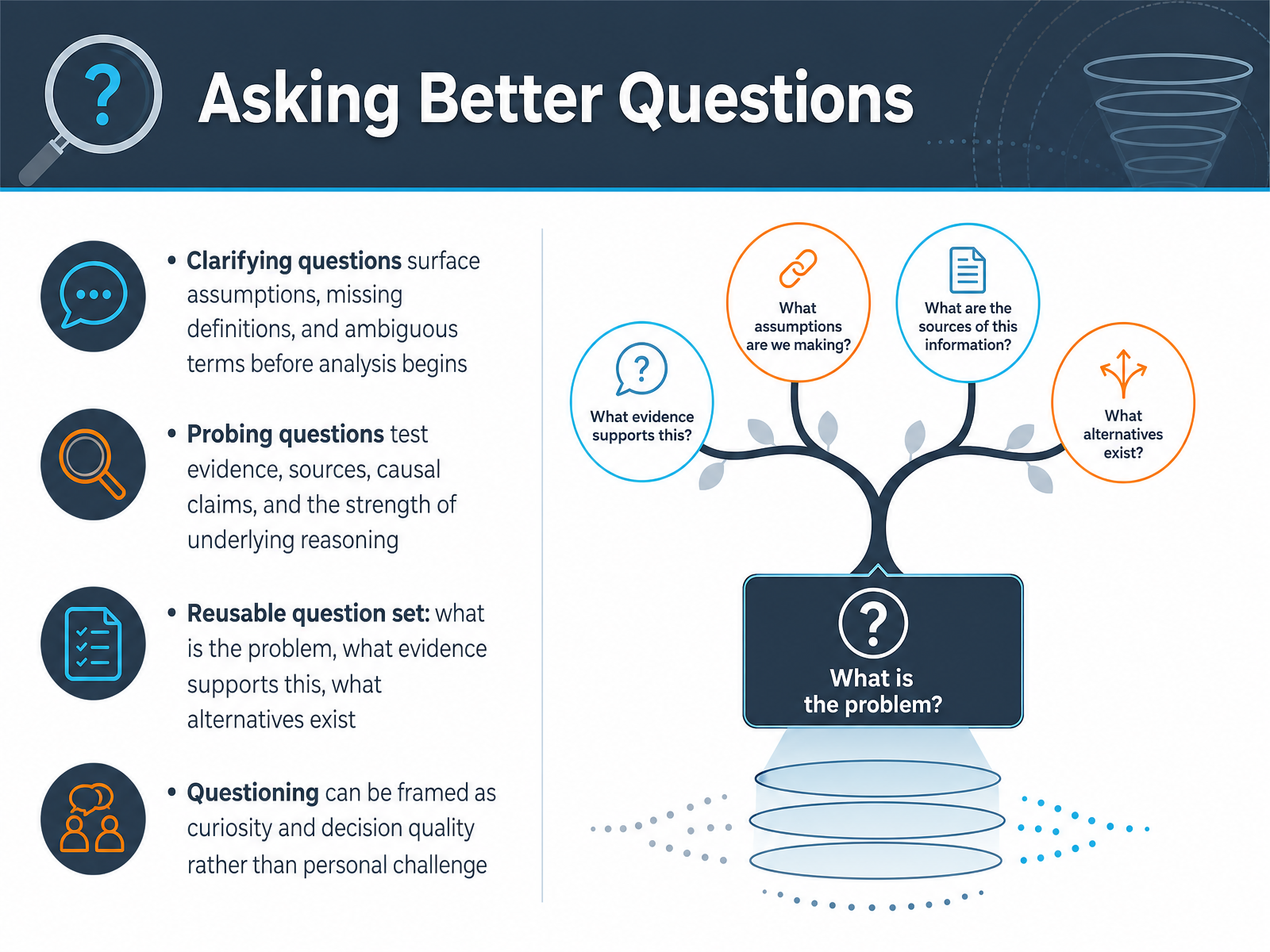
 - 08Asking Better QuestionsGood questions are the engine of critical thinking. Think about a time a project went sideways, and someone finally asked a question that made the room pause. That is the power we are talking about. Start with clarifying questions. These surface hidden assumptions, missing definitions, and ambiguous terms before any analysis begins. Then move to probing questions. These test the evidence, the sources, the causal claims, and how strong the reasoning actually is. If you need a reusable set, try these three. What is the problem? What evidence supports this? And what alternatives exist? These questions work in almost any decision meeting. A key point here: frame these questions as curiosity and decision quality, not as a personal challenge. You are not attacking the person. You are pressure-testing the idea. So next time, pause before agreeing. Ask what is missing, and why it matters. That single habit improves the quality of every decision your team makes.
 files.eric.ed.govlearninglab.rmit.edu.aueducation.illinois.edu+21 min
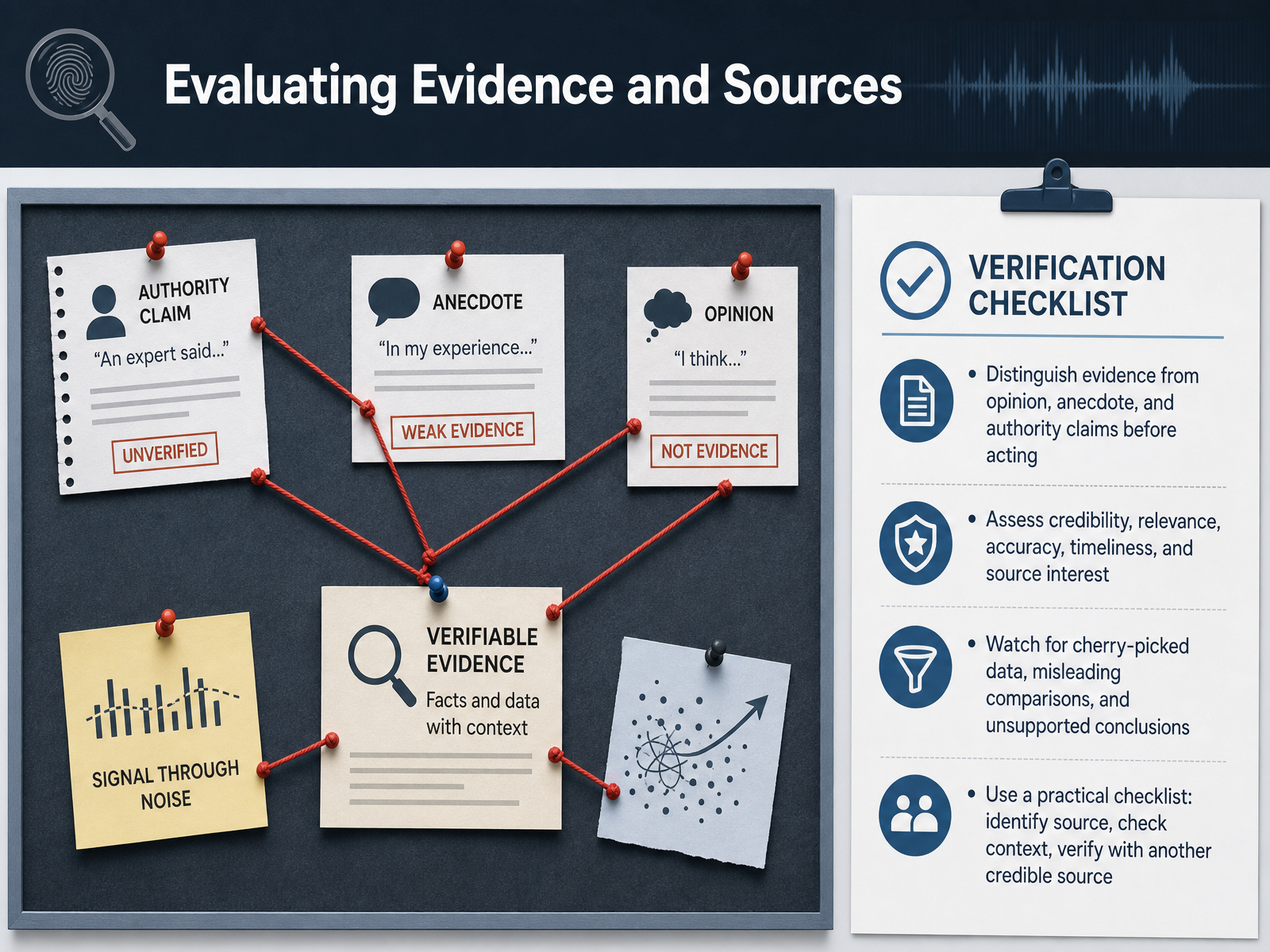
 - 09Evaluating Evidence and SourcesNow let's talk about evaluating evidence before you act on it. When a decision lands on your desk, your first job is to separate evidence from opinion. Ask: is this a fact, someone's story, or just an authority claim? A vendor's award list is not the same as a controlled performance comparison. Next, check credibility, relevance, accuracy, timeliness, and source interest. Does the source gain anything from your decision? Watch for cherry-picked data, misleading comparisons, and conclusions that outrun the support. For example, a chart showing sales up since a new tool launched proves timing, not cause. Use a simple checklist: identify the source, check the original context, and verify the claim with another credible source. That extra verification step often finds what a single report hides. So before your team moves forward, make verification a habit. Coming up next, we'll look at the cognitive biases that quietly disrupt this kind of reasoning.
 1 min
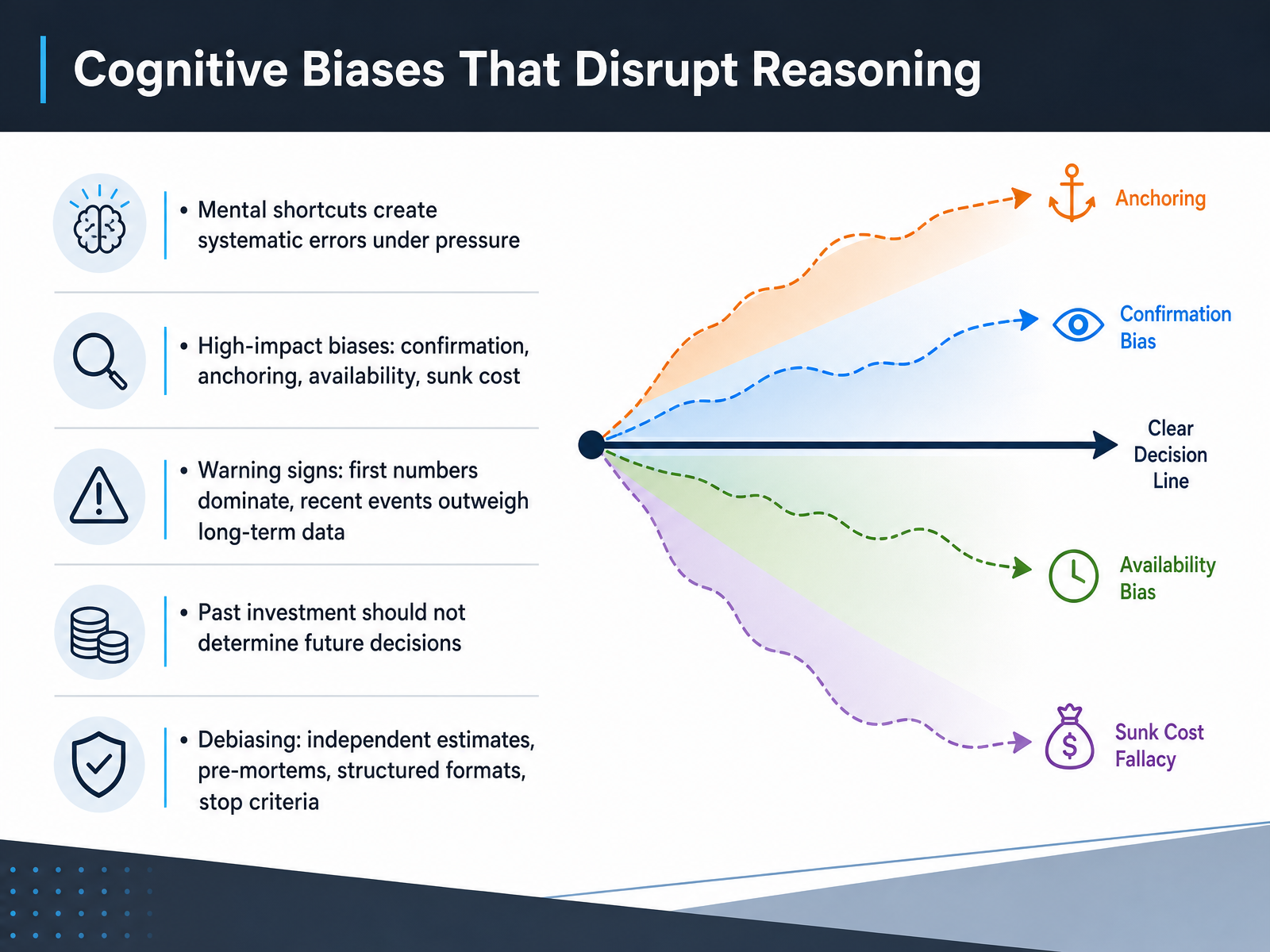
1 min - 10Cognitive Biases That Disrupt ReasoningNow let's look at what can quietly derail our reasoning: cognitive biases. These are mental shortcuts that create systematic errors, especially under pressure. Four of them cause real damage in the workplace. Confirmation bias makes us seek out information that supports what we already believe and discount data that doesn't. Anchoring gives too much weight to the first number we hear, which is why the first estimate in a room often sets the whole playing field. Availability makes us overreact to recent or vivid events, like a single complaint outweighing months of steady data. And sunk cost pushes us to keep investing in a failing project because we've already spent so much on it. But here's the key: past investment should never determine future decisions. What was spent is gone either way. To counter these biases, build structure into your process. Use independent estimates before group discussion. Run a pre-mortem by imagining a decision has failed and asking why. Use structured formats for reviews, and agree on stop criteria before a project starts. These tools help you decide based on evidence, not instinct. Next, we'll explore patterns of strong arguments.
 2 min
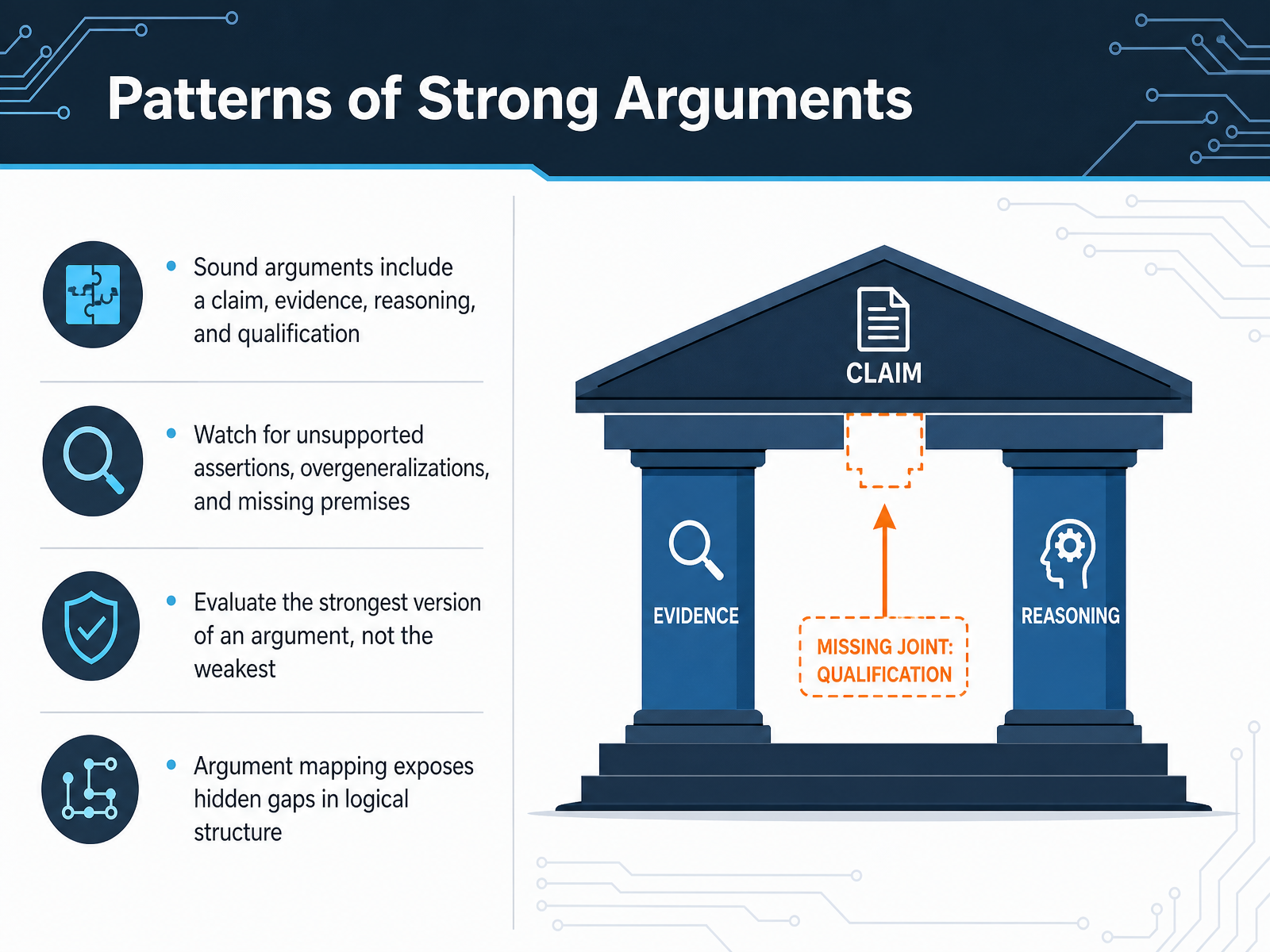
2 min - 11Patterns of Strong ArgumentsLet's look at what actually makes an argument strong enough to guide a business decision. A sound argument has four parts. There's a claim, which is the point someone wants you to accept. There's evidence, the facts or data backing that claim. There's reasoning, the logic that connects the evidence to the claim. And there's qualification, the honest statement of limits or conditions. When any of those pieces is missing, you'll often see red flags. Watch for unsupported assertions, statements offered with no evidence at all. Watch for overgeneralizations, words like always and never that collapse under a single counterexample. And watch for missing premises, the hidden assumptions an argument needs but never states. One useful habit is to evaluate the strongest version of an argument, not the weakest. If you can knock down a straw man, you haven't tested the real proposal. Instead, reconstruct the best case your colleague could be making, then evaluate that. Finally, try argument mapping. Sketch the claim at the top, the evidence below, and the reasoning that links them. The gaps you couldn't see in prose often become obvious in a simple diagram. That's a practical tool for your next meeting. Up next, we'll apply these patterns to real workplace scenarios and decision-making situations.
 files.eric.ed.govlearninglab.rmit.edu.aueducation.illinois.edu+22 min
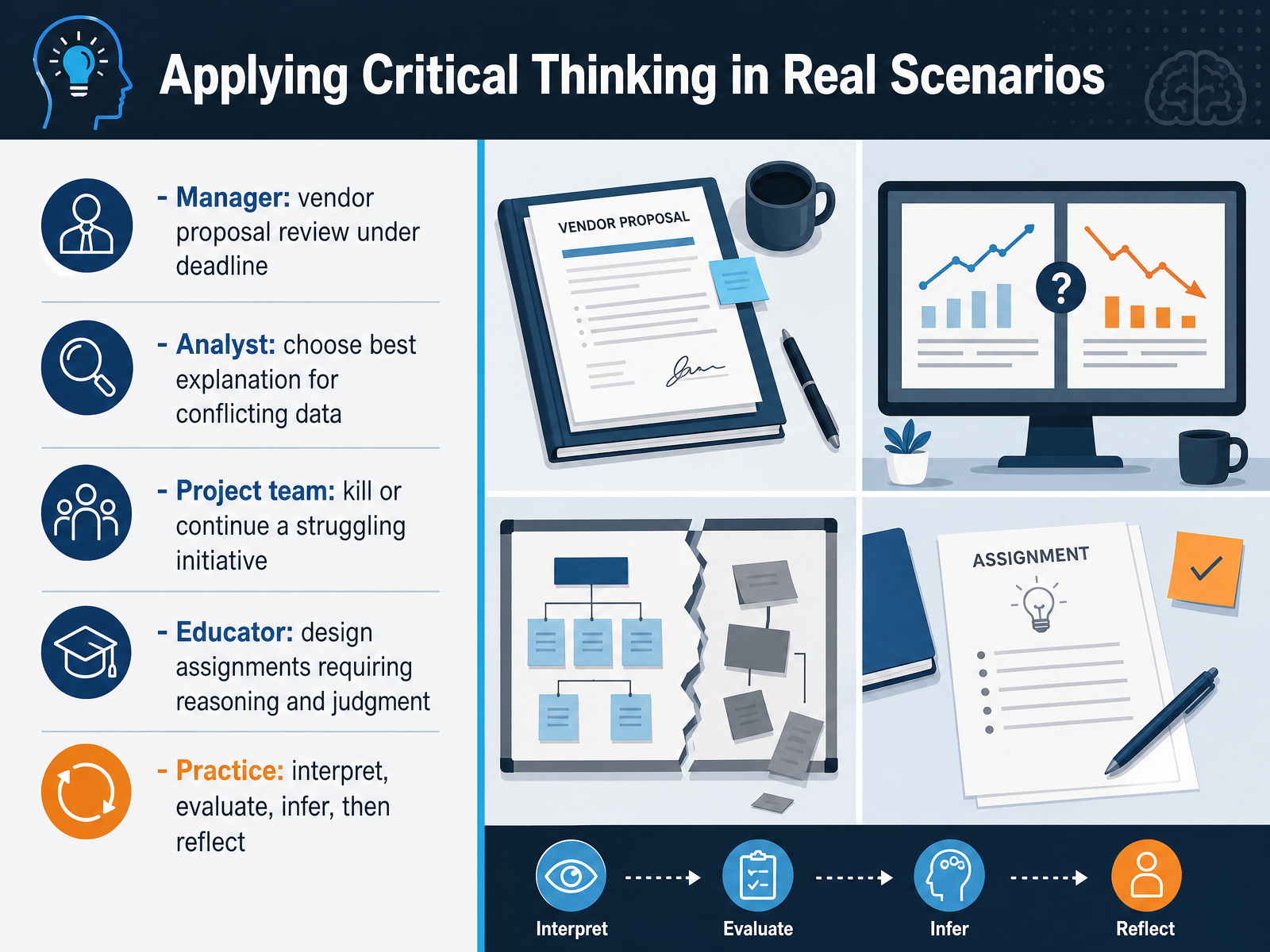
 - 12Applying Critical Thinking in Real ScenariosLet’s make this practical and look at how these tools show up in your everyday work. Imagine you’re a manager with a vendor proposal on your desk and a tight deadline. You might start deductively, checking the proposal against your procurement rules. But you’d also look inductively at the vendor’s past performance. And if something feels off in the numbers, you’d shift to abductive thinking to ask, what is the most likely explanation here? As an analyst facing conflicting data, you don’t just pick one source. You evaluate credibility first, then you infer the best possible story the data supports. For project teams with a struggling initiative, the real test is often overcoming sunk cost bias. The question is not what we’ve already spent, but whether the future payoff still justifies the future cost. And for educators, assignments work best when they require actual judgment, not just recall. So no matter your role, a useful loop is the same: interpret the information, evaluate its quality, infer the most reasonable conclusion, and then reflect on what that means for the next decision. Wherever you sit in an organization, you can apply that loop today.
 cris.ulima.edu.pedesignsociety.orgmerriam-webster.com+22 min
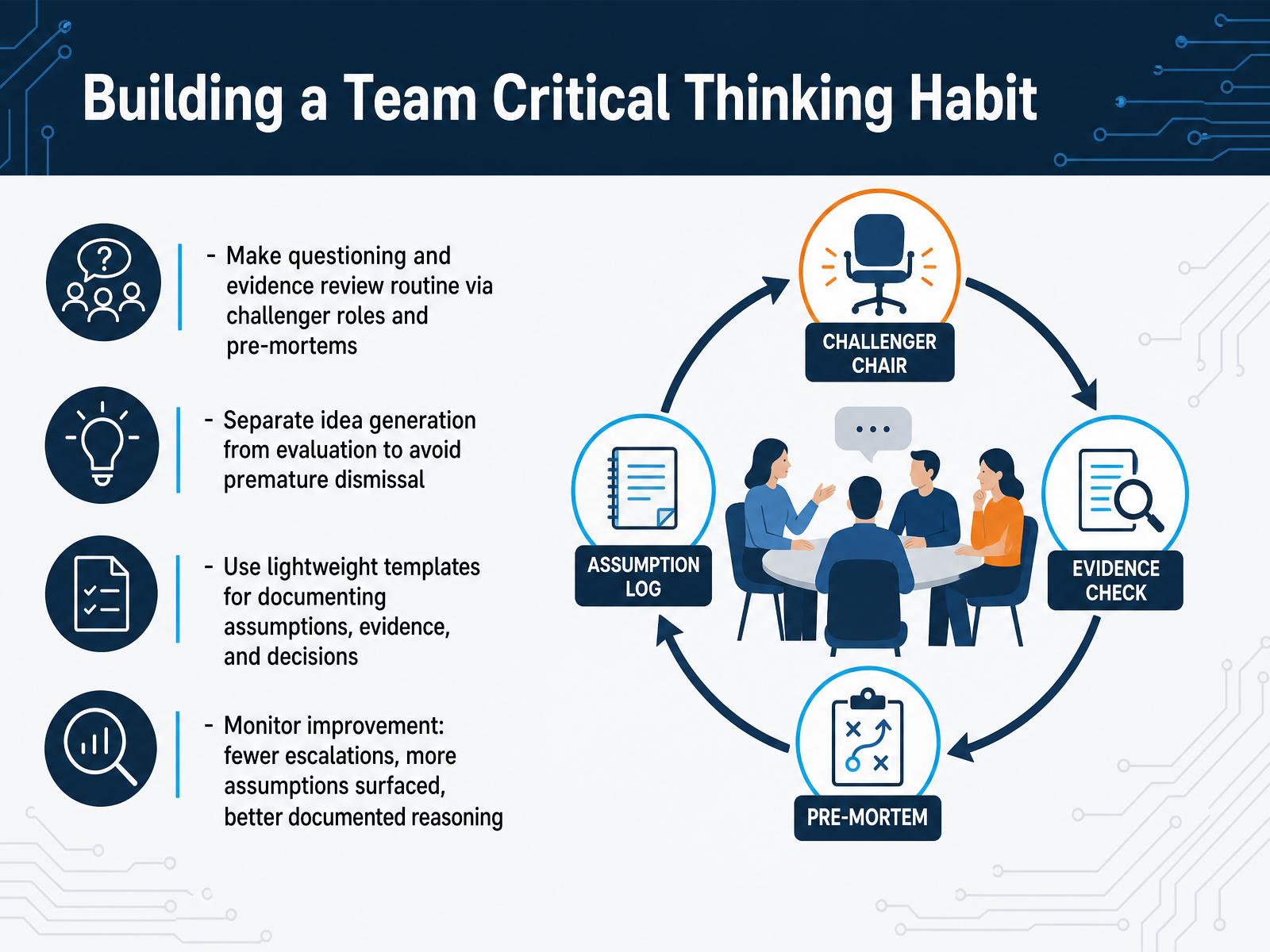
 - 13Building a Team Critical Thinking HabitIf you want critical thinking to stick, you have to make it a habit, not just a training topic. One of the most effective routines is running a pre-mortem before a big decision. Instead of asking what could go wrong, tell your team to imagine the plan has already failed, and then ask them to write down why. That small shift makes honest warnings feel safe, and it often surfaces roughly a third more risks than a standard review. Pair that with a challenger role in meetings, so someone is always responsible for testing the evidence behind the recommendation. And make a point of separating idea generation from evaluation, so new thinking is not dismissed before it can be explored. Keep the process light. Use a simple template to record the assumption, the evidence, and the final decision with its owner and date. Over time, you should see fewer escalations, more assumptions surfaced early, and better documented reasoning. In the next lesson, we will turn these habits into an action plan and a practice guide you can use with your team.
 ets.orgoreilly.comcareer.ucf.edu+21 min
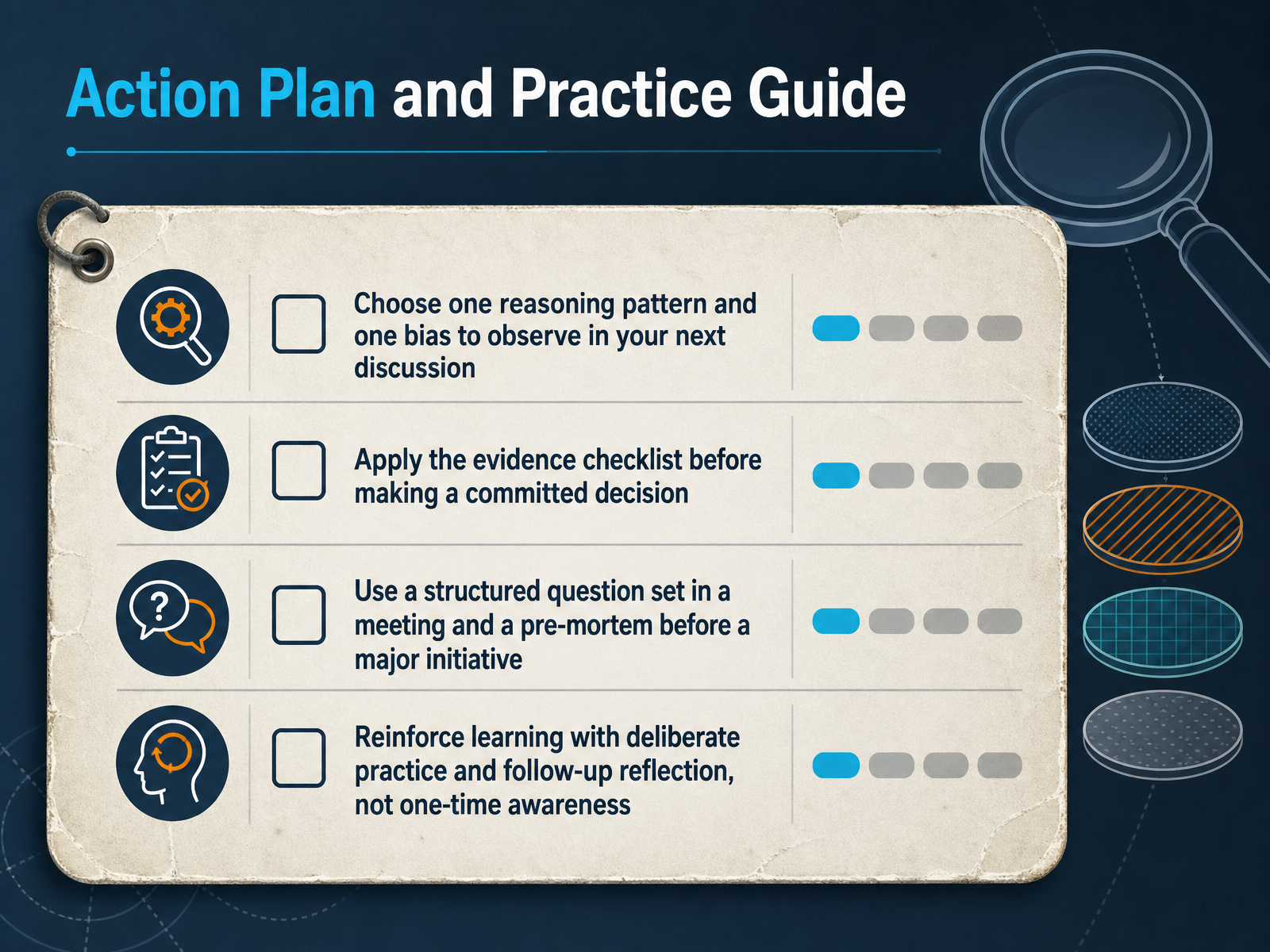
 - 14Action Plan and Practice GuideLet's turn all of this into something you can actually use. Start small. Pick one reasoning pattern and one bias, and watch for them in your next discussion. You don't have to fix everything at once. Before you commit to a decision, run the evidence checklist. Ask what's fact, what's assumption, and what's still unknown. In your next meeting, bring a structured question set, and before your next major initiative, run a pre-mortem. Imagine the project has already failed, then work backward to name the reasons why. That one exercise can surface risks the room would otherwise miss. Finally, treat this like a skill, not a one-time training. Deliberate practice and follow-up reflection are what actually change habits. So begin with one action this week. Thank you for joining, and good luck putting your sharper judgment to work.
 ets.orgoreilly.comcareer.ucf.edu+21 min
Take the deck with you
Download this course as a file — free, no sign-up needed.
- PDF handoutEvery slide page, ready to print or share.15 pages · 3.5 MBDownload
- Narrated PowerPointThe deck that presents itself — every slide carries the digital human's narration video.15 pages · 25.1 MBDownload
- PowerPoint slidesThe full deck as a .pptx — open it in PowerPoint, Keynote, or Google Slides.15 pages · 3.4 MBDownload
Free to use in your own training — please keep the PersonWise credit page at the end.
Have your own deck? Turn it into a course
Sources consulted
Web sources consulted while building this course.
- New Hire Readiness Report 2025 — uschamber.com
- Recruitment - Employer Skills Survey 2024 - Scotland - gov.scot — gov.scot
- Credentials, Skills and Experiences | U.S. Chamber of Commerce — uschamber.com
- Beyond Degrees: Rethinking Qualifications in the Skills-First Era — ZipRecruiter Economic Research — ziprecruiter-research.org
- DURABLE BY DESIGN: — americasucceeds.org
- Exploring Approaches for Developing and Evaluating Workplace Critical Thinking Skills — ets.org
- How to Develop Critical Thinking Skills in Employees in the AI Era – O’Reilly — oreilly.com
- What Are Critical Thinking Skills? – Dixon Career Development Center | University of Central Florida — career.ucf.edu
- Critical and Analytical Thinking : U.S. Bureau of Labor Statistics — bls.gov
- Critical thinking skills: 7 steps for the workplace [2026] - Asana — asana.com
- MEASURING STUDENT SUCCESS SKILLS: A REVIEW OF THE LITERATURE ON CRITICAL THINKING — files.eric.ed.gov
- Elements of critical thinking - Learning Lab - RMIT University — learninglab.rmit.edu.au
- The Nature of Critical Thinking: An Outline of Critical Thinking Dispositions and Abilities — education.illinois.edu
- What is Critical Thinking? - University of Galway — universityofgalway.ie
- What is critical thinking? - Student Academic Success — monash.edu
- Deductive, Inductive and Abductive Reasoning: Differences and Integration from Business Examples - Current Research Information System of University of Lima (CRIS Ulima) — cris.ulima.edu.pe
- CHOOSING INNOVATION: HOW REASONING AFFECTS DECISION ERRORS — designsociety.org
- Inductive vs. Deductive vs. Abductive Reasoning | Merriam-Webster — merriam-webster.com
- Using Your Logical Powers: Abductive Reasoning for Business Success - User Experience — uxpamagazine.org
- Generating Theory by Abduction | Academy of Management Review — journals.aom.org