Begin
14 pages · ~28 min
Understanding Fast Spoken English
This training helps English learners understand fast, natural speech by teaching connected speech patterns. Ideal for intermediate learners seeking to improve listening comprehension.
A digital instructor presents all 14 pages. Hold “Ask” at any point and ask out loud — the answer comes from this course. No sign-up needed.
What you’ll learn
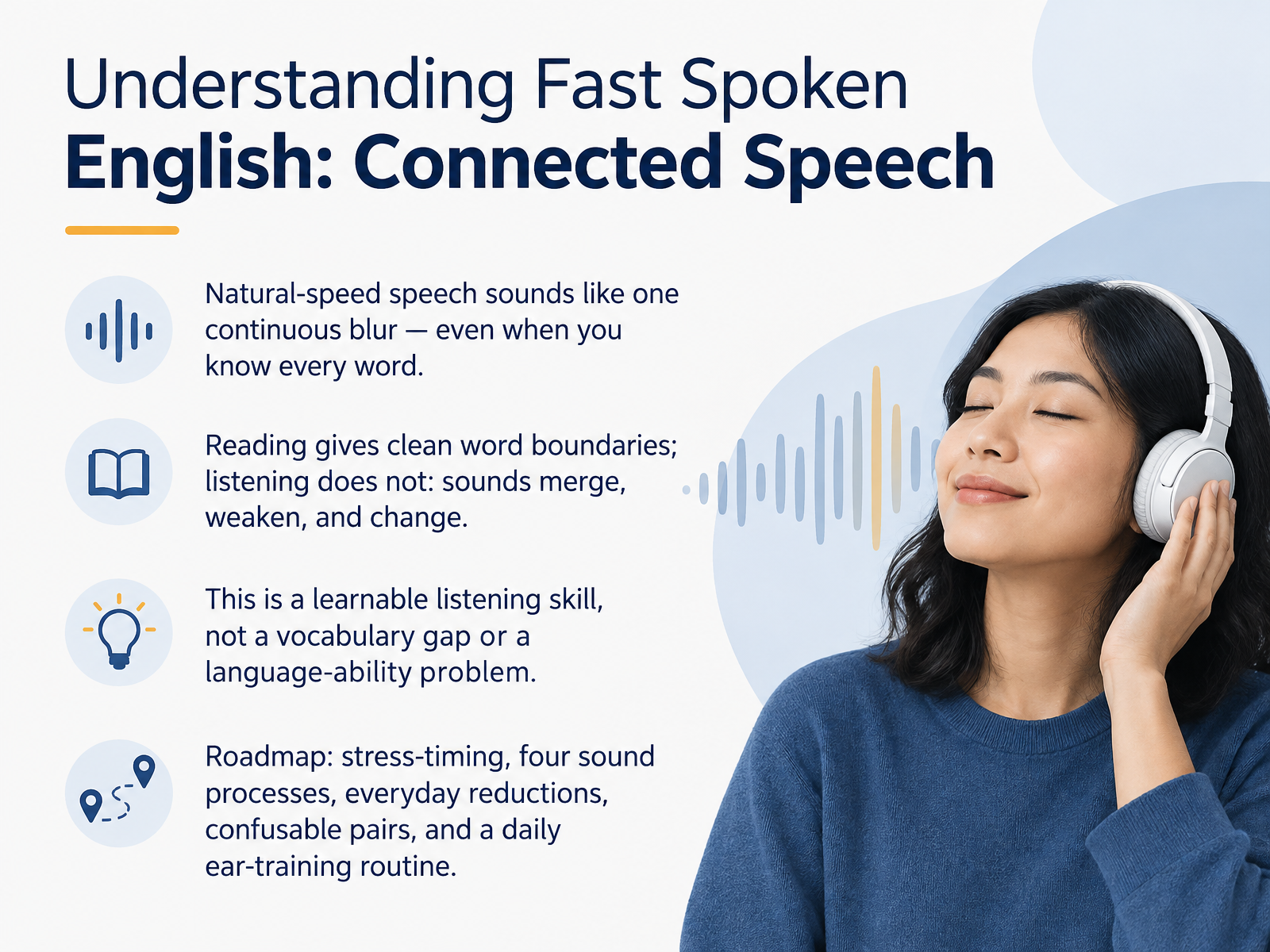
- 01Understanding Fast Spoken English: Connected SpeechWelcome. I'm glad you're here. Today we're working on connected speech, the reason natural English can sound like one continuous blur, even when you already know every single word. Here's the key idea. Reading gives you clean word boundaries. Listening does not. In real speech, sounds merge, weaken, and change. So if fast speech feels hard, that is not a vocabulary gap, and it is not a language-ability problem. It is a listening skill, and it is learnable. Over the next slides, we'll cover stress timing, four sound processes, everyday reductions, confusable pairs, and a simple daily ear-training routine. Let's begin with why strong readers get lost when people talk.listenglish.comteachingenglish.org.ukteachingenglishwithoxford.oup.com+21 min
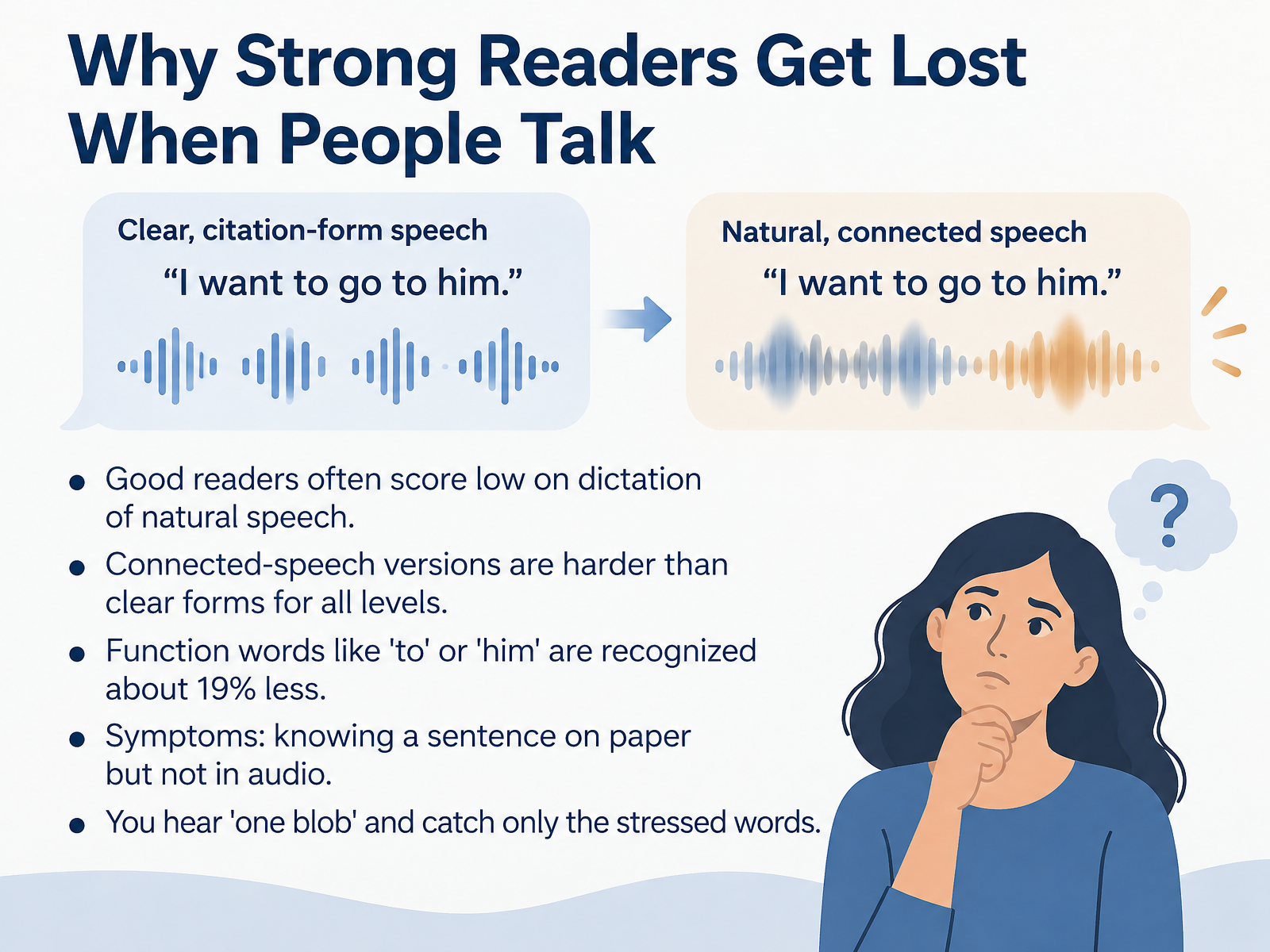
- 02Why Strong Readers Get Lost When People TalkSo why do strong readers get lost when people talk? This is not a sign that something is wrong with you. Research shows the opposite, actually. Good readers often score surprisingly low on dictation tasks using natural speech. And connected speech versions are harder than clear forms for learners at every level. There is one number worth remembering. Function words like to, or him are recognized about nineteen percent less in connected speech. That is roughly one in five. You may know a sentence perfectly on paper, but miss it completely in audio. You hear what feels like one long blob, and catch only the stressed words. That experience is normal, and it is exactly what we will work on next. The engine behind fast speech, stress-timing and weak forms.
 doi.orgsciencedirect.comteachingenglish.org.uk+21 min
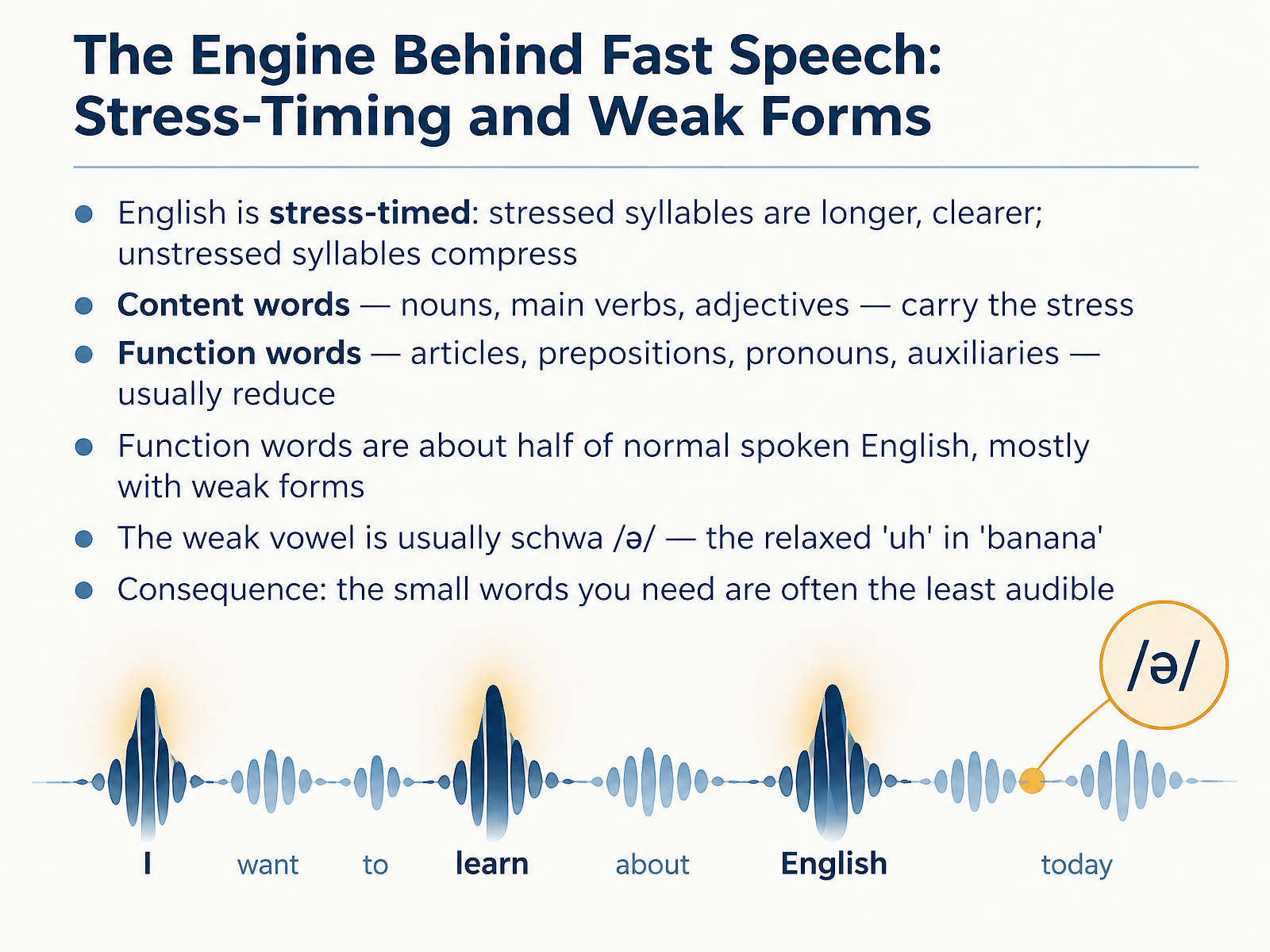
- 03The Engine Behind Fast Speech: Stress-Timing and Weak FormsNow let's look at why fast speech sounds the way it does. English is stress-timed. That means stressed syllables are longer and clearer, while unstressed syllables get squeezed together. Content words, like nouns, main verbs, and adjectives, carry the stress. Function words, like articles, prepositions, pronouns, and auxiliaries, usually reduce. In fact, function words make up about half of normal spoken English, and most of them appear in weak forms. The weak vowel is usually schwa, the relaxed uh sound in banana. So here is the consequence. The small words you need are often the least audible. That is normal, and it is not your fault. As you listen, focus on the strong content words first, and let the weak forms fill in around them. Next, we will compare strong and weak forms side by side, with the same word pronounced two different ways.
 iastate.pressbooks.pubbabbel.comphonetics.ucla.edu+21 min
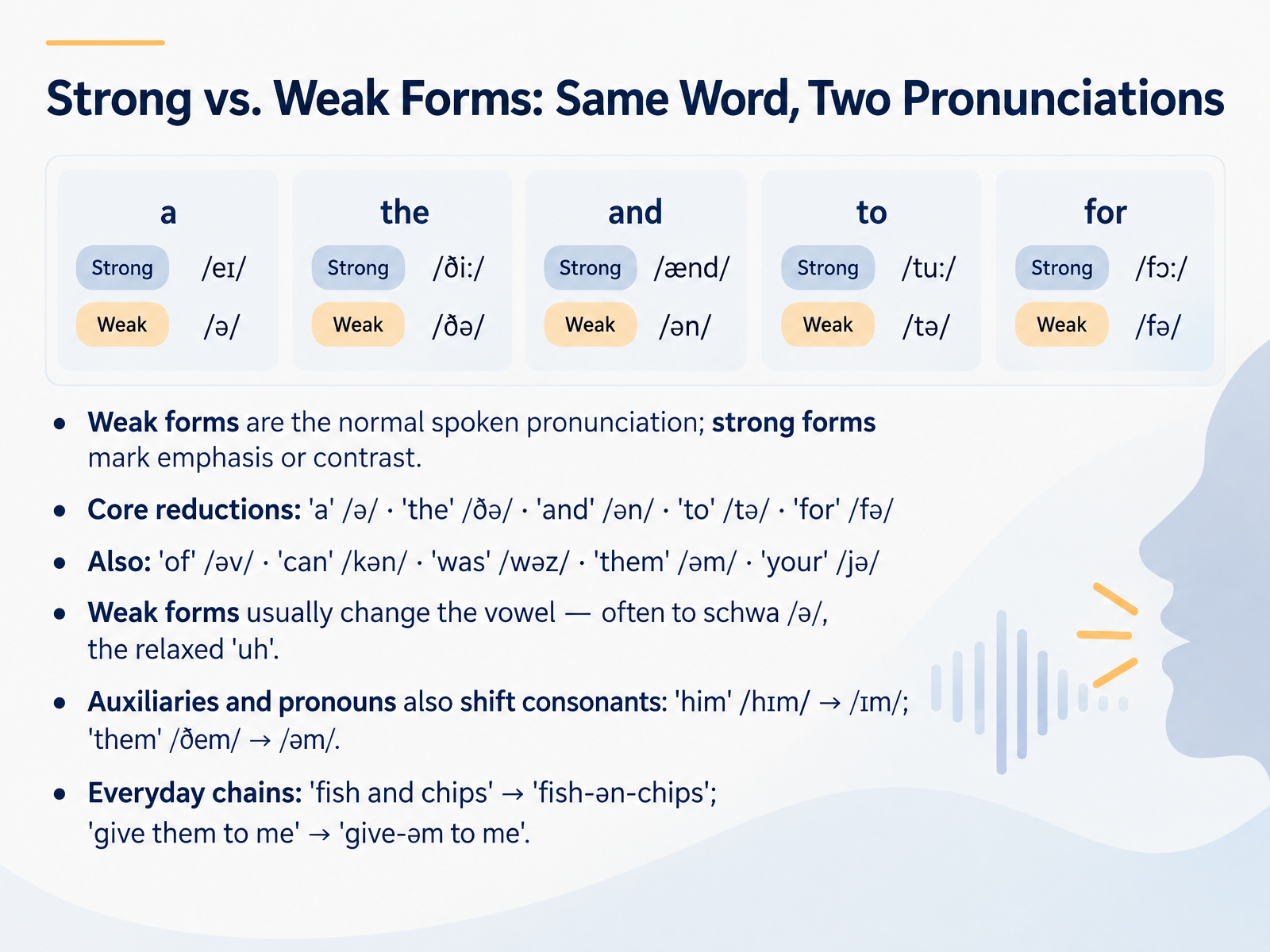
- 04Strong vs. Weak Forms: Same Word, Two PronunciationsNow let's look at something that explains a lot of listening confusion. Strong forms and weak forms. The same word, two different pronunciations. Here's the key idea. Weak forms are the normal spoken pronunciation. Strong forms mark emphasis or contrast. Take the word "can." In "I can swim," it sounds like "kən," short and relaxed. But if you say "Yes, I can," it becomes "can," clear and strong. Same word, different jobs. Several common words work this way. "A" becomes "ə." "The" becomes "ðə." "And" becomes "ən." "To" becomes "tə." "For" becomes "fə." You'll also hear "of" as "əv," "can" as "kən," "was" as "wəz," "them" as "əm," and "your" as "jə." Notice the pattern. Most weak forms change the vowel to schwa, that relaxed "uh" sound. Auxiliaries and pronouns can also shift their consonants. "Him" can lose its "h" and become "im." "Them" can become "əm." In everyday speech, this creates smooth chains. "Fish and chips" becomes "fish-ən-chips." "Give them to me" becomes "give-əm to me." Your reading strength already tells you these words are there. Now you're training your ear to hear them. Next, let's see what happens when words link together.
 iastate.pressbooks.pubbabbel.comphonetics.ucla.edu+22 min
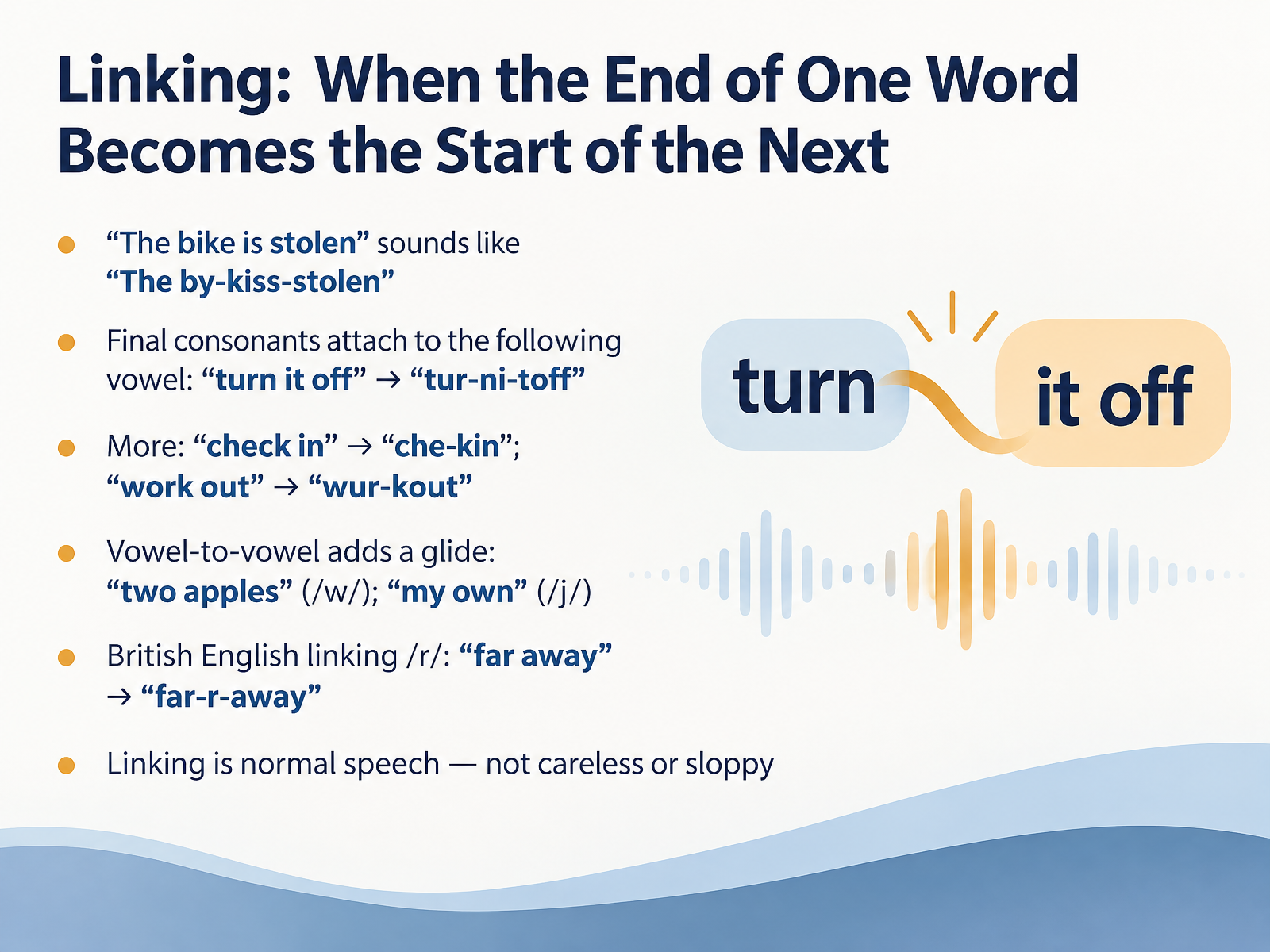
- 05Linking: When the End of One Word Becomes the Start of the NextNow let's look at linking. This is where the end of one word becomes the start of the next. Listen to this sentence. The bike is stolen. In natural speech, it often sounds like the by kiss stolen. The final consonant of bike attaches to the vowel in is. Nothing is lost. The sounds just join together. This happens a lot with common phrases. Turn it off can sound like tur ni toff. Check in becomes che kin. And work out becomes wur kout. When one word ends in a vowel and the next begins with a vowel, English often adds a small glide. So two apples can sound like two wapples, with a little w sound. And my own can sound like my yown, with a small y sound. In British English, there is also linking r. Far away can sound like far r away. Remember, linking is completely normal. It is not careless or sloppy speech. It is simply how English flows. Try to listen for these connections, and your understanding will grow. Next, we look at elision, sounds that quietly disappear.
 iastate.pressbooks.pubdiscovery.ucl.ac.ukcs.columbia.edu+21 min
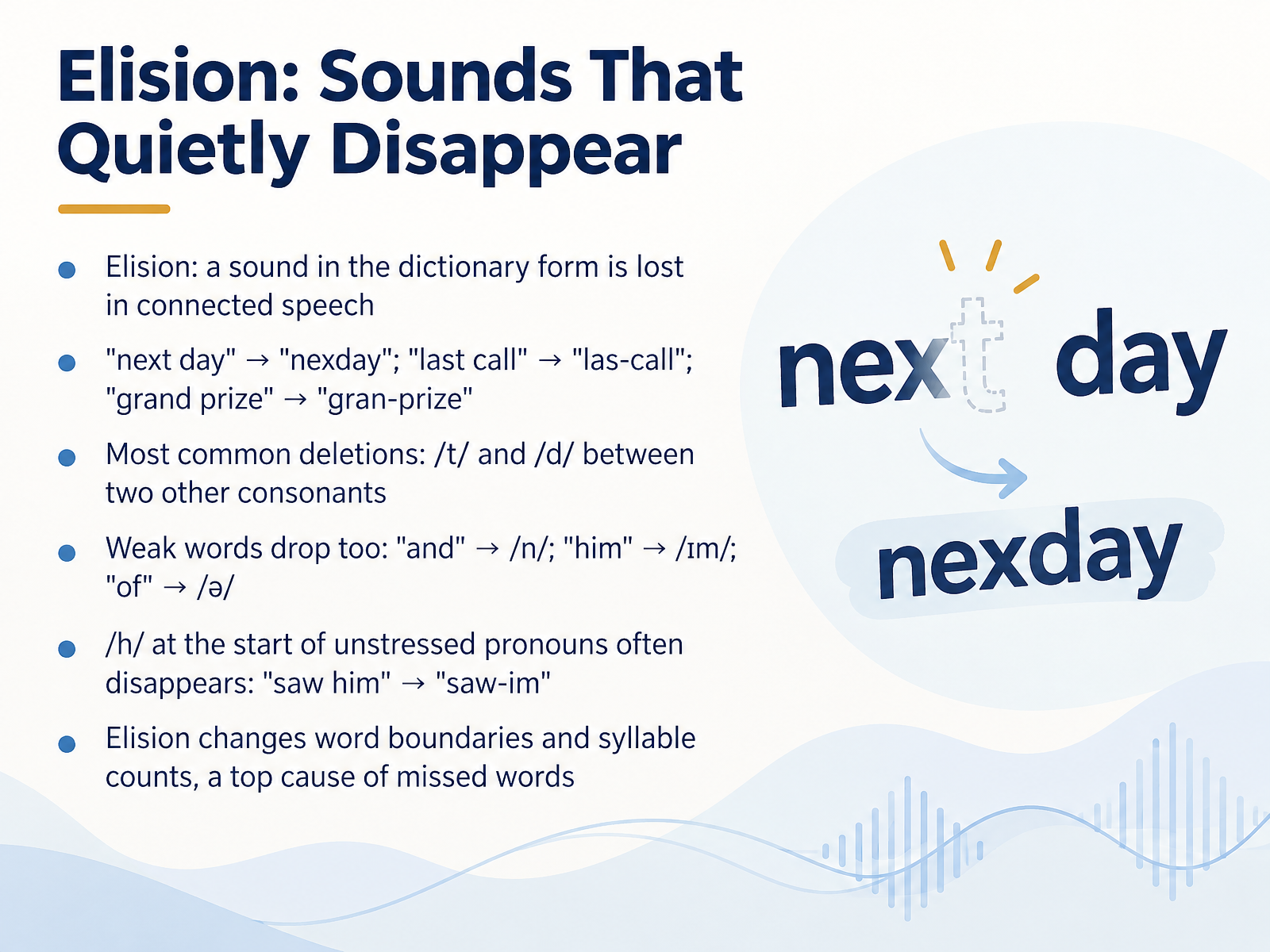
- 06Elision: Sounds That Quietly DisappearLet's look at a process called elision. That simply means a sound that exists in the dictionary form of a word is lost in connected speech. Say next day. In natural speech, that often becomes nexday. Or last call, which sounds like las call. And grand prize, which comes out as gran prize. The most common deletions are the sounds t and d when they sit between two other consonants. Weak words drop too. And can turn into a simple n. Him can sound like im. And of can shrink to a soft uh. The h at the start of unstressed pronouns often disappears as well, so saw him can sound like saw im. Here is the important part. Elision changes word boundaries and syllable counts. That makes it one of the top reasons you miss words you actually know. Take a breath. This is normal. You read well, and your vocabulary is a real strength. Hearing these reductions takes practice, not talent. As we move on, watch how neighboring sounds also change each other. Assimilation, neighboring sounds change each other.
 iastate.pressbooks.pubdiscovery.ucl.ac.ukcs.columbia.edu+22 min
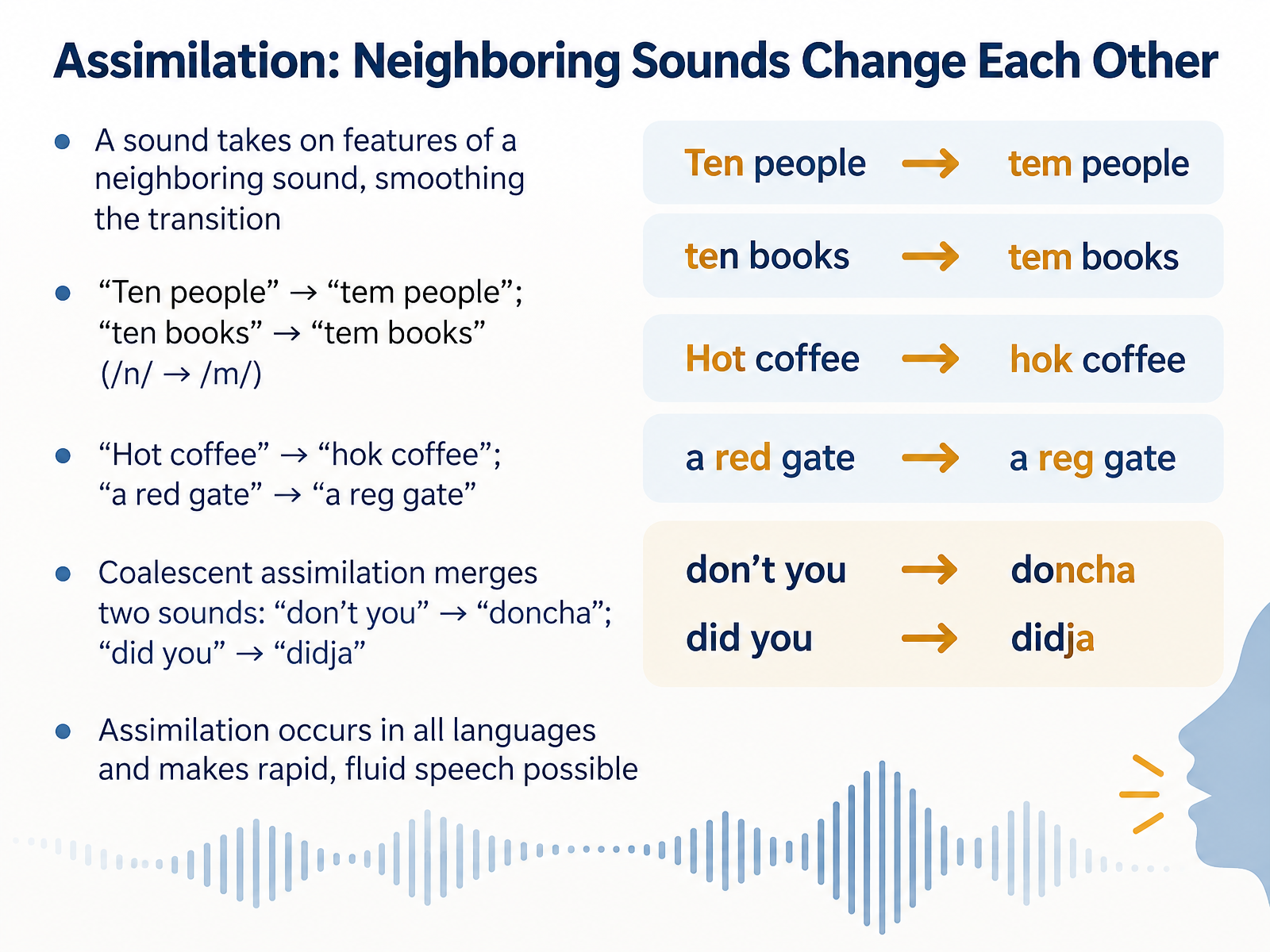
- 07Assimilation: Neighboring Sounds Change Each OtherNow let's look at assimilation. This is when one sound takes on features of a neighboring sound, which smooths the transition between them. It happens because your mouth is already getting ready for the next sound. You'll see this most clearly with the nasal sound /n/. Say "ten people" naturally. The /n/ becomes an /m/ because your lips are preparing for the /p/. So it sounds like "tem people." The same happens in "ten books," which becomes "tem books." You'll also hear this with /t/ and /d/. "Hot coffee" can sound like "hok coffee," and "a red gate" can sound like "a reg gate." There's one more type called coalescent assimilation, where two sounds merge into one new sound. "Don't you" often becomes "doncha," and "did you" becomes "didja." This isn't lazy speech. Assimilation occurs in all languages and makes rapid, fluid speech possible. Next, let's explore some everyday reductions you'll hear constantly: gonna, wanna, gotta, and whaddaya.
 iastate.pressbooks.pubdiscovery.ucl.ac.ukcs.columbia.edu+21 min
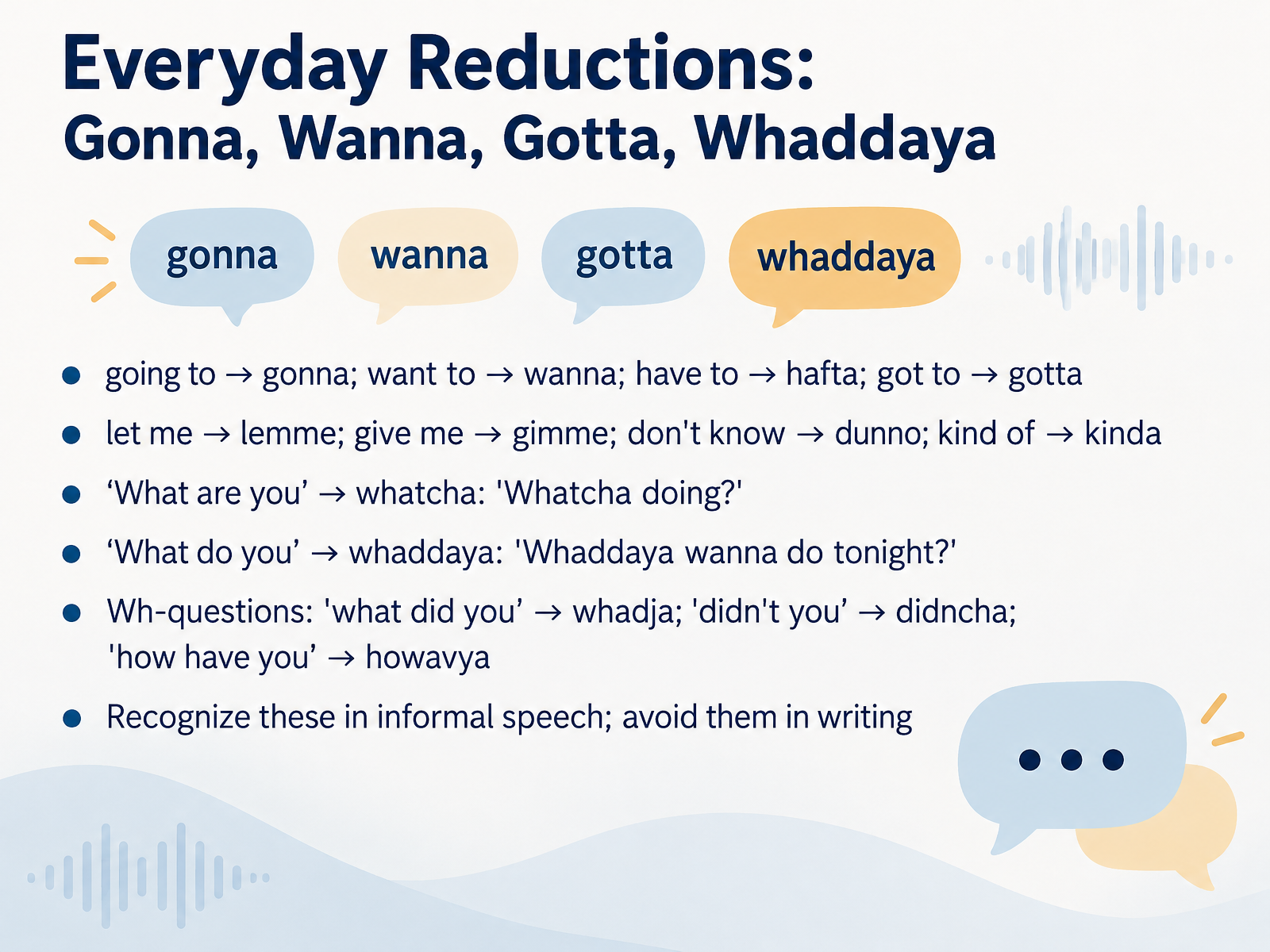
- 08Everyday Reductions: Gonna, Wanna, Gotta, WhaddayaNow let's look at everyday reductions. These are the relaxed forms you hear constantly in informal speech, and knowing them will make fast English much easier to follow. For example, going to becomes gonna. Want to becomes wanna. Have to becomes hafta, and got to becomes gotta. You will also hear let me as lemme, give me as gimme, don't know as dunno, and kind of as kinda. Questions reduce too. What are you can sound like whatcha, as in, Whatcha doing? And what do you can sound like whaddaya, as in, Whaddaya wanna do tonight? Other wh-questions change as well. What did you can become whadja. Didn't you can become didncha. And how have you can become howavya. Your goal is to recognize these forms when you hear them. In writing, keep the full forms. Now, let's move on to some high-risk confusions: can versus can't, counts, and negatives.
 1 min
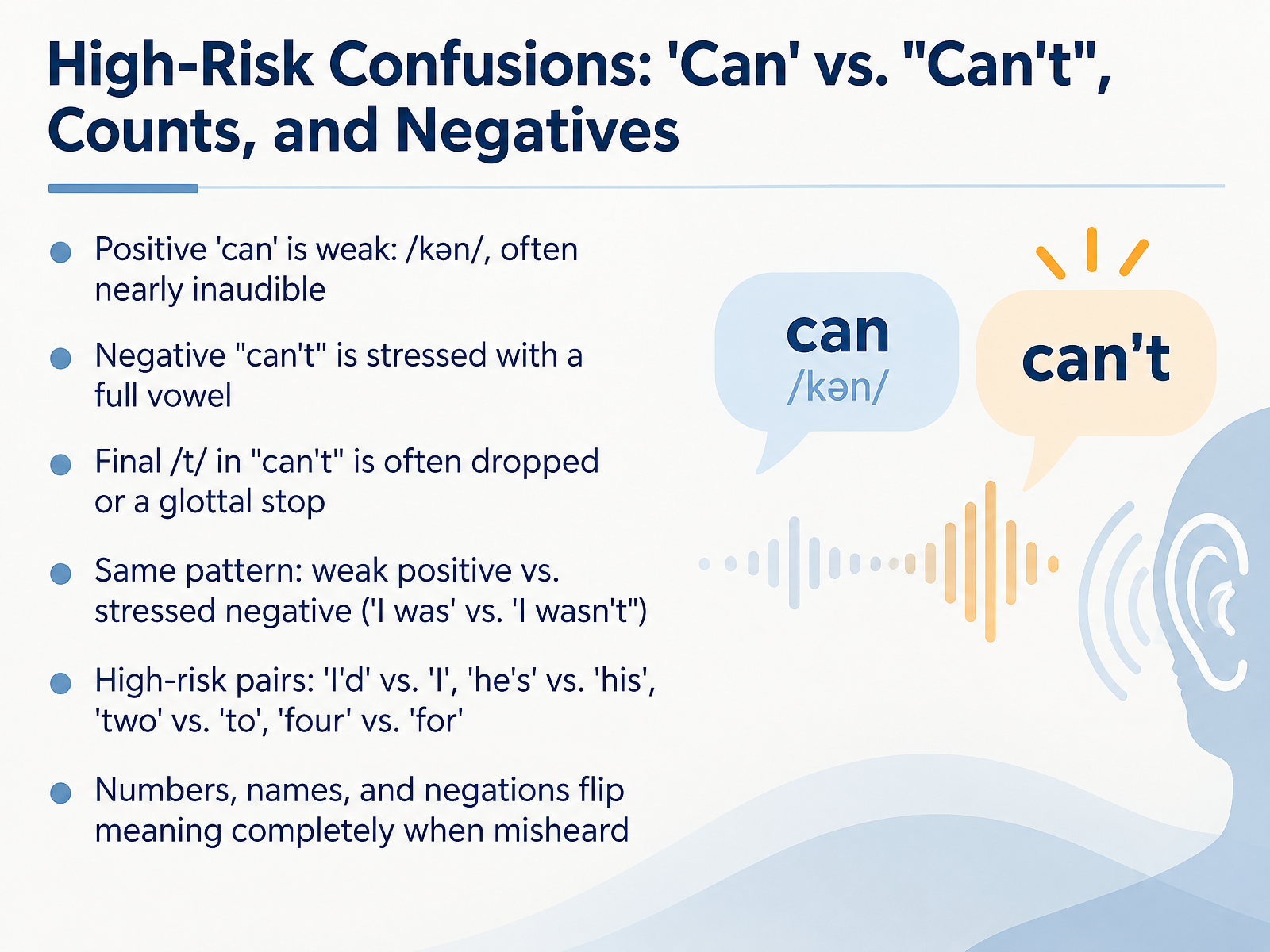
- 09High-Risk Confusions: 'Can' vs. "Can't", Counts, and NegativesNow let's look at some high-risk confusions. The biggest one is can versus can't. In natural speech, positive can is weak. It sounds like kuhn, and it can be almost inaudible. Negative can't is stressed, with a full vowel. And the final t is often dropped or replaced by a tiny stop of air. So in American English, can and can't can sound very similar. The clue is stress. The positive is weak, the negative is strong. This same pattern appears with other pairs. I was is weak, but I wasn't is stressed. Now listen to these risky pairs. I'd versus I. He's versus his. Two versus to. Four versus for. Numbers, names, and negatives flip the meaning completely when you mishear them. So train your ear to notice stress, not just individual sounds. Next, we'll see how grammar and context can fill the gaps when the sounds blur together.
 martinweisser.org1 min
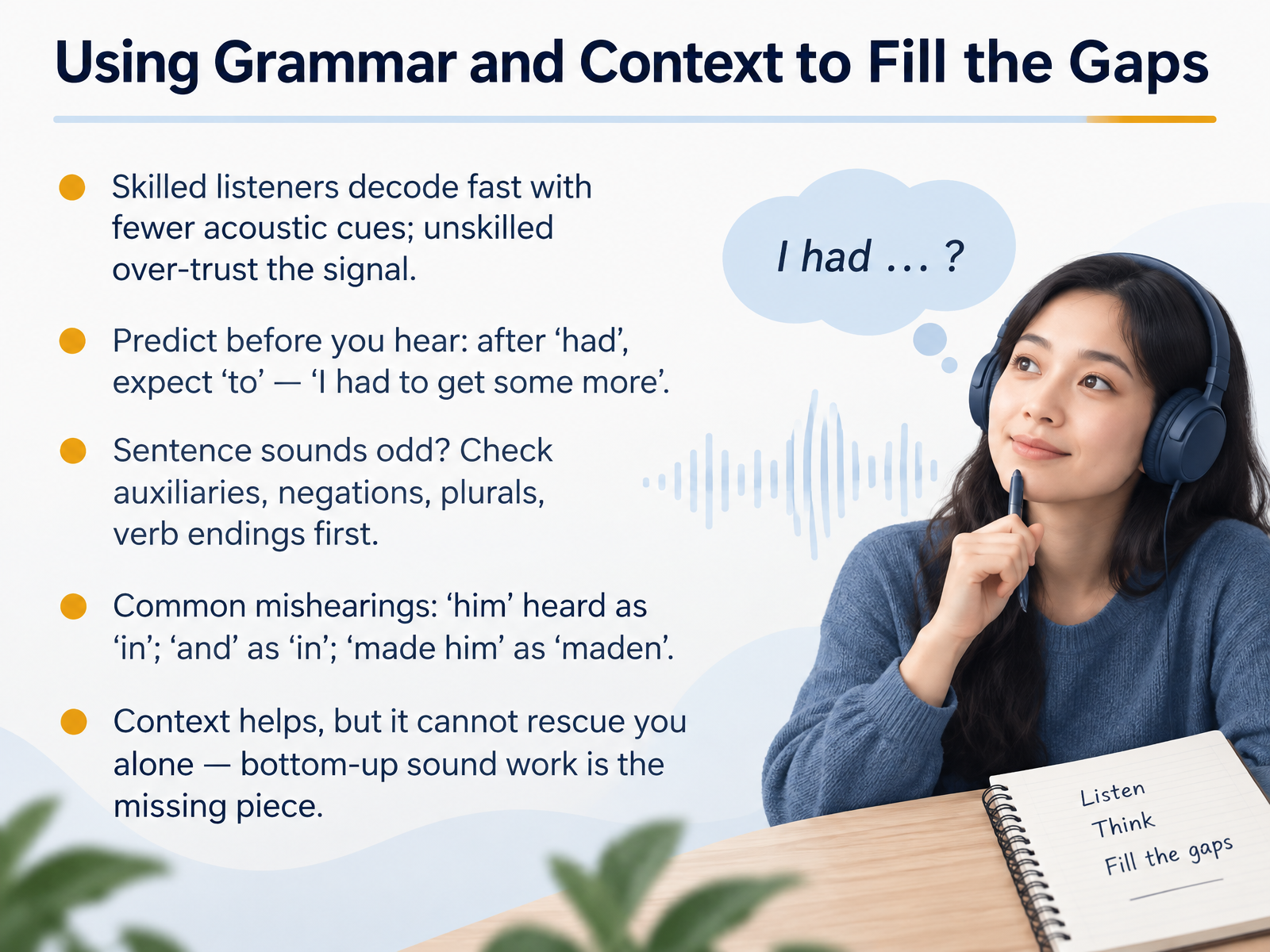
- 10Using Grammar and Context to Fill the GapsLet's look at how grammar and context help you fill the gaps. Skilled listeners decode fast speech with fewer sound cues. Less skilled listeners tend to over-trust the sound signal itself. So use prediction. After 'had', expect 'to'. For example, 'I had to get some more.' If a sentence sounds odd, check auxiliaries, negations, plurals, and verb endings first. Some common mishearings: 'him' heard as 'in', 'and' also heard as 'in', and 'made him' heard as 'maden'. Context helps, but it cannot rescue you alone. Bottom-up sound work is the missing piece. Next, we'll practice training your ear with shadowing and narrow listening.
 doi.orgsciencedirect.comteachingenglish.org.uk+21 min
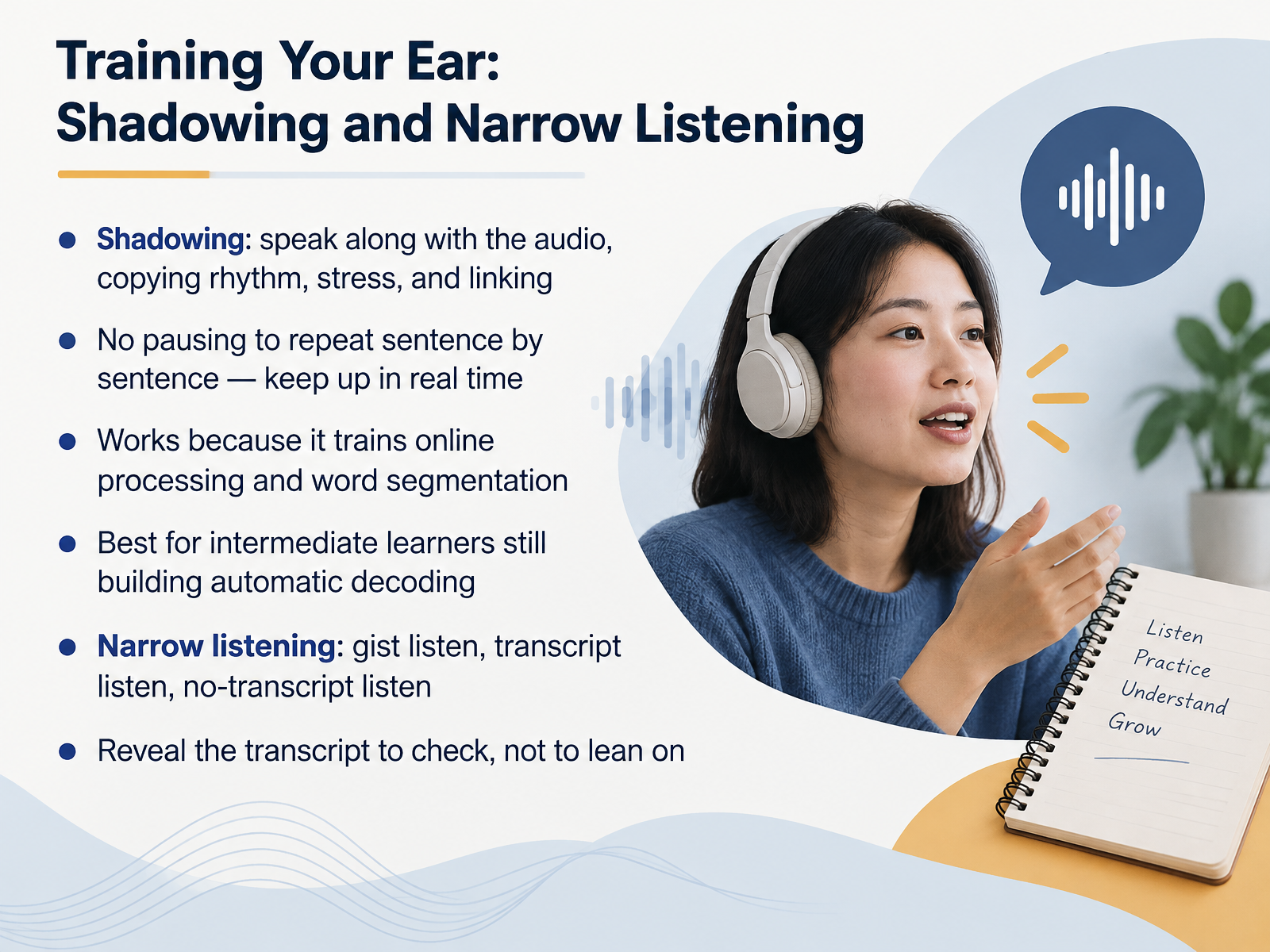
- 11Training Your Ear: Shadowing and Narrow ListeningNow let us talk about two practical ways to train your ear. First, shadowing. Shadowing means speaking along with the audio, copying the speaker's rhythm, stress, and linking. You are not pausing to repeat sentence by sentence. You try to keep up in real time, even if it feels messy at first. This works because it trains online processing, the skill of understanding speech as it unfolds, and it helps you hear where one word ends and the next begins. It is especially useful for intermediate learners whose automatic decoding is still developing. Second, narrow listening. Take one short clip and listen in three passes. First, just for the gist. Then with the transcript. Then again with no transcript. Use the transcript to check what you missed, not to lean on. So, pick one short clip this week, shadow it gently, and let your ear do the work. Next, we will look at moving from writing to speech by predicting how a sentence will sound.
 listenglish.comteachingenglish.org.ukteachingenglishwithoxford.oup.com+22 min
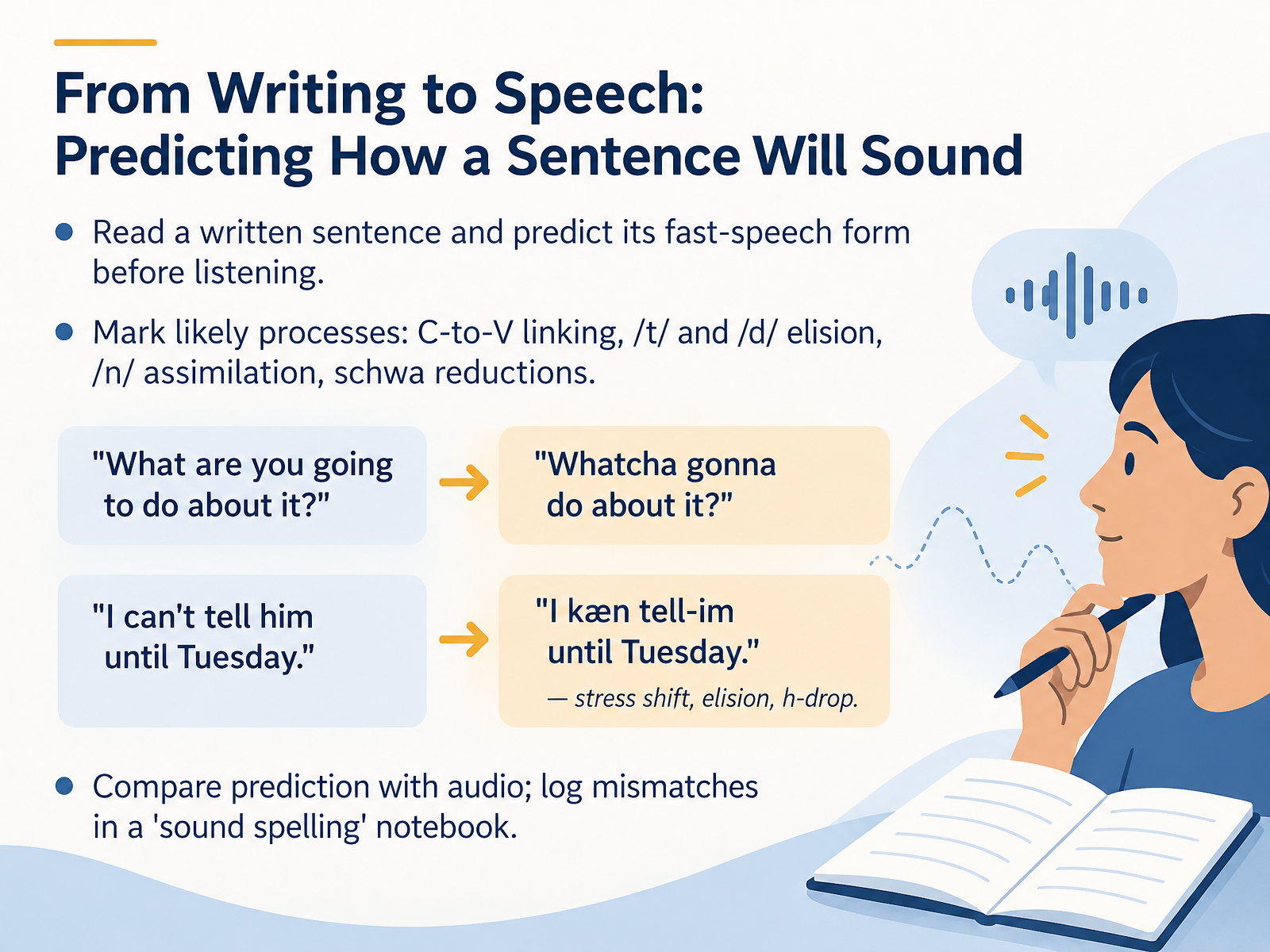
- 12From Writing to Speech: Predicting How a Sentence Will SoundNow let's turn your reading strength into a listening strategy. Here's the idea. Before you listen, read a sentence and predict how it will sound at natural speed. Then mark the likely processes. Watch for consonant to vowel linking, the dropping of t and d sounds, the way n can shift before certain consonants, and schwa reductions in small function words. Let's try two examples. The written sentence, What are you going to do about it, often becomes, Whatcha gonna do about it. And, I can't tell him until Tuesday, can sound like, I kæn tell im until Tuesday. Notice the stress shift, the missing t, and the dropped h in him. So after listening, compare your prediction with the audio. When something surprises you, write it in your sound spelling notebook. That log turns your reading skill into listening confidence. Next, we will try this together in Guided Practice: Dissecting a Real Clip Together.
 iastate.pressbooks.pubbabbel.comphonetics.ucla.edu+22 min
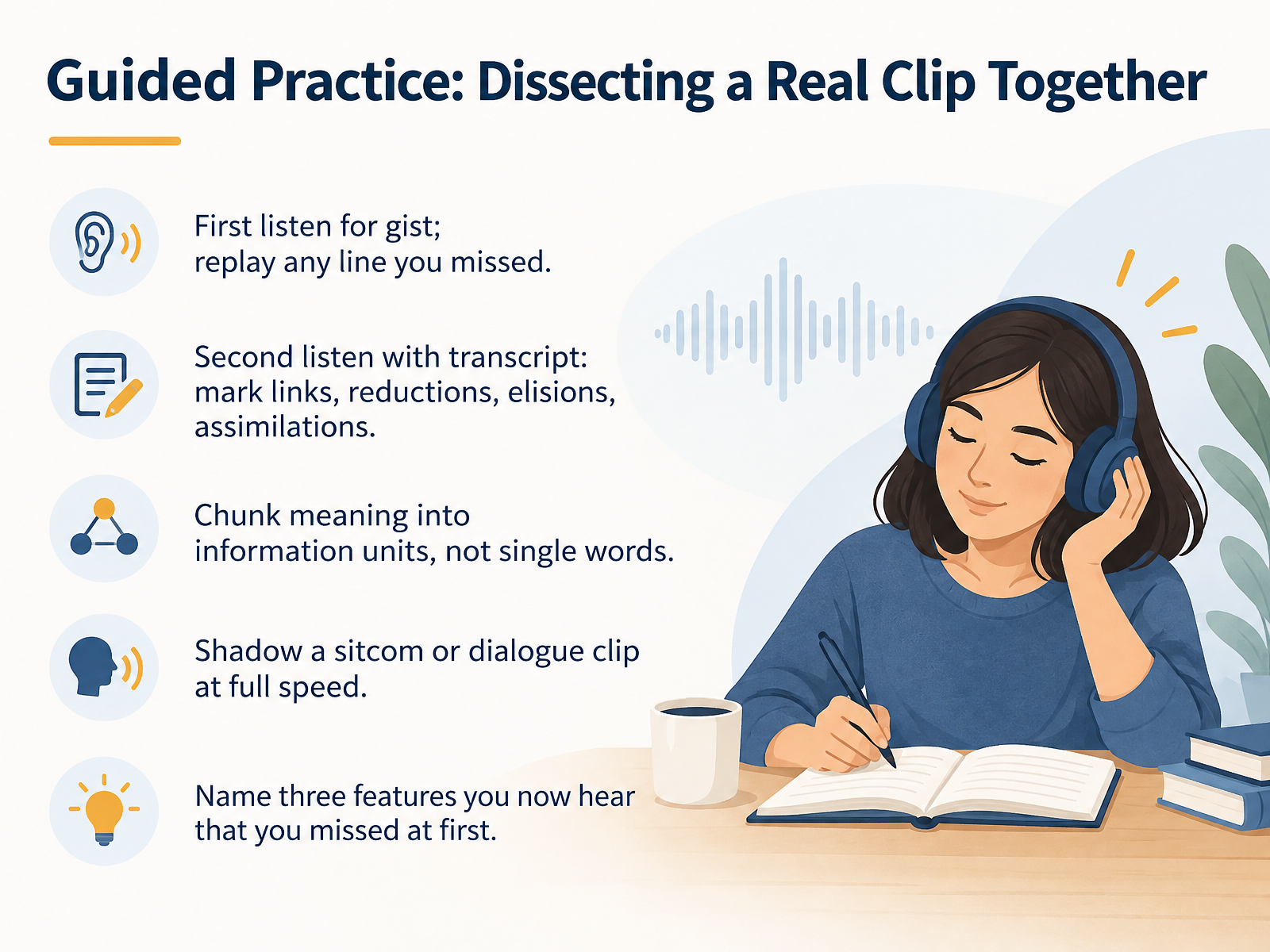
- 13Guided Practice: Dissecting a Real Clip TogetherNow let's put all of this into practice together. Here's a simple method you can use with any real clip. First, just listen for the gist. Don't worry about every word. If a line slips past you, replay it. That's normal. Second, listen again with the transcript open. This time, mark the links, the reductions, the elisions, and the assimilations. You already read English well, so the transcript is your friend here. Third, chunk the meaning into information units, not single words. Follow the ideas, not every syllable. Then try shadowing a sitcom or a dialogue clip at full speed. Copy the rhythm, not just the sounds. And finally, name three features you now hear that you missed at first. That last step is where the real progress shows. Next, let's bring this together in your Connected Speech Toolbox: Takeaways and a Daily Plan.
 2 min
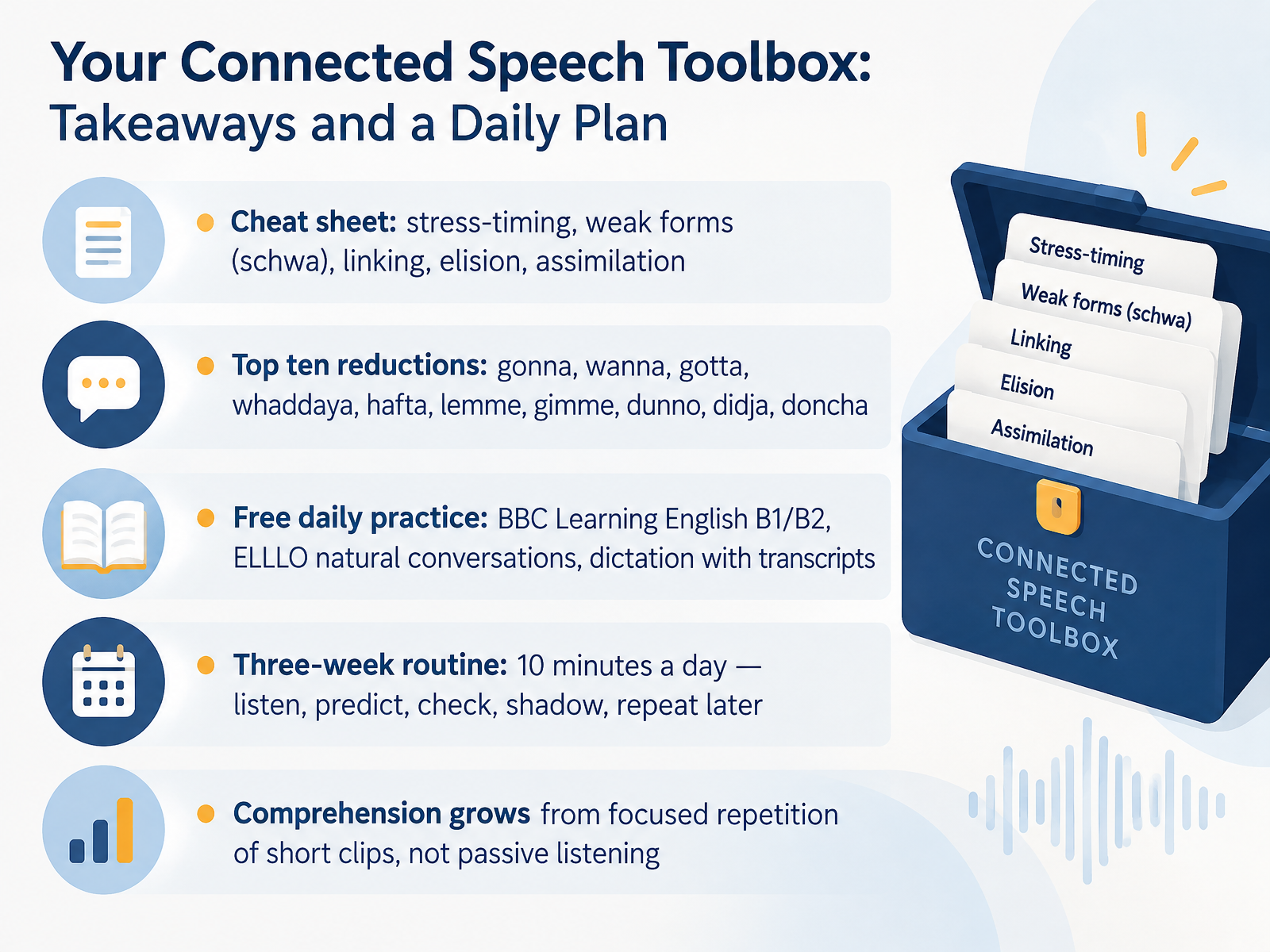
- 14Your Connected Speech Toolbox: Takeaways and a Daily PlanLet's bring everything together into a simple toolbox you can actually use. Your cheat sheet is five ideas. Stress timing, weak forms with the schwa, linking, elision, and assimilation. And the top ten reductions to listen for are gonna, wanna, gotta, whaddaya, hafta, lemme, gimme, dunno, didja, and doncha. For daily practice, keep it free and simple. BBC Learning English at B one and B two, ELLLO natural conversations, and short dictation with transcripts. Here is your three week routine. Ten minutes a day. Listen, predict, check, shadow, and repeat the clip later in the week. Remember, comprehension grows from focused repetition of short clips, not passive listening. That same clip, heard several times, teaches your ear more than an hour of background audio. So thank you for staying with this course. You already read English well. Now you are training your ear, and that simply takes time and repetition. You are doing fine. Keep going, one short clip at a time.
 listenglish.comteachingenglish.org.ukteachingenglishwithoxford.oup.com+22 min
Take the deck with you
Download this course as a file — free, no sign-up needed.
- PDF handoutEvery slide page, ready to print or share.15 pages · 3.4 MBDownload
- Narrated PowerPointThe deck that presents itself — every slide carries the digital human's narration video.15 pages · 22.9 MBDownload
- PowerPoint slidesThe full deck as a .pptx — open it in PowerPoint, Keynote, or Google Slides.15 pages · 3.4 MBDownload
Free to use in your own training — please keep the PersonWise credit page at the end.
Have your own deck? Turn it into a course
Sources consulted
Web sources consulted while building this course.
- Intermediate English Listening Practice (B1–B2) — listenglish.com
- Shadow reading | TeachingEnglish | British Council — teachingenglish.org.uk
- Shadowing: a useful technique for autonomous practice of listening and speaking - Teaching English with Oxford — teachingenglishwithoxford.oup.com
- Situating Shadowing in the Framework of Deliberate Practice: A Guide to Using 16 Techniques — journals.sagepub.com
- Shadowing for Developing EFL Learners’ Bottom-up Listening Skills: A Systematic Review — doi.org
- Insights into L2 connected speech segmentation: A gating experiment with listeners of different English proficiency levels — doi.org
- Chinese ESL learners’ perceptual errors of English connected speech: Insights into listening comprehension — sciencedirect.com
- Connected speech – part 1 | TeachingEnglish | British Council — teachingenglish.org.uk
- https://core.ac.uk/download/198565890.pdf — core.ac.uk
- Effects of Explicit Connected Speech Instruction on Libyan EFL Learners’ Perceptions of Listening Comprehension Problems in Speech Recognition, Parsing and Utilisation — doi.org
- Rhythm – Teaching Pronunciation with Confidence — iastate.pressbooks.pub
- Connected Speech: What Is It And How Do You Use It? — babbel.com
- Table5.1 Document — phonetics.ucla.edu
- How to Teach Weak Forms — englishclub.com
- Strong & Weak Forms — martinweisser.org
- Connected Speech – Teaching Pronunciation with Confidence — iastate.pressbooks.pub
- 31 Connected Speech — discovery.ucl.ac.uk
- Connected speech effects — cs.columbia.edu
- English Phonetics and Pronunciation Practice -- Paul Carley, Inger M. Mees, Beverley Collins -- 1, 2017 -- Routledge -- 9781138886339 -- 5a2afae634e593247b5ce9a055aeece1 -- Anna’s Archive — edisciplinas.usp.br
- Adjustments in Connected Speech — ocw.mit.edu