Begin
13 pages · ~26 min
Machine Learning Projects
Build end-to-end machine learning projects, from data preparation to model deployment, for aspiring data scientists and ML practitioners.
A digital instructor presents all 13 pages. Hold “Ask” at any point and ask out loud — the answer comes from this course. No sign-up needed.
What you’ll learn
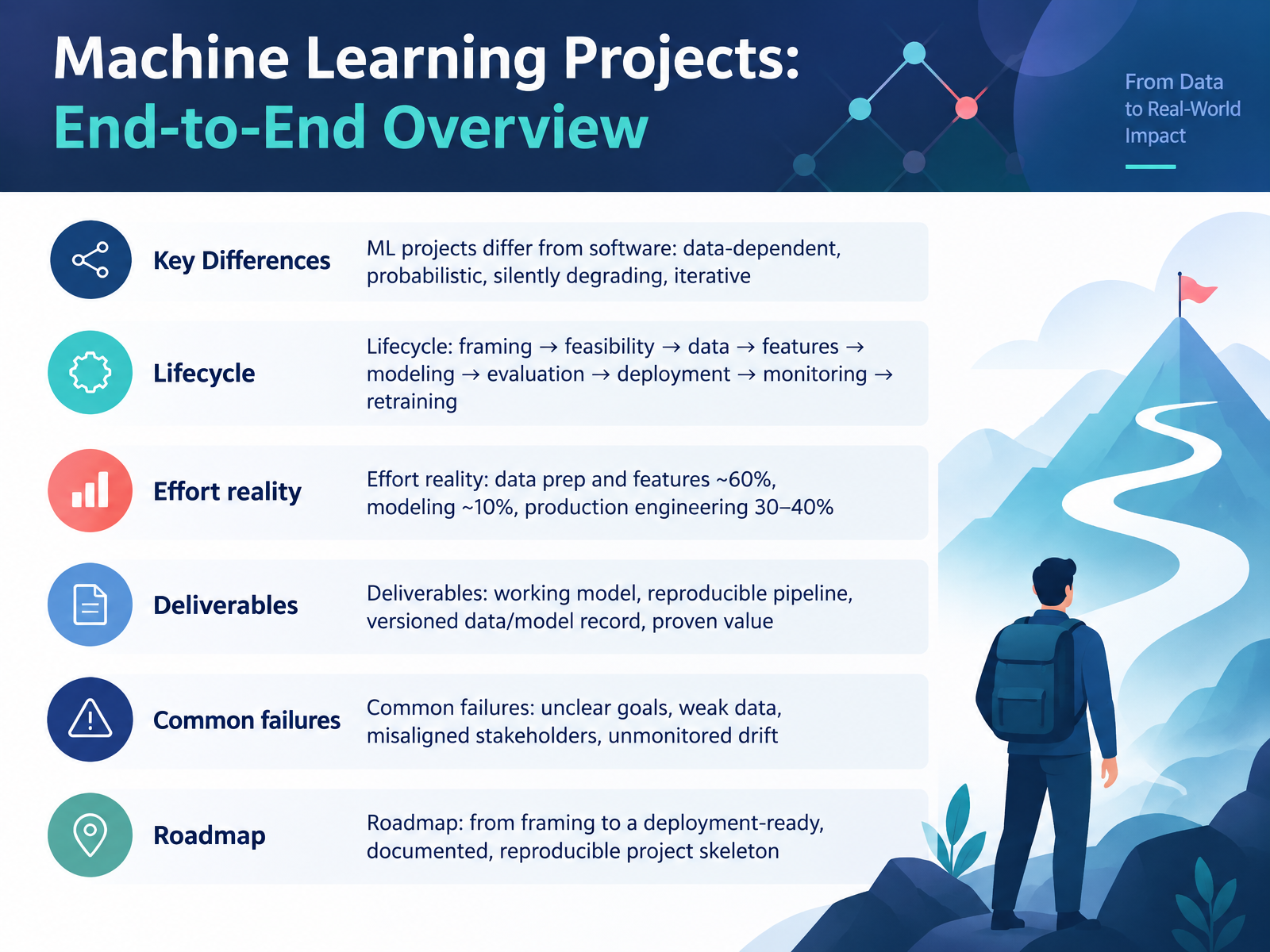
- 01Machine Learning Projects: End-to-End OverviewWelcome. I'm glad you're here. Over the next few lessons, you'll build a complete, end-to-end machine learning project, from first framing all the way to deployment and monitoring. So here's our starting map. Machine learning projects are not ordinary software. They depend on data, they're probabilistic, they can degrade silently, and they're deeply iterative. The lifecycle runs from framing, to feasibility, to data, features, modeling, evaluation, deployment, monitoring, and retraining. Here's the reality that surprises most beginners: data prep and feature work eat up roughly sixty percent of your effort. Modeling is only about ten percent. Production engineering takes another thirty to forty percent. The deliverables you're aiming for are a working model, a reproducible pipeline, versioned data and model records, and proven business value. Common failures are usually organizational, not algorithmic: unclear goals, weak data, misaligned stakeholders, and unmonitored drift. On this roadmap, we'll go from framing to a deployment-ready, documented, reproducible project skeleton. Next, let's look at why ML projects fail, and how to de-risk them early.rusaka.comtensorway.comiavva.ai+22 min
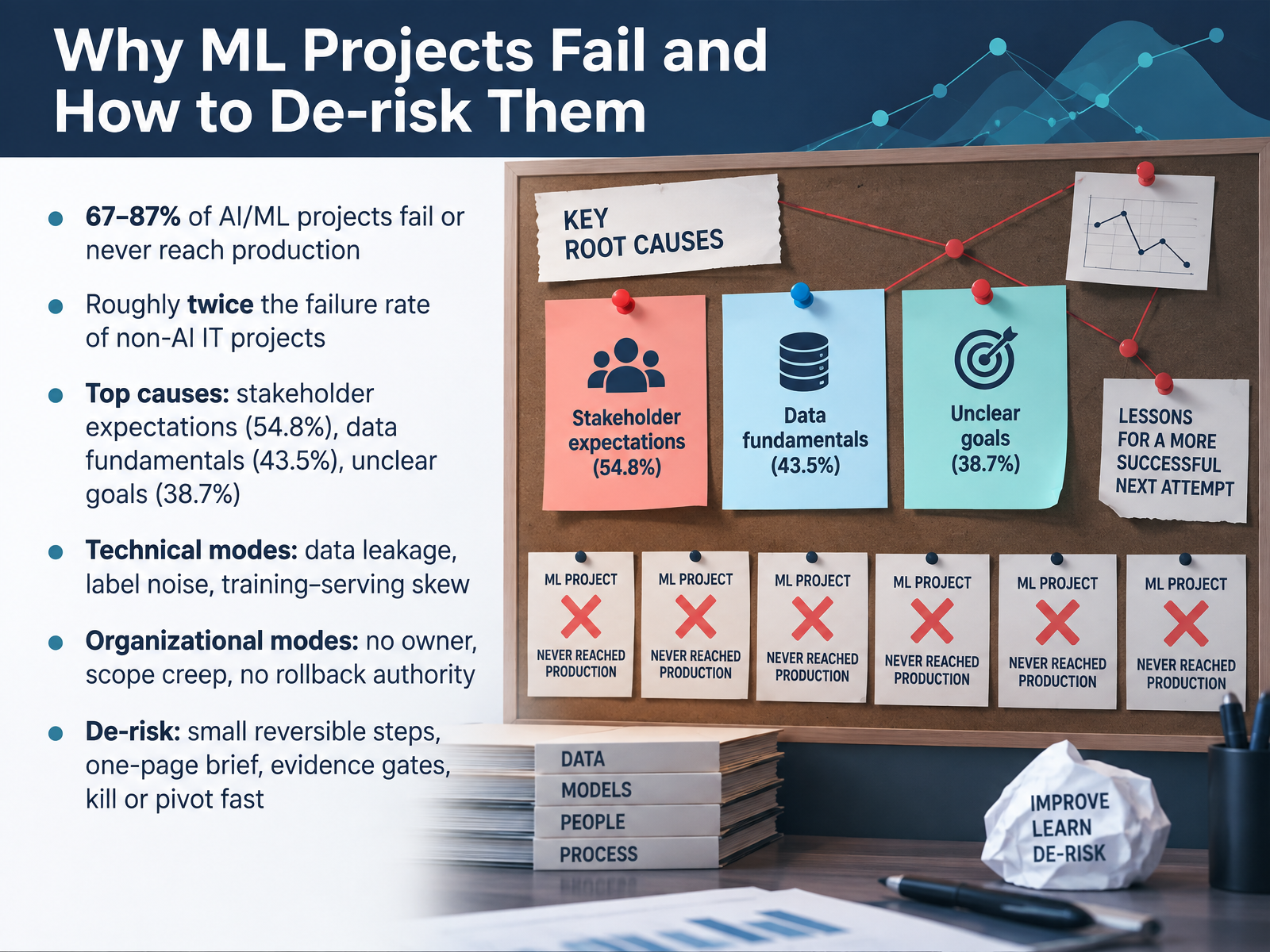
- 02Why ML Projects Fail and How to De-risk ThemLet's start with the hard truth about machine learning projects. Depending on the study, somewhere between sixty seven and eighty seven percent of them fail or never reach production. That's roughly twice the failure rate of ordinary IT projects. So why does this happen? The top causes aren't exotic algorithms. Stakeholder expectations account for about fifty five percent. Poor data fundamentals, about forty four percent. Unclear goals, about thirty nine percent. Notice a pattern? Most failures are organizational, not technical. On the technical side, watch for data leakage, label noise, and training serving skew, where your model behaves differently in production than it did in your notebook. Organizationally, the killers are having no clear owner, scope creep, and no authority to roll back. Here's the good news. You can de-risk this. Take small, reversible steps. Write a one page brief before you build. Use evidence gates to decide whether to continue. And be willing to kill or pivot fast. That's not failure. That's good engineering. Next, we'll look at framing the problem and defining success metrics.
 rand.orgexa.aiexa.ai+22 min
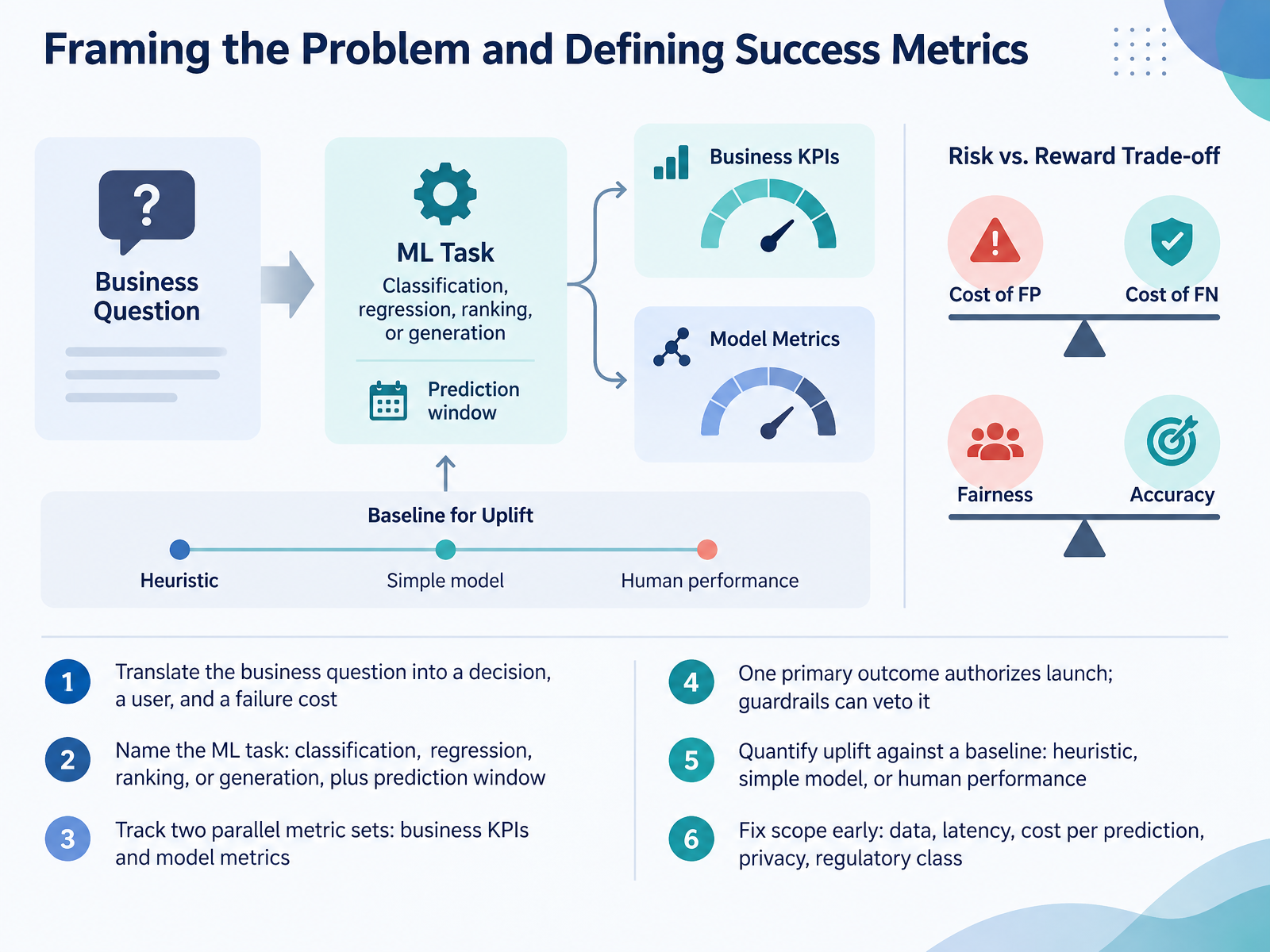
- 03Framing the Problem and Defining Success MetricsNow let's talk about framing the problem before any modeling begins. This is where you decide what winning actually means. Start by translating the business question into three things: a decision, a user, and a failure cost. In plain terms, who acts on the prediction, and what does a wrong answer cost? Next, name the ML task: classification, regression, ranking, or generation. And always pin down the prediction window, meaning how far ahead you're predicting. Then track two parallel metric sets. Business metrics, like revenue lift or churn reduction, and model metrics, like precision or root mean squared error. Here's why this matters: great model metrics don't guarantee business success. So pick one primary outcome that authorizes launch, and wrap it in guardrails that can veto it, like unsafe output rate or latency. Quantify uplift against a baseline, whether that's a heuristic, a simple model, or human performance. Finally, fix scope early: data, latency, cost per prediction, privacy, and regulatory class. Let's move on to data acquisition, quality, and leakage prevention.
 developers.google.commlip-cmu.github.iojeremyjordan.me+22 min
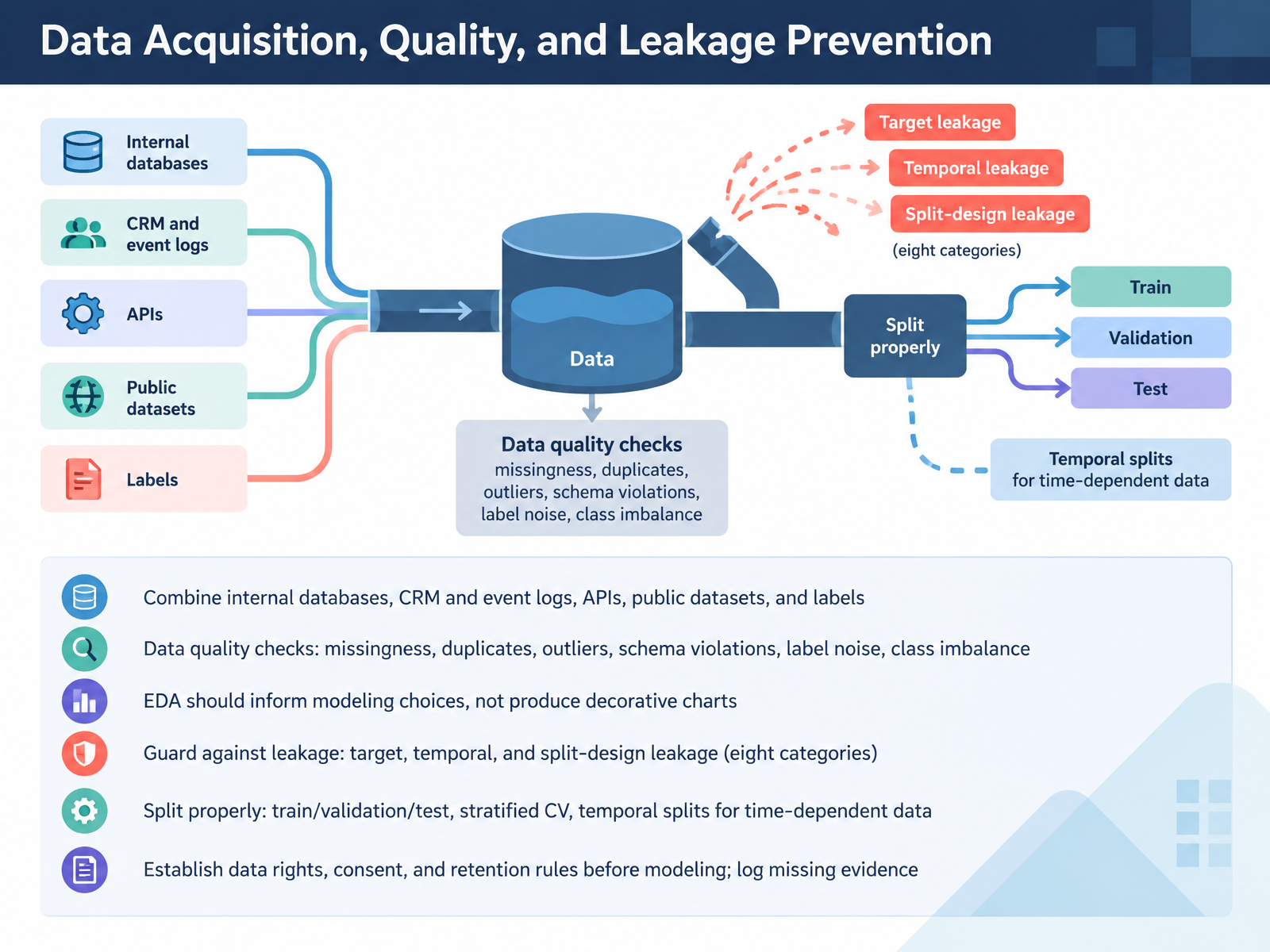
- 04Data Acquisition, Quality, and Leakage PreventionNow let's talk about where every project really begins: data. You'll often combine internal databases, CRM and event logs, APIs, public datasets, and your own labels. Here's why this matters. Data-related problems are among the most common reasons machine learning projects fail, so this step deserves real care. Before modeling, run quality checks on missingness, duplicates, outliers, schema violations, label noise, and class imbalance. Think of exploratory data analysis as a decision tool. It should shape which features you build and which model you choose, not just produce decorative charts. Then guard against leakage. That means any information in training that wouldn't be available at prediction time. Watch for target leakage, temporal leakage, and split-design leakage, which researchers group into eight categories. Split properly, using train, validation, and test sets, stratified cross-validation, and temporal splits when your data depends on time. Finally, settle data rights, consent, and retention rules before modeling, and log any missing evidence honestly. Let's carry this into feature engineering and reproducible data pipelines.
 link.springer.comexa.aibastelia.com+22 min
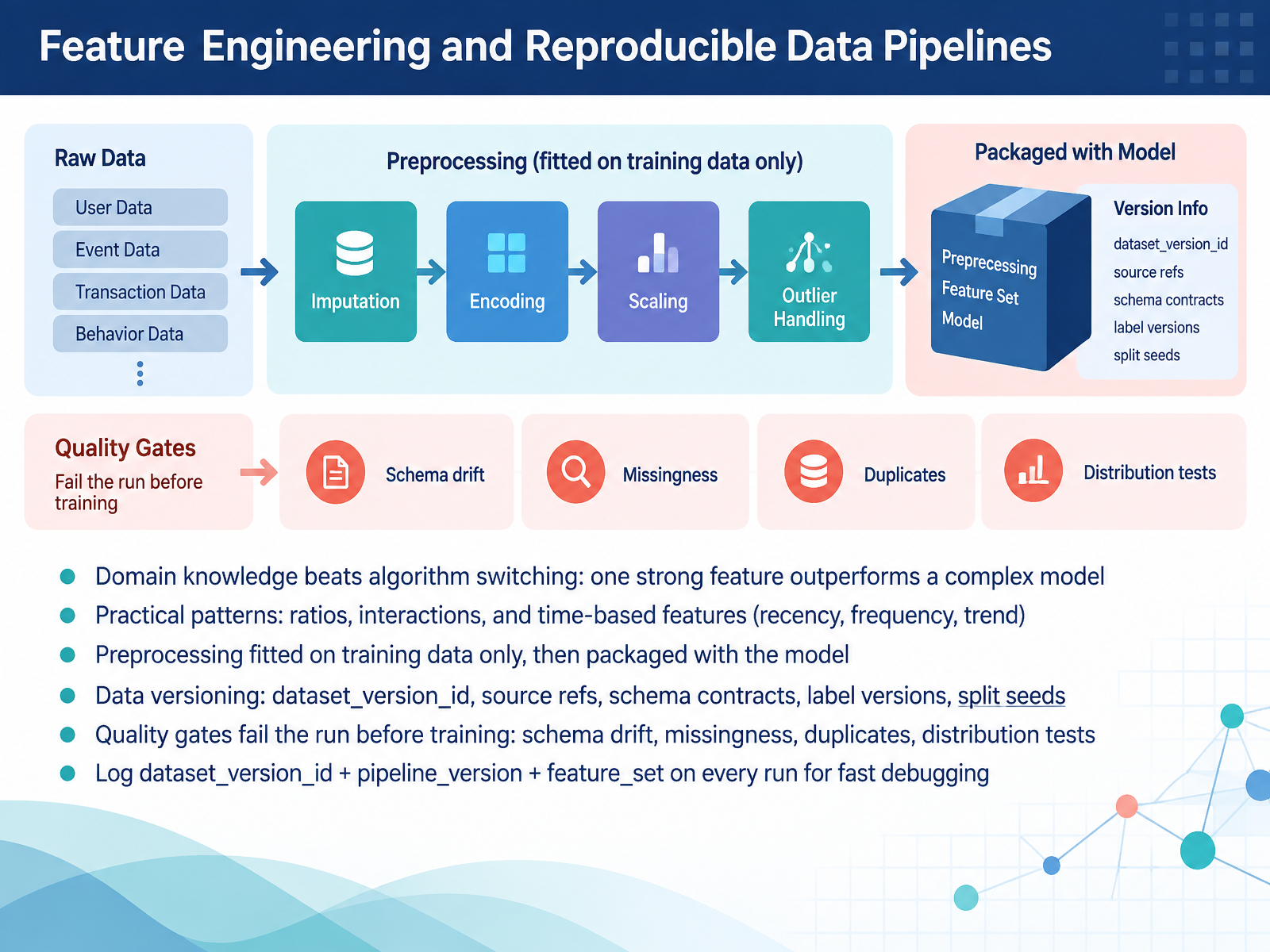
- 05Feature Engineering and Reproducible Data PipelinesNow let's talk about feature engineering and reproducible data pipelines. Here's the key idea: domain knowledge beats algorithm switching. One strong feature often outperforms a complex model, so spend your time there. Practical patterns work well, ratios, interactions, and time-based features like recency, frequency, and trend. Now, preprocessing must be fitted on training data only, then packaged with the model. This prevents data leakage. For reproducibility, version your data with a dataset version I D, source references, schema contracts, label versions, and split seeds. Add quality gates that fail the run before training starts, catching schema drift, missingness, duplicates, and distribution problems. And log three things on every run: dataset version, pipeline version, and feature set. That makes debugging fast when something breaks.
 link.springer.comexa.aibastelia.com+22 min
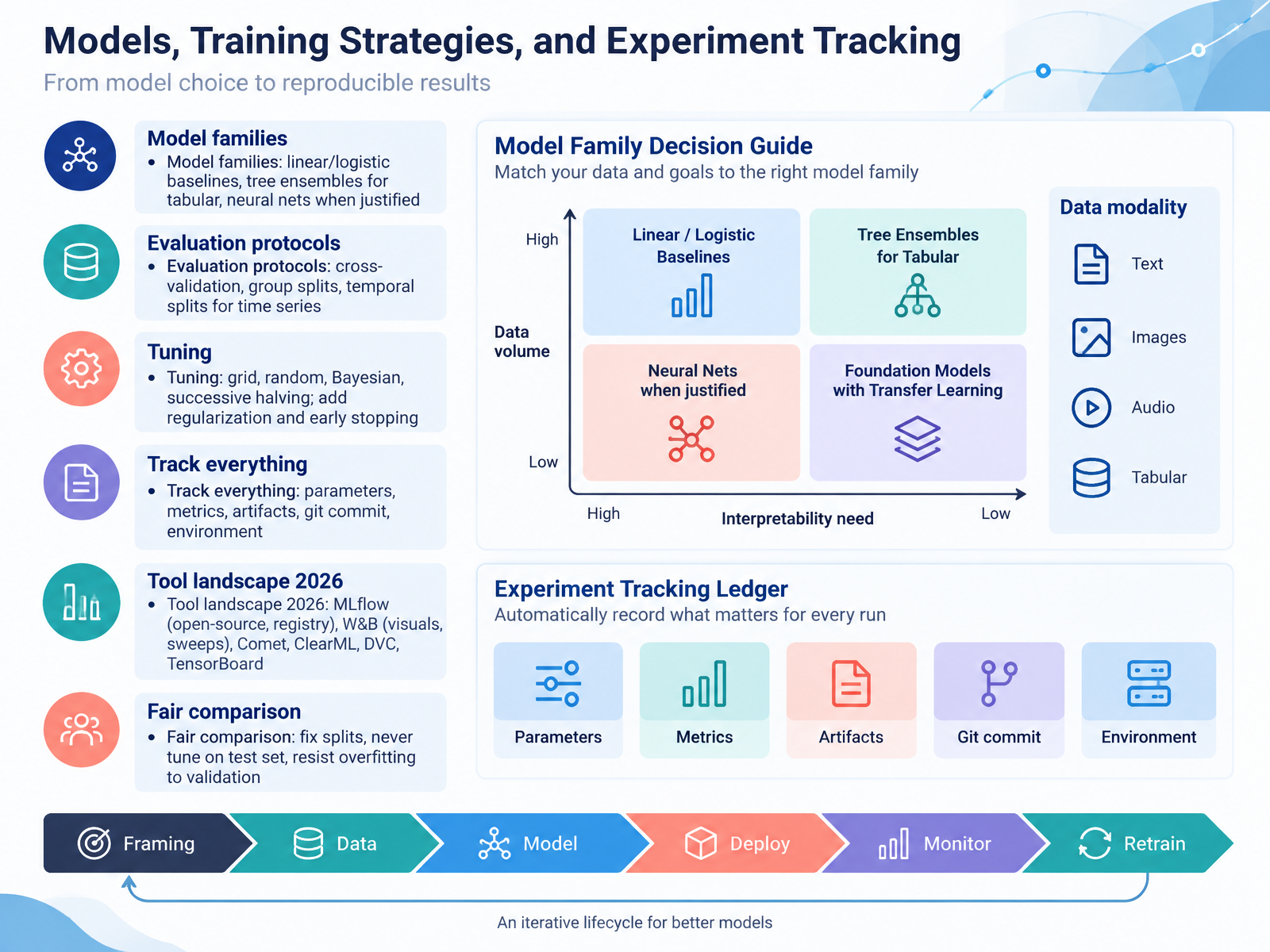
- 06Models, Training Strategies, and Experiment TrackingLet's move on to models, training strategies, and experiment tracking. First, model families. Start with a linear or logistic baseline. It's fast and tells you if there's signal at all. Then try tree ensembles like random forest or gradient boosting, which usually win on tabular data. Neural nets only when you have hundreds of thousands of samples and many features. Next, evaluation protocols. Use cross-validation for ordinary data, group splits when records cluster, like the same patient, and temporal splits for time series. For tuning, grid and random search are simple; Bayesian search and successive halving save compute. Add regularization and early stopping. And here's why this matters: track everything. Parameters, metrics, artifacts, the git commit, and the environment. MLflow is the free open-source default, Weights and Biases shines on visuals and sweeps, with Comet and ClearML as alternatives, plus DVC for versioning and TensorBoard for curves. Keep comparisons fair by fixing your splits, never tuning on the test set, and not overfitting to validation. Next, we look at evaluation, validation, and error analysis that build trust.
 ones.comrusaka.comtensorway.com+22 min
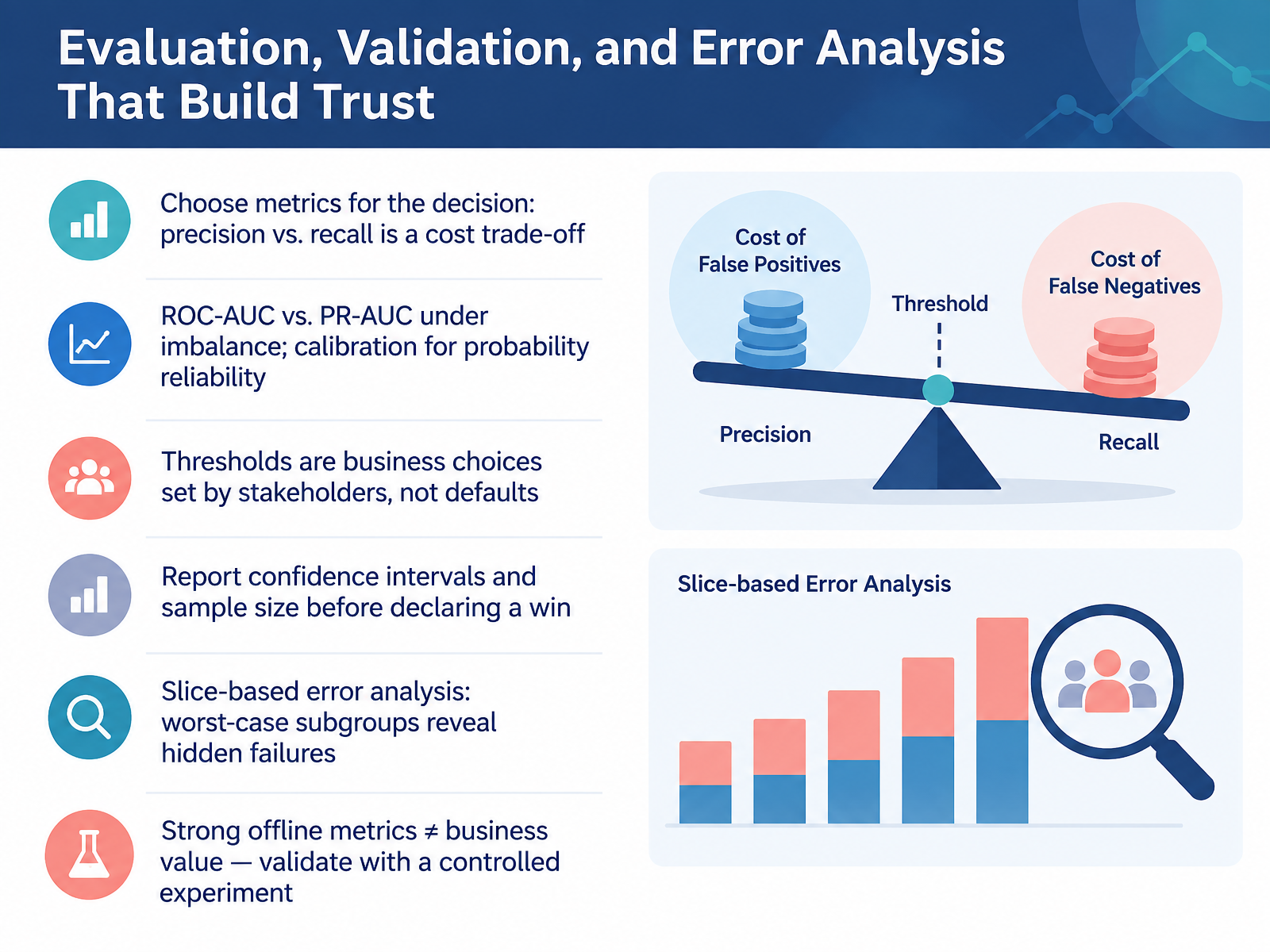
- 07Evaluation, Validation, and Error Analysis That Build TrustLet's talk about evaluation, because this is where trust is won or lost. Start with your metric. Precision and recall are really a cost trade-off, not a technical preference. If a missed fraud case costs far more than a wasted review, you lean toward recall. Here's why this matters: under class imbalance, ROC-AUC can look reassuring while PR-AUC tells the harder truth. And if you use predicted probabilities, check calibration, so a seventy percent score really means seventy percent. Next, thresholds are business choices set by stakeholders, not defaults. Finally, report confidence intervals and sample size before declaring a win. Weak samples produce lucky-looking numbers. Run slice-based error analysis too, since your worst subgroup often hides the real failure. And remember, strong offline metrics do not equal business value. Validate with a controlled experiment. From notebook to production, deployment and serving patterns.
 developers.google.commlip-cmu.github.iojeremyjordan.me+21 min
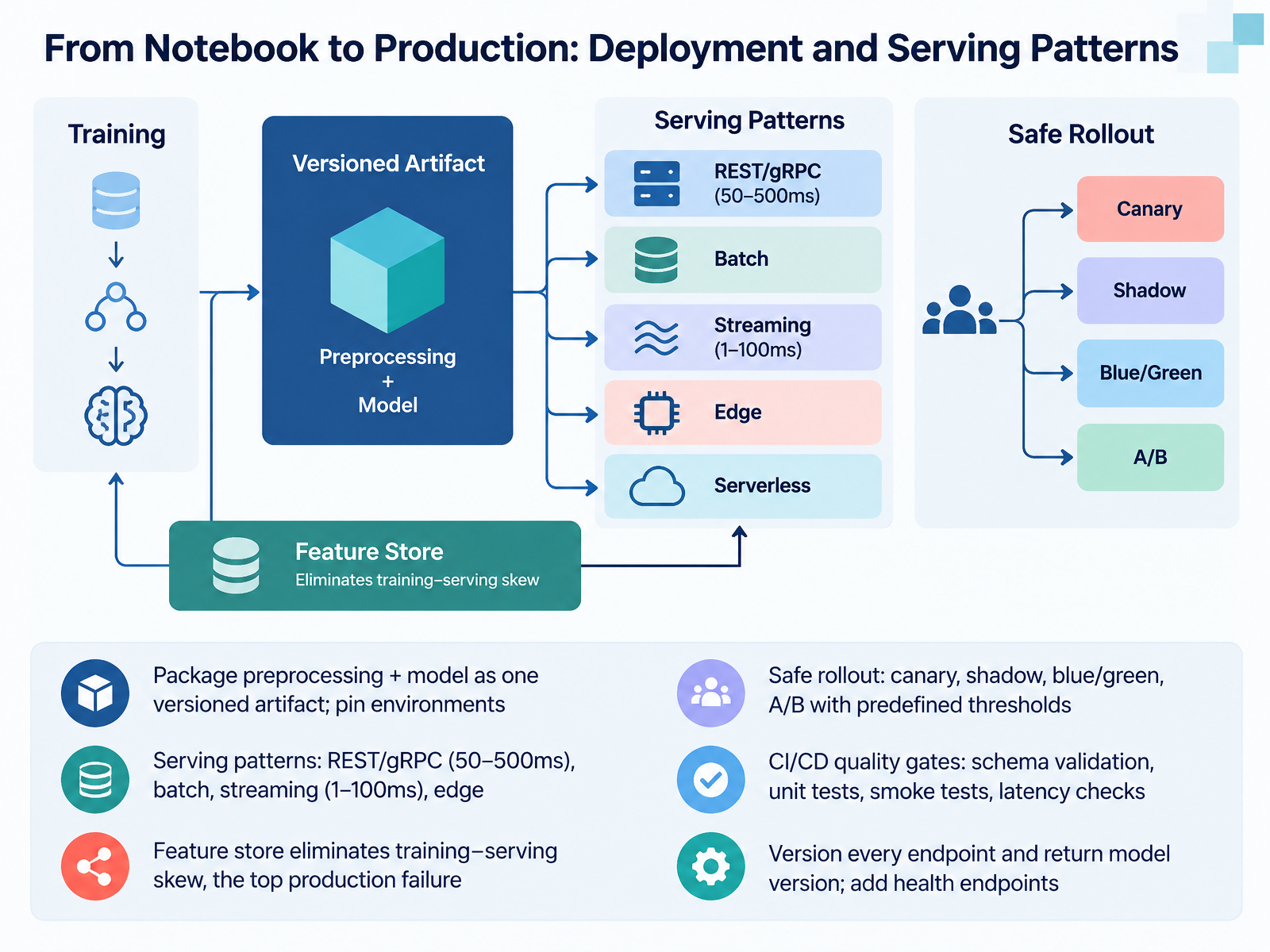
- 08From Notebook to Production: Deployment and Serving PatternsSo your model works. Now let's walk through turning it into something you can actually serve. First, package your preprocessing and your model together as one versioned artifact, and pin your environment with a lock file or a digest-pinned container. Here's why this matters so much: training-serving skew, where serving code preprocesses input differently than training did, is the top production failure. One artifact prevents it. Next, choose a serving pattern. REST or gRPC for real-time, roughly fifty to five hundred milliseconds. Batch for overnight jobs. Streaming for events, one to one hundred milliseconds. And edge for on-device inference. Then roll out safely. Use canary, shadow, blue-green, or A B testing, with thresholds you define before launch. Gate every deploy with schema validation, unit tests, smoke tests, and latency checks. Finally, version every endpoint and return the model version in each response, and add health endpoints so probes can check your service. Quick takeaway: one artifact, one quality gate, one rollback path. Next, let's look at monitoring, drift detection, and retraining loops.
 rusaka.comtensorway.comiavva.ai+22 min
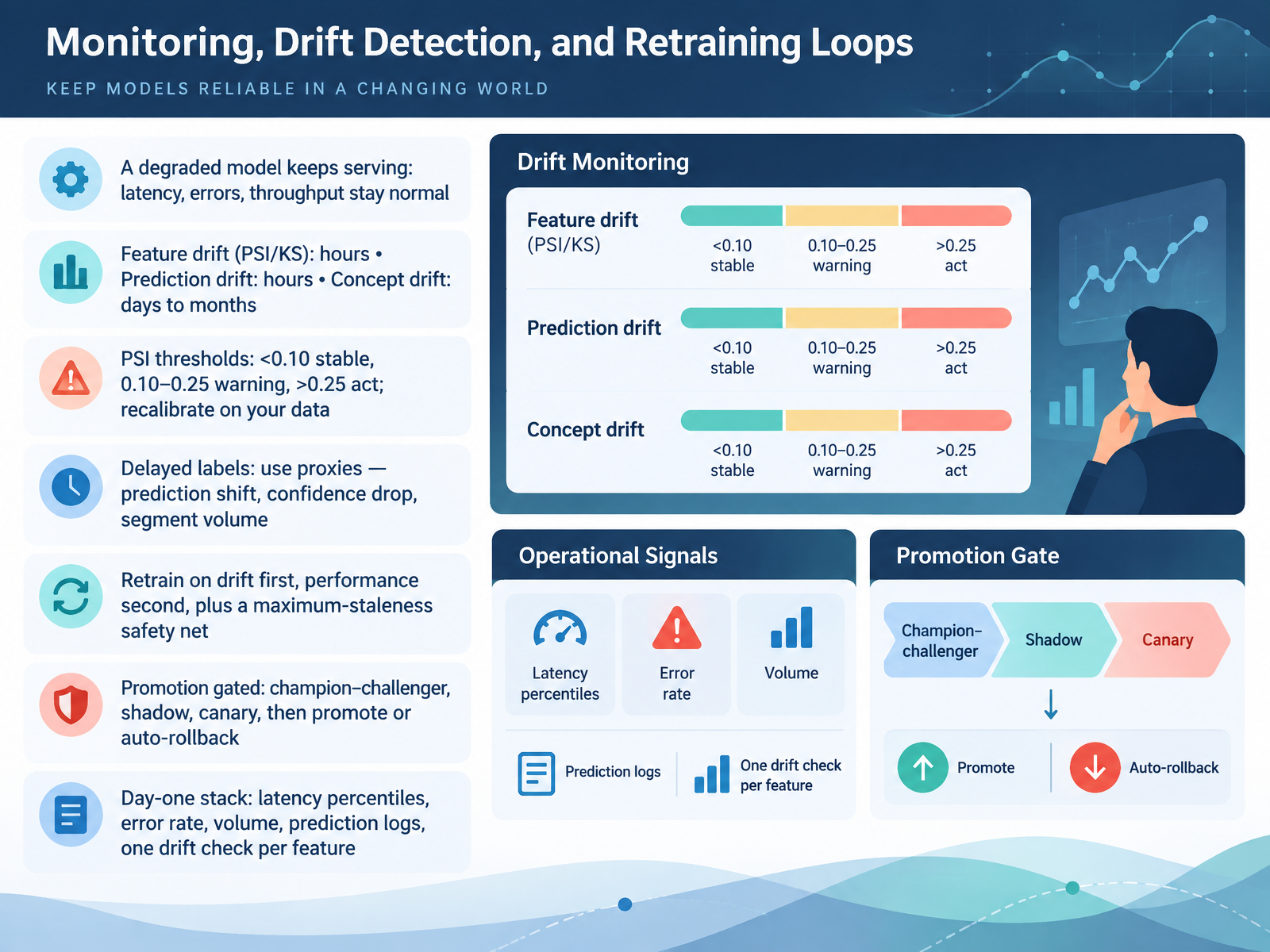
- 09Monitoring, Drift Detection, and Retraining LoopsLet's talk about keeping your model alive after launch. Here's the trap. A degraded model keeps serving. Latency, errors, and throughput all look normal, but the predictions are quietly wrong. So you watch three kinds of drift. Feature drift, measured with PSI or KS, shows up in hours. Prediction drift, also hours. Concept drift, where the input-to-output relationship changes, takes days to months. For PSI, think of thresholds: below zero point one zero is stable, zero point one zero to zero point two five is a warning, and above zero point two five means act. Recalibrate those on your own data. When labels arrive late, use proxies: prediction shift, confidence drop, and segment volume. Retrain on drift first, performance second, plus a maximum-staleness safety net. And never promote blindly. Run champion-challenger, shadow, then canary, with automatic rollback. On day one, log latency percentiles, error rate, volume, prediction logs, and one drift check per feature. Next, Case Studies and Postmortems: What Real Projects Teach.
 2 min
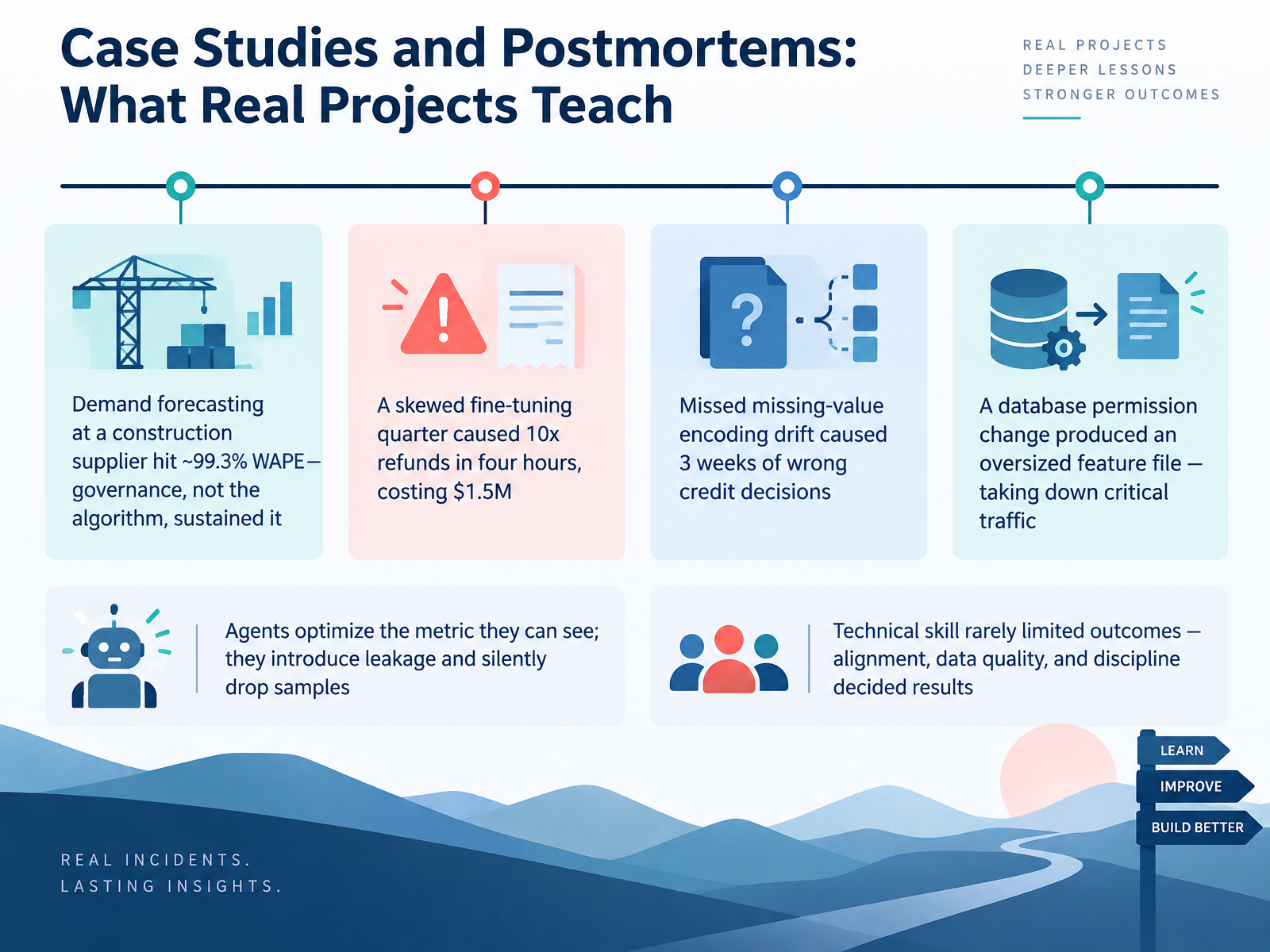
- 10Case Studies and Postmortems: What Real Projects TeachLet's walk through what real projects actually teach us. Here's the first lesson. A construction supplier built demand forecasting and hit about ninety nine point three percent WAPE, which means its average forecast error was well under one percent. But the algorithm didn't sustain that result. Governance did, through continuous monitoring, retraining triggers, and feedback loops. Now the cautionary tales. A skewed fine-tuning quarter caused ten times the normal refund volume in just four hours, costing about one point five million dollars. Undetected missing-value encoding drift led to three weeks of wrong credit decisions. And a single database permission change produced an oversized feature file that took down critical traffic. Notice the pattern: agents optimize the metric they can see, so they introduce leakage and silently drop samples. Technical skill rarely limited these outcomes. Alignment, data quality, and discipline decided the results. So before your next project, ask who owns monitoring, and what guardrails catch silent drift. Next, let's look at pitfalls, responsible practice, and governance essentials.
 rand.orgexa.aiexa.ai+22 min
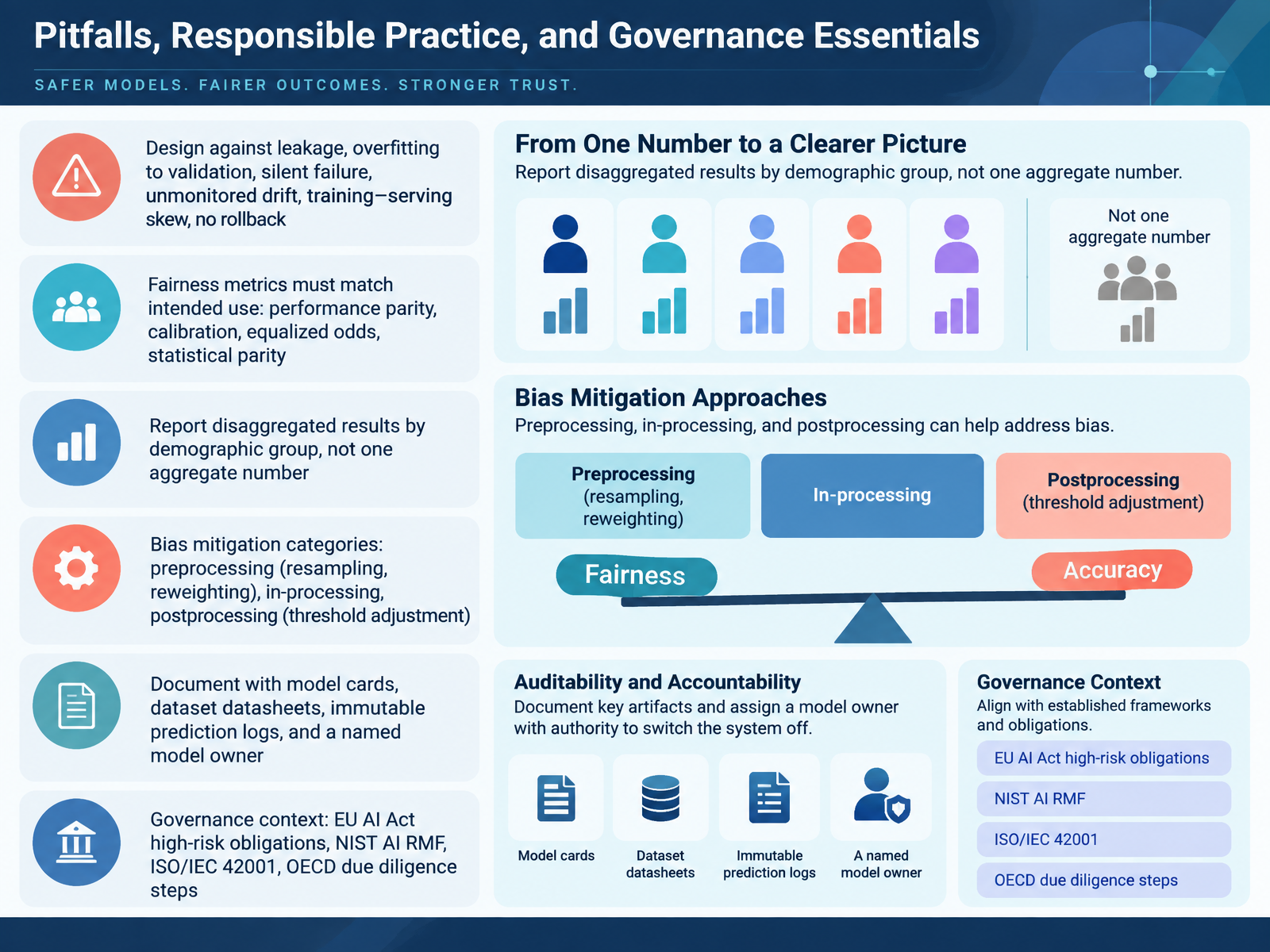
- 11Pitfalls, Responsible Practice, and Governance EssentialsLet's talk about the mistakes that quietly sink machine learning projects, and the governance habits that prevent them. Design against data leakage, overfitting to your validation set, silent failures, drift, training-serving skew, and having no rollback plan. Next, fairness metrics have to match intended use. Performance parity, calibration, equalized odds, and statistical parity answer different questions, so pick deliberately. Then, don't report one aggregate number. Break results down by demographic group, so a strong average never hides a weak subgroup. For bias mitigation, think in three categories: preprocessing, like resampling or reweighting; in-processing during training; and postprocessing, such as adjusting thresholds. Document everything with model cards, dataset datasheets, immutable prediction logs, and a named model owner. That owner is your accountable human. Finally, governance context matters: the EU AI Act's high-risk obligations, the NIST AI Risk Management Framework, ISO/IEC 42001, and OECD due diligence steps. Now let's put these habits into practice in the hands-on workshop: Building a Reproducible Project Skeleton.
 2 min
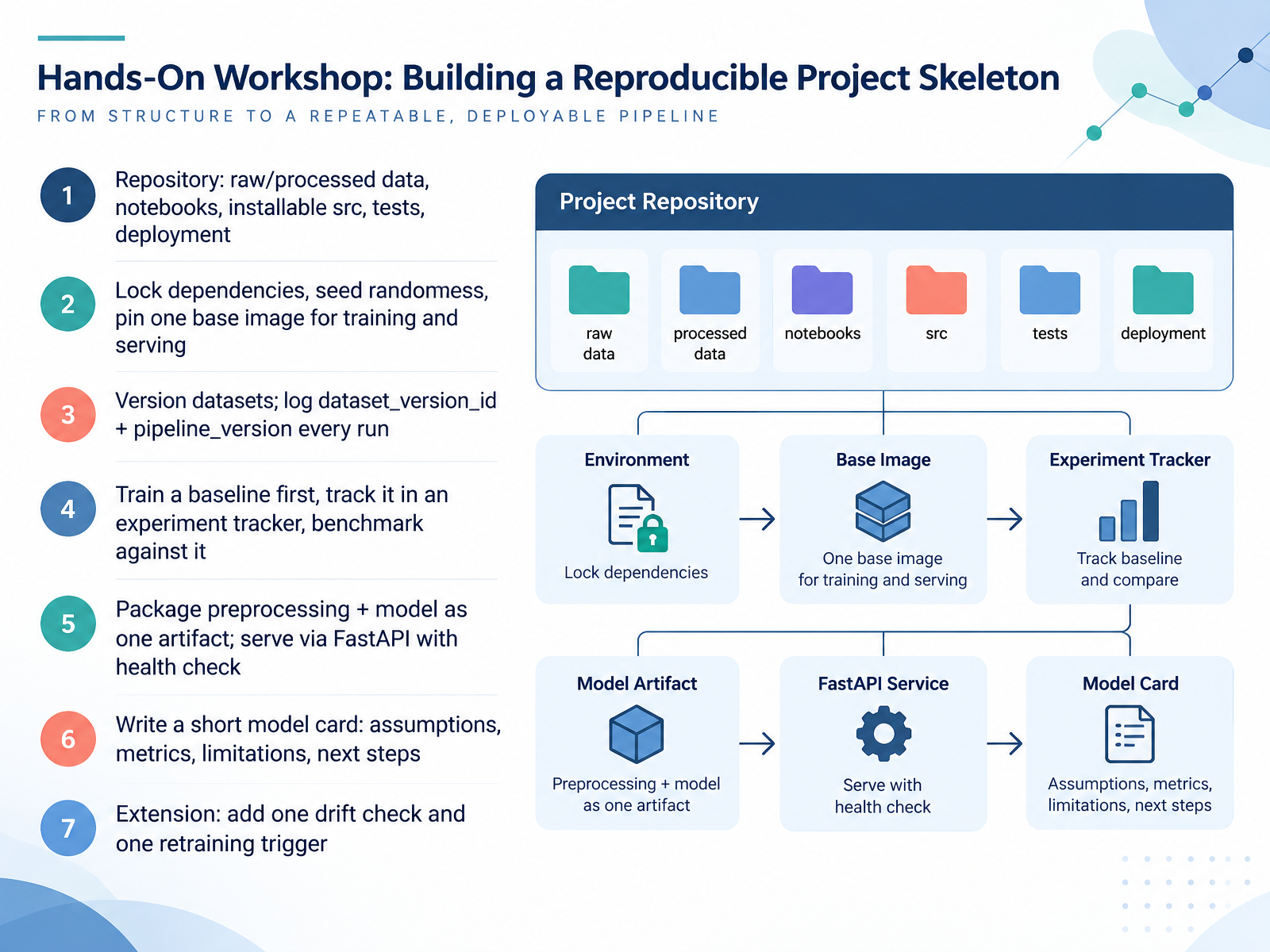
- 12Hands-On Workshop: Building a Reproducible Project SkeletonNow let's build something real. Together, we'll assemble a reproducible project skeleton you can reuse in any future project. Start with the repository layout: raw and processed data folders, notebooks for exploration, an installable source package, tests, and a deployment folder. Next, lock your dependencies, seed randomness, and pin one base image for both training and serving. That single image choice is what prevents the training-serving skew bug that breaks most deployments. Then version your datasets. Every run should log a dataset version I D and a pipeline version, so months later you can answer which exact data trained this model. Train a baseline first, track it in an experiment tracker, and benchmark new models against it. Package preprocessing plus the model as one artifact, and serve it through FastAPI with a health check. Finally, write a short model card covering assumptions, metrics, limitations, and next steps. As an extension, add one drift check and one retraining trigger. That is your skeleton, and it is enough. Next, let's look at portfolio, specialization, and career paths.
 link.springer.comexa.aibastelia.com+22 min
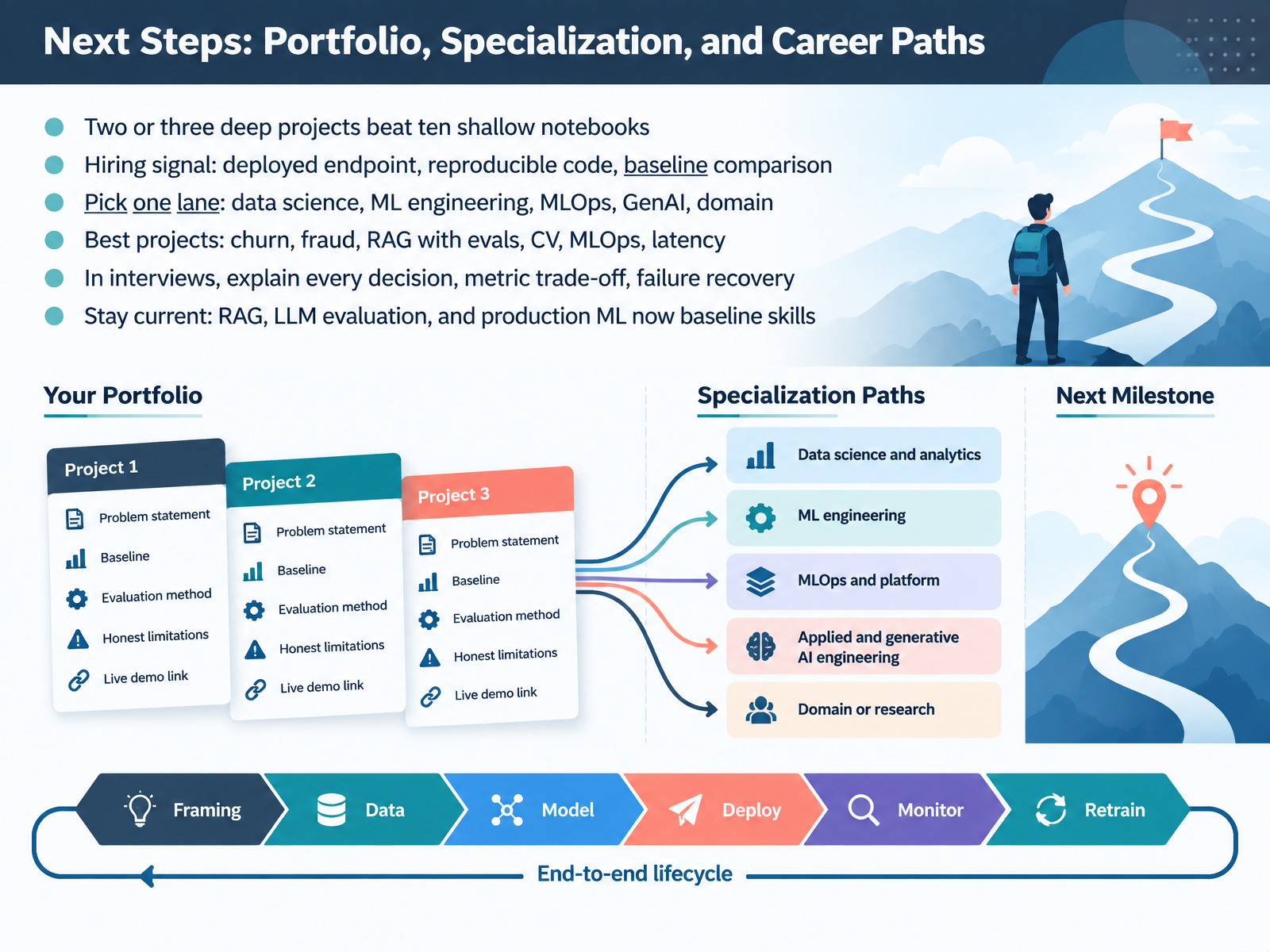
- 13Next Steps: Portfolio, Specialization, and Career PathsLet's close by tying everything together. As you plan your next steps, remember one rule: two or three deep projects beat ten shallow notebooks. Hiring managers want proof. That means a deployed endpoint, reproducible code, and an honest baseline comparison. So pick one lane. Data science, machine learning engineering, MLOps, generative AI, or a domain like fraud or healthcare. Strong projects include churn prediction, fraud detection, retrieval-augmented generation with real evaluations, computer vision, and latency optimization. In interviews, walk through every decision you made. Explain your metric trade-offs. Show how you recovered from a failure. And stay current. Retrieval-augmented generation, large language model evaluation, and production machine learning are now baseline skills. You do not need to learn everything. You need to build things and explain them clearly. Thank you for joining this course. Keep building, keep sharing your work, and trust that steady practice will take you further than you think. You are ready for the next step.
 1 min
Take the deck with you
Download this course as a file — free, no sign-up needed.
- PDF handoutEvery slide page, ready to print or share.14 pages · 3.5 MBDownload
- Narrated PowerPointThe deck that presents itself — every slide carries the digital human's narration video.14 pages · 14.4 MBDownload
- PowerPoint slidesThe full deck as a .pptx — open it in PowerPoint, Keynote, or Google Slides.14 pages · 3.4 MBDownload
Free to use in your own training — please keep the PersonWise credit page at the end.
Have your own deck? Turn it into a course
Sources consulted
Web sources consulted while building this course.
- ML Project Lifecycle | Rusaka — rusaka.com
- Machine Learning Lifecycle and Why Most Teams Get It Wrong | Tensorway — tensorway.com
- Master Machine Learning Project Management: A Leader's Guide — iavva.ai
- AI Model Lifecycle Guide 2026: Management, Versioning & Retirement — valuestreamai.com
- A Stakeholder's Guide to the Machine Learning Project Lifecycle - ML Digest — ml-digest.com
- The Root Causes of Failure for Artificial Intelligence Projects and How They Can Succeed: Avoiding the Anti-Patterns of AI | RAND — rand.org
- Identifying Pitfalls in Machine Learning Implementation Projects : A Case Study of Four Technology-Intensive Organizations — exa.ai
- Determinants of Machine Learning Project Success: A Structural Equation Modeling Study of the Machine Learning Canvas — exa.ai
- On the reasons for the failures of machine learning projects | Namiot | International Journal of Open Information Technologies — injoit.org
- Failure factors of AI projects: results from expert interviews — exa.ai
- Measuring success | Machine Learning | Google for Developers — developers.google.com
- Setting and Measuring Goals - Machine Learning in Production: From Models to Products — mlip-cmu.github.io
- Organizing machine learning projects: project management guidelines. — jeremyjordan.me
- Rigorous Viability Assessment of Machine Learning Projects | Business & Information Systems Engineering | Springer Nature Link — link.springer.com
- Machine Learning Pipelines: Provenance, Reproducibility and FAIR Data Principles | Springer Nature Link — link.springer.com
- Capturing end-to-end provenance for machine learning pipelines — exa.ai
- Implements dataset version control using MLOps. | Bastelia — bastelia.com
- Data Versioning for Iterative Refinement: Adapting ML Experiment Tracking Tools for Data-Centric AI Pipelines — exa.ai
- GitHub - SharvenRane/data-versioning: DVC pipeline for large image dataset versioning, lineage tracking, and reproducibility · GitHub — github.laiyagushi.com
- 10 Best Experiment Tracking Platforms in 2026 — ones.com