Silk Roads Cultural Exchange
Begin
15 pages · ~30 min
Silk Roads Cultural Exchange
This training explores the historical Silk Roads and their role in facilitating cultural, commercial, and intellectual exchange across regions, helping learners understand the interconnectedness of ancient civilizations and the lasting impact of these networks.
What you’ll learn
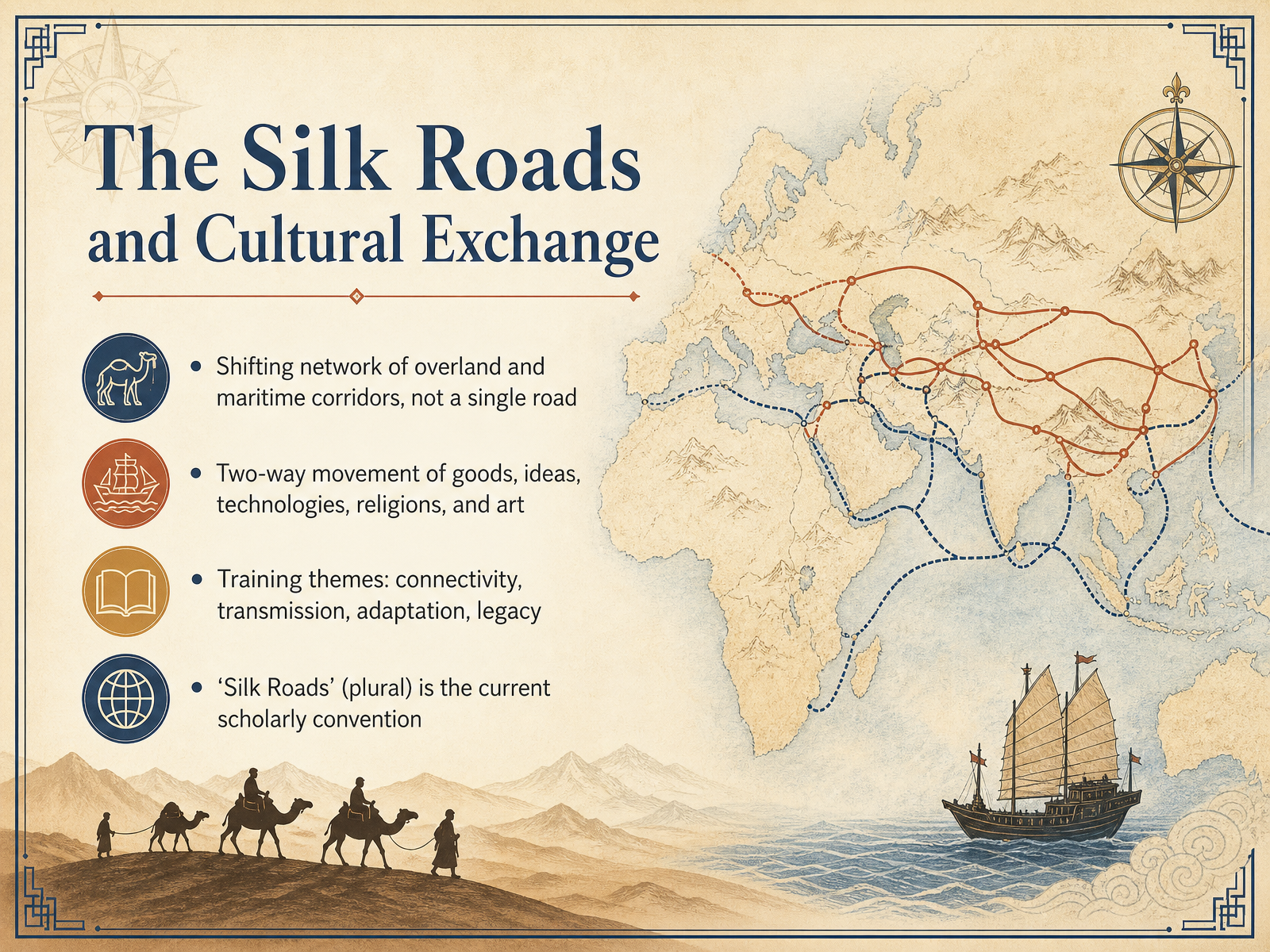
- 01The Silk Roads and Cultural ExchangeWelcome. We often picture the Silk Roads as a single golden path stretching from China to Rome, but the reality is far richer. It was a shifting network of overland tracks and maritime corridors, always in motion, always changing. And it was never just about silk. Along these routes moved ideas, religions, technologies, and art, in both directions at once, connecting distant communities in a constant, two-way exchange. Over the next few minutes, we will explore what that connectivity really meant, how transmission happened, how cultures adapted what they received, and why this legacy still shapes our world today. One quick note before we begin: when scholars say Silk Roads, plural, they mean many routes, not one road. That single word, plural, captures the true scale and complexity of the system. So, let's start with the network itself. How did so many threads weave together into one of history's greatest tapestries? That is what we'll uncover in the next section, A Network, Not a Road.unesco.orgbritannica.comicomos.org+22 min
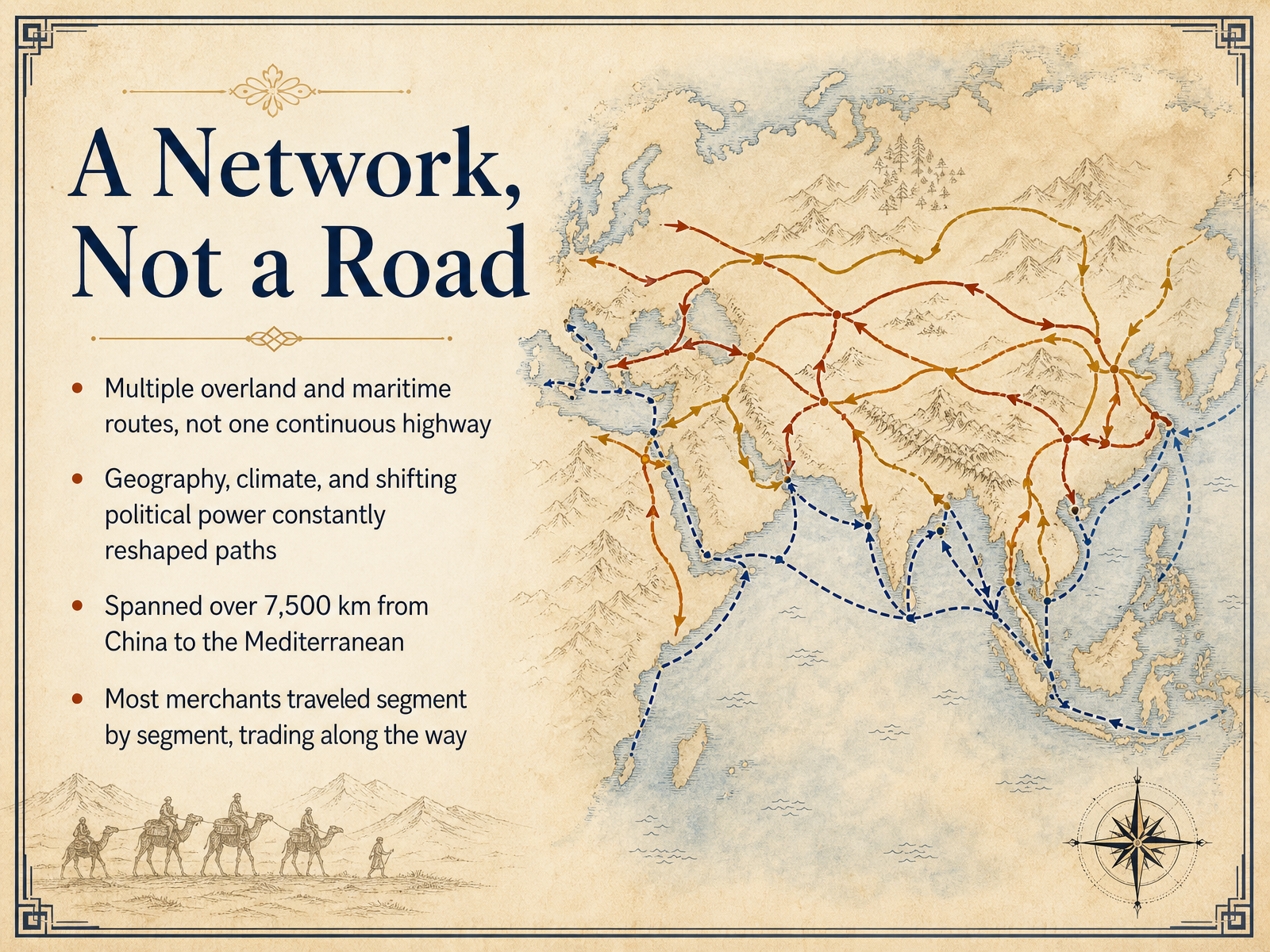
- 02A Network, Not a RoadLet’s clear up a common misconception right away: the Silk Roads were never a single highway stretching from China to Rome. Think of them instead as a vast, shifting web of pathways. Some snaked overland through deserts and mountain passes, while others crossed oceans, guided by monsoon winds. In total, this network spanned over seven thousand five hundred kilometers. But here’s the key insight: geography, climate, and the rise and fall of empires constantly reshaped these paths. A route that flourished in one century might be abandoned the next. And most merchants never traveled the whole distance. They moved segment by segment, trading their goods at oasis cities and bustling ports, then handing them off to the next caravan. This is what made the Silk Roads so dynamic and so powerful. Now, let’s zoom in on the geography and the major hubs that made this vast exchange possible.
 iranturan.leiden.eduarcgis.comtransportgeography.org+21 min
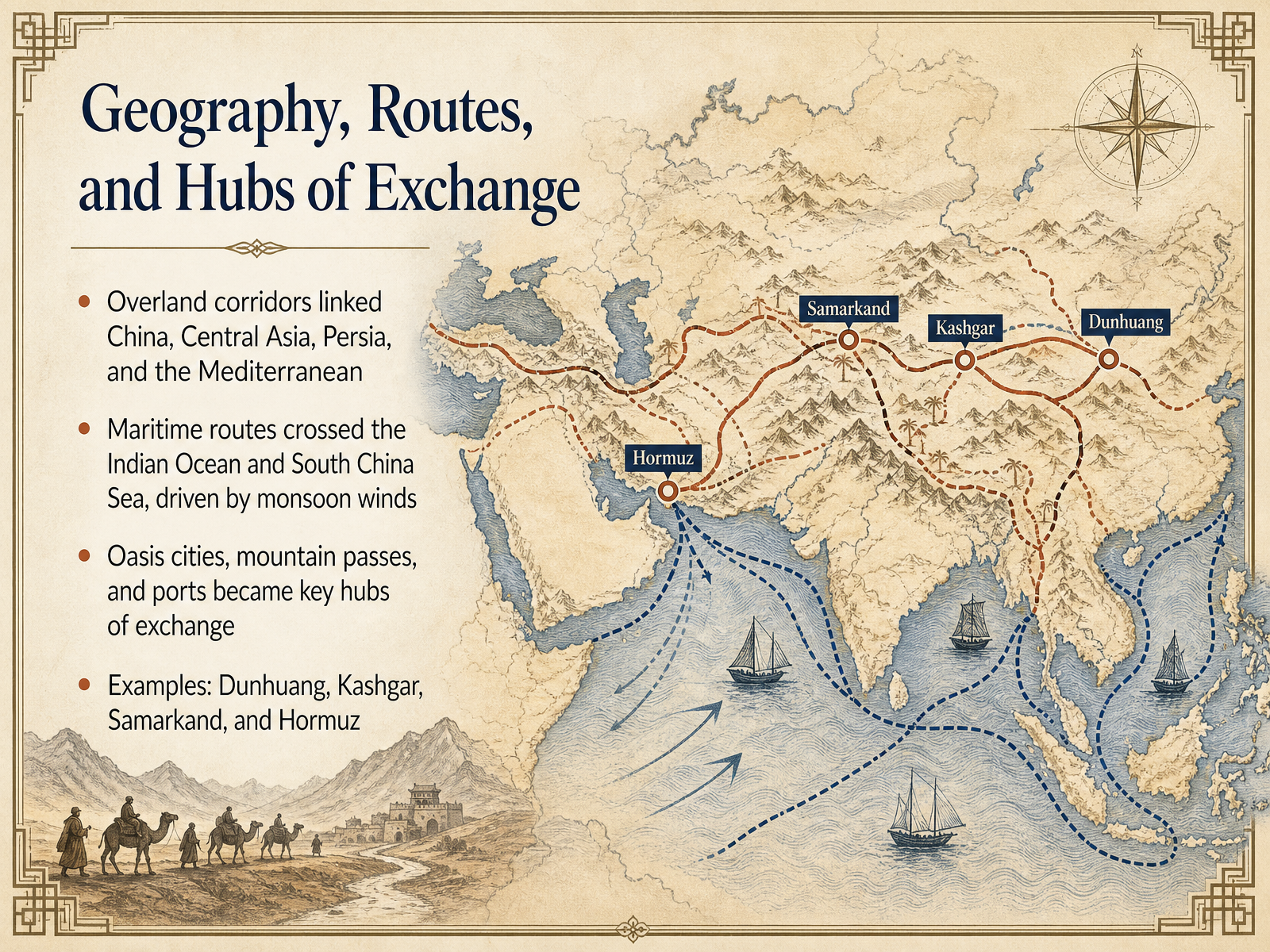
 - 03Geography, Routes, and Hubs of ExchangeLet’s look at the map of the Silk Roads. These were not one single road, but a web of routes stretching across thousands of miles. Overland, caravans linked China through Central Asia and Persia, all the way to the Mediterranean. At the same time, ships sailed the maritime routes across the Indian Ocean and the South China Sea, guided by the reliable monsoon winds. The geography shaped everything. Oasis cities, mountain passes, and bustling ports became the vital hubs where travelers rested, traded, and exchanged stories. Think of places like Dunhuang in China, Kashgar in the shadow of the Pamir Mountains, the grand city of Samarkand, or the strategic port of Hormuz on the Persian Gulf. Each of these hubs was a melting pot, a place where goods, ideas, and languages all mixed together. So as we trace the people and goods along these routes, keep these geographical anchors in mind. Next, let's turn to the chronology and historical context to see how this network evolved over time.
 iranturan.leiden.eduarcgis.comtransportgeography.org+22 min
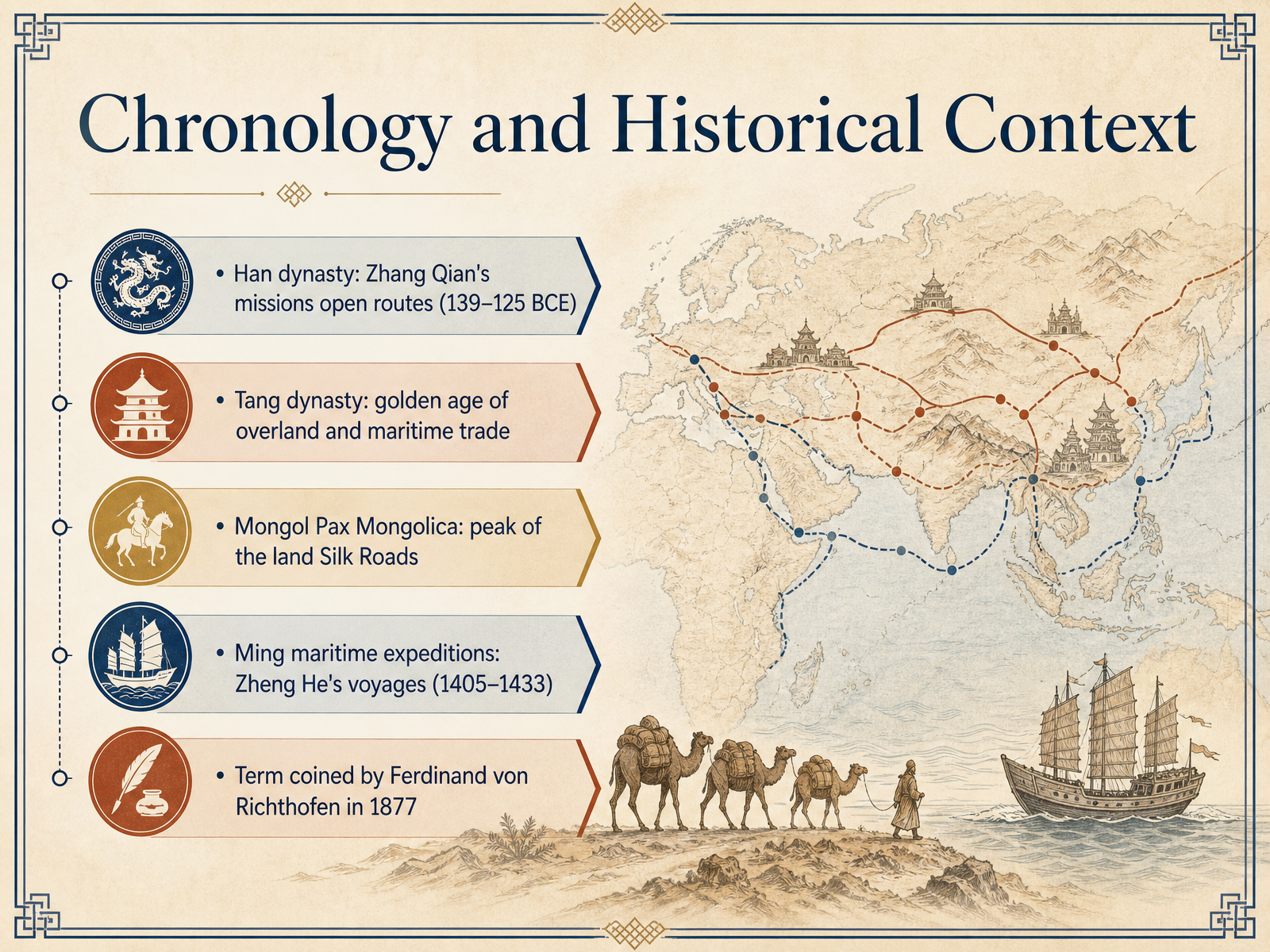
 - 04Chronology and Historical ContextNow let's place these connections on a timeline. The story begins in the Han dynasty, around 139 BCE, when a diplomat named Zhang Qian was sent on a mission to the west. He didn't achieve his original goal, but he came back with something far more valuable: detailed knowledge of lands beyond China. That knowledge opened the routes that would become the Silk Roads. Fast forward to the Tang dynasty, from the seventh to the tenth century. This was the golden age, when both overland caravans and maritime ships carried goods in unprecedented volume. Then came the Mongols. Under their empire in the thirteenth and fourteenth centuries, the land routes reached their absolute peak. They enforced peace across vast territories, making travel safer and more efficient than ever before. But the seas were calling. In the early fifteenth century, the Ming dynasty sent Admiral Zheng He on seven massive voyages across the Indian Ocean, showcasing China's maritime power. Interestingly, the name 'Silk Road' is modern. A German geographer named Ferdinand von Richthofen coined it only in 1877. So what does this timeline show us? The Silk Roads weren't a single static road. They were a dynamic system that shifted and adapted over two thousand years. Next, we'll look at what actually traveled along these routes: goods, technologies, and everyday life.
 faculty.washington.edusilk-road.commdpi.com+22 min
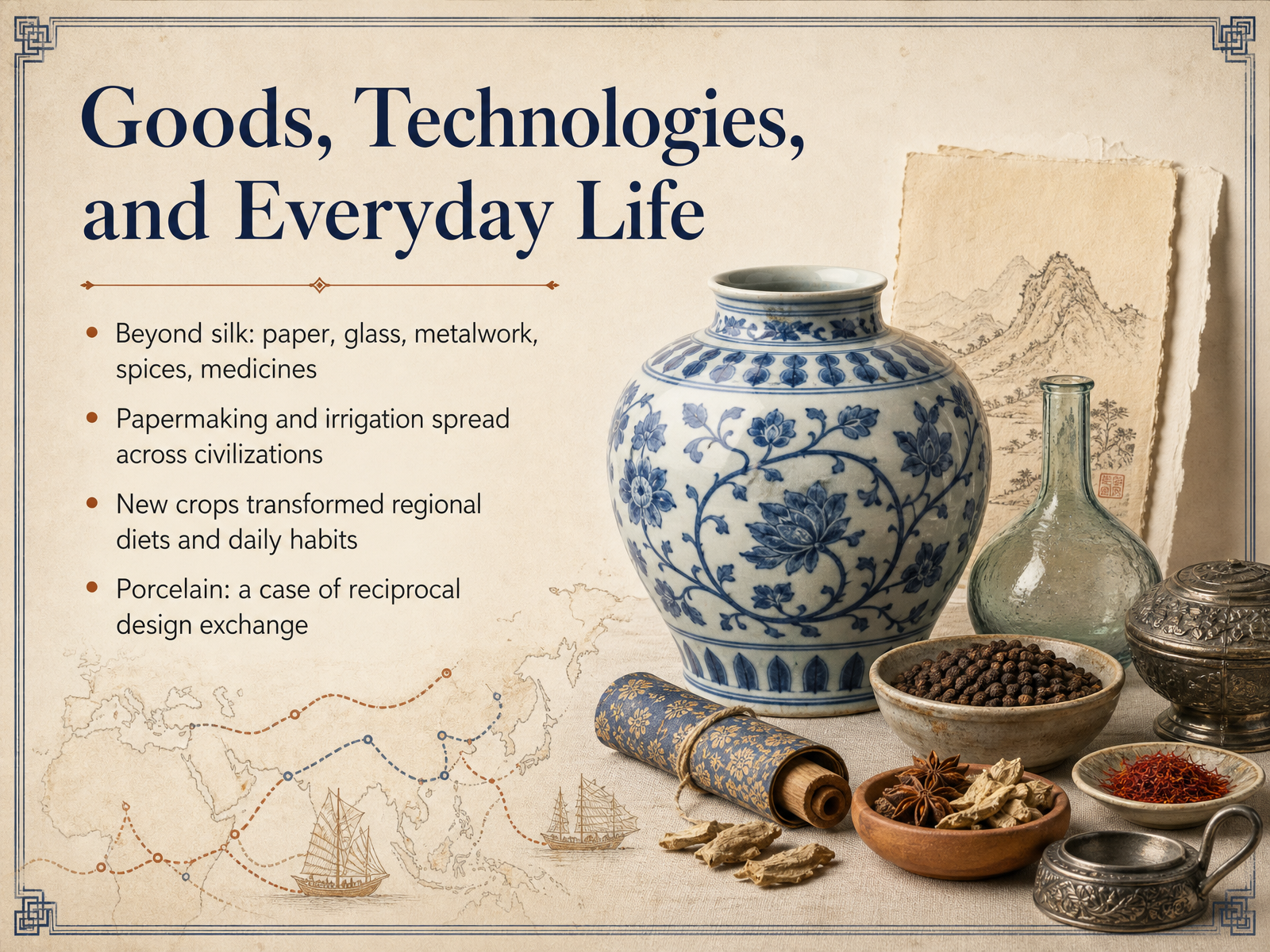
 - 05Goods, Technologies, and Everyday LifeLet’s take a closer look at the goods that moved along these routes, because silk was really just the beginning. Alongside it traveled paper, glass, metalwork, spices, and medicines. Papermaking, in particular, transformed how knowledge was recorded and shared. It spread from China across Central Asia to the Islamic world and eventually into Europe, changing education, bureaucracy, and literature. Irrigation techniques also traveled these routes, helping arid regions of Central Asia bloom. And new crops, like citrus fruits, carrots, and sugar, slowly reshaped what people ate and how they lived their daily lives. Even something as familiar as porcelain tells a story of exchange. Chinese potters created fine white porcelain that amazed the Islamic world, where craftsmen tried to imitate it with local materials. But the influence flowed both ways, as Chinese artists later adopted cobalt blue designs inspired by Islamic ceramics. This back-and-forth blending of materials, techniques, and tastes shows that the Silk Roads were not just about moving objects. They were shared classrooms where communities learned from one another. Next, we’ll see how those same routes carried religions and philosophies across continents.
 unesco.orgdegruyter.commetmuseum.org+22 min
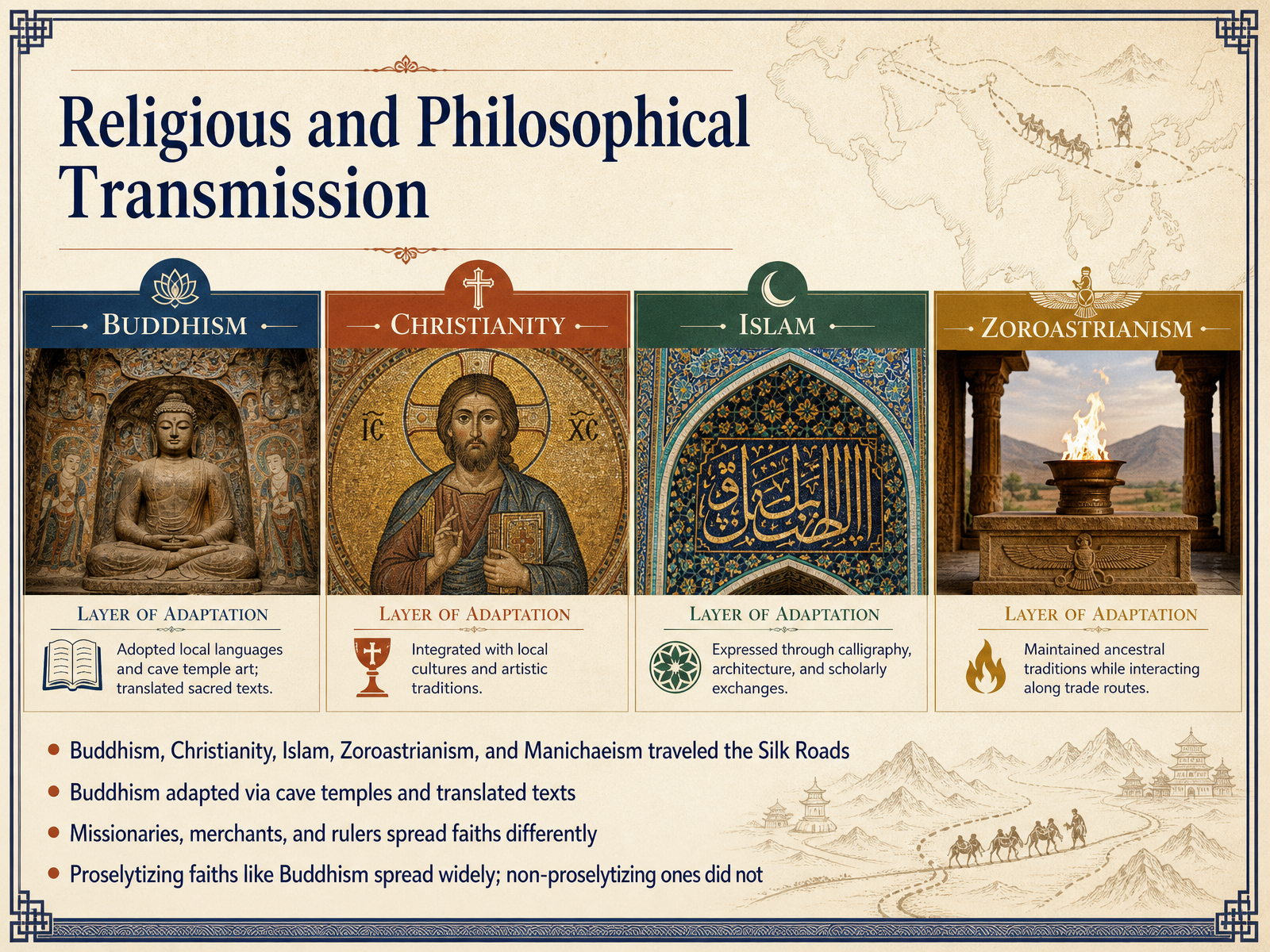
 - 06Religious and Philosophical TransmissionNow let's shift our attention from goods to beliefs, because the Silk Roads were just as much highways of faith as they were of commerce. Buddhism, Christianity, Islam, Zoroastrianism, and Manichaeism all traveled these routes, carried by merchants, missionaries, and sometimes even rulers. Take Buddhism, for example. It didn't just arrive in China unchanged. Instead, it adapted, finding new expression in cave temples carved into cliffsides and in sacred texts translated into local languages. Think about that for a moment: a religion born in India, reshaped in Central Asia, and eventually flourishing in East Asia, all because travelers absorbed the cultures they encountered and carried those ideas back home. The key difference in how far a faith spread often came down to its nature. Proselytizing faiths like Buddhism, Christianity, and Islam actively sought new members, so they traveled far and wide. Non-proselytizing traditions, which were tied more closely to birth and ethnicity, tended to stay closer to home or form smaller enclaves. So as we move forward, let's keep this in mind as we explore the artistic and intellectual exchanges that shaped these cultures.
 en.unesco.orgunesco.orgbritannica.com+21 min
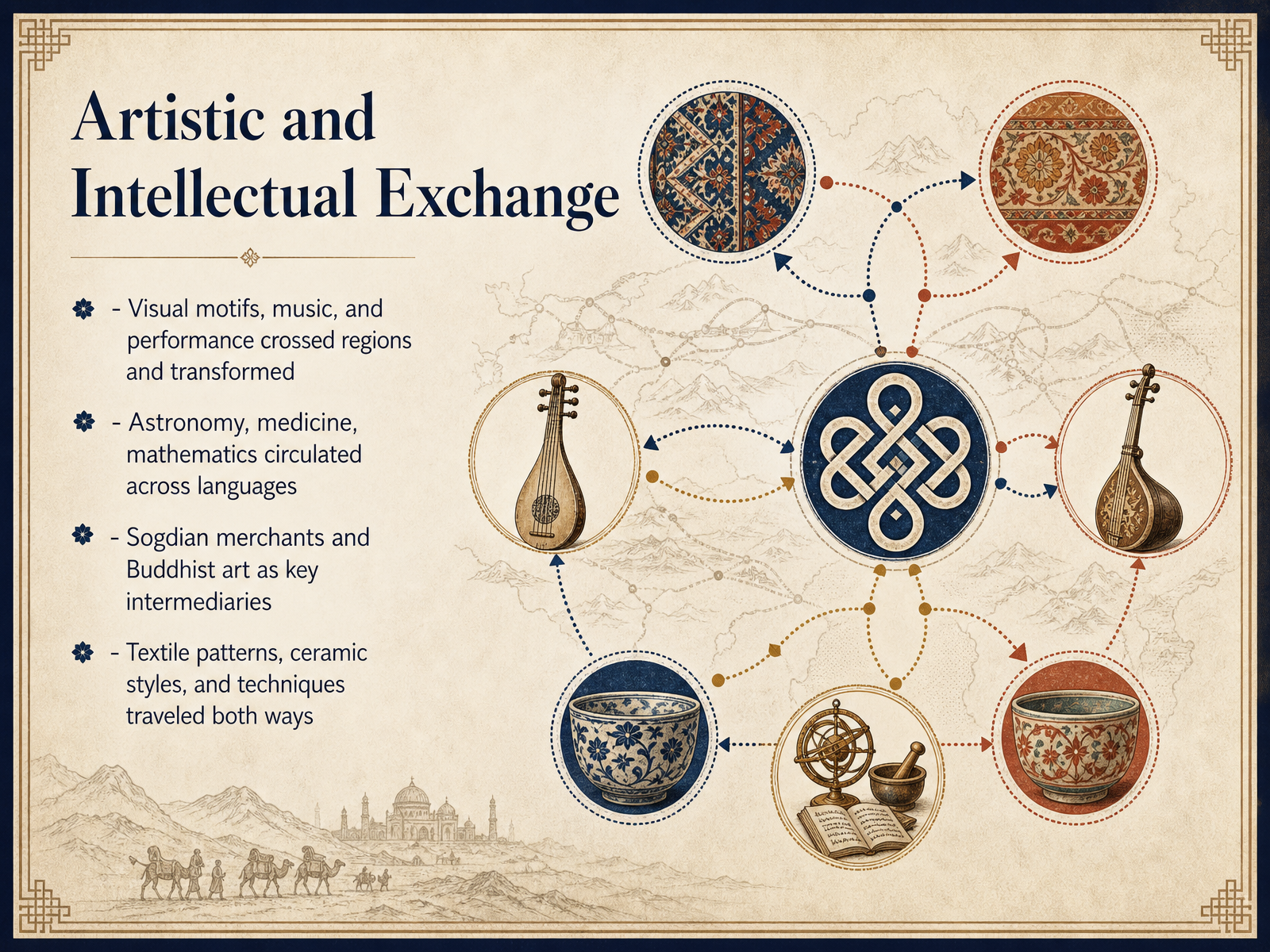
 - 07Artistic and Intellectual ExchangeNow let's turn to the artistic and intellectual exchanges that traveled alongside the goods. When we think of the Silk Roads, we often picture caravans and cargo, but some of the most enduring treasures were intangible. Visual motifs, musical traditions, and performance styles crossed regions and transformed along the way. Think of a pattern on a textile: a Persian roundel with two animals facing each other, which Chinese weavers adopted during the Tang dynasty, not just for export but because it became fashionable at home. Music and dance moved similarly, blending instruments and melodies across cultures. But the exchange wasn't limited to art. Astronomy, medicine, and mathematics circulated across languages. Greek astronomical texts were translated into Arabic, Indian medical manuals found their way to Baghdad, and scholars in Samarkand built upon them all. Sogdian merchants were key intermediaries here, carrying not just goods but ideas. Buddhist art also played a vital role, spreading visual styles and stories from India through Central Asia to China. Even ceramic techniques traveled both ways. Islamic potters introduced cobalt decoration, which would eventually inspire the famous blue-and-white porcelain of China. So, the artistic and intellectual exchanges along the Silk Roads weren't a one-way street; they were a dynamic, creative dialogue. Next, let's explore how cities along these routes became vibrant contact zones, where all these influences converged and flourished.
 unesco.org2 min
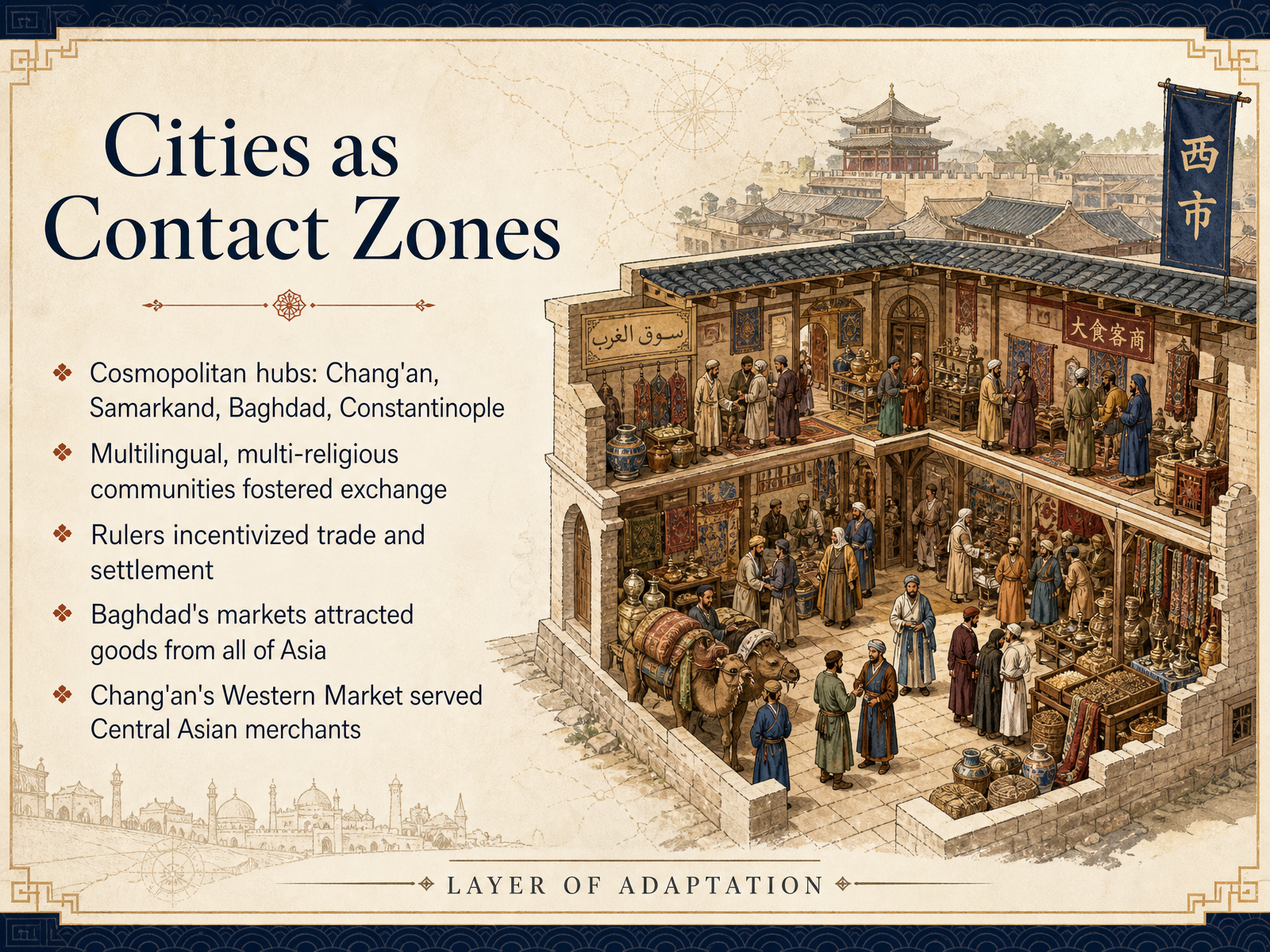
 - 08Cities as Contact ZonesNow let's step inside the great cities that made the Silk Roads hum with life. Think of Chang'an, Samarkand, Baghdad, and Constantinople. These weren't just stops along a route; they were bustling contact zones where people from every direction converged. In Chang'an, the Tang capital, over a million residents lived within its walls, and its Western Market was a favorite spot for Central Asian merchants, especially the Sogdians, who set up shops, wine houses, and temples. Baghdad, founded in 762, quickly became the world's trade magnet. Its markets drew goods from all of Asia, from Chinese silks to Iranian carpets. Rulers actively encouraged this mix. They knew that trade brought wealth, so they offered incentives for merchants to settle and do business. These cities were multilingual and multi-religious, with Buddhists, Zoroastrians, Christians, and Muslims living side by side. That diversity wasn't just tolerated; it was essential. Every culture brought its own knowledge, styles, and goods, and when people interact that closely, exchange is inevitable. As we move on, we'll see how these exchanges shaped art, ideas, and identities far beyond the marketplace.
 1 min
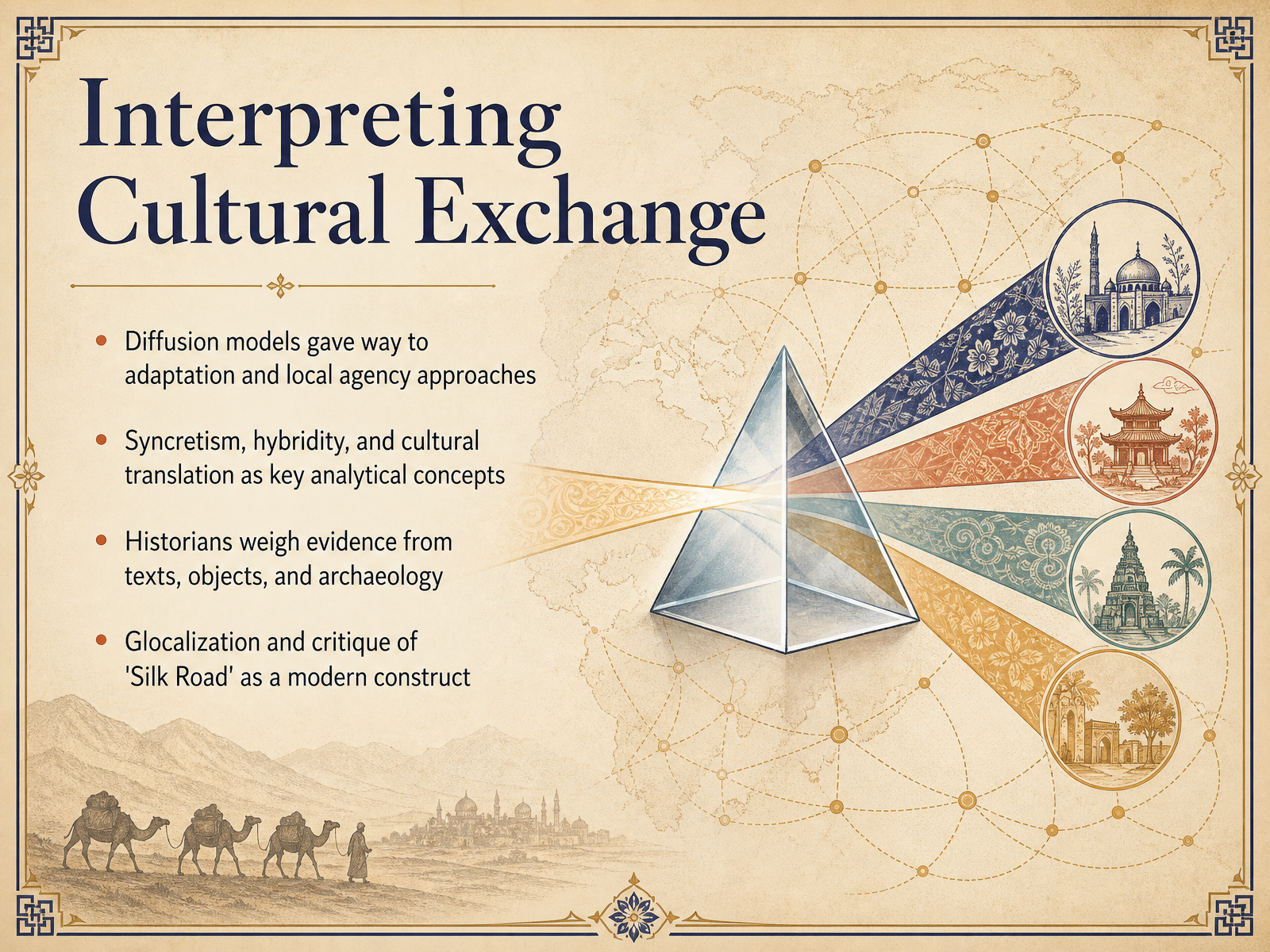
1 min - 09Interpreting Cultural ExchangeNow let's step back and ask a bigger question. How do historians actually interpret all this cultural exchange? For a long time, the diffusion model ruled. That meant tracing ideas and objects from a supposed center outward, like ripples in a pond. But today, scholars favor a more dynamic view. They focus on adaptation and local agency. In other words, a Buddhist statue in China isn't just an Indian import. It's a local creation that speaks to local needs and tastes. This is where concepts like syncretism, hybridity, and cultural translation come in. They help us describe how traditions blend, how new forms emerge, and how meanings get recoded as they travel. And historians don't just read texts. They weigh evidence from objects, from archaeology, and from the landscape itself. There's also a critical edge to this work. Scholars examine glocalization, the way global influences get reshaped locally, and they question the very term 'Silk Road' as a modern construct, one that often obscures more than it reveals. So, interpreting cultural exchange is less about finding a single origin, and more about tracing a web of creative connections. Up next, we'll look at the legacies of these networks and why they still matter today.
 2 min
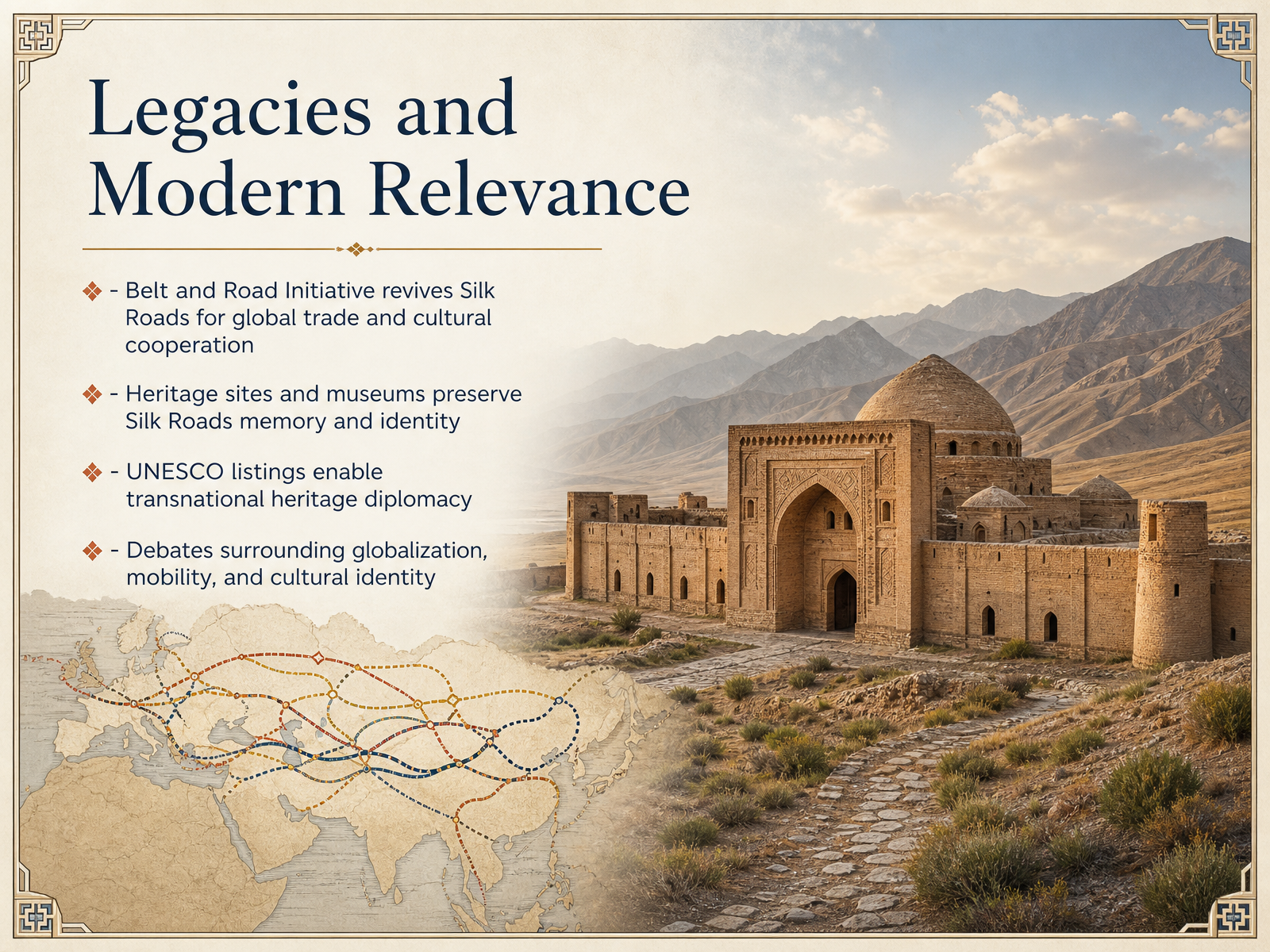
2 min - 10Legacies and Modern RelevanceSo what does this all mean for us today? The Silk Roads haven't just faded into history—they've been reborn in many ways. In 2013, the Belt and Road Initiative began reviving these ancient corridors, not just for trade, but for cultural cooperation on a massive scale. Hundreds of heritage sites across more than thirty countries are now part of a shared story. When UNESCO inscribed the Chang'an-Tianshan corridor in 2014, it was a landmark moment—three nations, China, Kazakhstan, and Kyrgyzstan, cooperating to protect thirty-three sites together. That's heritage diplomacy in action. Museums and heritage centers keep these stories alive, and they shape how communities see their own identity today. But there's a lively debate here too. As these ancient routes become modern economic engines, we have to ask ourselves: who benefits? How do we balance tourism and development with genuine preservation? How does globalization change the way we understand cultural identity? These aren't just academic questions. They're living ones that connect us to that ancient network of exchange. And that discussion continues as we turn to how we teach the Silk Roads today without falling back on outdated misconceptions.
 2 min
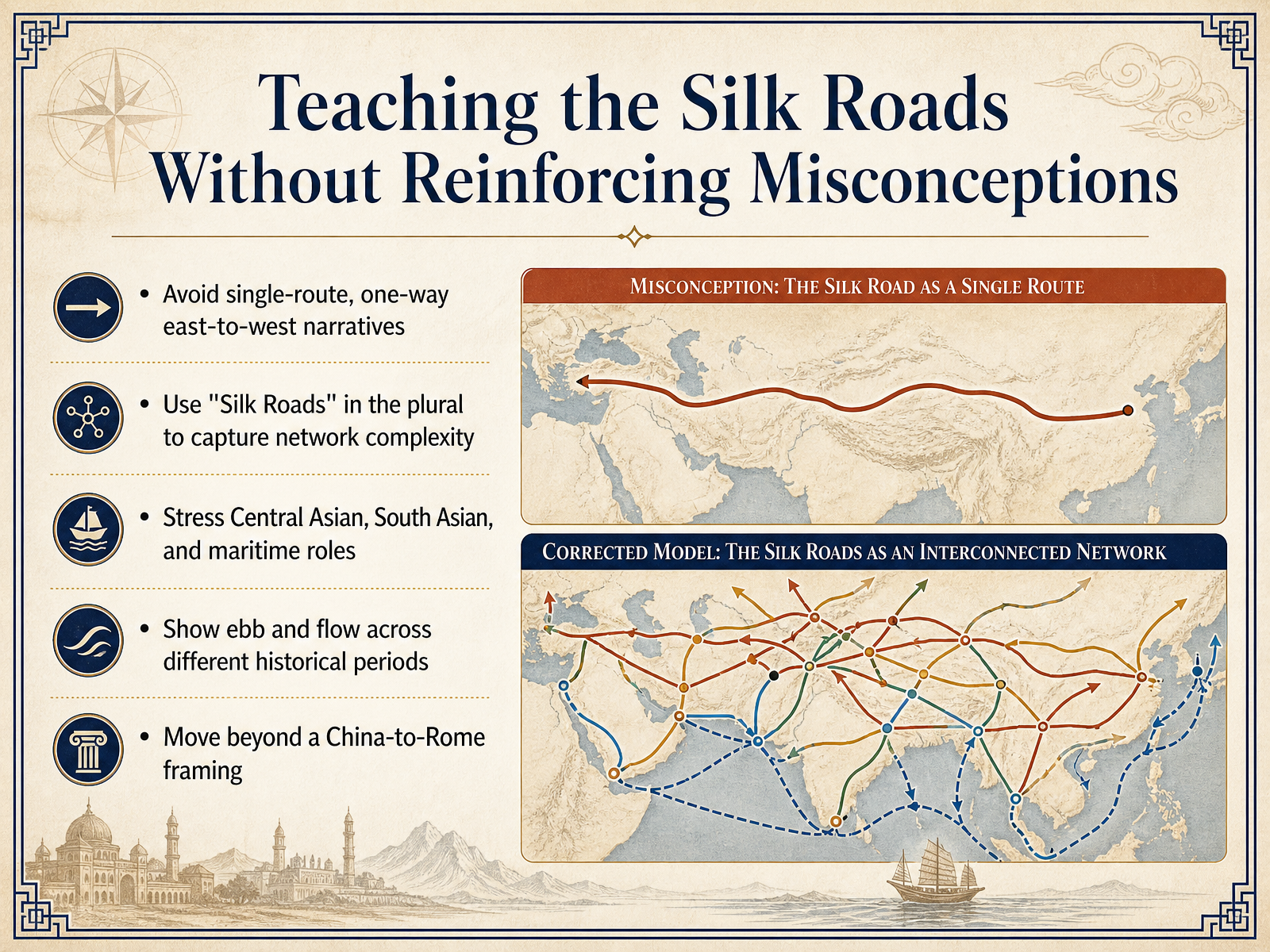
2 min - 11Teaching the Silk Roads Without Reinforcing MisconceptionsNow let's turn to how we bring these ideas into the classroom. Teaching the Silk Roads well means moving past the familiar image of a single golden road stretching from China to Rome. In fact, that image is one of the biggest misconceptions. So here are some practical principles to keep in mind. First, always use the plural, Silk Roads. A single route implies one highway, but this was a web of interlocking paths across land and sea. Second, resist the temptation to tell a one-way story from east to west. Ideas and goods moved in every direction, north and south as well. Buddhism, for example, traveled from South Asia into Central Asia and then to China. Third, give Central Asian, South Asian, and maritime players their due. The merchants, nomads, and sailors in between were not just middlemen; they were creators of culture and knowledge. Fourth, remember that the network had ebbs and flows. Trade boomed in the Han era, contracted, then surged again under the Tang and later the Mongols. Finally, don't anchor the story to Rome. The Silk Roads connected a vast Afro-Eurasian world, and its heartland was often in Central Asia, not at the edges of the map. By telling this richer story, we do justice to the truly global connections that shaped our shared history. Next, we will explore how to bring this complexity to life with primary sources and object-based activities.
 unesco.orgbritannica.comicomos.org+22 min
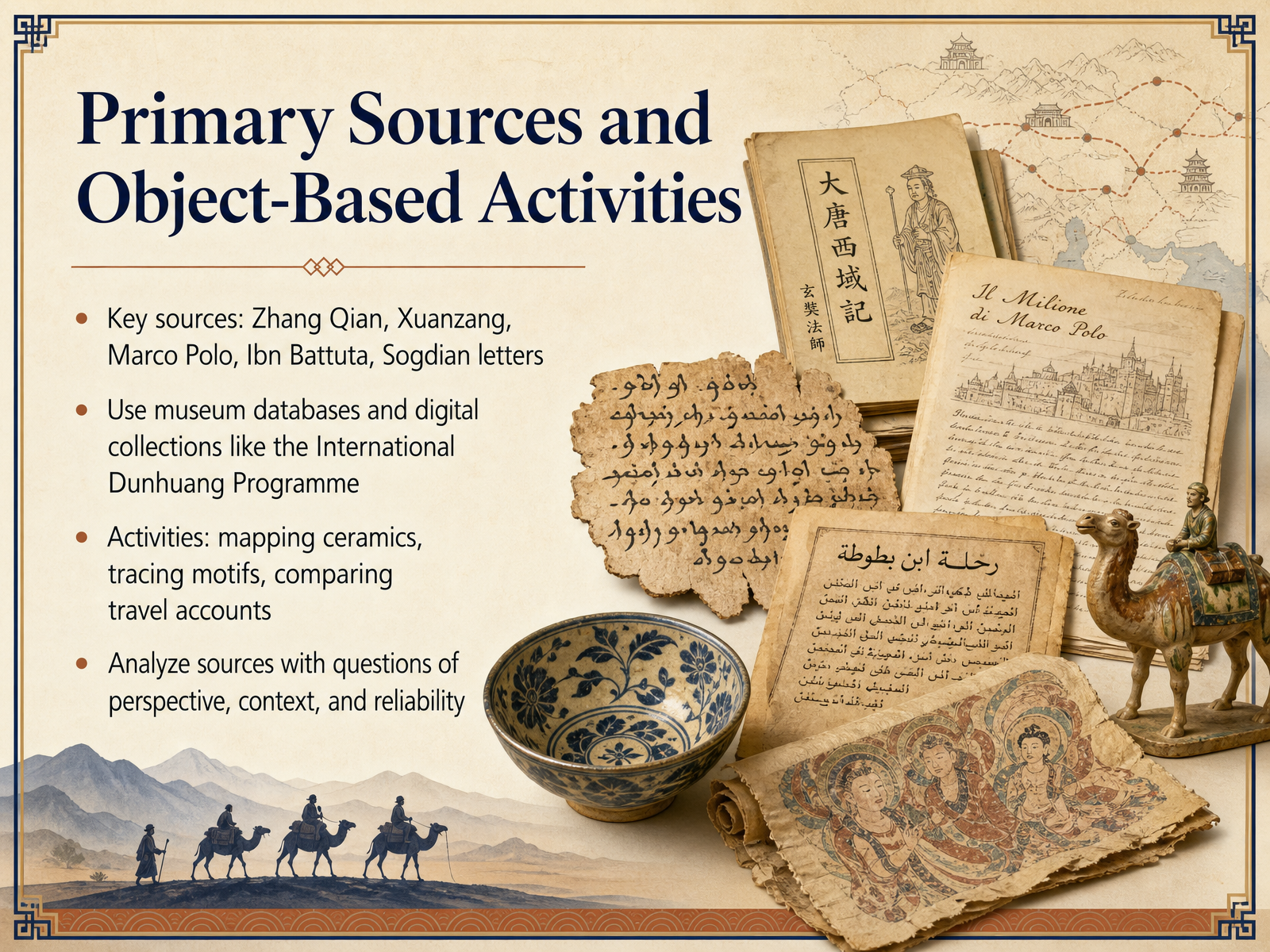
 - 12Primary Sources and Object-Based ActivitiesNow let's look at how we can bring these stories to life in the classroom through primary sources and object-based activities. Rather than just telling students about the Silk Roads, we can let them explore the voices and materials from the past themselves. Key sources include the travel accounts of Zhang Qian, Xuanzang, Marco Polo, and Ibn Battuta, as well as the Sogdian letters, which give us a rare glimpse into everyday trade and communication. To make these accessible, we can turn to digital collections like the International Dunhuang Programme, which offers images and manuscripts from along the routes. For activities, consider mapping where ceramics have been found, tracing how decorative motifs traveled and transformed across cultures, or comparing two travel accounts of the same city. When analyzing any source, guide students to ask: whose perspective is this, what was the context, and how reliable is the account? These questions turn passive reading into active historical inquiry. With that foundation, let's turn to thinking about how we can create accurate and engaging digital content from these materials.
 unesco.org1 min
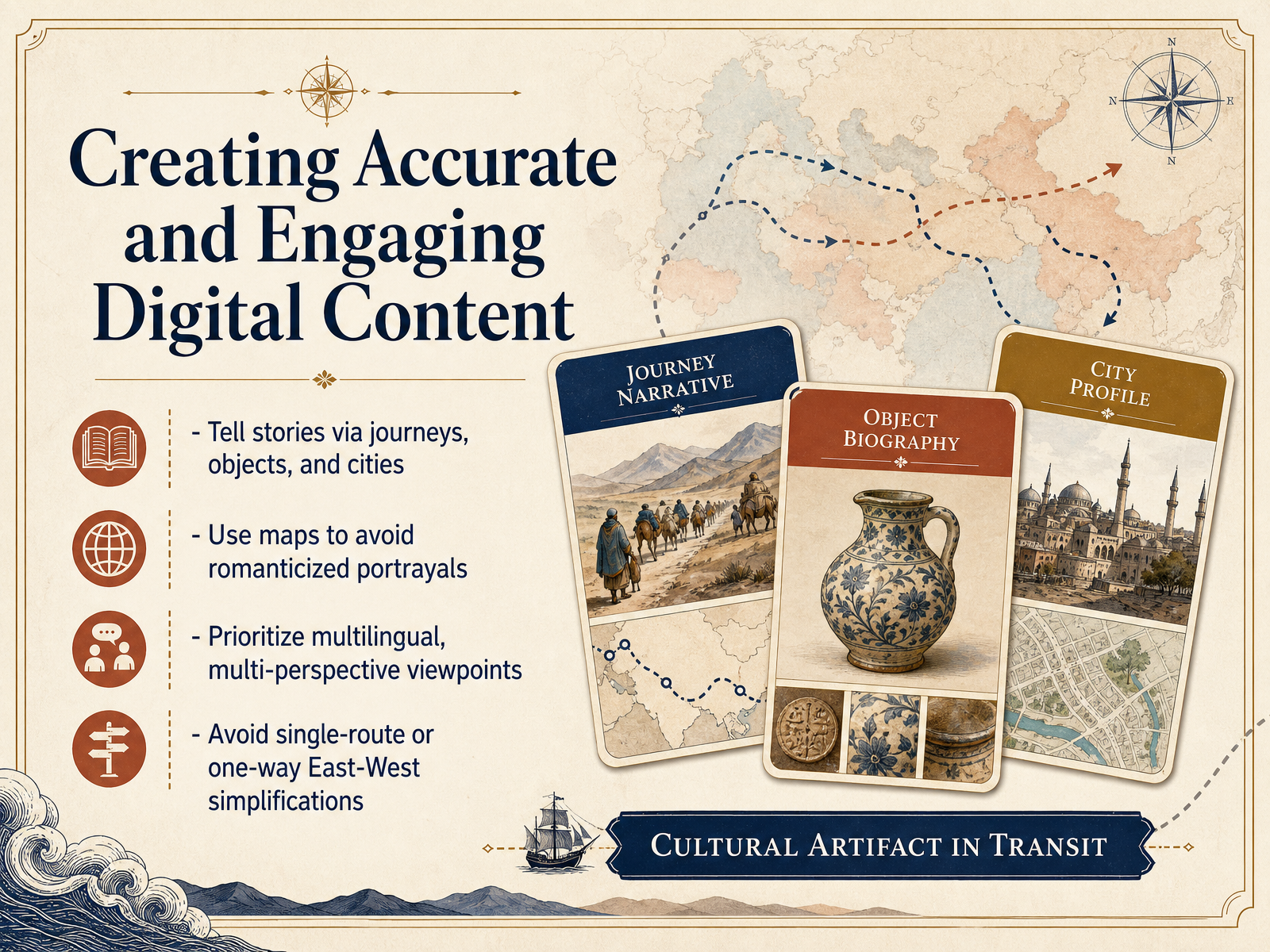
 - 13Creating Accurate and Engaging Digital ContentSo how do we bring all of this to life without falling into old traps? Start with stories, not abstractions. Follow a traveler, trace an object like a Buddha statue or a piece of glass, or walk through a city like Samarkand. Journeys and artifacts make exchange visible and personal. Next, use maps deliberately. A single arrow across the continent is a distortion. Show the multiple routes, the sea lanes, the stopping points, the communities in between. That grounds your story in geography and keeps it from becoming a romanticized fantasy. Above all, seek out multilingual and multi-perspective sources. Let a Persian merchant speak, and a Chinese monk, and a Sogdian letter. When accounts conflict, that is not a problem, it is the lesson. And never reduce the Silk Roads to a simple east-west highway. The nomads of the steppe were not just obstacles; they were the engines of the network. Next, let's consider how to assess what learners have actually understood.
 2 min
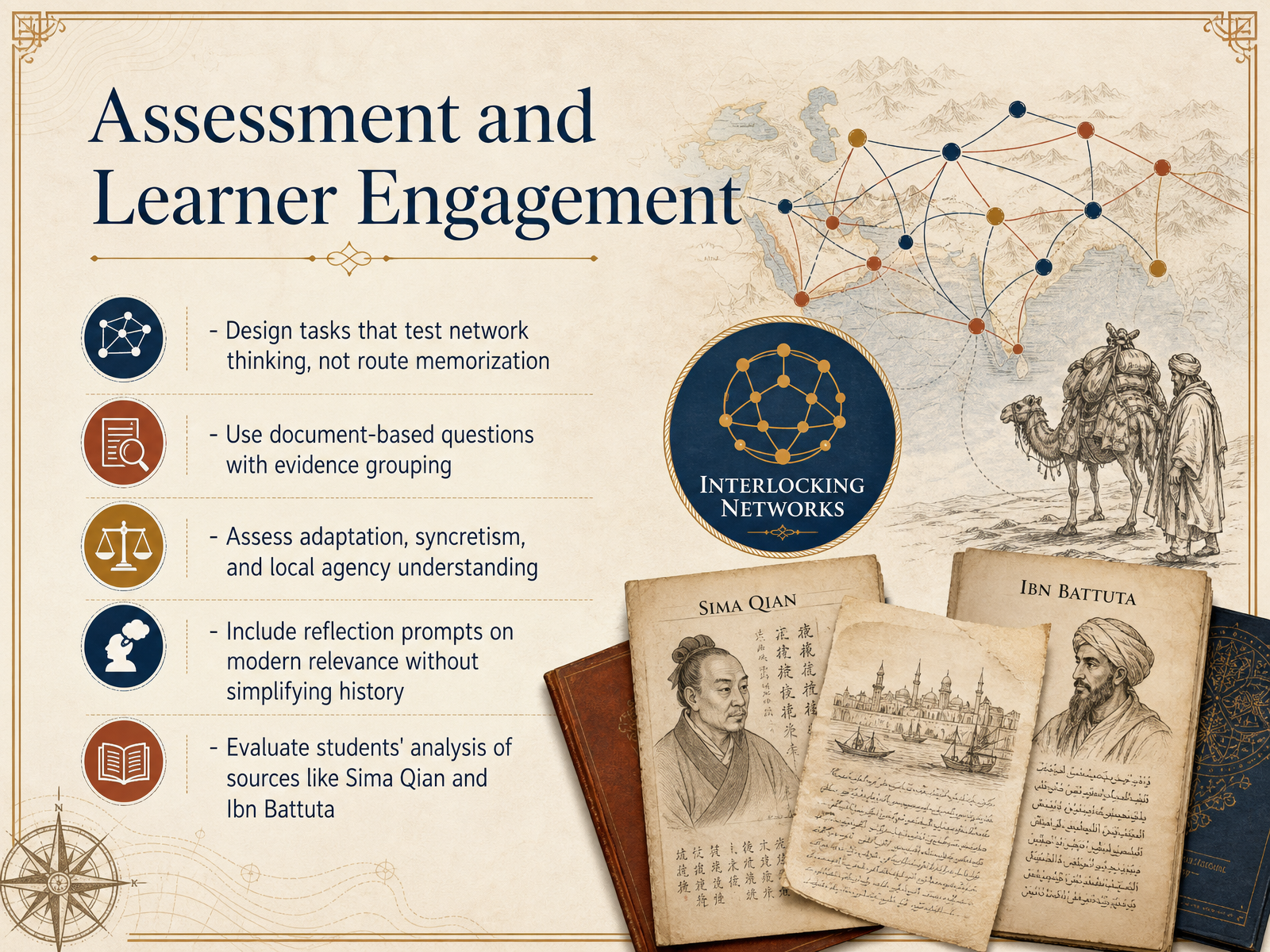
2 min - 14Assessment and Learner EngagementNow let’s talk about how we bring this to the classroom. The goal is to test network thinking, not route memorization. That means asking students to trace how an idea, a good, or a belief moved across regions and changed as it traveled. Document-based questions work wonderfully here. Have students group sources by theme, such as adaptation, syncretism, or local agency, and then use that evidence to build an argument. For example, you might ask them to compare how Sima Qian framed the Han expansion with how Ibn Battuta described the cultures he encountered. Those two voices come from very different worlds, and the contrast opens up great discussion. Also, include reflection prompts that connect these historical dynamics to the present, but be careful not to simplify the past into easy parallels. The key is to help learners see that the Silk Roads were not just a route, but a living web of exchange, negotiation, and creativity. Give them the tools to analyze that complexity for themselves. That skill, not just the facts, is what will stay with them. Next, we’ll pull these ideas together with some practical next steps.
 2 min
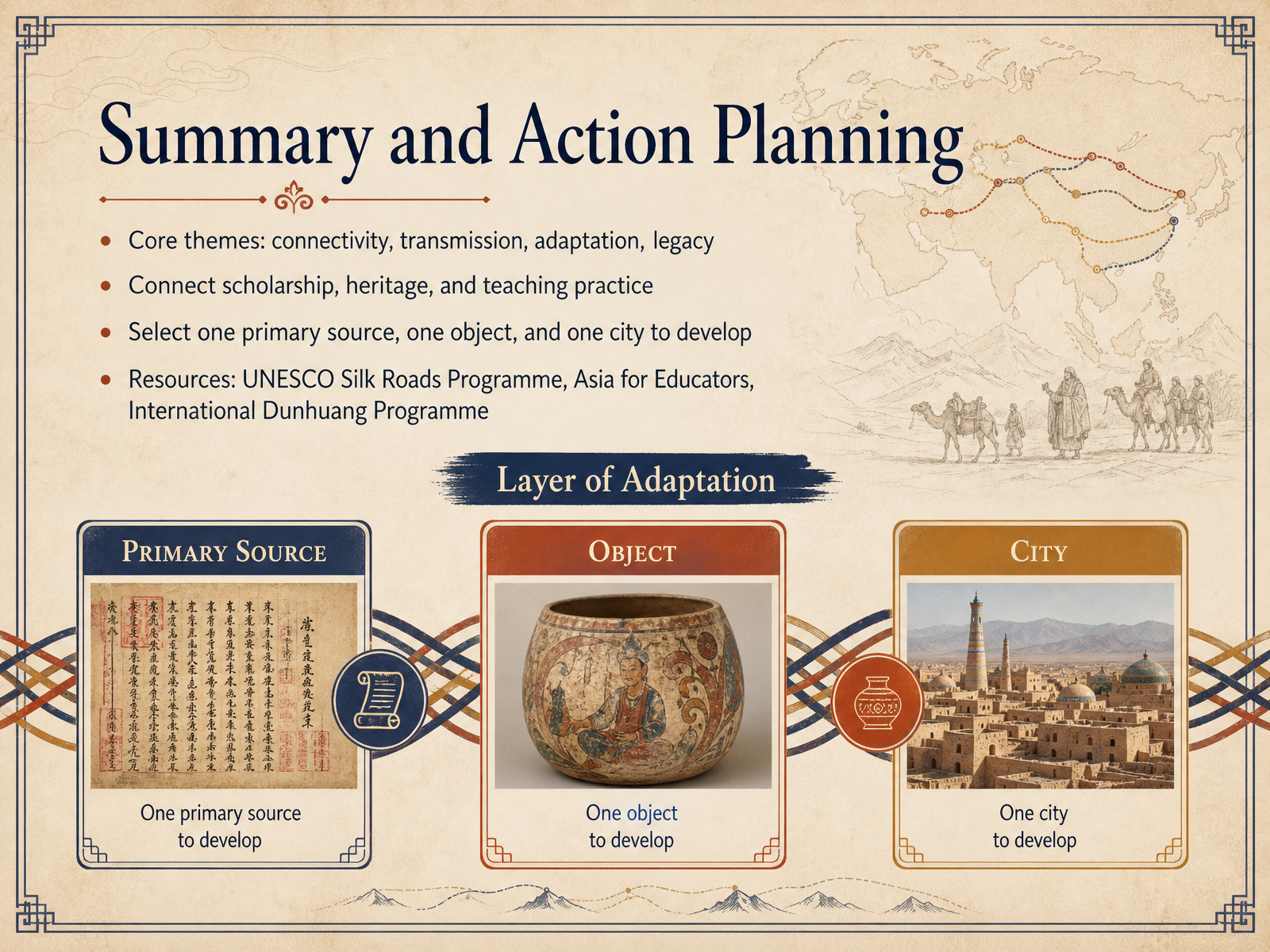
2 min - 15Summary and Action PlanningLet's take a moment to pull everything together. We've seen how the Silk Roads were far more than trade routes. They were living networks of connectivity, transmission, adaptation, and legacy. Now it's your turn to bring this history into your own work. Pick one primary source, like a traveler's account. Choose one object, maybe a piece of silk or a ceramic bowl. And select one city, such as Dunhuang or Samarkand. Use these three anchors to explore the bigger story of cultural exchange. For resources, start with the UNESCO Silk Roads Programme, which offers rich material on shared heritage. Asia for Educators provides excellent lesson plans and documents. And the International Dunhuang Programme gives you access to manuscripts and artifacts from the eastern Silk Roads. These tools make the past tangible. By connecting scholarship, heritage, and your teaching practice, you can help others see the Silk Roads as a living legacy. Thank you for joining me on this journey. Now go out and share these stories, one source, one object, one city at a time.
 unesco.orgbritannica.comicomos.org+22 min
Take the deck with you
Download this course as a file — free, no sign-up needed.
- PDF handoutEvery slide page, ready to print or share.16 pages · 7.1 MBDownload
- Narrated PowerPointThe deck that presents itself — every slide carries the digital human's narration video.16 pages · 22.1 MBDownload
- PowerPoint slidesThe full deck as a .pptx — open it in PowerPoint, Keynote, or Google Slides.16 pages · 7.1 MBDownload
Free to use in your own training — please keep the PersonWise credit page at the end.
Have your own deck? Turn it into a course
Sources consulted
Web sources consulted while building this course.
- About the Silk Roads — unesco.org
- Silk road trade route — britannica.com
- The Silk Roads: — icomos.org
- Thematic Collection of the Cultural Exchanges along the Silk Roads — unesco.org
- UNESCO World Heritage Centre - <em>World Heritage</em> — whc.unesco.org
- The Silk Roads - Iran Turan — iranturan.leiden.edu
- Silk Road and Other Trade Routes - Overview - ArcGIS Online — arcgis.com
- The Silk Road and Arab Sea Routes (11th - 12th Centuries) — transportgeography.org
- Silk Road Map - History Crunch — historycrunch.com
- AKM Silk Roads Map · Hidden Stories: Books Along the Silk Roads — booksalongthesilkroads.library.utoronto.ca
- Silk Road Chronology — faculty.washington.edu
- Silk Road Chronology - Silk-Road.com — silk-road.com
- The Silk Route from Land to Sea — mdpi.com
- History of China Silk Road: Development, Significance, Travelers — travelchinaguide.com
- Maritime Silk Road — china.org.cn
- https://www.degruyter.com/document/doi/10.1515/9783110753301-022/pdf?licenseType=open-access — degruyter.com
- Tracing the Development of Ceramics along the Silk Road - The Metropolitan Museum of Art — metmuseum.org
- A Tale of Papermaking along the Silk Road — degruyterbrill.com
- srjournal_v3n2 (December 2005) — edspace.american.edu
- The Paths of New Beliefs | Silk Roads Programme — en.unesco.org