Begin
13 pages · ~26 min
Cloud Software Selection and Workflow
This training guides professionals through selecting cloud computing software, defining requirements, and building effective workflows.
A digital instructor presents all 13 pages. Hold “Ask” at any point and ask out loud — the answer comes from this course. No sign-up needed.
What you’ll learn
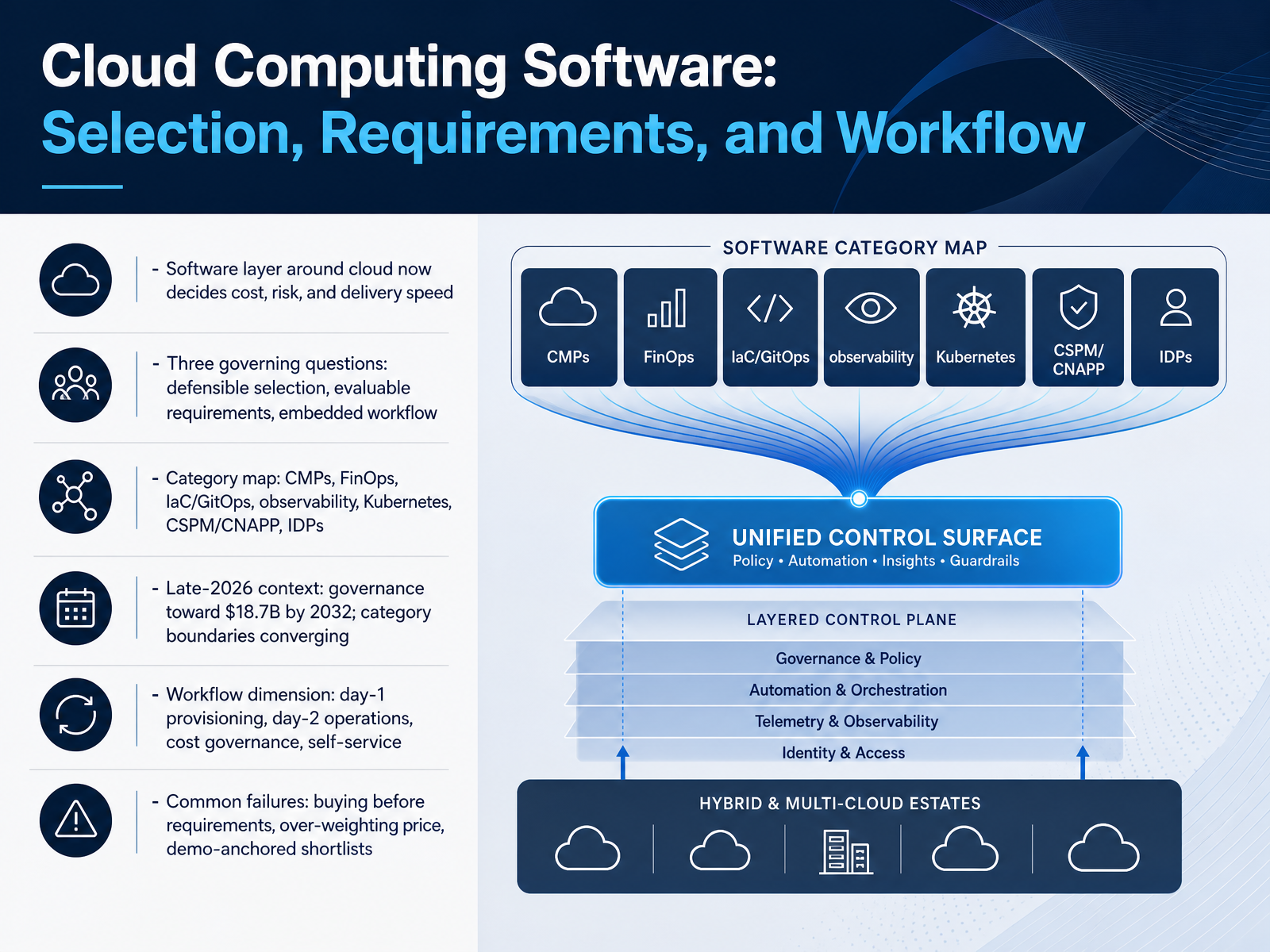
- 01Cloud Computing Software: Selection, Requirements, and WorkflowWelcome. This course is about the software layer that sits around your cloud, because that layer increasingly decides your cost, your risk, and your delivery speed. We'll work through three governing questions. First, how do you make a defensible selection? Second, how do you write requirements you can actually evaluate? Third, how do you embed all of this into everyday workflow? Along the way we'll map the categories you'll meet: cloud management platforms, FinOps, infrastructure as code and GitOps, observability, Kubernetes tooling, cloud security posture and CNAPP tools, and internal developer platforms. For late 2026 context, governance platforms are projected to grow toward roughly eighteen point seven billion dollars by 2032, up from about five point eight billion in 2025, and category boundaries are converging. So think in workflow terms: day one provisioning, day two operations, cost governance, and self-service. And watch for the common failures: buying before requirements are settled, over-weighting price, and shortlisting based on demo polish alone. Here is how to assess each of those moments. Let's start with background: how cloud tooling reached its current shape.n6cloud.comstrativant.comcloudconsultingfirms.com+22 min
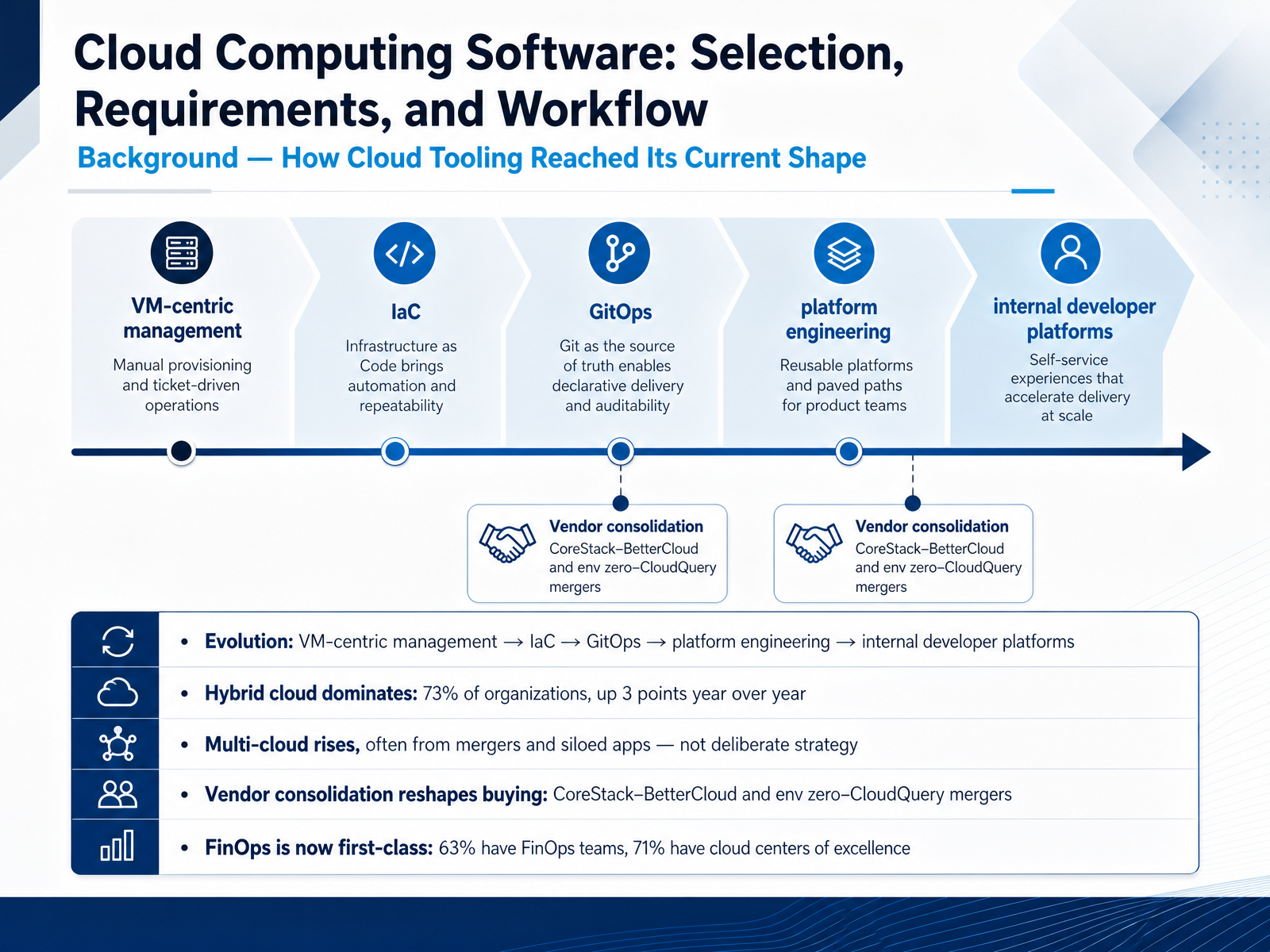
- 02Background: How Cloud Tooling Reached Its Current ShapeLet's look at how cloud tooling reached its current shape. The path is fairly consistent. We moved from virtual machine centric management, to infrastructure as code, then GitOps, then platform engineering, and now internal developer platforms. Each step traded manual control for declarative, automated control. Hybrid cloud dominates today. Seventy three percent of organizations run hybrid estates, up three points year over year. Multi cloud is also rising, but often by accident. Mergers bring in a second provider, or an isolated app pulls in a different stack. It is rarely a deliberate strategy. Vendor consolidation is reshaping buying. CoreStack acquired BetterCloud, and env zero merged with CloudQuery. Both deals target the same gap, governance across infrastructure, software as a service, and AI. FinOps has gone mainstream too. Sixty three percent now have FinOps teams, and seventy one percent run cloud centers of excellence. So the lesson is this. Ask how a tool closes the gap between what you intend to deploy and what is actually running. Next, we cover Core Concepts and Reference Architecture.
 hfsresearch.comenvzero.comapnews.com+22 min
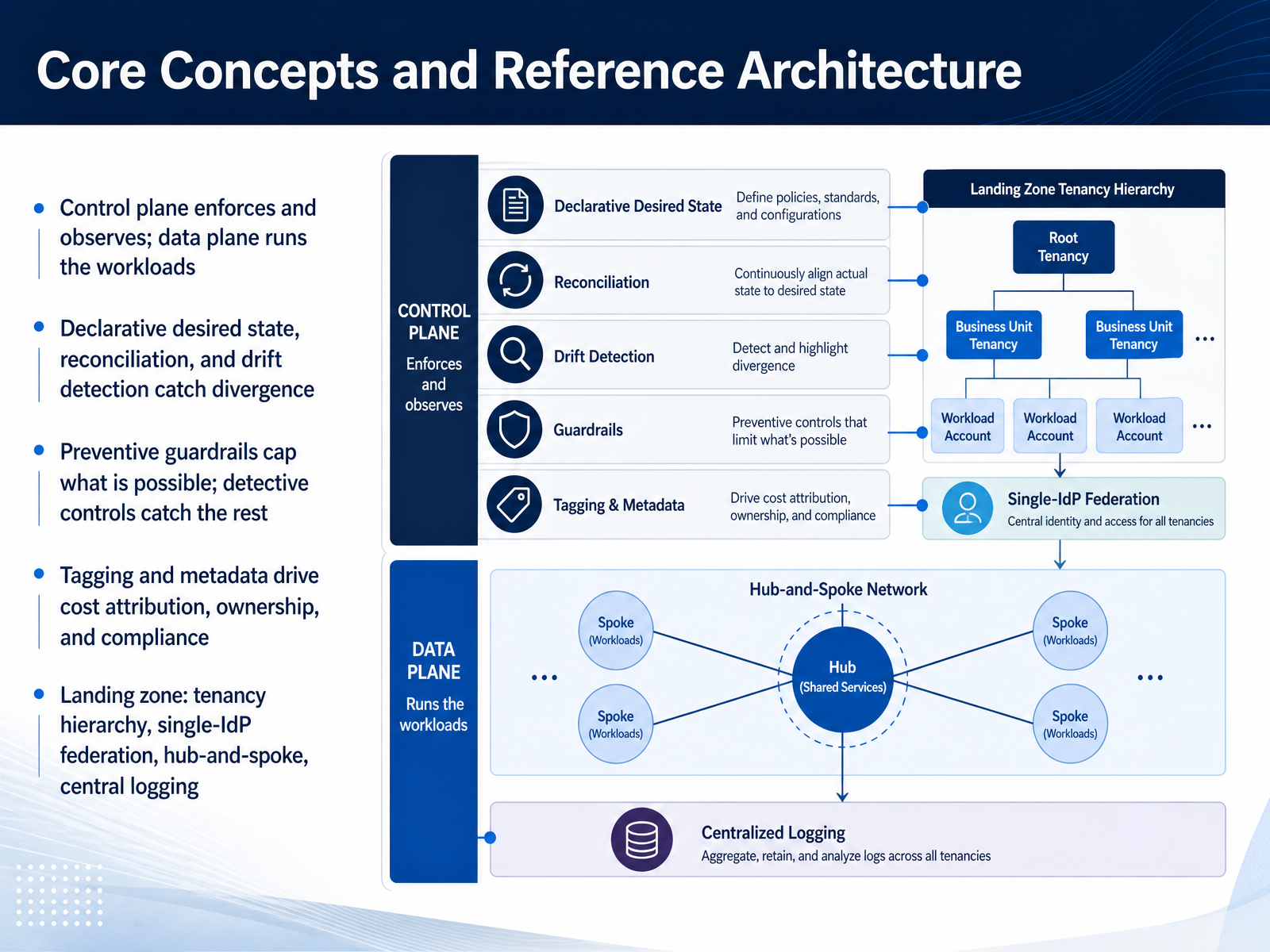
- 03Core Concepts and Reference ArchitectureLet us ground the rest of this evaluation in one reference architecture. Five concepts, and each becomes a question you can put to a vendor.
First, the control plane enforces and observes. The data plane runs your workloads. Ask where each one lives, and whether a failure in one degrades the other.
Second, declarative desired state, reconciliation, and drift detection. You describe what should exist, the tool makes it so, and it flags divergence. Ask how fast drift surfaces after an out-of-band console change.
Third, preventive guardrails cap what is possible. Detective controls catch the rest. Prevention is non-compensatory, so treat it as a gate, not a score.
Fourth, tagging and metadata drive cost attribution, ownership, and compliance. Enforced tags, not requested ones, because untagged resources are the ones nobody can bill or safely delete.
Fifth, the landing zone itself. Tenancy hierarchy, single identity provider federation, hub-and-spoke networking, and central logging. Ask what is reversible after go-live, because hierarchy and network addressing are not cheap to rebuild under running workloads.
From Business Drivers to Evaluable Requirements.
 learn.microsoft.comgithub.combashconsultants.com+22 min
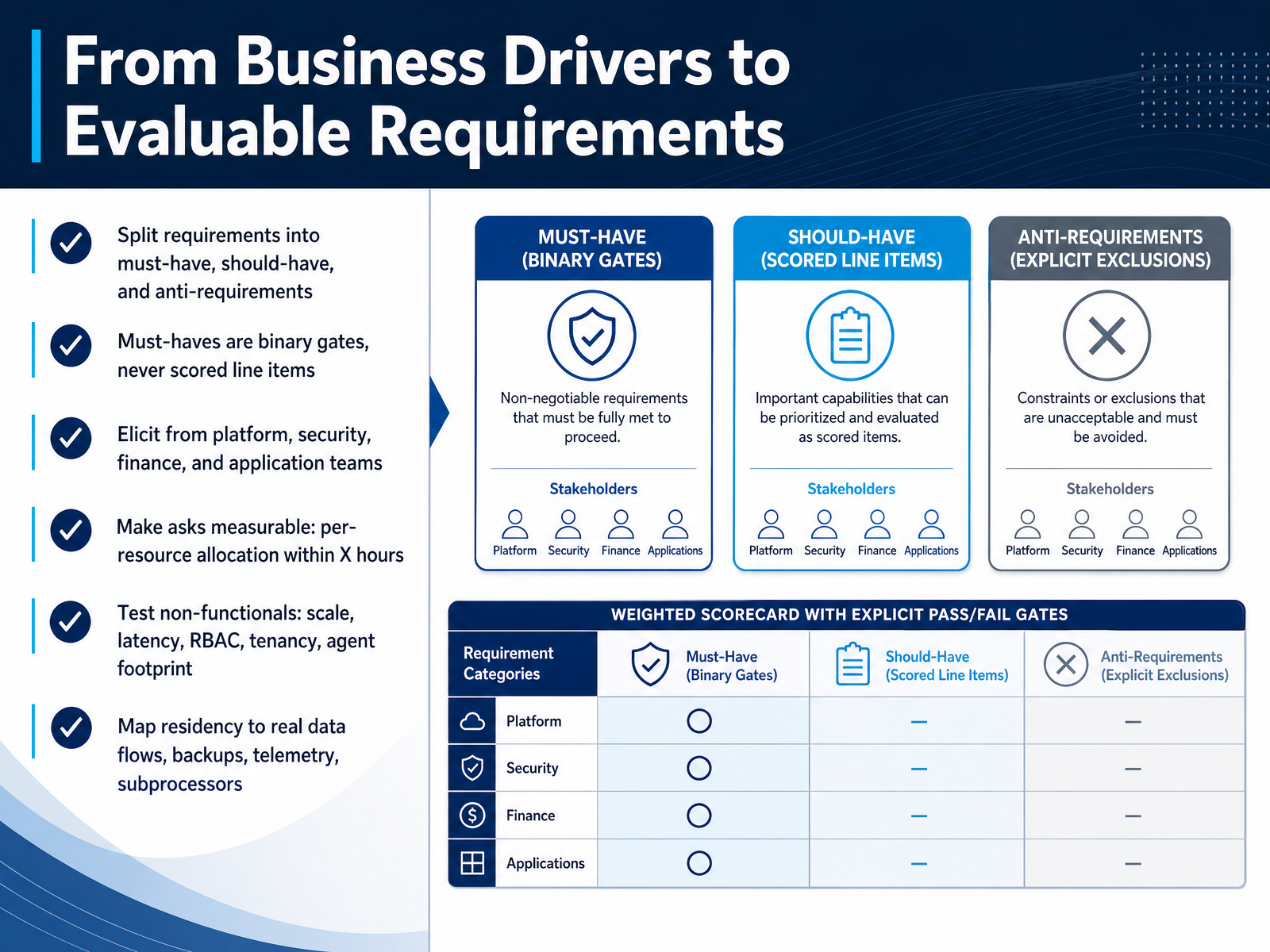
- 04From Business Drivers to Evaluable RequirementsNow let's turn business drivers into requirements you can actually evaluate. First, split your list three ways: must-haves, should-haves, and anti-requirements.
Must-haves are binary gates, never scored line items. A vendor either passes or gets eliminated. Failing one mandatory item should disqualify them, regardless of how strong the other scores look. Should-haves are where you weight and score. Anti-requirements are the things you explicitly do not want, and naming them prevents scope creep.
Elicit requirements from four teams. Platform, security, finance, and application owners. Each sees a different failure mode.
Then make every ask measurable. Instead of fast provisioning, write per-resource allocation within X hours.
Test the non-functionals during proof of concept. Scale, latency, role-based access control, tenancy isolation, and agent footprint.
Finally, map data residency to real flows. That includes backups, telemetry, and every subprocessor.
With that baseline in hand, let's look at the selection process itself: longlists, RFPs, and weighted decision models.
 umbrex.comresponsive.iospeclens.ai+22 min
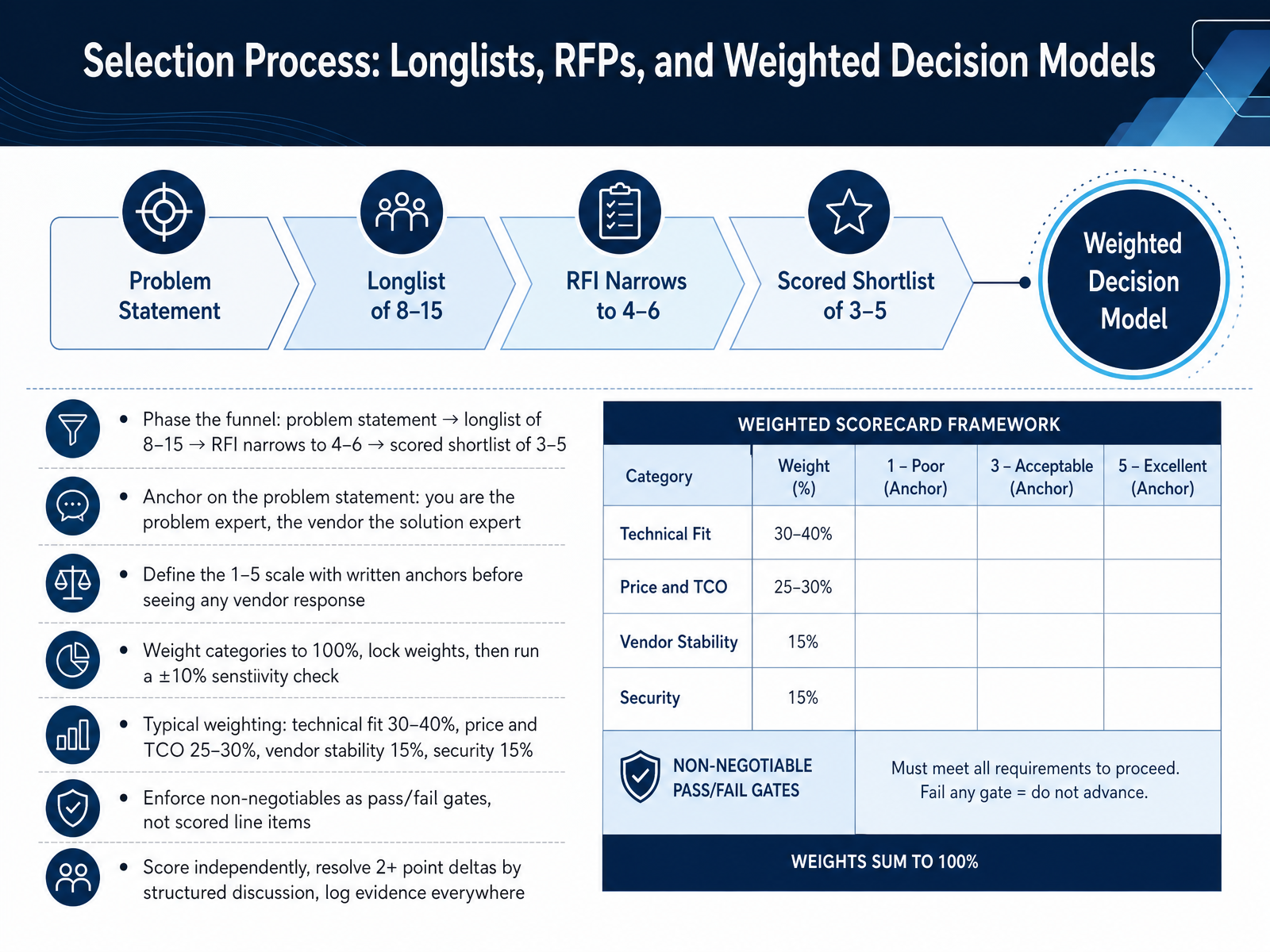
- 05Selection Process: Longlists, RFPs, and Weighted Decision ModelsLet's talk about structuring the selection process itself, because how you run the funnel matters as much as the criteria. Phase it deliberately. Start with a clear problem statement. Build a longlist of eight to fifteen vendors. Use a Request for Information, or RFI, to narrow to four to six. Then score a shortlist of three to five. Anchor everything on the problem statement. You are the problem expert. The vendor is the solution expert. Fill that gap with evidence, not marketing. Before you see any response, define your one-to-five scale with written anchors. Lock your category weights at one hundred percent, then run a sensitivity check, moving the top weights by plus or minus ten percent. If the ranking flips, your model is fragile. A typical split looks like this. Technical fit at thirty to forty percent. Price and total cost of ownership, or TCO, at twenty-five to thirty. Vendor stability at fifteen. Security at fifteen. Treat non-negotiables as pass or fail gates, not scored line items. Score independently first, then resolve any two-point gaps through structured discussion. Log your evidence everywhere. Now let's move into architecture and integration fit, and what the scorecard must test.
 umbrex.comresponsive.iospeclens.ai+22 min
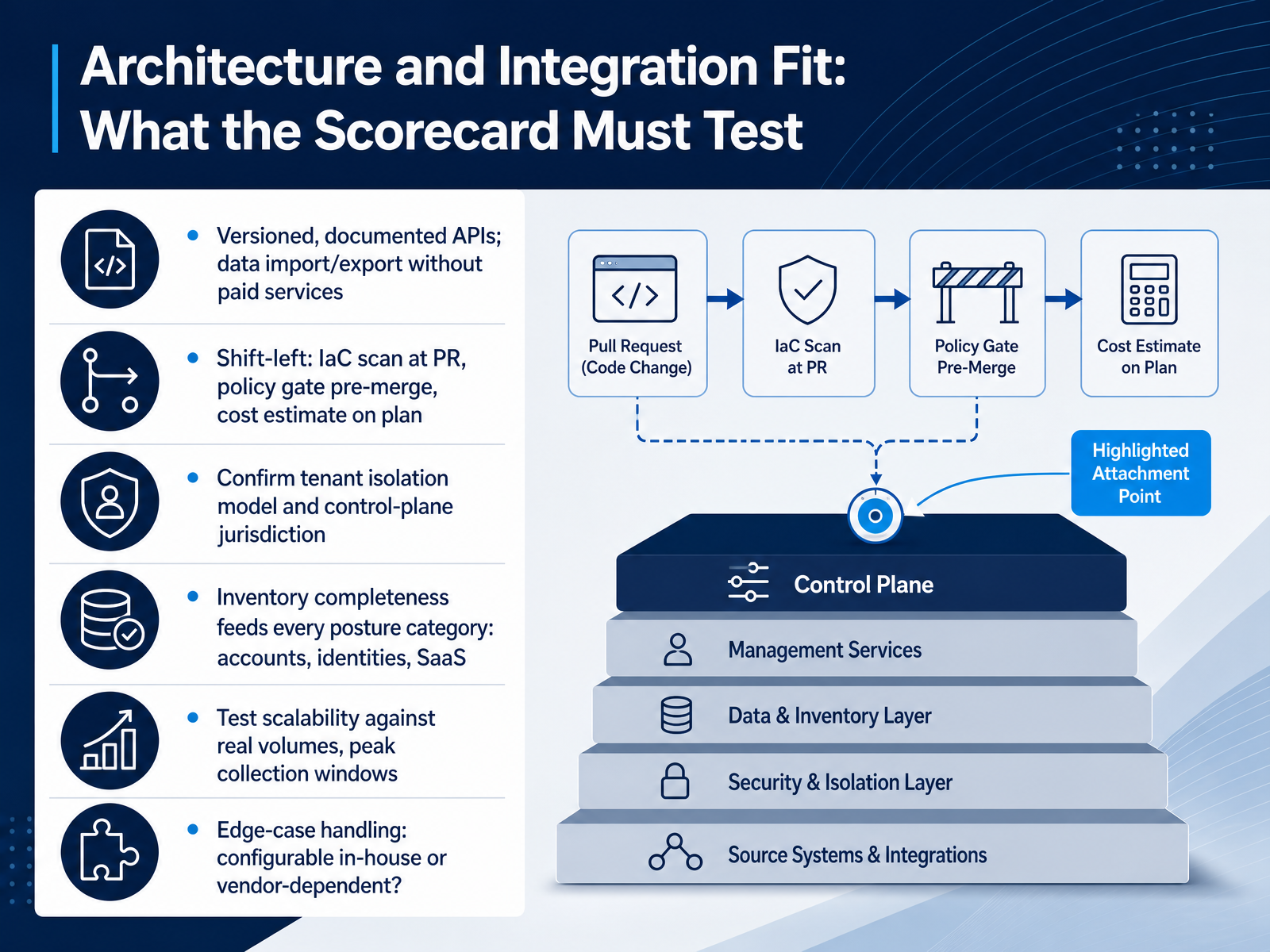
- 06Architecture and Integration Fit: What the Scorecard Must TestLet's talk architecture and integration fit, and what your scorecard actually has to test. Start with the API layer. Push for versioned, documented APIs, and confirm you can import and export data without paying for a premium service to move your own data. Next, shift-left behavior. Look for infrastructure-as-code scanning at the pull request, a policy gate before merge, and a cost estimate generated on the plan. Then ask directly: how is tenant isolation enforced, and where does the control plane live? Jurisdiction matters, and so does knowing whether one tenant's data can ever touch another's. Watch inventory completeness too. Accounts, identities, and SaaS apps all feed every posture category downstream, so a gap there quietly undermines everything else. Finally, test scalability with real volumes and peak collection windows, and ask how edge cases get handled. Configurable in-house, or vendor-dependent? That answer shapes your operating model and your total cost of ownership. Now let's move on to evaluating security, compliance, and sovereignty fit.
 learn.microsoft.comgithub.combashconsultants.com+22 min
- 07Evaluating Security, Compliance, and Sovereignty FitNow let's look at security, compliance, and sovereignty fit.
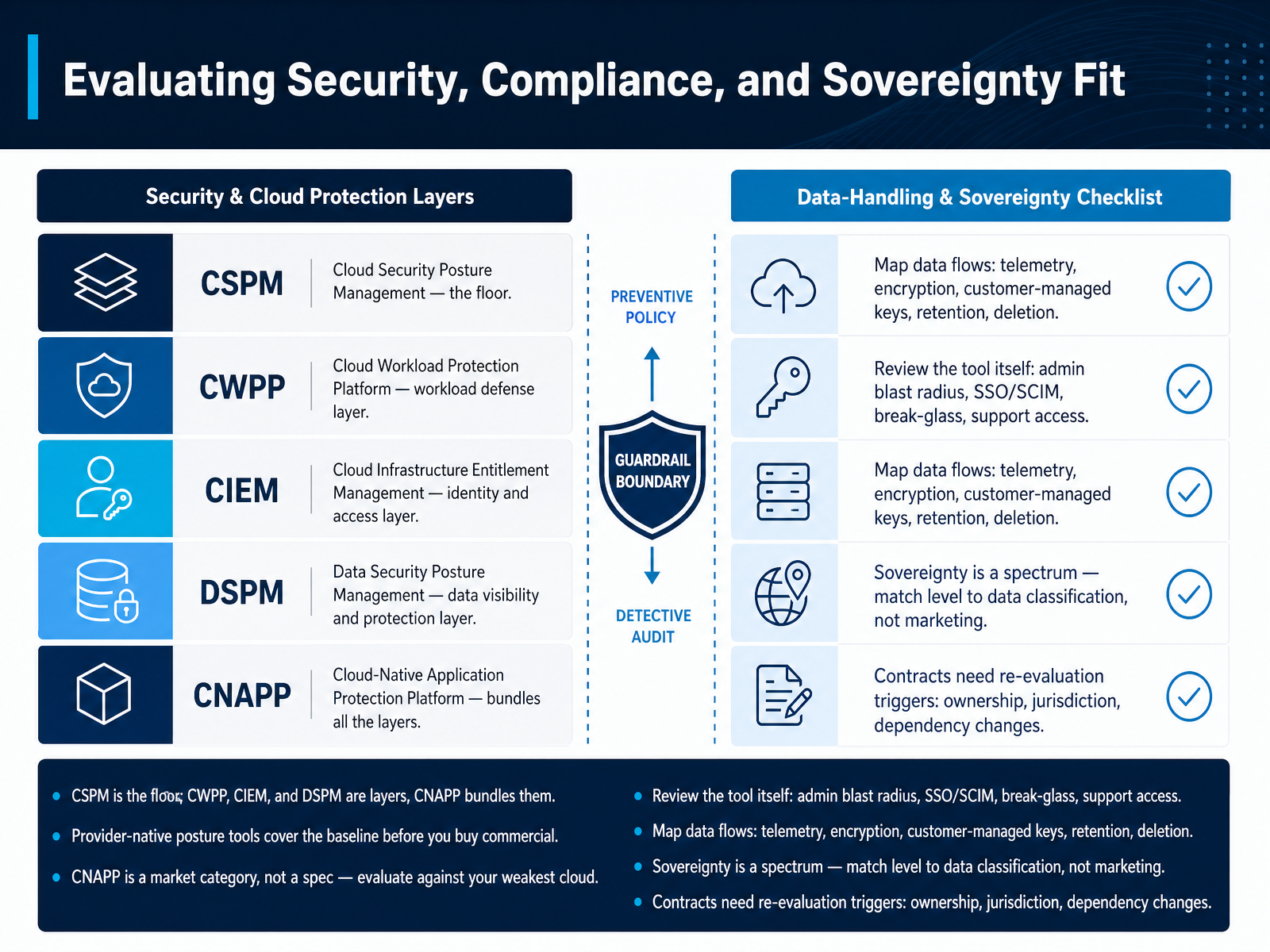
Start with CSPM, or Cloud Security Posture Management. That's the floor. It finds misconfigured storage, open ports, missing encryption. CWPP protects running workloads. CIEM governs identity permissions. DSPM watches sensitive data. A CNAPP bundles them, and it's a market category, not a spec. So evaluate it against your weakest cloud, not your strongest.
Before buying commercial, check what your provider gives you natively. AWS Security Hub, Defender for Cloud, Security Command Center. Get those findings to zero first. Then review the tool itself. What's the admin blast radius? Does it support SSO and SCIM? Is there a break-glass path? How does vendor support access your tenant?
Map your data flows. Where does telemetry go? How are keys managed? What's the retention and deletion window?
On sovereignty, treat it as a spectrum. Match the level to your data classification, not the marketing. And put re-evaluation triggers in the contract. Ownership changes, jurisdiction shifts, new dependencies. Those are your exit points.
The takeaway: buy posture depth where you're weakest, and make sovereignty a contract term, not a slide.
Next, workflow integration. Day one provisioning and day two operations.
 2 min
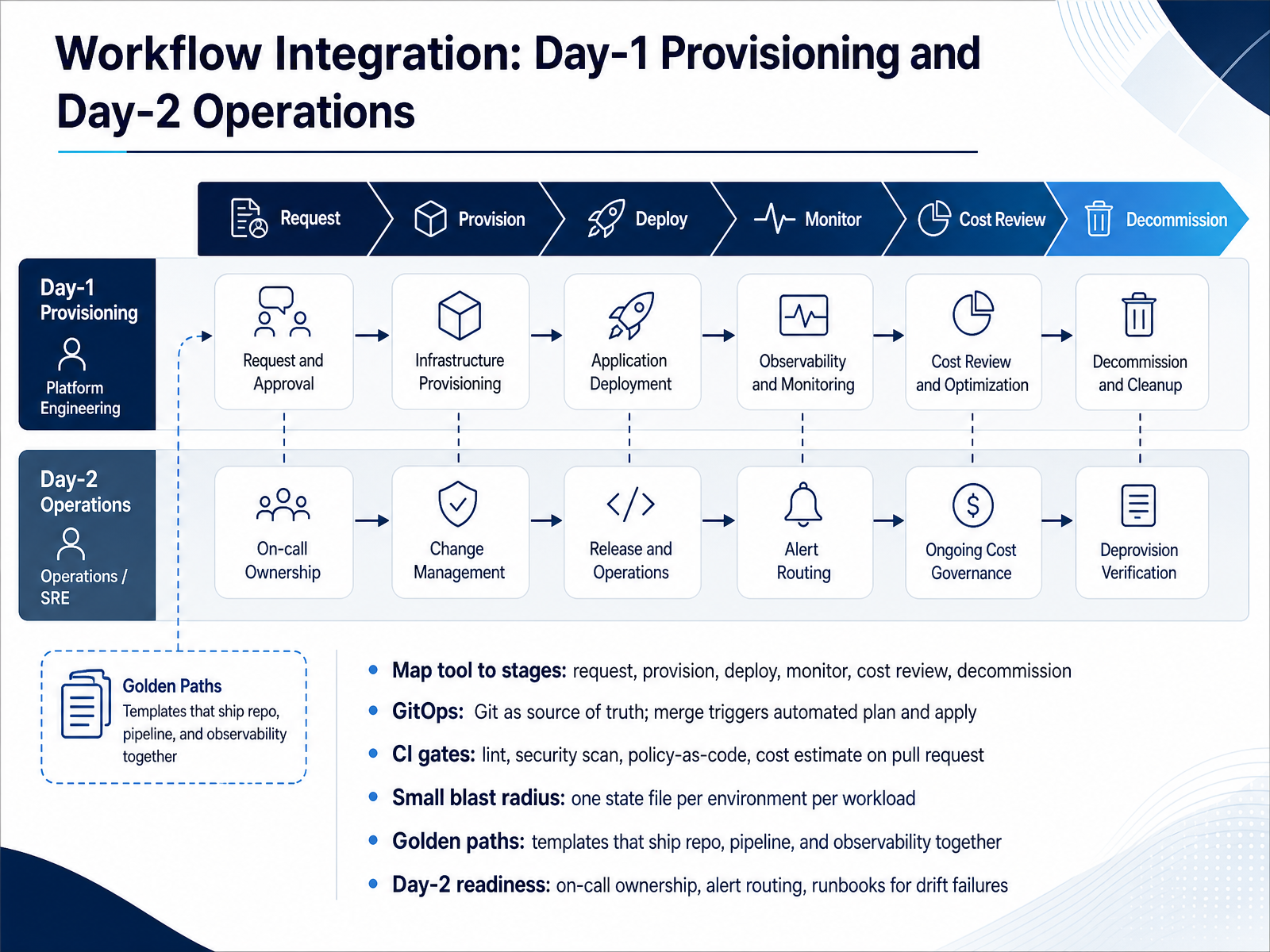
- 08Workflow Integration: Day-1 Provisioning and Day-2 OperationsLet's move into the operational side, and specifically workflow integration across Day One and Day Two. Start by mapping each tool to a lifecycle stage: request, provision, deploy, monitor, cost review, and decommission. If a tool only covers one stage, note the handoff points. Here is how to assess GitOps. Git, meaning the version control repository, becomes your source of truth. A merge triggers an automated plan, and then an apply. On pull requests, add CI gates: linting, a security scan, policy-as-code, and a cost estimate. Next, control blast radius. Use one state file per environment per workload, so a failure stays contained. Then golden paths: opinionated templates that ship the repo, pipeline, and observability together. Finally, Day Two readiness. Assign on-call ownership, route alerts, and write runbooks for drift and failed applies. Define these before you go live, not after. Coming up next: the Cost, Chargeback, and FinOps Workflow.
 2 min
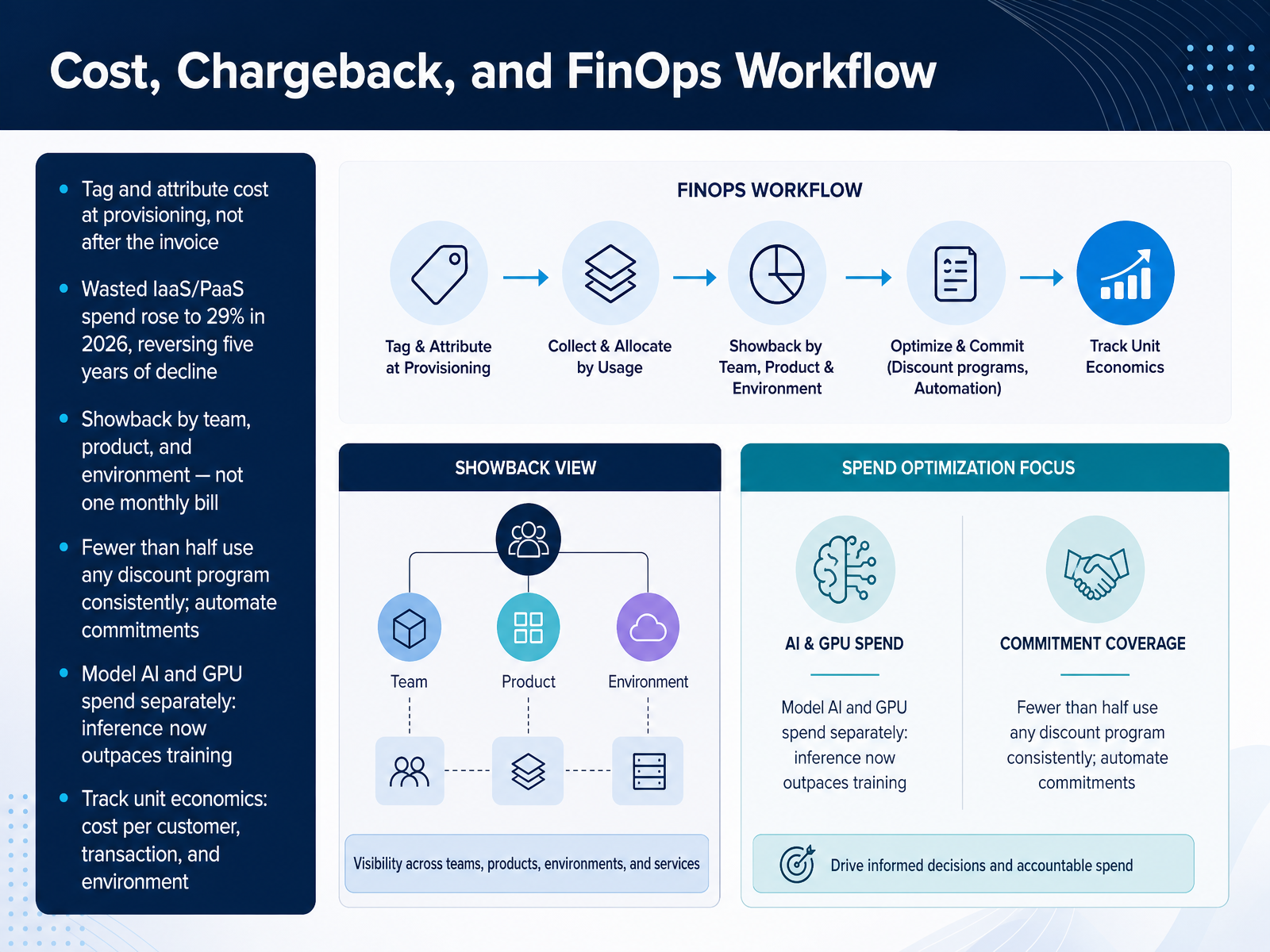
- 09Cost, Chargeback, and FinOps WorkflowNow let's look at cost, chargeback, and the FinOps workflow. Start with tagging. Tag and attribute cost at provisioning time, not after the invoice arrives. If you tag late, you are reconciling, not managing. Here is the hard part: wasted IaaS and PaaS spend rose to twenty-nine percent in twenty twenty-six, reversing five years of decline. So visibility alone is not working. Show back by team, product, and environment, not as one monthly bill. Teams change behavior when they can see their own number. On discounts, fewer than half of organizations use any commitment program consistently. That is a decision point: automate commitments, or accept the premium. Model AI and GPU spend separately, because inference now outpaces training, and its cost profile is different. Finally, track unit economics: cost per customer, per transaction, and per environment. Then watch the trend. If unit cost falls as usage grows, you have leverage. If it stays flat, you likely have inefficiency worth investigating. Next, commercial evaluation: licensing models and a three-to-five-year total cost of ownership.
 2 min
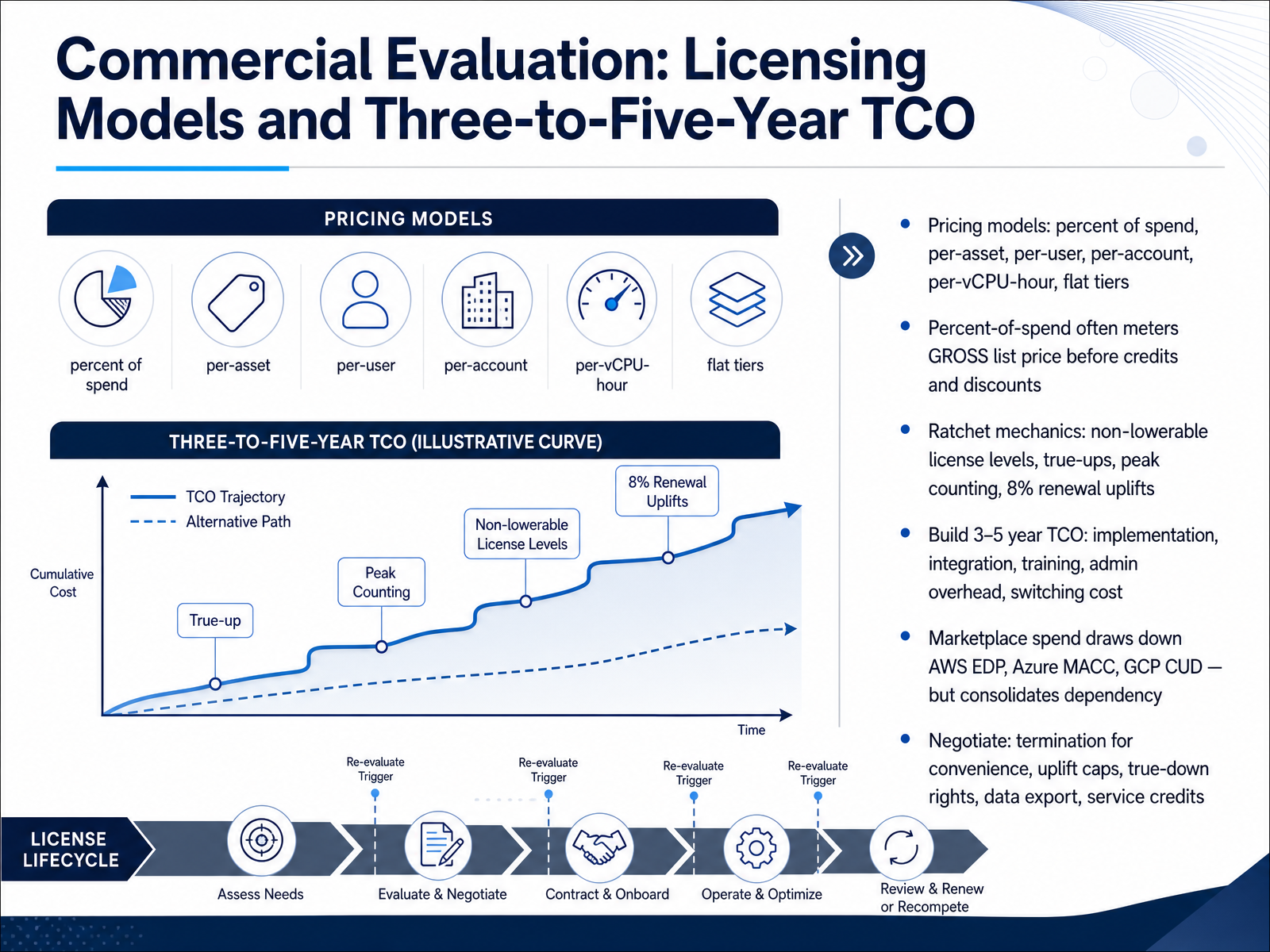
- 10Commercial Evaluation: Licensing Models and Three-to-Five-Year TCOLet's move into the commercial side, because licensing is where a good platform decision quietly turns expensive. First, know the pricing models you'll encounter. Percent of spend, per asset, per user, per account, per vCPU hour, and flat tiers. Each one shifts risk differently as you grow. Now here's the catch. Percent of spend usually meters gross list price, before credits and discounts. So your fee is calculated on ten million, even if you actually pay eight. Then there's the ratchet. Non lowerable license levels, annual true ups, peak counting, and renewal uplifts around eight percent. One load test can raise your level permanently. Usage falls, the level does not. So build a three to five year TCO, not a year one number. Include implementation, integration, training, admin overhead, and switching cost. Marketplace spend can draw down your AWS EDP, Azure MACC, or GCP CUD, but it also consolidates dependency. Finally, negotiate what actually matters. Termination for convenience, uplift caps, true down rights, data export, and service credits. Next, pilots, proofs of concept, and migration without breaking delivery.
 umbrex.comresponsive.iospeclens.ai+22 min
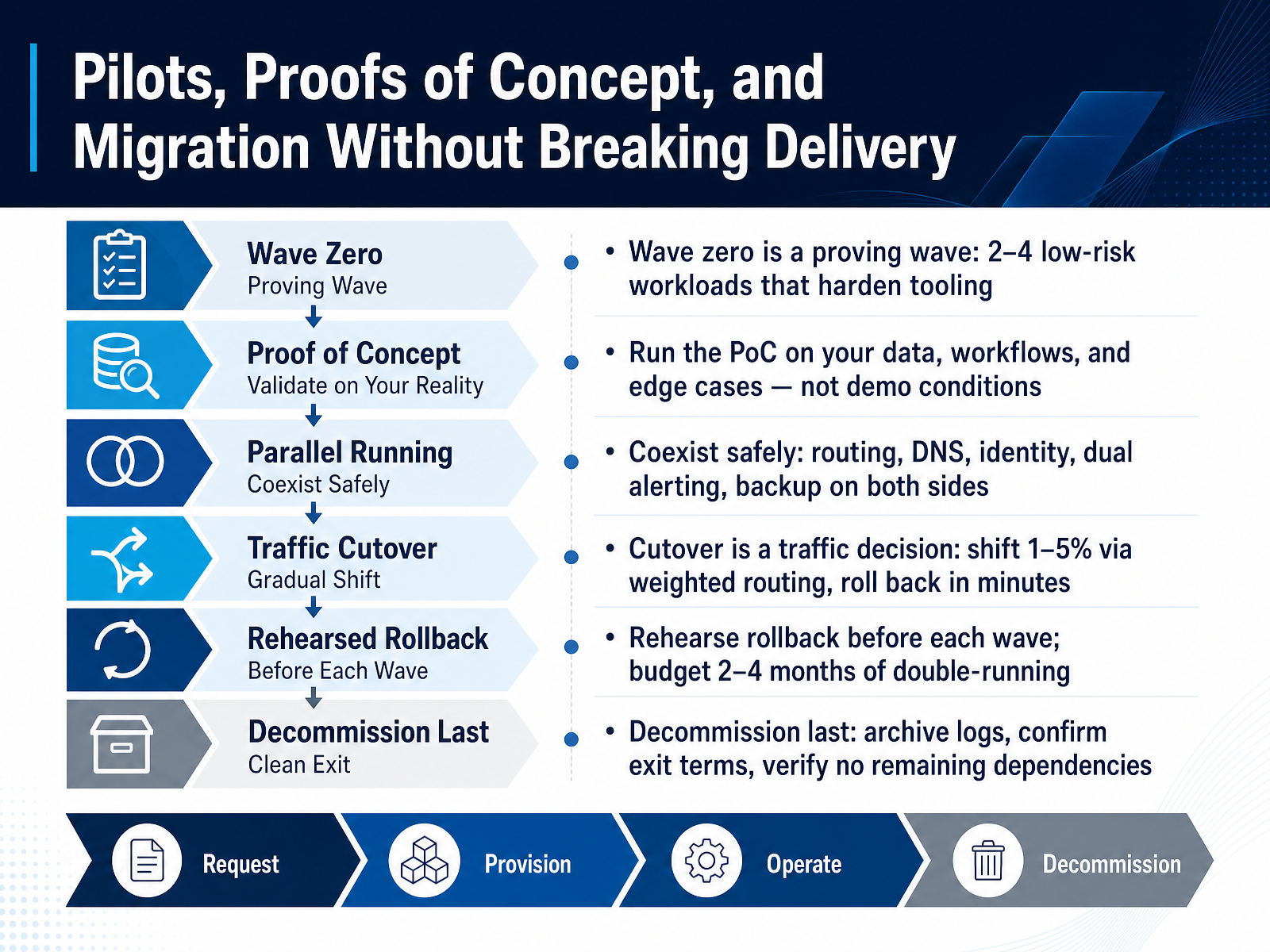
- 11Pilots, Proofs of Concept, and Migration Without Breaking DeliveryLet's talk about the part that actually decides whether your migration holds up, which is the pilot and the cutover plan. Treat wave zero as a proving wave. Pick two to four low-risk workloads, because its job is to harden your tooling, not to move your revenue systems. Run the proof of concept on your data, your workflows, and your edge cases, not on clean demo conditions. During the parallel run, design coexistence deliberately. Routing, DNS, identity, dual alerting, and backup on both sides all need owners. Then remember that cutover is a traffic decision, not a deployment decision. Shift one to five percent through weighted routing, watch your exit criteria, and roll back in minutes. Rehearse that rollback before every wave, and budget two to four months of double-running. Decommission last. Archive logs, confirm exit terms, and verify no dependencies remain. Next, we move to measuring value, governance, and continuous re-evaluation.
 learn.microsoft.comgithub.combashconsultants.com+21 min
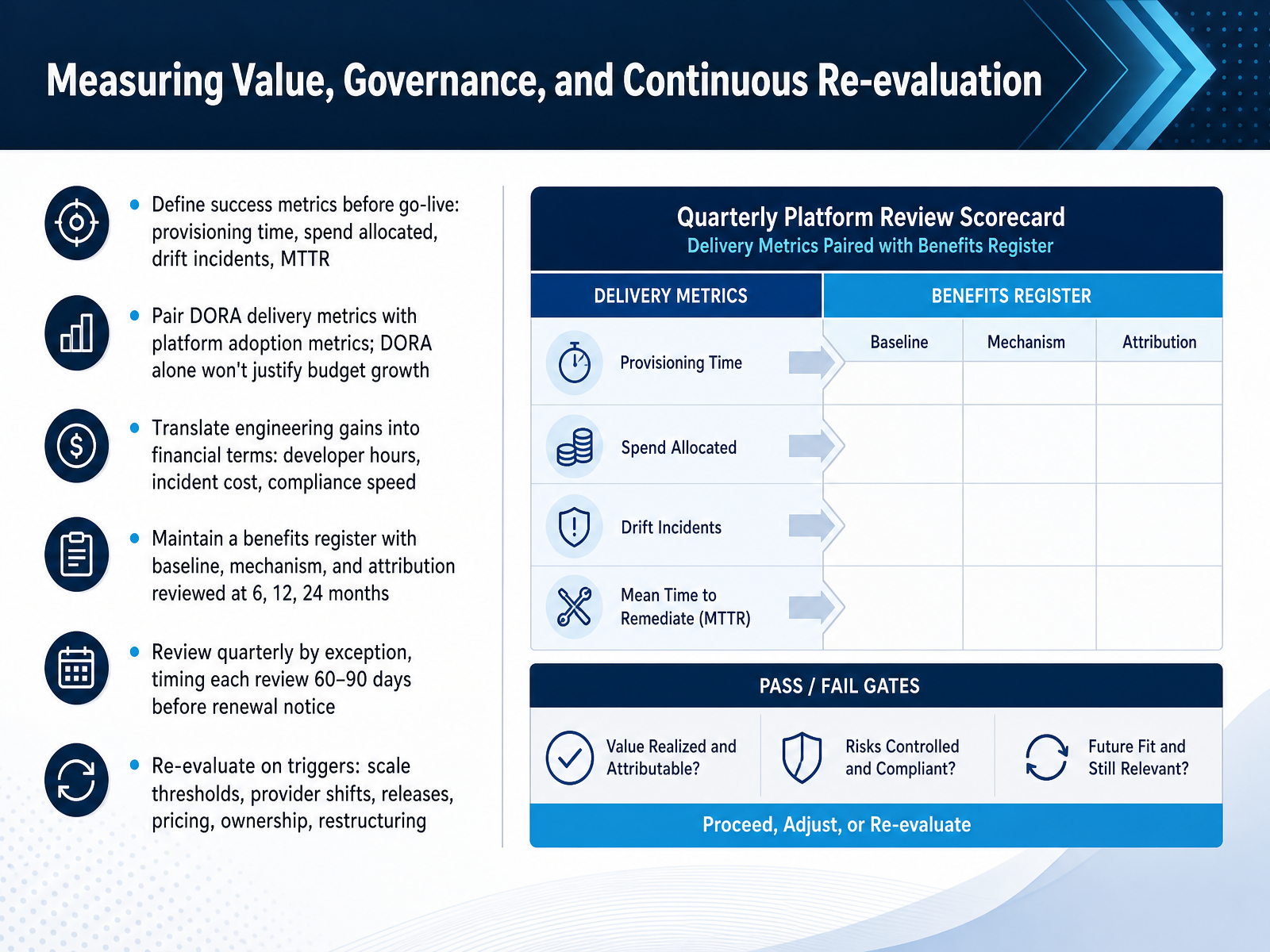
- 12Measuring Value, Governance, and Continuous Re-evaluationLet's close the loop on value and governance. Define your success metrics before go-live, not after. Provisioning time, spend allocated, drift incidents, and mean time to recovery. Those become your baseline. Now, DORA metrics describe delivery flow, but delivery metrics alone will not justify budget growth. Pair DORA with platform adoption metrics, then translate engineering gains into financial terms: developer hours recovered, incident cost avoided, time to compliance. Keep a benefits register with three attributes per line: baseline, mechanism, and attribution. Review it at six, twelve, and twenty-four months. Run quarterly reviews by exception, and time each one sixty to ninety days before the renewal notice window, because most contracts auto-renew. Then re-evaluate on triggers: scale thresholds, provider shifts, major releases, pricing changes, ownership changes, and restructuring. Next, we put this into a ninety-day action plan.
 2 min
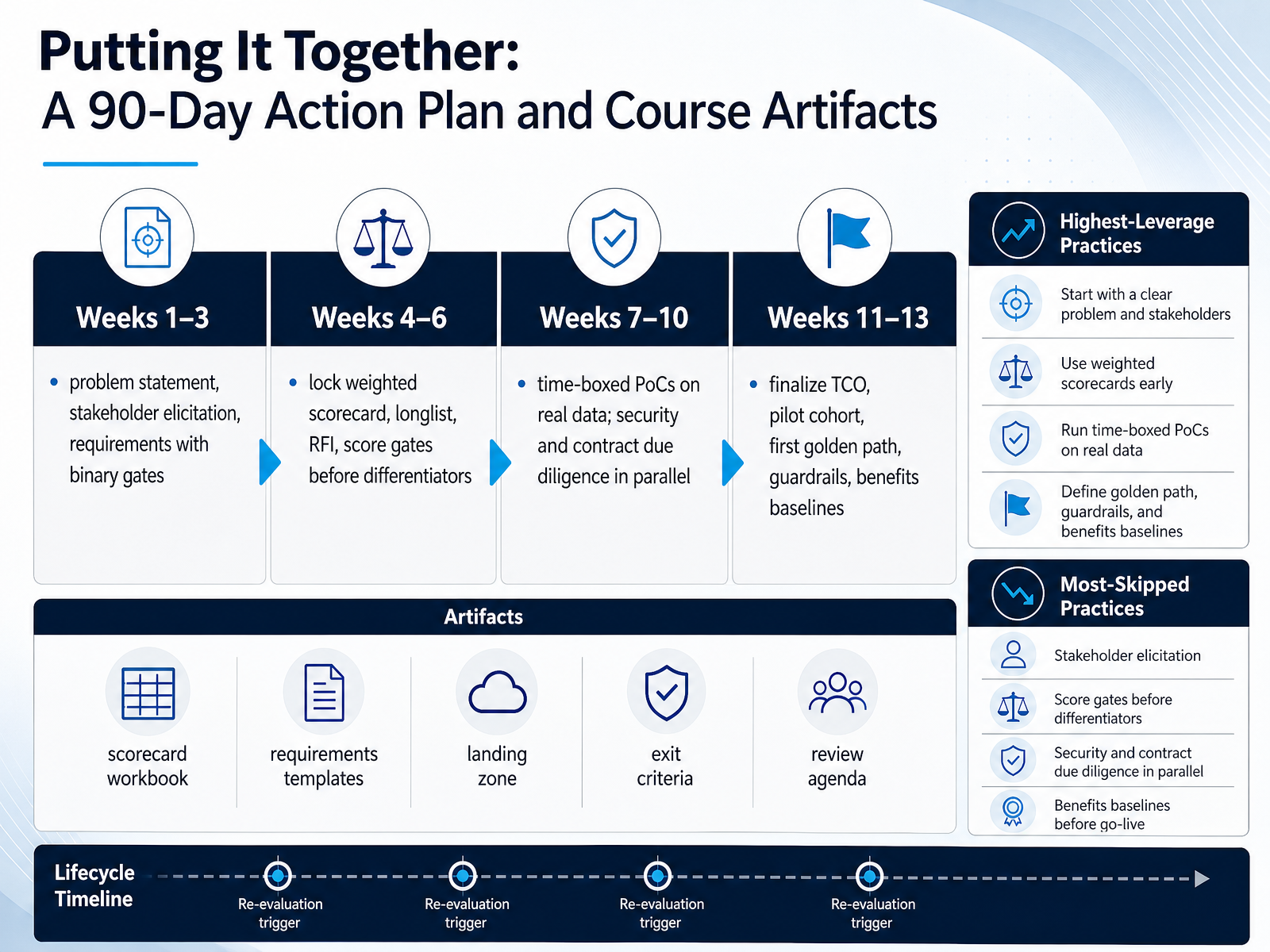
- 13Putting It Together: A 90-Day Action Plan and Course ArtifactsLet's close with a ninety day action plan you can actually run. Weeks one through three: write the problem statement, elicit stakeholders, and define requirements with binary pass or fail gates. Weeks four through six: lock your weighted scorecard before you see vendor answers, build the longlist, issue the RFI, and apply gate scoring before you debate differentiators. Weeks seven through ten: run time boxed proofs of concept on real data. Run security and contract due diligence in parallel, not after. Weeks eleven through thirteen: finalize your three year total cost of ownership model, select a pilot cohort, ship the first golden path, and set your guardrails and benefits baselines. Reuse the artifacts: the scorecard workbook, requirements templates, landing zone, exit criteria, and a recurring review agenda. That cadence keeps the decision honest long after signatures. Thank you for working through all thirteen slides. You now have a repeatable method. Start small, document decisions, and revisit quarterly. Good luck with your evaluation.
 n6cloud.comstrativant.comcloudconsultingfirms.com+22 min
Take the deck with you
Download this course as a file — free, no sign-up needed.
- PDF handoutEvery slide page, ready to print or share.14 pages · 3.9 MBDownload
- Narrated PowerPointThe deck that presents itself — every slide carries the digital human's narration video.14 pages · 15.1 MBDownload
- PowerPoint slidesThe full deck as a .pptx — open it in PowerPoint, Keynote, or Google Slides.14 pages · 3.7 MBDownload
Free to use in your own training — please keep the PersonWise credit page at the end.
Have your own deck? Turn it into a course
Sources consulted
Web sources consulted while building this course.
- IDC Cloud Buying Criteria 2026: How to Choose a Provider — n6cloud.com
- Cloud Infrastructure Buyer's Guide | Strativant — strativant.com
- How to Choose a Cloud Provider: A Technical Framework for 2026 — cloudconsultingfirms.com
- How to Choose the Right Cloud Platform for Your Enterprise in 2026 – USA Business Times — usabusinesstimes.com
- Enterprise Software Selection Playbook - 2026 — viewpointanalysis.com
- CoreStack’s BetterCloud deal marks the end of siloed governance - HFS Research — hfsresearch.com
- env zero and CloudQuery Merge: Leading IaC Data Platform | env zero — envzero.com
- CoreStack Acquires BetterCloud Establishing a Unified Agentic Governance OS Across Cloud, SaaS and AI | AP News — apnews.com
- CoreStack Acquires BetterCloud Establishing a Unified Agentic Governance OS Across Cloud, SaaS and AI | Morningstar — morningstar.com
- env zero and CloudQuery Announce Merger to Create the Industry’s First Unified Cloud Intelligence Platform | AP News — apnews.com
- Azure landing zone design principles - Cloud Adoption ... — learn.microsoft.com
- alz/2026.04.2/platform/alz/README.md — github.com
- Cloud landing zones and infrastructure as code | BASH Consultants — bashconsultants.com
- Landing Zone 2026: What Belongs In It (Azure, AWS, GCP) — alekseialeinikov.com
- Citadel-Cloud-Management/multi-cloud-landing-zone — github.com
- Enterprise Software Selection: RFP Build & Scoring — umbrex.com
- RFP weighted scoring: Steps, examples, and templates | Responsive — responsive.io
- RFP Evaluation Matrix Template | SpecLens — speclens.ai
- How Procurement Teams Evaluate Vendor Proposals — steerlab.ai
- How to Build an RFP Scoring Matrix That Actually Works | Strutter AI — strutterai.com