Begin
14 pages · ~28 min
English Articles: A vs. An vs. The
This training helps English learners master the use of definite and indefinite articles (a, an, the) for clearer, more accurate writing and speech.
A digital instructor presents all 14 pages. Hold “Ask” at any point and ask out loud — the answer comes from this course. No sign-up needed.
What you’ll learn
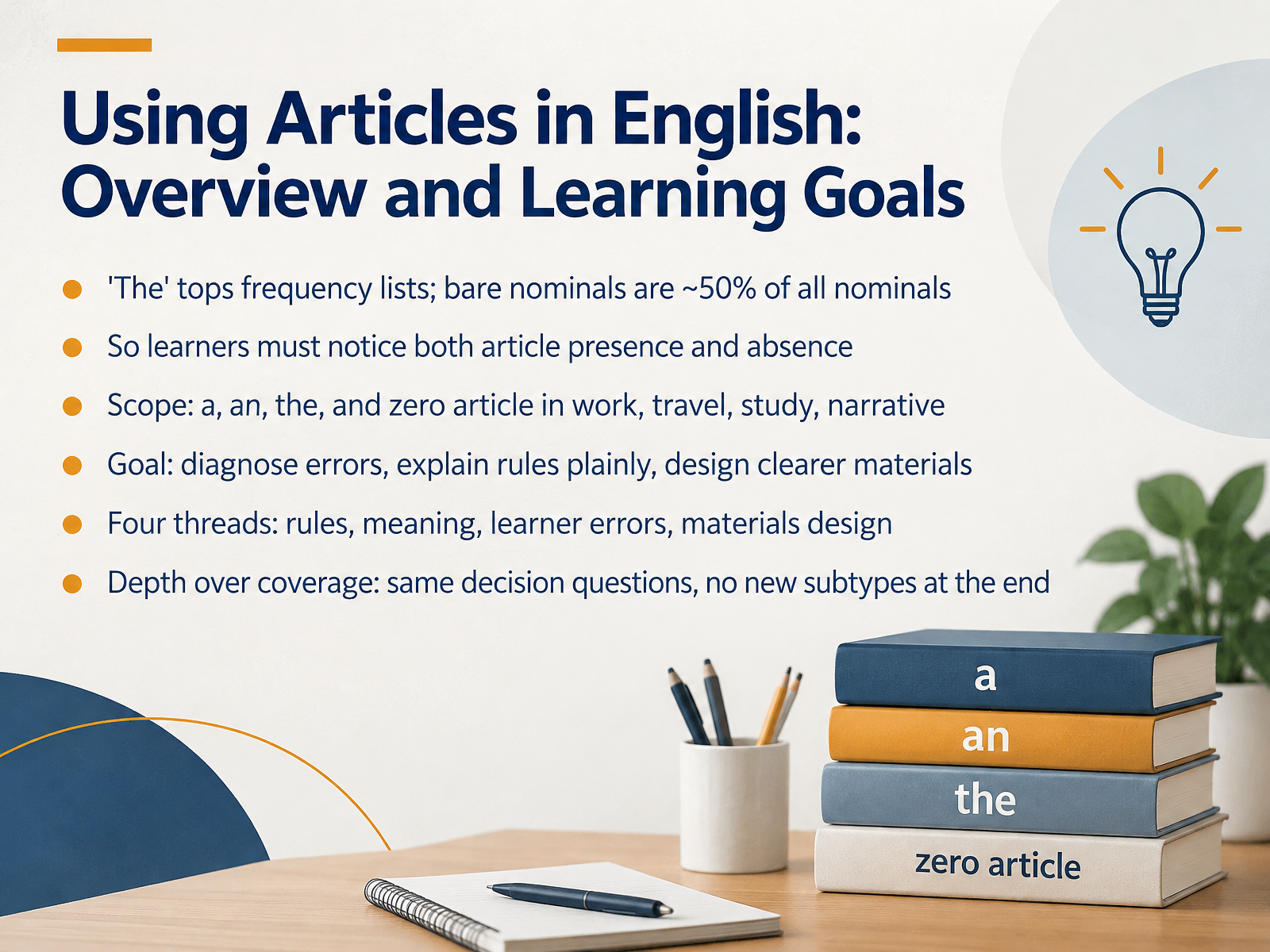
- 01Using Articles in English: Overview and Learning GoalsWelcome. I'm glad you're here, because article choice in English is one of those areas that can feel genuinely inconsistent, even for strong speakers. You're not imagining it. So let's start with the big picture. First, the facts. The word 'the' tops English frequency lists. And yet bare nominals, nouns with no article at all, make up about fifty percent of all nominals in native English. That means you have to notice two things: when an article appears, and when it doesn't. Now, our scope. We'll look at a, an, the, and the zero article across four everyday settings: work, travel, study, and storytelling. Here's our goal. By the end, you should be able to diagnose errors, explain the rules plainly, and design clearer materials for your own learners. We'll follow four threads: the rules, the meaning, common learner errors, and materials design. And we'll choose depth over coverage. We'll keep asking the same decision questions, with no new subtypes at the end. One takeaway for this slide: treat absence of an article as a real choice, not a gap. Now let's move on to the three-way choice at a glance.doi.orgjournal.aall.org.audoi.org+22 min
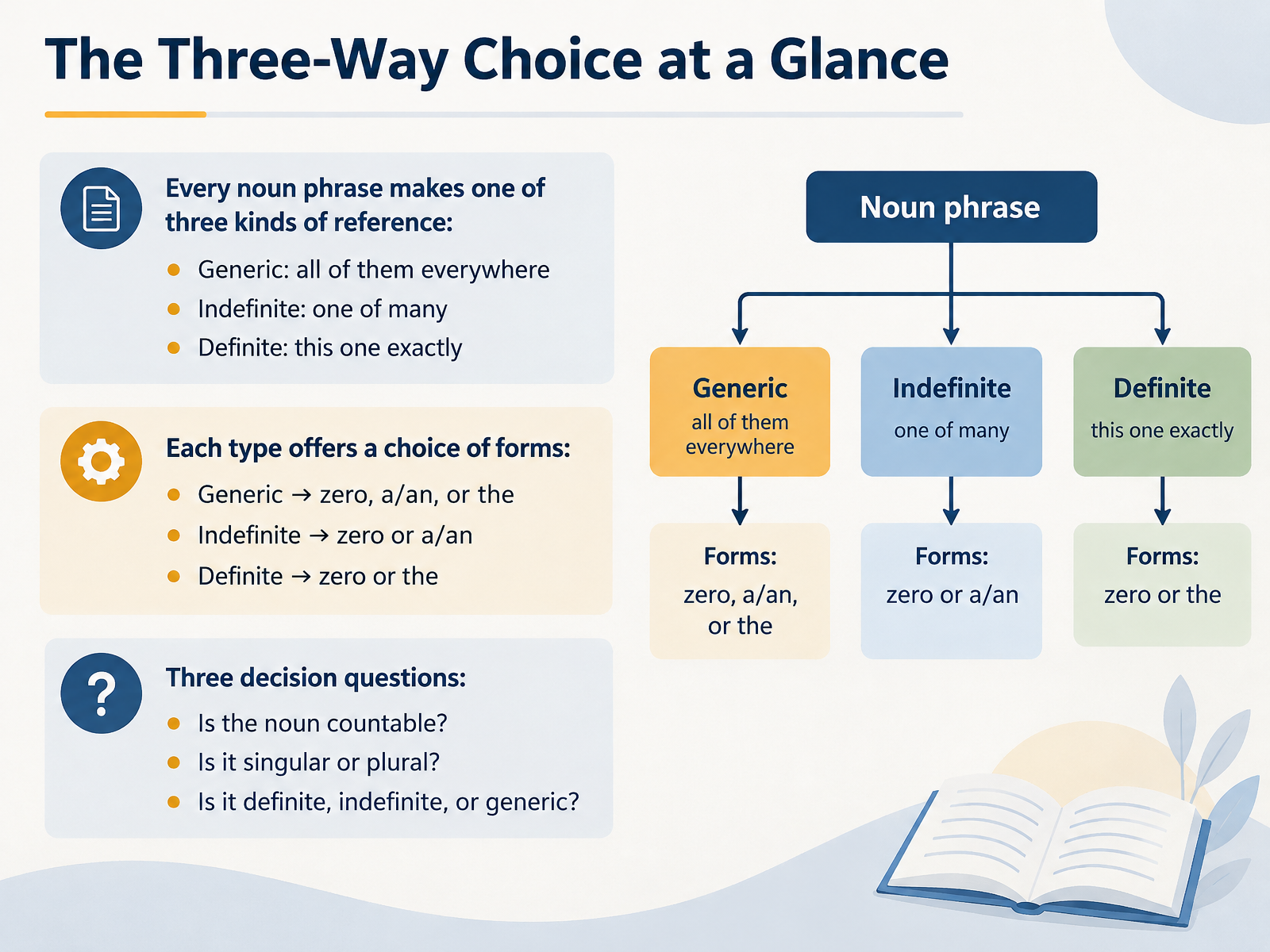
- 02The Three-Way Choice at a GlanceLet's step back and look at the whole system at a glance. Every noun phrase you write makes one of three kinds of reference. First, generic, meaning all of them everywhere. Second, indefinite, meaning one of many. Third, definite, meaning this one exactly. Now compare the forms each type allows. Generic reference gives you three choices: zero article, a or an, or the. Indefinite reference gives you zero or a or an. Definite reference gives you zero or the. Here's the exception that trips people up: zero article is not the same as no choice. It is a real option, and sometimes the correct one. To pick well, ask three quick questions. Is the noun countable? Is it singular or plural? And is it definite, indefinite, or generic? Here's your takeaway. Before you choose a form, decide the reference first, then let countability and number narrow the choice. Next, we'll build that foundation with countability and number.
 doi.orgsana.aalto.fiterpconnect.umd.edu+21 min
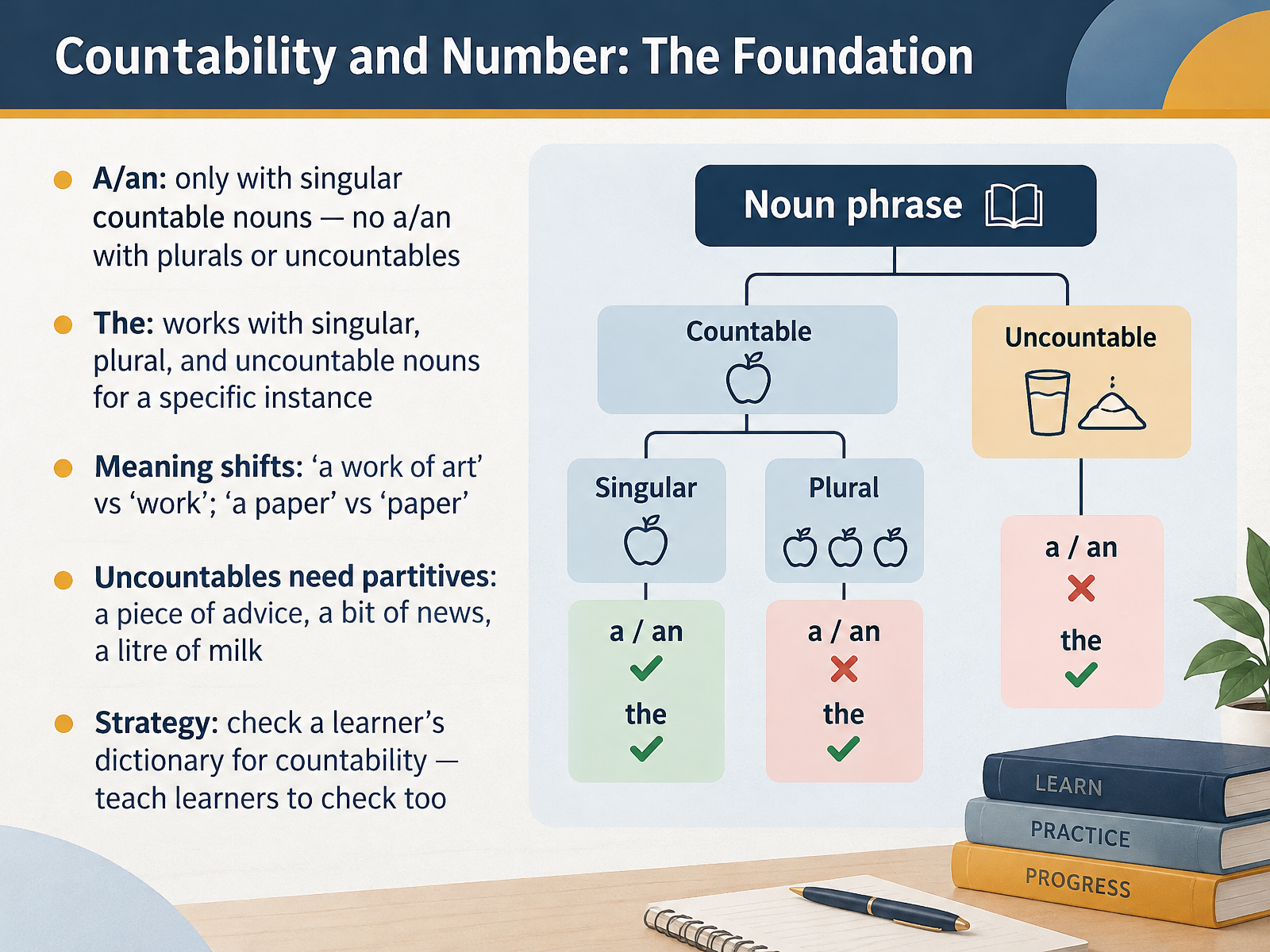
- 03Countability and Number: The FoundationNow let's build the foundation: countability and number. First, a and an only work with singular countable nouns. So you say a report, but never a reports or a information. Now compare the. The works with singular, plural, and uncountable nouns when you mean a specific instance. For example, the report on my desk, the reports from last week, the information you sent. Meaning shifts matter too. A work of art is one piece, while work means effort. A paper can be a document, while paper is the material. For uncountables, use a partitive: a piece of advice, a bit of news, a litre of milk. Here's your takeaway: check a learner's dictionary for countability, and teach your learners to check too. Next, we look at indefinite articles: a and an.
 eric.ed.govdoi.orgcup.columbia.edu+21 min
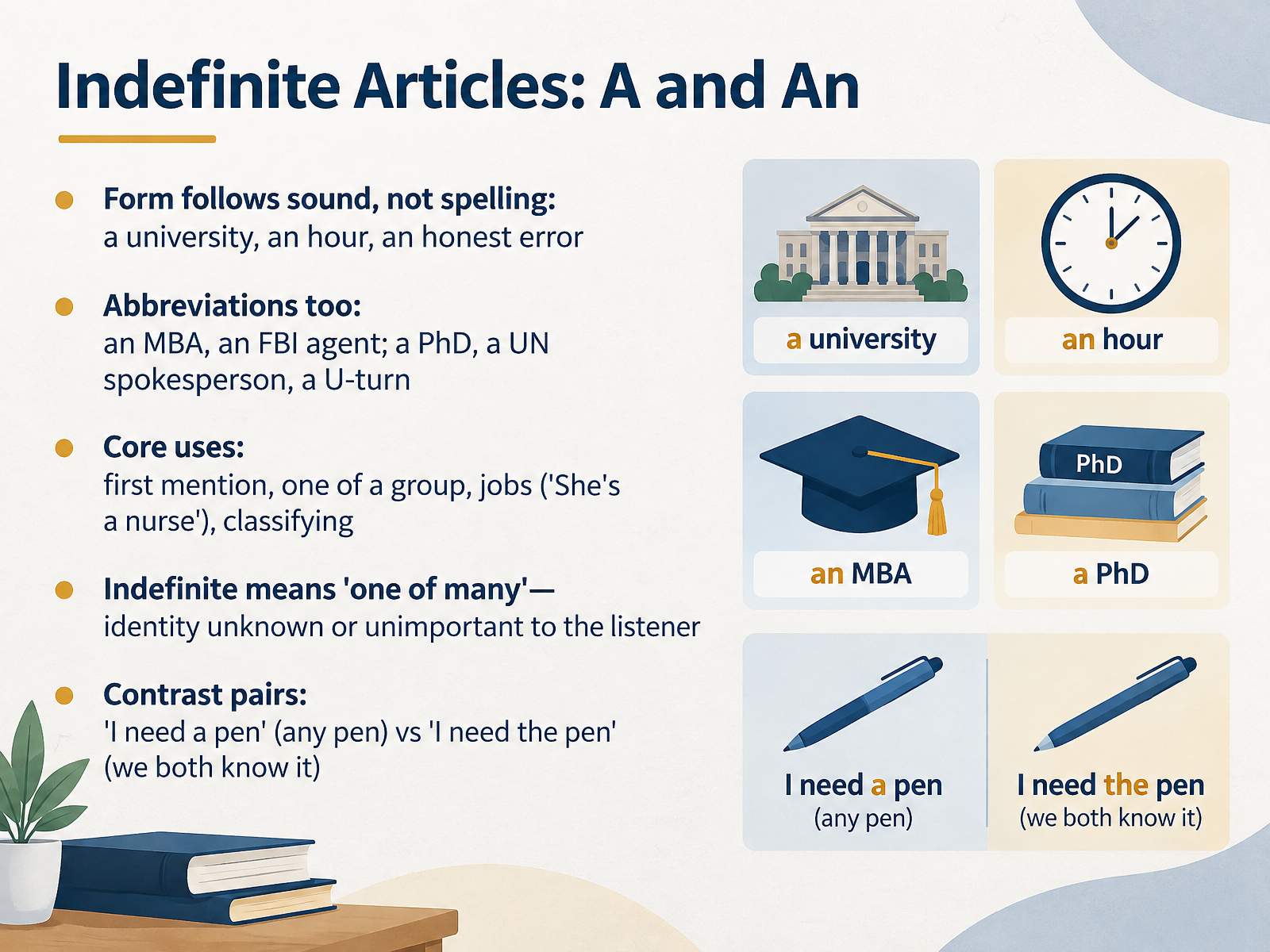
- 04Indefinite Articles: A and AnLet's move on to indefinite articles: a and an. First, here is the part that catches almost everyone. Form follows sound, not spelling. So we say a university, an hour, an honest error. Now compare abbreviations. An M B A, an F B I agent. But a P H D, a U N spokesperson, a U-turn. So read the first sound out loud before you choose. Next, the core uses: first mention, one of a group, jobs like she's a nurse, and classifying. Indefinite simply means one of many. The identity is unknown, or it doesn't matter to the listener. Now compare this pair. I need a pen means any pen. I need the pen means we both know which one. Your takeaway: say the word aloud first. Let's look at the definite article: the.
 learnenglish.britishcouncil.orgour-languages.canada.caowl.purdue.edu+22 min
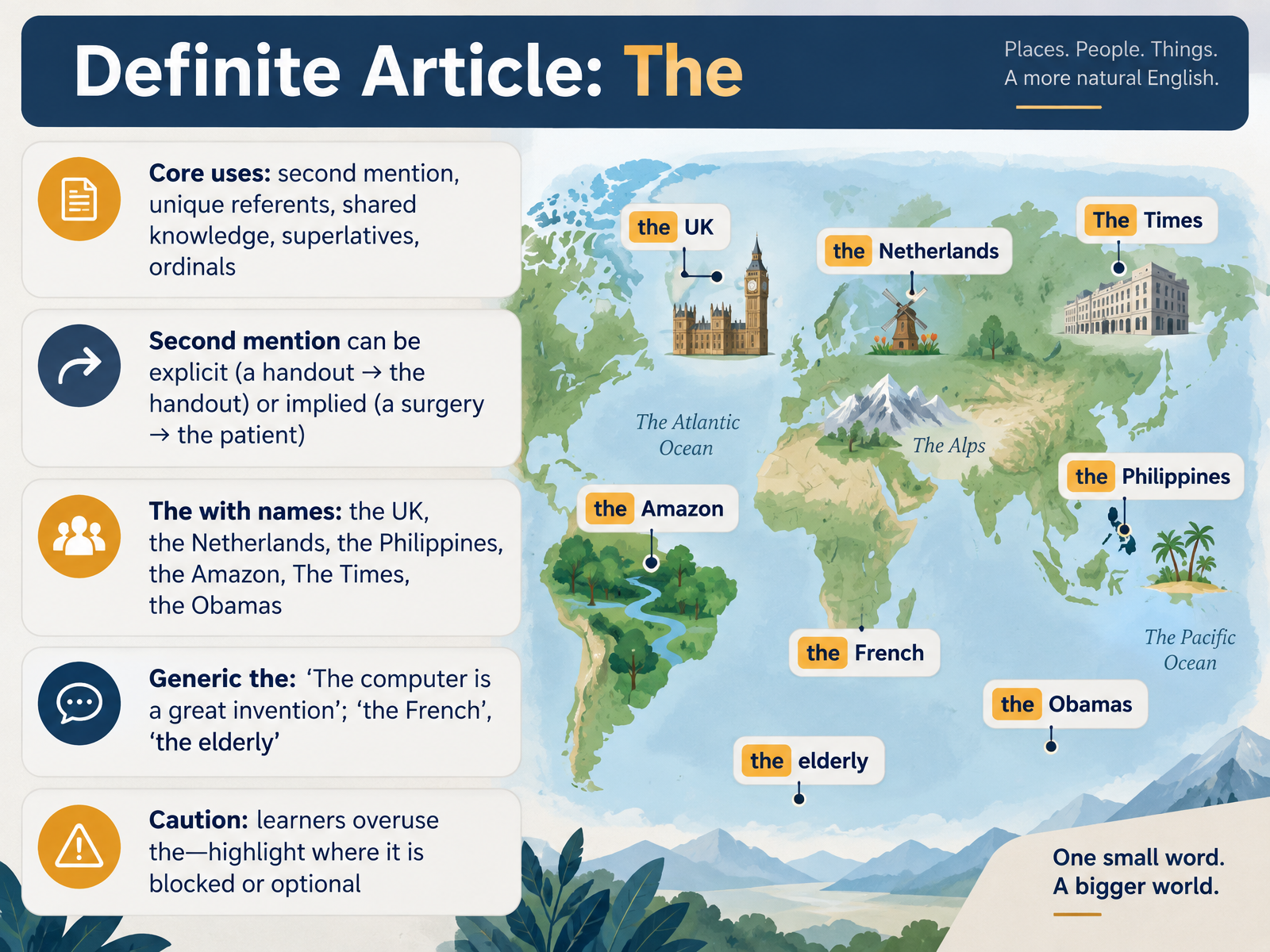
- 05Definite Article: TheNow let's look at the definite article, the. Here's the core idea. We use the when both you and your listener know which one you mean. First, second mention. You say a handout, then the handout. It can also be implied. A surgery means the patient. Next, unique things and shared knowledge. The sun, the boss. Also superlatives and ordinals: the best, the first. Now compare names. Most names take no article, but we say the UK, the Netherlands, the Philippines, the Amazon, The Times, and the Obamas. Here's the generic exception. In formal writing, the plus a singular noun can mean a whole class: The computer is a great invention. And groups: the French, the elderly. Here's the caution. Learners often overuse the. Highlight where it is blocked or optional, like school in go to school. Your takeaway is this. Before you write the, ask: does my reader know exactly which one I mean? If not, stop. Coming up next, Zero Article: When No Article Is the Right Choice.
 learnenglish.britishcouncil.orgjournal.aall.org.audoi.org+22 min
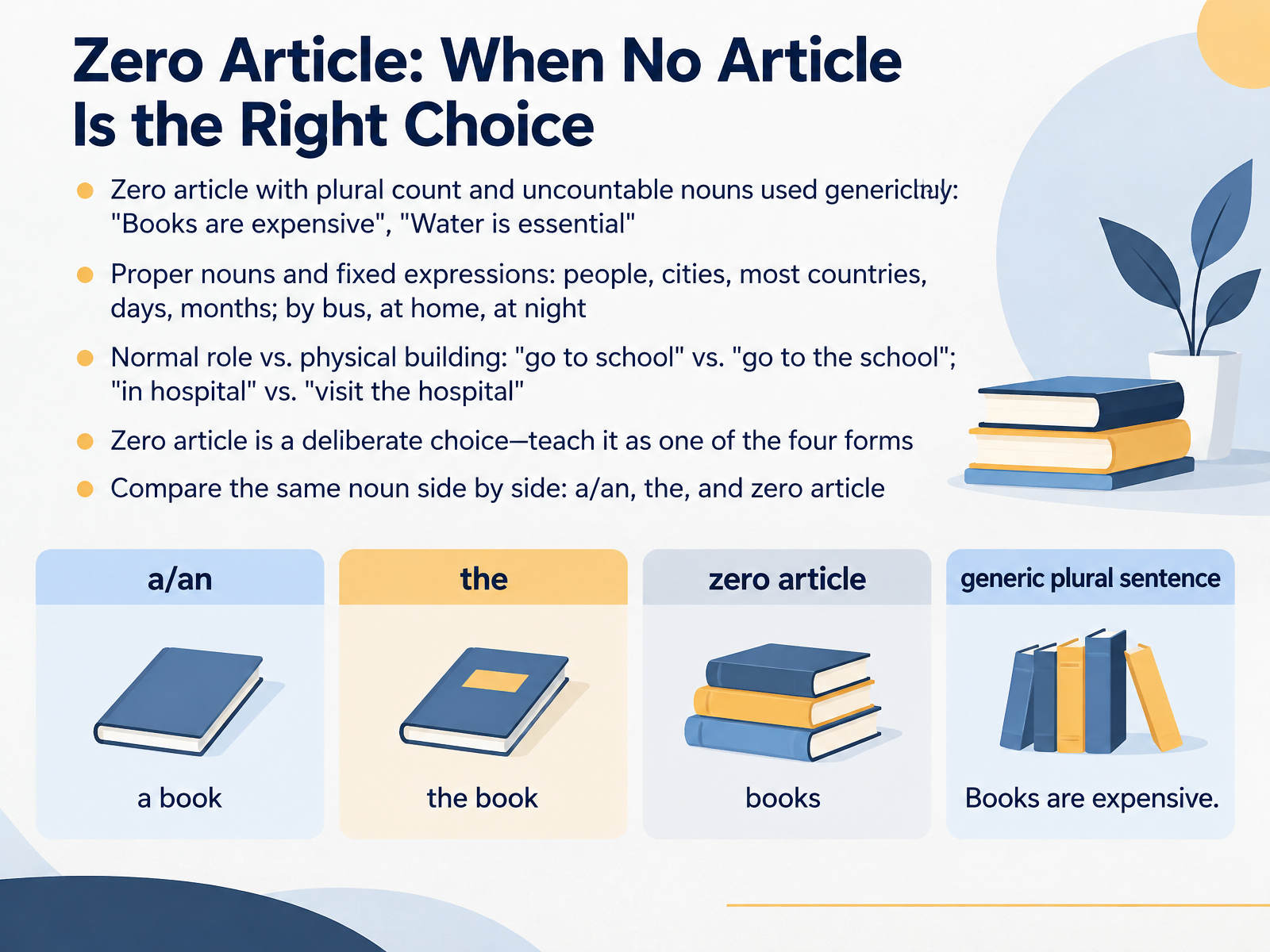
- 06Zero Article: When No Article Is the Right ChoiceNow let's look at the zero article, when no article is the right choice. This is where article choice often feels inconsistent, so let's make it concrete. First, zero article with plural count nouns and uncountable nouns used generally. Books are expensive. Water is essential. You mean all books and all water, not specific ones. Second, proper nouns and fixed expressions. We say London, Tuesday, August, by bus, at home, at night. Here's the exception worth teaching: normal role versus physical building. Go to school means you're a student there. Go to the school means the building. In hospital means you're a patient. Visit the hospital means you're a visitor. Treat zero article as a deliberate choice, one of the four forms. Compare the same noun side by side: I need a book, the book on your desk, and books are expensive. Your takeaway: when a noun is general, plural, or uncountable, check whether no article is the clearest choice. Next, we'll see how articles shift across a text, from first mention to second mention.
 learnenglish.britishcouncil.orgjournal.aall.org.aueric.ed.gov+22 min
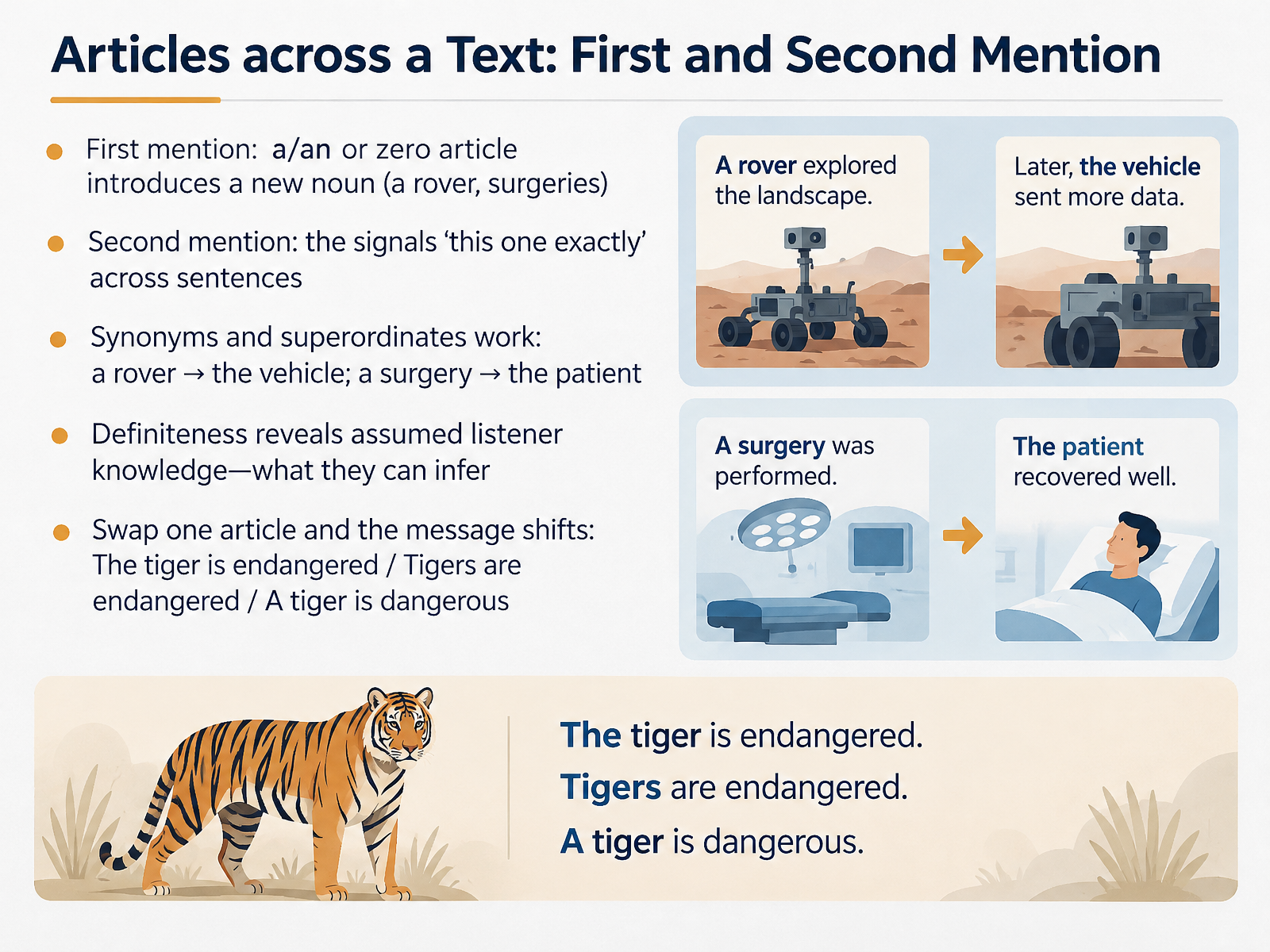
- 07Articles across a Text: First and Second MentionNow let's watch articles work across a whole text. First, first mention. A new noun comes in with a or an, or with no article for plurals. So, a rover landed on Mars. Or, surgeons performed several surgeries. Next, second mention. Once a noun is known, the signals this one exactly, and that is usually the. A rover landed on Mars. The vehicle was controlled remotely. Now compare synonyms and superordinates. You do not repeat the exact noun. A surgery took three hours. The patient is recovering well. Here's the key idea. Definiteness shows what you assume your listener already knows, or can infer. And the opposite is true too. Swap one article and the message shifts. The tiger is endangered. Tigers are endangered. A tiger is dangerous. Same noun, different meaning. So today's takeaway, when you edit or teach a paragraph, track each noun from first to second mention. That small check catches most article errors. Next, we look at generic meaning and the three patterns it allows.
 doi.orgsana.aalto.fiterpconnect.umd.edu+22 min
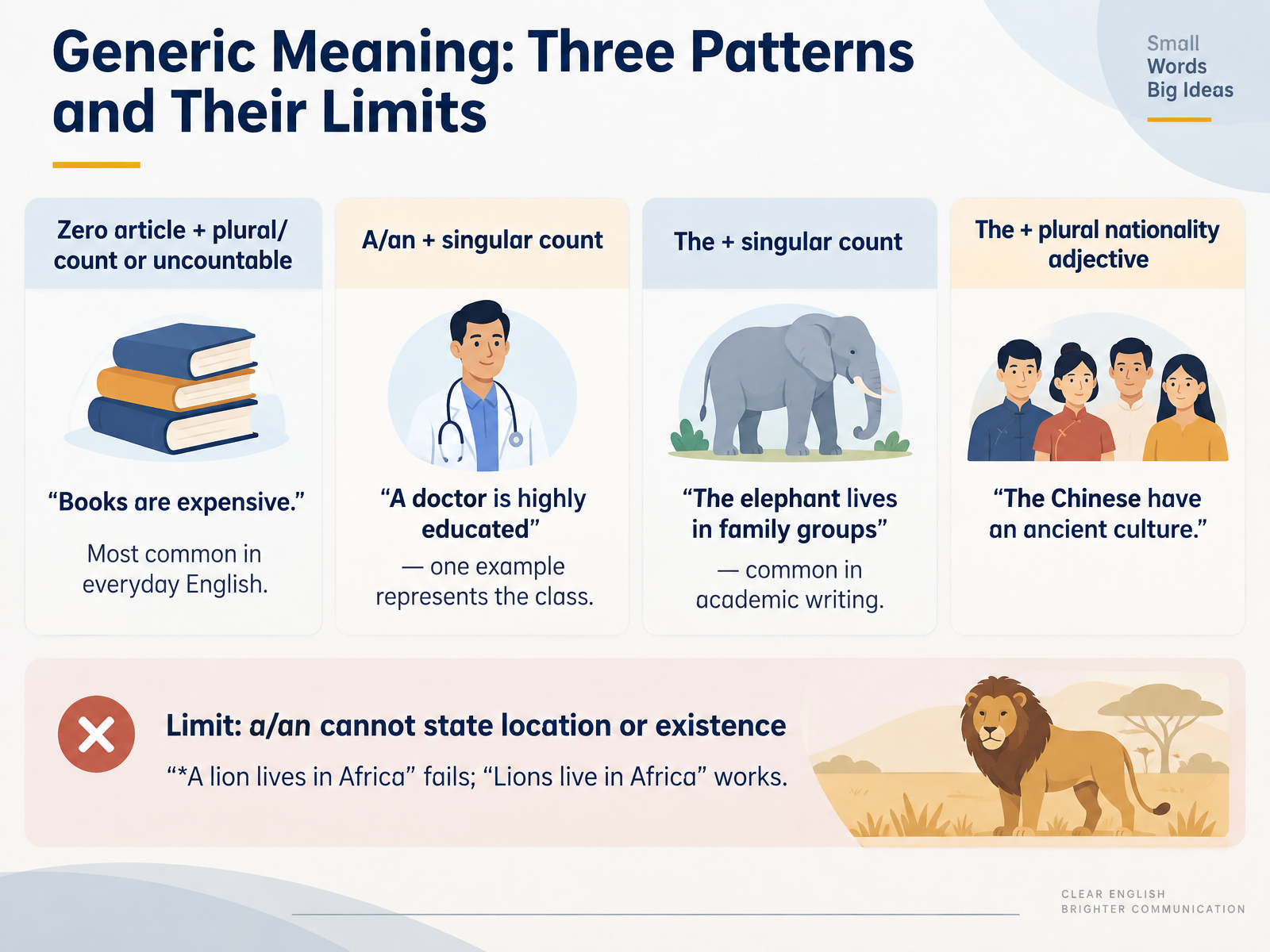
- 08Generic Meaning: Three Patterns and Their LimitsNow let's look at generic meaning. That's when you make a general statement about a whole class, not one specific thing. There are three main patterns, plus one special case. First, zero article with a plural count noun or an uncountable noun. For example, "Books are expensive." This is the most common pattern in everyday English. Next, a or an with a singular count noun. "A doctor is highly educated." Here, one example represents the whole class. Now compare the third pattern: the with a singular count noun. "The elephant lives in family groups." You'll see this often in academic writing. Here's the exception. The with a plural nationality adjective. "The Chinese have an ancient culture." And here's the limit you need to remember. A or an cannot state location or existence. You cannot say, "A lion lives in Africa." Instead, say, "Lions live in Africa." So your takeaway is this: for general statements about where things exist, use the zero article with a plural noun. Next, we'll look at common errors, what A2 to B2 learners actually do.
 doi.orgsana.aalto.fiterpconnect.umd.edu+21 min
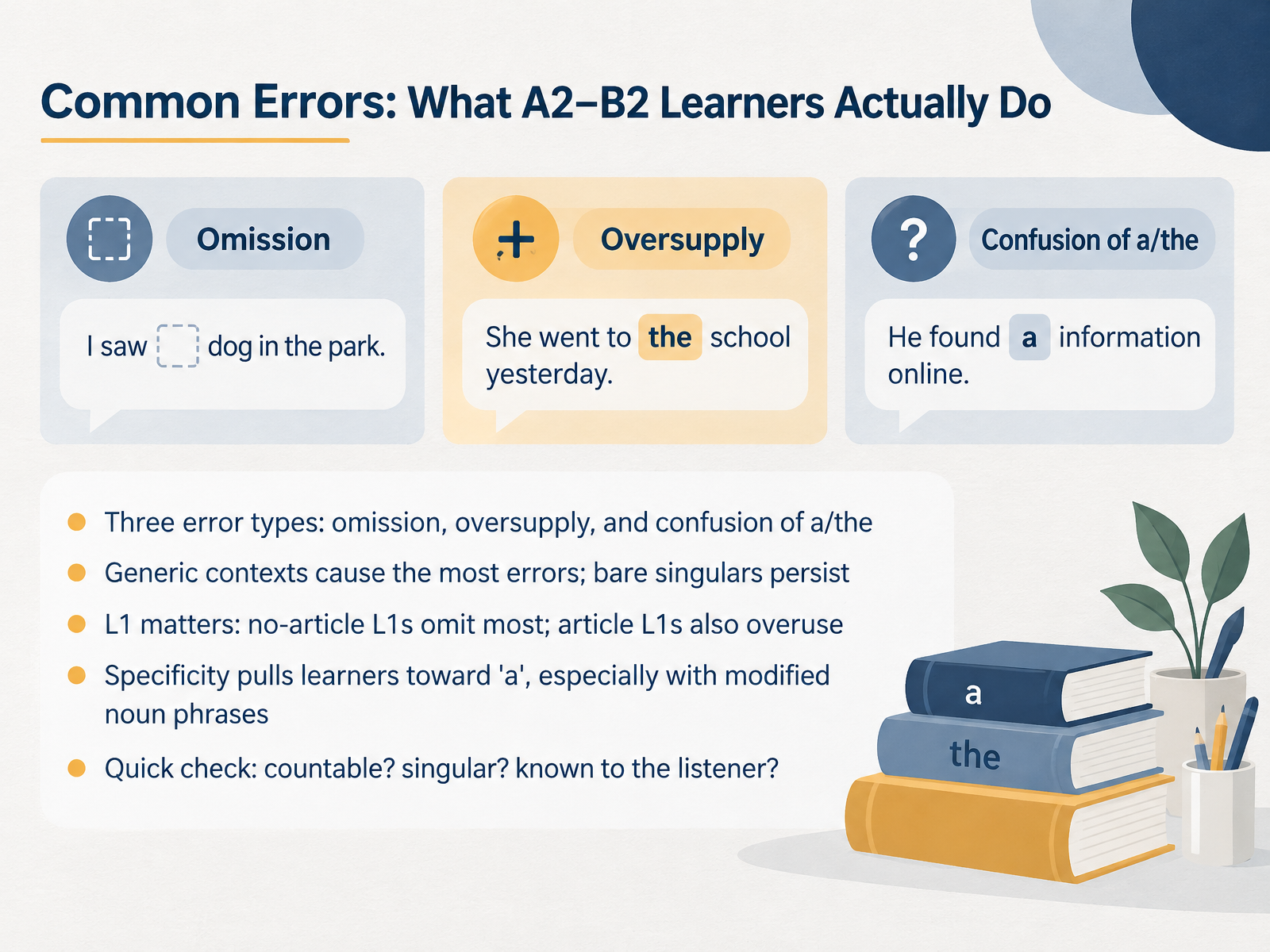
- 09Common Errors: What A2–B2 Learners Actually DoNow let's look at the errors learners actually make, so you can recognize them fast. There are three main types. First, omission: a missing article, as in, she sent email to client. Second, oversupply: an article that should not be there, as in, she gave me an advice. Third, confusion between a and the, as in, I read the book about leadership, when you mean any book.
Here's the pattern. Generic contexts cause the most errors, and bare singulars persist, like, computer changed the way we work.
Your learners' first language matters. If their L1 has no articles, they tend to omit. If it has articles, they can also overuse. And specificity pulls learners toward a, especially with modified noun phrases.
So run this quick check: Is it countable? Is it singular? Is it known to the listener? One takeaway: when you spot an error, name which of the three types it is. That keeps feedback specific and actionable.
Next, we'll walk through a diagnostic routine for the classroom.
 doi.orgjournal.aall.org.audoi.org+22 min
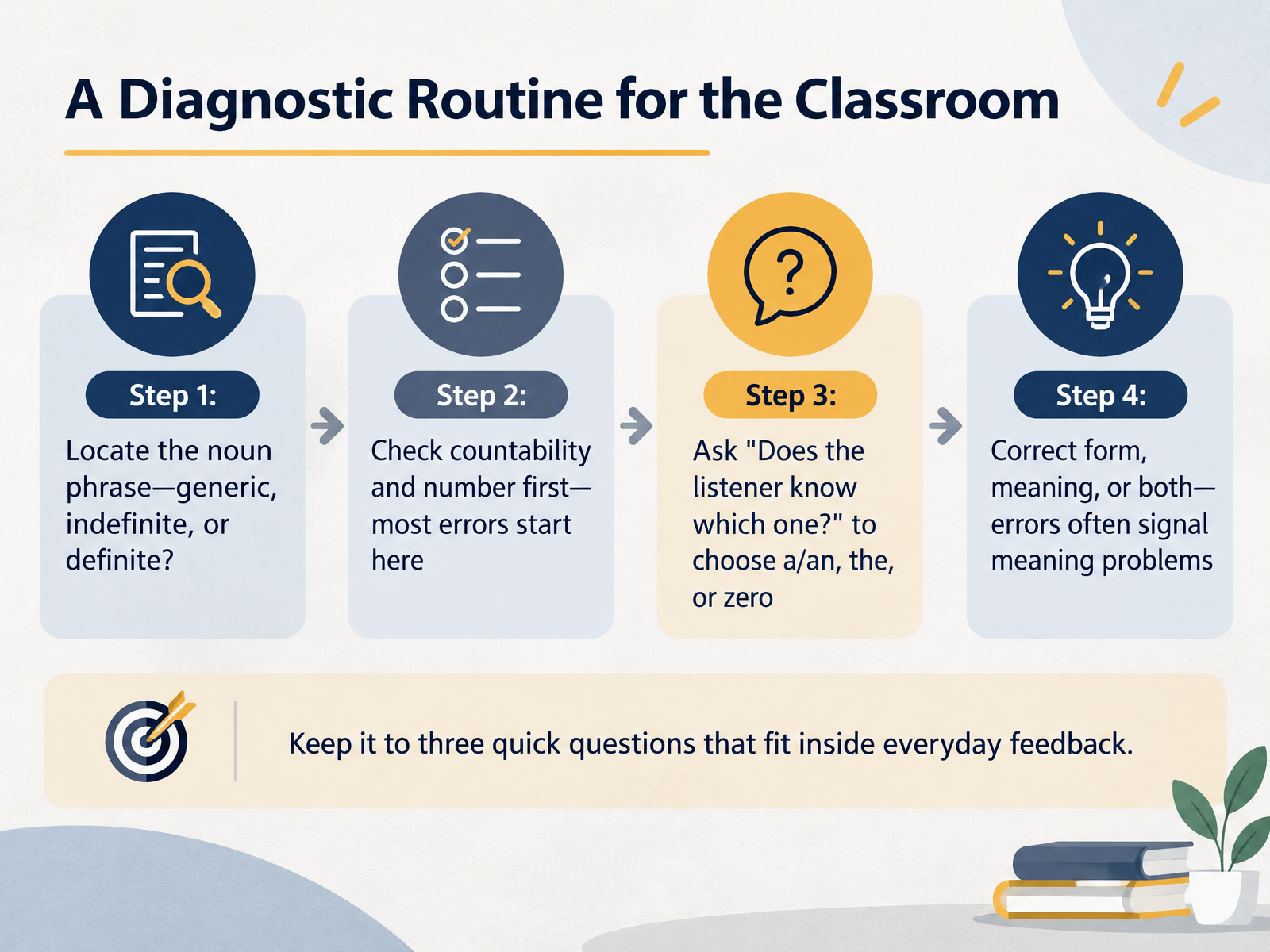
- 10A Diagnostic Routine for the ClassroomLet's turn all of this into a routine you can use in real feedback. First, locate the noun phrase. Is it generic, indefinite, or definite? Second, check countability and number. Most errors start here. For example, in 'I need advice,' advice is uncountable, so no article. Now compare: 'I need a suggestion.' Suggestion is countable and singular, so it takes a. Third, ask a simple question: does the listener know which one? If yes, use the. If no, use a or an. And if the noun is general or uncountable, use no article. Here's the exception: sometimes the form is wrong, but often the article mistake signals a meaning problem, like missing context about which thing you mean. So correct form and meaning together. Keep it to three quick questions that fit inside everyday feedback. That's your takeaway: noun phrase, countability and number, then listener knowledge. Next, we'll look at teaching sequence: from examples to rules and back.
 doi.orgjournal.aall.org.audoi.org+21 min
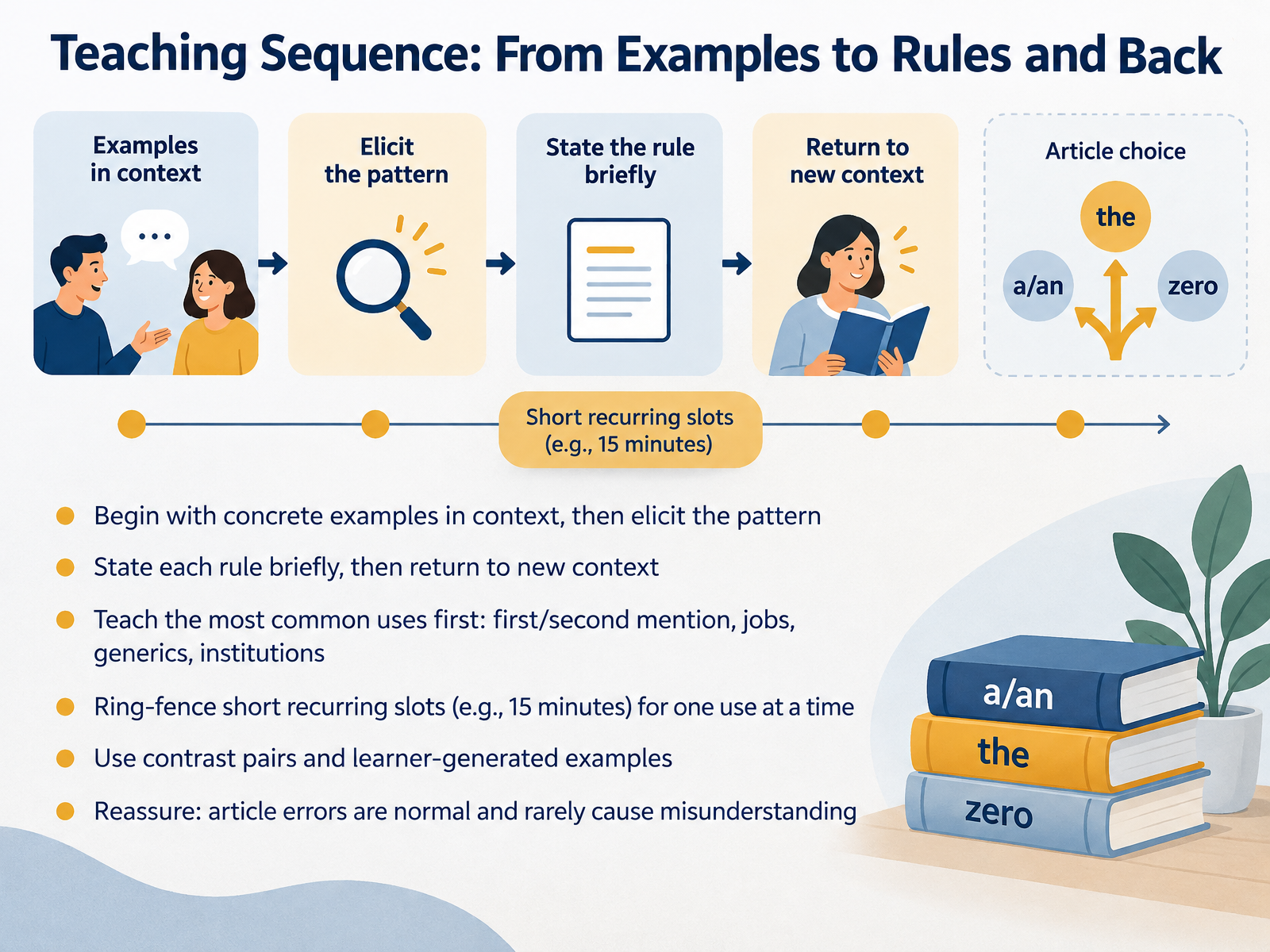
- 11Teaching Sequence: From Examples to Rules and BackNow let's talk about how to actually sequence the teaching. First, begin with concrete examples in context, then elicit the pattern from your learners. For a first and second mention, show a short description like: there is a house, and the house is old. Ask what changed. Now state each rule briefly, then return to a new context. Teach the most common uses first: first and second mention, jobs, generics, and institutions. Here's the exception that helps your planning: short, recurring slots work better than long sessions. Ring-fence fifteen minutes for one use at a time. Now compare, using contrast pairs and learner-generated examples: she is a teacher versus she went to university. And reassure your learners. Article errors are normal, and they rarely cause misunderstanding. So your takeaway is this: choose one common use, anchor it in examples, then give it fifteen focused minutes. Next, let's look at practice activities that reveal reasoning.
 research.ncl.ac.ukeric.ed.govdoi.org+22 min
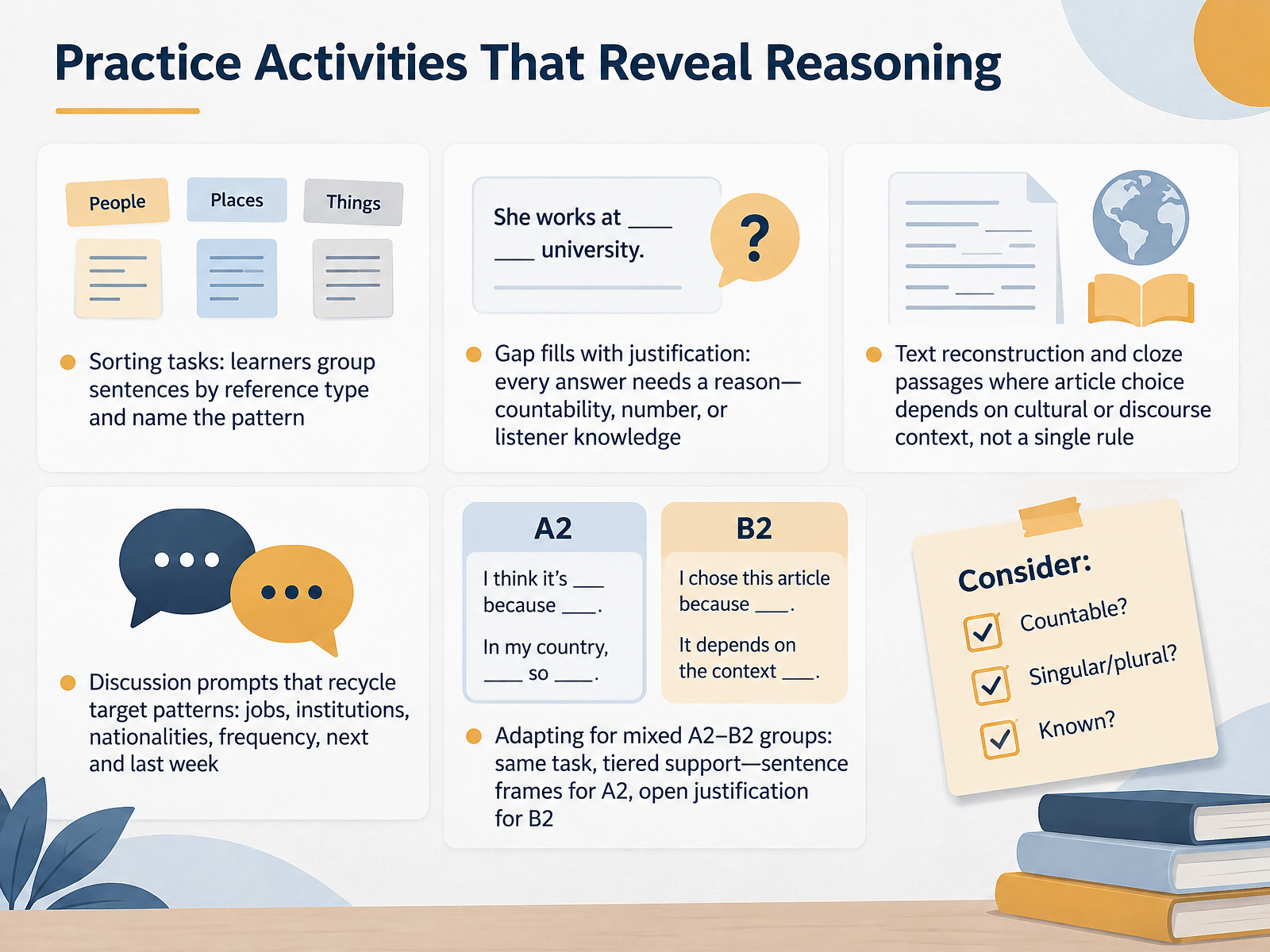
- 12Practice Activities That Reveal ReasoningNow let's look at practice activities that reveal reasoning, not just answers. First, sorting tasks. Learners group sentences by reference type, then name the pattern they see. This makes their thinking visible to you. Next, gap fills with justification. Every answer needs a reason: countability, number, or listener knowledge. Now compare text reconstruction and cloze passages. Here, article choice depends on cultural or discourse context, not a single rule. One learner may say the rainbow; another says a rainbow. Both can be defensible. Then use discussion prompts that recycle target patterns: jobs, institutions, nationalities, frequency, and phrases like next week and last week. Here's the exception for mixed A2 to B2 groups: keep the same task, but tier the support. Offer sentence frames for A2, and open justification for B2. Your takeaway: ask why after every answer, so practice shows you the reasoning. Next, we'll move on to designing materials and assessment items.
 research.ncl.ac.uklearnenglish.britishcouncil.orgjournal.aall.org.au2 min
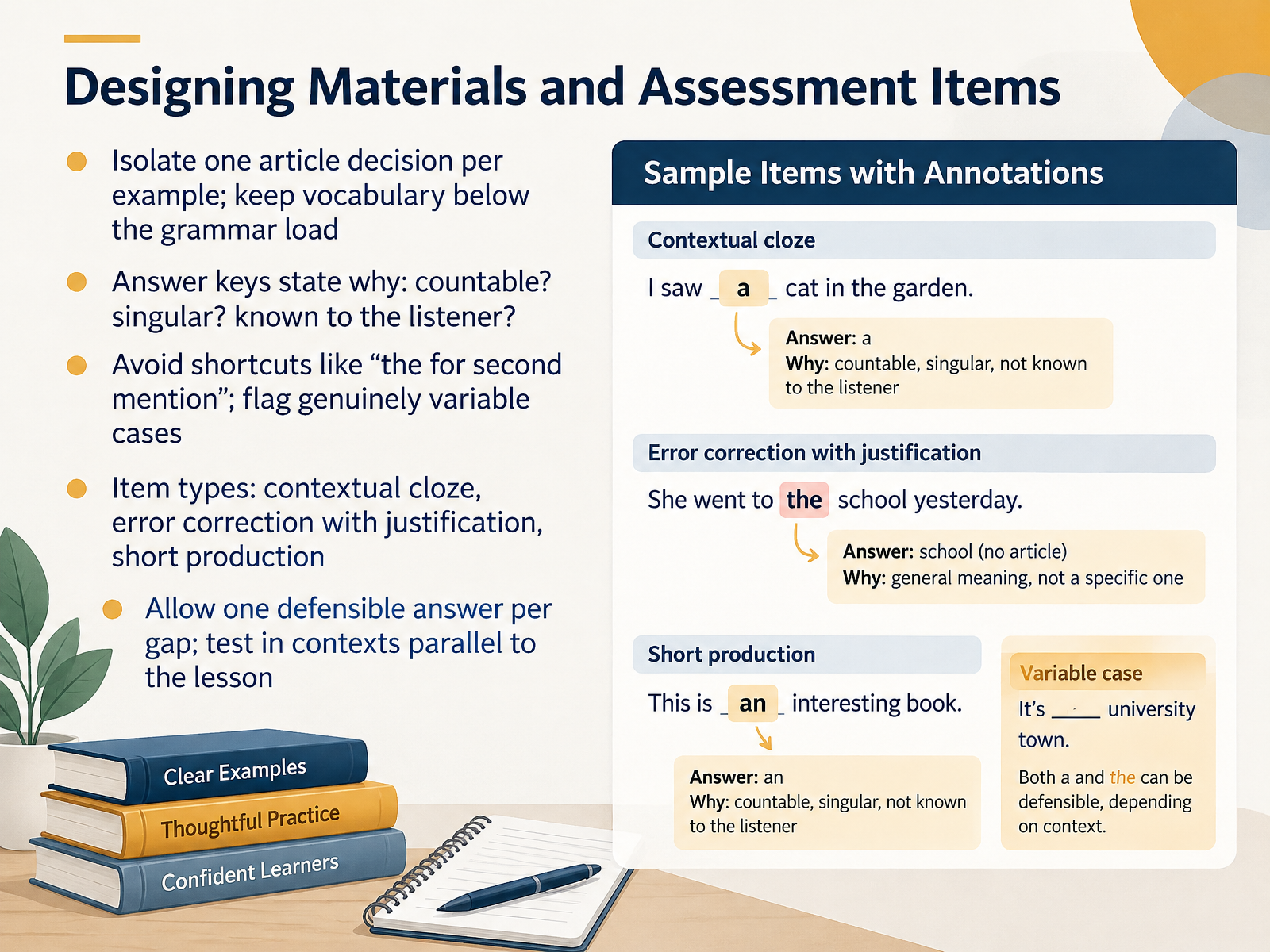
- 13Designing Materials and Assessment ItemsNow let's turn to designing your own materials and assessment items. First, isolate one article decision per example, and keep the vocabulary below the grammar load. For instance, use a simple word like "key," so the only challenge is choosing a, an, the, or no article. Next, answer keys should state why: is the noun countable? Is it singular? Is it known to the listener? Now compare these shortcuts. Avoid loose rules like "use the for second mention." That rule fails often. Instead, flag genuinely variable cases and explain them. Here's the exception to watch for: sometimes more than one answer is defensible. So allow one defensible answer per gap, and test in contexts parallel to your lesson. Use item types like contextual cloze, error correction with justification, and short production. Your takeaway for this slide: every item should have a clear reason behind it, and your answer key should show that reason. Next, we'll move into review, reflection, and action plan.
 eric.ed.govdoi.orgcup.columbia.edu+22 min
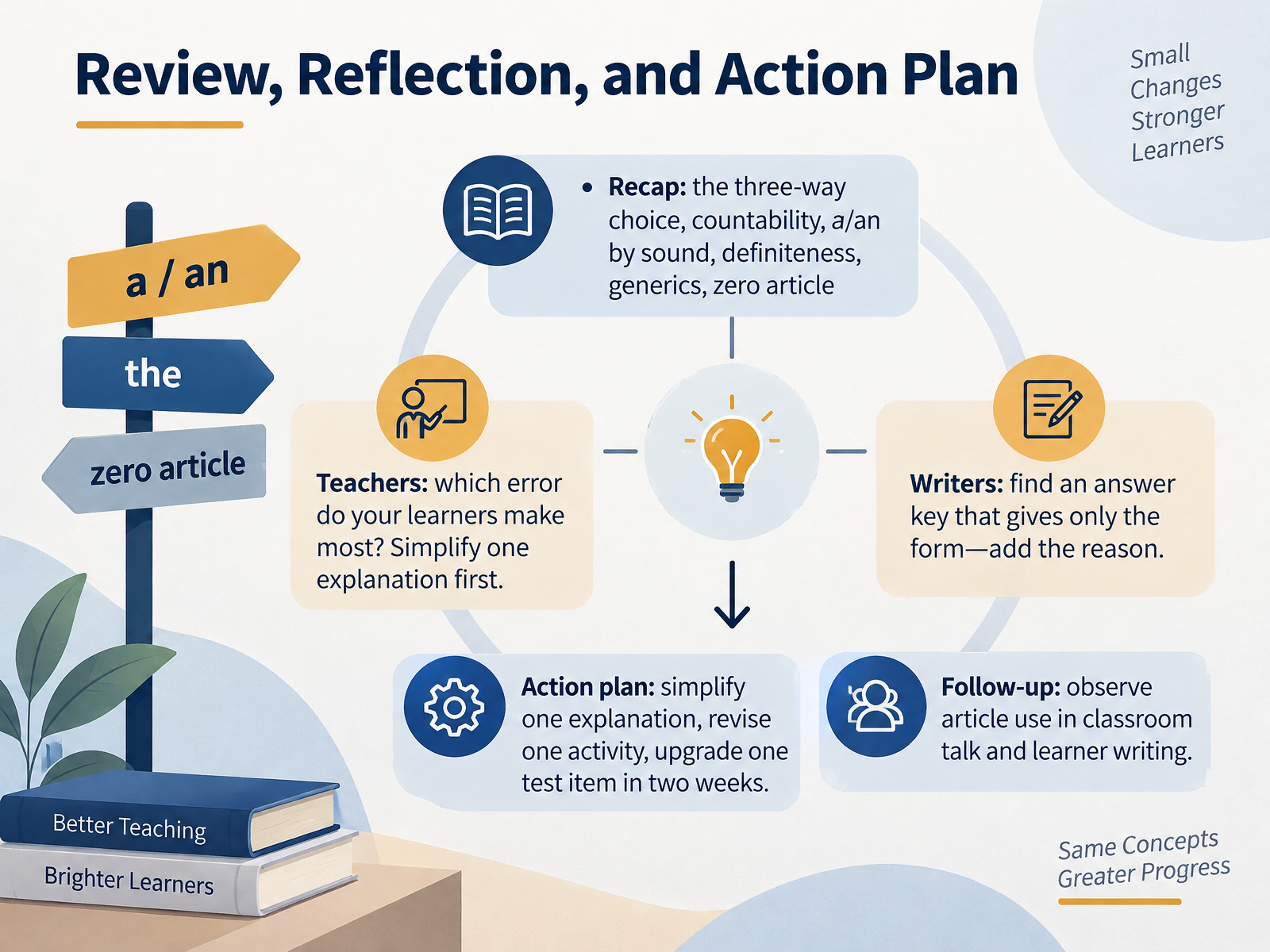
- 14Review, Reflection, and Action PlanLet's bring everything together. You've worked through the three-way choice: a or an, the, or no article. You've checked countability, the sound rule for a and an, definiteness, generics, and the zero article. That's a lot, and it's fine if some of it still feels slippery. So here's the plan. Teachers, notice which error your learners make most, then simplify one explanation first. Instead of two pages on definiteness, try one clear question they can ask themselves. Writers, find an answer key that gives only the form, and add the reason: 'the, because the reader already knows which one.' Now for your two-week action plan. Simplify one explanation. Revise one activity so it tests the reason, not just the form. And upgrade one test item. Finally, follow up by observing article use in classroom talk and in learner writing. Noticing is where the change starts. Thank you for staying with this course, and choose your first small step today. You know more than you think.
 eric.ed.govdoi.orgcup.columbia.edu+22 min
Take the deck with you
Download this course as a file — free, no sign-up needed.
- PDF handoutEvery slide page, ready to print or share.15 pages · 3.8 MBDownload
- Narrated PowerPointThe deck that presents itself — every slide carries the digital human's narration video.15 pages · 13.5 MBDownload
- PowerPoint slidesThe full deck as a .pptx — open it in PowerPoint, Keynote, or Google Slides.15 pages · 3.7 MBDownload
Free to use in your own training — please keep the PersonWise credit page at the end.
Have your own deck? Turn it into a course
Sources consulted
Web sources consulted while building this course.
- The underlying reasons for the difficulties in use of the English articles for EFL learners: an analysis based on the learners’ experiences — doi.org
- Countability and confusion: Helping students with English as an additional language to understand the English article system — journal.aall.org.au
- Difficulties in The Acquisition and Use of English Articles among Adult Pashto Learners — doi.org
- Definite and indefinite article accuracy in learner English: A multifactorial analysis | Studies in Second Language Acquisition | Cambridge Core — cambridge.org
- Most of ESL students have trouble with the articles — files.eric.ed.gov
- Using metalinguistic explanations to help advanced ESL/EFL learners overcome their problems with the use of English articles and reference representation — doi.org
- Main Page - Articles (AWE) - level 3 — sana.aalto.fi
- The definite article, accessibility, and the construction of discourse referents* — terpconnect.umd.edu
- A Closer Look at the English Article System: Internal and External Sources of Difficulty Revisited — doi.org
- (PDF) Article Omission: How Are Referents Tracked in L2 Discourse? — researchgate.net
- ERIC - EJ547527 - The English Article System: Acquisition, Function, and Pedagogy., System, 1997 — eric.ed.gov
- A System for Understanding and Selecting English‐Language Articles for Advanced ESL Writers — doi.org
- Articles in English as a Second Language | Columbia University Press — cup.columbia.edu
- APPROACHES AND ACTIVITIES FOR ENGLISH ARTICLE USE — research.ncl.ac.uk
- The indefinite article: 'a' and 'an' | LearnEnglish — learnenglish.britishcouncil.org
- a, an – Writing Tips Plus – Writing Tools – Resources of the Language Portal of Canada – Canada.ca — our-languages.canada.ca
- Articles: A versus An - Purdue OWL — owl.purdue.edu
- Articles | Robert Gillespie Academic Skills Centre — utm.utoronto.ca
- Learning English | BBC World Service — bbc.co.uk
- The definite article: 'the' | LearnEnglish — learnenglish.britishcouncil.org