Digital Marketing Fundamentals
Begin
14 pages · ~28 min
Digital Marketing Fundamentals
A concise overview of digital marketing fundamentals, covering core concepts, strategic purpose, and real-world examples for beginners seeking a practical foundation.
What you’ll learn
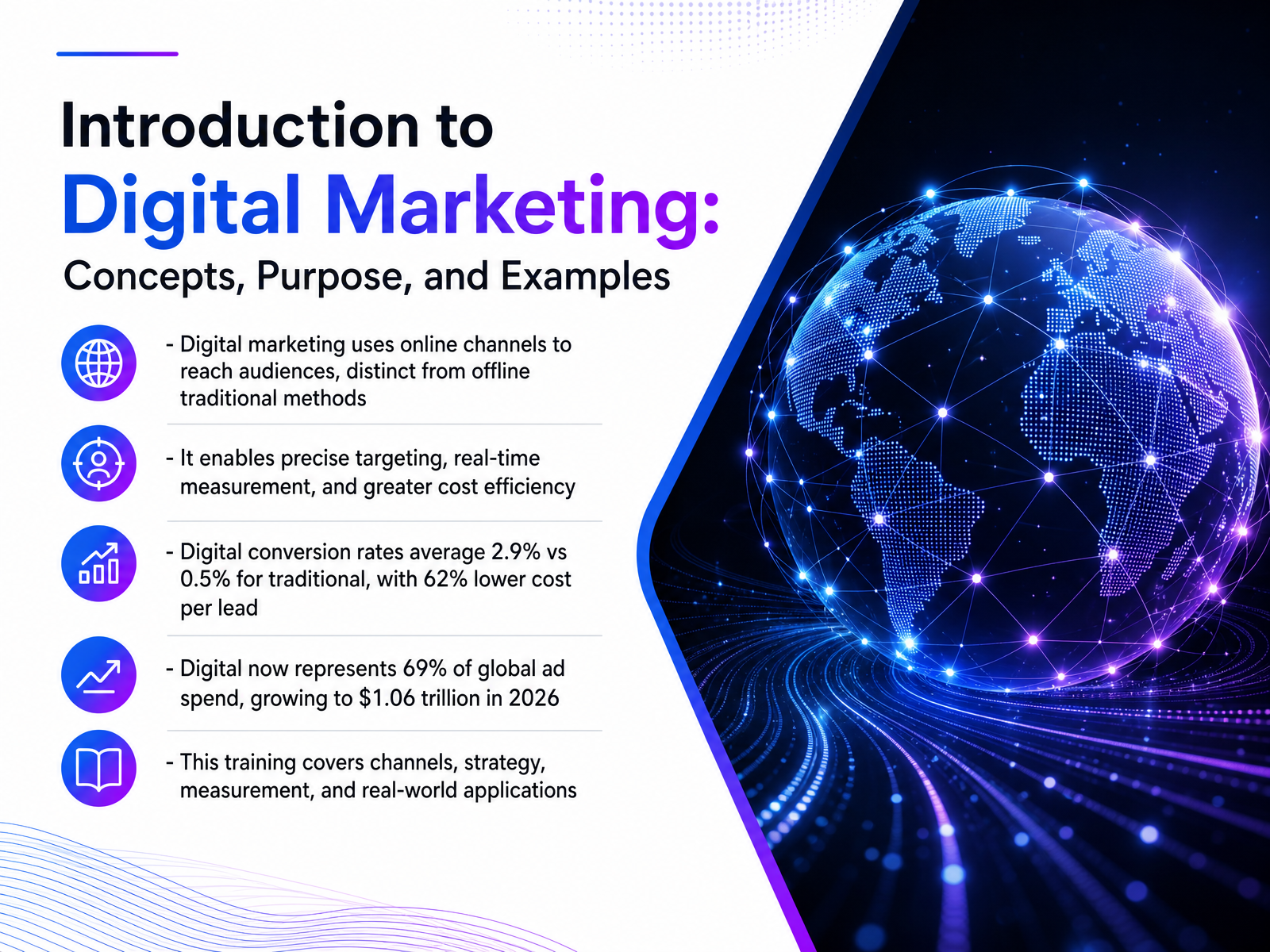
- 01Introduction to Digital Marketing: Concepts, Purpose, and ExamplesHello and welcome. I’m really glad you’re here to explore digital marketing together. Think of this session as your friendly guide to how online channels work, why they’re so effective, and how you can use them in your own projects or business. Digital marketing simply means using platforms like search engines, social media, email, and websites to connect with people. Unlike traditional methods like print or billboards, digital gives you the ability to target exactly who you want, measure every interaction in real time, and often spend your budget far more wisely. For example, the average digital conversion rate is nearly three percent, compared to just point five percent for traditional media. And the cost per lead is over sixty percent lower on average. That’s one reason digital now accounts for sixty nine percent of global ad spending. Throughout this course we’ll walk through the main channels, smart strategies, practical measurement tips, and real-world examples you can start applying right away. Up next, we’ll unpack the digital marketing ecosystem: what you own, what you earn, and what you pay for.blog.hubspot.comsemrush.commonday.com+22 min
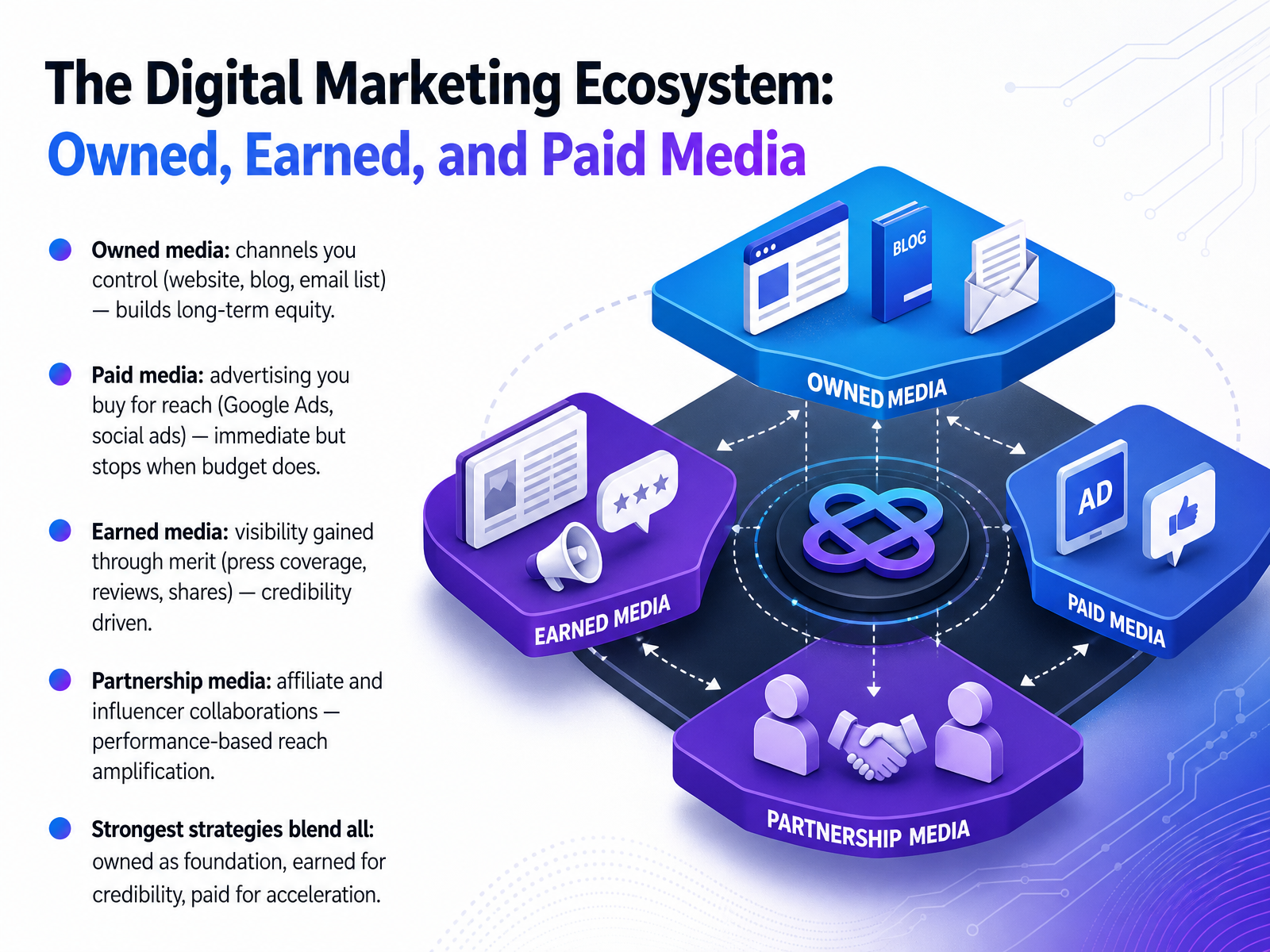
- 02The Digital Marketing Ecosystem: Owned, Earned, and Paid MediaLet's look at the full ecosystem of digital marketing channels—also called the owned, earned, paid, and partnership model. Think of these as the different ways your message reaches people. Owned media is everything you fully control: your website, your blog, your email list. No one can turn it off—but you have to invest time to build it. Paid media is advertising you buy for immediate reach. That's your Google Ads, your social ads. The reach stops when the budget stops. Earned media is visibility you don't pay for directly—press coverage, customer reviews, mentions, shares. It's credibility driven because someone else is vouching for you. And partnership media—like affiliate and influencer collaborations—amplifies your reach on a performance basis. The strongest strategies blend all four. Think of owned as your foundation, earned as your trust builder, and paid as your accelerator. Up next, let's walk through the core digital marketing channels you'll use to put this into practice.
 neelnetworks.comsweetfishmedia.comgoonlinenow.co+22 min
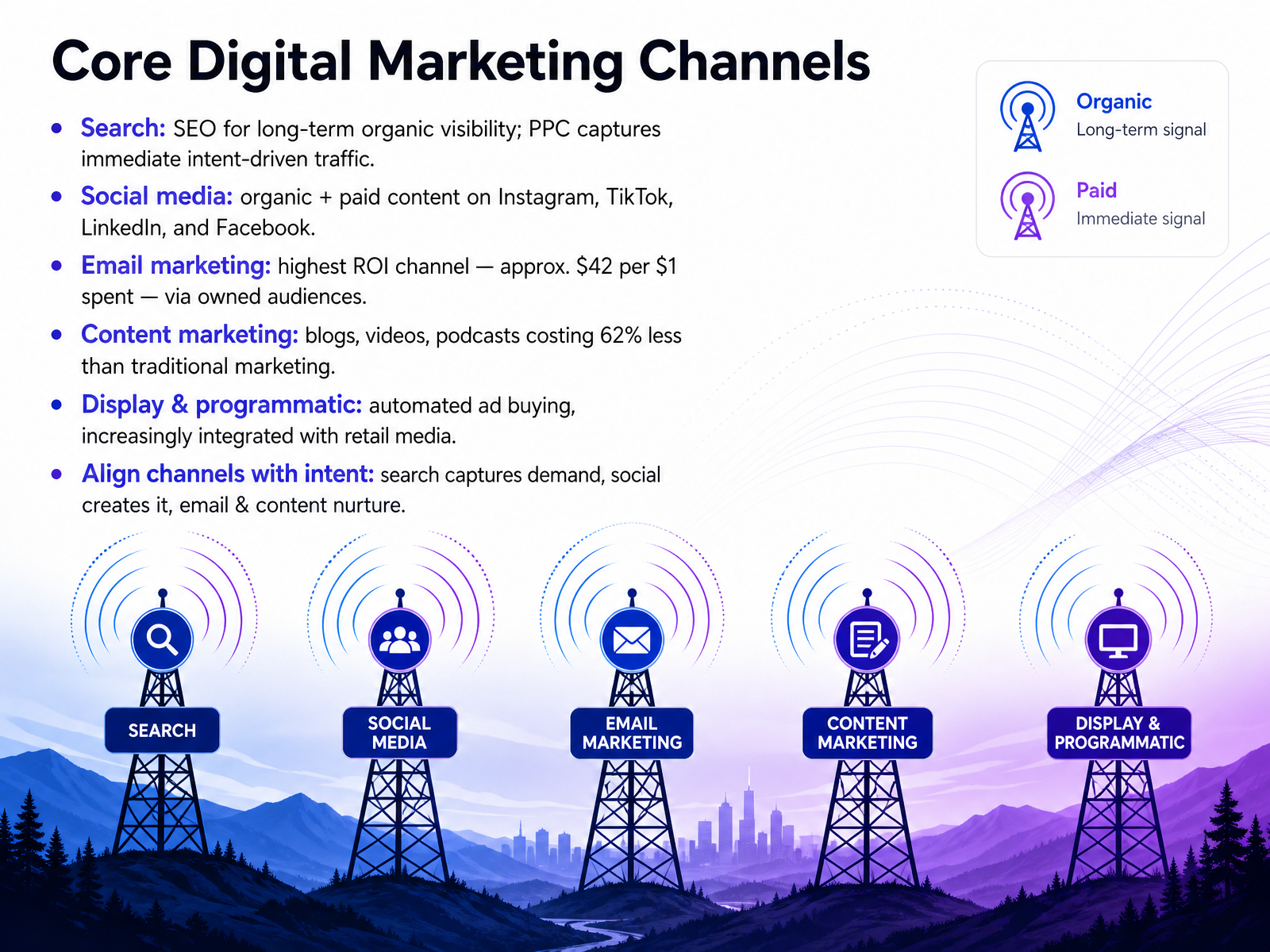
 - 03Core Digital Marketing ChannelsLet's look at the core channels you have at your disposal. Think of these as the essential tools in your marketing toolkit. First, there's search. This includes SEO, which builds long-term organic visibility, and PPC ads that capture immediate, intent-driven traffic. Next is social media, where you'll use both organic posts and paid ads on platforms like Instagram, TikTok, LinkedIn, and Facebook. Then we have email, a real powerhouse. It consistently delivers the highest return, roughly forty-two dollars back for every single dollar spent, by connecting directly with your owned audience. Content marketing is another key channel. We're talking about blogs, videos, and podcasts. The beauty here is it costs about sixty-two percent less than traditional marketing. Finally, there's display and programmatic advertising, which uses automated ad buying to place your message across the web. The real magic isn't just knowing the channels, but knowing how they work together. A great rule of thumb is to align channels with intent. Search captures existing demand. Social media creates new demand. And email and content? They nurture that interest into a relationship. Now, with those foundations in place, it’s time to look ahead at emerging channels and trends shaping 2026.
 blog.hubspot.comsemrush.commonday.com+22 min
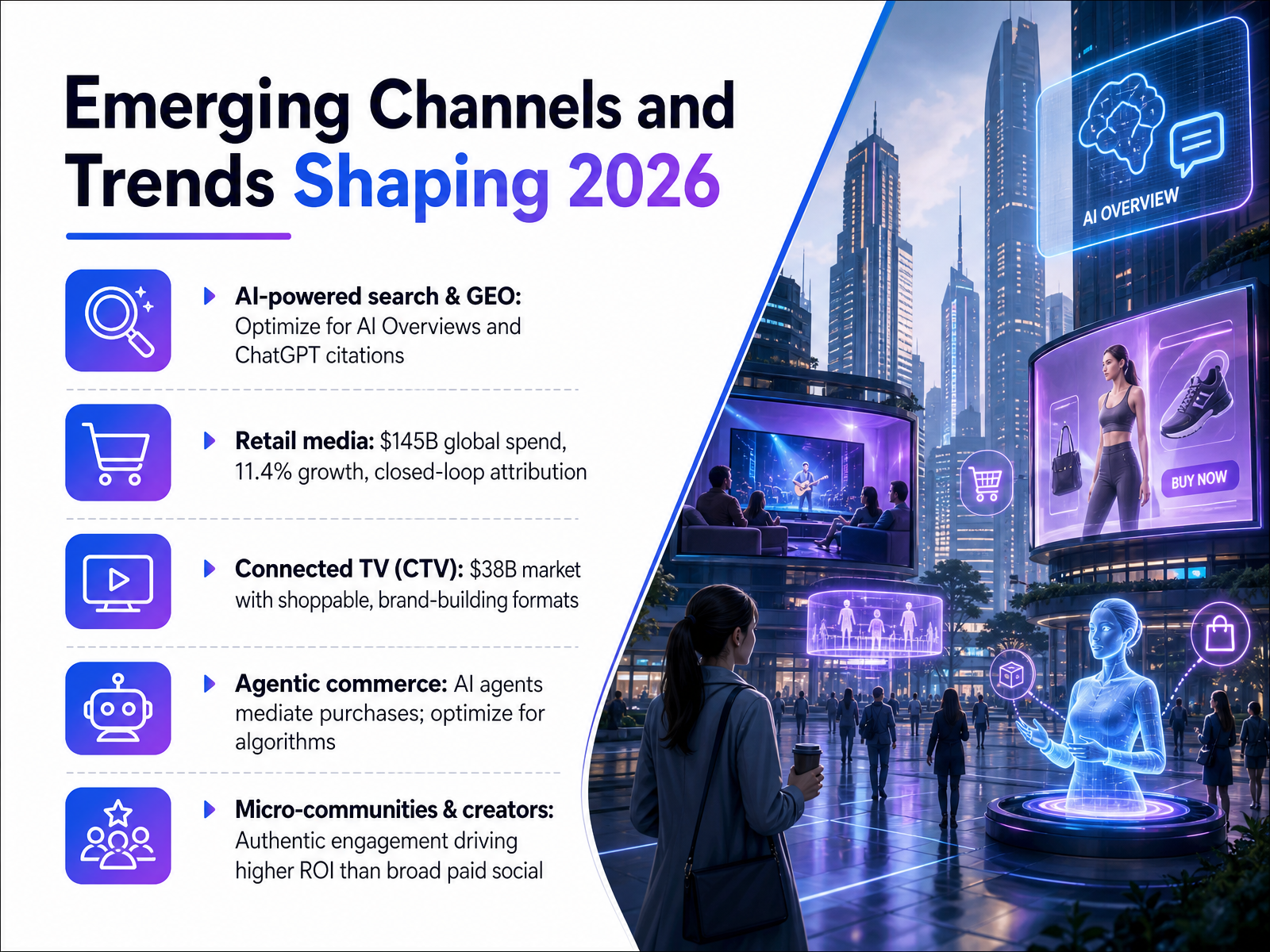
 - 04Emerging Channels and Trends Shaping 2026Now, let's look at the channels and trends that are really defining this year. First, there's a big shift happening in search. With AI Overviews and chatbots like ChatGPT, people are finding answers without ever clicking a website. So, a new practice called generative engine optimization, or GEO, is becoming essential. It's about making sure your brand's information is structured so AI models cite you as the source. Think of it as SEO for a world where the algorithm reads for the customer. Next, retail media is exploding. We're talking about a 145-billion-dollar global channel that lets brands like a local coffee company advertise directly on a supermarket's app, right at the point of sale. The magic here is closed-loop attribution, meaning you can see exactly which ad led to which sale. We're also seeing connected TV, or CTV, mature into a 38-billion-dollar market. It's not just for awareness anymore. Imagine watching a streaming show and buying the main character's sweater directly from your remote. That's the power of shoppable, brand-building formats. A newer concept you'll hear is agentic commerce. This is where AI agents start making purchase decisions for people. As a marketer, you'll need to optimize your product content so algorithms prefer your brand, not just human shoppers. Finally, the biggest return on investment is often coming from a smaller place: micro-communities. A brand collaborating with a niche creator in a private group can build authentic engagement and trust that broad, expensive social ads simply can't match. These lean, genuine connections are driving real results. Now that we've seen where the market is moving, let's connect these trends directly to the customer experience in our next slide, 'The Customer Journey: From Funnel to Flywheel.'
 emarketer.comdentsu.comfact.mr+22 min
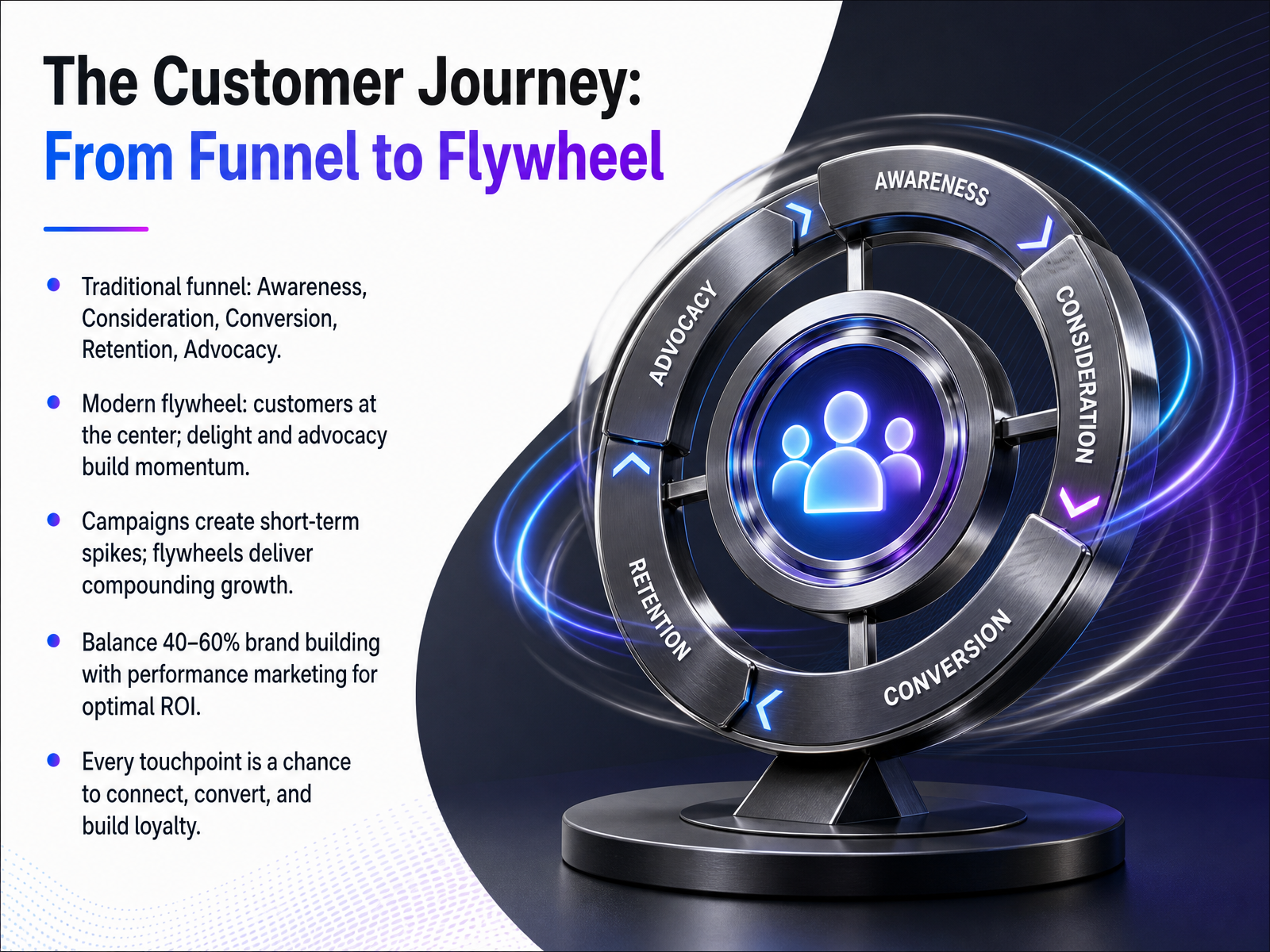
 - 05The Customer Journey: From Funnel to FlywheelLet’s look more closely at the path a customer travels with your brand. You have probably seen the classic marketing funnel. It starts with Awareness, then moves to Consideration, Conversion, Retention, and finally, Advocacy. Think of it like a local coffee shop you discover online, visit once, and eventually recommend to a friend. That is a linear journey. But modern marketing has evolved into something more dynamic, a flywheel. Here, the customer sits at the very center. Every time you delight someone and turn them into an advocate, they add energy that spins the wheel and builds growth that compounds over time. Campaigns are great for creating short-term spikes, like a launch week for a new product. The flywheel, however, is what keeps your business growing between those spikes. A key insight for 2026 is balance. The most effective teams invest about 40 to 60 percent of their budget in brand building and the rest in performance marketing to get the best return. That means every single touchpoint, whether it is a support email or a social ad, is a chance to connect, convert, and build lasting loyalty. Now that you see how the customer journey has shifted, let's map specific tactics to each stage of the funnel.
 blog.hubspot.comsemrush.commonday.com+22 min
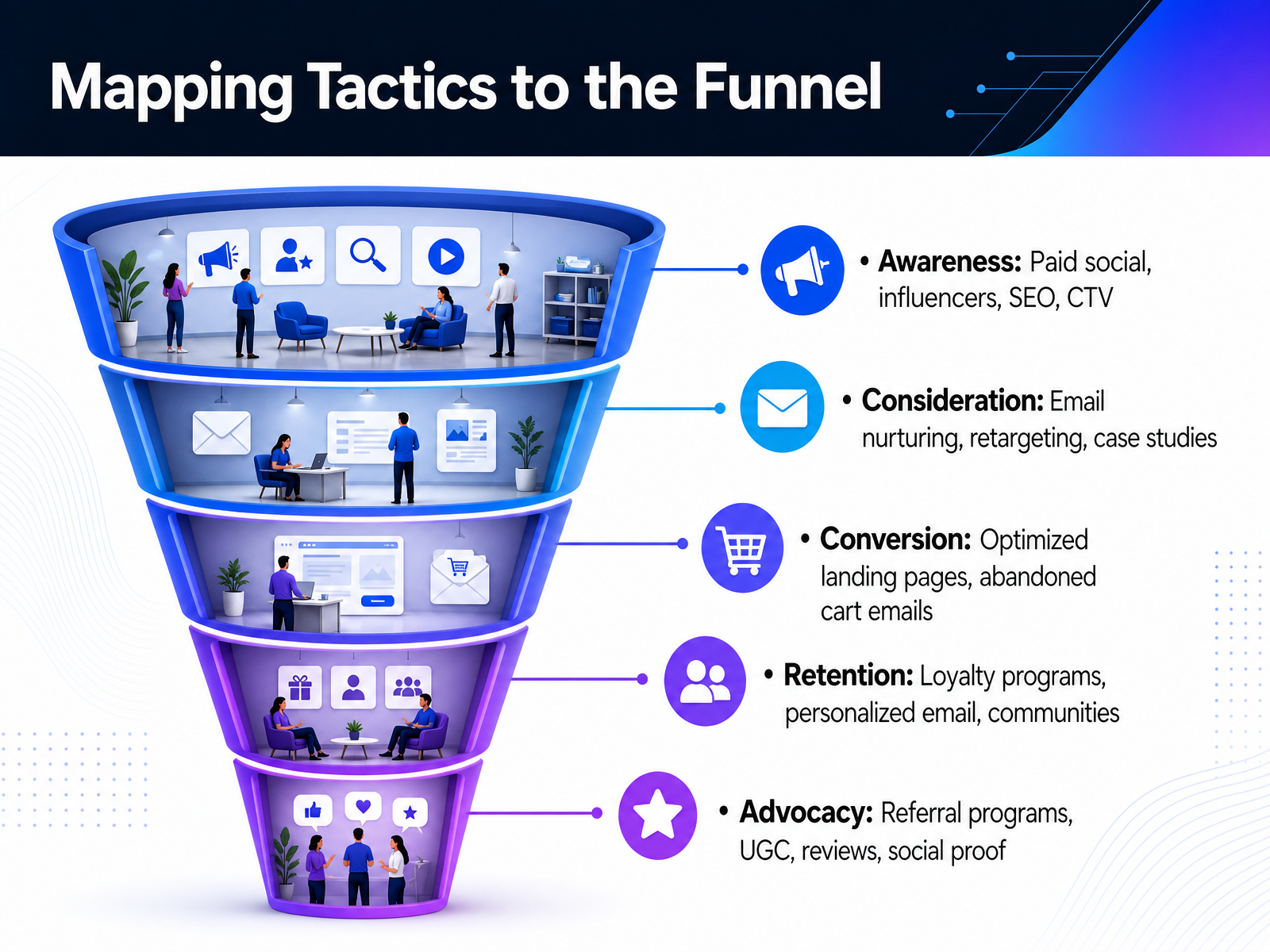
 - 06Mapping Tactics to the FunnelNow let's make all those tactics more practical by mapping them to the stages of the funnel we just explored. Think of the funnel as a journey your customer takes, from never hearing of you to becoming your biggest fan. At the top is awareness. Here, you help new people discover you through paid social ads, working with influencers, showing up in search results with SEO, and connected TV streaming ads. Imagine a local coffee shop running a fun, short video on Instagram to attract new followers—that's awareness. Moving down to consideration, potential customers are evaluating if you can solve their problem. Tactics here include email nurturing, retargeting ads that follow them across the web, and case studies. The coffee shop might send an email series on bean sourcing and roasting, building trust before pushing a sale. Then comes conversion, the moment of decision. This is where optimized landing pages and abandoned cart emails do the heavy lifting. For example, a clean, fast online store page that makes checking out simple, with a friendly reminder email if a visitor leaves items behind. After purchase, retention keeps customers coming back through loyalty programs, personalized emails, and exclusive communities. And finally, advocacy. This is the peak of the funnel. You turn happy customers into active promoters with referral programs, user-generated content, online reviews, and social proof. This funnel view connects everything—awareness, consideration, conversion, retention, and advocacy. Up next, we'll look at the content and messaging that connects with people at every stage.
 blog.hubspot.comsemrush.commonday.com+22 min
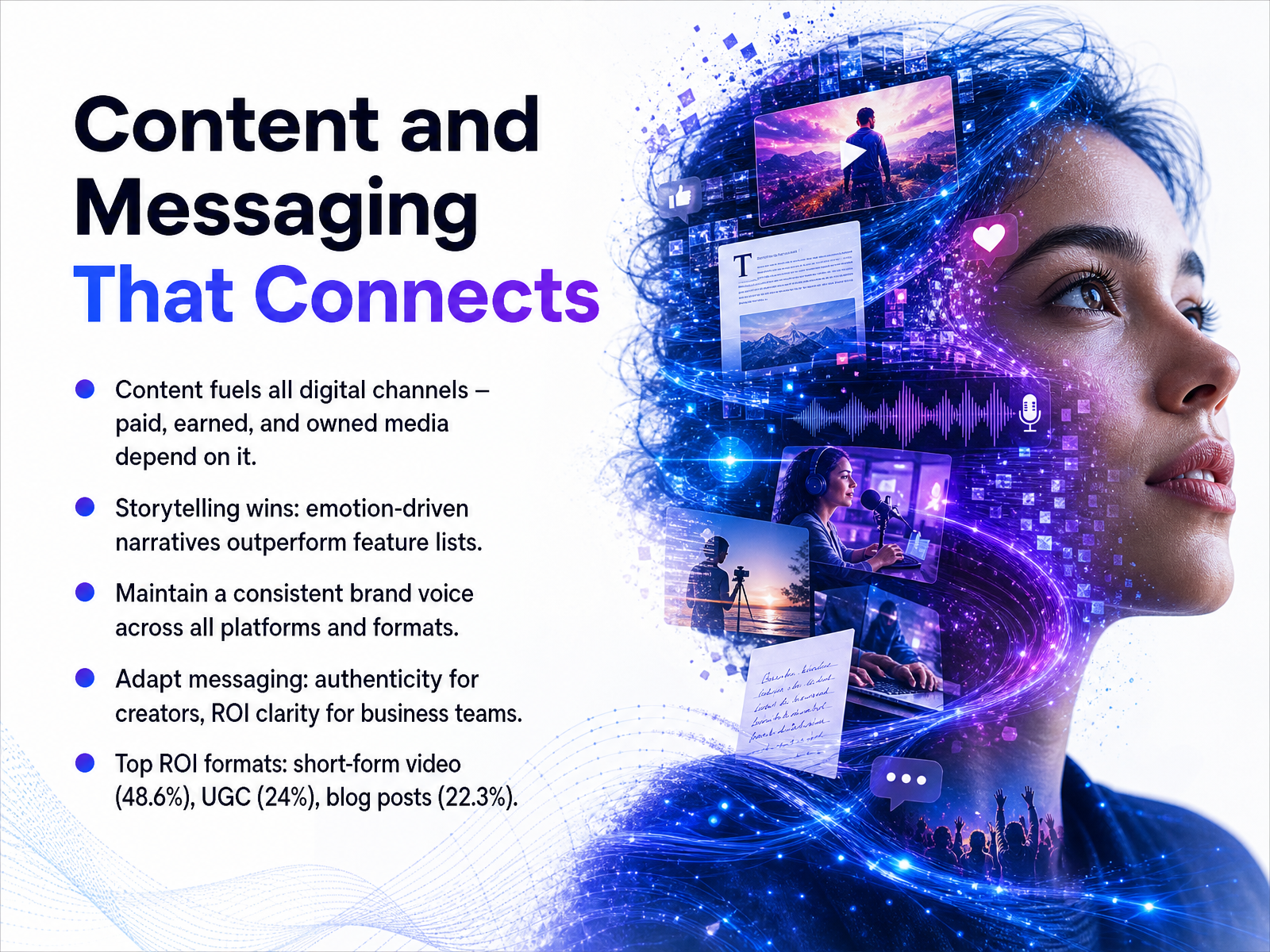
 - 07Content and Messaging That ConnectsNow, let's talk about the heart of it all—the content and messaging that actually connects. Think of content as the fuel for every digital channel. Whether it’s a paid ad, a blog post getting shared around, or a review your brand earns, it all runs on content. But here’s the secret: storytelling wins. People don’t remember a list of features; they remember how a story made them feel. So, whether you’re writing a quick social caption or a full case study, lead with emotion. You also need a consistent brand voice. Your audience should recognize your tone instantly, whether they see your TikTok or your email newsletter. That doesn’t mean the message stays the same for everyone. You’ll want to adapt it. For creators, lead with authenticity and creative freedom. For a business team, lead with clear ROI—show them the data that proves it works. And if you’re wondering where to invest your creative energy, the data points us in one direction. Short-form video is the top ROI format, cited by over 48 percent of marketers. Next comes user-generated content, and then traditional blog posts. The takeaway? Make your content flexible, make it genuine, and always adapt it for the person on the other side. Next, we’ll turn that insight into action by setting S M A R T marketing goals.
 gitnux.orgloopexdigital.comjournal.access-bg.org+22 min
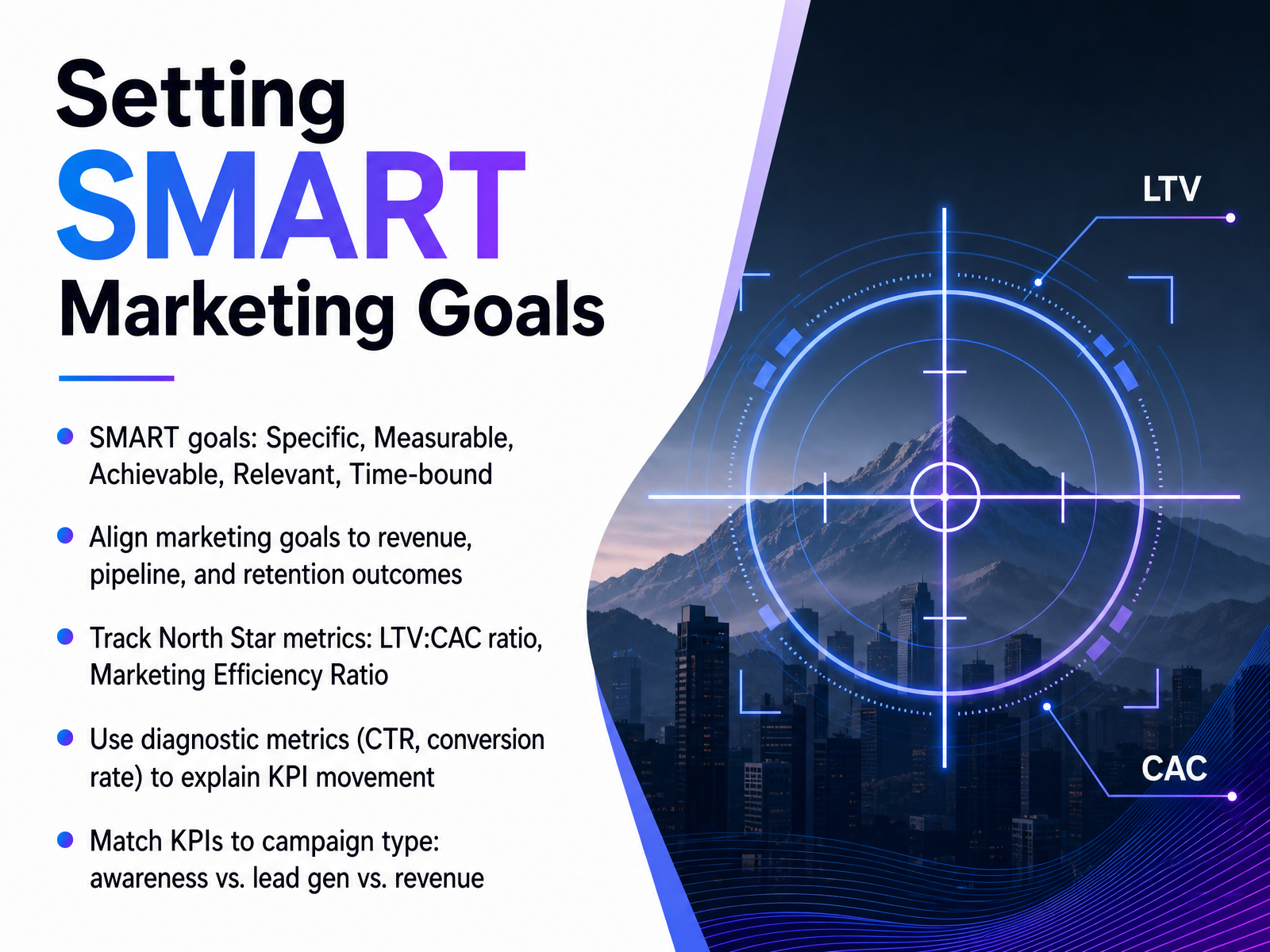
 - 08Setting SMART Marketing GoalsLet's talk about turning broad ideas into real, trackable plans. You do that with SMART goals. SMART stands for Specific, Measurable, Achievable, Relevant, and Time-bound. A specific goal is narrow and clear, not vague. Measurable means you can track it with a number. Achievable means it's realistic with your resources. Relevant ties it directly to a business outcome, and time-bound gives it a deadline. For example, instead of saying 'get more leads,' a SMART goal would be 'increase marketing qualified leads by twenty percent this quarter.' Now, those goals need to connect to what the business actually cares about: revenue, a healthy pipeline of future sales, and keeping existing customers. To stay on track, you watch what we call North Star metrics. A powerful one is the LTV to CAC ratio. That's your customer lifetime value compared to your customer acquisition cost. You want that ratio to be at least three to one. Another is the Marketing Efficiency Ratio, which simply compares total revenue to total marketing spend. When one of those big numbers moves, you turn to diagnostic metrics like click-through rate and conversion rate to understand why. Speaking of understanding, up next we'll look at the essential digital marketing KPIs you'll use every day.
 blog.hubspot.comsemrush.commonday.com+22 min
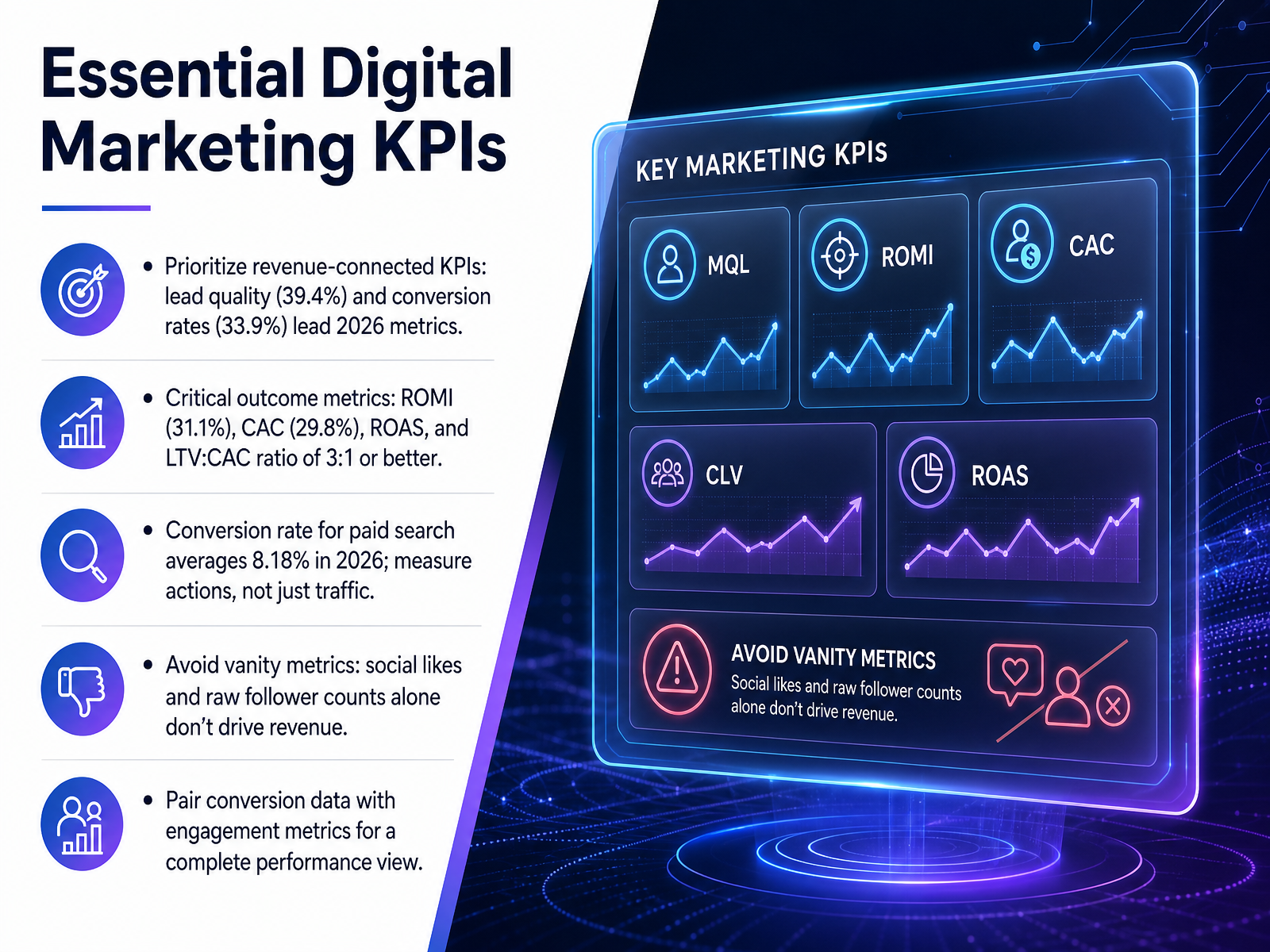
 - 09Essential Digital Marketing KPIsLet's talk numbers, but not just any numbers. I mean the metrics that actually connect your work to revenue. Research tells us the big ones for 2026 are lead quality and conversion rates. Think of it this way: if you run a small online bakery, getting a hundred random clicks is nice. But getting one inquiry from a bride planning a wedding? That's a high-quality lead, and that's what we measure. We also look at Return on Marketing Investment, or ROMI, and Customer Acquisition Cost, which we call CAC. A healthy target is to earn three dollars for every dollar you spend to get a customer. Also, move away from vanity metrics like raw likes. Measure actions instead. For paid search, a strong conversion rate to aim for is around eight point one eight percent. When you pair that conversion data with your engagement metrics, you get the full picture of what's really working. Up next, we'll pull all this data together and talk about analytics for making data-driven decisions.
 blog.hubspot.comsemrush.commonday.com+21 min
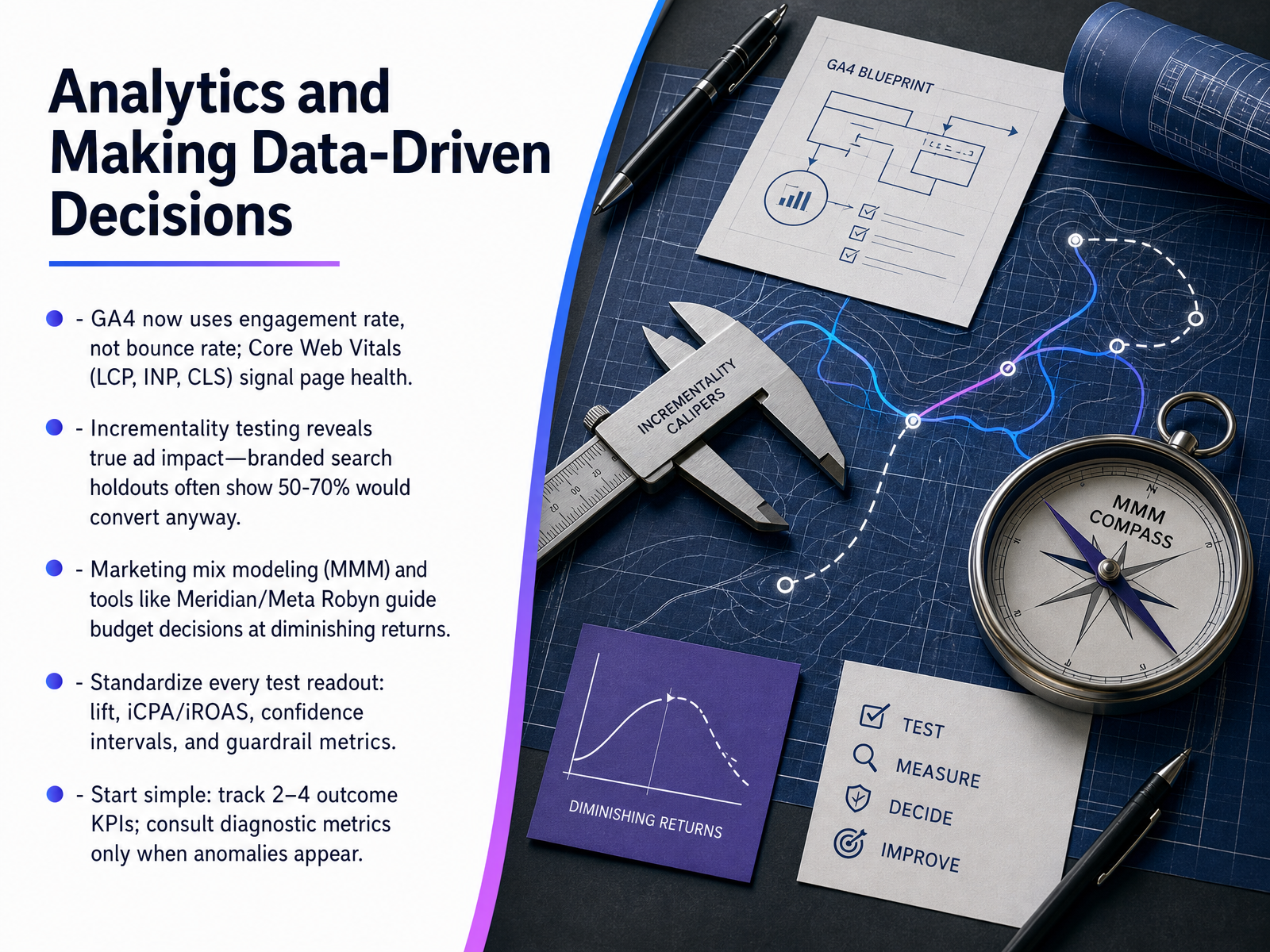
 - 10Analytics and Making Data-Driven DecisionsNow let’s talk about how we actually measure success and make smart, data-driven decisions. If you remember one thing from this slide, keep it focused: track only two to four outcome KPIs that tie directly to revenue. Think conversion rate, cost per acquisition, or return on ad spend. Everything else—like click-through rate or engagement time—is a diagnostic. You consult those when you see an anomaly in your main numbers. In Google Analytics 4, we look at engagement rate now, not the old bounce rate. And don’t ignore page health: metrics like Largest Contentful Paint and Interaction to Next Paint have a real impact on conversion. One of the most eye-opening tests you can run is an incrementality test, especially on branded search. You might discover that fifty to seventy percent of those clicks would have converted anyway. For higher-level budget decisions, teams are using marketing mix modeling with tools like Meta’s Robyn. Just remember to standardize every test readout: include the lift, the incremental cost per acquisition or return, the confidence intervals, and your guardrail metrics. This keeps your experiments honest and comparable. Up next, we’ll walk through a practical example in our first walkthrough on planning a campaign.
 blog.hubspot.comsemrush.commonday.com+22 min
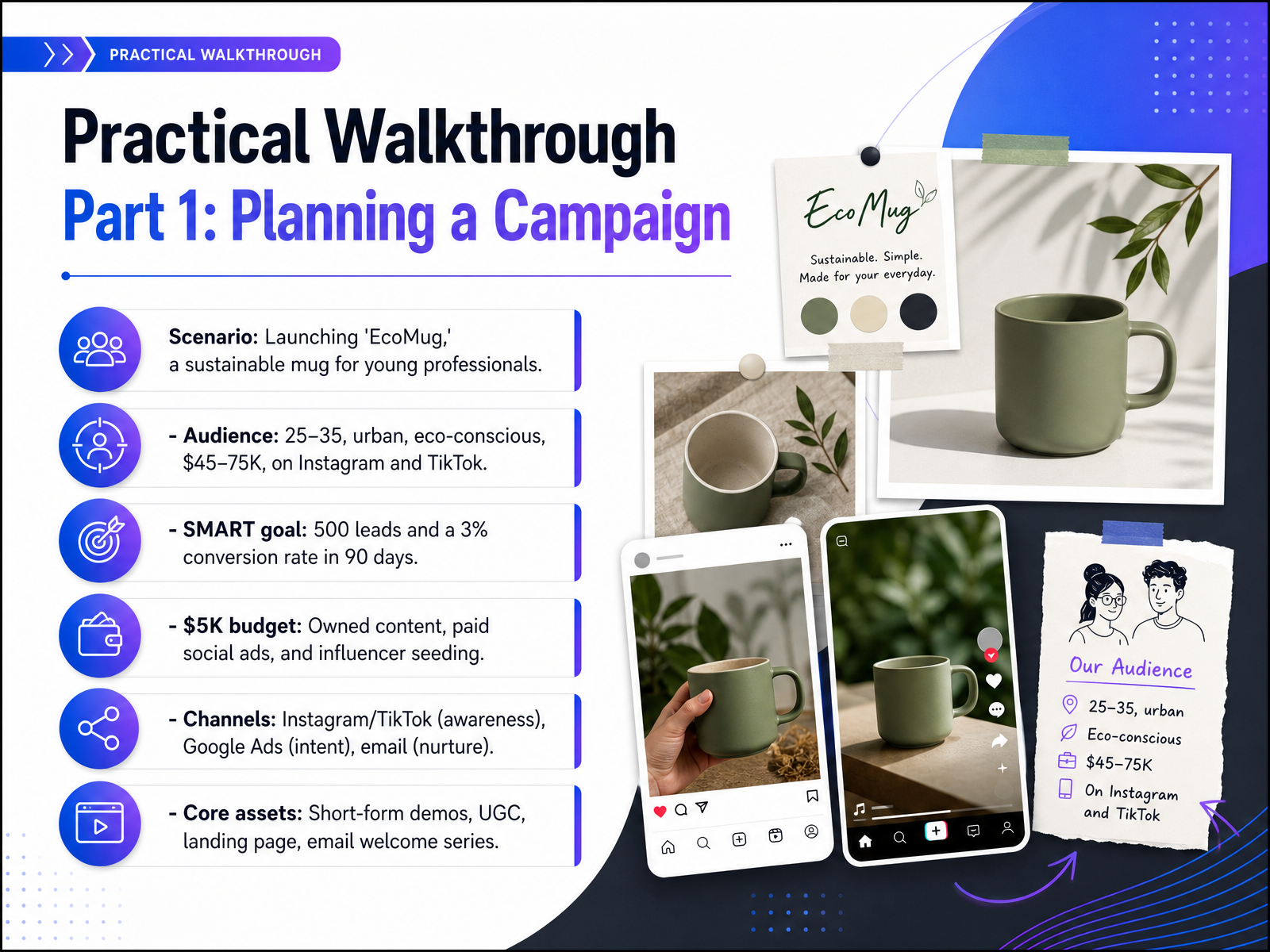
 - 11Practical Walkthrough Part 1: Planning a CampaignLet's make this real with a practical example. Imagine you're launching a brand called EcoMug—a sustainable, stylish mug for young professionals. Your target audience is twenty-five to thirty-five-year-olds in cities, eco-conscious, and spending time on Instagram and TikTok. You set a SMART goal: generate five hundred leads and a three percent conversion rate within ninety days. Your budget is five thousand dollars, split across owned content, paid social ads, and sending free mugs to a few relevant creators. For channels, you'll use Instagram and TikTok to build awareness, Google Ads to capture active searchers, and email to nurture the leads you collect. Your core assets? Short demo videos, customer-generated content, a dedicated landing page, and a welcome email series. Notice how every piece connects back to your audience and your goal. Next, we'll walk through what it looks like to actually launch and measure this campaign.
 neelnetworks.comsweetfishmedia.comgoonlinenow.co+22 min
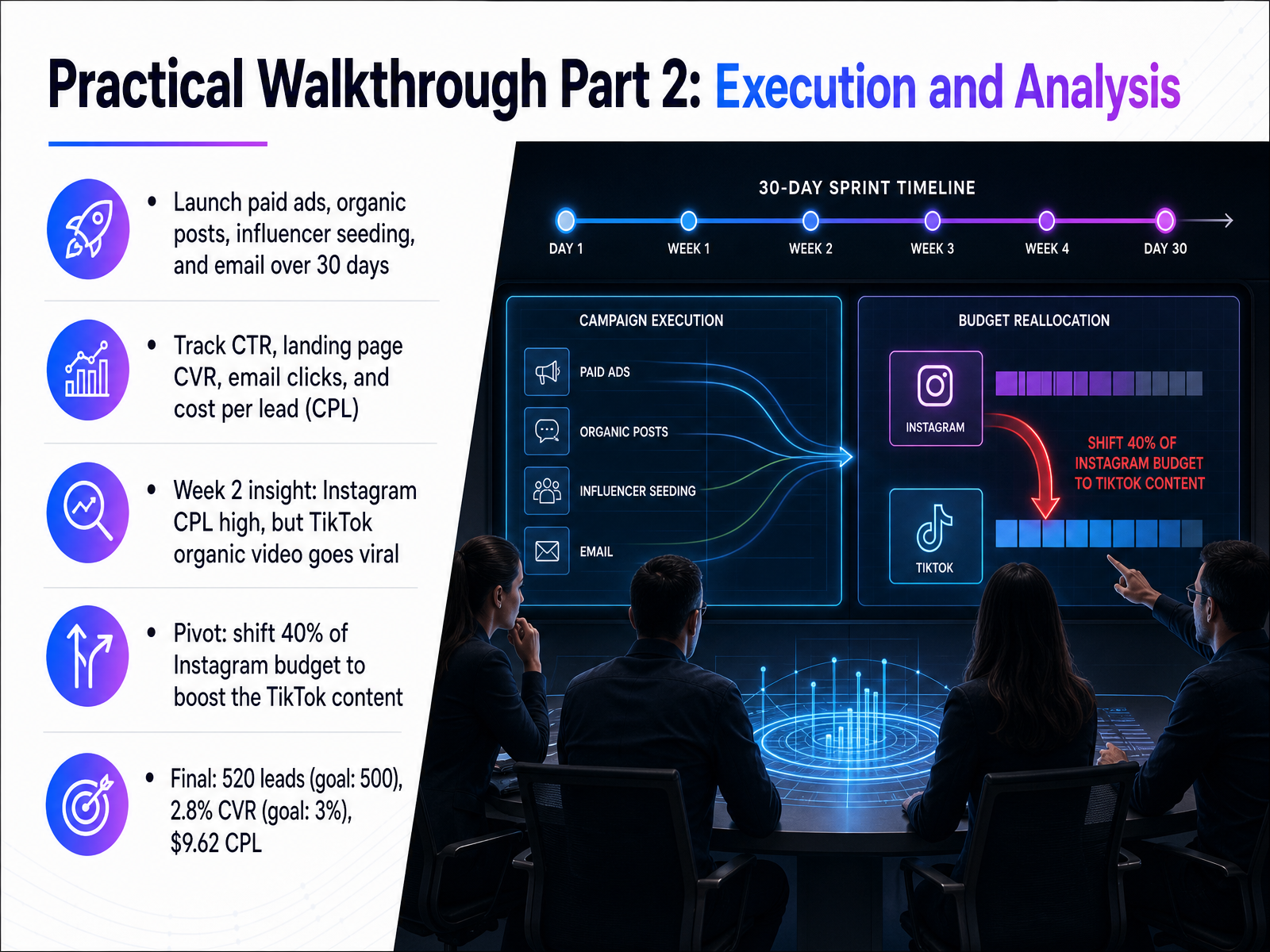
 - 12Practical Walkthrough Part 2: Execution and AnalysisNow we put those numbers into action. Let’s walk through a 30-day campaign execution. We launched paid ads, organic posts, influencer seeding, and email all at once. Then we started tracking. We measured click-through rate, landing page conversions, email clicks, and cost per lead, or CPL. By week two, the data told a story. Instagram’s CPL was getting expensive. But one TikTok organic video was suddenly catching fire. So we made a real-time pivot. We shifted 40 percent of the Instagram budget to boost that TikTok content. At the end of 30 days, we had 520 leads, beating our goal of 500. Conversion rate came in at 2 point 8 percent, just under the 3 percent target. And the final cost per lead was 9 dollars 62 cents. The lesson here is that a plan is only the starting point. The real strategy is watching your diagnostic metrics and moving budget to what’s actually working. Next, let’s look forward. AI in Digital Marketing: 2026 Trends and Practical Use.
 blog.hubspot.comsemrush.commonday.com+22 min
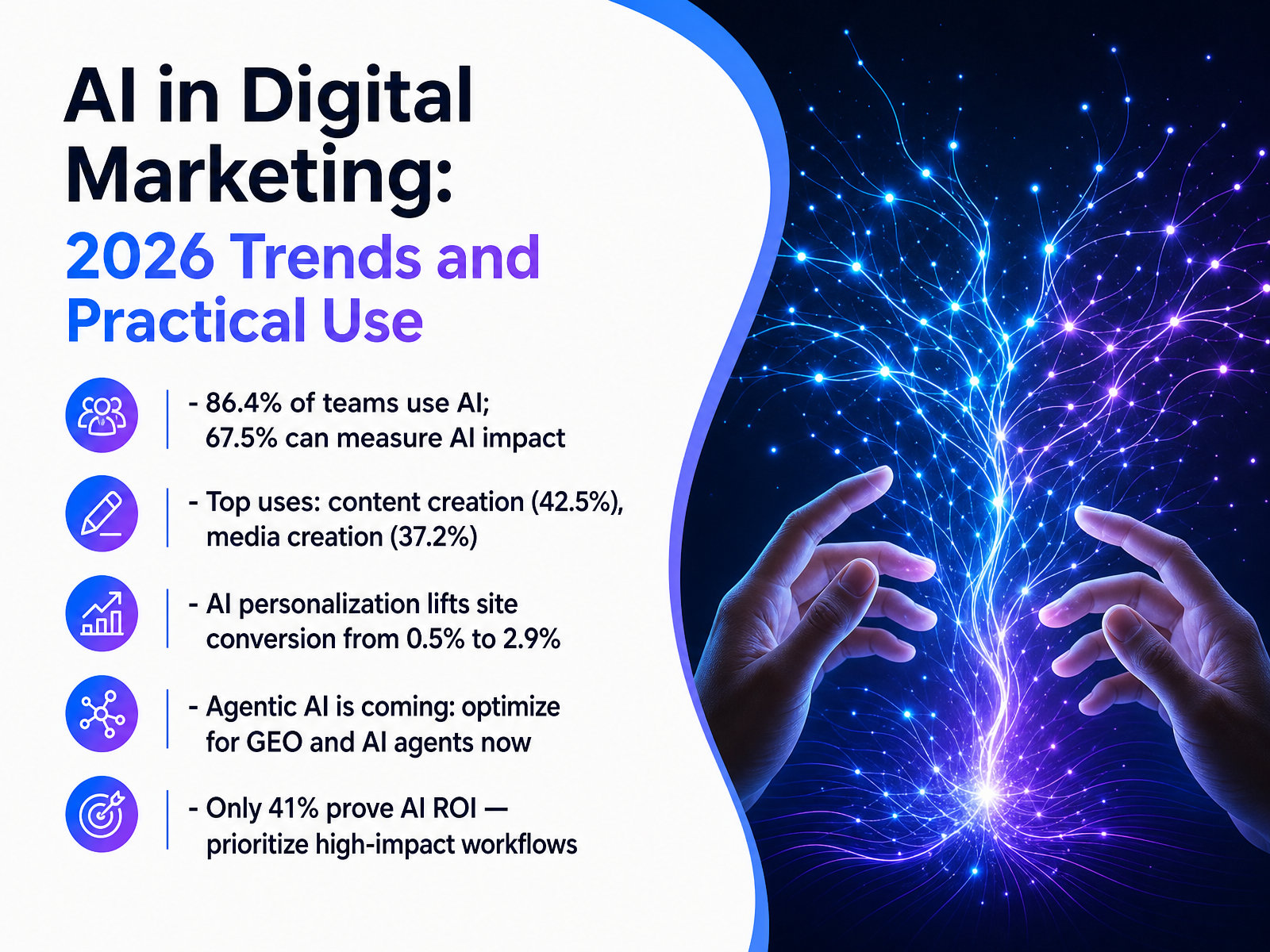
 - 13AI in Digital Marketing: 2026 Trends and Practical UseNow let's look at how AI is reshaping digital marketing right now, and what's coming next. The numbers are striking. 86.4 percent of marketing teams already use AI in at least a few areas. And 67.5 percent say they now know how to measure its impact. But here's the gap: only 41 percent can actually prove AI's return on investment. So what are teams doing with these tools? The top two uses are content creation, at 42.5 percent, and media creation, like images and video, at 37.2 percent. When AI gets personalization right, the results are dramatic. We see site conversion lift from just point five percent to 2.9 percent. Think about that: nearly six times more visitors turning into customers. Now, one of the biggest shifts on the horizon is agentic AI. These are systems that don't just assist, they act. Soon, AI agents will compare products, check reviews, and even make purchases on behalf of consumers. That means your brand needs to be visible and trusted by AI, not just by people. We call this Generative Engine Optimization, or GEO. It's about making sure your content is structured and clear, so AI models choose you as the best recommendation. With only 41 percent of teams proving AI's value right now, the smartest move is to focus on high-impact workflows first. Don't try to do everything. Pick the areas where AI can save time, improve personalization, or help you measure what really matters. Coming up next, we'll bring all of this together in our key takeaways and next steps.
 gitnux.orgloopexdigital.comjournal.access-bg.org+22 min
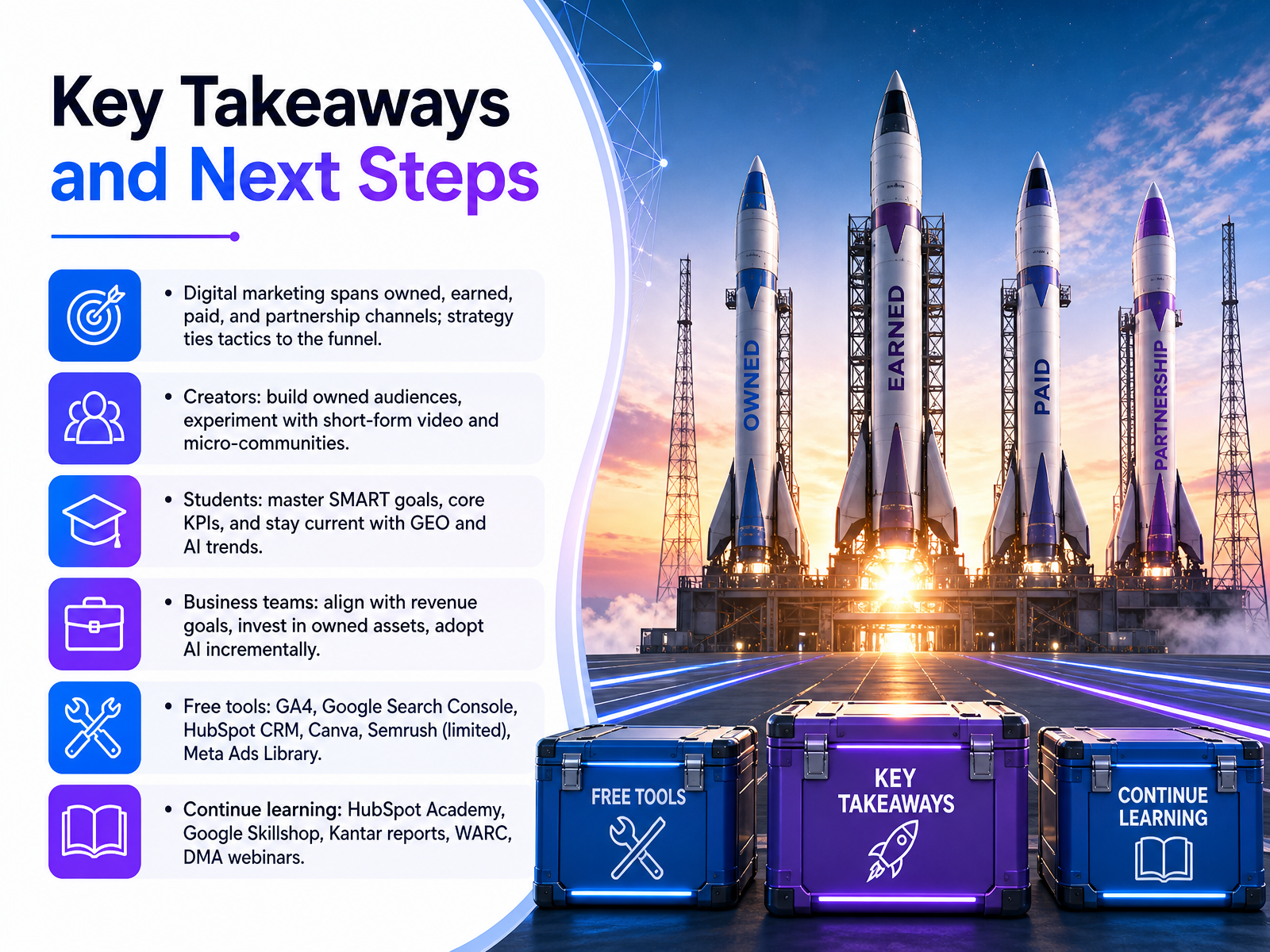
 - 14Key Takeaways and Next StepsAnd here we are at the finish line. Let’s pull everything together into a few clear takeaways. First, remember that digital marketing isn’t one big channel; it’s a mix of owned, earned, paid, and partnership channels. Your strategy is simply the plan that ties these tactics to your funnel, from awareness all the way down to conversion. For creators in the room, the most powerful move you can make is building a truly owned audience. That means experimenting with short-form video and authentic micro-communities, rather than renting your reach from an algorithm. For students, master SMART goals and core K P I s like conversion rate and customer acquisition cost. Then stay current with generative engine optimization and A I trends; they’re reshaping how people discover brands. And for business teams, always align your work with a revenue goal. Invest in owned assets like your website and email list, and adopt A I incrementally to make smarter decisions, not just faster ones. To keep learning, you don’t need a huge budget. Start with free tools like G A four, Google Search Console, and HubSpot C R M. Then deepen your expertise with courses from HubSpot Academy or Google Skillshop, and keep up with research from Kantar and the D M A. Thank you for spending this time with me. You now have the framework; the next step is simply to apply it, test things out, and keep learning. You’ve got this.
 blog.hubspot.comsemrush.commonday.com+22 min
Take the deck with you
Download this course as a file — free, no sign-up needed.
- PDF handoutEvery slide page, ready to print or share.15 pages · 4.7 MBDownload
- Narrated PowerPointThe deck that presents itself — every slide carries the digital human's narration video.15 pages · 19.2 MBDownload
- PowerPoint slidesThe full deck as a .pptx — open it in PowerPoint, Keynote, or Google Slides.15 pages · 4.7 MBDownload
Free to use in your own training — please keep the PersonWise credit page at the end.
Have your own deck? Turn it into a course
Sources consulted
Web sources consulted while building this course.
- How successful marketing teams are optimizing performance in 2026 (and what metrics they’re tracking) — blog.hubspot.com
- 20 marketing KPIs to track & improve in 2026 - Semrush — semrush.com
- Marketing KPIs: Essential Metrics To Track Performance In 2026 — monday.com
- Top 25 Digital Marketing Metrics and KPIs to Measure in 2026 — owox.com
- Online Marketing KPIs: The Metrics That Matter in 2026 | Online Marketing KPIs 2026: Metrics Guide — evelan.de
- Digital Marketing Channels Explained: Which Ones Actually Drive Business Growth? — neelnetworks.com
- The B2B Marketer's Guide to Owned, Earned, and Paid Media in 2026 — sweetfishmedia.com
- Digital Marketing Channels Explained for SMB Growth - Go Online Now — goonlinenow.co
- Paid vs earned vs owned media: A guide for modern PR teams | Presspage — presspage.com
- The Essential Guide to Owned, Paid, and Earned Media - Cision — cision.com
- Worldwide Ad Spending H1 2026 — emarketer.com
- Ad Spend Growth Is Projected to Slow to 5.0% in 2026, Still ... — dentsu.com
- Digital Marketing Spend in 2026: Where Budgets Are Actually Going — fact.mr
- WFA & Ebiquity Global Media Budgets 2026 - World Federation of Advertisers — wfanet.org
- Global Ad Spend Set to Surpass $1 Trillion for the First Time in 2026 as the Algorithmic Era Redefines Growth | News | dentsu — dentsu.com
- Digital Marketing Vs Traditional Marketing Statistics 2026 — gitnux.org
- The Ultimate List of Digital Marketing Statistics for 2026 [By ... — loopexdigital.com
- Comparative assessment of traditional, digital, and hybrid marketing on firm performance in... — journal.access-bg.org
- The CMO Survey — cmosurvey.org
- PowerPoint Presentation — cmosurvey-new.fuqua.duke.edu