Begin
13 pages · ~26 min
Reviewing Python Programming Projects
This training teaches reviewers how to evaluate Python programming projects, covering code quality, structure, and best practices for providing effective feedback.
A digital instructor presents all 13 pages. Hold “Ask” at any point and ask out loud — the answer comes from this course. No sign-up needed.
What you’ll learn
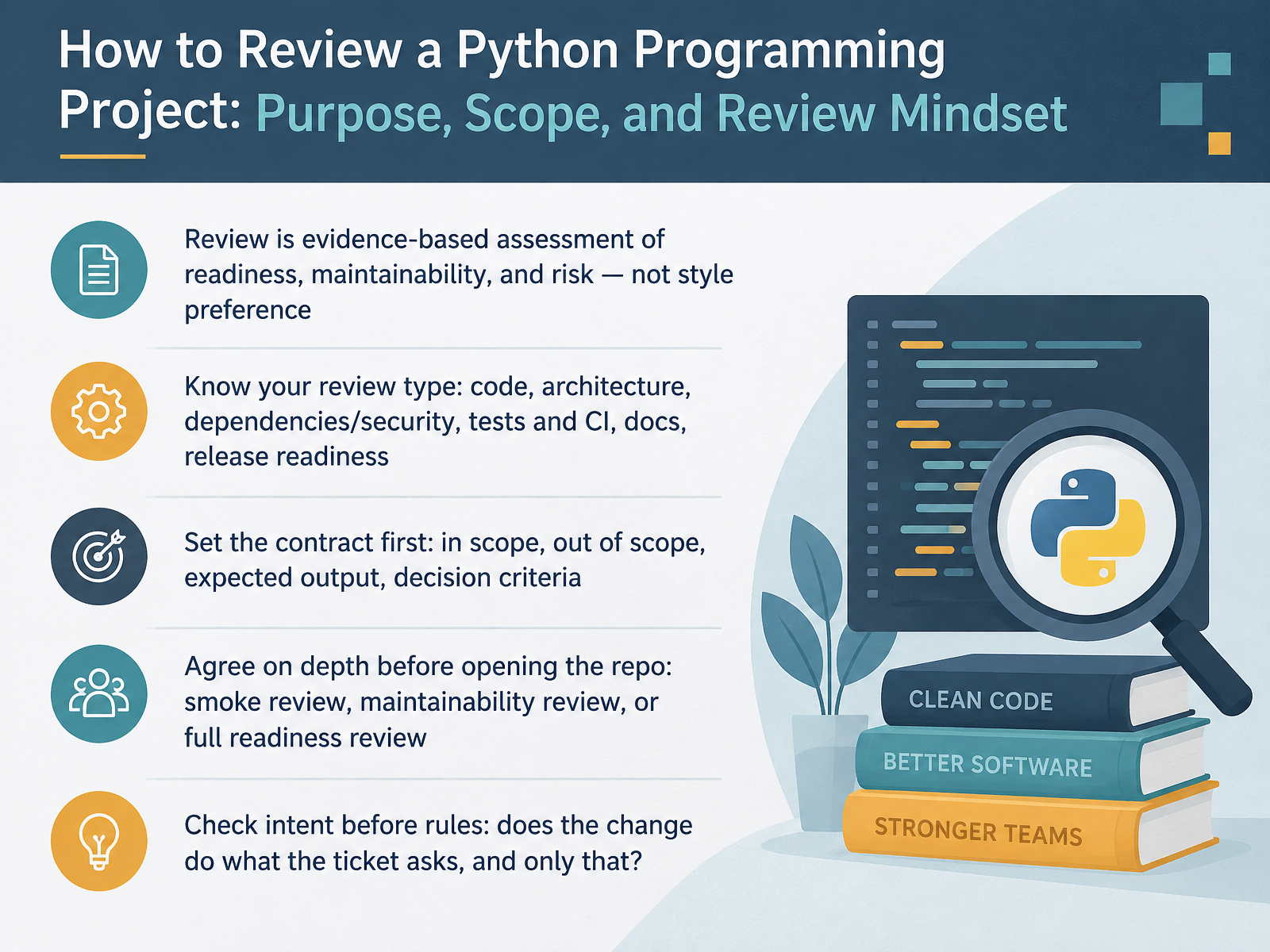
- 01How to Review a Python Programming Project: Purpose, Scope, and Review MindsetWelcome. In this course, we'll walk through how to review a Python programming project, with a focus on readiness, maintainability, and risk. Let's start with purpose, scope, and mindset.
Here's the core idea. A review is an evidence-based assessment, not a style preference debate. You're asking whether the project is ready, whether it stays maintainable, and where the risk lives.
First, know your review type. It could be code, architecture, dependencies and security, tests and continuous integration, docs, or release readiness. Naming the type keeps you from drifting.
Next, set the contract before you open the repository. What's in scope, what's out of scope, what output is expected, and what decision criteria you'll apply. For example, are you deciding merge, or just collecting findings?
Agree on depth upfront: a smoke review, a maintainability review, or a full readiness review. Each produces a different report and a different time commitment.
Finally, check intent before rules. Does the change do what the ticket asks, and only that? If the answer is unclear, stop and clarify scope before critiquing details.
That's the mindset: evidence, explicit criteria, and intent first. Next, we'll look at why reviews fail without shared pass/fail criteria.augmentcode.compablogonzalez.mekodus.io+22 min
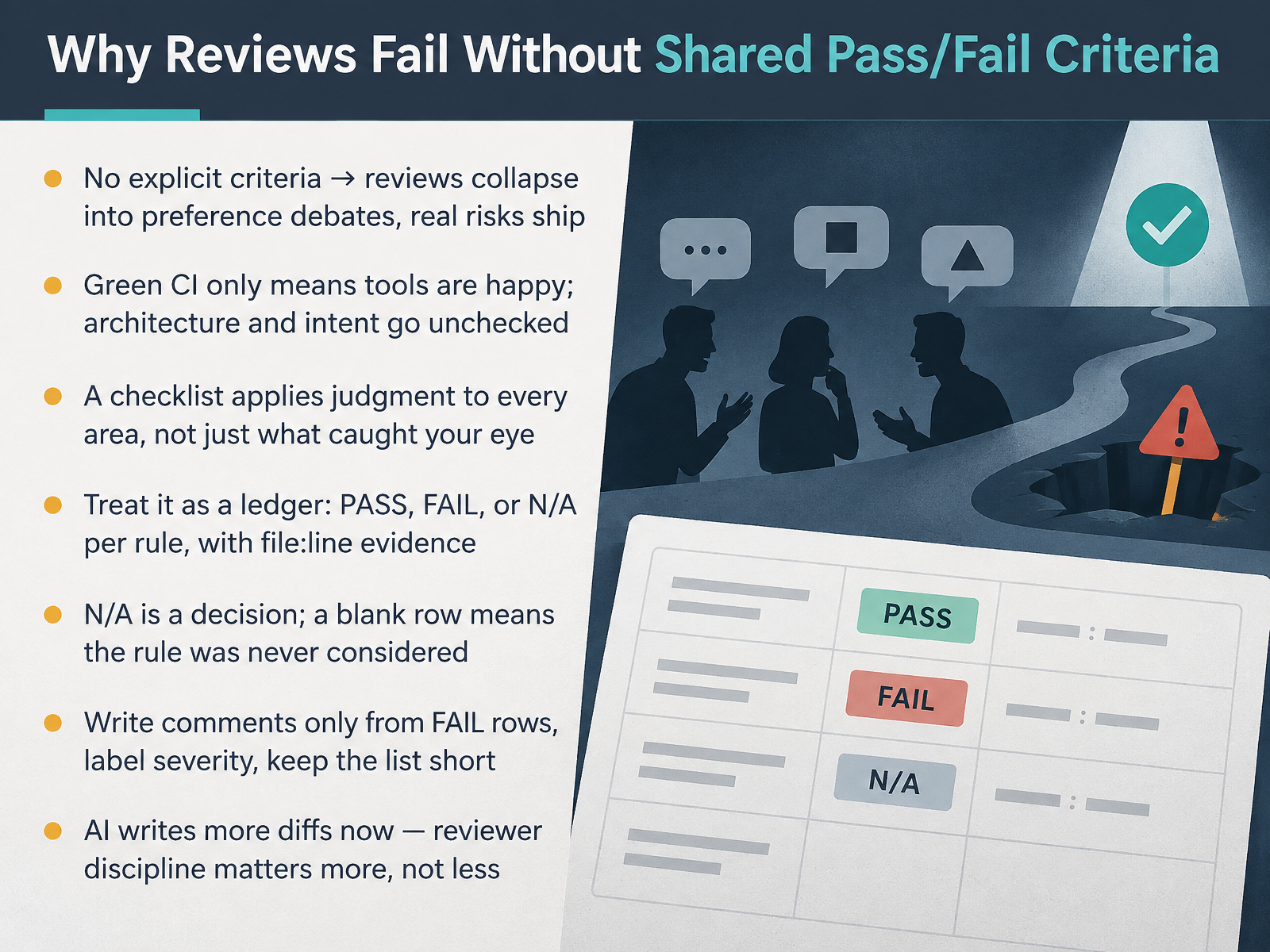
- 02Why Reviews Fail Without Shared Pass/Fail CriteriaLet us talk about why reviews fail without shared pass or fail criteria. When criteria are not explicit, reviews collapse into preference debates, and real risks ship. A green CI pipeline only tells you the tools are happy. It says nothing about architecture, intent, or the decisions behind the diff. A checklist fixes that. It applies judgment to every area, not just whatever caught your eye first. Treat it as a ledger. Give every rule a verdict: PASS, FAIL, or N/A, with file and line evidence. N/A is a decision. A blank row means the rule was never considered. Write comments only from FAIL rows, label severity, and keep the list short. One more thing matters now. AI writes more diffs, so reviewer discipline matters more, not less. Next, we look at repository structure and packaging sanity checks.
 augmentcode.compablogonzalez.mekodus.io+21 min
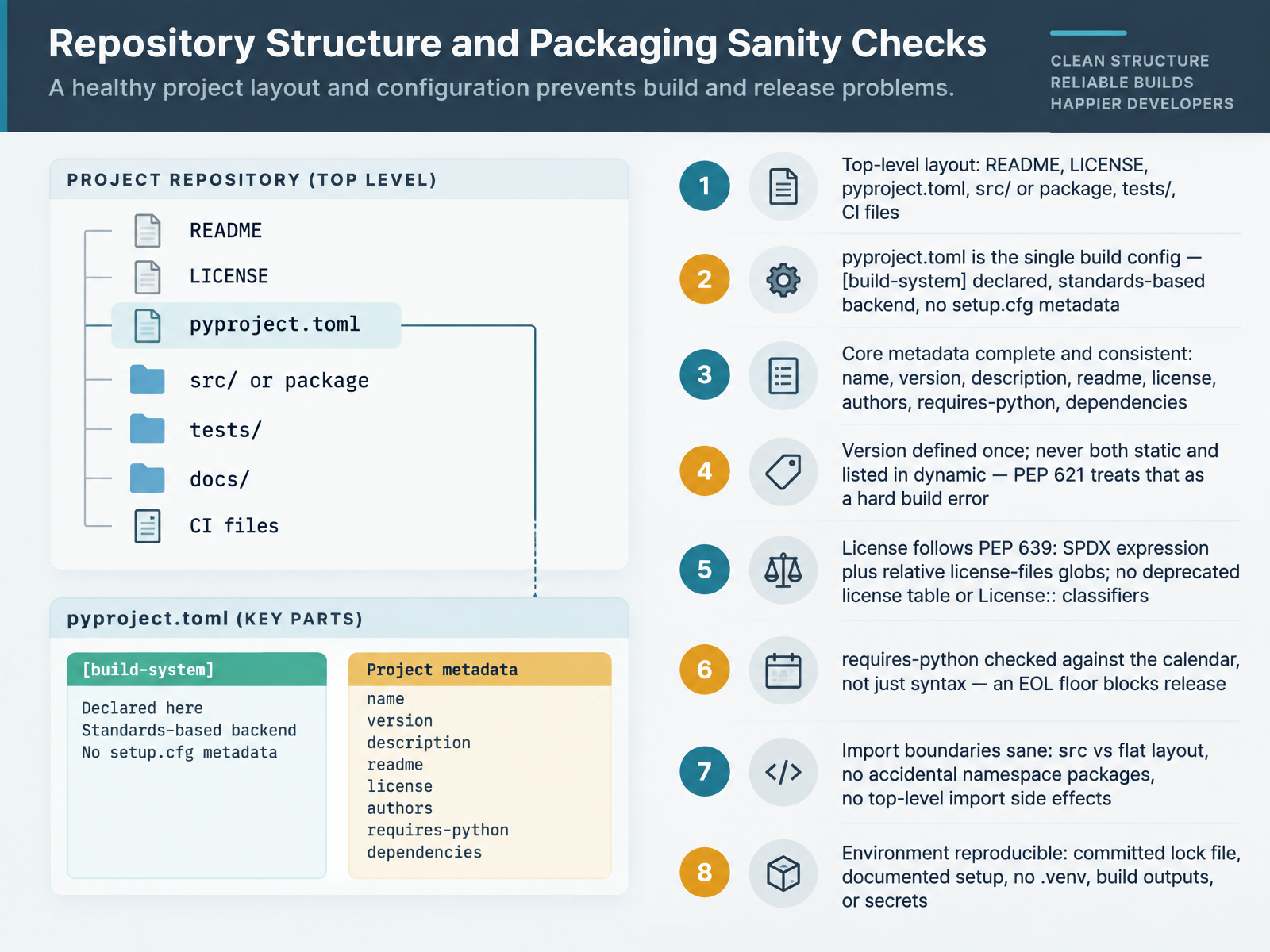
 - 03Repository Structure and Packaging Sanity ChecksNow let's sanity check the repository structure and packaging. Open the repo root first. You want a README, a LICENSE, pyproject.toml, either a src folder or a clearly named package, a tests directory, and your CI configuration. Keep pyproject.toml as the single build config. The build-system table should be declared with a standards based backend, and setup.cfg should not be carrying metadata. Next, confirm core metadata is complete and consistent: name, version, description, readme, license, authors, requires-python, and dependencies. Version must be defined once. If it appears statically and is also listed under dynamic, PEP 621 treats that as a hard build error. For licensing, follow PEP 639: an SPDX expression plus relative license-files globs. Drop the older license table and any License classifiers. Then check requires-python against the calendar, not just syntax. An end-of-life floor should block your release. Verify import boundaries too. Watch for accidental namespace packages, and make sure importing your package triggers no side effects. Finally, reproducibility. A lock file should be committed, setup should be documented, and virtual environments, build outputs, and secrets should not be in version control. Those are the structure signals that tell you whether a release is safe to start from. Next, we move into code quality, style, and static analysis signals.
 packaging.python.orgpackaging.python.orgpeps.python.org+22 min
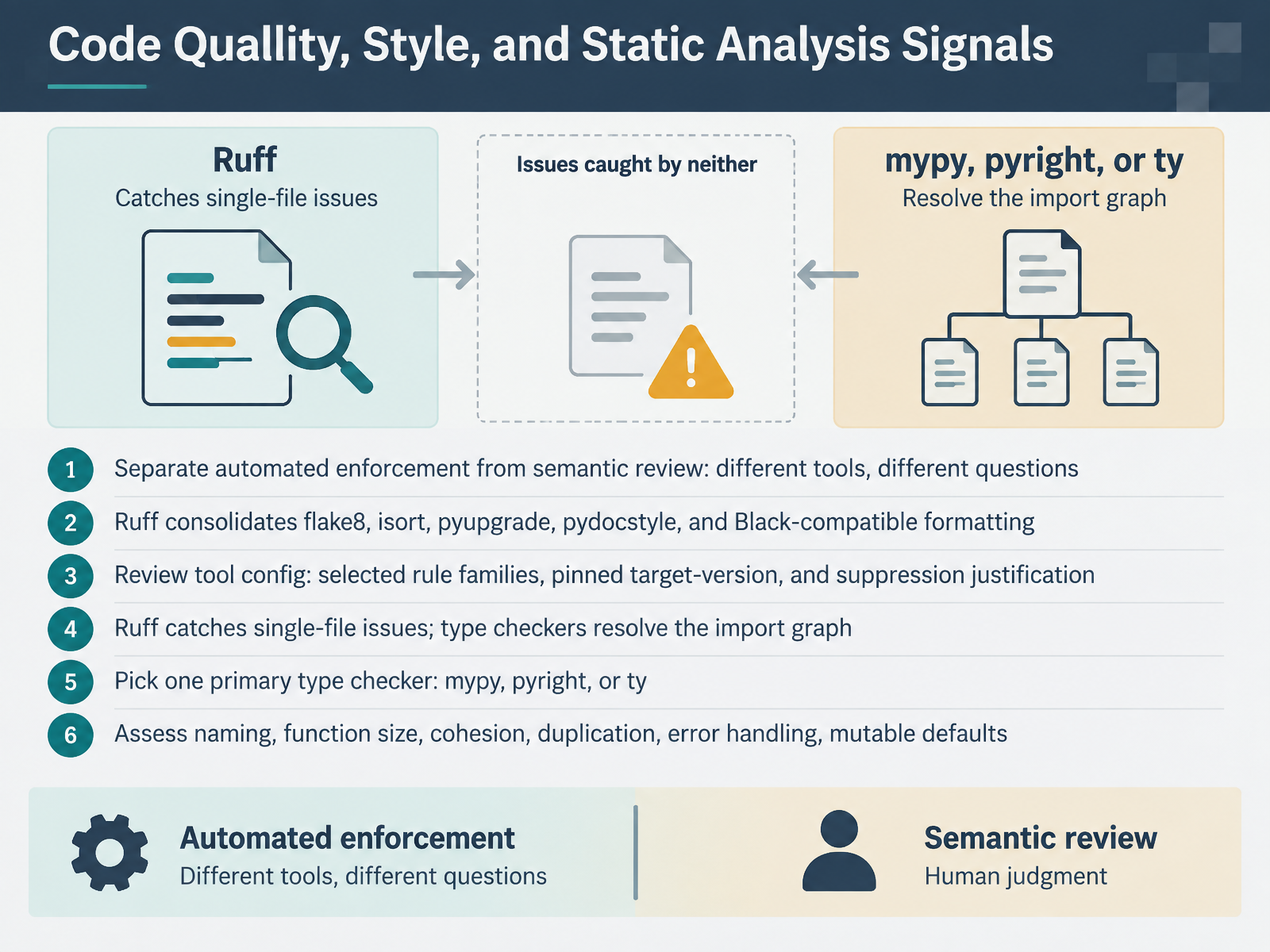
 - 04Code Quality, Style, and Static Analysis SignalsNow, let us separate automated enforcement from semantic review. These are different tools answering different questions. Ruff consolidates flake8, isort, pyupgrade, pydocstyle, and Black-compatible formatting into one binary. Before you trust it, open the tool config. Check which rule families are selected, whether target-version is pinned, and whether every suppression has a written justification. Next, remember the scope limit. Ruff catches issues inside a single file. It does not resolve your import graph. Type checkers do. Pick one primary type checker for the project, whether that is mypy, pyright, or ty. Then review what no tool sees. Assess naming, function size, cohesion, duplication, error handling, and mutable defaults. Those are judgment calls. The tools narrow your attention, but you still make the call. Coming up next, Testing, Coverage, and Real Quality Gates.
 blog.marcosalonso.devhigherpass.comfreeqatools.com+21 min
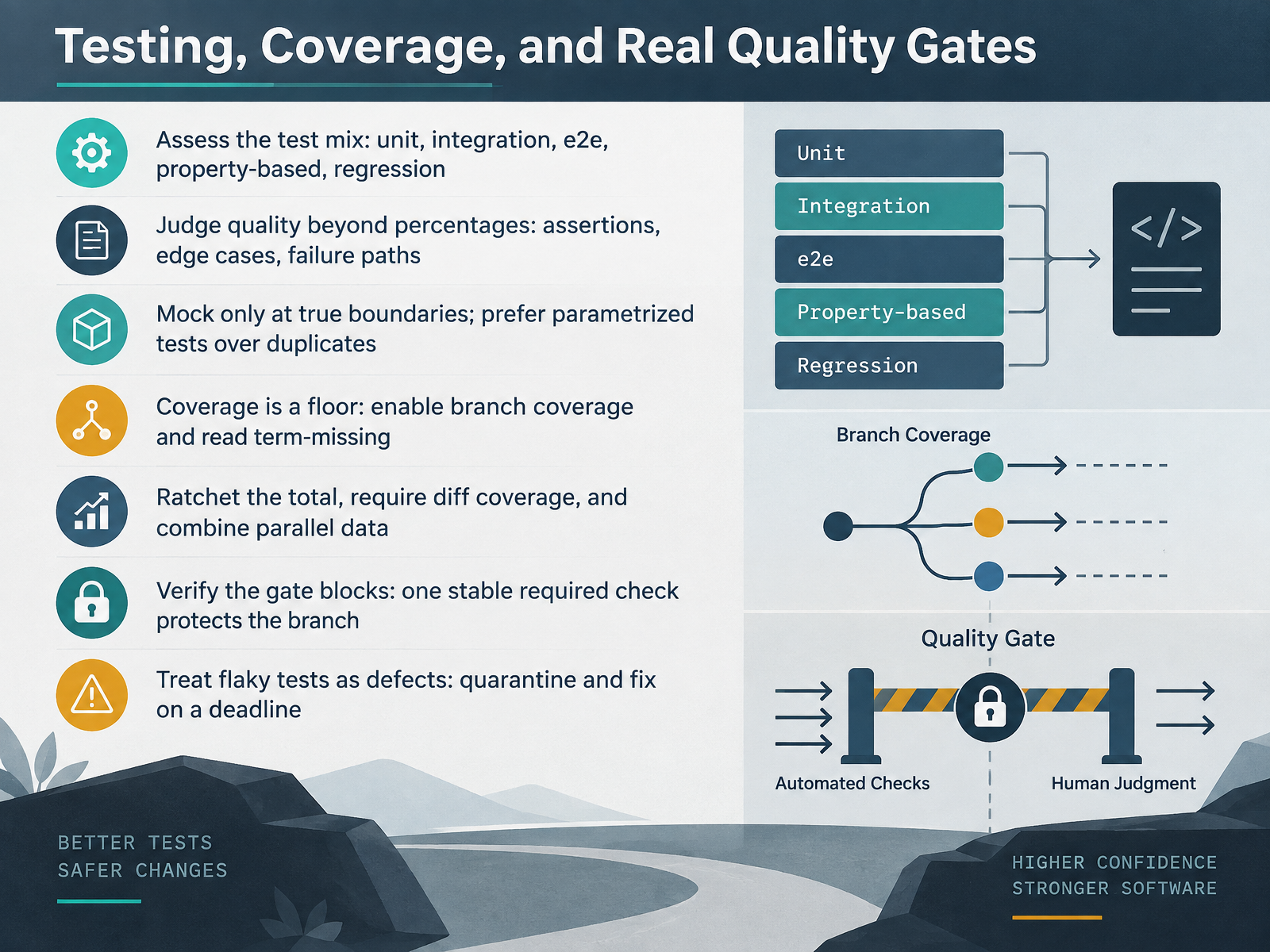
 - 05Testing, Coverage, and Real Quality GatesLet's turn to testing and coverage, and what a real quality gate looks like. First, assess your test mix. You want unit tests, integration tests, end to end tests, property based tests, and regression tests where they earn their place. Then, judge quality beyond the percentage. Read the assertions. Check edge cases and failure paths, not just the happy path. Mock only at true boundaries like the network or the clock. Inside your own domain, use real objects. Prefer parametrized tests over near duplicate cases. Next, treat coverage as a floor. Enable branch coverage and read the term missing column, because that list of uncovered lines is where bugs hide. Then, make the gate real. Ratchet the total so it can never drop. Require diff coverage on changed lines. Combine parallel data before reporting, or your number is wrong. Verify the gate actually blocks. One stable required check should protect the branch, and prove it fails before you trust it. Finally, treat flaky tests as defects. Quarantine them and fix them on a deadline. A test the team stops believing is worse than no test at all. Next, we move into dependencies, security, and supply chain review.
 istranin.devdeepwiki.compython-testing-debugging.com+22 min
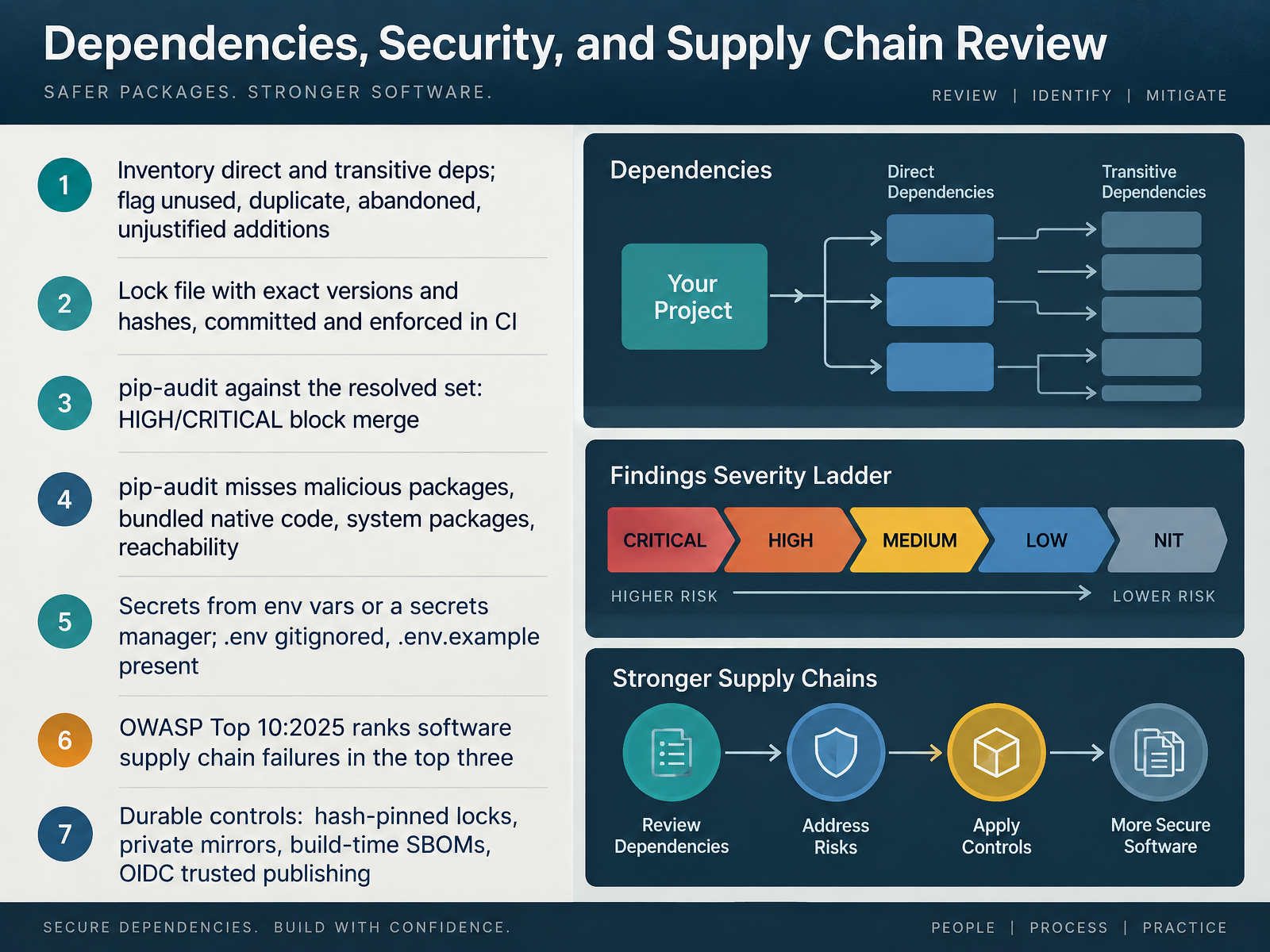
 - 06Dependencies, Security, and Supply Chain ReviewLet's move on to dependencies, security, and the supply chain. Start by inventorying your dependencies, both direct and transitive. Flag anything unused, duplicated, abandoned, or added without justification. Then confirm your lock file records exact versions and hashes, is committed, and is enforced in continuous integration. In your audit step, run pip audit against the resolved set, and let high and critical findings block the merge. Be clear about the limits, though. pip audit will not catch malicious packages, bundled native code, or system libraries, and it has no reachability analysis. Next, check secrets. Credentials should come from environment variables or a secrets manager. Your dot env file must be gitignored, and a dot env example should be present. Note that OWASP's twenty twenty five Top Ten ranks software supply chain failures in the top three. So build durable controls: hash pinned locks, a private mirror, build time SBOMs, and OIDC trusted publishing. Now let's turn to architecture, design, and maintainability assessment.
 augmentcode.compablogonzalez.mekodus.io+22 min
 - 07Architecture, Design, and Maintainability AssessmentNext, let us assess architecture, design, and maintainability.
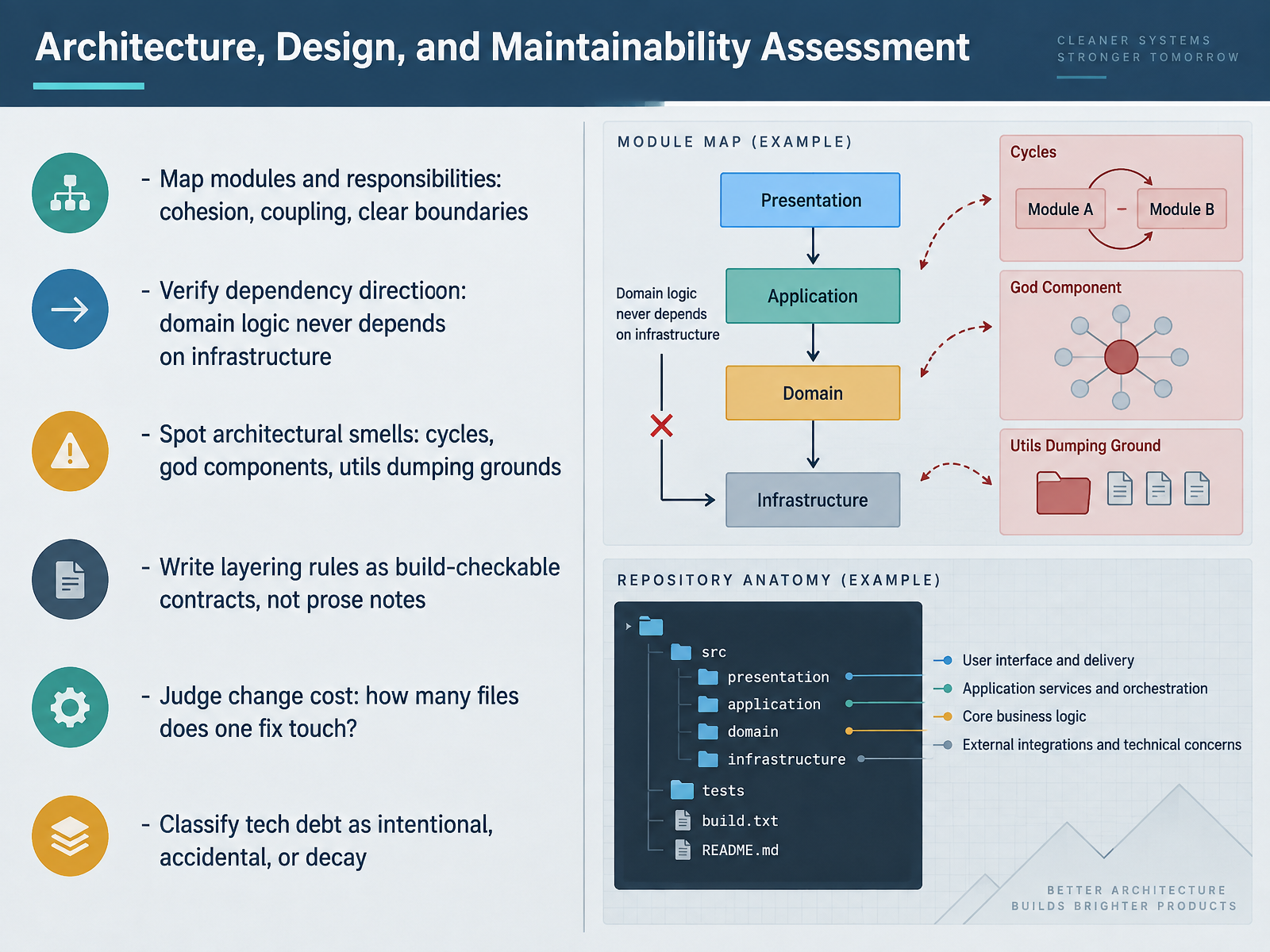
Start by mapping modules to responsibilities. Check cohesion, coupling, and boundaries. Then verify dependency direction: domain logic should never depend on infrastructure, only the reverse.
Scan for architectural smells: import cycles, god components, and utils dumping grounds like helpers.py. If a module only forwards calls, delete it. If a folder holds a single module, inline it.
Write your layering rules as build-checkable contracts, not prose notes. Tools like import-linter or ArchPython can fail the build on a violation. A paragraph in a README will drift; a contract that fails CI will not.
Judge change cost with one question: how many files does one fix touch? If a small behavior change ripples across five modules, the boundaries are wrong.
Finally, classify tech debt. Label it intentional, accidental, or decay. That label tells you what to schedule and what to block.
As you review, remember: a green pipeline does not prove sound architecture. Linters and type checkers see files, not layers.
That leads us to the next phase: Documentation, Onboarding, and Developer Experience.
 pablogonzalez.meblog.marcosalonso.devhigherpass.com+22 min
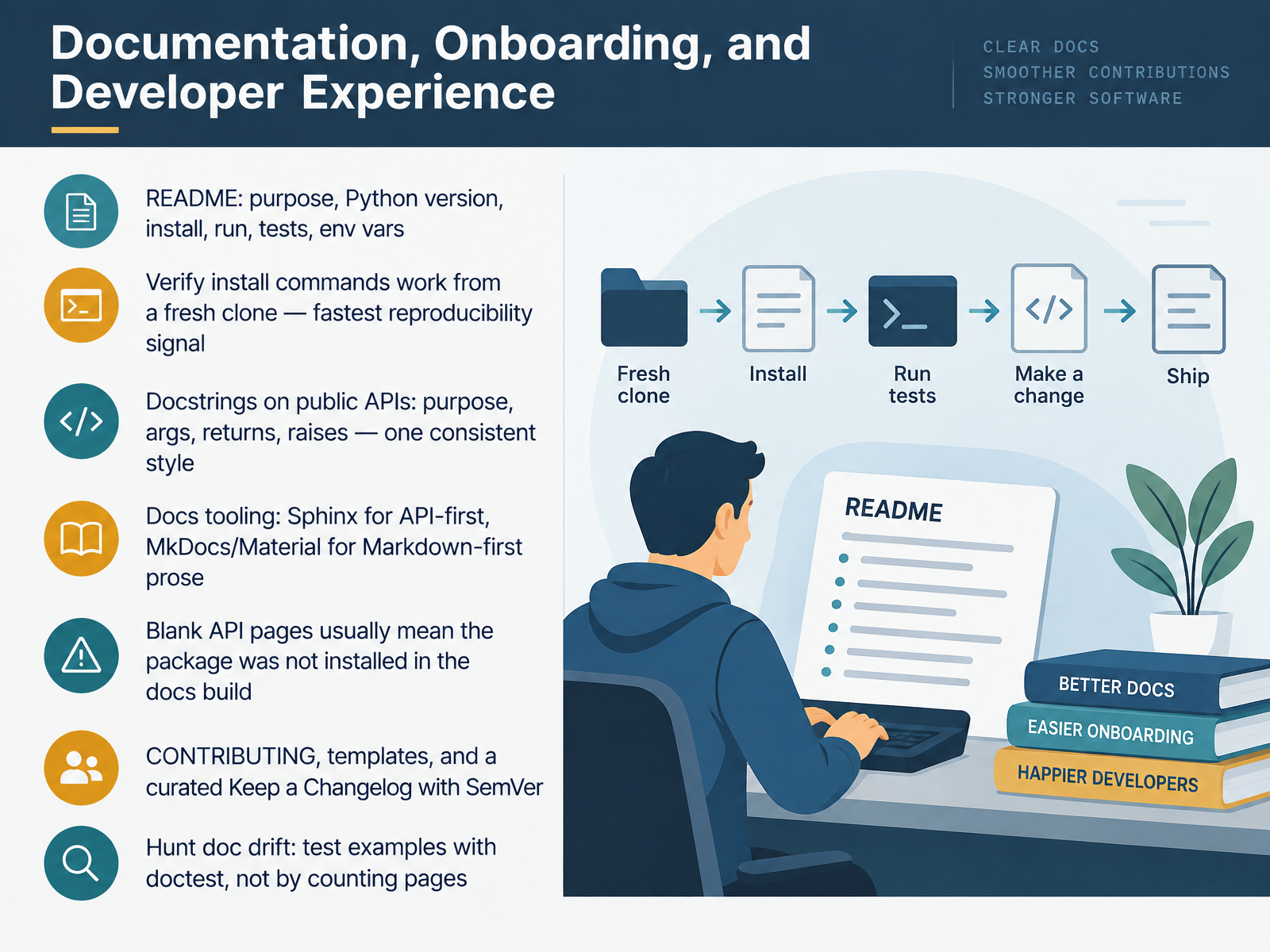
 - 08Documentation, Onboarding, and Developer ExperienceNow let's look at documentation and developer experience. Start with the README. It should state the project's purpose, the required Python version, install and run commands, how to run tests, and any environment variables. Then open a fresh clone and run those install commands yourself. If they fail, that is your fastest reproducibility signal, and nothing else matters until it works. Next, check docstrings on public APIs. Each one should cover purpose, arguments, returns, and raised exceptions, in one consistent style across the codebase. For docs tooling, choose based on your content. Sphinx fits API-first libraries with deep cross-references. MkDocs with Material fits Markdown-first prose. Whichever you use, if the rendered API pages come out blank, the usual cause is that the package was not installed in the docs build. Also confirm you have a CONTRIBUTING guide, contribution templates, and a curated changelog that follows Keep a Changelog with semantic versioning. Finally, hunt doc drift. Run doctest against your examples rather than counting pages, because tested examples are the only ones that stay true. That covers documentation and onboarding. Next, we move into Performance, Reliability, and Operational Readiness.
 augmentcode.compablogonzalez.mekodus.io+22 min
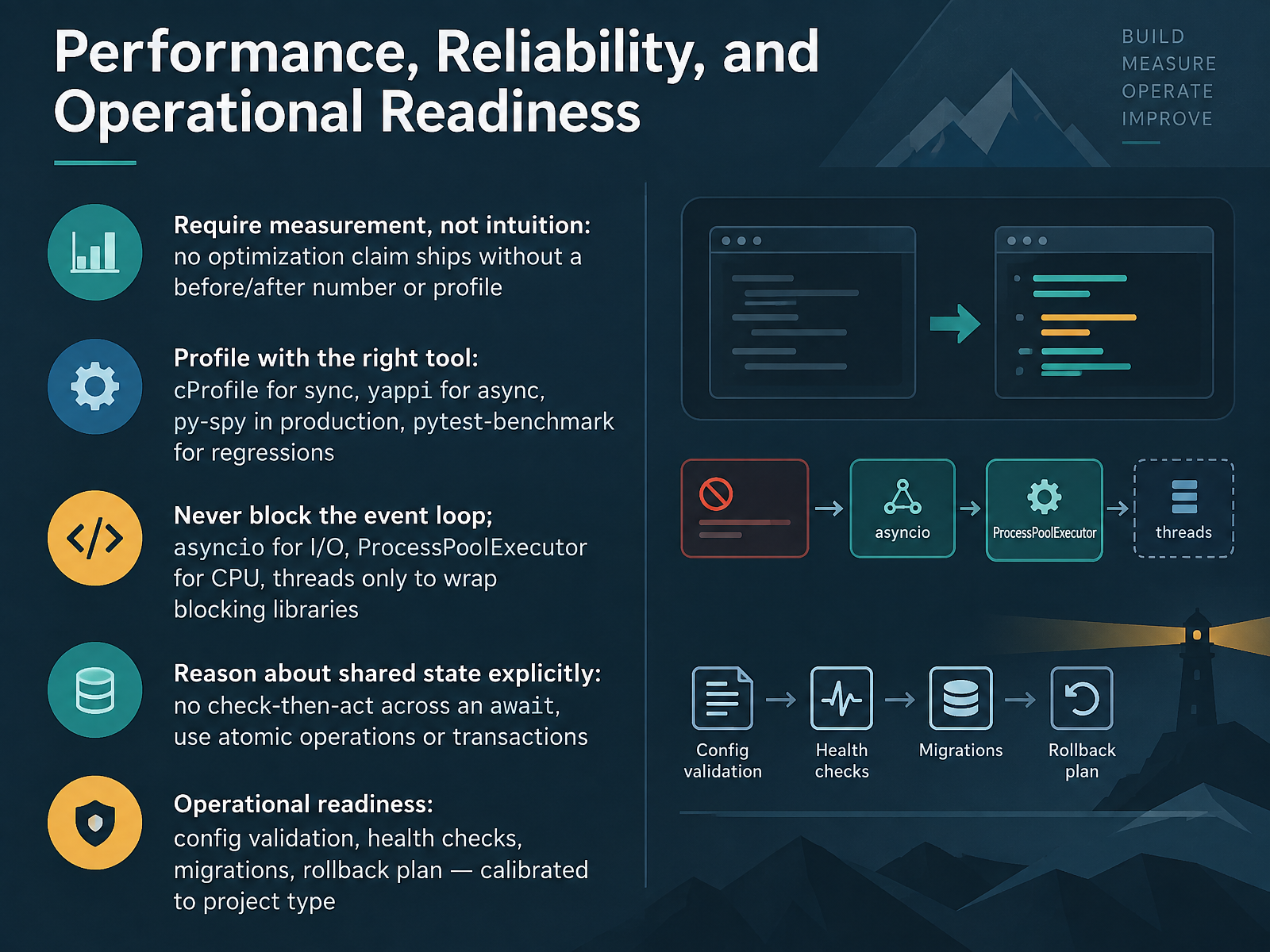
 - 09Performance, Reliability, and Operational ReadinessLet's move to performance, reliability, and operational readiness. Start with one rule: no optimization claim ships without evidence. A pull request that says "faster" needs a before and after number, or a profile. Pick the right tool. cProfile for synchronous code. yappi or an async-aware profiler for coroutines. py-spy when you need to attach to a running production process without changing code. pytest-benchmark to lock in regressions. Next, check the event loop. Any blocking call inside an async function freezes every other task. The rule is simple: asyncio for I/O, ProcessPoolExecutor for CPU-bound work, and threads only to wrap blocking libraries that have no async equivalent. Then examine shared state. No check-then-act split across an await. Another request can run at every await point. Prefer atomic operations, transactions, or idempotency keys over read-modify-write. Finally, confirm operational readiness. That means config validation with clear failure on missing values, health checks, reversible migrations, and a rollback plan. Calibrate the depth to the project type. A library needs less than a service. A service needs all of it. Next, we will look at how to turn these checks into a review workflow: evidence, severity, and communication.
 augmentcode.compablogonzalez.mekodus.io+21 min
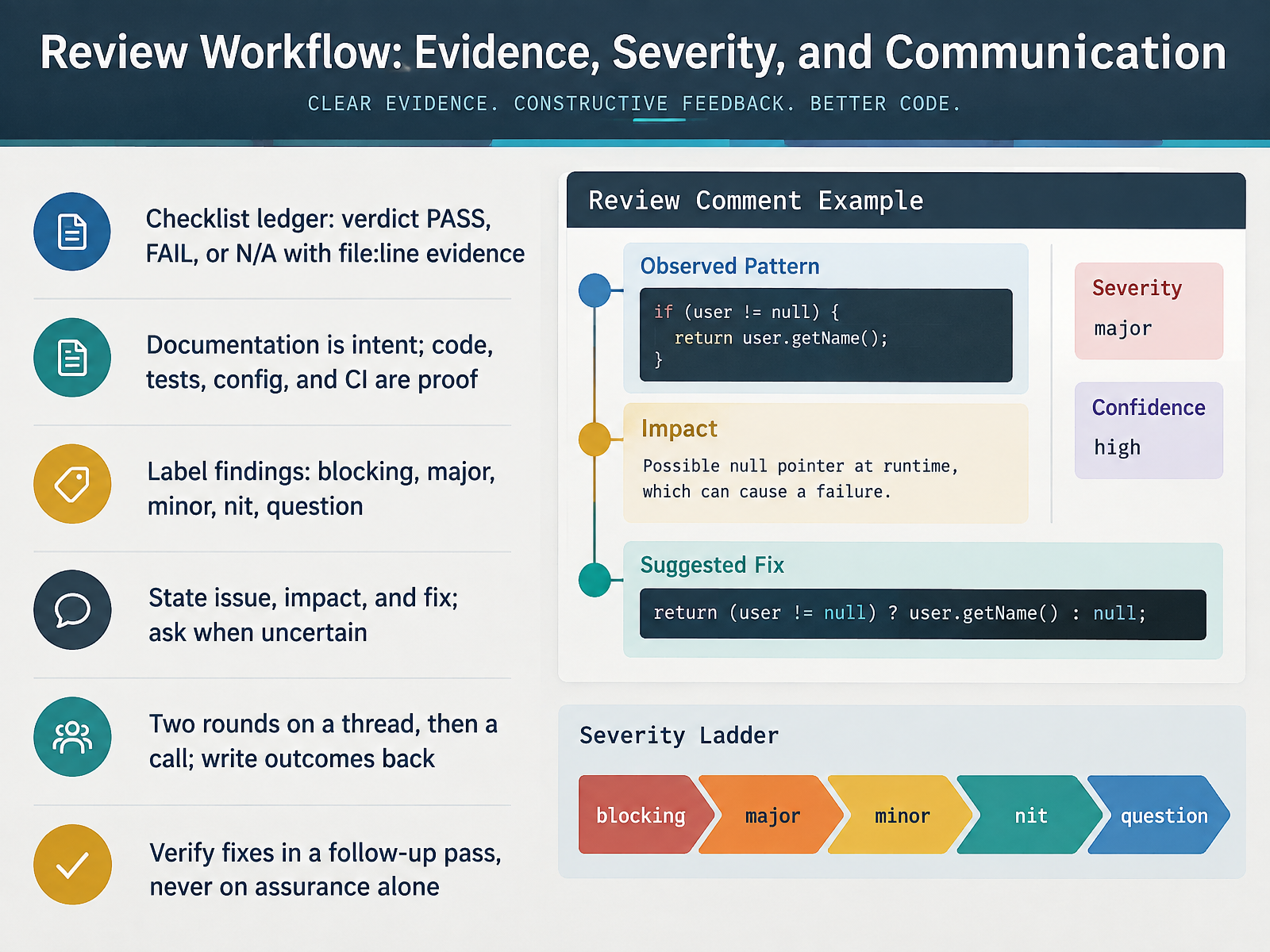
 - 10Review Workflow: Evidence, Severity, and CommunicationNow let's walk through the review workflow itself, covering evidence, severity, and communication. Start with a checklist ledger. Give every rule a verdict, PASS, FAIL, or N/A, and back each one with file and line evidence. Treat documentation as intent. Code, tests, config, and CI are proof. When you find something, label it: blocking, major, minor, nit, or question. Then state three things: the issue, its impact, and a concrete fix. If you are unsure, ask a question instead of asserting. On any single thread, keep it to two rounds, then move to a call, and write the outcome back on the pull request. Finally, in a follow-up pass, verify the fixes in code. Never accept a fix on assurance alone. That discipline keeps review factual, fair, and finished. Next, we look at reviewing AI-generated and high-volume diffs.
 pablogonzalez.meaugmentcode.commadhudadi.in2 min
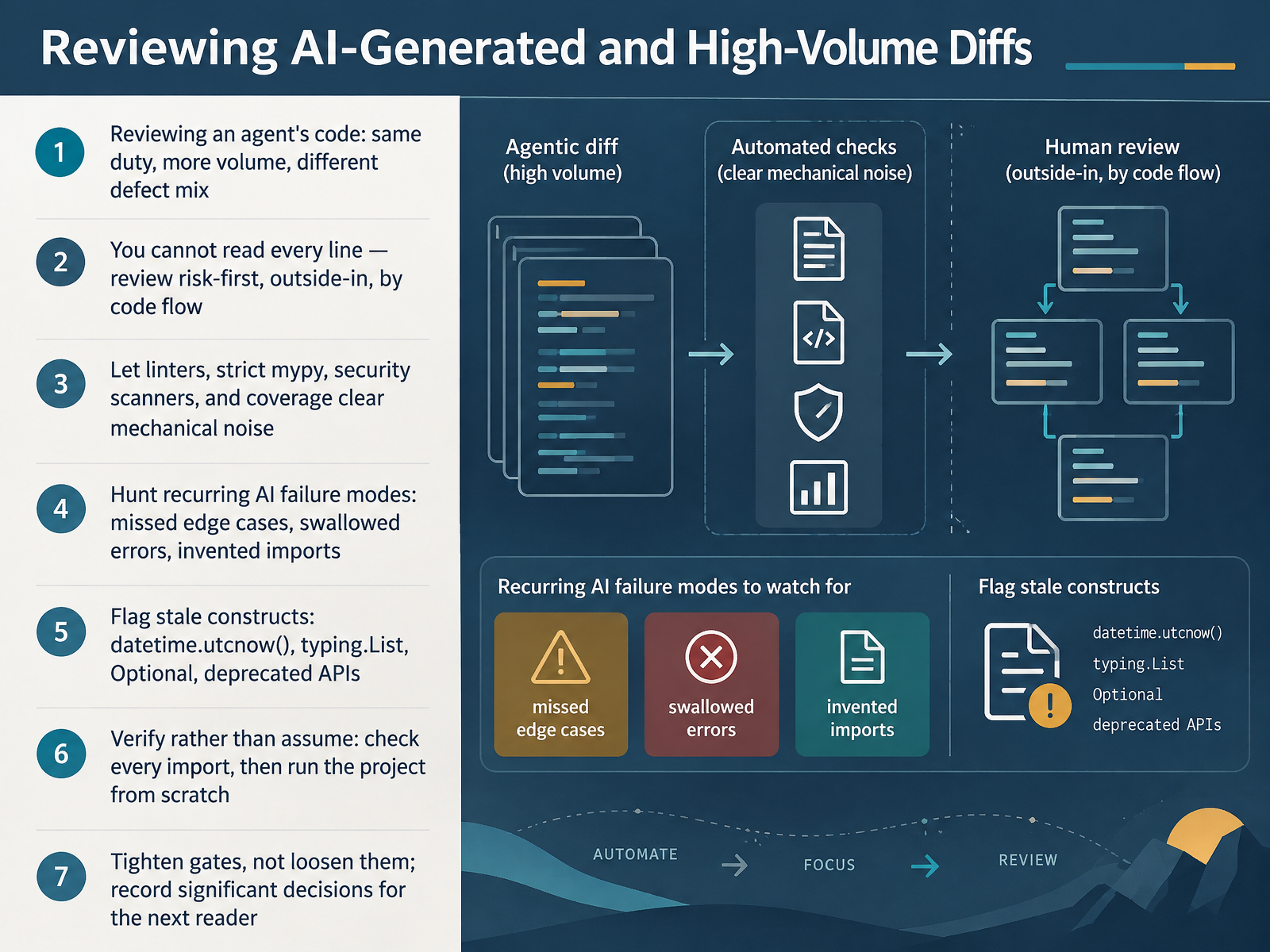
 - 11Reviewing AI-Generated and High-Volume DiffsNow let's talk about reviewing AI-generated and high-volume diffs. When the author is an agent, your duty is the same, but the volume is much higher, and the defect mix is different. So you cannot read every line. Review risk-first, outside-in, following the code's flow. Let linters, strict mypy, security scanners, and branch coverage clear the mechanical noise before you start. Then hunt the recurring AI failure modes: missed edge cases, swallowed errors, and invented imports. Flag stale constructs the model regurgitates, like datetime.utcnow(), typing.List, and Optional. Verify rather than assume. Check every import actually exists on PyPI, then run the project from scratch. And tighten your gates, not loosen them. Record significant decisions in an architecture decision record, so the next reader understands why. Next, we look at adapting the review to context and depth.
 augmentcode.compablogonzalez.mekodus.io+21 min
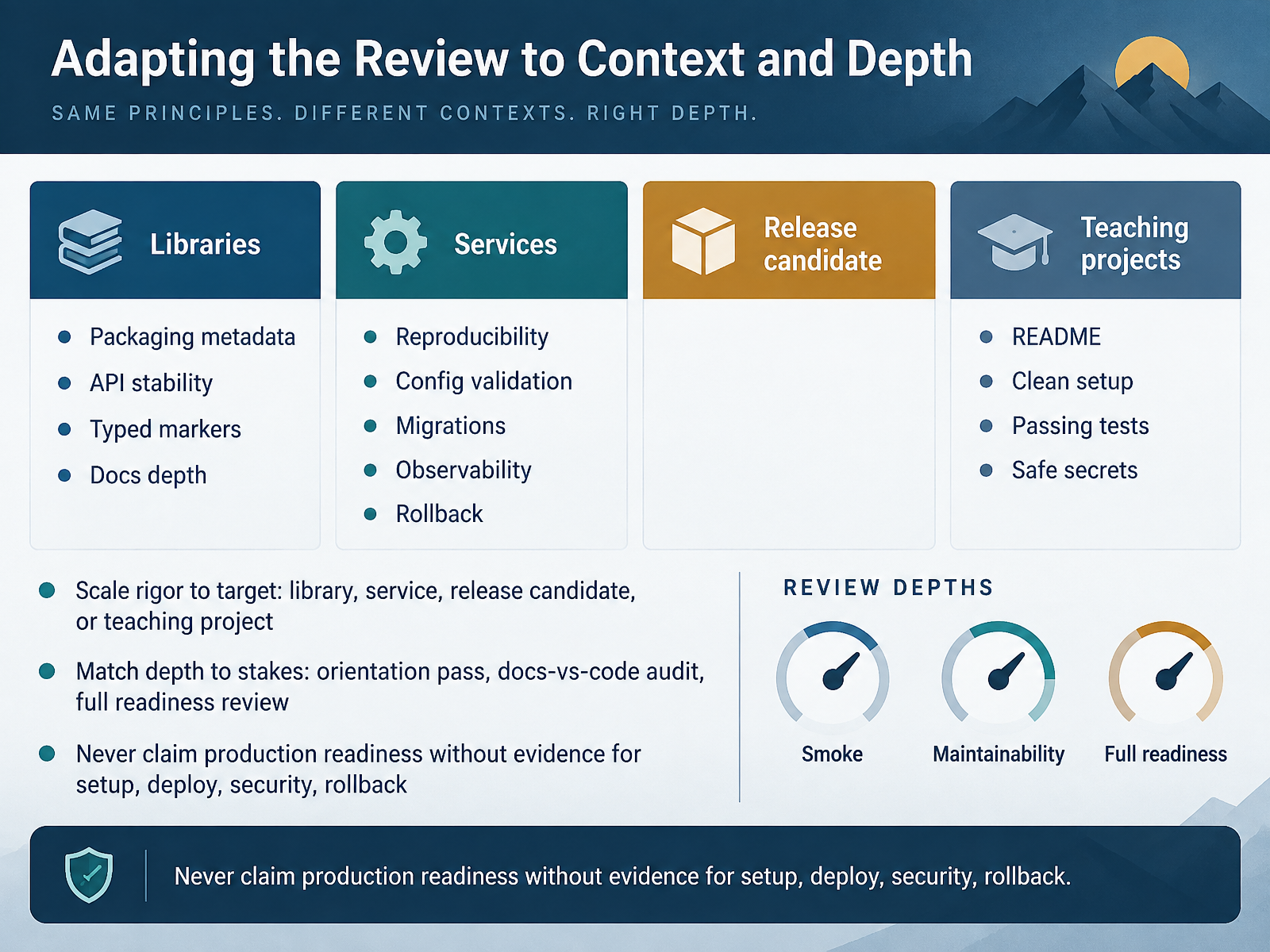
 - 12Adapting the Review to Context and DepthBefore you run a full review, decide how deep it needs to go. That decision depends on two things: the target you are reviewing, and the stakes involved. Scale your rigor to the target. A library, a service, a release candidate, and a teaching project each call for different checks. For libraries, focus on packaging metadata, API stability, typed markers, and documentation depth. Verify your pyproject dot toml is the single source of build config, that runtime dependencies use ranges rather than exact pins, and that the wheel ships a py dot typed file. For services, the emphasis shifts. You want reproducibility, config validation, database migrations, observability, and a rollback path. Check every runtime dependency and lock file, confirm secrets come from the environment, and look for something that actually verifies a published release. For teaching projects, keep it lean. A useful README, a clean setup that works from a fresh clone, passing tests, and secrets kept out of the repository. Then match depth to stakes. A thirty minute orientation pass gives you the project map and top blockers. A docs versus code audit checks whether the README claims hold up against the implementation. A full readiness review backs every claim with recorded command output. One hard rule applies across all of them. Never claim production readiness without evidence for setup, deployment, security, and rollback. Documentation describes intent. Only inspected output proves it works. Next, we put this into practice with the capstone: End to End Review Walkthrough and Scoring Rubric.
 augmentcode.commadhudadi.inpablogonzalez.me+22 min
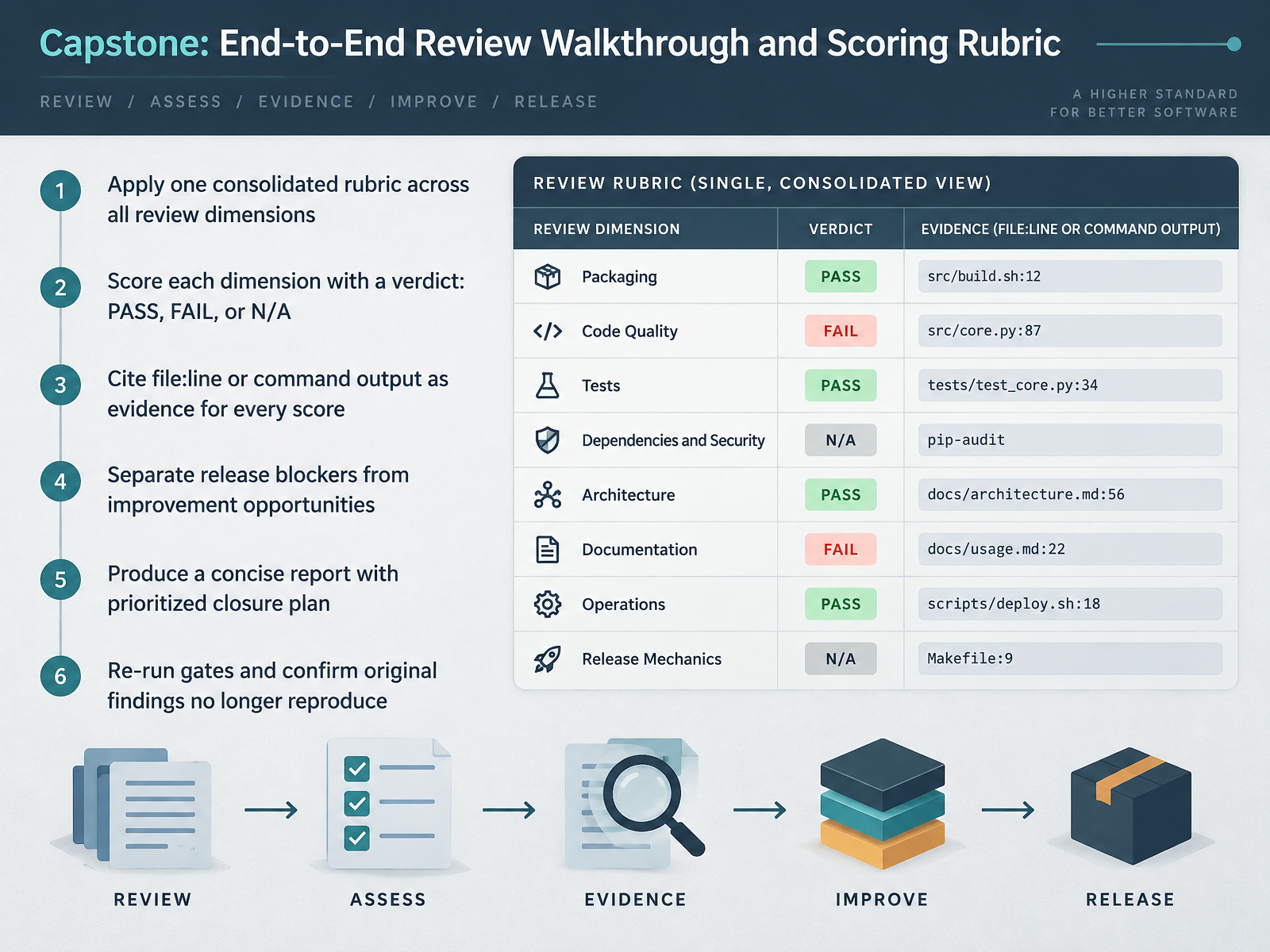
 - 13Capstone: End-to-End Review Walkthrough and Scoring RubricLet's close by putting the whole review into one pass. Apply a single consolidated rubric across every dimension, then score each one with a verdict: PASS, FAIL, or N/A. N/A is a real decision, not a blank. Every score needs evidence, so cite a file and line, or paste the command output you ran. Next, separate release blockers from improvement opportunities. Blockers make the project untruthful, unsafe, or unrunnable; everything else goes in the improvement column. Produce a concise report with a prioritized closure plan, worst-first. Finally, re-run your gates and confirm the original findings no longer reproduce. If a fix doesn't change the evidence, it isn't closed. That discipline is what turns a review into a decision. Thanks for working through this with me, and go review something real this week.
 augmentcode.commadhudadi.inpablogonzalez.me+22 min
Take the deck with you
Download this course as a file — free, no sign-up needed.
- PDF handoutEvery slide page, ready to print or share.14 pages · 3.6 MBDownload
- Narrated PowerPointThe deck that presents itself — every slide carries the digital human's narration video.14 pages · 14.6 MBDownload
- PowerPoint slidesThe full deck as a .pptx — open it in PowerPoint, Keynote, or Google Slides.14 pages · 3.6 MBDownload
Free to use in your own training — please keep the PersonWise credit page at the end.
Have your own deck? Turn it into a course
Sources consulted
Web sources consulted while building this course.
- Python Code Review Checklist: 25 Things to Check in 2026 | Augment Code — augmentcode.com
- An Opinionated Python Code Review Guide • Pablo González — pablogonzalez.me
- Python Code Review Best Practices + Checklist (2026) - kodus.io — kodus.io
- Code Review Best Practices: What to Look For and What to Skip | Mukul Kadel — mukulkadel.com
- Production-Ready Python Project Checklist for Developers | Madhu Dadi — madhudadi.in
- Writing your pyproject.toml¶ — packaging.python.org
- pyproject.toml specification ¶ — packaging.python.org
- PEP 621 – Storing project metadata in pyproject.toml | peps.python.org — peps.python.org
- Packaging Python Projects ¶ — packaging.python.org
- Configuring setuptools using pyproject.toml files ¶ — setuptools.pypa.io
- The Complete Python Code Quality Stack in 2026: Ruff + mypy — blog.marcosalonso.dev
- Enhancing Python Code Quality with Ruff, Black, and Mypy - Higherpass — higherpass.com
- Ruff vs mypy: open-source code quality and static analysis tools compared — freeqatools.com
- mypy vs Ruff: Linter & Formatter Comparison (2026) — Zaira Labs — zairalabs.ai
- Python Static Analysis and CI Integration | python-type-hints.com — python-type-hints.com
- GitHub Actions Python Testing: Complete pytest CI Guide — istranin.dev
- Continuous Integration and GitHub Actions | pytest-dev/pytest-cov | DeepWiki — deepwiki.com
- Coverage Measurement and Enforcement | PTD — python-testing-debugging.com
- Pytest Coverage with pytest-cov: Complete 2026 Guide | QASkills.sh — qaskills.sh
- Python Testing 2026: pytest, Coverage and CI | Vucense — vucense.com