Begin
14 pages · ~28 min
API Development Review Checklist
A step-by-step checklist for developers to review and validate API development processes, ensuring completeness and best practices throughout the build lifecycle.
A digital instructor presents all 14 pages. Hold “Ask” at any point and ask out loud — the answer comes from this course. No sign-up needed.
What you’ll learn
- 01API Development Checklist: A Step-by-Step ReviewWelcome. In this course, we are going to walk through a complete API development checklist. Think of this as a final code review, but applied to the entire lifecycle of an API, from the first design draft all the way to deprecation. The goal here is not just to check boxes. It is to build a muscle memory for spotting the issues that cause production incidents, overwhelm support teams, and make integrations painful for your consumers. We will move through fourteen focused sessions, each one mapped to a real review gate you will encounter in your own workflows. So, let's start by understanding exactly what is at stake when we skip these structured reviews.apiscout.devapiopscycles.comedilec.com+22 min
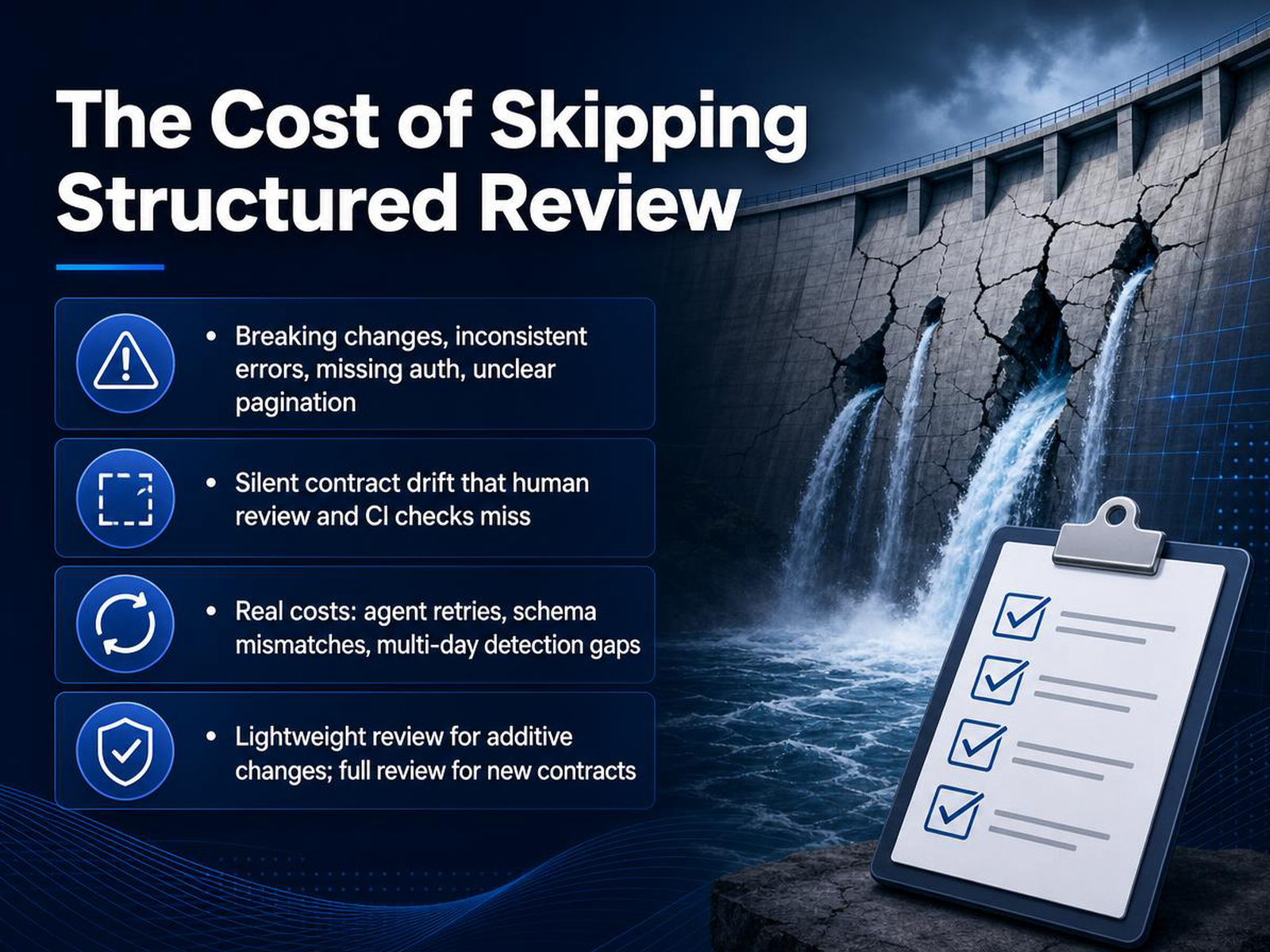
- 02The Cost of Skipping Structured ReviewNow let’s talk about why skipping a structured review is so expensive. The failures are rarely dramatic. They show up as breaking changes, inconsistent error shapes, missing authentication, or unclear pagination. These are silent contract drifts. They slip past human review, and they slip past CI, because the code still works. But the consumers are the ones that break. We see real costs from incidents like the field rename that took down payment processing at nineteen restaurants for nearly a week. Or agent retries that kept failing for two weeks, because nobody noticed the schema had moved. Detection gaps stretch for days, and the bill lands in lost revenue, emergency engineering time, and support overload. So make the review proportionate. Additive changes need a lightweight check. New contracts or breaking modifications need a full review. Don’t use one heavy process for everything. Next, we’ll start with the design review itself: contracts, naming, and versioning.
 tianpan.codatapace.aicoderifts.com+21 min
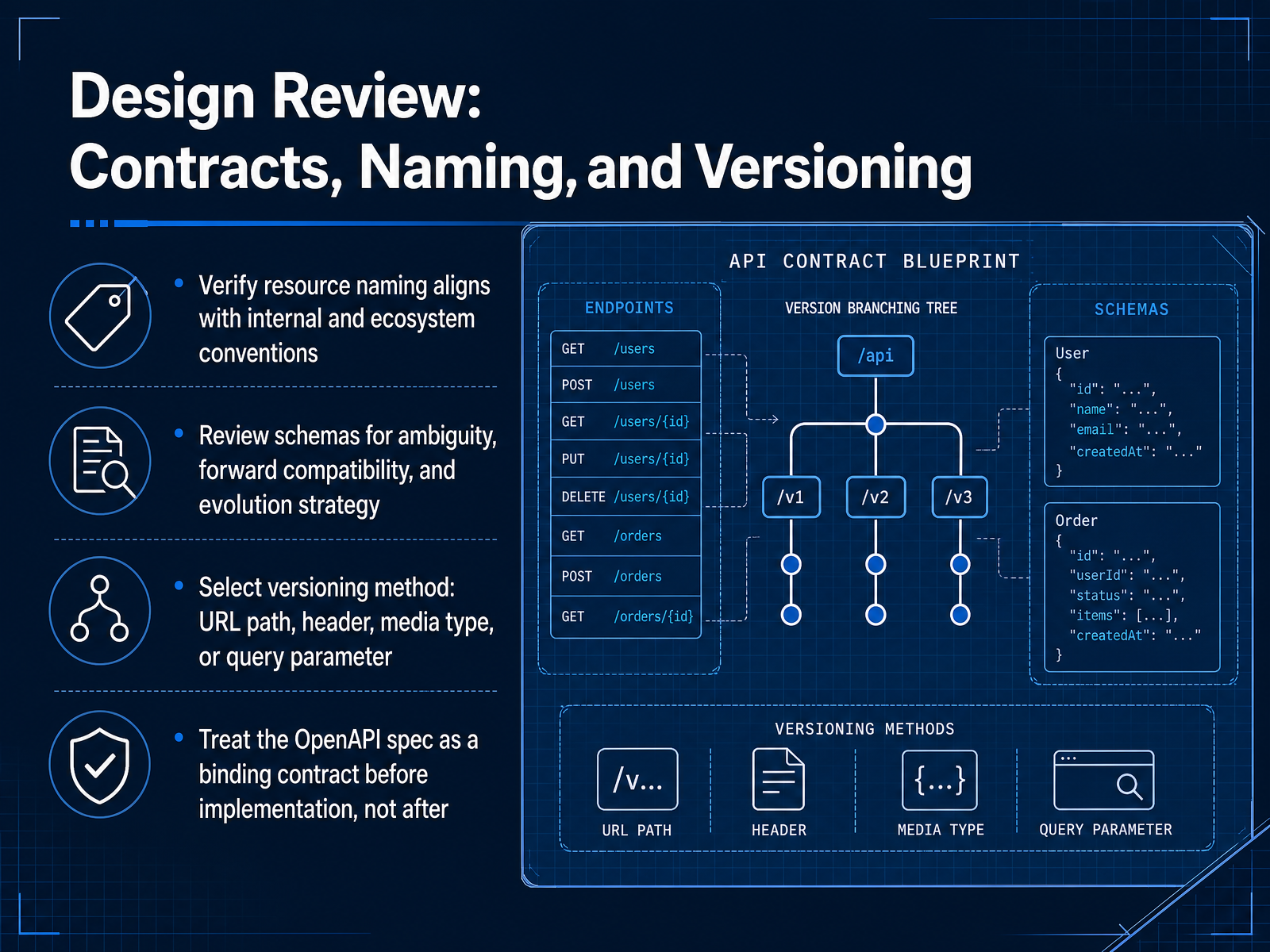
 - 03Design Review: Contracts, Naming, and VersioningNow we turn to the design review itself, starting with the contract, naming conventions, and versioning strategy. The first thing to verify is that resource naming aligns with both your internal standards and the broader ecosystem your developers expect. Inconsistent naming forces every consumer to memorize exceptions, and that friction compounds quickly. Next, review your schemas for ambiguity. Look for anything that could be interpreted in multiple ways, and think about how the schema will evolve. Adding optional fields is safe, but removing or renaming fields is a breaking change. Ask yourself now what will change in the next twelve months. For versioning, choose one method deliberately. URL path versioning is the most common choice for public APIs because it is explicit and cache friendly. Header or media type versioning keeps URIs cleaner but requires more client sophistication. What matters is deciding before you launch, not reacting after a breaking change. Finally, treat the OpenAPI spec as a binding contract. Write it, review it, and get sign-off before implementation begins. A spec generated from code after the fact often leaks internal names and lacks reviewed intent. Your takeaway for this slide: naming consistency, schema evolution, and explicit versioning are design decisions, not afterthoughts. With the design locked down, we can move on to security and access control checks.
 archman.devozimmer.chletsbuildsolutions.com+22 min
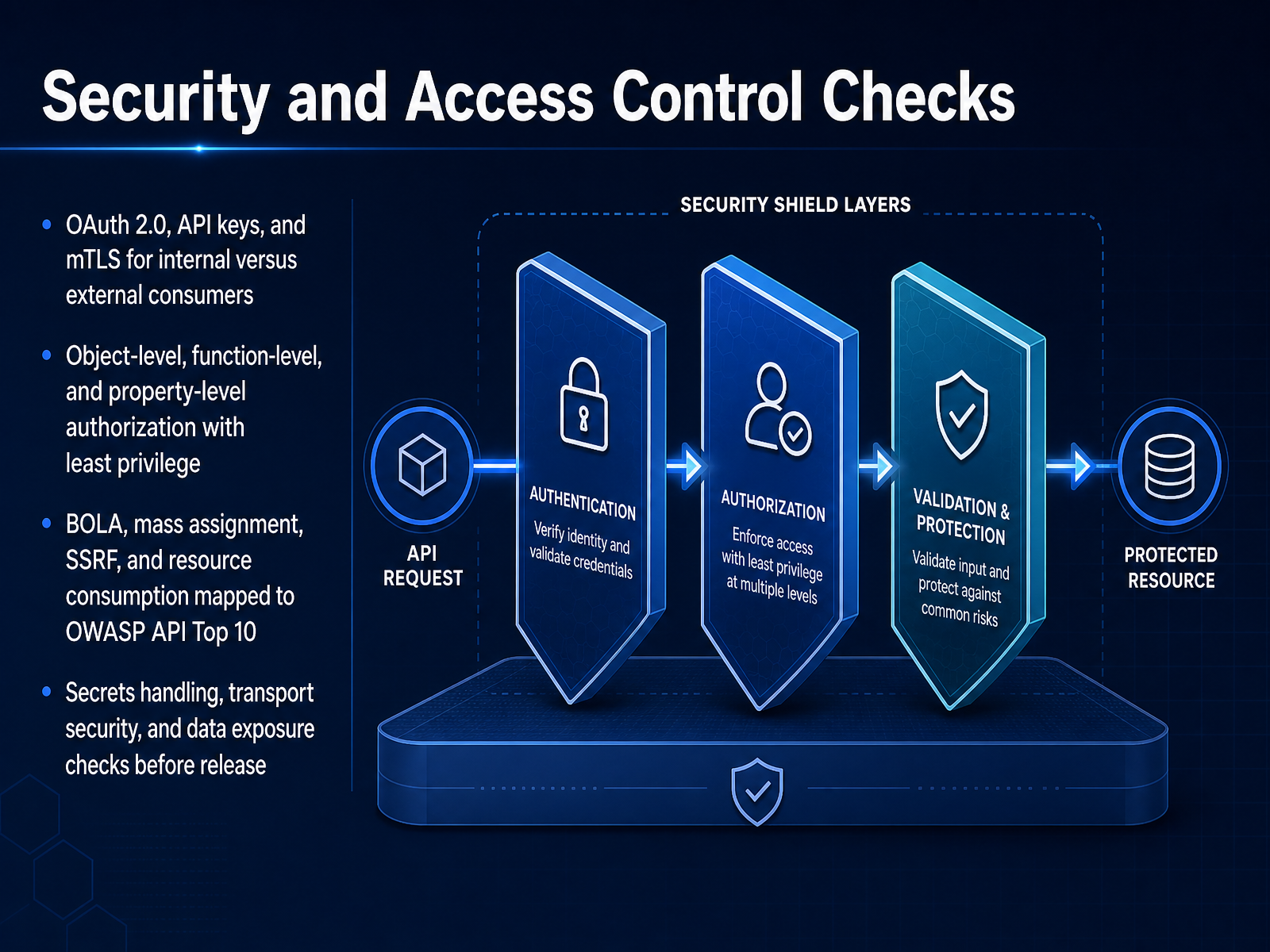
 - 04Security and Access Control ChecksNow let's move into a critical section: security and access control checks. First, get your authentication model right from the start. Use OAuth 2.0 or API keys for external consumers, and reserve mTLS for internal service-to-service calls. The mechanism changes, but the principle does not: every non-public endpoint must reject requests with no token. Next, enforce authorization at every layer. Check object-level access, so a user cannot read another user's record by changing an ID. Check function-level access, so normal users cannot reach administrative endpoints. And check property-level access, so users cannot overwrite protected fields like role or price through mass assignment. All of this follows a simple rule: least privilege, nothing more. Then map your risks to the OWASP API Top Ten. Treat BOLA, mass assignment, SSRF, and resource consumption as release blockers, not backlog items. For example, an SSRF vulnerability in a callback or webhook parameter can expose internal cloud metadata, so validate and deny private address ranges. Finally, review secrets handling, transport security, and data exposure. Enforce HTTPS with HSTS, keep service-role secrets server-side only, and ensure sensitive fields never appear in public responses. Your takeaway: authorization failures and leaked secrets are the most common and most damaging API vulnerabilities, and they are both avoidable. Next, we will cover error handling standards.
 owasp.orggithub.comgithub.com+22 min
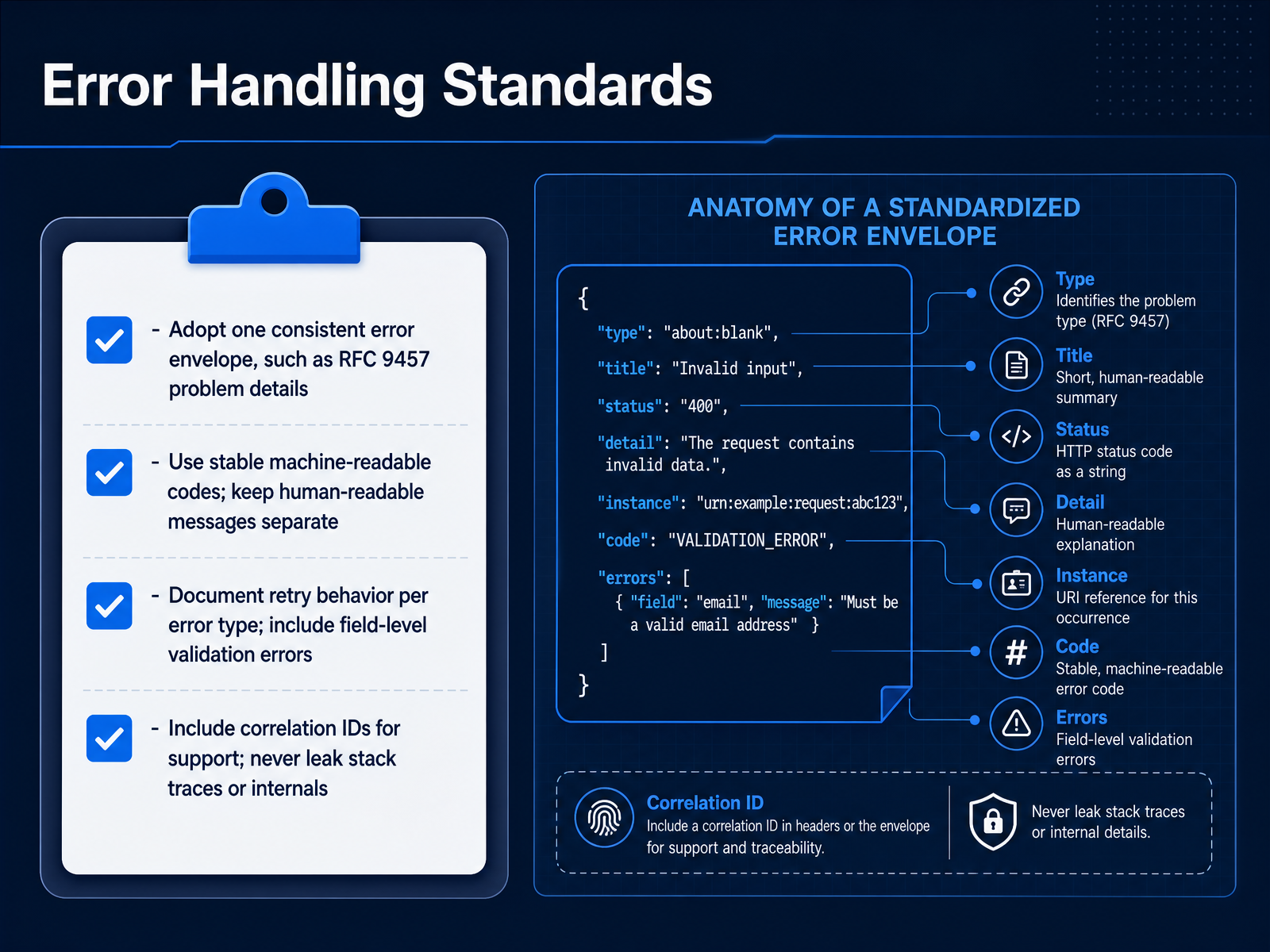
 - 05Error Handling StandardsNext, let's talk about error handling standards, because every error response is part of your API contract. The first rule is simple: adopt one consistent error envelope across every endpoint. RFC 9457 problem details is a strong default, but if your team already has a stable envelope, keep it. The key is that clients parse once and reuse that logic everywhere. Second, separate machine-readable codes from human-readable messages. Clients should branch on stable identifiers, not on text that will change for localization or clarity. Third, document retry behavior for every error type. Is it safe to retry? When? With what delay? And for validation errors, include field-level detail so clients can point the user to the exact input that failed. Finally, include a correlation ID in every error response for support, and never leak stack traces, SQL fragments, or internal hostnames. Your error body is a public interface, not a debugging tool. Next, we'll move into observability and alerting requirements.
 archman.devozimmer.chletsbuildsolutions.com+21 min
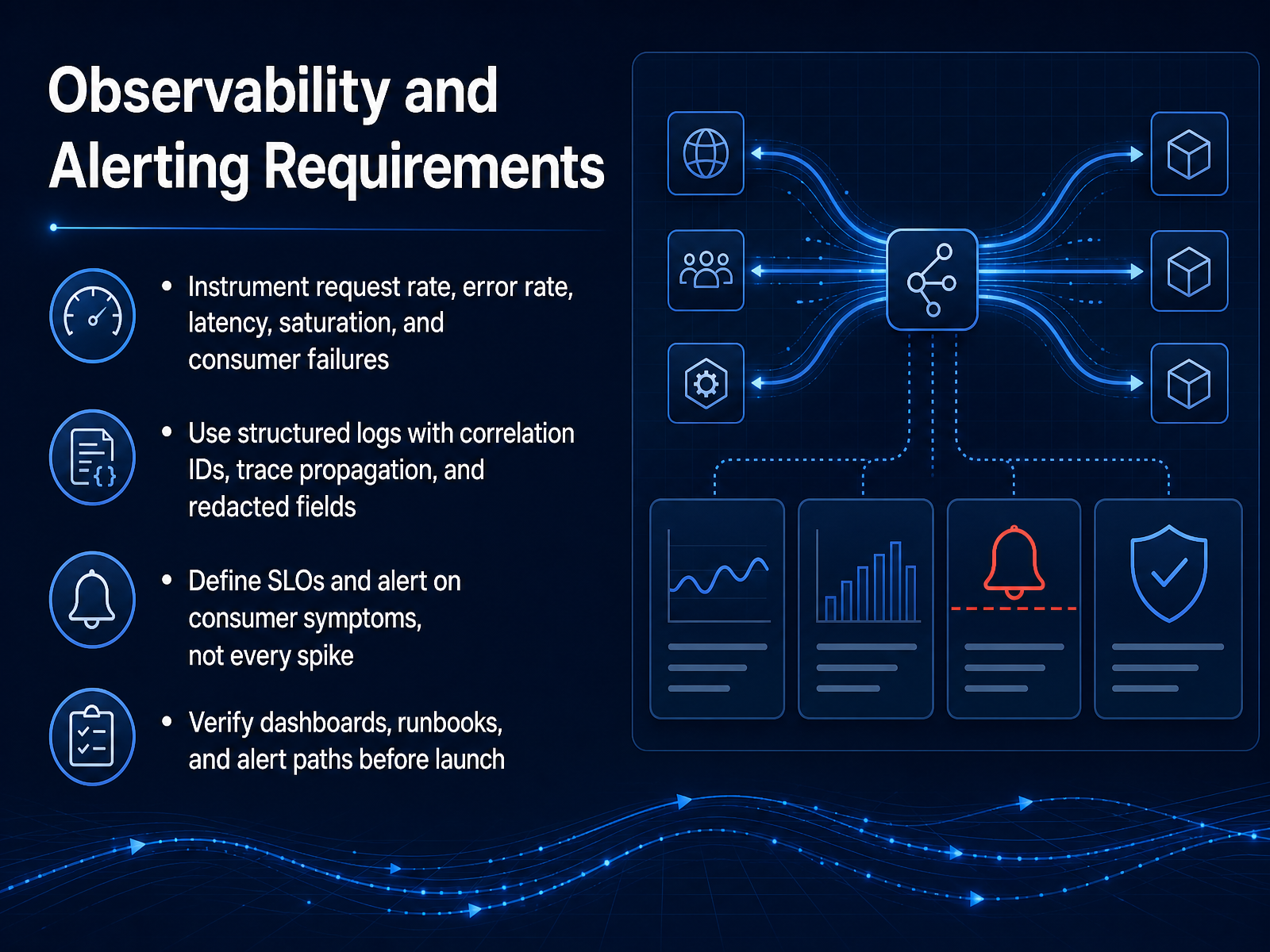
 - 06Observability and Alerting RequirementsNow let's talk about observability and alerting, because this is where your API proves it can survive real traffic. First, instrument the basics: request rate, error rate, latency, saturation, and consumer failures. These five signals tell you whether the system is healthy from the consumer's perspective, not just your own. Second, use structured logs with correlation IDs and trace propagation. Every request should carry an ID that travels across services, and sensitive fields must be redacted before anything hits the logs. Third, define SLOs and alert on consumer symptoms, not every spike. A noisy alert causes fatigue. A clear error budget burn tells your team when action actually matters. Finally, verify dashboards, runbooks, and alert paths before launch. If the dashboard is missing a key metric, or the runbook points to the wrong on-call rotation, you will discover it in the worst possible moment. Takeaway: observability is not a post-launch add-on. It is part of the contract. Up next, we will examine performance, pagination, and rate limiting.
 apiscout.devapiopscycles.comedilec.com+22 min
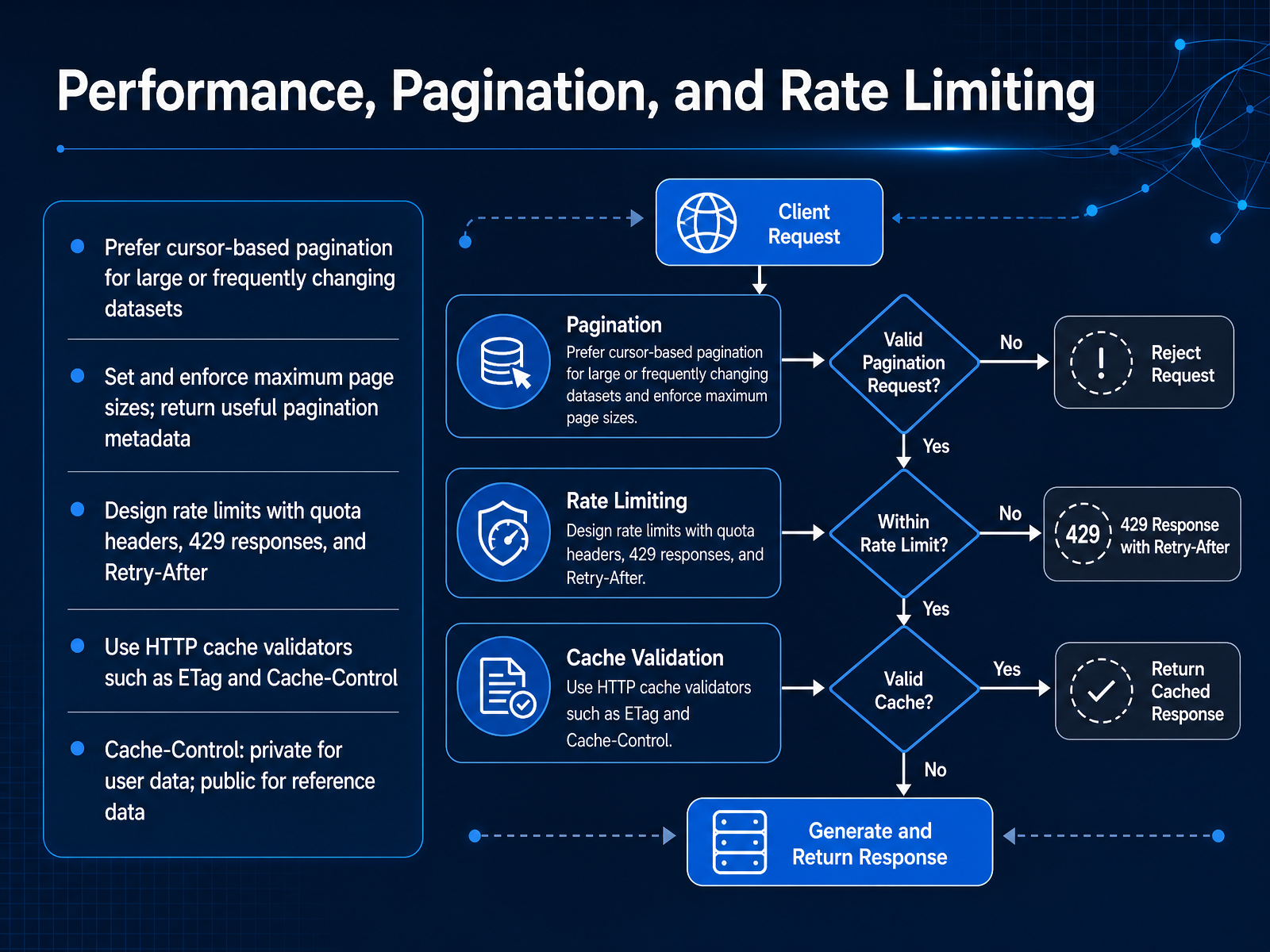
 - 07Performance, Pagination, and Rate LimitingNow let's look at the operational side of your API. The goal here is to protect performance and give clients enough information to behave well. First, prefer cursor-based pagination for large or frequently changing datasets. Offset-based pagination forces the database to scan and discard rows, and it drifts when new records are inserted. Cursors stay stable and perform consistently. Second, set and enforce a maximum page size. Always return metadata like next cursor and a has more flag. Third, design rate limits with quota headers, a 429 response, and a Retry-After header. Clients need to know when to retry. Fourth, use HTTP cache validators like ETag and Cache-Control. This lets clients revalidate with a 304 and avoid redundant work. Finally, set Cache-Control to private for user data and public for reference data. That keeps sensitive responses out of shared caches. The key takeaway: pagination and caching are not just features. They are contracts with your clients. Next, we'll cover idempotency and safe retries.
 archman.devozimmer.chletsbuildsolutions.com+21 min
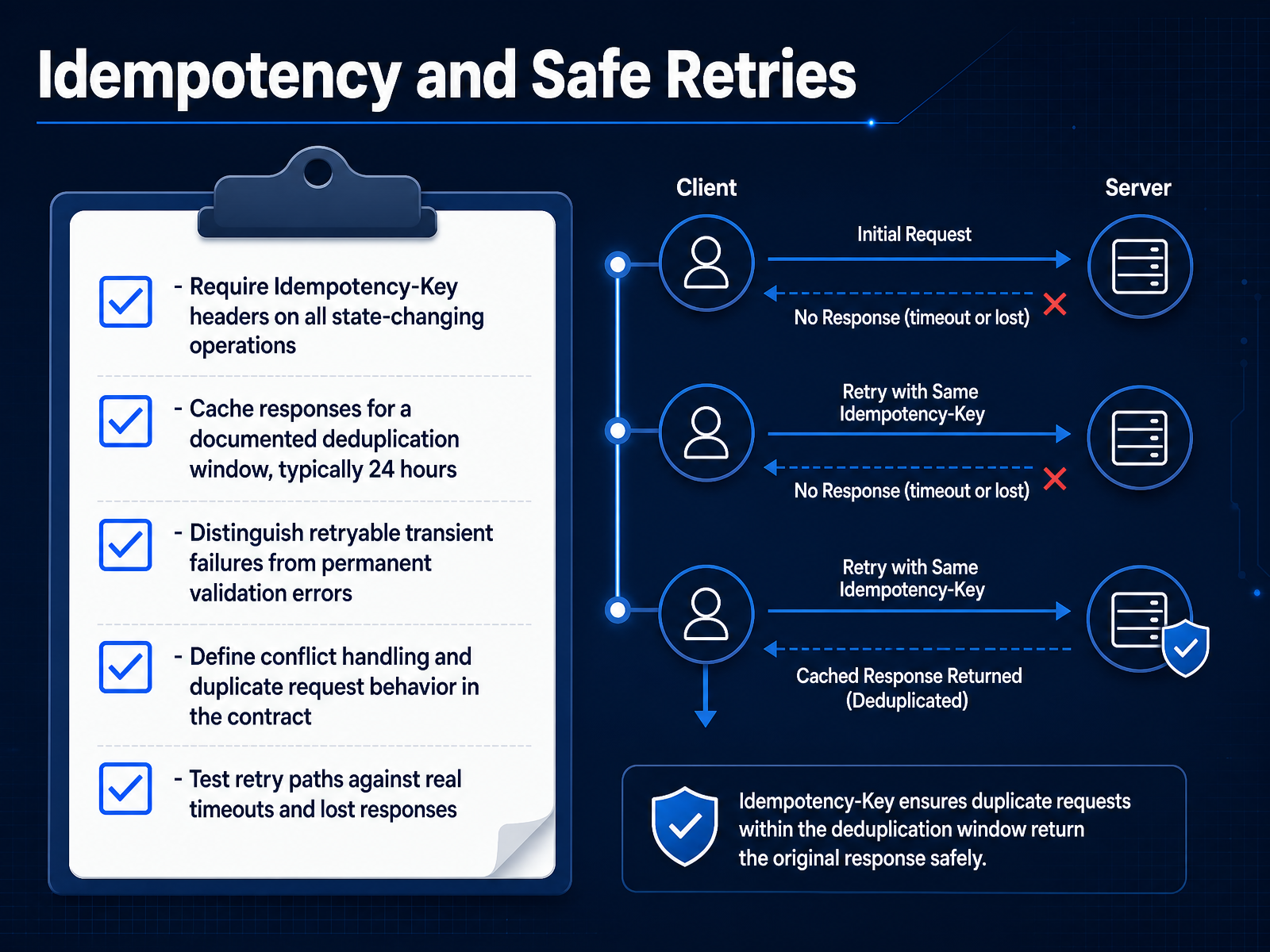
 - 08Idempotency and Safe RetriesNow let's talk about making retries safe with idempotency. The core rule is to require an Idempotency-Key header on every state-changing operation. This client-generated token lets the server deduplicate requests, so a timed-out payment is not charged twice. Cache those responses for a documented window, usually twenty-four hours, matching the Stripe convention. Next, distinguish retryable transient failures from permanent validation errors. A network timeout is safe to retry, but a four hundred error is not, and conflating them is how retry loops burn budget. Your API contract must also define conflict handling and duplicate request behavior clearly, so a repeated key with a different payload returns a clear error. Finally, test retry paths against real timeouts and lost responses, not just the happy path. A retry that has never been induced in testing is a guess in production. Keep this simple: idempotency turns uncertain retries into deterministic outcomes. Next, we will look at testing and pre-release verification.
 tianpan.codatapace.aicoderifts.com+21 min
 - 09Testing and Pre-Release VerificationNow let's talk about the testing and verification work that has to happen before release. And I want to be direct here: the happy path test suite is not enough. You need five specific layers. Contract tests to prove the shape still matches. Integration tests to prove the wiring works. Load tests to prove it holds up under real traffic. Negative tests to prove it fails cleanly. And backward compatibility tests to prove your old clients keep working. To catch breaking changes early, run spec diffs on every pull request, and add consumer driven contract tests so you're checking what real clients actually depend on, not just what your own spec says. For examples and edge cases, use mock servers and sandbox environments. That lets you exercise weird inputs, missing fields, and error paths without risking anything. But here's the key. Verify compatibility against real production traffic, not just spec diffs. A field can exist in the spec but never appear in real responses. Shadow your logs, run schema validation against actual payloads, and surface what is really there. That's what protects your consumers. Next, we'll review documentation and the developer experience.
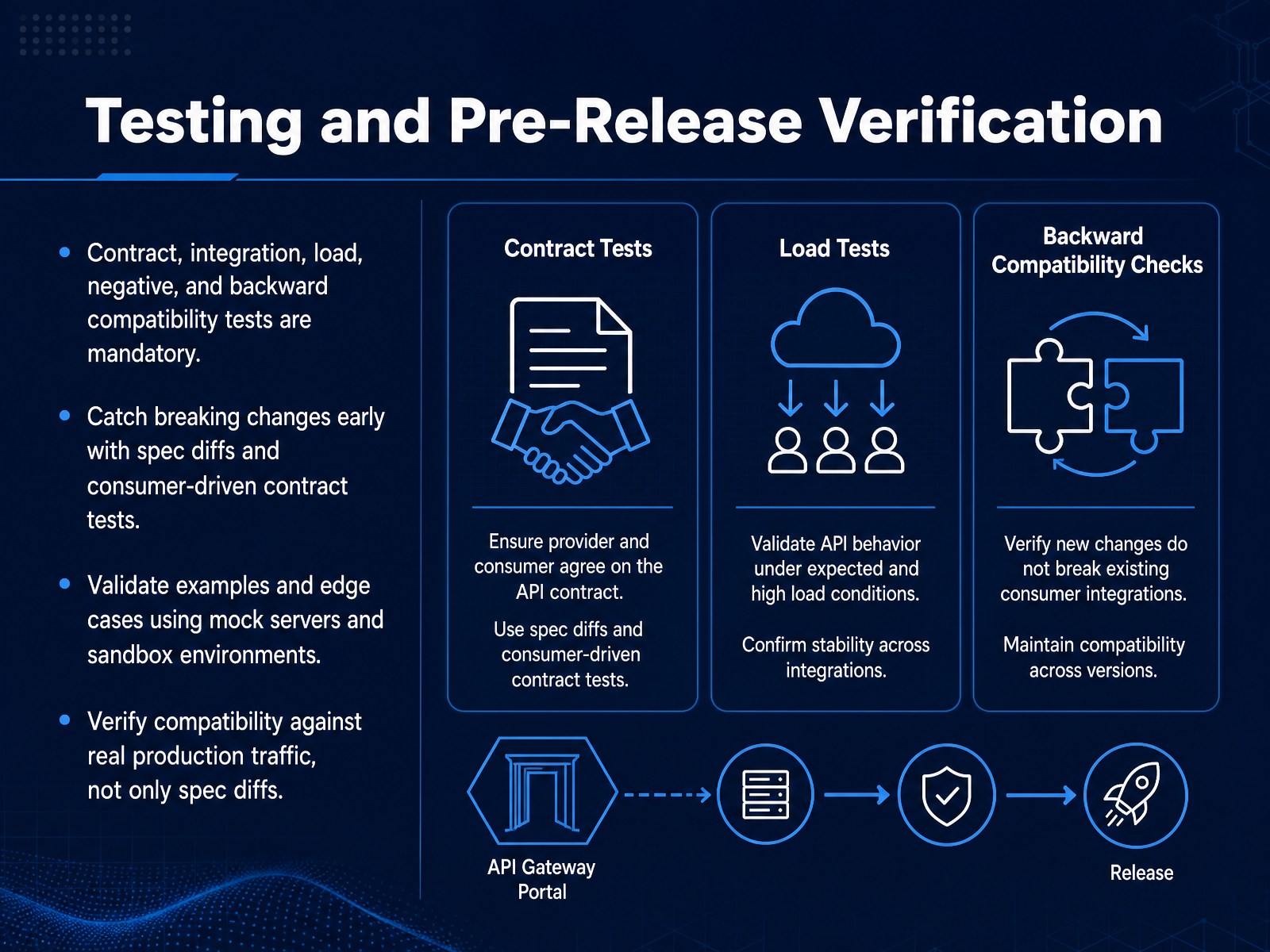 spec-coding.devarchman.devozimmer.ch+22 min
 - 10Documentation and Developer Experience ReviewLet's shift now to documentation and developer experience, because this is where your API review either builds trust or quietly loses it. First, scan every endpoint reference for accuracy. Are the paths correct, are the parameters correctly marked required, and do the examples reflect real data? Next, confirm that your quick-start guides walk a new developer through a working first call. If a junior engineer cannot get a successful response within five minutes by following the guide alone, that is a documentation bug. Third, check the interactive experience. Can developers try requests directly from the docs, generate a client SDK without errors, and understand the authentication flow from the examples themselves? If any of those steps requires guessing, flag it. Fourth, review your changelog and migration guides. Breaking changes need clear before-and-after examples, and deprecated endpoints need explicit notices with a timeline. Treat documentation as part of the release, not a follow-up ticket. Lint the OpenAPI spec in CI, test the documented examples against staging, and fail the build when the spec is invalid. The core takeaway is simple: if your docs do not pass the same quality gate as your code, your developers are already debugging from a contract that is lying to them. Coming up next, we'll look at the pre-launch review workflow for teams.
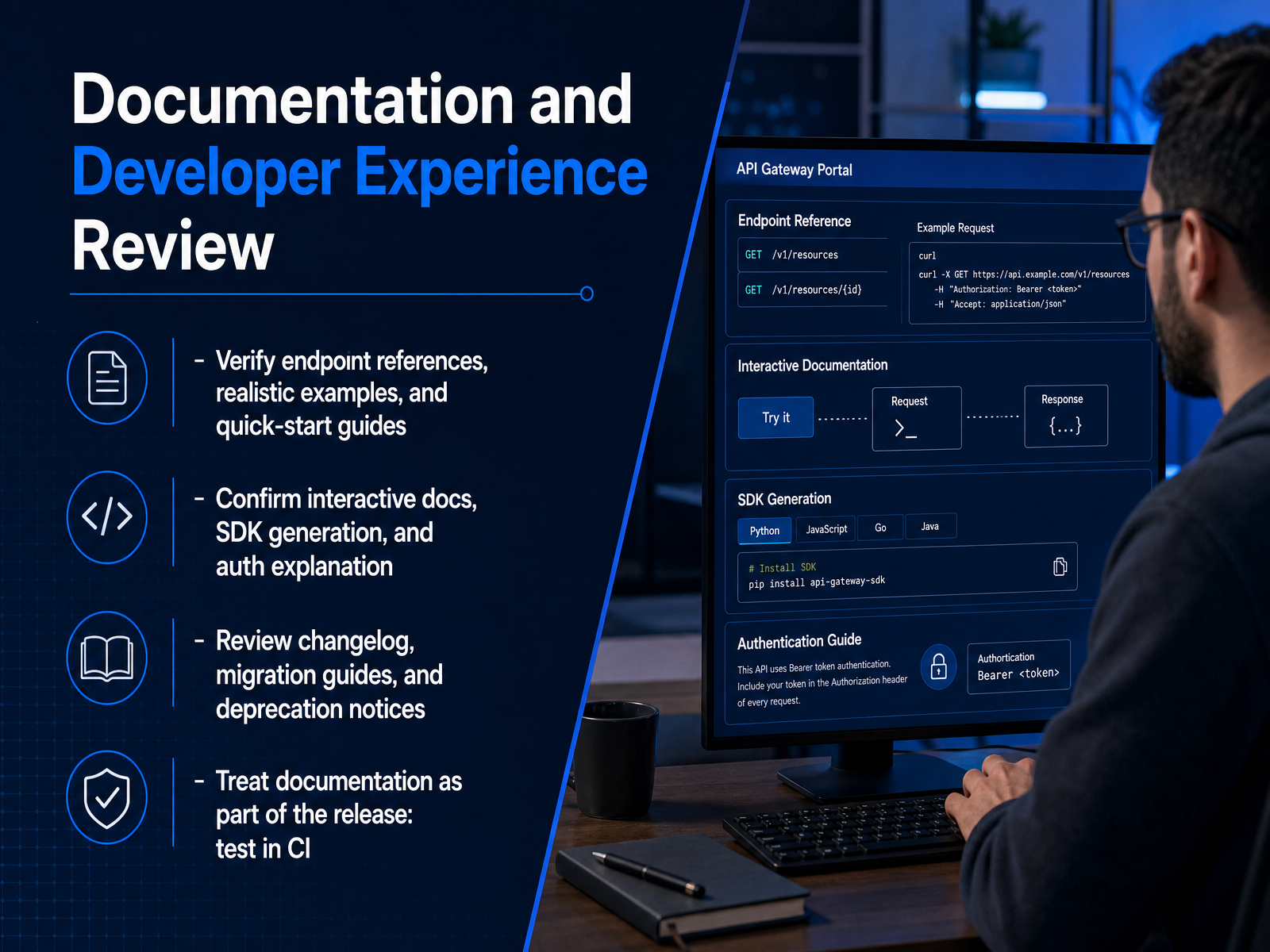 archman.devozimmer.chletsbuildsolutions.com+22 min
 - 11Pre-Launch Review Workflow for TeamsLet's talk about making the final review workflow a team practice. Start by assigning clear owners for design, security, documentation, and operational readiness. This prevents anything from falling through the cracks. Then, automate what a machine can check. CI gates, OpenAPI linting, and breaking change detection should run on every pull request. This catches structural regressions before a human even looks at the code. Reserve human review for what automation cannot catch, like semantics and intent. Use async reviews for additive changes, but schedule a synchronous session for brand new APIs or changes to existing contracts. That meeting is where you make explicit decisions about compatibility. The key takeaway is this: combine automated checks with human judgment. The automation keeps the floor safe, and the review session raises the ceiling. Next, we will look at post-release monitoring and feedback loops.
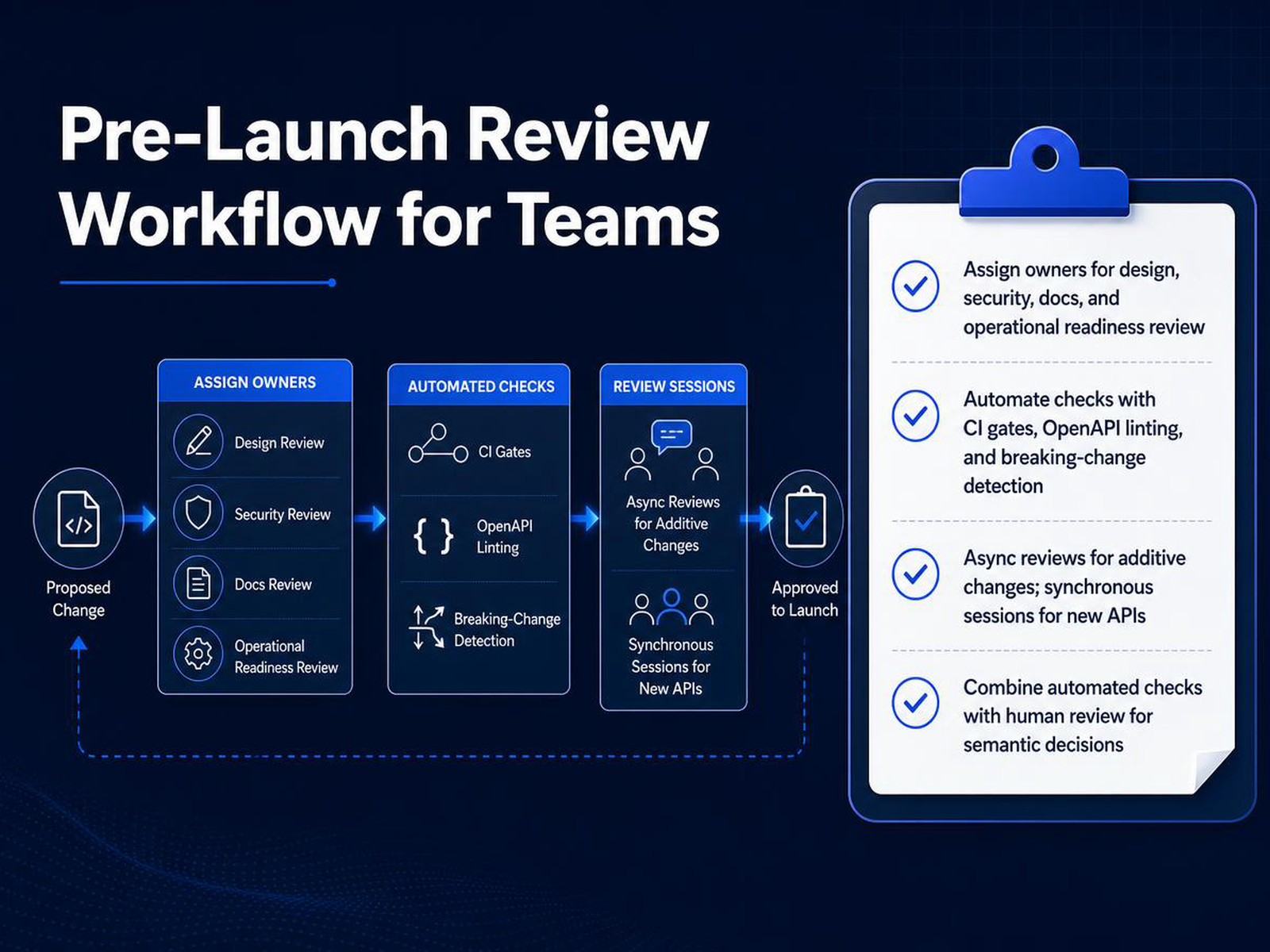 letsbuildsolutions.comarchman.devozimmer.ch+21 min
 - 12Post-Release Monitoring and Feedback LoopsNow let's talk about what happens after the launch, because shipping is where the real feedback begins. Your release checklist should set up a monitoring loop that tells you how the API is actually performing. Watch adoption to see who is using it, error rates to catch breaking issues, latency to spot performance problems, and support tickets to hear what is confusing people. You also need to track usage of deprecated endpoints and measure whether customers are migrating to newer versions. Treat support tickets and incident reviews as direct input to improve your checklist. If a problem escaped your process, that is a gap worth closing. Finally, measure the health of your governance program itself. Check your API registry coverage, your lint pass rate, and the number of defects that escaped into production. These numbers tell you if your checks are actually working. Next, we will look at how to plan deprecation and communicate changes to your consumers.
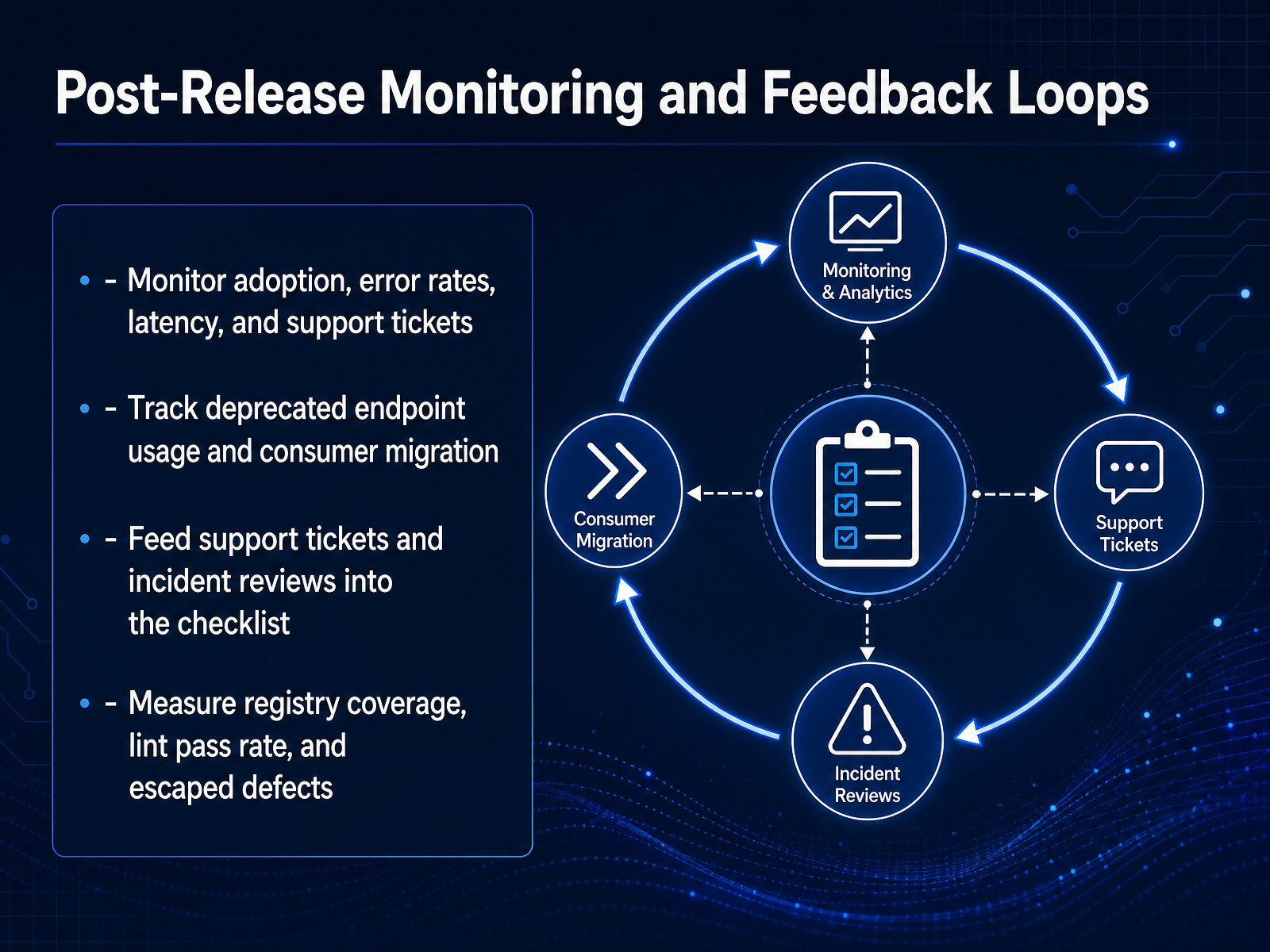 apiscout.devapiopscycles.comedilec.com+21 min
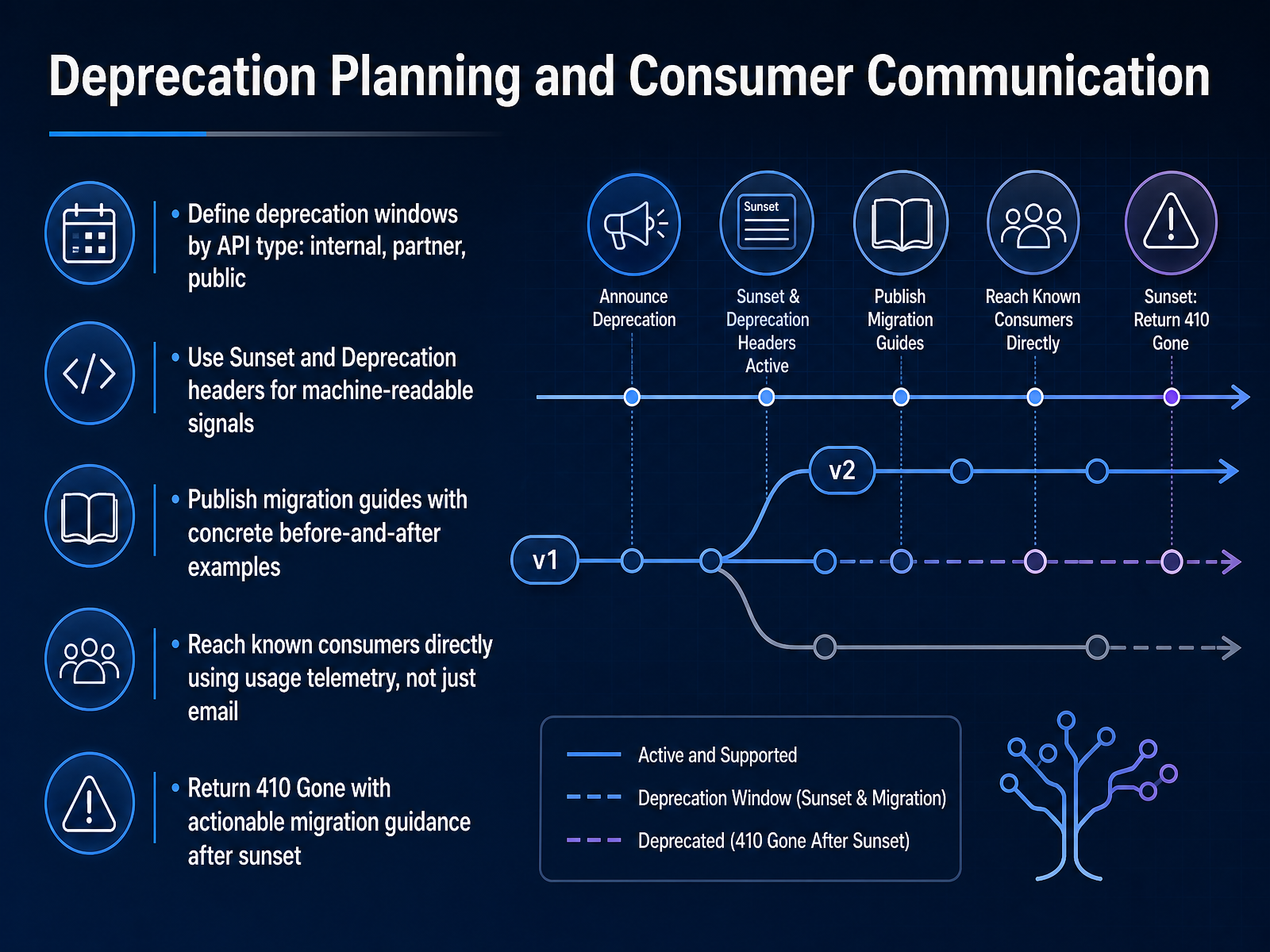
 - 13Deprecation Planning and Consumer CommunicationNow let’s talk about deprecation planning and how we communicate it to consumers. The first step is to define deprecation windows by API type. Internal APIs can move faster, often within one to three months. Partner APIs need more runway, typically three to six months. And public APIs require the most notice, usually six to twelve months. Use Sunset and Deprecation headers to make this machine-readable. These headers tell monitoring tools and client code exactly when a resource will disappear. Next, publish migration guides with concrete before-and-after examples. Show the old request and response next to the new one, so developers do not have to guess what changed. Also, reach known consumers directly using usage telemetry, not just broadcast email. Your logs show exactly who is still calling the old endpoint, and that data drives better, more personal outreach. After the sunset date, return 410 Gone with actionable migration guidance. Do not return a generic 404. The response body should name the replacement endpoint and link to the migration guide. That is the difference between a controlled retirement and a support ticket storm. Up next, we will cover putting the checklist into practice.
 archman.devozimmer.chletsbuildsolutions.com+22 min
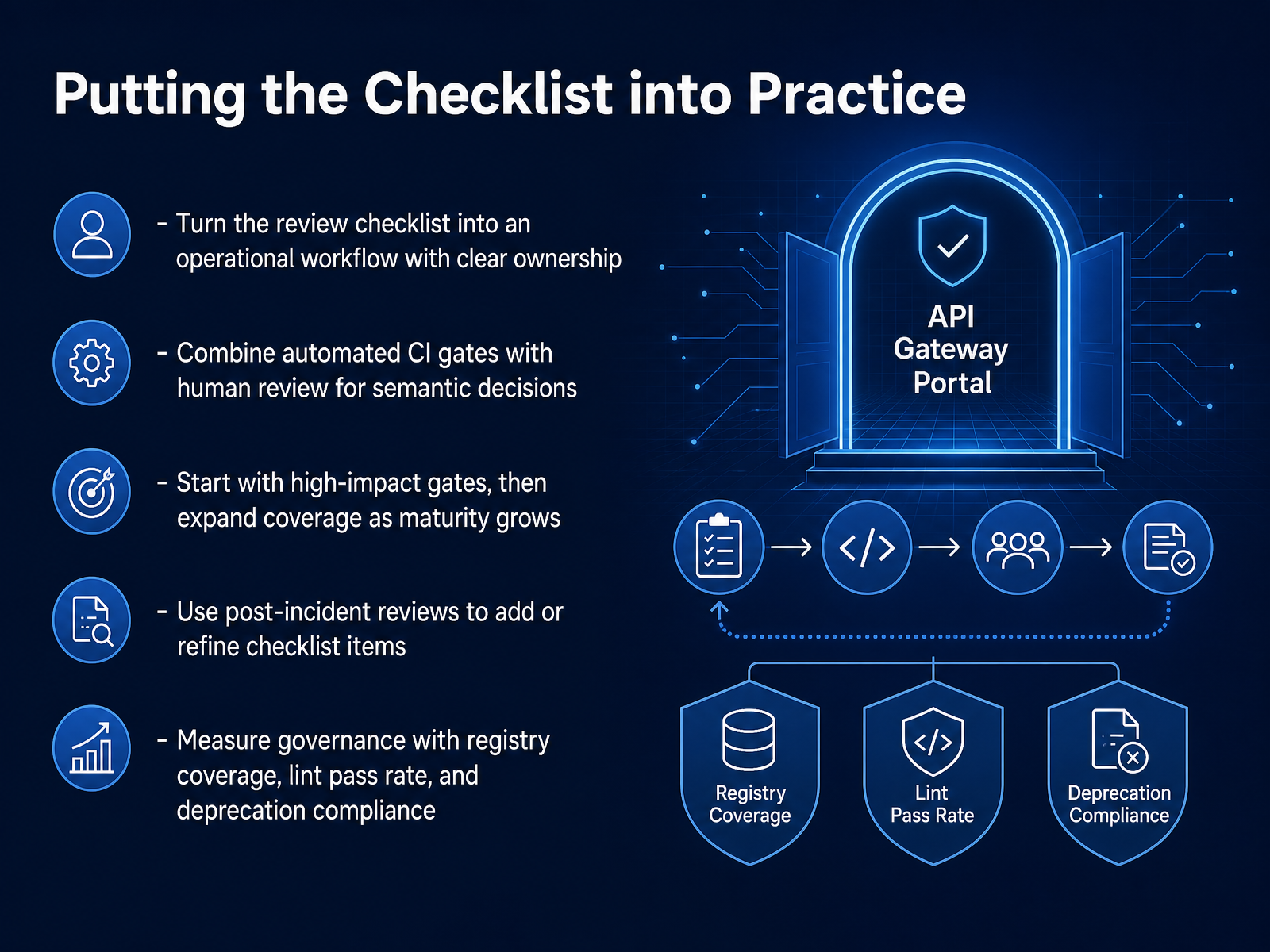
 - 14Putting the Checklist into PracticeLet's close by turning this checklist into a living workflow. Don't let these recommendations sit in a document; assign clear ownership for each gate. Someone needs to be accountable for the review process, or it will quietly fade away. Next, find the right balance between automation and judgment. Let your CI pipeline enforce structural rules like linting and breaking change detection, but keep human reviewers focused on semantic decisions that a machine simply cannot make. Start small and aim for precision. Pick a few high-impact gates, enforce them well, and then expand coverage as your process matures. Treat your checklist as an evolving asset: when an incident happens, use that postmortem to add or refine a specific item. Finally, measure what you manage. Track metrics like registry coverage, lint pass rates, and deprecation compliance to prove your governance is actually working. Remember, a checklist only creates value when it drives consistent action. Thank you for joining this review, and good luck applying these practices to your own APIs.
 apiscout.devapiopscycles.comedilec.com+22 min
Take the deck with you
Download this course as a file — free, no sign-up needed.
- PDF handoutEvery slide page, ready to print or share.15 pages · 3.7 MBDownload
- Narrated PowerPointThe deck that presents itself — every slide carries the digital human's narration video.15 pages · 15.7 MBDownload
- PowerPoint slidesThe full deck as a .pptx — open it in PowerPoint, Keynote, or Google Slides.15 pages · 3.7 MBDownload
Free to use in your own training — please keep the PersonWise credit page at the end.
Have your own deck? Turn it into a course
Sources consulted
Web sources consulted while building this course.
- API Governance for Enterprise Teams 2026 | APIScout — apiscout.dev
- API Development Best Practices | APIOps Cycles — apiopscycles.com
- API Platform Design Before Development: Contracts, Governance and Operations | Edilec — edilec.com
- 16 REST API design best practices and guidelines | TechTarget — techtarget.com
- Designing APIs That Scale: 150+ Project Lessons | Soamee — soamee.com
- The Tool Schema Migration That Broke Your Agent's Retries for Two Weeks — tianpan.co
- One CI check would have caught both of Railway's billion-row Postgres migration outages | Datapace — datapace.ai
- How a Field Rename Broke 19 Restaurants for a Week | CodeRifts Blog — coderifts.com
- Post Incident Report: 2026-07-14 Bitbucket OAuth Change Causes Login Failures and Workflow Issues - Announcements - CircleCI Discuss — discuss.circleci.com
- Postmortem: The July 21 TLS Certificate Incident on api.mailchannels.net - MailChannels Blog — blog.mailchannels.com
- API Review Checklist | ArchMan — archman.dev
- API Design Review Checklist: Questions Concerning the Developer Experience (DX) — ozimmer.ch
- Running API Design Reviews: Contracts, Backward Compatibility, and Change Management — Let's Build — letsbuildsolutions.com
- API Contract Checklist for Reliable Releases | Spec Coding — spec-coding.dev
- API Review Workflow | Normalize — docs.rhi.zone
- API Security Risks - OWASP API Security Top 10 — owasp.org
- OWASP/www-project-api-security-testing-framework — github.com
- 0x48756773/OWASP-API-Checklist — github.com
- OWASP API Security Top 10 (2025): Guide with Tests & Fixes | Qodex.ai — qodex.ai
- API Security Checklist: 25 Checks (OWASP API Top 10, 2026) | Nurbak — nurbak.com