Enlightenment Ideas and Global Impact
Begin
14 pages · ~28 min
Enlightenment Ideas and Global Impact
This training explores the Enlightenment's core ideas, historical context, and global impact, helping learners understand its significance in world history.
What you’ll learn
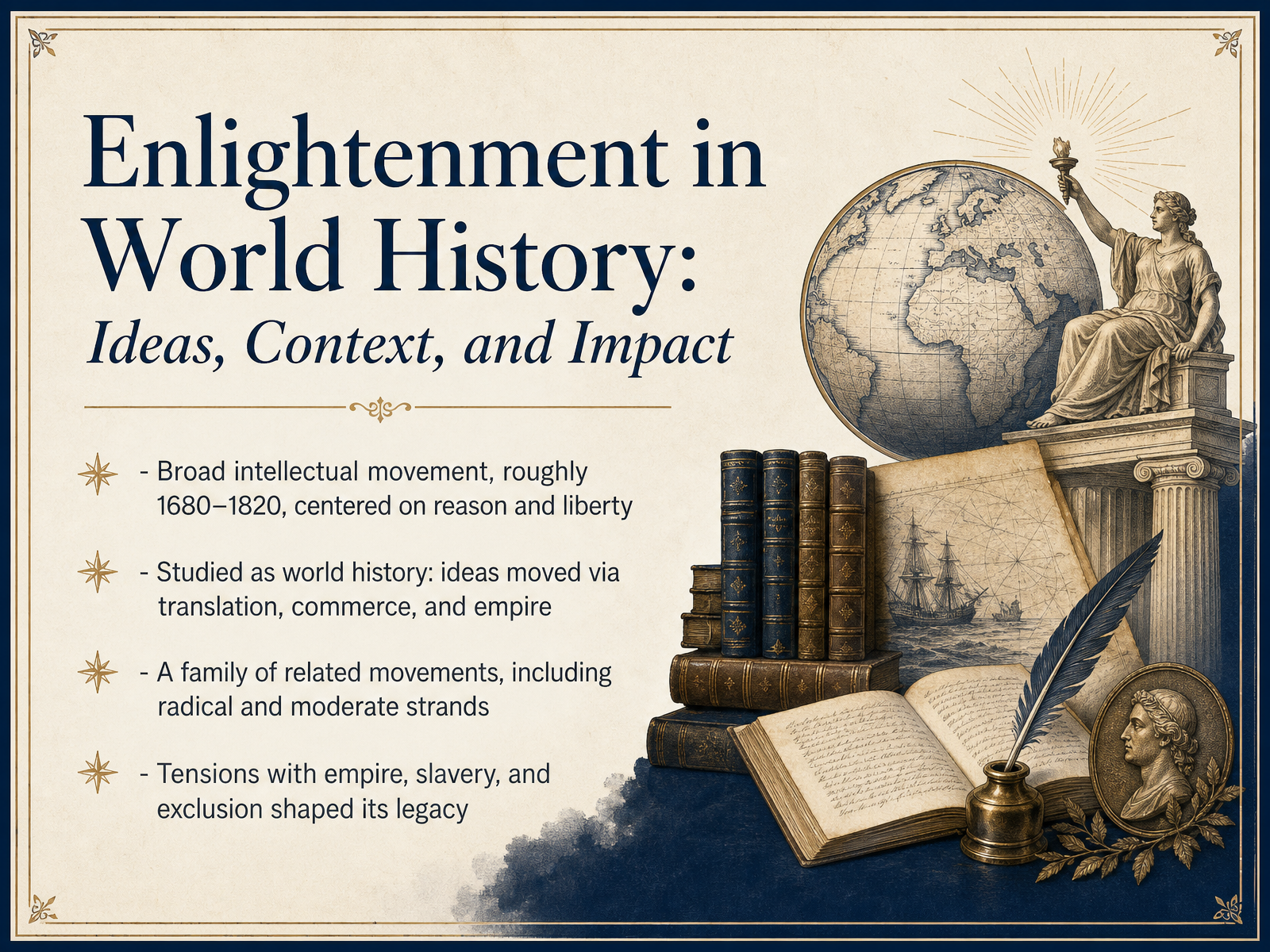
- 01Enlightenment in World History: Ideas, Context, and ImpactWelcome. In this course, we are going to explore the Enlightenment not as a single, fixed event, but as a broad intellectual movement that unfolded roughly between 1680 and 1820. Think of it as a family of related movements, centered on reason and liberty, but always shaped by the worlds it touched. We will study it as world history. Ideas traveled through translation, commerce, and empire. Coffeehouses in London buzzed with debates that had roots in Paris, Istanbul, and Beijing. Some strands were radical. Others were moderate. And this movement carried real tensions. Empires that spoke of natural rights also practiced slavery. Thinkers who praised liberty could still exclude women, the enslaved, and colonized peoples. Those tensions are not side notes. They shaped the Enlightenment's legacy. So as we move through these slides, keep that bigger picture in mind. We are not just memorizing names and dates. We are tracing how ideas moved, collided, and left lasting marks. Next, we will turn to the intellectual foundations and core ideas that grounded these debates.sts.wisc.edukops.uni-konstanz.decambridge.org+22 min
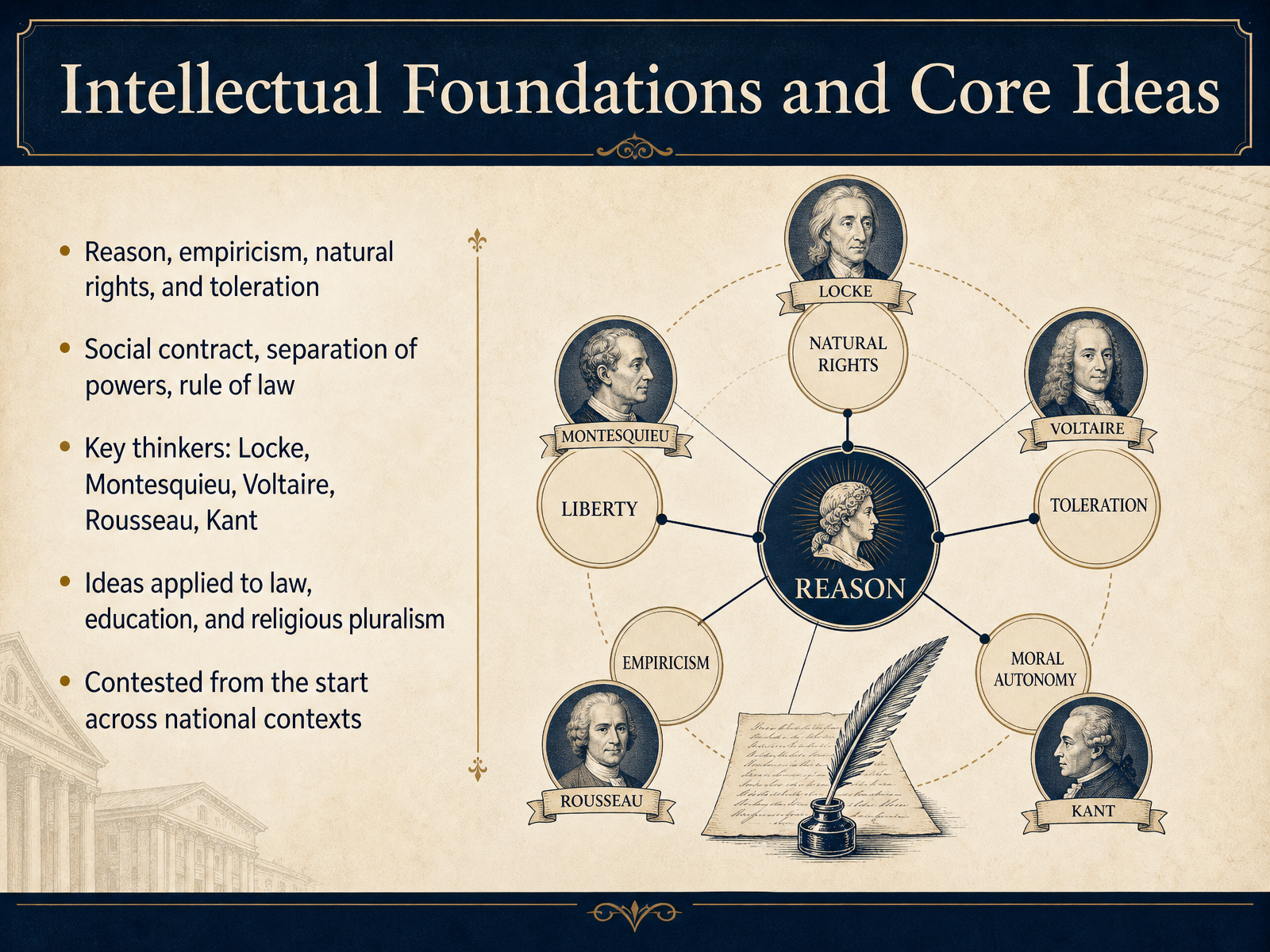
- 02Intellectual Foundations and Core IdeasNow let's look at the intellectual foundations that made the Enlightenment so powerful. Reason, empiricism, natural rights, and toleration became the era's guiding lights. Think of natural rights as freedoms you are born with, not gifts from a ruler. The social contract imagined government as an agreement, not a command. Locke insisted on that. Montesquieu separated powers so no single branch could rule alone. Voltaire fought for tolerance, Rousseau for the general will, and Kant for the courage to think. These ideas did not stay on the page. They reshaped law, education, and religious coexistence across Europe and the wider world. Coffeehouses buzzed with these debates, and translation networks carried them to the Ottoman Empire, India, and China. Yet from the very start, they were contested. Reception varied widely across national contexts. Some embraced them as tools of reform, while others saw them as a threat to order. This global circulation is what made the Enlightenment so durable. Next, we will turn to the Scientific Revolution and new ways of knowing.
 sts.wisc.edukops.uni-konstanz.decambridge.org+21 min
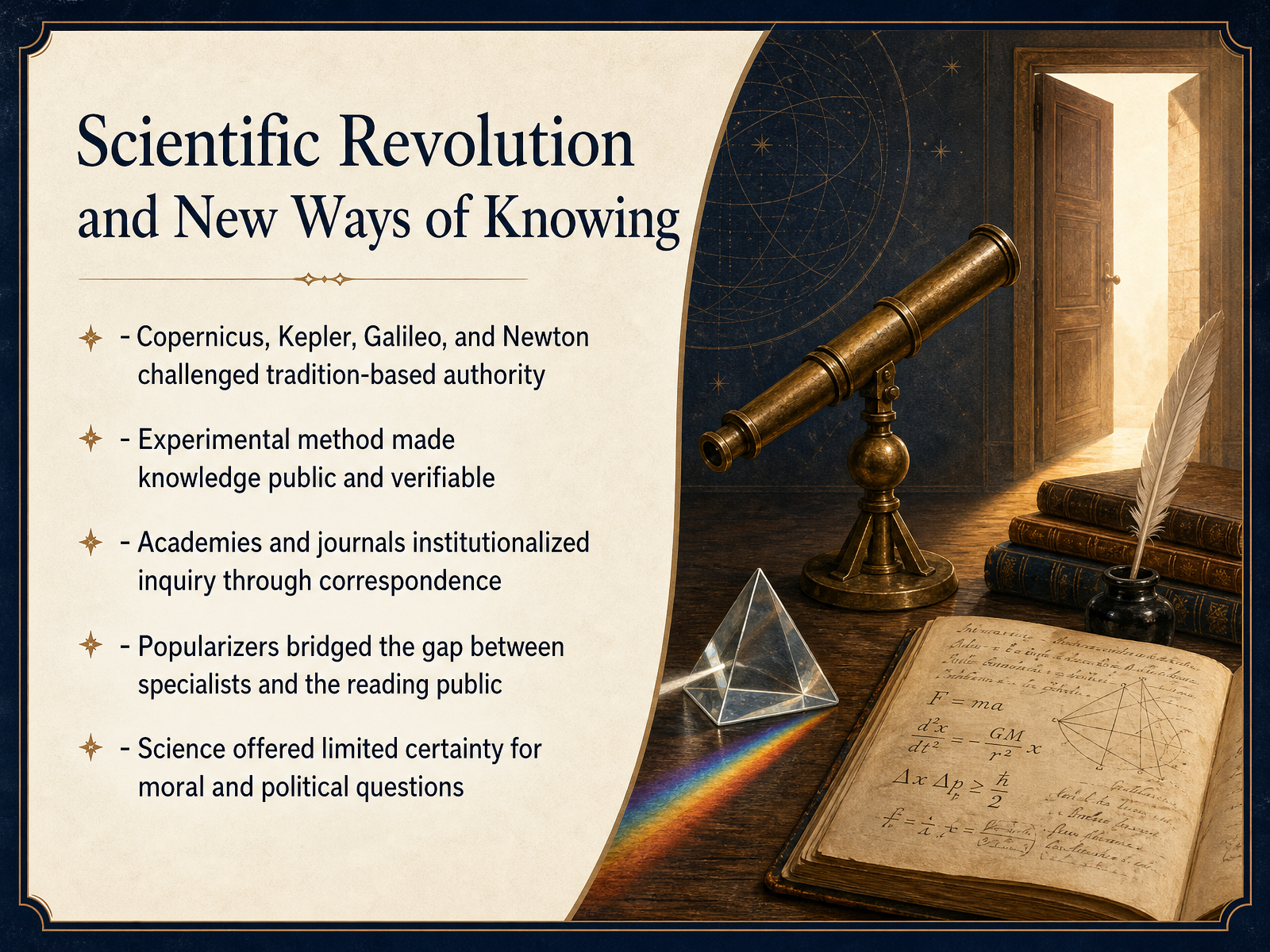
 - 03Scientific Revolution and New Ways of KnowingNow let's turn to the Scientific Revolution, because this is where the Enlightenment really found its footing. Thinkers like Copernicus, Kepler, Galileo, and Newton did something radical: they questioned authority that was based simply on tradition. Instead of relying on ancient texts alone, they insisted on observation and experiment. This created what we might call the experimental method, and crucially, it made knowledge public. A claim now had to be verifiable by others. New academies and journals sprang up to share these findings through formal correspondence, turning private discovery into collective enterprise. At the same time, skilled popularizers stepped in to explain these complex ideas to the reading public, bridging the gap between specialists and curious amateurs. But it is important to remember that science offered only limited certainty when it came to moral and political questions. Knowing how the planets moved did not automatically tell people how to organize a just society. That gap between scientific certainty and human values would become one of the Enlightenment's central challenges. Next, we will look at how these ideas actually circulated, through print culture, salons, and the Republic of Letters.
 shc.stanford.eduehne.frliverpooluniversitypress.co.uk+21 min
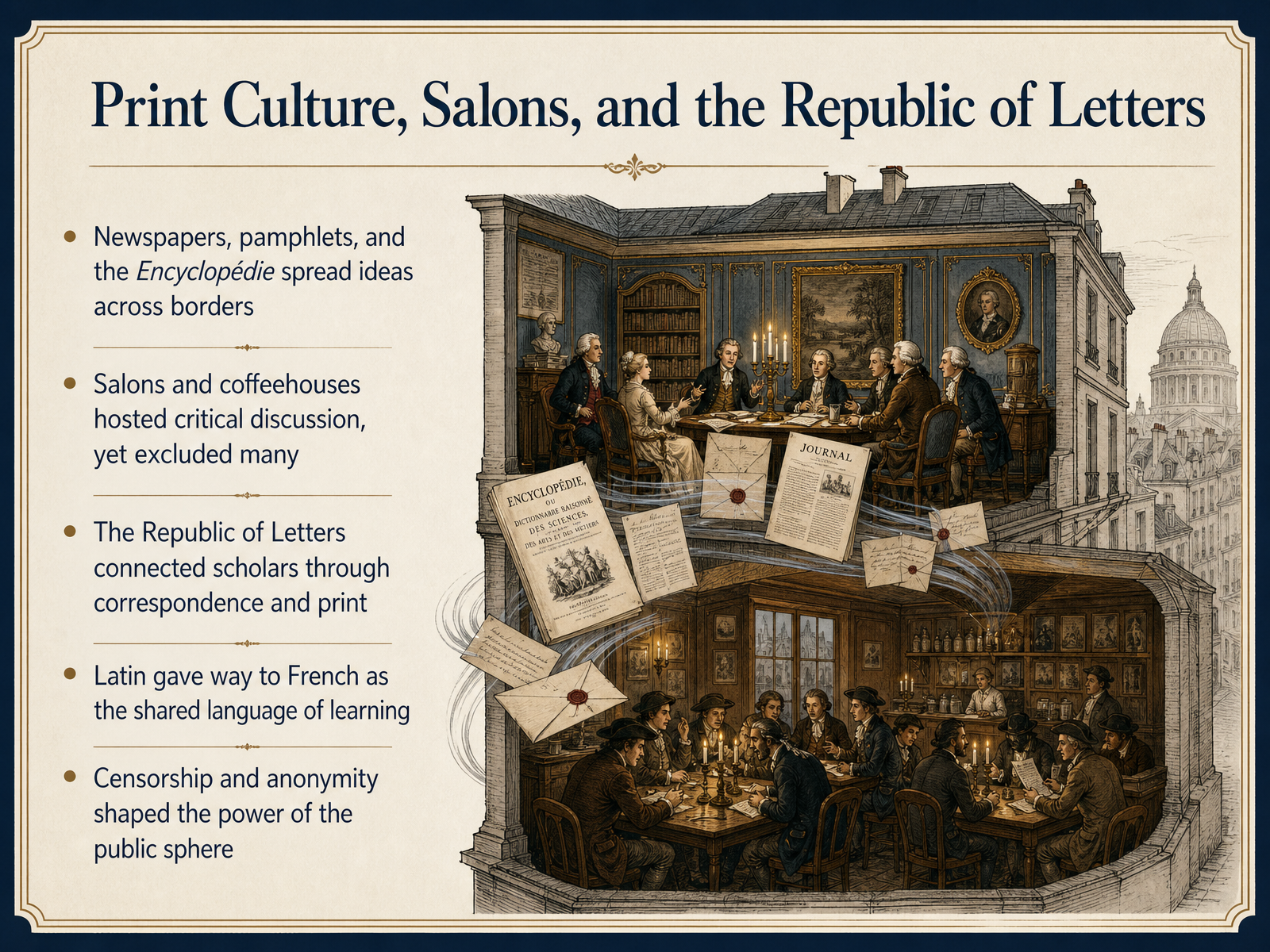
 - 04Print Culture, Salons, and the Republic of LettersIdeas need a way to travel, and in the eighteenth century, print carried them further and faster than ever before. Newspapers, pamphlets, and ambitious projects like the Encyclopédie crossed borders, sparking conversations in Paris, Edinburgh, and Philadelphia. Coffeehouses buzzed with debate, while private salons hosted more privileged gatherings of writers and aristocrats. But these spaces were not open to everyone. Wealth, status, and gender still shaped who could speak and who was left outside. Meanwhile, a broader community called the Republic of Letters connected scholars through handwritten correspondence and shared publications. Imagine a virtual commonwealth of minds, bound not by geography but by a common language of inquiry. For centuries Latin served as that bridge. Now, French was taking its place as the shared language of learning, especially in circles of prestige and power. Yet censorship remained a constant shadow. Many writers published anonymously or smuggled works across borders to avoid royal and religious authorities. In this mix of openness and restriction, a public sphere was emerging. It was uneven, exclusive, and often dangerous. But it was also a new kind of power. Next, we will follow these ideas beyond Europe to explore their global exchange and reception.
 shc.stanford.eduehne.frliverpooluniversitypress.co.uk+22 min
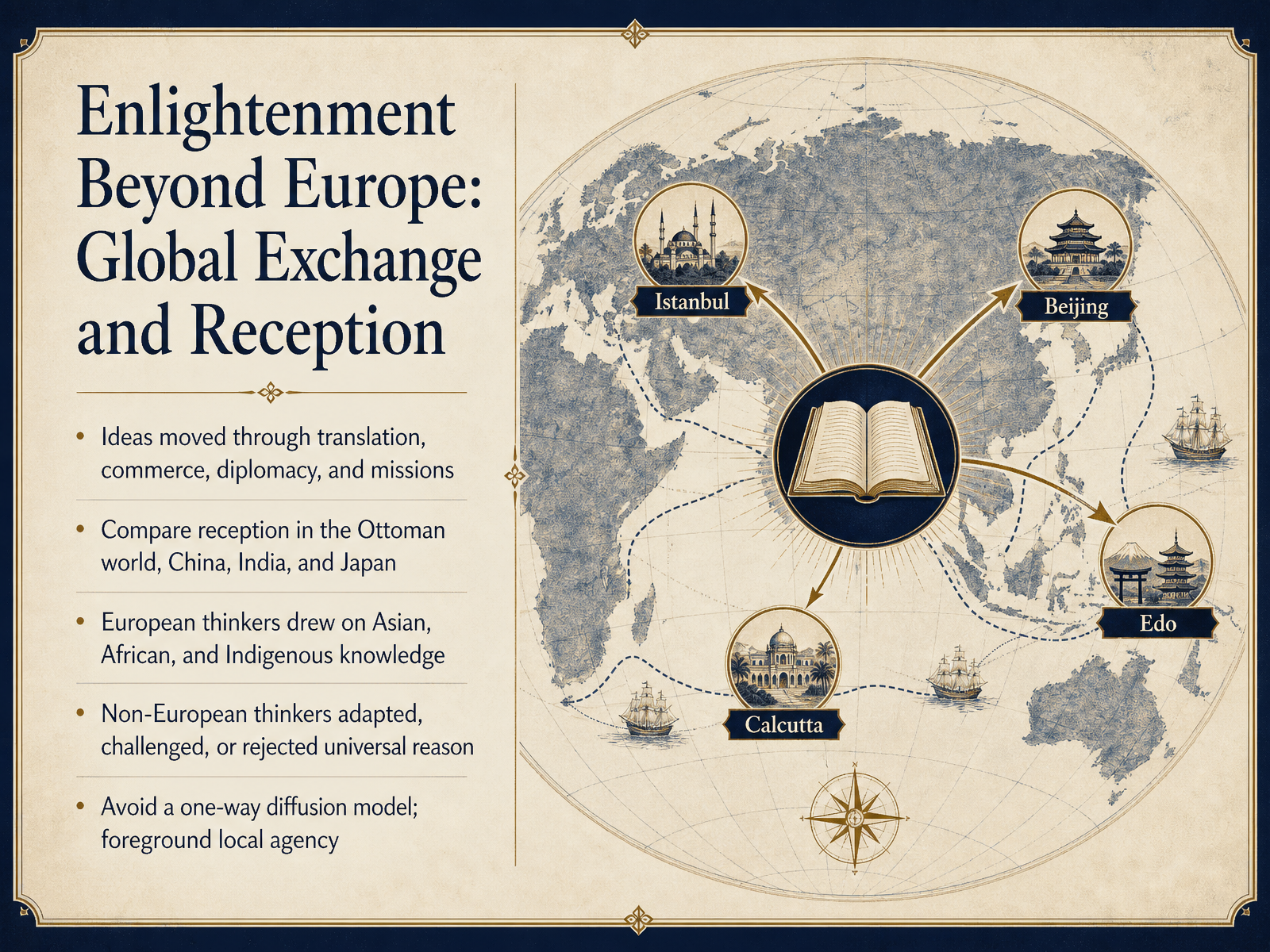
 - 05Enlightenment Beyond Europe: Global Exchange and ReceptionLet's step beyond Europe for a moment, because the Enlightenment was never a one-way street. Ideas traveled through translations, trade routes, diplomatic missions, and missionary networks. Coffeehouses in Istanbul, academies in Beijing, and courts in Edo all became sites of exchange. Consider the Ottoman world. Ottoman scholars and geographers engaged European knowledge, but often through their own priorities, sometimes reframing or resisting it. In China, the story is equally complex. Early Enlightenment thinkers like Voltaire admired Confucian ethics as a model of reason, while later generations dismissed China as stagnant. Meanwhile, Chinese texts on astronomy and cosmology fed European debates about progress itself. In India and Japan, local intellectuals selectively borrowed, challenged, or rejected universal claims of reason based on their own traditions. European thinkers, in turn, drew on Asian, African, and Indigenous knowledge, whether they acknowledged it or not. So we should avoid a simplistic diffusion model, where ideas simply spread outward from Europe. Local agency mattered everywhere. That principle will sharpen as we turn next to the Enlightenment's entanglement with empire, slavery, and race.
 sts.wisc.edukops.uni-konstanz.decambridge.org+22 min
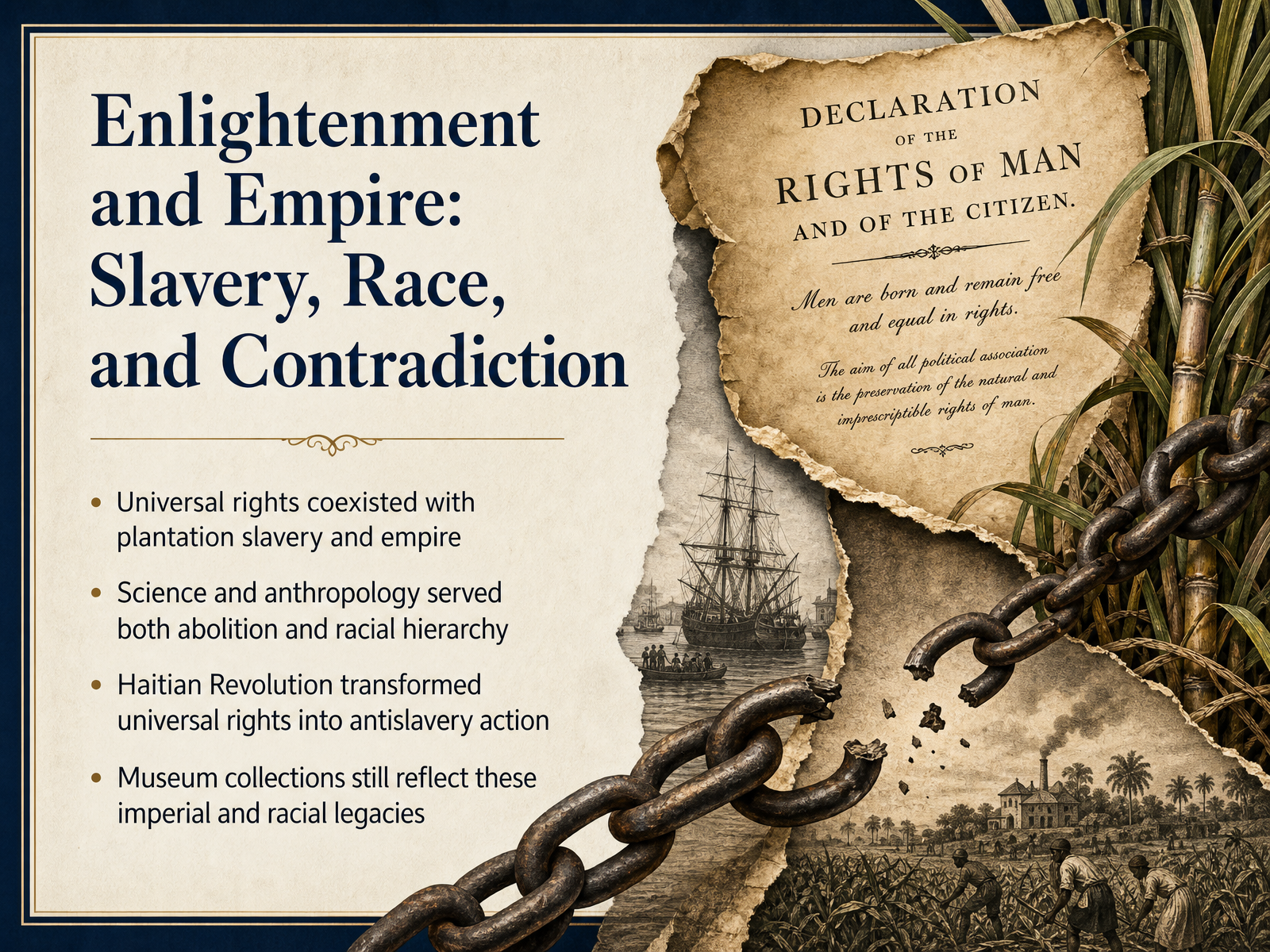
 - 06Enlightenment and Empire: Slavery, Race, and ContradictionNow, let's turn to one of the most difficult and important tensions in Enlightenment history. The same era that proclaimed universal liberty and reason also built its wealth on plantation slavery and empire. Ideas of natural rights, the belief that freedom belongs to every person, coexisted with the brutal reality of the transatlantic slave trade. Science and anthropology were used for both remarkable ends, to argue for abolition and human equality, and also to create false racial hierarchies that justified empire. Then a revolution changed the stakes. In Haiti, enslaved people took the language of universal rights and transformed it into antislavery action, making freedom something more than a philosophical promise. Even today, many museum collections carry these imperial and racial legacies, and curators are working to tell that story honestly. So, the Enlightenment is not a simple story of pure reason; it is a story of contradiction, and also of radical possibility. That possibility leads us into our next topic, Atlantic Revolutions and the Politics of Rights.
 link.springer.comonlinelibrary.wiley.comcup.columbia.edu+21 min
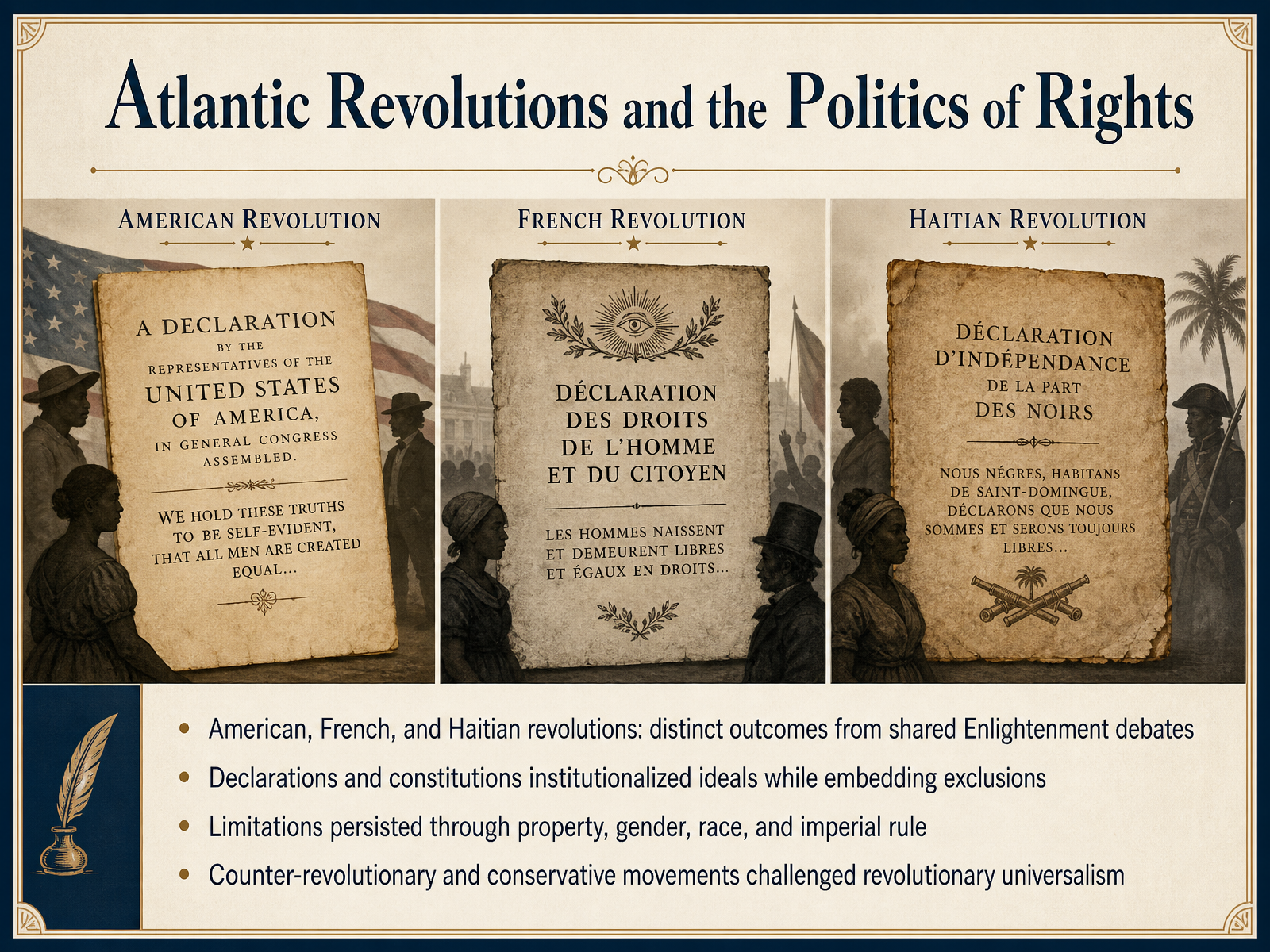
 - 07Atlantic Revolutions and the Politics of RightsNow let's carry these ideas across the Atlantic, because the Enlightenment didn't just live in books. It helped ignite a series of revolutions. The American, French, and Haitian revolutions were very different events with very different outcomes, yet all three drew from the same well of Enlightenment debates about rights and legitimate government. In each case, declarations and constitutions tried to turn abstract ideals into laws. But here is the crucial tension. While these documents institutionalized ideas like natural rights, they also embedded exclusions. The promise of universal rights was often withheld based on property, gender, race, or imperial status. For instance, a constitution could declare that all men are equal while slavery remained legal. This gap did not go unnoticed. Counter-revolutionary and conservative movements arose precisely to challenge this revolutionary universalism, arguing for tradition, order, and hierarchy over sweeping change. So we see a central drama of the era: the struggle to define who counts as a rights-bearing person. Let's continue that conversation when we look at the Counter-Enlightenment, including conservatism, Romanticism, and religion.
 link.springer.comonlinelibrary.wiley.comcup.columbia.edu+21 min
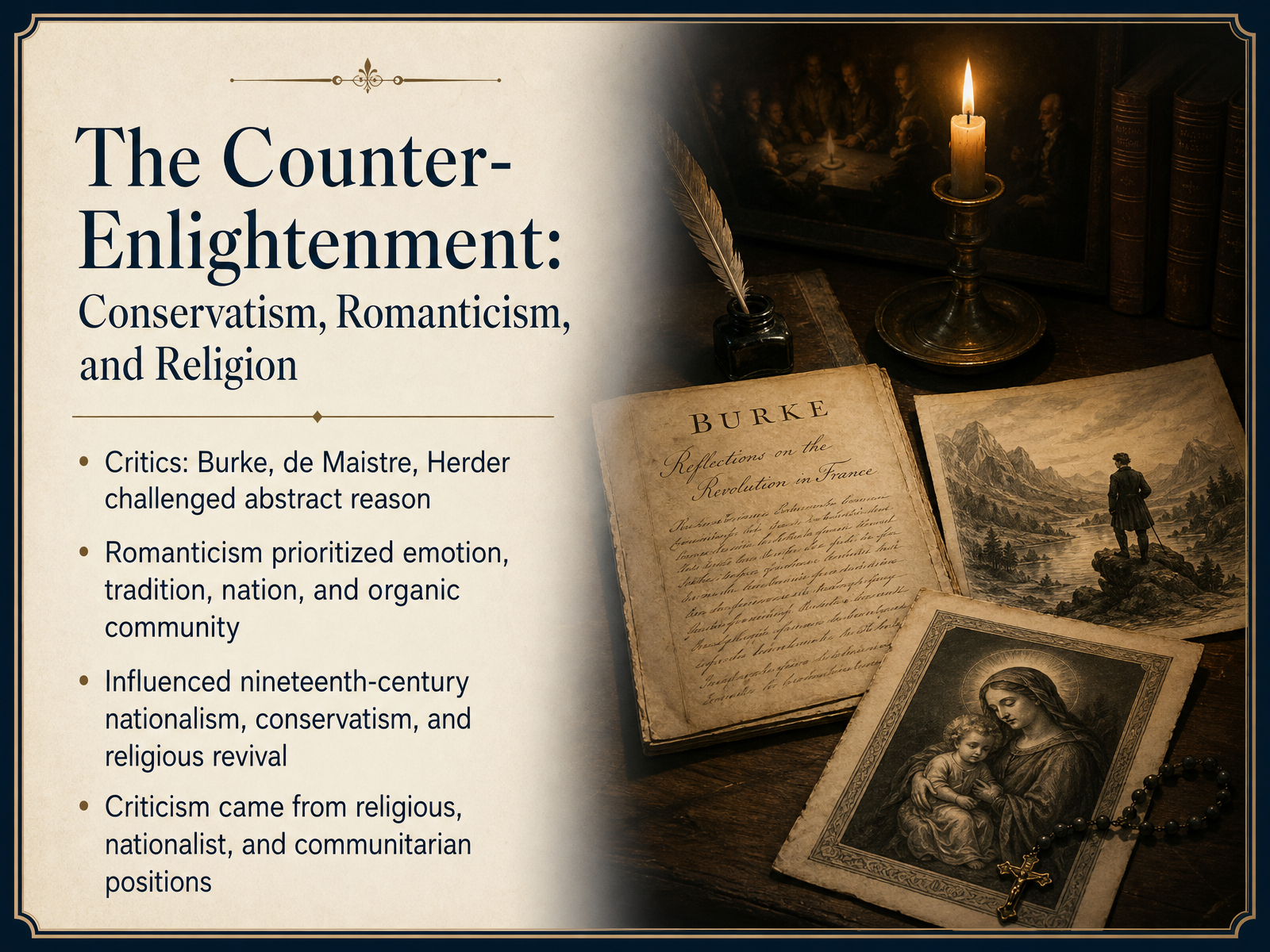
 - 08The Counter-Enlightenment: Conservatism, Romanticism, and ReligionNot everyone welcomed the Enlightenment's faith in abstract reason. Conservative thinkers like Edmund Burke and Joseph de Maistre warned that societies are not machines to be rebuilt from scratch. They argued that customs, traditions, and institutions carry hard-won wisdom, and that tearing them down in the name of pure logic invites chaos. At the same time, Romanticism pushed back from another direction. Writers and artists celebrated emotion, intuition, and the deep bonds of nation and local community. They saw human life as rooted in feeling and belonging, not just rational calculation. Johann Gottfried Herder, for example, insisted that each people has its own unique voice and history, shaped by language and landscape. These counter-currents did not simply fade away. They fed directly into nineteenth-century nationalism, conservative politics, and waves of religious revival. Criticism came from religious believers defending revealed truth, from nationalists defending distinct cultures, and from communitarians defending shared ways of life. So the Enlightenment was never a single, uncontested story. Its boldest claims sparked equally powerful reactions that still shape how we think about reason, identity, and belonging. Next, we will trace how these debates crystallized into modern institutions and enduring values.
 link.springer.comonlinelibrary.wiley.comcup.columbia.edu+22 min
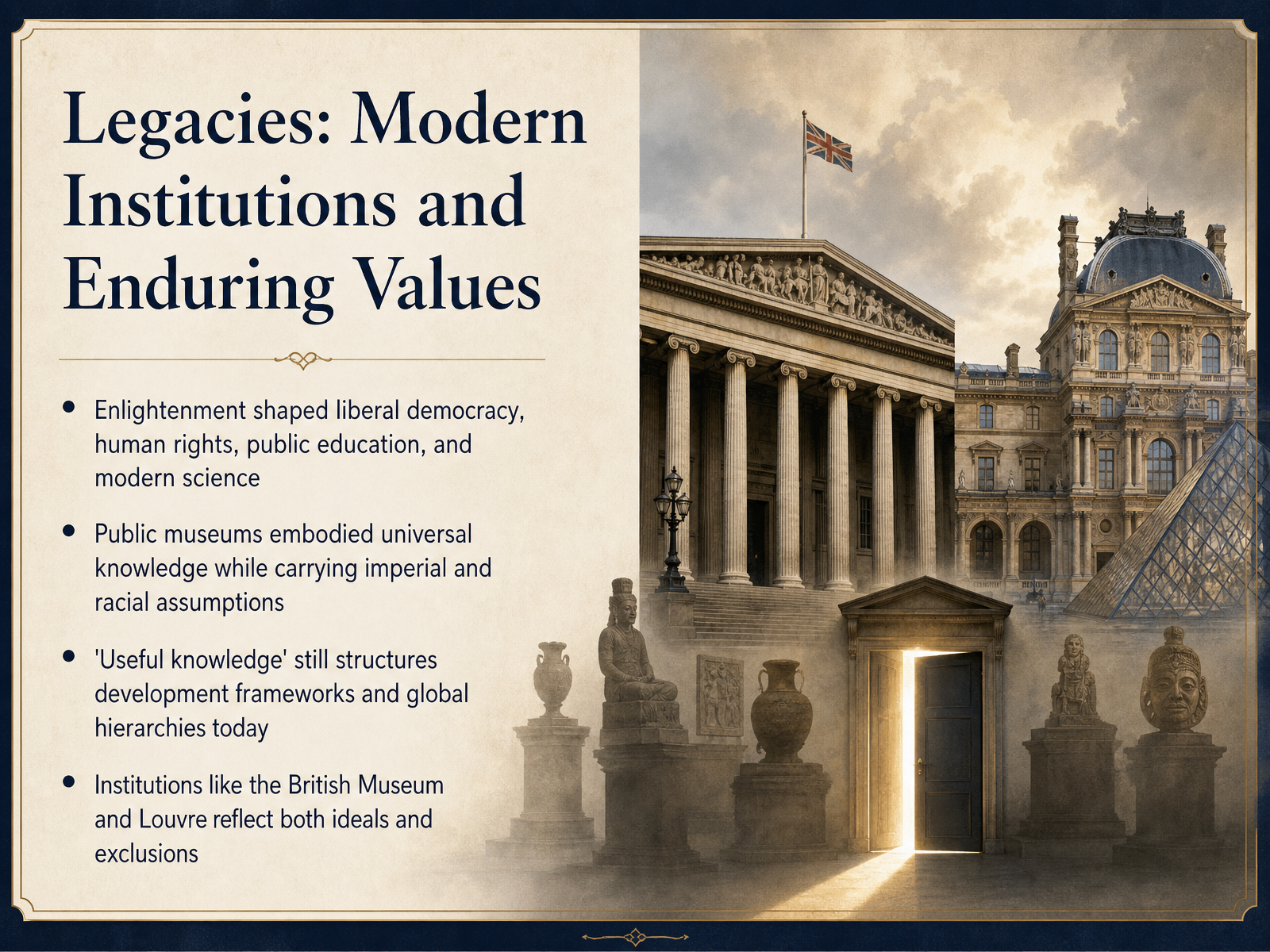
 - 09Legacies: Modern Institutions and Enduring ValuesThe Enlightenment gave us some of our most familiar institutions, from modern liberal democracy and human rights to public education and science as we know it. Yet its legacies are not simple gifts. Public museums, like the British Museum and the Louvre, embodied a real ideal: making universal knowledge available to all. But they also carried assumptions about empire and race. Their collections often reflected a worldview that ranked European civilization above others. Even the idea of useful knowledge, so central to progress, helped shape global hierarchies. It defined which societies counted as developed and which did not, a framework that still influences international development today. So these institutions hold a double legacy. They stand for curiosity, learning, and public access, and at the same time they remind us who was excluded and whose knowledge was treated as inferior. In our next slide, we will look at critical reappraisals of the Enlightenment from postcolonial, feminist, and Frankfurt School perspectives.
 sts.wisc.edukops.uni-konstanz.decambridge.org+21 min
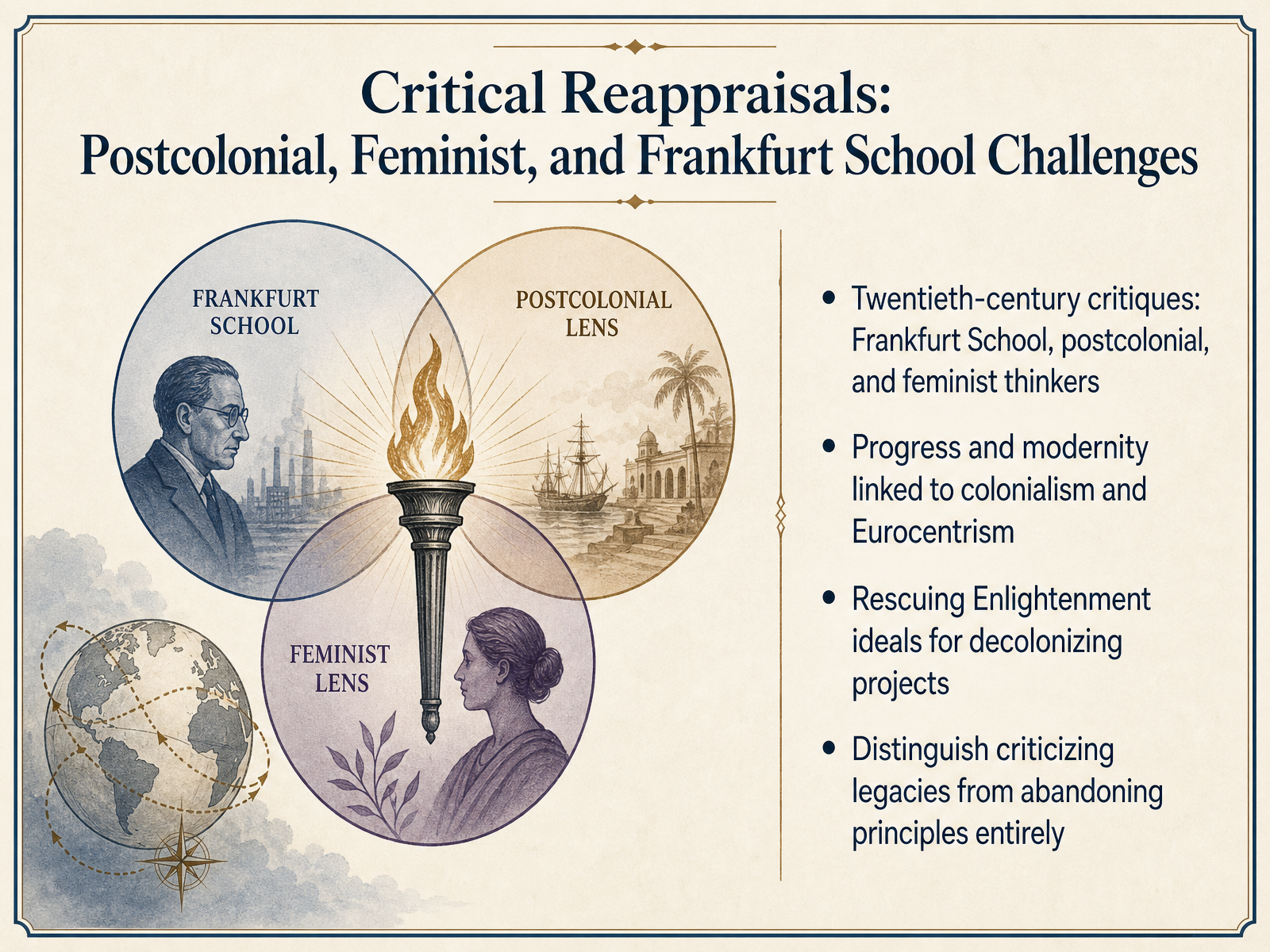
 - 10Critical Reappraisals: Postcolonial, Feminist, and Frankfurt School ChallengesBy the twentieth century, the Enlightenment’s story grew more complex. Thinkers from the Frankfurt School questioned whether its push for reason and progress had a dark side, helping to normalize colonialism and a Eurocentric view of the world. Postcolonial and feminist scholars sharpened this critique, pointing out that the age of liberty also financed and justified empire. But here is the key tension. Many critics did not want to throw away Enlightenment ideals altogether. Instead, they asked if concepts like human rights and self-determination could be rescued and repurposed for decolonizing projects. Think of it like repairing an old ship while still at sea. The goal is not to abandon the vessel, but to fix what is broken and chart a fairer course. So the conversation shifts from blind praise or total rejection to a careful, critical rescue. Up next, we explore how these debates continue to shape our world in 'Debating the Enlightenment Today: Defend, Expand, or Abandon?'
 link.springer.comonlinelibrary.wiley.comcup.columbia.edu+21 min
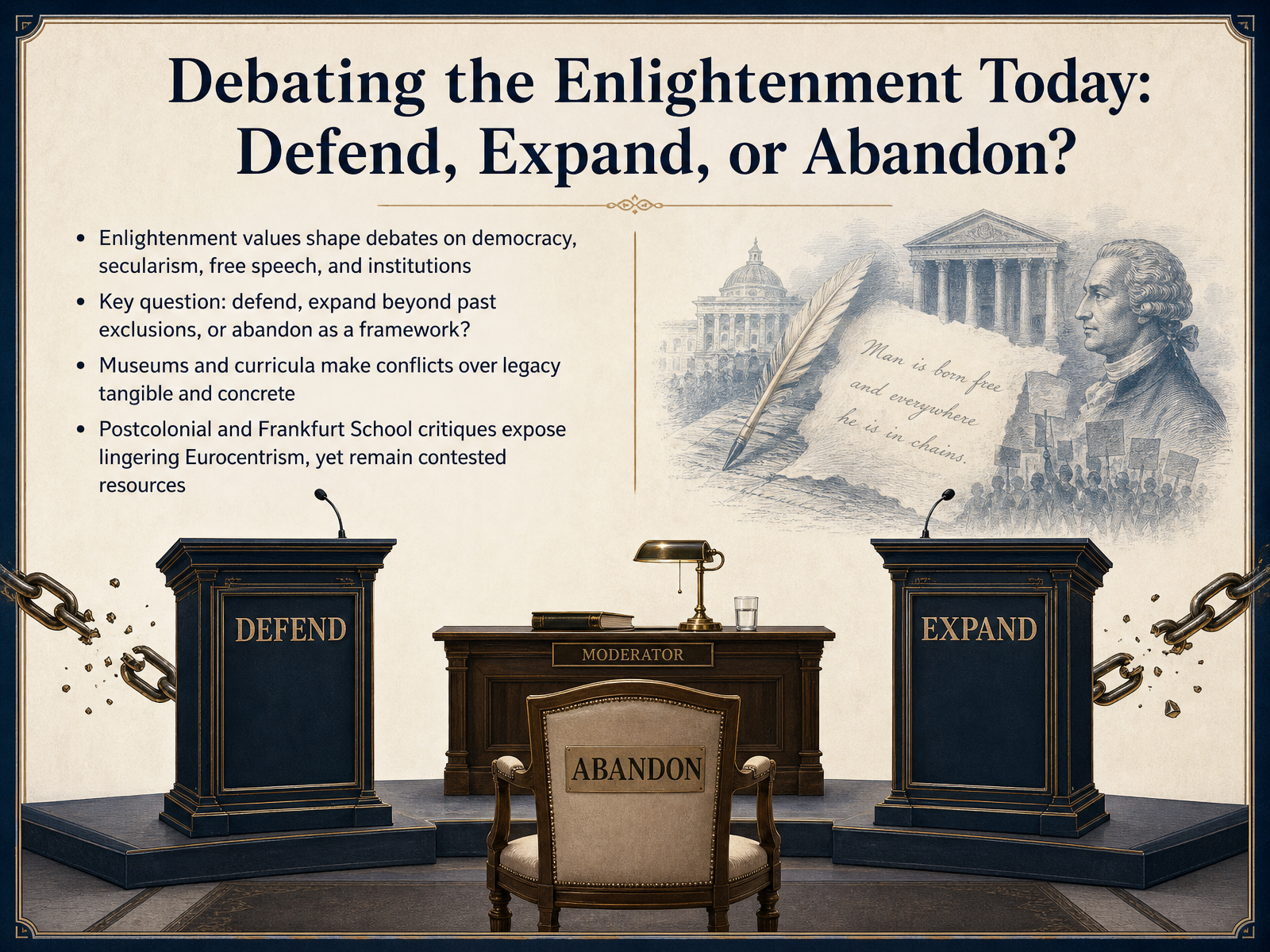
 - 11Debating the Enlightenment Today: Defend, Expand, or Abandon?Now we have to ask a harder question. The Enlightenment gave us powerful ideas about individual rights and self-government. And those ideas still shape our debates about democracy, secularism, and free speech. But whose voices were actually included in those original conversations? That question sits at the heart of today's arguments. Some say we should defend the Enlightenment as the foundation of modern freedoms. Others argue we need to expand it, to extend its promises to people it once excluded. And some ask, should we abandon it altogether as a flawed, Eurocentric framework? You can see this struggle play out in museums and school curricula, where decisions about what to display or teach make these conflicts very real. Postcolonial thinkers and members of the Frankfurt School have shown how deeply colonial attitudes run through even the most celebrated Enlightenment texts. Yet those critiques are themselves debated. As scholars like Amy Allen and Nikita Dhawan point out, criticizing the Enlightenment does not always mean rejecting it. Sometimes it means rescuing its best tools to finish the work it left undone. Next, we will look at the misconceptions and sensitive topics that come up when we try to teach this history.
 link.springer.comonlinelibrary.wiley.comcup.columbia.edu+22 min
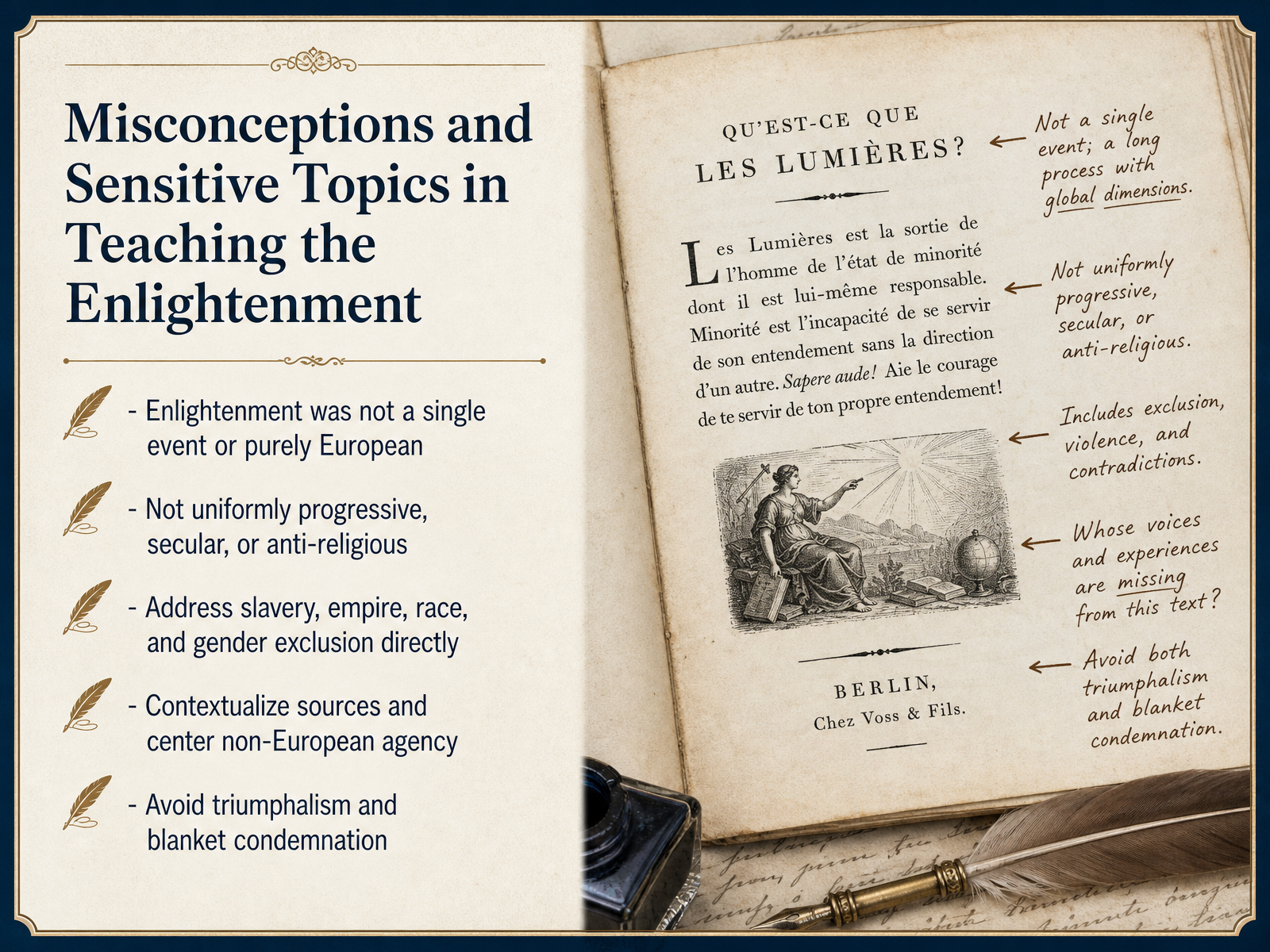
 - 12Misconceptions and Sensitive Topics in Teaching the EnlightenmentNow, let's pause on something that often trips up both teachers and students. The Enlightenment is frequently simplified into a tidy European story. But truly, it wasn't one singular event, like a switch flipping on for the world. It unfolded in different pockets, with thinkers in places like the Ottoman world and China actively making sense of it. And it certainly wasn't purely secular. Many figures blended reason with deep faith.
This is the heart of the matter. Ignoring the difficult parts of this era can lead to a shallow story. So, let's directly confront how the same period that championed liberty and natural rights also built systems of slavery and empire, and often excluded women and people of color from its vision.
The goal here is balance. We must avoid presenting the Enlightenment as a triumphant march to modernity, but also be wary of condemning it entirely. Instead, practice contextualizing the sources we use. When we do this, we can reveal the agency of non-European thinkers and uncover the connections often hidden from view. Next, we'll explore practical ways to bring these difficult conversations to life in the classroom.
 journals.gmu.eduvam.ac.ukworldhistoryconnected.press.uillinois.edu+22 min
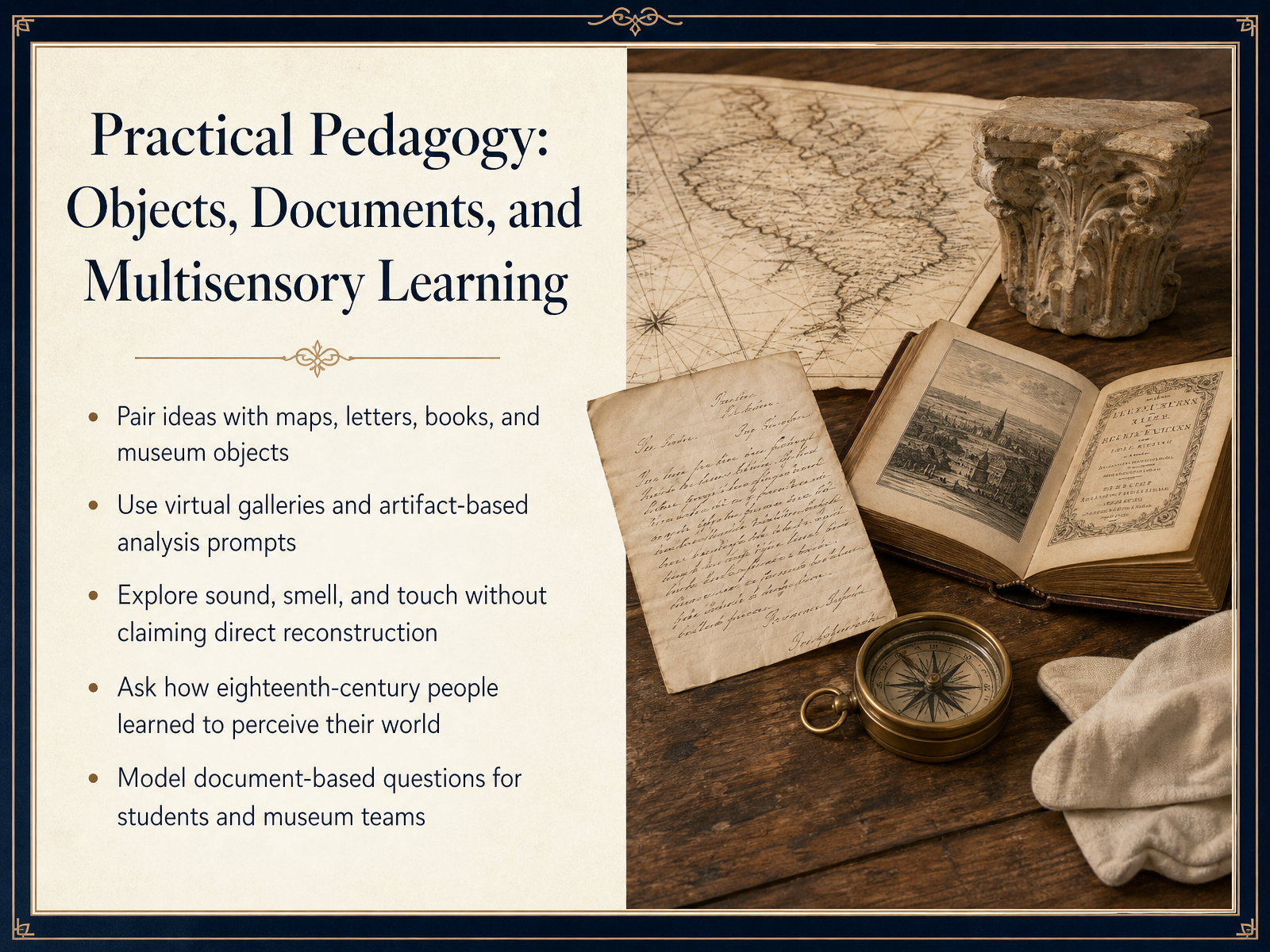
 - 13Practical Pedagogy: Objects, Documents, and Multisensory LearningLet's move from ideas to how we actually teach the Enlightenment. One of the most powerful starting points is pairing abstract concepts with concrete things. A letter can show how natural rights moved through personal networks. A map can reveal how the social contract travelled with colonial expansion. A museum object can make ideas feel less like philosophy and more like lived experience. Virtual galleries and artifact-based analysis prompts help students slow down, look closely, and ask better questions. We can also invite sound, smell, and touch into the classroom, not by claiming we can reconstruct the past, but by asking how eighteenth-century people learned to perceive their world. For students and museum teams alike, document-based questions are a simple but effective model. Ask what a source assumes. Ask what it leaves out. Ask whose perspective it preserves. When we do this, objects stop being illustrations and become arguments we can investigate together. Next, we'll look at teaching the Enlightenment in museums, classrooms, and public history.
 journals.gmu.eduvam.ac.ukworldhistoryconnected.press.uillinois.edu+22 min
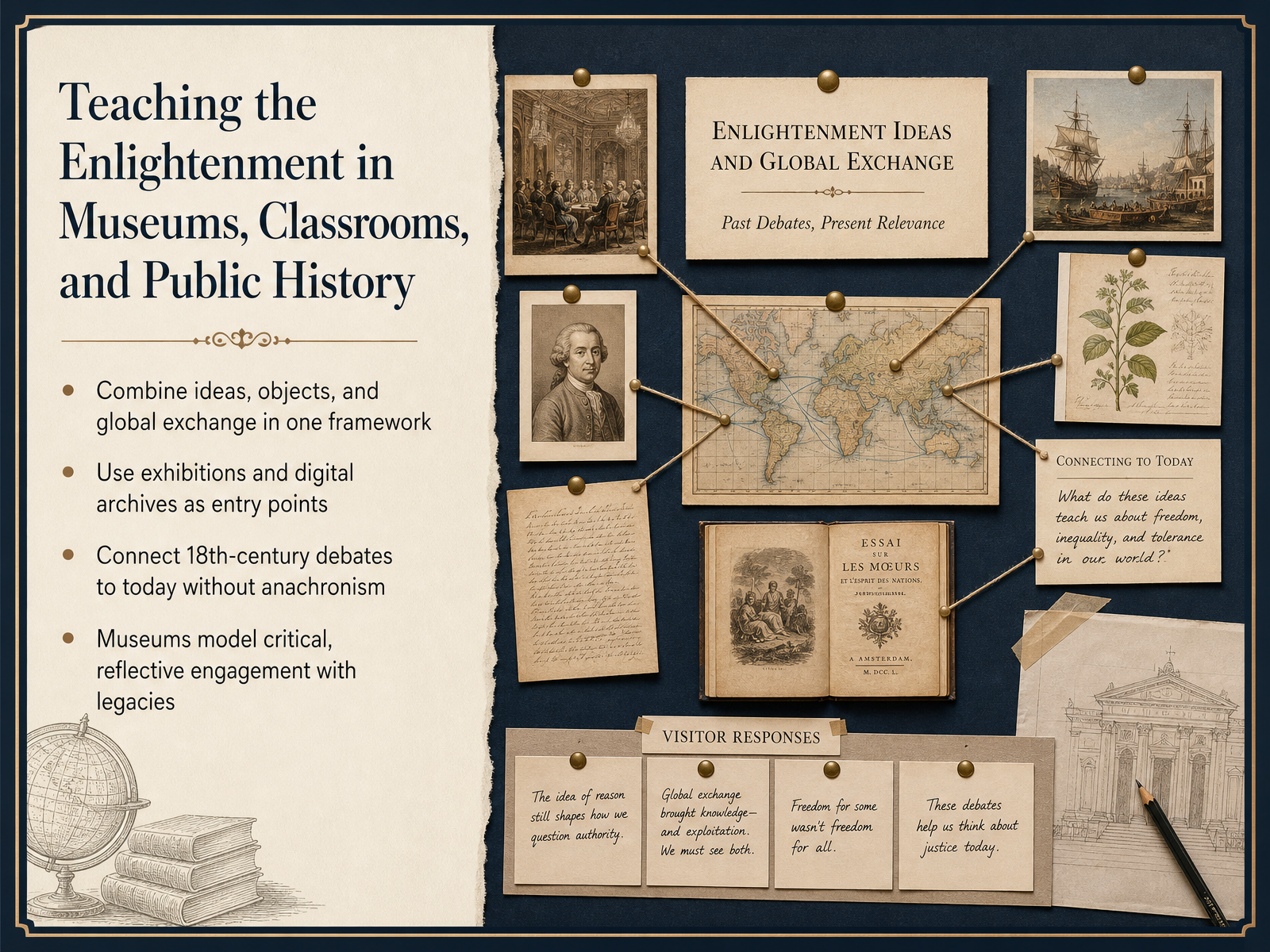
 - 14Teaching the Enlightenment in Museums, Classrooms, and Public HistoryAs we wrap up, let's think about how to teach the Enlightenment in ways that feel alive and honest. Instead of separating big ideas from daily life, try weaving together three strands: the philosophy, the physical objects, and the global exchanges that shaped them. A coffeehouse debate becomes real when paired with a porcelain cup traded across oceans. Museums and digital archives offer powerful entry points. Collections like the British Museum's Enlightenment Gallery can spark immediate questions. But we need to guide students to see the full picture, including how these collections often rested on empire and enslaved labor. Connecting eighteenth century debates to today is essential. We can ask students how ideas about natural rights, or reason, echo in modern discussions of citizenship and science, without pretending the past was just like the present. The goal is critical, reflective engagement. We are not just celebrating the Enlightenment; we are reckoning with its legacies. Thank you for joining this exploration. Take these ideas into your own teaching or learning, and help others see this era not as a simple story of progress, but as a rich, complicated human conversation that still shapes our world.
 journals.gmu.eduvam.ac.ukworldhistoryconnected.press.uillinois.edu+22 min
Take the deck with you
Download this course as a file — free, no sign-up needed.
- PDF handoutEvery slide page, ready to print or share.15 pages · 6.0 MBDownload
- Narrated PowerPointThe deck that presents itself — every slide carries the digital human's narration video.15 pages · 30.6 MBDownload
- PowerPoint slidesThe full deck as a .pptx — open it in PowerPoint, Keynote, or Google Slides.15 pages · 5.9 MBDownload
Free to use in your own training — please keep the PersonWise credit page at the end.
Have your own deck? Turn it into a course
Sources consulted
Web sources consulted while building this course.
- The First Global Turn: Chinese Contributions to Enlightenment World History — sts.wisc.edu
- A world connecting? : from the unity of history to global history — kops.uni-konstanz.de
- European Intellectual History after the Global Turn | Annales. Histoire, Sciences Sociales - English Edition | Cambridge Core — cambridge.org
- History beyond the nation. Dutch world histories in the Enlightenment Eleá de la Porte, De Achttiende Eeuw. Jaargang 46 - DBNL — dbnl.org
- HISTORIOGRAPHY AND ENLIGHTENMENT: A VIEW OF THEIR HISTORY — cambridge.org
- The Kingdom of Politesse: Salons and the Republic of Letters in ... — shc.stanford.edu
- Republic of Letters (seventeenth-eighteenth centuries) (The) | EHNE — ehne.fr
- Networks of Enlightenment | Home — liverpooluniversitypress.co.uk
- Mapping the Republic of Letters — republicofletters.stanford.edu
- The Project | Mapping Print, Charting Enlightenment — fbtee.uws.edu.au
- An Anticolonial Deficit in Frankfurt School Critical Theory: A Need for a Decolonial Turn | Springer Nature Link — link.springer.com
- Critical Theory, colonialism, and the historicity of thought — onlinelibrary.wiley.com
- The End of Progress | Columbia University Press — cup.columbia.edu
- Brazil - A crítica do mito da modernidade: da Escola de Frankfurt ao giro decolonial A crítica do mito da modernidade: da Escola de Frankfurt ao giro decolonial — scielo.br
- Rescuing the Enlightenment from the Europeans: Critical Theories of Decolonization — dukeupress.edu
- Researching and Teaching Exhibitions: Opportunities for Engaging World History in Context | World History Connected — journals.gmu.edu
- The Enlightenment and the Universal Museum • V&A Blog — vam.ac.uk
- World History Connected | Vol. 13 No. 3 | Peter H. Hoffenberg: Researching and Teaching Exhibitions: Opportunities for Engaging World History in Context — worldhistoryconnected.press.uillinois.edu
- Neoclassicism Curriculum (Education at the Getty) — getty.edu
- Chapter 3 Sensational pedagogy: teaching the sensory eighteenth century | Innovations in Teaching History | University of London Press — read.uolpress.co.uk