Software Engineering Manager Essentials
Begin
14 pages · ~28 min
Software Engineering Manager Essentials
This training defines the Software Engineering Manager role, covering core responsibilities and essential skills for aspiring or new managers.
What you’ll learn
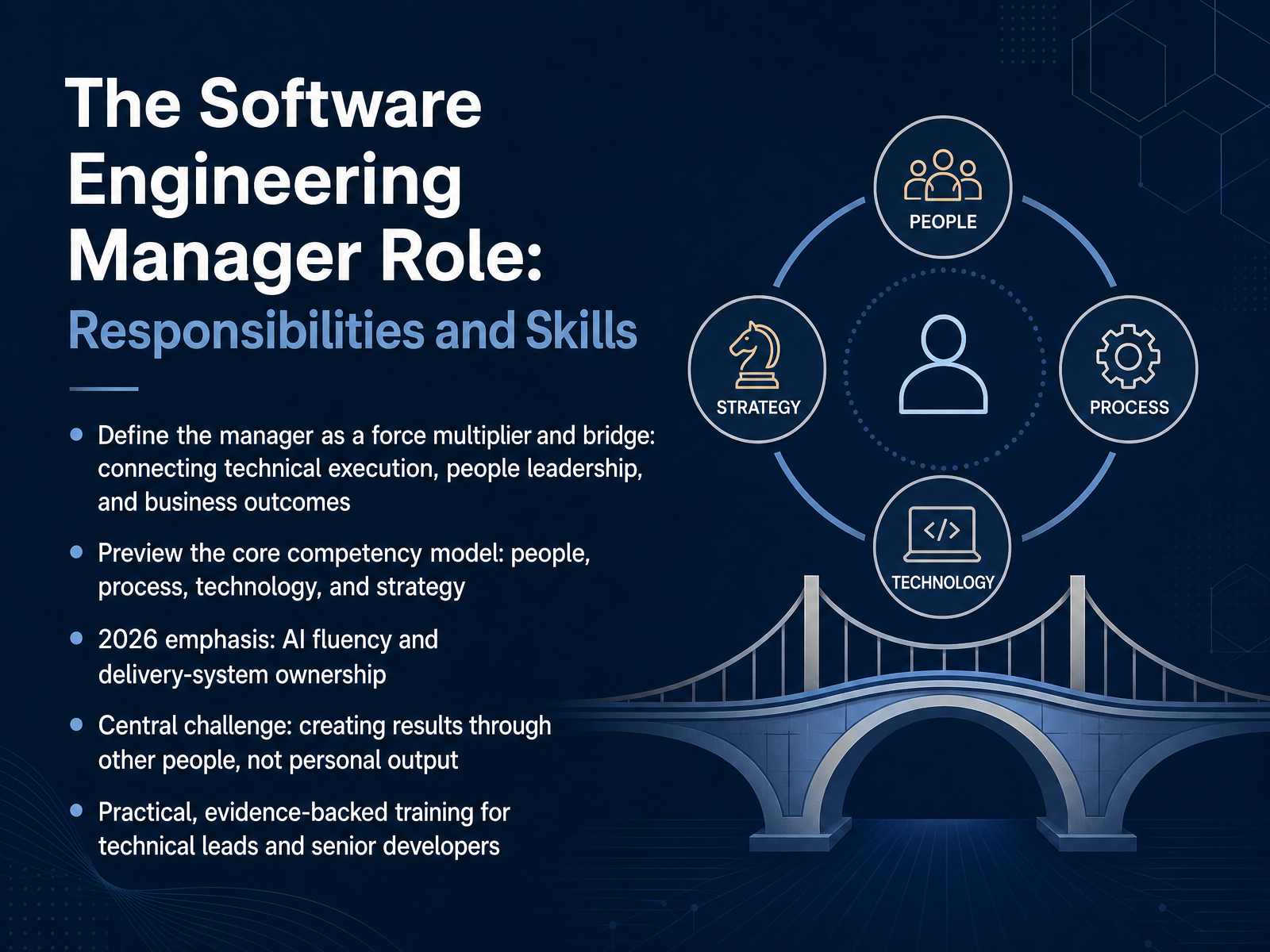
- 01The Software Engineering Manager Role: Responsibilities and SkillsWelcome. If you are a technical lead or a senior developer stepping into management, this course is for you. We are going to talk about the engineering manager role in 2026, not as a promotion, but as a career change. Your value shifts from personal output to the output of your team. Think of the manager as a force multiplier, the bridge between technical execution, people leadership, and business outcomes. We will build a practical competency model across four areas: people, process, technology, and strategy. And we will address the 2026 reality. AI fluency and delivery-system ownership are now table stakes. The central challenge is creating results through other people, not just through your own code. This training is evidence-backed and practical, built for people who make daily decisions about shipping, team health, and stakeholder alignment. Let's get started. First, we need to redefine what your value actually is when you cross from maker to manager.devopsschool.comlinearb.iotealhq.com+22 min
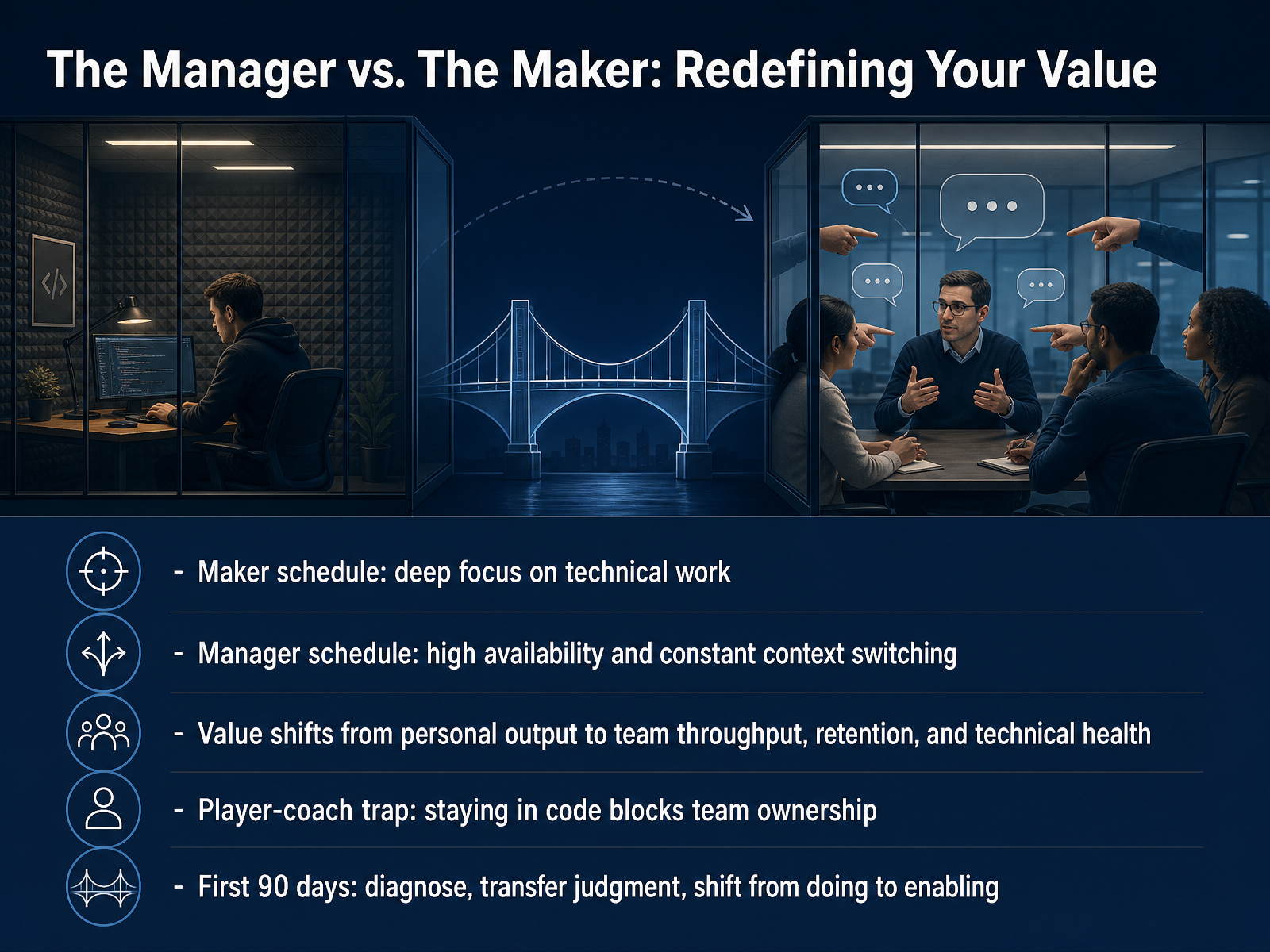
- 02The Manager vs. The Maker: Redefining Your ValueLet's talk about the shift that defines this role. As an engineer, your value was your output: the code you wrote, the systems you designed, the bugs you fixed. As a manager, your value is your team's output. That means a completely different schedule, and a completely different definition of success. You're moving from the maker schedule, with long blocks of deep focus, to the manager schedule: high availability, constant context switching, and your day fragmented into many small conversations. Your metrics change too. Personal output matters less than team throughput, retention, and technical health. This is where many new managers get stuck in what we call the player-coach trap: staying deep in the code because it feels productive. But when you hold onto the technical work, you block your team from taking ownership, and you stall your own development as a manager. Your first ninety days should be about diagnosing the system, transferring your technical judgment to the team, and making the mental shift from doing to enabling. It will feel slow. That's normal. Your new job is making others faster.
 stackoverflow.blogemaccelerator.comjuststeveking.com+22 min
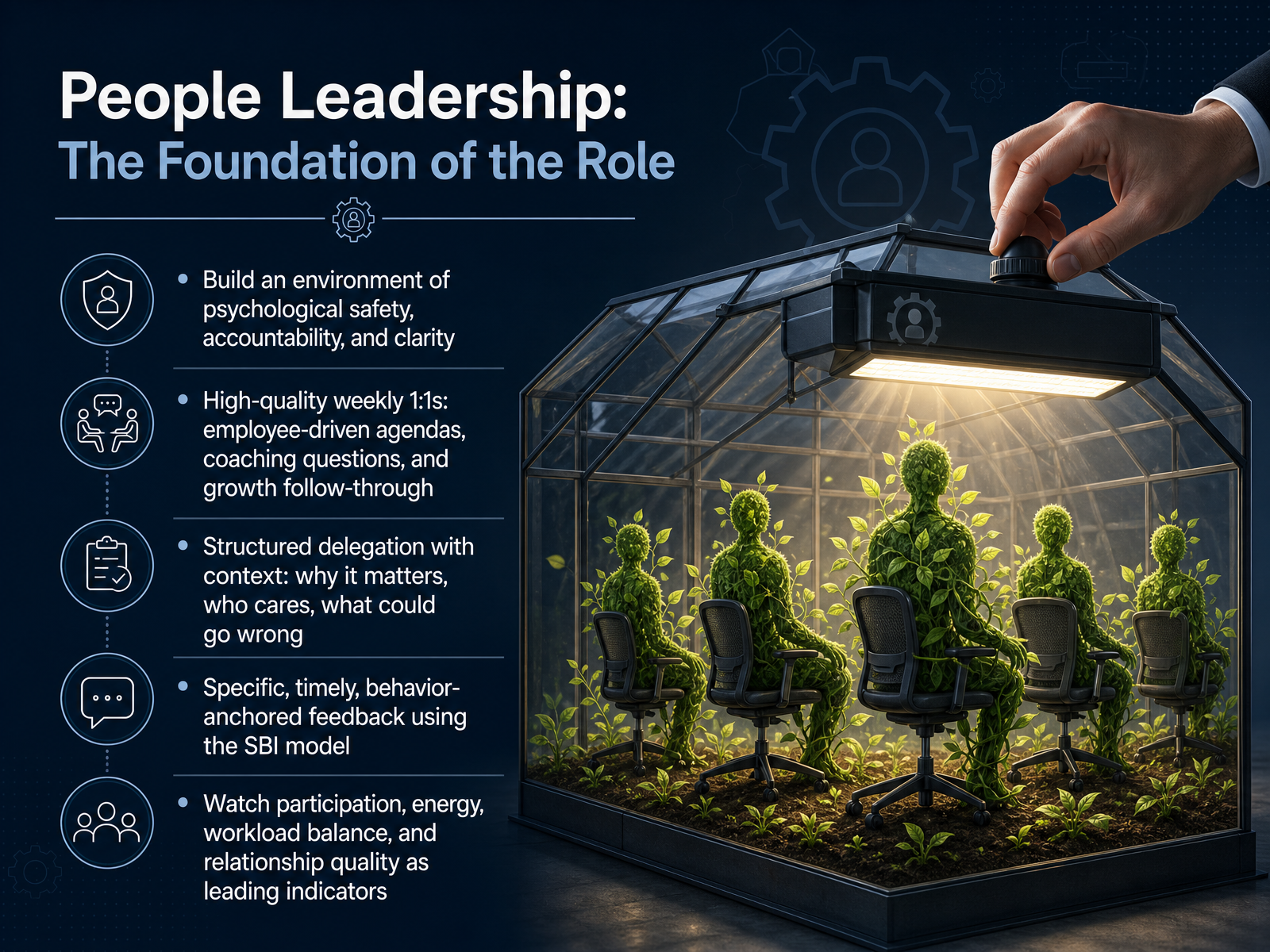
 - 03People Leadership: The Foundation of the RoleNow let's talk about the foundation of the role: people leadership. Your technical skills got you promoted, but your team's performance depends on the environment you create. That starts with psychological safety — your engineers need to know they can surface a problem without being punished for it. That pairs with accountability and clarity. High-quality, weekly one-on-ones are the core instrument here. Make them employee-driven. Ask coaching questions like, 'What's the hardest problem you're dealing with?' and follow through on their growth. When delegating, don't just assign tasks — provide context: why the work matters, who cares about it, and what could go wrong. This turns execution into ownership. Feedback is another lever. Use the SBI model — situation, behavior, impact — and make it timely and specific. Finally, monitor leading indicators: participation in meetings, energy levels, workload balance, and the quality of relationships on the team. These tell you something is off long before delivery metrics do. With this foundation, your team becomes resilient — and that makes your next role, developing engineers through feedback and coaching, far more effective.
 em-tools.ioimrul.technalyd.dev+22 min
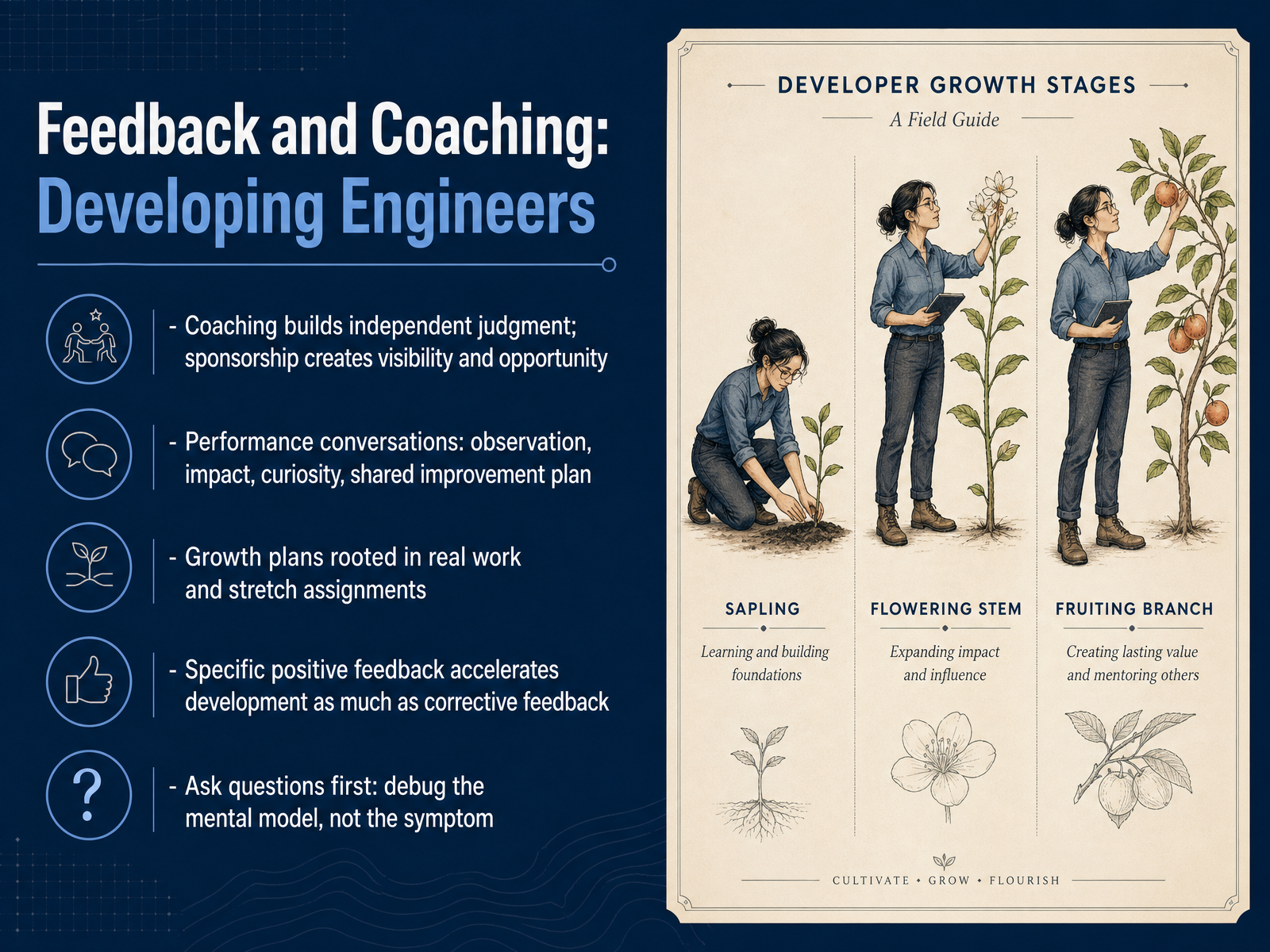
 - 04Feedback and Coaching: Developing EngineersLet’s talk about feedback and coaching. This is where you build independent judgment on your team. Coaching means asking questions that help engineers solve problems themselves. Sponsorship, on the other hand, means actively putting their name forward for stretch assignments and high-visibility work. Both matter, but they are different actions.
When you do have a performance conversation, keep this structure in mind: specific observation first, then impact, then genuine curiosity, then a shared improvement plan. Don’t say someone’s code quality is slipping. Point to the last three pull requests and what would have happened if they shipped. Then ask what’s going on from their side. That turns a judgment into a conversation.
Growth plans work best when they are rooted in real work. Connect the plan to an upcoming project that gives them the visibility or the technical depth they need. And remember, specific positive feedback matters as much as corrective feedback. Saying exactly what you want to see more of reinforces the behavior.
Your best tool is a question. Before you give an answer, ask what they have tried and what they think is causing it. You are debugging their mental model, not just the symptom. That takes patience in the moment, but it builds people who do not need you to make every decision.
That leads us directly into driving technical strategy and managing technical debt, where that same independent judgment becomes critical.
 juststeveking.comvibeengines.comkore1.com+22 min
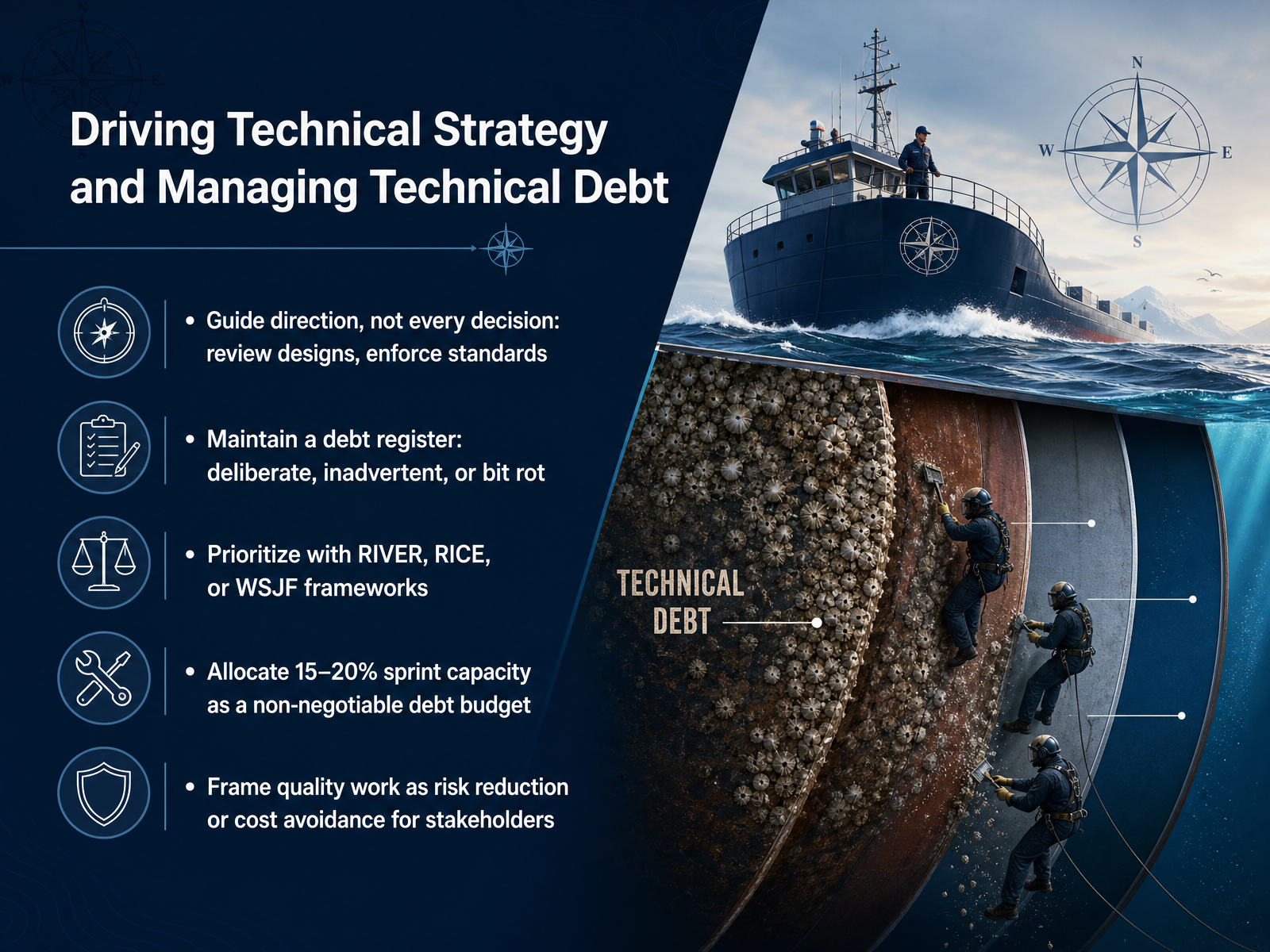
 - 05Driving Technical Strategy and Managing Technical DebtNow let's talk about driving technical strategy and managing technical debt. Your role is to guide direction, not make every decision. That means reviewing designs for significant work and enforcing standards, but trusting your team to make the day-to-day calls. Start by maintaining a debt register. Categorize each item as deliberate, inadvertent, or bit rot. Deliberate debt is a conscious trade-off you planned to revisit. Inadvertent debt accumulates as requirements change. Bit rot is the slow decay from outdated dependencies. Then prioritize with a framework like RIVER, RICE, or WSJF. They all score risk, impact, and effort so you can compare unlike items objectively. Allocate 15 to 20 percent of sprint capacity as a non-negotiable debt budget. Protect it like any commitment. When stakeholders push back, frame quality work as risk reduction or cost avoidance. Instead of saying we need to refactor, say this dependency will go end-of-life in six months and delaying increases our outage risk. That's the language they understand. The key takeaway: tech debt is manageable if you track it, score it, and budget for it consistently. This discipline directly feeds into how you execute and deliver. That's our next topic.
 devopsschool.comlinearb.iotealhq.com+22 min
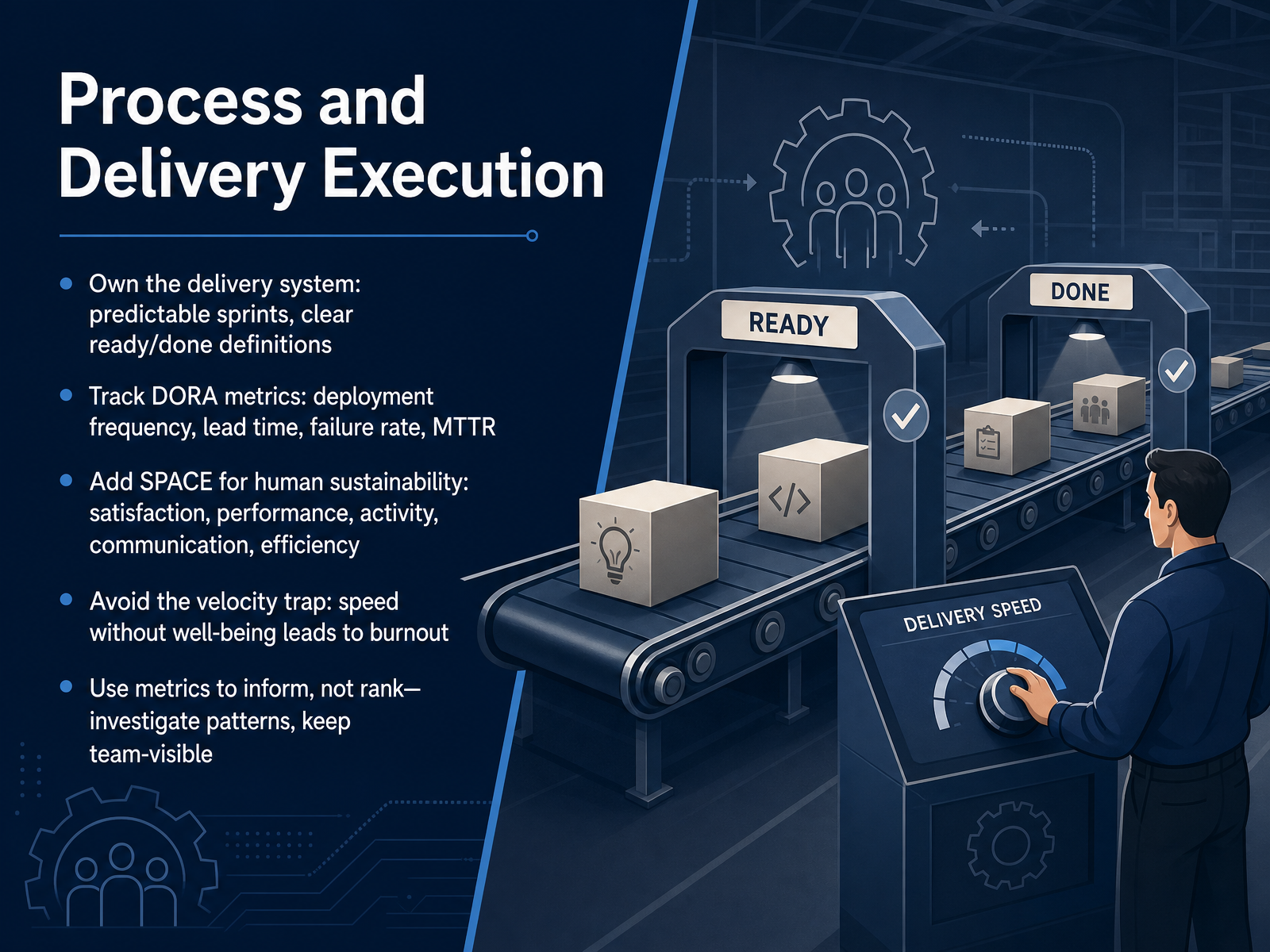
 - 06Process and Delivery ExecutionNow let’s talk about process and delivery execution. Your job here is to own the delivery system, not just the backlog. That means predictable sprints with clear ready and done definitions, so the team knows exactly what enters the cycle and what counts as finished. On top of that, track DORA metrics: deployment frequency, lead time, change failure rate, and time to recovery. These tell you how healthy your pipeline really is. But here’s the gap: DORA only measures the machine. It says nothing about whether people can sustain the pace. That’s where SPACE comes in. Add dimensions for satisfaction, performance, activity, communication, and efficiency. The practical rule is to pick metrics from at least three of those dimensions and never report one in isolation. And watch out for the velocity trap. Speed without well-being leads to burnout. You can hit elite DORA numbers while your senior engineers quietly update their resumes. So use metrics to inform, not to rank. Investigate the patterns they reveal, and keep the data visible to the team. For example, a rising change failure rate might point to unclear requirements or rushed work, not lazy engineers. In short, build a delivery system that is predictable on the outside and sustainable on the inside. Next, we’ll look at how these metrics actually play out in practice, with DORA, SPACE, and the human signals that tie them together.
 2 min
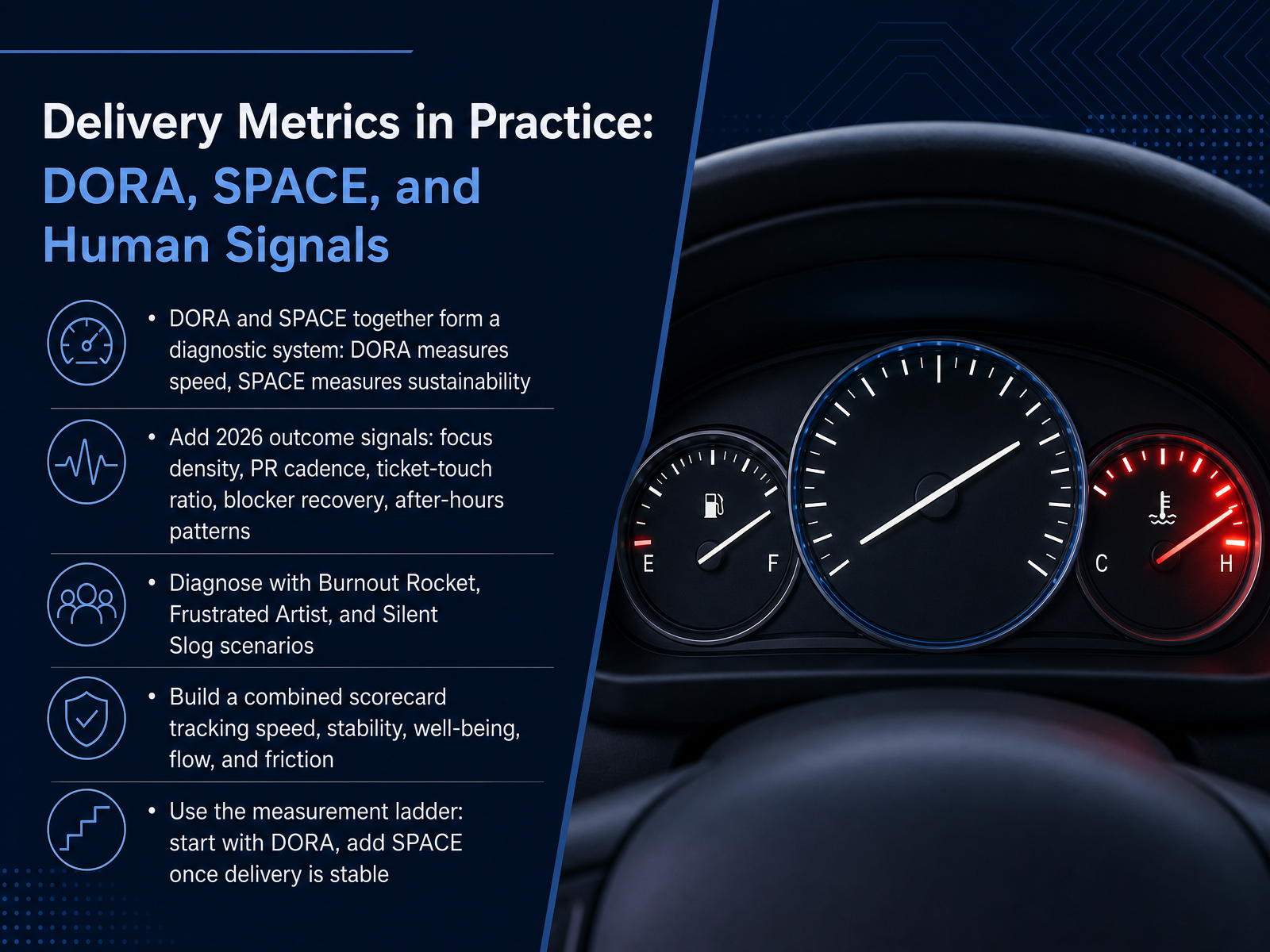
2 min - 07Delivery Metrics in Practice: DORA, SPACE, and Human SignalsLet’s move to how you actually measure delivery in practice. DORA and SPACE aren’t competing frameworks—they form a diagnostic system. DORA measures speed and stability of the pipeline. SPACE measures whether the team can sustain that pace. Track both, and you get the full picture. In 2026, add day-level outcome signals: focus density, PR cadence, ticket-touch ratio, blocker recovery, and after-hours patterns. These surface friction that quarterly surveys miss. Watch for three classic scenarios. The Burnout Rocket—high DORA, low satisfaction. The Frustrated Artist—great collaboration, slow shipping. The Silent Slog—low on both, a real emergency. Build a combined scorecard: speed, stability, well-being, flow, and friction. Don’t track everything at once. Start with DORA, establish baselines, run improvement cycles. Once delivery is stable, layer in SPACE to understand the human factors. That sequencing keeps measurement actionable. Next, we’ll look at stakeholder communication and executive influence.
 2 min
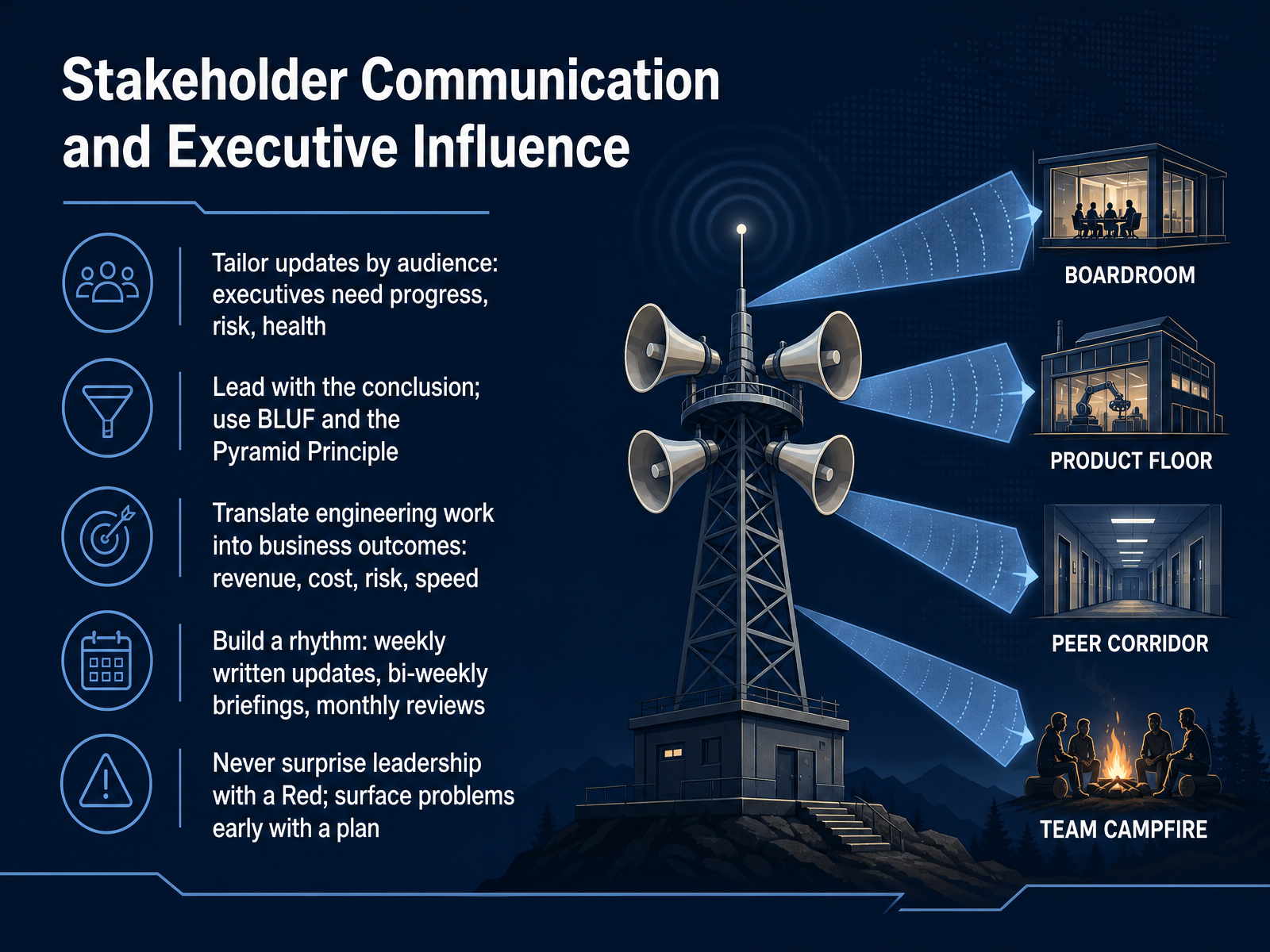
2 min - 08Stakeholder Communication and Executive InfluenceNow let's talk about stakeholder communication and executive influence. This is where many managers struggle, but it's crucial for your team's resources and strategic freedom. First, tailor your updates by audience. Executives want progress, risks, and team health, not technical details. Product managers want timelines and trade-offs. Lead with the conclusion, using the BLUF method: bottom line up front. This is the inverted pyramid for communication. For example, instead of saying, "We're refactoring the database layer," say, "We're investing two weeks to reduce page load time by forty percent and prevent outages." Translate engineering work into business outcomes: revenue, cost, risk, and speed. If you can't map it to at least one of these, the framing is incomplete. Build a rhythm: a weekly written update, a bi-weekly briefing, and a monthly review. Consistency builds trust. And here's the key rule: never surprise leadership with a red status. If a project is at risk, communicate it early with a mitigation plan. Problems without solutions burden executives; problems with options empower them. To build real influence, treat communication as part of delivery, not an add-on. Next, we'll look at how to scale teams and design your organization for growth.
 em-tools.ioimrul.technalyd.dev+21 min
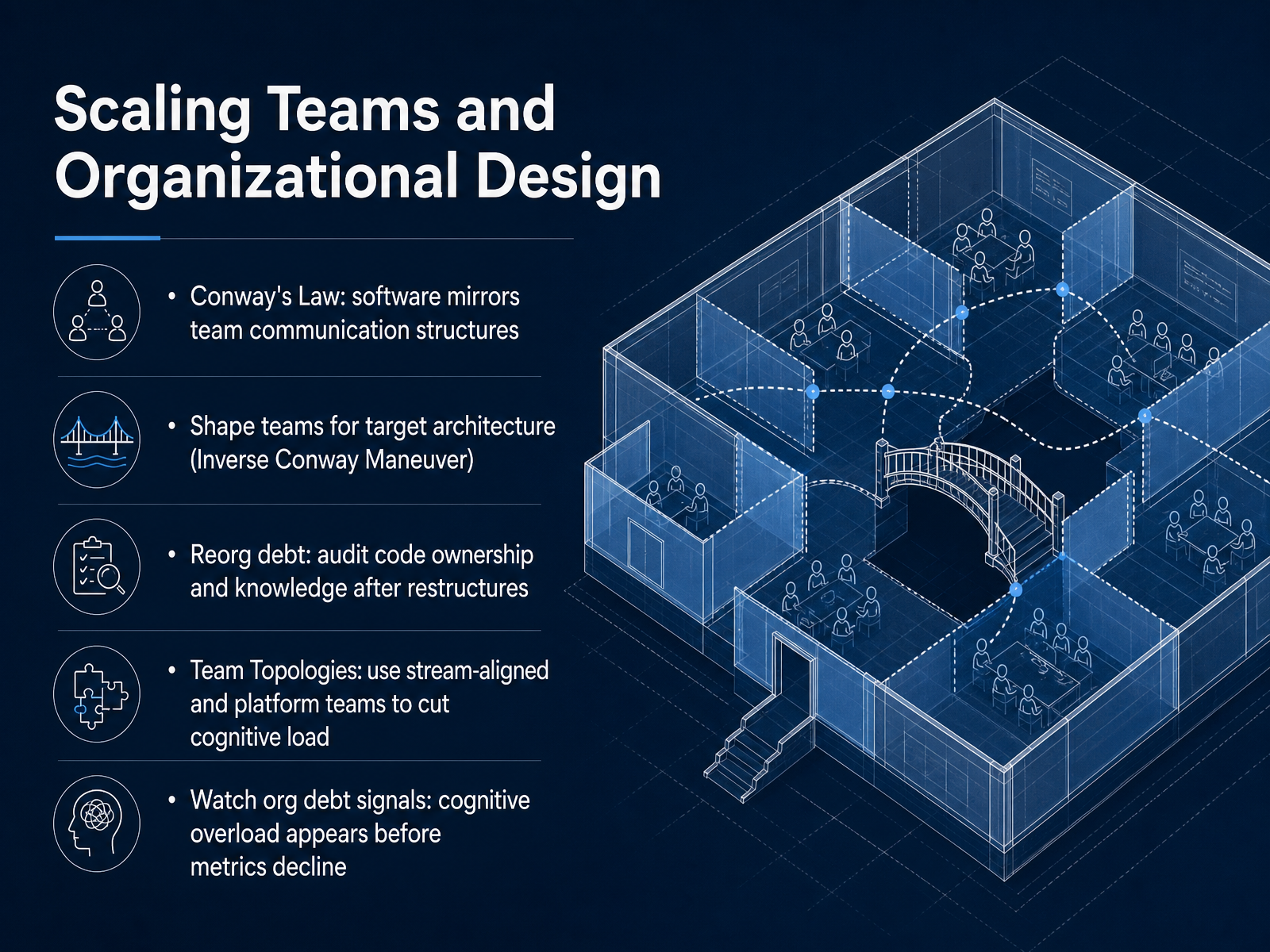
 - 09Scaling Teams and Organizational DesignLet's talk about scaling teams and organizational design, because this is where architecture decisions actually get made. Conway’s Law says your software will mirror your team’s communication structure. If two teams barely talk, you’ll get two services, whether you planned them or not. So use the Inverse Conway Maneuver: shape the teams to match the architecture you want, and let the software follow. After any restructure, audit for reorg debt. Code ownership, on-call rotations, and runbooks all go stale the day the org chart changes. Team Topologies gives you a practical toolkit here, with stream-aligned teams owning a slice of the product end to end, and platform teams reducing cognitive load across the board. Watch for overload signals. If a team's cognitive load is spiking, that shows up in delivery metrics months later, not sooner. The takeaway: treat your org chart as an architectural lever. It’s the most powerful one you have. Next, we’ll cover the manager’s toolkit: one-on-ones, performance reviews, and career ladders.
 1 min
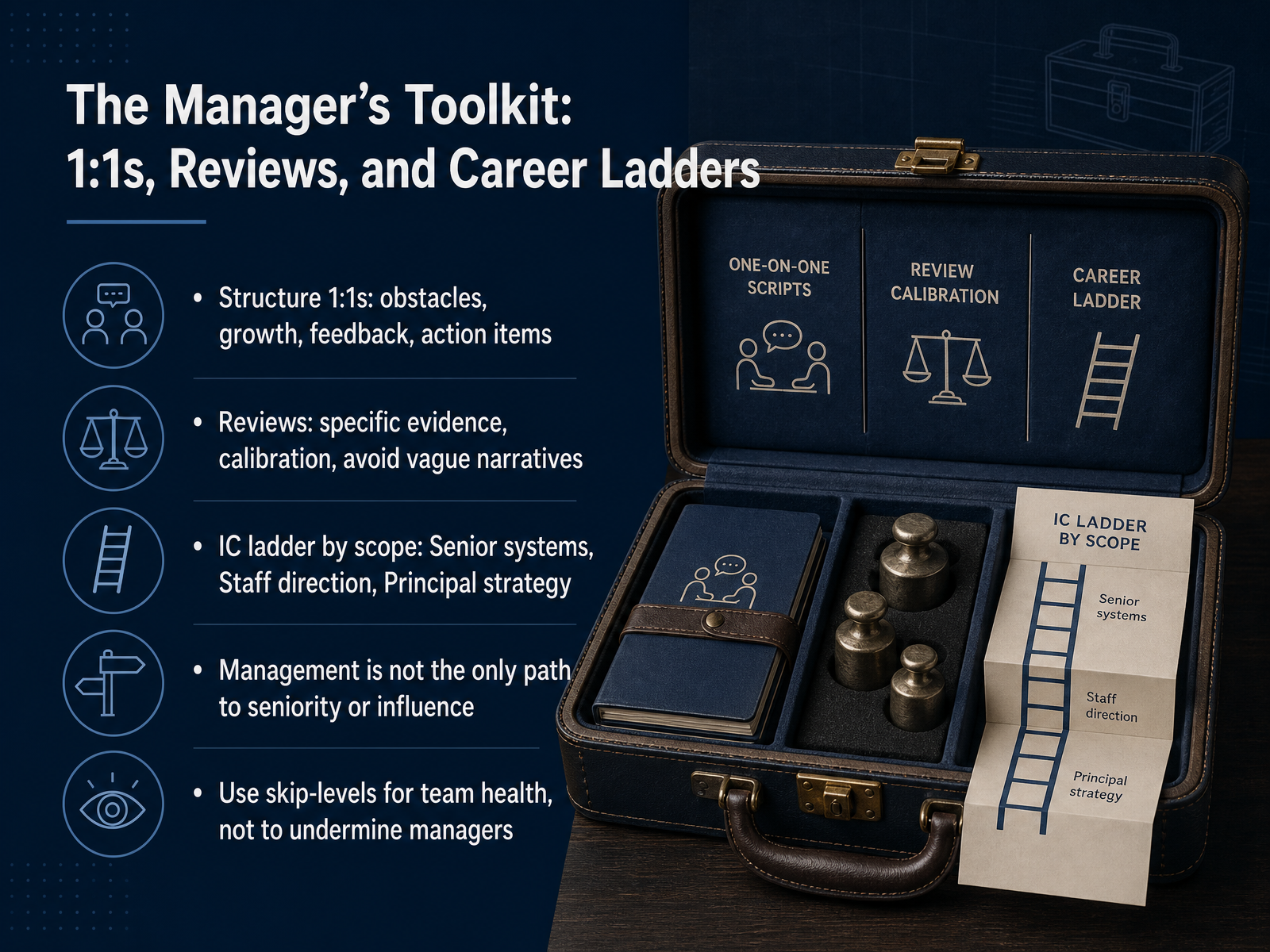
1 min - 10The Manager's Toolkit: 1:1s, Reviews, and Career LaddersNow let’s get practical. Your core toolkit has three parts: one-on-ones, performance reviews, and a career ladder you actually use. One-on-ones should be structured around four things: obstacles, growth, feedback, and clear action items. That’s it. If every conversation covers those, your team always knows where they stand. For reviews, anchor everything in specific evidence. Calibrate with other managers so one person’s “exceeds” isn’t another’s “meets.” Avoid vague narratives — “great work” means nothing without examples. On the ladder itself: Senior owns a system, Staff owns direction across teams, Principal owns strategy for the whole org. And remember — management is not the only path to seniority or influence. If your org rewards only managers, the IC track is decorative, not real. Finally, use skip-levels to check team health, not to undermine your direct managers. They’re a safety valve, not a surveillance tool. That’s the toolkit. Next, we’ll cover hiring and onboarding: how to build a high-signal process that gets you the right people from day one.
 em-tools.ioimrul.technalyd.dev+21 min
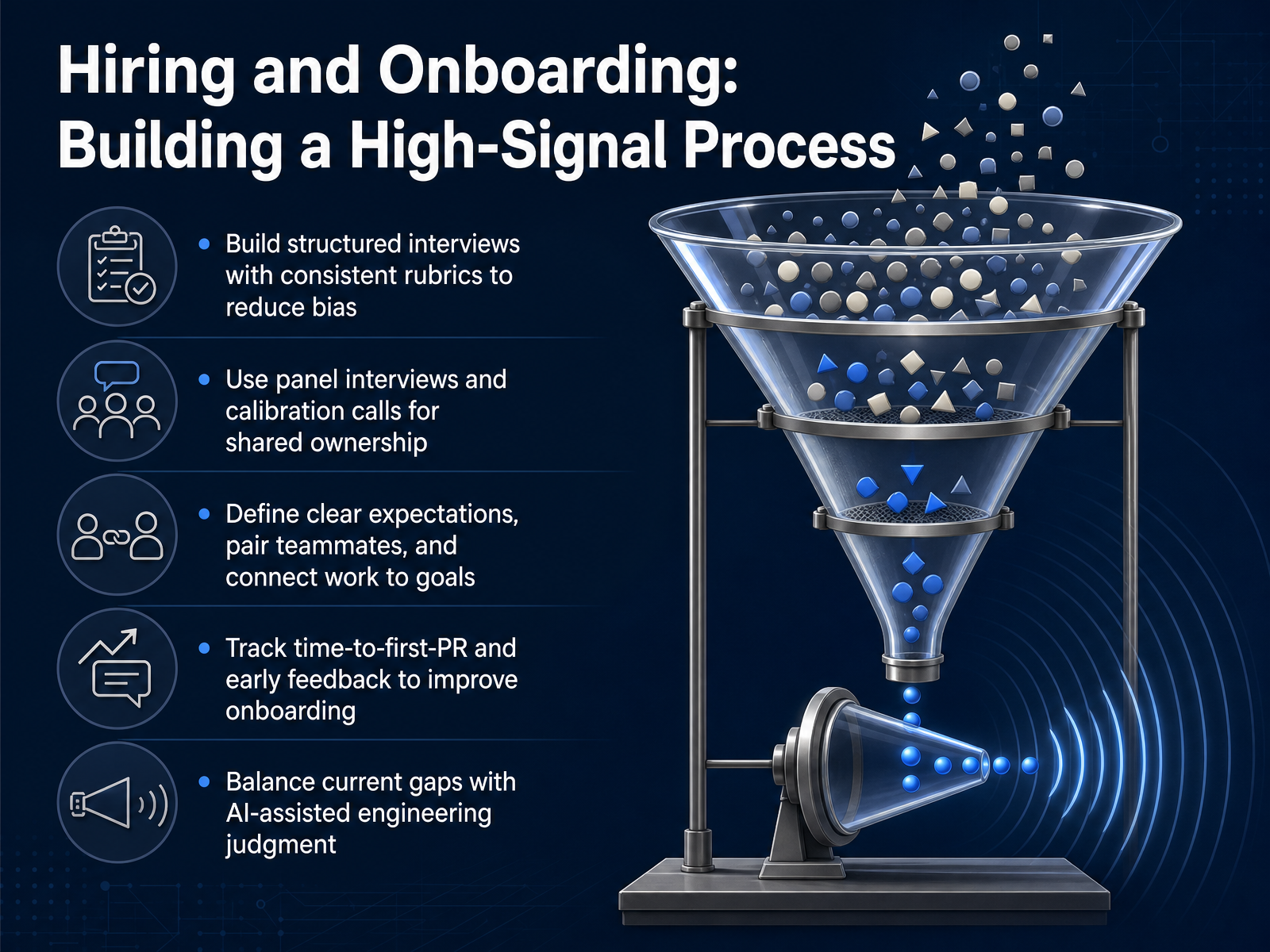
 - 11Hiring and Onboarding: Building a High-Signal ProcessHiring and onboarding deserve the same rigor as your delivery pipeline. A loose process shows up as bias, mis-hires, and a ramp that drags. Build structured interviews with consistent rubrics so every candidate is scored on the same signals. Use panel interviews and calibration calls so ownership is shared, not one person's gut call. Once they accept, the onboarding is where you set the tone. Pair every new hire with a teammate, connect their first tasks to real team goals, and define expectations clearly. Track time to first pull request and gather early feedback so you can fix friction before it becomes a habit. And when you're weighing current gaps, use AI-assisted judgment to move faster without skipping the human check. Hiring is a compounding investment. Get the signal right, and your team's trajectory changes from day one. Now let's talk about handling the harder moments: crisis and conflict resolution.
 devopsschool.comlinearb.iotealhq.com+22 min
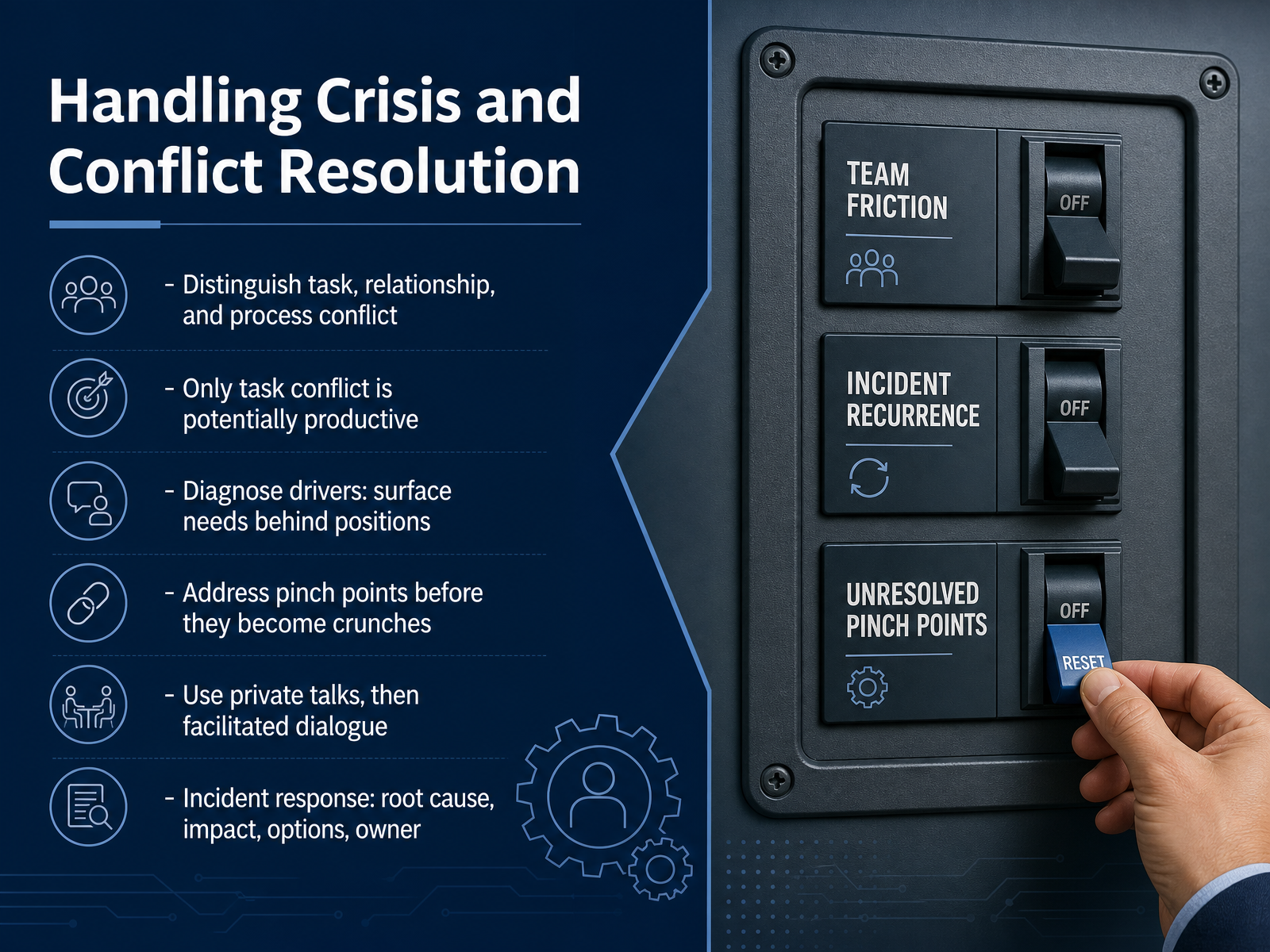
 - 12Handling Crisis and Conflict ResolutionLet’s talk about handling crisis and conflict resolution. Not all conflict is bad. Task conflict, disagreements about the work itself, is often healthy. Relationship conflict, personal friction, is always harmful. Process conflict sits in between. Your job is to diagnose the type first, because the fix depends on it. Look beneath the stated positions. Two engineers arguing about code formatting might really be fighting about autonomy or respect. Surface the underlying needs. Address pinch points early, before they become crunches. A small annoyance, left alone, turns into resentment, and then a full-blown incident you have to mediate. Start with private talks. Hear each person individually, then bring them together for a facilitated dialogue. Focus on specific behaviors and their impact, not character judgments. And when things go wrong, respond like you would to a technical incident. Identify the root cause, assess the impact, lay out the options, and assign an owner. Your goal is not to eliminate conflict, it is to keep it productive and stop it from becoming personal. And as we move into leading through organizational change and uncertainty, remember this same discipline will be your anchor.
 juststeveking.comvibeengines.comkore1.com+21 min
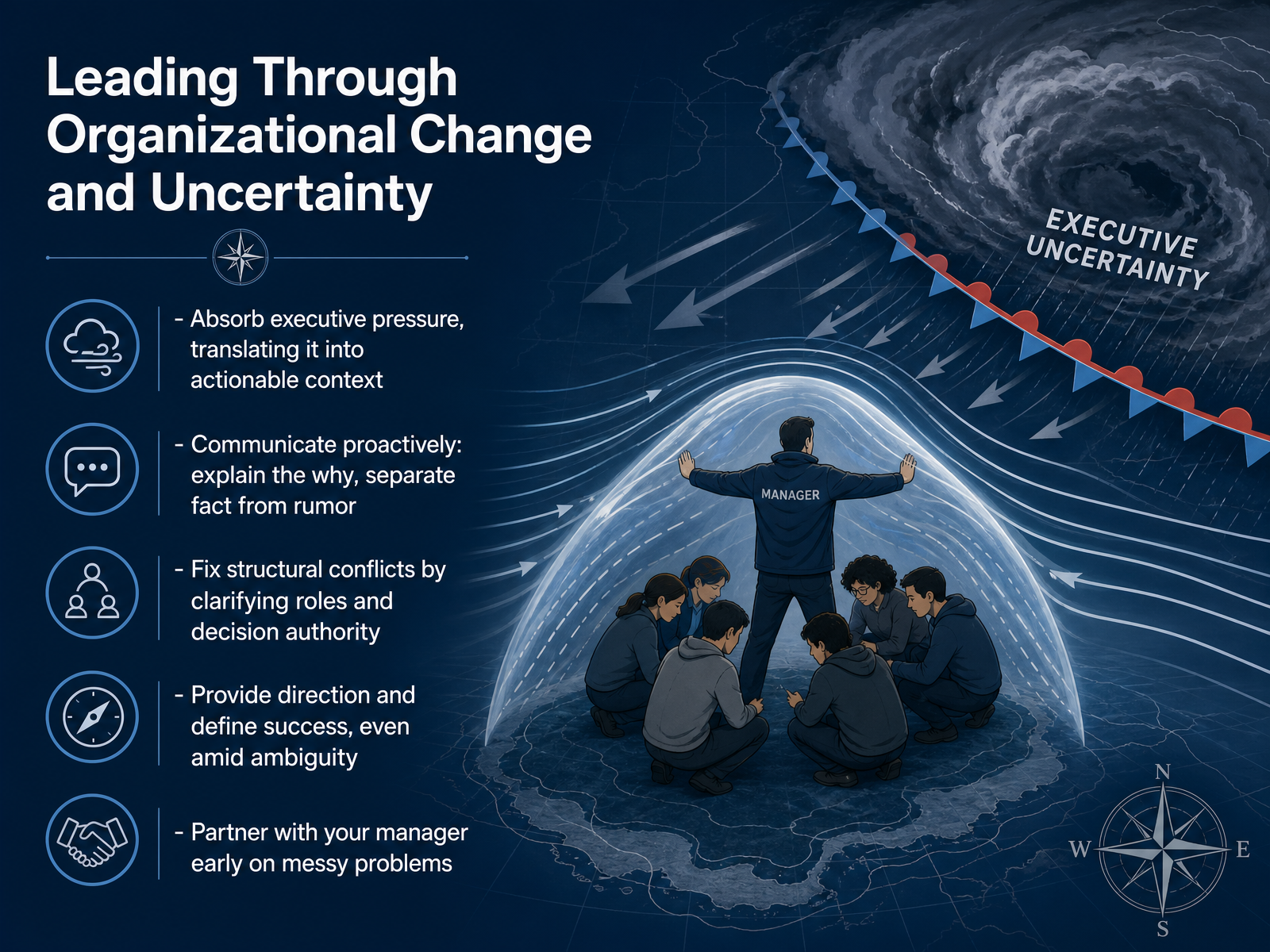
 - 13Leading Through Organizational Change and UncertaintyLet’s talk about leading through organizational change and uncertainty. This is where your role shifts from managing delivery to managing meaning. Executive pressure will come down, and it’s your job to absorb it, translate it, and turn it into context your team can actually act on. You don’t pass anxiety down; you pass clarity down. Communicate proactively, especially when information is incomplete. Explain the why whenever you can, and actively separate fact from rumor. Silence creates a vacuum, and rumor will fill it. When structural conflicts emerge—unclear roles, competing priorities—don’t mediate them away. Fix the structure. Clarify who owns what and who makes which call. Even in ambiguity, your team needs direction and a working definition of success. If the target is fuzzy, define what good looks like anyway; you can always refine it. Above all, partner with your manager early on messy problems. Don’t wait until something escalates into a crisis. Getting in front of it early buys you options and builds trust. Up next, we’ll look at your roadmap to leadership: your first ninety days and beyond.
 em-tools.ioimrul.technalyd.dev+22 min
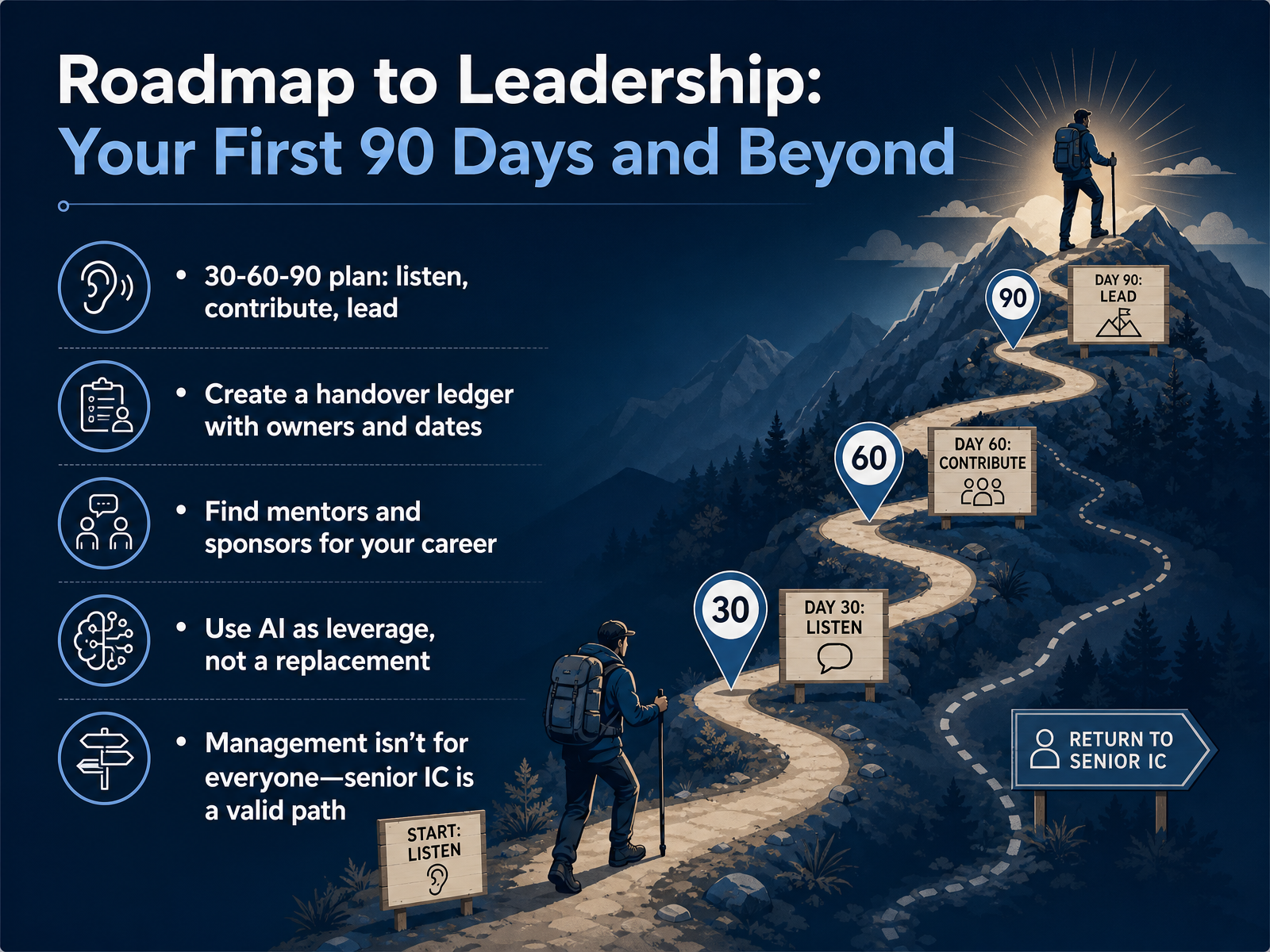
 - 14Roadmap to Leadership: Your First 90 Days and BeyondLet’s wrap this up with a roadmap you can actually use. Your first ninety days should follow a simple rhythm: listen, contribute, lead. In the first thirty days, do a listening tour. Complete every one-on-one, map the architecture, and identify where the team feels friction. Days thirty-one to sixty, make one meaningful process change and lock in your weekly cadence. By day ninety, you should own the roadmap and have delegated real ownership to your seniors. Along the way, keep a handover ledger. Write down what you’re giving up, who owns it, and when. A commitment without a date is just a preference. Also, find mentors and sponsors. Mentors give you advice; sponsors put your name forward when you’re not in the room. You need both. And use AI as leverage, not a replacement. It can help you get back up to speed on the code quickly and handle small unplanned work, but your job is still judgment, coaching, and stakeholder alignment. Finally, be honest with yourself. Management is not for everyone, and the senior individual contributor track is a perfectly valid career path. The best leaders are the ones who chose the role deliberately, not by default. Thank you for your time today, and good luck with your transition.
 juststeveking.comvibeengines.comkore1.com+22 min
Take the deck with you
Download this course as a file — free, no sign-up needed.
- PDF handoutEvery slide page, ready to print or share.15 pages · 4.3 MBDownload
- Narrated PowerPointThe deck that presents itself — every slide carries the digital human's narration video.15 pages · 18.1 MBDownload
- PowerPoint slidesThe full deck as a .pptx — open it in PowerPoint, Keynote, or Google Slides.15 pages · 4.3 MBDownload
Free to use in your own training — please keep the PersonWise credit page at the end.
Have your own deck? Turn it into a course
Sources consulted
Web sources consulted while building this course.
- Software Engineering Manager: Role Blueprint, Responsibilities, Skills, KPIs, and Career Path — devopsschool.com
- Engineering management: what the role owns in 2026 — linearb.io
- What is a Software Engineering Manager? - Career Insights | Teal — tealhq.com
- Engineering Manager Career in 2026: Skills, Salary & Interviews (From 345 Live JDs) | Dexity Intel | Dexity — dexity.com
- Engineering managers have a new job description - LeadDev — zporigin.leaddev.com
- What you give up when moving into engineering management — stackoverflow.blog
- Your First 90 Days as an Engineering Manager — emaccelerator.com
- From IC to Manager: First Steps for New Engineering Leads | JustSteveKing — juststeveking.com
- My first 30 days as an engineering manager — Yousuf Sohail — yousufsohail.com
- Career Change Guide - How to Transition Into an Engineering Manager Role - MentorCruise — mentorcruise.com
- Stakeholder Communication for Engineering Managers — em-tools.io
- Stakeholder Communication | Imrul Sheikh — imrul.tech
- Translating Engineering Work: Communicating Impact to Executives & Product Leaders | Playbooks | Dylan Marin — nalyd.dev
- Executive Communication: Unlock Resources and Trust | Engineering Manager Tools — em-tools.io
- Effective Communication Strategies for Engineering Leaders — engineeringmanagementinstitute.org
- The Engineering Manager as Coach, Not Boss | JustSteveKing — juststeveking.com
- Engineering Manager Roadmap 2026 — From IC to Leading People, Teams & Orgs | Vibe Engines — vibeengines.com
- Engineering Manager Coaching & IC-to-Leader Advisory - KORE1 — kore1.com
- Coaching a New Engineering Manager Before They Wash Out - KORE1 — kore1.com
- Engineering Manager Coaching With the Scientific Method | elevanation.com — elevanation.com