Begin
14 pages · ~28 min
Introduction to Epistemology
This introductory epistemology training explores what counts as knowledge, helping learners understand its nature, sources, and justification. Ideal for students and professionals new to philosophy.
A digital instructor presents all 14 pages. Hold “Ask” at any point and ask out loud — the answer comes from this course. No sign-up needed.
What you’ll learn
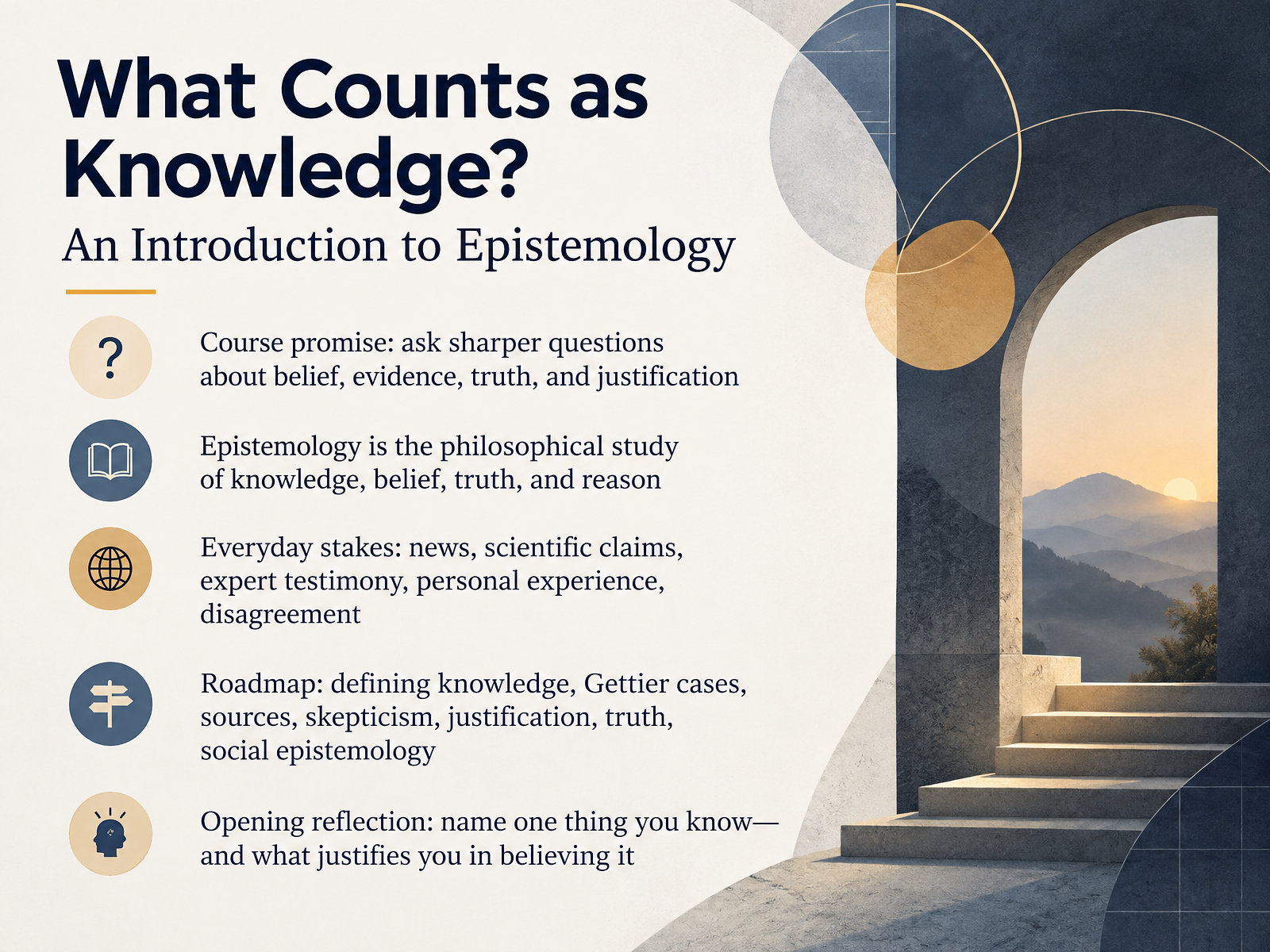
- 01What Counts as Knowledge? An Introduction to EpistemologyWelcome. I'm glad you're here. Over the next few lessons, we'll explore one of philosophy's oldest and most practical questions: what counts as knowledge? This field is called epistemology, the philosophical study of knowledge, belief, truth, and reason. Our promise is simple. You'll learn to ask sharper questions about belief, evidence, truth, and justification. Why does this matter? Think about the news you read, scientific claims, expert testimony, your own experience, and disagreements with people you trust. In each case, you're deciding what to believe. Here's our roadmap. We'll define knowledge, look at Gettier cases, examine sources of knowledge, confront skepticism, explore justification and truth, and finish with social epistemology. Before we begin, take a moment to reflect. Name one thing you know. Then ask yourself, what justifies you in believing it? Keep that example in mind. It will anchor everything we discuss. Next, let's define our core terms: knowledge, belief, opinion, and information.plato.stanford.eduroutledge.comphilosophycourse.info+22 min
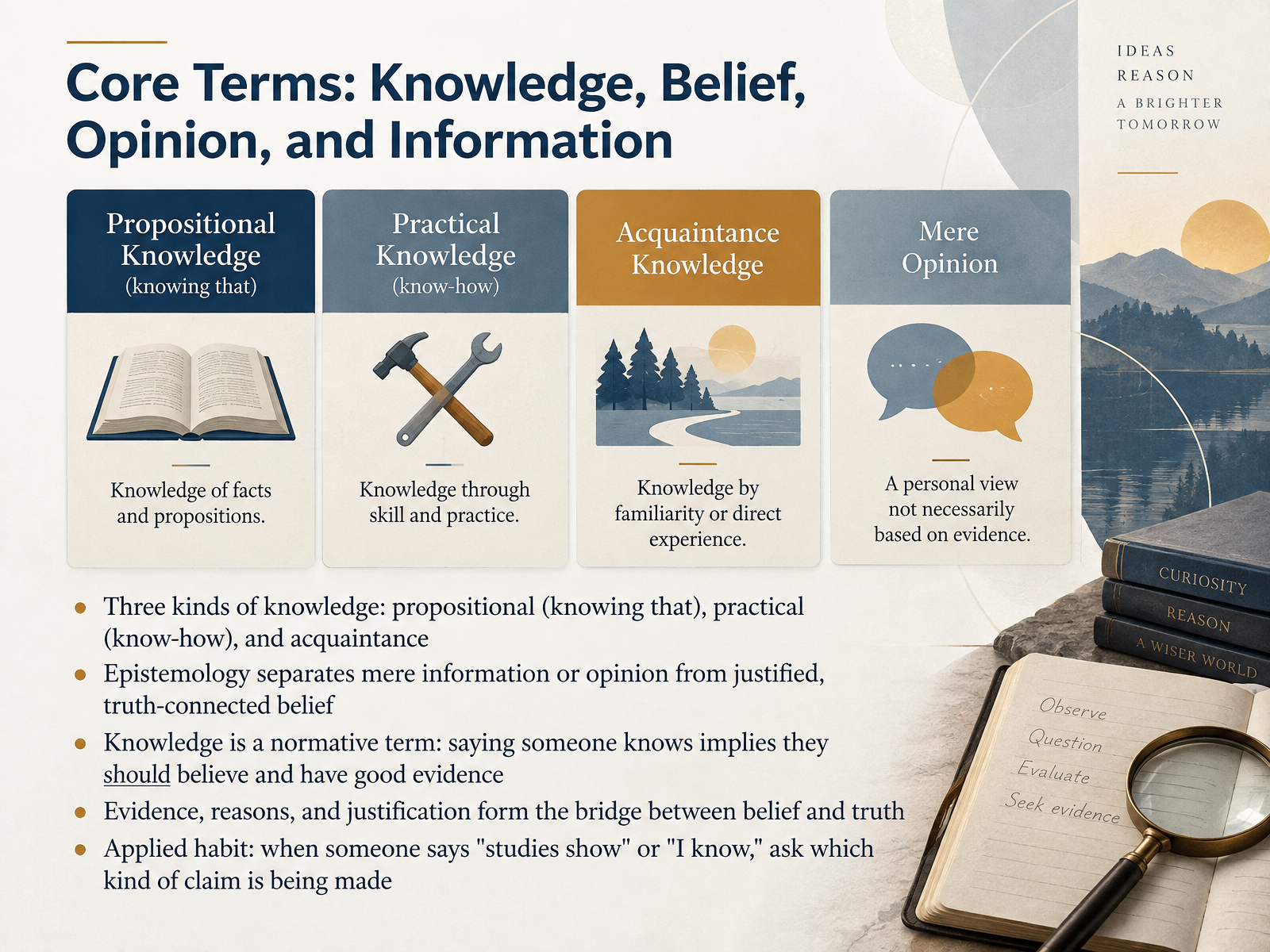
- 02Core Terms: Knowledge, Belief, Opinion, and InformationLet's start with the core terms. Epistemologists usually distinguish three kinds of knowledge. Propositional knowledge is knowing that something is the case, like knowing that Paris is the capital of France. Practical knowledge is know-how, like knowing how to ride a bike. And knowledge by acquaintance is familiarity, like knowing a friend. Now, epistemology is not just about collecting facts. It separates mere information or opinion from belief that is justified and connected to truth. This matters because knowledge is a normative term. If I say someone knows something, I am implying they should believe it and have good evidence for it. Belief on its own is not enough. Evidence, reasons, and justification are the bridge between belief and truth. So here is a useful habit. When someone says studies show, or simply I know, ask which kind of claim is being made, and what supports it. That question is the heart of epistemology. Next, we will look at the classic definition: knowledge as justified true belief.
 plato.stanford.eduroutledge.comphilosophycourse.info+22 min
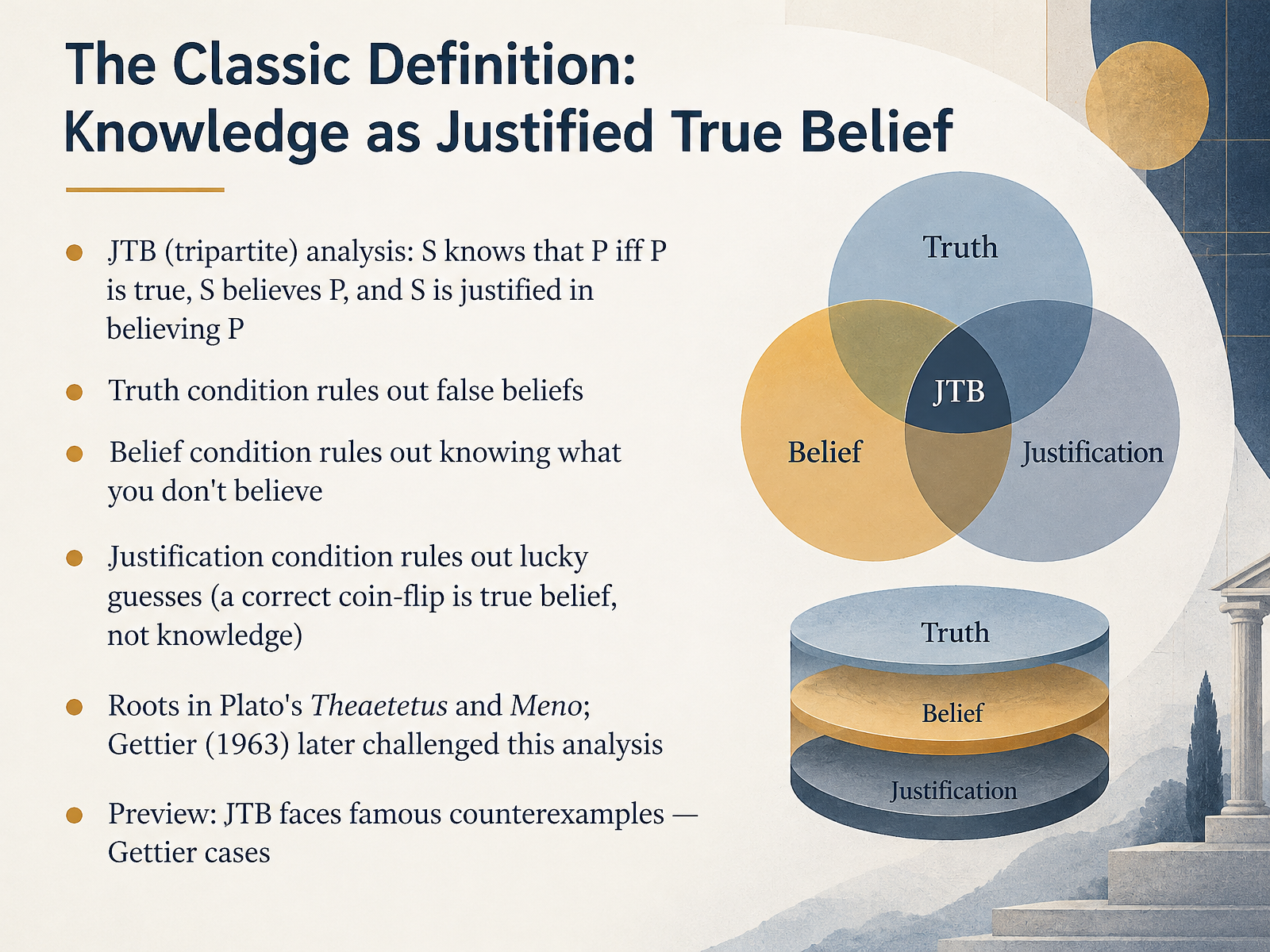
- 03The Classic Definition: Knowledge as Justified True BeliefLet's turn now to the classic definition of knowledge, often called the J T B analysis. J T B stands for justified true belief. According to this view, you know something if and only if three conditions are met. First, the claim is true. Second, you believe it. And third, you are justified in believing it. Each condition does important work. The truth condition rules out false beliefs. The belief condition rules out claiming to know something you don't actually believe. And the justification condition rules out lucky guesses. Suppose you flip a coin and confidently guess it will land heads. If it does, your belief is true, but it isn't knowledge, because you had no good reason. This idea goes back to Plato's dialogues, the Theaetetus and the Meno. Much later, in nineteen sixty-three, Edmund Gettier challenged this analysis with famous counterexamples. Keep those in mind, because next we'll look at Gettier cases and the problem of epistemic luck.
 iep.utm.eduplato.stanford.educourses.physics.illinois.edu+22 min
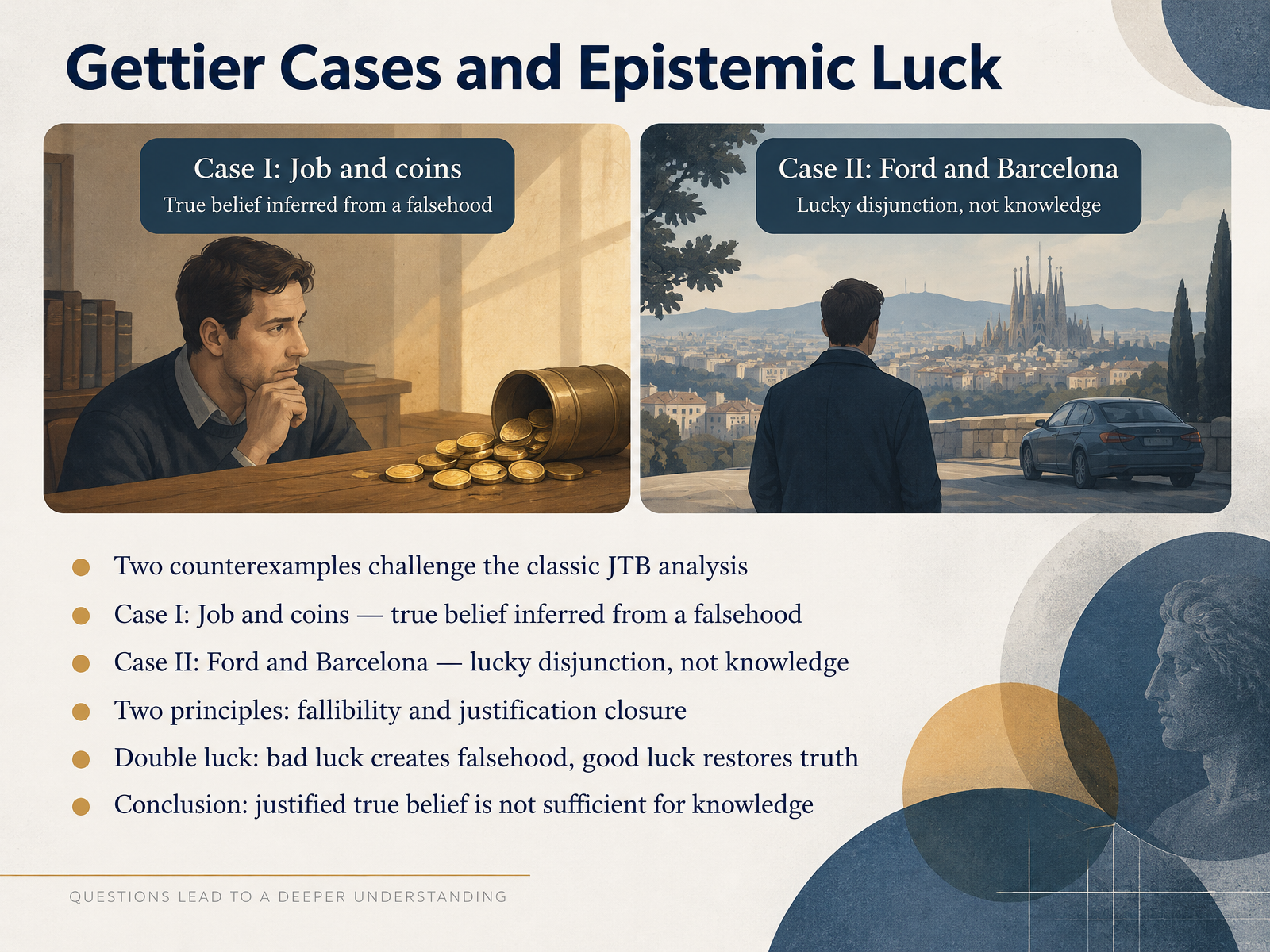
- 04Gettier Cases and Epistemic LuckNow let's look at the cases that shook the classic analysis of knowledge. In nineteen sixty-three, Edmund Gettier offered two counterexamples. In Case One, Smith has strong evidence that Jones will get the job, and that Jones has ten coins in his pocket. So Smith concludes that the person who will get the job has ten coins in his pocket. But Smith gets the job, and Smith happens to have ten coins. The belief is true and justified, yet it clearly is not knowledge. In Case Two, Smith justifiably believes Jones owns a Ford, and infers that either Jones owns a Ford or Brown is in Barcelona. Jones does not own a Ford, but by pure coincidence, Brown really is in Barcelona. Again, true and justified, but not knowledge. These cases rest on two principles. Fallibility: you can be justified in believing something false. And justification closure: if you are justified in believing something, and it entails another claim, you are justified in believing that too. Notice the double luck. Bad luck makes the original belief false. Good luck makes the final belief true. And that final truth is not connected to Smith's evidence in the right way. What is the conclusion? Justified true belief is not sufficient for knowledge. There is more to knowing than evidence and truth alone. After Gettier: Repairing or Replacing the Analysis.
 iep.utm.eduplato.stanford.educourses.physics.illinois.edu+22 min
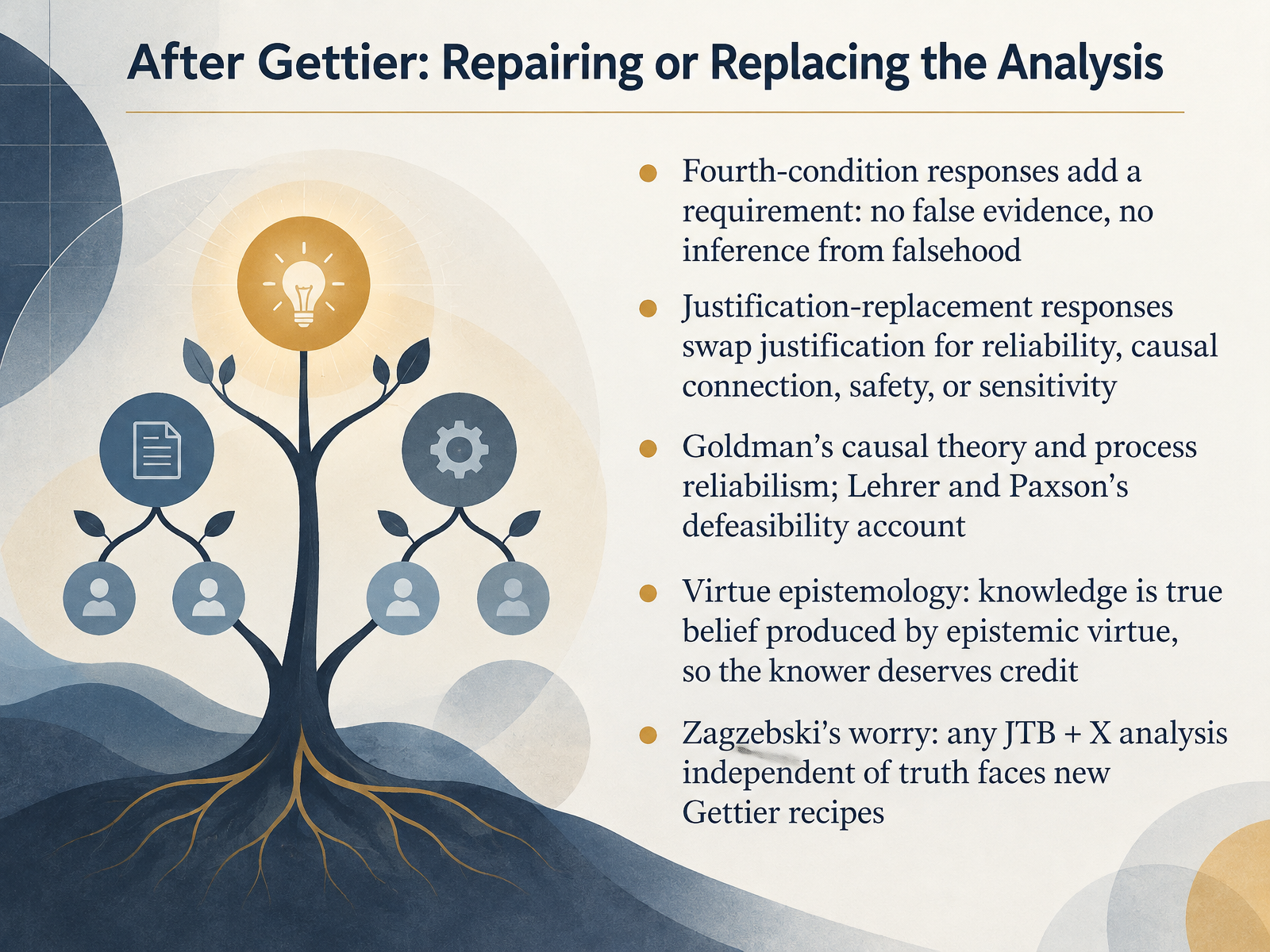
- 05After Gettier: Repairing or Replacing the AnalysisSo how have philosophers tried to fix the old definition of knowledge? Two main strategies. The first adds a fourth condition. For example, no false evidence, or no inference from a falsehood. The second replaces justification altogether, swapping it for reliability, a causal connection, safety, or sensitivity. Alvin Goldman's causal theory and his later process reliabilism are the classic examples. Keith Lehrer and Thomas Paxson offered a defeasibility account, where knowledge is justified true belief that no further truth would undermine. Then comes virtue epistemology. Here, knowledge is true belief produced by an epistemic virtue, so the knower genuinely deserves credit. But Linda Zagzebski raised a sharp worry. Any analysis built as justified true belief plus some extra condition, where that condition is independent of truth, faces a recipe for new Gettier cases. So the repair work continues. Next, we turn to where our beliefs come from: sources of knowledge, perception, and reason.
 iep.utm.eduen.wikipedia.orgrep.routledge.com+21 min
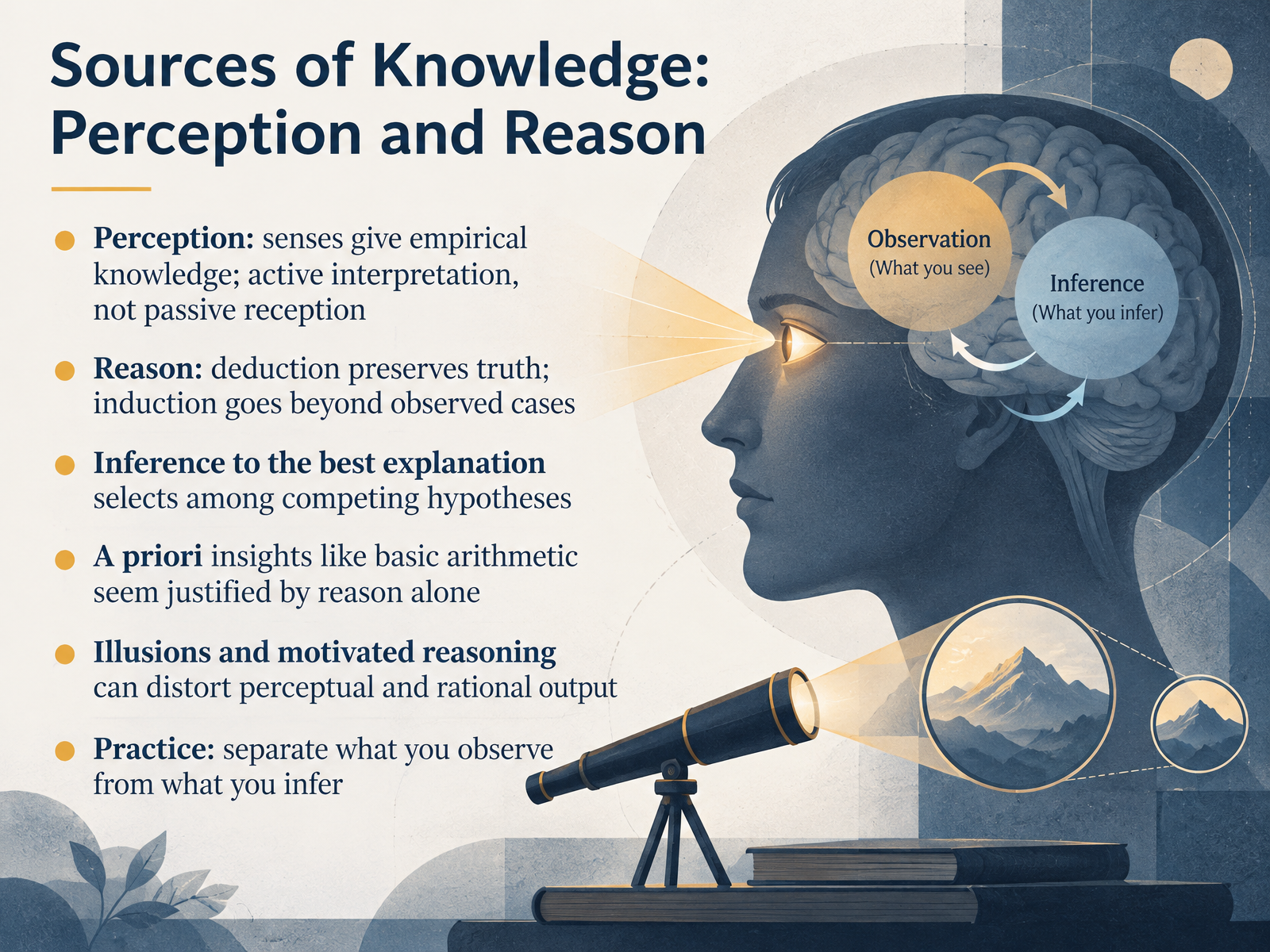
- 06Sources of Knowledge: Perception and ReasonLet's turn now to where knowledge comes from, starting with perception and reason. Perception is the main source of empirical knowledge. Your senses give you information about the world. But perception is not passive. It is an active process. Your mind selects, organizes, and interprets what your senses take in. Think of reading a familiar word: you do not carefully examine each letter. You recognize the whole word at once. Illusions show the same thing. Sometimes perception misrepresents reality, so observation and inference are not the same. Reason works differently. Deduction preserves truth. If the premises are true and the logic is valid, the conclusion must be true. Induction goes beyond what you have observed. You see many swans that are white, and you infer that all swans are white, until you meet a black one. Inference to the best explanation selects among competing hypotheses, asking which one explains the evidence best. And some insights, like basic arithmetic, seem justified by reason alone, without needing experience. Still, both perception and reason can be distorted, by illusions or by motivated reasoning, where we favor what we want to believe. So here is a useful practice. Separate what you observe from what you infer. Ask, what did I actually see or hear, and what did I add? That habit sharpens your thinking. Next, we will look at memory, introspection, and testimony.
 academic.oup.complato.stanford.eduen.wikipedia.org+22 min
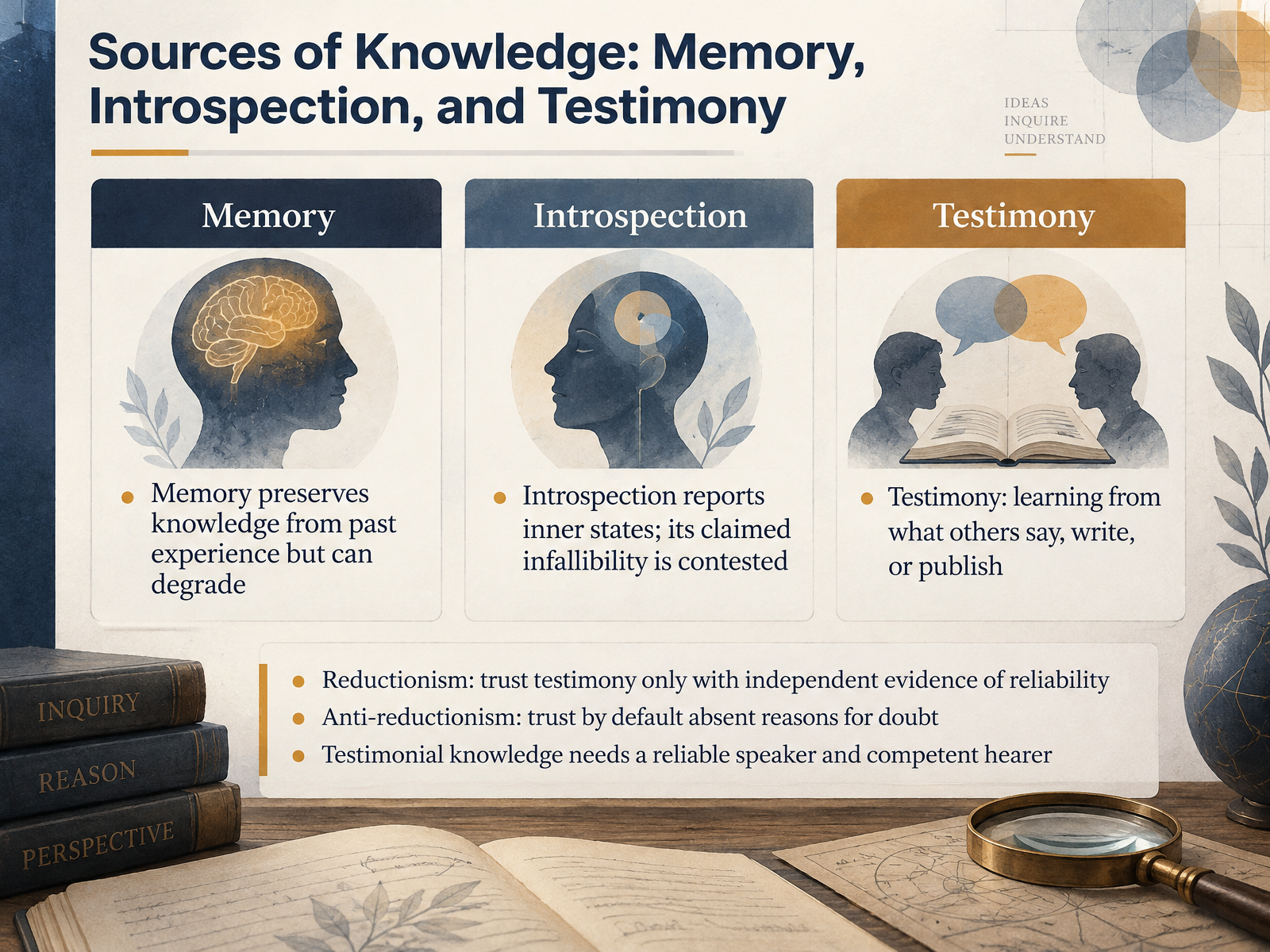
- 07Sources of Knowledge: Memory, Introspection, and TestimonyLet us turn to three more sources of knowledge: memory, introspection, and testimony. Memory preserves what you learned earlier. It carries knowledge forward from past experience, but it can fade or distort, so it is preservative rather than a fresh source. Introspection is your awareness of your own inner states, like noticing that you feel tired or anxious. Some say it cannot be wrong, but that claim is contested. Testimony is learning from what others say, write, or publish. Now, how much should we trust it? Reductionism says trust testimony only when you have independent evidence that the source is reliable. Anti-reductionism says trust by default unless you have a reason to doubt. Either way, testimonial knowledge needs a reliable speaker and a competent hearer. Next, we ask: Skepticism: Can We Know Anything at All?
 academic.oup.complato.stanford.eduen.wikipedia.org+22 min
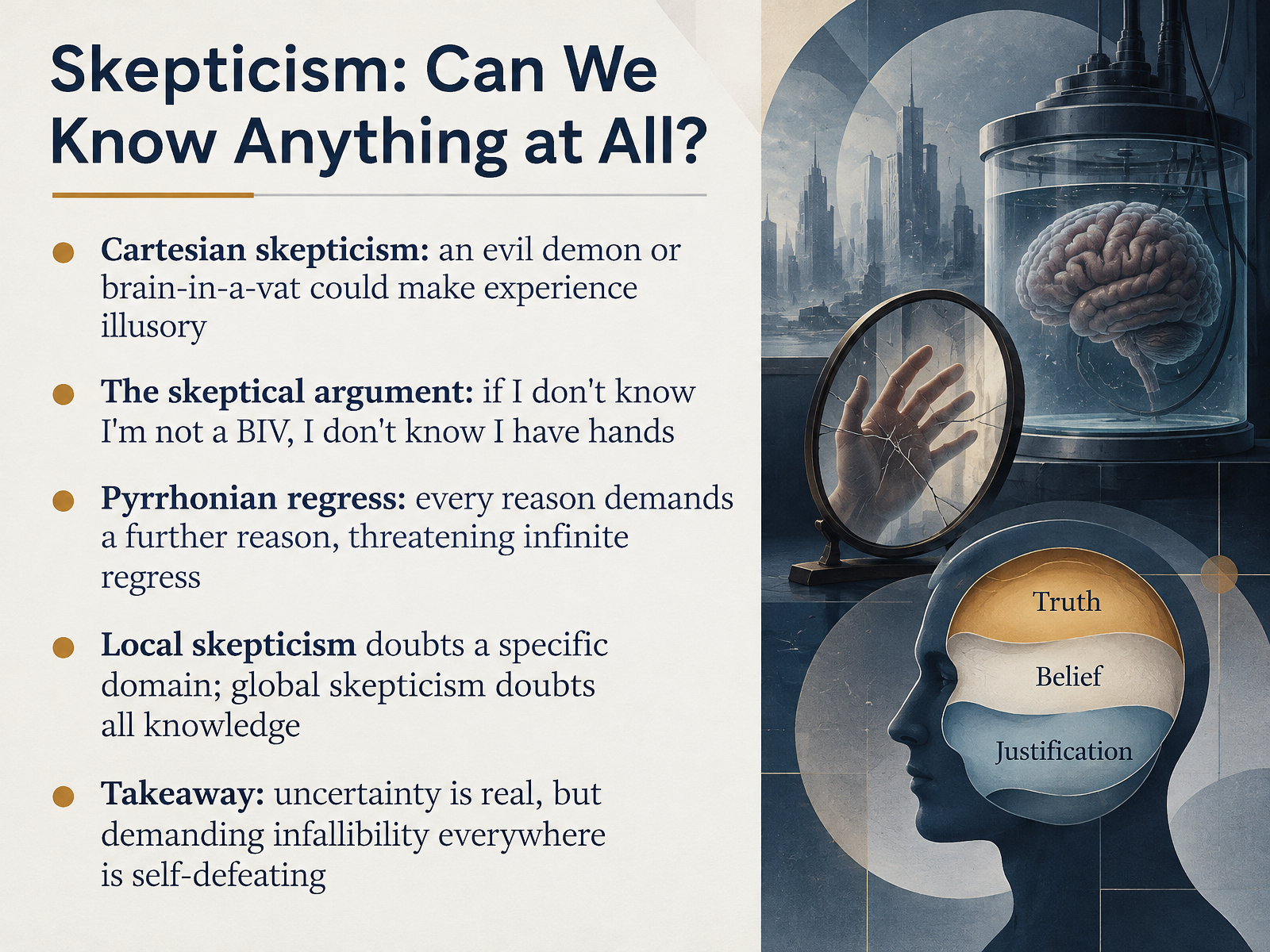
- 08Skepticism: Can We Know Anything at All?Let's turn to skepticism, and a question that can feel unsettling: can we know anything at all? One famous version is Cartesian skepticism. It asks you to imagine that an evil demon, or a brain in a vat, could be feeding you an experience that is completely illusory. Everything would seem the same, yet none of it would be real. That leads to the skeptical argument. If I don't know I'm not a brain in a vat, then I don't know I have hands. Notice what the argument does. It sets the bar for knowledge very high, then shows that ordinary beliefs cannot clear it. A second line, Pyrrhonian skepticism, comes from the regress problem. Every reason you give seems to demand a further reason, and that chain may never end. It helps to separate two targets here. Local skepticism doubts one specific domain, say, knowledge of the past. Global skepticism doubts all knowledge at once. The lesson is not that uncertainty is fake. It is real. But demanding perfect certainty everywhere is self-defeating. If nothing can count as knowledge, then the demand itself cannot be known either. Next, we'll look at how philosophers respond, through foundations, coherence, and context.
 iep.utm.eduplato.stanford.eduonlinelibrary.wiley.com2 min
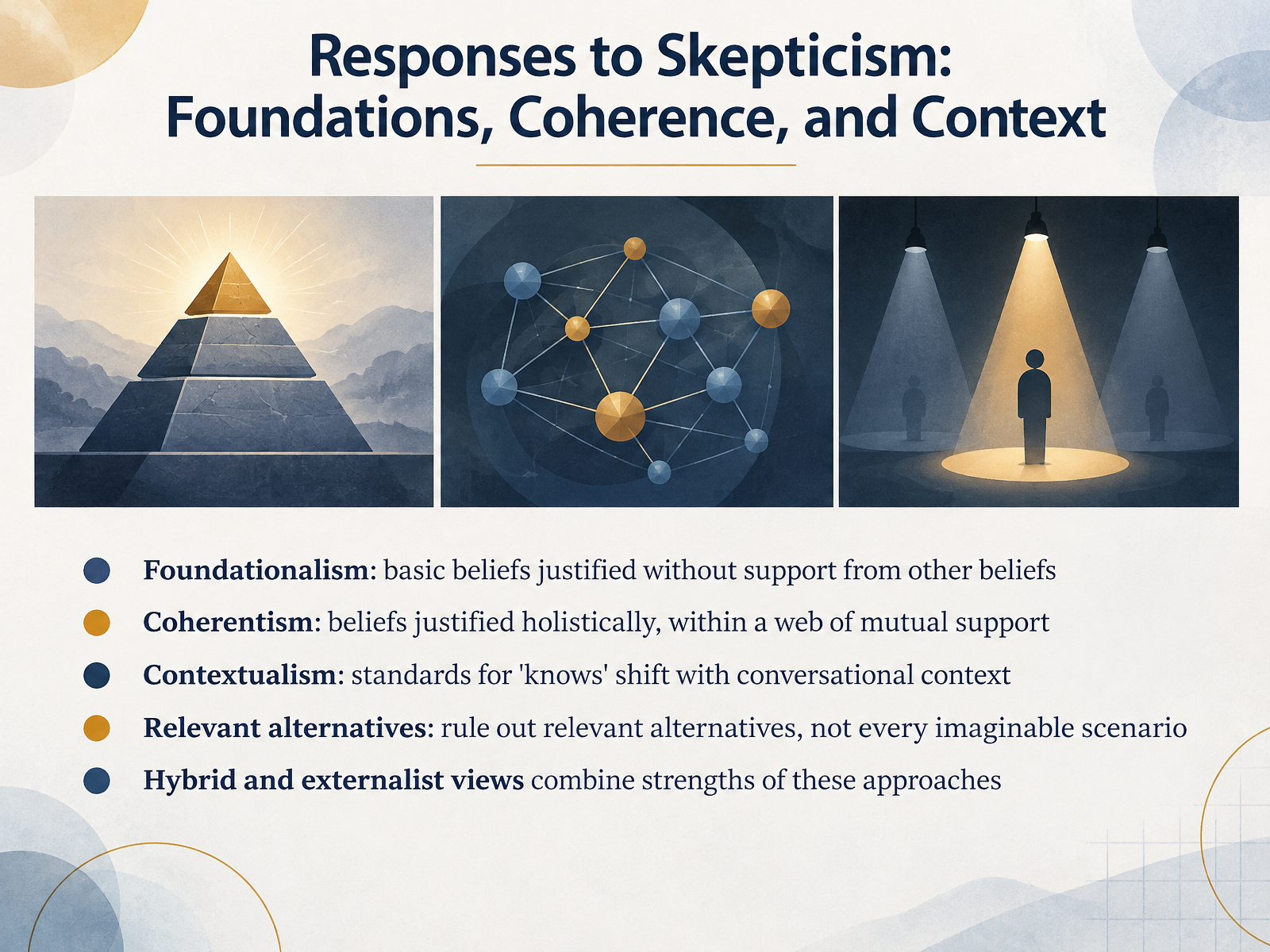
- 09Responses to Skepticism: Foundations, Coherence, and ContextNow that we have seen the challenge skepticism poses, how do philosophers respond? One answer is foundationalism. It says some basic beliefs are justified on their own, without support from other beliefs. Think of a building. Other beliefs rest on that foundation. A second answer is coherentism. Here, beliefs are justified together, like strands in a web that hold each other up. A third response is contextualism. The standards for the word knows shift with the conversation. In a casual chat, saying you know your friend's name is fine. In a courtroom, the bar rises. Related to this is the relevant alternatives view. To know something, you only need to rule out the alternatives that actually matter, not every imaginable scenario. And finally, hybrid and externalist views combine strengths from several of these approaches. They often add that factors outside your awareness, like reliable perception, can help justify belief. So there is no single winner here. Each response offers a different way to keep knowledge possible. Next, we look more closely at justification and how rational belief is structured, in Justification, Evidence, and the Structure of Rational Belief.
 iep.utm.eduplato.stanford.eduonlinelibrary.wiley.com+12 min
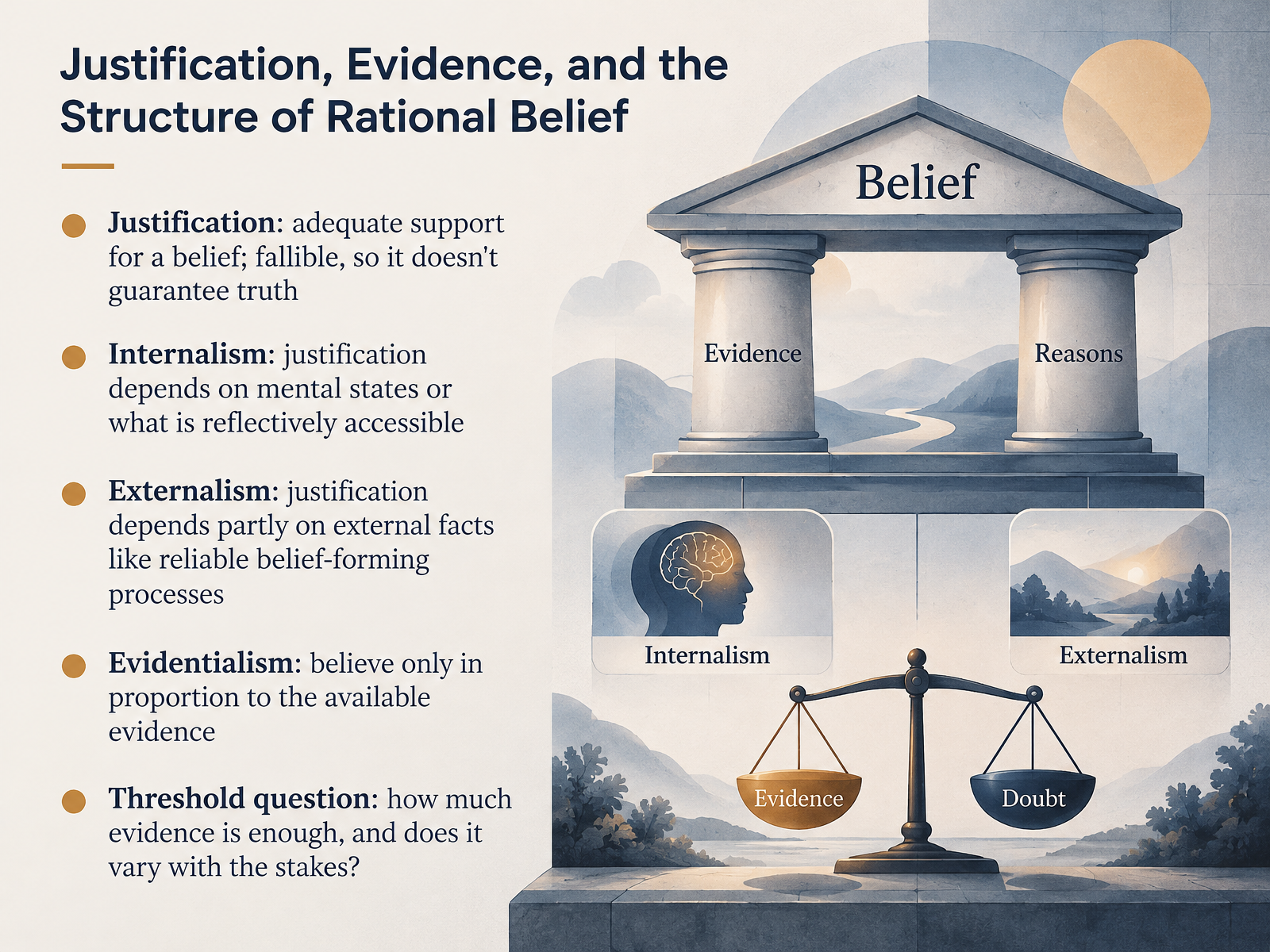
- 10Justification, Evidence, and the Structure of Rational BeliefNow let's look at what actually supports a belief. Justification means having adequate support for what you believe. It is fallible, so it does not guarantee truth. Think of a student trusting a classmate's notes. That support is real, but it can still fail. Next, internalism says justification depends on your mental states, or on what you can reflectively access. Externalism says it also depends on external facts, like whether your belief came from a reliable process. Then there is evidentialism. Believe only in proportion to the available evidence. But this raises a threshold question. How much evidence is enough? And does the answer change with the stakes? In a low-stakes quiz, a little evidence may feel sufficient. In a medical or financial decision, we usually demand much more. That same tension shapes debates about truth, objectivity, and disagreement.
 plato.stanford.edu1 min
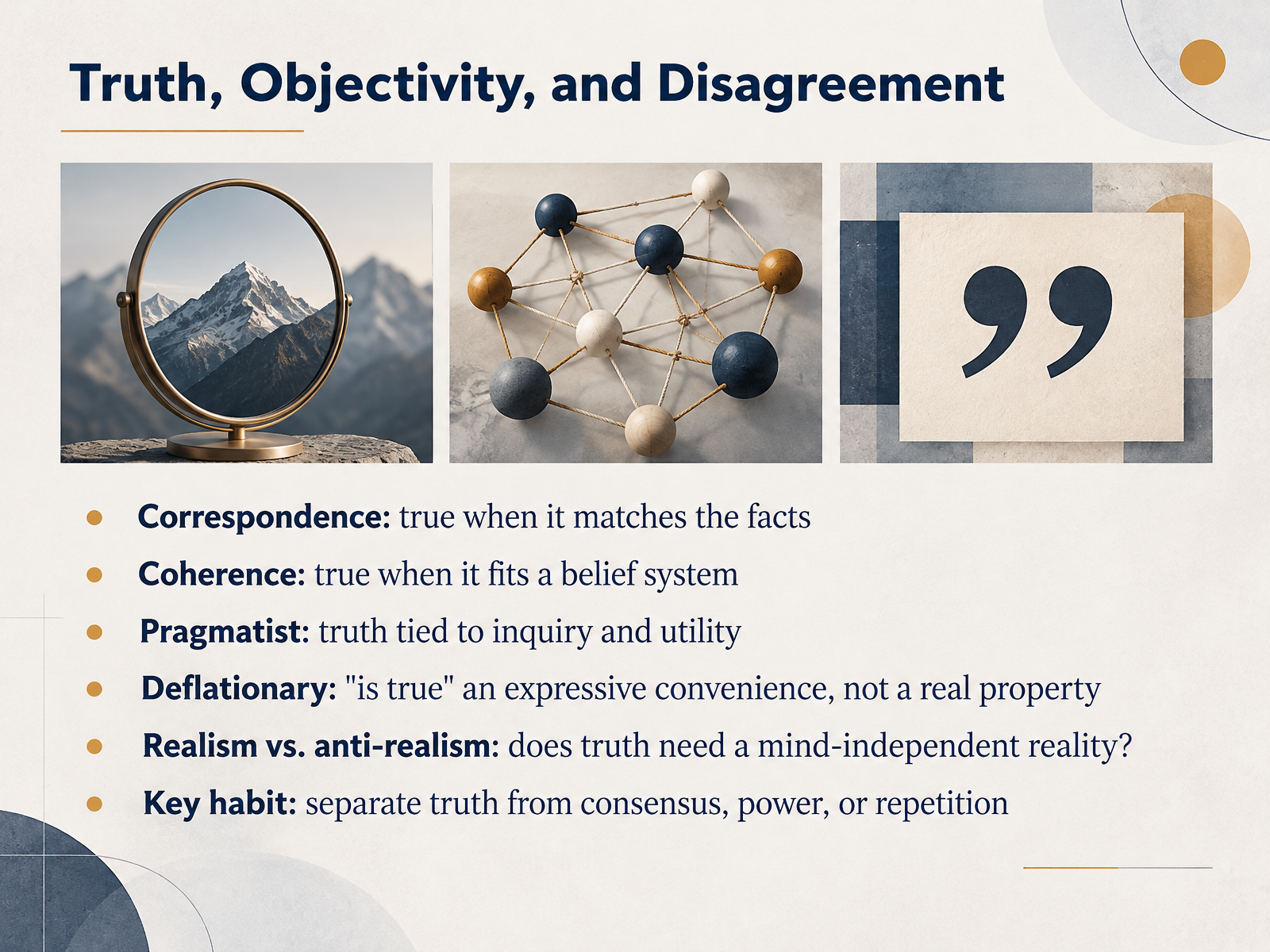
- 11Truth, Objectivity, and DisagreementLet's turn now to truth, objectivity, and disagreement. Philosophers have proposed several ways to explain what truth is. Correspondence says a claim is true when it matches the facts. If I say it is raining and water is actually falling, that claim corresponds to reality. Coherence says a claim is true when it fits consistently within a belief system. Pragmatist theories tie truth to inquiry and utility, asking what works and what survives testing. Deflationary theories take a different step: they say is true is mostly an expressive convenience, not a deep property. Then comes realism versus anti-realism. Does truth depend on a mind-independent reality, or is it shaped by minds and practices? Here is the key habit for your own thinking: separate truth from consensus, from power, and from repetition. A claim is not true just because many people agree, or because someone powerful says so, or because it has been repeated often. Keep those questions distinct as we move on to social epistemology, testimony, experts, and epistemic injustice.
 1 min
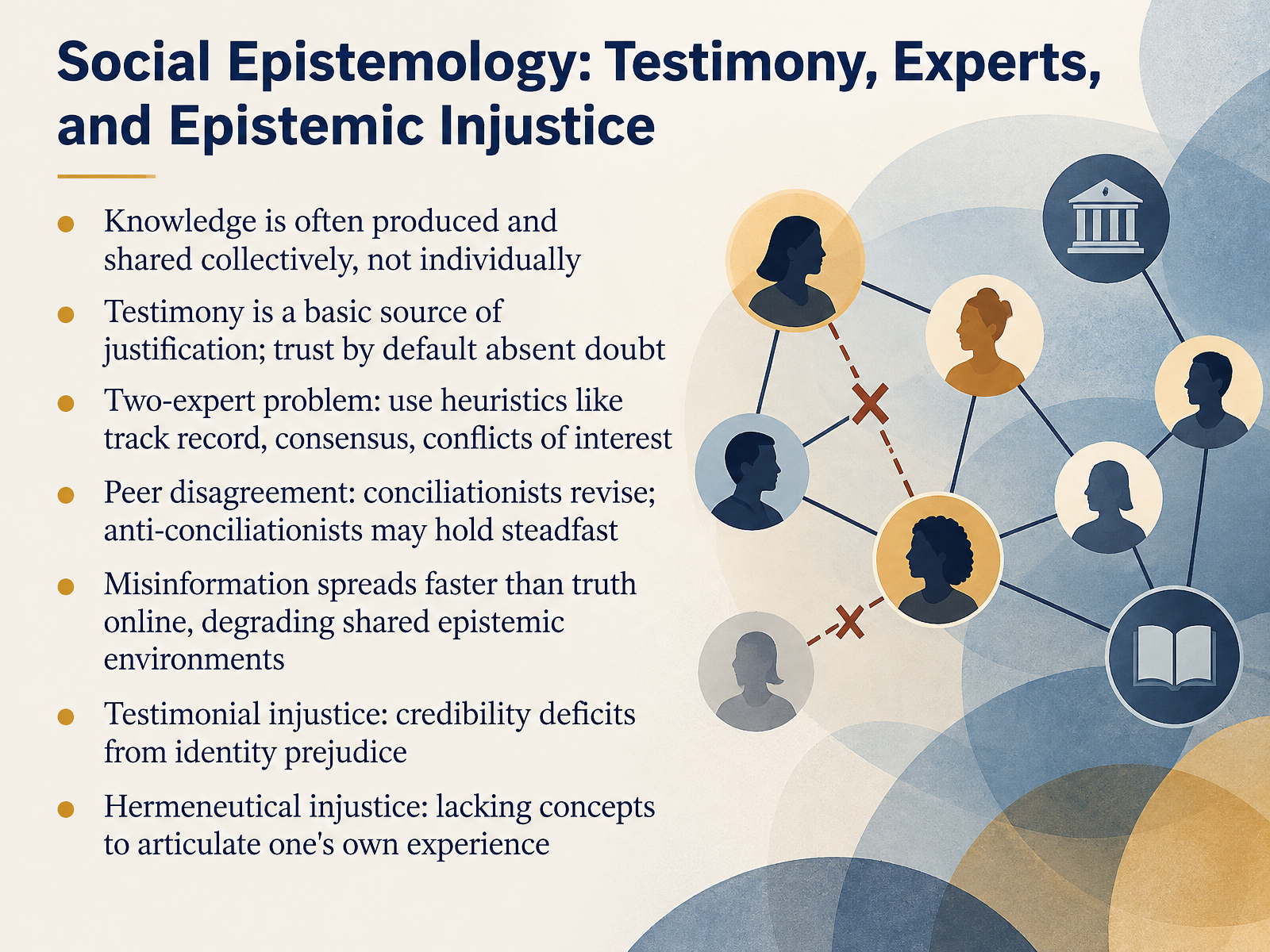
- 12Social Epistemology: Testimony, Experts, and Epistemic InjusticeNow let's widen the lens. Knowledge is often produced collectively, not just by individuals. Think of a workplace, where a diagnosis or decision rests on many people sharing what they know. Testimony, simply put, is what we learn from what others tell us. Many philosophers treat it as a basic source of justification. That means we trust by default, unless we have a reason for doubt. But what happens when two experts disagree? As a non-expert, you face the two-expert problem. You cannot easily judge who is right, so you use heuristics: a track record, broad consensus, and conflicts of interest. And what about disagreement with a peer, someone roughly as informed as you? Conciliationists say you should revise your view. Anti-conciliationists say you may sometimes hold steadfast. These debates matter because our shared epistemic environment is fragile. Online, misinformation often spreads faster than truth. Another concern is epistemic injustice. Testimonial injustice occurs when someone's credibility is unfairly discounted because of prejudice about their identity. Hermeneutical injustice occurs when a group lacks the concepts to describe their own experience. Both wrong people in their capacity as knowers, and both weaken the knowledge we build together. Next, let's turn to evaluating claims in everyday life and digital environments.
 2 min
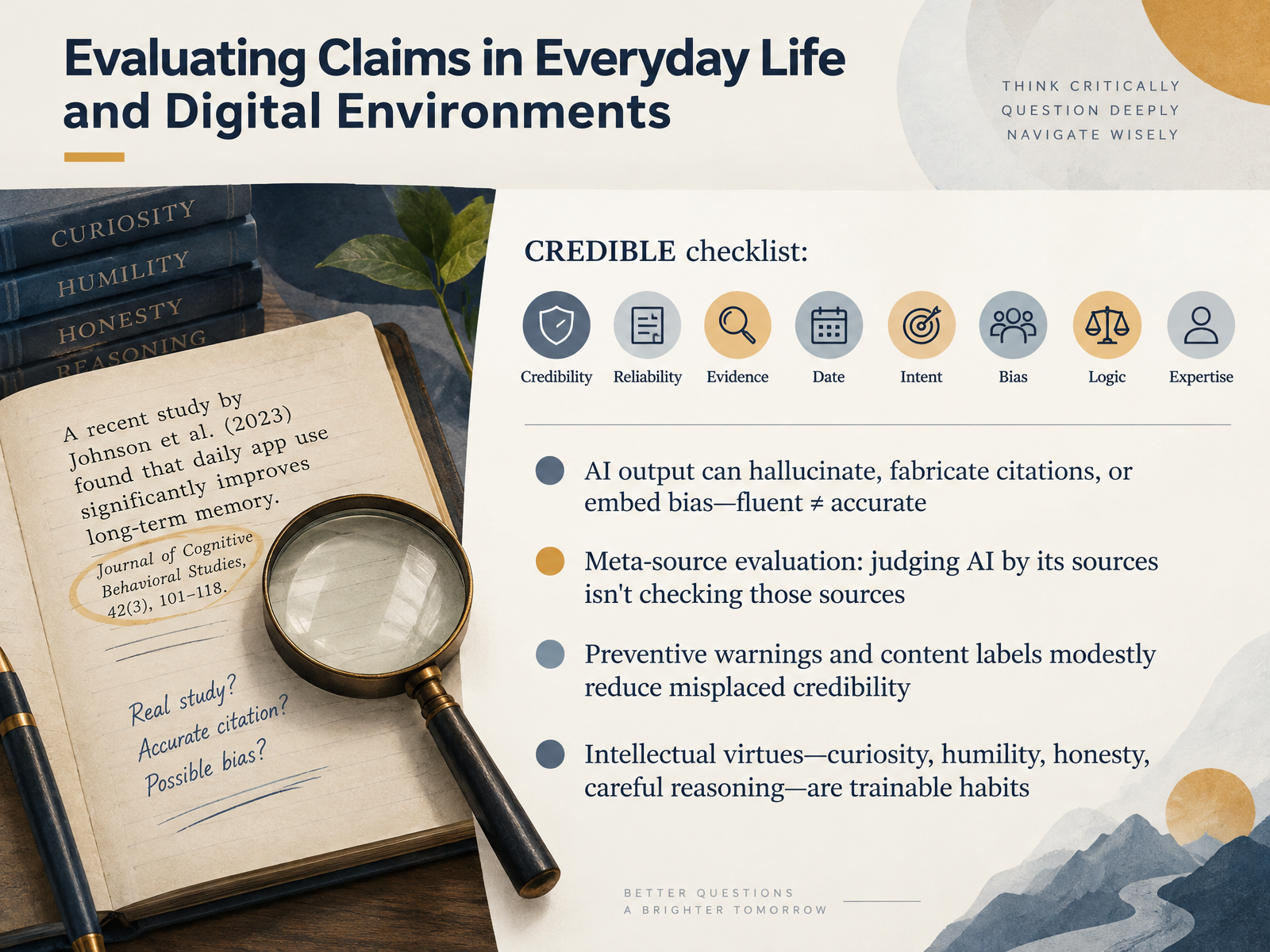
- 13Evaluating Claims in Everyday Life and Digital EnvironmentsNow let's apply all of this to everyday life and digital environments. A useful tool is the CREDIBLE checklist: Credibility, Reliability, Evidence, Date, Intent, Bias, Logic, and Expertise. Ask yourself: who is behind this claim, and how do they know what they claim to know? When you use an AI tool, remember that fluent language is not the same as accuracy. AI can hallucinate, fabricate citations, or quietly reflect bias in its training data. Watch for a common trap called meta-source evaluation. That means judging the AI by the sources it names, without actually checking those sources yourself. So verify that a cited source exists, says what the AI claims, and is trustworthy. Preventive warnings and content labels modestly reduce misplaced credibility, but they are not a cure. Here is the hopeful part. Intellectual virtues like curiosity, humility, honesty, and careful reasoning are habits. Like any habit, they can be trained. So treat evaluation not as a one-time trick, but as a practice you build over time. Next, we will review, reflect, and look at next steps in epistemology.
 plato.stanford.eduroutledge.comphilosophycourse.info+22 min
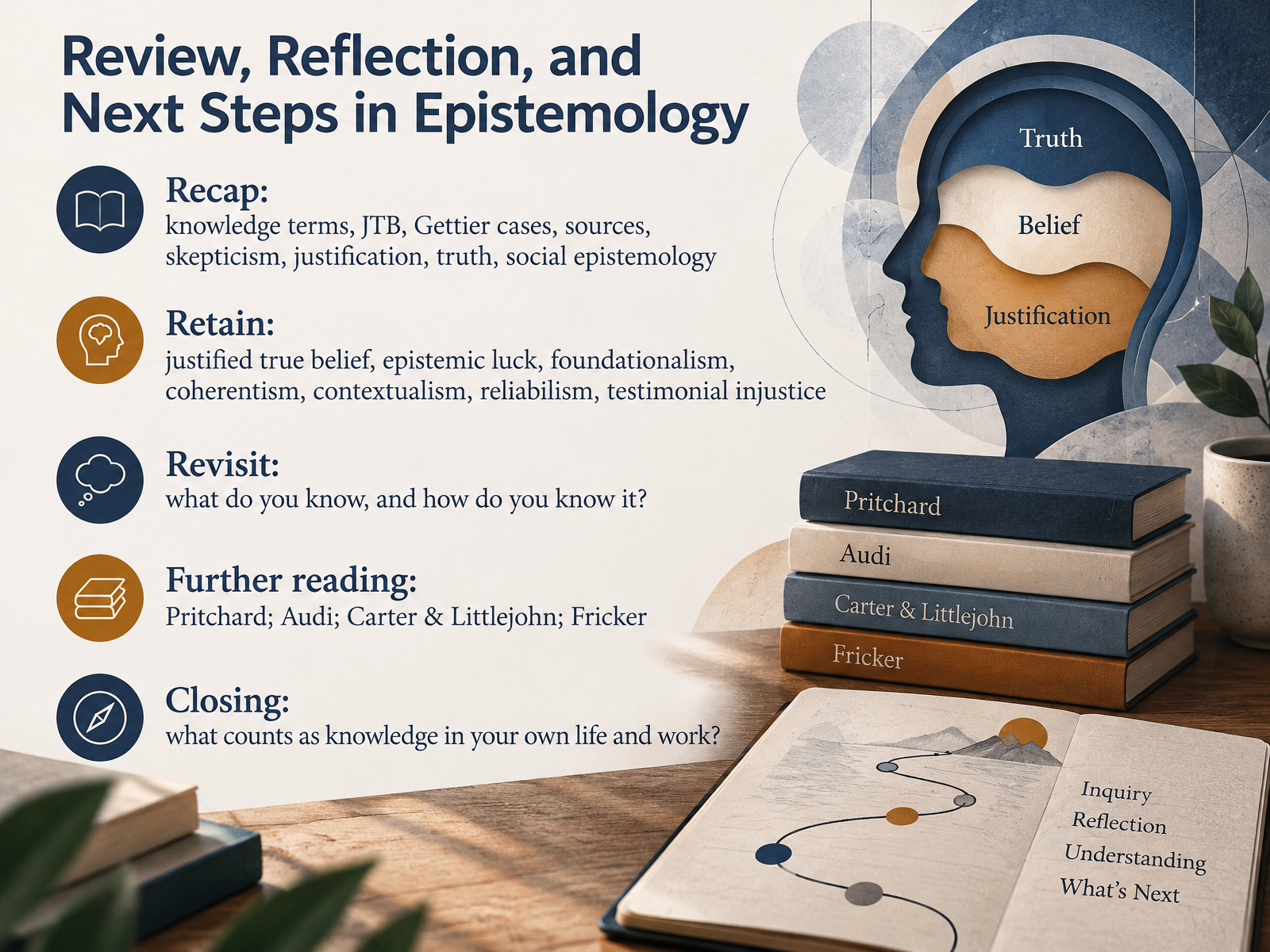
- 14Review, Reflection, and Next Steps in EpistemologyLet's bring things together. We began with the core terms of knowledge, then looked at justified true belief, or JTB, and why Gettier cases push us to refine that definition. We explored sources of knowledge like perception, memory, reason, and testimony, and we asked how far skepticism can take us. Justification and truth appeared throughout, and we closed with social epistemology, which reminds us that much of what we know comes from other people. Before you go, hold onto a few ideas: justified true belief, epistemic luck, foundationalism, coherentism, contextualism, reliabilism, and testimonial injustice. And keep asking the central question: what do you know, and how do you know it? If you would like to go further, good starting points are Duncan Pritchard's What Is This Thing Called Knowledge, Robert Audi's Epistemology, Carter and Littlejohn's This Is Epistemology, and Miranda Fricker's work on epistemic injustice. Thank you for thinking carefully with me. The habits you practiced here will serve you well. What counts as knowledge in your own life and work is now yours to examine.
 routledge.complato.stanford.eduphilosophycourse.info+22 min
Take the deck with you
Download this course as a file — free, no sign-up needed.
- PDF handoutEvery slide page, ready to print or share.15 pages · 4.7 MBDownload
- Narrated PowerPointThe deck that presents itself — every slide carries the digital human's narration video.15 pages · 16.6 MBDownload
- PowerPoint slidesThe full deck as a .pptx — open it in PowerPoint, Keynote, or Google Slides.15 pages · 4.7 MBDownload
Free to use in your own training — please keep the PersonWise credit page at the end.
Have your own deck? Turn it into a course
Sources consulted
Web sources consulted while building this course.
- Epistemology (Stanford Encyclopedia of Philosophy) — plato.stanford.edu
- What is this thing called Knowledge? - 5th Edition - Duncan Pritchard — routledge.com
- lecture: introduction to epistemology — philosophycourse.info
- Epistemology: A Contemporary Introduction to the Theory of Knowledge — people.cs.rutgers.edu
- PHIL-AD 240. Epistemology — phil101.jimpryor.net
- Gettier Problems — iep.utm.edu
- The Analysis of Knowledge — plato.stanford.edu
- Analysis, Vol. 23, No. 6. (Jun., 1963), pp. 121-123. — courses.physics.illinois.edu
- Is Justified True Belief Knowledge? — courses.physics.illinois.edu
- Gettier problem — en.wikipedia.org
- Gettier Problems | Internet Encyclopedia of Philosophy — iep.utm.edu
- Gettier problem - Routledge Encyclopedia of Philosophy — rep.routledge.com
- Reliabilism | Internet Encyclopedia of Philosophy — iep.utm.edu
- https://files.turri.org/research/Gettier_tax.pdf — files.turri.org
- The Sources of Knowledge | The Oxford Handbook of Epistemology | Oxford Academic — academic.oup.com
- Knowledge — en.wikipedia.org
- Epistemological Problems of Testimony (Stanford Encyclopedia of Philosophy) — plato.stanford.edu
- Contemporary Skepticism | Internet Encyclopedia of Philosophy — iep.utm.edu
- Skepticism - Stanford Encyclopedia of Philosophy — plato.stanford.edu
- Contextualism and Skepticism — onlinelibrary.wiley.com