CS vs Software Engineering Tradeoffs
Begin
13 pages · ~26 min
CS vs Software Engineering Tradeoffs
Explore the key differences, tradeoffs, and use cases between computer science and software engineering to choose the right approach for your projects.
What you’ll learn
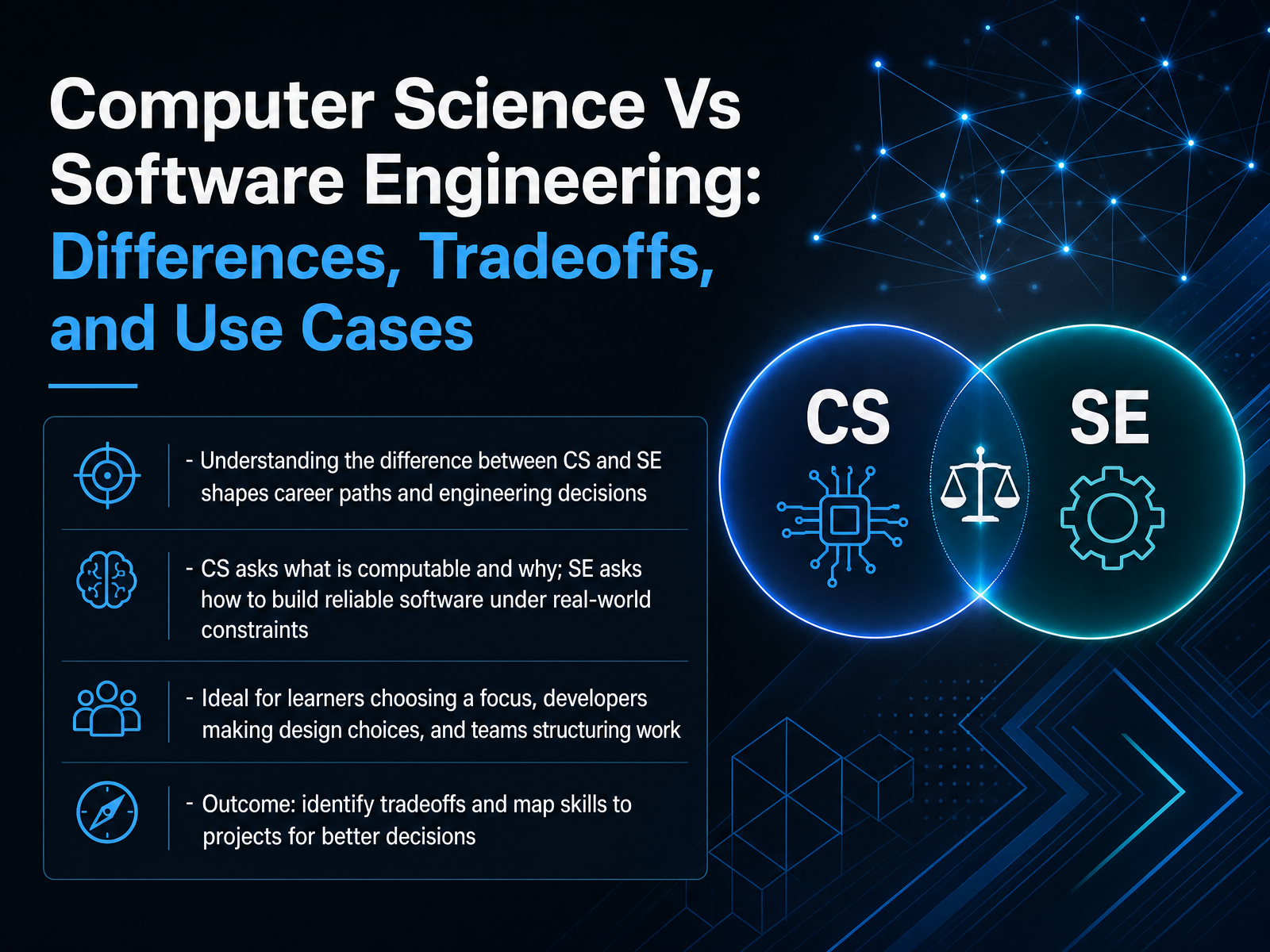
- 01Computer Science Vs Software Engineering: Differences, Tradeoffs, and Use CasesWelcome. If you are trying to decide between computer science and software engineering, or you manage a team that blends both, this one is for you. These two fields get used interchangeably, but they are not the same thing. CS is about what is computable, and why. SE is about how you build reliable software under real-world constraints. Understanding that difference shapes career paths, hiring decisions, and the way you structure engineering work. So today, we are going to map out the real tradeoffs, look at where they overlap, and help you map your skills to the right projects. By the end, you will have a clearer picture of which discipline fits your goals, and how to make better decisions because of it. Let's start by defining exactly what each discipline actually is.scecareer.nau.eduindeed.comcoursera.org+21 min
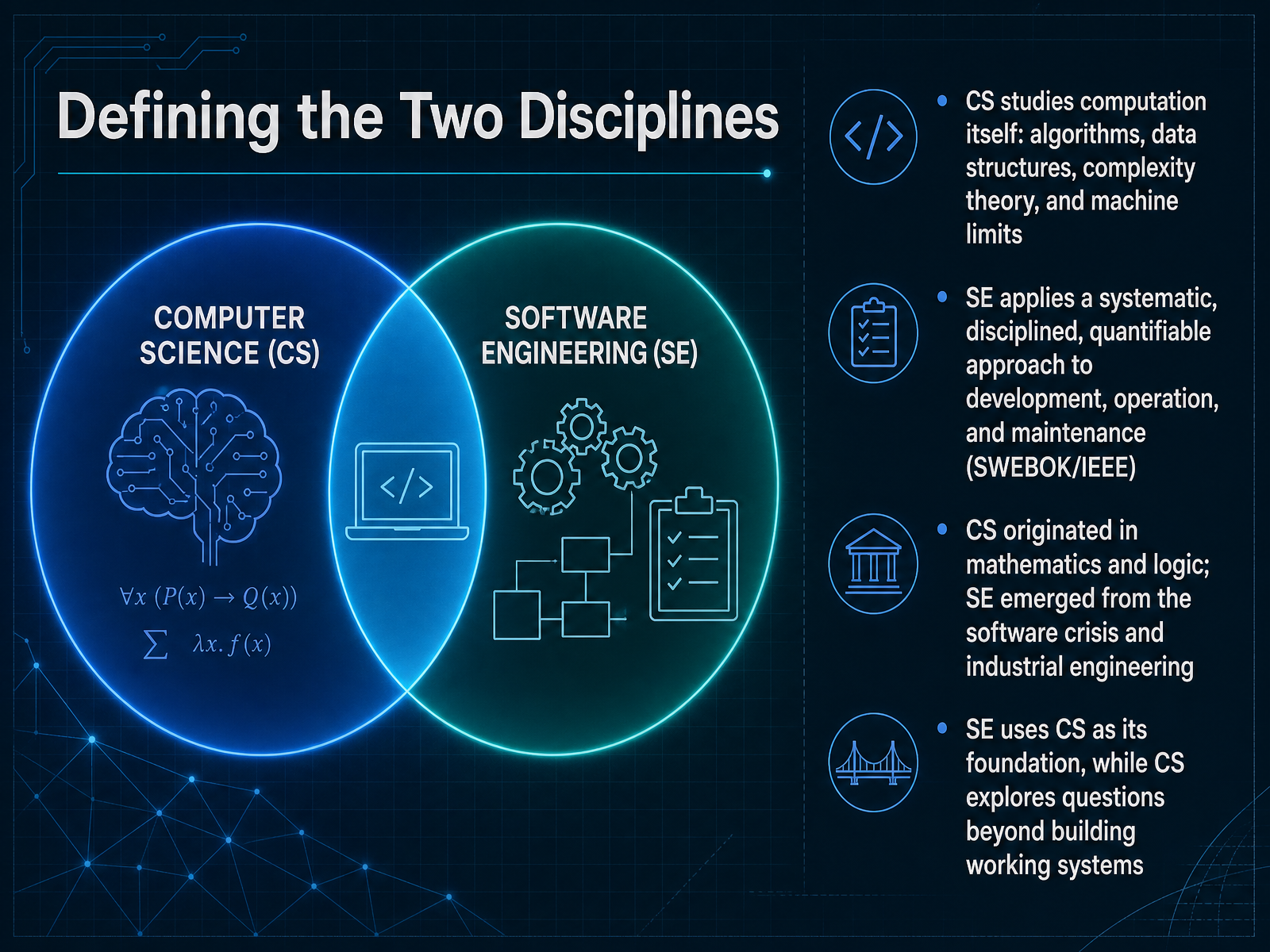
- 02Defining the Two DisciplinesLet's get the definitions straight, because the line between these two fields is where a lot of confusion starts. Computer science is the study of computation itself. It asks what can be computed, how efficiently, and what the fundamental limits are. You're looking at algorithms, data structures, complexity theory, and the mathematical models that describe what machines can and cannot do. It's a discipline rooted in logic and mathematics, and it explores questions that go beyond just building something that works. Software engineering is the application of a systematic, disciplined, and quantifiable approach to developing, operating, and maintaining software. That's the IEEE definition, and the key word there is engineering. It emerged from the software crisis of the 1960s, when projects were failing because there was no process. It's about the lifecycle: requirements, design, testing, deployment, maintenance. The pragmatic takeaway is this: software engineering uses computer science as its foundation, but its focus is on building reliable systems in the real world, with real constraints. Computer science asks what's possible; software engineering asks what's practical. Now let's look at where each discipline concentrates its core effort, starting with theory versus construction.
 scecareer.nau.eduindeed.comcoursera.org+21 min
 - 03Core Focus: Theory vs ConstructionLet’s get into the core distinction. Computer science is about provable correctness, computational limits, and abstract models like Turing machines. Software engineering is about working systems, maintainability, cost, schedule, and team coordination. One focuses on algorithm design and complexity; the other on system integration and deployment reliability. You need both—theory sets the limits, engineering turns it into reliable products. In practice, think of computer science as the laws of physics and software engineering as the bridge you build on top of them. You can’t skip the laws, but you also can’t ship a bridge just by knowing them. Next, we’ll look at how problem solving and decision making styles differ between the two.
 scecareer.nau.eduindeed.comcoursera.org+21 min
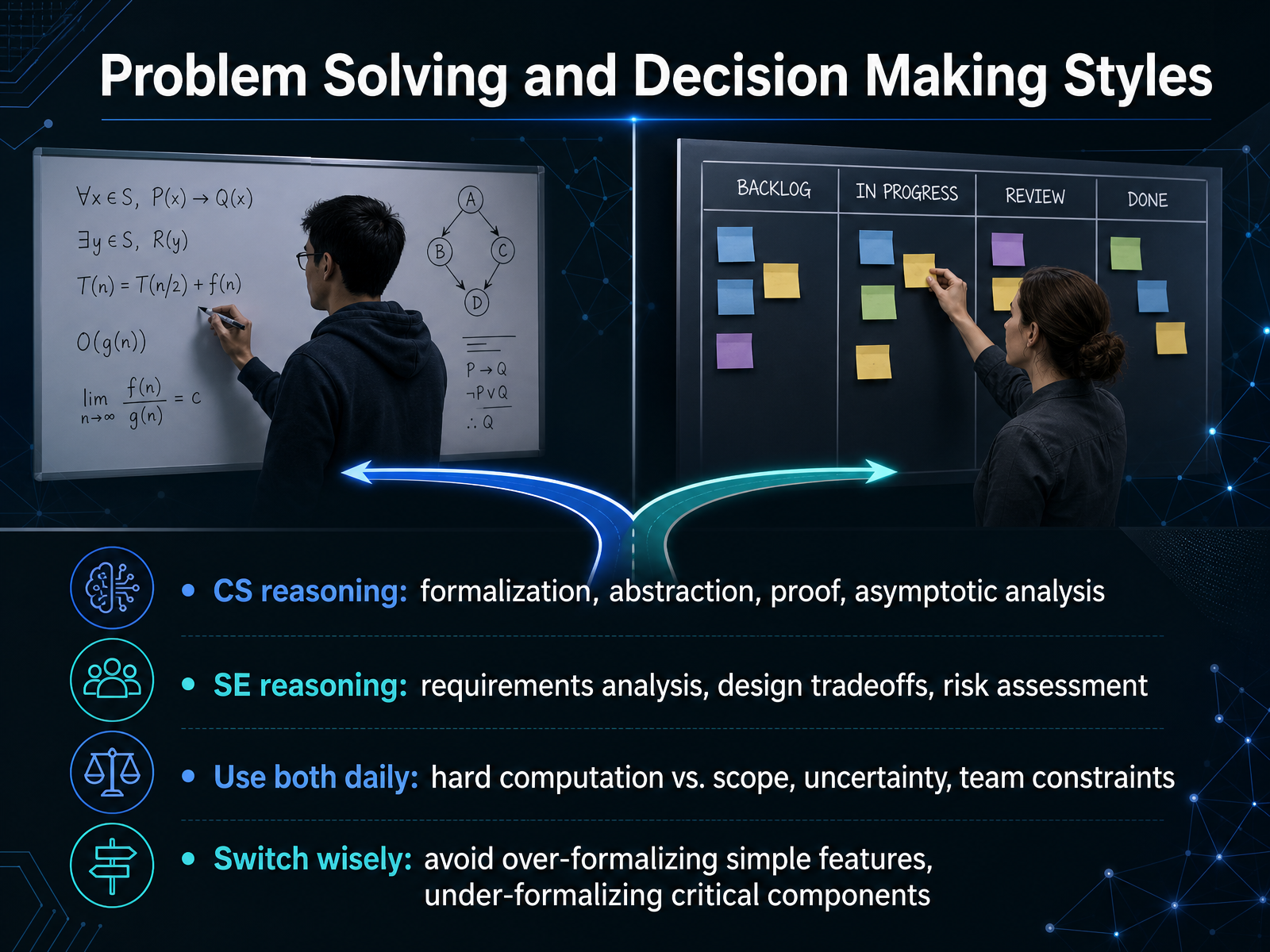
 - 04Problem Solving and Decision Making StylesLet's talk about how each discipline actually thinks. Computer science reasoning is about formalization and abstraction. You formalize a problem, build a proof, and analyze asymptotic complexity to understand theoretical limits. Software engineering reasoning is different. It's about requirements analysis, design tradeoffs, and risk assessment. You're weighing scope against uncertainty against team constraints. The reality is you use both daily, whether your title says so or not. The trap is using the wrong lens at the wrong time. Over-formalizing a simple feature wastes cycles and adds ceremony, while under-formalizing a critical component invites silent failures. The practical takeaway? Switch modes deliberately. Reach for CS rigor when correctness is hard to reason about, and switch to engineering pragmatism when the bottleneck is delivery and coordination. Knowing which mode to apply is the actual skill. Next, let's look at how education and career paths cement these differences.
 scecareer.nau.eduindeed.comcoursera.org+21 min
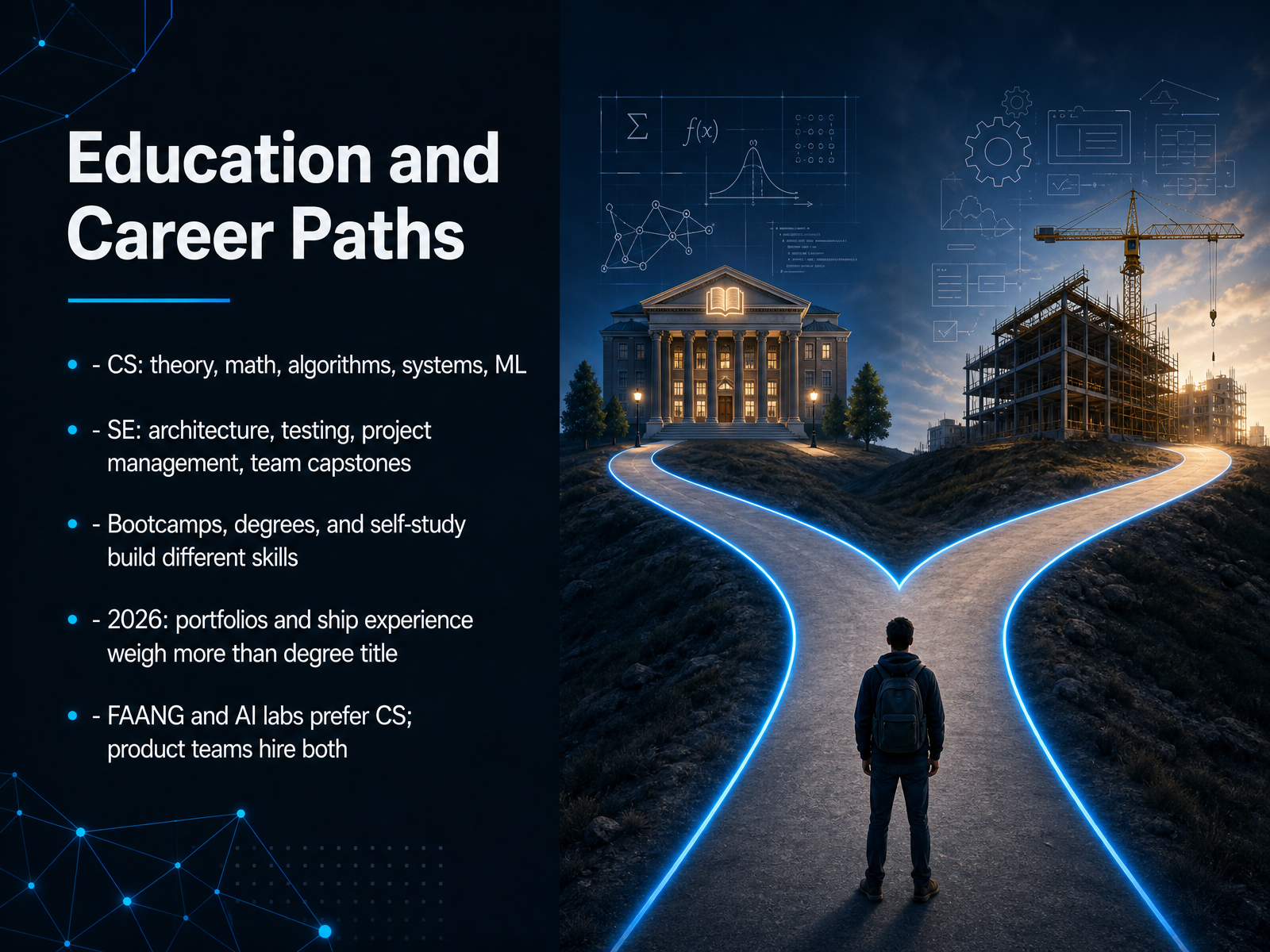
 - 05Education and Career PathsNow let's talk about education and career paths. Here's where the practical differences really show up. Computer Science majors spend most of their time on theory, math, and algorithms. They build depth in systems and get early exposure to machine learning. Software Engineering is more applied. The curriculum centers on architecture, testing, project management, and team capstones. You're training for how to ship software with a group. As for entry routes, the degree title matters less than it used to. In 2026, a strong portfolio and actual shipped work carry more weight than the name on your certificate. Bootcamps and self-study can absolutely get you there, but they build a different skill set. A bootcamp grad knows real tools and shipping fast. A CS grad often has a deeper mental model to grow from. Now, who's hiring whom? FAANG companies and AI labs like Google and OpenAI still prefer CS grads. All that abstraction skill is what they filter for. Product teams at mid-tier companies are more open. They'll hire both, as long as you can pass the interview and ship. The takeaway? A CS degree maximizes optionality in the long run, but SE gets you into the industry faster. Pick based on how you like to work, not just where you want to land. Next, let's look at the key tradeoffs in practice.
 majormatch.usmentorcruise.comcoursera.org+21 min
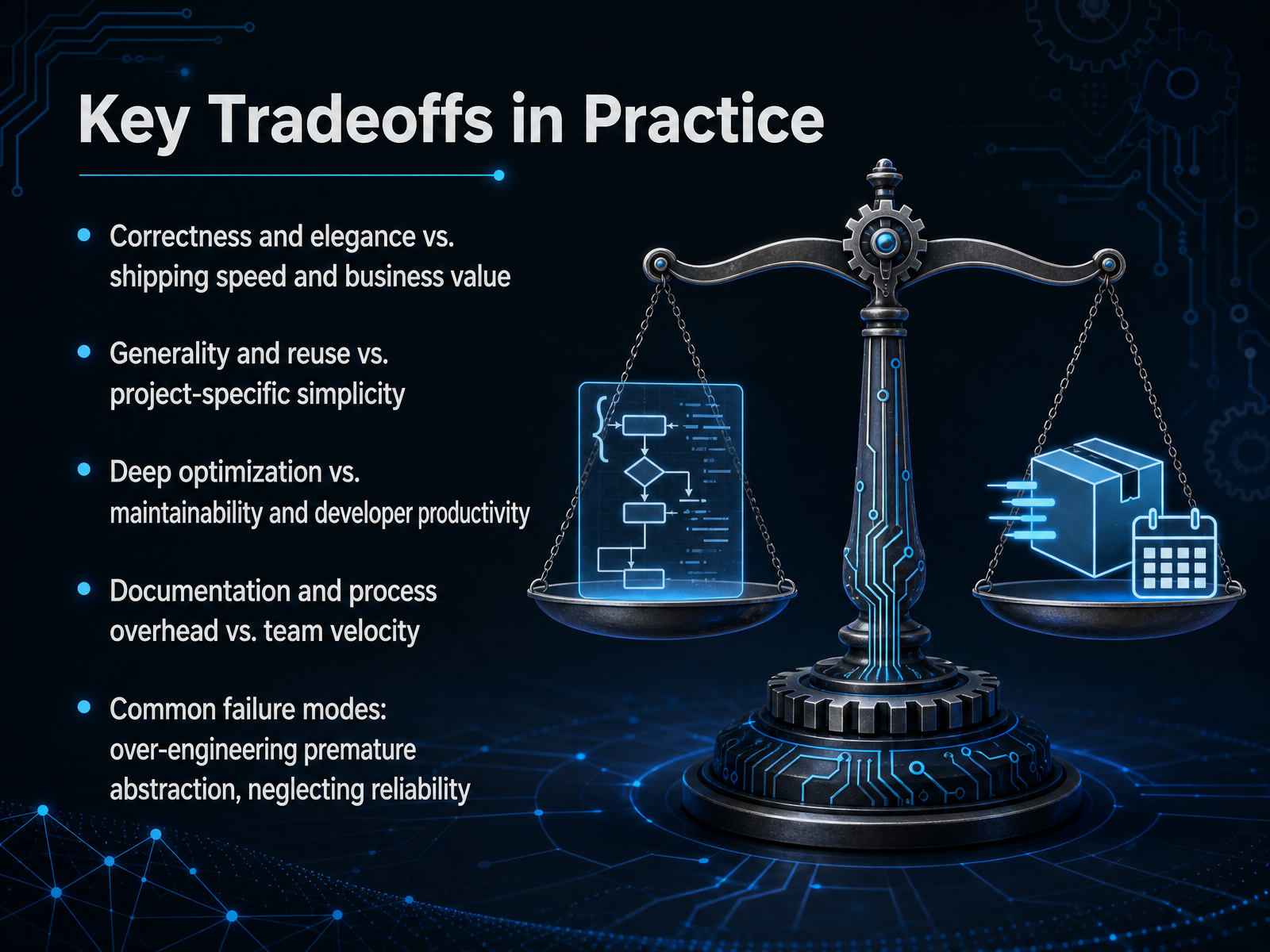
 - 06Key Tradeoffs in PracticeLet's get concrete about the tradeoffs. First: correctness versus shipping speed. A computer scientist might hold out for an elegant solution; a software engineer knows the business needs the feature this quarter. Both have a point, but the right answer depends on which failure mode you can afford. Second: generality versus simplicity. Reusable abstractions sound great, but a project-specific hack might be exactly what a small codebase needs. Optimize for the system you actually maintain, not the one you imagine. Third: deep optimization versus developer productivity. Squeezing performance is satisfying, but if it means onboarding takes three times longer, you've made a poor trade. Fourth: process overhead versus velocity. Documentation, code review, CI—all good, until the ceremony costs more than the bugs it prevents. And the failure modes here are real: over-engineering, premature abstraction, and quietly neglecting reliability because the feature roadmap never stops. The pattern is the same across all four: know what you're giving up before you optimize. That awareness, more than any technical skill, is what separates a seasoned engineer from a cargo-culting one. Next, let's look at use cases and industry examples to see these tradeoffs play out in the wild.
 majormatch.usmentorcruise.comwebsites.uta.edu+22 min
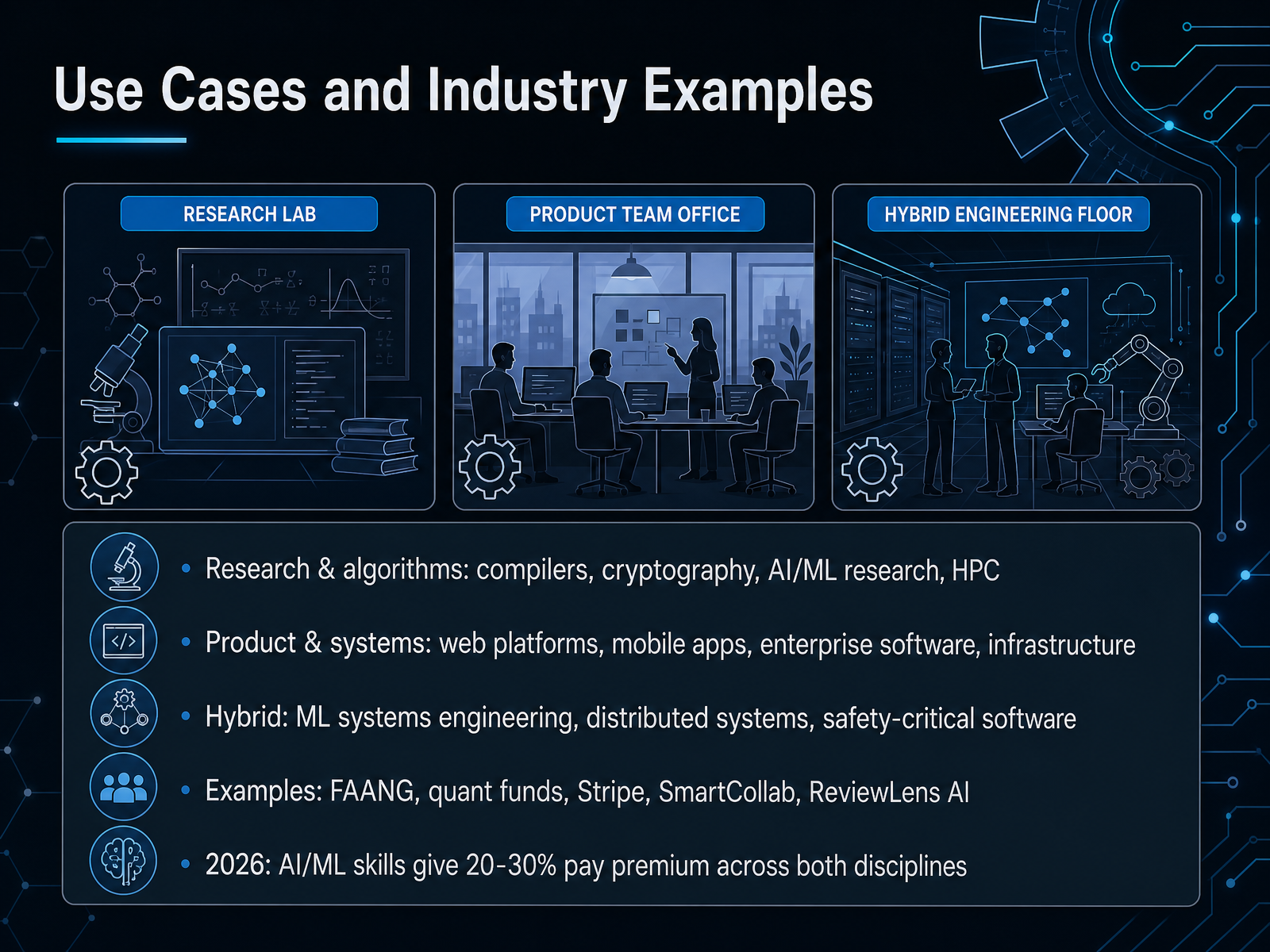
 - 07Use Cases and Industry ExamplesSo where does each discipline actually show up in the real world? Let's map this to concrete use cases. Computer science principles dominate research and algorithms: compilers, cryptography, AI and ML research, high-performance computing. If the core challenge is computational complexity or proving something is possible, that's CS territory. Software engineering, by contrast, owns product and systems work: web platforms, mobile apps, enterprise software, infrastructure. If the challenge is shipping reliably with a team under real constraints, that's SE territory. The most interesting space is the hybrid zone: ML systems engineering, distributed systems, safety-critical software. These demand both the theoretical depth and the engineering rigor. Look at the examples. FAANG and quant firms lean heavily on CS foundations. Stripe, by contrast, cares more about what you've built than your degree title. The capstone projects like SmartCollab and ReviewLens AI show how SE skills translate to production-grade, team-delivered software. One stat worth internalizing for 2026: genuine AI and ML skills command a twenty to thirty percent pay premium across both disciplines, regardless of your degree. Now let's look at how teams actually blend these two skill sets in practice.
 majormatch.usmentorcruise.comwebsites.uta.edu+22 min
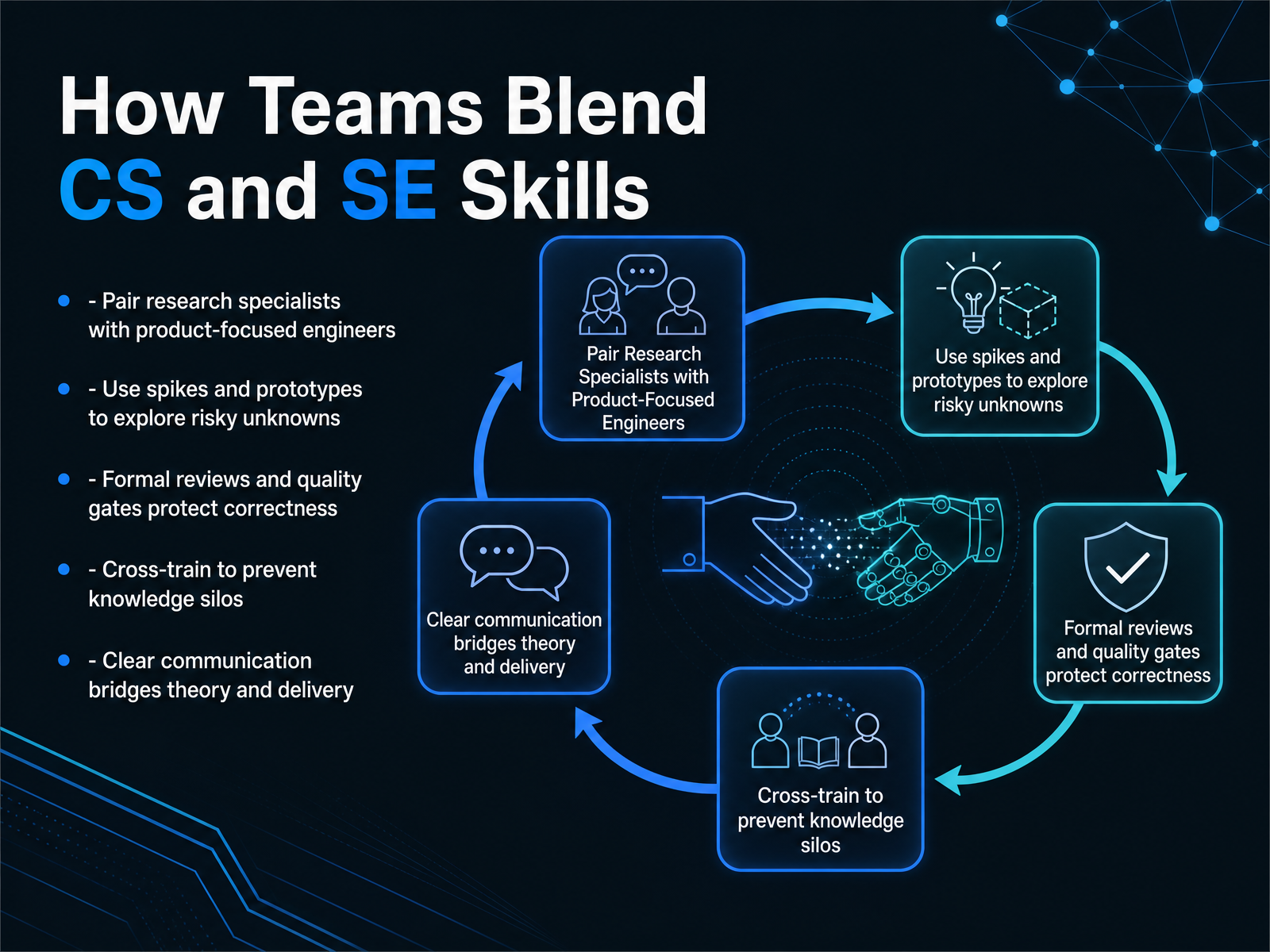
 - 08How Teams Blend CS and SE SkillsLet's talk about how teams actually blend these skill sets, because in practice, the line between CS and SE gets blurry fast. The most effective teams pair research specialists with product-focused engineers. You want the person who can reason about algorithmic complexity sitting next to the person who knows how to ship a feature under deadline. Spikes and prototypes are your friend here. Use them to explore risky unknowns before committing to an architecture. A spike is cheap insurance—it answers the question 'will this work?' without the overhead of production polish. Formal reviews and quality gates protect correctness, especially in regulated industries or systems where failure is costly. They're not bureaucracy; they're the difference between a theory that works on paper and a system that works in production. Cross-train relentlessly. Knowledge silos are a single point of failure. If only one person understands the distributed systems layer, you have a bus factor of one. And finally, clear communication bridges theory and delivery. The researcher needs to explain why the algorithm matters, and the engineer needs to explain what the constraint is. That translation layer is where projects either succeed or die. The takeaway: you don't need everyone to be equally strong in both—you need the blend to be deliberate. Next, we'll look at how you choose your focus and what next steps make sense for your career.
 majormatch.usmentorcruise.comwebsites.uta.edu+21 min
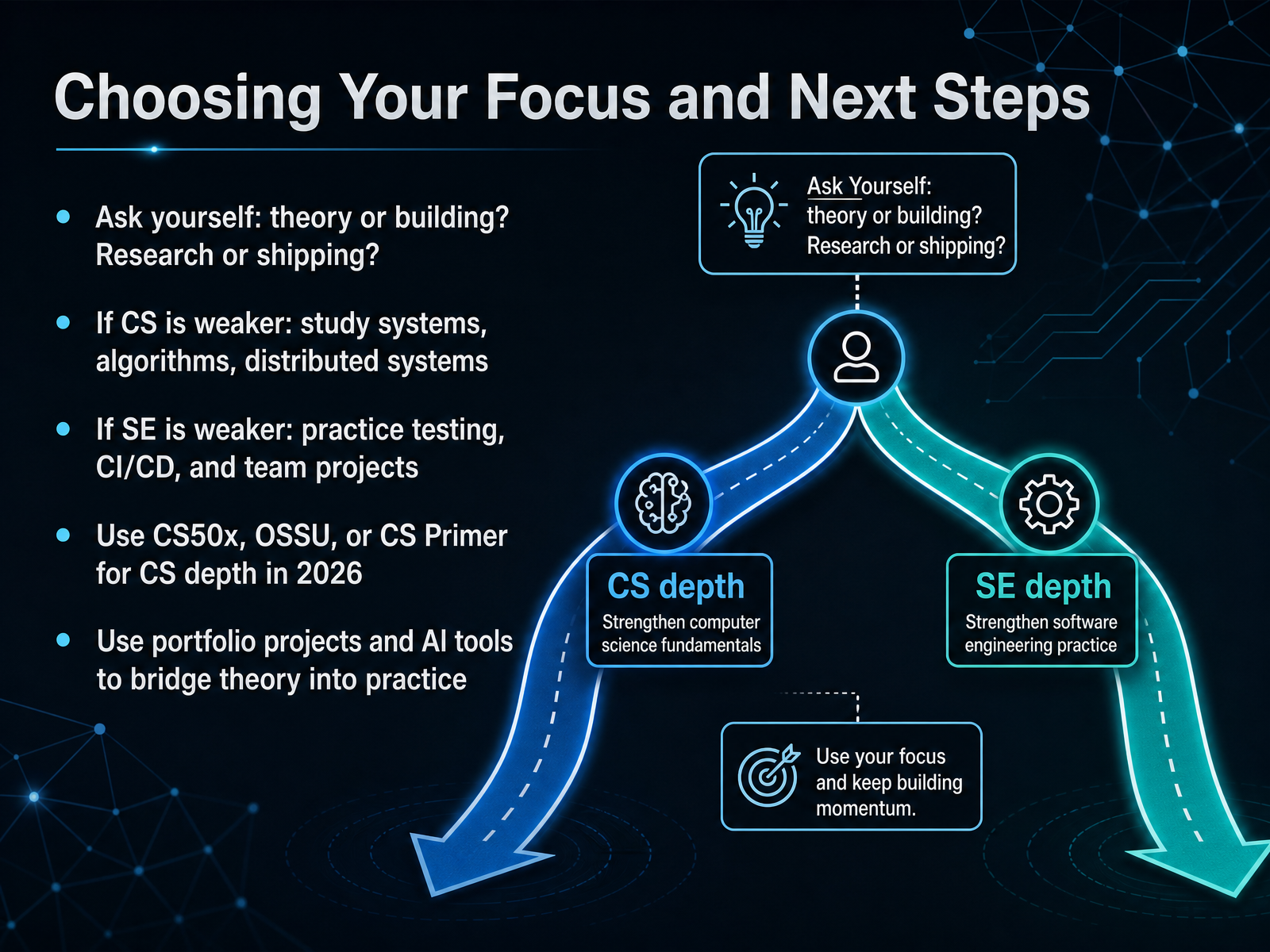
 - 09Choosing Your Focus and Next StepsSo where does that leave you? This is a self-assessment question more than a career verdict. Ask yourself honestly: are you energised by the theory, by understanding why systems work, or are you energised by building, by shipping something real? If your computer science foundations feel weak, prioritise systems, algorithms, and distributed systems. Those are the subjects that show up in every technical interview and architecture discussion. If your software engineering practice feels thin, focus on testing, CI/CD, and real team projects. Those are the habits that make you reliable in production. For depth, in 2026 the strongest paths remain CS50x for a structured introduction, the OSSU curriculum for a full degree-equivalent path, and CS Primer if you want a problem-driven, systems-focused approach. The key is to bridge theory into practice. Build portfolio projects, and use AI tools as your tutor, not your crutch. They can explain a complex concept or review your code instantly, but the understanding has to stick in your head. A strong engineer is both a computer scientist and a software engineer, knowing the fundamentals deeply and applying them pragmatically. That is the real target. Now, let's pull it all together in a summary and discussion.
 teachyourselfcs.comcs50.harvard.edugithub.com+22 min
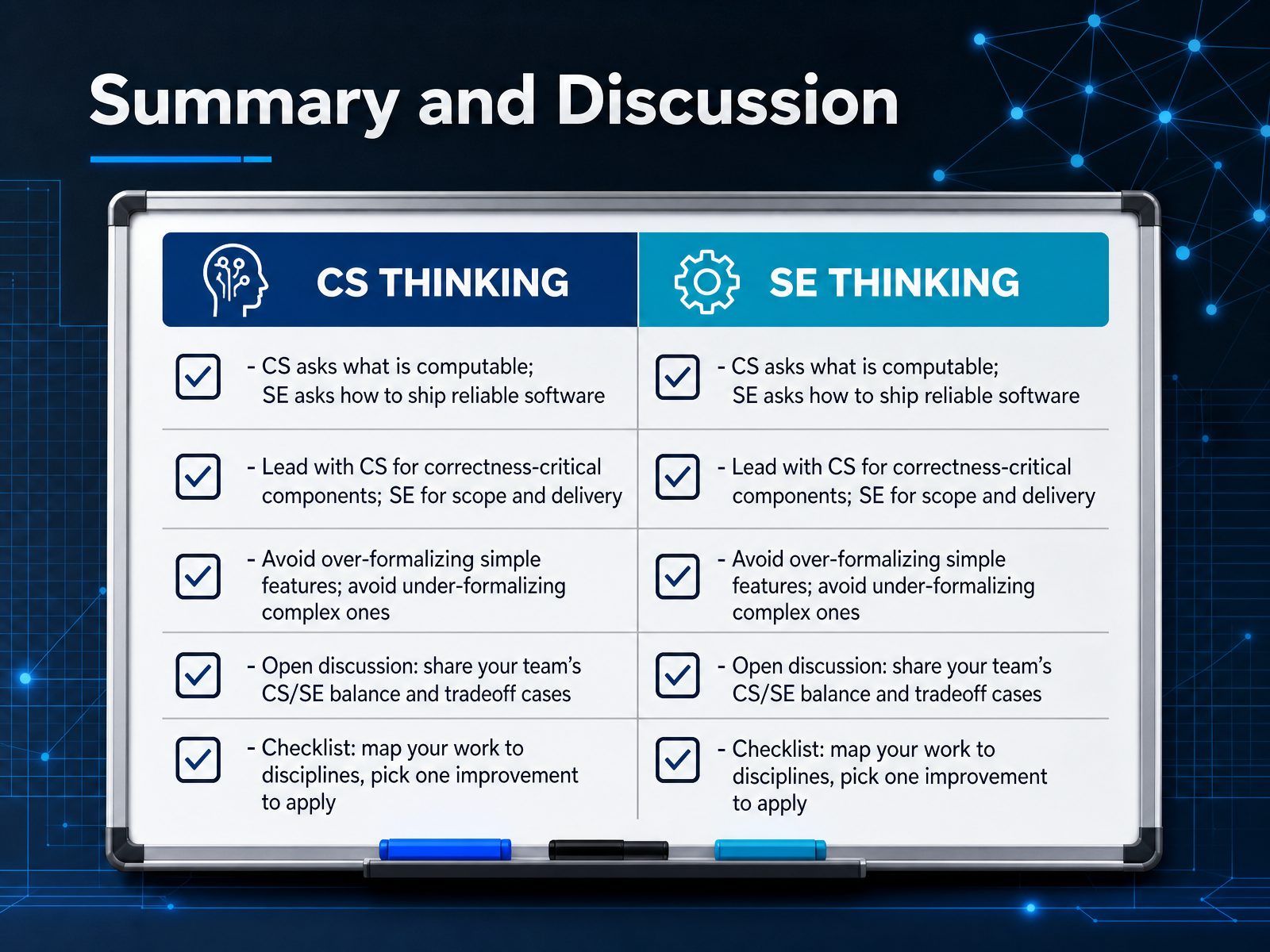
 - 10Summary and DiscussionLet’s pull this together. Computer science asks what is computable, what are the limits of computation. Software engineering asks how we ship reliable software that doesn’t fall apart in production. Both matter, but they matter in different places. Lead with CS when you're building correctness-critical components — think distributed consensus, cryptographic primitives, anything where a subtle flaw is catastrophic. Lead with SE when the challenge is scope and delivery — coordinating teams, managing technical debt, hitting release dates without breaking things. The real trap is applying the wrong discipline at the wrong scale. Over-formalizing a simple CRUD feature adds ceremony without value. Under-formalizing a complex, safety-critical system invites disaster. You want a healthy balance, and that balance shifts per project. So here's the open question for you: how does your team currently strike that CS and SE balance? What tradeoffs have you had to make? And as a takeaway — take a moment to map your recent work to these two disciplines. Identify one concrete improvement you can apply, whether that's deeper algorithmic analysis or stronger engineering process. Pick one and act on it. Coming up next, we’ll look at key data points and 2026 market signals to ground these decisions in real-world trends.
 scecareer.nau.eduindeed.comcoursera.org+22 min
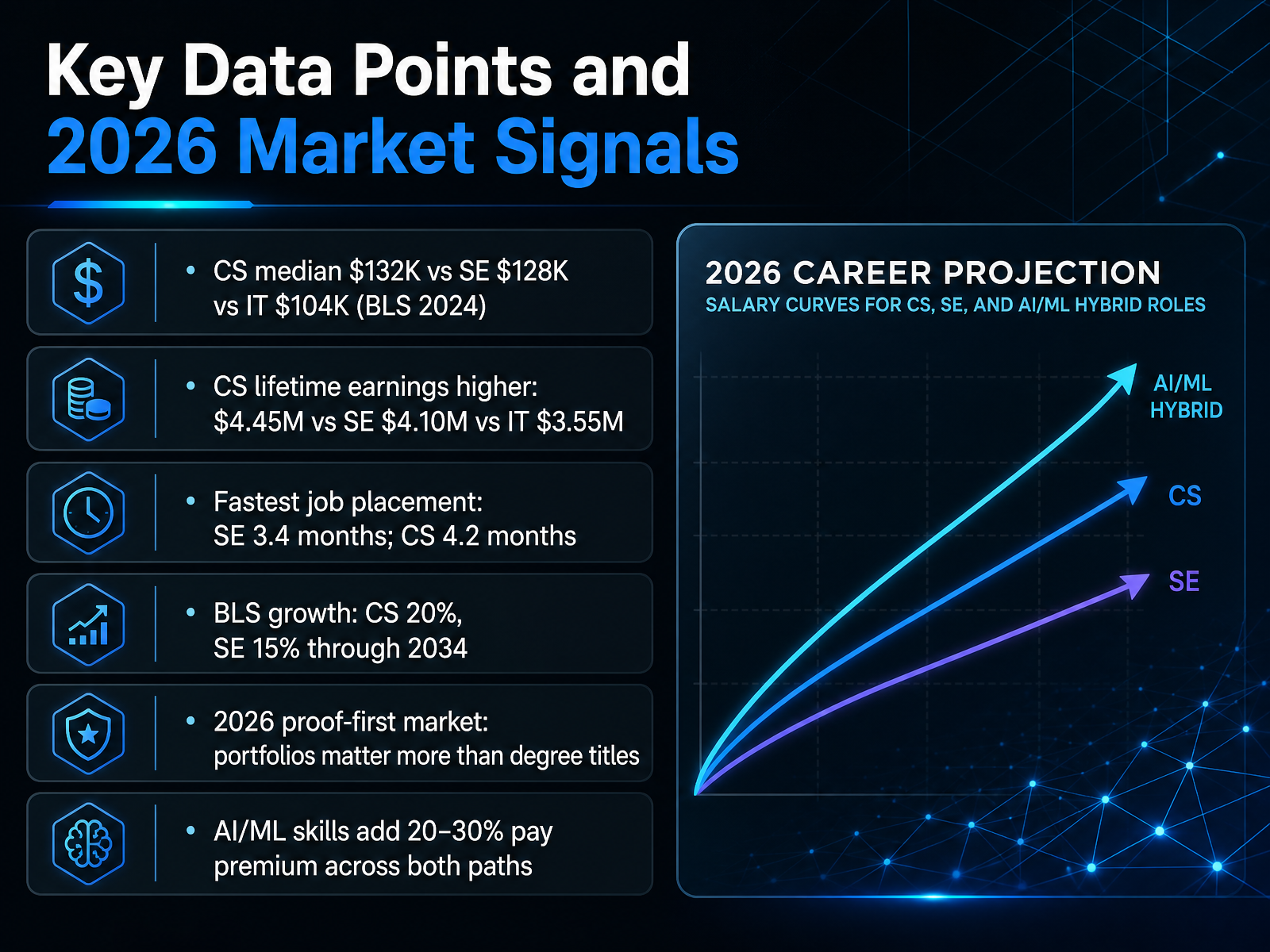
 - 11Key Data Points and 2026 Market SignalsLet's get concrete with the numbers. BLS data from 2024 puts computer science median pay around one thirty-two thousand, software engineering at one twenty-eight, and IT at one oh four. Lifetime earnings tell a similar story: CS leads at four point four five million, SE at four point one, and IT at three point five five. But pay is only one axis. Software engineering grads land jobs fastest, averaging three point four months to first offer, versus four point two for CS. Both fields are growing, with CS at twenty percent and SE at fifteen percent through twenty thirty-four. Here's what matters more in twenty twenty-six: the proof-first market. Employers are looking at portfolios, not degree titles. And across both paths, genuine AI and ML depth commands a twenty to thirty percent pay premium. That's the sign to follow. Next, let's turn this data into practical learning pathways for twenty twenty-six.
 majormatch.usmentorcruise.comcoursera.org+21 min
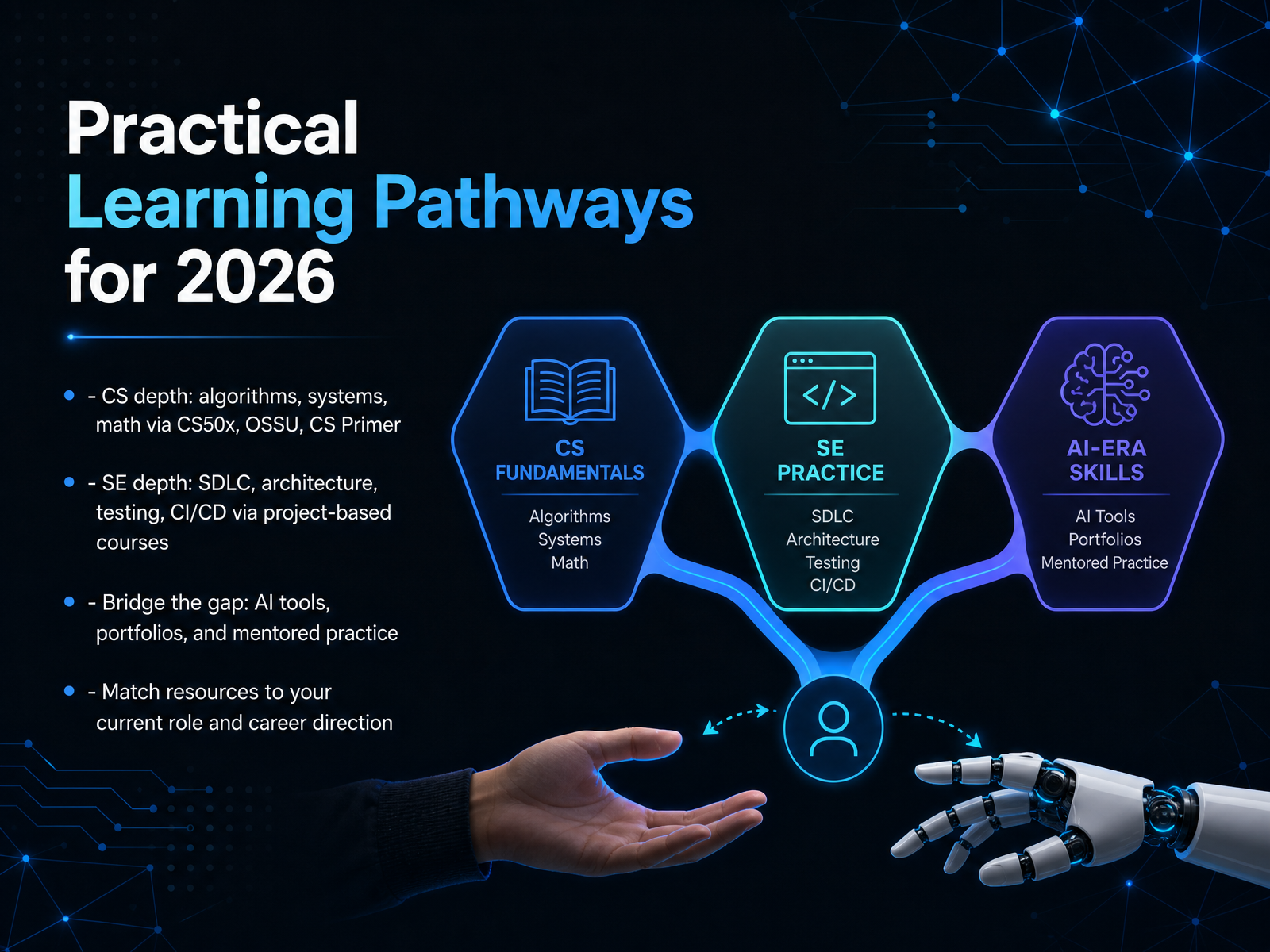
 - 12Practical Learning Pathways for 2026So where do you actually start? For computer science depth, think CS50x for a solid introduction, then the Open Source Society University curriculum, or CS Primer for a more systems-focused, problem-driven approach. These build the theory and mental models you need for the hard problems. On the software engineering side, focus on the software development lifecycle, architecture, testing, and CI/CD. Project-based courses that get you building and shipping real software are your best bet here. The key in 2026 is to bridge the gap. AI tools are now part of the workflow, so learn to use them effectively, but pair that with a tangible portfolio and mentored practice. Don't just grind tutorials—build things, get feedback, and iterate. Match the resource to your current role and where you want to go. If you're an engineer who wants to go deeper into systems, invest in computer science fundamentals. If you're a computer science grad who needs to ship production code, focus on software engineering practices. Your learning path should support your career direction, not the other way around. Now, let's wrap this all up with a course summary and action plan.
 teachyourselfcs.comcs50.harvard.edugithub.com+22 min
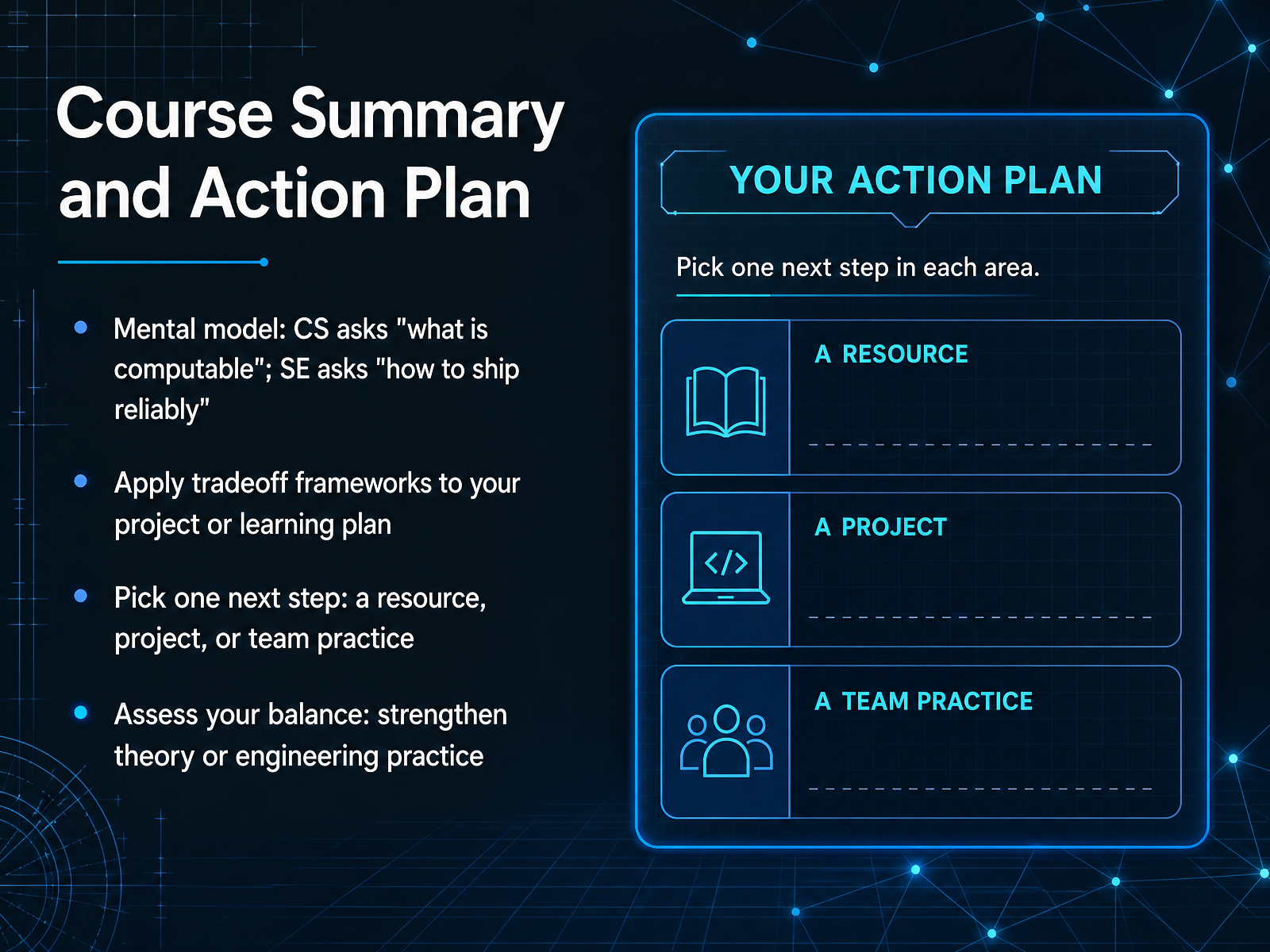
 - 13Course Summary and Action PlanLet's wrap this up with a mental model you can carry forward. Computer science asks what is computable. Software engineering asks how to ship reliably. Keep those two questions in your head, and most of the tradeoffs we covered become obvious. Now, apply the frameworks to your own situation. Look at your current project or your learning plan. Where do you sit? Are you optimizing for theoretical depth or for delivery speed? There's no wrong answer, but there is a wrong fit for your goals. Pick one next step. A resource, a project, or a team practice. Maybe it's working through Designing Data-Intensive Applications. Maybe it's starting a production-grade side project. Or maybe it's introducing a code review checklist on your team. One concrete action beats a page of good intentions. Finally, assess your balance. If you're strong on theory, go build something. If you're strong on engineering practice, go read something that makes you uncomfortable. Strengthen the side that's weak, and you'll become the engineer everyone wants on their team. Thanks for sticking with this. You have the map now, so go use it.
 majormatch.usmentorcruise.comcoursera.org+21 min
Take the deck with you
Download this course as a file — free, no sign-up needed.
- PDF handoutEvery slide page, ready to print or share.14 pages · 3.7 MBDownload
- Narrated PowerPointThe deck that presents itself — every slide carries the digital human's narration video.14 pages · 26.3 MBDownload
- PowerPoint slidesThe full deck as a .pptx — open it in PowerPoint, Keynote, or Google Slides.14 pages · 3.6 MBDownload
Free to use in your own training — please keep the PersonWise credit page at the end.
Have your own deck? Turn it into a course
Sources consulted
Web sources consulted while building this course.
- Computer Science vs. Software Engineering: What’s the Difference? – Career Development | NAU College of Engineering — scecareer.nau.edu
- Computer Science vs. Software Engineering: Differences ... — indeed.com
- Computer Science vs. Software Engineering: Explore Their Differences | Coursera — coursera.org
- Computer Science vs. Software Engineering Education: Key Differences | Programming Authority — programmingauthority.com
- Computer Science vs. Software Engineering - Intuit Blog — intuit.com
- Computer Science vs Software Engineering vs IT: Which Major Pays More in 2026? — majormatch.us
- The real question behind computer science vs software engineering - MentorCruise — mentorcruise.com
- Computer Science vs Software Engineering in UK — careerwidth.com
- AI Interviewer – CSE Senior Design — websites.uta.edu
- SmartCollab – CSE Senior Design — websites.uta.edu
- Software Engineer vs. Computer Science: The Difference — eathealthy365.com
- Teach Yourself Computer Science — teachyourselfcs.com
- CS50x 2026 — cs50.harvard.edu
- ossu/computer-science — github.com
- CS Primer: Learn computer science by writing code — csprimer.com
- The Computer Science Book, Second Edition | Practical CS for self-taught developers — thecomputersciencebook.com