Begin
14 pages · ~28 min
Leadership & Management Fundamentals
This training equips aspiring and current managers with core leadership skills to effectively guide teams, make sound decisions, and drive organizational success.
A digital instructor presents all 14 pages. Hold “Ask” at any point and ask out loud — the answer comes from this course. No sign-up needed.
What you’ll learn
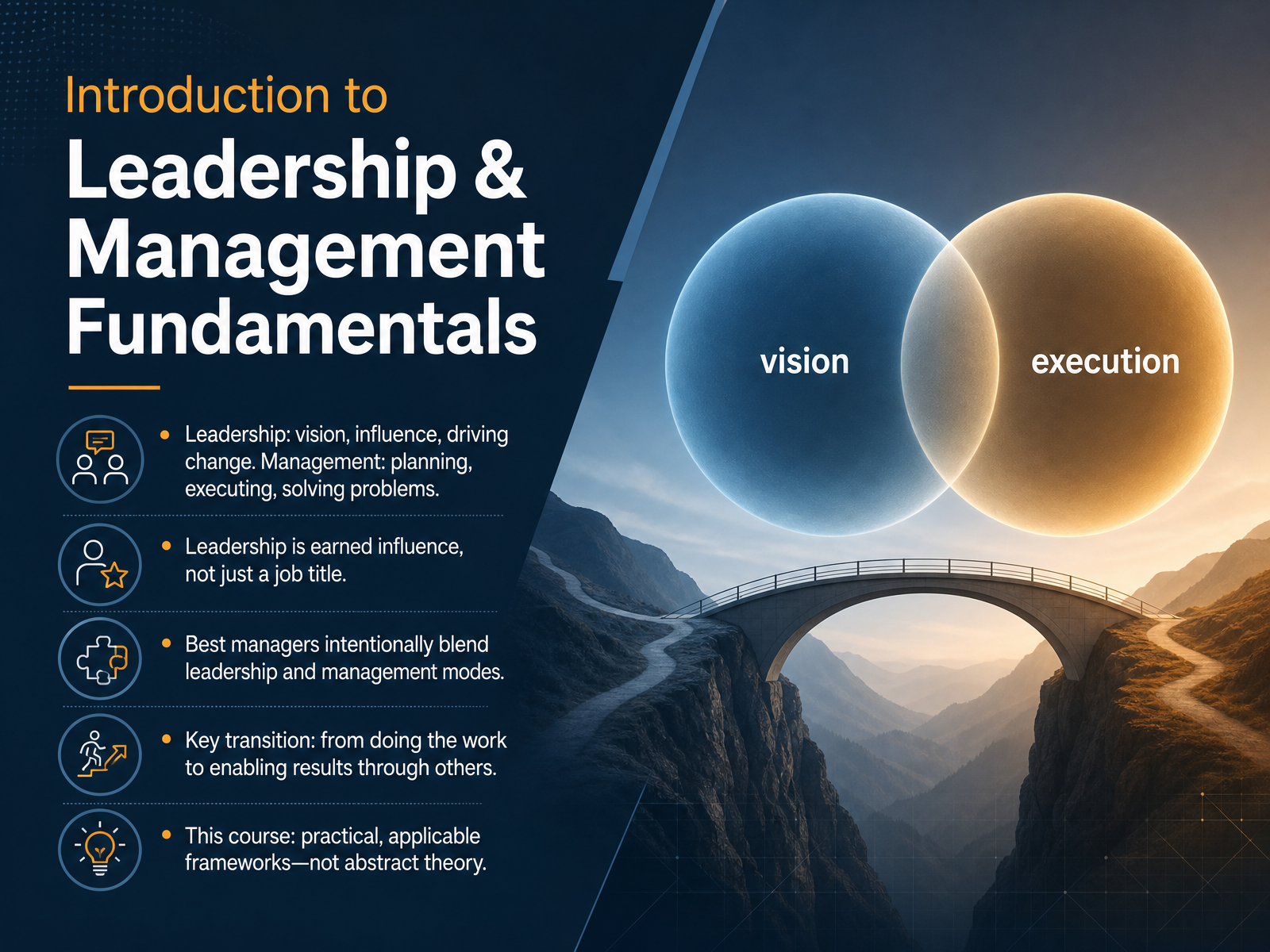
- 01Introduction to Leadership & Management FundamentalsWelcome to Leadership and Management Fundamentals. I'm glad you're here, because this is where real growth starts. Whether you've just stepped into a team lead role or you're a founder building from the ground up, this course is designed for the decisions you'll face every single day. Here's the core idea. Leadership and management are not two different jobs. They're two modes of the same job. Leadership is about vision, influence, and driving change. Management is about planning, executing, and solving problems. And the best leaders intentionally move between both modes. Think about when you delegate a key project. You're managing the timeline, but you're also leading the person by connecting their work to a bigger goal. That's the blend. One thing I want you to remember from this slide. Leadership is earned influence. It is not a job title. People choose to follow you because of how you show up, not because of what's written on your business card. The biggest shift for most new leaders is this. You're no longer rewarded just for doing the work. You're rewarded for enabling results through others. That's a tough transition, and we'll go step by step together. This course keeps theory where it belongs, in the background. We focus on practical frameworks you can apply the same day. Let's move forward to the core mindset shift from contributor to leader.1 min
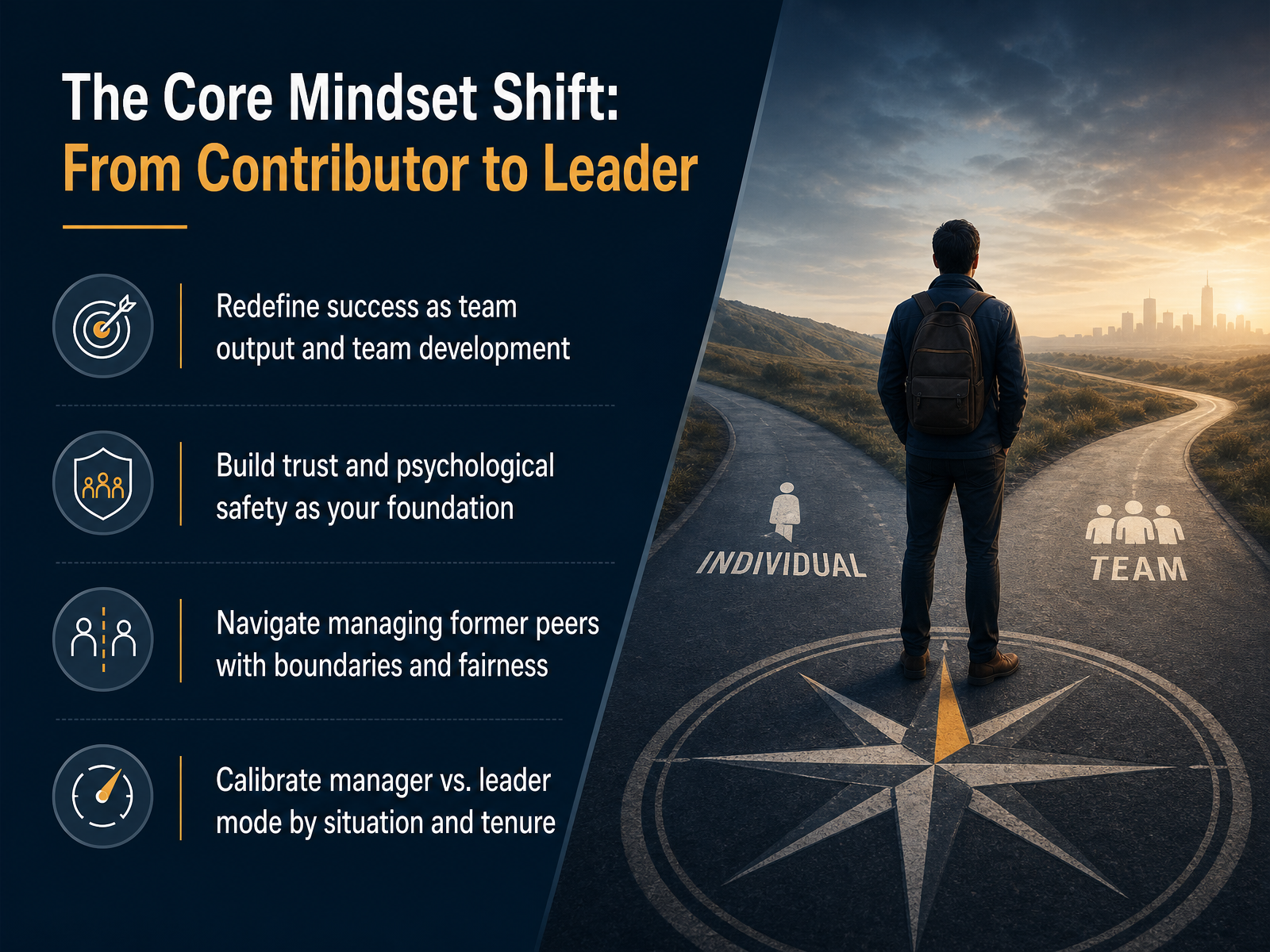
- 02The Core Mindset Shift: From Contributor to LeaderThe single biggest shift you make as a manager is redefining what success looks like. It is no longer about your own list of completed tasks. It is about the output of your team, and just as importantly, how you are developing the people on that team. That changes almost every decision you will make from here. It also means trust becomes your foundation. If your team does not feel psychologically safe, they will hide problems instead of raising them early, and you will be the last to know. Then there is the reality of managing former peers. That can be awkward. You will need clear boundaries and consistent fairness, even when it feels uncomfortable, because fairness is what preserves your credibility. And remember you are not always in the same mode. Sometimes you are the manager, ensuring work gets done correctly. Other times you are the leader, painting the bigger picture. Calibrate that based on the situation and how long your team has been together. With that mindset established, let's move into how you set the direction for your team, focusing on goals, priorities, and alignment.
 1 min
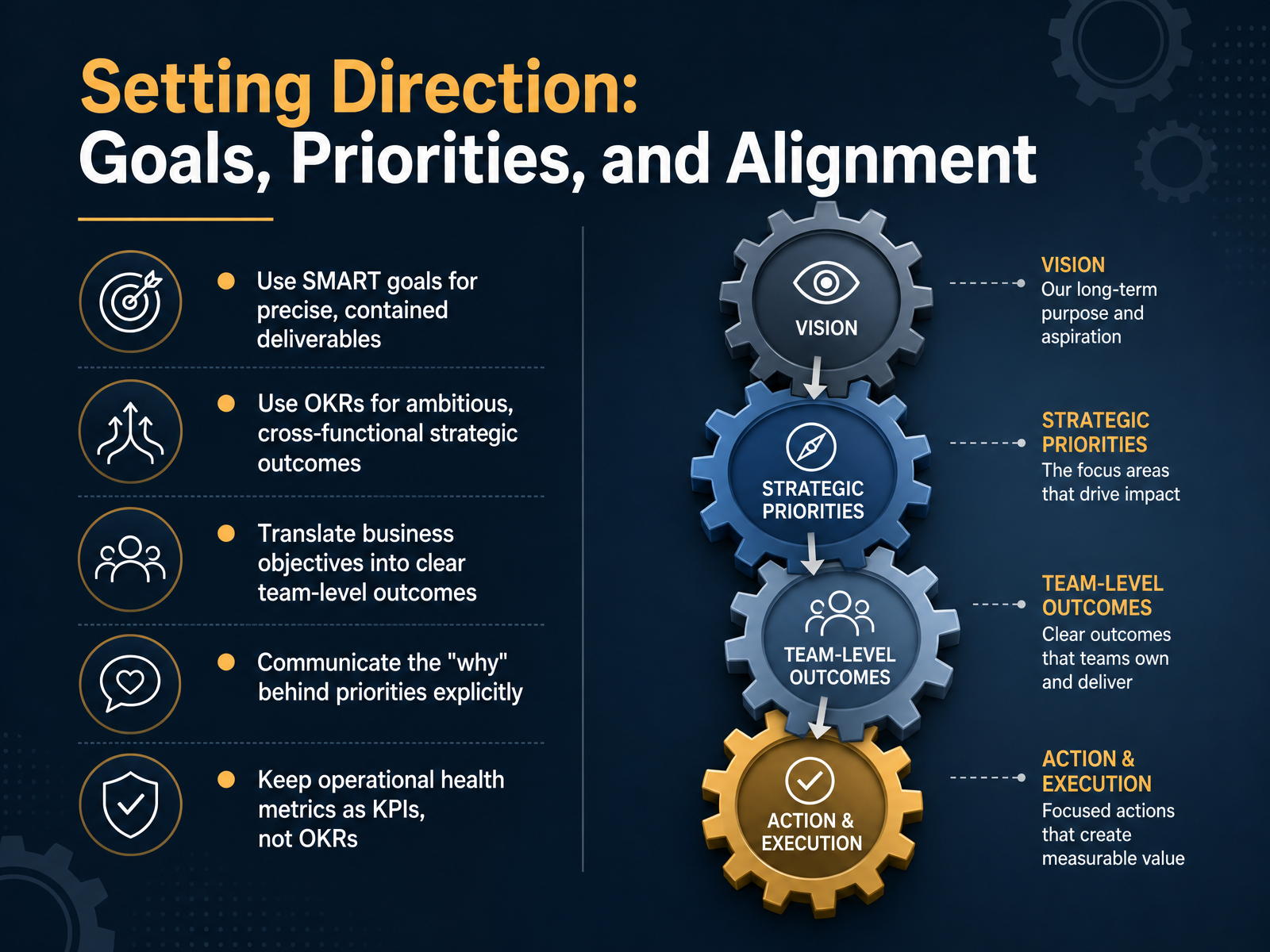
1 min - 03Setting Direction: Goals, Priorities, and AlignmentNow let's get practical about setting direction. When a task has clear boundaries, like preparing this month's revenue report, a SMART goal works well. Keep it specific, measurable, and time bound. But when you're pushing for something bigger, like improving cross team collaboration over the quarter, OKRs give you more room to aim high and align effort. Your real job is to translate those business objectives into team level outcomes people can act on. So don't just assign the number. Explain the why behind the priority. People move faster when they understand what problem they're solving. And keep operational health metrics like uptime or error rates as KPIs. They're the baseline, not the breakthrough. Once direction is clear, the next challenge is getting work through others effectively, which brings us to delegation and effective task management.
 1 min
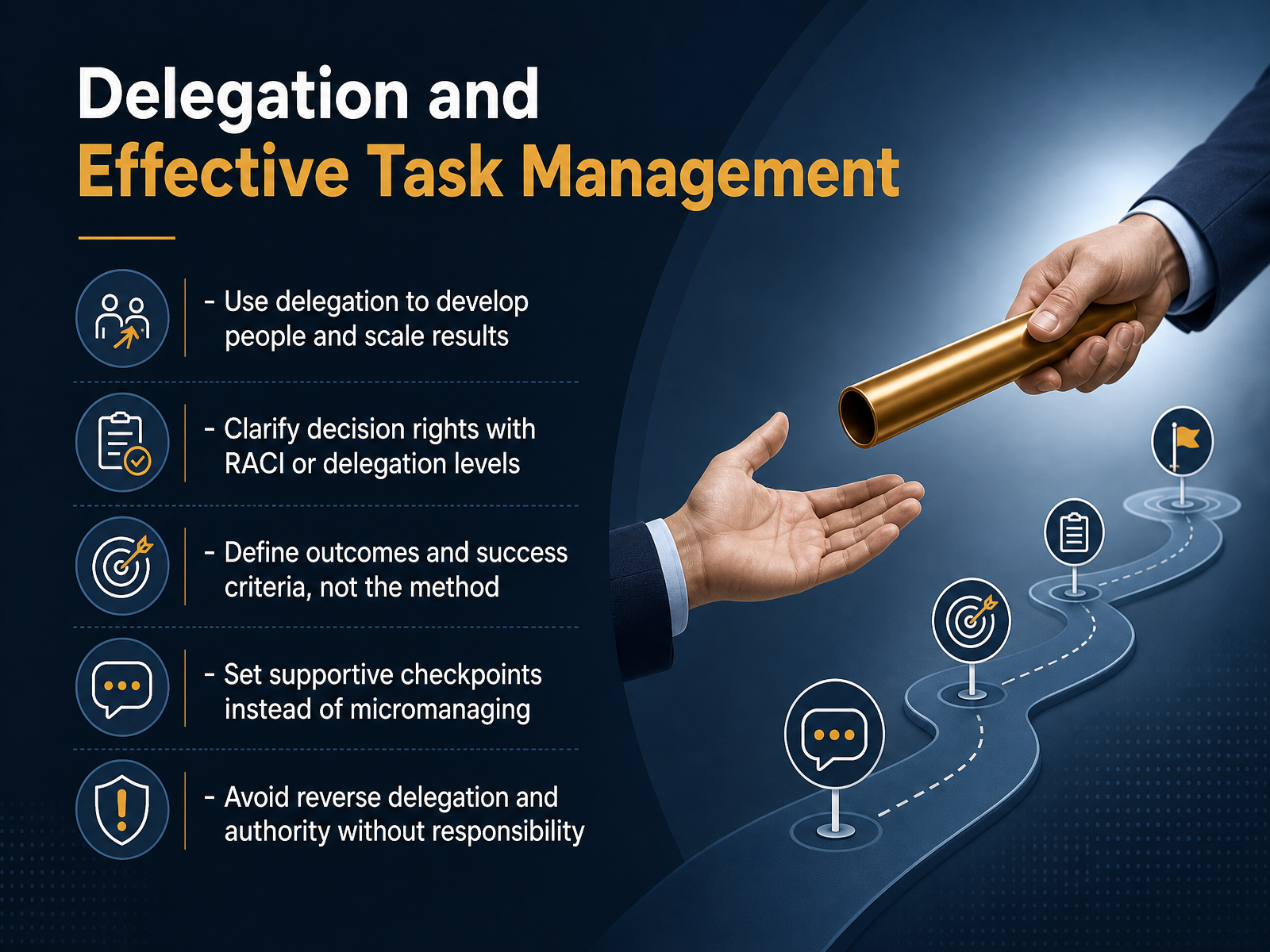
1 min - 04Delegation and Effective Task ManagementDelegation is one of the fastest ways to scale your impact, but only when you treat it as a development tool rather than just offloading tasks. Think about the last time a project stalled because no one knew who actually had the final call. That is where a simple RACI or a clear delegation level removes the guesswork. You are not just assigning work. You are defining decision rights. Next, focus on outcomes, not methods. Tell your team what success looks like and how you will measure it, then let them choose the path. That is how people grow. Set supportive checkpoints along the way so you stay informed without hovering. And watch out for reverse delegation, when a direct report brings a problem back up to you and you solve it for them. Instead, hand it back with guidance. If someone owns the outcome, they also need the authority to make the calls. Up next, we will apply that same mindset to coaching and feedback essentials.
 2 min
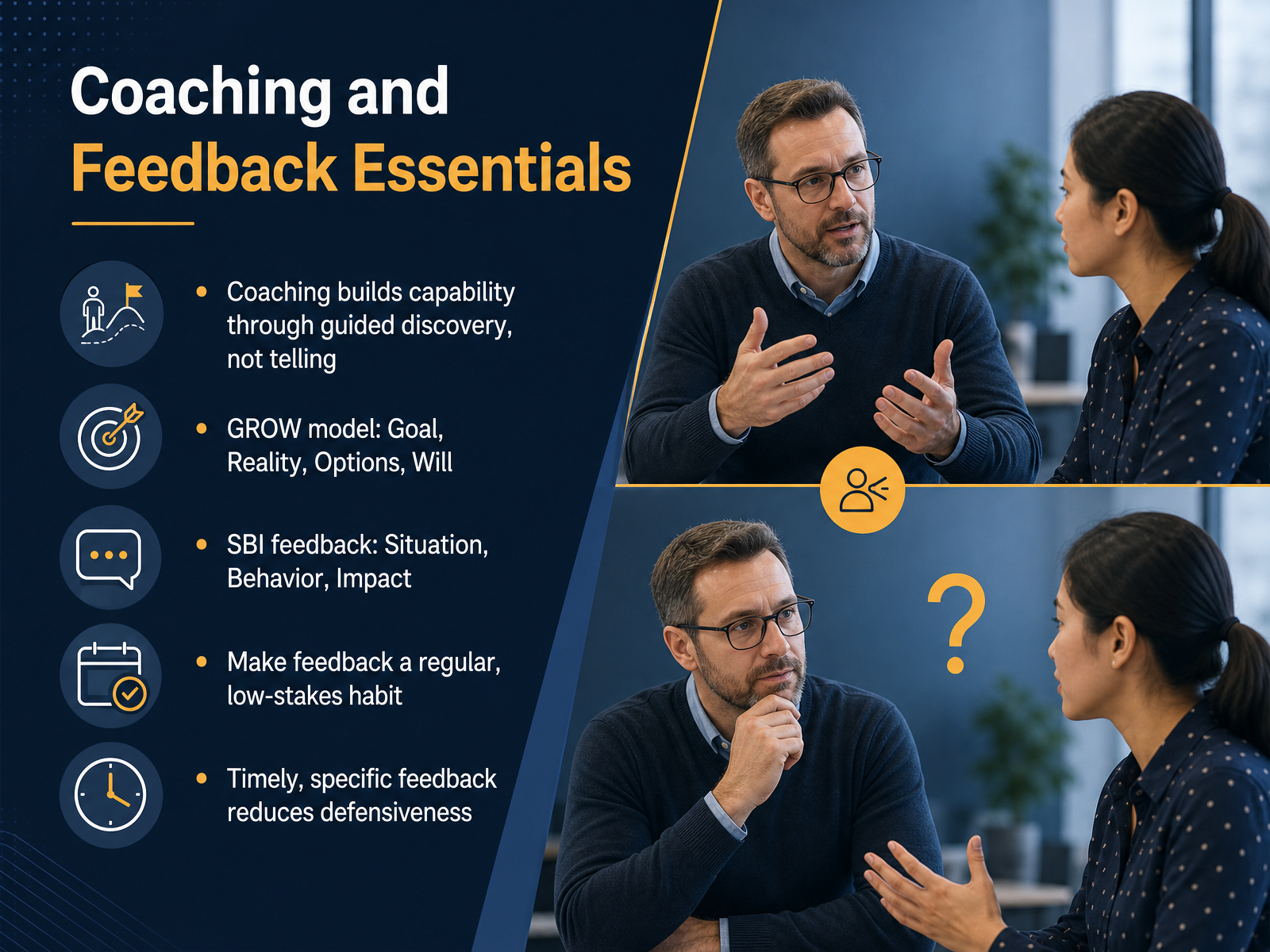
2 min - 05Coaching and Feedback EssentialsNow let's talk about coaching and feedback, because this is where your leadership shows up in daily conversations. Coaching is not about giving answers. It is about guiding someone to think clearly and build their own capability. A simple structure is the GROW model. Start with the goal, then get grounded in current reality, explore options, and end with a clear commitment to action. When you give feedback, use the SBI format. Describe the situation, the specific behavior you observed, and the impact it had. For example, say, in this morning's client call, you interrupted the account lead twice, and the client went quiet. That is far easier to hear than a vague comment about communication style. Make feedback a regular, low-stakes habit. A short check-in right after a meeting is more useful than a formal review months later. Timely and specific feedback reduces defensiveness and builds trust. In the next section, we will connect these skills to running discussions as a team.
 1 min
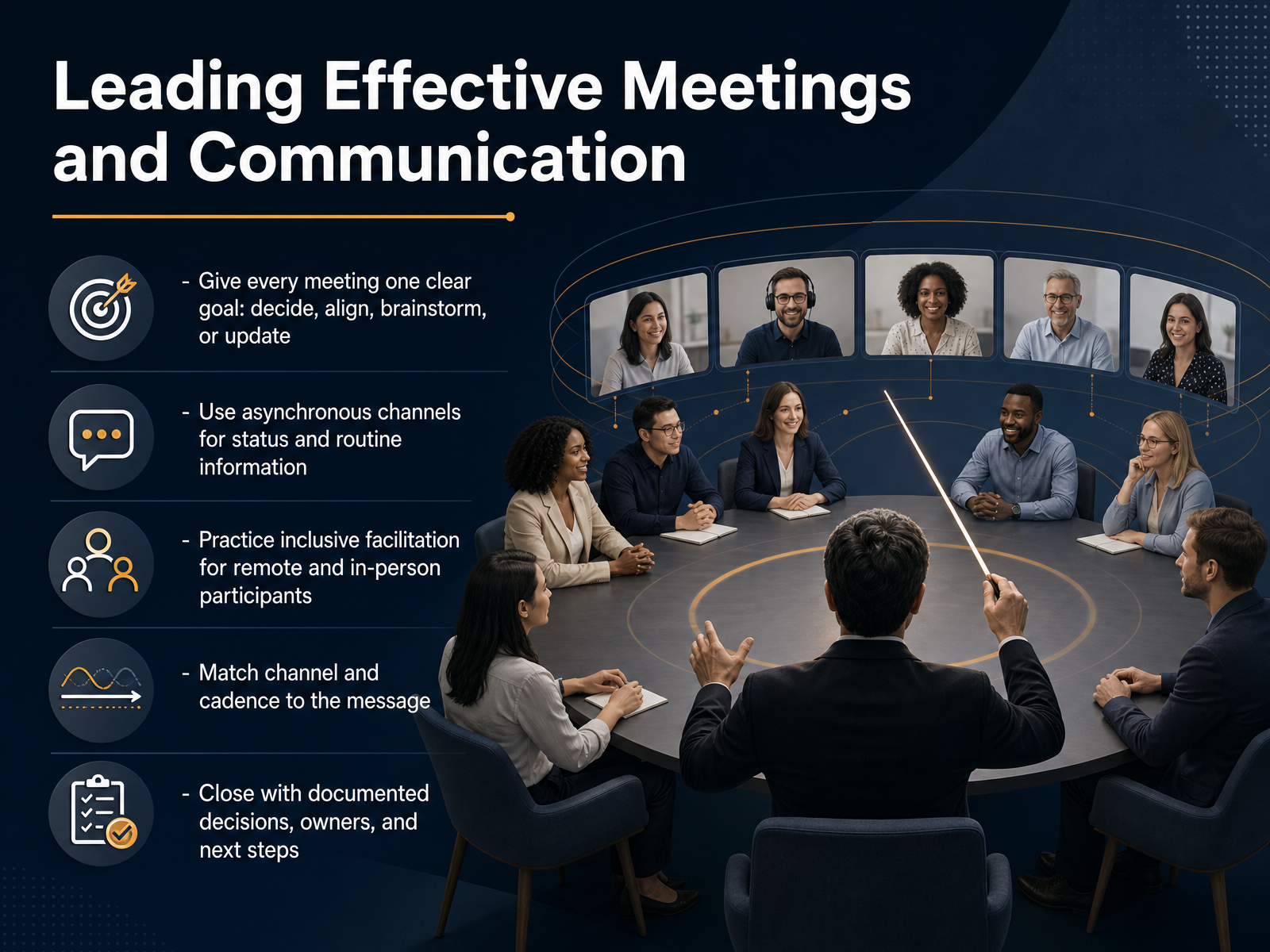
1 min - 06Leading Effective Meetings and CommunicationEvery meeting you run has a cost, so make sure it earns its place on the calendar. Start by defining one clear goal. Are you there to decide, to align, to brainstorm, or simply to update? If it is just a status update, consider moving it to an asynchronous channel like email or your team chat. Routine information rarely needs a live audience. If you do meet, practice inclusive facilitation. Make sure remote participants are not just listening in but actually included in the discussion. Ask for their input directly. Match your communication channel and cadence to the message. A quick question might be a chat message, while a complex decision probably deserves a live conversation. And never let a meeting end without closure. Document the decisions made, assign clear owners, and state the specific next steps. A meeting without a clear ending is just an unfinished conversation. Next, we will talk about how to build motivation and engagement, even when you do not have formal authority.
 1 min
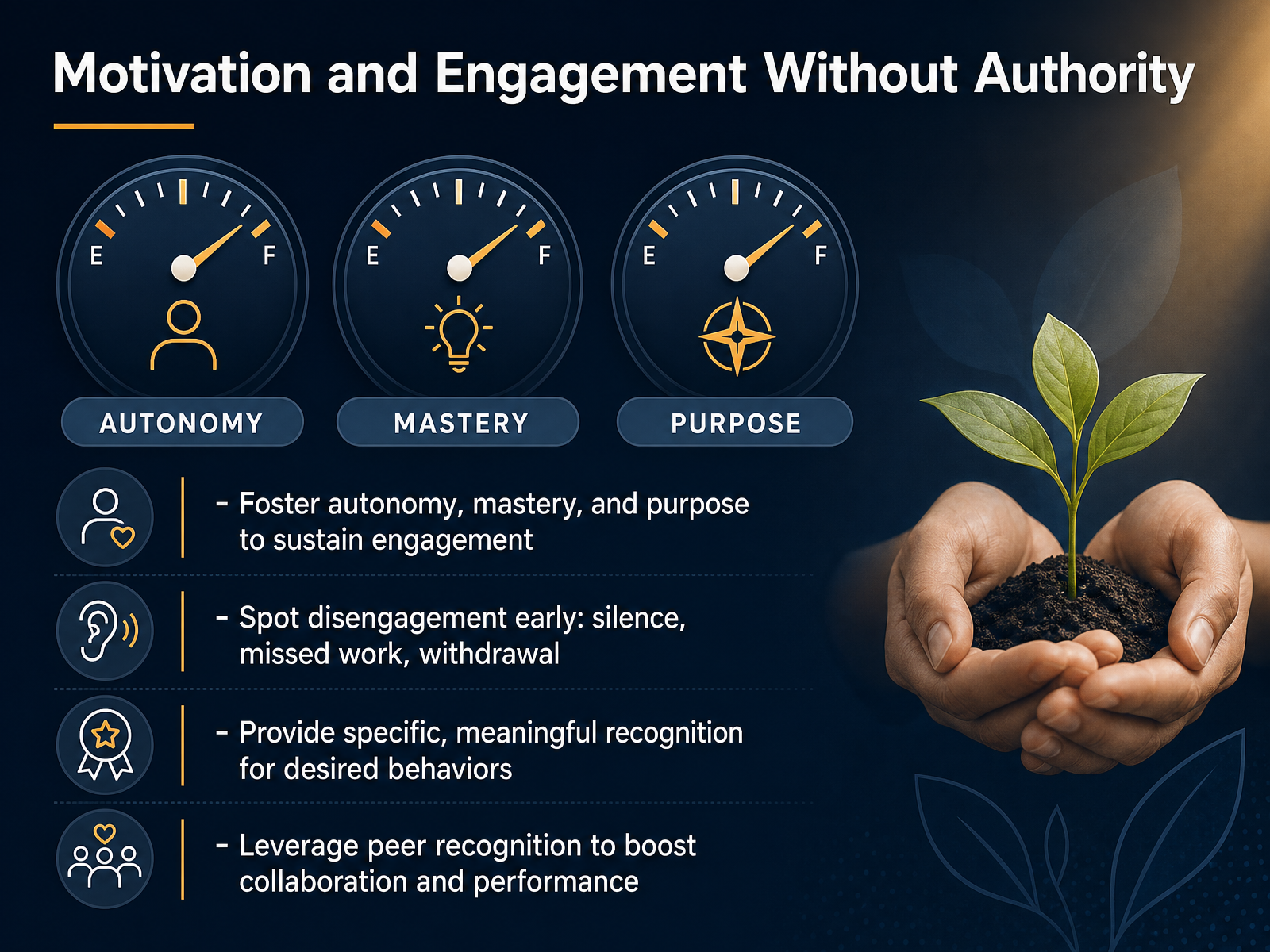
1 min - 07Motivation and Engagement Without AuthorityMotivating a team without formal authority is one of the most common challenges you will face as a leader. It also clarifies what leadership really is. Authority can demand compliance, but it can never command commitment. The real work is creating conditions where people choose to engage. Start with autonomy, mastery, and purpose. Give people meaningful control over how they do their work. Support their desire to get better at something that matters to them. And connect daily tasks to a result that feels worth achieving. Now, look for early signs of disengagement. Silence in meetings is not always agreement. It is often the first warning sign. Watch for missed commitments, decreased collaboration, or someone who has simply gone quiet. Your job is to notice, and to ask a good question before the problem grows. When you see the behavior you want, recognize it. But be specific. Instead of saying good job, say, the way you handled that customer objection in today's review helped the whole team see a better approach. Specific recognition teaches people what success looks like. And remember that recognition does not have to come only from you. Highlighting a peer's contribution with the group creates shared ownership of the team's performance. When you help people feel capable, connected, and valued, they bring energy to the work even when no one is telling them to. That energy becomes especially important when tension shows up. Next we will look at handling conflict and difficult conversations.
 2 min
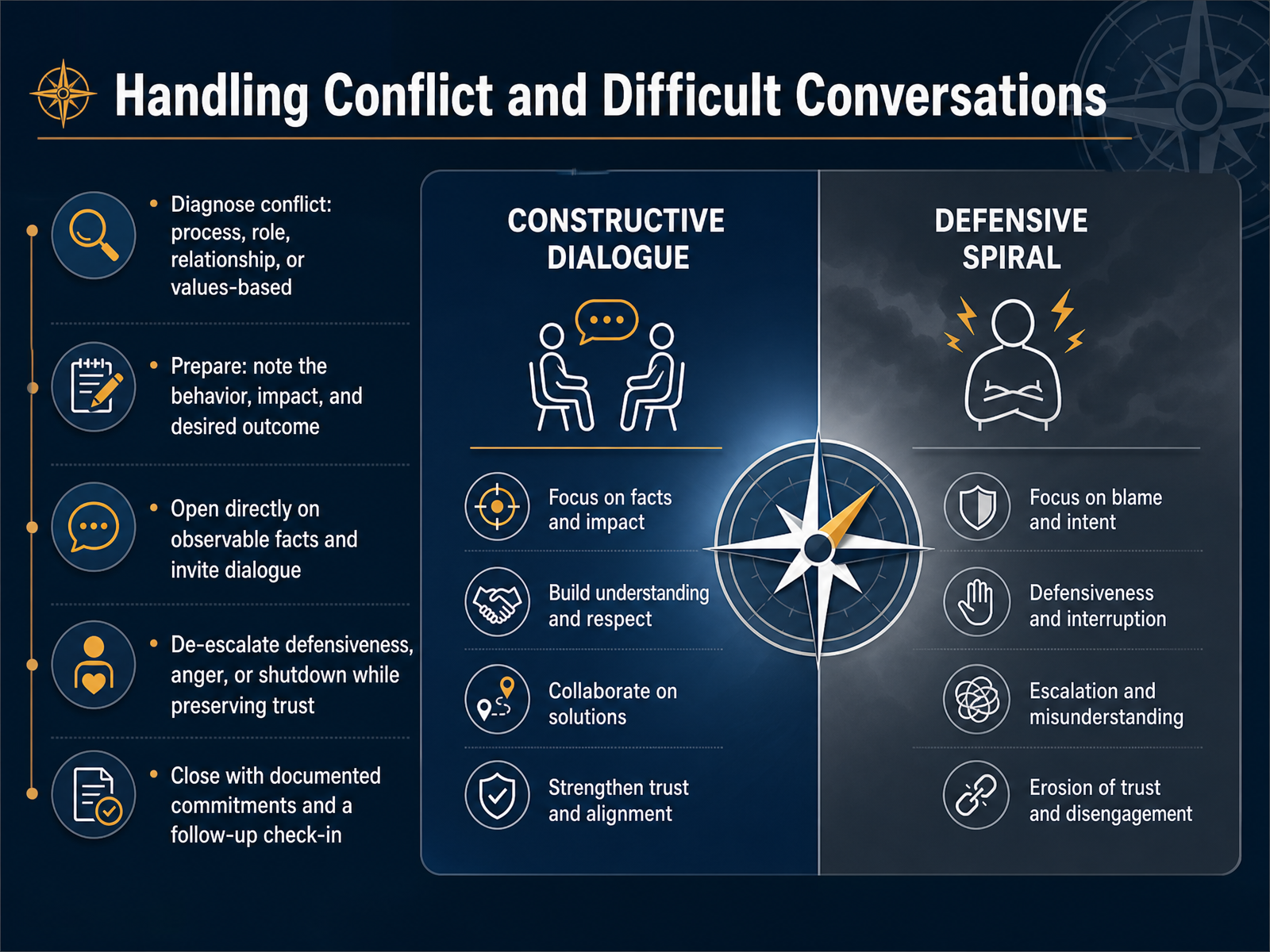
2 min - 08Handling Conflict and Difficult ConversationsNow let's talk about handling conflict and difficult conversations. The first step is to diagnose what you're actually dealing with. Is this a conflict about process, roles, the relationship itself, or a clash of core values? Your approach should match the root cause. Before you speak, prepare. Note the specific behavior you observed, the impact it had, and the outcome you want from the conversation. When you open, start directly on observable facts, not assumptions, and invite the other person into the dialogue. As emotions rise, your job is to de-escalate defensiveness, anger, or shutdown, while preserving trust. That means staying calm, listening, and steering back to the issue, not the person. End by documenting clear commitments and schedule a follow-up check-in. That follow-up is what turns a hard talk into real accountability. Next, we'll build your personal leadership operating system.
 1 min
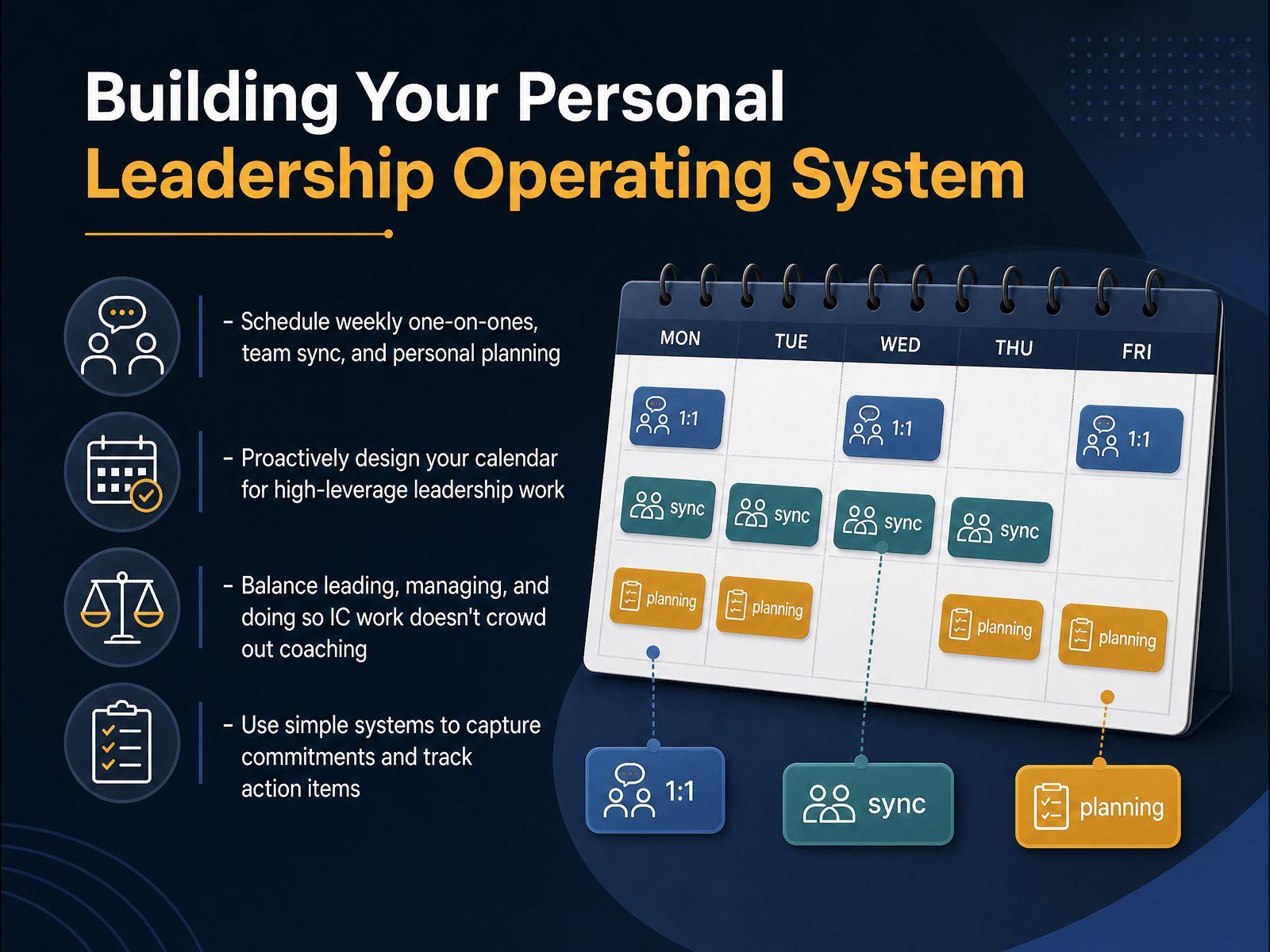
1 min - 09Building Your Personal Leadership Operating SystemLet's move from mindset to mechanics, and build your personal leadership operating system. This is where good intentions become repeatable practice. Start with the basics. Schedule a weekly one-on-one with each direct report, a team sync, and a personal planning block. If these do not exist on your calendar, they will not happen consistently. Next, proactively design your calendar for high-leverage leadership work. Protect time for coaching, thinking, and preparing before the week fills up with requests. Watch your mix of leading, managing, and doing. Your individual contributor work will always try to expand and crowd out the coaching conversations your team needs. Set boundaries on deep work, and keep space for the human part of leadership. Finally, use simple systems to capture commitments and track action items. A shared document, a task tool, or a running agenda is enough. The goal is not a complicated process. It is trust built through reliable follow-through. So your operating system comes down to three habits. Protect recurring conversations. Design your calendar around leadership priorities. And close every loop you open. Up next, we will apply these habits to your first critical window with the thirty, sixty, ninety day action plan for new managers.
 2 min
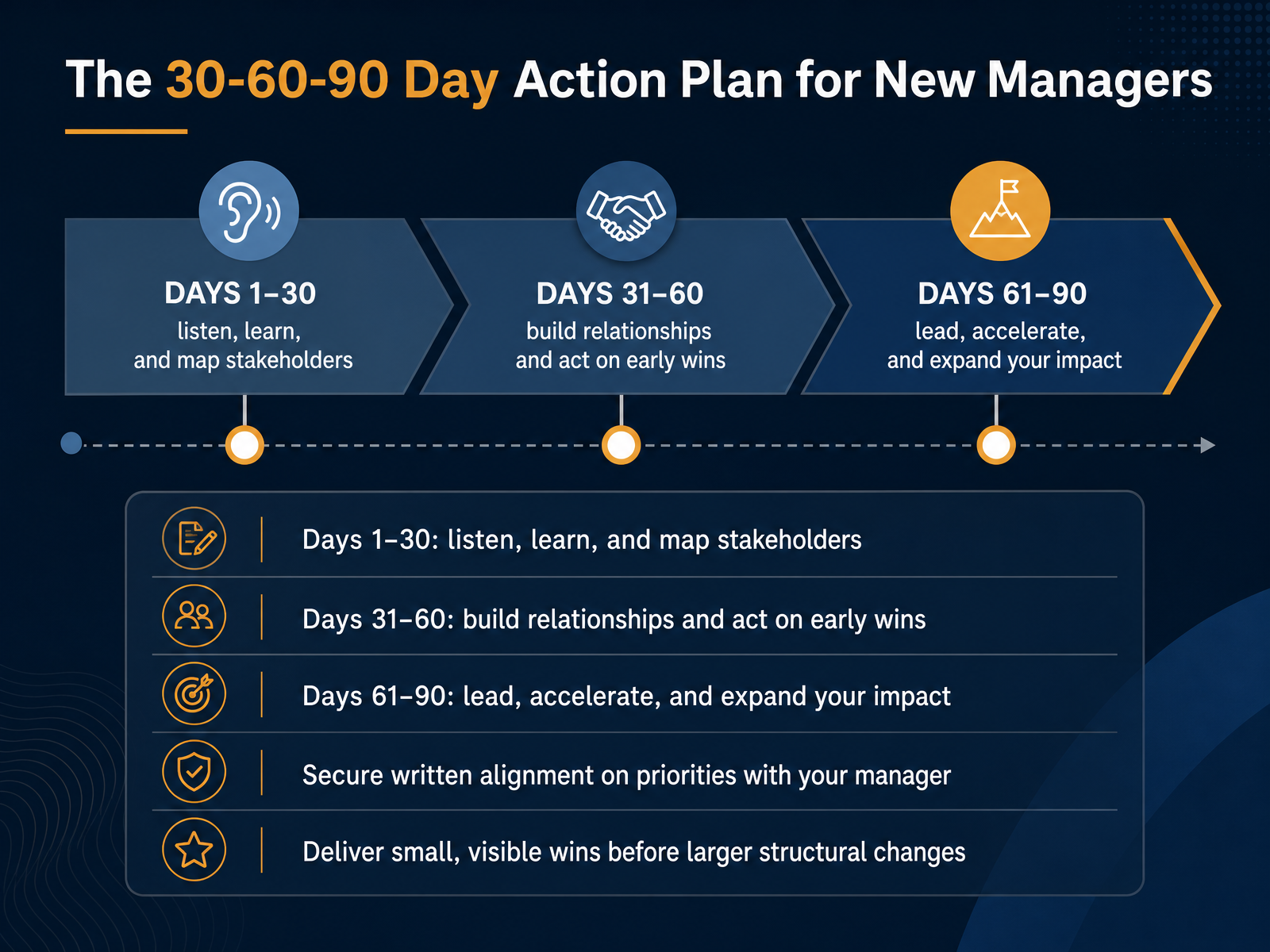
2 min - 10The 30-60-90 Day Action Plan for New ManagersLet’s turn this into a practical plan. A thirty, sixty, ninety day structure gives you a clear runway, without trying to fix everything in week one. In your first thirty days, your job is to listen and learn. Sit in on meetings, ask direct reports what’s working and what slows them down, and map the people who influence your team’s success. During the next thirty days, start building those relationships and act on small wins. Pick one or two manageable improvements, like clarifying a recurring process or removing a simple blocker, and follow through visibly. In days sixty-one to ninety, shift into leading with more confidence. Accelerate decisions, expand your influence beyond your immediate team, and connect your work to broader goals. One discipline matters throughout. Secure written alignment on your priorities with your manager. That document is your cover when new tasks arrive and your proof when you deliver results. And remember, win trust with small visible progress before you propose larger structural changes. Now let’s look at common pitfalls and how to avoid them.
 2 min
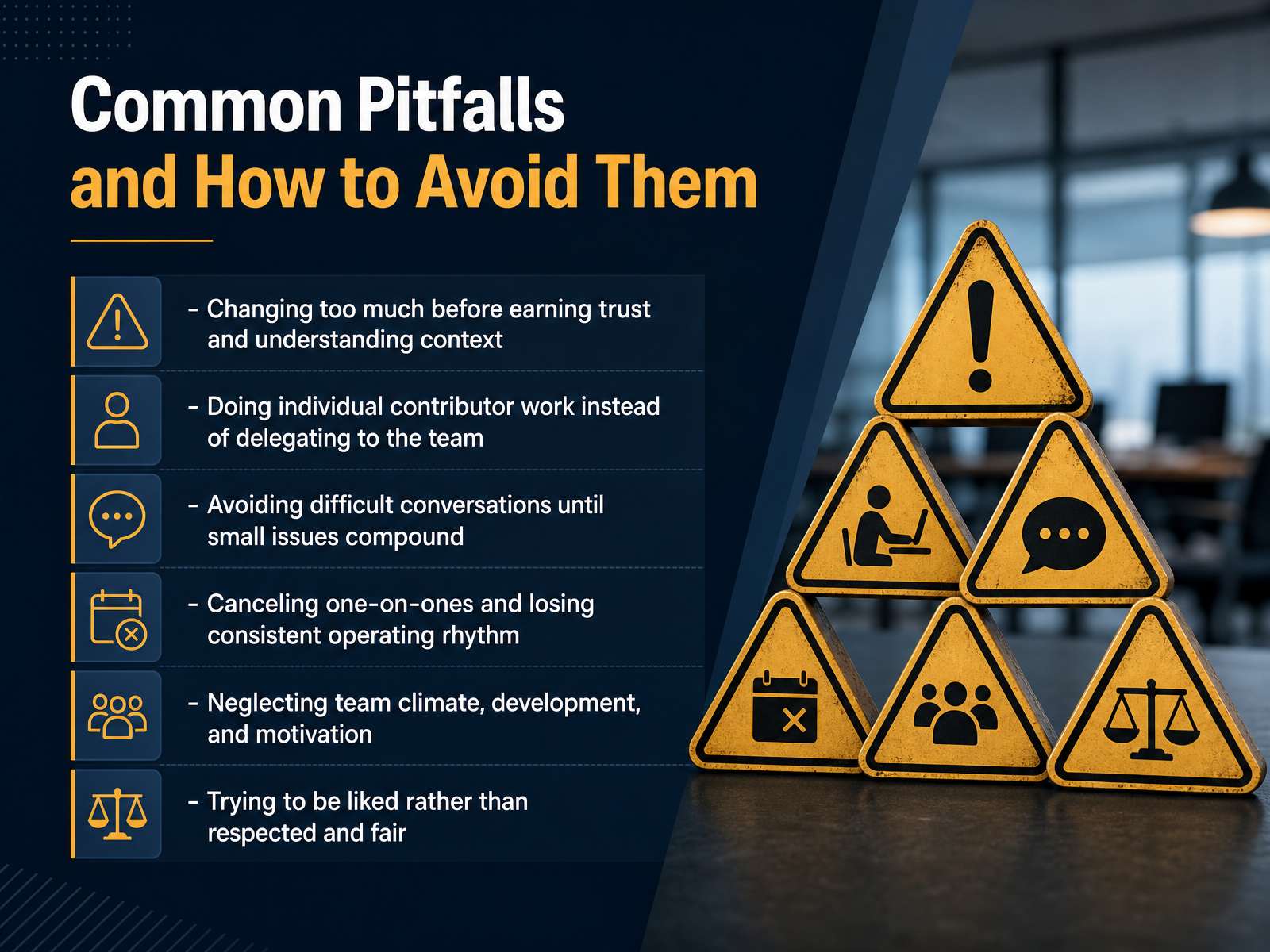
2 min - 11Common Pitfalls and How to Avoid ThemLet's talk about the mistakes that quietly undermine new leaders. The first one is moving too fast. If you change processes before your team trusts you, even good ideas feel like disruption. So slow down, watch how work actually gets done, and ask questions before you redesign anything. Another common trap is holding on to individual contributor work. It feels productive, but every task you keep is a growth opportunity you have taken from someone else. Delegation is not offloading busywork; it is how you build a capable team. Difficult conversations are also easy to avoid, but small issues compound quickly. A missed expectation in week one becomes a performance problem in week six. Address concerns early and with respect. Then there is your operating rhythm. When you cancel one-on-ones, the message to your team is that they are not a priority. Protect that time. And do not neglect team climate. Motivation does not sustain itself. People need feedback, development, and a sense that their work matters. Finally, stop trying to be liked. Your goal is to be respected and fair. Consistency earns trust faster than popularity. If you avoid these patterns, you avoid becoming the leader you once complained about. Next, we will work through scenario practice covering feedback, delegation, and conflict.
 2 min
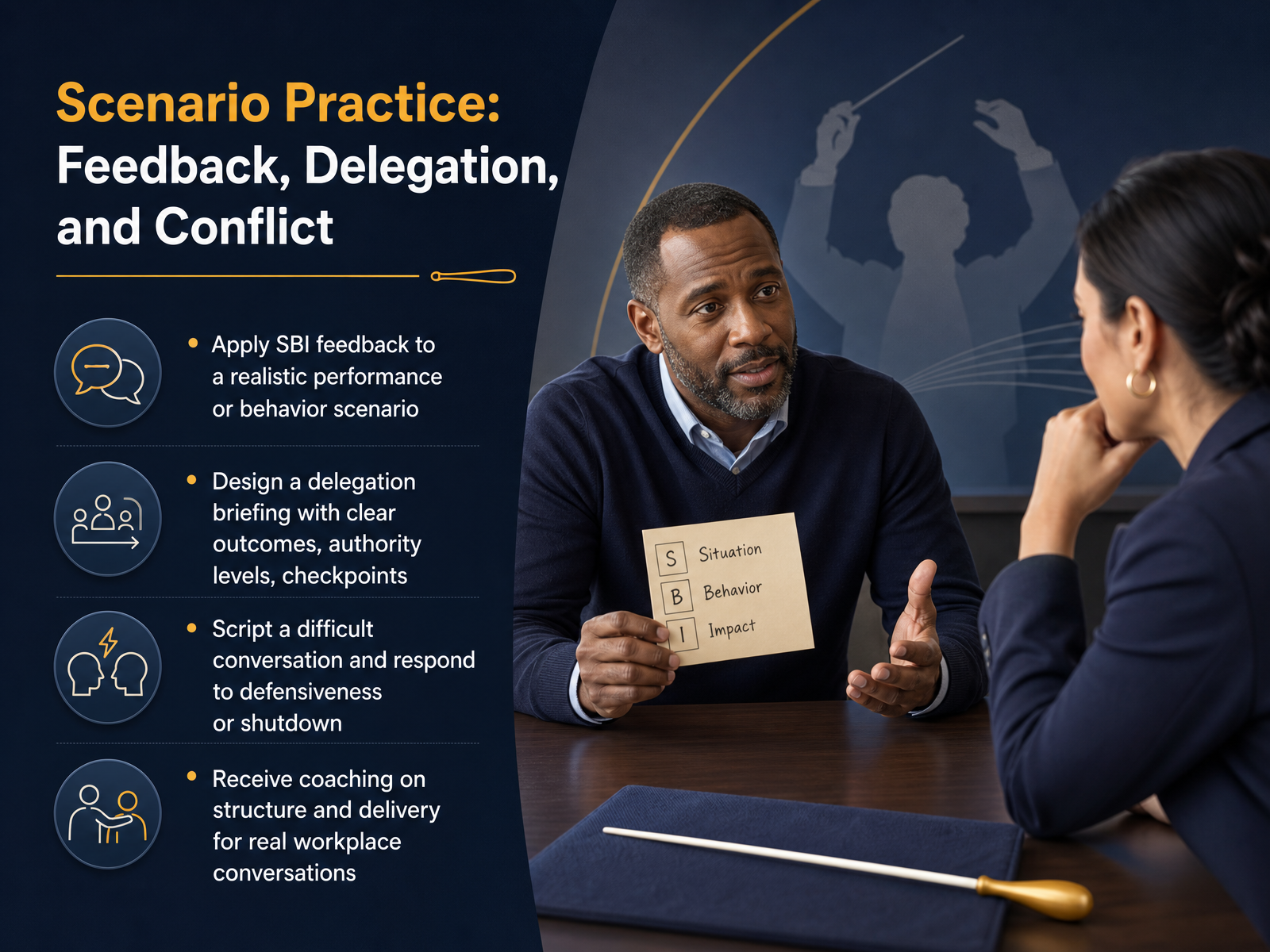
2 min - 12Scenario Practice: Feedback, Delegation, and ConflictNow let's put these ideas into practice. Imagine a team member delivered a presentation that fell short of expectations. Use the SBI model: describe the situation, the specific behavior you observed, and the impact it had. That keeps the conversation factual instead of personal. Next, think about delegation. Before you hand off a task, write a short briefing with three elements: the desired outcome, the decision-making authority your team member has, and the checkpoints where you will connect. This prevents both micromanaging and confusion. Finally, prepare for a difficult conversation. Write down your opening three sentences, then anticipate what you will do if the other person gets defensive or goes quiet. Your job is not to avoid that reaction; it is to stay grounded and bring the discussion back to the issue. Use these tools to script your real workplace conversations, not just to discuss them.
 1 min
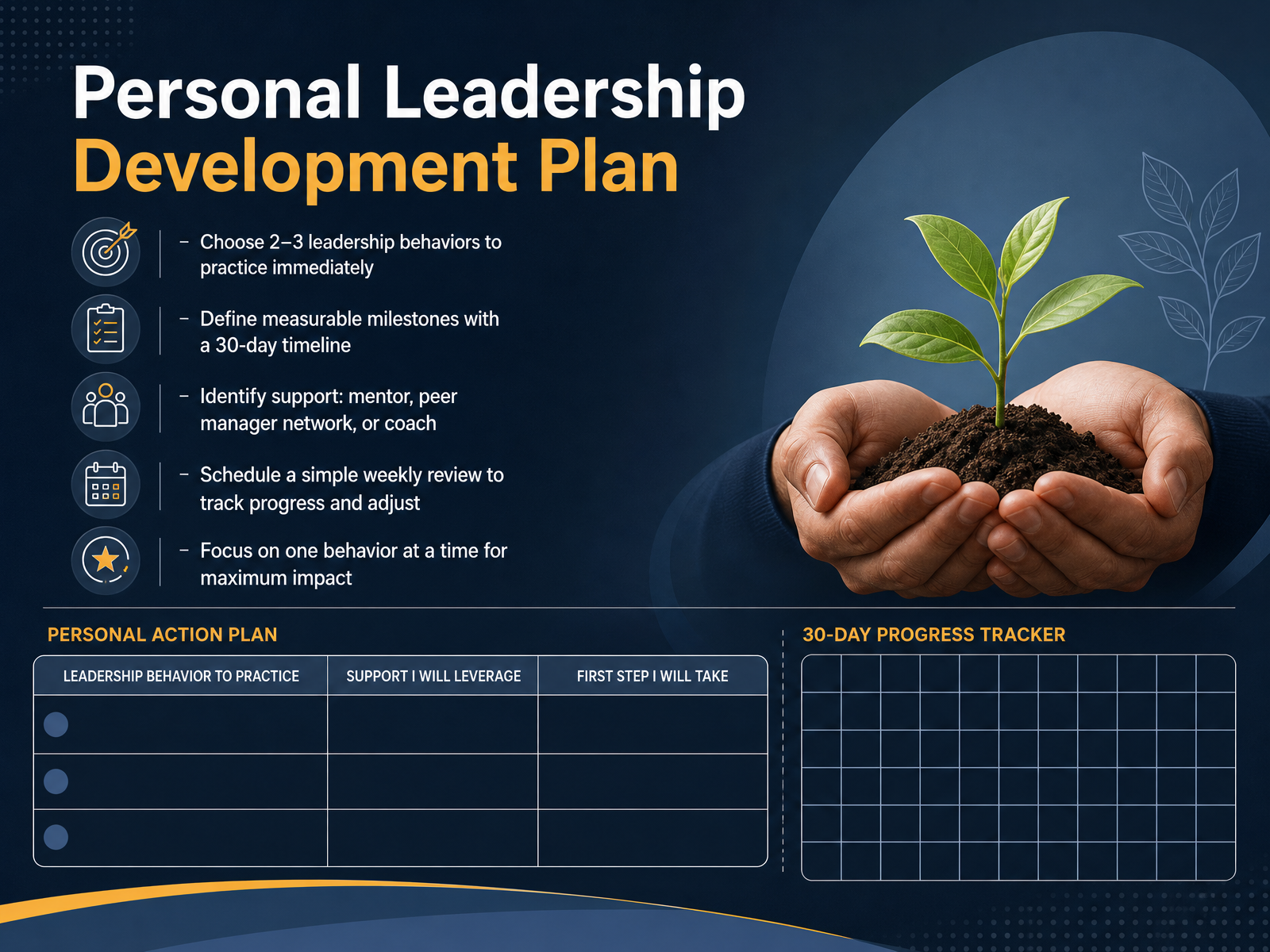
1 min - 13Personal Leadership Development PlanNow let us turn this into a plan you can actually execute. Start by choosing just two or three leadership behaviors to practice immediately. For example, if you tend to jump in and solve problems yourself, pick delegation. If feedback conversations feel rushed, pick giving structured feedback. Then define measurable milestones with a thirty day timeline. That could mean delegating one recurring task per week, or holding three feedback conversations by the end of the month. Next, identify your support system. A mentor who has led teams before, a peer manager network, or a coach. You need someone to help you see what you cannot see from inside your own habits. Also schedule a simple weekly review. Fifteen minutes to ask yourself what worked, what did not, and what you will adjust. And here is the most important rule. Focus on one behavior at a time. Trying to change everything at once usually changes nothing. Now let us close with the key takeaways.
 2 min
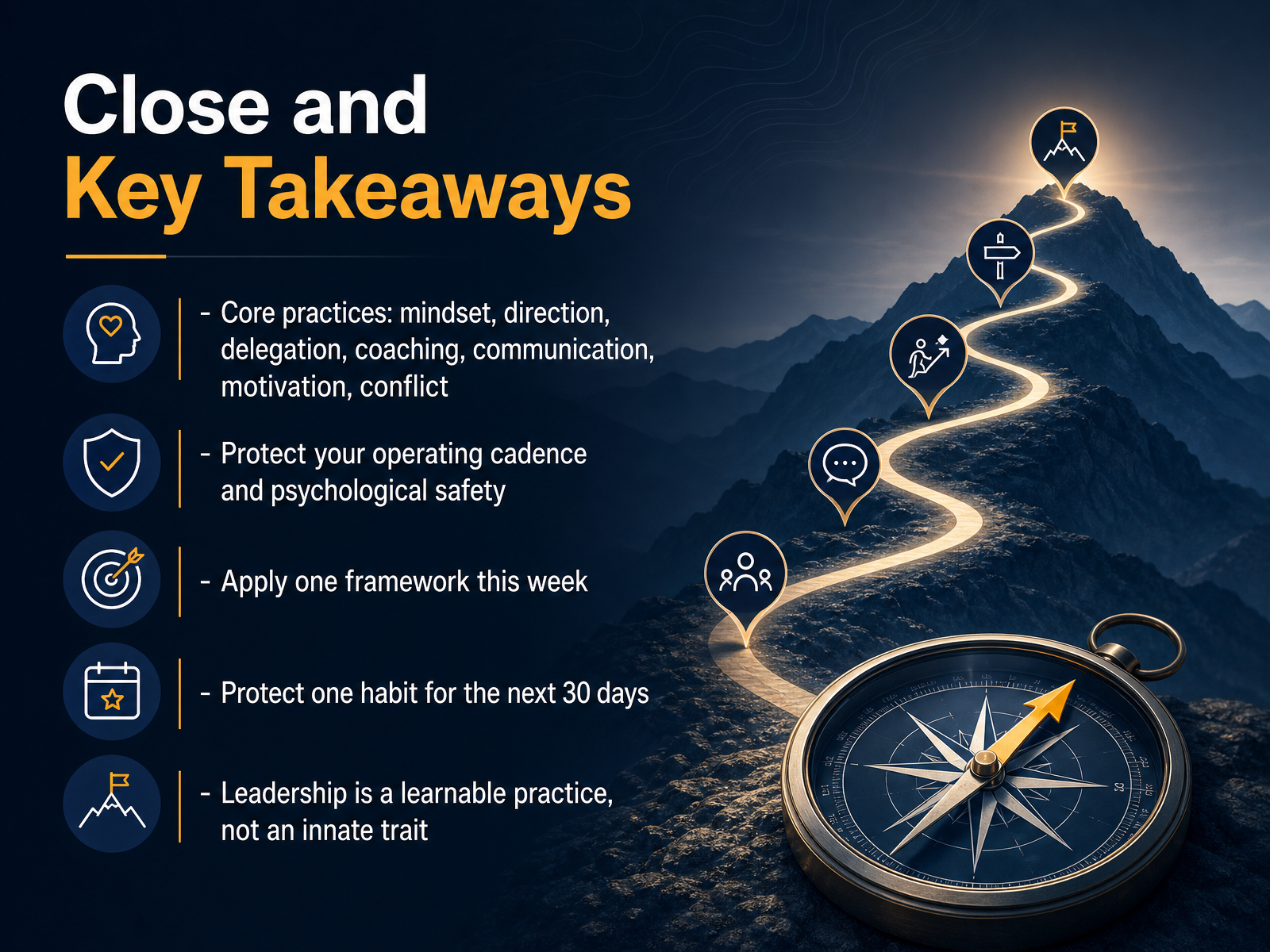
2 min - 14Close and Key TakeawaysSo where does this leave you. Leadership is not a trait you either have or you don't. It is a practice you build through repeated decisions. The core practices we covered, mindset, direction, delegation, coaching, communication, motivation, and conflict, are not a checklist. They are muscles you strengthen under real pressure. As you go back to your team, protect two things. Protect your operating cadence, the rhythm of one on ones, team meetings, and feedback loops that keeps work moving without constant firefighting. And protect psychological safety. That is the unspoken permission your team needs to raise problems early, admit mistakes, and challenge ideas before they become expensive failures. This week, choose one framework and apply it deliberately. Not five. One. Maybe you run a delegation conversation before your next project kickoff. Maybe you use the feedback model in a real conversation you have been avoiding. Then pick one habit to protect for the next thirty days. It might be a weekly planning block every Friday. It might be asking one coaching question before giving an answer. The point is not speed. The point is consistency. You will not get this perfect, and you do not need to. You need to stay in the practice. Thank you for investing the time. Now go lead with a little more clarity than you had this morning.
 2 min
2 min
Take the deck with you
Download this course as a file — free, no sign-up needed.
- PDF handoutEvery slide page, ready to print or share.15 pages · 3.8 MBDownload
- Narrated PowerPointThe deck that presents itself — every slide carries the digital human's narration video.15 pages · 26.9 MBDownload
- PowerPoint slidesThe full deck as a .pptx — open it in PowerPoint, Keynote, or Google Slides.15 pages · 3.7 MBDownload
Free to use in your own training — please keep the PersonWise credit page at the end.
Have your own deck? Turn it into a course