Begin
14 pages · ~28 min
Etymology: Tracing Word Origins
This training teaches learners to trace word origins and understand how etymology reveals meaning, ideal for anyone curious about language history and vocabulary.
A digital instructor presents all 14 pages. Hold “Ask” at any point and ask out loud — the answer comes from this course. No sign-up needed.
What you’ll learn
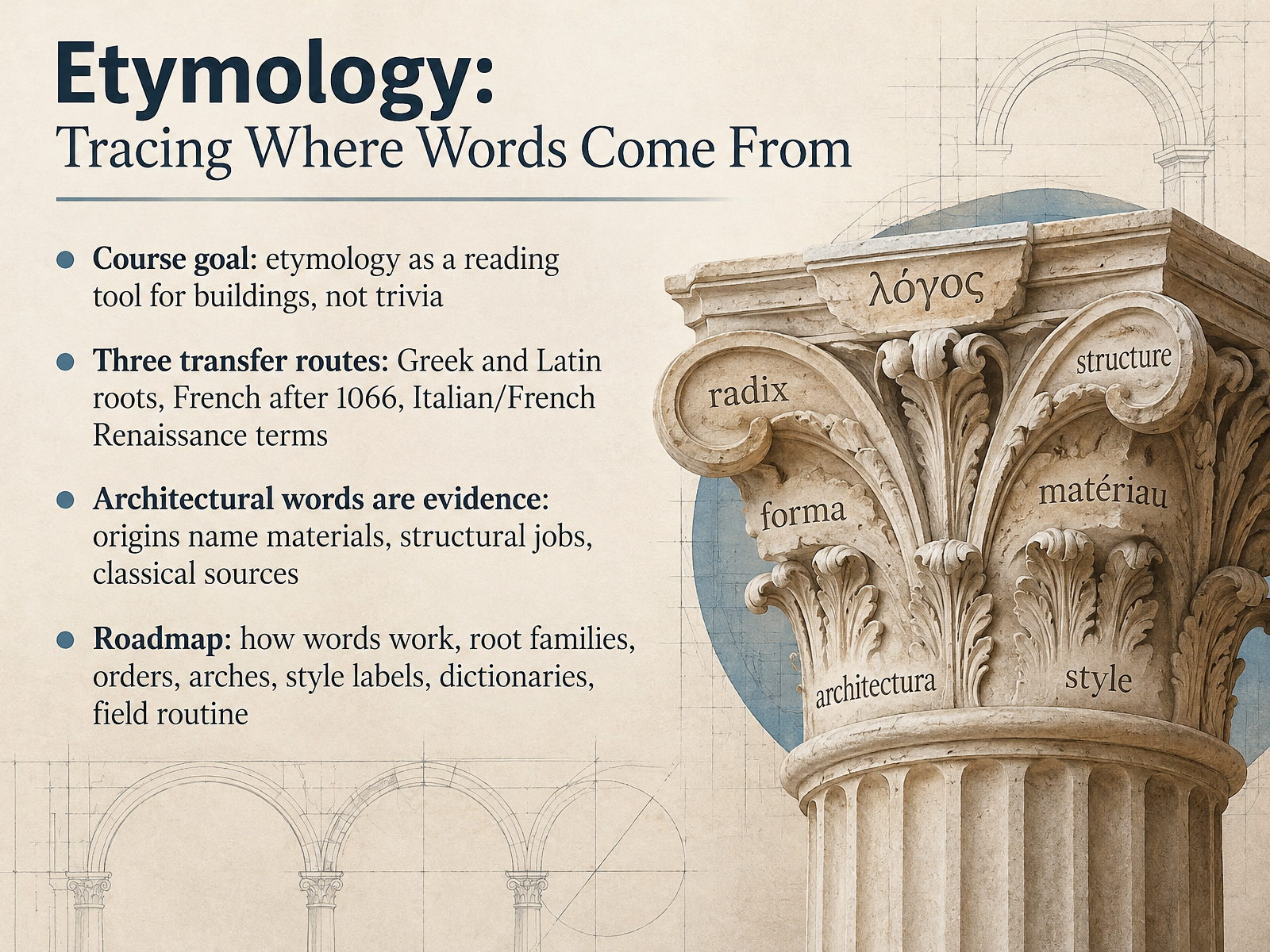
- 01Etymology: Tracing Where Words Come FromWelcome. I'm glad you're here. In this course we're going to use etymology as a reading tool for buildings, not as trivia. Point at a capital, and the name takes you back to the Latin word for head, because it sits at the top of the column. Words like that arrive by three main routes: Greek and Latin roots, French after the Norman arrival of ten sixty-six, and Italian or French Renaissance terms. Each one is evidence. The origin often names a material, a structural job, or a classical source. So our roadmap is practical: how words work, root families, the orders, arches, style labels, dictionaries, and a field routine you can use on site. Take a breath. You don't need to memorize anything yet. Just start noticing that every term is a small record of how builders reasoned. Next, we'll look at how words work: root, borrowing, cognate, and drift.elib.bsu.byclassicist.orgen.wikipedia.org+21 min
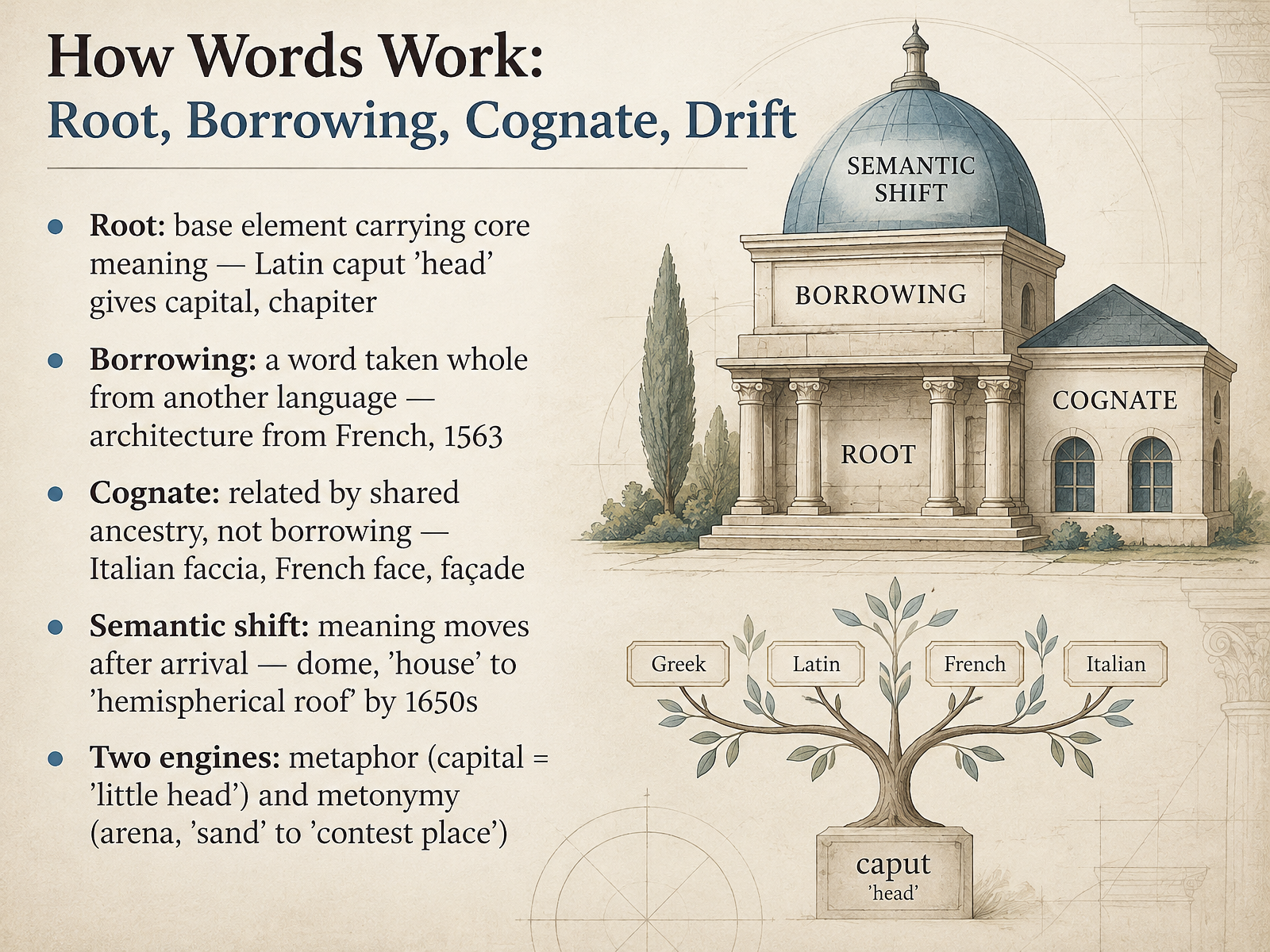
- 02How Words Work: Root, Borrowing, Cognate, DriftBefore we look closely at a building, let's see how the words themselves work. A root is the base element carrying the core meaning, like the Latin caput, meaning head. That gives us capital, the head of a column. A borrowing is a word taken whole from another language. Architecture came into English from French, first recorded in fifteen sixty-three. Cognates are related by shared ancestry rather than borrowing. Italian faccia, French face, and façade all descend from the same Latin source. Semantic shift means the meaning moves after arrival. Dome once meant house, and by the sixteen fifties it came to mean a hemispherical roof. Two engines drive much of this: metaphor, as when capital names a little head atop a column, and metonymy, as when arena moves from sand to the place of contest. In the next part, we'll put this to work, reading a building word by word.
 elib.bsu.byclassicist.orgen.wikipedia.org+22 min
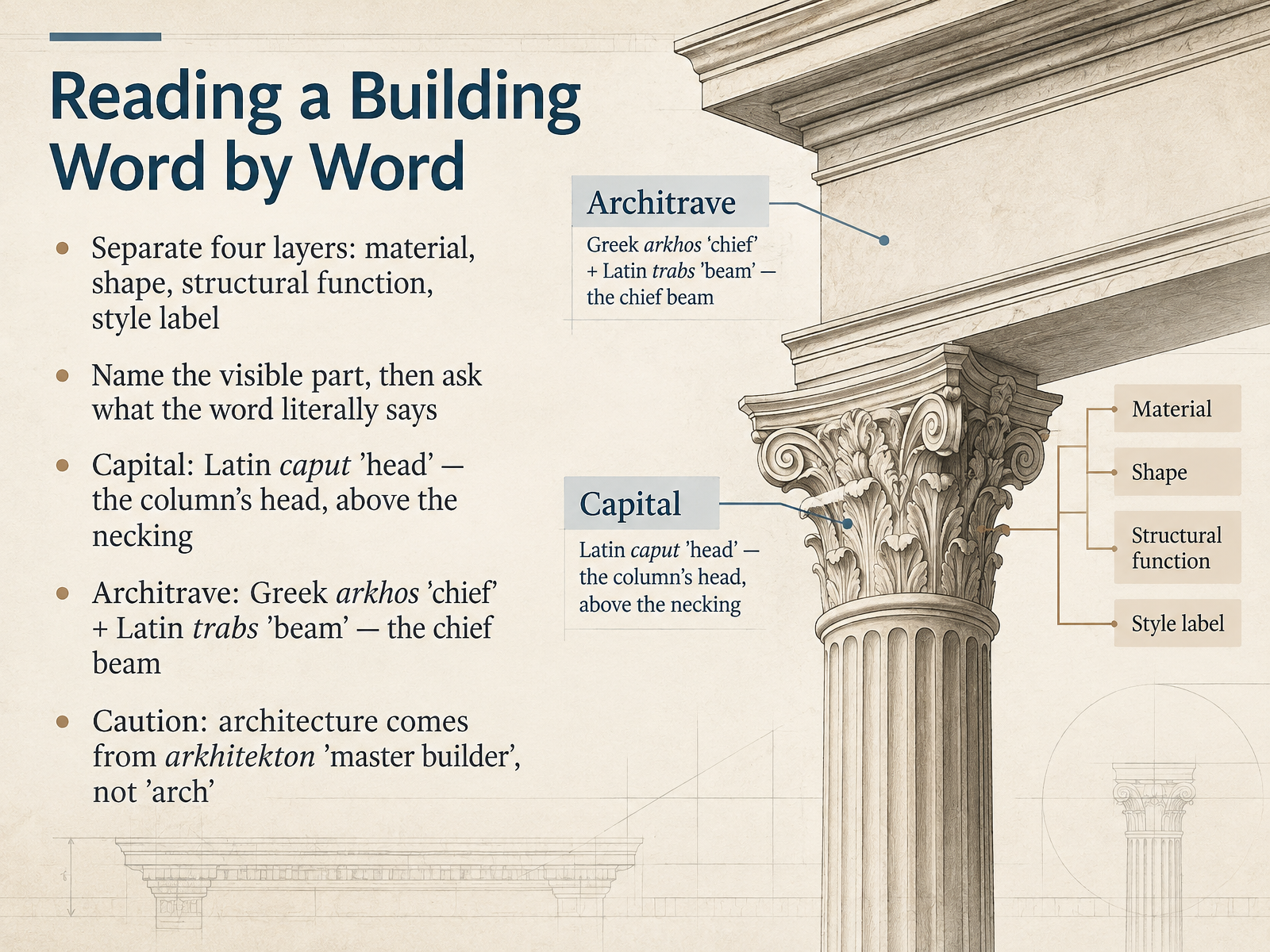
- 03Reading a Building Word by WordLet's begin reading a building word by word. When you look at a column, try separating four layers: the material, the shape, the structural function, and the style label. Then name the visible part, and ask what the word literally says. Take capital. It comes from the Latin caput, meaning head, the column's head, sitting above the necking. Now look at the architrave, the lowest band resting on the capitals. Its first syllable is Greek arkhos, chief, and the second is Latin trabs, beam. So the architrave is the chief beam. One caution before we go on. Architecture does not come from arch. It traces to the Greek arkhitekton, master builder. Here is the takeaway: a name is often a small description of what the part does or where it sits. Next, we look at Greek and Latin Building Blocks.
 elib.bsu.byclassicist.orgen.wikipedia.org+21 min
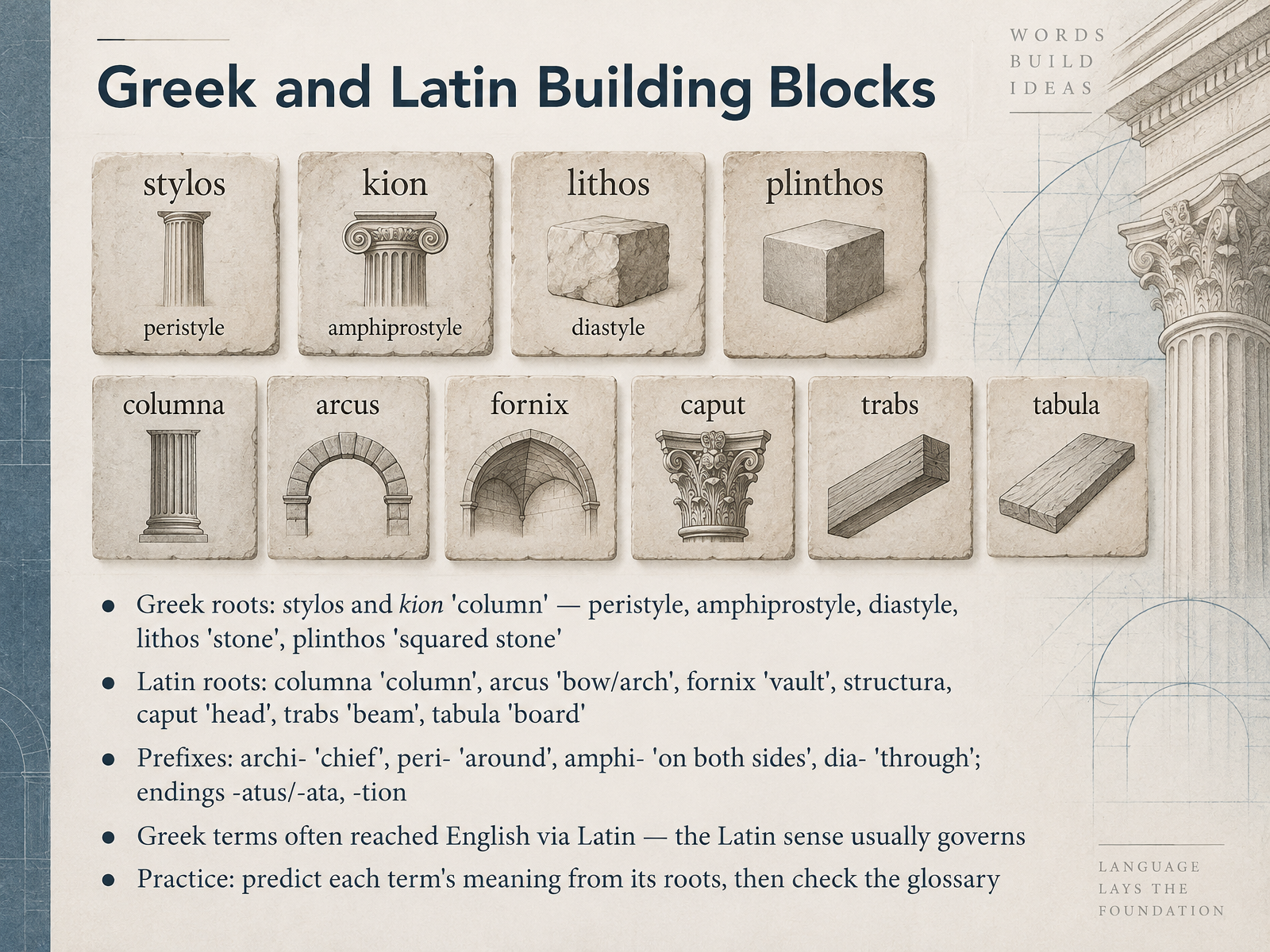
- 04Greek and Latin Building BlocksNow let's break these terms down into their Greek and Latin building blocks. Greek gives us stylos and kion, both meaning column. Add peri, around, and you get peristyle, a row of columns running around a court. Add amphi, on both sides, or dia, through, and you get amphiprostyle and diastyle. Greek also gives us lithos, stone, and plinthos, a squared stone. Latin supplies columna, column, arcus, bow or arch, fornix, vault, and structura, building. Note caput, head, which becomes capital, the head of the column. Trabs, a beam, gives us architrave when paired with archi, chief. And tabula, board, leads to the entablature. Latin endings like atus and tion also shape English terms. One caution. Greek words often reached English through Latin, and the Latin sense usually governs. So as we go, try predicting each term's meaning from its roots, then check the glossary. Next, we look at French and Italian layers in design vocabulary.
 elib.bsu.byleme.library.utoronto.capenelope.uchicago.edu+22 min
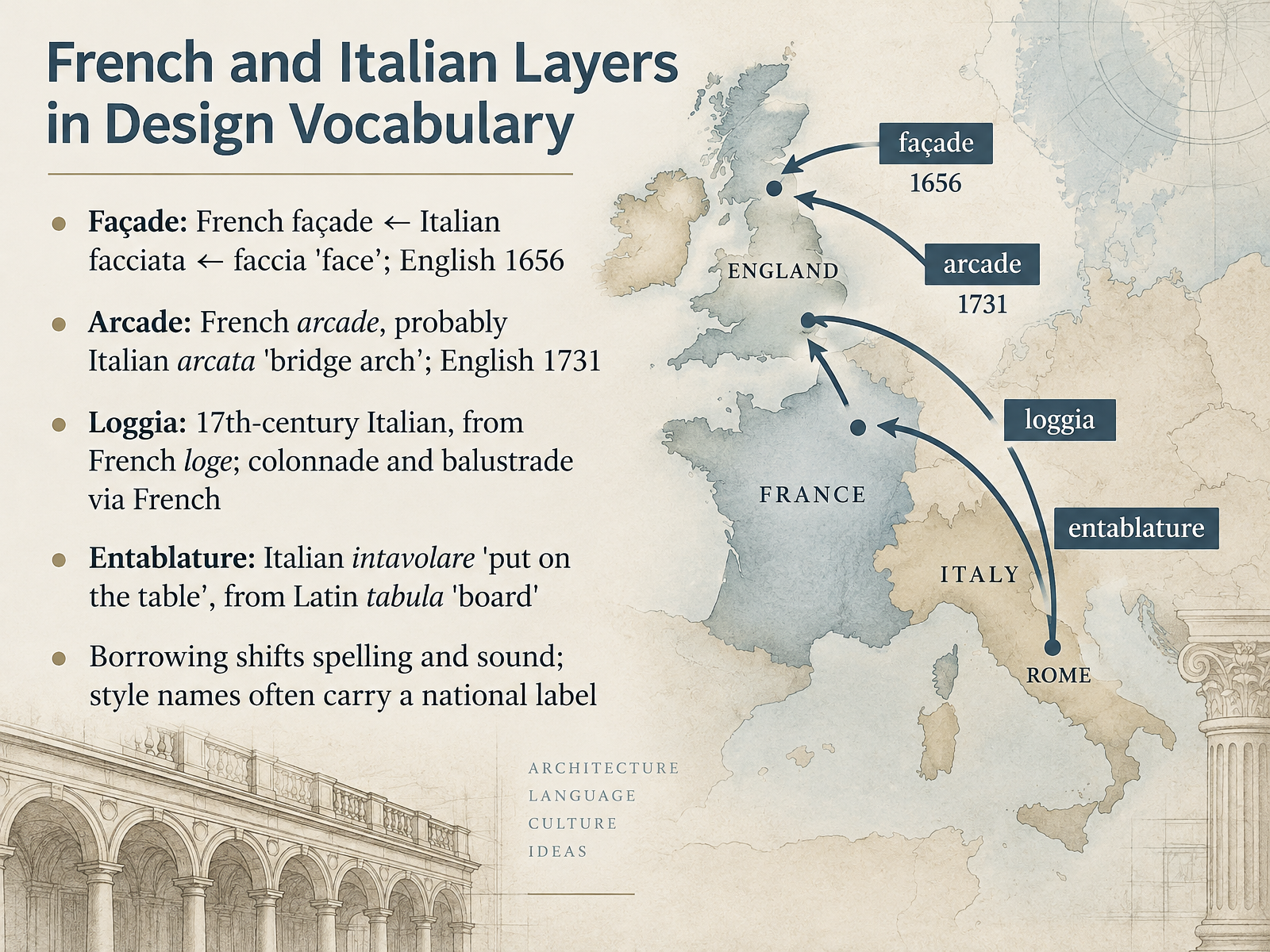
- 05French and Italian Layers in Design VocabularyNow let's look at how French and Italian layers sit inside our design vocabulary. Take façade. English borrowed it from French façade, which came from Italian facciata, from faccia, meaning face. The earliest English record is sixteen fifty-six. Arcade is similar: English took it from French arcade, probably from Italian arcata, a bridge arch, and it appears in English by seventeen thirty-one. Loggia is seventeenth-century Italian, but it traces back to French loge, and terms like colonnade and balustrade also arrived through French. Then there's entablature, from Italian intavolare, to put on the table, rooted in Latin tabula, a board. Notice the pattern: borrowing shifts spelling and sound, and style names often carry a national label. Next, we turn to the Orders and Where Their Names Come From.
 doi.orgdoi.orgetymonline.com+21 min
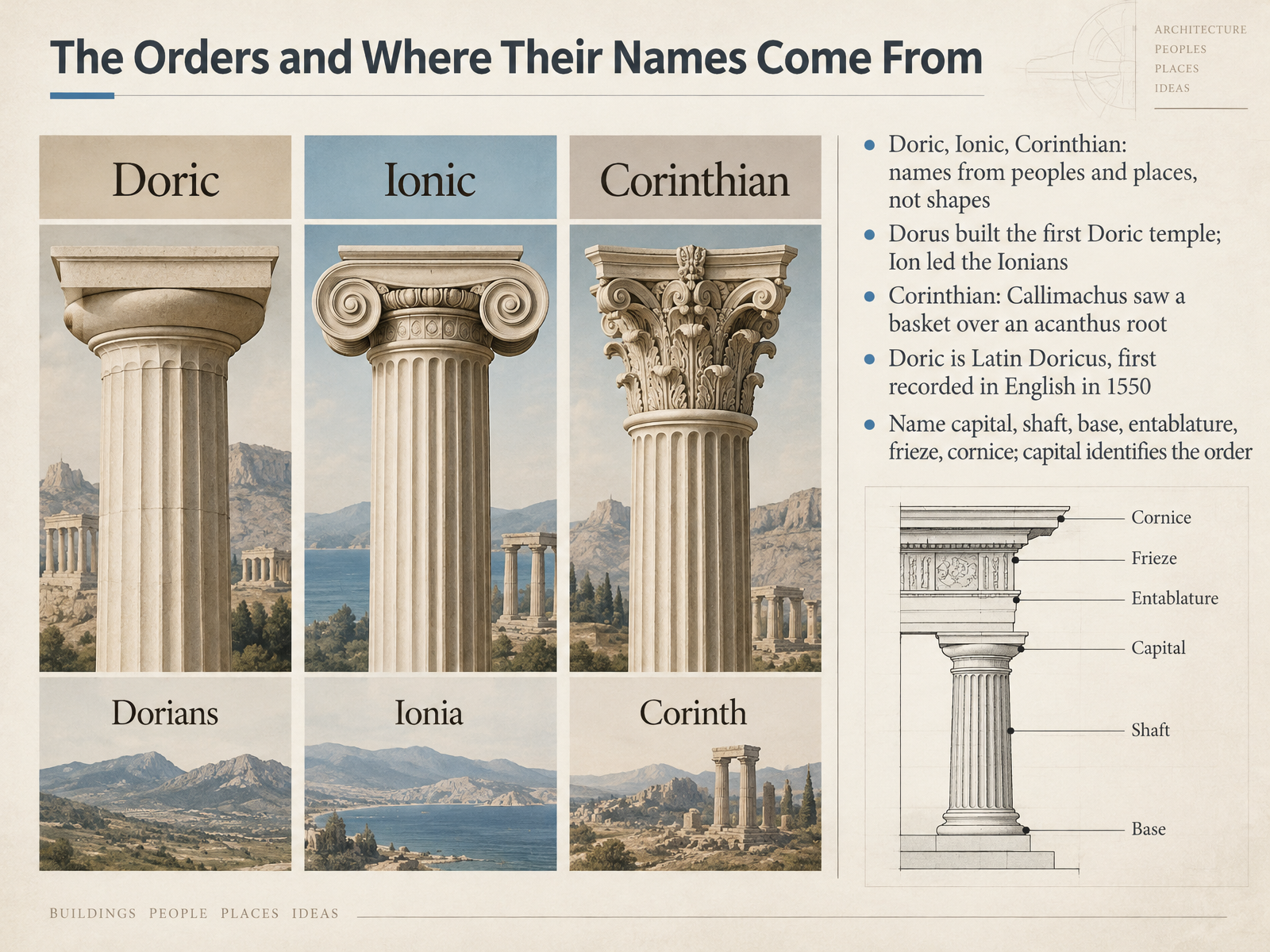
- 06The Orders and Where Their Names Come FromNext, let's look at the names of the orders themselves. Doric, Ionic, and Corinthian come from peoples and places, not from shapes. Vitruvius tells us Dorus, a king in Achaea, built the first temple of this kind. And Ion led the Ionian colonies to Asia Minor, where the second order took its name. The Corinthian capital has its own story. A basket left on a maiden's tomb was covered by an acanthus root, and the sculptor Callimachus saw it and turned that image into stone. The word Doric itself is Latin Doricus, first recorded in English in fifteen fifty. As you look at a building, learn the parts. There is the capital at the top, the shaft below it, and the base at the foot. Above everything runs the entablature, with its frieze and crowning cornice. And here is the practical rule. The capital identifies the order. Now, let's take that capital apart, piece by piece, in the next slide, Dissecting a Capital: Abacus, Echinus, Volute.
 perseus.tufts.eduperseus.tufts.edurepository.upenn.edu+22 min
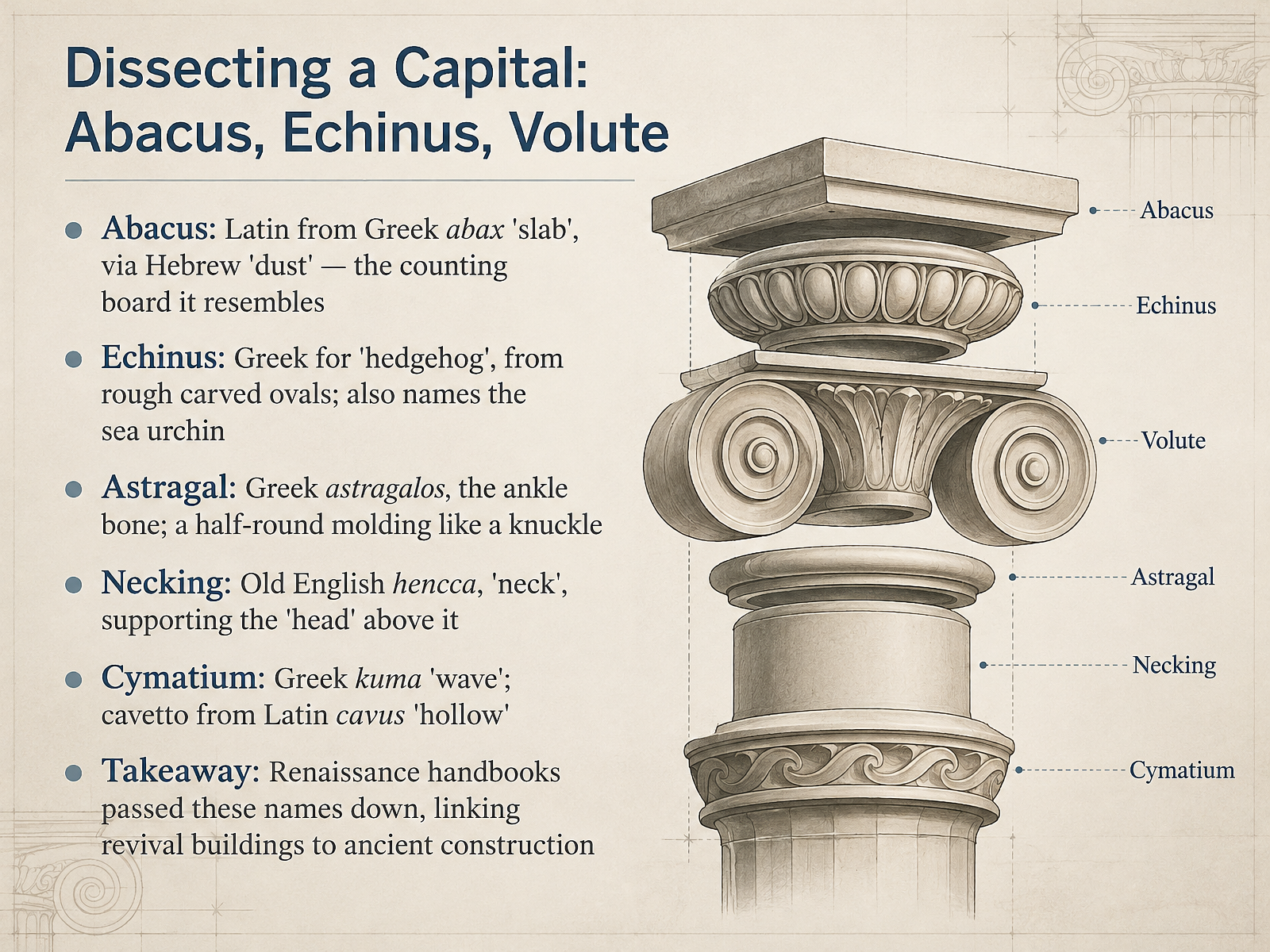
- 07Dissecting a Capital: Abacus, Echinus, VoluteNow let's take the capital apart, piece by piece, and listen to what the names tell us. Start at the top. The abacus is the flat slab resting on the capital. The word comes from the Greek abax, meaning slab, and traces back through Hebrew to a word for dust, because it looked like the sand-covered counting board ancient students wrote in with a finger. Below it sits the echinus, Greek for hedgehog, named for its rough carved ovals, the same word we use for a sea urchin. Down at the base of the capital, the astragal is a half-round molding named after the ankle bone, projecting like a knuckle. The necking below it is simply the neck supporting the head above. And the cymatium, from the Greek word for wave, is the curling molding at the crown; its cousin the cavetto comes from the Latin cavus, hollow. Renaissance handbooks passed these names down, so a revival building still speaks the language of ancient construction. Next, we turn to arch, vault, and dome words.
 elib.bsu.byclassicist.orgen.wikipedia.org+22 min
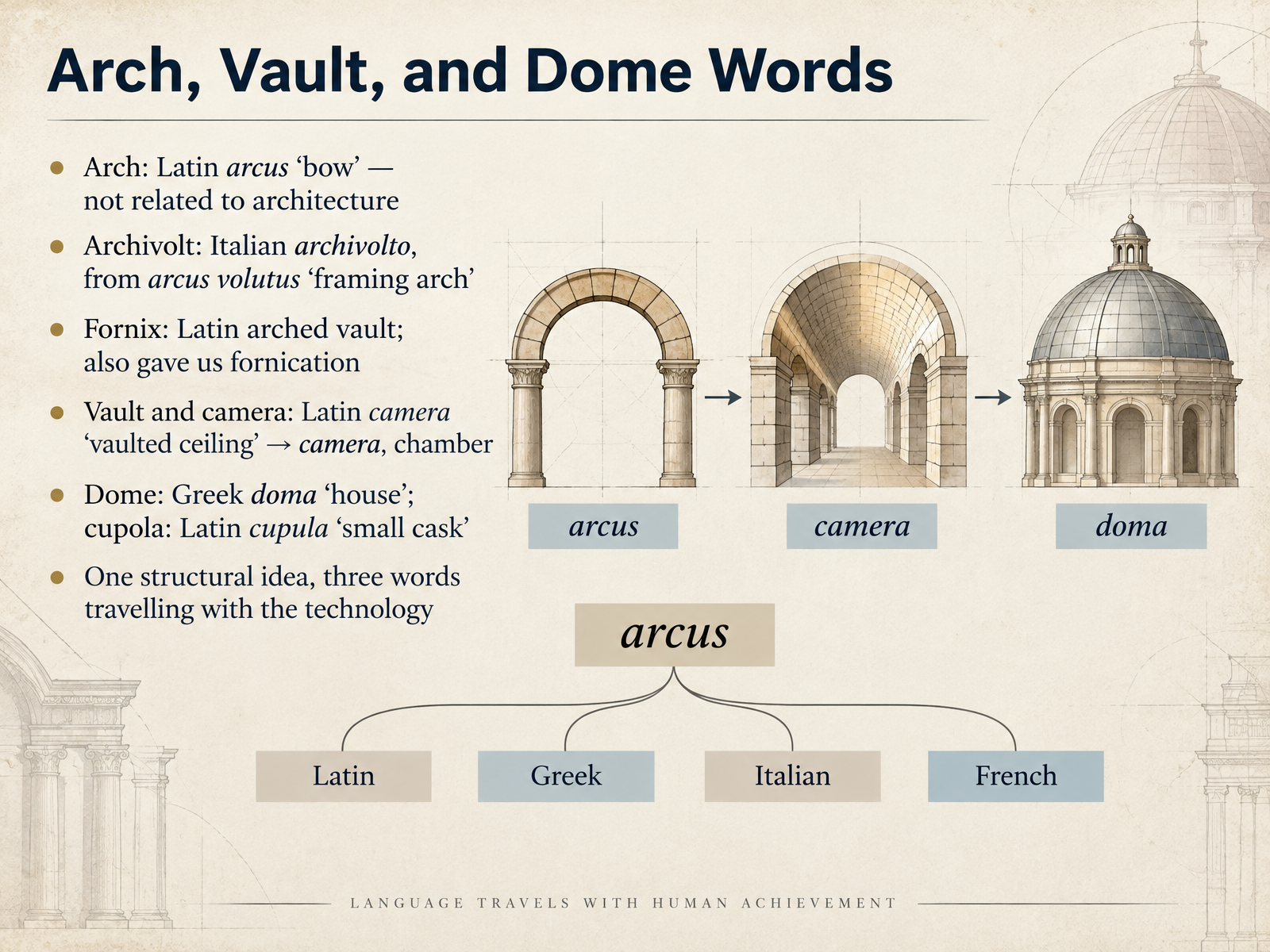
- 08Arch, Vault, and Dome WordsNow let's follow the curved opening itself, and see how one structural idea travels under three different names. Start with the arch. The word comes from Latin arcus, meaning a bow, like the weapon. And here's a useful surprise. Arch is not related to architecture at all, even though it sounds like it should be. Architecture traces back to Greek roots meaning chief builder. Arch means a curve.
Now look at the molding that frames an arch, the archivolt. That comes through Italian from arcus volutus, a framing arch. So you can see the bow and the frame folded into a single word.
The Romans also had fornix, an arched vault. And that word had a second life, because small vaulted rooms at street level were associated with prostitution, which is where fornication comes from. A word's history is not always polite.
Next, vault and camera. Latin camera meant a vaulted ceiling, and it also gave us chamber. Dome comes from Greek doma, a house. And cupola, from Latin cupula, a small cask. One structural idea, three words. Notice how they travel with the technology, borrowing from whatever object the shape resembled. That pattern continues as we turn to style names.
 penelope.uchicago.eduelib.bsu.byarchive.org+22 min
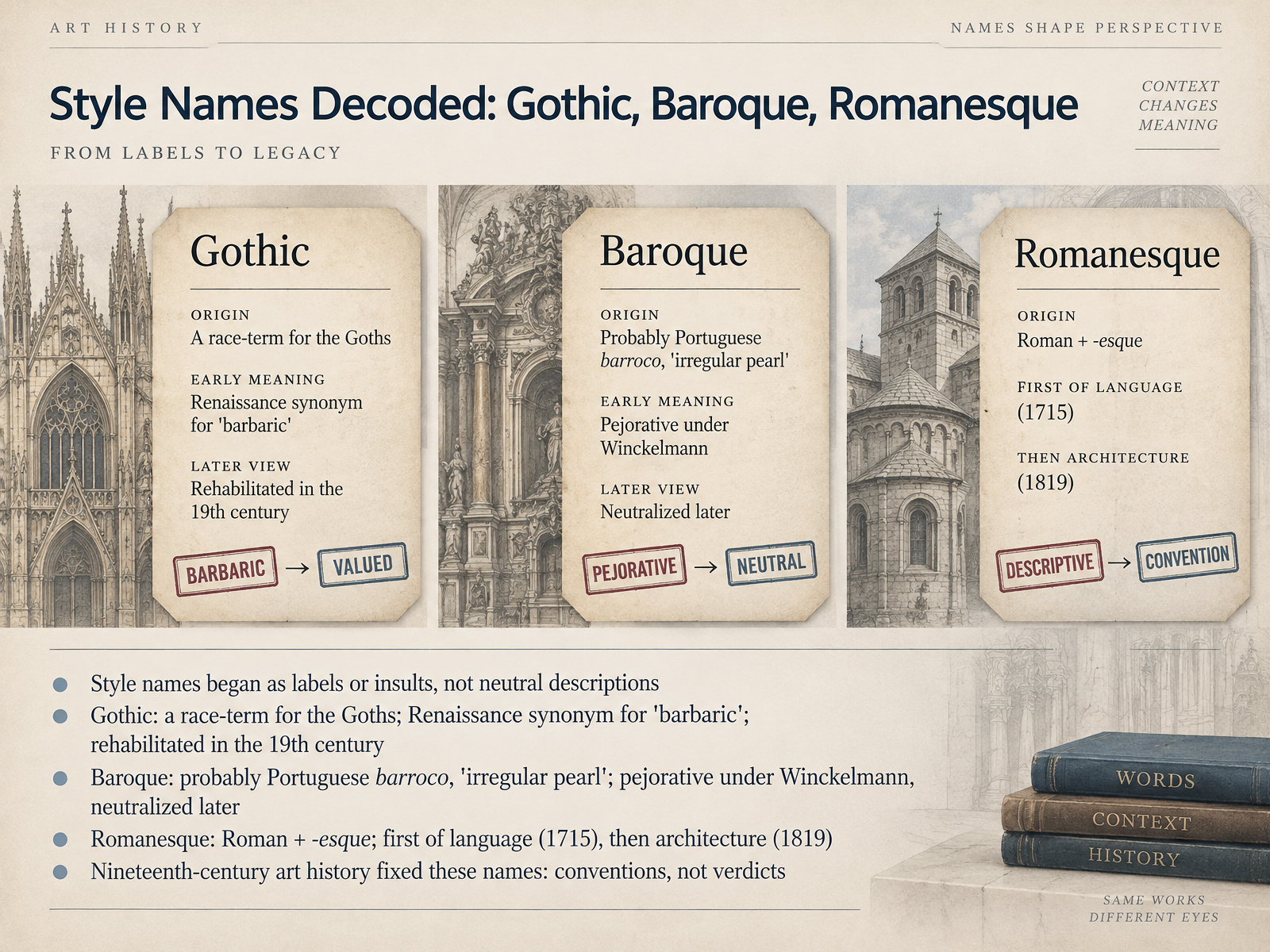
- 09Style Names Decoded: Gothic, Baroque, RomanesqueNow let's decode the style names themselves. Gothic, Baroque, Romanesque. Each began as a label, and often an insult, not a neutral description. Gothic started as a race term for the Goths. Renaissance writers then used it as a synonym for barbaric. It was only rehabilitated in the nineteenth century. Baroque probably comes from the Portuguese barroco, meaning an irregular pearl. Under Winckelmann it was pejorative, and it was neutralized later. Romanesque is Roman plus esque. It first described language in seventeen fifteen, then architecture in eighteen nineteen. Nineteenth-century art history fixed these names. They are conventions, not verdicts. Next, we'll see how a historical dictionary helps. Using a Historical Dictionary.
 elib.bsu.byleme.library.utoronto.capenelope.uchicago.edu+21 min
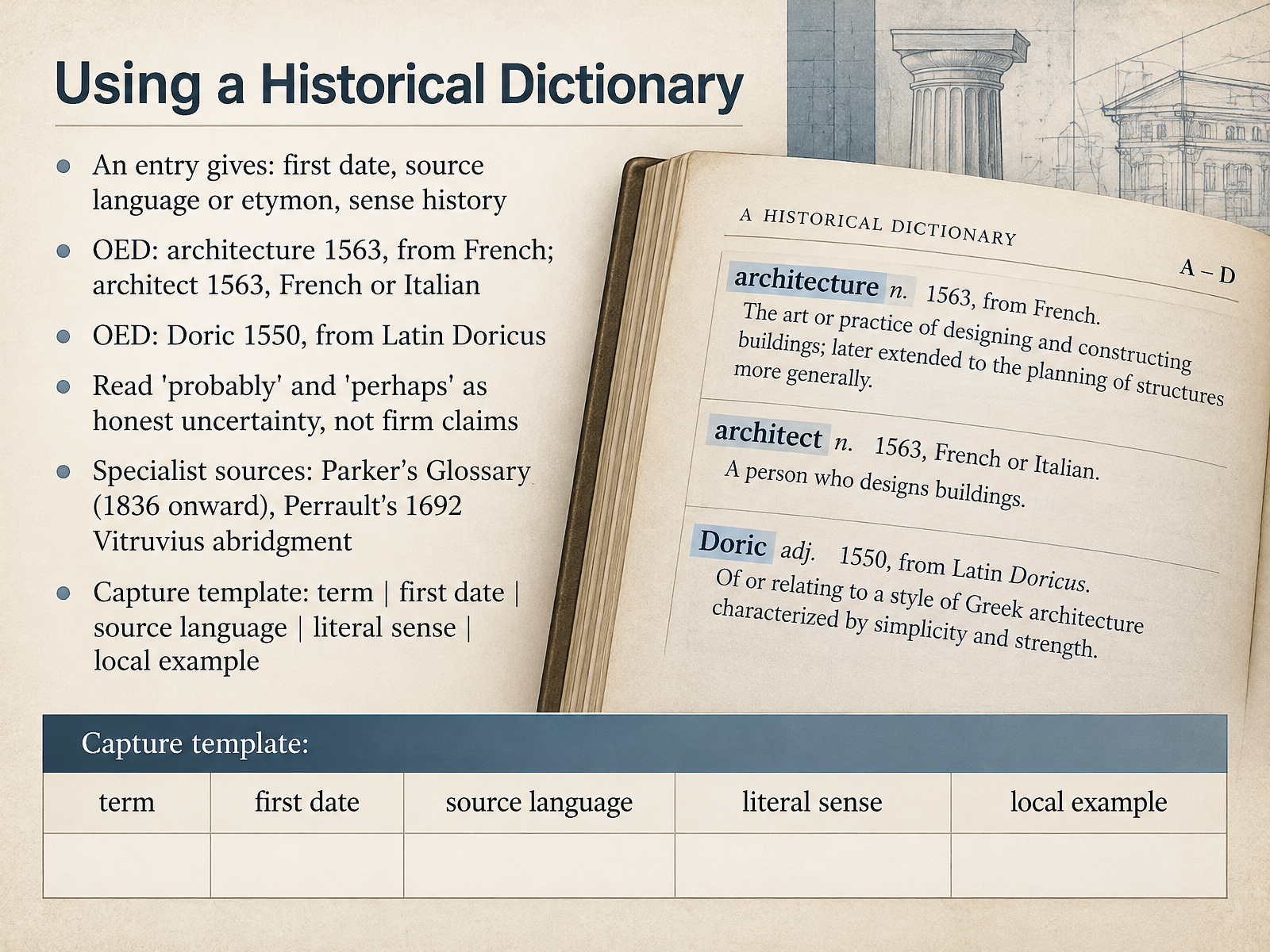
- 10Using a Historical DictionaryNow let's put a historical dictionary to work. A good entry gives you three things: a first date, a source language or etymon, and the history of senses. In the Oxford English Dictionary, architecture is first recorded in fifteen sixty-three, borrowed from French. Architect appears the same year, perhaps from French, perhaps from Italian. Doric is recorded in fifteen fifty, from Latin Doricus. Notice how the OED hedges with words like probably and perhaps. Read those as honest uncertainty, not firm claims. For specialist depth, turn to Parker's Glossary, which began in eighteen thirty-six, or Perrault's sixteen ninety-two abridgment of Vitruvius, which includes a table of architectural terms. And to keep your findings tidy, use a simple capture template: term, first date, source language, literal sense, and one local example. That habit turns scattered reading into a usable record. Next, we look at red flags: folk etymology and false friends.
 leme.library.utoronto.caclassicist.orgelib.bsu.by+21 min
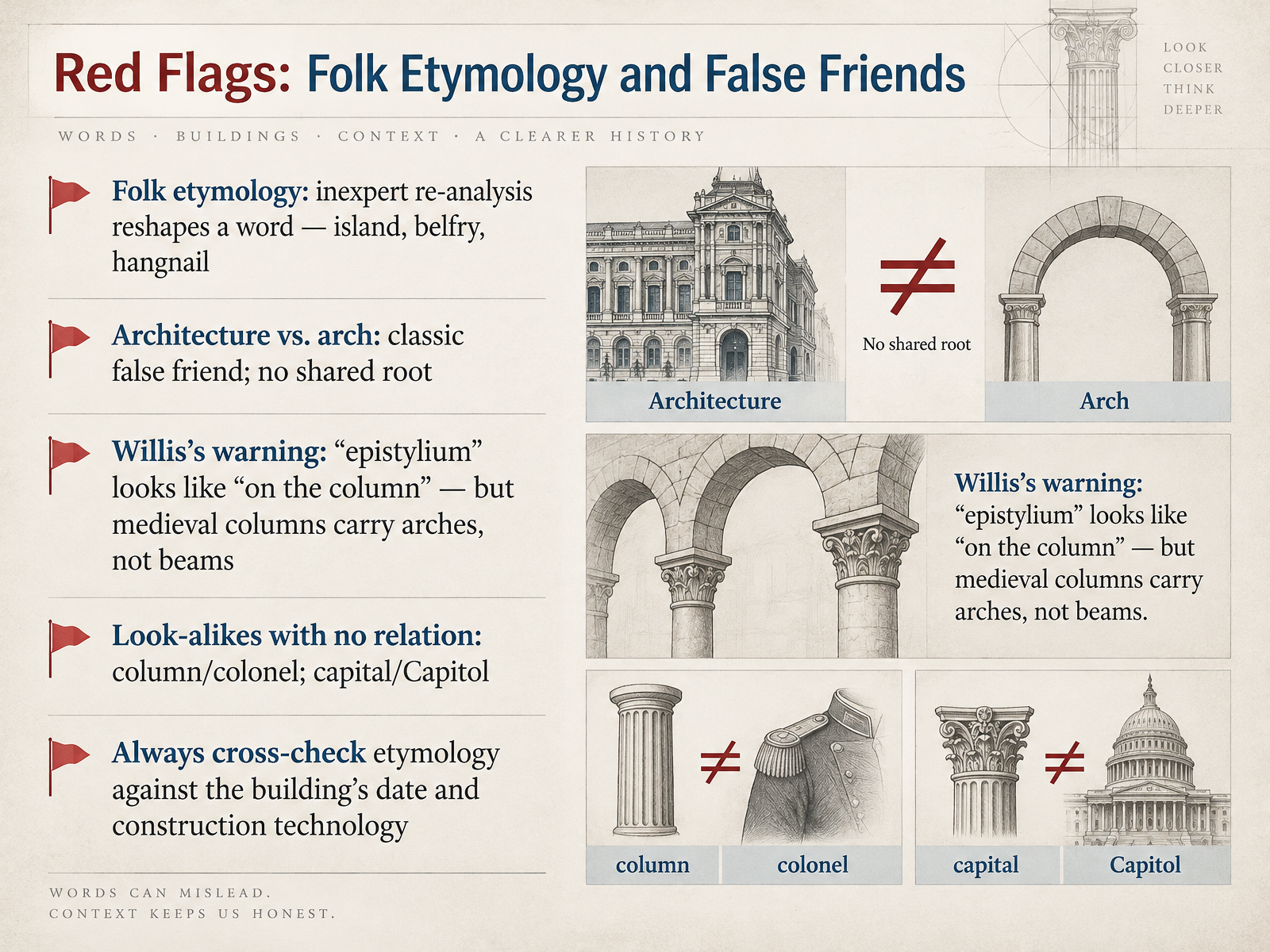
- 11Red Flags: Folk Etymology and False FriendsNow let's talk about the traps. Folk etymology is when an inexpert re-analysis reshapes a word, and you can see it in island, belfry, and hangnail. In architecture, the classic false friend is arch. It has no shared root with architecture; architecture comes from the Greek for chief builder, while arch comes from the Latin arcus, meaning a bow. Robert Willis offered a warning worth remembering. The word epistylium looks like it means on the column, but medieval columns carry arches, not beams, so the match is misleading. And watch look-alikes with no relation, like column and colonel, or capital and Capitol. So always cross-check a word's etymology against the building's date and construction technology. The takeaway is simple: a tempting word origin is a hypothesis, not proof. Next, we'll put this into practice with field methods for etymology on a site visit.
 classicist.orgelib.bsu.byleme.library.utoronto.ca+21 min
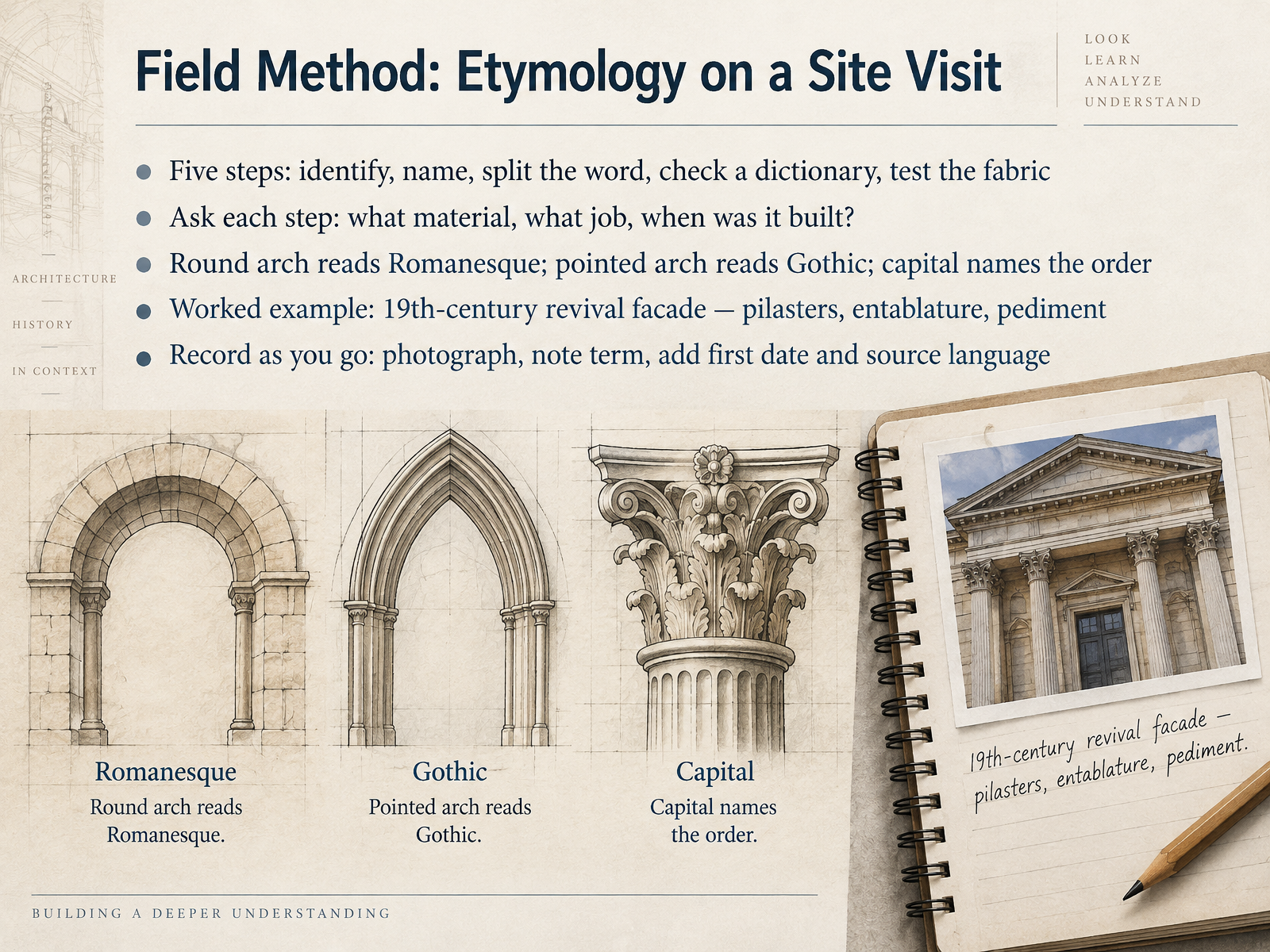
- 12Field Method: Etymology on a Site VisitNow let's take etymology out of the classroom and onto the site. The method has five steps. Identify the feature. Name it. Split the word into its parts. Check a dictionary for the root and the first recorded use. Then test that against the fabric itself. At every step, ask three plain questions. What material is it? What job does it do? And when was it built? The evidence is visible. A round arch reads Romanesque. A pointed arch reads Gothic. And the capital names the order, whether Doric, Ionic, or Corinthian. Try a nineteenth-century revival facade. You see pilasters, an entablature, and a pediment, and each term traces back through Latin or Greek. Record as you go. Photograph the feature, note the term, and add its first date and source language. That habit turns looking into real evidence. Next, in Practice: Build Your Own Term Glossary, you will try this sequence yourself.
 elib.bsu.byleme.library.utoronto.capenelope.uchicago.edu+22 min
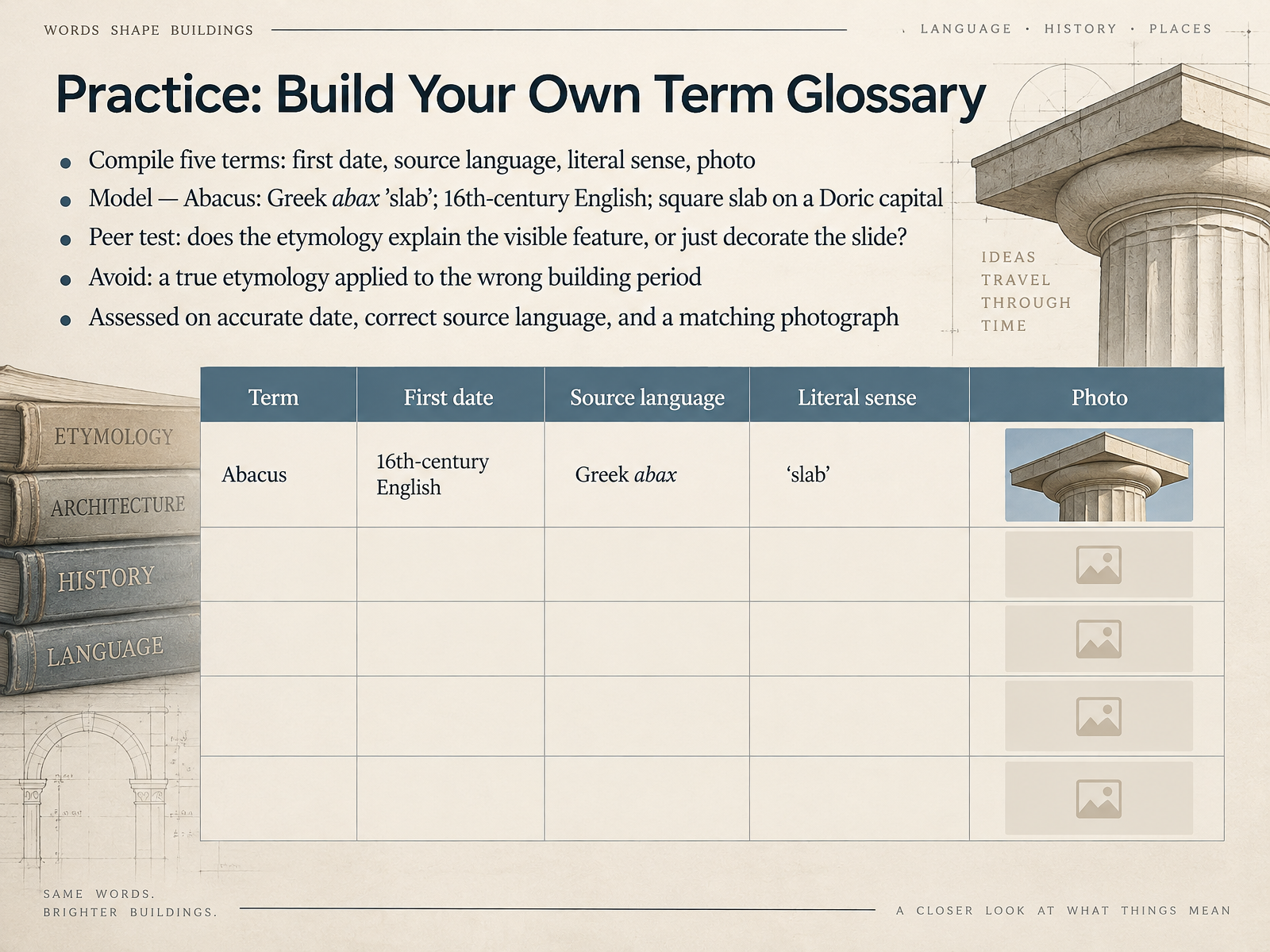
- 13Practice: Build Your Own Term GlossaryNow it is your turn to build something. For this practice, compile a glossary of five terms, and for each one, record four things: the first date you can document, the source language it came from, its literal sense, and a photograph of the feature. Here is a model. Take the abacus, the flat slab that tops a Doric capital. It goes back to the Greek abax, meaning slab, and the English word is recorded from the sixteenth century. Now, peer test it. Ask a partner whether that etymology explains what you actually see, the square slab sitting on the capital, or whether it simply decorates your slide. The most common mistake to avoid is a true etymology applied to the wrong building period. So your work is assessed on three things: an accurate date, the correct source language, and a matching photograph. Keep each entry short and checkable. That is your takeaway. A good glossary entry earns its place by fitting the stone in front of you. In our final segment, we will step back. Wrap-Up: Let the Building Have the Last Word.
 classicist.orgelib.bsu.byen.wikipedia.org+22 min
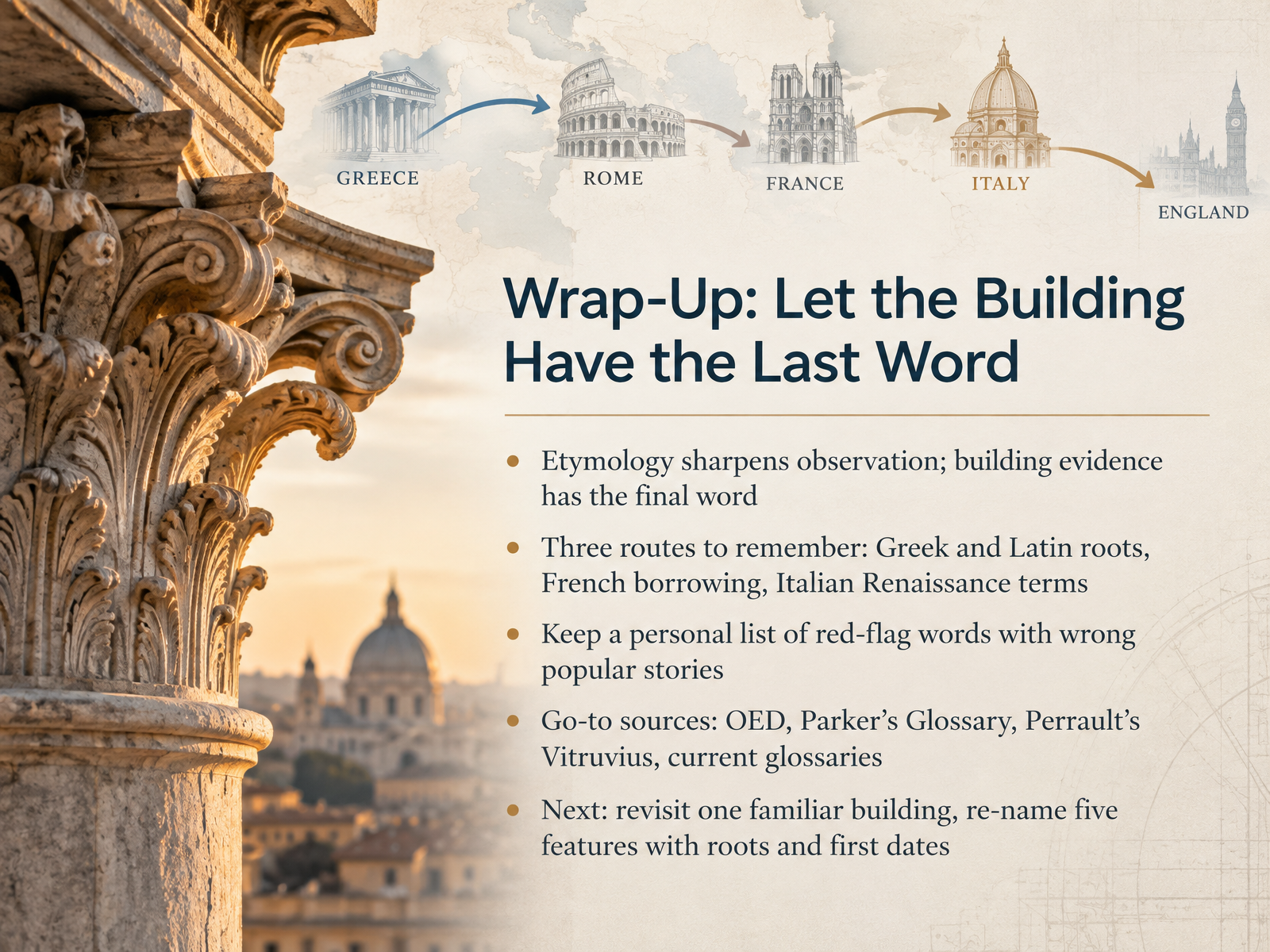
- 14Wrap-Up: Let the Building Have the Last WordSo let's bring this together. Etymology sharpens your eye, but the building always has the final word. If a stone says one thing and a story says another, trust the stone. Keep three routes in mind: Greek and Latin roots, like capital from caput, meaning head; French borrowing, as in façade; and Italian Renaissance terms, like architrave. Keep a personal list of red-flag words, the ones with a popular story that turns out wrong. For example, architecture does not come from arch. It comes through French from Latin architectura, and arch goes back to arcus, meaning bow. When you want to check, go to the Oxford English Dictionary, Parker's Glossary, Perrault's Vitruvius, and current glossaries. And here is your next step: revisit one familiar building, and re-name five features with their roots and first recorded dates. Let the building have the last word. Thank you for coming along, and keep looking closely. You now have the tools to read a façade with real confidence.
 leme.library.utoronto.caclassicist.orgelib.bsu.by+22 min
Take the deck with you
Download this course as a file — free, no sign-up needed.
- PDF handoutEvery slide page, ready to print or share.15 pages · 5.5 MBDownload
- Narrated PowerPointThe deck that presents itself — every slide carries the digital human's narration video.15 pages · 14.6 MBDownload
- PowerPoint slidesThe full deck as a .pptx — open it in PowerPoint, Keynote, or Google Slides.15 pages · 5.5 MBDownload
Free to use in your own training — please keep the PersonWise credit page at the end.
Have your own deck? Turn it into a course
Sources consulted
Web sources consulted while building this course.
- Античные истоки архитектурных терминов: языковые преобразования греко-римских лексем на пути к современности — elib.bsu.by
- Architectural Etymology - Institute of Classical Architecture & Art — classicist.org
- Capital (architecture) — en.wikipedia.org
- Full text of "Chambers Etymological Dictionary" — archive.org
- https://leme.library.utoronto.ca/plainText/lexicon0827.txt — leme.library.utoronto.ca
- LacusCurtius • The Column in Greek and Roman Architecture (Smith's Dictionary, 1875) — penelope.uchicago.edu
- Full text of "A Glossary of Terms Used in Grecian, Roman, Italian, and Gothic Architecture" — archive.org
- Histoire des termes d'architecture empruntes par le francais a l'italien au XVIe siecle : leur introduction et leur evolution — doi.org
- Contributo dell'italiano alla formazione del lessico architettonico rinascimentale inglese — doi.org
- Arcade - Etymology, Origin & Meaning — etymonline.com
- The Language of Architecture: in English and in Polish — skase.sk
- Façade — en.wikipedia.org
- Vitruvius Pollio, The Ten Books on Architecture, BOOK IV, CHAPTER I: THE ORIGINS OF THE THREE ORDERS, AND THE PROPORTIONS OF THE CORINTHIAN CAPITAL, section 3 — perseus.tufts.edu
- Vitruvius Pollio, The Ten Books on Architecture, BOOK IV — perseus.tufts.edu
- BEGINNING AGAIN WITH THE CLASSICAL ORDERS: — repository.upenn.edu
- Vitruvius, Book IV: Chapter I. The Origins of the Three Orders, and the Proportions of the Corinthian Capital | The Textbook of Architecture — textbookofarchitecture.com
- Classical order — en.wikipedia.org
- LacusCurtius • Fornix — (Smith's Dictionary, 1875) — penelope.uchicago.edu
- Dome - Etymology, Origin & Meaning — etymonline.com
- LacusCurtius • The Arch (Smith's Dictionary, 1875) — penelope.uchicago.edu