Begin
14 pages · ~28 min
Apparent vs Absolute Magnitude
This training teaches learners to distinguish apparent from absolute magnitude and understand how astronomers compare star brightness.
A digital instructor presents all 14 pages. Hold “Ask” at any point and ask out loud — the answer comes from this course. No sign-up needed.
What you’ll learn
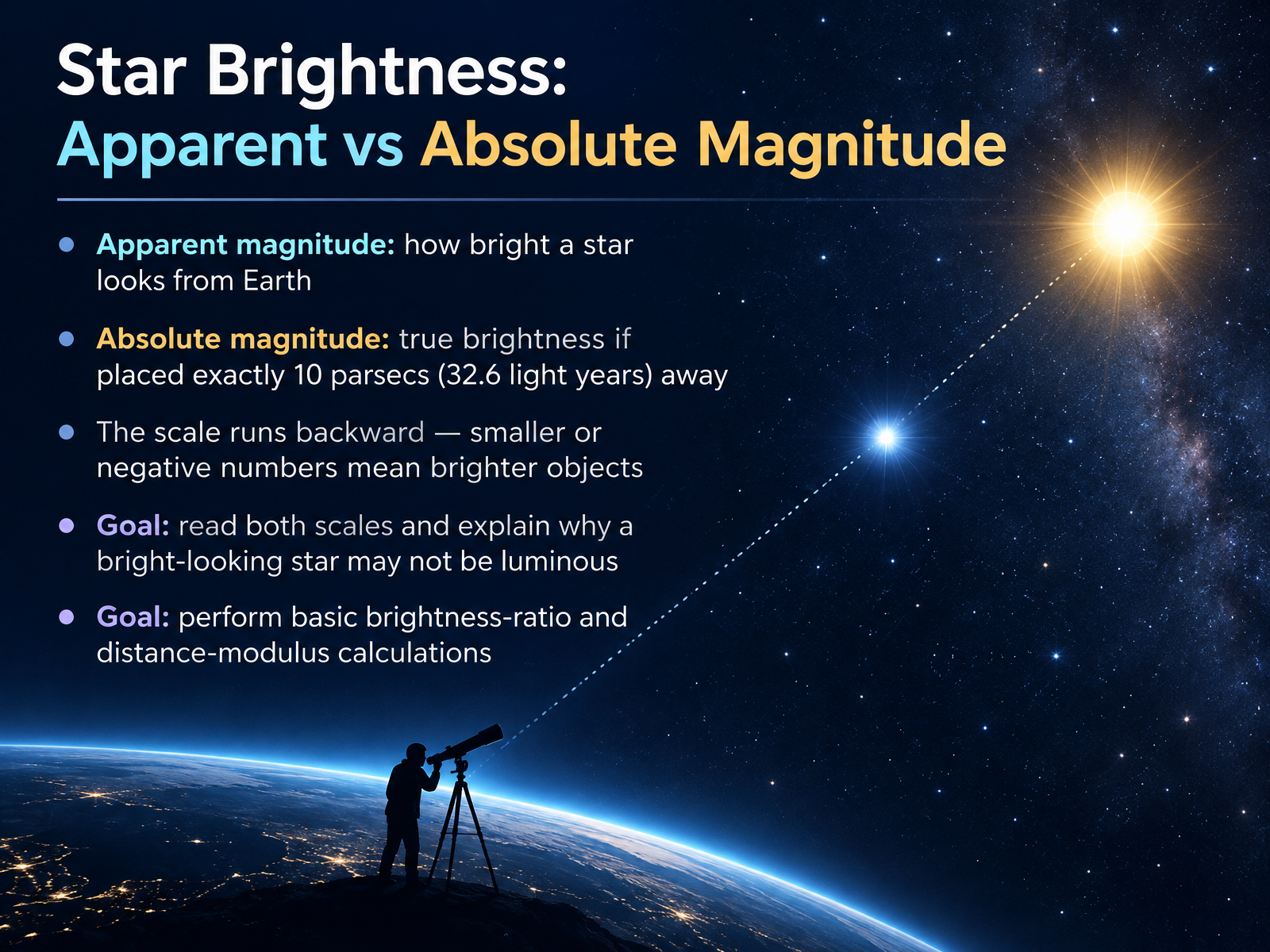
- 01Star Brightness: Apparent vs Absolute MagnitudeWelcome. If you have ever looked up at a clear night sky and wondered why some stars seem so much brighter than others, you are in exactly the right place. Today we are going to explore star brightness, and specifically the difference between apparent magnitude and absolute magnitude. Apparent magnitude is simply how bright a star looks from Earth. Absolute magnitude is the brightness that star would have if we placed it exactly ten parsecs away, which is about thirty two point six light years. Here is the part that surprises almost everyone. The scale runs backward. Smaller numbers, and even negative numbers, mean brighter objects. So a star with magnitude one is brighter than a star with magnitude three. By the end of this lesson, you will be able to read both scales and explain why a star that looks bright in our sky may not actually be very luminous. You will also learn to do some basic brightness ratio and distance modulus calculations. Do not worry if that sounds like a lot right now. We will take it one step at a time. Let us start by asking a simple question. Why did astronomers ever need two different magnitudes in the first place?science.nasa.goven.wikipedia.orgaanda.org+22 min
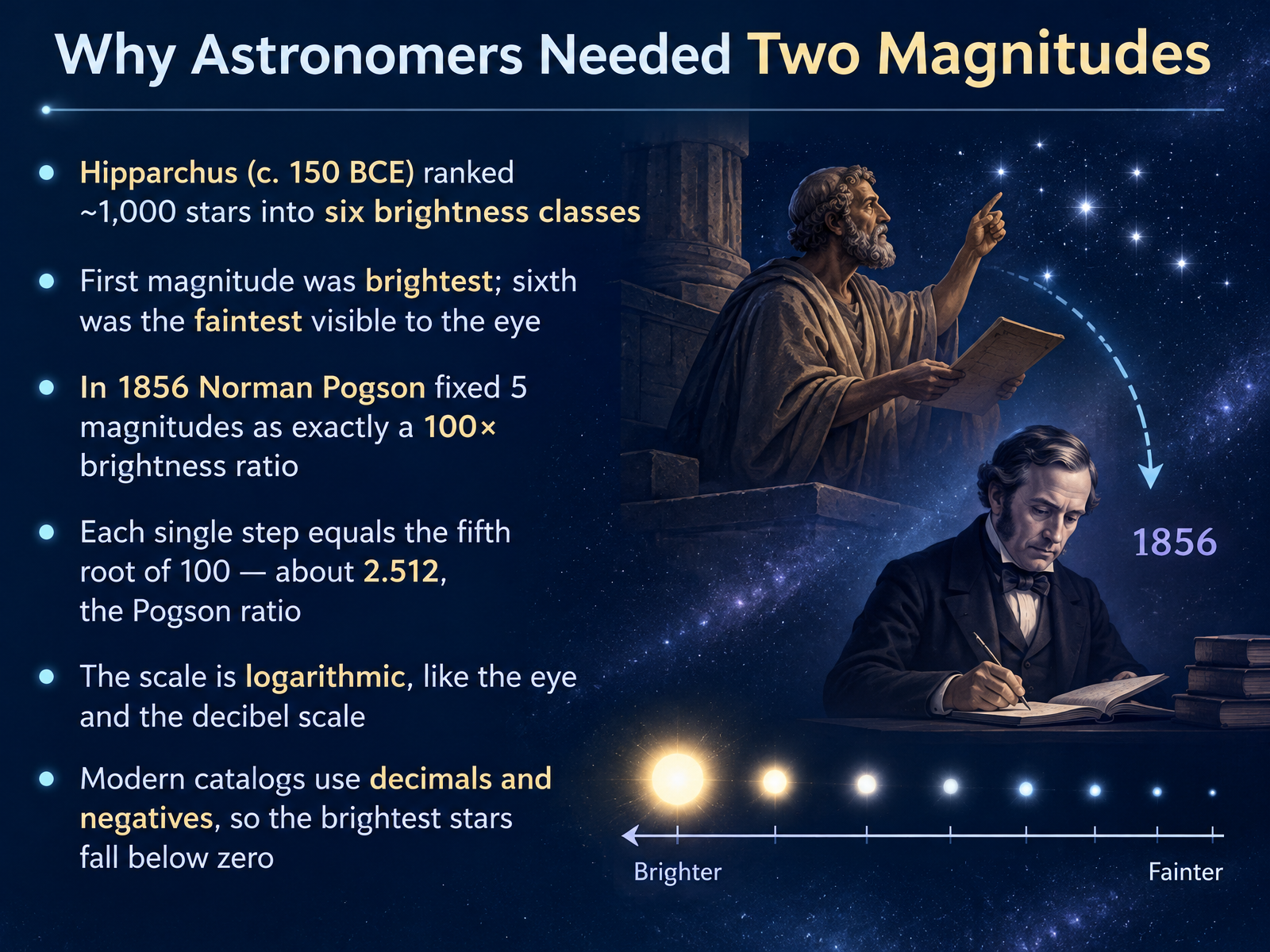
- 02Why Astronomers Needed Two MagnitudesSo why do astronomers need two magnitudes, anyway? Let's start with a quick history. Around one hundred fifty B C E, Hipparchus ranked about a thousand stars into six brightness classes. The first magnitude was the brightest, and the sixth was the faintest your eye could see. That was just by eyeballing it. Then in 1856, Norman Pogson made it precise. He defined a difference of five magnitudes as exactly a hundred times in brightness. So each single step equals the fifth root of a hundred, about two point five one two. Astronomers call that the Pogson ratio. The scale is logarithmic, like your eye and the decibel scale. Modern catalogs use decimals and even negative numbers, so the very brightest stars fall below zero. Next, let's look at reading the magnitude scale, brightness ratios.
 openstax.orgskyandtelescope.orgastro.wku.edu+22 min
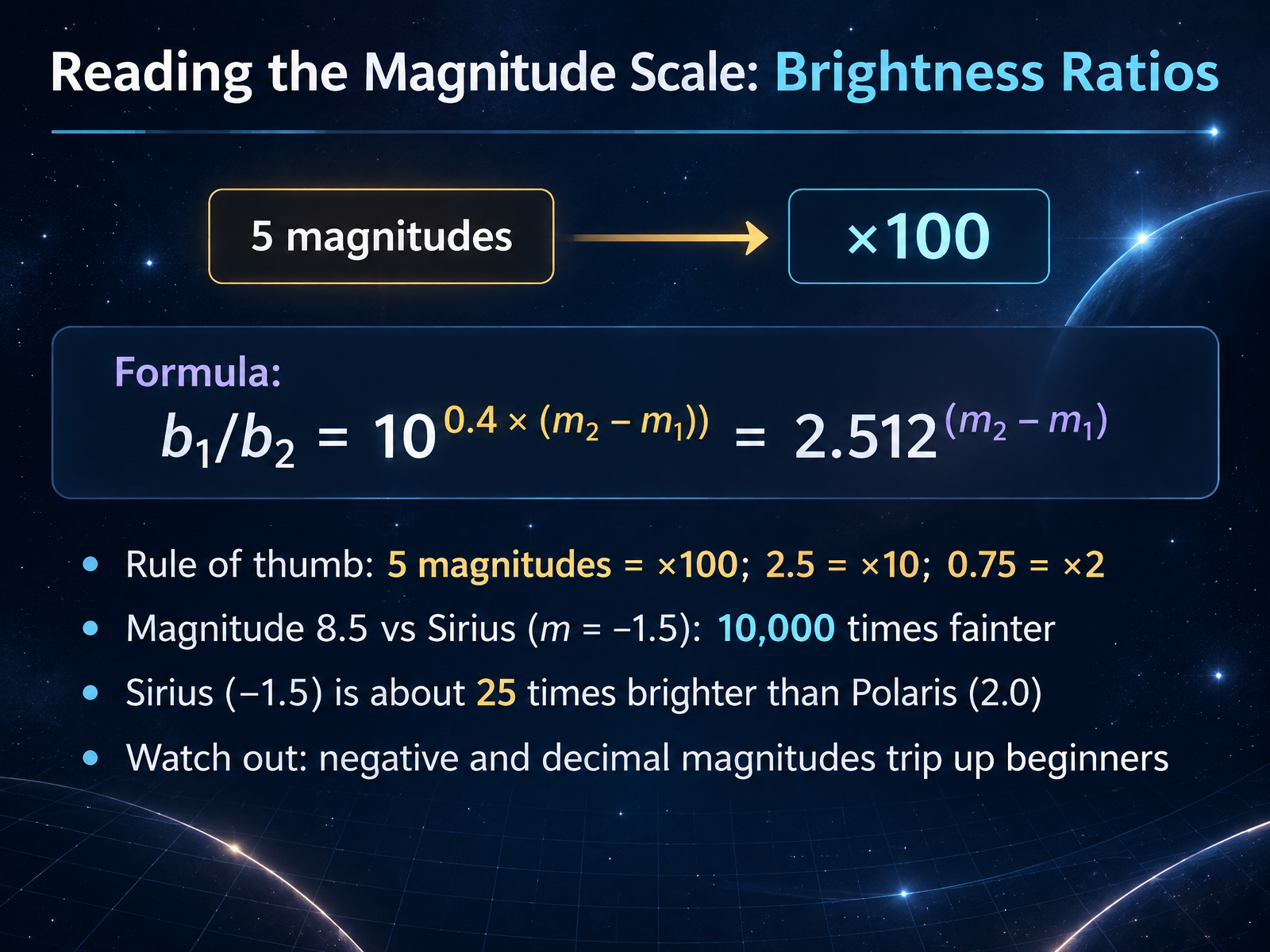
- 03Reading the Magnitude Scale: Brightness RatiosLet's move from the idea of magnitude to the actual numbers, and how to read them. Here's a rule of thumb worth memorizing. Five magnitudes equals a hundred times in brightness. Two and a half magnitudes means about ten times. And three quarters of a magnitude, about two times. In formula form, the brightness ratio b one divided by b two equals ten to the power of zero point four times the magnitude difference. That's the same as two point five one two raised to that difference. Let's try it. A magnitude eight point five star next to Sirius, at minus one point five, differs by ten magnitudes. That works out to ten thousand times fainter than Sirius. And Sirius itself is about twenty five times brighter than Polaris at magnitude two. Now, don't worry if negative and decimal magnitudes feel confusing at first. They trip up almost everyone. The key is just remembering that smaller numbers mean brighter stars. Next, we'll look at some handy reference points, from the Sun down to the faintest stars you can see with your naked eye.
 openstax.orgskyandtelescope.orgastro.wku.edu+21 min
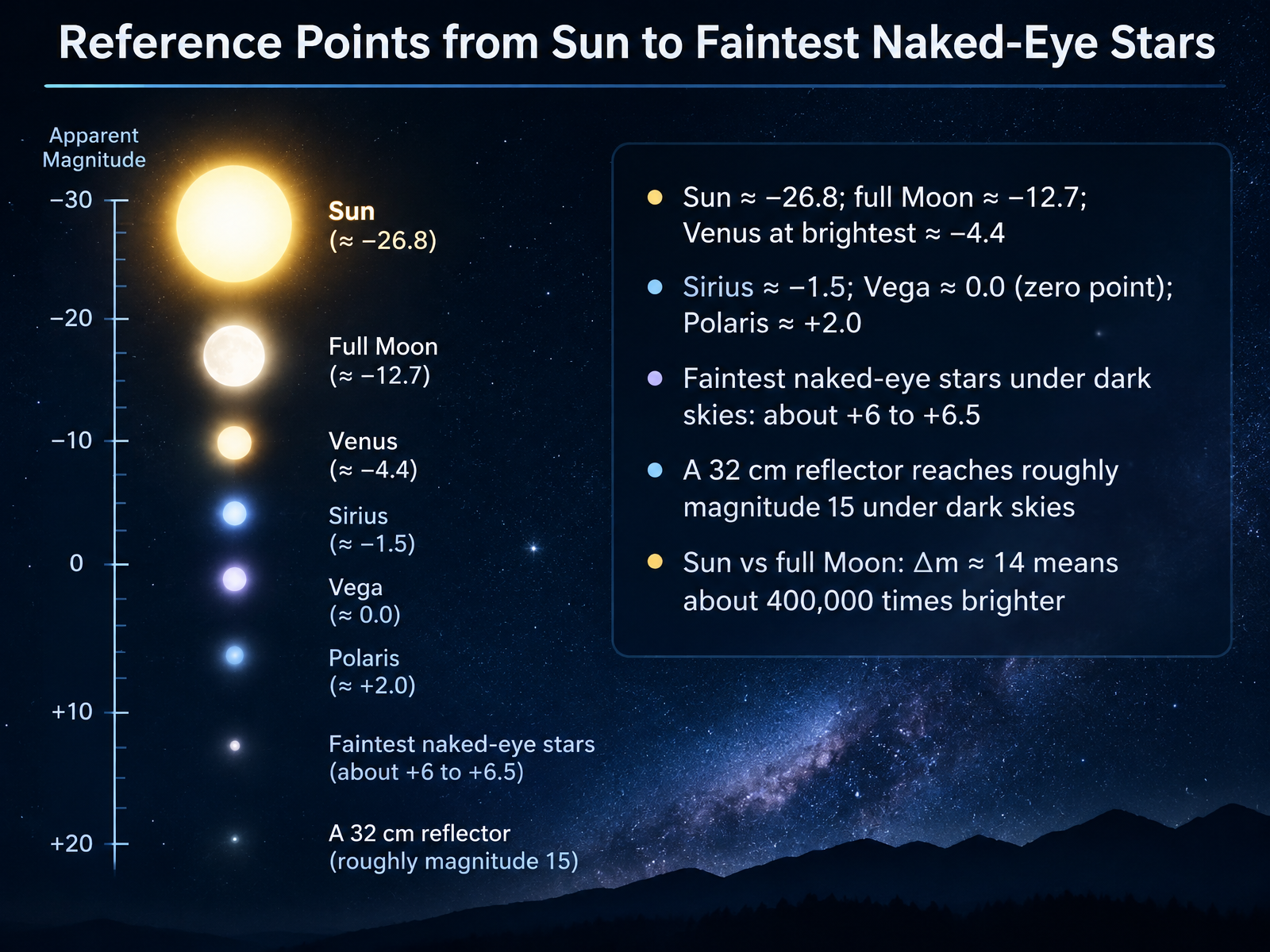
- 04Reference Points from Sun to Faintest Naked-Eye StarsLet's anchor the scale with a few reference points you can actually see. The Sun sits at minus twenty six point eight, the full Moon at minus twelve point seven, and Venus at its brightest reaches about minus four point four. Sirius, the brightest star in the night sky, comes in at minus one point five. Vega defines the zero point at zero point zero, and Polaris, the North Star, is a modest plus two point zero. Under truly dark skies, the faintest stars your eyes can pick out are around plus six to plus six point five. And a thirty two centimeter reflector can push down to roughly magnitude fifteen on a good night. Notice how far apart the Sun and the full Moon are. That gap of about fourteen magnitudes means the Sun shines roughly four hundred thousand times brighter. Now let's look at why distance changes apparent brightness.
 openstax.orgskyandtelescope.orgastro.wku.edu+22 min
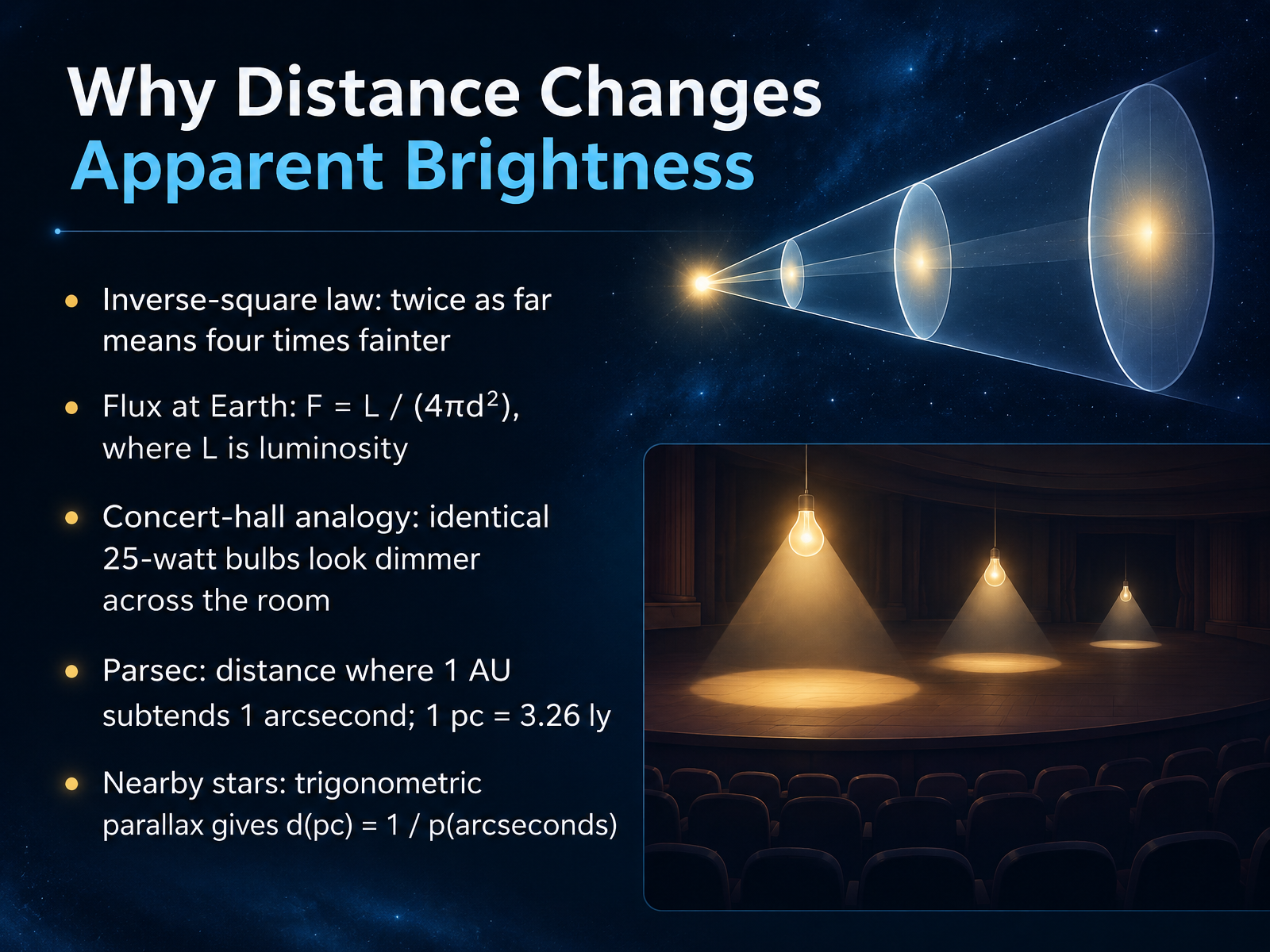
- 05Why Distance Changes Apparent BrightnessNow let's see why distance changes apparent brightness. The rule is the inverse-square law: if a star is twice as far away, it looks four times fainter. Three times as far, nine times fainter. We can write flux at Earth as F equals L divided by four pi d squared, where L is luminosity, the star's total energy output, and d is the distance. Think of a dark concert hall lit by identical twenty-five watt bulbs. The bulbs near you look bright; the ones across the room look dim, even though they give off the same light. Next, the parsec. It's the distance at which one astronomical unit spans one arcsecond on the sky, and one parsec equals three point two six light years. For nearby stars, we measure a tiny yearly shift called trigonometric parallax, and the distance in parsecs is simply one divided by the parallax angle in arcseconds. So distance is the key that unlocks apparent brightness. Next, we'll compare stars on equal footing with absolute magnitude.
 nasa.govopenstax.orgaoc.nrao.edu+22 min
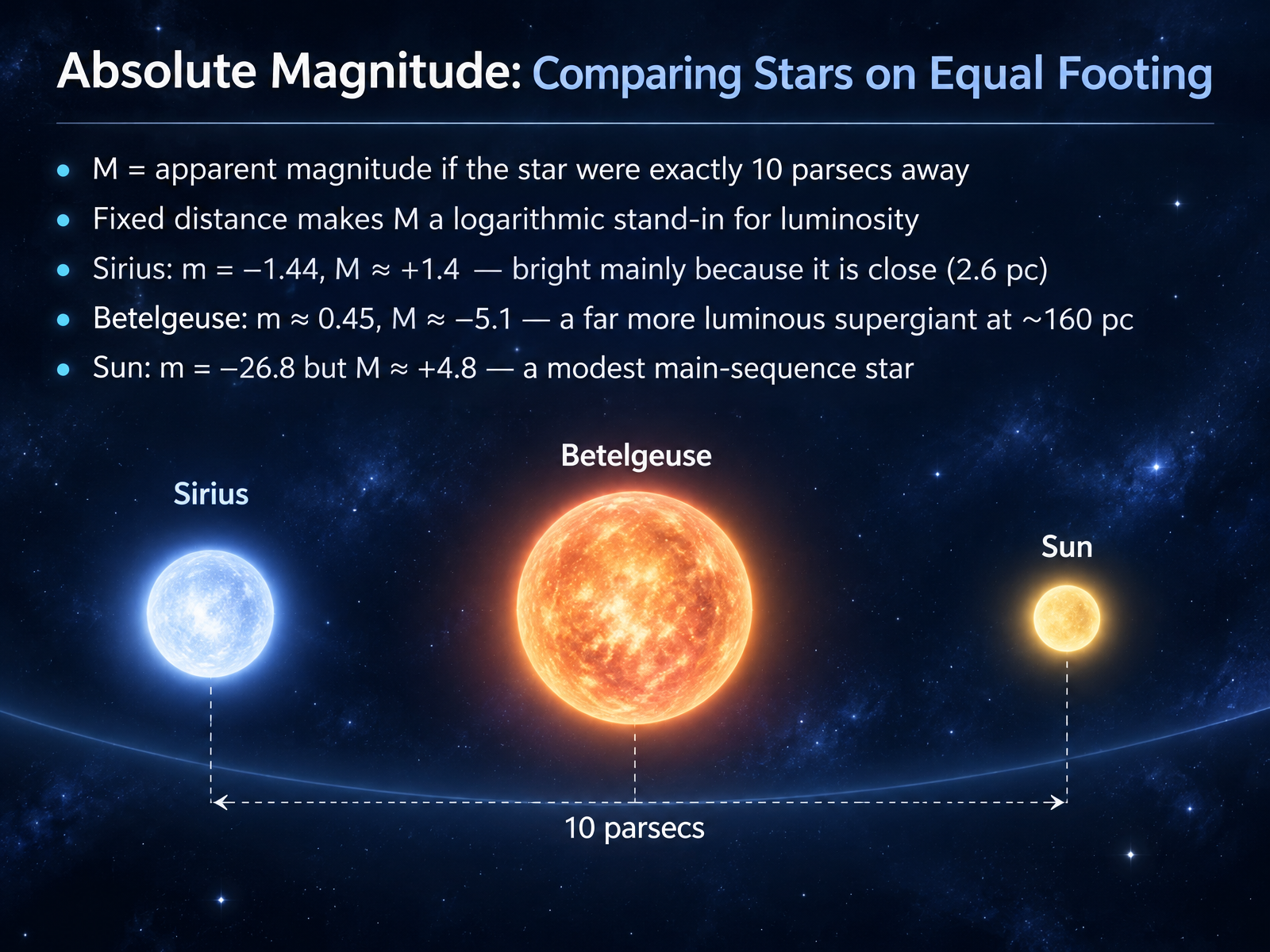
- 06Absolute Magnitude: Comparing Stars on Equal FootingNow let's put stars on equal footing with absolute magnitude. Absolute magnitude, written as capital M, is the apparent magnitude a star would have if it sat exactly ten parsecs away, about thirty two point six light years. By fixing the distance, M becomes a stand in for true luminosity, just on a logarithmic scale. Remember, lower numbers mean brighter stars. Here is a helpful comparison. Sirius looks brilliant, with an apparent magnitude of minus one point four four, but its absolute magnitude is only about plus one point four. It stands out mainly because it is close, just two point six parsecs away. Betelgeuse, by contrast, appears fainter at magnitude zero point four five, yet its absolute magnitude is about minus five point one. It is a far more luminous supergiant, roughly one hundred sixty parsecs off. And our Sun? Its apparent magnitude is minus twenty six point eight, amazingly bright, but its absolute magnitude is about plus four point eight, a fairly modest main sequence star. So absolute magnitude lets you compare what stars are truly made of. Next, we will see how distance links the two, with the distance modulus formula.
 science.nasa.goven.wikipedia.orgaanda.org+21 min
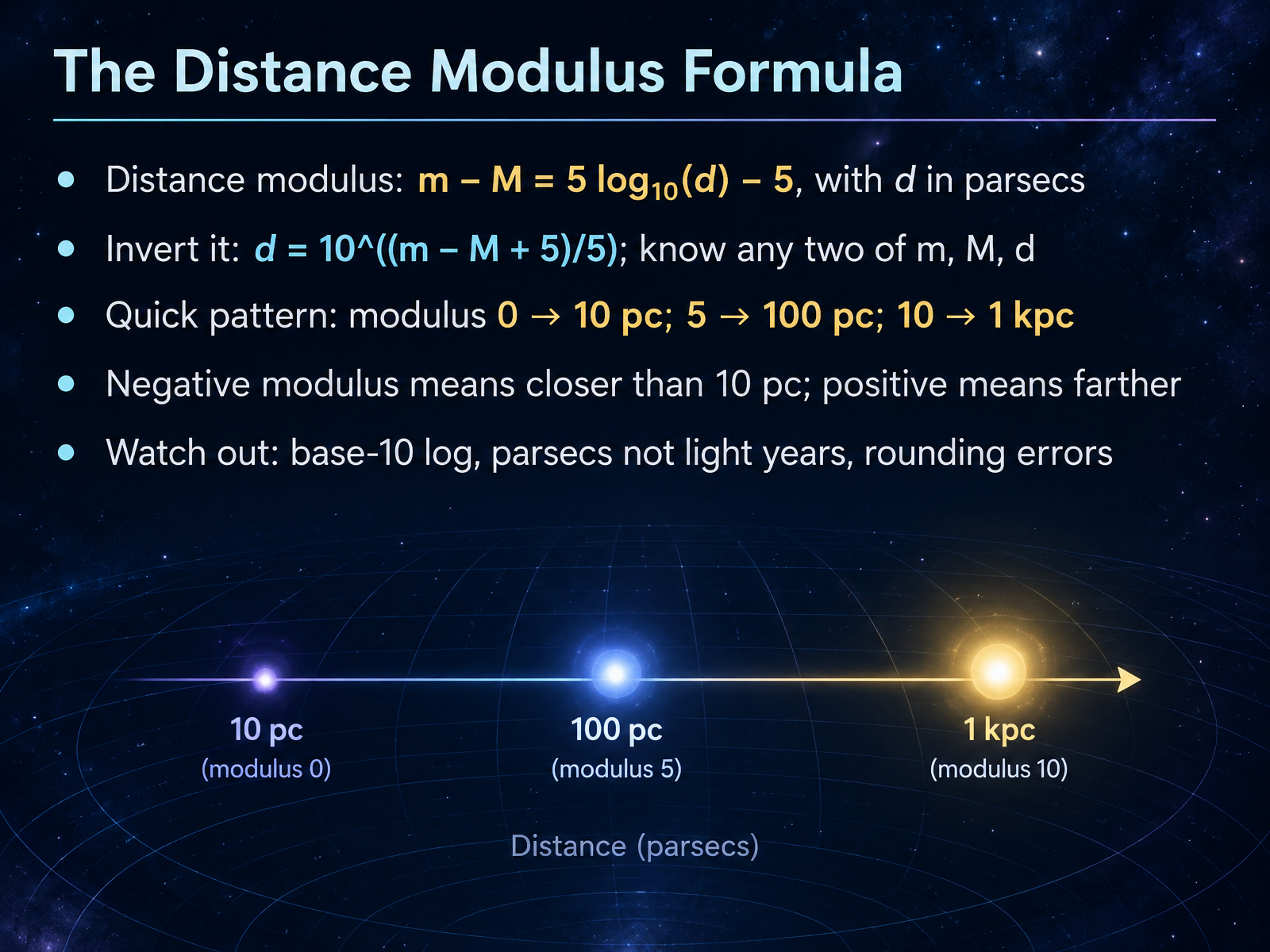
- 07The Distance Modulus FormulaNow let's put that relationship into a formula. The distance modulus is m minus M, and it equals five times log base ten of d, minus five, where d is the distance in parsecs. If you know any two of the three quantities, you can solve for the third. To find distance directly, invert it. d equals ten to the power of, m minus M plus five, all divided by five. Here's a quick pattern worth remembering. A distance modulus of zero means ten parsecs. Five means one hundred parsecs. And ten means one thousand parsecs, or one kiloparsec. The sign tells you a lot. A negative modulus means the star is closer than ten parsecs. A positive modulus means it's farther away. And watch for three common slips. Use base ten logs, keep distance in parsecs rather than light years, and don't round too early. Next, we'll apply this to some real stars.
 star.ucl.ac.ukastro.wku.eduastronomy.swin.edu.au+22 min
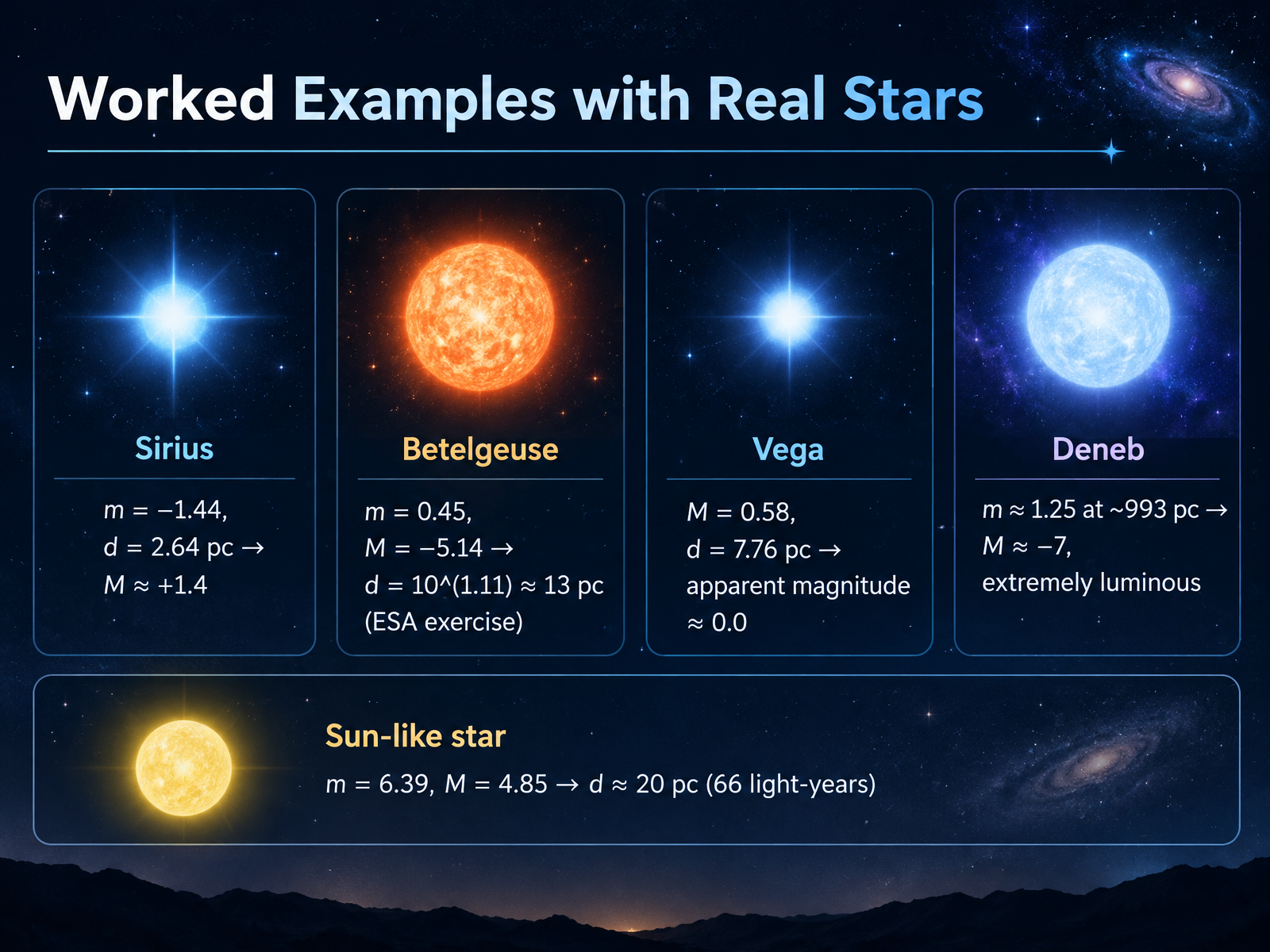
- 08Worked Examples with Real StarsLet's put the distance modulus to work with a few real stars. Take Sirius. Its apparent magnitude is minus one point four four, and it sits two point six four parsecs away. Plug those in, and its absolute magnitude comes out roughly plus one point four. So Sirius only looks dazzling because it's close. Now Betelgeuse: apparent magnitude zero point four five, absolute magnitude minus five point one four. Solving for distance gives about thirteen parsecs. Then Vega: absolute magnitude zero point five eight, distance seven point seven six parsecs, so its apparent magnitude lands near zero. Deneb is the dramatic one. Apparent magnitude around one point two five at nearly a thousand parsecs means an absolute magnitude near minus seven, genuinely extremely luminous. And a Sun-like star with apparent magnitude six point three nine and absolute magnitude four point eight five sits about twenty parsecs away, or sixty-six light years. Same math every time. Next, let's look at flux, luminosity, and what magnitude really measures.
 star.ucl.ac.ukastro.wku.eduastronomy.swin.edu.au+22 min
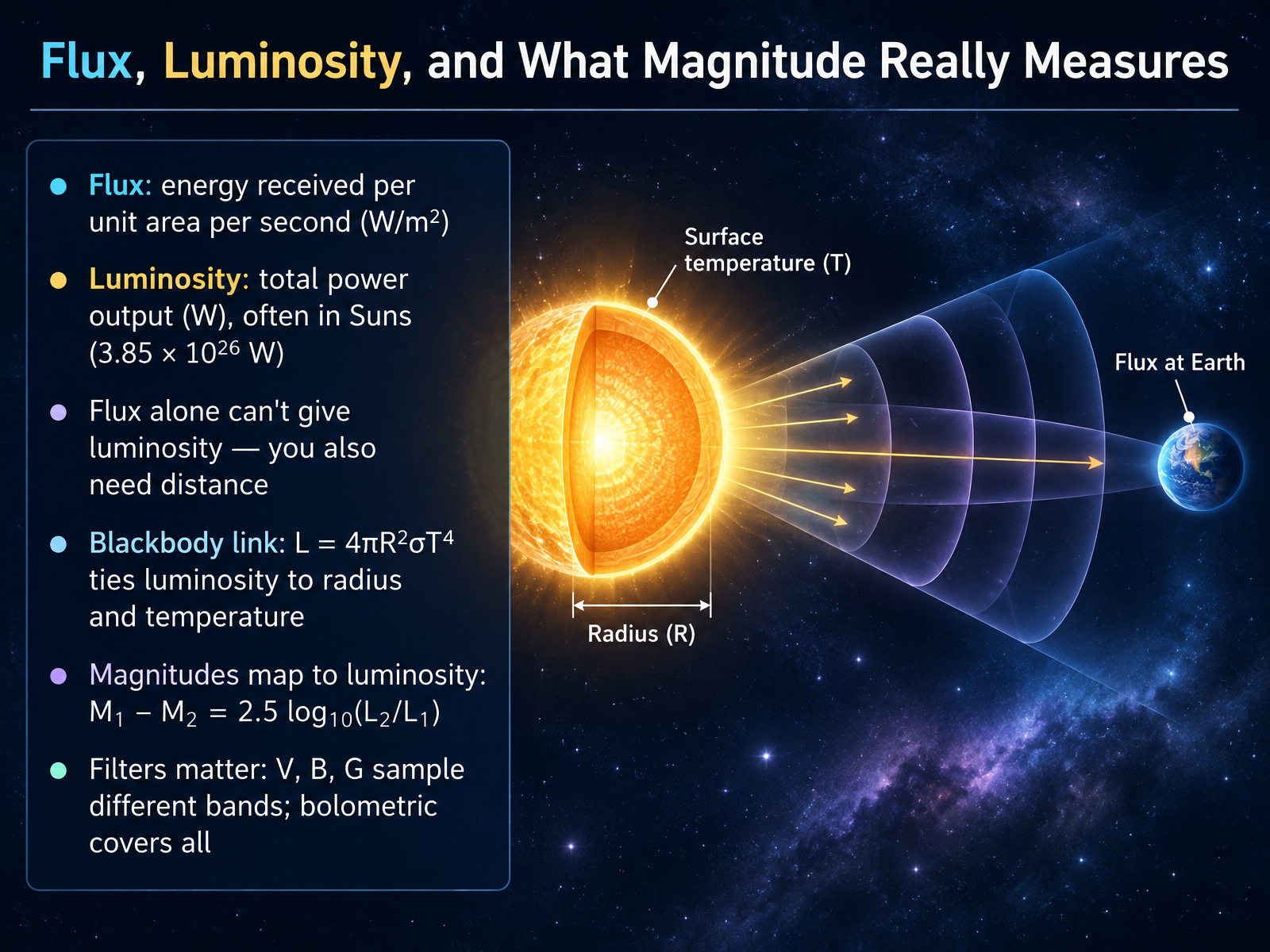
- 09Flux, Luminosity, and What Magnitude Really MeasuresNow let's connect brightness to real physics. Flux is the energy you actually receive per unit area each second. Luminosity is the star's total power output. Think of luminosity as the wattage printed on a light bulb. Flux is how much of that light lands on your hand. And because light spreads out, flux alone can't give you luminosity. You also need distance. For a hot glowing object, luminosity equals four pi times radius squared times sigma times temperature to the fourth. So a bigger or hotter star shines more. Magnitudes link back to luminosity through a simple relation: M one minus M two equals two point five times log base ten of L two divided by L one. One caution: filters matter. The V, B, and G bands sample different wavelengths, while bolometric magnitude covers all of them. Next, we'll see how this plays out on the Hertzsprung Russell Diagram Connection.
 sci.esa.intaoc.nrao.edudoi.org+12 min
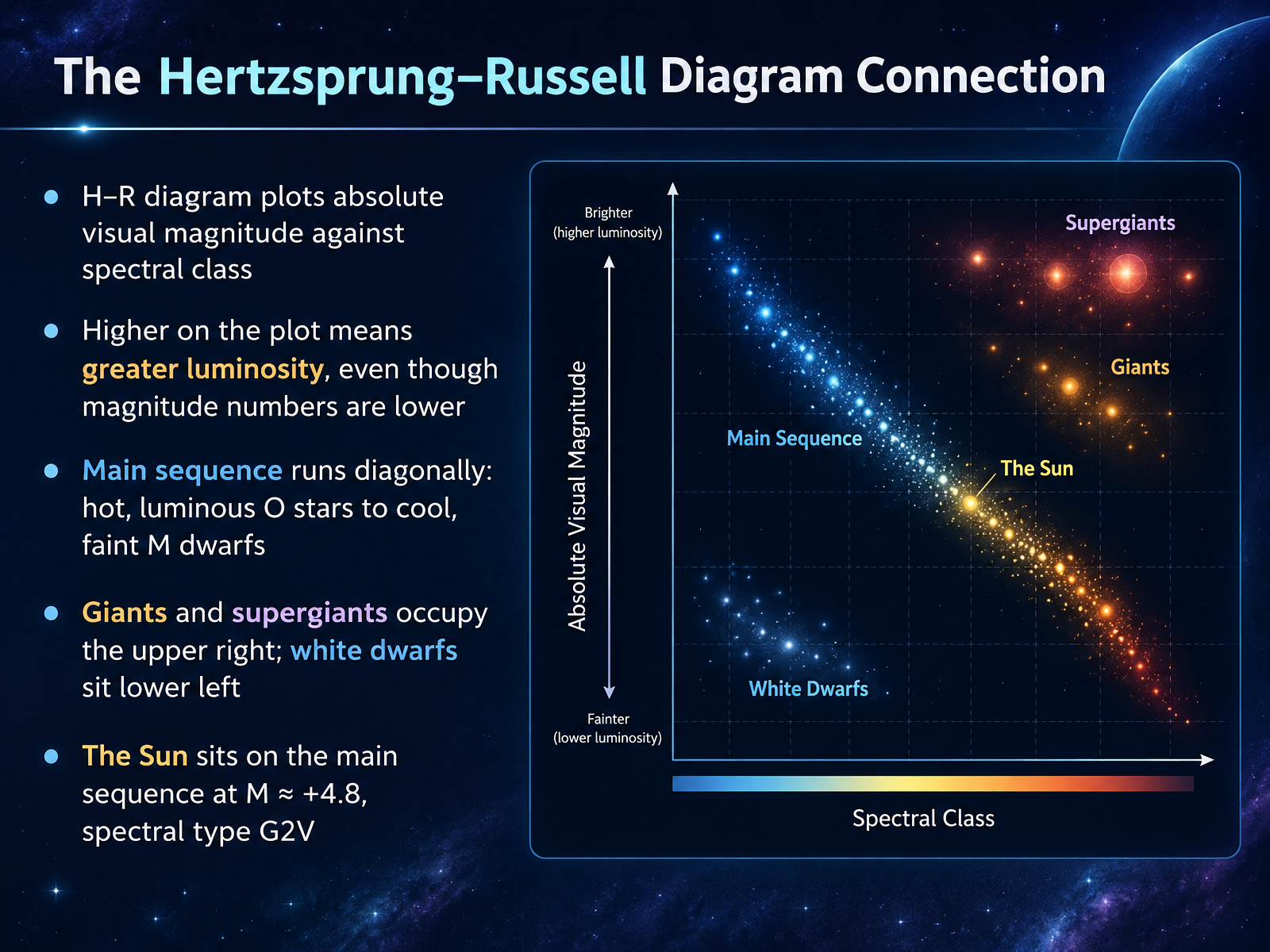
- 10The Hertzsprung–Russell Diagram ConnectionNow let's tie everything together with the Hertzsprung–Russell diagram, or H–R diagram for short. It plots absolute visual magnitude on the vertical axis against spectral class on the horizontal axis. Here's the one thing to hold on to: higher on the plot means greater luminosity, even though the magnitude numbers get lower. Think of it like a leaderboard where first place is at the top. Most stars fall along a diagonal band called the main sequence, running from hot, luminous O stars at the upper left down to cool, faint M dwarfs at the lower right. Giants and supergiants sit in the upper right, and white dwarfs sit in the lower left. And our Sun? It rests on the main sequence with an absolute magnitude of approximately plus four point eight, spectral type G2V. So the same diagram that places the Sun also reveals the family of stars around it. Next, we'll look at observing brightness: limiting magnitude and light pollution.
 1 min
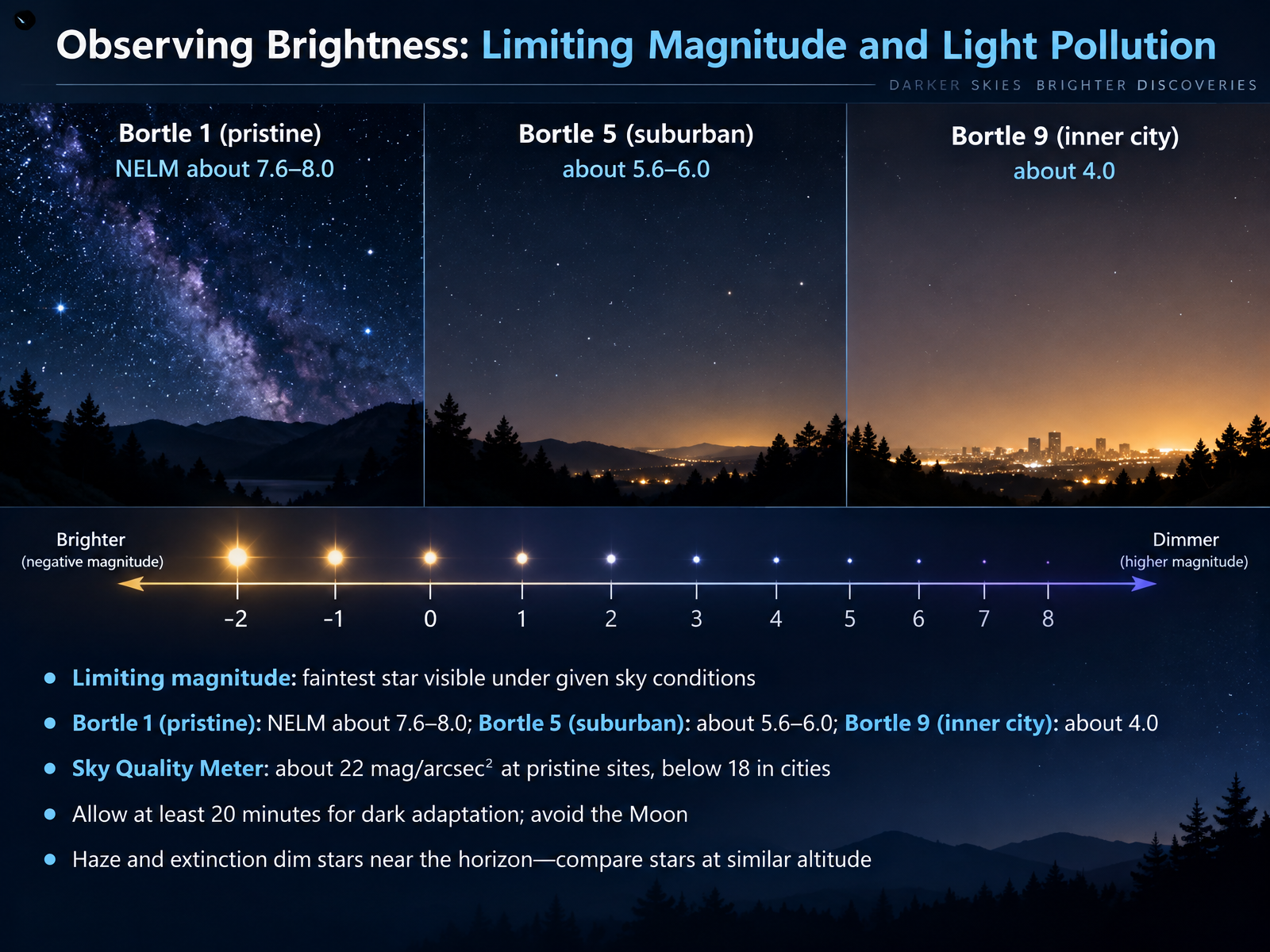
- 11Observing Brightness: Limiting Magnitude and Light PollutionNow let's talk about measuring what you can actually see. Limiting magnitude is simply the faintest star visible to your naked eye under the current sky conditions. And light pollution changes that number a lot. Under a pristine Bortle one sky, the limit is about seven point six to eight point zero. In a suburban Bortle five sky, it drops to roughly five point six to six point zero. And in an inner city, Bortle nine, you're lucky to reach magnitude four. A Sky Quality Meter gives a matching number. Pristine sites read around twenty two magnitudes per square arcsecond, while cities fall below eighteen. Here's a practical tip. Give your eyes at least twenty minutes to dark adapt, and keep the Moon out of view. Also remember that haze near the horizon dims stars, so compare stars at similar altitudes. Next, we'll build on this by looking at estimating magnitudes by eye, a practical skill.
 2 min
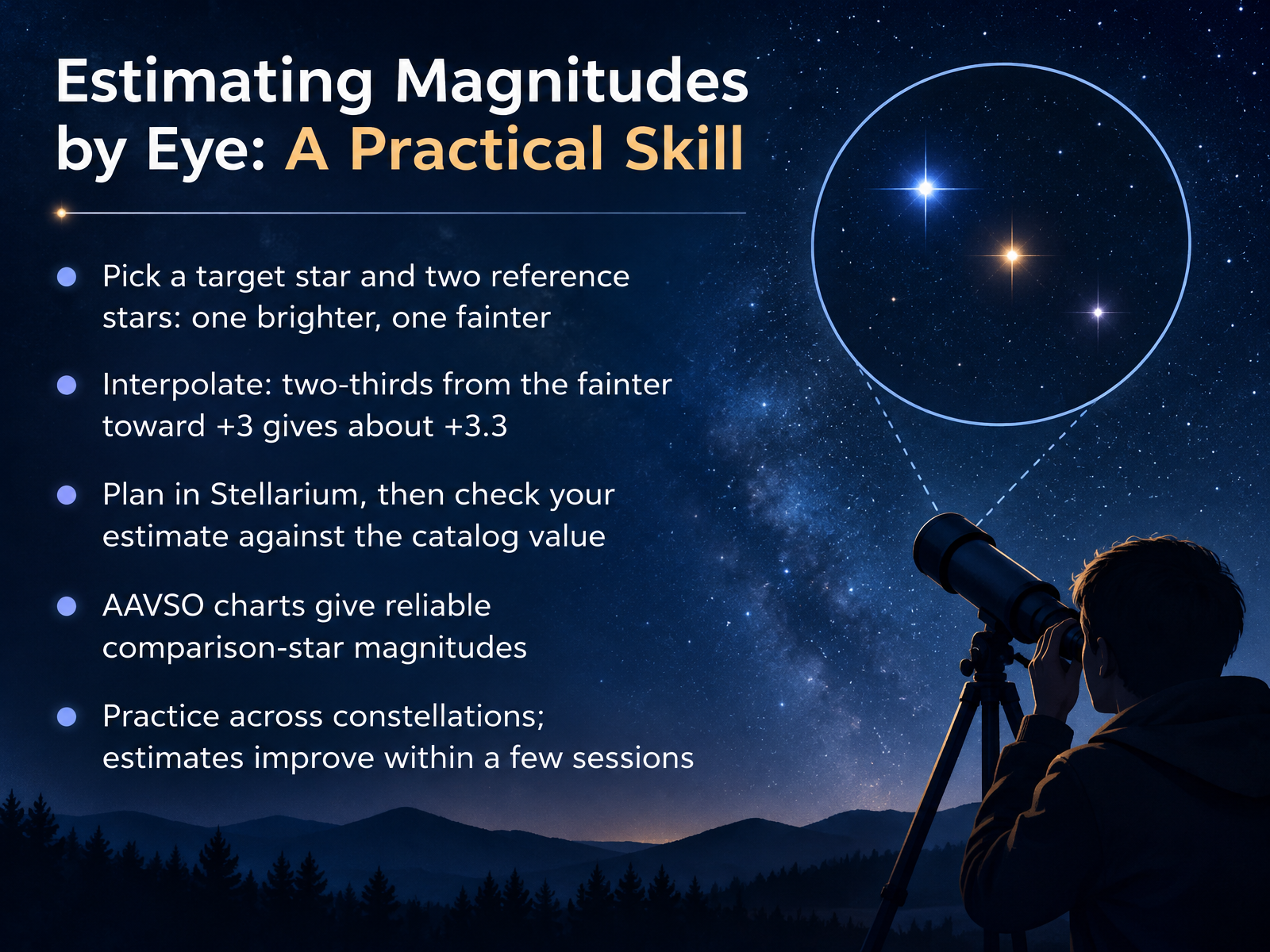
- 12Estimating Magnitudes by Eye: A Practical SkillNow let's turn that idea into a practical skill you can actually use outside. Pick a target star, and then choose two reference stars near it: one that's clearly brighter, and one that's clearly fainter. You're building a little brightness ladder. If your references are at plus three and plus four, and the target looks two thirds of the way from the fainter star toward the brighter one, your estimate lands around plus three point three. A good way to rehearse is to plan it in Stellarium first, then step outside and check your estimate against the catalog value. And if you want reliable comparison-star magnitudes, AAVSO charts are a great resource. Try a few different constellations. Most people find their estimates improve within just a few sessions. Next, we'll put these skills into hands-on practice and data checking.
 skyandtelescope.orgopenstax.org1 min
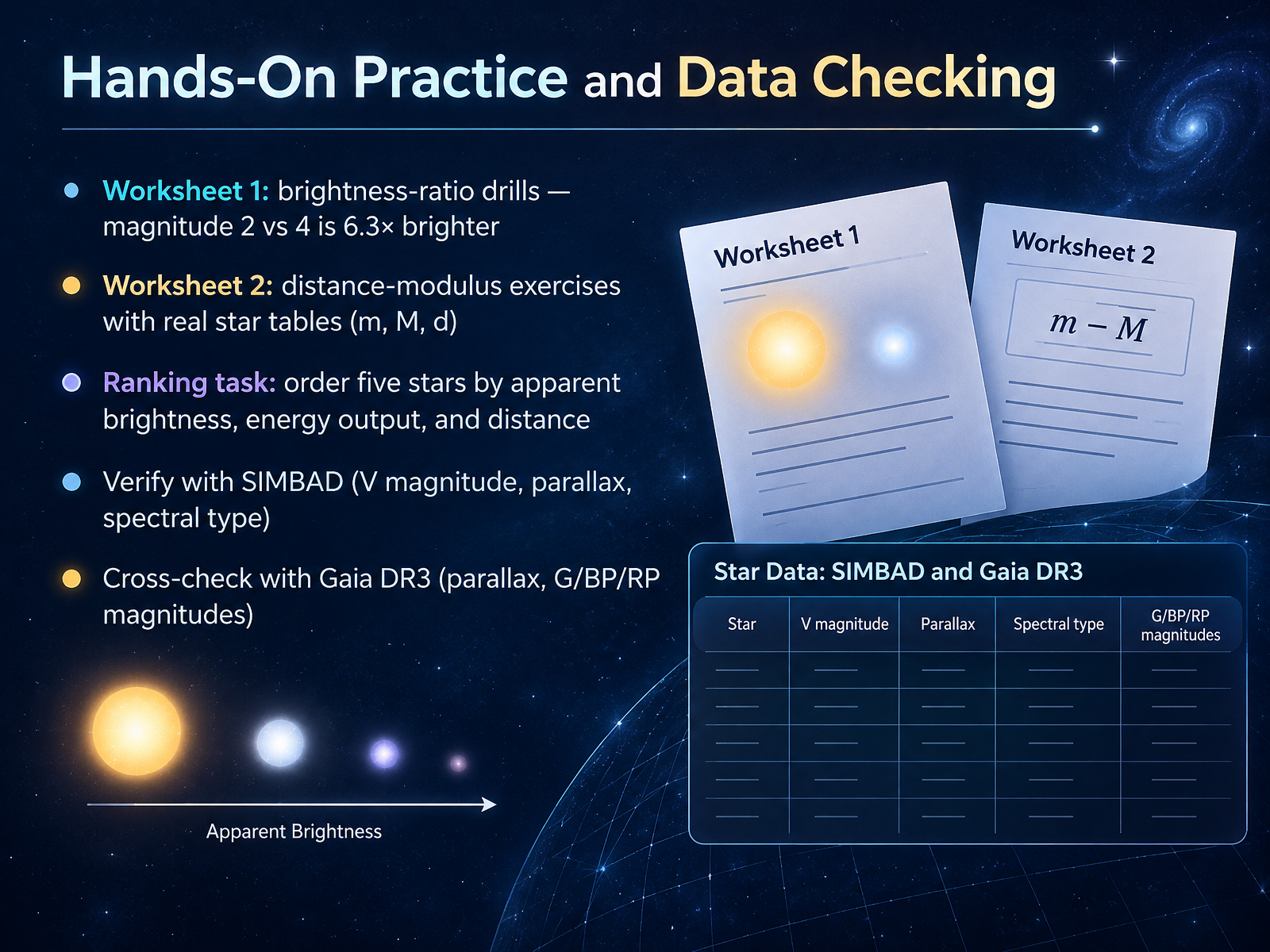
- 13Hands-On Practice and Data CheckingNow it's your turn to put all of this into practice, and check your work against real data. Start with worksheet one: brightness-ratio drills. For example, a magnitude two star versus a magnitude four star, a difference of two magnitudes, means the brighter one is about six point three times brighter, since each step of one magnitude is roughly two point five times. Worksheet two moves to the distance modulus, using real star tables with apparent magnitude, absolute magnitude, and distance. Then try the ranking task: take five stars and order them three ways, by how bright they look, by their true energy output, and by distance. This is where the ideas click. Next, verify your values in SIMBAD, checking the V magnitude, parallax, and spectral type. Then cross-check with Gaia DR3 for parallax and the G, BP, and RP magnitudes. Take your time, expect small disagreements between sources, and treat each mismatch as a learning moment. That habit of checking is exactly what real astronomy looks like. Next, we'll look at teaching strategies, common misconceptions, and next steps.
 doi.orgopenstax.orgskyandtelescope.org+22 min
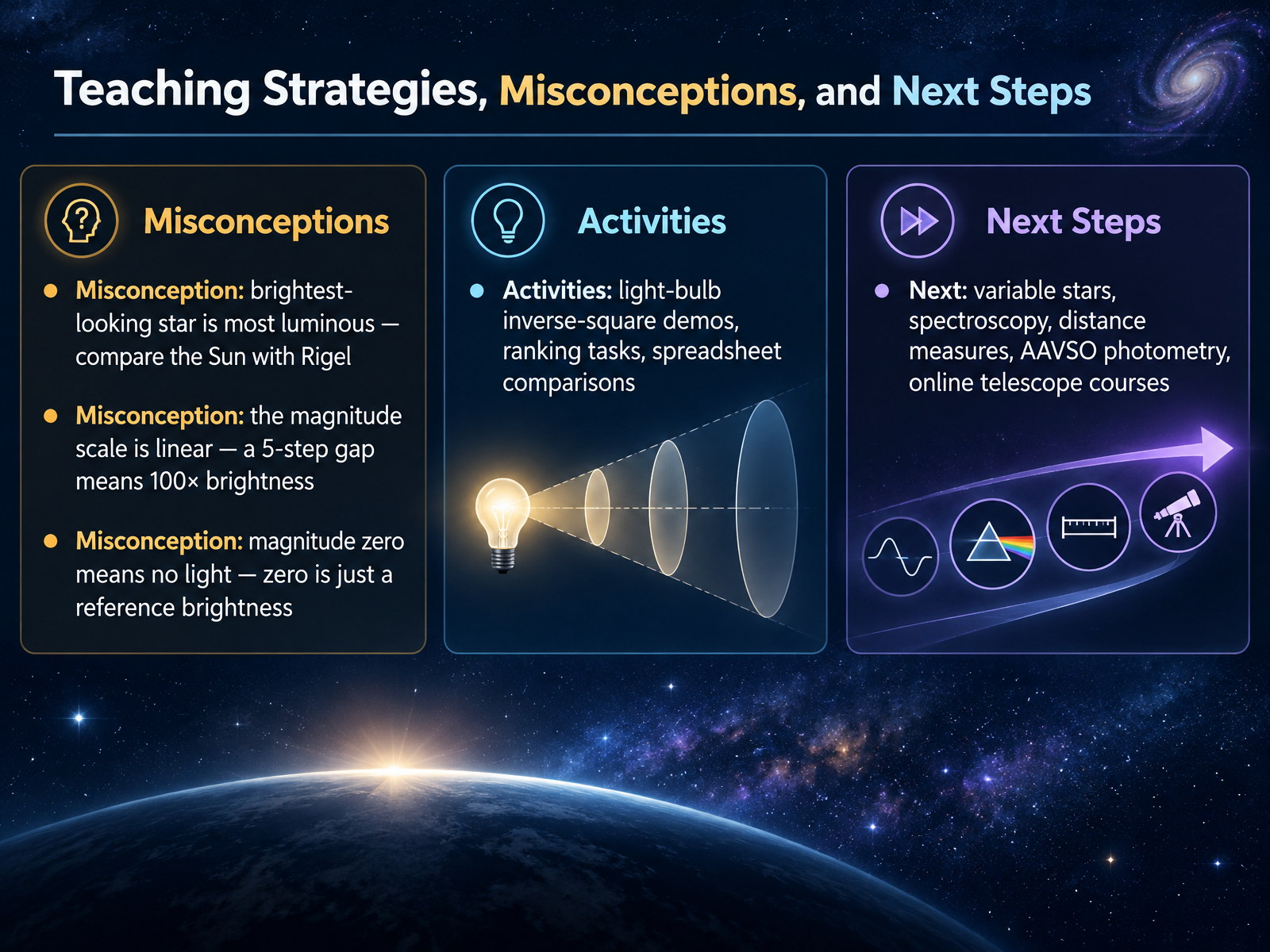
- 14Teaching Strategies, Misconceptions, and Next StepsLet's close by tackling a few common misconceptions, and then look at where you can go next. First, the brightest-looking star is not always the most luminous. Compare the Sun with Rigel. The Sun looks overwhelmingly bright to us, but Rigel is actually far more luminous. It just sits about seven hundred seventy light-years away. Second, the magnitude scale is not linear. A gap of five magnitudes means one hundred times the brightness, so each single step is about two and a half times. Third, magnitude zero does not mean no light. Zero is simply a reference brightness, and it's actually quite bright. For activities, try a light bulb inverse-square demo, ranking tasks, and spreadsheet comparisons of apparent and absolute magnitude. When you're ready for more, explore variable stars, spectroscopy, distance measures, and AAVSO photometry, or take an online telescope course. Thank you for learning with me. Keep looking up, and enjoy the sky.
 doi.orgskyandtelescope.orgopenstax.org2 min
Take the deck with you
Download this course as a file — free, no sign-up needed.
- PDF handoutEvery slide page, ready to print or share.15 pages · 3.9 MBDownload
- Narrated PowerPointThe deck that presents itself — every slide carries the digital human's narration video.15 pages · 14.3 MBDownload
- PowerPoint slidesThe full deck as a .pptx — open it in PowerPoint, Keynote, or Google Slides.15 pages · 3.9 MBDownload
Free to use in your own training — please keep the PersonWise credit page at the end.
Have your own deck? Turn it into a course
Sources consulted
Web sources consulted while building this course.
- Hubble Glossary - NASA Science — science.nasa.gov
- Absolute magnitude — en.wikipedia.org
- Astronomy & Astrophysics (A&A) — aanda.org
- 2-Toolkit — eso.org
- The Magnitude Scale — atnf.csiro.au
- 17.1 The Brightness of Stars - Astronomy 2e | OpenStax — openstax.org
- The Stellar Magnitude System - Sky & Telescope — skyandtelescope.org
- Magnitudes and distance — astro.wku.edu
- Ch. 17 Figuring for Yourself - Astronomy | OpenStax — openstax.org
- Apparent magnitude — en.wikipedia.org
- The Inverse Square Law of Light — nasa.gov
- Lecture 23 - Stars (3/6/96) — aoc.nrao.edu
- Teachers Notes Booklet 3: Stellar Distances Page 1 of 27 — sci.esa.int
- Inverse Square Law and Magnitudes — burro.cwru.edu
- PHAS1102: Physics of the Universe Problem-Solving Tutorial, Week 15: Notes for Answers — star.ucl.ac.uk
- Distance Modulus | COSMOS — astronomy.swin.edu.au
- An example of distance modulus - distance relation — homepage.physics.uiowa.edu
- Distance Modulus - Cosmic Distance Ladder - NAAP — astro.unl.edu
- 2-Toolkit — sci.esa.int
- Stellar photometry in an introductory physics lab (or, translating flux into magnitudes) — doi.org