Begin
13 pages · ~26 min
SEO Roles and Handoffs
This training clarifies SEO roles, responsibilities, and handoffs for marketers and web teams, helping learners streamline collaboration and workflow across SEO tasks.
A digital instructor presents all 13 pages. Hold “Ask” at any point and ask out loud — the answer comes from this course. No sign-up needed.
What you’ll learn
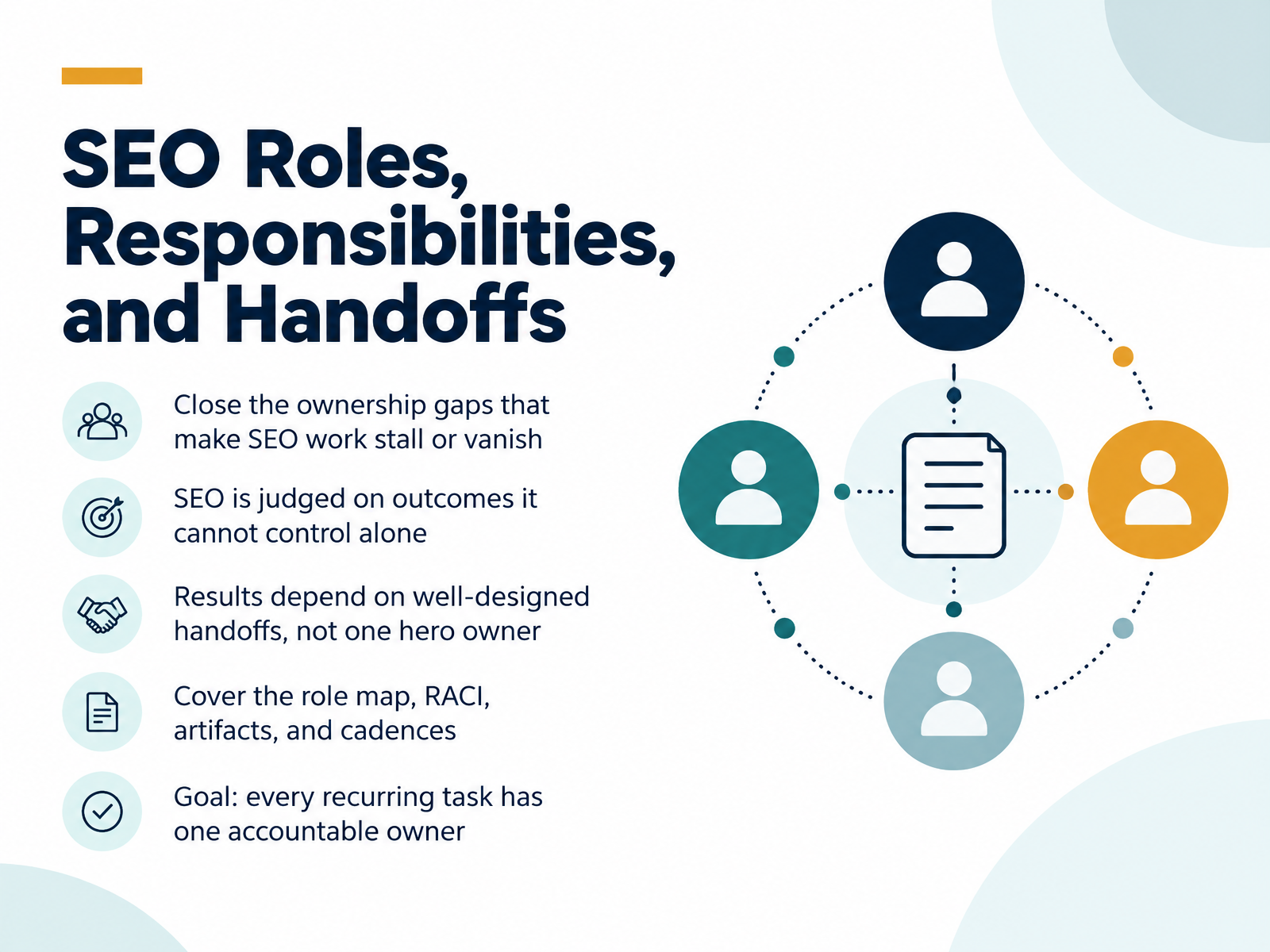
- 01SEO Roles, Responsibilities, and HandoffsWelcome. This course is about SEO roles, responsibilities, and handoffs, and it is built for teams where search work crosses more than one department. Here is the problem we are solving. Enterprise SEO rarely fails because people lack skill. It fails because ownership is fractured. SEO is judged on outcomes it cannot control alone. Engineering owns templates and rendering. Content owns briefs and publishing. Product owns the roadmap. Legal controls what you can say. SEO carries the number but not the inputs, so work stalls in the handoffs. Our goal is simple. Every recurring task gets one accountable owner. Across the next slides, we will cover the role map, the RACI, the exact handoff artifacts, and the review cadences that keep them working. You will see who decides, who executes, and what the receiver must verify before publishing or deploying. Confirm the owner before publishing. Confirm the approver before a template change. Keep that lens as we move into why these gaps open in the first place.searchenginejournal.comsrnaseo.comdigitalsnowstorm.com+22 min
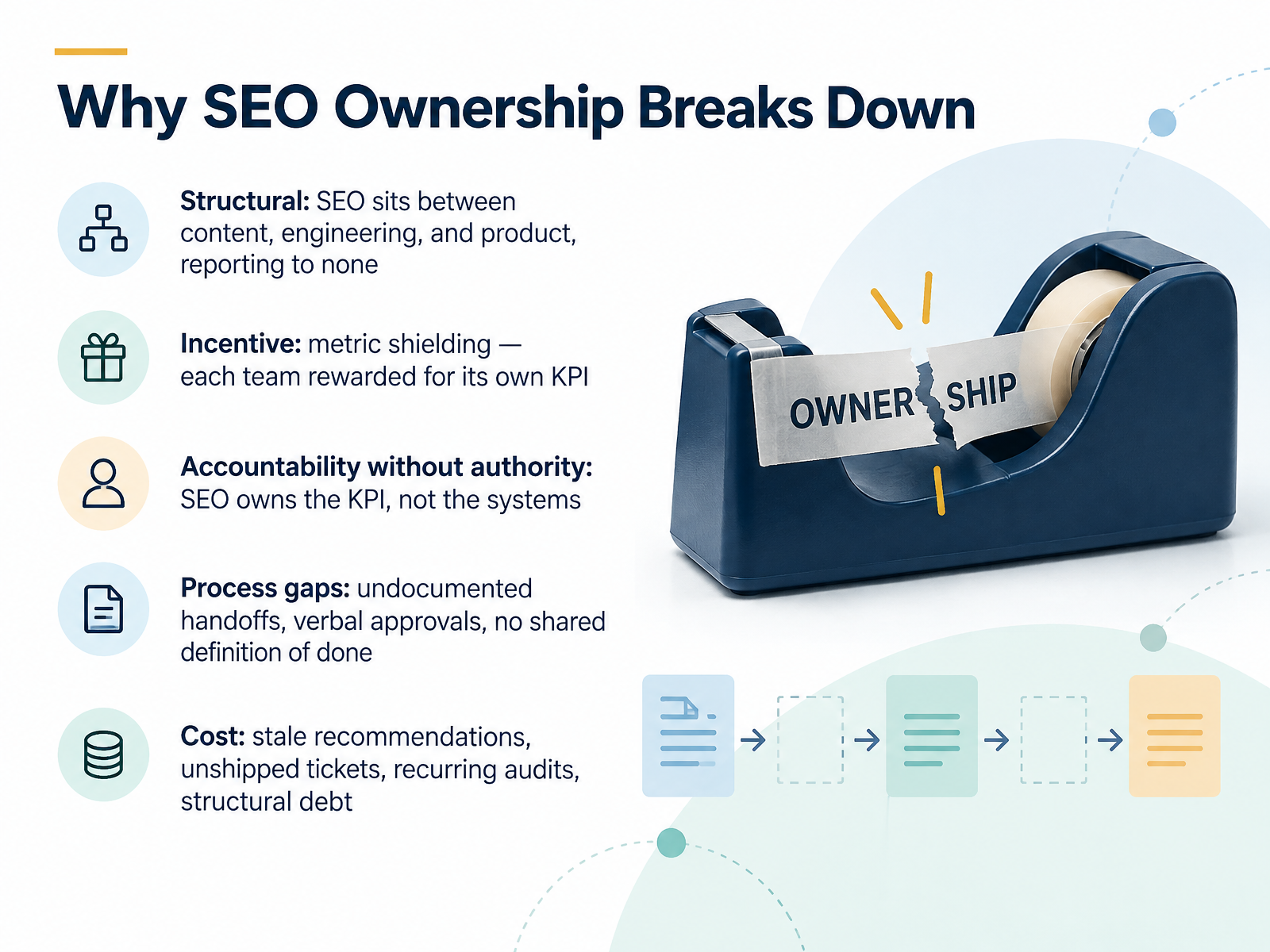
- 02Why SEO Ownership Breaks DownLet's look at why SEO ownership breaks down. The first cause is structural. SEO sits between content, engineering, and product, and reports to none of them, so recommendations arrive as requests, not requirements. Second, incentives diverge through metric shielding. Engineering is rewarded for shipping, content for brand alignment, product for features, so fixing an SEO issue rarely improves the metric a team is measured on. Third, accountability without authority. SEO owns the visibility KPI, but not the templates, taxonomy, or release timing that produce it. Fourth, process gaps. Handoffs go undocumented, approvals stay verbal, and no shared definition of done exists. Confirm the owner before publishing. The cost shows up as stale recommendations, unshipped tickets, recurring audits, and growing structural debt. Now let's map the roles across the delivery chain.
 searchenginejournal.comsrnaseo.comdigitalsnowstorm.com+22 min
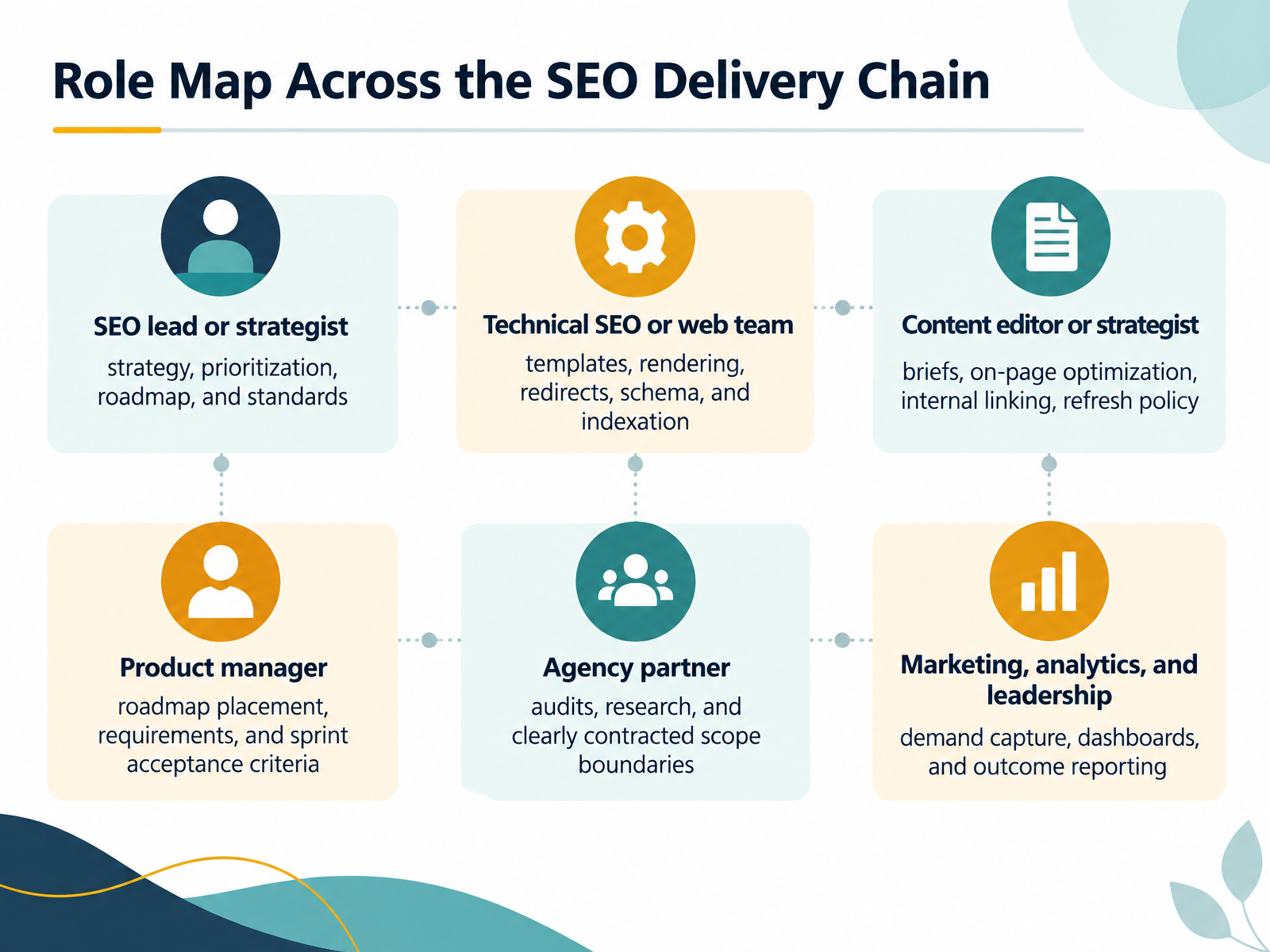
 - 03Role Map Across the SEO Delivery ChainNow, let's map the roles across the SEO delivery chain. Six groups, each with clear decision rights. The SEO lead or strategist owns strategy, prioritization, the roadmap, and standards, and is accountable for the organic number. The technical SEO or web team owns templates, rendering, redirects, schema, and indexation, and implements the code. The content editor or strategist owns briefs, on-page optimization, internal linking, and the refresh policy. The product manager owns roadmap placement, requirements, and sprint acceptance criteria. The agency partner owns audits and research, but only within clearly contracted scope boundaries. And marketing, analytics, and leadership own demand capture, dashboards, and outcome reporting. At each handoff, receivers verify rather than assume. Engineering confirms feasibility before content scales. Product confirms sprint fit before SEO commits a date. Analytics confirms the field definitions before reporting. Remember the rule: one accountable name per workstream, written at the action level, not the department. Confirm the owner before publishing. Next, we look at ownership models: centralized, embedded, and hybrid.
 zxweb.euseowebster.comexpertseo.uk+21 min
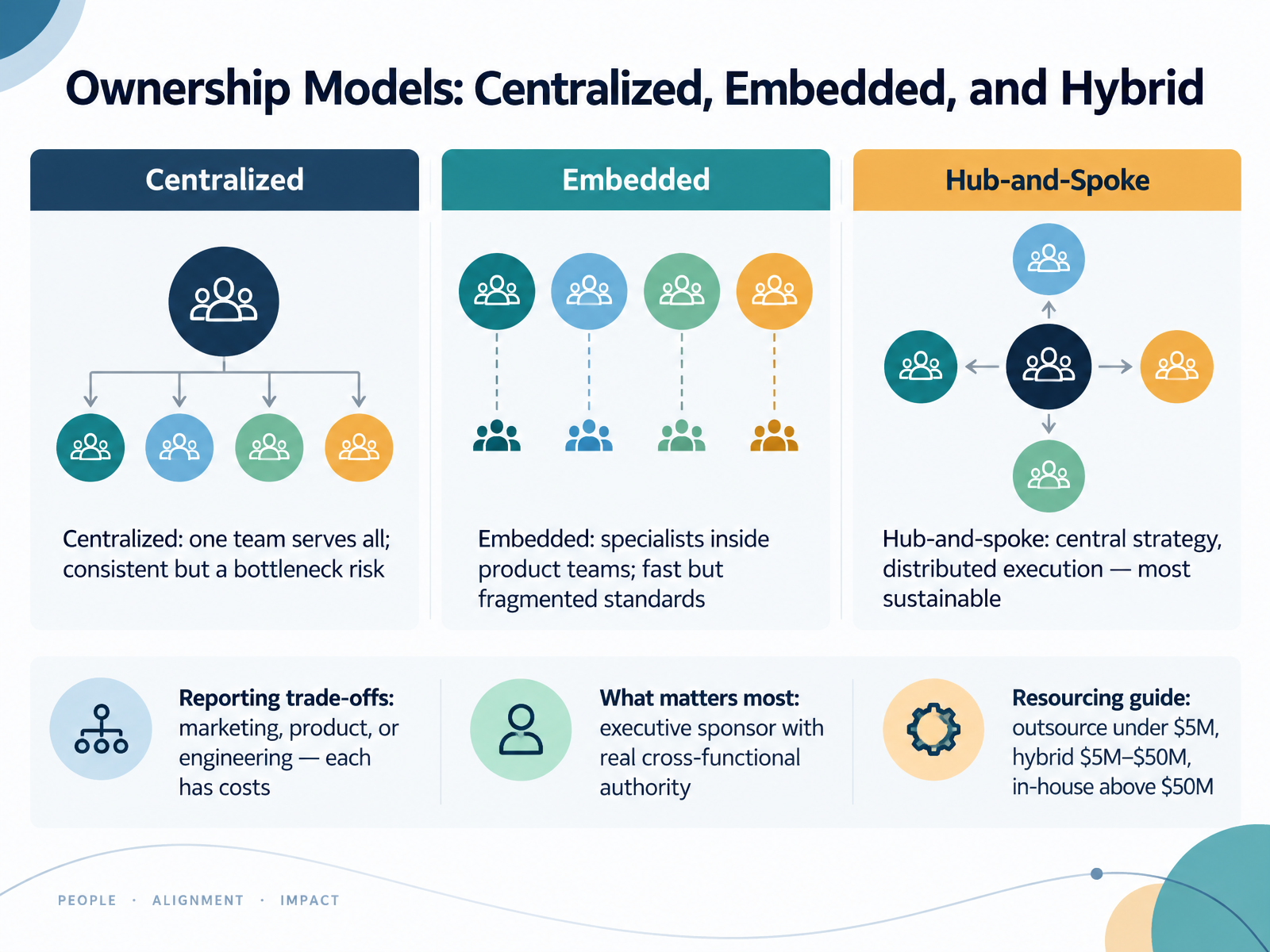
 - 04Ownership Models: Centralized, Embedded, and HybridLet's look at how you can structure SEO ownership. The centralized model puts one team in service of the whole organization. You get consistency and easier governance, but that team becomes a bottleneck, and it can drift from what individual markets actually need. The embedded model places specialists inside product teams. Execution moves fast, but standards fragment, tooling duplicates, and the brand experience drifts. Hub-and-spoke is the most sustainable for most enterprises. A central hub owns strategy, measurement, and technical governance. Spokes execute locally. The key design rule is that the hub acts as a service layer, not a control tower. Adoption dies when business units feel policed.
Reporting lines are trade-offs, not right answers. Under marketing, you get content alignment but slow engineering access. Under product, you get roadmap visibility but content drifts. Under engineering, technical work ships fast, but strategy and editorial suffer.
What matters more than the org chart is an executive sponsor with real cross-functional authority. Without one, organic search sits on nobody's scorecard, and every fix becomes a negotiation.
For resourcing, below five million dollars in revenue, outsource. Between five and fifty million, run hybrid: an in-house lead owns strategy, an agency executes. Above fifty million, build in-house with agency support for surge work. Confirm the owner before publishing. Next, we'll cover assigning accountability with RACI.
 zxweb.euseowebster.comexpertseo.uk+22 min
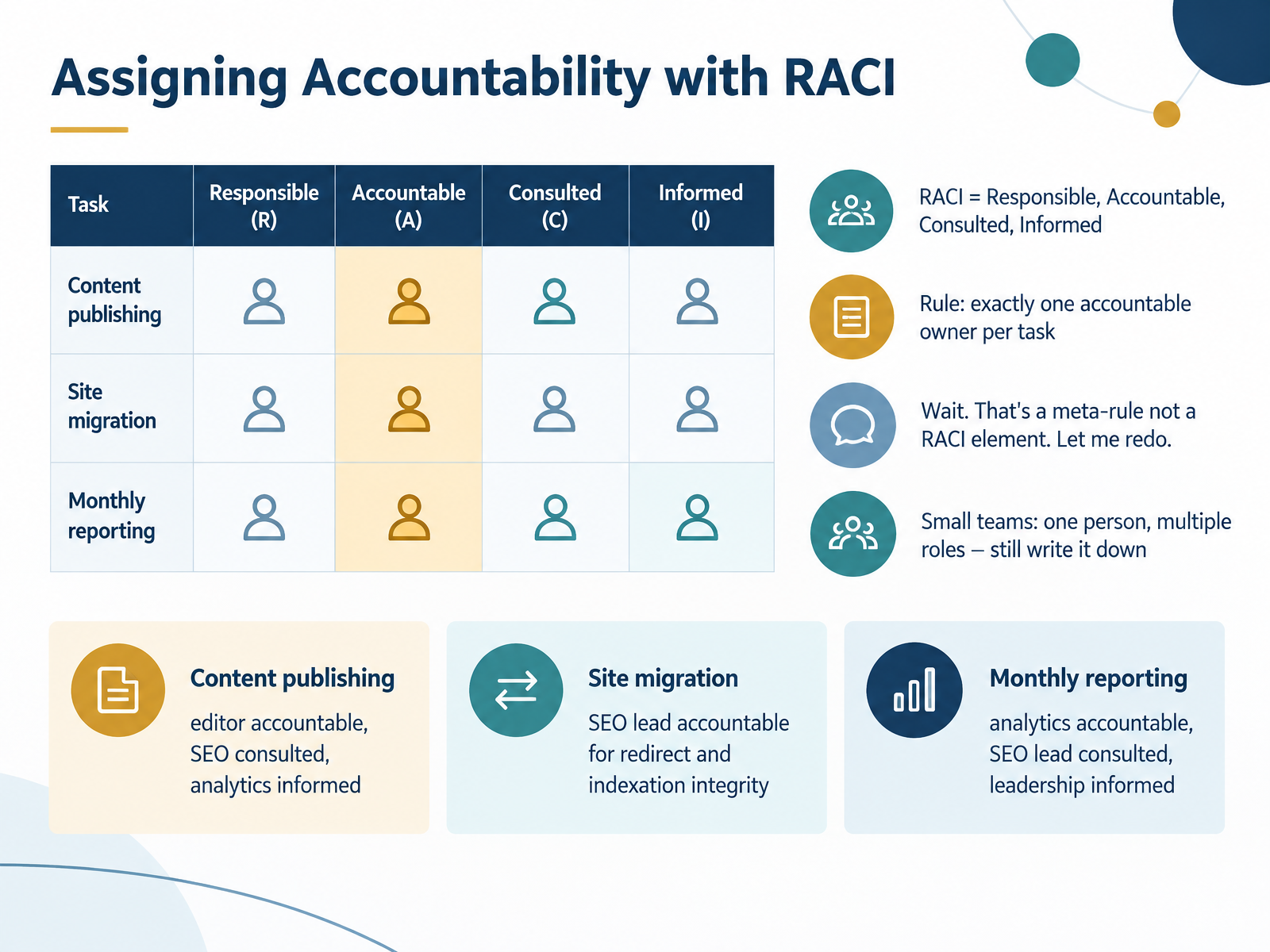
 - 05Assigning Accountability with RACILet's turn roles into clear decision rights using a RACI. RACI stands for Responsible, Accountable, Consulted, and Informed. Responsible does the work. Accountable owns the outcome. Consulted gives input before the decision. Informed gets updates after. The rule that matters most: exactly one accountable owner per task. Now apply it. For content publishing, the editor is accountable, SEO is consulted, analytics is informed. Confirm the owner before publishing. For a site migration, the SEO lead is accountable for redirect and indexation integrity. Engineering implements, product and legal are consulted. For monthly reporting, analytics is accountable, the SEO lead is consulted, and leadership is informed. In small teams, one person may hold several roles, but still write it down. Keep RACI at the level of actions, not departments. Now let's look at how this plays out in practice, starting with handoff points in the SEO workflow.
 zxweb.euseowebster.comexpertseo.uk+21 min
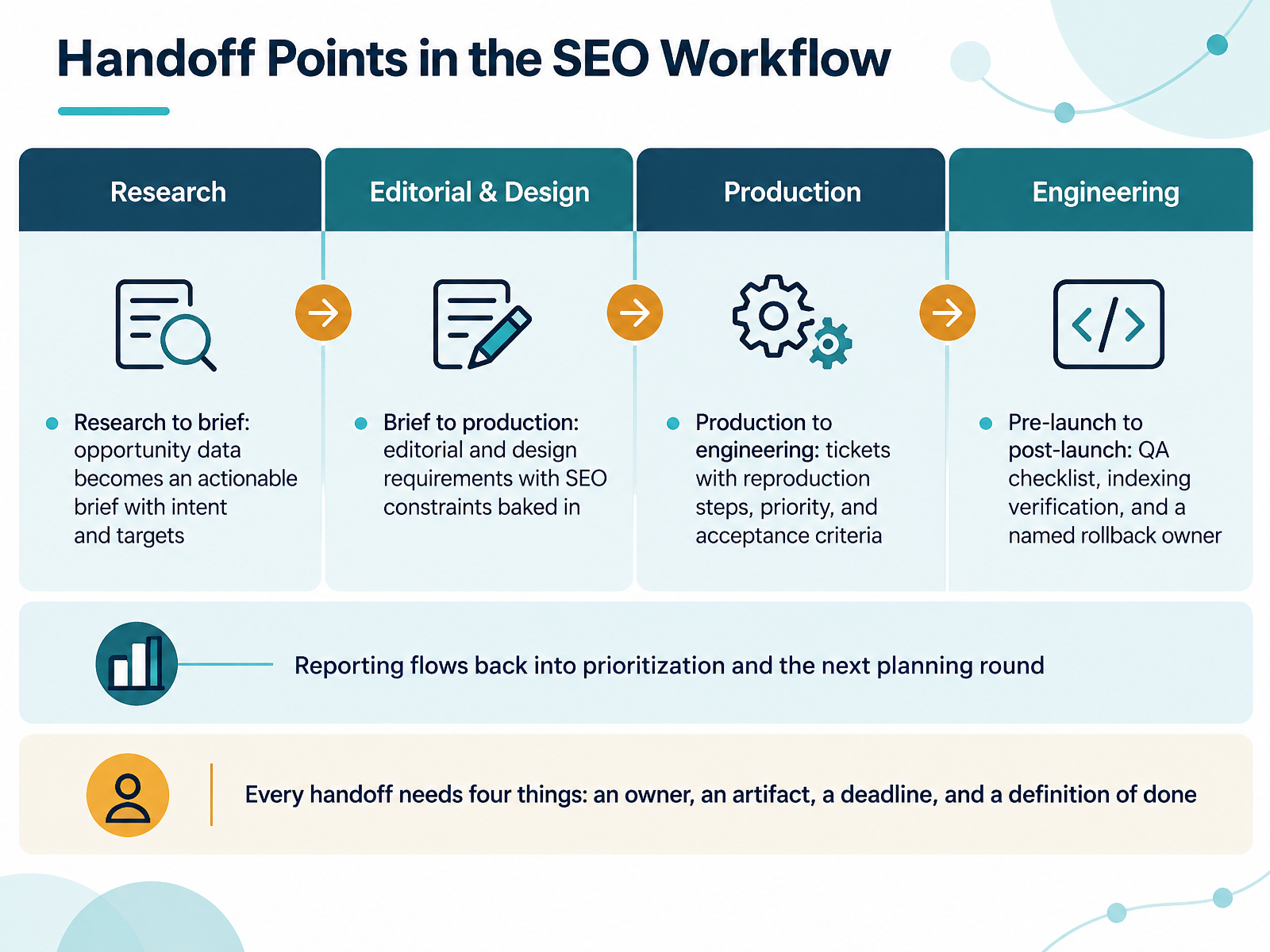
 - 06Handoff Points in the SEO WorkflowLet's walk through the handoff points in the SEO workflow, and who passes what to whom.
First, research to brief. The SEO lead turns opportunity data into an actionable brief with intent and targets. The content editor confirms the owner before publishing.
Next, brief to production. Editorial and design requirements go out with SEO constraints baked in, so writers and designers are not guessing.
Then production to engineering. The SEO lead writes tickets with reproduction steps, priority, and acceptance criteria. Engineers verify those criteria before closing.
Before launch, the technical SEO lead runs the QA checklist and indexing verification. Name a rollback owner before you ship, not after.
After launch, reporting flows back into prioritization and the next planning round.
Every handoff needs four things: an owner, an artifact, a deadline, and a definition of done.
Now let's look at the artifacts themselves, in Handoff Artifacts: Briefs, Tickets, and Launch Checklists.
 sitebulb.comthegray.companypatrickstox.com+22 min
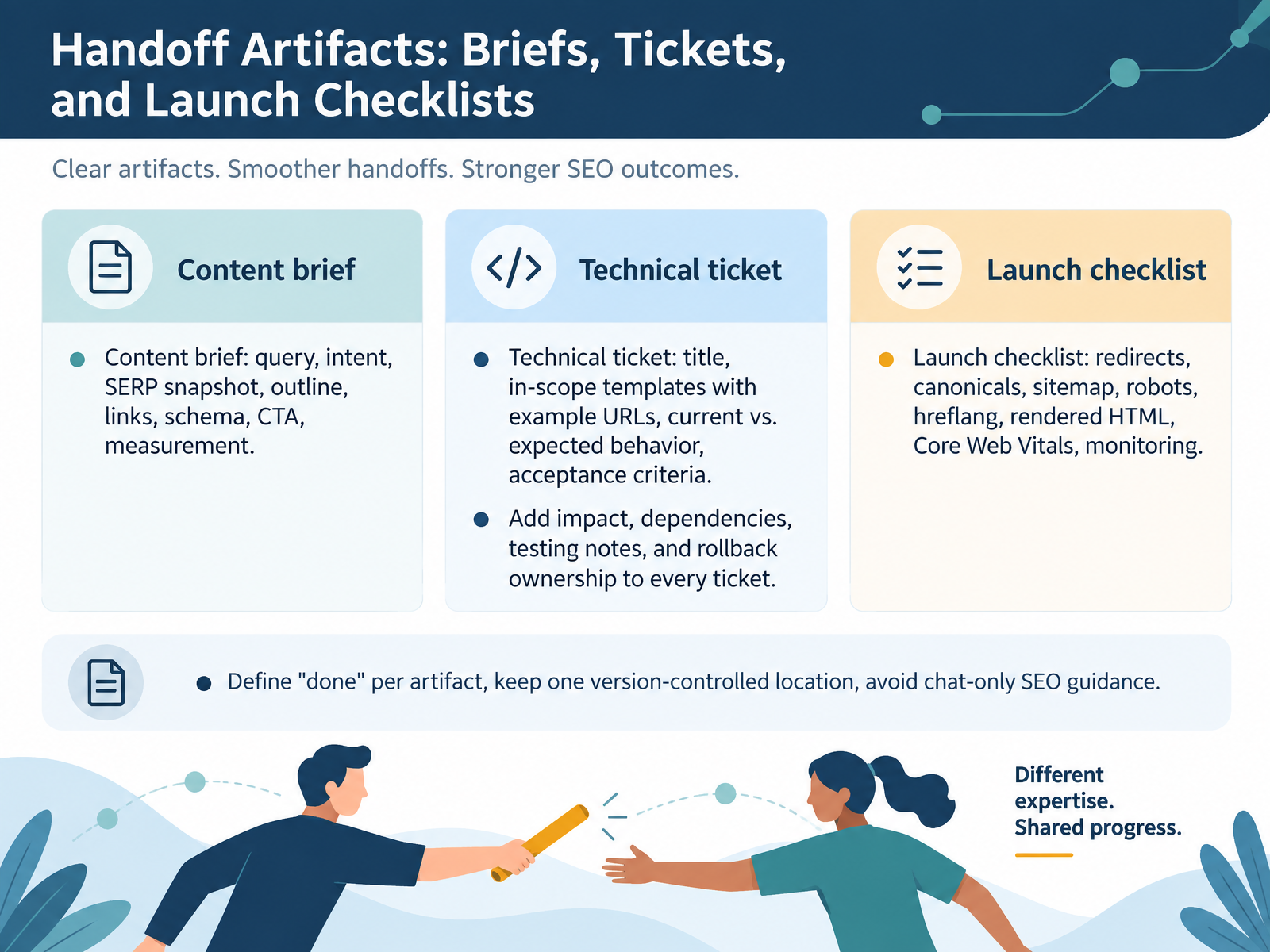
 - 07Handoff Artifacts: Briefs, Tickets, and Launch ChecklistsLet's look at the three artifacts every SEO handoff depends on, and what makes each one complete. First, the content brief. It carries the query, intent, a SERP snapshot, the outline, internal and external links, schema guidance, the CTA, and the measurement plan. A writer should be able to draft from it without asking you a single question. Confirm the brief is approved before the writer starts.
Second, the technical ticket. Its title names the exact change. In-scope templates are listed with example URLs. Current versus expected behavior is stated plainly. Acceptance criteria define done in testable terms. Always add impact, dependencies, testing notes, and rollback ownership. If the change underperforms, everyone should know who decides to revert and what reverted means.
Third, the launch checklist. Redirects, canonicals, sitemap, robots, hreflang, rendered HTML, Core Web Vitals, and monitoring. Confirm each item is checked before you call the launch complete.
One rule ties these together. Define done per artifact, and keep a single version-controlled location. Avoid chat-only SEO guidance, because it disappears and gets misremembered. Next, we move into prioritization and trade-offs for handoffs.
 sitebulb.comthegray.companypatrickstox.com+22 min
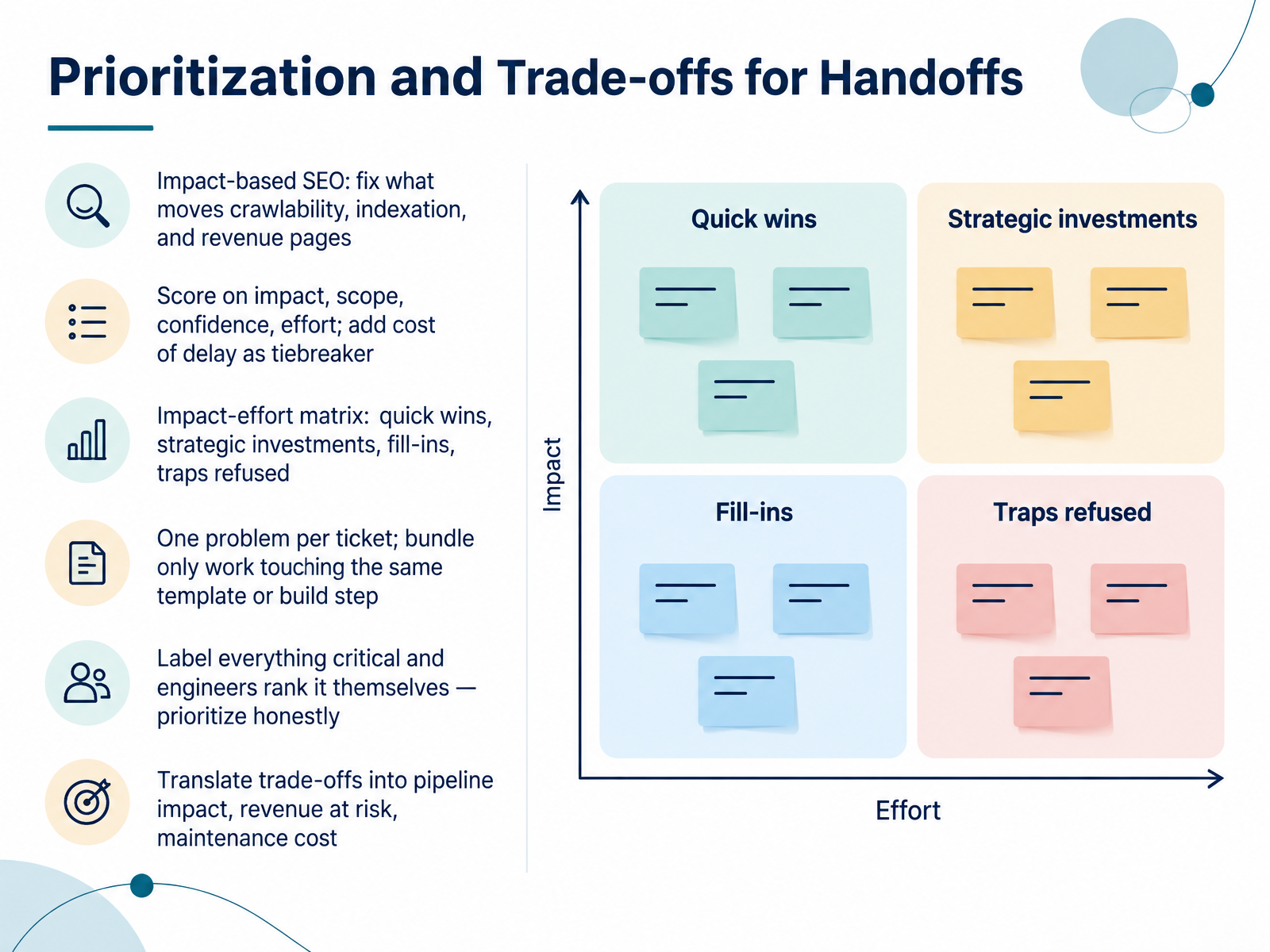
 - 08Prioritization and Trade-offs for HandoffsLet's talk about how you actually choose which handoffs happen first. For SEO, prioritize impact, not audit volume. Fix what moves crawlability, indexation, and revenue pages. Score each item on impact, scope, confidence, and effort, then use cost of delay as the tiebreaker. A decaying page losing pipeline often outranks a brand new one. Plot work on an impact-effort matrix: quick wins go first, strategic investments get planned, fill-ins wait, and traps get refused. When you write tickets, keep one problem per ticket. Bundle only work that touches the same template or build step. Handing an engineer a single bloated ticket forces them to split it themselves. Instead, label everything critical, then let engineers rank it. Confirm the owner before publishing, and prioritize honestly rather than by who asked loudest. Finally, translate trade-offs into pipeline impact, revenue at risk, and maintenance cost, so product and finance can weigh them. Next, let's look at collaboration rituals and cadences.
 tenspeed.iogetspike.aisearchengineland.com+22 min
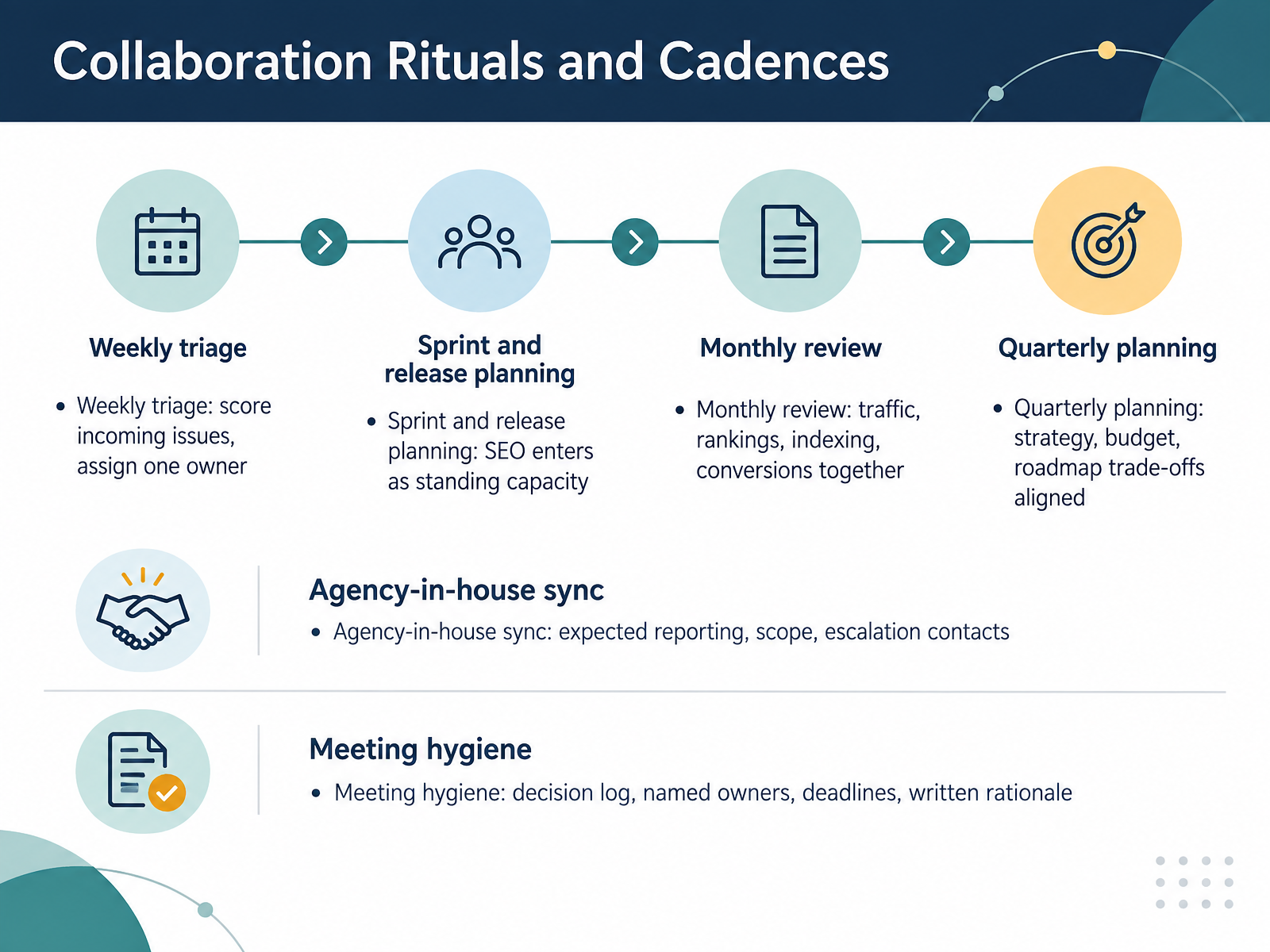
 - 09Collaboration Rituals and CadencesNow let's make these handoffs repeatable by establishing collaboration rituals and cadences. First, run a weekly triage. The SEO lead scores each incoming issue by impact and effort, then assigns exactly one owner. Confirm the owner before anything leaves the room. Second, sprint and release planning. SEO enters as standing capacity, not ad hoc requests. The SEO program manager negotiates a fixed share of each sprint, and engineering confirms feasibility before commitments lock. Third, the monthly review. Pull traffic, rankings, indexing, and conversions into one view, owned by the analytics lead, so you are reading the same numbers. Fourth, quarterly planning, where the head of SEO brings strategy, budget, and roadmap trade-offs to the executive sponsor for sign-off. For agency and in-house syncs, agree the reporting format, scope boundaries, and named escalation contacts up front. Finally, keep meeting hygiene: a decision log, named owners, deadlines, and written rationale. Every ritual needs one accountable owner and a clear output. With those cadences running, the next step is handling escalation, conflict resolution, and trade-offs.
 zxweb.euseowebster.comexpertseo.uk+22 min
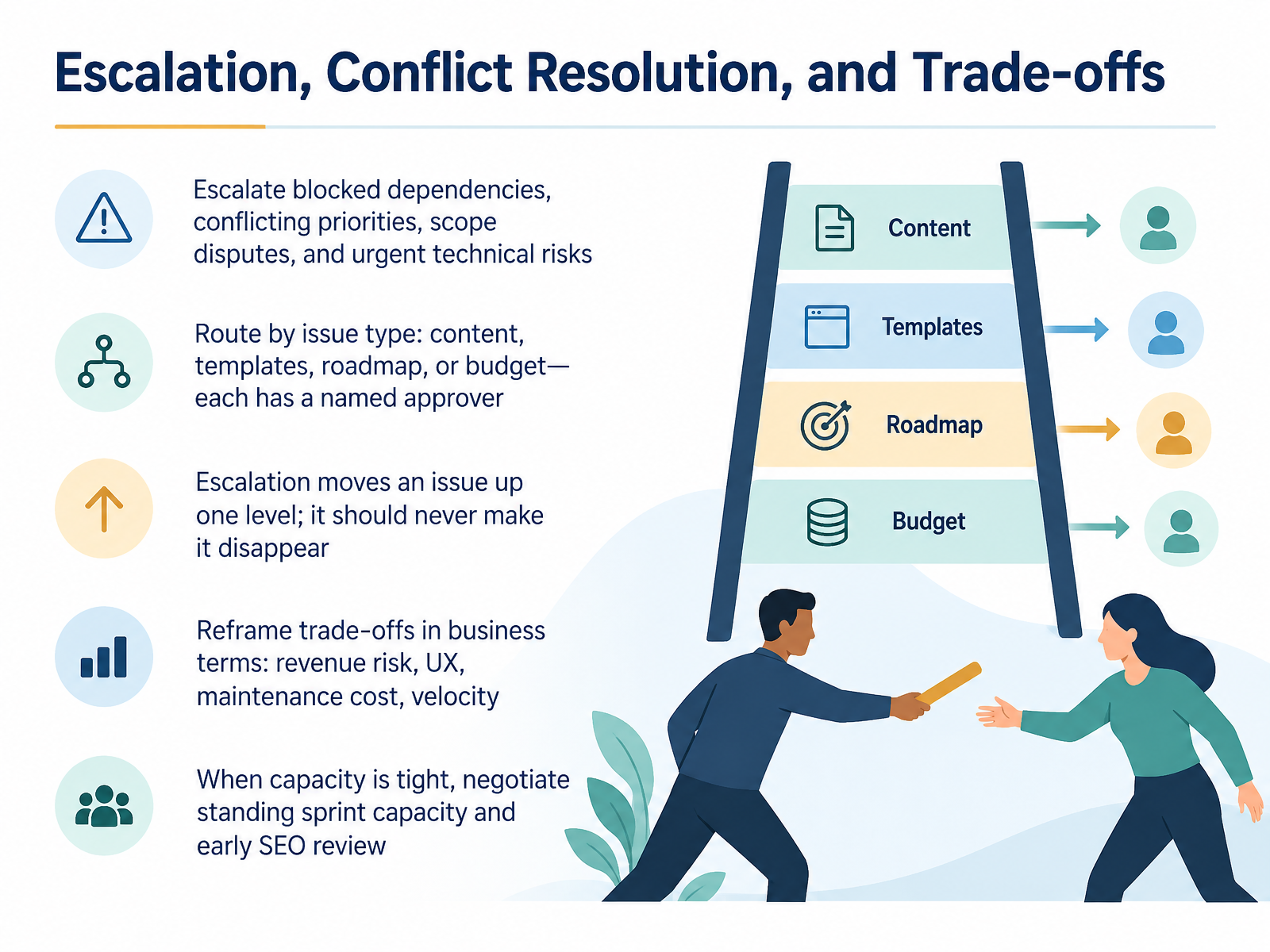
 - 10Escalation, Conflict Resolution, and Trade-offsLet's talk escalation, conflict resolution, and trade-offs. When a dependency blocks you, or priorities conflict, or scope and technical risk need a fast decision, escalate. Route by issue type. Content issues go to the content owner. Template changes go to the tech approver. Roadmap conflicts go to the product owner. Budget disputes go to the executive sponsor. Escalation moves an issue up one level. It should never make it disappear. So confirm the named approver before you push it up. Now reframe trade-offs in business terms. Revenue risk, user experience, maintenance cost, and velocity. A redirect fix is not just a ticket. It's revenue protection. When capacity is tight, negotiate standing sprint capacity and early SEO review. Get your requirements into the product requirements document before build starts, not after launch. Then verify fixes in production, because caching and edge config can break them after the merge. Your takeaway: escalation is a routing decision, not a complaint. Name the approver, frame the trade-off, and lock in your standing capacity. Next, we'll look at measuring handoff effectiveness.
 zxweb.euseowebster.comexpertseo.uk+22 min
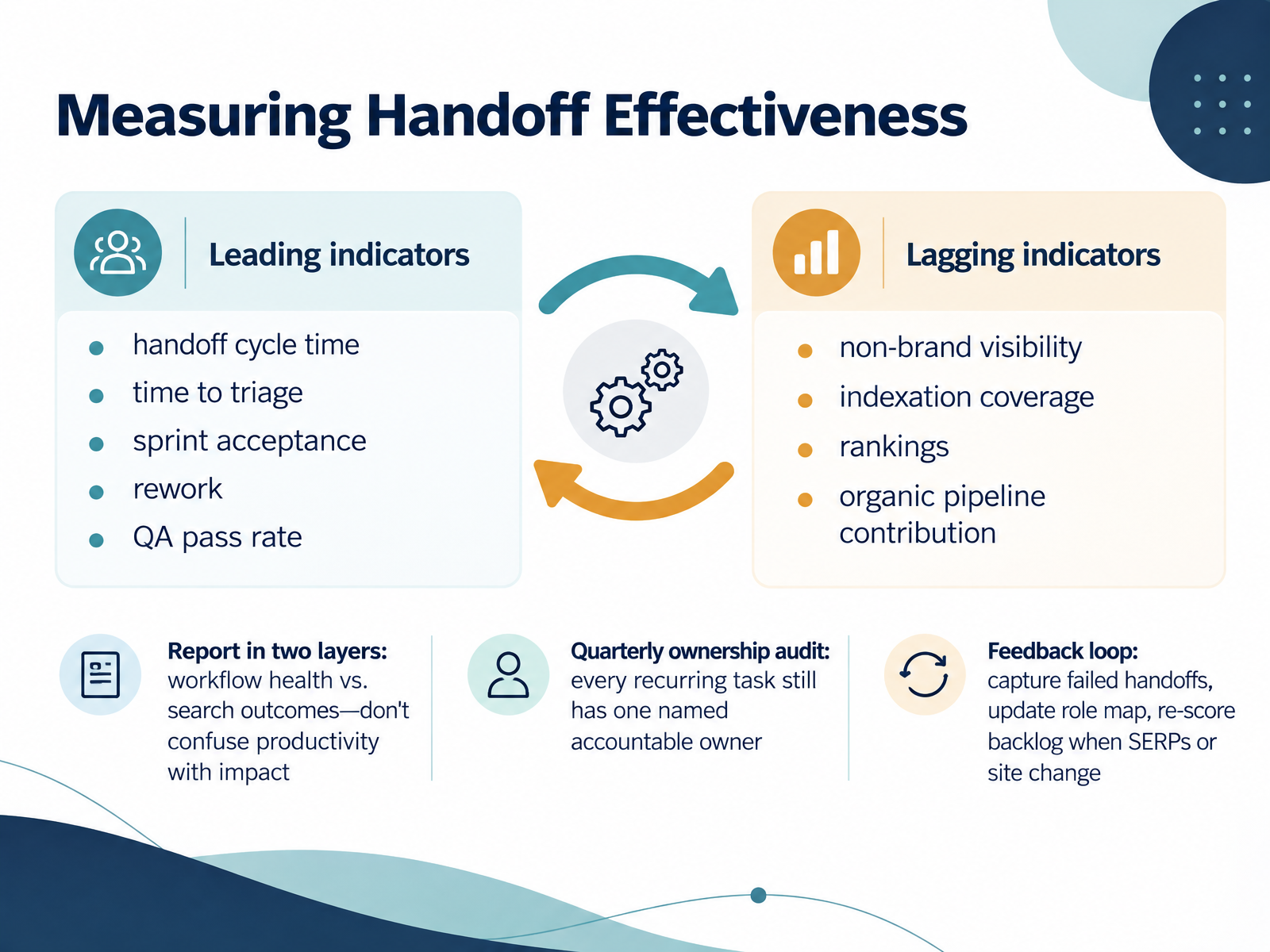
 - 11Measuring Handoff EffectivenessNow let's talk about measurement. Measure handoffs in two layers, and keep them separate. Layer one is workflow health: handoff cycle time, time to triage, sprint acceptance, rework, and QA pass rate. Layer two is search outcomes: non-brand visibility, indexation coverage, rankings, and organic pipeline contribution. Report both, but never confuse productivity with impact. A fast handoff that ships the wrong page is still a failed handoff. Once a quarter, run an ownership audit. Every recurring task should still have one named accountable owner. If a name is missing, that's your first fix. Then close the loop. Capture failed handoffs, whether it's a missing brief, a rejected ticket, or a launch that skipped SEO review. Update the role map. Re-score the backlog when search results or the site change. Confirm the owner before publishing, and log the handoff outcome. Workflow health tells you if the system is working. Search outcomes tell you if it's working on the right things. Next, we'll look at the common failure patterns to avoid.
 searchenginejournal.comsrnaseo.comdigitalsnowstorm.com+22 min
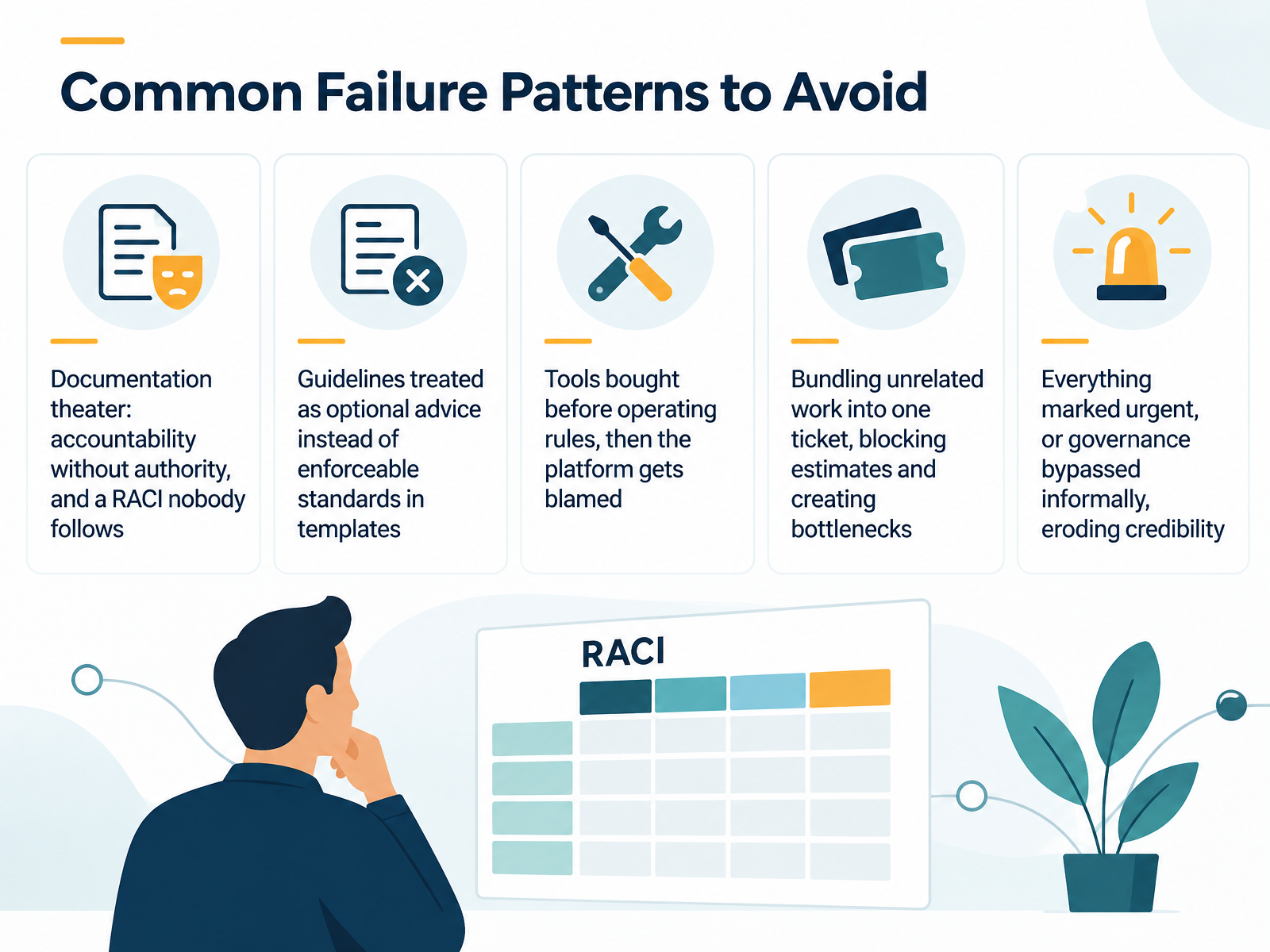
 - 12Common Failure Patterns to AvoidNow let's look at the failure patterns to avoid. First, documentation theater. That is accountability without authority, and a RACI nobody follows. If the governance lead owns the process but engineering does not have to listen, the document changes nothing. Confirm your accountable owner can approve sprint capacity before you publish anything. Second, guidelines treated as optional advice. If the brief template is a suggestion, writers skip it, and quality drifts. Make brief templates and metadata standards enforceable, so non-compliant pages cannot publish without a QA flag. Third, tools bought before operating rules. Then the platform gets blamed for a process problem. Define your canonical, schema, and ticket rules first. Fourth, bundling unrelated work into one ticket. A ticket covering canonicals, redirects, sitemap, and pagination will never get estimated. Split it, one problem per ticket. Fifth, everything marked urgent, or governance bypassed informally. Rank requests honestly, and route exceptions through a named approver with a time limit. Keep the rules few, enforced, and owned. Next, we move into the action plan for implementing clear SEO ownership.
 sitebulb.comthegray.companypatrickstox.com+22 min
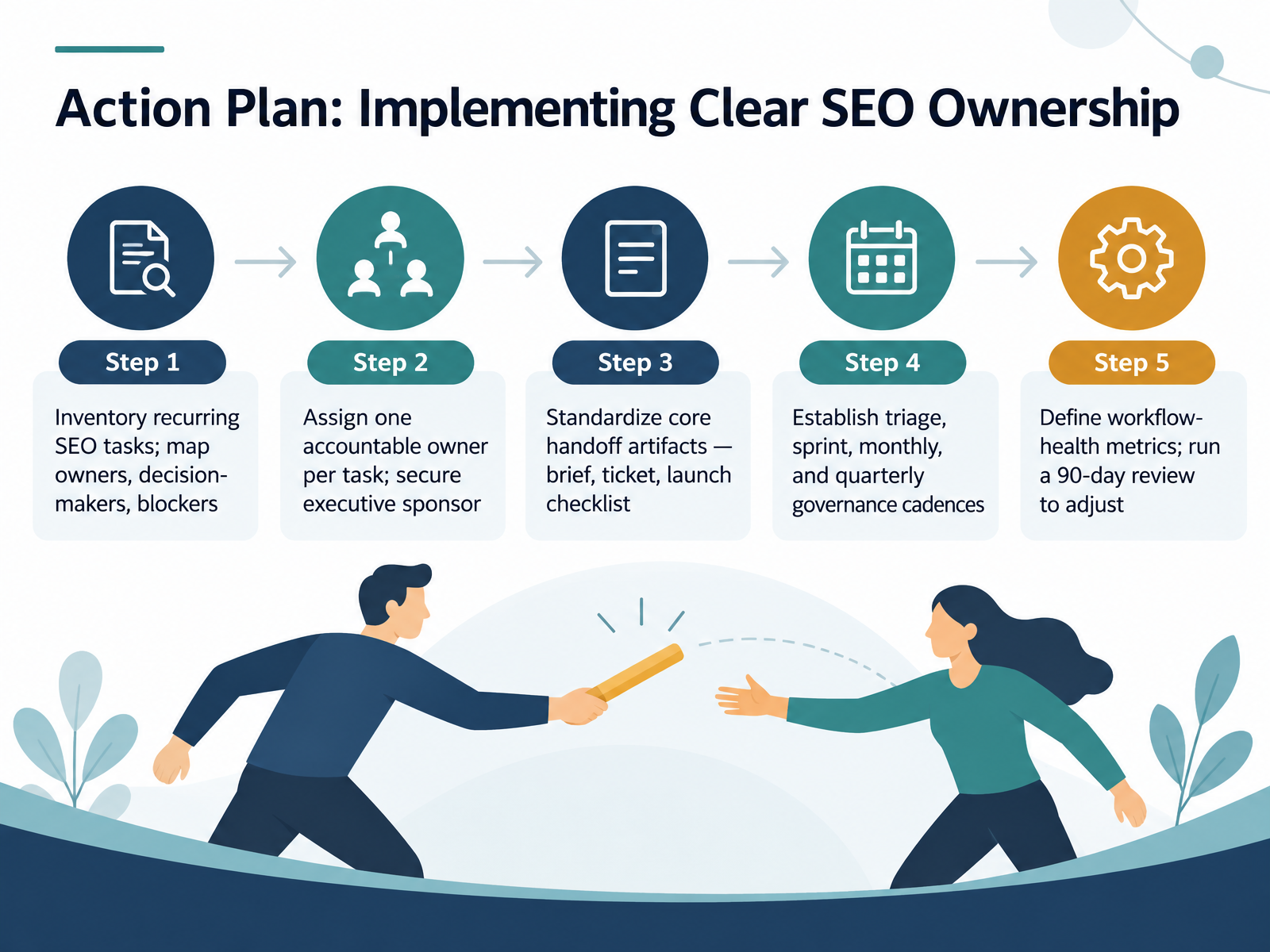
 - 13Action Plan: Implementing Clear SEO OwnershipLet's close with a practical action plan for implementing clear SEO ownership. Step one, inventory your recurring SEO tasks. For each one, map the owner, the decision-maker, and the common blockers. Step two, assign one accountable owner per task. Not a committee. One name. Then secure an executive sponsor who treats organic visibility as a business metric. Step three, standardize your core handoff artifacts. A content brief, a technical ticket, and a launch checklist should look the same every time. Confirm the owner before publishing. Step four, establish governance cadences. Triage weekly, sprints on your normal cycle, a monthly prioritization review, and a quarterly executive check. Step five, define workflow-health metrics like time to triage and implementation rate, then run a ninety-day review and adjust. To wrap up: ownership is the durable fix. You have the steps, so start with one task and one owner this week. Thank you, and go make ownership structural.
 searchenginejournal.comsrnaseo.comdigitalsnowstorm.com+21 min
Take the deck with you
Download this course as a file — free, no sign-up needed.
- PDF handoutEvery slide page, ready to print or share.14 pages · 2.8 MBDownload
- Narrated PowerPointThe deck that presents itself — every slide carries the digital human's narration video.14 pages · 14.0 MBDownload
- PowerPoint slidesThe full deck as a .pptx — open it in PowerPoint, Keynote, or Google Slides.14 pages · 2.7 MBDownload
Free to use in your own training — please keep the PersonWise credit page at the end.
Have your own deck? Turn it into a course
Sources consulted
Web sources consulted while building this course.
- Who Owns SEO In The Enterprise? The Accountability Gap That Kills Performance — searchenginejournal.com
- Enterprise SEO Operating Model: Build It Right or Pay the Price – SRNA SEO — srnaseo.com
- Enterprise SEO Management: Teams & Workflows | Digital Snowstorm — digitalsnowstorm.com
- How SEO Fails in Multi-Department Environments — johnpuno.com
- Enterprise SEO Strategy: Why Governance Matters More Than Tactics — wryveai.com
- Enterprise SEO Team Structure and Responsibilities — zxweb.eu
- Structuring an SEO Team: Roles, Responsibilities, and Hierarchy (2026 Guide) — seowebster.com
- Cross-Functional Enterprise SEO Audit Playbook — expertseo.uk
- What a modern SEO team looks like in 2026 | Pepper Content — pepper.inc
- Enterprise SEO Governance Tips for Growth-Stage Teams | Rule27 Design — rule27design.com
- How to Write THE Perfect SEO Ticket for Your Devs — sitebulb.com
- How to Write Engineering Tickets for SEO Work | Gray Dot Co — thegray.company
- Agile SEO — patrickstox.com
- How to Communicate SEO Changes to Developers | AAMAX — aamax.co
- Exactly How to Create SEO Content Briefs For Better Performing Content | Ten Speed — tenspeed.io
- SEO Priority: A Framework for B2B Marketing Teams | Ten Speed — tenspeed.io
- SEO Prioritization: A Scoring Framework for Shipping What Matters First | Spike — getspike.ai
- How to prioritize technical SEO fixes by business impact — searchengineland.com
- SEO Issue Prioritization Framework That Works | WhatSEO.ai — whatseo.ai
- Enterprise SEO Prioritization Matrix: Focus on What Moves the Needle | Hashmeta AI Marketing Blog — hashmeta.ai