Begin
14 pages · ~28 min
Cybersecurity Case Studies: Patterns & Tradeoffs
This training examines real-world cybersecurity case studies to help security professionals identify recurring attack patterns and evaluate defensive tradeoffs.
A digital instructor presents all 14 pages. Hold “Ask” at any point and ask out loud — the answer comes from this course. No sign-up needed.
What you’ll learn
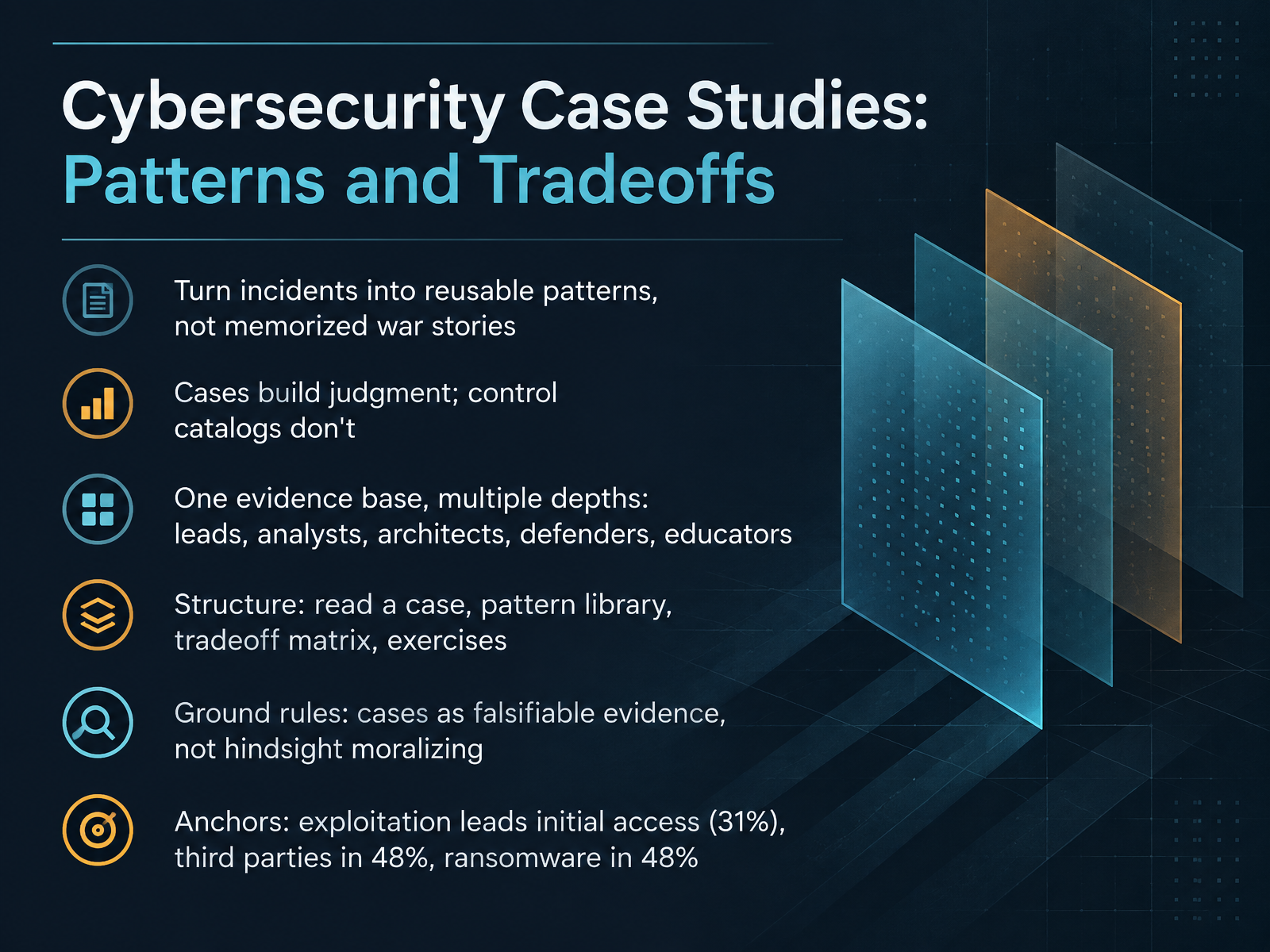
- 01Cybersecurity Case Studies: Patterns and TradeoffsWelcome. Over the next fourteen slides, we're going to treat incidents as reusable patterns, not as war stories you memorize and retell. Control catalogs tell you what to buy. Cases build the judgment you need when the situation is ambiguous and the clock is running. So we'll work from one evidence base, with multiple depths. Whether you lead a team, analyze alerts, design architecture, defend the perimeter, or teach this material, you should find a useful layer here. The structure is straightforward. We read a case, extract a pattern, place the tradeoffs in a matrix, then practice. Our ground rules matter. Cases are falsifiable evidence, not hindsight moralizing. Where the record is uncertain, we'll say so. Three anchors from the 2026 Verizon Data Breach Investigations Report frame the discussion. Exploitation of vulnerabilities is now the leading initial access vector, at thirty-one percent of breaches. Third-party involvement reached forty-eight percent. Ransomware also appears in forty-eight percent of confirmed breaches. Hold those numbers loosely, but hold them. Next, how to read a case study like a defensive practitioner.eclypsium.comeclypsium.comgreynoise.io+22 min
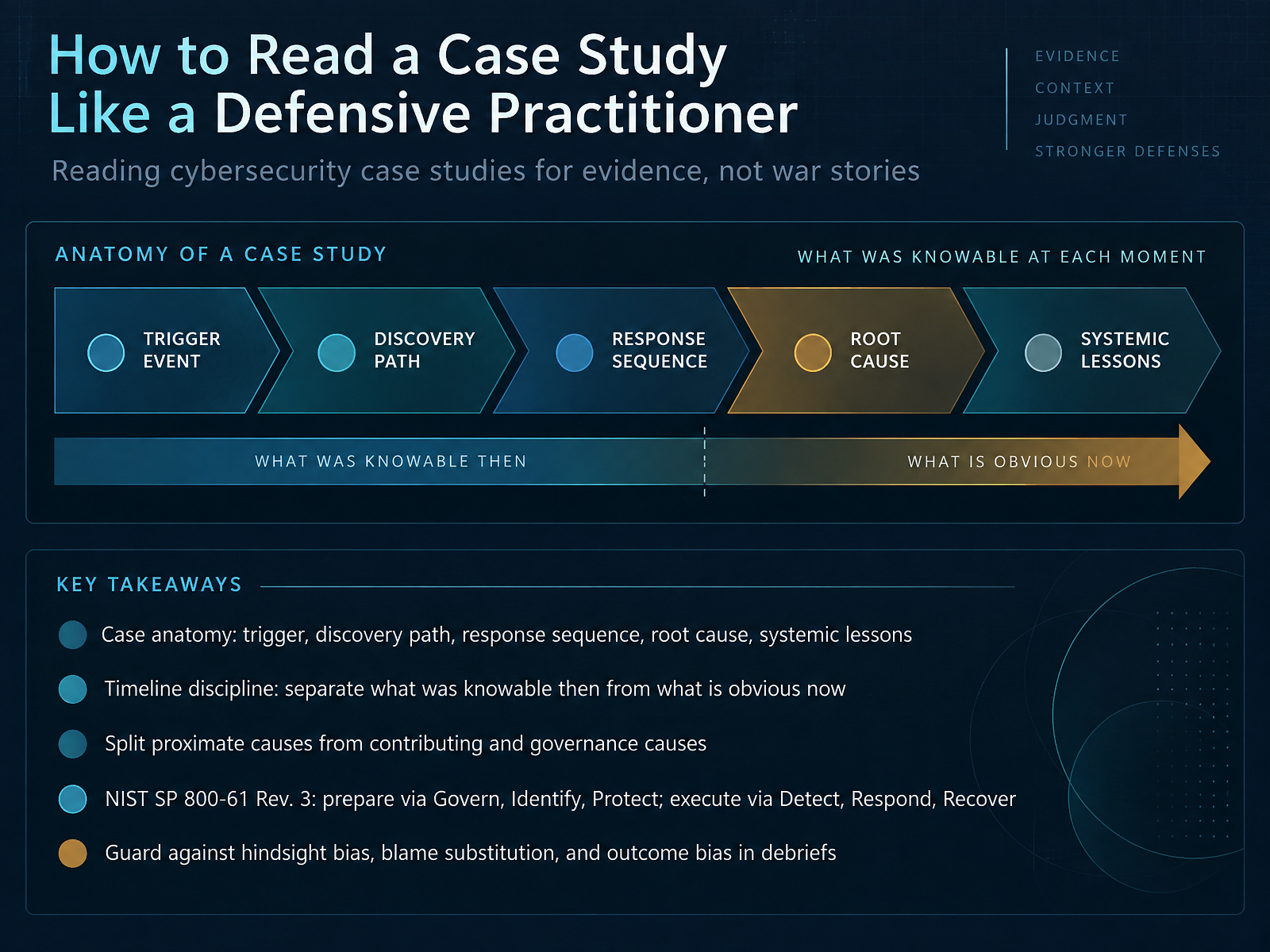
- 02How to Read a Case Study Like a Defensive PractitionerLet's talk about how to read a case study like a defensive practitioner. Read for evidence, not war stories. A useful case has a consistent anatomy: the trigger, the discovery path, the response sequence, the root cause, and the systemic lessons. Then apply timeline discipline. Separate what was knowable at the time from what is obvious now. That distinction matters, because decisions get made with incomplete information. Next, split proximate causes from contributing causes and governance causes. The proximate cause may be an unpatched server. The governance cause may be an exception process nobody owned. For structure, NIST SP 800-61 Revision 3 organizes preparation under Govern, Identify, and Protect, and execution under Detect, Respond, and Recover. In debriefs, guard against three traps: hindsight bias, blame substitution, and outcome bias. A messy response that worked is not automatically a good process. Path: Pattern: Initial Access and Attack Surface Concentration.
 csrc.nist.govnvlpubs.nist.govinsideprivacy.com+22 min
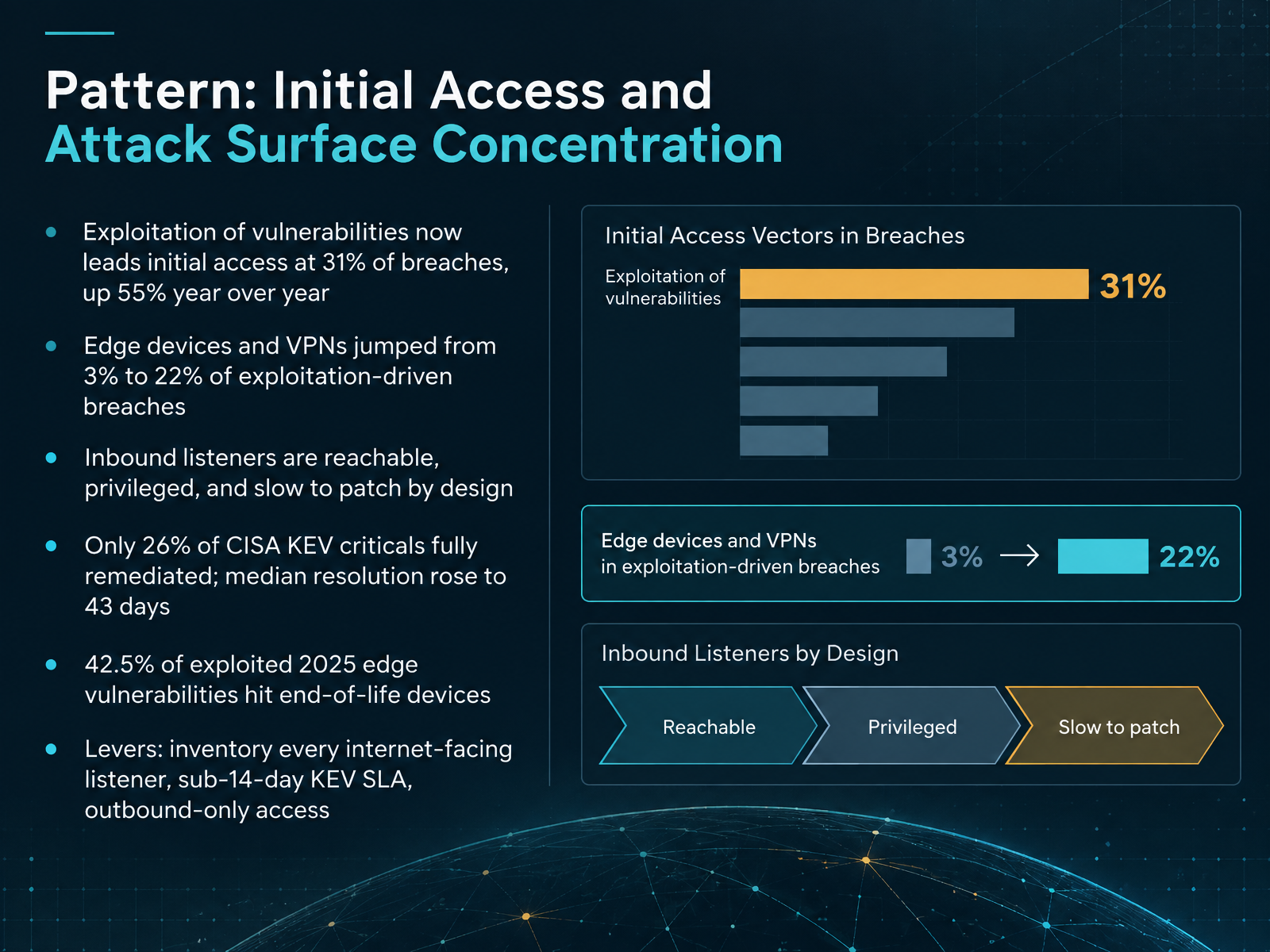
- 03Pattern: Initial Access and Attack Surface ConcentrationLet's look at the first pattern: initial access and attack surface concentration. Exploitation of vulnerabilities is now the leading known initial access vector, at thirty-one percent of breaches, up fifty-five percent year over year. Edge devices and VPNs jumped from three to twenty-two percent of exploitation-driven breaches. That shift matters because of three design properties. Inbound listeners are reachable, privileged, and slow to patch, all by design. Patching a VPN gateway means downtime for every remote worker behind it, so change windows get negotiated, not scheduled. Remediation data reflects that friction. Only twenty-six percent of CISA KEV criticals were fully remediated, and median resolution rose to forty-three days. Forty-two and a half percent of exploited 2025 edge vulnerabilities hit end-of-life devices. Botnets disproportionately target that unsupported gear. So the levers are concrete. Inventory every internet-facing listener. Hold a sub-fourteen-day KEV service level agreement on those assets. And where you can, move toward outbound-only access, so there is no inbound portal to scan or exploit. Next, we look at what happens after that foothold: pattern, detection gaps and visibility tradeoffs.
 eclypsium.comeclypsium.comgreynoise.io+22 min
- 04Pattern: Detection Gaps and Visibility TradeoffsLet's look at detection gaps and the visibility tradeoffs behind them.
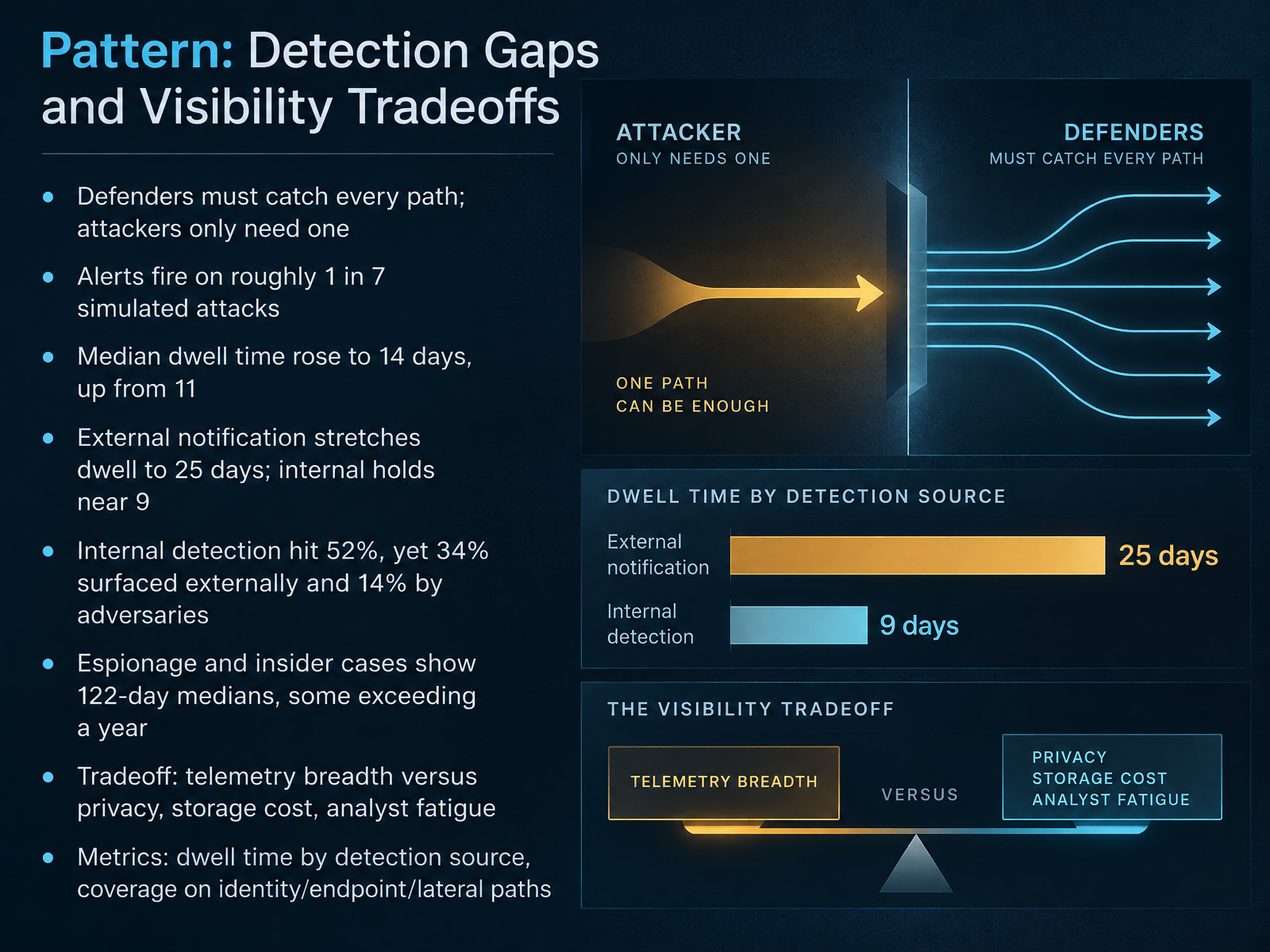
Defenders have to catch every path. An attacker only needs one. That asymmetry shows up in the numbers. Independent simulation data puts alerting at roughly one in seven attacks, about fourteen percent. Prevention held near sixty-two percent. So many intrusions simply never generate a signal.
That matches what we see in dwell time. The global median rose to fourteen days, up from eleven. But the average hides the useful part, which is who found it. When your own team detected the intrusion, the median stayed near nine days. When an external party had to call, it stretched to twenty-five days. Internal detection reached fifty-two percent. Still, thirty-four percent surfaced externally, and fourteen percent came from the adversaries themselves. Espionage and insider cases ran a median of one hundred twenty-two days, some past a year.
Here is the tradeoff. Telemetry breadth buys coverage, but it costs privacy, storage, and analyst attention. More logs do not automatically mean more detection.
So track dwell time by detection source, and coverage on the identity, endpoint, and lateral movement paths.
Next, a case that shows what happens when logging stops too early. Case: A Single Edge Appliance to Domain Control.
 services.google.comstudylib.netstingrai.io+22 min
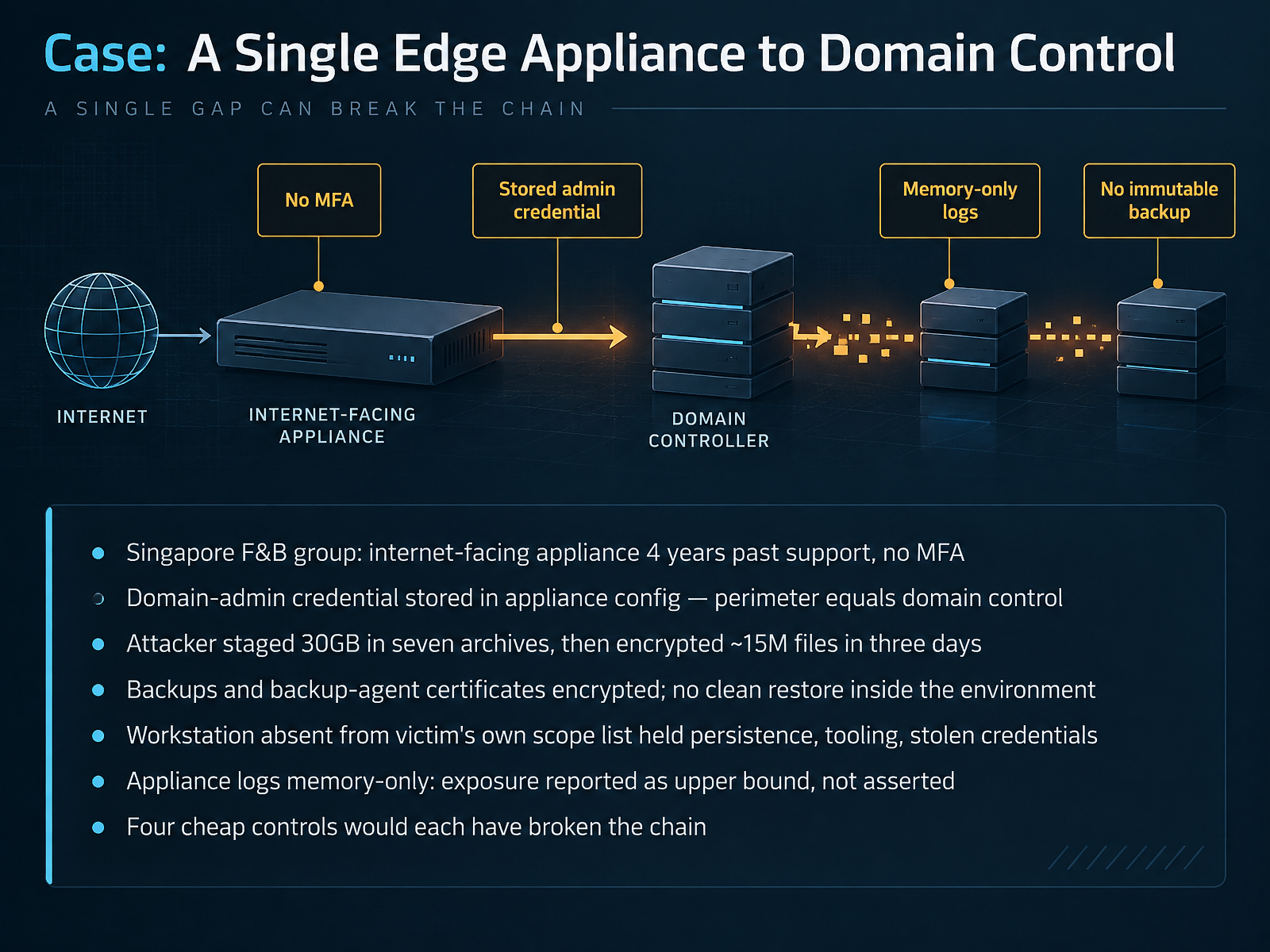
- 05Case: A Single Edge Appliance to Domain ControlNow let's walk through a case that shows how a perimeter device becomes domain control. A Singapore food and beverage group had one internet-facing appliance sitting between the public internet and everything else. Its firmware was more than four years past end of support, and no account on it demanded a second factor. The real problem was what the device stored: a domain administrator credential, in its configuration. So reaching the perimeter meant controlling the domain. The attacker worked for the rest of the week, staging thirty gigabytes into seven archives, then encrypted almost fifteen million files across five systems in three days. The backups went too, along with the certificates the backup agent needed, so there was no clean restore inside the environment. One machine the group didn't even list as affected still held the attacker's persistence, tooling, and stolen credentials. And the appliance logged to memory only, so the team reported the exposure as an upper bound, not a confirmed fact. Four cheap controls would each have broken the chain: multi-factor authentication, a low-privilege directory account, external log collection, and one immutable backup. Next, we'll look at patterns in lateral movement, identity, and segmentation tradeoffs.
 massivegrid.comstonefly.comhcinnovationgroup.com+22 min
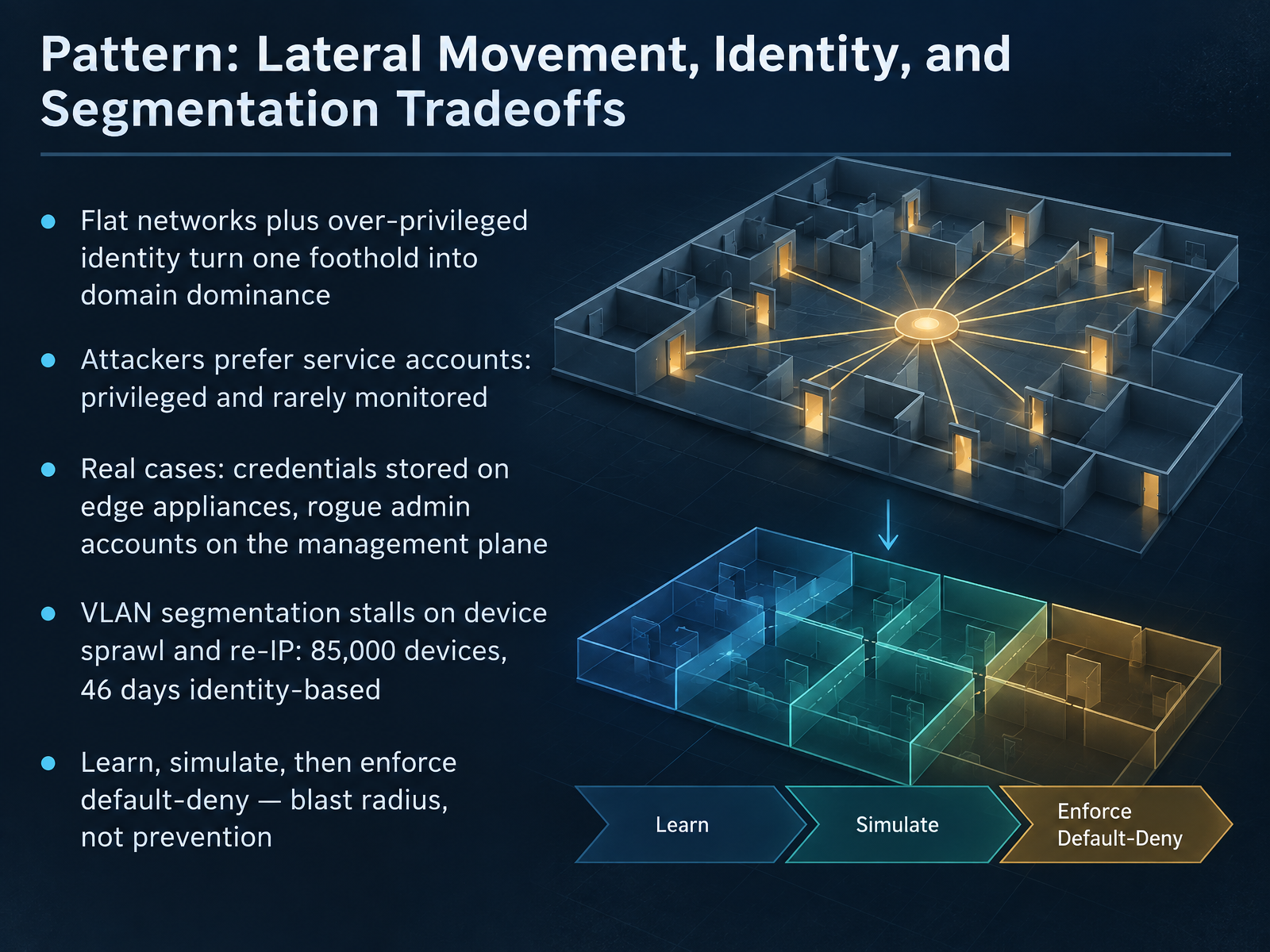
- 06Pattern: Lateral Movement, Identity, and Segmentation TradeoffsThis pattern shows up in nearly every large breach: lateral movement, identity, and segmentation, all pulling against each other. A flat network plus over-privileged identity turns one foothold into domain dominance. Attackers know this. They prefer service accounts, because those are privileged and rarely monitored. In one manufacturing case, compromised admin and service credentials drove a large-scale push toward the domain controller. In another, real intrusions reached the management plane of edge appliances and created rogue admin accounts, pulling stored credentials off the device. Segmentation helps, but it stalls. VLAN approaches hit device sprawl and re-IP work. One health system had eighty-five thousand devices, and finished its major segmentation in about forty-six days using identity-based policy instead. So the sequence is learn, simulate, then enforce default-deny. You are not preventing every intrusion. You are deciding how far it can travel. Next, we look at supply chain and third-party trust amplification.
 eclypsium.comeclypsium.comgreynoise.io+22 min
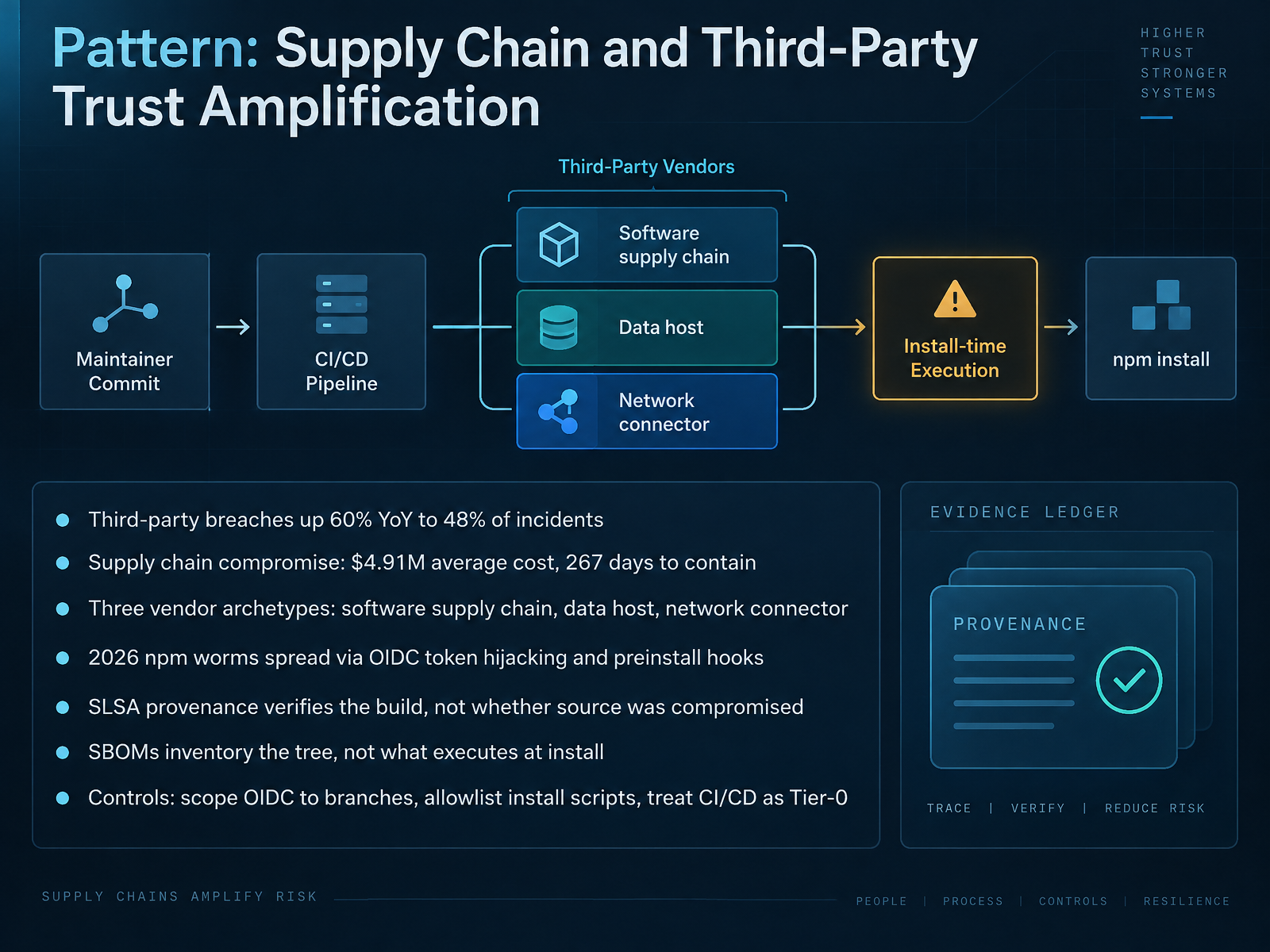
- 07Pattern: Supply Chain and Third-Party Trust AmplificationLet's look at supply chain risk, and why third party trust amplifies it. The numbers shifted hard. Third party involvement in breaches rose sixty percent year over year, reaching forty eight percent of incidents. A supply chain compromise now costs about four point nine one million dollars on average, and takes two hundred sixty seven days to identify and contain. Consider three vendor archetypes. A software supply chain vendor inserts code you run. A data host holds your data. A network connector links into your environment. Each fails differently. In twenty twenty six, npm worms spread through hijacked OIDC tokens and preinstall hooks. Here is the uncomfortable part. SLSA provenance verifies the build, not whether the source was compromised. A malicious commit built by a legitimate pipeline carries a valid attestation. SBOMs have the same boundary. They inventory the tree, not what executes at install. So what holds? Scope OIDC trust to specific protected branches. Allowlist install scripts rather than running every lifecycle hook. And treat CI CD as Tier zero, because it now holds your publishing identity. Next, Case: When the Recovery Plan Becomes the Attack Surface.
 eclypsium.comeclypsium.comgreynoise.io+22 min
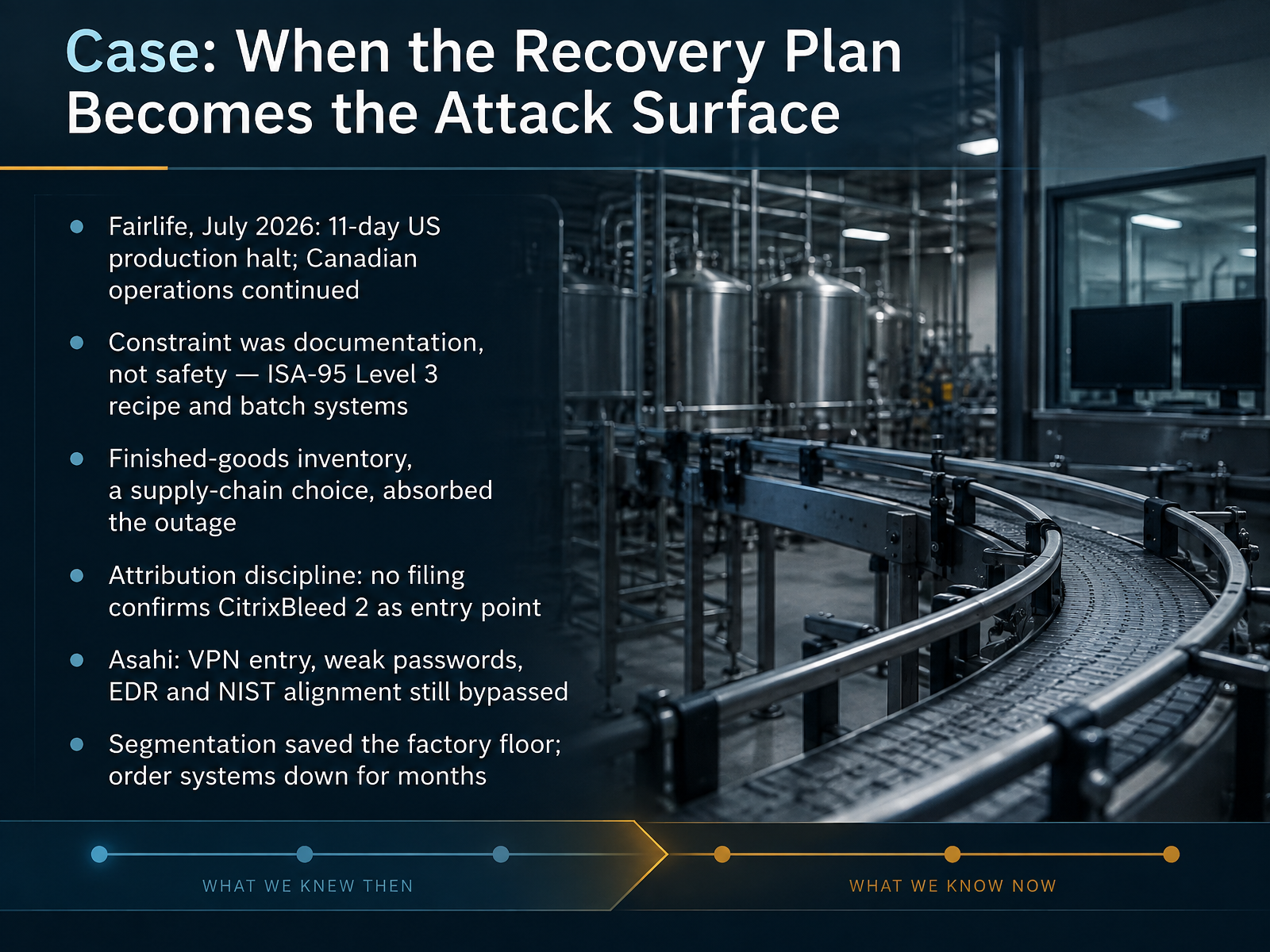
- 08Case: When the Recovery Plan Becomes the Attack SurfaceLet's look at a case where the recovery plan itself became the attack surface. Fairlife, July 2026. An eleven-day halt across United States production, while Canadian operations kept running. The binding constraint was documentation, not safety. ISA-95 Level 3 recipe and batch systems hold the records that make product lawful to ship. Lose them, and the milk is fine but undocumentable. Finished-goods inventory, a supply-chain choice rather than a security control, absorbed the outage. Now, attribution discipline. No filing confirms CitrixBleed two as the entry point. Treat that claim as unverified. Compare Asahi: VPN entry, weak internal passwords. They had EDR and NIST alignment, and the attack still bypassed both. One thing held. Network segmentation saved the factory floor. Production resumed in three days. Order systems stayed down for months. So the tradeoff: recovery depends on systems you may not have mapped. Know what connects to what before you need it.
 2 min
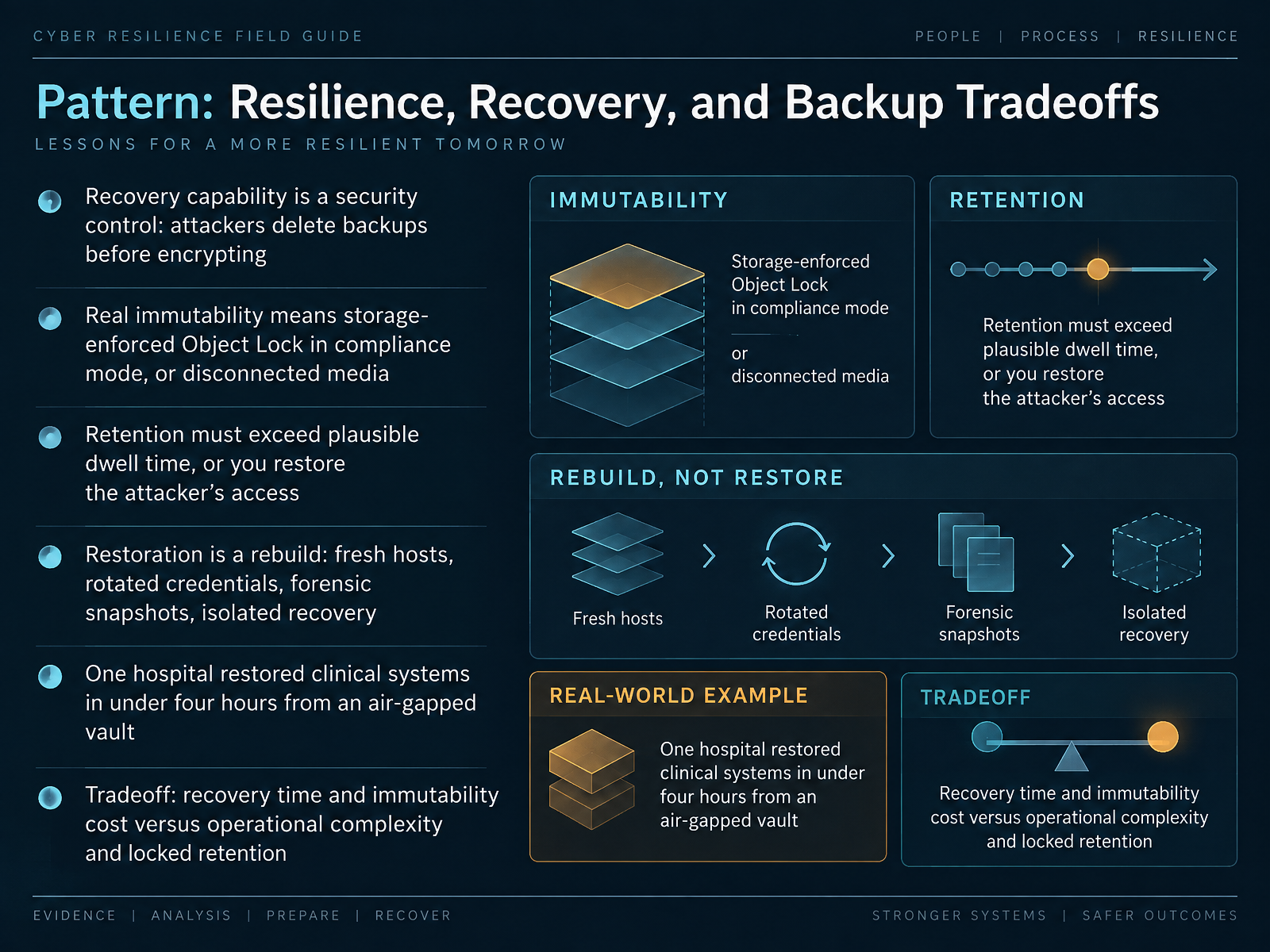
- 09Pattern: Resilience, Recovery, and Backup TradeoffsNow let's look at the resilience pattern. Recovery capability is a security control. Attackers delete backups before they encrypt. So ask directly, does a copy exist that an attacker holding your domain administrator credentials cannot reach or delete? Real immutability means storage-enforced Object Lock in compliance mode, or genuinely disconnected media. Governance mode is not enough. It can be switched off. Then retention. Crews often dwell for weeks. If your retention is seven days and the intrusion began three weeks ago, every backup you hold was taken while the environment was already compromised. Restoring it restores the attacker's access. That is the tradeoff. Longer retention and immutability cost more and lock you in, but they buy a way back. Restoration is a rebuild. Fresh hosts, rotated credentials, forensic snapshots taken before recovery, and an isolated environment. One hospital restored clinical systems in under four hours from an air-gapped vault, with a copy timestamped fifty-eight minutes before the payload ran. Next, we move to the economic side. Case: Manufacturing Downtime as Economic Weapon.
 massivegrid.comstonefly.comhcinnovationgroup.com+22 min
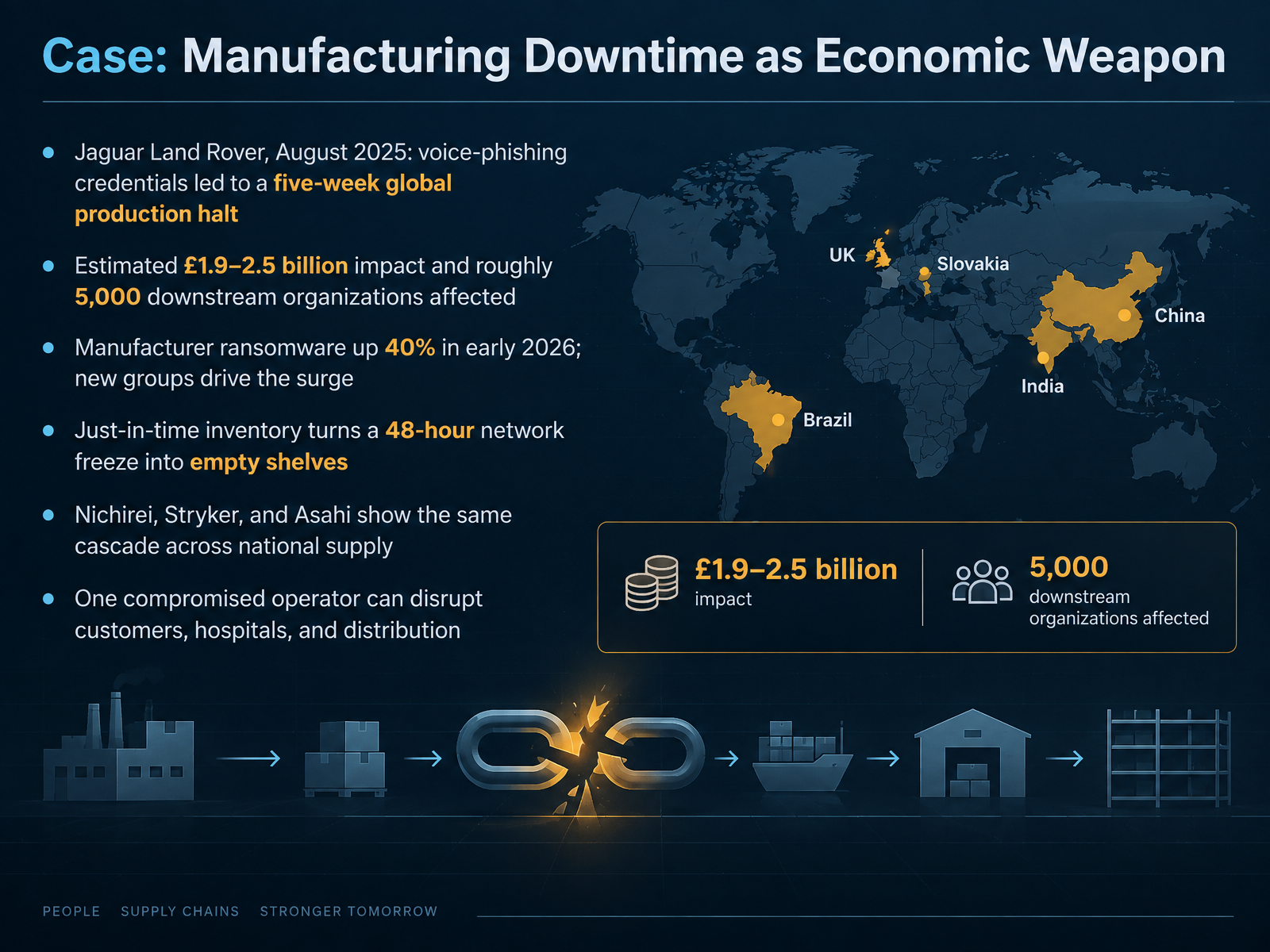
- 10Case: Manufacturing Downtime as Economic WeaponLet's walk through a case where downtime itself became the weapon. In August 2025, attackers used voice phishing to steal employee credentials from Jaguar Land Rover. That single foothold froze global production for five weeks. The UK Cyber Monitoring Centre put the economic impact between one point nine and two point five billion pounds, and roughly five thousand downstream organizations were affected. Here is the tradeoff. Just-in-time inventory keeps costs low and buffers thin. So a forty-eight hour network freeze becomes empty shelves almost immediately. The same cascade shows up elsewhere. Nichirei disrupted frozen food deliveries to about five thousand customers. Stryker's wiper attack halted manufacturing across seventy-nine countries. Asahi took a nine-month revenue hit after a VPN device was breached. Manufacturer ransomware rose forty percent in early 2026, driven largely by new groups. The takeaway is uncomfortable but clear. One compromised operator can disrupt customers, hospitals, and distribution far beyond your own walls. So treat recovery time and buffer inventory as security decisions, not just operational ones. Next, we look at the pattern behind these failures: governance, incentives, and accountability.
 2 min
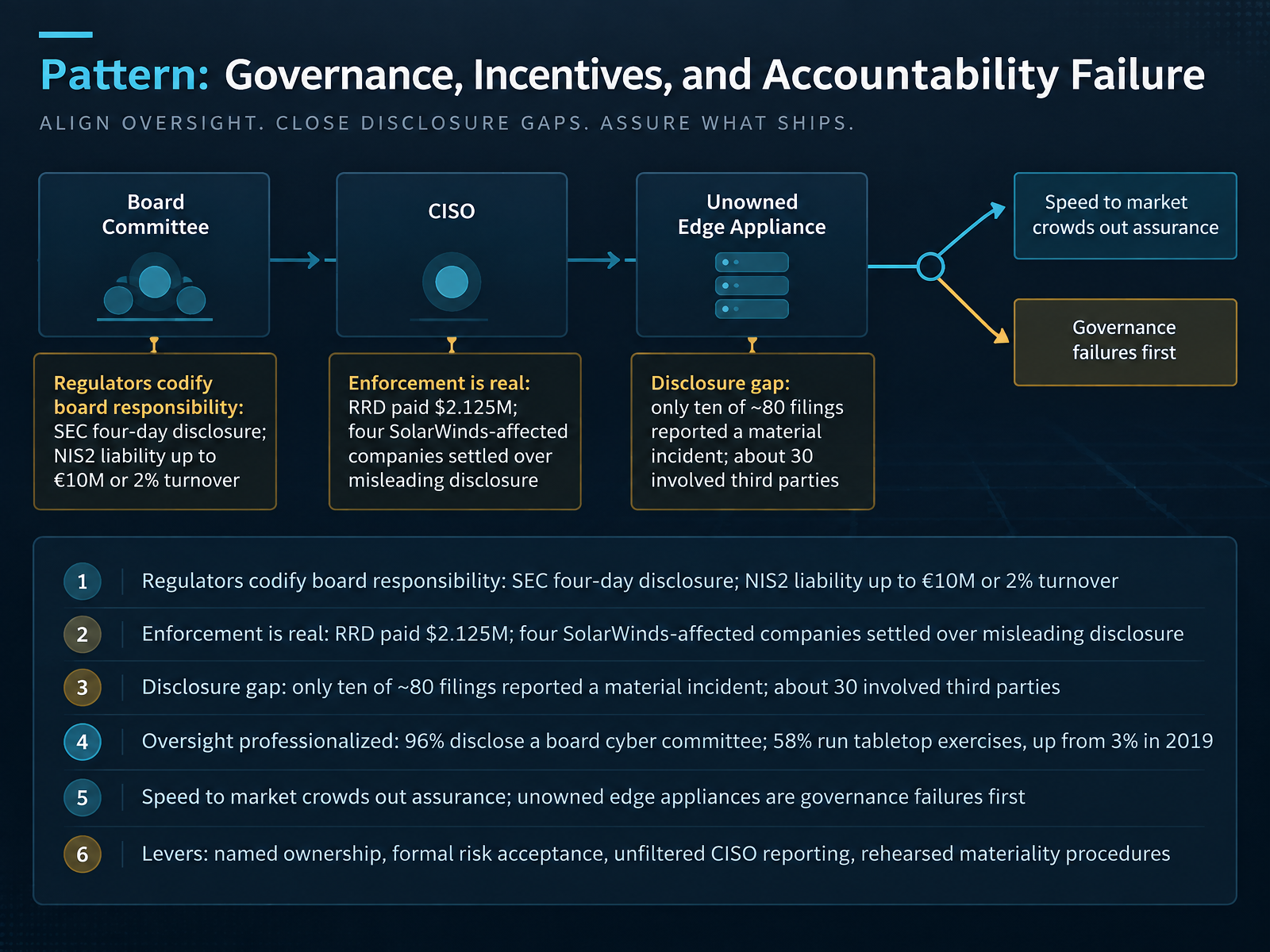
- 11Pattern: Governance, Incentives, and Accountability FailureNow let's look at the governance failure pattern. Regulators have codified board responsibility. The SEC requires disclosure of material incidents within four business days. Europe's NIS2 can impose liability up to ten million euros or two percent of global turnover. Enforcement is real. R.R. Donnelley paid two point one two five million dollars. Four SolarWinds-affected companies settled over misleading disclosure. But note the disclosure gap. In a survey of about eighty filings, only ten reported a material incident. Roughly thirty involved third parties. Where does that leave oversight? Ninety-six percent of large caps now disclose a board cyber committee. Fifty-eight percent run tabletop exercises, up from three percent in twenty nineteen. Yet speed to market still crowds out assurance. An unowned edge appliance is a governance failure first, not a technical one. The levers are named ownership, formal risk acceptance, unfiltered CISO reporting, and rehearsed materiality procedures. Next, we'll work through the tradeoff matrix for choosing under uncertainty.
 csrc.nist.govnvlpubs.nist.govinsideprivacy.com+22 min
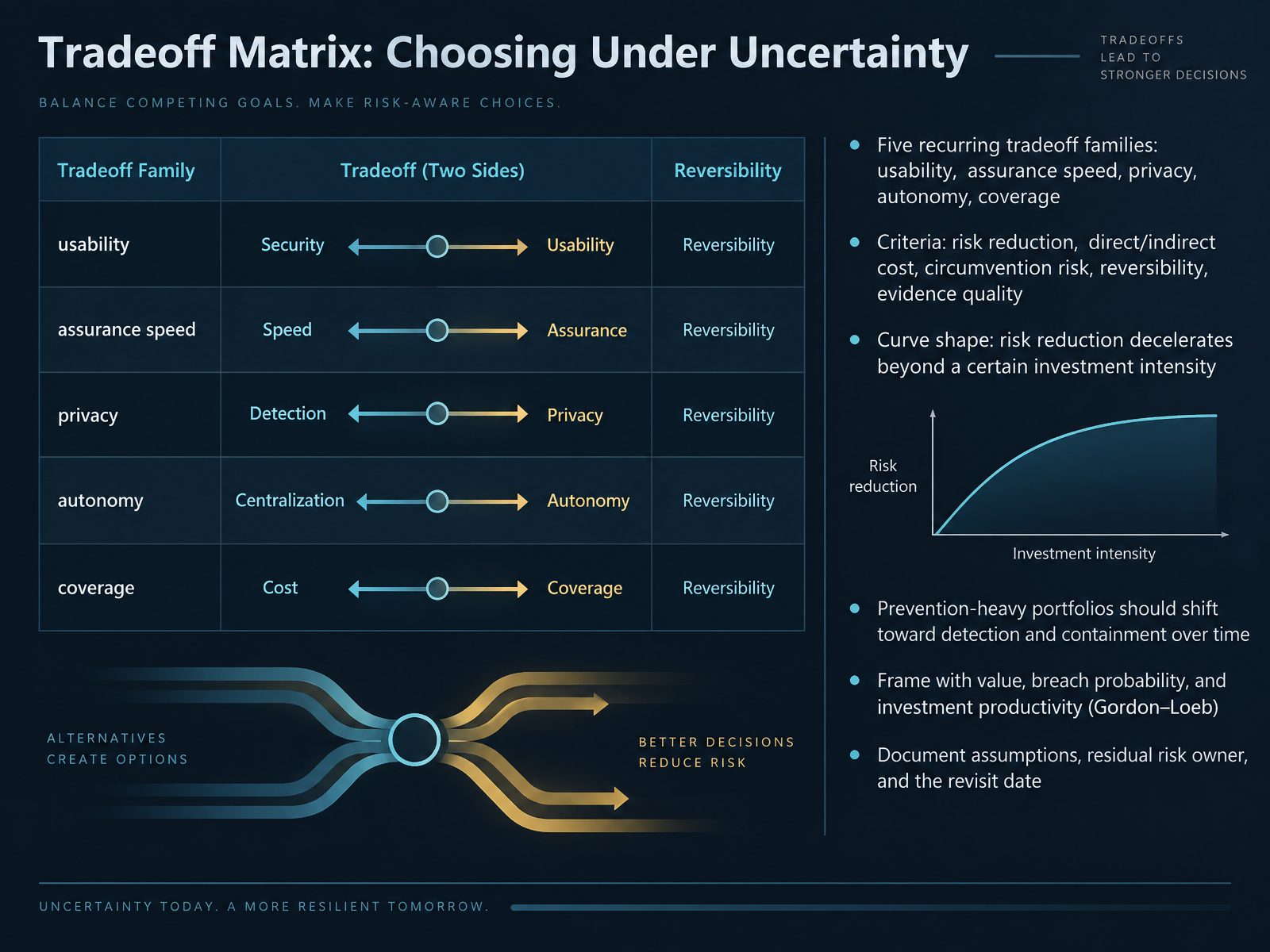
- 12Tradeoff Matrix: Choosing Under UncertaintyNow let's put the pieces together into a tradeoff matrix. Five families recur across these cases: usability, assurance speed, privacy, autonomy, and coverage. Evaluate each option against risk reduction, direct and indirect cost, circumvention risk, reversibility, and evidence quality. Here's a pattern worth remembering. Risk reduction decelerates beyond a certain investment intensity. Spending more does not linearly buy more safety. Prevention-heavy portfolios should shift toward detection and containment over time. Frame the decision with value, breach probability, and investment productivity, in the Gordon-Loeb tradition. Then document three things: your assumptions, the residual risk owner, and the revisit date. One caution. The numbers are estimates. Name the uncertainty rather than hiding it.
 1 min
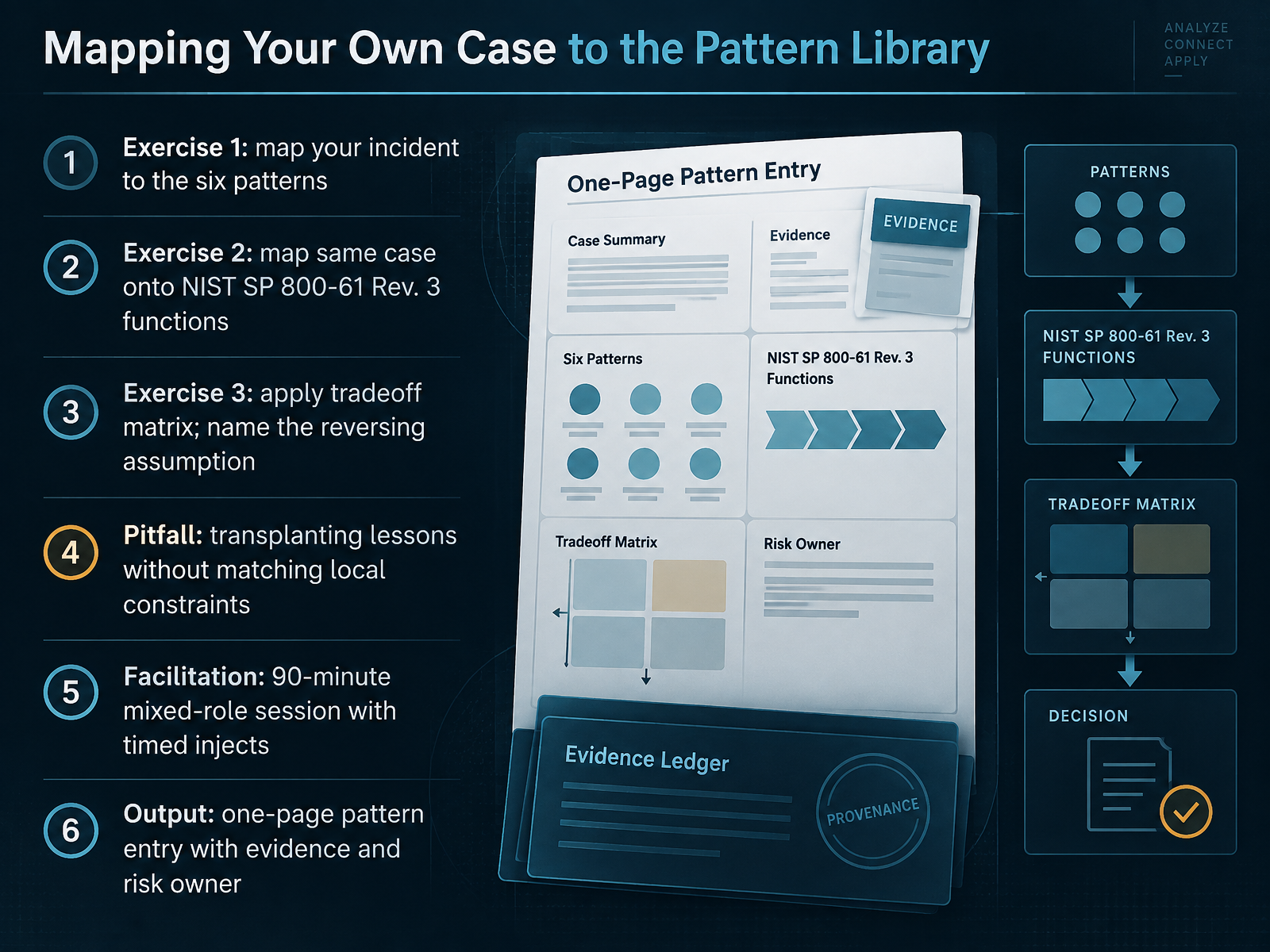
- 13Mapping Your Own Case to the Pattern LibraryNow let's map your own case onto the patterns. Three exercises. First, take a real incident and assign it to one of the six patterns. Second, map that same case onto the NIST SP 800-61 Revision 3 functions: Govern, Identify, Protect, Detect, Respond, Recover. You'll notice where your evidence is thin.
Third, apply the tradeoff matrix, and name the reversing assumption, the condition that would flip your decision. That's the part teams skip.
One pitfall: transplanting lessons without matching local constraints. A playbook built for one jurisdiction or scale may not hold in yours. Evidence and risk owner both matter.
Facilitation runs ninety minutes, mixed roles, with timed injects. Output is a one-page pattern entry with evidence and a named risk owner.
From patterns to practice: takeaways and an action list.
 csrc.nist.govnvlpubs.nist.govinsideprivacy.com+22 min
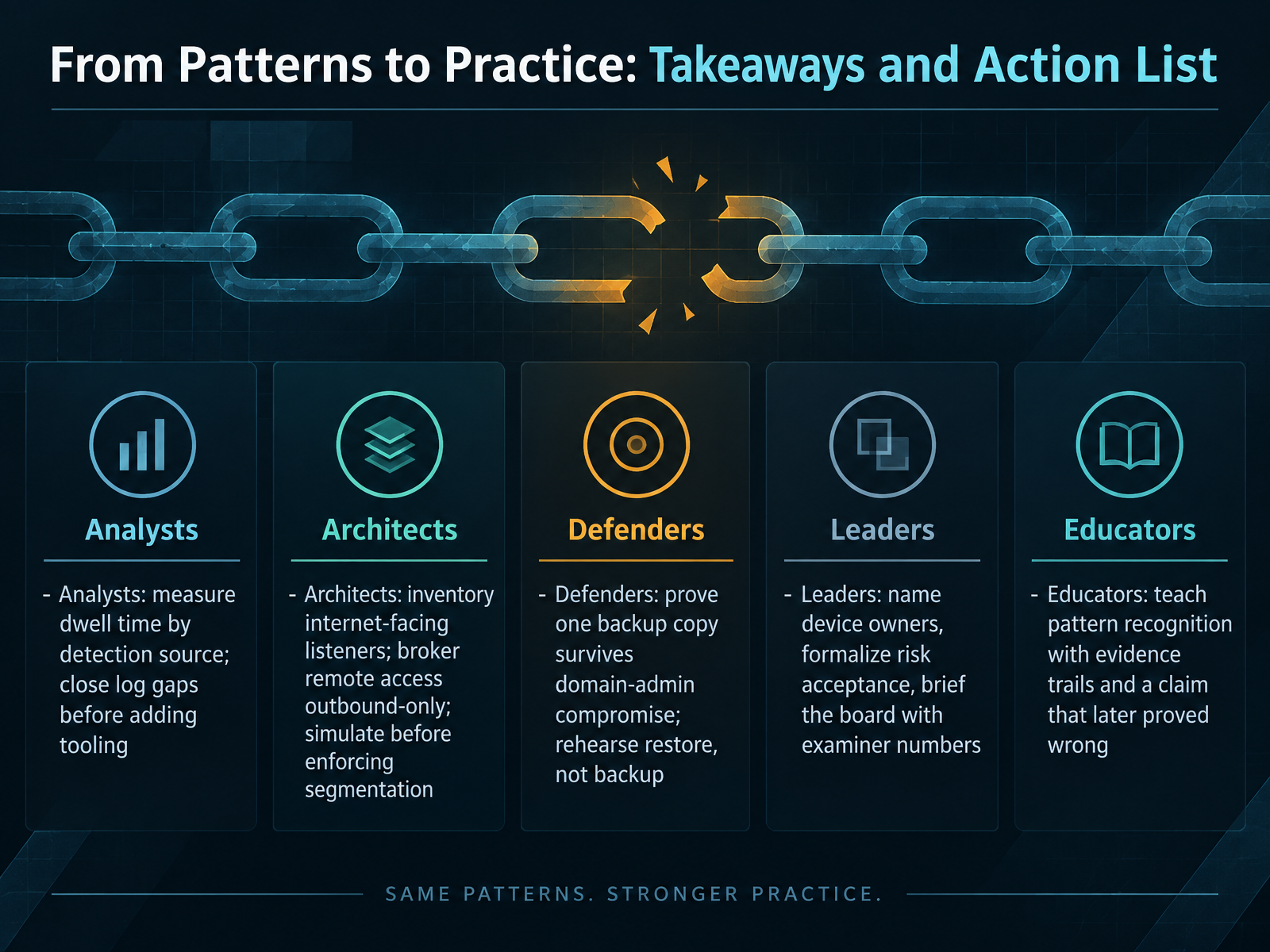
- 14From Patterns to Practice: Takeaways and Action ListSo let us close by turning patterns into practice. The data points one direction: exploitation of vulnerabilities now leads initial access, edge devices went from three percent to twenty-two percent of exploitation breaches, and median dwell time rose to fourteen days, with externally notified cases at twenty-five. That is the backdrop for these actions. Analysts, measure dwell time by detection source, and close log gaps before adding tooling. Architects, inventory your internet-facing listeners, broker remote access outbound-only, and simulate segmentation before enforcing it. Defenders, prove one backup copy survives domain-admin compromise, and rehearse restore, not backup. Leaders, name device owners, formalize risk acceptance, and brief the board with examiner numbers. Educators, teach pattern recognition through evidence trails, including a claim that later proved wrong. One caution: dwell time and cost lifecycle figures measure different things, so do not blend them. Pick one line from each role this week and assign an owner. Thank you for your attention, and good luck putting these patterns to work.
 eclypsium.comeclypsium.comgreynoise.io+22 min
Take the deck with you
Download this course as a file — free, no sign-up needed.
- PDF handoutEvery slide page, ready to print or share.15 pages · 3.7 MBDownload
- Narrated PowerPointThe deck that presents itself — every slide carries the digital human's narration video.15 pages · 15.3 MBDownload
- PowerPoint slidesThe full deck as a .pptx — open it in PowerPoint, Keynote, or Google Slides.15 pages · 3.6 MBDownload
Free to use in your own training — please keep the PersonWise credit page at the end.
Have your own deck? Turn it into a course
Sources consulted
Web sources consulted while building this course.
- Verizon DBIR 2026: Network Asset Attacks Up 3x. - Eclypsium | Supply Chain Security for the Modern Enterprise — eclypsium.com
- Verizon DBIR 2025 Key Stats for Network Defenders - Eclypsium | Supply Chain Security for the Modern Enterprise — eclypsium.com
- 2026 State of the Edge Report — greynoise.io
- Supply Chain Attack Statistics for 2026: Third-Party Breaches, Open Source Malware, and the New Cost of Trust | Swif — swif.ai
- Exploring the — wwv.vulncheck.com
- SP 800-61 Rev. 3, Incident Response Recommendations and Considerations for Cybersecurity Risk Management: A CSF 2.0 Community Profile | CSRC — csrc.nist.gov
- Incident Response Recommendations and Considerations for Cybersecurity Risk Management: A CSF 2.0 Community Profile — nvlpubs.nist.gov
- NIST Publishes Updated Incident Response Recommendations and Considerations | Inside Privacy — insideprivacy.com
- Incident Response Plan (IRP): Steps, Framework 2026 — deepstrike.io
- SP 800-61 Rev. 3, Incident Response Recommendations and Considerations for Cybersecurity Risk Management: A CSF 2.0 Community Profile | CSRC — csrc.nist.gov
- Mandiant — services.google.com
- M-Trends 2026: Cybersecurity Threat Report — studylib.net
- Red Team Detection Benchmarks 2026: SOC Detection Rates — stingrai.io
- Cost of a Data Breach Report 2026 — www-api.ibm.com
- The Progress We Thought We Were Making Against Hackers? It Just Went Backward. — johnzblack.com
- Immutable Backups and Ransomware Recovery | MassiveGRID — massivegrid.com
- Hospital Recovers From Ransomware Attack In 4 Hours | StoneFly — stonefly.com
- LockBit Took Down UHSP’s Systems. Its Backups Brought Them Back | HCI Innovation Group — hcinnovationgroup.com
- NightSpire Ransomware: Singapore F&B Group Case Study | Blackpanda — blackpanda.com
- Lessons From the Field: Recovering From a .Play Cryptolocker Attack in Phoenix - BVA Technology Services — bvainc.com