Begin
14 pages · ~28 min
Generative AI vs Machine Learning: Key Differences
This training explains the differences, tradeoffs, and use cases of generative AI versus machine learning, helping professionals choose the right approach for their projects.
A digital instructor presents all 14 pages. Hold “Ask” at any point and ask out loud — the answer comes from this course. No sign-up needed.
What you’ll learn
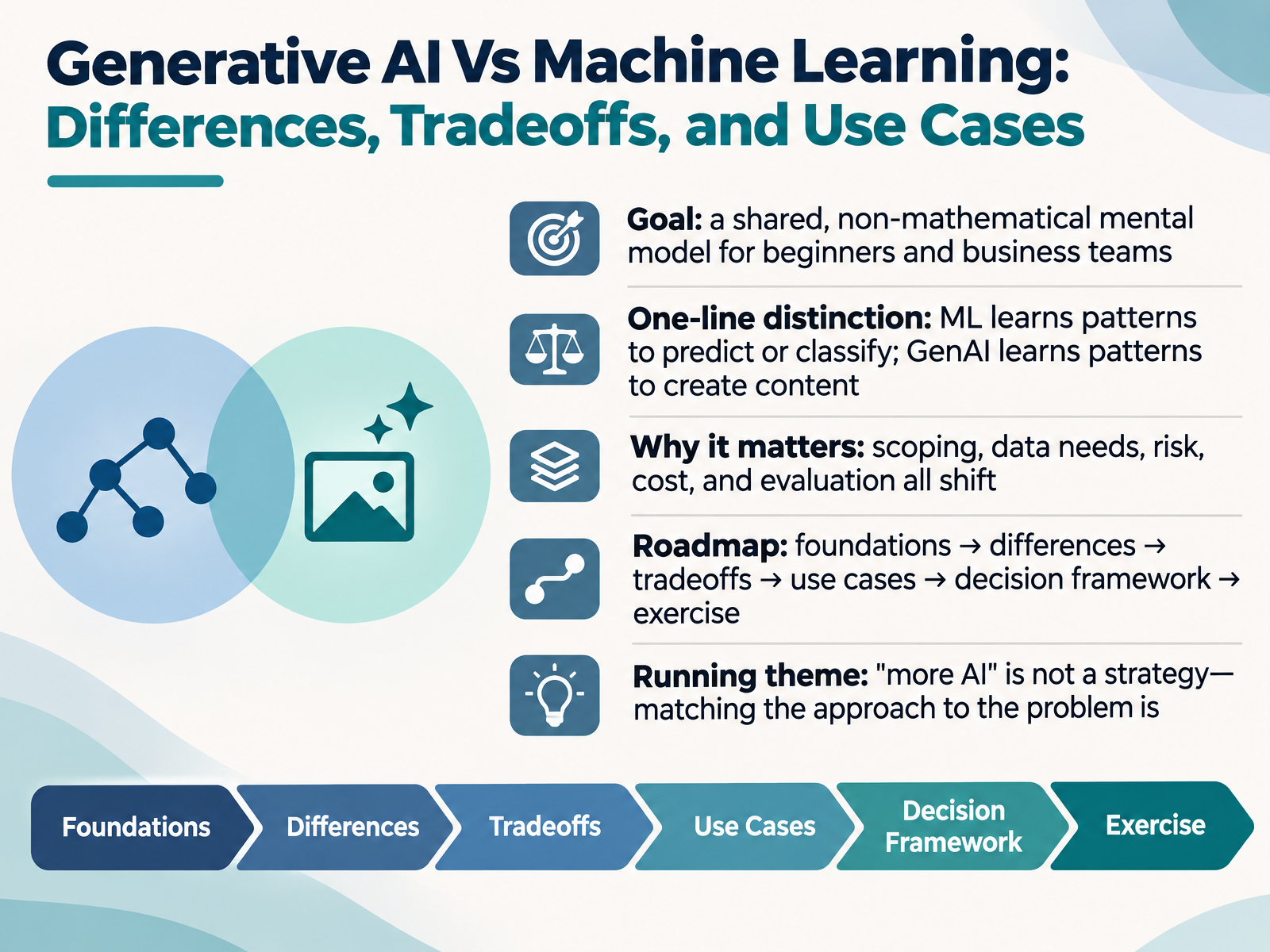
- 01Generative AI Vs Machine Learning: Differences, Tradeoffs, and Use CasesWelcome. In the next few minutes, we'll build one shared mental model you can use with your team, no math background needed. Here is the one-line distinction to hold onto. Machine learning learns patterns to predict or classify, like flagging which invoices are likely to be late. Generative AI learns patterns to create content, like drafting the reminder email itself. That difference is not academic. It shifts how you scope a project, how much and what kind of data you need, where the risks sit, what it costs to run, and how you evaluate whether it works. We'll move through foundations, differences, tradeoffs, use cases, and a simple decision framework, then a short exercise. Our running theme is this. More AI is not a strategy. Matching the approach to the problem is. As you go through this course, keep one real use case from your own work in mind, and test each idea against it. Up next, why this distinction matters now.ey.comdataiku.comey.com+22 min
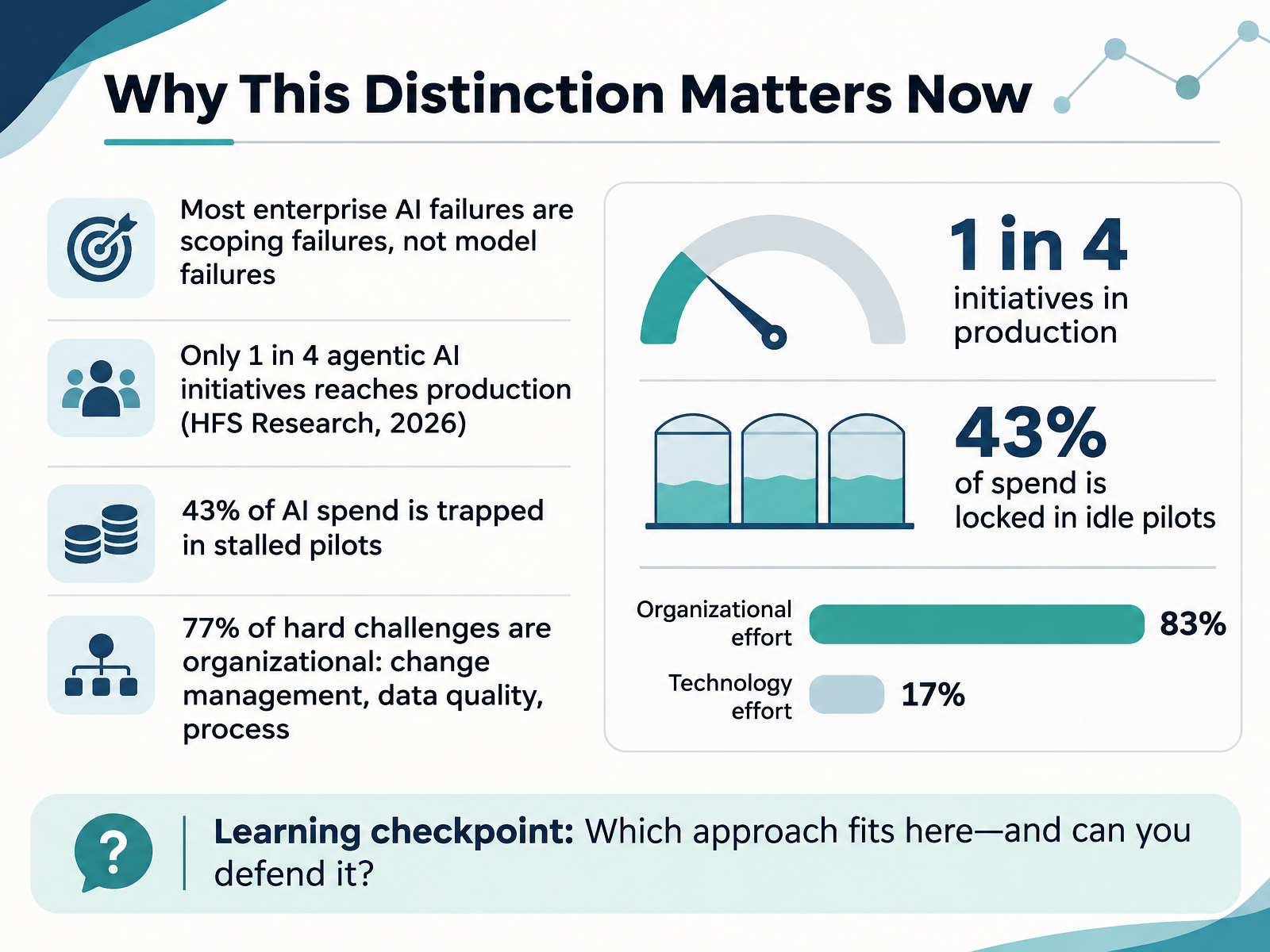
- 02Why This Distinction Matters NowLet's start with why this distinction matters right now. Here is the headline. Most enterprise AI failures are scoping failures, not model failures. The technology usually works. The question is whether you chose the right problem and the right approach for it. The data backs this up. According to HFS Research in 2026, only one in four agentic AI initiatives reaches production. And forty-three percent of AI spend sits trapped in stalled pilots. Think of your own roadmap. How many experiments are still waiting for a decision? Now look at what actually blocks progress. Seventy-seven percent of the hardest challenges are organizational. Change management, data quality, and process redesign. In contrast, model quality is rarely the issue. So here is the practical takeaway. Before your team invests, ask two questions. Which approach fits this problem, machine learning or generative AI? And can you defend that choice to your leadership? Keep that checkpoint in mind as we go. Next, we'll build the plain-language foundations for machine learning, deep learning, and generative AI.
 hfsresearch.comtechtarget.combain.com+22 min
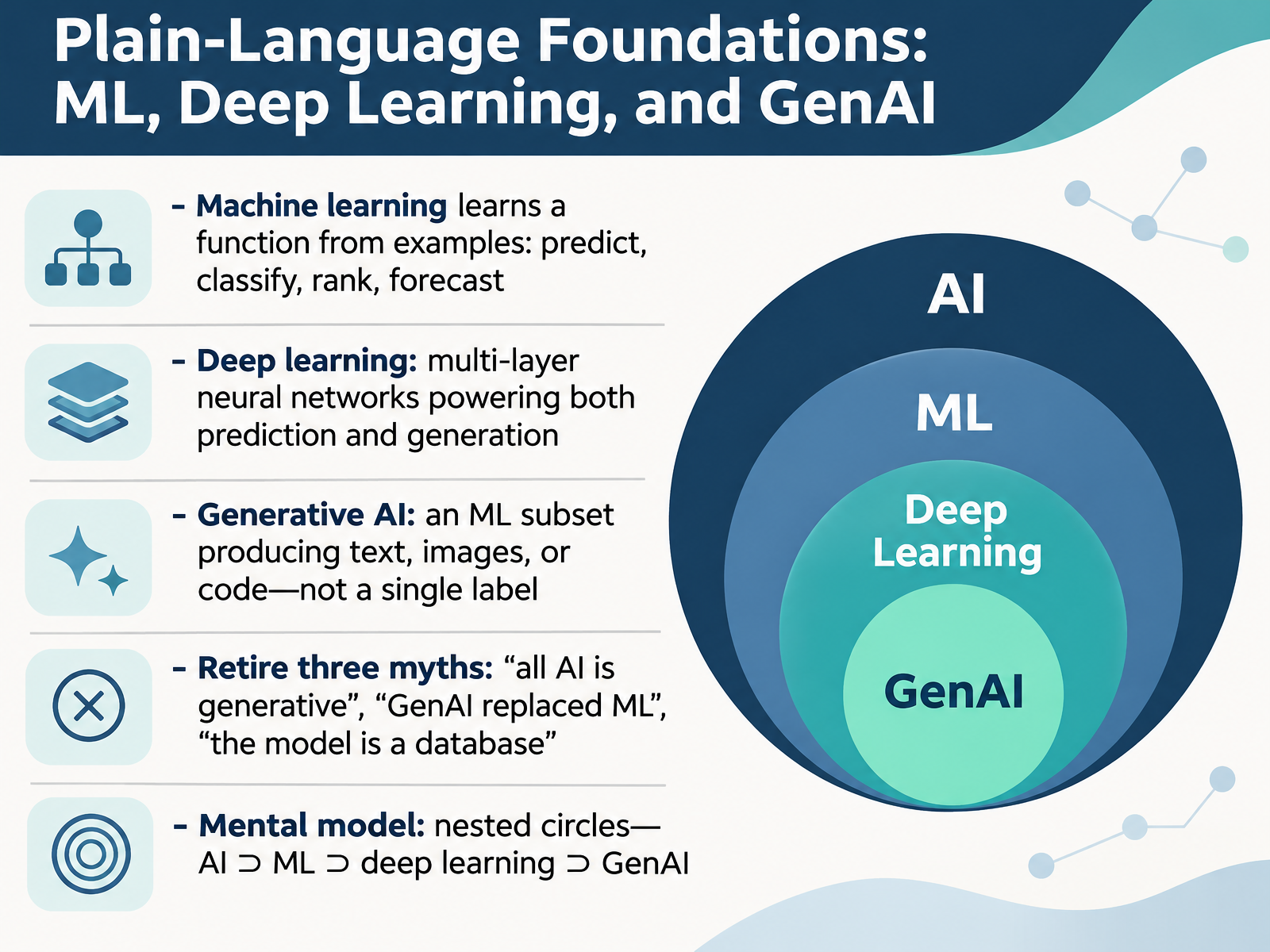
- 03Plain-Language Foundations: ML, Deep Learning, and GenAINow let's build some plain-language foundations. First, machine learning learns a function from examples. Show it historical data, and it predicts a number, classifies an item, ranks options, or forecasts a trend. Think of a bank scoring loan applications. Deep learning is a family of machine learning using multi-layer neural networks. It powers both prediction and generation. Generative AI sits inside machine learning too, but its output is text, images, or code, not a single label. Here is a simple mental model. Picture nested circles. Artificial intelligence contains machine learning, machine learning contains deep learning, and generative AI sits within that. And please retire three myths. All AI is not generative. Generative AI did not replace machine learning. And the model is not a database. So in your next product discussion, ask which circle your feature actually lives in before you name the technology. Next, we'll look at how machine learning works, through prediction and classification.
 ischool.syracuse.eduarxiv.orgarxiv.org+22 min
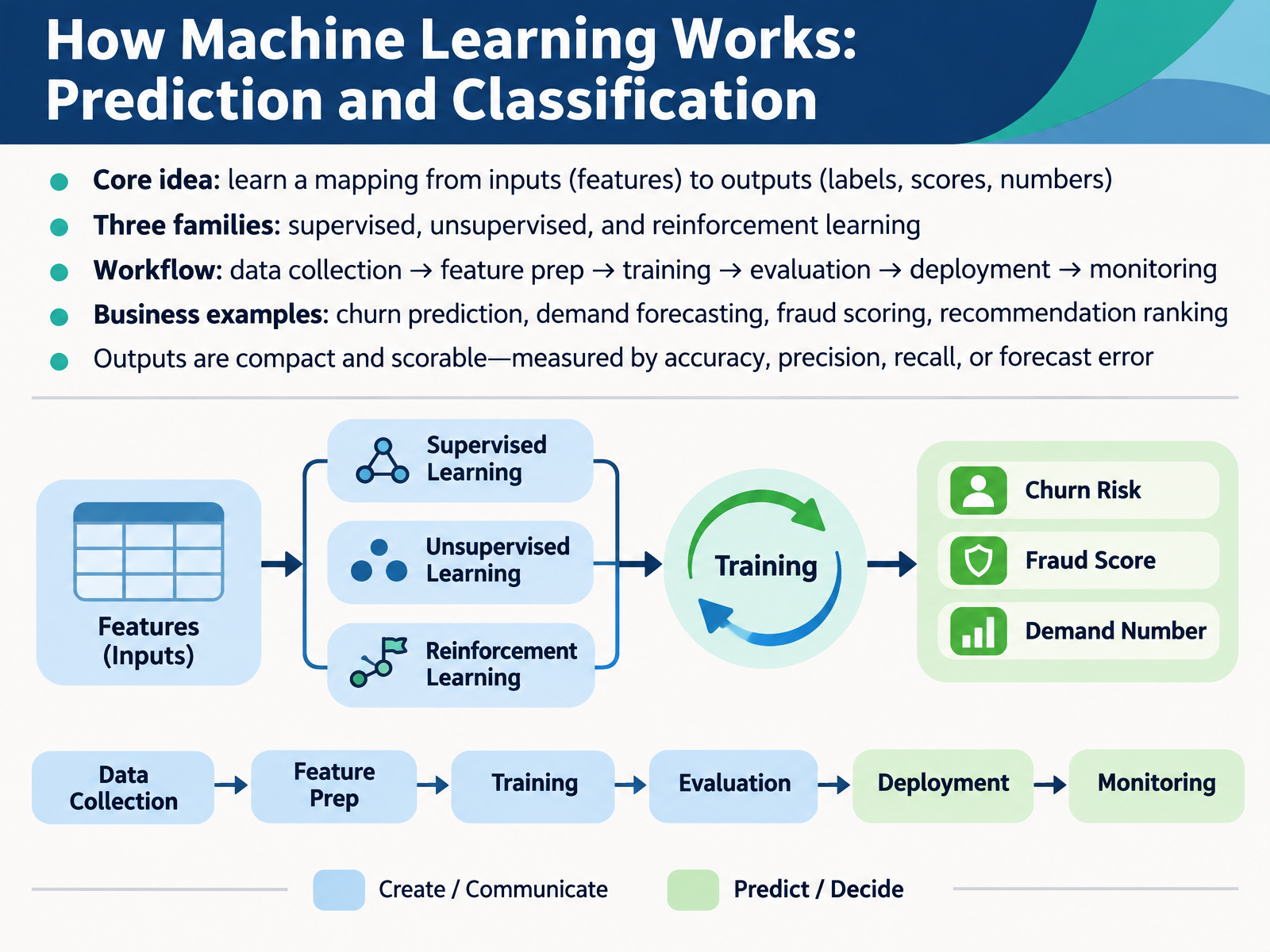
- 04How Machine Learning Works: Prediction and ClassificationNow let's look at how machine learning actually works. The core idea is simple: the model learns a mapping from inputs we call features to outputs we call labels, scores, or numbers. For example, features might be a customer's usage and billing history, and the output might be a churn score. There are three families. Supervised learning learns from labeled examples. Unsupervised learning finds patterns in unlabeled data. And reinforcement learning learns through trial and reward. The workflow follows a steady path: collect data, prepare features, train, evaluate, deploy, and then monitor. Business examples are everywhere. Churn prediction, demand forecasting, fraud scoring, and recommendation ranking. Notice the outputs here are compact and scorable. That is different from generated text or images. Instead, you measure them with accuracy, precision, recall, or forecast error. Here is the practical takeaway. Before your team starts any machine learning project, name the output you want to score, and pick the metric you will use to judge it. That single decision shapes your data, your model, and how you monitor it in production. Next, we will see how generative AI works, from next-token prediction to content.
 hfsresearch.comtechtarget.combain.com+22 min
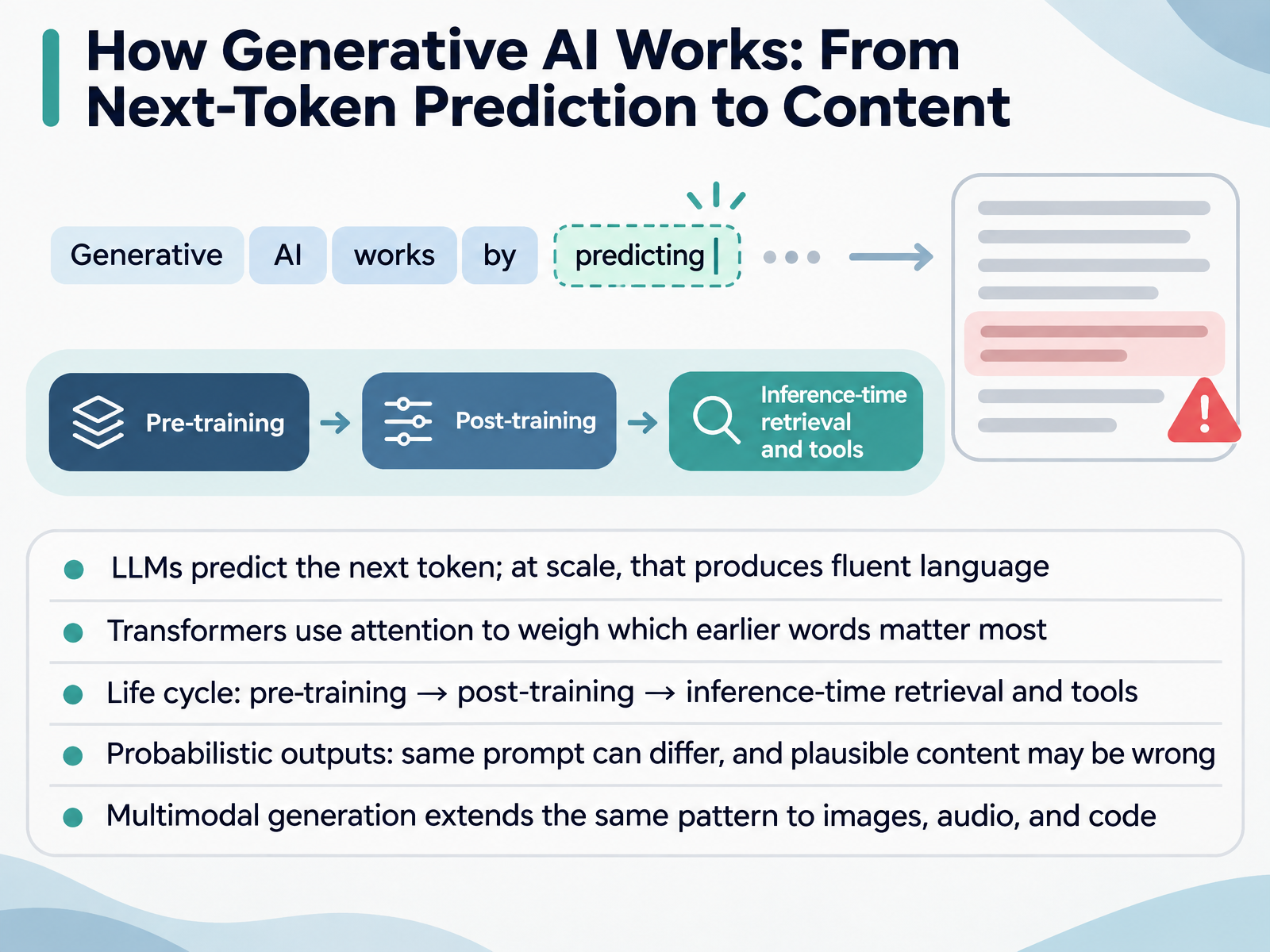
- 05How Generative AI Works: From Next-Token Prediction to ContentNow let's look inside the engine and see how generative AI actually produces content. At its core, a large language model predicts the next token, a word or word fragment, and at scale that one repeated step produces fluent language. The transformer architecture uses attention to weigh which earlier words matter most, so the word it in a long sentence connects to the right noun. Here is the life cycle. First, pre-training builds a base model from huge amounts of text. Second, post-training adapts it to follow instructions and human preferences. Third, inference-time retrieval and tools let it look things up while answering. And because the output is probabilistic, the same prompt can produce different answers, and plausible content may still be wrong. Multimodal generation extends the same pattern to images, audio, and code. Here is the practical takeaway for your team. Treat every generated output as a draft that needs verification, and build review steps into your workflow before anything reaches a customer. Next, we'll look at the three main levers for shaping model behavior: prompting, retrieval-augmented generation, and fine-tuning.
 ischool.syracuse.eduarxiv.orgarxiv.org+22 min
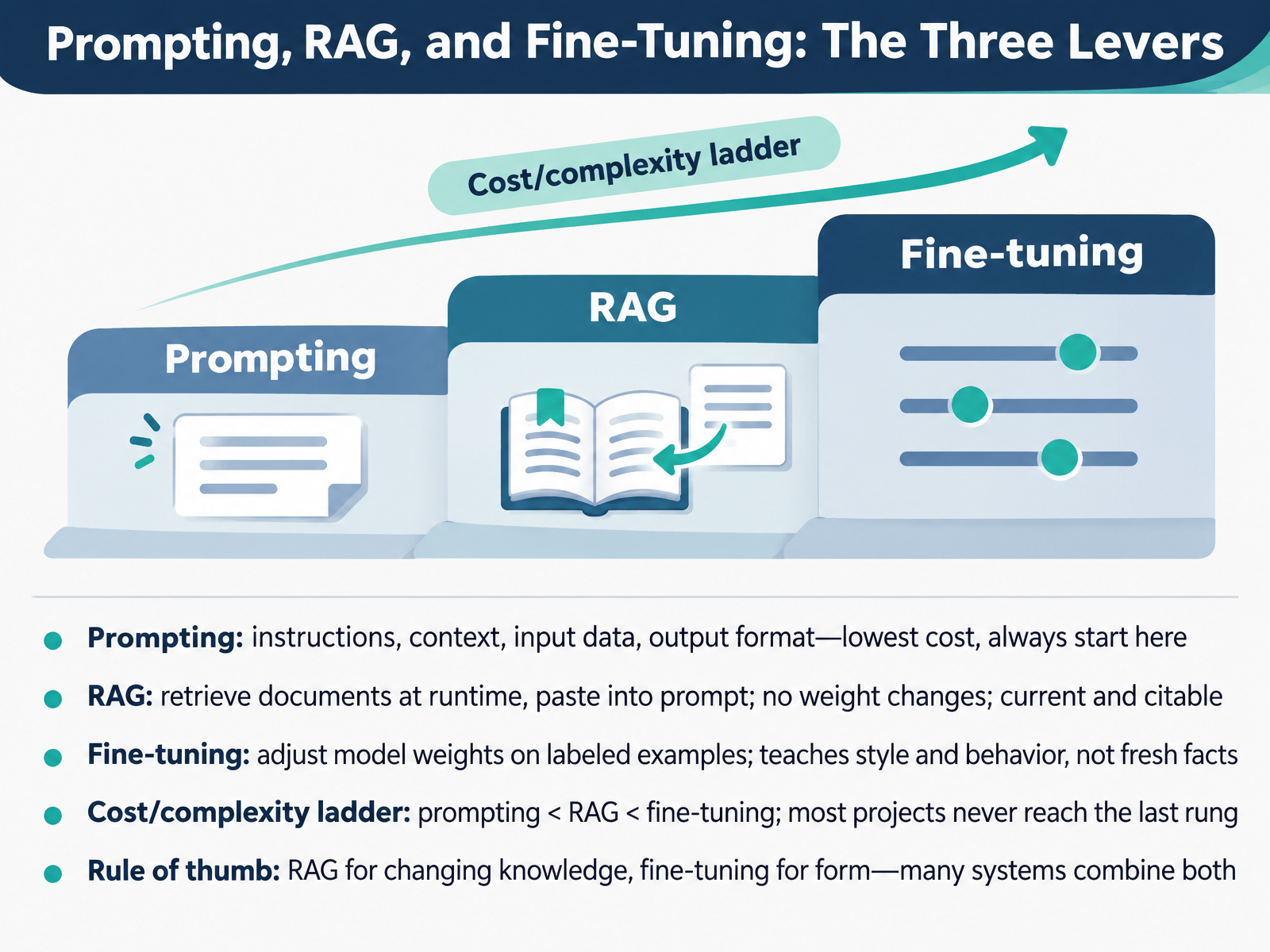
- 06Prompting, RAG, and Fine-Tuning: The Three LeversNow let's look at your three practical levers: prompting, retrieval, and fine-tuning. Prompting means giving clear instructions, context, input data, and an output format. It is the lowest cost option, and you should almost always start there. In contrast, retrieval, or RAG, fetches documents at runtime and places them into the prompt. The model's weights stay unchanged, so answers can be current and citable. Fine-tuning goes further. It adjusts the model's weights using labeled examples. That teaches style and behavior, not fresh facts. Think of it as a ladder: prompting is cheapest, then RAG, then fine-tuning. Most projects never reach the last rung. So the rule of thumb is simple. Use RAG for changing knowledge, and fine-tuning for form. Many systems combine both. Here is the practical takeaway for your team: before requesting a custom model, prove the use case with prompting and retrieval first. Next, we will compare machine learning and generative AI side by side.
 ischool.syracuse.eduarxiv.orgarxiv.org+22 min
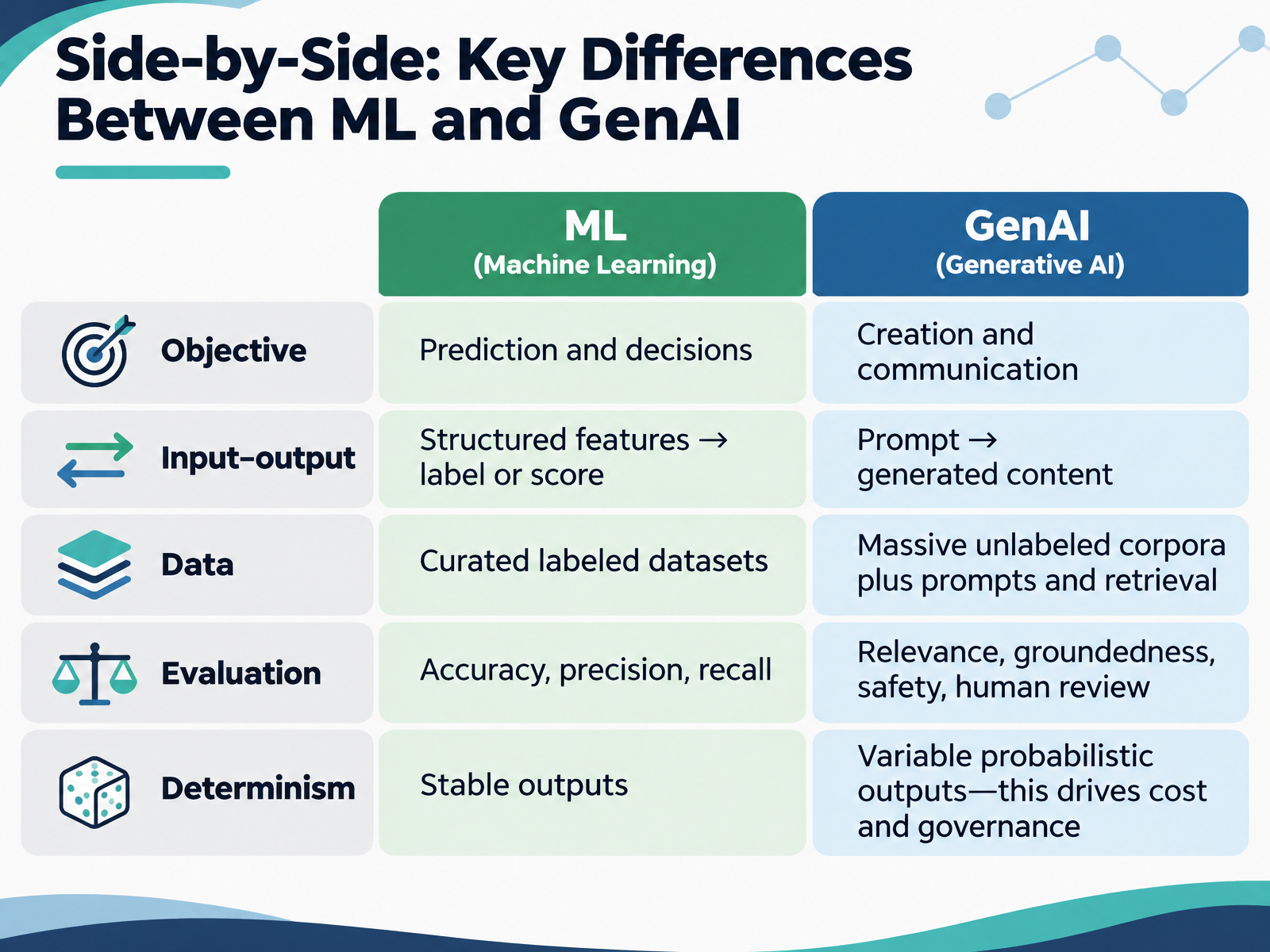
- 07Side-by-Side: Key Differences Between ML and GenAILet's make the contrast concrete by walking through the five differences that matter most in daily work. First, the objective. Traditional machine learning predicts and decides. Think of a churn model that scores a customer as likely to leave. Generative AI, in contrast, creates and communicates. Think of a draft email explaining a retention offer. Second, input and output. Machine learning usually takes structured features and returns a label or a score. Generative AI takes a prompt and returns generated content. Third, data. Machine learning leans on curated, labeled datasets. Generative AI relies on massive unlabeled text, plus prompts and retrieved documents. Fourth, evaluation. Prediction models are judged on accuracy, precision, and recall. Generated content is judged on relevance, groundedness, safety, and human review. Fifth, determinism. Machine learning outputs tend to be stable. Generative outputs are variable and probabilistic. Here is the practical takeaway. So before you pick a tool, ask whether your task is a decision or a communication. That single question settles most early design choices. Next, let's look at cost and operational tradeoffs.
 ischool.syracuse.eduarxiv.orgarxiv.org+22 min
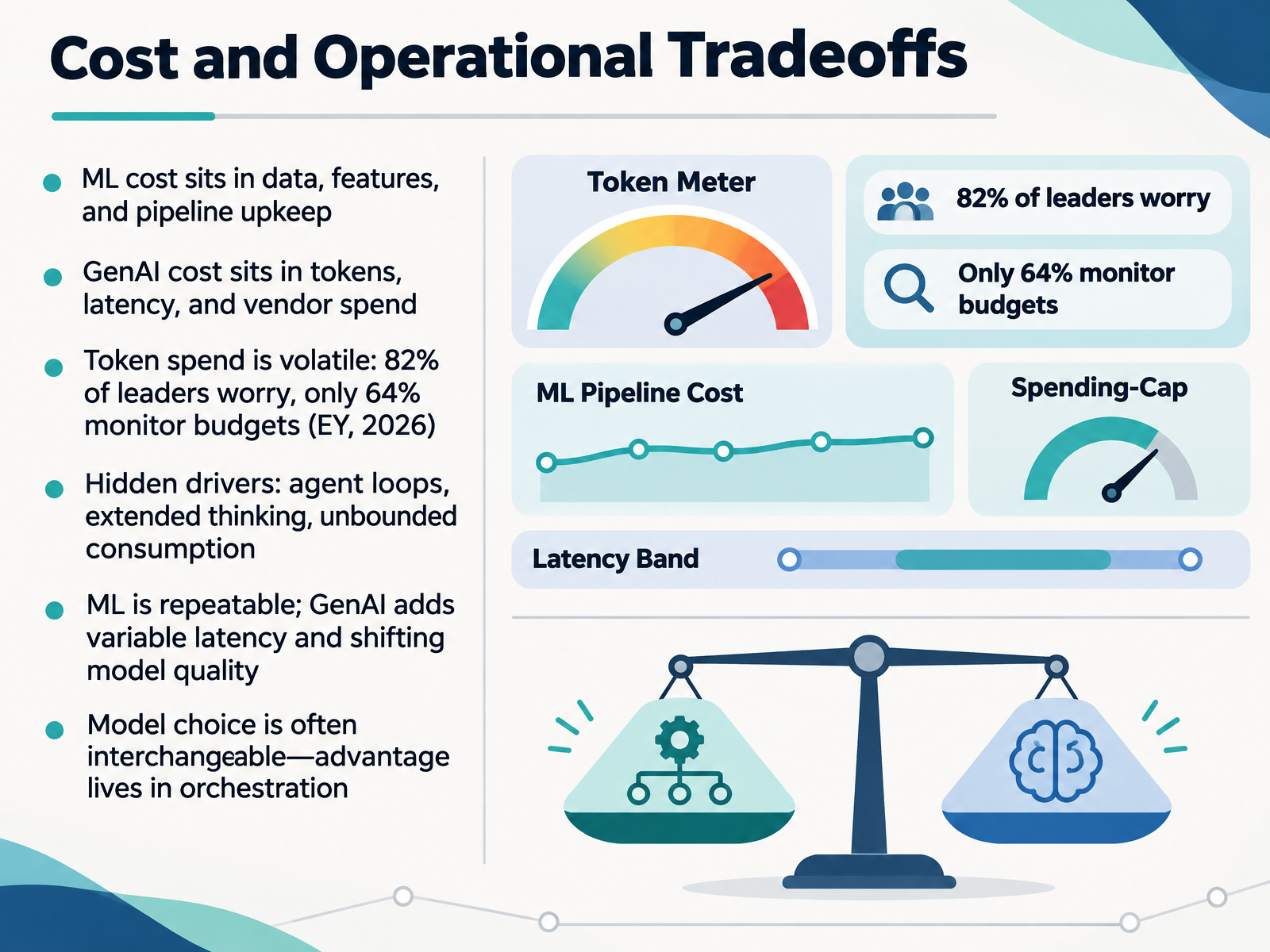
- 08Cost and Operational TradeoffsNow let's talk about cost and operational tradeoffs, because the bill for these two technologies behaves very differently. First, traditional machine learning cost sits mostly in data, features, and pipeline upkeep. You pay to clean data, build features, and keep the pipeline running month after month. It is fairly predictable. In contrast, generative AI cost sits in tokens, latency, and vendor spend. Every request consumes tokens, and those costs scale with usage. Here is the concern. Token spend is volatile. According to an E Y survey from twenty twenty six, eighty two percent of leaders worry about it, but only sixty four percent actually monitor budgets. The hidden drivers are agent loops, extended thinking, and unbounded consumption. Watch for agents that keep retrying, or users who leave a process running overnight. Traditional machine learning is repeatable. Generative AI adds variable latency and shifting model quality, so the same prompt can behave differently next month. And one useful finding, model choice is often interchangeable. In one study, forty two percent of implementations found models fully interchangeable. The durable advantage lives in orchestration, the layer that routes, checks, and governs requests. So here is your practical takeaway. Put a usage budget and monitoring on every generative AI feature before launch, and treat orchestration as the real investment. That naturally leads us into the next topic, risk, safety, and governance tradeoffs.
 hfsresearch.comtechtarget.combain.com+22 min
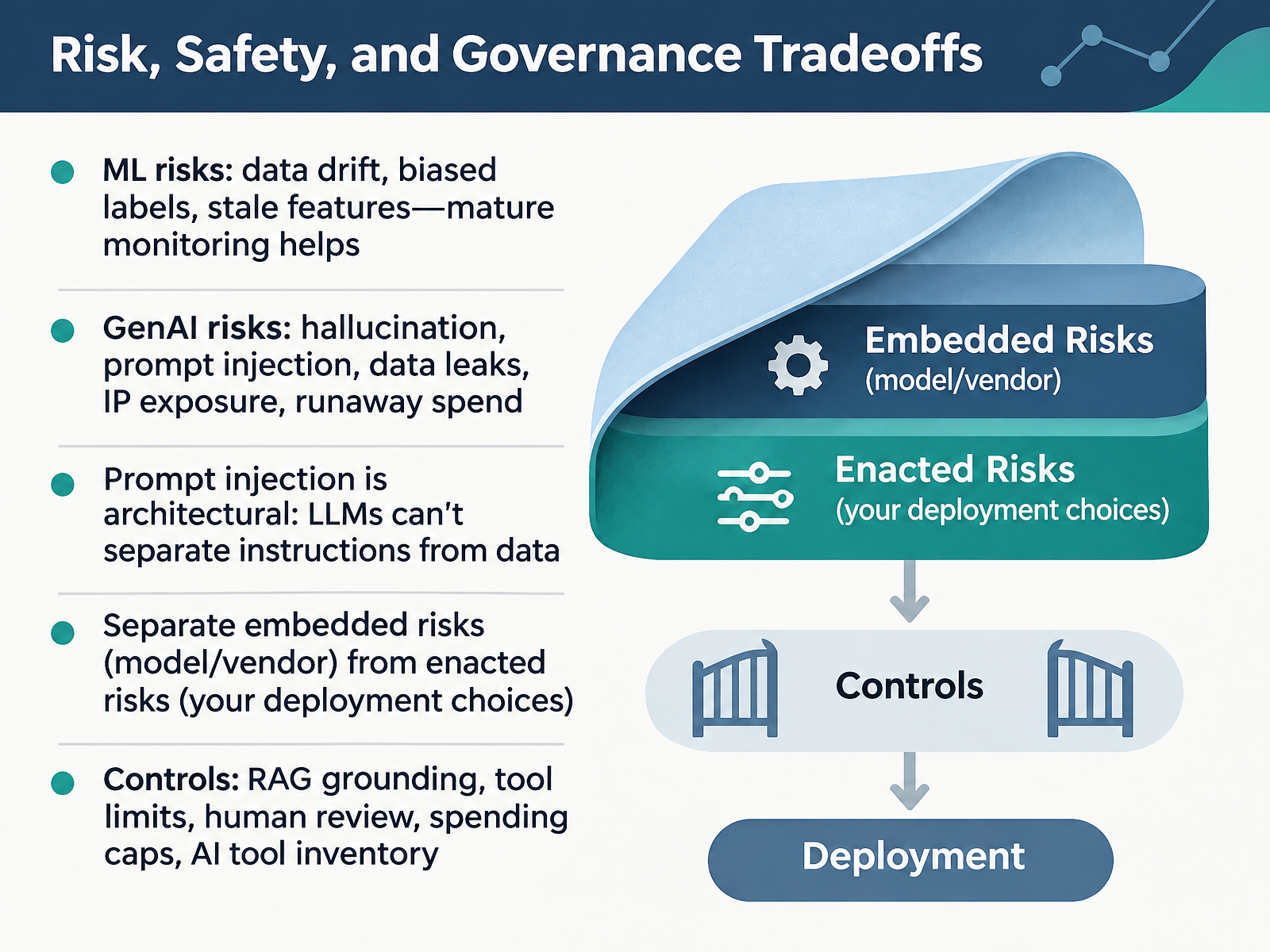
- 09Risk, Safety, and Governance TradeoffsLet's turn to risk, safety, and governance tradeoffs. This is where we stop treating these technologies as one category and start separating their failure modes. First, machine learning risks. These are familiar problems. Data drift, biased labels, and stale features can quietly degrade a model over time. The good news is that mature monitoring and retraining processes catch most of them. You likely already have those controls in place.
In contrast, generative AI brings a different risk profile. Hallucination, prompt injection, data leaks, intellectual property exposure, and runaway spend are harder to detect. Here is the key distinction. Prompt injection is architectural. A language model cannot reliably separate instructions from data, so untrusted text can become part of the command stream. You cannot prompt your way out of that.
A useful filter is to separate embedded risks from enacted risks. Embedded risks come from the model or vendor. Enacted risks come from your deployment choices. You can offset both with practical controls. Retrieval grounding, tool limits, human review, spending caps, and a simple AI tool inventory go a long way.
Here is the practical takeaway. For your next AI feature, write down which risks are embedded and which are enacted by your team. Then assign one control to each. Now, where does machine learning still win? Let's look at use cases.
 2 min
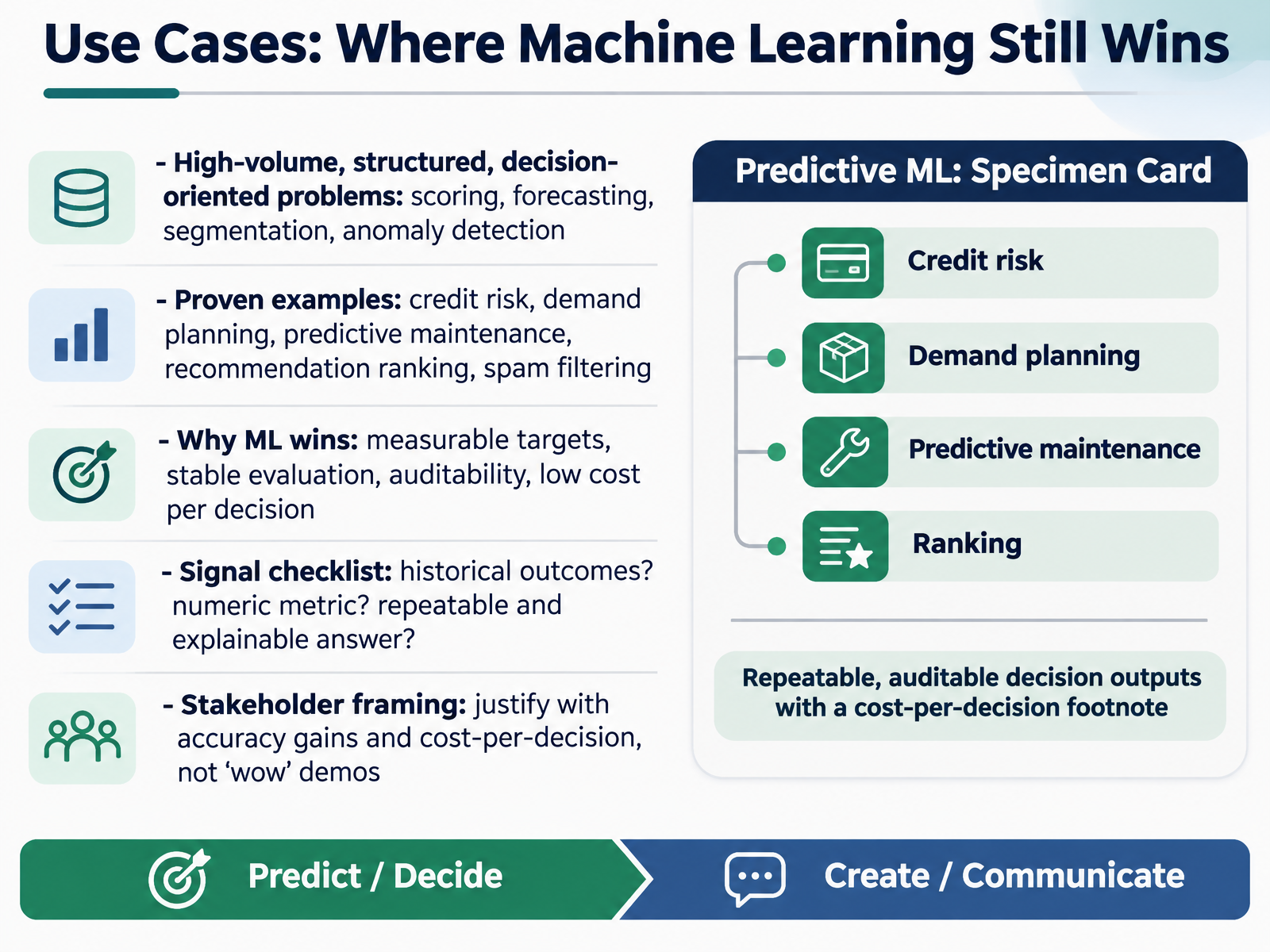
- 10Use Cases: Where Machine Learning Still WinsSo where does machine learning still clearly win? The answer is high-volume, structured, decision-oriented problems. Think credit risk scoring, demand forecasting, customer segmentation, and anomaly detection. Why does machine learning win here? Because the targets are measurable. You have stable evaluation, auditability, and a low cost per decision. Here is a simple signal checklist. Do you have historical outcomes? Is there a numeric metric to optimize? And can the answer be repeatable and explainable? If yes, machine learning is often the right tool. When you frame this for stakeholders, justify it with accuracy gains and cost per decision, not a wow demo. Your practical takeaway is this. For recurring, measurable decisions, build the business case in numbers, and reserve generative AI for the open-ended work that comes next.
 hfsresearch.comtechtarget.combain.com+21 min
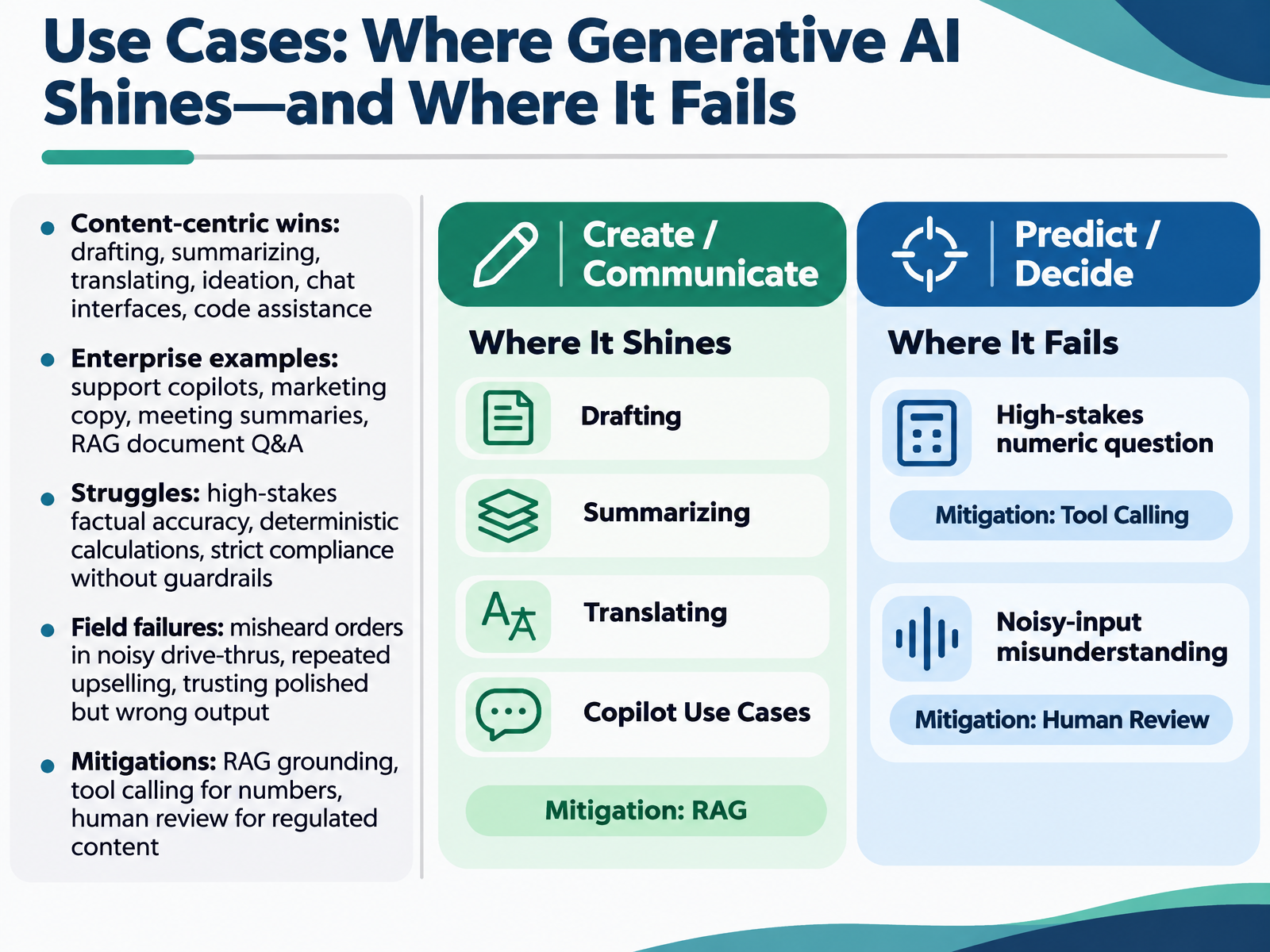
- 11Use Cases: Where Generative AI Shines—and Where It FailsSo let's get practical. Where does generative AI genuinely shine, and where does it still fail? First, the wins are content-centric. Drafting, summarizing, translating, brainstorming, chat interfaces, and code assistance. In your organization, that might look like a support copilot, marketing copy, meeting summaries, or question answering over your own documents with retrieval-augmented generation. Now, in contrast, generative AI struggles with high-stakes factual accuracy, deterministic calculations, and strict compliance without guardrails. We have seen voice ordering systems mishear orders in noisy drive-thrus and repeat upselling prompts. Teams also trust polished but wrong output. Here is the practical takeaway. Pair generative AI with retrieval grounding for facts, tool calling for numbers, and human review for regulated content. That combination turns a clever demo into a dependable workflow. Next, we will look at a decision framework for choosing an approach.
 hfsresearch.comtechtarget.combain.com+22 min
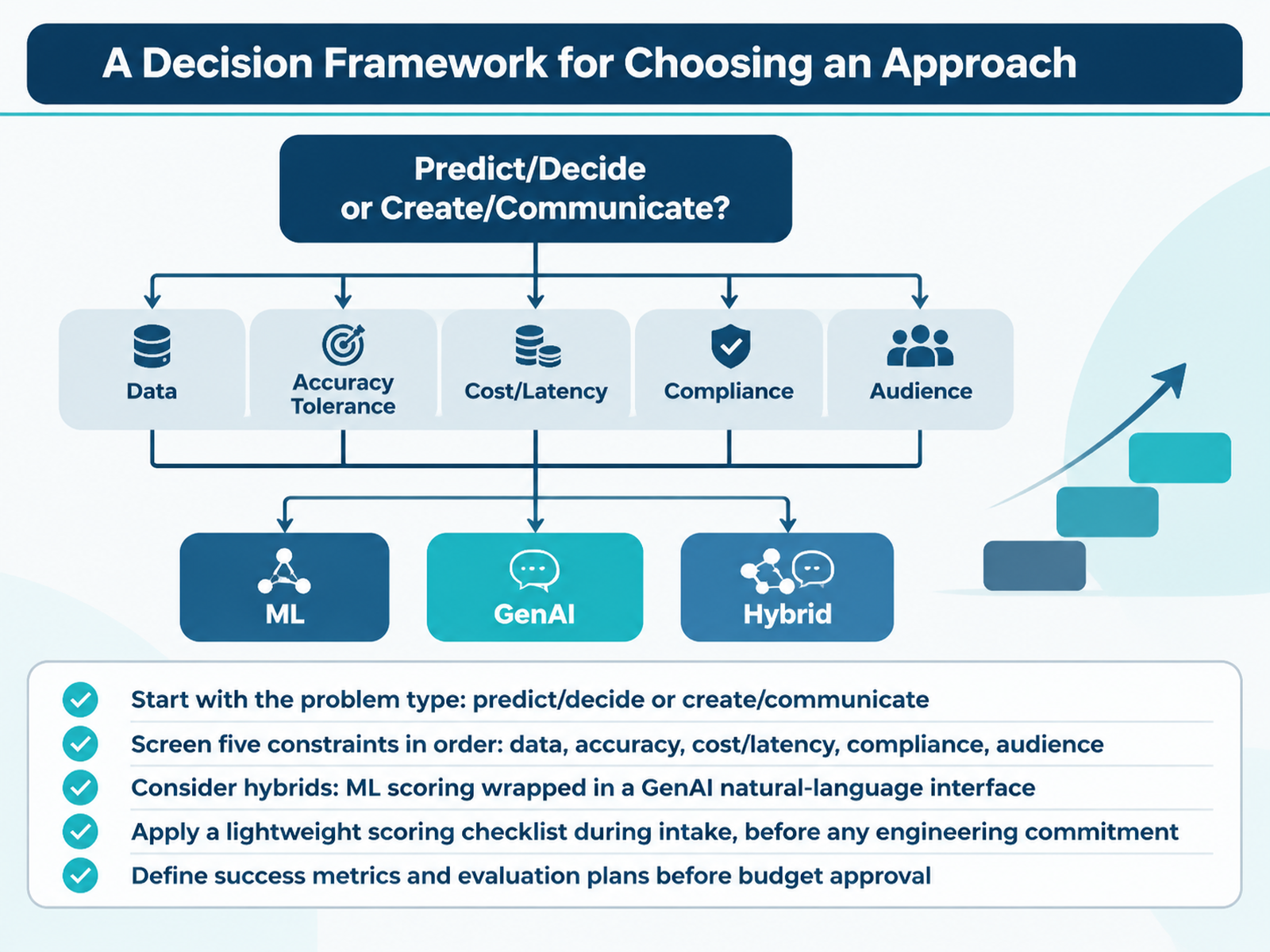
- 12A Decision Framework for Choosing an ApproachNow let's bring the last few slides together into a decision framework you can actually use. First, start with the problem type. Is this a predict and decide problem, like scoring a lead or flagging fraud? Or is it a create and communicate problem, like drafting responses or summarizing documents? That single question narrows your options fast. In contrast, if you skip it, teams often buy a generative tool for a prediction job. Next, screen five constraints in order: data, accuracy, cost and latency, compliance, and audience. For example, low tolerance for wrong answers points toward machine learning with tight evaluation. Here is the practical takeaway. Run a lightweight scoring checklist during intake, before any engineering commitment. And define success metrics and evaluation plans before budget approval. Sometimes the best answer is a hybrid, machine learning scoring wrapped in a generative natural language interface. With that framework in hand, let's move into our scenario clinic: M L, Gen A I, or hybrid?
 2 min
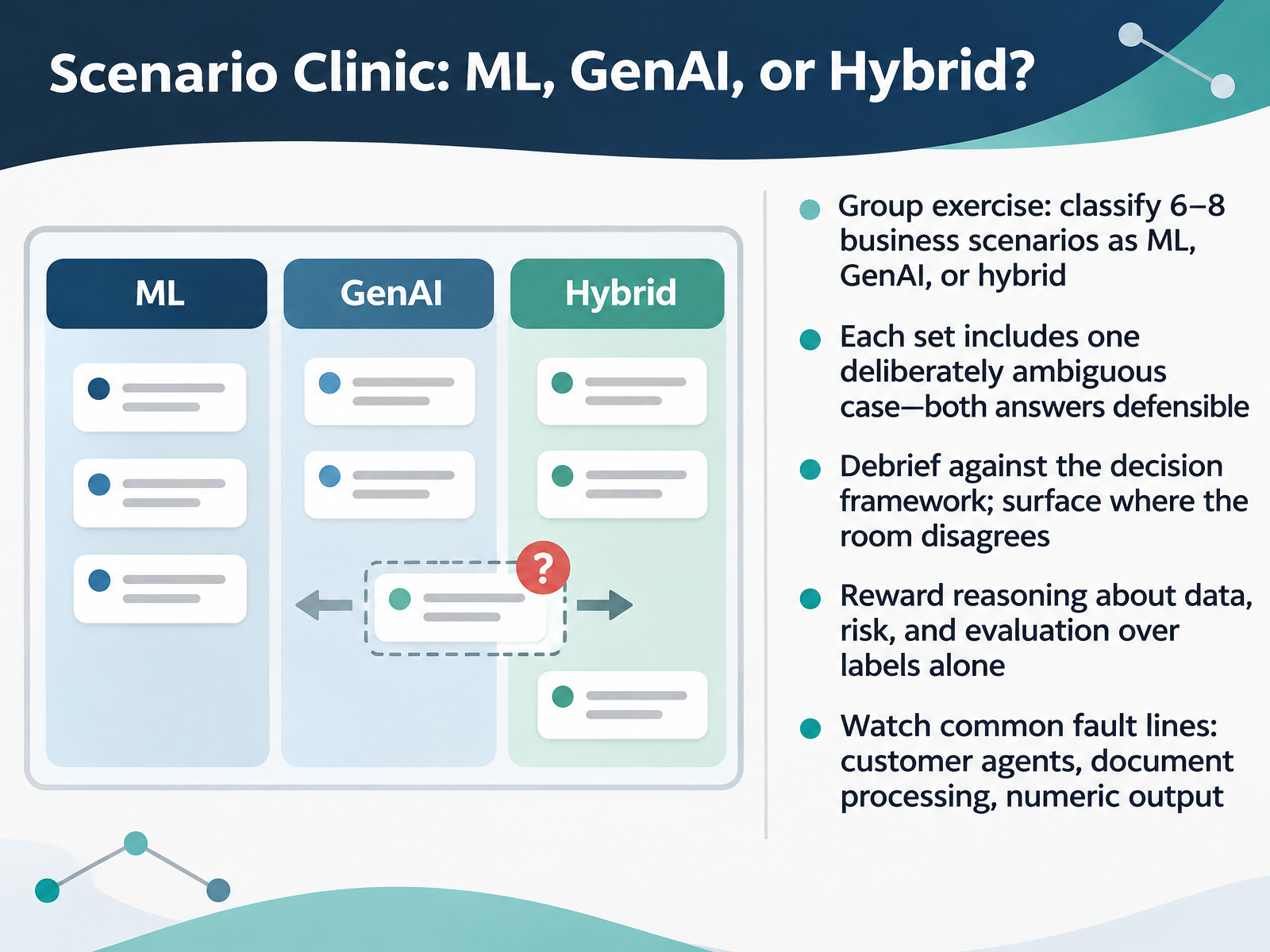
- 13Scenario Clinic: ML, GenAI, or Hybrid?Now let's put the framework to work with a scenario clinic. In small groups, you will classify six to eight business scenarios as machine learning, generative AI, or hybrid. Here is the first instruction. One of those scenarios is deliberately ambiguous. Both answers are defensible, and that is the point. In the debrief, we test each answer against the decision framework, and we surface where the room disagrees. Customer support agents, document processing, and numeric outputs are the usual fault lines, so listen for them. Second, reward reasoning over labels. Ask three questions. What data does this need? What is the risk if it is wrong? How would you evaluate it? A label without those answers is just a guess. Picture a support agent that drafts replies, retrieves policy, and applies refund rules. That is hybrid, and the reasoning is what matters. Here is the practical takeaway. Pick one scenario from today, write down its data, risk, and evaluation needs, and bring that one-page note to your next team planning session. That note will help your team choose between machine learning and generative AI with evidence rather than enthusiasm. In the next section, we will pull the key takeaways and next steps together.
 hfsresearch.comtechtarget.combain.com+22 min
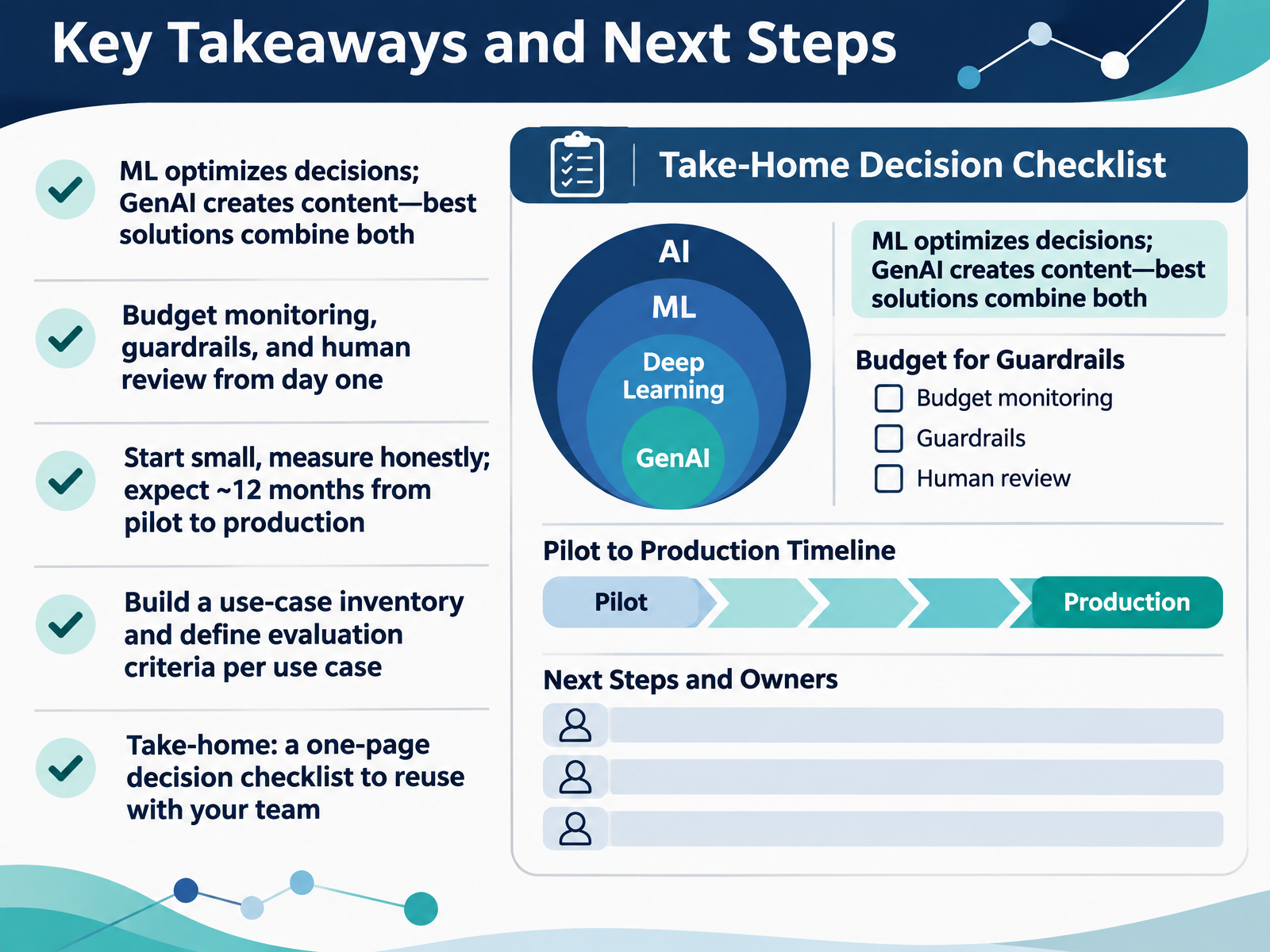
- 14Key Takeaways and Next StepsLet's bring this together. Here is the practical takeaway. Machine learning optimizes decisions. Generative AI creates content. The best solutions combine both. So budget monitoring, guardrails, and human review belong in place from day one, not after launch. And start small, measure honestly. Plan for about twelve months from pilot to production, because that is the realistic average. Next, build a use-case inventory, and define evaluation criteria for each use case before you build. That keeps your team honest. Your take-home is a one-page decision checklist you can reuse with your team on your very next AI proposal. Thank you for joining me through this course. You now have a clearer map of where machine learning and generative AI each fit. Go apply it, ask better questions, and start small with confidence. You've got this.
 hfsresearch.comtechtarget.combain.com+21 min
Take the deck with you
Download this course as a file — free, no sign-up needed.
- PDF handoutEvery slide page, ready to print or share.15 pages · 3.6 MBDownload
- Narrated PowerPointThe deck that presents itself — every slide carries the digital human's narration video.15 pages · 15.1 MBDownload
- PowerPoint slidesThe full deck as a .pptx — open it in PowerPoint, Keynote, or Google Slides.15 pages · 3.5 MBDownload
Free to use in your own training — please keep the PersonWise credit page at the end.
Have your own deck? Turn it into a course
Sources consulted
Web sources consulted while building this course.
- Agentic AI governance and real-time trust | EY - US — ey.com
- Generative AI governance framework: building responsible AI systems — dataiku.com
- AI governance: managing AI costs and usage | EY - US — ey.com
- Mapping the Generative AI Risk Space | MIT CISR — cisr.mit.edu
- Managing generative AI risks: PwC — pwc.com
- The agentic AI production gap: Five learnings enterprises can take to close it - HFS Research — hfsresearch.com
- AI deployments gone wrong: The fallout and lessons learned | TechTarget — techtarget.com
- Executive Survey: AI Moves from Pilots to Production | Bain & Company — bain.com
- EnterpriseAIPlaybook_PereiraGraylinBrynjolfsson — digitaleconomy.stanford.edu
- Inside the AI experimentation trenches — cfobrew.com
- How to Learn Large Language Models (LLMs) Step by Step — ischool.syracuse.edu
- Large Language Models: A Plain-Language Overview for Engineers — arxiv.org
- An Introduction to Large Language Models for Scientists and Professionals — arxiv.org
- Prompt Engineering vs. RAG vs. Fine-Tuning: A Beginner’s Guide on AWS | AWS Builder Center — builder.aws.com
- LLM Roadmap 2026: How to Learn Large Language Models from Scratch - Scaler — scaler.com